Historical Holdings: An Overview
Special Collections and College Archives (SPARC) in the Fashion Institute of Technology (FIT) Gladys Marcus Library is a highly-specialized repository of rare and primary source research materials related to the fields of fashion and many other creative industries. As such, SPARC is ‘much more than the rare book and designer archives unit of the FIT Library.’Footnote 1 It is a rich resource for the fashion industry and scholars of design history, certainly including and not limited to students and faculty in FIT's own design-centric graduate and undergraduate programs.
There are more than 3,200 monograph titles, representing well over 10,000 volumes, in SPARC and each one has been vetted for its rarity or importance in the fields of fashion, textiles, costume, interior design, and/or other creative subject areas. In total, the collection includes approximately 5,000 linear feet of monographs, periodicals, oral histories, and designer scrapbooks as well as over 370 unique manuscript collections. Within those manuscript collections, there are more than 500,000 original works of art on paper, many of which are original designer sketches. ‘The manuscript collections are especially strong in their documentation of American fashion design from the late 19th century’Footnote 2 through the 1980s; the history of New York City's own Seventh Avenue (also called Fashion Avenue); and the city's Garment District.
The manuscript collections are unique to SPARC and provide countless points of discovery for original research. They date from the 1880s starting with the Whittingham and Humphreys sketch collection, which dates from 1888–1914. Whittingham and Humphreys was a ‘late 19th-century British women's dressmaker located at 14 Onslow Place, South Kensington. Records show Frederick George Humphreys was associated with the firm.’Footnote 3 This collection consists of 32 bound volumes of roughly 3200 fashion illustrations; the illustrations are in pencil and/or ink. Some of the illustrations have suggested textile materials and colours noted. ‘The firm is mentioned in the guidebook London of today: an illustrated handbook of the season (1890) by Charles Eyre Pascoe and the Victoria and Albert Museum owns one gown produced by the firm from circa 1895. Notations in some of the bound volumes indicate that at one time the collection belonged to the Ashmolean Museum of Art and Archaeology at the University of Oxford.’Footnote 4 While the illustrations are quite delicate, they are still spectacular examples of the fashion of the day.
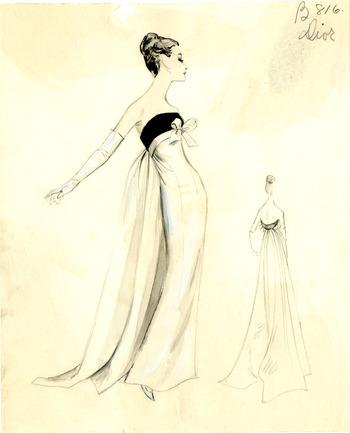
One of the most requested and often accessed manuscript collections is the Bergdorf Goodman Custom Salon sketches, which date from the late 1930s to 1969. This collection numbers approximately 10,000 sketches. The Custom Salon is where privileged customers would indulge in a demi-couture experience of sorts. While the clothes were not haute couture, they were designed by and patterned at the direction of couture houses including and not limited to Chanel, Dior, Givenchy, Lanvin, and many others. Essentially, the couture houses would send models of their latest garments to the Bergdorf Goodman Custom Salon, which would then license them for reproduction. Pattern makers would make the garment patterns and sketch artists would document each garment in beautiful detail. Salon employees would take customers’ specific measurements so that each garment could be made especially for each individual. As special as they are, the sketches were working documents, meant to record the Salon's business activity and not meant for publication or distribution. We are fortunate not only that the sketches survive, but also that they are in our possession thanks to the generous donation of Andrew Goodman, former president of Bergdorf Goodman and former FIT Trustee (Figure 1.).
Bergdorf Goodman Custom Salon sketches, 1930–1969.

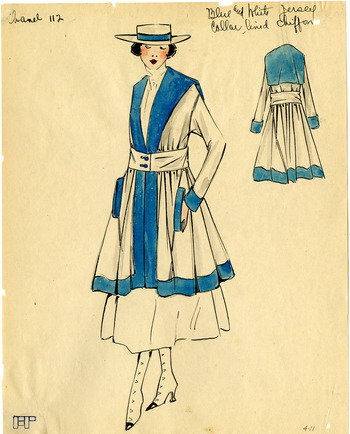
Another manuscript collection is the Max Meyer sketch collection; this collection dates from 1915 to 1929. Meyer was a principal in Abraham Beller and Company, which manufactured women's cloaks and suits in New York City. Beller was allowed almost unheard of access to Paris couture houses’ creations where direct copies were documented via sketch artists. The charming sketches number around 9,000 pieces and are especially important in their documentation of Paris fashion during World War I; couture houses represented include Chanel, Molyneux, Poiret and Worth. Meyer left the trade to become a maverick in transforming fashion industry-related education in New York State. He ultimately became one of the founding fathers of FIT along with Mortimer Ritter (Figure 2.).
Max Meyer sketch collection, 1915–1929.

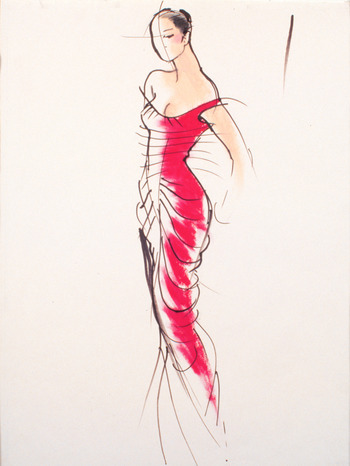
The best of the best in fashion illustration is represented in the Frances Neady collection of original fashion illustrations. These date from 1913 to the present day and the collection numbers almost 400 pieces. This collection was conceived in honour of FIT fashion illustration professor Frances Neady and reflects her stringent criteria and standards for fine fashion illustration. Of particular note are the female illustrators represented in the collection including Dorothy Hood, Esther Larson, and Esta Nesbitt. Other notable illustrators include Antonio Lopez, Kenneth Paul Block, George Stavrinos, and Tod Draz (Figure 3.).
Antonio Lopez illustration (circa 1982).

In the last eight years, the manuscript collections have almost doubled in volume, measuring a total of about 2000 linear feet.
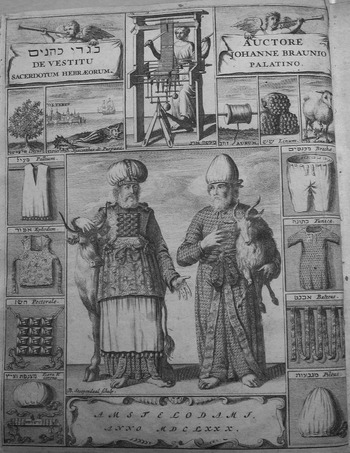
The oldest book in the collection is Vestitus sacerdotum Hebraeorum by Johannes Braun (1638–1708); it was published in Amsterdam in 1680. Vestitus is written in four languages, mostly Latin, with some references in Arabic, Greek, and Hebrew. The book is comprised of two volumes; together they provide a comprehensive review of ‘Jewish garments worn by priests at the Temple of Jerusalem in what is referred to as Ancient Israel.’Footnote 5 In his descriptions, Braun highlights the specific garments, the materials from which they were made, biblical citations for the descriptions, and the detailed accounting of the origin and use of the garments.Footnote 6 The volumes also contain eighteen intricate engravings that have been attributed to Bastiaan Stoopendaal. Keren Ben-Horin, a SPARC graduate student intern, was assigned the project of translating some of the Hebrew references and making an inventory of the illustrations in the nearly 1000 page volume; these activities make the volume's contents much more discoverable (Figure 4.).
Table of Contents, Vestitus sacerdotum Hebraeorum, 1680.

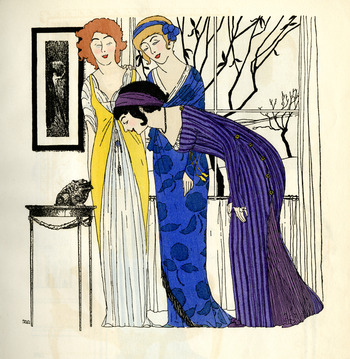
Two particularly important items in the monograph collection are Les robes de Paul Poiret (1908) by Paul Iribe and Les choses de Paul Poiret (1911) by Georges LePape. As their titles suggest, these monographs cover Poiret's 1908 dress collection and aspects of the 1911 accoutrements collection respectively. The deluxe volumes are both executed in the pochoir method of illustration. “Pochior” is French for “stencil” and the method involves the hand application of colour to a stencil pattern. The result is an unusually highly saturated rendering of brilliant colour and distinctive line, much like the fashions of the day. Les robes was produced in a very limited run of about 250 and Les choses was produced in a limited run of about 1000; very few of either title survive today for public consultation (Figure 5.).
Les robes de Paul Poiret, 1908.

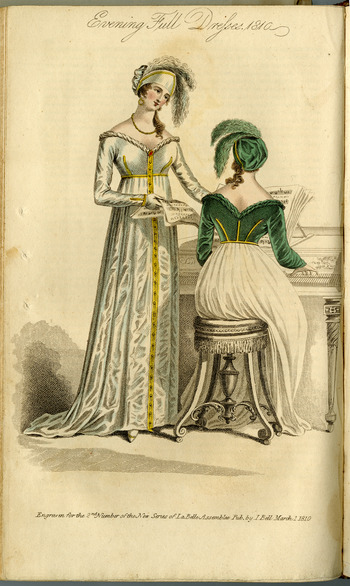
In addition to the manuscript collections and monographs, SPARC's holdings include approximately 600 periodicals titles; these date from 1806 to the current day, beginning with La belle assemblée (1806–1832) (Figure 6.). Around 1750, the modern fashion journal made its debut. These journals were directed toward women readers and regularly included hand-coloured fashion plates; the journals fuelled an increasing interest for a periodical literature which catered to an audience that was ever-expanding. The swift changes in French fashion were documented in early titles and kept readers abreast of the latest styles to emulate. One such title, Pierre de La Mésangère's Journal des dames et des modes [1797–1839 (and 1912–1914)] ‘was the most influential fashion magazine of its time; its fashion plates were reprinted in numerous publications throughout Europe.’Footnote 7 La belle assemblée is ‘characterized by a high standard of typography, illustration and layout. Fashion plates from such periodicals provide an excellent source of early nineteenth-century period imagery.’Footnote 8
La belle assemblee (1810).

By approximately 1850, vast improvements in the printing process together with the ever-increasing literacy rate led to the publication of many relatively inexpensive magazines for the mass market; as it would follow, the United States became a leader in the popular, illustrated magazine. These magazines were highly accessible, unlike the limited-edition Poiret volumes mentioned earlier, and contained articles of interest regarding a broad range of tastes; thus, the modern women's magazine was born. The most popular cover image for these magazines was that of the modern fashionable woman. She was a woman interested in self-improvement, education and sporting endeavours such as bicycling. Of the nearly 600 titles held by SPARC, notable titles include ‘Delineator (1873–1937), Godey's lady's book (1830–1898), Harper's bazaar (1867-), Ladies’ home journal (1883-), and American Vogue (1892-).’Footnote 9
The SPARC holdings also include 1,160 scrapbooks across 61 scrapbook collections. These include the nearly 500 Lord & Taylor marketing department scrapbooks, which date from the 1930s through the 1970s, as well as the B. Altman and Company scrapbooks, which date from 1887. With the addition of the Lord & Taylor books, the collection has grown about 38 percent in the last five years. These and other scrapbook collections chronicle the historical development of various retail establishments, mostly those in New York City, as well as the press for individual designers such as the American couturier Main Rousseau Bocher (1890–1976), also known as Mainbocher.
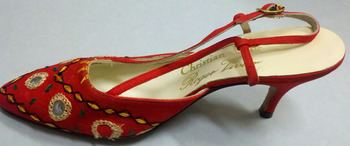
While it is not the main mission of the unit to collect artefacts, in 2010, the unit was gifted a large collection, which includes almost 30,000 shoe design sketches and about 500 individual shoe prototypes, some in pairs. The collection dates from the mid-1960s through 2009 and all elements are the creation of Arsho Baghsarian. Baghsarian worked for such firms as Christian Dior, Jerry Miller, and Stuart Weizman (Figure 7.).
Arsho Baghsarian design for Christian Dior, circa 1965.

Other artefacts are included in the Valerie Fuchs glove collection, which dates from 1962–1986. This collection consists of items Fuchs executed for or contributed to the Aris Glove Company. The collection ‘includes original pairs of gloves designed by Fuchs, many in their original packaging.’Footnote 10 Also included are glove patterns with hand-sewn samples, photographs, press clippings and correspondence; these diverse elements make it an especially rich archival collection.
A growing and vital part of the unit is the FIT institutional records or college archives. Included in the college archives are FIT yearbooks, course catalogues, charter documents, board of trustee meeting minutes and other materials documenting the history of the college and its myriad activities. Of special note is an audio-visual series of FIT-sponsored student fashion shows, a rich series of photographs from the FIT communications and external relations division, and the oral history collection of approximately 325 interviews including those of American fashion designers such as FIT alumnus Calvin Klein, American fashion publicists such as Eleanor Lambert and retail leaders such as Geraldine Stutz, former President of Henri Bendel.
SPARC not only houses analogue material; it also holds almost five terabytes of digital assets. Digital assets range from images created from our manuscript collections to those of building plans of the FIT campus. Our total assets increase every week as the unit satisfies digitization requests and executes digitization projects; there are born-digital holdings as well. About 2,500 assets are currently accessible to the public via the FIT Digital Image Library or FITDIL (https://fitdil.fitnyc.edu/announcements.aspx); this number increases every month and another 18,000 assets are poised for inclusion into FITDIL.
Also on the digital horizon is an effort to publish via the web all finding aids created within the unit; these guides are for navigating the information about manuscript collections as well as college archives series. Soon, the unit will launch its Access to Memory (AtoM) site; AtoM ‘is a web-based, open source application for standards-based archival description and access in a multilingual, multi-repository environment.’Footnote 11
New Dimensions: Reinvention through Renovation
The Gladys Marcus Library at FIT has been taking custody of material deemed “special” since the 1950s; one of the first acquisitions was the Lucile, Lady Duff Gordon collection (1915–1925). For most of its history, the SPARC unit was an operational part of the larger Research and Instructional Services (RIS) unit (formerly called Reference); in 2007, the unit became truly distinct from RIS to become the unit of Special Collections and College Archives.
From 1981 until February 2016, SPARC occupied a most inadequate space of up to 3,500 square feet on the fourth floor of the Gladys Marcus Library; the library is located in the Shirley Goodman Resource Center on the south-west corner of 7th Avenue and 27th Street, Manhattan, New York. The former space had no appropriate heating, ventilation and air conditioning (HVAC) controls and the shelving was woefully misaligned with the materials. Indeed, the environmental conditions were unsuitable given the value of the unit's vast and exquisite holdings.
In 2005, FIT Library Director Professor NJ Bradeen began to champion the case and mission of SPARC and to justify to the FIT Administration the need for a major renovation. In 2007, FIT President Dr. Joyce F. Brown and Prof. Bradeen began to discuss SPARC's special holdings and infrastructural needs with members of the United States Congress, New York state legislators, and New York City officials. With the help of Lisa Wager, FIT Director of Community and Government Relations, they were able to procure approximately two million dollars toward a renovation effort. The college is providing the balance of the construction budget, which is another approximately two million.
In February 2016, SPARC moved into a temporary location during the renovations, measuring approximately 2,500 square feet and still without proper HVAC and shelving. This ‘swing-space’ was located just feet away from the original unit footprint. All parties agreed that it would be best to keep the material on the premises if it could be accommodated. While the temporary space has had its challenges, it has provided for the unit to the effect that it could operate at almost 100% functionality during the renovation process.
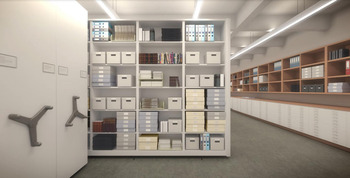
Samuel Anderson Architects (www.samuelanderson.com/) designed SPARC's new facility. The plans demonstrate state-of-the-art HVAC controls and security systems as well as efficient, manually-operated compact shelving. The new space will measure approximately 6,100 square feet with another 1,000 square feet dedicated to the mechanical room and its associated equipment. The images below are provided courtesy of Samuel Anderson Architects and Christopher Shelley (Figures 8, 9, 10.).
View of reception area, office spaces, and Reading Room.

View of compact shelving facility.

View of Reading Room and offices.

Conclusion
SPARC holdings are always rare, often unique, and have international significance. They are an important part of the intellectual capital of a unique institution of higher learning, the Fashion Institute of Technology-SUNY. The unit hosts an array of local, national, and international visitors, well over 300 a year. SPARC is open to researchers seven days a week including three evening appointment opportunities. More information can be found on the unit's website at www.fitnyc.edu/library/sparc/visit/index.php.
Over the last 8 years in my position as Head of SPARC, I've adopted a mantra which is a quote from The Beautiful Fall: Fashion, Genius, and Glorious Excess in 1970s Paris, Alicia Drake's recollection of Karl Lagerfeld and Yves Saint Laurent as they arrive in Paris as young designers; it reads: ‘Designers do not create in a vacuum; they need relentless stimulation, innovation, and objects of fascination to stir the mind.’Footnote 12
Without special objects of fascination, and new interpretations of them, to stir the minds of researchers, we risk stagnation and fail to strengthen the intellectual corpus of design studies. So, come and visit the Gladys Marcus Library's unit of Special Collections and College Archives; we would love to show you more.
Acknowledgements
A valuable partner in the renovation project was National Library Relocations, Inc.; it assisted the unit to move the holdings from the previous space to its temporary location. It will again move the collections from the temporary space to their permanent home in early 2017 (www.nlrbookmovers.com/index.php).
Another project partner, Vanguard Construction and Development Company, Inc., served as General Contractor and Project Management; its team members proved to be invaluable colleagues during every phase of development and renovation (vanguardcon.com/).