


In “Representation Rethought” (2009), Andrew Rehfeld claims that my earlier article in this review (Mansbridge Reference Mansbridge2003) produces confusing complexity.Footnote 1 In this response, I want to preserve the complexity, which I believe reflects reality, and try to clear up any confusion. In addition to responding to Rehfeld's criticisms, this article proposes a more relational and systemic conception of representation that extends the concepts of “gyroscopic” and “surrogate” representation. It proceeds in five sections.
First, I extend my argument on gyroscopic representation by underscoring the inadequacy of the Burkean trustee as an analytic tool for understanding representation today and by suggesting, as a replacement, the broader concept of a “selection model” of principal–agent relations to describe the relationship between representatives and constituents. Second, I argue that conceptual tools should be chosen for their empirical utility in particular contexts. On this basis I argue that although Rehfeld is correct that my concept of gyroscopic representation combines two logically separable features (self-reliant judgment and lowered responsiveness to sanction), these features seldom occur separately in real legislators. Third, I note that the “aim,” or “areal focus,” of a representative (or his or her constituents) is often linked to perceptions of the degree to which some “whole,” however defined, actually has common interests. Fourth, I argue that despite Rehfeld's criticism, it is useful to distinguish between promissory and anticipatory representation when one analyzes the representative–constituent relationship, as I do, rather than the characteristics of individual representatives. Finally, I defend a concept of surrogate representation that combines deliberation and aggregation. Because surrogate legislative representation is a relationship, not a characteristic of an individual representative, it is missing from Rehfeld's analysis. This form of representation is nevertheless crucial for legislative legitimacy in a first-past-the-post single-member electoral system. Like other informal forms of representation that have no base in electoral accountability, such as representation through interest groups, surrogate representation forms part of a larger representative system that should be judged normatively as a whole.
THE BURKEAN TRUSTEE VERSUS THE SELECTION MODEL
Neither Rehfeld nor I is satisfied with the simple trustee/delegate dichotomy that has been standard in political science since Heinz Eulau and his colleagues’ (1959) classic empirical treatment and Hanna Pitkin's ([1967] Reference Pitkin1972) classic normative and conceptual treatment.Footnote 2 Rehfeld focuses on narrowing the application of the term “trustee” to one example among representatives with the three characteristics of being relatively self-reliant in judgment, being less responsive to sanction, and aiming at the good of the whole. I argue for retiring the concept of “trustee” completely from legislative theory and replacing it with a selection model that applies to all forms of principal–agent relations.
The Selection Model
Regardless of whether representatives seek the good of the whole or the part, we can think of those who have the most self-reliant judgment, and are correspondingly less responsive to sanctions, as representing their constituents primarily through a principal–agent relation that works through selection rather than sanction (Mansbridge Reference Mansbridge2009).
A selection model is possible only when circumstances make available a pool of potential agents who are internally motivated and have goals closely aligned with those of a principal. When these conditions are met, however, it is more efficient and productive for the principal to spend time and effort ex ante, choosing an agent with aligned goals, than to expend those resources ex post monitoring and sanctioning an agent who is influenced only by punishment and reward (Pratt and Zeckhauser Reference Pratt and Zeckhauser1985). In management, this is McGregor's (Reference McGregor1960) Theory X, requiring a self-motivated employee, in contrast to his Theory Y, requiring only an employee motivated by salary. In academia, it is the theory behind tenure. In ordinary life, it is the theory that leads us to search for someone we think really loves children to care for our child, rather than relying primarily on external rewards and punishments to make the caregiver treat our child well. Having focused on sanctions for many years, economists have increasingly begun to adopt the selection model for appropriate contexts, giving this newly identified principal–agent relationship several different names (Besley Reference Besley2005, Reference Besley2006; Brennan Reference Brennan and Goodin1996; Kartik and McAfee Reference Kartik and Preston McAfee2007; Lee, Moretti, and Butler Reference Lee, Moretti and Butler2004; in political science, Fearon Reference Fearon, Przeworski, Stokes and Manin1999).
In the legislative realm, both sanctions and selection models incorporate the possibility of removal through elections, but the effects are critically different. In the sanctions model, the threat of not being re-elected induces the representative to do what he or she would otherwise not have done. In the selection model, removal replaces one self-reliant representative with another self-reliant representative who has different priorities. Neither representative need be responsive to the threat of sanctions. I call self-reliant representatives who are relatively unresponsive to sanctions gyroscopic.Footnote 3
Because no legislative representative or employee is (or ought to be) completely nonresponsive to sanctions, we may think of the principal–agent relation in the selection model as having a “selection core” and a “sanction periphery.” Normatively, the relative sizes of the core and periphery should depend on the degree of actual alignment between the interests of the principal and agent. Prudentially, they depend on such factors as the availability of potential agents whose interests are relatively well aligned with those of their principals, the costs of monitoring and sanctioning, and the benefits of giving agents flexibility in making judgments. In electoral politics as elsewhere, many principal–agent relationships have a large selection core and a small sanction periphery.
The normative requirement of actually aligned interests is demanding. In the United States today, the selection of candidates by active party members and their funding by the most intensely motivated, most affluent, and often most extreme sections of the electorate can often produce candidates whose internal motivations are not aligned with those of most citizens, even citizens who identify with the candidates’ parties. Voters may desire a gyroscopic representative, but must choose between the gyroscopes that parties put forward. The media, unions, nonprofits, social movements, and other institutions for organizing, reflecting, refining, educating, and distorting public sentiment mediate between voters and candidates in the selection and sanctioning processes in ways that can either conform to or undermine democratic norms. These intermediary institutions can, for example, help candidates portray themselves as gyroscopic when they are actually more induced, or as induced when they are actually more gyroscopic. Democratic norms require as much transparency as possible on this front, even though the features of any particular mix of selection and sanction may be hard for even the representative to discern.Footnote 4
Thinking of representatives who are relatively gyroscopic in this selection framework helps explain why it is often fruitless to track the influence of money in politics by seeking instances where special interests give legislators money to influence their votes. Interest groups usually look for potential representatives who already believe in the policies that the groups favor. The groups then finance their preferred candidates’ campaigns. Interest groups generally seek out self-reliant candidates who are relatively nonresponsive to sanctions rather than candidates who can be “bought,” because such candidates are less likely to change sides when rival interests try to influence them or public opinion changes. Any distortion of the process that money causes in this situation is not quid pro quo distortion, which is illegal and unethical, but selection distortion, which is both legal and individually ethical, even though a system that permits it is antithetical to the egalitarian norms at the heart of democracy. The systemic distortion is much harder than the individual one to address in existing law or even democratic theory.
Thinking of representatives in this potentially gyroscopic way also helps explain how George W. Bush's campaign against John Kerry in the 2004 U.S. presidential election could portray Kerry's “flip-flopping” in response to his constituents’ desires as a negative trait. Many voters want a representative with self-reliant judgment with whom they agree, not a representative who requires constant monitoring. Yet most also reject traditionally worded “trustee” formulations (Eulau et al. Reference Eulau, Wahlke, Buchanan and Ferguson1959; McMurray and Parsons Reference McMurray and Parsons1965).
The standard concept of a trustee, and particularly of a Burkean trustee, obscures the underlying dynamics of the selection model. It suggests an abdication of power on the part of the voter rather than the voter's use of power first to select an agent with aligned interests and then, if the voter's or the agent's interests change, to remove that agent. Voters in this model do not give up their power over the legislature as a whole by forgoing (in the pure case) their power to induce their representative. Instead they may well enhance their power over the legislature by selecting a self-motivated agent who can pursue their interests flexibly, adaptively, and with internal commitment.
The metaphor of a principal with the power to hire an agent who exercises independent judgment captures the understanding of at least some U.S. legislators. One member of Congress told Richard Fenno, “To me, representative government means you hire a guy to use his own judgment; and if you don't like what he does, you fire him. But you don't keep after him all the time. If it isn't my function to use my judgment, then what the hell is my function? And if that's not my function, I don't want the job” (Fenno Reference Fenno1978, 170; my emphasis). An Illinois state representative whom I interviewed in 1982 similarly imagined saying to a constituent, “You hired me to use my judgment about things [that] you can't even know about yet, and I plan to use that judgment, and if you think that I have been wrong on a kind of consistent basis then you certainly have an obligation to move me out of office the next time round” (my emphasis). Both of these legislators linked the use of their own self-reliant “judgment” to being “hired.” Both saw themselves as exercising their judgment until such time as the voters decided to remove them. They describe the features of their employment in such parallel language as to suggest a common perception. Those features evoke a selection model.
The Hierarchical Implications of “Trustee”
In contrast to the concept of the representative as being hired and the congruent concept of voter as boss, the concept of a trustee, particularly a Burkean trustee, implies a hierarchy in which the representative has more wisdom, intelligence, or prudence than the voter. In its most common usage today, the word “trustee” means someone who administers a trust for others—usually minors—who are perceived to be incompetent or insufficiently prudent to manage their finances on their own. The word strongly connotes an agent who knows better than the principal what is in the principal's interest. Burke himself, like many of his peers, had reservations regarding the capacities of “the people.” He famously called one group, and possibly by implication the people as a whole, “a swinish multitude” (Herzog Reference Herzog1998, 508–14). For Burke and many others at this time, including many framers of the U.S. constitution, electoral representation implied what Bernard Manin calls “the principle of distinction”—that representatives “should rank higher than their constituents in wealth, talent, and virtue” (Manin Reference Manin1997, 94). Hanna Pitkin considered this conception of representation “elitist” and anchored it in a theory of “natural aristocracy” (Pitkin [1967] Reference Pitkin1972, 168–69). Yet none of these connotations of incompetence or aristocracy is logically entailed by the three factors of low responsiveness to sanction, self-reliant judgment, and seeking the good of the whole. Although Rehfeld takes the Burkean trustee as his example in the cell defined by these factors, this term does not and should not define that cell.
The selection model eschews such hierarchy. Not only do some relatively gyroscopic representatives describe themselves as having been “hired,” with an implicit comparison of voters to principals whom the representative serves as an agent; just as tellingly, many representatives in the United States who fit the three requirements of the cell in Rehfeld's table that he uses a “Burkean trustee” to exemplfy see themselves as “like” their constituents, in demographic characteristics, political attitudes, or both. This is a relatively egalitarian stance. I first encountered it when a rural Illinois legislator told me unselfconsciously that he did not have to consult his constituents because “I come from my district, and they were brought up the same way that I am, or was, and worked the same way I always have” (Mansbridge Reference Mansbridge1986, 152). In much the same spirit, a member of Congress told John Kingdon, “I grew up with these people and I guess I reflect their thinking” (Kingdon Reference Kingdon1981, 45). The stance is not unusual.Footnote 5 It applies regardless of whether representatives seek the good of the whole or of their district, and it assumes no greater wisdom (although often more information) in the representative than in the constituent.
Many voters consciously prefer a representative who resembles them. In the 2008 U.S. presidential election a sizable number explained their approval of vice presidential candidate Sarah Palin by saying that she was “like me” (e.g., Shipman Reference Shipman2008). The movement for term limits promotes the ideal of the “citizen-legislator,” in which “average Americans . . . leave their jobs in the private sector for a very short period of time, serve their country, and then return to their ordinary lives” (Garrett Reference Garrett1996, 631). Term-limited citizen–legislators are supposed to be both like their constituents and also less responsive to sanctions (because they will often not be running for re-election).Footnote 6
In short, representatives who are less responsive to sanctions, more self-reliant in judgment, and more likely to seek the good of the whole can be conceived in a way that is distinctly not elitist and may be antielitist. In legislative contexts, therefore, let us drop the term “trustee” with all its misleading connotations.
CONCEPTS WITH EMPIRICAL UTILITY: DEFINING GYROSCOPIC REPRESENTATION
With a selection model in mind, we can see why it makes sense in practice (and need not cause confusion) to combine two of Rehfeld's logical categories—lowered responsiveness to sanction and greater reliance on one's own judgment—even though they are analytically distinguishable. Because the first characteristic is intrinsic to the selection model and the second is a prerequisite for its success, my article described what I called a gyroscopic representative as having both (Mansbridge Reference Mansbridge2003, 520–21). As Rehfeld rephrases it in his criticism, in my treatment “the gyroscopic representative is not merely less responsive to sanctioning, but also looks to herself as her own source of judgment and basis for determining the proper ends of legislation” (2009, 221, his emphasis).Footnote 7
Nonresponsiveness to sanction and self-reliant judgment occur together in practice because they are causally linked, and the relationship runs in both directions. Self-reliant agents tend to sort themselves away from sanction-based principal–agent relationships (cf. Besely and Ghatak 2005). Conversely, when control through sanctions is difficult (e.g., when good work is not easily predictable in advance or individually identifiable in retrospect), principals try to select agents who will use their own judgment.
It is always useful for some purposes to make distinctions, with finer and finer distinctions as the occasion demands. There will thus certainly be moments when it is useful in practice to distinguish, as Rehfeld does, between self-reliant judgment and lowered responsiveness to sanctions, just as there will certainly be moments when it is useful to distinguish within self-reliant judgment between self-confidence and arrogance, or between “self-motivation” (Besley Reference Besley2006) and self-reliance. Yet I resist Rehfeld's conclusion that it is confusing to bring together the two components of self-reliant judgment and a lesser responsiveness to sanctions in one word, “gyroscopic.” In order to insist on “separating the . . . distinctions and keeping them separate” (221, section heading), Rehfeld redefines my term “gyroscopic” to mean only low responsiveness to sanctions, excluding the feature of self-reliant source of judgment. I would prefer to keep the term as I defined it, with both components, because I cannot find many empirical instances in the legislative realm in which these two logically independent features are in fact separate.
The next two paragraphs discuss the two ways in which the two analytic components of gyroscopic representation might possibly be separated in fact. In one version of the separation we should find legislative representatives who are relatively nonresponsive to sanctions but nevertheless rely on the judgments of their constituents. Rehfeld produces no examples of legislative representatives of this sort, and I can think of none. Gyroscopic legislative representatives can and often do have good moral or other reasons for taking constituents’ judgments into account, but they use their own judgment about when this is appropriate.
In the other version of the separation we should find legislative representatives who are very responsive to sanctions but nevertheless rely on their own judgment. In Rehfeld's words, this is the “representative who uses his or her judgment to decide what the good is, but . . . is extremely responsive to electoral sanctions” (224). He offers two versions of this combination, one aiming at the good of the whole, the “Madisonian lawmaker,” and the other aiming at the good of the part, for which he gives a nonlegislative example, but could presumably give legislative ones. In the legislative realm, he invites us to imagine that Madisonian lawmakers decide what is good and act upon that judgment not because they want to or think it is best but because they are responding to the threat of sanctions. The constituency in effect says to the representative, “We want you to act for the good of all as you see it, not as we see it. If you do not, we will not re-elect you.”Footnote 8 I interpret this to mean that if self-interest (e.g., money or ambition) tempts such representatives to deviate from their best judgment about the good of the whole, these representatives might expect their constituents to replace them, a threat that holds them to their best judgment. In my analysis such threats act as the sanction periphery of a selection model (in which a largely gyroscopic representative also responds in part to sanctions). I find it hard to imagine legislators being held to their own best judgment primarily by the threat of constituent sanction, and equally hard to see why Madison would have recommended this.Footnote 9
Rehfeld's distinction between response to sanctions and source of judgment is a useful logical exercise, and it may have considerable practical use in some contexts. But the tight empirical link between lowered responsiveness to sanctions and self-reliant judgment among legislators is, I suspect, why neither Heinz Eulau et al. (Reference Eulau, Wahlke, Buchanan and Ferguson1959), in the first major empirical study of the role of the representative and the applicability of Edmund Burke's theory, nor the many empirical political scientists who have investigated representation since then have ever adopted this distinction.Footnote 10
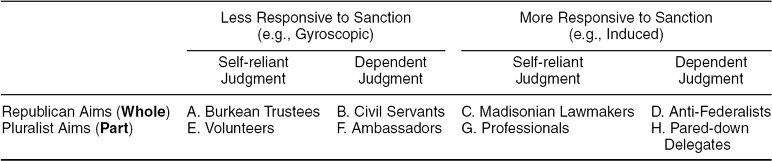
If, for the specific purpose of studying U.S. legislative representatives, we decide not to use Rehfeld's distinction, then his eightfold table collapses into the simpler fourfold table that Eulau et al. advanced 50 years ago and that empirical political scientists have been using ever since. Like Rehfeld, Eulau et al. (Reference Eulau, Wahlke, Buchanan and Ferguson1959) pointed out that Burke elided representatives who aimed at the good of the whole with those who exercised independent judgment, and accordingly developed their table around these two separate dimensions.Footnote 11 Adapted versions of both Rehfeld's and Eulau et al.'s tables appear here as Tables 1 and 2. I have placed my suggested future wording for the variables in boldface.
Schematic Conceptual Space of Three Distinctions

Note: Adapted from Rehfeld Reference Rehfeld2009, Table 2: “Schematic Conceptual Space of 3 Distinctions.” I have eliminated much of the descriptive language and added my own words “whole” and “part.”
Schematic Conceptual Space of Two Distinctions

Note: Adapted from Eulau et al. Reference Eulau, Wahlke, Buchanan and Ferguson1959, Table 4: “Areal-focal and Representational Role Orientations in Four States.” For parallelism I have dropped their middle categories and added descriptors from Rehfeld Reference Rehfeld2009 along with my own words “whole” and “part,” “gyroscopic” and “induced.” Eulau et al.’s category titles appear in quotation marks.
The most important substantive difference between the two tables is the distinction between responsiveness to sanction and self-reliant judgment, which I have argued has low utility for empirical researchers in the legislative field. The utility of that distinction for democratic theorists and in other instances of representation remains to be explored, and perhaps Rehfeld or others will take on this subject in future investigations.
Conceptually, however, Rehfeld's Table 1 makes some significant advances. For reasons explained earlier I consider the distinction that I initiated between “gyroscopic” and “induced” an improvement over Eulau et al.'s “Burkean” language of “trustee” and “delegate.”Footnote 12 For reasons to be explained below I consider Rehfeld's distinction between “republican” and “pluralist” an improvement for many purposes over the more limiting “areal focus.”
AIM AND AREAL FOCUS: INTEGRATING EMPIRICAL POLITICAL SCIENCE AND NORMATIVE POLITICAL THEORY
It is a mark of the disciplinary disjunction between normative and empirical work that Eulau and his colleagues’ conceptual point undoing Burke's elision between representational role and areal focus, their use of the longstanding distinction between the part and the whole to categorize areal focus, and the lines of empirical research flowing from their concepts of representational role and areal focus have had little effect on normative and conceptual studies of representation. Reciprocally, the long line of normative theory on commonality versus conflict, which Rehfeld summarizes in his treatment of “aim,” has had only minimal effect on empirical studies in the field. Bringing these together reveals that the state-oriented vs. district-oriented areal focus and the Republican vs. Pluralist aim are conceptually distinct but conceptually and empirically related.
Eulau and his colleagues's term “areal focus” and its specific components “state-oriented” and “district-oriented” have strong territorial connotations. Yet the authors make it clear that the subject of areal focus is not always territorial. As examples of “other than geographical interests,” they give “political parties, pressure groups and administrative agencies,” pointing out also that “different foci of representation need not be mutually exclusive” (Eulau et al. Reference Eulau, Wahlke, Buchanan and Ferguson1959, 744–45). In the terminology that I favor, either the part or the whole can be a functional as well as a territorial–jurisdictional entity. The part can also be an economic class, an ethnicity, or even a policy priority defended on the basis of its benefits for one group (e.g, the “partial” aims of opposing abortion and lowering taxes in Mansbridge Reference Mansbridge2003, 522). Territorially, the part can be a nation in the context of the globe.
Rehfeld's terms “Republican” and “Pluralist” usefully bring into play a longstanding normative disagreement between the civic republican focus on the common good of the whole and the pluralist insistence on conflict and difference among parts. This disagreement plays out in different ways in different eras. The Federalists in some ways advocated for the whole but were in other ways pluralists. The Anti-Federalists in some ways advocated for the parts, but were in other ways civic republicans. Much earlier, Aristotle argued against Plato's presumed espousal of unity that “the nature of the state is to be a plurality” made up of “different kinds of men” (Aristotle [c. 335–322 BC] Reference Aristotle, Jowett and Everson1988, 1261a); yet his factual insistence on plurality did not undermine his normative goal of working for “the common interest” (1279a). The contrasts between part and whole, plurality and unity, conflict and commonality thus do not involve the same conceptual entities. Yet these contrasts have some affinities and in specific contexts imply normative stances.
In the arena of legislative representation, for example, the normative aims of political actors are deeply entwined with their perceptions of empirical reality. Representatives and presumably also their constituents differ in their perceptions of the degree of common and conflicting interests in their states and in their nation.Footnote 13 In 1982 I began a set of interviews with Illinois legislators by reading the famous quotation from Edmund Burke beginning, “Parliament is not a congress of ambassadors from different and hostile interests . . .,” and asking, “To what extent would you say this is true about the state of Illinois—that the legislature here is a deliberative assembly of one state, with one interest, that of the whole?” The answers I got back ran from “It certainly ain't true of the Illinois legislature!” to “I think we are. . . . [We reach] a deliberative decision based upon the results of the input of many different backgrounds into what we feel is eventually the good of the whole state, of all the people.”Footnote 14 These beliefs about the world tended to be intertwined with the legislators’ normative stances, probably through reciprocal causation. Those who saw the state of Illinois primarily as a conglomerate of conflicting interests often thought they ought to represent primarily the interests of their districts. Those who saw the state as having significant common interests often thought they ought to represent primarily the state as a whole. (One cannot represent the interest of the whole without thinking the whole has common interests). Both perceptual and normative considerations could change from issue to issue. The legislators’ normative aims varied by their (and perhaps their constituents’) perceptions of the reality of conflicting versus common interests both by issue and in general.
Why agents and their principals believe what they do is an important part of how we evaluate such agents and their relationship with their principals both normatively and empirically. In the United States, constituents as well as their representatives may perceive the nation as having more common interests than the states, because foreign affairs and military policy direct attention to the national interest in ways that have little parallel at the state level. Or they may perceive the states as having more common interests than the nation, because the states are relatively smaller and more homogeneous. Empirical political scientists might thus ask in what contexts and on what issues constituents see their state or the nation as having a “good of the whole” and to what degree, if any, this perception is linked with a desire for relatively gyroscopic rather than induced representation.Footnote 15 Normative theorists might ask, with more attention to empirical context than has been the case in the past, when, if ever, citizens should perceive, try to perceive, or try to create a good of the whole.
PROMISSORY AND ANTICIPATORY VERSIONS OF INDUCED REPRESENTATION
A somewhat inductive attention to the empirical context also generated in my original discussion (2003) a distinction within the category of induced representation between “promissory representation,” in which constituent control works through the representative's campaign promises, and “anticipatory representation,” in which constituent control works through the representative's anticipation of the voters’ desires in the next election. Both concepts, I think, are immediately recognizable by empirical researchers. Promissory representation seems to be the understanding of representation most often held by members of the public. They want representatives to look backward to their promises in acting out the representative relationship, and they think of accountability in these terms. Anticipatory representation is a more sophisticated hypothesis advanced by empirical political scientists (e.g., Arnold Reference Arnold1990), who point out that in practice representatives often look forward to the next election, anticipating the desires of the future voter, and that accountability often works through this mechanism.Footnote 16 My point was that the two concepts had different normative implications. In promissory representation, as the name suggests, normative attention focuses on whether the representatives keep their promises or have good explanations for any change. In anticipatory representation, the norms are less clear. I suggested that those norms should focus on the quality of communication between representatives and their constituents, both when representatives try to change the views of the voters they will face in the next election and when constituents try to communicate to the representative (often by explicit threat) the concerns they will consider important in the next election.
Rehfeld criticizes a host of particular points in my discussion of anticipatory and promissory representation,Footnote 17 but I infer that his main complaint is that this distinction (“complexity”) is unnecessary. That may be true if one is analyzing, as he does, representatives’ individual characteristics. But the distinction has utility in an analysis of the relationship between voters and representatives. A focus on past promises conveys a different type of relationship from a focus on anticipating future voters’ desires.
SURROGATE REPRESENTATION: AGGREGATIVE AND DELIBERATIVE
A relational and systemic approach also gives a central normative role to what I called “surrogate representation,” or representation of a citizen by someone elected from another district. Rehfeld writes that this concept
is simply a reformulation of “virtual representation.” Mansbridge resists that term because she objected to Burke's elitism that she associates with the term. But Burke's “elitism” was attached to his view of representation and not to what made any case of it “virtual.” Here, for Burke (and the many others who use the term), the critical point of “virtual” was precisely, only, and no more than Mansbridge's own definition of the surrogate: “representation by a representative with whom one has no electoral relationship” (2009, 221; citing Mansbridge Reference Mansbridge2003, 522).
This characterization is incorrect. My concern with elitism was relevant to another concept of Burke's: his concept of the trustee. Turning to surrogate representation, my article cursorily specified four ways in which surrogate differs from virtual representation,Footnote 18 but spent far more time on the most fundamental difference between virtual and surrogate representation: aggregation. Burke's virtual representation applies only to deliberation. Surrogate representation applies to both the aggregative and the deliberative function of democracy. It is therefore subject to both aggregative and deliberative norms.
For deliberative functions, a strict Burkean would be normatively content with what Kymlicka (Reference Kymlicka and Siedle1993) calls “threshold representation”—that is, one individual who could voice the perspective and interests of a particular group in a deliberation.Footnote 19 For aggregative functions, however, the appropriate norm is arguably the proportional representation of interests.Footnote 20 First-past-the-post single-member-district electoral systems must look to surrogate representation to help them approach that proportional regulative ideal. Surrogate representatives may be conscious of their surrogate role, take it as an obligation, and even communicate with their surrogate constituents (often to appeal for funds). Or they may play their surrogate role unconsciously, making arguments and casting votes that represent the interests of individuals outside their districts simply by chance.Footnote 21 Either way, because surrogate representation describes a relationship between the representative and constituent and not the characteristics of an individual agent, Rehfeld's table excludes both this form of representation and the normative role it plays in partially legitimating some major representative democracies.
Perhaps because it can encompass both the aggregative and the deliberative, perhaps because it does not come with the Burkean baggage over which scholars disagree, or perhaps simply because its nomenclature is more transparent, the term “surrogate representation” seems to have proven more useful to today's empirical political scientists than “virtual representation.” It has been taken up by scholars studying women and politics, African American politics, and American legislative politics, as well as in normative theory.Footnote 22
The concept of surrogate representation begins to expand the normative and empirical study of representation beyond the relationship of constituents with their elected representatives to the entire representative system. From a systemic perspective, citizens are represented in the legislature both by their own elected representatives and by surrogate representatives from other districts. In a broader understanding of the larger representative system, each citizen is represented throughout the system by nonelected, nonlegislative representatives in parties, interest groups, nongovernmental organizations (NGOs), the media, and the citizenry, with varying degrees of formal and informal accountability.Footnote 23 Indeed, some who consciously claim to represent others in this way bring constituencies into being through that claim (Saward Reference Saward2006) and, in doing so, affect the way citizens conceive of themselves.
In the largest social sense we represent others, often unintentionally, any time a third party takes some feature of our existence or self-presentation as a guide to others’ intentions, capacities, preferences, or other characteristics. In regard to governmental decisions, we as citizens informally represent others whenever we write a letter to an editor, send money to a party or NGO, or attend a political meeting.Footnote 24 In these processes we rarely consider ourselves as representing others and even more rarely respond to formal processes of accountability. In a few instances, such as a town meeting or referendum, we make binding collective decisions for others without seeing ourselves as representatives or having formal relations of accountability to others. Normatively, it is worth parsing out more fully the spectrum between formal and informal representation, the attendant strong through weak claims that “constituents” can make on their “representatives,” and the judgments that third parties can make on the system. An articulated spectrum of this sort might capture both the intuitive force of Rehfeld's statement, “In the case of a direct democracy, citizens are not political representatives because they are not standing in for anyone but acting as themselves” (2009, 228), and also the ways in which those who attend a town meeting and make binding collective decisions that affect those who are absent do in some way stand in for the absentees, even if that is not their intent.
A full treatment of the larger representative system in politics would take account of these many contested and overlapping formal and informal, legislative and nonlegislative relationships. Inequalities in some realms might counterbalance those in others, although in practice inequalities tend to cumulate. Normatively, the reigning aggregative ideal is that, all told, each citizen's interests should be represented in the final decision, and perhaps in the processes leading to the decision, in proportion to the numbers of citizens in the polity holding those interests. The deliberative ideal is that important and relevant perspectives should be represented in the debate. Contests over these normative ideals will inevitably be bound up with empirical research mapping the elements of the representative system in various polities.
CONCLUSION
After a period of relative neglect in which many scholars, including myself, focused on direct, participatory democracy, the normative study of representation is accelerating sharply (Urbinati and Warren Reference Urbinati and Warren2008). Normative and conceptual questions regarding the relationship of constituents to their legislative representatives have come under new scrutiny. This article, in addition to responding to Andrew Rehfeld's criticisms, extends my earlier ideas in three ways. It suggests replacing the trustee concept of representation with a selection model based on the selection and replacement of gyroscopic representatives who are both relatively self-reliant in judgment and relatively nonresponsive to sanctions. It explores briefly the interaction between representative (and constituent) perceptions of reality and their normative views of what the representative ought to represent. Even more briefly, it suggests taking a more systemic view of representation, investigating the entire representative system as well as the characteristics of individual representatives, in a way that includes nonelected as well as elected representatives.
Normative political theory and empirical political science are more intertwined today than at any time in the past half century. Our understanding of democratic deliberation has already been enriched by the interpenetration of normative theory and empirical work (Thompson Reference Thompson2008). On the subject of representation the future is bright, as normative and conceptual political theorists begin to read more empirical work and empirical political scientists begin to develop operational measures of the communicative and consent-based norms implicit in different forms of representation. Only the first iteration of this subject has been “rethought.” It will need a lot more rethinking.




Comments
No Comments have been published for this article.