


1. The overlooked challenge to model transfer
Model transfer, the phenomenon that one and the same model gets reused in different domains, has recently drawn more attention from philosophers of science (see Herfeld Reference Herfeld, Knuuttila, Carrillo and Koskinen2024). Philosophers have studied the cross-domain use of the Lotka–Volterra model (e.g., Knuuttila and Loettgers Reference Knuuttila and Loettgers2017; Houkes and Zwart Reference Houkes and Zwart2019; Chao Reference Chao2023), evolutionary game-theoretic models (Kaznatcheev and Lin Reference Kaznatcheev and Lin2022; Grüne-Yanoff Reference Grüne-Yanoff2011), the virial theorem and the wave function (Price Reference Price2019), kinetic exchange models and Bayesian phylogeography (Bradley and Thébault Reference Bradley and Thébault2019), the Ising model (Knuuttila and Loettgers Reference Knuuttila and Loettgers2014, Reference Knuuttila and Loettgers2016, Reference Knuuttila and Loettgers2023), reaction–diffusion equations (Houkes Reference Houkes2023), scale-free networks (Knuuttila and Loettgers Reference Knuuttila and Loettgers2023), rational choice models (Herfeld Reference Herfeld2025), Malthus’s model of human population (Chen and Bolduc Reference Chen and Bolduc2025), the Chomsky hierarchy (Lin Reference Lin2022), and n-person game models (Herfeld and Peruzzi, Reference Herfeld and Peruzziforthcoming-b).
An observation that model transfers can be challenged because tractability can be assessed differently across domains is an insight this article departs from. Tractability is the property that the literature on model transfer identifies as one of the main factors explaining the cross-domain use of a model (Humphreys Reference Humphreys2002, Reference Humphreys2004). Paul Humphreys, a central inspiration for this literature, has argued that model transfer is attractive because a model that has proven tractable in its original domain can be expected to remain tractable when reused in a target domain. Consequently, using the already tractable model in a new domain saves us the effort of evaluating a model’s tractability anew in the target domain and allows us to rely on the mathematical proofs and computational techniques already established for ensuring the model’s tractability in the source domain. This pragmatic advantage is seen as one of the primary motivations for model transfer.
While this might generally be plausible for some of the cases discussed in the literature so far, Humphreys’s assumption that a model retains its tractability during transfer by virtue of preserving its syntactic configuration is called into question by cases of model transfer in which the model’s tractability is assessed differently in the target domain than in the source domain. His assumption rests on what I call the default view of tractability. The default view fails to capture such cases because it relies on an underspecified notion of tractability that focuses exclusively on objective factors governing model solvability.
To overcome the limitations of the default view, tractability should be reinterpreted as solvability within the framework of an acceptable model solution. The case for revising the notion of tractability rests on two premises: first, that the acceptability of model solutions depends on how scientists in a given domain negotiate trade-offs among epistemic desiderata, and second, that the resolution of these trade-offs is itself domain-specific. From these premises it follows that the sensitivity of tractability to domain-specific epistemic priorities can be epistemically justified.
I refer to methodological commitments regarding the acceptability of model solutions, shaped by these epistemic priorities, as tractability standards—adopting a term coined by Béatrice Cherrier (Reference Cherrier2023, 41), who defines them as standards that determine “which manipulations and model solutions are considered acceptable.” These standards influence how scientists in a given domain understand and define tractability, providing specific operational criteria, such as time complexity in computer science or the width of functional forms in macroeconomics (Cherrier Reference Cherrier2023). A change in the relevant tractability standards brought about by model transfer may lead to a negative reassessment of the transferred model’s solution procedures based on such domain-specific criteria, thereby undermining the pragmatic rationale for using the model in the new domain. I call the resulting challenge to model transfer the challenge of tractability standards.
There is, however, a strategy that can sometimes mitigate this challenge. I refer to this strategy as methodological embedding and argue that it involves reformulating the transferred model or its individual components to align it with the tractability standard in the new domain. In doing so, I adopt a concept analogous to Wybo Houkes’s (Reference Houkes2023, 7) “conceptual embedding.” Where Houkes’s conceptual embedding minimizes the distance between a transferred model and entrenched conceptions of phenomena in the target domain, methodological embedding analogously minimizes the distance between the transferred model and the relevant tractability standard. I argue that to overcome the challenge of tractability standards and thereby increase the chances of the model’s adoption in the target domain, scientists should investigate the possibility of ensuring the model’s tractability via methodological embedding.
To support my arguments, I draw on a case study of the transfer of agent-based models, which originated at the intersection of computer science and complex systems analysis,Footnote 1 into macroeconomics. I suggest that their transfer encountered the challenge of tractability standards and show that proponents of agent-based modeling in macroeconomics have responded to this challenge by following the strategy of methodological embedding manifest in the construction of so-called hybrid macroeconomic agent-based models.
2. Limitations of the default view of tractability and domain-specific tractability standards
The current literature in philosophy of scientific modeling has discussed model transfer largely by drawing on the so-called template-based account that originates in Paul Humphreys’s work. On this account, science is characterized by widespread application of what Humphreys (Reference Humphreys2002, Reference Humphreys2004) calls computational templates.Footnote 2 Computational templates are reusable “computationally tractable representations” (Humphreys Reference Humphreys, Carrier and Nordmann2011, 135), which include a syntactic structure and a set of construction assumptions.Footnote 3 Examples of computational templates that Humphreys has in mind are differential equations, such as Laplace’s equation, or computational algorithms and structures, such as cellular automata and agent-based models (Humphreys Reference Humphreys2002, Reference Humphreys2004). Building on Humphreys’s idea, model transfer can be viewed as the cross-domain application of such templates.Footnote 4 What explains their transfer is their tractability, their flexibility, and, as Tarja Knuuttila and Andrea Loettgers argue, their conceptual features (see Herfeld Reference Herfeld, Knuuttila, Carrillo and Koskinen2024).Footnote 5
On Humphreys’s account, construction assumptions, such as idealizations, abstractions, and approximations, ensure the tractability of templates (Humphreys Reference Humphreys2002, Reference Humphreys2004). It is clear that the syntactic structure underlying the template also influences tractability by shaping the range of possible numerical and analytical solutions. Moreover, the solution method is a crucial determinant of tractability. As Humphreys (Reference Humphreys, Stepney, Welch, Andrews and Sampson2010) notes, in some cases, solution methods are distinct from templates and are incorporated only later in the process of constructing computational models from those templates. In other cases, such as agent-based models and cellular automata, the solution method is an integral part of the template itself.
Humphreys argues that computational tractability is a crucial constraint on scientific progress: “Most scientific models are specifically tailored to fit, and hence are constrained by, the available mathematics,” and “it is the invention and deployment of tractable mathematics that drives much progress in the physical sciences” (Humphreys Reference Humphreys2004, 55–56). Often, models created from scratch suffer from intractability, which motivates the search in other disciplines for computational templates potentially applicable to the problem under study, since using these templates immediately guarantees the tractability of a corresponding model. The similarity of the syntactic configuration of a model to the already used models in other disciplines becomes its advantage. In Humphreys’s (Reference Humphreys2004, 68) words, “The drive for computational tractability underlies the enormous importance of a relatively small number of computational templates in the quantitatively oriented sciences.”
Thus Humphreys’s view presupposes that tractability amounts to the mathematical solvability of models and is determined by their syntactic configuration, and other objective computational constraints and capabilities. This view has not been challenged in the model transfer literature, and much of the philosophy of science literature also seems to presuppose such understanding, although the issue is rarely addressed explicitly. This is why I refer to it as the default view, while not claiming that it is universally accepted among philosophers of science.Footnote 6 A necessary consequence of the default view is that tractability is understood as an inherent formal property of models. To be sure, the default view does not deny that tractability is relative and depends on factors that shape our computational constraints and capabilities at a given time, such as mathematical knowledge, computational resources, and so on. However, once these relative computational constraints and capabilities are factored out, tractability becomes, on the default view, a fixed and guaranteed property: The procedure for solving an equation should not vary with the context in which it is applied.
My objection to the default view of tractability is that it leaves tractability underspecified. The concept remains vague without a clear account of what it means for a model to be “solvable.” There is no universal procedure for solving a computational model or for deriving a solvable model from a given syntactic structure. In practice, multiple such procedures are often available, resulting in solutions with different properties, some of which can be considered acceptable, while others cannot. To specify the concept of tractability, we should explicitly take into account which model solutions are considered acceptable and why. To put it another way, tractability should be understood as solvability within the framework of an acceptable model solution.
Cherrier (Reference Cherrier2023) draws attention to the acceptability of model solutions by introducing the notion of “tractability standards.” Based on the example of economics, she shows that understandings of which model solutions count as acceptable have changed over time and vary across subdisciplines and interprets these shifts as changes in tractability standards. Both temporal and interdomain variations in such standards deserve philosophical attention, but it is interdomain differences that have a direct implication for model transfer: If the criteria for what counts as an acceptable solution shift in the course of transfer, tractability in the target domain can no longer be assumed to be preserved. Although the formal properties of a model remain constant, and, in that sense, the default view is correct, the evaluation of those properties can vary substantially across local contexts of scientific practice. If a model is not tractable according to a locally accepted standard, its tractability under an alternative standard is not necessarily relevant. This has serious implications for the success of model transfer, given that tractability is a minimally necessary property required of a model.
While differences in tractability standards may stem from the historical development of disciplines and context-specific nonepistemic considerations, such standards can be justified on epistemic grounds, if certain kinds of model solutions impede the achievement of scientists’ epistemic desiderata. The procedure for solving a model depends on many factors, including the solution method and construction assumptions, such as idealizations, and, consequently, all these components can play a role in determining the acceptability of a model solution.
For example, there are multiple solution methods used in modeling, ranging from closed-form solutions to numerical approximations. The choice among these methods determines which basic tractability benchmark is adopted: analytical or numerical solvability. Already preliminary considerations suggest that the choice between them involves a trade-off among epistemic desiderata. As models become more complex, they often can only be solved using numerical methods, and the superior accuracy of the results obtained usually outweighs considerations favoring analytical solvability. Nonetheless, analytical solvability offers distinct advantages, such as greater generality of results and improved opportunities for analyzing limiting cases and asymptotic behavior. When these desiderata are especially valued, favoring analytical over numerical solvability may be epistemically justified.
The preference for certain construction assumptions, such as idealizations, and the rejection of others also depend in part on which epistemic desiderata are prioritized. In the case of so-called minimalist idealizations (Weisberg Reference Weisberg2007; Batterman and Rice Reference Batterman and Rice2014), it is not only considerations of tractability that play a role. If idealizations are selected specifically for reasons of tractability, they involve inherent trade-offs concerning what must be sacrificed to achieve tractability. These sacrifices may concern not only specific representational choices but also broader epistemic values. For instance, scientists who place a high value on accuracy may resist idealization altogether and instead sacrifice scope by replacing variables in the model with empirically estimated parameters or by restricting the analysis to particular states of the target system in which solvability can be achieved without resorting to substantial idealizations. By contrast, prioritizing simplicity may motivate idealizations that not only secure solvability but also facilitate ease of deriving solutions, even at the further expense of accuracy.
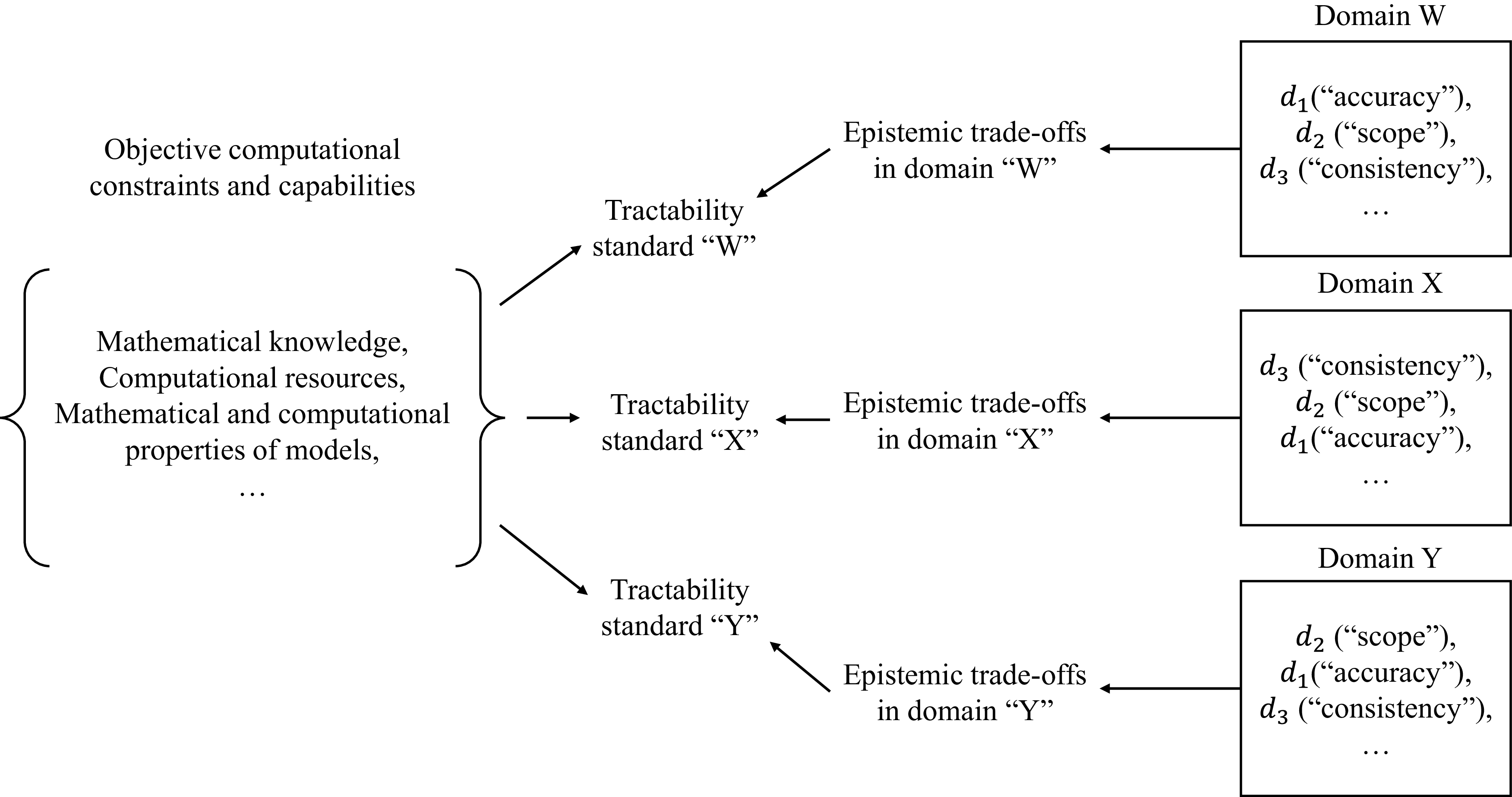
Thus, when deciding how to achieve tractability, scientists confront trade-offs among competing epistemic desiderata.Footnote 7 These trade-offs do not, however, fully determine their choices: Objective computational constraints and capabilities, such as the state of mathematical knowledge and available computational resources, also play a major role. Still, tractability standards partly depend on which epistemic desiderata we aim to achieve and on their relative priority. And scientists in different domains often resolve these trade-offs in different ways. In support of this general claim, see, for example, Miles MacLeod’s (Reference MacLeod2018) discussion of conceptual and methodological divides, as well as conflicts over epistemic values across disciplines.
Consequently, the domain specificity of tractability standards can be epistemically justified. Figure 1 illustrates the various factors that shape these standards. My general argument here does not depend on endorsing any specific account of how scientific disciplines are organized or how models ought to be appraised. We can remain agnostic about the precise nature of interdomain differences in epistemic desiderata, whether these are best characterized as differences in values, as famously suggested by Thomas Kuhn (Reference Kuhn1977), or, as Chiara Lisciandra (Reference Lisciandra2025) has recently suggested, as differences in explanatory norms. The rankings of epistemic values identified by Kuhn are used in figure 1 for illustrative purposes only. The modest claim that such interdomain differences often exist is sufficient.
Factors shaping tractability standards.

As the methodological criteria used to assess tractability, such as the computational time and memory requirements; the number of variables that a model can accommodate; and the required properties of the model solution vary across domains, they may conflict with one another.Footnote 8 Such conflicts between the source and target domains can make model transfer challenging for two reasons. First, it is epistemically risky to deviate from the domain’s tractability standard to accommodate a transferred model, as this deviation may result in a failure to meet domain-specific epistemic priorities. Second, it can be difficult to assess whether the potential epistemic benefits of transferring the model outweigh the risks associated with that deviation. As a result, scientists may even recognize a model’s potential usefulness yet still refrain from adopting it because they are uncertain whether its benefits justify the perceived tractability-related epistemic risks.
Of course, in actual practice, there are no clear boundaries, and multiple types of modeling often coexist. Furthermore, the similarity of tractability standards in two domains should prevent the challenge of tractability standards. Nevertheless, this is not always the case, and such a challenge can arise in principle. Many instances of model transfer may fail simply because a model does not align with the target domain’s tractability standard.
3. Tractability standard in macroeconomics and agent-based models
Agent-based models emerged in the 1980s at the intersection of computer science, operations research, political science, and ecology and were then transferred to various disciplines, including macroeconomics (see, e.g., Axtell and Farmer Reference Axtell and Doyne Farmer2025). Within the template-based account, agent-based modeling can be thought of as a family of related templates grounded in shared construction assumptions. Most notably, these templates posit the existence of autonomous entities, “agents,” whose behavior is defined by algorithmic, recursive rules that govern how they interact and influence one another. Leigh Tesfatsion (Reference Tesfatsion and Venkatachalam2023) formulated basic principles underlying the construction assumptions of agent-based models, such as agent local constructivity (an agent’s action at any given time is entirely determined by its local properties at that time), agent autonomy (all agent interactions are determined by the totality of their local states), and system historicity (each subsequent event in the model world is determined by all past agent interactions). Furthermore, the assumption of agent heterogeneity has long been central to agent-based modeling, as it allows for more realistic representations of complex interacting systems.
Agent-based models come in a wide variety of forms, with many possible structures for agent interaction. In macroeconomics, the transfer at issue is not the adoption of a single template with a fixed ontology and behavioral rules; rather, it is the transfer of a general principle for generating such templates. In the case of computational templates not tied to a strict mathematical representation (such as a system of equations), transfer often seems to occur at this more abstract level, with the details of the template’s structure determined during the model construction process.
Attempts to introduce agent-based modeling into macroeconomics date back to the 1990s (e.g., Lane Reference Lane1993). Macroeconomic agent-based models represent the interaction patterns among consumers, firms, the government, and the central bank, offering a potential alternative to established frameworks in macroeconomics, such as dynamic stochastic general equilibrium (DSGE) modeling.Footnote 9 In agent-based models, the equation-based representation common in macroeconomics is replaced by recursive algorithmic rules that specify the behavior of multiple agents. This approach enables more complex representations of firms and consumers as entities with heterogeneous properties while preserving numerical solvability.
Early attempts to construct agent-based macroeconomic models were met with skepticism from macroeconomists. Roberto Leombruni and Matteo Richiardi (Reference Leombruni and Richiardi2005, 105) identified two main objections: (1) agent-based models are “difficult to interpret and generalize,” and (2) they are “difficult to estimate.” The first objection arises from skepticism about whether a system’s macrodynamics can be defined unambiguously and reliably within a simulation-based solution implemented in an agent-based model, in contrast to analytical solutions. The second concerns the excessive complexity of the functional forms employed in agent-based models. In response to these concerns, Leombruni and Richiardi argued that the issues of estimation, interpretation, and generalizability can be resolved through the construction of statistical metamodels that examine model behavior across the entire parameter space. However, this apparently proved insufficient to dispel the prevailing skepticism.
Philosophers of economics have already discussed the domain-specific desiderata in economics that, particularly, influence the disciplinary perception of simulation and network models (e.g., Lehtinen and Kuorikoski Reference Lehtinen and Kuorikoski2007, Reference Lehtinen, Kuorikoski, Heilmann and Reiss2021; Kuorikoski and Marchionni Reference Kuorikoski and Marchionni2014; Marchionni Reference Marchionni2013). Their analysis boils down to the observation that economists place a particularly high value on unification, generality, and formal consistency. As Jaakko Kuorikoski and Caterina Marchionni (Reference Kuorikoski and Marchionni2014, 101) put it, it is the expectation that models should explain “many things, which were previously conceived of as being of a different kind, as manifestations of the same parsimonious set of principles.”
The strong emphasis on formal consistency places additional constraints on which numerically solved models will be acceptable, as it requires an ability to investigate the theoretical structure of a model using analytical methods to a certain extent, even if its numerical results are calculated using computer simulation. Macroeconomist Manuel Santos (Reference Santos, John and Woodford1999) made this position explicit in his handbook chapter on numerical solutions for dynamic models in economics. Specifically, he argued against beginning with “a numerical model (i.e., a collection of rules which could be coded as a finite set of computer instructions)” in model construction, thus “avoiding formulation of an abstract economic model” (Santos Reference Santos, John and Woodford1999, 377). According to him, although such numerical models might achieve easier solvability, introducing discreteness and round-off errors makes it significantly harder to verify essential properties of computed solutions, such as existence, stability, and monotonicity.
Moreover, the theoretical principles underlying the explanatory mechanisms used in macroeconomics largely determine the solution methods that are deemed acceptable. These methods typically rely on the notions of equilibrium, optimizing agent behavior, and rational expectations, which can at times make models harder to solve but are nonetheless maintained for the sake of theoretical consistency and explanatory power. The interplay between these theoretical desiderata and the pursuit of model solutions with certain desirable properties has led to the adoption of specific idealizations that have become deeply ingrained in macroeconomic modeling practice, particularly in DSGE models. Chief among these is the assumption of the representative agent, long regarded as useful because it enables the simultaneous achievement of multiple objectives. The representative agent is traditionally seen as providing macroeconomic models with microfoundations, that is, linking aggregate outcomes to the optimizing behavior of individual agents and thus grounding macroeconomic theory in microeconomic theory.Footnote 10 Despite ongoing controversy over whether the assumption of the representative agent adequately achieves this, the assumption has remained dominant in macroeconomic modeling, as it not only ensures formal consistency with microeconomic theory but also significantly simplifies the computation of aggregate macroeconomic equilibria, thereby enhancing solvability.
This context shapes what we can refer to as a domain-specific tractability standard in macroeconomics, which influences the choice of idealizations and other construction assumptions, as well as model-solution methods entrenched in the discipline. The tractability standard in macroeconomics differs significantly from such standard in computer science and the interdisciplinary field of complex systems analysis, both of which have exerted methodological influence on agent-based modeling (see, e.g., Anzola Reference Anzola2019).
Particularly, in computer science, the tractability of algorithmic solutions to computational models is evaluated according to a variety of criteria, especially time and memory requirements (e.g., Sipser Reference Sipser2012), but specific constraints on solution procedures that are characteristic of macroeconomics, such as the width of functional forms, receive less emphasis (see also Cherrier Reference Cherrier2023). Moreover, David Anzola (Reference Anzola2019) argues that methodological commitments in computer science are less concerned with the opacity of algorithmic solutions, even when such opacity substantially reduces the transparency of the solution procedure.
Furthermore, the specific construction assumptions underlying agent-based models do not align well with the procedure of model solution accepted in macroeconomics. In this regard, Tesfatsion (Reference Tesfatsion and Venkatachalam2023, 46) writes, “The determination of a rational expectations solution is therefore a global fixed-point problem that requires the simultaneous consideration of all modeled decision periods without regard for local constructivity, autonomy, and historical process constraints. In contrast, ACE [agent-based computational economics] permits the open-ended dynamic modeling of economic systems without external imposition of rationality, optimality, or equilibrium conditions.”
This discussion shows that the concerns about the difficulty of generalizing, interpreting, and estimating agent-based models can be understood as challenges arising from their misalignment with the tractability standard in macroeconomics. One objection essentially highlights that the solution method used in agent-based models, computer simulation of agent behavior, provides less analytical control over the results than models built on simpler algebraic systems, where the mechanisms leading to specific outcomes can be more transparently traced through mathematical analysis. Another objection targets computational forms and construction assumptions typical of agent-based models, based on which complex specifications with numerous parameters are produced. This is seen as complicating empirical estimation and aggravating the underidentification problem. Specifically, the discrepancy with the tractability standard arises at the level of empirical model estimation, since economists have traditionally regarded models with large numbers of free parameters in empirical work with suspicion.Footnote 11 Thus it is the differences in acceptable model-solution procedures that resulted in the challenged transfer.
4. Methodological embedding as a mitigation strategy
Sometimes we can address the challenge of tractability standards and thereby ensure successful model transfer by modifying the transferred model so that it meets those standards. I refer to this strategy as methodological embedding.Footnote 12
Literature on model transfer has already examined in detail various strategies for adapting templates at the level of conceptualization of phenomena (e.g., Price Reference Price2019, Reference Price2020; Houkes Reference Houkes2023). The need for this often arises from the “conceptual pressure” exerted on the transferred model, stemming from discrepancies between its conceptualizations and those entrenched in the target domain (Price Reference Price2020). In particular, Wybo Houkes (Reference Houkes2023, 78) proposes a “conceptual embedding” strategy, which “involves deliberately minimizing the semantic distance between the (interpretation of the) template and entrenched conceptions of the phenomena in the recipient domain.” In response to local pressures for a new template, scientists engaged in template transfer may offer localized justifications for the template’s construction assumptions (see also Bradley and Thébault Reference Bradley and Thébault2019). This involves not only demonstrating the reasonableness of these assumptions within a specific target system but also reformulating them through domain-specific conceptualizations.
As our discussion shows, domain-specific tractability standards can also exert pressure on the transferred template. I propose that the strategy for mitigating this pressure, namely, methodological embedding, should follow a path similar to that outlined by Houkes, that is, it can be based on minimizing the distance between the solution procedure of the transferred template and the domain-specific tractability standard, making this procedure more acceptable in the target domain given its epistemic priorities regarding model solutions.
Specific modifications that constitute methodological embedding may involve changes to the solution method and the model’s idealizations. For example, a model that is solved numerically may be modified so that an analytical solution can be approximated (e.g., by introducing additional idealizations or by converting an algorithmic model into an equation-based one). These changes can affect the representational mode of the model as a whole or that of its individual components, as well as the formal languages used to describe them. In this sense, methodological embedding involves some degree of reformulationFootnote 13 and can be understood as one possible aim of what Catherine Herfeld and Edoardo Peruzzi (Reference Herfeld and Peruzziforthcoming-b) call “model translation,” namely, the two-step process of deconstructing and reconstructing a transferred model to ensure its alignment with domain-specific features.
Of course, such reformulation is usually nontrivial. In many cases, full alignment with a local tractability standard is unachievable. Even in such situations, however, partial alignment may still be possible, and it can help address the problem of uncertainty when assessing the epistemic benefits and risks of model transfer. More specifically, methodological embedding can aim at enabling transparent comparison of the components of a model, which influence the procedure of model solution, with the tractability standard of the target domain. The comparative framework may take the form of multiple related models or a single integrated model composed of multiple independently analyzable modules.Footnote 14 It can allow identifying and reformulating key components influencing tractability, such as specific idealizations, while holding other elements of a model constant, thereby providing a clear understanding of how each factor affects the model’s solution procedure.Footnote 15
Within such a comparative framework, systematic evaluation of a transferred model’s potential epistemic benefits becomes possible against the background of the corresponding tractability-related epistemic risks. First, we can reformulate it to achieve varying degrees of alignment with the local standard. Second, we can compare overall epistemic benefits and risks across these different levels of alignment. Through this process, we may uncover templates that are partially adapted to the target domain’s tractability standard while retaining certain elements that do not fully align with it. Some of these templates may prove especially promising. Such “hybrids” may preserve the enhanced capacities for advancing our epistemic aims provided by the original template while at least partially reducing the epistemic risks entailed by misalignment with the domain’s tractability standard, thereby revealing the locally relevant potential of the transferred template for initiating scientific change. In its turn, the success of constructing these hybrids may subsequently justify a relaxation of the tractability standard in the target domain.
Accordingly, methodological embedding can be defined as a strategy for ensuring successful model transfer, consisting in the reformulation of the transferred model or its individual constituents (e.g., construction assumptions) through changes in formal language and other representational means, so as to better align with the tractability standard of the target domain. Scientists engaged in model transfer, based on their understanding of the priority ranking of epistemic desiderata in the target domain, which are sometimes articulated through specific methodological guidelines like model validation criteria,Footnote 16 may alter the formal language and other means of representation they employ to enable a model solution that is better aligned with those methodological guidelines.
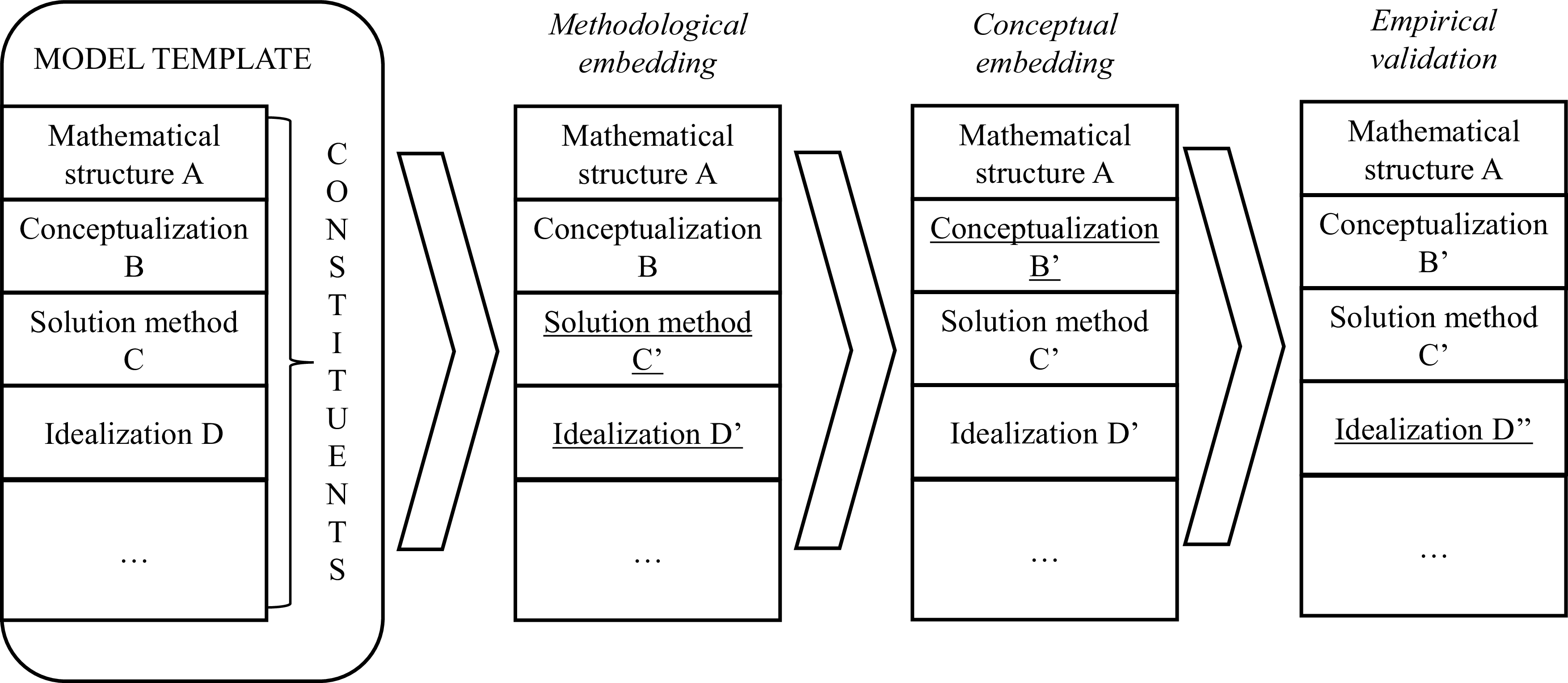
Methodological embedding is one component of a broader justificatory work aimed at adapting a transferred template to different domains. This work may also involve other strategies discussed in the literature, which address different challenges. These strategies can be combined and function as interrelated components of the process of model construction based on templates. If model transfer succeeds, culminating in the adoption of the model in the target domain, the overall process can be schematically described as follows (figure 2).Footnote 17 In the first stage, we should assess the extent to which the template’s tractability-relevant dimensions, such as its idealizations and solution method, align with the target domain’s tractability standard. If this alignment is insufficient, methodological embedding is undertaken. Then, attention shifts to the template’s conceptual dimensions, at which point strategies like conceptual embedding may be employed. In the final stage, we evaluate the adequacy of the methodologically and conceptually embedded template as a representational device for the target system and, if necessary, further revise its idealizations so that its resulting output representation can be empirically validated. After the initial adaptation, strategies like customization (see Houkes Reference Houkes2023) can be used to further demonstrate the template’s usefulness within the target domain. Of course, when examining real cases from the history of science, we can observe different sequences of action. For example, at intermediate stages of model development, scientists may work with an intractable model and achieve tractability only later in the process.Footnote 18
Stages of template adaptation during the successful model transfer process.

When methodological embedding proves feasible without significant complications, this strategy appears optimal for overcoming the challenge of tractability standards. At the same time, it is not costless and has clear limitations. Intervening in a model’s representational mode can negatively affect its effectiveness in achieving various epistemic desiderata. In such cases, a dilemma arises: Methodological embedding improves the model with respect to the epistemic desiderata prioritized in the target domain, yet it simultaneously diminishes its overall effectiveness. As discussed, it is sometimes possible to resolve this tension by developing partially adapted models. However, a possible scenario is that no promising way is found to maintain the potential epistemic benefits provided by the model while satisfying the constraints of the domain’s tractability standard. At this point, it may be necessary to conclude that model transfer is not possible; nevertheless, alternative strategies aimed at changing tractability standards themselves may still remain available.
5. Hybrid macroeconomic agent-based models as a case of methodological embedding
One response by proponents of macroeconomic agent-based modeling to the challenge of tractability standards has been the development of so-called hybrid agent-based models, which combine elements of agent-based and standard macroeconomic models in various ways (Baccini et al. Reference Baccini, Cioni, Legrand and Petrovich2025). For example, researchers “agentify” standard macroeconomic models by reformulating their algebraic construction assumptions using the algorithmic resources of agent-based modeling. This creates a unified formal framework that allows scientists to demonstrate the epistemic advantages of agent-based models while showing their capacity to replicate results from established disciplinary models (e.g., Gobbi and Grazzini Reference Gobbi and Grazzini2019; Sinitskaya and Tesfatsion Reference Sinitskaya and Tesfatsion2015). Another hybrid approach consists in incorporating key construction assumptions from agent-based models, such as agent heterogeneity, bounded rationality, and learning based on heuristic forecasting rules, into DSGE models (e.g., Dilaver et al. Reference Dilaver, Jump and Levine2018). Overall, in hybrid models, while agent-based modeling is partially adapted to the accepted solution methods and construction assumptions in macroeconomics, modelers seek to preserve certain novel assumptions regarded as especially valuable, notably the heterogeneous-agents assumption, in contrast to the representative-agent assumption that is widespread in macroeconomics.Footnote 19
Recently, John Geanakoplos (Reference Geanakoplos, del Rio-Chanona, Pangallo and Bednar2026), one of the leading proponents of agent-based modeling in economics, offered a methodological reflection on his use of agent-based models that, in essence, captures the rationale behind the hybrid-models strategy. Drawing on examples involving models of mortgage prepayment, monies and inflation, housing, and economic booms and busts, he argues that the most fruitful approach to constructing agent-based models in economics is to combine them with general equilibrium models that underlie economic theory. In Geanakoplos’s view, the axiom-theorem foundations of general equilibrium models are advantageous because they guarantee that equilibrium solutions remain consistent with assumptions of rational behavior. At the same time, agent-based models make it possible to represent finer behavioral details and to conveniently relax assumptions of full rationality where necessary. By building agent-based models on the foundation of simpler general equilibrium models, researchers can preserve the desirable properties of equilibrium solutions while extending the model’s representational accuracy beyond the inherent limitations of general equilibrium models.
Tiziana Assenza and Domenico Delli Gatti’s (Reference Assenza and Delli Gatti2019) article provides an illustrative example of a hybrid agent-based macroeconomic model. They aim to construct a model that remains as close as possible to the DSGE framework widely accepted in macroeconomic literature. At the aggregate level, the model’s dynamics can be algebraically described by three standard components of DSGE models: the investment–savings (IS) curve, the Phillips curve, and the Taylor rule. Together, these equations determine the equilibrium levels of employment, the interest rate, and inflation.
While preserving this conventional aggregate structure, Assenza and Delli Gatti (Reference Assenza and Delli Gatti2019) incorporate agent-based simulation at the micro level by introducing algorithmically simulated heterogeneous firms. A recursive rule specifies each firm’s production level and its demand for capital and labor, mirroring the optimizing logic of standard macroeconomic models. When firms lack sufficient internal funds to continue production, they borrow from banks; the resulting additional interest costs constitute the external finance premium, which is determined individually for each firm.
The average external finance premium serves as the key link between the algorithmic micro and algebraic macro levels of the model. Aggregate employment, the interest rate, and inflation in period t can be expressed as functions of the average finance premium in period t – 1. In turn, the interest rate in period t influences the average finance premium in period t + 1. The average premium depends on the first and second moments of the distribution of firms’ net worth, and the authors approximate it using the following formula (Assenza and Delli Gatti Reference Assenza and Delli Gatti2019, 274):
 ${f_t} \approx {\alpha \over {{A_{t - 1}}}} + {{\alpha {V_{t - 1}}} \over {A_{t - 1}^3}}$
where α is an exogenous parameter, A t−1 is the cross-sectional mean of the distribution of firms’ net worth in period t – 1, and V t−1 is the cross-sectional variance of the distribution of firms’ net worth in period t – 1.
Using this formula, the authors provide an analytical account of the pattern governing the dynamics of the average external finance premium within the model and isolate the influence of different modeling assumptions. The formula separates the average premium into two components. The first, termed the RA (representative-agent) component, depends only on the cross-sectional mean and corresponds to the representative-agent benchmark. The second, the HA (heterogeneous-agents) component, depends on both the cross-sectional mean and on variance, capturing the contribution of firm heterogeneity. This decomposition makes it possible to see how incorporating heterogeneity through the agent-based framework alters the model’s results. Specifically, they analytically derive the portions of fiscal, monetary, and financial shocks’ effects that are independent of changes in firms’ financial conditions at the micro level and then use agent-based simulations to estimate the portions attributable to changes in firms’ external finance premium, distinguishing between the RA and HA terms.
Thus the model integrates new elements, namely, recursive behavioral rules and agent heterogeneity, both characteristic of agent-based modeling, into a unified formal framework alongside the common equation-based representation of aggregate structure and the representative-agent assumption. The contribution of these new elements, exemplified by the algorithmically modeled heterogeneous firms, can be quantified as a fraction of the macroeconomic equilibrium at the aggregate level.
This model nicely illustrates the strategy of methodological embedding. Assenza and Delli Gatti reformulate the assumption of heterogeneous agents in a way that maximizes its consistency with rational-agent behavior in DSGE models and preserves comparability with the representative-agent assumption; they also treat the algorithmic simulation of firm behavior as a component of the model’s algebraic solution. Their model is explicitly designed to facilitate the identification of the individual contributions made by different construction assumptions and solution methods to the results, thereby enabling their systematic evaluation and, as a consequence, a more informed assessment of the necessity to adopt the transferred construction assumption and solution method.
They show that the effects introduced by firm heterogeneity are as significant as those associated with the representative agent alone, indicating that heterogeneity makes a substantial contribution to overall model dynamics. At the same time, the presence of an isolable representative-agent component makes the model’s results more amenable to theoretical interpretation and more consistent with accepted model-solution procedures in macroeconomics. Deviations from the tractability standard are confined to a separate agent-based component of the model, thereby reducing the associated epistemic risks.
In this sense, Assenza and Delli Gatti’s modeling strategy exemplifies both aspects of methodological embedding: minimizing the distance from the target domain’s tractability standard and reducing uncertainty in assessing the epistemic benefits and risks associated with departing from this standard. The general methodological arguments advanced by Geanakoplos (Reference Geanakoplos, del Rio-Chanona, Pangallo and Bednar2026) in favor of combining agent-based models with general equilibrium models, based on the idea of preserving the desired properties of equilibrium solutions while attaining the greater realism afforded by agent-based models, further substantiate my interpretation of hybrid macroeconomic agent-based models as instances of methodological embedding.
6. Conclusion
In this article, I argue that considerations of tractability depend not only on “objective” factors, such as the formal properties of models, computational constraints, and capabilities, but also on domain-specific priorities concerning epistemic desiderata. A fully specified notion of tractability must therefore take these priorities into account. This can be achieved by identifying tractability standards that determine which model solutions count as acceptable within a given domain.
The domain specificity of tractability standards creates a distinctive challenge for model transfer and complicates the template-based account of model transfer. In particular, it calls into question the relevance of tractability as a pragmatic motivation for transfer when the standards of the source and target domains diverge, and it helps explain why transfers in such cases may be unsuccessful. However, I argue that this challenge does not necessarily have to lead to a failure of transfer, since strategies exist that can mitigate it. As proposed in this article, methodological embedding is one such strategy, amounting to the reformulation of an entire model or selected components to ensure alignment with the tractability standard of the target domain.
When methodological embedding is not feasible, other strategies may still be available that aim at transforming the relevant standards. For example, the proponents of transfer might change the discipline’s epistemic priorities through transfer itself, even though this proves extremely demanding. Some reconstructions of the history of twentieth-century economics, showing how transfers from physics played a decisive role in the deep methodological transformation that occurred in economics, can serve as an example of this strategy (e.g., Mirowski Reference Mirowski1989). A less demanding alternative may be to bypass traditional disciplinary boundaries altogether. This approach has largely been followed by econophysics, although arguably in response to challenges other than those posed by tractability standards. As Yves Gingras and Christophe Schinckus (Reference Gingras and Schinckus2012) observe, econophysics became institutionalized as a research field within physics rather than economics.
Acknowledgments
This article is part of a project that has received funding from the European Research Council (ERC) under the European Union’s Horizon 2021 research and innovation program [Grant Agreement No. 101043071] with a project on Model Transfer and Its Challenges in Science: The Case of Economics. Views and opinions expressed are, however, those of the author only and do not necessarily reflect those of the European Union or the ERC Executive Agency. Neither the European Union nor the granting authority can be held responsible for them. First and foremost, I am deeply grateful to my supervisor, Catherine Herfeld, whose guidance throughout all stages of this article’s development was invaluable to its completion. I extend my sincere thanks to my colleagues in the ERC-funded MODEL TRANSFER project, Bele Wollesen, Edoardo Peruzzi, and Oliver Budras, as well as to the project’s visitors, Alberto Bartoccini and Lorenzo Sartori, for their generous and helpful feedback during the preparation of this article. I am also thankful to Aki Lehtinen, Chiara Lisciandra, Ivan Moscati, Muriel Dal Pont Legrand, Nadia Ruiz, and Teemu Lari, whose comments were influential in developing the article’s argument and case study, as well as to two anonymous reviewers whose suggestions helped improve the article. Furthermore, I benefited from valuable discussions at several conferences, workshops, and seminars, including the Third Lake Como INEM Summer School in Philosophy of Economics, PSA 2024, GWP.2025, the Philosophie und Wissenschaftsreflexion colloquium at Leibniz University Hannover, the seventeenth biennial INEM conference, and the second Hannover–Groningen Workshop on Philosophy of Science.

 Open access

