





1 Introduction
Problems concerning the reconstruction of convex bodies from data on their sections or projections arise naturally at the intersection of classical mechanics, harmonic analysis, differential geometry, and convex geometry [Reference Alfonseca, Stancu, Ryabogin, Yaskin, Pach and Toth1, Reference Busemann and Petty5, Reference Gardner9, Reference Werner15]. In particular, the questions addressed in this work trace their origins to Hammer’s X-ray problem [Reference Falconer6–Reference Gardner and McMullen8, Reference Hammer10, Reference Volčič14]. In [Reference Barker and Larman2], Barker and Larman posed the following:
Conjecture 1 If for two convex bodies K and L in
$\mathbb {R}^n$
 ,
$n \geq 2$
 , with a convex body M in their interiors and a supporting plane
$H_M(\xi )$
 of M with unit normal vector
$\xi $
 , the
$(n-1)$
 -dim volumes of the sections coincide

then
$K=L$
 .
In [Reference Xiong, Ma and Cheung16], Xionget al. confirmed the conjecture for origin-symmetric, strictly convex body M with analytic boundary in the planar case with K and L being polygons. Later, in [Reference Yaskin17], Yaskin gave the affirmative answer for convex polytopes
$K,L$
 , and a ball M (so-called t-sections). One of the goals of this article is to generalize this to a larger class of interior bodies M for
$n=2$
 that are not necessarily convex. In particular, we are interested in envelopes of lines defined by an analytic support function, analytic hedgehogs [Reference Martinez-Maure12].
Theorem 1.1 Let P and Q be convex polygons in
$\mathbb {R}^2$
 with a nontrivial piecewise-analytic hedgehog M in their interiors. If for every supporting line H of M,

then
$P= Q$
 .
To formulate the second result, we recall the notion of slab, which is the set of points between two parallel hyperplanes. If parallel planes with unit normal
$\xi \in S^{n-1}$
 are chosen to be tangent to a ball of radius t, we denote the slab
$S_t(\xi )$
 . In [Reference Ryabogin and Yaskin13], Ryabogin and Yaskin stated the following:
Conjecture 2 If for two origin-symmetric convex bodies K and L in
$\mathbb {R}^n$
 ,
$n \geq 2$
 , with a ball in their interiors

then
$K=L$
 .
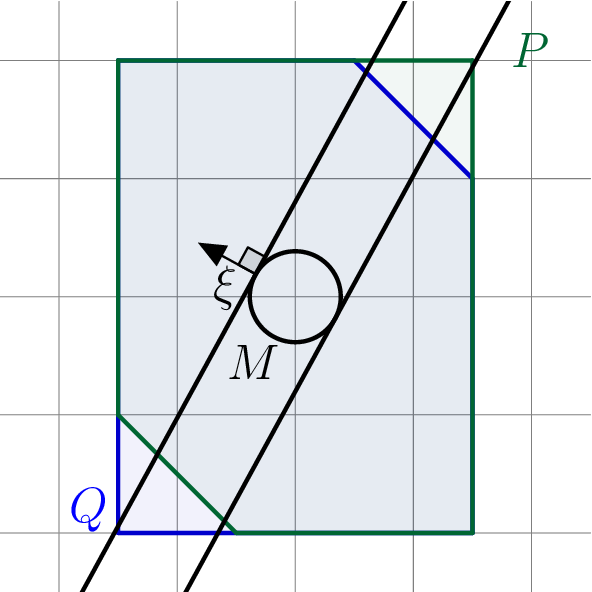
Simultaneously, the authors emphasized that the condition of origin-symmetry cannot be eliminated (Figure 1). Consider a rectangle centered at the origin. Cut one corner of the rectangle to obtain a polygon P. To construct a polygon Q, rotate P by
$180$
 degrees about the origin. Then, we obtain two distinct non-origin-symmetric polygons with the same slab areas in any direction.
$P \neq Q$
 , but
$\text {vol}_{2}\left ({P \cap S_M(\xi )}\right ) = \text {vol}_{2}\left ({Q \cap S_M(\xi )}\right )$
 for all
$\xi \in S^1$
 .

In [Reference Yaskin and Yaskina18], Yaskin and Yaskina provided the affirmative answer to Conjecture 2 in the class of convex polytopes. The next theorem extends this observation in the plane to the class of analytic hedgehogs instead of a ball.
Theorem 1.2 Let P and Q be origin-symmetric convex polygons in
$\mathbb {R}^2$
 with a nontrivial analytic origin-symmetric hedgehog M in their interiors. If

then
$P =Q$
 .
It is natural to wonder whether the analogous result holds if the equality for slab areas in Theorem 1.2 is replaced by the equality for their perimeters. Unfortunately, the series expansion approach helpful for the proof of Theorem 1.2 in this case does not seem to yield a clear conclusion, and the answer to such a question of uniqueness eludes us.
The proofs of both theorems are carried out by contradiction. We assume that the tomographic data (lengths of sections or areas of slabs) coincide for a pair of distinct polygons. These assumptions guarantee the existence of a point where the boundaries of the polygons intersect transversely. We then consider a supporting line of the hedgehog passing through this point and equate the corresponding tomographic data on an open set of nearby supporting lines. The assumption of analyticity allows us to uniquely extend this equality to the entire unit circle of normal directions, except for a finite set of points. This ultimately contradicts the transversality of the intersection and therefore implies the equality of the polygons. These arguments rely heavily on the polygonal structure of the bodies, since it is essential to vary the supporting lines over an open set while intersecting the same sides of the polygons.
These results also raise further questions concerning stability, extensions beyond the polyhedral class, higher dimensions, and other intrinsic volumes [Reference Gardner9].
2 Preliminaries
For the benefit of the reader, we recall the necessary preliminary notions and results.
2.1 Support function and envelopes
A set K in
$\mathbb {R}^n$
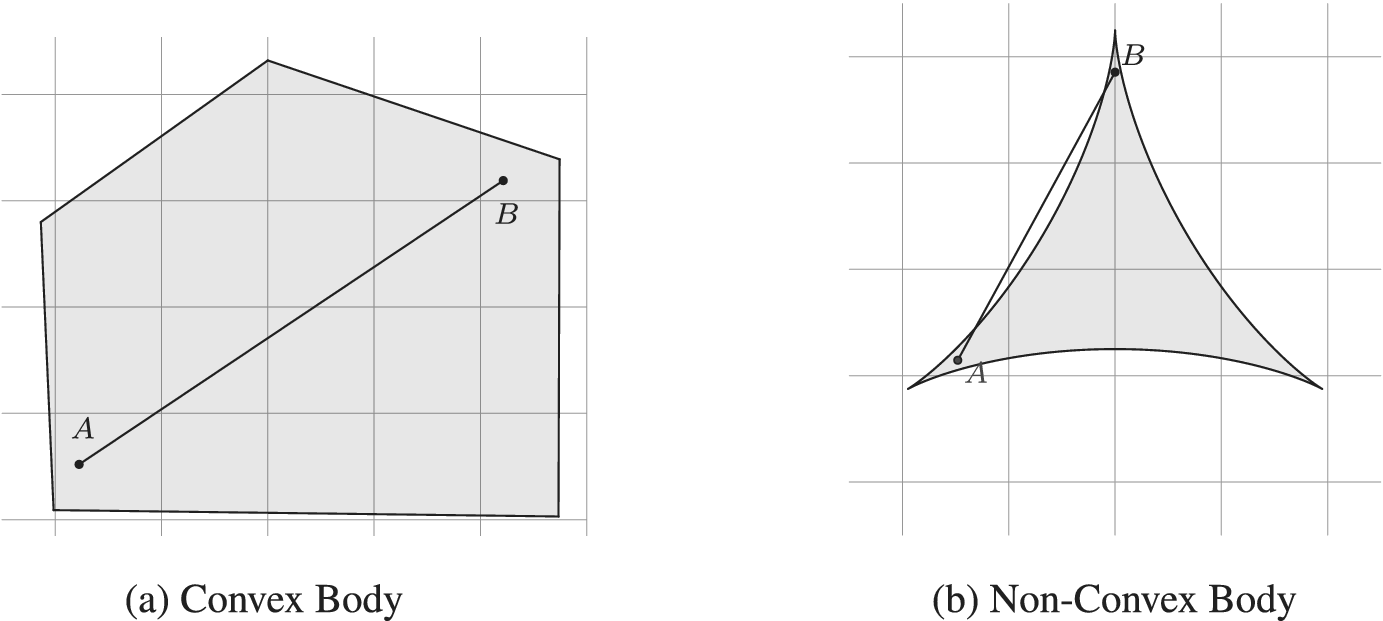
 is called convex if for any two points in K the line segment connecting them is contained in K. Set K is called a convex body if it is a bounded closed convex set with non-empty interior (Figure 2(a)). An example of a non-convex body is given by Figure 2(b).
Convex and non-convex bodies in
$\mathbb {R}^2$
 .

Among those, the origin-symmetric convex bodies are symmetric about the origin, that is, for a point
$v=(v_1,v_2) \in K$
 , we have
$-v=(-v_1,-v_2) \in K$
 as well. For two vectors
$u=(u_1, u_2), v=(v_1,v_2)$
 in
$\mathbb {R}^2$
 , the standard inner product is denoted as
$\langle u,v \rangle = u_1v_1 + u_2v_2$
 . The unit circle
$S^1$
 is the set of unit vectors in
$\mathbb {R}^2$
 .
For a convex body K in
$\mathbb {R}^2$
 , a supporting line H of K is a line that intersects the boundary of K but not the interior of K. The support function
$h_K$
 of K corresponds
$\xi \in S^1$
 to the signed distance from the origin to the supporting line
$H(\xi )$
 with the normal vector
$\xi $
 . Thus,

and

For
$\xi \in S^1$
 , two parallel supporting lines of K with normal vector
$\xi $
 determine a slab
$S_K(\xi )$
 ,

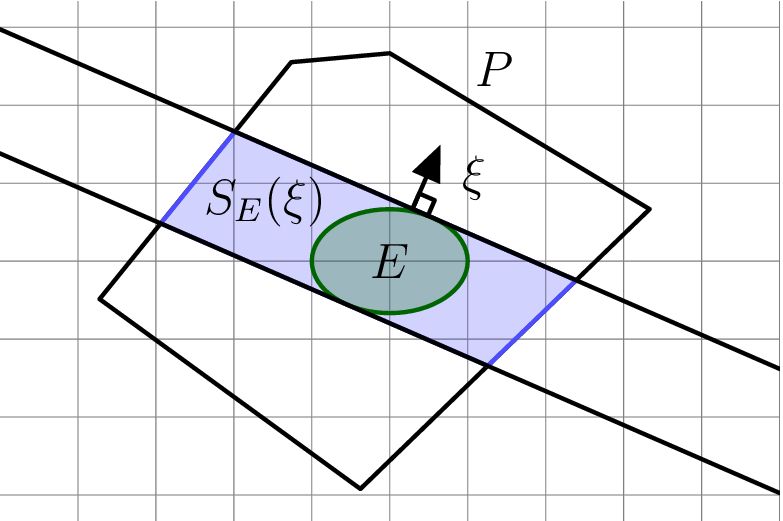
As Figure 3 indicates, we are interested in the intersection of a convex body P with a slab defined by E.
Intersection of a slab
$S_E(\xi )$
 with P.

To extend the notion of slab
$S_K$
 for a convex body K to non-convex structures, we recall the notion of envelope [Reference Bruce and Giblin4]. For a family of lines in the plane, the envelope (if it exists) can be thought of as a curve on which each point belongs to at least one of the lines.
Definition 2.1 For
$\theta \in \mathbb {R}$
 and a differentiable F, let a family of lines be defined by
$F(\theta ,x_1,x_2)=~0$
 . The envelope is the set of points
$(x_1,x_2) \in \mathbb {R}^2$
 that satisfy

For example, the envelope of the family of supporting lines for a convex body K is
$\partial K$
 , the boundary of K. If the family of lines is defined by a smooth function, each line has a unique common point
$X_\xi $
 with the envelope, supporting point. The following well-known proposition provides a way to trace
$X_\xi $
 .
Proposition 2.1 [Reference Martinez-Maure12, pp. 15–16]
Given an envelope
$M \subset \mathbb {R}^2$
 with a smooth support function
$h_M$
 and
$\xi = (\cos \theta , \sin \theta ) \in S^1$
 , the unique support point
$X_\xi $
 is given by

2.2 Hedgehogs
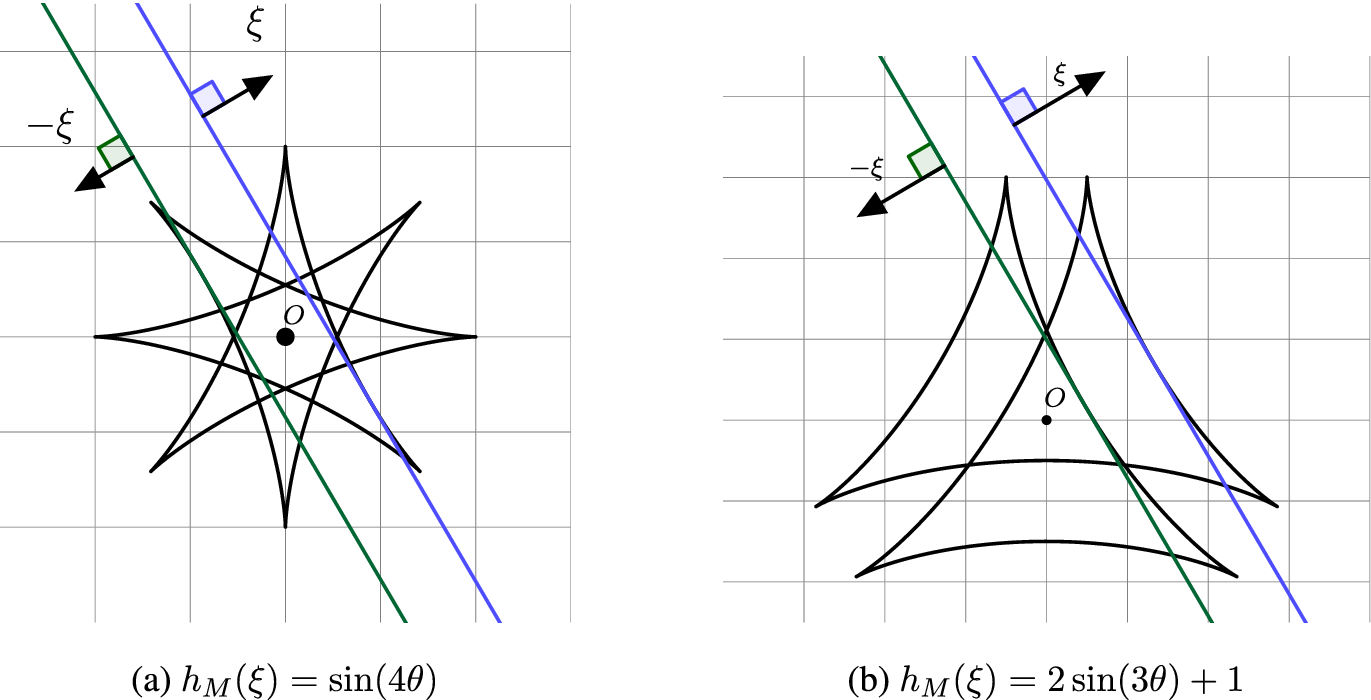
An envelope of lines that does not necessarily result in a convex body can have a peculiar shape that is reflected in its name (Figures 4(a) and 4(b)).
Definition 2.2 For
$\xi \in S^1$
 and a smooth function
$h_M(\xi )$
 on
$S^1$
 , a hedgehog M is the envelope of the family of lines defined by
$\langle (x_1,x_2) ,\xi \rangle = h_M(\xi )$
 .
Analytic hedgehogs.

Figure 4 Long description
Two panels, labeled a and b, are presented side-by-side on a light gray grid.
Panel a, titled h sub M xi equals sin 4 theta, features an eight-pointed star-like shape centered at point O. The shape is formed by overlapping curved arcs. Two parallel diagonal lines intersect the shape. A blue line on the right is tangent to one of the star's points; a perpendicular arrow labeled xi points away from it, marked with a right-angle symbol. A green line on the left is tangent to an opposite curve; a perpendicular arrow labeled minus xi points in the opposite direction, also marked with a right-angle symbol.
Panel b, titled h sub M xi equals 2 sin 3 theta plus 1, features a three-pointed, deltoid-like shape with concave sides, also centered at point O. Similar to panel a, a blue tangent line on the right has a normal vector arrow labeled xi, and a green tangent line on the left has a normal vector arrow labeled minus xi. Both vectors are perpendicular to their respective lines as indicated by right-angle symbols.
In particular, the definition implies that
$h_M = h_M(\xi (\theta ))$
 is
$2\pi $
 -periodic. Moreover, (1) does not depend on the convexity assumption and can be used to parametrize M for
$\theta \in [0, 2\pi ]$
 . This way the notion of support line
$H(\xi )$
 for a hedgehog M extends to
$\langle (x_1,x_2) ,\xi \rangle = h_M(\xi )$
 . See [Reference Martinez-Maure12] for more information on hedgehog theory and its fruitful applications.
2.3 Real analytic functions
Definition 2.3 [Reference Krantz and Parks11, p. 3]
Let U be an open set in
$\mathbb {R}$
 . Function f is said to be real analytic at a point
$c \in U$
 if f is equal to a convergent power series in some neighborhood of c,

A function f is said to be real analytic on a open set U if f is real analytic at every point of U. Recall that the basic arithmetic operations on two analytic functions yield an analytic function.
Theorem 2.1 [Reference Krantz and Parks11, pp. 4–6]
Let f be real analytic function on A and g be real analytic function on B; then the following holds:
-
• $f \pm g$
 is real analytic on
$A \cap B$
;
-
• $f\cdot g$
is real analytic on
$A \cap B$
; -
• $f/g$
is real analytic on
$(A \cap B )/\{ t\in \mathbb {R}| \, g(t)=0\}$
.


A profound property of unique analytic extension plays a vital role in the following proofs.
Theorem 2.2 [Reference Krantz and Parks11, p. 13]
If f and g are real analytic on an open set U and there is an open set
$W \subset U $
 such that

then

We also deal with piecewise analytic functions, that is, functions that are not analytic on a finite set of points but analytic otherwise.
3 Proofs of the theorems
In this section, we provide the proofs of Theorems 1.1 and 1.2 in the analytic settings that allow to generalize and simplify some of the approaches taken in [Reference Xiong, Ma and Cheung16–Reference Yaskin and Yaskina18].
3.1 Proof of Theorem 1.1
Proof Suppose to the contrary that P and Q are two distinct convex polygons in
$\mathbb {R}^2$
 that contain an analytic hedgehog M in their respective interiors, and for every supporting line H of M,
$\text {vol}_{1}\left ({P \cap H}\right ) = \text {vol}_{1}\left ({Q \cap H}\right )$
 . Hence, neither of the polytopes is contained in the interior of the other; otherwise,
$\text {vol}_{1}\left ({P \cap H}\right ) \neq \text {vol}_{1}\left ({Q \cap H}\right )$
 . Thus, there must be a point of intersection of the boundaries of P and Q where they intersect transversally. Let this point of intersection be
$u_1 \in \partial P \cap \partial Q$
 . Then, we consider a parametrization of the corresponding edges of P and Q containing
$u_1$
 ,

Since the boundaries intersect transversely at
$u_1$
 , we must have
$\ell _1$
 is not parallel to
$m_1$
 .
Let
$\xi _0 \in S^1$
 such that
$H(\xi _0)$
 passes through
$u_1$
 and is a supporting line of M. Then,
$H(\xi _0)$
 must also contain another intersection point of the boundaries of P and Q; otherwise,
$\text {vol}_{1}\left ({P \cap H}\right ) \neq \text {vol}_{1}\left ({Q \cap H}\right ) $
 . Similarly, the parametrization of the other pair of the intersected edges is

where
$x(s_1) = u_1 + \ell _1 s_1$
 and
$x(s_2) = u_2 + \ell _2 s_2$
 are the edges of P, and
$x(t_1) = u_1 + m_1t_1$
 and
$x(t_2) = u_2 + m_2t_2$
 are the edges of Q. Consider a small open interval
$\Lambda $
 of
$S^1$
 such that

For any
$\xi \in \Lambda $
 , there are four points of intersection with the sides of the polygons,
$p_1,\ p_2,\ q_1,$
 and
$q_2$
 . To determine these points, we solve the following systems of equations:

For
$i =1, 2$
 , these yield

The condition
$\text {vol}_{1}\left ({P \cap H}\right ) = \text {vol}_{1}\left ({Q \cap H}\right )$
 implies the equality between vectors
${p_1-p_2}$
 and
$q_1-q_2$
 for
$\xi \in \Lambda $
 ,

Since
$h_M(\xi )$
 is piecewise analytic on
$S^1$
 , there exists a finite set
$X = \{ x_1 , x_2, \ldots , x_n, \} \subset S^1$
 , where
$h_M$
 is not analytic and
$h_M$
 is analytic on every subinterval of
$S^1/X$
 . A vector
$ \xi \in S^1$
 is parametrized in terms of angle
$\theta \in [-\pi , \pi ]$
 ,
$\xi = (\cos \theta , \sin \theta )$
 . Let both sides of equation (4) be

By Theorem 2.1,
$f(\xi )$
 is analytic on
$S^1 /\left (X \cup \left \{ \ell _1^\perp , \ell _2^\perp \right \}\right )$
 . Analogously,
$g(\xi )$
 is analytic on
$S^1 /\left (X \cup \left \{ m_1^\perp , m_2^\perp \right \}\right )$
 . Now, consider the four lines that contain the intersected sides of the polytopes and extend the measurements of the corresponding segments between the lines analytically (and, by Theorem 2.2, uniquely), beyond the sides of polygons P and Q.
Since
$f(\xi ) = g(\xi )$
 for
$\xi \in \Lambda $
 , then the set of directions on
$S^1$
 , where
$f(\xi )$
 is not analytic, coincides with the set of such directions for
$ g(\xi )$
 ,
$\{X,m_1^\perp , m_2^\perp \}=\{X,\ell _1^\perp , \ell _2^\perp \}$
 , that gives
$\{\ell _1^\perp , \ell _2^\perp \} = \{m_1^\perp , m_2^\perp \}$
 .
3.1.1 Case
$\ell _1^\perp = m_1^\perp $
(
$\ell _1$
is parallel to
$m_1$
)


This is a contradiction to the assumption on transversality of the edges assumed in (2).
3.1.2 Case
$\ell _1^\perp = m_2^\perp $
(
$\ell _1$
is parallel to
$m_2$
)


In this case,
$\ell _1 = \pm m_2$
 and
$\ell _2 = \pm m_1$
 . Then, (4) implies

This shows that either
$\ell _1$
 is parallel to
$\ell _2$
 , or
$\left \langle \frac {u_1+u_2}{2},\xi \right \rangle = h_M(\xi )$
 . Since
$u_1$
 and
$u_2$
 are fixed and
$\xi \in S^1/(X \cup \{\ell _1^\perp ,\ell _2^\perp ,m_1^\perp ,m_2^\perp \})$
 , almost every supporting line of M must pass through a common point
$\frac {u_1+u_2}{2}$
 . This is impossible for a nontrivial hedgehog M.
Since both cases yield a contradiction, there is no point at which P and Q intersect transversely. As they are not subsets of each other, they must coincide,
$P= Q$
 .
3.2 Proof of Theorem 1.2
Proof Suppose to the contrary that P and Q are origin-symmetric distinct polygons in
$\mathbb {R}^2$
 with an analytic hedgehog M fully contained in their interiors,
$M \subset \text {int}(P \cap Q)$
 , yet

Note that neither of the polytopes can be a subset of the other; otherwise,
$\text {vol}_{2}\left ({P \cap S_M(\xi )}\right ) \neq \text {vol}_{2}\left ({Q \cap S_M(\xi )}\right )$
 . Since their interiors intersect (as they both contain M), there must exist a point
$u \in \partial P \cap \partial Q$
 . Moreover, u can be chosen so that the sides of the polygons intersect transversally at u. Consequently, the parametrizations of the lines containing the corresponding sides of P and Q containing u are

Since the intersection is transversal, we have
$\ell _1$
 is not parallel to
$m_1$
 .
For the standard basis
$\{e_1,e_2\}$
 of
$\mathbb {R}^2$
 , consider a coordinate system such that u belongs to the horizontal line
$\langle x , e_2 \rangle = h_M(e_2)$
 and the half plane
$\langle x , e_1 \rangle < 0$
 . Since the direction vectors of the sides cannot be horizontal, let
$\langle \ell _1 , e_2 \rangle> 0$
 and
$\langle m_1 , e_2 \rangle> 0$
 . Let
$v, w$
 be the other points of intersection of the line
$\langle x , e_2 \rangle = h_M(e_2)$
 with P and Q, respectively. The lines containing the points
$v,w$
 and the corresponding lines are

Similarly, assume
$\langle \ell _2,e_2\rangle < 0$
 and
$\langle m_2,e_2 \rangle < 0$
 .
Let
$\Omega \subset S^1$
 be an open set of unit vectors
$\xi $
 such that the line
$\langle x,\xi \rangle = h_M(\xi )$
 intersects the sides given by equations (5) and (6) but contains no vertices. Moreover, if
${\xi \in \Omega} $
 ,
$\xi (\phi ) = (\cos (\frac {\pi }{2}-\phi ),\sin (\frac {\pi }{2}-\phi )) = (\sin \phi ,\cos \phi )$
 . Then, the line
$\langle x,\xi \rangle =h_M(\xi )$
 intersects P and Q at four points that are determined by the systems of equations,

This yields

Consider the following sets for P and Q,

By assumption of the theorem,

which implies that
$X+Y = X'+Y'$
 and
$X+Z= X'+Z'$
 . Hence,
$Y-Z = Y'-Z'$
 that reads

or equivalently,

Therefore, for
$\xi \in \Omega $
 , the area of the triangle with vertices of u,
$p_1$
 , and
$q_1$
 is equal to the area of quadrilateral with vertices v, w,
$p_2$
 , and
$q_2$
 .
Recall that the area A of a simple polygon (a polygon without self intersections) with vertices
$x_1,x_2,x_3,\ldots ,x_k$
 in counterclockwise order is known from [Reference Braden3],

where
$| \cdot , \cdot |$
 is the determinant of
$2 \times 2$
 matrix. If u,
$q_1$
 , and
$p_1$
 are in counterclockwise orientation, then v, w,
$q_2$
 , and
$p_2$
 are also in counterclockwise orientation (otherwise, the areas of the triangle and the quadrilateral signs do not coincide).
Denote the corresponding values of the parameters for the four points as
$a= \frac {h_M(\xi ) - \langle u ,\xi \rangle }{\langle m_1 ,\xi \rangle }$
 ,
$b = \frac {h_M(\xi ) - \langle u ,\xi \rangle }{\langle \ell _1 ,\xi \rangle }$
 ,
$c = \frac {h_M(\xi ) - \langle v ,\xi \rangle }{\langle \ell _2 ,\xi \rangle } $
 , and lastly
$d = \frac {h_M(\xi ) - \langle w ,\xi \rangle }{\langle m_2 ,\xi \rangle }$
 . To determine the area
$A_\triangle $
 of the triangle with vertices
$u, q_1,p_1$
 , we evaluate the following:

The sum yields
$A_{\triangle } = \frac {1}{2} ab|m_1,\ell _1| = \frac {1}{2}\left ( \frac {(h_M(\xi ) - \langle u, \xi \rangle )^2}{\langle \ell _1,\xi \rangle \langle m_1,\xi \rangle } \right )|m_1,\ell _1|$
 . For the area
$A_\square $
 of the quadrilateral with vertices
$v,w,q_1$
 , and
$ p_1$
 , the corresponding determinants are

The sum yields the area
$A_\square $
 ,

By (7),
$A_\triangle = A_\square $
 that reads

Let
$u = \alpha e_1 + h_M(e_2)e_2$
 ,
$v = \beta e_1 + h_M(e_2)e_2$
 , and
$w = \gamma e_1 + h_M(e_2)e_2$
 , where
$\alpha < 0$
 ,
$\beta> 0$
 , and
$\gamma> 0$
 . Since
$h(\phi ) = h_M(\xi (\phi ))$
 is real analytic on
$S^1$
 , then
$h_M$
 is equal to its power series around
$e_2$
 (
$\phi =0$
 ) on
$\Omega $
 ,

By the chain rule for
$\xi \in \Omega $
 ,
$x_1 = \sin \phi $
 ,
$x_2 = \cos \phi $
 ,

Hence, the Taylor expansion of h about
$\phi = 0$
 is

Also consider the Taylor expansion of
$\langle x,\xi (\phi ) \rangle $
 for sufficiently small
$\phi $
 , where
$x=\lambda e_1 + h(e_2)e_2 $
 ,

Then,

Since the above holds for all points x on the horizontal line
$\langle x ,e_2\rangle = h_M(e_2)$
 , for
$x = u,v,w$
 , we have

Furthermore, for
$m_i = (m_{i_1},m_{i_2})$
 ,
$\ell _i = (\ell _{i_1},\ell _{i_2})$
 , the denominators in (8) can also be expanded around
$e_2$
 ,

For the reciprocal of
$\langle \ell _i ,\xi \rangle $
 and
$\langle m_i,\xi \rangle $
 , we get

where
$\epsilon (\phi ) = \frac {\ell _{i_1}}{\ell _{i_2}} \phi + o(\phi ^2)$
 . Thus,

Consequently, for sufficiently small
$\phi $
 , the expansions of the left-hand side (LHS) and the three terms of the right-hand side (RHS) in (8) are

Equating the expansions of the two sides and collecting linear terms in
$\phi $
 yields

Note
$v - w = (\beta - \gamma ) e_1$
 , then
$ |v-w, \ell _2 | = (\beta - \gamma ) \langle \ell _2 ,e_2\rangle. $
 Analogously, for
$m_2$
 ,
$|v-w , m_2| = (\beta - \gamma ) \langle m_2,e_2\rangle $
 . Then, (10) gives
$ (\beta - \gamma ) ( \tilde {\beta } + \tilde {\gamma }) = 0. $

If
$\beta = \gamma $
 , then
$v = w$
 . Otherwise,
$ \tilde {\beta } = - \tilde {\gamma }$
 ; then by the definition of
$\tilde {\beta }$
 and
$\tilde {\gamma }$
 , this yields
$ h_{x_1}(e_2) = \frac {\beta + \gamma }{2} .\label {eqn:contradiction2} $
 Furthermore, note that the midpoint of v and w is then given by
$\left (\frac {\beta +\gamma }{2},h_M(e_2) \right ) = \left ( h_{x_1}(e_2),h(e_2) \right )$
 .
By (1), a support point
$X_\xi \in M$
 for
$\xi = (\sin \phi ,\cos \phi )$
 is
$X_\xi = h_M(\xi ) \xi + \frac {dh_M(\xi )}{d\phi } \xi ^\perp $
 . Note that
$\xi ^\perp = (\cos \phi ,-\sin \phi )$
 . If
$\xi = e_2$
 (i.e.,
$\phi =0$
 ), then
$\xi ^\perp = e_1$
 . Using the chain rule,
$\frac {d h}{d \phi } (e_2) = h_{x_1} (e_2)$
 . This yields that
$X_{e_2} = h(e_2) e_2 +h_{x_1}(e_2)e_1 = (h_{x_1}(e_2),h(e_2))$
 . Thus, the support point
$X_{e_2}$
 of M is the midpoint between v and w. In particular, that means
$X_{e_2} \in M$
 ,
$X_{e_2} \not \in P \cap Q$
 , which is impossible since
$M \subset P \cap Q$
 , so
$\tilde {\beta } \neq -\tilde {\gamma }$
 .
Under the assumption
$\beta = \gamma $
 (or equivalently,
$v=w$
 ), (8) results in
$ \frac {(h_M(\xi ) - \langle u, \xi \rangle )^2}{\langle \ell _1,\xi \rangle \langle m_1,\xi \rangle } |m_1,\ell _1| = \frac {(h_M(\xi ) - \langle v, \xi \rangle )^2}{\langle \ell _2,\xi \rangle \langle m_2,\xi \rangle } |m_2,\ell _2| .\label {eqn:equality-v-w} $
 By Theorem 2.1, both sides are analytic, and by Theorem 2.2 their analytic extensions are unique and coincide beyond the intersected sides of the polygons. Then, the points of non-analyticity of the LHS and RHS must coincide. Thus,
$\{\ell _1^\perp , m_1^\perp \} = \{\ell _2^\perp , m_2^\perp \}$
 . Furthermore, it implies that the pair of vectors
$\{\ell _1, m_1\}$
 must have the same orientation as
$\{\ell _2, m_2\}$
 (otherwise, the signs of the left side and the right side are distinct). Then, the only possible outcome is
$\ell _1 =-\ell _2$
 and
$m_1 = -m_2$
 . To conclude the proof, we show that this is impossible.
Since P and Q are symmetric in origin,
$-u \in P \cap Q$
 if
$u \in P \cap Q$
 . Then, the sides of P and Q containing
$-u$
 have directions
$\ell _1$
 and
$m_1$
 , respectively. Hence,
$u,v,$
 and
$-u$
 belong to the pairwise parallel sides of P and Q. As a convex polygon cannot have three distinct parallel sides, u and
$-v$
 belong to the same sides of P and Q. Therefore, the side of P that is adjacent to
$-u$
 and parallel to
$\ell _1$
 should be the same as the side of P that is adjacent to v and parallel to
$\ell _1$
 . Thus,
$-u$
 lies on the straight line that passes through v and is parallel to
$\ell _1$
 . Similarly,
$-u$
 lies on the straight line that passes through v and is parallel to
$m_1$
 . Since
$\ell _1$
 is not parallel to
$m_1$
 , this gives
$v = -u$
 . This is not possible and implies
$P=Q$
 .
Note that the above proof relies on the fact that a supporting line
$H(\xi )$
 that defines a slab and contains a common point of P and Q corresponds to an analytical point
$\xi $
 of
$h_M$
 .
Corollary 3.0.1 Theorem 1.2 still holds if
$h_M(\xi )$
 is piecewise analytic on
$S^1$
 and analytic for
$\xi $
 such that
$H(\xi )$
 contains a common point of P and Q.
Acknowledgments
I would like to express gratitude to my supervisor, Dr. Serhii Myroshnychenko, for the guidance and support provided throughout this research project. I also thank the Department of Mathematics and Statistics at UFV for the many opportunities and encouragement offered during my studies. In addition, I would like to acknowledge NSERC for the Undergraduate Student Research Award, which allowed me to pursue research in a subject I am deeply passionate about. Finally, I thank the anonymous reviewers for their valuable comments and suggestions, which helped improve this work.






 Open access

