Although the authors are perhaps attacking a straw-man, we agree with many points raised in Jones & Love's (J&L's) critique of “Bayesian Fundamentalism.” It is our objective here to strengthen their claim that Bayesian Fundamentalism is empirically unconstrained; although such claims are often made, their basis is not usually fleshed out in any detail. This is such a key part of the case that we sketch a proof and discuss possible solutions.
Without placing constraints on prior beliefs, likelihood, and utility functions, claims of Bayesian rationality are empirically empty: any behaviour is consistent with that of some rational Bayesian agent. To illustrate this point, consider a simple probability learning task in which a participant has two response options (e.g., press a left or a right button), only one of which will be rewarded. On each trial t, the participant gives a response x
t
={0,1}, and then observes the placement of the reward y
t
={0,1}, which is under control of the experimenter. The question is whether the assumption of Bayesian rationality places any restrictions on the response sequence for a given reward sequence.
In Bayesian inference, the prior distribution and likelihood (model of the task) assign a probability P(y
t
= S
j
) to each possible reward sequence. Without further constraints, we can take this probability to be proportional to a value v
j
≥ 0. After observing y
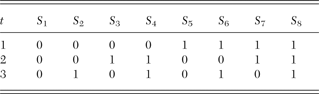
1, some of the rewarded sequences are impossible, and learning consists of setting the probability of these sequences to 0 and then renormalizing. For example, consider a task with three trials. The possible reward (and response) sequences are given in Table 1. Assume the sequence of rewards is y = S
1. After observing y
1=0, S
5 to S
8 are impossible and the posterior probabilities become P(S
j
|y
1) = v
j/Σ
k
v
k
, for j, k = 1, …, 4, and P(S
j
|y
1)=0 for j=5, …, 8. After observing y
2 = 0, S
3 and S
4 are also impossible, and the posterior probabilities become P(S
j
|y
1) = v
j
/Σ
j
v
k
, for j, k = 1, 2, and P(S
j
|y
1) = 0, for j=3, 4. After observing y
3 = 0, only S
1 remains with a probability 1.
Table 1.
Possible reward and response sequences (Sj) in a simple learning task with three trials (t)
A rational Bayesian agent gives responses which maximise his or her subjective expected utility, conditional upon the previously observed rewards. For simplicity, assume the utility of a correct prediction is u(y
t
=x
t
)=1 and that of an incorrect prediction is u(y
t
≠x
t
)=0, so that the expected utilities correspond to the posterior predicted probabilities of the next reward. The crucial point is that in this general setup, we can always choose the values v
j
to make any sequence of responses x
t
conform to that of a maximizer of subjective expected utility. For example, suppose the sequence of rewards is S
1 and the sequence of responses is S
8. The first response x
1=1 implies that v
1+v
2+v
3+v
4
v
5+v
6+v
7+v
8; the second response x
2=1 implies that v
1+v
2
v
3+v
4; the third response x
3 = 1 implies that v
1
v
2. One choice of values consistent with this is v
j
=j. For any response sequence, we can choose values which adhere to such implied inequalities, so behaviour is always consistent with a rational Bayesian agent. Although we have considered a rather simple situation with a small number of trials, this result generalizes readily to other sequential learning tasks such as category learning (for a related, more general and formal proof, see, e.g., Zambrano Reference Zambrano2005). The problem becomes even more severe if we allow the utilities to depend on previous outcomes, which may not be entirely implausible (e.g., a third misprediction in a row may be more unpleasant than the first).
One may object that the particular method of Bayesian inference sketched here is implausible: Would someone really assign probabilities to all possible reward sequences? Maybe not explicitly, but in an abstract sense, this is what Bayesian modelling boils down to. Granted, the values assigned have been arbitrary, but that is exactly the point: Bayesian rationality is silent about the rationality of priors and likelihoods, yet some of these seem more rational than others. Thus, rationality hinges on more than adherence to Bayesian updating and utility maximization.
Is the claim of Bayesian inference and decision making always empirically empty? No. For instance, the assumption that rewards are exchangeable (that they can be reordered without affecting the probabilities) places equivalence restrictions on the values v such that, given a sufficient number of trials, some response sequences would violate utility maximization. Exchangeability is crucial to the convergence of posterior probabilities and the decisions based on them. Another option would be to let participants make multiple decisions while keeping their information base (posterior probabilities) constant, so that intransitive decisions become possible. More generally, testable conditions of Bayesian rationality can be found in the axioms of subjective expected utility theory (e.g., Savage Reference Savage1954). Empirically meaningful claims of Bayesian rationality should minimally ensure the possibility that the data can falsify these axioms. Axiomatic tests are “model-free” in the sense that they do not rely on a particular choice of prior distribution and utility function. Such tests should be a first step in rational analysis; if the assumption of Bayesian rationality is not rejected, one can then look for priors and utilities which match the observed behaviour. Given rich-enough data, this search can be guided by conjoint measurement procedures (e.g., Wallsten Reference Wallsten1971).
To conclude, while “Bayesian Fundamentalism” is generally unconstrained, by placing appropriate restrictions, the assumption of Bayesian rationality is subject to empirical testing and, when not rejected, can help guide model building.





Although the authors are perhaps attacking a straw-man, we agree with many points raised in Jones & Love's (J&L's) critique of “Bayesian Fundamentalism.” It is our objective here to strengthen their claim that Bayesian Fundamentalism is empirically unconstrained; although such claims are often made, their basis is not usually fleshed out in any detail. This is such a key part of the case that we sketch a proof and discuss possible solutions.
Without placing constraints on prior beliefs, likelihood, and utility functions, claims of Bayesian rationality are empirically empty: any behaviour is consistent with that of some rational Bayesian agent. To illustrate this point, consider a simple probability learning task in which a participant has two response options (e.g., press a left or a right button), only one of which will be rewarded. On each trial t, the participant gives a response x t ={0,1}, and then observes the placement of the reward y t ={0,1}, which is under control of the experimenter. The question is whether the assumption of Bayesian rationality places any restrictions on the response sequence for a given reward sequence.
In Bayesian inference, the prior distribution and likelihood (model of the task) assign a probability P(y t = S j ) to each possible reward sequence. Without further constraints, we can take this probability to be proportional to a value v j ≥ 0. After observing y 1, some of the rewarded sequences are impossible, and learning consists of setting the probability of these sequences to 0 and then renormalizing. For example, consider a task with three trials. The possible reward (and response) sequences are given in Table 1. Assume the sequence of rewards is y = S 1. After observing y 1=0, S 5 to S 8 are impossible and the posterior probabilities become P(S j |y 1) = v j/Σ k v k , for j, k = 1, …, 4, and P(S j |y 1)=0 for j=5, …, 8. After observing y 2 = 0, S 3 and S 4 are also impossible, and the posterior probabilities become P(S j |y 1) = v j /Σ j v k , for j, k = 1, 2, and P(S j |y 1) = 0, for j=3, 4. After observing y 3 = 0, only S 1 remains with a probability 1.
Possible reward and response sequences (Sj) in a simple learning task with three trials (t)
A rational Bayesian agent gives responses which maximise his or her subjective expected utility, conditional upon the previously observed rewards. For simplicity, assume the utility of a correct prediction is u(y t =x t )=1 and that of an incorrect prediction is u(y t ≠x t )=0, so that the expected utilities correspond to the posterior predicted probabilities of the next reward. The crucial point is that in this general setup, we can always choose the values v j to make any sequence of responses x t conform to that of a maximizer of subjective expected utility. For example, suppose the sequence of rewards is S 1 and the sequence of responses is S 8. The first response x 1=1 implies that v 1+v 2+v 3+v 4 v 5+v 6+v 7+v 8; the second response x 2=1 implies that v 1+v 2 v 3+v 4; the third response x 3 = 1 implies that v 1 v 2. One choice of values consistent with this is v j =j. For any response sequence, we can choose values which adhere to such implied inequalities, so behaviour is always consistent with a rational Bayesian agent. Although we have considered a rather simple situation with a small number of trials, this result generalizes readily to other sequential learning tasks such as category learning (for a related, more general and formal proof, see, e.g., Zambrano Reference Zambrano2005). The problem becomes even more severe if we allow the utilities to depend on previous outcomes, which may not be entirely implausible (e.g., a third misprediction in a row may be more unpleasant than the first).
One may object that the particular method of Bayesian inference sketched here is implausible: Would someone really assign probabilities to all possible reward sequences? Maybe not explicitly, but in an abstract sense, this is what Bayesian modelling boils down to. Granted, the values assigned have been arbitrary, but that is exactly the point: Bayesian rationality is silent about the rationality of priors and likelihoods, yet some of these seem more rational than others. Thus, rationality hinges on more than adherence to Bayesian updating and utility maximization.
Is the claim of Bayesian inference and decision making always empirically empty? No. For instance, the assumption that rewards are exchangeable (that they can be reordered without affecting the probabilities) places equivalence restrictions on the values v such that, given a sufficient number of trials, some response sequences would violate utility maximization. Exchangeability is crucial to the convergence of posterior probabilities and the decisions based on them. Another option would be to let participants make multiple decisions while keeping their information base (posterior probabilities) constant, so that intransitive decisions become possible. More generally, testable conditions of Bayesian rationality can be found in the axioms of subjective expected utility theory (e.g., Savage Reference Savage1954). Empirically meaningful claims of Bayesian rationality should minimally ensure the possibility that the data can falsify these axioms. Axiomatic tests are “model-free” in the sense that they do not rely on a particular choice of prior distribution and utility function. Such tests should be a first step in rational analysis; if the assumption of Bayesian rationality is not rejected, one can then look for priors and utilities which match the observed behaviour. Given rich-enough data, this search can be guided by conjoint measurement procedures (e.g., Wallsten Reference Wallsten1971).
To conclude, while “Bayesian Fundamentalism” is generally unconstrained, by placing appropriate restrictions, the assumption of Bayesian rationality is subject to empirical testing and, when not rejected, can help guide model building.