





1 Introduction
Given a cardinal
$\kappa \geq \aleph _2$
 , the “
$\kappa $
 -Cohen model” means any model obtained by forcing over a model of CH with the poset
$\mathrm {Fn}(\kappa ,2)$
 of finite partial functions
$\kappa \to 2$
 , the usual poset for adding
$\kappa $
 mutually generic Cohen reals. In this article, we look at the question of whether the
$\kappa $
 -Cohen model contains nontrivial automorphisms of the Boolean algebra
 . We prove that the answer is yes if
$\kappa < \aleph _\omega $
 , and the answer is yes for all
$\kappa $
 under some additional “L-like” hypotheses on the ground model. Furthermore, if
$\kappa $
 is regular, then not only do these models contain nontrivial automorphisms, but they contain
$2^{\mathfrak {c}}$
 of them, the maximum possible number.
Main Theorem Assume
$\textsf {CH}$
 , let
$\kappa \geq \aleph _2$
 , and let
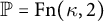
$\mathbb {P} = \mathrm {Fn}(\kappa ,2)$
 .
-
(1) If $\kappa < \aleph _\omega $
 , then every automorphism of
in V extends to
$2^\kappa $
automorphisms of
in
$V^{\mathbb {P}}$
.
-
(2) More generally, if $\kappa $
is a regular cardinal and there is a sage Davies tree of length
$\kappa $
, then every automorphism of
in V extends to
$2^\kappa $
automorphisms of
in
$V^{\mathbb {P}}$
. -
(3) If $\kappa $
is a singular cardinal and there is a sage Davies tree of length
$\nu = \kappa ^\omega $
, then there are nontrivial automorphisms of
in
$V^{\mathbb {P}}$
.


A Davies tree is a sequence
$\left \langle M_\alpha \colon \alpha < \kappa \right \rangle $
 of elementary submodels of some large fragment
$H_\theta $
 of the set-theoretic universe such that the
$M_\alpha $
 enjoy certain coherence and covering properties. (These sequences are called “trees” because they are constructed by cleverly enumerating the leaves of a tree of elementary submodels of
$H_\theta $
 .) These structures provide a unified framework for carrying out a wide variety of constructions in infinite combinatorics. They were introduced by Davies in [Reference Davies3], and an excellent survey of their many uses can be found in [Reference Soukup and Soukup23]. A version of Davies trees using countably closed models, called sage Davies trees, is introduced in [Reference Soukup and Soukup23]. Their construction uses the singular cardinals hypothesis
$\textsf {SCH}$
 below
$\kappa $
 (the length of the sequence), plus
$\square _\lambda $
 for limit cardinals
$\lambda < \kappa $
 of countable cofinality. As these hypotheses are vacuously true for
$\kappa < \aleph _\omega $
 , sage Davies trees of length
$\kappa <\aleph _\omega $
 can be proved to exist from ZFC alone. In particular, part
$(1)$
 of our main theorem is a direct consequence of
$(2)$
 ; we have stated it separately simply to emphasize that
$(1)$
 is a theorem of ZFC, while the more general
$(2)$
 requires an additional hypothesis, when
$\kappa \geq \aleph _\omega $
 . As shown in [Reference Soukup and Soukup23], it is consistent relative to a supercompact cardinal that there are no sage Davies trees of length
$\geq \aleph _\omega $
 (and a large cardinal hypothesis is necessary because the failure of either
$\textsf {SCH}$
 or
$\square _\lambda $
 has large cardinal strength). We do not know whether the general conclusion of
$(2)$
 is a theorem of ZFC.
The
$\kappa = \aleph _2$
 case of our main theorem was proved by Shelah and Steprāns in [Reference Shelah and Stepr22]. (Their theorem states only that the
$\aleph _2$
 -Cohen model contains nontrivial automorphisms, but their argument can be modified to obtain
$2^{\aleph _2}$
 automorphisms extending any given ground model automorphism.) However, the Shelah–Steprāns proof does not work for
$\kappa \geq \aleph _3$
 .
Roughly, the reason is that
 has a special structure in the
$\aleph _2$
 -Cohen model, a kind of “near-saturation” that enables some CH-like constructions, or modifications of them, to go through in the
$\aleph _2$
 -Cohen model (see [Reference Dow and Hart6] or [Reference Steprāns24]). (Recall that
 is a countably saturated Boolean algebra, as shown in [Reference Jónsson and Olin14, Reference Parovičenko16]. Under CH, where
 can be written as an increasing union of countable subalgebras, this enables us to recursively construct many automorphisms of
 .) The Shelah–Steprāns result in [Reference Shelah and Stepr22] predates [Reference Dow and Hart6, Reference Steprāns24], but in hindsight their argument utilizes aspects of this special structure in the
$\aleph _2$
 -Cohen model. These nice features of the
$\aleph _2$
 -Cohen model that drive the Shelah–Steprāns proof are simply lacking in the
$\kappa $
 -Cohen model for larger
$\kappa $
 .
Specifically, the Shelah–Steprāns proof for
$\kappa = \aleph _2$
 relies on two main ideas:
-
(1) Given a subalgebra A of
and an
$(\omega ,\omega )$
-gap in A, the natural forcing poset to fill the gap is countable, hence forcing equivalent to the poset
$\mathrm {Fn}(\omega ,2)$
for adding a single Cohen real. If
$|A| < \kappa $
, then there are many sufficiently generic filters for this poset available in the
$\kappa $
-Cohen model. -
(2) A subalgebra A of a Boolean algebra B is called a $\sigma $
-subalgebra if every gap in A generated by an element of B is an
$(\omega ,\omega )$
-gap. In the
$\aleph _2$
-Cohen model,
is the increasing union of a continuous chain of
$\sigma $
-subalgebras of size
$\aleph _1$
.


The Shelah–Steprāns proof works by first writing
 as an increasing union of a continuous chain of
$\sigma $
 -subalgebras of size
$\aleph _1$
 as in
$(2)$
 , say
 , and doing so in such a way that each
$A_\alpha $
 contains a set of
$\aleph _1$
 reals mutually Cohen-generic over
$\bigcup _{\xi < \alpha }A_\xi $
 . Doing this in the
$\aleph _2$
 -Cohen model is straightforward: as
$\mathrm {Fn}(\omega _2,2)$
 is equivalent to a length-
$\omega _2$
 finite support iteration of
$\mathrm {Fn}(\omega _1,2)$
 , simply write
$V[G]$
 as an increasing union
$V[G] = \bigcup _{\alpha < \omega _2}V[G_\alpha ]$
 , where each
$V[G_\alpha ]$
 is a model of CH and contains
$\aleph _1$
 “fresh” Cohen-generic reals. To build an automorphism
$\Phi $
 in
$V[G]$
 , we begin with some automorphism
$\Phi _0$
 of
 in V and recursively extend it to each
$V[G_\alpha ]$
 . At successor steps, we can extend
$\Phi $
 from
 to
 as follows:
-
○ Using the fact that $V[G_{\alpha +1}] \models \textsf {CH} $
, enumerate
in order type
$\omega _1$
, say
. Stepping through the
$b_\xi $
one at a time, at each step, we add one or two new reals to the domain of
$\Phi $
and close the domain under Boolean operations. In particular, at step
$\xi $
, the domain of
$\Phi $
is countably generated over
. From this and
$(1)$
, it follows that the new real
$b_\xi $
cuts the domain of
$\Phi $
in an
$(\omega ,\omega )$
-gap
$(L,U)$
. -
○ Because $V[G_{\alpha +1}]$
contains
$\aleph _1$
“fresh” Cohen reals over
$V[G_\alpha ]$
, some of these are still untouched and can be used to fill the
$(\omega ,\omega )$
-gap
$(\Phi [L],\Phi [U])$
and find an image for
$b_\xi $
. After adding
$b_\xi $
to the domain of
$\Phi $
, it can be added to the image of
$\Phi $
in a similar fashion.












If
$\kappa \geq \aleph _3$
 , then this argument breaks down. The main reason is that if
$\kappa \geq \aleph _3$
 , then in the
$\kappa $
 -Cohen model
 fails to satisfy fact
$(2)$
 above. In general, a Boolean algebra satisfying
$(2)$
 is called tightly
$\sigma $
 -filtered, a property introduced by Koppelberg in [Reference Koppelberg, Droste and Göbel15]. Geschke proved in [Reference Geschke11] that no complete Boolean algebra of size
$>\!\aleph _2$
 is tightly
$\sigma $
 -filtered, and that
 is tightly
$\sigma $
 -filtered if and only if
$\mathcal P(\omega )$
 is. In particular,
 is not tightly
$\sigma $
 -filtered if
$\mathfrak {c}> \aleph _2$
 .
To get around this obstacle, we show that, under the hypotheses on
$\kappa $
 in the main theorem, in the
$\kappa $
 -Cohen model
 is almost, but not quite, tightly
$\sigma $
 -filtered. More specifically, given a sage Davies tree
$\left \langle M_\alpha \colon \alpha < \kappa \right \rangle $
 in the ground model, let
 . If
$\alpha \geq \omega _2$
 , then
$X_\alpha $
 is not a subalgebra of
 . However, these
$X_\alpha $
 satisfy everything else that we demanded of the
$A_\alpha $
 in the Shelah–Steprāns argument: each
$X_{\alpha +1}$
 is
$\omega _1$
 -generated over
$X_\alpha $
 , contains
$\aleph _1$
 “fresh” Cohen-generic reals over
$X_\alpha $
 , and each member of
$X_{\alpha +1}$
 cuts
$X_\alpha $
 in an
$(\omega ,\omega )$
 -gap. In other words, the
$X_\alpha $
 ’s witness a weakening of
$(2)$
 in which “subalgebra” is replaced by “subset” (hence,
 is almost, but not quite, tightly
$\sigma $
 -filtered). As it turns out, this is sufficient to carry out an argument in the style of Shelah and Steprāns, although some new additional difficulties do arise.
One of the main new difficulties is ensuring
$M_{\alpha +1}[G]$
 contains enough reals to fill all the
$(\omega ,\omega )$
 -gaps that arise while trying to extend a partial automorphism
$\Phi $
 from the algebra generated by
$X_\alpha $
 to the algebra generated by
$X_{\alpha +1}$
 . For this to happen, we must ensure these gaps, and their images under
$\Phi $
 , are members of
$M_{\alpha +1}[G]$
 , since then the posets that fill the gaps are in
$M_{\alpha +1}[G]$
 , which means that
$M_{\alpha +1}[G]$
 can compute sufficiently generic filters on them, using its plenitude of fresh Cohen reals. This requires us to handle the recursion very carefully, so that at stage
$\alpha $
 the automorphism
$\Phi \!\restriction \! \langle \!\langle X_\alpha \rangle \!\rangle $
 is definable from
$\left \langle M_\xi [G] \colon \xi \leq \alpha \right \rangle \in M_{\alpha +1}[G]$
 .
Section 2 describes what becomes of a sage Davies tree after a
$\kappa $
 -Cohen forcing. While the resulting sequence of models is no longer a sage Davies tree, it remembers enough of its original structure to provide a useful combinatorial tool in the extension. In Section 3, we show how to use this tool to extend the Shelah–Steprāns argument from [Reference Shelah and Stepr22] and obtain many automorphisms of
 . Using remnants of sage Davies trees in Cohen models was first explored in [Reference Brian, Dow and Shelah2], though in a rather different way. Also, let us point out that Theorem 2.1(2) is reminiscent of [Reference Fuchino, Koppelberg and Shelah9, Reference Fuchino and Soukup10], where it is shown that
 has the weak Freese–Nation property in
$\kappa $
 -Cohen models under essentially the same hypotheses as in our main theorem.
2 Sage Davies trees after Cohen forcing
In what follows,
$H_\theta $
 denotes the set of all sets hereditarily smaller than some big enough cardinal
$\theta $
 . (Taking
$\theta = (2^\kappa )^+$
 suffices in all that follows.) Given two sets M and N, we write
$M \prec N$
 to mean that
$(M,\in )$
 is an elementary submodel of
$(N,\in )$
 . A set M is countably closed if
$M^\omega \subseteq M$
 . If M satisfies (enough of) ZFC, this is equivalent to the property
$[M]^\omega \subseteq M$
 .
Let
$\kappa $
 be a cardinal with
$\mathrm {cf}(\kappa )> \omega $
 . A sage Davies tree for
$\kappa $
 over a set P (a parameter) is a sequence
$\left \langle M_\alpha \colon \alpha < \kappa \right \rangle $
 of elementary submodels of
$H_\theta $
 , for some “big enough” regular cardinal
$\theta $
 , such that
-
(1) Each $M_\alpha $
is countably closed, and
$|M_\alpha | = \aleph _1$
, and
$P \in M_\alpha $
. -
(2) $[\kappa ]^\omega \subseteq \bigcup _{\alpha < \kappa }M_\alpha $
. -
(3) For each $\alpha < \kappa $
, there is a countable collection
$\mathcal N_\alpha $
of countably closed elementary submodels of
$H_\theta $
, each containing P, such that $$ \begin{align*}\textstyle \bigcup_{\xi < \alpha}M_\xi \,=\, \bigcup \mathcal N_\alpha.\end{align*} $$
-
(4) For each $\alpha < \kappa $
,
$\left \langle M_\xi \colon \xi < \alpha \right \rangle \in M_\alpha $
. -
(5) $\bigcup _{\alpha < \kappa }M_\alpha $
is a countably closed elementary submodel of
$H_\theta $
. -
(6) Furthermore, if $\kappa $
is a regular cardinal, then $$ \begin{align*}\textstyle \left\lbrace \delta \in \kappa\, \colon \delta = \kappa \cap \bigcup_{\xi < \delta}M_\xi \right\rbrace\end{align*} $$
is a closed and unbounded subset of $\kappa $
.










The definition of sage Davies trees in [Reference Soukup and Soukup23] lists only properties (1)–(5). We have taken the liberty of adding
$(6)$
 into the definition because it follows easily from the construction of the sage Davies trees in [Reference Soukup and Soukup23, Section 14]. Also, though we have stated the full definition from [Reference Soukup and Soukup23] in (1)–(5), property
$(5)$
 is not used anywhere in what follows.
Let
$\mathrm {Fn}(A,2)$
 denote the usual Cohen forcing consisting of all the finite partial functions
$A \to 2$
 , ordered by extension. Let
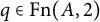
$\mathrm {supp}(q)$
 denote the domain of a condition
$q \in \mathrm {Fn}(A,2)$
 , and if
$\dot x$
 is an
$\mathrm {Fn}(A,2)$
 -name, then let
$\mathrm {supp}(\dot x) = \bigcup \left \lbrace \mathrm {supp}(q) \colon q \in \mathrm {Fn}(A,2) \cap \mathrm {TC}(\dot x) \right \rbrace $
 (where
$\mathrm {TC}(\dot x)$
 denotes the transitive closure of
$\dot x$
 ).
Given a forcing poset
$\mathbb {P}$
 , recall that a nice
$\mathbb {P}$
 -name for a subset of
$\omega $
 is a subset
$\dot x$
 of
$\check \omega \times \mathbb {P}$
 such that for each
$n \in \mathbb {N}$
 ,
$\left \lbrace p \colon (\check n,p) \in \dot x \right \rbrace $
 is an antichain in
$\mathbb {P}$
 . For convenience, we will write n for
$\check n$
 and consider a nice name to be a subset of
$\omega \times \mathbb {P}$
 . The evaluation of a nice name
$\dot x$
 with respect to a filter
$G \subseteq \mathbb {P}$
 is denoted
$\mathrm {val}_G(\dot x) = \left \lbrace n \in \omega \colon (n,p) \in \dot x \text { for some } p \in G \right \rbrace $
 .
Theorem 2.1 Let
$\kappa $
 be an infinite cardinal with
$\kappa ^\omega = \kappa $
 , and suppose
$\left \langle M_\alpha \colon \alpha < \kappa \right \rangle $
 is a sage Davies tree for
$\kappa $
 . If G is
$\mathrm {Fn}(\kappa ,2)$
 -generic over V, then the sequence
$\left \langle M_\alpha [G] \colon \alpha < \kappa \right \rangle $
 in
$V[G]$
 satisfies:
-
(1) $\left \lvert \mathrm {Lim}(\kappa ) \cap M_\alpha \backslash \bigcup _{\xi < \alpha }M_\xi \right \rvert = \aleph _1$
for each
$\alpha < \kappa \vphantom {f^f}$
. Consequently, there is a function
$C: \mathrm {Lim}(\kappa ) \to \mathcal {P}(\omega )$
such that for all
$\alpha < \kappa $
,
$C \in M_\alpha [G]$
and C maps
$\mathrm {Lim}(\kappa ) \cap M_\alpha $
to a set of
$\aleph _1$
reals mutually Cohen-generic over
$V\big [ G \cap \bigcup _{\xi <\alpha }M_\xi \big ]$
. -
(2) For each $\vphantom {f^{f^{f}}} \alpha < \kappa $
and
, there are countable sets
such that for every
,-
○ $\vphantom {f^f} x \leq r \ \, \Leftrightarrow \ \, x \leq \ell \text { for some }\ell \in L^r$
; -
○ $r \leq x \ \, \Leftrightarrow \, \ u \leq x \text { for some }u \in U^r$
.
Furthermore, there are some such sets $\vphantom {f^{f^f}} L^r,U^r \in M_\alpha [G]$
. -















Proof Fix
$\alpha < \kappa $
 . To prove the first claim, we begin by working in V. As
$|M_\xi | = \aleph _1$
 , for each
$\xi < \alpha $
 , we have
$\left \lvert \kappa \cap \bigcup _{\xi < \alpha }M_\xi \right \rvert \leq |\alpha | \cdot \aleph _1 < \kappa $
 , which implies
$\left \lvert \mathrm {Lim}(\kappa ) \backslash \bigcup _{\xi < \alpha }M_\xi \right \rvert = \kappa $
 . By part
$(4)$
 of our definition of sage Davies trees,
$\left \langle M_\xi \colon \xi < \alpha \right \rangle \in M_\alpha $
 , and (because
$\kappa \in M_\alpha $
 and
$M_\alpha $
 is closed under basic set-theoretic operations)
$\mathrm {Lim}(\kappa ) \cap \bigcup _{\xi < \alpha }M_\xi \in M_\alpha $
 . By elementarity,
$M_\alpha \models \left \lvert \mathrm {Lim}(\kappa ) \backslash \bigcup _{\xi < \alpha }M_\xi \right \rvert =~\kappa $
 , and in particular, there is a bijection
$f \in M_\alpha $
 from
$\mathrm {Lim}(\kappa ) \backslash \bigcup _{\xi < \alpha }M_\xi $
 to
$\kappa $
 . Restricting f to
$M_\alpha $
 gives a bijection from
$\mathrm {Lim}(\kappa ) \cap M_\alpha \backslash \bigcup _{\xi < \alpha }M_\xi $
 to
$\kappa \cap M_\alpha $
 , and
$|\kappa \cap M_\alpha | = \aleph _1$
 . (In fact, standard arguments show that
$\omega _1 \subseteq M$
 whenever M is a countably closed model of enough of ZFC.) Thus,
$\left \lvert \mathrm {Lim}(\kappa ) \cap M_\alpha \backslash \bigcup _{\xi < \alpha }M_\xi \right \rvert = \aleph _1$
 .
Because
$M_\alpha $
 is closed under basic set-theoretic operations, an ordinal
$\lambda \in M_\alpha $
 if and only if
$\lambda +n \in M_\alpha $
 for all
$n \in \omega $
 . Thus, for
$\lambda \in \mathrm {Lim}(\kappa )$
 ,

Still working in the ground model, for each
$\lambda \in \mathrm {Lim}(\kappa )$
 , let
$c_\lambda $
 denote the natural isomorphism
$\mathrm {Fn}\big ( [\lambda ,\lambda +\omega ),2 \big ) \to \mathrm {Fn}(\omega ,2)$
 .
In
$V[G]$
 , each
$c_\lambda $
 maps
$G \cap \mathrm {Fn}\big ( [\lambda ,\lambda +\omega ),2 \big )$
 to a generic-over V subset of
$\mathrm {Fn}(\omega ,2)$
 , whose union is a Cohen-generic subset of
$\omega $
 , say
$g_\lambda $
 . Define
$C(\lambda ) = g_\lambda $
 for all
$\lambda \in \mathrm {Lim}(\kappa )$
 . This definition of C has only G as a parameter, so
$C \in M_\alpha [G]$
 for all
$\alpha < \kappa $
 , and it is clear that C maps
$\mathrm {Lim}(\kappa ) \cap M_\alpha $
 to a set of
$\aleph _1$
 reals mutually Cohen-generic over
$V\big [ G \cap \bigcup _{\xi <\alpha }M_\xi \big ]$
 .
Before proving the second claim, we must introduce a few definitions. For convenience, let
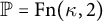
$\mathbb {P} = \mathrm {Fn}(\kappa ,2)$
 , and given
$S \subseteq \kappa $
 , let
$\mathbb {P}_S = \mathrm {Fn}(S,2)$
 . Let
$G_S = G \cap \mathbb {P}_S$
 . Note that, if
$\kappa \supseteq T \supseteq S$
 , then
$\mathbb {P}_T = \mathbb {P}_S*\mathbb {P}_{T \backslash S}$
 ,
$G_{T \backslash S}$
 is
$\mathbb {P}_{T \backslash S}$
 -generic over
$V[G_S]$
 , and
$V[G_T] = V[G_S][G_{T \backslash S}]$
 . If
$\dot x$
 is a nice
$\mathbb {P}$
 -name for a subset of
$\omega $
 and
$S \subseteq \kappa $
 , define the partial evaluation of
$\dot x$
 with respect to
$G_S$
 to be

For example, if
$\dot x$
 is a
$\mathbb {P}_S$
 -name, then
$p \!\restriction \! (\kappa \backslash S) = \emptyset $
 whenever
$(n,p) \in \dot x$
 , in which case
$\mathrm {pval}_S(\dot x) \,=\, \left \lbrace (n,\emptyset ) \colon (n,p) \in \dot x \text { and } p \in G_S \right \rbrace ,$
 which is just the canonical name
$\check {y}$
 for
$y = \mathrm {val}_{G_S}(\dot x) = \mathrm {val}_{G}(\dot x)$
 . At the other extreme, if
$\dot x$
 is a
$\mathbb {P}_{\kappa \backslash S}$
 -name, then
$p \!\restriction \! (\kappa \backslash S) = p$
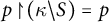 and
$p \!\restriction \! S = \emptyset \in G$
 whenever
$(n,p) \in \dot x$
 , so that
$\mathrm {pval}(\dot x) = \dot x$
 . Observe that for any nice
$\mathbb {P}$
 -name
$\dot x$
 and any
$S \subseteq \kappa $
 ,
$\mathrm {pval}_S(\dot x)$
 is a nice
$\mathbb {P}_{\kappa \backslash S}$
 -name for a subset of
$\omega $
 , and
$\emptyset \Vdash \mathrm {val}_G(\dot x) = \mathrm {val}_{G_{\kappa \backslash S}}\big (\mathrm {pval}_{G_S}(\dot x)\big )$
 .
We now proceed to the proof of the second claim. Fix
$\alpha < \kappa $
 . By part
$(3)$
 of the definition of a sage Davies tree, there is a countable set
$\mathcal N_\alpha $
 of countably closed elementary submodels of
$H_\theta $
 with
$\bigcup \mathcal N_\alpha = \bigcup _{\xi < \alpha }M_\xi $
 .
Claim Let
$r \in \mathcal {P}(\omega ) \cap M_\alpha [G] \backslash \bigcup _{\xi < \alpha } M_\xi [G]$
 , let
$\dot r \in M_\alpha $
 be a nice name for r, and let
$N \in \mathcal N_\alpha $
 . For each
$p \in \mathbb {P}$
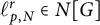
 , there is a nice name
$\dot \ell \in N$
 for the set,

Consequently,
$\ell ^r_{p,N} \in N[G]$
 .
Proof of claim Fix
$p \in \mathbb {P}$
 . Working in V, let X denote the set of all nice names
$\dot x$
 for subsets of
$\omega $
 such that
$\dot x \in N$
 and
$p \Vdash \dot x \subseteq \dot r$
 . Let

If
$\dot x \in X$
 , then
$\dot x \in N$
 and, because nice names for subsets of
$\omega $
 are countable, this implies
$\dot x \subseteq N$
 . Hence,
$\dot \ell _0 = \bigcup X \subseteq N$
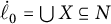 , and it is not hard to see that
$\dot \ell _0$
 is a
$\mathbb {P}$
 -name for
$u^r_{p,N}$
 . But
$\dot \ell _0$
 may not be a nice name, and we have no reason to believe
$\dot \ell _0 \in N$
 (as neither p nor
$\dot r$
 need be in N).
For each
$n \in \omega $
 , let
$B_n = \left \lbrace q \colon (n,q) \in \dot \ell _0 \right \rbrace $
 . Note that, if
$(n,q) \in \dot \ell _0$
 , then
$(n,q) \in N$
 , and hence
$q \in N$
 ; therefore,
$B_n \subseteq N \cap \mathbb {P} = \mathbb {P}_{\kappa \cap N}$
 . Let
$A_n$
 be an antichain in
$\mathbb {P}_{\kappa \cap N}$
 such that
$\bigvee A_n = \bigvee B_n$
 in the Boolean completion of
$\mathbb {P}_{\kappa \cap N}$
 . Let
$\dot \ell = \bigcup _{n \in \omega }(\{n\} \times A_n)$
 . This is a nice
$\mathbb {P}_{\kappa \cap N}$
 -name for a subset of
$\omega $
 , and by our choice of the
$A_n$
 ,
$\emptyset \Vdash \dot \ell _0 = \dot \ell $
 , which means
$\dot u$
 is a nice
$\mathbb {P}_{\kappa \cap N}$
 -name for
$\ell ^r_{p,N}$
 . Furthermore, because
$\mathbb {P}_{\kappa \cap N}$
 has the ccc, each
$A_n$
 is countable. Because N is countably closed,
$A_n \in N$
 for all n. Because N is also closed under basic set-theoretic operations,
$\{n\} \times A_n \in N$
 for all N and, using the countable closure of N again, this implies
$\dot \ell \in N$
 .
$\hspace{137pt}\square $

Claim Let
$r \in \mathcal {P}(\omega ) \cap M_\alpha [G] \backslash \bigcup _{\xi < \alpha } M_\xi [G]$
 . Suppose
$N \in \mathcal N_\alpha $
 ,
$x \in N[G]$
 , and
$x \subseteq~r$
 . Let
$\dot r \in M_\alpha $
 be a nice name for r, and let
$S = \mathrm {supp}(\dot r)$
 . There is a nice name
$\dot x$
 for x, with
$\dot x \in N$
 , and a
$p \in G_S$
 such that
$p \Vdash \dot x \subseteq \dot r$
 .
Proof of claim Let
$\dot x_0$
 be a nice
$\mathbb {P}$
 -name for x such that
$\dot x_0 \in N$
 , and fix a condition
$q \in G$
 such that
$q \Vdash \dot x_0 \subseteq \dot r$
 . Let
$S_0 = \mathrm {supp}(\dot x_0)$
 , and note that
$S_0 \subseteq N$
 (because
$\dot x_0 \in N$
 ). Without loss of generality, we may (and do) suppose
$\mathrm {supp}(q) \subseteq \mathrm {supp}(\dot x_0) \cup \mathrm {supp}(\dot r) = S_0 \cup S \subseteq N \cup S$
 . Let
$T = \mathrm {supp}(q) \backslash S$
 , and note that T is a finite subset of
$\kappa \cap N$
 .
Let
$\dot x = \mathrm {pval}_T(\dot x_0)$
 and let
$p = q \!\restriction \! (\kappa \backslash T)$
 . Clearly,
$p \in G$
 because
$q \in G$
 and q extends p. Because
$q \Vdash \dot x_0 \subseteq \dot r$
 in V,
$p \Vdash \mathrm {pval}_T(\dot x_0) \subseteq \mathrm {pval}_T(\dot r)$
 in
$V[G_T]$
 . But
$\mathrm {pval}_T(\dot x_0) = \dot x$
 by definition,
$\mathrm {pval}_T(\dot r) = \dot r$
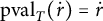 because
$T \cap S = \emptyset $
 , and
$V[G_T] = V$
 because T is finite. Hence,
$p \Vdash \dot x \subseteq \dot r$
 in V. Finally,
$\dot x$
 is definable from
$\dot x_0$
 and
$G_T$
 , which are both in N, and therefore
$\dot x \in N$
 .
$\hspace{260pt}\square $

Now, fix
$r \in \mathcal {P}(\omega ) \cap M_\alpha [G] \backslash \bigcup _{\xi < \alpha } M_\xi [G]$
 . Let
$\dot r \in M_\alpha $
 be a nice name for r, and let
$S = \mathrm {supp}(\dot r)$
 . Because
$\dot r$
 is a nice name for a real, S is countable. This implies that
$G_S$
 is countable as well. For each
$N \in \mathcal N_\alpha $
 and each
$p \in G_S$
 , let
$\ell ^r_{p,N}$
 be defined as in the statement of the claim above. Let

This is a countable set because
$G_S$
 and
$\mathcal N_\alpha $
 are both countable, and it is a subset of
$\mathcal {P}(\omega ) \cap \bigcup _{N \in \mathcal N_\alpha }N[G] = \mathcal {P}(\omega ) \cap \bigcup _{\xi < \alpha }M_\xi [G]$
 by the first of the two claims above.
Let
$x \in \mathcal {P}(\omega ) \cap \bigcup _{\xi < \alpha }M_\xi [G] = \mathcal {P}(\omega ) \cap \bigcup _{N \in \mathcal N_\alpha }N[G]$
 , and fix
$N \in \mathcal N$
 with
$x \in N[G]$
 . If
$x \subseteq r$
 , then by the second of the two claims above, there is a nice name
$\dot x \in N$
 for x and a
$p \in G_S$
 such that
$p \Vdash \dot x \subseteq \dot r$
 . By the definition of
$\ell ^r_{p,N}$
 , this means
$x \subseteq \ell ^r_{p,N} \in L^r_0$
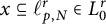 . Conversely, if
$x \subseteq \ell ^r_{p,N}$
 for some
$p \in G_S$
 and
$N \in \mathcal N_\alpha $
 , then it is clear from the definition of
$\ell ^r_{p,N}$
 that
$x \subseteq r$
 .
Thus, given
$x \in \mathcal {P}(\omega ) \cap \bigcup _{\xi < \alpha }M_\xi [G]$
 , we have
$x \subseteq r$
 if and only if
$x \subseteq \ell $
 for some
$\ell \in L^r_0$
 . Passing to equivalence classes, set
$L^{[r]_{\mathrm {Fin}}} = \left \lbrace [\ell ]_{\mathrm {Fin}} \colon \ell \in L^r_0 \right \rbrace $
 has the desired properties. An essentially identical argument can be used to prove the analogous statement involving
$U^r$
 . Alternatively, one can deduce the statement about
$U^r$
 from the statement about
$L^r$
 by taking complements, setting
$U^r = \left \lbrace [\omega ]_{\mathrm {Fin}} - \ell \, \colon \ell \in L^{[\omega ]_{\mathrm {Fin}} - r} \right \rbrace $
 .
Finally, to prove the “furthermore” part of the theorem, we use the elementarity of
$M_\alpha $
 . The part of statement
$(2)$
 that precedes the “furthermore” is a first-order description of
$L^r$
 and
$U^r$
 using only parameters from
$M_\alpha [G]$
 . (Note that
$\bigcup _{\xi < \alpha }M_\alpha [G] \in M_\alpha [G]$
 because
$\left \langle M_\xi \colon \xi < \alpha \right \rangle \in M_\alpha $
 and
$G \in M_\alpha [G]$
 ). Because
$M_\alpha \preceq H_\theta $
 , the definability of the forcing relation implies
$M_\alpha [G] \preceq H_\theta [G]$
 . (For more details on this, see [Reference Shelah20, Theorem 2.11].) Thus, this description of
$L^r$
 and
$U^r$
 , which we just proved is witnessed in
$H_\theta $
 , is witnessed in
$M_\alpha [G]$
 as well.
3 Building the automorphisms
An almost permutation on
$\omega $
 is a bijection between cofinite subsets of
$\omega $
 . Every permutation of
$\omega $
 is an almost permutation, but not every almost permutation is a permutation or even the restriction of one (e.g., consider the successor function
$n \mapsto n+1$
 ). Every almost permutation f of
$\omega $
 induces an automorphism
$\alpha _f$
 of
 , defined by the formula

for every
$A \subseteq \omega $
 . An automorphism of
 that is induced in this way by an almost permutation of
$\omega $
 is called trivial. Note that as there are only
$\mathfrak {c}$
 functions
$\omega \to \omega $
 , there are only
$\mathfrak {c}$
 trivial automorphisms of
 . Consequently, if there are more than
$\mathfrak {c}$
 automorphisms of
 , then some (most) are nontrivial.
Rudin proved in [Reference Rudin17] that CH implies that there are
$2^{\mathfrak {c}}$
 automorphisms of
 . Years later, Shelah proved in [Reference Shelah19, Chapter 4] that it is consistent with ZFC that all automorphisms are trivial. Shelah’s result was extended and refined in [Reference De Bondt, Farah and Vignati4, Reference Shelah and Steprāns21, Reference Veličković25], revealing ultimately that the forcing axiom
$\textsf {OCA}$
 (also known as
$\textsf {OGA}$
 or
$\textsf {OCA}_T$
 ) implies all automorphisms are trivial. Further models, in which all automorphisms are trivial, include models with
$\mathfrak {c}> \aleph _2$
 in [Reference Dow5] or with
$\mathfrak d = \aleph _1$
 in [Reference Farah and Shelah7]. (Recall that OCA implies
$\mathfrak d = \mathfrak {c} = \aleph _2$
 ).
The following theorem covers parts
$(1)$
 and
$(2)$
 of the main theorem stated in the introduction.
Theorem 3.1 Suppose
$V \models $
 $\textsf {CH}$
 , let
$\kappa \geq \aleph _2$
 be a regular cardinal, and let G be an
$\mathrm {Fn}(\kappa ,2)$
 -generic filter over V. Assume that for any P, there is a sage Davies tree of length
$\kappa $
 over P. If
$\phi $
 is an automorphism of
 in V, then in
$V[G]$
 , and there are
$2^\kappa $
 automorphisms of
 extending
$\phi $
 .
Proof Let
$\phi $
 be an automorphism of
 in V, and (still in V) fix a well ordering R of
$H_\kappa $
 . Let F be a set of
$2^\kappa $
 functions
$\kappa \to 2$
 with the property that if
$h,h' \in F$
 and
$h \neq h'$
 , then
$\left \lbrace \alpha \in \kappa ~\colon~ h(\alpha ) \neq h'(\alpha ) \right \rbrace $
 is stationary. (To see that there is such a set of functions, first recall that there is a partition
$\mathcal {P}$
 of
$\kappa $
 into
$\kappa $
 stationary sets. Take F to be the set of all functions
$h: \kappa \to 2$
 , such that
$h \!\restriction \! A$
 is constant for every
$A \in \mathcal {P}$
 .)
To prove the theorem, we construct for every
$h \in F$
 an automorphism
$\Phi _h$
 of
 in
$V[G]$
 such that
$\Phi _h \!\restriction \! V = \phi $
 , and furthermore, we do this in such a way that
$h \neq h'$
 implies
$\Phi _h \neq \Phi _{h'}$
 . Fix
$h \in F$
 , and let
$\left \langle M_\alpha ~\colon~ \alpha < \kappa \right \rangle $
 be a sage Davies tree over
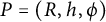
$P = (R,h,\phi )$
 .
Let C denote the function described in Theorem 2.1
$(1)$
 . For each
$\alpha < \kappa $
 , let
$\delta _\alpha = \min \big ( \kappa \cap M_\alpha \backslash \bigcup _{\xi < \alpha } \big )$
 . Note that
$\delta _\alpha $
 is a limit ordinal, and because
$\delta _\alpha $
 and
$\delta _\alpha +\omega $
 are definable from each other,
$\delta +\omega \in \kappa \cap M_\alpha \backslash \bigcup _{\xi < \alpha }M_\xi $
 as well. Define
$c^\alpha _0 = C(\delta _\alpha )$
 and
$c^\alpha _1 = C(\delta _\alpha +\omega )$
 for all
$\alpha < \kappa $
 .
Define
 , and if
$0 < \alpha < \kappa $
 , then define

the subalgebra of
 generated by
 . The fact that
$M_0$
 is countably closed and
$M_0 \preceq H_\theta $
 implies
$\mathcal {P}(\omega ) \cap V \subseteq M_0$
 . Hence,
$B_0 \subseteq B_1$
 , and it is clear that if
$\alpha < \beta < \kappa $
 , then
$B_\alpha \subseteq B_\beta $
 . Thus,
$\left \langle B_\alpha ~\colon~ \alpha < \kappa \right \rangle $
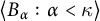 is an increasing sequence of subalgebras of
 , and (it follows easily from the definition that)
$B_\alpha = \bigcup _{\xi < \alpha }B_\xi $
 for limit
$\alpha $
 .
We claim furthermore that
 . To see this, it suffices to show, working in V, that every nice
$\mathbb {P}$
 -name for a subset of
$\omega $
 is a member of
$\bigcup _{\alpha < \kappa }M_\alpha $
 . If
$\dot x$
 is such a name, then
$\mathrm {supp}(\dot x)$
 is a countable subset of
$\kappa $
 . By part
$(2)$
 of the definition of a sage Davies tree, there is some
$\alpha < \kappa $
 with
$\mathrm {supp}(\dot x) \in M_\alpha $
 . Using the fact that
$M_\alpha $
 is countably closed and
$\omega \subseteq M_\alpha $
 , it follows that
$\dot x \in M_\alpha $
 .
Suppressing the subscript for now, let us construct from h an automorphism
$\Phi $
 of
 in
$V[G]$
 . We aim to build
$\Phi $
 by transfinite recursion, working in
$V[G]$
 . The recursion is organized into
$\kappa $
 main stages. At stage
$\alpha $
 of the recursion, we begin with an automorphism
$\Phi _\alpha $
 of
$B_\alpha $
 , and we wish to extend it to an automorphism
$\Phi _{\alpha +1}$
 of
$B_{\alpha +1}$
 while also encoding the value of
$h(\alpha )$
 into
$\Phi _{\alpha +1}$
 . Through the recursion, we maintain the following inductive hypothesis at stage
$\alpha $
 :
-
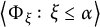
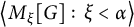
(*) the sequence of automorphisms $\left \langle \Phi _\xi ~\colon~ \xi \leq \alpha \right \rangle $
is uniformly definable from P and
$\left \langle M_\xi [G] ~\colon~ \xi < \alpha \right \rangle $
. In particular,
$\Phi _\alpha \in M_\alpha $
.

For the base case
$\alpha = 0$
 , we begin with the automorphism
$\Phi _0 = \phi $
 of
$B_0$
 . Note that our inductive hypothesis is trivially satisfied at
$\alpha =0$
 . At limit stages, we simply take
$\Phi _\alpha = \bigcup _{\xi < \alpha }\Phi _\xi $
 . This is an automorphism of
$B_\alpha $
 because
$B_\alpha = \bigcup _{\xi < \alpha }B_\xi $
 for limit
$\alpha $
 . And this preserves our inductive hypothesis:
$\left \langle \Phi _\xi ~\colon~ \xi \leq \alpha \right \rangle $
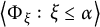 is defined as
$\left \langle \Phi _\xi ~\colon~ \xi < \alpha \right \rangle \!\,^{\frown } \langle \bigcup _{\xi < \alpha }\Phi _\xi \rangle $
 , and this defining formula is uniform across all limit ordinals.
We must now describe how
$\Phi _{\alpha +1}$
 is obtained from
$\Phi _\alpha $
 . This single stage of the main recursion is itself accomplished by a transfinite recursion of length
$\omega _1$
 . Observe that
$M_\alpha \in M_{\alpha +1}$
 (it is definable as the last element of
$\left \langle M_\xi ~\colon~ \xi \leq \alpha \right \rangle \in M_{\alpha +1}$
 ), which means that
$M_{\alpha +1}$
 contains a canonical well ordering, given by R, of the nice names for subsets of
$\omega $
 in
$M_\alpha $
 . Evaluating these names, and deleting repeats and members of
$B_\alpha $
 (which is also definable in
$M_{\alpha +1}$
 ), this means that
$M_{\alpha +1}$
 contains a canonical enumeration
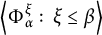
$\left \langle b_\xi ~\colon~ \xi < \omega _1 \right \rangle $
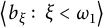 of the members of
 . Making some simple modifications to this well order if needed, we may (and do) assume
$b_0 = c^\alpha _0$
 . The goal of our stage
$\alpha $
 , length-
$\omega _1$
 sub-recursion is to construct
-
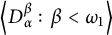
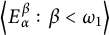
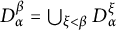
(1) two increasing sequences $\left \langle D_\alpha ^\beta ~\colon~ \beta < \omega _1 \right \rangle $
and
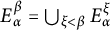
$\left \langle E_\alpha ^\beta ~\colon~ \beta < \omega _1 \right \rangle $
of subalgebras of
$B_{\alpha +1}$
, such that
$D_\alpha ^\beta = \bigcup _{\xi < \beta }D_\alpha ^\xi $
and
$E_\alpha ^\beta = \bigcup _{\xi < \beta }E_\alpha ^\xi $
for limit
$\beta $
, and
$\bigcup _{\beta < \omega _1}D_\alpha ^\beta = \bigcup _{\beta < \omega _1}E_\alpha ^\beta = B_{\alpha +1}$
; -
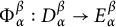
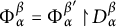
(2) a sequence of injective homomorphisms $\Phi _\alpha ^\beta : D_\alpha ^\beta \to E_\alpha ^\beta $
, for
$\beta < \omega _1$
, such that
$\Phi _\alpha ^0 = \Phi _\alpha $
and if
$\beta < \beta '$
, then
$\Phi _\alpha ^\beta = \Phi _\alpha ^{\beta '} \!\restriction \! D_\alpha ^\beta $
.





Furthermore, at each step of this sub-recursion on
$\beta $
 , we maintain the following inductive hypotheses:
-
(1) $D_\alpha ^\beta ,E_\alpha ^\beta \supseteq \langle \hspace {-.9mm}\langle B_\alpha \cup \left \lbrace b_\xi ~\colon~ \xi < \beta \right \rbrace \rangle \hspace {-.9mm}\rangle $
. -
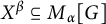
(2) There is a countable $X^\beta \subseteq M_\alpha [G]$
such that
$D_\alpha ^\beta = \langle \hspace {-.9mm}\langle B_\alpha \cup X^\beta \rangle \hspace {-.9mm}\rangle $
. -
(3) Furthermore, the sequence $\left \langle X^\xi ~\colon~ \xi \leq \beta \right \rangle $
is uniformly definable from parameters in
$M_\alpha [G]$
, and hence it is a member of
$M_\alpha [G]$
. -
(4) The sequence $\left \langle \Phi _\alpha ^\xi ~\colon~ \xi \leq \beta \right \rangle $
is also uniformly definable from parameters in
$M_\alpha [G]$
, and hence a member of
$M_\alpha [G]$
.






For the base step, take
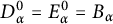
$D_\alpha ^0 = E_\alpha ^0 = B_\alpha $
 and
$\Phi _\alpha ^0 = \Phi _\alpha $
 . This trivially satisfies hypotheses (1)–(3). It satisfies
$(4)$
 because
$\Phi _\alpha \in M_\alpha [G]$
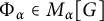 by our larger inductive hypothesis
$(*)$
 .
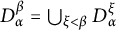
The limit steps are also easy: because
$D_\alpha ^\beta = \bigcup _{\xi < \beta }D_\alpha ^\xi $
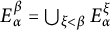
 and
$E_\alpha ^\beta = \bigcup _{\xi < \beta }E_\alpha ^\xi $
 for limit
$\beta $
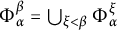
 , we simply take
$\Phi _\alpha ^\beta = \bigcup _{\xi < \beta }\Phi _\alpha ^\xi $
 . This preserves all four of the inductive hypotheses.
To obtain
$\Phi ^1_\alpha $
 , we do one of two things, depending on the value of
$h(\alpha )$
 . If
$h(\alpha )=0$
 , then we map
$b_0 = c^\alpha _0$
 to itself. Because
$c^\alpha _0$
 is Cohen-generic over
$V[G \cap \bigcup _{\xi < \alpha }M_\alpha ]$
 , it is free over
$B_\alpha $
 . Consequently, the map
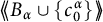
$\Phi ^0_\alpha \cup \{(c^\alpha _0,c^\alpha _0)\}$
 naturally extends to an automorphism
$\Phi ^1_\alpha $
 of
$\langle \hspace {-.9mm}\langle B_\alpha \cup \{c^\alpha _0\} \rangle \hspace {-.9mm}\rangle $
 , and we set
$D^1_\alpha = E^1_\alpha = \langle \hspace {-.9mm}\langle B_\alpha \cup \{c^\alpha _0\} \rangle \hspace {-.9mm}\rangle $
 . If
$h(\alpha )=~1$
 , then we map
$c^\alpha _0$
 to
$c^\alpha _1$
 and
$c^\alpha _1$
 to
$c^\alpha _0$
 . Because
$c^\alpha _0$
 and
$c^\alpha _1$
 are mutually Cohen-generic over
$V[G \cap \bigcup _{\xi < \alpha }M_\alpha ]$
 , each
$c^\alpha _i$
 is free over
$\langle \hspace {-.9mm}\langle B_\alpha \cup \{c^\alpha _{1-i}\} \rangle \hspace {-.9mm}\rangle $
 . Consequently, the map
$\Phi ^0_\alpha \cup \{(c^\alpha _0,c^\alpha _1),(c^\alpha _1,c^\alpha _0)\}$
 naturally extends to an automorphism
$\Phi ^1_\alpha $
 of
$\langle \hspace {-.9mm}\langle B_\alpha \cup \{c^\alpha _0,c^\alpha _1\} \rangle \hspace {-.9mm}\rangle $
 , and we set
$D^1_\alpha = E^1_\alpha = \langle \hspace {-.9mm}\langle B_\alpha \cup \{c^\alpha _0,c^\alpha _1\} \rangle \hspace {-.9mm}\rangle $
 . This clearly preserves the inductive hypotheses (bearing in mind, for inductive hypothesis
$(4)$
 , that
$M_\alpha [G]$
 is closed under the Boolean operations of
 ).
For the general successor step, fix
$\beta $
 with
$0 < \beta < \omega _1$
 , and let
$D_\alpha ^\beta $
 ,
$E_\alpha ^\beta $
 , and
$\Phi _\alpha ^\beta $
 be given satisfying (1)–(4). We obtain
$\Phi _\alpha ^{\beta +1}$
 in two steps, first extending our algebras and mappings so that
$b_\beta $
 gets into the domain of
$\Phi _\alpha ^{\beta +1}$
 , and extending again to put
$b_\beta $
 into the image. Specifically, we first extend
$D_\alpha ^\beta $
 ,
$E_\alpha ^\beta $
 , and
$\Phi _\alpha ^\beta $
 to some
$\bar D_\alpha ^\beta $
 ,
$\bar E_\alpha ^\beta $
 , and
$\bar \Phi _\alpha ^\beta $
 with
$b_\beta \in \bar D_\alpha ^\beta $
 , and then we extend
$\bar D_\alpha ^\beta $
 ,
$\bar E_\alpha ^\beta $
 , and
$\bar \Phi _\alpha ^\beta $
 to
$D_\alpha ^{\beta +1}$
 ,
$E_\alpha ^{\beta +1}$
 , and
$\Phi _\alpha ^{\beta +1}$
 with
$b_\beta \in E_\alpha ^{\beta +1}$
 .
If
$b_\beta \in D_\alpha ^\beta $
 already, then there is nothing to do in the first step: simply define
$\bar D_\alpha ^\beta = D_\alpha ^\beta $
 ,
$\bar E_\alpha ^\beta = E_\alpha ^\beta $
 , and
$\bar \Phi _\alpha ^\beta = \Phi _\alpha ^\beta $
 .
Suppose instead that
$b_\beta \notin D_\alpha ^\beta $
 . Applying Theorem 2.1, fix countable sets
 with
$L,U \in M_\alpha [G]$
 having the properties stated in part
$(2)$
 of the theorem with
$r=b_\beta $
 . Let
$X^\beta $
 denote the set described in inductive hypotheses
$(2)$
 and
$(3)$
 , and define

These are countable subsets of
$D_\alpha ^\beta $
 and, using the properties of L and U stated in Theorem 2.1, if
$x \in D_\alpha ^\beta $
 , then
-
○ $x \leq b_\beta \ \, \Leftrightarrow \ \, x \leq \ell \text { for some }\ell \in \tilde L$
; -
○ $b_\beta \leq x \ \, \Leftrightarrow \, \ u \leq x \text { for some }u \in \tilde U$
.


In other words,
$(\tilde L,\tilde U)$
 is an
$(\omega ,\omega )$
 -gap in
$D_\alpha ^\beta $
 , and this gap is split by
$b_\beta $
 . It follows that
$\big ( \Phi _\alpha ^\beta [\tilde L],\Phi _\alpha ^\beta [\tilde U] \big )$
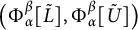 is an
$(\omega ,\omega )$
 -gap in
$E_\alpha ^\beta $
 . If we are to extend
$\Phi _\alpha ^\beta $
 to
$b_\beta $
 , we must map
$b_\beta $
 to a member of
$M_\alpha [G]$
 that splits this gap.
Because
$L,U,X^\beta ,b_\beta \in M_\alpha [G]$
 , we have
$\tilde L,\tilde U \in M_\alpha [G]$
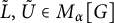 . By inductive hypothesis
$(4)$
 , we have
$\Phi _\alpha ^\beta [\tilde L],\Phi _\alpha ^\beta [\tilde U] \in M_\alpha [G]$
 as well. Because
$X^\beta $
 is countable and
$D_\alpha ^\beta = \langle \hspace {-.9mm}\langle B_\alpha \cup X^\beta \rangle \hspace {-.9mm}\rangle $
 , and because the members of the (uncountable) set
$C_\alpha $
 are all Cohen-generic over
$B_\alpha $
 , all but countably many members of
$C_\alpha $
 are Cohen-generic over
$D_\alpha ^\beta $
 . Fix some such
$c \in C_\alpha $
 .
The standard forcing poset used to split an
$(\omega ,\omega )$
 -gap in
 is countable, hence forcing equivalent to the Cohen forcing
$\mathrm {Fn}(\omega ,2)$
 . Because c is Cohen-generic over
$E_\alpha ^\beta $
 , and because
$M_\alpha [G]$
 satisfies (enough of) ZFC, this means that, working within
$M_\alpha [G]$
 , it is possible to define a generic splitting
$s_\beta \in M_\alpha [G]$
 of the
$(\omega ,\omega )$
 -gap
$\big ( \Phi _\alpha ^\beta [\tilde L],\Phi _\alpha ^\beta [\tilde U] \big )$
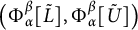 in
$E_\alpha ^\beta $
 . Furthermore, we may (and do) make the choice of
$s_\beta $
 canonical by taking the R-least
$c \in C_\alpha $
 (i.e., the one with the R-least name) generic over
$D^\beta _\alpha $
 , the R-least dense embedding between
$\mathrm {Fn}(\omega ,2)$
 and
$\big ( \Phi _\alpha ^\beta [\tilde L],\Phi _\alpha ^\beta [\tilde U] \big )$
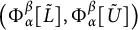 , etc. Because
$s_\beta $
 splits the gap
$\big ( \Phi _\alpha ^\beta [\tilde L],\Phi _\alpha ^\beta [\tilde U] \big )$
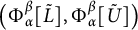 , the function
$\Phi _\alpha ^\beta \cup \{(b_\beta ,s_\beta )\}$
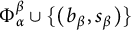 extends to an isomorphism from
$\bar D^\beta _\alpha = \langle \hspace {-.9mm}\langle D_\alpha ^\beta \cup \{b_\beta \} \rangle \hspace {-.9mm}\rangle $
 to
$\bar E^\beta _\alpha = \langle \hspace {-.9mm}\langle E_\alpha ^\beta \cup \{s_\beta \} \rangle \hspace {-.9mm}\rangle $
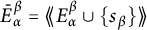 . Let
$\bar \Phi _\alpha ^\beta $
 denote this isomorphism.
The construction of
$D_\alpha ^{\beta +1}$
 ,
$E_\alpha ^{\beta +1}$
 , and
$\Phi _\alpha ^{\beta +1}$
 from
$\bar D_\alpha ^{\beta }$
 ,
$\bar E_\alpha ^{\beta }$
 , and
$\bar \Phi _\alpha ^{\beta }$
 works in exactly the same way, only using
$\bar E_\alpha ^\beta $
 in the place of
$\bar D_\alpha ^b$
 ,
$(\bar \Phi _\alpha ^{\beta })^{-1}$
 in the place of
$\Phi _\alpha ^{\beta }$
 , etc.
These choices clearly preserve inductive hypotheses
$(1)$
 and
$(2)$
 . Because all the choices in this construction were made canonically via R, the preceding construction constitutes a definition of
$D_\alpha ^{\beta +1}$
 ,
$E_\alpha ^{\beta +1}$
 , and
$\Phi _\alpha ^{\beta +1}$
 from
$D_\alpha ^{\beta }$
 ,
$E_\alpha ^{\beta }$
 , and
$\Phi _\alpha ^{\beta }$
 . Moreover, this definition is uniform, as it works the same way for all
$\beta $
 . It follows that
$(3)$
 and
$(4)$
 are preserved.
This concludes our length-
$\omega _1$
 sub-recursion. Inductive hypothesis
$(1)$
 makes it clear that
$\bigcup _{\beta < \omega _1} D^\beta _\alpha = \bigcup _{\beta < \omega _1} E^\beta _\alpha = B_{\alpha +1}$
 , and the fact that
$\Phi ^\beta _\alpha = \Phi ^{\beta '}_\alpha \!\restriction \! D_\alpha ^\beta $
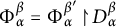 whenever
$\beta < \beta '$
 shows that
$\Phi _{\alpha +1} = \bigcup _{\beta < \omega _1}\Phi ^\beta _\alpha $
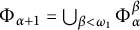 is an automorphism of
$B_{\alpha +1}$
 . Finally, the entire sub-recursion was defined from
$M_\alpha [G]$
 , C, and R (or P). Applying the recursion theorem in
$M_{\alpha +1}[G]$
 , and using inductive hypothesis
$(4)$
 , this means that our entire length-
$\omega _1$
 sub-recursion and its result
$\Phi _{\alpha +1}$
 are definable from
$\left \langle M_\xi [G] ~\colon~ \xi \leq \alpha \right \rangle $
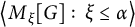 and R in
$M_{\alpha +1}[G]$
 . Furthermore, this definition is uniform across various
$\alpha $
 (i.e., our description of the inductive step does not depend on
$\alpha $
 ), so that
$(*)$
 is preserved at successor steps of the main recursion.
This completes the recursion, the result of which is an automorphism
$\Phi = \bigcup _{\alpha < \kappa }\Phi _\alpha $
 of
 in
$V[G]$
 that extends
$\phi = \Phi _0$
 . It remains to show that there are
$2^\kappa $
 automorphisms like this.
Recall that our notation has been slightly dishonest: the construction above depends on a function
$h \in F$
 , although we redacted h from
$\Phi $
 for the sake of tidiness. Restoring our subscript notation from the beginning of the proof, for every
$h \in F$
 , the preceding construction gives an automorphism
$\Phi _h$
 of
 in
$V[G]$
 extending
$\phi $
 . To finish the proof, we must show that if
$h,h' \in F$
 and
$h \neq h'$
 , then
$\Phi _h \neq \Phi _h'$
 .
Given our construction, one might be tempted to think that h can be recovered from
$\Phi _h$
 : if
$\Phi _h(c^\alpha _0) = c^\alpha _0$
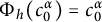 , then
$h(\alpha ) = 0$
 , and if
$\Phi _h(c^\alpha _0) \neq c^\alpha _0$
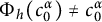 , then
$h(\alpha ) = 1$
 . However, the value of
$c^\alpha _0$
 is determined note only by C, which does not depend on h, but also
$M_\alpha \backslash \bigcup _{\xi < \alpha }M_\xi $
 , which does depend on h. Recall that h was taken as part of the parameter P for the sage Davies tree
$\left \langle M_\alpha ~\colon~ \alpha < \kappa \right \rangle $
 used to obtain
$\Phi _h$
 , which means that the identity of the
$c^\alpha _0$
 ’s depends on h. Thus, the proposed definition of h from
$\Phi _h$
 is circular.
To get around this, we use part
$(6)$
 of our definition of a sage Davies tree. Let
$\left \langle M_\alpha ^h ~\colon~ \alpha < \kappa \right \rangle $
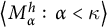 denote the sage Davies tree used to obtain
$\Phi _h$
 , and let
$\big \langle M_\alpha ^{h'} :\, \alpha < \kappa \big \rangle $
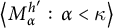 denote the sage Davies tree used to obtain
$\Phi _{h'}$
 . Similarly, let
$(c^\alpha _0)^h \!= C\big (\! \min (\kappa \cap M_\alpha ^h \backslash \bigcup _{\xi < \alpha }M_\xi ^h) \big )$
 and
$(c^\alpha _0)^{h'} \!= C\big (\! \min (\kappa \cap M_\alpha ^{h'} \backslash \bigcup _{\xi < \alpha }M_\xi ^{h'}) \big )$
 for all
$\alpha < \kappa $
 . Applying part
$(6)$
 of our definition of sage Davies trees,

is closed and unbounded in
$\kappa $
 . If
$\delta \in D$
 , then
$(c^\delta _0)^h = (c^\delta _0)^{h'} = C(\delta )$
 .
By our choice of F, the set
$S = \left \lbrace \alpha < \kappa ~\colon~ h(\alpha ) \neq h'(\alpha ) \right \rbrace $
 is stationary. In particular, there is some
$\delta \in D$
 with
$h(\delta ) \neq h'(\delta )$
 . By the previous paragraph,
$(c^\delta _0)^h = (c^\delta _0)^{h'} = C(\delta )$
 . But since
$h(\delta ) \neq h'(\delta )$
 , one of the functions
$\Phi _h$
 and
$\Phi _{h'}$
 has
$C(\delta )$
 as a fixed point and the other does not. Hence,
$\Phi _h \neq \Phi _{h'}$
 .
Proof of part
$(3)$
of the main theorem

We now describe how to modify the preceding argument in order to accommodate singular
$\kappa $
 .
First, consider the case
$\kappa ^\omega = \kappa $
 . In this case, Theorem 2.1 applies, and the proof of the previous theorem goes through unmodified except for the last two paragraphs, where we use part
$(6)$
 of the definition of a sage Davies tree (the part of the definition that assumes that
$\kappa $
 is regular) in order to prove that the
$\Phi _h$
 are all distinct. When
$\kappa $
 is singular, we do not aim to prove that all the
$\Phi _h$
 are distinct, but only that at least one of them is a nontrivial automorphism.
Consider the automorphism
$\Phi _h$
 constructed from the constant function
$h(\alpha ) = 1$
 . We claim that this function is a nontrivial automorphism of
 . To see this, fix an almost bijection
$f: \omega \to \omega $
 . In the ground model V, there is a nice name
$\dot f$
 for f with countable support S. Setting
$G_S = G \cap \mathrm {Fin}(S,2)$
 , we have
$f \in V[G_S]$
 . The reals
$\left \lbrace c^\alpha _\xi ~\colon~ \alpha < \kappa , \xi < \omega _1 \right \rbrace $
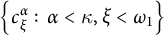 are mutually Cohen-generic over V, and it follows that for all but countably many values of
$\alpha $
 , the reals
$c_\alpha ^0$
 and
$c_\alpha ^1$
 are mutually Cohen-generic over
$V[G_S]$
 . In particular, this implies that
$f[c^0_\alpha ] \neq ^* c^1_\alpha $
 . Because
$\Phi _h(c^0_\alpha ) = c^1_\alpha $
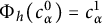 , this means that
$\Phi _h$
 is not induced by f. As f was an arbitrary almost bijection of
$\omega $
 , this shows that
$\Phi _h$
 is nontrivial.
Next, consider the case
$\kappa ^\omega> \kappa $
 . In this case, we must use a sage Davies tree of length
$\nu = \kappa ^\omega $
 rather than length
$\kappa $
 . Also in this case, the proof of Theorem 2.1(1) does not work, although Theorem 2.1(2) still goes through.
To work around not having access to Theorem 2.1(1), we use a generalized almost disjoint family in
$[\kappa ]^\omega $
 . First, note that the set
$\kappa ^{<\omega }$
 of all finite sequences in
$\kappa $
 is a set of size
$\kappa $
 . Associating with each infinite sequence
$s \in \kappa ^\omega $
 its set of restrictions
$A_s = \left \lbrace s \!\restriction \! n ~\colon~ n \in \omega \right \rbrace $
 , we see that there is a size-
$\kappa ^\omega $
 family
$\left \lbrace A_s ~\colon~ s \in \kappa ^\omega \right \rbrace $
 of pairwise almost disjoint countable subsets of
$\kappa ^{<\omega }$
 .
Fix a bijection
$\psi $
 between
$\nu = \kappa ^\omega $
 and some size-
$\kappa ^\omega $
 family of pairwise almost disjoint countable subsets of
$\kappa $
 . Now modify the proof of Theorem 3.1 by including
$\psi $
 in the parameter for our sage Davies tree: that is, take
$P = (R,h,\phi ,\psi )$
 instead of just
$P = (R,h,\phi )$
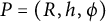 .
Using the fact that
$\nu> \kappa $
 , we can show (using an argument essentially identical to the first paragraph of the proof of Theorem 2.1) that
$\left \lvert \nu \cap M_\alpha \backslash \bigcup _{\xi < \alpha }M_\xi \right \rvert = \aleph _1$
 for each
$\alpha < \nu $
 . Because
$\psi \in M_\alpha $
 , the
$\aleph _1$
 -many new ordinals
$<\!\nu $
 give us access to
$\aleph _1$
 -many new countable subsets of
$\kappa $
 , namely the sets
$\psi (\zeta )$
 , where
$\zeta \in \nu \cap M_\alpha \backslash \bigcup _{\xi < \alpha }M_\xi $
 .
Now, suppose
$S \in M_\xi $
 for some
$\xi < \alpha $
 and
$S \in [\kappa ]^\omega $
 . Because
$\psi $
 maps to an almost disjoint family,
$\mathrm {Hit}(S) = \left \lbrace \zeta < \nu ~\colon~ \psi (\zeta ) \cap S \text { is infinite} \right \rbrace $
 is a countable subset of
$\nu $
 definable from S. Consequently,
$\mathrm {Hit}(S) \subseteq M_\xi $
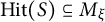 . Furthermore, if
$\zeta \in \nu \cap M_\alpha \backslash \bigcup _{\xi < \alpha }M_\xi $
 , then
$\psi (\zeta ) \cap S$
 is finite for all
$S \in [\kappa ]^\omega \cap \bigcup _{\xi < \alpha }M_\xi $
 . In particular,
$C_\alpha = \left \lbrace \psi (\zeta ) ~\colon~ \zeta \in \nu \cap M_\alpha \backslash \bigcup _{\xi < \alpha }M_\xi \right \rbrace $
 is a size-
$\aleph _1$
 collection of countable subsets of
$\kappa $
 in
$M_\alpha $
 , each one of which is almost disjoint from every such set in
$\bigcup _{\xi < \alpha }M_\xi $
 .
These sets in
$C_\alpha $
 take the role of the sets
$[\lambda ,\lambda +\omega )$
 in the proof of Theorem 2.1
$(1)$
 . Because they are almost disjoint from each other and from the sets in
$\bigcup _{\xi < \alpha }M_\xi $
 , they give rise to a set of
$\aleph _1$
 mutually generic Cohen reals in
$M_\alpha [G]$
 that can be used to carry out the construction of
$\Phi _h$
 at stage
$\alpha $
 . As with the
$\kappa ^\omega = \kappa $
 case at the start of this proof, going through this construction with h, the constant function
$\alpha \mapsto 1$
 yields a nontrivial automorphism of
 .
We conclude with some further observations and open questions. The most pressing question raised by our main theorem is as follows.
Question 3.2. Can parts
$(2)$
 and
$(3)$
 of the main theorem be proved from
$\textsf {ZFC}$
 ? And can the number of automorphisms in
$(3)$
 be raised to
$2^\kappa $
 ?
It is worth pointing out that if it is consistent that all automorphisms of
 are trivial in the
$\kappa $
 -Cohen model for some
$\kappa \geq \aleph _\omega $
 , then proving this will require a large cardinal hypothesis.
As was mentioned already, the hypothesis of the theorem, that there is a sage Davies tree of length
$\kappa $
 , holds provided that
$\textsf {SCH}$
 and
$\square _\lambda $
 hold at all
$\lambda \leq \kappa $
 with
$\mathrm {cf}(\lambda ) = \kappa $
 . The failure of
$\square _\lambda $
 at a singular
$\lambda $
 while
$\textsf {SCH}$
 holds is quite high: [Reference Schimmerling and Zeeman18, Corollary 5] shows that it gives rise to an inner model with infinitely many Woodin cardinals. (And even without
$\textsf {SCH}$
 , one still gets an inner model with a Woodin cardinal.) The failure of
$\textsf {SCH}$
 has much lower consistency strength: by the work of Gitik in [Reference Gitik12, Reference Gitik13], the failure of
$\textsf {SCH}$
 is equiconsistent with the existence of a measurable cardinal
$\mu $
 with Mitchell order
$\mu ^{++}$
 . This, then, is the bottleneck for constructing sage Davies trees: if there is a model without long sage Davies trees, then it is consistent to have (at least) measurable cardinals of large Mitchell order.
If we assume GCH in the ground model rather than merely CH, then
$\textsf {SCH}$
 holds automatically, so a lack of sage Davies trees would entail the failure of
$\square _\lambda $
 for singular
$\lambda $
 . Furthermore, it is proved in [Reference Brian, Dow, Milovich and Yengulalp1] that under GCH, the “Very Weak Square” of Foreman and Magidor from [Reference Foreman and Magidor8] suffices to construct sage Davies trees.
Question 3.3 Is it consistent, relative to some large cardinal hypothesis, that all automorphisms of
 are trivial in the
$\kappa $
 -Cohen model for some
$\kappa \geq \aleph _\omega $
 ? Is it consistent (relative to large cardinals) that there is a regular
$\kappa> \aleph _\omega $
 such that not all ground model automorphisms of
 extend to
$2^\kappa $
 automorphisms in the
$\kappa $
 -Cohen model?
Finally, let us point out that while we have a decent understanding of automorphisms of
 after adding Cohen reals, it is open what happens after adding random reals.
Question 3.4 Are there nontrivial automorphisms of
 in the random real model? What about the
$\kappa $
 -random real model for
$\kappa \geq \aleph _3$
 ?
Acknowledgments
We would like to thank both Stefan Geschke and an anonymous referee for drawing our attention to the work in [Reference Geschke11, Reference Koppelberg, Droste and Göbel15] on tightly
$\sigma $
 -filtered Boolean algebras, shortly after the appearance of the first draft of this article. While we were not aware of it beforehand, Geschke’s results in [Reference Geschke11] clarify why certain aspects of our argument must look the way they do since
 is not tightly
$\sigma $
 -filtered in higher
$\kappa $
 -Cohen models.


 Open access

