



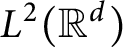
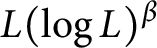

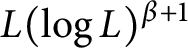

1 Introduction
We will work on
 $\mathbb {R}^d$
,
 $d\geq 2$
. Let
 $p\in (1,\,\infty )$
and
 $T_1$
,
 $T_2$
be two singular integral operators. It is obvious that if
 $T_1$
and
 $T_2$
are bounded on
 $L^p(\mathbb {R}^d)$
, then the composite operator
 $T_1T_2$
is also bounded on
 $L^p(\mathbb {R}^d)$
. However, if
 $T_1$
and
 $T_2$
are all bounded from
 $L^1(\mathbb {R}^d)$
to
 $L^{1,\,\infty }(\mathbb {R}^d)$
, we cannot deduce the mapping property of
 $T_1T_2$
on
 $L^1(\mathbb {R}^d)$
immediately.
The composition of singular integral operators arises typically in the algebra of singular integral (see [Reference Calderón2, Reference Calderón3, Reference Calderón and Zygmund6]) and the noncoercive boundary-value problems for elliptic equations (see [Reference Nagel, Ricci, Stein and Wainger16, Reference Phone and Stein17]). In the past decades, consideration attention has been paid to the composition of singular integral operators (see [Reference Benea and Bernicot1, Reference Christ8, Reference Nagel, Ricci, Stein and Wainger16, Reference Phone and Stein17, Reference Strichartz20] and the references therein). Carozza and Passarelli di Napoli [Reference Carozza and Passarelli di Napoli7] considered the weak type endpoint estimates for the composition of maximal operators and proved that for
 $k\in \mathbb {N}$
,
 $M^k$
, the kth iterated operator of the Hardy–Littlewood maximal operator satisfies
 $$ \begin{align*}|\{x\in\mathbb{R}^d:\,M^kf(x)>\lambda\}|\lesssim \int_{\mathbb{R}^d}\Psi_{k-1}\Bigg(\frac{|f(x)|}{\lambda}\Bigg)dx, \end{align*} $$
where, and in the following, for
 $\beta \in [0,\,\infty )$
,
 $\Psi _{\beta }(t)=t\log ^{\beta }({\textrm {e}}+t)$
. Benea and Bernicot [Reference Benea and Bernicot1] and Hu [Reference Hu12] studied the weighted weak type endpoint estimates for the compositions of Calderón–Zygmund operators. It should be pointed out that the results in [Reference Benea and Bernicot1, Reference Hu12] depend on the regularity of kernel of the Calderón–Zygmund operators.
Let
 $\Omega $
be homogeneous of degree zero, integrable, and have mean value zero on the unit sphere
 ${S}^{d-1}$
. Define the singular integral operator
 ${T}_{\Omega }$
by
 $$ \begin{align}{T}_{\Omega}f(x)={\textrm{p. v.}}\int_{\mathbb{R}^d} \frac {\Omega( y')}{|y|^d}f(x-y)dy,\end{align} $$
where, and in the following,
 $y'=y/|y|$
for
 $y\in \mathbb {R}^d$
. This operator was introduced by Calderón and Zygmund [Reference Calderón and Zygmund4] and then studied by many authors in the last 60 years. Calderón and Zygmund [Reference Calderón and Zygmund5] proved that if
 $\Omega \in L\log L({S}^{d-1})$
, then
 $T_{\Omega }$
is bounded on
 $L^p(\mathbb {R}^d)$
for
 $p\in (1,\,\infty )$
. Ricci and Weiss [Reference Ricci, Weiss, Wainger and Weiss18] improved the result of Calderón–Zygmund and showed that
 $\Omega \in H^1(S^{d-1})$
guarantees the
 $L^p(\mathbb {R}^n)$
boundedness on
 $L^p(\mathbb {R}^n)$
for
 $p\in (1,\,\infty )$
. Seeger [Reference Seeger19] showed that
 $\Omega \in L\log L(S^{d-1})$
is a sufficient condition, such that
 $T_{\Omega }$
is bounded from
 $L^1(\mathbb {R}^d)$
to
 $L^{1,\,\infty }(\mathbb {R}^d)$
. For other works about the mapping properties of
 $T_{\Omega }$
, we refer the papers [Reference Christ and Rubio de Francia9, Reference Duoandikoetxea and Rubio de Francia10, Reference Ricci, Weiss, Wainger and Weiss18] and the references therein.
Let
 $\eta \in (0,\,1)$
and
 $\mathcal {S}=\{Q_j\}$
be a family of cubes. We say that
 $\mathcal {S}$
is
 $\eta $
-sparse, if for each fixed
 $Q\in \mathcal {S}$
, there exists a measurable subset
 $E_Q\subset Q$
, such that
 $|E_Q|\geq \eta |Q|$
and
 $E_{Q}$
s are pairwise disjoint. Let T be a sublinear operator acting on
 $\cup _{p\geq 1}L^p(\mathbb {R}^d)$
,
 $\beta ,\,q\in (0,\,\infty )$
. We say that T enjoys a
 $(L(\log L)^{\beta },\,L^{q})$
-bilinear sparse domination, if for each bounded function f with compact support, there exists a sparse family
 $\mathcal {S}$
of cubes, such that for all
 $h\in L_{{\textrm {loc}}}^{q}(\mathbb {R}^d)$
,
 $$ \begin{align*}\Big|\int_{\mathbb{R}^d}h(x)Tf(x)dx\Big|\lesssim\sum_{Q\in\mathcal{S}}\|f\|_{L(\log L)^{\beta},\,Q}\langle |h|\rangle_{Q,\,q}|Q|,\end{align*} $$
where
 $$ \begin{align*}\|f\|_{L(\log L)^{\beta},\,Q}=\inf\Bigg\{\lambda>0:\,\frac{1}{|Q|}\int_{Q}\Psi_{\beta}\Bigg(\frac{|f(y)|}{\lambda}\Bigg)dy\leq 1\Bigg\},\end{align*} $$
 $\langle |h|\rangle _{Q}$
denotes the mean value of
 $|h|$
on Q, and
 $\langle |h|\rangle _{Q, r}= (\langle |h|^r\rangle _{Q} )^{\frac {1}{r}}.$
Recently, Hu et al. [Reference Hu, Lai and Xue13] considered the composition of operators in abstract settings and obtained the following result.
Theorem 1.1 Let
 $q\in (1,\,3/2]$
,
 $U_1$
be a sublinear operator and
 $U_2$
be a linear operator on
 $\cup _{p\geq 1}L^p(\mathbb {R}^d)$
. Suppose that
-
(i)
 $U_1$
is bounded on
$L^2(\mathbb {R}^d)$
with bound
$1$
;
-
(ii) there exists a positive constant
$\beta _1$
, such that for any
$\lambda>0$
, (1.3)
$$ \begin{align}|\{x\in \mathbb{R}^d:\,|U_1f(x)|>\lambda\}|\le \int_{\mathbb{R}^d}\Psi_{\beta_1}\Bigg(\frac{|f(x)|}{\lambda}\Bigg)dx; \end{align} $$
-
(iii) for some
$q\in (1,\,\frac {3}{2}]$
and
$\beta _2\in [0,\,\infty )$
,
$U_2$
enjoys a bilinear
$(L(\log L)^{\beta _2},\,L^q)$
-sparse domination with bound
$1$
.


Then, for any
 $\lambda>0$
,
 $$ \begin{align}&&|\{x\in \mathbb{R}^d:\,|U_1U_2f(x)|>\lambda\}|\lesssim\int_{\mathbb{R}^d}\Psi_{1+\beta_1+\beta_2}\Bigg(\frac{|f(x)|}{\lambda}\Bigg)dx.\end{align} $$
Recall that when
 $\Omega \in L^{\infty }(S^{d-1})$
,
 $T_{\Omega }$
satisfies the
 $(L^1,\,L^r)$
-bilinear sparse domination for any
 $r\in (1,\,\infty )$
(see [Reference Hu, Lai and Xue13, Reference Lerner14]), we deduce from Theorem 1.1 that
Corollary 1.2 Let
 $\Omega $
be homogeneous of degree zero, have mean value zero on
 $S^{d-1}$
, and
 $\Omega \in L^{\infty }({S}^{d-1})$
,
 $T_{\Omega }$
be the operator defined by equation (1.2). Let U be a sublinear operator which is bounded on
 $L^2(\mathbb {R}^d)$
and satisfies equation (1.3) for some
 $\beta _1\in [1,\,\infty )$
. Then for any
 $\lambda>0$
,
 $$ \begin{align}|\{x\in \mathbb{R}^d:\,|U(T_{\Omega}f)(x)|>\lambda\}|\lesssim\int_{\mathbb{R}^d}\Psi_{\beta_1+1}\Bigg(\frac{|f(x)|}{\lambda}\Bigg)dx.\end{align} $$
For the case of
 $\Omega \in L\log L(S^{d-1})$
, we know that
 $T_{\Omega }$
does not satisfy a bilinear sparse domination of
 $(L(\log L)^{\beta },\,L^q)$
type for some
 $\beta \in [1,\,\infty )$
and
 $q\in (1,\,\infty )$
. In fact, if
 $T_{\Omega }$
satisfies a bilinear sparse domination of
 $(L(\log L)^{\beta },\,L^q)$
type, then for any bounded functions f and h, a standard duality argument tells us that there exists a sparse family
 $\mathcal {S}$
, such that
 $$ \begin{align}\Bigg|\int_{\mathbb{R}^d}h(x)T_{\Omega}f(x)dx\Bigg|\lesssim \sum_{Q\in\mathcal{S}}\langle |f|\rangle_{Q,q} \|h\|_{L(\log L)^{\beta},\,Q}|Q|.\end{align} $$
For
 $p\in [1,\,\infty )$
, let
 $A_{p}(\mathbb {R}^d)$
be the weight function class of Muckenhoupt (see [Reference Grafakos11, Chapter 9] for definitions and properties of
 $A_p(\mathbb {R}^d)$
),
 $M_qf(x)=\big [M(|f|^q)(x)\big ]^{1/q}$
, and
 $$ \begin{align*}M_{L(\log L)^{\beta}}h(x)=\mathop{\mathrm{sup}}\limits_{Q\ni x}\|h\|_{L(\log L)^{\beta},\,Q}.\end{align*} $$
By inequality (1.6) and sparseness of
 $\mathcal {S}$
, we know that for
 $p\in (q,\,\infty )$
and
 $w\in A_{p/q}(\mathbb {R}^d)$
,
 $$ \begin{align*}\Bigg|\int_{\mathbb{R}^d}h(x)T_{\Omega}f(x)dx\Bigg|&\lesssim \int_{\mathbb{R}^d}M_qf(x)M_{L(\log L)^{\beta}}h(x)dx\\ &\lesssim \|M_qf\|_{L^p(\mathbb{R}^d,\,w)}\|M_{L(\log L)^{\beta}}h\|_{L^{p'}(\mathbb{R}^d,w^{-1/(p-1)})}\\ &\lesssim \|f\|_{L^p(\mathbb{R}^n,\,w)}\|h\|_{L^{p'}(\mathbb{R}^d,w^{-1/(p-1)})}.\end{align*} $$
But [Reference Muckenhoupt and Wheeden15, Theorem 1] tells us that the last inequality is false when
 $\Omega \in L\log L(S^{d-1})$
. Thus, Theorem 1.1 does not apply to
 $T_{\Omega }$
in this case. Our main purpose in this paper is to prove that inequality (1.5) still holds when
 $\Omega \in L\log L(S^{d-1})$
, namely we will prove the following result.
Theorem 1.3 Let
 $\beta \in [0,\,\infty )$
, U be a sublinear operator which is bounded on
 $L^2(\mathbb {R}^d)$
and satisfies the weak type endpoint estimate of
 $L(\log L)^{\beta }$
type, that is, for any
 $\lambda>0$
,
 $$ \begin{align}|\{x\in\mathbb{R}^d:\, |Uf(x)|>\lambda\}|\lesssim\int_{\mathbb{R}^d}\Psi_{\beta}\Bigg(\frac{|f(x)|}{\lambda}\Bigg)dx.\end{align} $$
Let
 $\Omega $
be homogeneous of degree zero, have mean value zero on
 $S^{d-1}$
and
 $\Omega \in L\log L({S}^{d-1})$
,
 $T_{\Omega }$
be the operator defined by equation (1.2). Then for
 $\lambda>0$
and bounded function f with compact support,
 $$ \begin{align}\big|\{x\in\mathbb{R}^d: |UT_{\Omega}f(x)|>\lambda\}\big|\lesssim \int_{\mathbb{R}^d}\Psi_{\beta+1}\Bigg(\frac{|f(x)|}{\lambda}\Bigg)dx.\end{align} $$
As an application of Theorem 1.3, we obtain the following result.
Corollary 1.4 Let
 $\Omega _1,\,\dots ,\,\Omega _k$
be homogeneous of degree zero, have mean value zero on
 $S^{d-1}$
, and
 $\Omega _1,\,...,\,\Omega _k\in L\log L({S}^{d-1})$
. Then for
 $\lambda>0$
,
 $$ \begin{align*}\big|\{x\in\mathbb{R}^d: |T_{\Omega_1}(T_{\Omega_2}\dots T_{\Omega_k}f)(x)|>\lambda\}\big|\lesssim \int_{\mathbb{R}^d}\Psi_{k-1}\Bigg(\frac{|f(x)|}{\lambda}\Bigg)dx. \end{align*} $$
Remark 1.5 Let
 $M_{\Omega }$
be the operator defined by
 $$ \begin{align} M_{\Omega}f(x)=\mathop{\mathrm{sup}}\limits_{r>0}r^{-d}\int_{|y-x|<r}|\Omega(x-y)||f(y)|dy. \end{align} $$
Using the estimates relating to
 $M_{\Omega }$
in [Reference Christ and Rubio de Francia9], and the argument used inthe proof of Theorem 1.3, we can verify the following Theorem 1.6.
Theorem 1.6 Let
 $\beta \in [0,\,\infty )$
, U be a sublinear operator which is bounded on
 $L^2(\mathbb {R}^d)$
and satisfies the weak type endpoint estimate of
 $L(\log L)^{\beta }$
type. Let
 $\Omega $
be homogeneous of degree zero and
 $\Omega \in L\log L({S}^{d-1})$
. Then for
 $\lambda>0$
and bounded function f with compact support,
 $$ \begin{align*}\big|\{x\in\mathbb{R}^d: |UM_{\Omega}f(x)|>\lambda\}\big|\lesssim \int_{\mathbb{R}^d}\Psi_{\beta+1}\Bigg(\frac{|f(x)|}{\lambda}\Bigg)dx.\end{align*} $$
It was proved in [Reference Christ and Rubio de Francia9] that if
 $\Omega \in L\log L(S^{d-1})$
, then
 $M_{\Omega }$
is bounded from
 $L^1(\mathbb {R}^d)$
to
 $L^{1,\,\infty }(\mathbb {R}^d)$
. By Theorem 1.6, we know that if
 $\Omega _1,\,\dots ,\,\Omega _k\in L\log L(S^{d-1})$
, then for any
 $\lambda>0$
,
 $$ \begin{align*}\big|\{x\in\mathbb{R}^d: M_{\Omega_1}(M_{\Omega_2}\dots M_{\Omega_k}f)(x)>\lambda\}\big|\lesssim \int_{\mathbb{R}^d}\Psi_{k-1}\Bigg(\frac{|f(x)|}{\lambda}\Bigg)dx. \end{align*} $$
This, in some sense, is an extension of inequality (1.1).
Remark 1.7 In the proof of Theorem 1.3, we will employ some ideas and estimates of Seeger [Reference Seeger19]. The main difficult in our proof is that for
 $\beta \in (0,\infty )$
, the inequality
 $$ \begin{align*}\int_{\mathbb{R}^d}\Psi_{\beta}\Bigg(\sum_{j=1}^{\infty}|f_j(x)|\Bigg)dx\lesssim \sum_{j=1}^{\infty}\int_{\mathbb{R}^d}\Psi_{\beta}(|f_j(x)|)dx\end{align*} $$
is not true. Our observation is that, if b is the bad part in the Calderón–Zygmund decomposition of function f, then
 $T_{\Omega }b(x)$
can be decomposed to four terms, all of which enjoy suitable
 $L^2(\mathbb {R}^d)$
estimates. These estimates either lead to desired conclusion directly or lead to the desired estimate via the
 $L^1(\mathbb {R}^d)$
estimate and an interpolation argument.
Throughout this paper, C always denotes a positive constant that is independent of the main parameters involved but whose value may differ from line to line. We use the symbol
 $A\lesssim B$
to denote that there exists a positive constant C, such that
 $A\le CB$
. Specially, we use
 $A\lesssim _{d,p} B$
to denote that there exists a positive constant C depending only on
 $d,p$
, such that
 $A\le CB$
. Constant with subscript such as
 $c_1$
does not change in different occurrences. For any set
 $E\subset \mathbb {R}^d$
,
 $\chi _E$
denotes its characteristic function. For a cube
 $Q\subset \mathbb {R}^d$
and
 $\lambda \in (0,\,\infty )$
, we use
 $\ell (Q)$
to denote the side length of Q and
 $\lambda Q$
to denote the cube with the same center as Q and whose side length is
 $\lambda $
times that of Q.
2 Proof of Theorem 1.3
We employ the ideas in [Reference Seeger19, Section Reference Calderón2]. For
 $s>3$
, let
 $\mathfrak {E}^s=\{e_{\nu }^s\}$
be a collection of unit vectors on
 $S^{d-1}$
, such that
-
(a) for
$\nu \not =\nu '$
,
$|e_{\nu }^s-e_{\nu '}^s|>2^{-s-10}d^{-1}$
; -
(b) for each
$\theta \in S^{d-1}$
, there exists an
$e^s_{\nu }$
satisfying that
$|e^s_{\nu }-\theta |\leq 2^{-s-1}.$


We may construct disjoint measurable set
 $E_{\nu }^s\subset S^{d-1}$
with
 $e_{\nu }^s\in E_{\nu }^s$
,
 ${\textrm {diam}}(E_{\nu }^s)\leq 2^{-s}$
, and
 $\cup _{\nu }E_{\nu }^s=S^{d-1}$
.
Fix a number
 $\kappa \in (0,\,1)$
. Let
 $\psi \in C^{\infty }_0(\mathbb {R})$
with
 ${\textrm {supp}}\, \psi \subset [-4,\,4]$
and
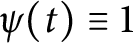 $\psi (t)\equiv 1$
when
 $t\in [-2,\,2]$
. Define the operator
 $P_{\nu }^s$
by
 $$ \begin{align*}\widehat{P_{\nu}^s}(\xi)=\psi(2^{s(1-\kappa)}\langle \xi, e_{\nu}^s\rangle/|\xi|).\end{align*} $$
Take a smooth radial non-negative function
 $\phi $
on
 $\mathbb {R}^d$
, such that
 ${\textrm {supp}}\, \phi \subset \{x:\frac {1}{2}\leq |x|\leq 2\}$
and
 $\sum _j\phi _j(x)=1$
for all
 $x\in \mathbb {R}^d\backslash \{0\}$
, where
 $\phi _j(x)=\phi (2^{-j}x)$
. Let
 $\Omega $
be homogeneous of degree zero and
 $\Omega \in L^{1}(S^{d-1})$
,
 $K_j(x)=\Omega (x')|x|^{-d}\phi _j(x)$
,
 $$ \begin{align}K_{j\nu}^s(x)=K_j(x)\chi_{E_{\nu}^s}(x/|x|), \,\, \Gamma_j^s(x)=\sum_{\nu}P_{\nu}^s*K_{j\nu}^s(x).\end{align} $$
Lemma 2.1 Let
 $\Omega $
be homogeneous of degree zero and
 $\Omega \in L^{\infty }(S^{d-1})$
,
 $\mathcal {Q}$
be a collection of cubes with disjoint interiors. Define
 $L(Q)=m$
if
 $2^{m-1}<\ell (Q)\leq 2^m$
and let
 $\mathcal {Q}_m=\{Q\in \mathcal {Q}:\,L(Q)=m\}$
. For each cube
 $Q\in \mathcal {Q}$
, let
 $f_Q$
be an integrable function supported in Q satisfying
 $$ \begin{align*}\|f\|_{L^1(\mathbb{R}^d)}\leq |Q|.\end{align*} $$
Let
 $F_m =\sum _{Q\in \mathcal {Q}_m}f_Q$
. Then, for
 $s\geq 3$
,
 $$ \begin{align*}\Bigg\|\sum_{j}\Gamma_j^s*F_{j-s}\Bigg\|^2_{L^2(\mathbb{R}^d)}\leq \|\Omega\|_{L^{\infty}(S^{d-1})}^22^{-s(1-\kappa)}\sum_{Q}\|f_Q||_{L^1(\mathbb{R}^d)}. \end{align*} $$
This lemma is Lemma 2.1 in [Reference Seeger19].
Lemma 2.2 Let
 $\Omega $
be homogeneous of degree zero and
 $\Omega \in L^{\infty }(S^{d-1})$
. Let
 $\eta \in C^{\infty }(\mathbb {R}^d\backslash \{0\})$
, such that
 ${\textrm {supp}}\, \eta \subset \{1/2\leq |\xi |\leq 2\}$
and
 $\sum _{k\in \mathbb {Z}}\eta ^2(2^{-k}\xi )=1$
for all
 $\xi \in \mathbb {R}^d\backslash \{0\}$
, and
 $L_k$
be defined by
 $\widehat {L_k}(\xi )=\eta (2^{-k}\xi )$
. Let Q be a cube and
 $Q\in \mathcal {Q}_{j-s}$
,
 $b_Q$
be integrable, have integral zero, and supported on Q. Set
 $$ \begin{align*}m_{j\nu}^{sk}(\xi)=\eta(2^{-k}\xi)(1-\widehat{P}_{\nu}^s(\xi))\widehat{K^{s}_{j\nu}}(\xi).\end{align*} $$
Then,
 $$ \begin{align*}\Bigg\|\sum_{\nu}\sum_{k}\mathcal{F}^{-1}[m_{j\nu}^{sk}]*{L}_k*b_Q\Bigg\|_{L^1(\mathbb{R}^d)}\lesssim \|\Omega\|_{L^{\infty}(S^{d-1})}2^{-\varepsilon s}\|b_Q\|_{L^1(\mathbb{R}^d)}, \end{align*} $$
where
 $\varepsilon>0$
is a universal constant depending on
 $\kappa $
.
This is Lemma 2.2 in [Reference Seeger19].
Proof of Theorem 1.3
By homogeneity, it suffices to prove inequality (1.8) for
 $\lambda =1$
. Applying the Calderón–Zygmund decomposition to f at level
 $1$
, we can obtain a collection of nonoverlapping closed dyadic cubes
 $\mathcal {S}=\{Q_l\}$
, such that
 $\|f\|_{L^{\infty }(\mathbb {R}^d\backslash \cup _{Q\in \mathcal {S}}Q)}\lesssim 1$
, and
 $$ \begin{align*}\int_{Q}|f(x)|dx \lesssim |Q|,\,\,\,\sum_{Q\in\mathcal{S}}|Q|\lesssim \|f\|_{L^1(\mathbb{R}^d)}.\end{align*} $$
Let
 $$ \begin{align*}g(x)=f(x)\chi_{\mathbb{R}^d\backslash \cup_{Q\in\mathcal{S}}Q}(x)+\sum_{Q\in\mathcal{S}}\langle f\rangle_{Q}\chi_{Q}(x), \end{align*} $$
and
 $$ \begin{align*}b(x)=\sum_{Q\in\mathcal{S}}b_{Q}(x),\,\,\text{with}\,\,b_Q(x)=(f(x)-\langle f\rangle_{Q}\big)\chi_{Q}(x).\end{align*} $$
It is obvious that
 $$ \begin{align*}\|g\|_{L^{\infty}(\mathbb{R}^d)}\lesssim 1,\,\,\,\|g\|_{L^1(\mathbb{R}^d)}\lesssim \|f\|_{L^1(\mathbb{R}^d)}.\end{align*} $$
Thus, by the
 $L^2(\mathbb {R}^d)$
boundedness of U and
 $T_{\Omega }$
, we obtain that
 $$ \begin{align}\big|\{x\in\mathbb{R}^d: |UT_{\Omega}g(x)|>1/2\}\big|\lesssim \|g\|^2_{L^2(\mathbb{R}^d)}\lesssim \|f\|_{L^1(\mathbb{R}^d)}.\end{align} $$
To estimate the term
 $UT_{\Omega }b$
, we set
 $E=\cup _{l}2^{200}Q_l$
and write
 $$ \begin{align*}UT_{\Omega}b(x)=U(\chi_{E}T_{\Omega}b\big)(x)+U(\chi_{\mathbb{R}^d\backslash E}T_{\Omega}b\big)(x)=:{\textrm{I}}_1b(x)+{\textrm{I}}_2b(x).\end{align*} $$
Recall that U satisfies the estimate (1.7), and
 $|E|\lesssim \|f\|_{L^1(\mathbb {R}^d)}$
. It then follows that
 $$ \begin{align*} \int_{E}\Psi_{\beta}(|T_{\Omega}b(x)|)dx &\lesssim \int_{0}^{\infty}\big|\{x\in E:\,|T_{\Omega}b(x)|>s\}\big|d\Psi_{\beta}(s)\\ &\lesssim |E|+\int_{{\textrm{e}}}^\infty|\{x\in E: |T_{\Omega}b(x)|>2s\}|d\Psi_{\beta}(s)\\ &\lesssim |E|+\int_{\textrm{e}}^\infty|\{x\in E: |T_{\Omega}(b\chi_{\{|b|>s\}})(x)|>s\}|d\Psi_{\beta}(s)\\ &\quad +\int_{\textrm{e}}^\infty|\{x\in E: |T_{\Omega}(b\chi_{\{|b|\leq s\}})(x)|>s\}|d\Psi_{\beta}(s). \end{align*} $$
Since
 $T_{\Omega }$
is bounded from
 $L^1(\mathbb {R}^d)$
to
 $L^{1,\,\infty }(\mathbb {R}^d)$
(see [Reference Seeger19]), we deduce that
 $$ \begin{align*} &\int_{{\textrm{e}}}^\infty|\{x\in E: |T_{\Omega}(b\chi_{\{|b|>s\}})(x)|>s\}|d\Psi_{\beta}(s)\\ &\quad\lesssim\int_{{\textrm{e}}}^\infty\frac{1}{s}\int_{|b(x)|>s}|b(x)|dxd\Psi_{\beta}(s)\\ &\quad\lesssim \sum_{Q\in\mathcal{S}}\int_{Q}\Psi_{\beta+1}(|b_Q(x)|)dx\lesssim \int_{\mathbb{R}^d}\Psi_{\beta+1}(|f(x)|)dx, \end{align*} $$
where in the last inequality, we have invoked Jensen’s inequality, which tells us that
 $$ \begin{align*}\langle |f|\rangle_Q\log^{\beta+1}({\textrm{e}}+\langle |f|\rangle_Q)\le \frac{1}{|Q|}\int_{Q}|f(y)|\log^{\beta+1}({\textrm{e}}+|f(y)|)dy. \end{align*} $$
On the other hand, we deduce from the
 $L^2(\mathbb {R}^d)$
boundedness of
 $T_{\Omega }$
that
 $$ \begin{align*} &\int_{{\textrm{e}}}^\infty|\{x\in E:\, |T_{\Omega}(b\chi_{\{|b|\leq s\}})(x)|>s\}|d\Psi_{\beta}(s)\\ &\quad\quad\lesssim\int_{{\textrm{e}}}^\infty\frac{1}{s^2}\int_{|b(x)|\leq s}|b(x)|^2dxd\Psi_{\beta}(s)\lesssim \|\Psi_{\beta}(|f|)\|_{L^1(\mathbb{R}^d)}. \end{align*} $$
Therefore, we conclude the estimate of
 ${\textrm {I}}_1b(x)$
as follows:
 $$ \begin{align*}|\{x\in\mathbb{R}^d:\,|{\textrm{I}}_1b(x)|>1/4\} |\lesssim \int_{E}\Psi_{\beta}(|T_{\Omega}b(x)|)dx\lesssim\int_{\mathbb{R}^d}\Psi_{\beta+1}(|f(x)|)dx.\end{align*} $$
By inequality (2.2), our proof of Theorem 1.3 is now reduced to proving that
 $$ \begin{align} &&|\{x\in\mathbb{R}^d:\,|{\textrm{I}}_2b(x)|>1/4\}|\lesssim \int_{\mathbb{R}^d}\Psi_{\beta+1}(|f(x)|)dx.\end{align} $$
To prove inequality (2.3), we will employ some estimates from [Reference Seeger19]. Let
 $$ \begin{align*}E_0=\{x'\in S^{d-1}:\, |\Omega(x')|\leq 1\}\end{align*} $$
and
 $$ \begin{align*}E_k=\{x'\in S^{d-1}:\,2^{k-1}<|\Omega(x')|\leq 2^k\}\end{align*} $$
for
 $k\in \mathbb {N}$
. Set
 $$ \begin{align*}\Omega_0(x')=\Omega(x')\chi_{E_0}(x'),\,\,\Omega_k(x')=\Omega(x')\chi_{E_k}(x')\,\,(k\in\mathbb{N}).\end{align*} $$
For
 $j\in \mathbb {Z}$
, let
 $K_j^i(x)=\frac {\Omega _i(x)}{|x|^d}\phi _j(x)$
and
 $\mathcal {S}_j=\{Q\in \mathcal {S},\,\ell (Q)=2^j\}$
and
 $B_j(x)=\sum _{Q\in \mathcal {S}_j}b_Q(x)$
. Let
 $\Gamma ^{i,s}_{j}$
be the same as in equation (2.1) with
 $\Omega $
replaced by
 $\Omega _i$
. Write
 $$ \begin{align*}\chi_{\mathbb{R}^d\backslash E}(x)T_{\Omega}b(x)&=\chi_{\mathbb{R}^d\backslash E}(x)\sum_{i=0}^{\infty}\sum_{100\leq s\leq Ni}\sum_{j\in\mathbb{Z}}K^i_j*B_{j-s}(x)\\ &\quad +\chi_{\mathbb{R}^d\backslash E}(x)\sum_{i=0}^{\infty}\sum_{s>Ni}\sum_{j\in\mathbb{Z}}\Gamma^{i,s}_j*B_{j-s}(x)\\ &\quad +\chi_{\mathbb{R}^d\backslash E}(x)\sum_{i=0}^{\infty}\sum_{s> Ni}\sum_{j\in\mathbb{Z}}(K^i_j-\Gamma_{j}^{i,s})*B_{j-s}(x)\\ &:={\textrm{D}}_1b(x)+{\textrm{D}}_2b(x)+{\textrm{D}}_3b(x), \end{align*} $$
with
 $N\in \mathbb {N}$
a constant, such that
 $N>2\max \{\varepsilon ^{-1},\,(1-\kappa )^{-1}\}$
. Let
 $M_{\Omega _i}$
be the maximal operator defined as equation (1.9) with
 $\Omega $
replaced by
 $\Omega _i$
. The method of rotation of Calderón and Zygmund tells us that
 $$ \begin{align*}\|M_{\Omega_i}h\|_{L^p(\mathbb{R}^d)}\lesssim \|\Omega_i\|_{L^1(S^{d-1})}\|h\|_{L^p(\mathbb{R}^d)},\,\,1<p<\infty. \end{align*} $$
For each fixed
 $\lambda>0$
, let
 $E_{Q,\lambda }=\{x\in \mathbb {R}^d:\,|b_{Q}(x)|>\lambda \}$
and set
 $$ \begin{align}\widetilde{b}_{Q,\,\lambda}=b_{Q}(x)\chi_{E_{Q,\lambda}}(x),\,\,\widetilde{b}_{Q}^{\lambda}(x)=b_{Q}(x)\chi_{\mathbb{R}^d\backslash E_{Q,\lambda}}(x),\end{align} $$
and
 $$ \begin{align*}\widetilde{b}_{\lambda}=\sum_{Q\in\mathcal{S}}b_{Q,\,\lambda},\,\,\widetilde{b}^{\lambda}=\sum_{Q\in\mathcal{S}}b_{Q}^{\lambda}.\end{align*} $$
Let
 $h\in L^2(\mathbb {R}^d\backslash E)$
with
 $\|h\|_{L^2(\mathbb {R}^d)}=1$
and
 ${\textrm {supp}}\, h\subset \mathbb {R}^d\backslash E$
. A trivial computation shows that
 $$ \begin{align*} \Big|\int_{\mathbb{R}^d}{\textrm{D}}_1\widetilde{b}^{\lambda}(x)h(x)dx\Big|&\leq\sum_{i=0}^{\infty}\sum_{100\leq s\leq Ni}\sum_{j\in\mathbb{Z}}\sum_{Q\in\mathcal{S}_{j-s}}\int_{\mathbb{R}^d}\big|\widetilde{b}^{\lambda}_Q(x)K_j^i*h(x)\big|dx\\ &\lesssim\sum_{i=0}^{\infty}\sum_{100\leq s\leq Ni}\int_{\mathbb{R}^d}\sum_{Q\in\mathcal{S}}|\widetilde{b}^{\lambda}_Q(y)|M_{\Omega_i}h(y)dy\\ &\lesssim\sum_{i=0}^{\infty}\sum_{100\leq s\leq Ni}\|M_{\Omega_i}h\|_{L^2(\mathbb{R}^d)}\|\widetilde{b}^{\lambda}\|_{L^2(\mathbb{R}^d)}\\ &\lesssim\|\Omega\|_{L\log L(S^{d-1})}\|\widetilde{b}^{\lambda}\|_{L^2(\mathbb{R}^d)}. \end{align*} $$
Therefore,
 $$ \begin{align} \|{\textrm{D}}_1\widetilde{b}^{\lambda}\|_{L^2(\mathbb{R}^d)}\lesssim \|\widetilde{b}^{\lambda}\|_{L^2(\mathbb{R}^d)}. \end{align} $$
On the other hand, we have
 $$ \begin{align} &&\|{\textrm{D}}_1\widetilde{b}_{\lambda}\|_{L^1(\mathbb{R}^d)}\lesssim \sum_{i=0}^{\infty}\;\;\sum_{100\leq s\leq Ni}\;\;\sum_{j\in\mathbb{Z}}\;\;\sum_{Q\in\mathcal{S}_{j-s}}\|K_j^i*\widetilde{b}_{Q,\lambda}\|_{L^1(\mathbb{R}^d)}\lesssim \|\widetilde{b}_{\lambda}\|_{L^1(\mathbb{R}^d)}, \end{align} $$
and
 $$ \begin{align} \|{\textrm{D}}_1{b}\|_{L^1(\mathbb{R}^d)}\lesssim \|b\|_{L^1(\mathbb{R}^d)}. \end{align} $$
Estimate (2.7) now tells us that
 $$ \begin{align}\int_{\mathbb{R}^d}\Psi_{\beta}(|{\textrm{D}}_1b(x)|)dx&=\int_{\{x:|{\textrm{D}}_1b(x)|\leq {\textrm{e}}\}}\Psi_{\beta}(|{\textrm{D}}_1b(x)|)dx\nonumber\\ &\quad +\int_{\{x:|{\textrm{D}}_1b(x)|>{\textrm{e}}\}}\Psi_{\beta}(|{\textrm{D}}_1b(x)|)dx\nonumber\\ &\lesssim \|f\|_{L^1(\mathbb{R}^d)}+\int_{\{x:|{\textrm{D}}_1b(x)|> {\textrm{e}}\}}\Psi_{\beta}(|{\textrm{D}}_1b(x)|)dx. \end{align} $$
Write
 $$ \begin{align*} \int_{\{|{\textrm{D}}_1b(x)|>{\textrm{e}}\}}\Psi_{\beta}(|{\textrm{D}}_1b(x)|)dx&\lesssim |\{x\in\mathbb{R}^d:\,|{\textrm{D}}_1b(x)|>{\textrm{e}}\}|\\ &\quad +\int_{{\textrm{e}}}^{\infty}|\{x\in\mathbb{R}^d:\,|{\textrm{D}}_{1}\widetilde{b}_{\lambda}(x)|>\lambda/2\}|d\Psi_{\beta}(\lambda)\\ &\quad +\int_{{\textrm{e}}}^{\infty}|\{x\in\mathbb{R}^d:\,|{\textrm{D}}_1\widetilde{b}^{\lambda}(x)|>\lambda/2\}|d\Psi_{\beta}(\lambda)\\&={\textrm{E}}_1+{\textrm{E}}_2+{\textrm{E}}_3. \end{align*} $$
It then follows inequality (2.6) that
 $$ \begin{align*} {\textrm{E}}_2 &\lesssim\sum_{Q}\int_{{\textrm{e}}}^{\infty}\int_{\mathbb{R}^d}|\widetilde{b}_{Q,\lambda}(x)|dx\lambda^{-1} d\Psi_{\beta}(\lambda)\\ &\lesssim\sum_{Q}\int_{\mathbb{R}^d}|b_{Q}(x)|\int_{e}^{|b_{Q}(x)|}d\big(\log^{{\beta}+1}({\textrm{e}}+\lambda)\big)dx\lesssim \int_{\mathbb{R}^d}\Psi_{{\beta}+1}(|f(x)|)dx. \end{align*} $$
On the other hand, it follows from inequality (2.5) that
 $$ \begin{align*} {\textrm{E}}_3 &\lesssim\sum_{Q}\int_{{\textrm{e}}}^{\infty}\int_{\mathbb{R}^d}|\widetilde{b}_{Q}^{\lambda}(x)|^2dx\lambda^{-2} d\Psi_{\beta}(\lambda)\\ &\lesssim-\sum_{Q}\int_{\mathbb{R}^d}|b_{Q}(x)|^2\int_{|b_{Q}(x)|}^{\infty}d\big(\lambda^{-1}\log^{\beta}({\textrm{e}}+\lambda)\big)dx \lesssim \int_{\mathbb{R}^d}\Psi_{\beta}(|f(x)|)dx. \end{align*} $$
Those estimates for
 ${\textrm {E}}_2$
and
 ${\textrm {E}}_3$
, along with inequality (2.7), show that
 $$ \begin{align} \big|\big\{x\in\mathbb{R}^d:\,|U({\textrm{D}}_1b)(x)|>1/12\big\}\big| &\lesssim \int_{\mathbb{R}^d}\Psi_{\beta}(|{\textrm{D}}_1b(x)|)dx\nonumber\\ &\lesssim\int_{\mathbb{R}^d}\Psi_{\beta+1}(|f(x)|)dx. \end{align} $$
We now estimate
 ${\textrm {D}}_2b$
. An application of Lemma 2.1 gives us that
 $$ \begin{align*} \Big\|\sum_j\Gamma_j^{i,s}*B_{j-s}\Big\|^2_{L^2(\mathbb{R}^d)}\lesssim 2^{-(1-\kappa) s}\|\Omega_i\|^2_{L^{\infty}(S^{n-1})}\sum_{Q\in\mathcal{S}}\|b_Q\|_{L^1(\mathbb{R}^d)}. \end{align*} $$
Therefore,
 $$ \begin{align} \|{\textrm{D}}_2b\|_{L^2(\mathbb{R}^d)}^2\lesssim \Bigg(\sum_{i=0}^{\infty}\sum_{s> Ni}\Bigg\|\sum_j\Gamma_j^{i,s}*B_{j-s}\Bigg\|_{L^2(\mathbb{R}^d)}\Bigg)^2\lesssim \|b\|_{L^1(\mathbb{R}^d)}. \end{align} $$
Chebyshev’s inequality, along with estimate (2.10), yields
 $$ \begin{align} \big|\big\{x\in\mathbb{R}^d:\,|U({\textrm{D}}_2b)(x)|>1/12\big\}\big| \lesssim \|{\textrm{D}}_2b\|^2_{L^2(\mathbb{R}^d)}\lesssim\|f\|_{L^1(\mathbb{R}^d)}. \end{align} $$
We turn our attention to
 $ |U({\textrm {D}}_3b)(x) |.$
Let
 $K^{i,s}_{j\nu }$
,
 $m_{j\nu }^{isk}$
be the same as in equation (2.1) with
 $\Omega $
replaced by
 $\Omega _i$
. Set
 $$ \begin{align*}m_{j\nu}^{isk}(\xi)=\eta(2^{-k}\xi)(1-\widehat{P}_{\nu}^s(\xi))\widehat{H^{is}_{j\nu}}(\xi),\end{align*} $$
and
 $$ \begin{align*}K_j^i(y)-\Gamma_j^{i,\,s}(y)=\sum_{\nu}\sum_{k}\mathcal{F}^{-1}(m_{j\nu}^{isk})*L_k(y). \end{align*} $$
For each fixed
 $\lambda>0$
, let
 $\widetilde {b}_{Q,\lambda }$
,
 $\widetilde {b}_{Q}^{\lambda }(x)$
be the same as in equation (2.4), and set
 $$ \begin{align*}{b}_{Q,\lambda}(x)=\big(\widetilde{b}_{Q,\lambda}(x)-\langle\widetilde{b}_{Q,\lambda}\rangle_Q\big)\chi_{Q}(x),\,\,{b}_{Q}^{\lambda}(x)=\big(\widetilde{b}_{Q}^{\lambda}(x)-\langle\widetilde{b}_{Q}^{\lambda}\rangle_Q\big)\chi_{Q}(x). \end{align*} $$
It then follows that
 $$ \begin{align*} {\textrm{D}}_3b(x)&=\chi_{\mathbb{R}^d\backslash E}(x)\sum_{i=0}^{\infty}\sum_{s>Ni}\sum_{\nu}\sum_{k}\sum_{Q\in\mathcal{S}_{j-s}}\mathcal{F}^{-1}(m_{j\nu}^{isk})*L_k*b_{Q,\lambda}(x)\\ &\quad +\chi_{\mathbb{R}^d\backslash E}(x)\sum_{i=0}^{\infty}\sum_{s>Ni}\sum_{\nu}\sum_{k}\sum_{Q\in\mathcal{S}_{j-s}}\mathcal{F}^{-1}(m_{j\nu}^{isk})*L_k*b_{Q}^{\lambda}(x)\\ &:={\textrm{D}}_{3,\lambda}b(x)+{\textrm{D}}_3^{\lambda}b(x). \end{align*} $$
Let
 $b_{\lambda }=\sum _{Q\in \mathcal {S}}b_{Q,\,\lambda }$
and
 $b^{\lambda }=\sum _{Q\in \mathcal {S}}b_{Q}^{\lambda }$
. Observe that both
 $b_{Q}$
and
 $b_{Q,\lambda }$
have integrals zero. Applications of Lemma 2.2 lead to that
 $$ \begin{align}&&\|{\textrm{D}}_{3}b\|_{L^1(\mathbb{R}^d)}\lesssim \sum_{i=0}^{\infty}\|\Omega_i\|_{L^{\infty}(S^{d-1})}\sum_{s\geq Ni}2^{-\varepsilon s}\sum_j\|B_{j-s}\|_{L^1(\mathbb{R}^d)}\lesssim\sum_{Q\in\mathcal{S}}\|b_{Q}\|_{L^1(\mathbb{R}^d)},\end{align} $$
and
 $$ \begin{align}\|{\textrm{D}}_{3,\,\lambda}b\|_{L^1(\mathbb{R}^d)}\lesssim \sum_{Q}\|b_{Q,\,\lambda}\|_{L^1(\mathbb{R}^d)}.\end{align} $$
On the other hand, as in the
 $L^2(\mathbb {R}^d)$
estimates for
 ${\textrm {D}}_1b$
and
 ${\textrm {D}}_2b$
, we have that
 $$ \begin{align*}\|{\textrm{D}}_1b^{\lambda}\|_{L^2(\mathbb{R}^d)}\lesssim \|b^{\lambda}\|_{L^2(\mathbb{R}^d)},\, \|{\textrm{D}}_2b^{\lambda}\|_{L^2(\mathbb{R}^d)}^2\lesssim \|b^{\lambda}\|_{L^1(\mathbb{R}^d)}, \end{align*} $$
which, together with the
 $L^2(\mathbb {R}^d)$
boundedness of
 $T_{\Omega }$
, gives us that for each fixed
 $\lambda>0$
,
 $$ \begin{align} \|{\textrm{D}}_3^{\lambda}b\|_{L^2(\mathbb{R}^d)}&\leq \|T_{\Omega}b^{\lambda}\|_{L^2(\mathbb{R}^d)}+\|{\textrm{D}}_1b^{\lambda}\|_{L^2(\mathbb{R}^d)}+\|{\textrm{D}}_2b^{\lambda}\|_{L^2(\mathbb{R}^d)}\nonumber\\ &\lesssim\Bigg(\sum_{Q\in\mathcal{S}}\|b^{\lambda}_Q\|^2_{L^2(\mathbb{R}^d)}\Bigg)^{\frac{1}{2}}+\Bigg(\sum_{Q\in\mathcal{S}} \|b^{\lambda}_Q\|_{L^1(\mathbb{R}^d)}\Bigg)^{\frac{1}{2}}. \end{align} $$
Let
 $$ \begin{align*}{\textrm{F}}_1 &= \int_{{\textrm{e}}}^{\infty}|\{x\in\mathbb{R}^d:\,|{\textrm{D}}_{3,\lambda}b(x)|>\lambda/2\}|d\Psi_{\beta}(\lambda),\\ {\textrm{F}}_2 &= \int_{{\textrm{e}}}^{\infty}|\{x\in\mathbb{R}^d:\,|{\textrm{D}}_3^{\lambda}b(x)|>\lambda/2\}|d\Psi_{\beta}(\lambda).\end{align*} $$
It then follows inequality (2.13) that
 $$ \begin{align*} {\textrm{F}}_1 &\lesssim\sum_{Q}\int_{{\textrm{e}}}^{\infty}\int_{\mathbb{R}^d}|b_{Q,\lambda}(x)|dx\lambda^{-1} d\Psi_{\beta}(\lambda)\\ &\lesssim\sum_{Q}\int_{\mathbb{R}^d}|b_{Q}(x)|\int_{{\textrm{e}}}^{|b_{Q}(x)|}d\big(\log^{\beta+1}({\textrm{e}}+\lambda)\big)dx\lesssim \int_{\mathbb{R}^d}\Psi_{\beta+1}(|f(x)|)dx. \end{align*} $$
While inequality (2.14) implies that
 $$ \begin{align*} {\textrm{F}}_2 &\lesssim\sum_{Q}\int_{{\textrm{e}}}^{\infty}\int_{\mathbb{R}^d}|b_{Q}^{\lambda}(x)|dx\lambda^{-2} d\Psi_{\beta}(\lambda)+\sum_{Q}\int_{{\textrm{e}}}^{\infty}\int_{\mathbb{R}^d}|b_{Q}^{\lambda}(x)|^2dx\lambda^{-2} d\Psi_{\beta}(\lambda)\\ &\lesssim\sum_{Q}\int_{\mathbb{R}^d}|b_{Q}(x)|dx\int_{|b_{Q}(x)|}^{\infty}\lambda^{-1}d\Psi_{\beta}(\lambda)\\ &\quad +\sum_{Q}\int_{\mathbb{R}^d}|b_{Q}(x)|^2dx\int_{|b_{Q}(x)|}^{\infty}d\big(\lambda^{-1}\log^{\beta}({\textrm{e}}+\lambda)\big)\\ &\lesssim \int_{\mathbb{R}^d}\Psi_{\beta+1}(|f(x)|)dx+\int_{\mathbb{R}^d}\Psi_{\beta}(|f(x)|)dx\lesssim\int_{\mathbb{R}^d}\Psi_{\beta+1}(|f(x)|)dx. \end{align*} $$
As in the estimate for
 ${\textrm {D}}_1$
, we obtain from estimates for
 ${\textrm {F}}_1$
and
 ${\textrm {F}}_2$
that
 $$ \begin{align*}\int_{\mathbb{R}^d}\Psi_{\beta}(|{\textrm{D}}_3b(x)|)dx\lesssim \int_{\mathbb{R}^d}\Psi_{\beta+1}(|f(x)|)dx. \end{align*} $$
This, in turn, leads to that
 $$ \begin{align} \big|\big\{x\in\mathbb{R}^d:\,|U({\textrm{D}}_3b)(x)|>1/12\big\}\big| &\lesssim \int_{\mathbb{R}^d}\Psi_{\beta}(|{\textrm{D}}_3b(x)|)dx\nonumber\\ &\lesssim\int_{\mathbb{R}^d}\Psi_{\beta+1}(|f(x)|)dx. \end{align} $$
Combining estimates (2.9), (2.11), and (2.15) leads to estimate (2.3) and then completes the proof of Theorem 1.3.▪
Acknowledgment
The authors would like to thank the referee for his/her valuable suggestions and helpful comments.


