



1 Introduction
In this section, we will provide the background of the research and state the main results of the paper.
1.1 Characteristic factors
The study of convergence of the multiple ergodic averages began with Furstenberg’s elegant proof of the Szemerédi theorem [Reference Szemerédi28] via an ergodic theoretical analysis [Reference Furstenberg5]. After nearly three decades of work by many researchers, the problem (for
$L^2$
 convergence) was finally solved in [Reference Host and Kra13, Reference Ziegler29]. In their proof, the key idea due to Furstenberg is to find an appropriate factor, called a characteristic factor, that controls the behavior of the limit in the sense of
$L^2$
 norm. For the origin of these ideas and this terminology, see [Reference Furstenberg5]. The next step is to obtain a specific description for some well-chosen characteristic factors to prove convergence. The result in [Reference Host and Kra13, Reference Ziegler29] shows that such a characteristic factor can be described as an inverse limit of nilsystems, which is also called a pro-nilfactor.
The counterpart of characteristic factors for topological dynamics was first studied by Glasner in [Reference Glasner7]. To state the result, we need a notion called saturated subset. Given a map
$\pi :X\to Y$
 of sets X and Y, a subset L of X is called
$\pi $
 -saturated if
$L=\pi ^{-1}(\pi (L))$
 . Next is the definition of topological characteristic factors. Let
$\pi :(X,T)\to (Y,T)$
 be a factor map of topological dynamical systems and
$d\in \mathbb {N}$
 . Here,
$(Y,T)$
 is said to be a d-step topological characteristic factor if there exists a dense
$G_\delta $
 subset
$\Omega $
 of X such that for each
$x\in \Omega $
 , the orbit closure

is
$\underbrace {\pi \times \cdots \times \pi }_{d\text { times}}$
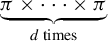 -saturated. That is,
$(x_1,\ldots ,x_d)\in L_x^d(X)$
 if and only if
$(x_1',\ldots ,x_d')\in L_x^d(X)$
 whenever
$\pi (x_i)=\pi (x_i')$
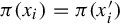 for
$i=1,\ldots , d$
 .
In [Reference Glasner7], it was shown that for minimal systems, up to a canonically defined proximal extension, a characteristic family for
$T\times \cdots \times T^d$
 is the family of canonical proximal isometric (PI) flows of class
$(d-1)$
 . In particular, if
$(X,T)$
 is distal, then its largest class
$(d-1)$
 distal factor is its topological characteristic factor along
$T\times \cdots \times T^d$
 . Moreover, if
$(X,T)$
 is weakly mixing, then the trivial system is its topological characteristic factor. For more related results, we refer the reader to [Reference Glasner7].
However, to get the corresponding pro-nilfactors for topological dynamics, in a pioneer work, Host, Kra, and Maass [Reference Host, Kra and Maass15] introduced the notion of regionally proximal relation of order d for a topological dynamical system
$(X,T)$
 , denoted by
$\mathbf {RP}^{[d]}$
 . For
$d\in \mathbb {N}$
 , we say that a minimal system
$(X,T)$
 is a d-step pro-nilsystem if
$\mathbf {RP}^{[d]}=\Delta $
 and this is equivalent for
$(X,T)$
 being an inverse limit of minimal d-step nilsystems. For a minimal distal system
$(X,T)$
 , it was proved that
$\mathbf {RP}^{[d]}$
 is an equivalence relation and
$X/\mathbf {RP}^{[d]}$
 is the maximal d-step pro-nilfactor [Reference Host, Kra and Maass15]. Later, Shao and Ye [Reference Shao and Ye27] showed that in fact for any minimal system, the regionally proximal relation of order d is an equivalence relation. Furthermore, for any minimal system,
$\mathbf {RP}^{[\infty ]}=\bigcap _{d\geqslant 1}\mathbf {RP}^{[d]}$
 is also an equivalence relation.
The recent result in [Reference Glasner, Huang, Shao, Weiss and Ye10] improves Glasner’s result significantly to pro-nilsystems. That is, they proved the following theorem.
Theorem 1.1. (Glasner–Huang–Shao–Weiss–Ye)
Let
$(X,T)$
 be a minimal system and let
$\pi :X\rightarrow X/\mathbf {RP}^{[\infty ]}= X_\infty $
 be the factor map. Then, there exist minimal systems
$X^*$
 and
$X_\infty ^*$
 which are almost one to one extensions of X and
$X_\infty $
 , respectively, and a commuting diagram below such that
$X_\infty ^*$
 is a d-step topological characteristic factor of
$X^*$
 for all
$d\geqslant 2$
 .

An equivalent form of Theorem 1.1 is the following.
Theorem 1.2. Let
$(X,T)$
 be a minimal system and let
$\pi :X\rightarrow X_\infty $
 be the factor map. Then, there exists a dense
$G_\delta $
 subset
$\Omega $
 of X such that for every
$x\in \Omega $
 and every
$d\geqslant 2$
 ,

That is, if
$\pi (x_i)=\pi (x)$
 for
$i=1,\ldots , d$
 , then
$(x_1,\ldots ,x_d)\in L_x^d(X)$
 .
Motivated by Theorem 1.2, the following question is natural.
Question 1.3. Let
$(X,T)$
 be a minimal system and let
$\pi :X\rightarrow X_\infty $
 be the factor map. Given an ergodic measure
$\mu $
 on
$(X,T)$
 , is there a subset
$\Omega $
 of X with
$\mu (\Omega )=1$
 such that
$(\pi ^{-1}(\pi (x)))^{d}\subseteq L_x^d(X)$
 for every
$x\in \Omega $
 and every
$d\geqslant 2$
 ?
We are unable to address this question in the present paper. Still, we answer a similar question by considering the face cubegroup instead of the group generated by
$T\times T^2\times \cdots \times T^d$
 , and derive some interesting applications.
As we know, the face cubegroup introduced in [Reference Host, Kra and Maass15] plays an important role when studying the pro-nilfactors. See §2.3 for the precise definition. We first study the topological characteristic factors under the action of face cubegroups. Following a recurrence theorem obtained by Bergelson and McCutcheon [Reference Bergelson and McCutcheon1], and performing a detailed analysis of the Host–Kra cubic measures, we prove the following theorem.
Theorem 1.4. Let
$(X,T)$
 be a minimal system and let
$\pi :X\to X/\mathbf {RP}^{[\infty ]}$
 be the factor map. Let

Then,
$\mu (\Omega )=1$
 for any ergodic measure
$\mu $
 on
$(X,T)$
 .
1.2 Applications
Following the local entropy theory, for a survey, see [Reference Glasner and Ye12], each dynamical system admits a maximal zero topological entropy factor and this factor is induced by the smallest closed invariant equivalence relation containing entropy pairs [Reference Blanchard and Lacroix2]. In [Reference Huang and Ye22], entropy pairs are characterized as those pairs that admit an interpolating set of positive density. Later on, the notions of sequence entropy pairs [Reference Huang, Li, Shao and Ye18] and untame pairs (called scrambled pairs in [Reference Huang16]) were introduced. In [Reference Kerr and Li24], the concept of independence was extensively studied and used to unify the notions mentioned above.
Let
$(X,T)$
 be a topological dynamical system and let
$\mathcal {U}=(U_1,\ldots ,U_k)$
 be a tuple of subsets of X. We say that a subset
$F\subseteq \mathbb {N}$
 is an independence set for
$\mathcal {U}$
 if for any non-empty finite subset
$J\subseteq F$
 and any
$s=(s(j):j\in J)\in \{1,\ldots ,k\}^J$
 , we have
$\bigcap _{j\in J}T^{-j}U_{s(j)}\neq \emptyset $
 . It was shown that a tuple of points
$x_1,\ldots ,x_k$
 in X is a sequence entropy k-tuple (if
$k=2$
 , a tuple is said to be a pair) if and only if each
$\mathcal {U}=(U_1,\ldots ,U_k)$
 , where
$U_1,\ldots ,U_k$
 are neighborhoods of
$x_1,\ldots ,x_k$
 , respectively, has arbitrarily long finite independence sets. Also, the pair is an untame pair if and only if each
$\mathcal {U} = (U_1 ,U_2 )$
 as before has infinite independence sets. It was shown [Reference Glasner9, Reference Huang, Li, Shao and Ye18, Reference Kerr and Li24] that a minimal null (respectively tame) system is an almost one-to-one extension of its maximal equicontinuous factor and is also uniquely ergodic.
For
$d\in \mathbb {N}$
 and
$n_1,\ldots ,n_d\in \mathbb {N}$
 , we call the set

an
$\mathrm{IP}_d$
 -set. The notion of
$\mathrm{Ind}_{fip}$
 -k-tuple was introduced in [Reference Huang, Li and Ye17]: a tuple of points
$x_1,\ldots ,x_k$
 in X is an
$\text {Ind}_{fip}$
 -k-tuple if and only if the independence sets for each
$\mathcal {U}=(U_1,\ldots ,U_k)$
 as before contain an
$\mathrm {IP}_d$
 -set for every
$d\in \mathbb {N}$
 . It was shown that a minimal system without any non-trivial
$\mathrm {Ind}_{fip}$
 -pairs is an almost one-to-one extension of its maximal
$\infty $
 -step pro-nilfactor [Reference Dong, Donoso, Maass, Shao and Ye3]. They also asked whether a minimal system without any non-trivial
$\mathrm {Ind}_{fip}$
 -pairs is uniquely ergodic [Reference Dong, Donoso, Maass, Shao and Ye3, Conjecture 6.6]. In this paper, we give a positive answer to this question.
It is also interesting to study the structure of minimal systems without any non-trivial sequence entropy tuples (respectively
$\mathrm {Ind}_{fip}$
 -tuples). This problem was also studied in [Reference Maass and Shao26]. In the recent work, Huang et al [Reference Huang, Lian, Shao and Ye19] proved that if a minimal system has no non-trivial sequence entropy
$(k+1)$
 -tuples, then the system is an almost
$k'$
 -to-one extension of its maximal equicontinuous factor for some
$k'\in \{1,\ldots ,k\}$
 , and the system has at most
$k^{k}$
 ergodic measures.
In this paper, we study the structure of minimal systems without any non-trivial
$\mathrm {Ind}_{fip}$
 -tuples. As an application of Theorem 1.4, we prove the following theorem.
Theorem 1.5. Let
$(X,T)$
 be a minimal system without any non-trivial
$\mathrm{Ind}_{fip}$
 -
$(k+1)$
 -tuples and let
$\pi :X\to X/\mathbf {RP}^{[\infty ]}=Y$
 be the factor map. Then, there exists
$j\in \{1,\ldots ,k\}$
 such that
$m(Y_{j})=1$
 , where m is the unique ergodic measure on Y and
$Y_i=\{y\in Y: |\pi ^{-1}(y)|=i\}, i\in \mathbb {N}$
 . (It was proved in [Reference Dong, Donoso, Maass, Shao and Ye3] that Y is an inverse limit of minimal nilsystems, thus
$(Y,T)$
 is uniquely ergodic.) Consequently, X has at most j ergodic measures and X is an almost
$j'$
 -to-one extension of Y for some
$j'\in \{1,\ldots ,j\}$
 , that is,
$Y_{j'}$
 contains a dense
$G_\delta $
 set.
Remark 1.6. Notice that if any
$\mathrm {Ind}_{fip}$
 -tuple is a sequence entropy tuple, Theorem 1.5 implies that if a minimal system has no non-trivial sequence entropy
$(k+1)$
 -tuples, then the system has at most k ergodic measures, which gives a sharp bound on the result obtained in [Reference Huang, Lian, Shao and Ye19].
Remark 1.7. It was shown in [Reference Fuhrmann, Glasner, Jäger and Oertel4] that every minimal tame system is a regular extension of its maximal equicontinuous factor (the set of points with trivial fibers has full measure). Theorem 1.5 implies that any minimal system without any non-trivial
$\mathrm {Ind}_{fip}$
 -pairs is a regular extension of its maximal
$\infty $
 -step pro-nilfactor.
The paper is organized as follows. In §2, the basic notions used in the paper are introduced. In §3, we prove Theorem 1.4 and, as an application, we prove Theorem 1.5 in §4.
2 Preliminaries
In this section, we gather definitions and preliminary results that will be necessary later on. Let
$\mathbb {N}$
 and
$\mathbb {Z}$
 be the sets of all positive integers and integers, respectively. For a finite set F, denote by
$|F|$
 the number of elements of F.
2.1 Dynamical systems
A topological dynamical system (TDS) is a pair
$(X,T)$
 , where X is a compact metric space with a metric
$\rho $
 and
$T : X \to X$
 is a homeomorphism. For
$x\in X,\mathcal {O}(x,T)=\{T^nx: n\in \mathbb {Z}\}$
 denotes the orbit of x. A TDS
$(X,T)$
 is called minimal if every point has dense orbit in X. A homomorphism between TDSs
$(X,T)$
 and
$(Y,T)$
 is a continuous onto map
$\pi :X\to Y$
 which intertwines the actions; one says that
$(Y,T)$
 is a factor of
$(X,T)$
 and that
$(X,T)$
 is an extension of
$(Y,T)$
 . One also refers to
$\pi $
 as a factor map or an extension and one uses the notation
$\pi : (X,T) \to (Y,T)$
 . An extension
$\pi $
 is determined by the corresponding closed invariant equivalence relation
$R_\pi =\{(x,x')\in X\times X\colon \pi (x)=\pi (x')\}$
 .
A measure preserving probability system (MPS) is a quadruple
$(X, \mathcal {X} , \mu , T)$
 , where
$(X, \mathcal {X} , \mu )$
 is a standard Borel probability space (in particular, X is a Polish space and
$\mathcal {X}$
 is its Borel
$\sigma $
 -algebra) and T is an invertible Borel measure-preserving map (
$\mu (TA)=\mu (A)$
 for all
$A\in \mathcal {X}$
 ). An MPS
$(X, \mathcal {X} , \mu ,T)$
 is ergodic if for every set
$A\in \mathcal {X}$
 such that
$TA=A$
 , one has
$\mu (A)=0$
 or 1.
Let
$(X,T)$
 be a TDS and
$M(X)$
 be the set of Borel probability measures on X. Denote by
$M(X,T)$
 the set of invariant probability measures. For
$x_0\in X$
 and
$\mu \in M(X,T)$
 , we say that
$x_0$
 is generic for
$\mu $
 if

for any continuous function f on X.
Proposition 2.1. [Reference Furstenberg6, Proposition 3.7]
Let
$(X,T)$
 be a TDS and
$\mu \in M(X,T)$
 be ergodic. Then, almost every point of X with respect to
$\mu $
 is generic for
$\mu $
 .
2.2 Discrete cubes
Let
$d \geqslant 1$
 be an integer and write
$[d] = \{1, \ldots , d\}$
 . We view the element in
$\{0, 1\}^d$
 in one of two ways, either as a sequence
$\epsilon =(\epsilon _1,\ldots ,\epsilon _d)$
 of 0s and 1s, or as a subset of
$[d]$
 . A subset
$\epsilon $
 corresponds to the sequence
$(\epsilon _1,\ldots ,\epsilon _d)\in \{0, 1\}^d$
 such that
$i\in \epsilon $
 if and only if
$\epsilon _i=1$
 for
$i\in [d]$
 . For example,
$\vec {0}=(0,\ldots ,0)\in \{0, 1\}^d$
 is the same to
$\emptyset \subseteq [d]$
 . Let
$\mathcal {V}_d=\{0,1\}^d$
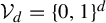 and
$\mathcal {V}_d^*=\{0,1\}^d\backslash \{\vec {0}\}$
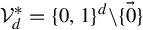 . If
$\vec {n} = (n_1,\ldots , n_d)\in \mathbb {Z}^d$
 and
$\epsilon \in \mathcal {V}_d$
 , we define
$ \vec {n}\cdot \epsilon = \sum _{i=1}^d n_i\cdot \epsilon _i. $
 If we consider
$\epsilon $
 as
$\epsilon \subseteq [d]$
 , then
$\vec {n}\cdot \epsilon =\sum _{i\in \epsilon }n_i$
 .
For
$\alpha =(\alpha _1,\ldots ,\alpha _n)\in \mathcal {V}_n$
 and
$\beta =(\beta _1,\ldots ,\beta _d)\in \mathcal {V}_d$
 , we define

Given a set X, we denote
$X^{2^d}$
 by
$X^{[d]}$
 . A point
$\mathbf {x}\in X^{[d]}$
 can be written in one of two equivalent ways, depending on the context:

Hence,
$x_{\emptyset }=x_{\vec {0}}$
 is the first coordinate of
$\mathbf {x}$
 . Sometimes,
$\mathbf {x}(\epsilon )$
 will be used to denote the
$\epsilon $
 -component of
$\mathbf {x}$
 . For
$x\in X$
 , we write
$x^{[d]}=(x,\ldots ,x)\in X^{[d]}$
 . The diagonal of
$X^{[d]}$
 is
$\Delta ^{[d]}=\Delta ^{[d]}(X)=\{ x^{[d]}:x\in X\}$
 . Usually, when
$d=1$
 , we denote the diagonal by
$\Delta _X$
 or
$\Delta $
 instead of
$\Delta ^{[1]}$
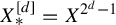
 . We can isolate the first coordinate, writing
$X^{[d]}_*=X^{2^d-1}$
 and writing
$\mathbf {x}\in X^{[d]}$
 as
$\mathbf {x}=(\mathbf {x}(\vec {0}),\mathbf {x}_*)$
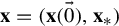 , where
$\mathbf {x}_*\in X^{[d]}_*$
 .
2.3 Dynamical cubespaces
Let
$(X,T)$
 be a TDS and
$d\in \mathbb {N}$
 . We define
$\mathbf {Q}^{[d]}(X)$
 to be the closure in
$X^{[d]}$
 of elements of the form

where
$\vec {n}\in \mathbb {Z}^d$
 and
$x\in X$
 . We call this set the dynamical cubespace of dimension d of the system.
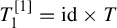
Face transformations are defined inductively as follows. Let
$T^{[1]}_1=\mathrm {id} \times T$
 . If
$\{T^{[d-1]}_j\}_{j=1}^{d-1}$
 is defined already, then set

It is easy to see that for
$j\in [d]$
 , the face transformation
$T^{[d]}_j : X^{[d]}\rightarrow X^{[d]}$
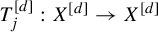 can be defined by, for every
$\mathbf {x} \in X^{[d]}$
 and
$\epsilon \in \mathcal {V}_d$
 ,

The face cubegroup of dimension d is the group
$\mathcal {F}^{[d]}(X)$
 of transformations of
$X^{[d]}$
 spanned by the face transformations. The parallelepiped group of dimension d is the group
$\mathcal {G}^{[d]}(X)$
 spanned by the diagonal transformation and the face transformations. We often write
$\mathcal {F}^{[d]}$
 and
$\mathcal {G}^{[d]}$
 instead of
$\mathcal {F}^{[d]}(X)$
 and
$\mathcal {G}^{[d]}(X)$
 , respectively. For convenience, we denote the orbit closure of
$\mathbf {x}\in X^{[d]}$
 under
$\mathcal {F}^{[d]}$
 by
$\overline {\mathcal {F}^{[d]}}(\mathbf {x})$
 , instead of
$\overline {\mathcal {O}(\mathbf {x},\mathcal {F}^{[d]})}$
 . For
$x\in X$
 , let
$\mathbf {Q}^{[d]}_x(X)=\mathbf {Q}^{[d]}(X)\cap (\{x\}\times X^{2^d-1})$
 .
Theorem 2.2. [Reference Shao and Ye27]
Let
$(X,T)$
 be a minimal system and
$d\in \mathbb {N}$
 . Then:
-
(1) $(\mathbf {Q}^{[d]}(X),\mathcal {G}^{[d]})$
 is a minimal system;
-
(2) $(\overline {\mathcal {F}^{[d]}}(x^{[d]}),\mathcal {F}^{[d]})$
is minimal for all
$x\in X$
; -
(3) $\overline {\mathcal {F}^{[d]}}(x^{[d]})$
is the unique
$\mathcal {F}^{[d]}$
-minimal subset in
$\mathbf {Q}^{[d]}_x(X)$
for all
$x\in X$
.




2.4 Regionally proximality of higher order
Definition 2.3. [Reference Host, Kra and Maass15] Let
$(X,T)$
 be a TDS and
$d\in \mathbb {N}$
 . The regionally proximal relation of order d is the relation
$\textbf {RP}^{[d]}$
 defined by:
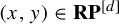
$(x,y)\in \textbf {RP}^{[d]}$
 (or
$\mathbf {RP}^{[d]}(X)$
 in case of ambiguity) if and only if for every
$\delta>0$
 , there exist
$x',y'\in X$
 and
$n_1,\ldots ,n_d\in \mathbb {N}$
 such that
$\rho (x,x')<\delta ,\rho (y,y')<\delta $
 and

We say
$(X,T)$
 is a d-step pro-nilsystem if
$\mathbf {RP}^{[d]}$
 is trivial.
Theorem 2.4. [Reference Shao and Ye27]
Let
$(X,T)$
 be a minimal system and
$d\in \mathbb {N}$
 . Then:
-
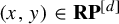
(1) $(x,y)\in \mathbf {RP}^{[d]}$
if and only if
$(x,y^{[d+1]}_*)=(x,y,\ldots ,y)\in \mathbf {Q}^{[d+1]}$
if and only if
$(x,y^{[d+1]}_*)\in \overline {\mathcal {F}^{[d+1]}}(x^{[d+1]})$
; -
(2) $\mathbf {RP}^{[d]}$
is a closed invariant equivalence relation.



The regionally proximal relation of order d allows us to construct the maximal d-step pro-nilfactor of a minimal system. That is, any factor of order d factorizes through this system.
Theorem 2.5. [Reference Shao and Ye27]
Let
$\pi :(X,T)\to (Y,T)$
 be the factor map of minimal systems and
$d\in \mathbb {N}$
 . Then:
-
(1) $(\pi \times \pi ) \mathbf {RP}^{[d]}(X)=\mathbf {RP}^{[d]}(Y)$
; -
(2) $(Y,T)$
is a d-step pro-nilsystem if and only if
$\mathbf {RP}^{[d]}(X)\subseteq R_\pi $
.



In particular, the quotient of
$(X,T)$
 under
$\mathbf {RP}^{[d]}(X)$
 is the maximal d-step pro-nilfactor of X.
It follows from Theorem 2.4 that for any minimal system
$(X,T)$
 ,

is also a closed invariant equivalence relation.
Now, we formulate the definition of
$\infty $
 -step pro-nilsystems.
Definition 2.6. [Reference Dong, Donoso, Maass, Shao and Ye3] A minimal system
$(X,T)$
 is an
$\infty $
 -step pro-nilsystem, if the equivalence relation
$\mathbf {RP}^{[\infty ]}$
 is trivial, that is, coincides with the diagonal. We say the quotient under
$\mathbf {RP}^{[\infty ]}$
 is the maximal
$\infty $
 -step pro-nilfactor of X.
Proposition 2.7. [Reference Huang, Shao and Ye20, Proposition 8.1.5]
Let
$(X,T)$
 be a minimal system and
$(x,y)\in X\times X\backslash \Delta $
 . Then,
$(x,y)\in \mathbf {RP}^{[\infty ]}$
 if and only if for every neighborhood V of y and any
$d\in \mathbb {N}$
 , there exists an
$\mathrm {IP}_d$
 -set
$I_d$
 such that
$T^nx\in V$
 for all
$n\in I_d$
 .
2.5 Nilpotent groups, nilmanifolds, and nilsystems
Let G be a Lie group. Let
$G_1 = G$
 and
$G_k = [G, G_{k-1}]$
 for
$k \geqslant 2$
 , where
$[G, H] = \{[g, h] : g \in G, h \in H\}$
 and
$[g, h] = g^{-1}h^{-1}gh$
 . If there exists some
$d \geqslant 1$
 such that
$G_{d+1} = \{e\}$
 , G is called a d-step nilpotent Lie group. We say that a discrete subgroup
$\Gamma $
 of a Lie group G is cocompact if
$G/\Gamma $
 , endowed with the quotient topology, is compact. We say that the quotient
$X=G/\Gamma $
 is a d-step nilmanifold if G is a d-step nilpotent Lie group and
$\Gamma $
 is a discrete, cocompact subgroup. The group G acts on X by left translations and we write this action as
$(g,x)\mapsto gx$
 . Let
$\tau \in G$
 and T be the transformation
$x\mapsto \tau x$
 of X. Then,
$(X,T)$
 is called a d-step nilsystem.
We also make use of inverse limits of nilsystems and so we recall the definition of an inverse limit of systems (restricting ourselves to the case of sequential inverse limits). If
$\{(X_i,T_i)\}_{i\in \mathbb {N}}$
 are systems with
$\text {diam}(X_i)\leqslant 1$
 and
$\phi _i:X_{i+1}\to X_i$
 are factor maps, the inverse limit of the systems is defined to be the compact subset of
$\prod _{i\in \mathbb {N}}X_i$
 given by
$\{(x_i)_{i\in \mathbb {N}}:\phi _i(x_{i+1})=x_i,i\in \mathbb {N}\}$
 , which is denoted by
$\lim _{\longleftarrow }\{ X_i\}_{i\in \mathbb {N}}$
 . It is a compact metric space endowed with the distance
$\rho (x,y)=\sum _{i\in \mathbb {N}}1/ 2^i \rho _i(x_i,y_i)$
 . We note that the maps
$\{T_i\}$
 induce a transformation T on the inverse limit.
The following structure theorems characterize pro-nilsystems.
Theorem 2.8. [Reference Host, Kra and Maass15]
A minimal system is a d-step pro-nilsystem if and only if it is an inverse limit of d-step minimal nilsystems.
Theorem 2.9. [Reference Dong, Donoso, Maass, Shao and Ye3]
A minimal system is an
$\infty $
 -step pro-nilsystem if and only if it is an inverse limit of minimal nilsystems.
2.6 Independence
The notion of independence was first introduced and studied in [Reference Kerr and Li24, Reference Kerr and Li25]. It corresponds to a modification of the notion of interpolating set studied in [Reference Glasner and Weiss11, Reference Huang and Ye22].
Definition 2.10. Let
$(X,T)$
 be a TDS. Given a tuple
$\mathcal {U} = (U_1,\ldots ,U_k )$
 of subsets of X, we say that a subset
$F\subseteq \mathbb {N}$
 is an independence set for
$\mathcal {U}$
 if for any non-empty finite subset
$ J\subseteq F$
 and any
$s=(s(j):j\in J)\in \{1,\ldots ,k\}^J$
 , we have

We shall denote the collection of all independence sets for
$\mathcal {U}$
 by
$\mathrm {Ind}(U_1 ,\ldots ,U_k )$
 or
$\mathrm {Ind}(\mathcal {U})$
 .
The following definition of an
$\mathrm {Ind}_{fip}$
 -k-tuple comes from [Reference Dong, Donoso, Maass, Shao and Ye3].
Definition 2.11. Let
$(X,T)$
 be a TDS and
$k\geqslant 2$
 . A tuple
$(x_1,\ldots ,x_k ) $
 of points in X is called an
$\mathrm {Ind}_{fip}$
 -k-tuple if for any neighborhoods
$U_1,\ldots ,U_k$
 of
$x_1,\ldots ,x_k$
 , respectively, and any
$d\in \mathbb {N}$
 , there exists an
$\mathrm {IP}_d$
 -set
$I_d$
 such that
$I_d$
 is an independence set for
$(U_1,\ldots ,U_k)$
 .
Denote by
$\mathrm {Ind}_{fip}^{(k)} (X)$
 the set of all
$\mathrm {Ind}_{fip}$
 -k-tuples of
$(X,T)$
 .
The following characterization of
$\mathrm {Ind}_{fip}$
 -tuples using dynamical cubespaces was first given in [Reference Dong, Donoso, Maass, Shao and Ye3] for
$k=2$
 .
Lemma 2.12. Let
$(X,T)$
 be a minimal system,
$k\geqslant 2$
 , and
$x_1,\ldots ,x_k\in X$
 . Then, we have
$\{x_1,\ldots ,x_k\}^{2^d}\subseteq \mathbf {Q}^{[d]}(X)$
 for all
$d\in \mathbb {N}$
 if and only if
$(x_1,\ldots ,x_k)$
 is an
$\mathrm {Ind}_{fip}$
 -k-tuple.
Proof. Let
$x_1,\ldots ,x_k\in X$
 be distinct points. First, we assume
$\{x_1,\ldots ,x_k\}^{2^d}\subseteq \mathbf {Q}^{[d]}(X)$
 for all
$d\in \mathbb {N}$
 .
Fix
$d\in \mathbb {N}$
 . Let
$ \{1,\ldots ,k\}^{\mathcal {V}_d} =\{\omega _1,\ldots ,\omega _{k^{2^d}}\}$
 . For
$1\leqslant i\leqslant k^{2^d}$
 , write
$\omega _i=(\omega _{i,\epsilon })_{\epsilon \in \mathcal {V}_d}$
 . Choose
$m\in \mathbb {N}$
 with
$2^m\geqslant k^{2^d}$
 and let
$\omega _i=(1,\ldots ,1)$
 (
$2^d$
 times) for
$k^{2^d}+1\leqslant i\leqslant 2^m$
 . Let
$\mathcal {V}_m=\{\alpha _1,\ldots ,\alpha _{2^m}\}$
 . Notice that for every
$\eta \in \mathcal {V}_{m+d}$
 , there exists unique
$i\in \{1,\ldots ,2^m\}$
 and
$\beta \in \mathcal {V}_d$
 such that
$\eta =\underline {\alpha _i\beta }$
 .
Let
$U_1,\ldots , U_k$
 be neighborhoods of
$x_1,\ldots , x_k$
 , respectively. Now, we define
$\mathbf {x}=(x_\eta )_{\eta \in \mathcal {V}_{m+d}} \in \{x_1,\ldots ,x_k\}^{\mathcal {V}_{m+d}} =\{x_1,\ldots ,x_k\}^{2^{m+d}}$
 and
$\mathbf {U}=(U_\eta )_{\eta \in \mathcal {V}_{m+d}}\in \{U_1,\ldots ,U_k\}^{\mathcal {V}_{m+d}}$
 such that
$x_\eta =x_{\omega _{i,\beta }}$
 and
$U_\eta =U_{\omega _{i,\beta }}$
 if
$\eta =\underline {\alpha _i\beta }$
 . Then,
$\mathbf {U}$
 is a neighborhood of
$\mathbf {x}$
 and
$\mathbf {x}\in \mathbf {Q}^{[m+d]}(X)$
 by our assumption. Thus, by Theorem 2.2, there exist
$a\in \mathbb {N}$
 and
$\vec {a}=(a_1,\ldots ,a_m,n_1,\ldots ,n_{d})\in \mathbb {N}^{m+d}$
 such that
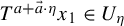
$T^{a+\vec {a}\cdot \eta }x_1\in U_{\eta }$
 for all
$\eta \in \mathcal {V}_{m+d}$
 .
We claim that the
$\mathrm {IP}_d$
 -set generated by
$n_{1}, \ldots , n_{d}$
 belongs to
$\mathrm {Ind}(U_1,\ldots ,U_k)$
 . As a matter of fact, for any
$s\in \{1,\ldots ,k\}^{\mathcal {V}_d}$
 , there exists
$\omega _i$
 such that
$\omega _{i,\epsilon }=s(\epsilon )$
 for all
$\epsilon \in \mathcal {V}_d$
 . Set
$\vec {b}=(a_1,\ldots ,a_m)$
 and
$\vec {n}=(n_1,\ldots ,n_d)$
 . Then, for any
$\epsilon \in \mathcal {V}_d$
 , we have

which implies that

As d is arbitrary, we conclude that
$(x_1,\ldots ,x_k)$
 is an
$\mathrm {Ind}_{fip}$
 -k-tuple.
Conversely, assume that
$(x_1,\ldots ,x_k)$
 is an
$\mathrm {Ind}_{fip}$
 -k-tuple. That is, for any neighborhoods
$U_1,\ldots , U_k$
 of
$x_1,\ldots , x_k$
 , respectively, and any
$d\in \mathbb {N}$
 , there exists
$\vec {m}_0=(m_1,\ldots ,m_d,m_{d+1}) \in \mathbb {N}^{d+1}$
 such that for any
$t\in \{1,\ldots ,k\}^{\mathcal {V}_{d+1}}$
 ,

Now, fix
$s\in \{1,\ldots ,k\}^{\mathcal {V}_d}$
 . There exists
$t\in \{1,\ldots ,k\}^{\mathcal {V}_{d+1}}$
 such that
$t(\underline {\epsilon 1})=s(\epsilon )$
 for all
$\epsilon \in \mathcal {V}_d$
 . Let
$x\in \bigcap _{\omega \in \mathcal {V}_{d+1}} T^{-\vec {m}_0\cdot \omega }U_{t(\omega )}$
 and set
$\vec {m}=(m_1,\ldots ,m_d)$
 . Then, we have

for all
$\epsilon \in \mathcal {V}_d$
 , which implies
$\{x_1,\ldots ,x_k\}^{2^d}\subseteq \mathbf {Q}^{[d]}(X)$
 .
This completes the proof.
2.7 Some facts about hyperspaces
Let X be a compact metric space with a metric
$\rho $
 . Let
$2^X$
 be the collection of non-empty closed subsets of X. We may define a metric on
$2^X$
 as follows:

where
$\rho (x,A)=\inf _{y\in A}\rho (x,y)$
 and
$B(A,\epsilon )=\{x\in X:\rho (x,A)<\epsilon \}$
 . The metric
$\rho _H$
 is called the Hausdorff metric on
$2^X$
 .
Let
$X,Y$
 be two compact metric spaces. Let
$F : Y \to 2^X$
 be a map and
$y\in Y$
 . We say that F is lower semi-continuous (LSC) at y if for any
$\epsilon>0$
 , there exists a neighborhood U of y such that
$F(y) \subseteq B(F(y'),\epsilon )$
 for all
$y'\in U$
 ; and F is upper semi-continuous (USC) at y if for any
$\epsilon>0$
 , there exists a neighborhood U of y such that
$F(U) \subseteq B(F(y),\epsilon )$
 . If F is LSC (respectively USC) at every point of Y, then we say that F is LSC (respectively USC).
If
$f:X\to Y$
 is a continuous map, then it is easy to verify that

is USC.
Lemma 2.13. Let
$(X,T)$
 be a TDS and
$d\in \mathbb {N}$
 . The map
$F_d:X\to 2^{X^{[d]}}, x\mapsto \overline {\mathcal {F}}^{[d]}(x^{[d]})$
 is LSC.
Proof. Let
$\Theta _d$
 be the metric on
$X^{[d]}$
 defined by
$\Theta _d(\mathbf {u},\mathbf {v})=\max _{\epsilon \in \mathcal {V}_d}\rho (\mathbf {u}(\epsilon ),\mathbf {v}(\epsilon ))$
 for
$\mathbf {u},\mathbf {v}\in X^{[d]}$
 , where
$\rho $
 is the metric on X.
Let
$x\in X$
 and
$\delta>0$
 . Since
$\overline {\mathcal {F}}^{[d]}(x^{[d]})$
 is compact and
$\{ (T^{\vec {n}\cdot \epsilon }x)_{\epsilon \in \mathcal {V}_d}:\vec {n}\in \mathbb {Z}^d\}$
 is dense in
$\overline {\mathcal {F}}^{[d]}(x^{[d]})$
 , there exist
$\vec {n}_1,\ldots ,\vec {n}_k\in \mathbb {Z}^d$
 such that for any
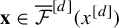
$\mathbf {x}\in \overline {\mathcal {F}}^{[d]}(x^{[d]})$
 , one can choose
$i\in [k]$
 such that
$\Theta _d((T^{\vec {n}_i\cdot \epsilon }x)_{\epsilon \in \mathcal {V}_d},\mathbf {x})<\delta /2$
 . Then, there exists
$\eta>0$
 with
$\eta <\delta /2$
 such that whenever
$x'\in X$
 with
$\rho (x,x')<\eta $
 , one has
$\rho (T^{\vec {n}_i\cdot \epsilon }x,T^{\vec {n}_i\cdot \epsilon }x')<\delta /2$
 for all
$i\in [k]$
 and
$\epsilon \in \mathcal {V}_d$
 .
We claim that
$ F_d(x)\subseteq B(F_d(x'),\delta )$
 for all
$x'\in B(x, \eta )$
 . Let
$x' \in B(x, \eta )$
 and
$\mathbf {x}\in F_d(x)= \overline {\mathcal {F}}^{[d]}(x^{[d]})$
 . There exists
$j\in [k]$
 such that
$\Theta _d((T^{\vec {n}_j\cdot \epsilon }x)_{\epsilon \in \mathcal {V}_d},\mathbf {x})<\delta /2$
 . Thus, we have

which implies
$\mathbf {x}\in B(\overline {\mathcal {F}}^{[d]}({x'}^{[d]}),\delta )=B(F_d(x'),\delta )$
 , as was to be shown.
2.8 Almost finite-to-one extensions
Let
$\pi :(X,T)\to (Y,T)$
 be a factor map of TDSs and
$k\in \mathbb {N}$
 . One says that
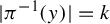
$\pi $
 is an almost k-to-one extension if there exists a dense
$G_\delta $
 subset
$\Omega $
 of Y such that
$|\pi ^{-1}(y)|=k$
 for every
$y\in \Omega $
 .
Proposition 2.14. [Reference Huang, Lian, Shao and Ye19, Proposition 2.14]
Let
$\pi :(X,T)\to (Y,T)$
 be a factor map of TDSs with
$(Y,T)$
 being minimal. If
$Y_f=\{y\in Y:|\pi ^{-1}(y)|<\infty \}$
 is non-empty, then
$Y_0=\{y\in Y:|\pi ^{-1}(y)|=N\}$
 contains a dense
$G_\delta $
 subset of Y, where
$N=\min _{y\in Y_f}|\pi ^{-1}(y)|$
 .
2.9 A recurrence theorem
The following recurrence theorem plays an important role in our proof. We recall that a subset R of
$\mathbb {Z}^k$
 is an
$\mathrm{IP}_s$
 -set if there exist
$\vec {n}_1, \ldots , \vec {n}_s\in \mathbb {Z}^k$
 such that

We shall call a subset of
$\mathbb {Z}^k$
 an
$IP^*_s$
 -set if it intersects every non-trivial
$\mathrm {IP}_s$
 -set.
Theorem 2.15. [Reference Bergelson and McCutcheon1, Theorem 6.15]
Suppose
$t\in \mathbb {N}$
 and
$\delta>0$
 are given. There exists
$s=s(t,\delta )\in \mathbb {N}$
 and
$\xi =\xi (t,\delta )>0$
 having the property that for all
$r,k\in \mathbb {N}$
 , if r commuting measure preserving transformations
$T_1,\ldots ,T_r$
 of a probability space
$(X,\mathcal {B},\mu )$
 are given, as well as linear polynomials
$p_{i,j}(n_1,\ldots ,n_k)\in \mathbb {Z}[n_1,\ldots ,n_k]$
 with
$p_{i,j}(0,\ldots ,0)=0,1\leqslant i\leqslant r,1\leqslant j\leqslant t$
 , then for every
$B\in \mathcal {B}$
 with
$\mu (B)\geqslant \delta $
 , the set

is an
$\mathrm{IP}_s^{*}$
 -set in
$\mathbb {Z}^k$
 .
The following corollary follows from Theorem 2.15 directly.
Corollary 2.16. Assume that
$T_1,\ldots ,T_d$
 are commuting measure preserving transformations of a probability space
$(X,\mathcal {B},\mu )$
 and
$B\in \mathcal {B}$
 with
$\mu (B)>0$
 , then for any
$s\in [d]$
 , there exists
$N\in \mathbb {N}$
 such that for any
$\mathbf {n}_1,\ldots ,\mathbf {n}_{N}\in (\mathbb {Z}^{d})^{s}$
 , one can find some
$\mathbf {n}=(\vec {n}_1,\ldots ,\vec {n}_s)\in \mathrm {IP}(\mathbf {n}_1,\ldots ,\mathbf {n}_{N})$
 such that

where
$T^{\vec {n}}=T_1^{n_1}\cdots T_d^{n_d}$
 for
$\vec {n}=(n_1,\ldots ,n_d)\in \mathbb {Z}^d$
 .
We give some examples to explain this corollary.
Assume that
$T_1,T_2$
 are commuting measure preserving transformations of a probability space
$(X,\mathcal {B},\mu )$
 and
$B\in \mathcal {B}$
 with
$\mu (B)>0$
 .
-
• There exists $N_1\in \mathbb {N}$
such that for any
$n_1,\ldots ,n_{N_1}\in \mathbb {Z}$
, one can find some
$n\in \mathrm {IP}(n_1,\ldots ,n_{N_1})$
such that $$ \begin{align*} \mu(B\cap T_1^{-n}B)>0. \end{align*} $$
-
• There exists $N_2\in \mathbb {N}$
such that for any
$\vec {n}_1,\ldots ,\vec {n}_{N_2}\in \mathbb {Z}^2$
, one can find some
$\vec {n}=(a,b)\in \mathrm {IP}(\vec {n}_1,\ldots ,\vec {n}_{N_2})$
such that $$ \begin{align*} \mu(B\cap T_1^{-a}B\cap T_2^{-b}B\cap T_1^{-a}T_2^{-b}B)>0. \end{align*} $$
-
• There exists $N_3\in \mathbb {N}$
such that for any
$\mathbf {n}_1,\ldots ,\mathbf {n}_{N_3}\in (\mathbb {Z}^{2})^{2}$
, one can find some
$\mathbf {n}=(\vec {u},\vec {v})\in \mathrm {IP}(\mathbf {n}_1,\ldots ,\mathbf {n}_{N_3})$
with
$\vec {u}=(u_1,u_2),\vec {v}=(v_1,v_2)$
such that $$ \begin{align*} \mu&(B\cap T^{-\vec{u}}B\cap T^{-\vec{v}}B\cap T^{-\vec{u}-\vec{v}}B ) \\ & =\;\mu(B\cap T_1^{-u_1} T_2^{-u_2}B\cap T_1^{-v_1}T_2^{-v_2}B\cap T_1^{-u_1-u_2}T_2^{-v_1-v_2}B)>0. \end{align*} $$













2.10 A useful lemma
To end this section, we give a useful lemma which can be derived from [Reference Host, Kra and Maass15, Reference Huang, Shao and Ye21]. For readability, we move the complicated proof to Appendix A.
For
$d\in \mathbb {N}$
 and
$k\in [d]$
 , we say a map
$p: \mathcal {V}_k\to \mathcal {V}_d$
 is a morphism if there exist pairwise disjoint non-empty subsets
$\epsilon _1,\ldots ,\epsilon _k$
 of
$[d]$
 such that
$p(\emptyset )=\emptyset $
 and
$p(\eta )=\bigcup _{i\in \eta }\epsilon _i$
 for
$\eta \in \mathcal {V}_k^*$
 . Given a set X, then p determines a projection
$\bar {p}:X^{[d]}\to X^{[k]}$
 such that

for
$\mathbf {x}\in X^{[d]}$
 and
$\eta \in \mathcal {V}_k$
 .
Lemma 2.17. Let
$(X,T)$
 be a minimal system and
$\mu \in M(X,T)$
 be an ergodic measure. Then, there exists a family
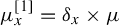
$\{\mu _x^{[d]}=\delta _x\times \mu _x^{[d]_*} \}_{x\in X}$
 of Borel probability measures on
$X^{[d]}$
 such that: for any measurable subset M of X with positive measure, there exists a measurable subset
$M_0$
 of M with
$\mu (M_0)=\mu (M)$
 such that for any
$x\in M_0$
 and any
$d\in \mathbb {N}$
 :
-
(1) $\mu _x^{[d]}$
is
$\mathcal {F}^{[d]}$
-ergodic and
$\mu _x^{[1]}=\delta _x\times \mu $
; -
(2) $\bar {p}_*(\mu _x^{[d]})=\mu _x^{[k]}$
for any
$k\in [d]$
and any morphism
$p: \mathcal {V}_k\to \mathcal {V}_d$
. In particular, for measurable subsets
$W_\epsilon ,\epsilon \in \mathcal {V}_d$
of X, one has $$ \begin{align*} \mu_x^{[k]}\bigg(\!\prod_{\eta\in \mathcal{V}_k}W_{p(\eta)}\bigg)\geqslant \mu_x^{[d]}\bigg(\!\prod_{\epsilon\in \mathcal{V}_d}W_{\epsilon}\bigg); \end{align*} $$
-
(3) $\mu _x^{[d]}((M\cap V)^{[d]})>0$
for any neighborhood V of x.








3 Proof of Theorem 1.4
In this section, we prove Theorem 1.4. Throughout this section, we assume that
$(X,T)$
 is a minimal system and
$\mu \in M(X,T)$
 is an ergodic measure. Let
$\pi :X\to X/\mathbf {RP}^{[\infty ]}=Y$
 be the factor map.
3.1 An intermediate proposition of proving Theorem 1.4
We start with the following definition.
Definition 3.1. For a non-empty subset
$\kappa $
 of
$\mathcal {V}_d^*$
 , we say that
$\pi $
 has the property
$F_d(\kappa )$
 if, for any measurable subset V of X with
$\mu (V)>0$
 and any open subsets
$V_\epsilon ,\epsilon \in \kappa $
 of X with

there exists
$\vec {n}\in \mathbb {Z}^d$
 such that

where
$V_\epsilon =V$
 for
$\epsilon \in \mathcal {V}_d\backslash \kappa $
 .
In this section, we focus on proving the following proposition, from which we can directly derive Theorem 1.4. As the proof of this implication is straightforward, we will present the proof of Theorem 1.4, assuming Proposition 3.2 for the remainder of this subsection.
Proposition 3.2. For every
$d\in \mathbb {N}$
 ,
$\pi $
 has the property
$F_d(\mathcal {V}_d^*)$
 . That is, for any measurable subset
$V_{\vec {0}}$
 of X with
$\mu (V_{\vec {0}})>0$
 and any open subsets
$V_\epsilon ,\epsilon \in \mathcal {V}_d^*$
 of X with

there exists
$\vec {n}\in \mathbb {Z}^d$
 such that

Proof of Theorem 1.4 assuming Proposition 3.2
Let
$\pi :X\to X/\mathbf {RP}^{[\infty ]}$
 be the factor map and let
$\mu $
 be an ergodic measure on
$(X,T)$
 . For
$d\in \mathbb {N}$
 , let
$\Theta _d$
 be the metric on
$X^{[d]}$
 defined by
$\Theta _d(\mathbf {u},\mathbf {v})=\max _{\epsilon \in \mathcal {V}_d}\rho (\mathbf {u}(\epsilon ),\mathbf {v}(\epsilon ))$
 for
$\mathbf {u},\mathbf {v}\in X^{[d]}$
 , where
$\rho $
 is the metric on X. Let
$\Theta _{d,H}$
 be the Hausdorff metric on
$2^{X^{[d]}}$
 . Consider the maps

and

Then,
$\Pi $
 is upper semi-continuous and
$F_d$
 is lower semi-continuous by Lemma 2.13.
For
$d\in \mathbb {N},\delta>0$
 , and
$x\in X$
 , let

and

Claim 1. We have that
$\Lambda _{d,\delta }$
 is closed for any
$d\in \mathbb {N}$
 and
$\delta>0$
 .
Proof of Claim 1
Fix
$d\in \mathbb {N}$
 and
$\delta>0$
 . Let
$\gamma>0$
 with
$4\gamma <\delta $
 . Assume that
$\{x_i\}_{i\in \mathbb {N}}$
 is a sequence in
$\Lambda _{d,\delta }$
 such that
$\lim _{i\to \infty }x_i=x$
 for some
$x\in X$
 . Then, for every
$i\in \mathbb {N}$
 , there exists
$\mathbf {x}_{i}\in A_{x_i}^{[d]}$
 such that
$\Theta _d(\mathbf {x}_i,F_d(x_i))>\delta -\gamma $
 . Without loss of generality, we may assume that
$\lim _{i\to \infty }\mathbf {x}_i=\mathbf {x}$
 for some
$\mathbf {x}\in X^{[d]}$
 . Then,
$\mathbf {x}(\vec {0})=x$
 and

which implies
$\mathbf {x}\in A_{x}^{[d]}$
 . To show this claim, it suffices to show
$\mathbf {x}\in \Lambda _{d,\delta }$
 .
Recall that the map
$F_d$
 is lower semi-continuous, there exists a neighborhood U of x such that
$F_d(x) \subseteq B(F_d(x'),\gamma )$
 for all
$x'\in U$
 . Choose
$i\in \mathbb {N}$
 such that
$x_i\in U$
 and
$\Theta _d(\mathbf {x}_i,\mathbf {x})<\gamma $
 . Then,
$F_d(x) \subseteq B(F_d(x_i),\gamma )$
 . Let
$\mathbf {y}\in F_d(x)$
 and choose
$\mathbf {y}_i\in F_d(x_i)$
 with
$\Theta _d(\mathbf {y}_i,\mathbf {y})<\gamma $
 . Hence, we have

and thus,
$\Theta _d(\mathbf {x},\mathbf {y})>\delta -3\gamma $
 . This implies that

As
$\gamma $
 is arbitrary, we deduce
$\Theta _d(\mathbf {x},F_d(x))\geqslant \delta $
 and thus,
$\mathbf {x}\in \Lambda _{d,\delta }$
 , as was to be shown.
Claim 2. We have
$\mu (\Lambda _{d,\delta })=0$
 for any
$d\in \mathbb {N}$
 and
$\delta>0$
 .
Proof of Claim 2
Suppose for a contradiction that
$\mu (\Lambda _{d,\delta })>0$
 for some
$d\in \mathbb {N}$
 and
$\delta>0$
 . Here,
$\Pi $
 is upper semi-continuous and
$F_d$
 is lower semi-continuous; hence, both maps
$\Pi $
 and
$F_d$
 are Borel measurable. By Lusin’s theorem, there exists
$K\subseteq \Lambda _{d,\delta }$
 with
$\mu (K)>0$
 such that both maps
$F_d|_{K}$
 and
$\Pi |_K$
 are continuous.
Now, let
$x\in \mathrm {supp}(\mu |_K)\subseteq K\subseteq \Lambda _{d,\delta }$
 and fix
$\gamma>0$
 . Choose
$\mathbf {x}=(x_\epsilon )_{\epsilon \in \mathcal {V}_d}\in A_x^{[d]}$
 such that

As both the map
$F_d|_{K}$
 and
$\Pi |_K$
 are continuous and
$x\in K$
 , there exists
$\eta>0$
 with
$\eta <\gamma $
 such that whenever
$x'\in K\cap B(x,\eta )$
 , one has

and

Now, set
$V_{\vec {0}}=K\cap B(x,\eta )$
 and
$V_\epsilon =B(x_\epsilon ,\gamma )$
 for
$\epsilon \in \mathcal {V}_d^*$
 . Then, we have
$\mu (V_{\vec {0}})>0$
 as
$x\in \mathrm {supp}(\mu |_K)$
 and by (3.2),

It follows from Proposition 3.2 that there is some
$\vec {n}\in \mathbb {Z}^d$
 such that

Let
$w\in \bigcap _{\epsilon \in \mathcal {V}_d}T^{-\vec {n}\cdot \epsilon }V_{\epsilon }\subseteq V_{\vec {0}}= K\cap B(x,\eta )$
 and set
$\mathbf {w}=(T^{\vec {n}\cdot \epsilon }w)_{\epsilon \in \mathcal {V}_d}$
 . Then, we have
$\Theta _d(\mathbf {x},\mathbf {w})<\gamma $
 and
$\Theta _{d,H}(F_d(x),F_d(w))<\gamma $
 by (3.1). Since
$\mathbf {w}\in F_d(w)$
 , by the definition of the Hausdorff metric, one can choose
$\mathbf {x}'\in F_d(x)$
 with
$\Theta _d(\mathbf {w},\mathbf {x}')<\gamma $
 . This implies that

As
$\gamma $
 is arbitrary, we conclude that
$\mathbf {x}\in F_d(x)$
 , which is a contradiction.
Let

Notice that
$X\backslash \Omega \subseteq \bigcup _{d,k\in \mathbb {N}}\Lambda _{d,({1}/{k})}$
 and
$\mu (\Lambda _{d,({1}/{k})})=0$
 for any
$d,k\in \mathbb {N}$
 by Claim 2, we conclude that
$\mu (\Omega )=1$
 .
This finishes the proof.
3.2 Proof of Proposition 3.2
We note that the proof of Proposition 3.2 is quite lengthy and we will structure it into three parts. First, we prove that
$\pi $
 has the property
$F_d(\{\{1\}\})$
 for every
$d \in \mathbb {N}$
 , which is a critical step in the overall proof (see Proposition 3.3). Next, we show that
$\pi $
 also has the property
$F_d(\kappa )$
 for any
$d \in \mathbb {N}$
 and any
$\kappa \subseteq \mathcal {V}_d^*$
 with
$|\kappa | = 1$
 (see Proposition 3.4). Finally, we use this property to demonstrate Proposition 3.2 by employing induction on the number of elements in
$\kappa $
 .
3.2.1 Step 1:
$\kappa =\{\{1\}\}$

Proposition 3.3. Let
$V_0$
 be a measurable subset of X with
$\mu (V_0)> 0$
 , and let
$V_1$
 be an open subset of X such that
$\pi (V_0) \subseteq \pi (V_1)$
 . Then, there exists a measurable set
$W\subseteq V_0$
 with
$\mu (W)>0$
 and
$(n_1,\ldots ,n_d)\in \mathbb {Z}^d$
 such that:
-
• $T^{n_1}W\subseteq V_1$
; -
• $T^{\sum _{i\in \epsilon }n_i}W\subseteq V_0$
for all
$\epsilon \subseteq [d],\epsilon \neq \{1\}$
.



Proof. Let
$\{\mu _x^{[d]}\}_{x\in X,d\in \mathbb {N}}$
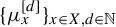 be as in Lemma 2.17. It follows from Lemma 2.17 that there exists
$x\in V_0$
 such that
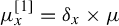
$\mu _x^{[1]}=\delta _x\times \mu $
 and for any
$d\in \mathbb {N}$
 :
-
(E) $(X^{[d]},\mu _x^{[d]},\mathcal {F}^{[d]})$
is ergodic; -
(P) $\mu _x^{[d]}((V_0\cap B(x,\gamma ))^{[d]})>0$
for any
$\gamma>0$
; -
(M) $\bar {p}_*(\mu _x^{[d]})=\mu _x^{[k]}$
for any
$k\in [d]$
and any morphism
$p: \mathcal {V}_k\to \mathcal {V}_d$
.






Claim. For any
$N\in \mathbb {N}$
 , there is an
$\mathrm{IP}_{N}$
 -set R and
$W\subseteq V_0$
 with
$\mu (W)>0$
 such that:
-
• $T^nW\subseteq V_1$
for any
$n\in R$
; -
• $\mu _x^{[d]}(W^{[d]})>0$
for every
$d\in \mathbb {N}$
.




Proof of the claim
As
$\pi (V_0)\subseteq \pi (V_1)$
 , we can choose
$y\in V_1$
 such that
$(x,y)\in \mathbf {RP}^{[\infty ]}$
 . Fix
$N\in \mathbb {N}$
 . It follows from Proposition 2.7 that there is an
$\mathrm{IP}_{N}$
 -set R such that
$T^nx\in V_1$
 for all
$n\in R$
 . Let
$\delta>0$
 such that
$T^nB(x,\delta )\subseteq V_1$
 for all
$n\in R$
 . Set
$W=V_0\cap B(x,\delta )$
 . Then,
$\mu _x^{[d]}(W^{[d]})>0$
 for every
$d\in \mathbb {N}$
 by condition (P). In particular,
$\mu (W)=\mu _x^{[1]}(W^{[1]})>0$
 .
Before giving the full proof, we will show that this proposition holds for
$d=2,3$
 as examples to illustrate our basic ideas.
The case
$d=2$
 . As
$\mu (V_0)=\mu _x^{[1]}(V_0)>0$
 , there exists
$N\in \mathbb {N}$
 such that for any
$\mathrm {IP}_N$
 -set R, one can find some
$n\in R$
 such that

By the claim above, there is an
$\mathrm {IP}_N$
 -set R and
$W_0\subseteq V_0$
 with
$\mu (W_0)>0$
 such that
$T^nW_0\subseteq V_1$
 for all
$n\in R$
 . Now, we can choose
$n\in R$
 such that

Recall that
$\mu $
 is ergodic, so there exists
$m\in \mathbb {N}$
 such that

Set
$W=W_0\cap T^{-m}V_0\cap T^{-n-m}V_0$
 . Then, we have:
-
• $ T^nW\subseteq T^n W_0\subseteq V_1$
; -
• $W\subseteq W_0\subseteq V_0$
and
$T^mW,\; T^{n+m}W\subseteq V_0$
.



This shows the case
$d=2$
 .
The case
$d=3$
 . We first define inductively positive integers
$m_3,m_2,m_1$
 and
$N_2,N_1$
 as follows. Set
$m_3=1$
 . As
$\mu (V_0)>0$
 , it follows from Corollary 2.16 that there exists
$N_2\in \mathbb {N}$
 such that for any
$\vec {n}_1,\ldots ,\vec {n}_{N_2}\in \mathbb {N}^2$
 , one can find some
$(n,m)\in \mathrm {IP}(\vec {n}_1,\ldots ,\vec {n}_{N_2})$
 such that

Set
$m_2=m_3N_2=N_2$
 . Let us consider the system
$(X^{[N_2]},\mu _x^{[N_2]},\mathcal {F}^{[N_2]})$
 . As
$\mu _x^{[N_2]} (V_0^{[N_2]}) >0$
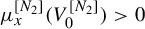 by condition (P), it follows from Corollary 2.16 that there exists
$N_1\in \mathbb {N}$
 such that for any
$\vec {n}_1,\ldots ,\vec {n}_{N_1}\in \mathbb {N}^{m_2}=\mathbb {N}^{N_2}$
 , one can find some
$\vec {n}\in \mathrm {IP}(\vec {n}_1,\ldots ,\vec {n}_{N_1})$
 such that
$S=(T^{\vec {n}\cdot \epsilon })_{\epsilon \in \mathcal {V}_{N_2}}$
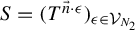 and

Set
$m_1=m_2N_1=N_2N_1$
 .
By the claim above, there is an
$\mathrm {IP}_{m_1}$
 -set R and
$W_0\subseteq V_0$
 with
$\mu (W_0)>0$
 such that:
-
• $T^nW_0\subseteq V_1$
for any
$n\in R$
; -
• $\mu _x^{[d]}(W_0^{[d]})>0$
for every
$d\in \mathbb {N}$
.


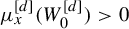

Let
$n_1^{1},\ldots ,n_{m_1}^{1}\in \mathbb {N}$
 such that
$R=\mathrm {IP}(n_1^{1},\ldots ,n_{m_1}^{1})$
 . As
$m_1=N_2N_1$
 , we can divide
$\{n_1^{1},\ldots ,n_{N_2N_1}^{1}\}$
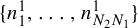 into
$N_1$
 vectors of dimension
$N_2$
 as follows: set
$\vec {n}_i^{1}=(n_{(i-1)N_2+1}^{1},\ldots , n_{iN_2}^{1})$
 for
$i\in [ N_1]$
 . Then, there exists
$\vec {m}^{1}\in \mathrm {IP}(\vec {n}_1^{1},\ldots ,\vec {n}_{N_1}^{1})$
 such that
$S_1=(T^{\vec {m}^{1}\cdot \epsilon })_{\epsilon \in \mathcal {V}_{N_2}}$
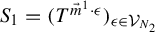 and

Recall that the system
$(X^{[N_2]},\mu _x^{[N_2]},\mathcal {F}^{[N_2]})$
 is ergodic by condition (E) and
$\mu _x^{[N_2]}(W_0^{[N_2]})>0$
 , so there exists
$\vec {m}^{2}\in \mathbb {N}^{N_2}$
 such that
$S_2=(T^{\vec {m}^{2}\cdot \epsilon })_{\epsilon \in \mathcal {V}_{N_2}}$
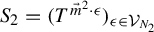 and

Set
$\vec {m}^{i}=(m_1^{i},\ldots ,m_{N_2}^{i})$
 for
$i=1,2$
 and set
$\vec {n}^{2}_j=(m_j^{1},m_j^{2})$
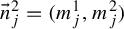 for
$j\in [ N_2]$
 . Then, by the construction of
$N_2$
 , there exists
$(a,b)\in \mathrm {IP}(\vec {n}^{2}_1,\ldots ,\vec {n}^{2}_{N_2})$
 such that

Let
$\omega \in \mathcal {V}^*_{N_2} $
 such that

Notice the
$\vec {0}$
 -component and
$\omega $
 -component of
$W_0^{[N_2]}\cap S_2^{-1}(V_0^{[N_2]}\cap S_1^{-1}V_0^{[N_2]})$
 are
$W_0$
 and
$W_0\cap T^{-b}V_0\cap T^{-a-b}V_0=:W_\omega $
 , respectively, it follows from condition (M) that

As
$\mu $
 is ergodic, there exists
$c\in \mathbb {N}$
 such that

Now, let

Then,
$W\subseteq W_0\subseteq V_0$
 and
$T^nW\subseteq V_0$
 for any
$n\in \mathrm {IP}(a,b,c)\setminus \{a\}$
 .
Recall that
$\vec {m}^{1}\in \mathrm {IP}(\vec {n}_1^{1},\ldots ,\vec {n}_{N_1}^{1})$
 , so there exist
$1\leqslant j_1<\cdots <j_l\leqslant N_1$
 such that
$\vec {m}^{1}=\vec {n}_{j_1}^{1}+\cdots +\vec {n}_{j_l}^{1}$
 , which implies

Then, we have
$T^aW\subseteq T^aW_0\subseteq V_1$
 .
This shows the case
$d=3$
 .
The general case. We first define inductively positive integers
$m_d,\ldots ,m_1$
 and
$N_{d-1},\ldots ,N_1$
 as follows. Set
$m_d=1$
 . Assume that we have already defined
$m_d,\ldots ,m_{i+1}$
 and
$N_{d-1},\ldots ,N_{i+1}$
 . Let us consider the system
$(X^{[m_{i+1}]},\mu _x^{[m_{i+1}]}, \mathcal {F}^{[m_{i+1}]})$
 . As
$\mu _x^{[m_{i+1}]}(V_0^{[m_{i+1}]})>0$
 by condition (P), it follows from Corollary 2.16 that there exists
$N_i\in \mathbb {N}$
 such that for any
$\mathbf {n}_1,\ldots ,\mathbf {n}_{N_i}\in (\mathbb {N}^{m_{i+1}})^{i}$
 , one can find some
$\mathbf {n}=(\vec {n}_1,\ldots ,\vec {n}_{i})\in \mathrm {IP}(\mathbf {n}_1,\ldots ,\mathbf {n}_{N_i})$
 such that
$S_j=(T^{\vec {n}_j\cdot \epsilon })_{\epsilon \in \mathcal {V}_{m_{i+1}}},j\in [i]$
 and

Set
$m_{i}=m_{i+1}N_i$
 . This finishes the inductive definition.
By the claim above, there is an
$\mathrm {IP}_{m_1}$
 -set R and
$W_0\subseteq V_0$
 with
$\mu (W_0)>0$
 such that


For
$i\in \{2,\ldots ,d\}$
 , inductively, we will construct
$\vec {n}_1^{i},\ldots ,\vec {n}_i^{i}\in \mathbb {N}^{m_i}$
 and
$W^i_\epsilon \subseteq W_0,\epsilon \in \mathcal {V}_{m_i}$
 such that:
-
(Ai ) $\vec {n}_1^i\cdot \epsilon \in R$
for any
$\epsilon \in \mathcal {V}_{m_i}^*$
; -
(Bi ) $\mu _x^{[m_i]}(\prod _{\epsilon \in \mathcal {V}_{m_i}}W^i_\epsilon )>0$
; -
(Ci ) $( \prod _{j\in \alpha }T^{\vec {n}_{j}^{i}\cdot \epsilon })W_{\epsilon }^{i}\subseteq V_0$
for any
$\epsilon \in \mathcal {V}_{m_i}$
and any
$\alpha \subseteq [i], \alpha \neq \{1\}$
.






Assume this has been achieved, then there exist
$n_1^d,\ldots ,n_d^d\in \mathbb {N}^{m_d}=\mathbb {N}$
 and
$W_0^d,W_1^d\subseteq W_0$
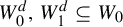 such that:
-
• $n_1^d\in R$
; -
• $\mu (W_1^d)=\mu _x^{[1]}(W_0^d\times W_1^d)>0$
; -
• $(\prod _{j\in \alpha }T^{n_j^d})W_1^d\subseteq V_0$
for any
$\alpha \subseteq [i], \alpha \neq \{1\}$
.




Set
$W=W_1^d$
 and
$n_i=n_i^d$
 for
$i\in [d]$
 . Then, we have
$\mu (W)>0$
 and:
-
• $T^{n_1}W= T^{n_1^d}W_1^d\subseteq T^{n_1^d}W_0\subseteq V_1$
by (3.4); -
• $T^{\sum _{j\in \alpha }n_j}W= (\prod _{j\in \alpha }T^{n_j^d})W_1^d \subseteq V_0$
for any
$\alpha \subseteq [i], \alpha \neq \{1\}$
,



which shows the proposition.
We now return to the inductive construction.
Step 1. Let
$n_1^{1},\ldots ,n_{m_1}^{1}\in \mathbb {N}$
 such that
$R=\mathrm {IP}(n_1^{1},\ldots ,n_{m_1}^{1})$
 . Since
$m_1=m_{2}N_1$
 , we divide
$\{n_1^{1},\ldots ,n_{m_1}^{1}\}$
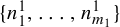 into
$N_1$
 vectors of dimension
$m_2$
 as follows: set
$\vec {r}_{k}=(n_{(k-1)m_{2}+1}^1,\ldots ,n_{km_{2}}^1)$
 for
$ k\in [N_1]$
 . Let us consider the system
$(X^{[m_{2}]},\mu _x^{[m_{2}]},\mathcal {F}^{[m_{2}]})$
 . Notice that
$\mu _x^{[m_{2}]}(V_0^{[m_2]})>0$
 by condition (P), thus, by the construction of
$N_1$
 , there exists a non-empty subset
$\beta $
 of
$ [N_1]$
 such that

and

As
$\mu _x^{[m_{2}]}$
 is
$\mathcal {F}^{[m_{2}]}$
 -ergodic by condition (E) and
$\mu _x^{[m_2]}(W_0^{[m_2]})>0$
 , there exists
$\vec {n}_{2}^{2}\in \mathbb {N}^{m_{2}}$
 such that
$S_2^{2}=(T^{-\vec {n}_{2}^{2}\cdot \epsilon })_{\epsilon \in \mathcal {V}_{m_{2}}}$
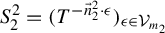 and

Set
$W_\epsilon ^2=W_0\cap T^{-\vec {n}_2^2\cdot \epsilon }V_0\cap T^{-(\vec {n}_2^2+\vec {n}_1^2)\cdot \epsilon }V_0\subseteq W_0$
 for
$\epsilon \in \mathcal {V}_{m_2}$
 . Then, we have:
-
• for any $\epsilon \in \mathcal {V}_{m_2}^*$
, $$ \begin{align*} \vec{n}_1^{2}\cdot \epsilon=\sum_{k\in\beta}\vec{r}_{k}\cdot \epsilon =\sum_{k\in\beta}\sum_{j=1}^{m_2}n_{(k-1)m_{2}+j}^1\cdot \epsilon_j\in R; \end{align*} $$
-
• $\mu _x^{[m_2]}(\prod _{\epsilon \in \mathcal {V}_{m_2}}W^2_\epsilon )= \mu _x^{[m_{2}]} (W_0^{[m_2]}\cap S_2^2(V_0^{[m_2]}\cap S_1^2 V_0^{[m_2]}))>0$
; -
• $W_{\epsilon }^2\subseteq V_0\cap T^{-\vec {n}_2^2\cdot \epsilon }V_0\cap T^{-(\vec {n}_2^2+ \vec {n}_1^2)\cdot \epsilon }V_0$
for any
$\epsilon \in \mathcal {V}_{m_2}$
.





Step i. Let
$i\geqslant 2$
 be an integer and assume that we have already chosen
$\vec {n}_1^{i},\ldots ,\vec {n}_i^{i}\in \mathbb {N}^{m_i}$
 and
$W^i_\epsilon \subseteq W_0,\epsilon \in \mathcal {V}_{m_i}$
 such that:
-
(Ai ) $\vec {n}_1^i\cdot \epsilon \in R$
for any
$\epsilon \in \mathcal {V}_{m_i}^* $
; -
(Bi ) $\mu _x^{[m_i]}(\prod _{\epsilon \in \mathcal {V}_{m_i}}W^i_\epsilon )>0$
; -
(Ci ) $( \prod _{j\in \alpha }T^{\vec {n}_{j}^{i}\cdot \epsilon })W_{\epsilon }^{i}\subseteq V$
for any
$\epsilon \in \mathcal {V}_{m_i}$
and any
$\alpha \subseteq [i], \alpha \neq \{1\}$
.






For
$j\in [i]$
 , set
$\vec {n}_j^{i}=(n_{j,1}^{i},\ldots ,n_{j,m_i}^{i})$
 . As
$m_{i}=m_{i+1}N_i$
 , we can divide
$\{n_{j,1}^{i},\ldots ,n_{j,m_i}^{i}\}$
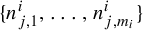 into
$N_{i}$
 vectors of dimension
$m_{i+1}$
 as follows: set
$\vec {r}_{j,k}=(n_{j,(k-1)m_{i+1}+1}^{i}, \ldots ,n_{j,km_{i+1}}^{i})$
 for
$ k\in [N_i]$
 . Set
$\mathbf {n}_k=(\vec {r}_{1,k},\ldots ,\vec {r}_{i,k})\in (\mathbb {Z}^{m_i})^i$
 for
$k\in [N_i]$
 .
Let us consider the system
$(X^{[m_{i+1}]},\mu _x^{[m_{i+1}]},\mathcal {F}^{[m_{i+1}]})$
 . Notice that
$\mu _x^{[m_{i+1}]}(V_0^{[m_{i+1}]})>0$
 by condition (P), thus, by the construction of
$N_i$
 , there exist
$1\leqslant k_1<\cdots <k_l\leqslant N_i$
 such that for
$j\in [i]$
 ,

and

For
$s\in [m_{i+1}]$
 , set
$\omega _s=\{(k_1-1)m_{i+1}+s,\ldots ,(k_l-1)m_{i+1}+s\}$
 . Then,
$\omega _1,\ldots , \omega _{m_{i+1}}$
 are non-empty pairwise disjoint subsets of
$[m_i]$
 . Let
$p: \mathcal {V}_{m_{i+1}}\to \mathcal {V}_{m_i}$
 be the map such that
$p(\emptyset )=\emptyset $
 and
$p(\eta )=\bigcup _{s\in \eta } \omega _s$
 for
$\eta \in \mathcal {V}_{m_{i+1}}^*$
 . It follows from condition (M) that

Moreover, for
$j\in [i]$
 and
$\eta \in \mathcal {V}_{m_{i+1}}^*$
 , we have

Recall that
$\mu _x^{[m_{i+1}]}$
 is
$\mathcal {F}^{[m_{i+1}]}$
 -ergodic by condition (E), so there exists
$\vec {n}_{i+1}^{i+1}\in \mathbb {N}^{m_{i+1}}$
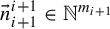 such that
$S_{i+1}^{i+1}=(T^{-\vec {n}_{i+1}^{i+1}\cdot \eta })_{\eta \in \mathcal {V}_{m_{i+1}}}$
 and

For
$\eta \in \mathcal {V}_{m_{i+1}}$
 , set

Then, we have


We next show that
$\vec {n}_1^{i+1},\ldots ,\vec {n}_{i+1}^{i+1}$
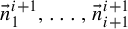 and sets
$W^{i+1}_\eta ,\eta \in \mathcal {V}_{m_{i+1}}$
 satisfy
$(A)_{i+1},(B)_{i+1}, (C)_{i+1}$
 .
By (3.6) and
$(A)_i$
 for any
$\eta \in \mathcal {V}_{m_{i+1}}^*$
 , we have


It remains to show
$(C)_{i+1}$
 . Let
$\alpha \subseteq [i+1]$
 with
$\alpha \neq \{1\}$
 .
When
$i+1\in \alpha $
 , set
$\alpha '=\alpha \backslash \{i+1\}$
 . Then, by (3.9), we have

When
$i+1\not \in \alpha $
 , we can view
$\alpha $
 as a subset of
$[i]$
 . Hence, by
$(C)_i$
 , (3.6), and (3.10), we have

We finish the construction by induction and, hence, the proof is complete.
3.2.2 Step 2:
$|\kappa |=1$

Proposition 3.4.
$\pi $
 has the property
$F_d(\kappa )$
 for any
$d\in \mathbb {N}$
 and any
$\kappa \subseteq \mathcal {V}_d^*$
 with
$|\kappa |=1$
 .
Proof. Fix
$d\in \mathbb {N}$
 and let
$\omega \in \mathcal {V}_d^*$
 with
$\kappa =\{\omega \}$
 . Assume that V is a measurable subset of X with
$\mu (V)>0$
 and
$V_1$
 is an open subset of X such that
$\pi (V)\subseteq \pi (V_1)$
 . It follows from Proposition 3.3 that there exists
$W_0\subseteq V$
 with
$\mu (W_0)>0$
 and
$(m_1,\ldots ,m_d)\in \mathbb {Z}^d$
 such that:
-
• $T^{m_1}W_0\subseteq V_1$
; -
• $T^{\sum _{i\in \epsilon }m_i}W_0\subseteq V$
for all
$\epsilon \subseteq [d],\epsilon \neq \{1\}$
.



Set
$a=\min \omega $
 . Let
$\vec {n}=(n_1,\ldots ,n_d)\in \mathbb {Z}^d$
 such that

and let
$W=T^{\sum _{i\in \omega \backslash \{a\}}m_i}W_0$
 . Then,
$W\subseteq V$
 and
$\mu (W)>0$
 .
Set
$\omega '=\omega \backslash \{a\}$
 . For
$\epsilon \in \mathcal {V}_d$
 , we have

which implies that

and

Thus, we have:
-
• $T^{\vec {n}\cdot \omega }W=T^{\sum _{i\in \omega }n_i +\sum _{i\in \omega '}m_i}W_0 =T^{m_1}W_0\subseteq V_1$
; -
• $T^{\vec {n}\cdot \epsilon }W=T^{\sum _{i\in \epsilon }n_i+\sum _{i\in \omega '}m_i}W_0\subseteq V$
for all
$\epsilon \in \mathcal {V}_d\backslash \{\omega \}$
.



This shows that
$\pi $
 has the property
$F_d(\kappa )$
 and, hence, finishes the proof.
3.2.3 Step 3:
$\kappa =\mathcal {V}_d^*$

We will now employ induction on the number of elements in
$\kappa $
 together with Propositions 3.3 and 3.4 to show Proposition 3.2. Before the induction, we show a special case when
$d=2$
 and
$\kappa =\{ \{1\},\{2\}\}$
 as an example.
A special case.
$d=2$
 and
$\kappa =\{ \{1\},\{2\}\}$
 . Assume that V is a measurable subset of X with
$\mu (V)>0$
 and
$V_{10},V_{01}$
 are open subsets of X such that
$\pi (V)\subseteq \pi (V_{10})\cap \pi (V_{01})$
 . We next show that there is
$(n_1,n_2)\in \mathbb {Z}^2$
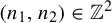 such that

By Proposition 3.4,
$\pi $
 has the property
$F_2(\{\{1,2\}\})$
 . As
$\pi (V)\subseteq \pi (V_{01})$
 , there is
$(a_1,a_2)\in \mathbb {Z}^2$
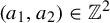 such that

Set
$W_1=V\cap T^{-a_1}V\cap T^{-a_2}V\cap T^{-a_1-a_2}V_{01}$
 . Then,
$\mu (W_1)>0$
 . Again by Proposition 3.4,
$\pi $
 has the property
$F_2(\{\{1\}\})$
 . As
$\pi (W_1)\subseteq \pi (V)\subseteq \pi (V_{10})$
 , there is
$(b_1,b_2)\in \mathbb {Z}^2$
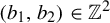 such that

Set
$n_1=b_1-a_1,n_2=b_2+a_2,W_2=W_1\cap T^{-b_1}V_{10}\cap T^{-b_2}W_1\cap T^{-b_1-b_2}W_1$
 and
$W=T^{a_1}W_2$
 . Then,
$\mu (W)>0$
 :
-
• $W=T^{a_1}W_2\subseteq T^{a_1}W_1\subseteq V$
; -
• $T^{n_1}W=T^{b_1-a_1}(T^{a_1}W_2)=T^{b_1}W_2\subseteq V_{10}$
; -
• $T^{n_2}W=T^{b_2+a_2}(T^{a_1}W_2)=T^{a_1+a_2}(T^{b_2}W_2) \subseteq T^{a_1+a_2}W_1\subseteq V_{01}$
; -
• $T^{n_1+n_2}W= T^{b_1-a_1+b_2+a_2}(T^{a_1}W_2)=T^{a_2}(T^{b_1+b_2}W_2)\subseteq T^{a_2}W_1 \subseteq V$
,




and thus,

This shows that
$\pi $
 has the property
$F_2(\{ \{1\},\{2\}\})$
 .
Now, we can give a proof of Proposition 3.2.
Proof of Proposition 3.2
Fix
$d\in \mathbb {N}$
 and let
$\kappa \subseteq \mathcal {V}_d^*$
 . When
$|\kappa |=1$
 , it follows from Proposition 3.4. Let
$i\geqslant 2$
 be an integer and assume that we have already shown that
$\pi $
 has the property
$F_d(\kappa )$
 for any
$\kappa \subseteq \mathcal {V}_d^*$
 with
$|\kappa |=i-1$
 .
Now, fix
$\kappa \subseteq \mathcal {V}_d^*$
 with
$|\kappa |=i$
 . Assume that V is a measurable subset of X with
$\mu (V)>0$
 and
$V_\epsilon ,\epsilon \in \kappa $
 are open subsets X such that
$\pi (V)\subseteq \bigcap _{\epsilon \in \kappa }\pi (V_\epsilon )$
 .
Choose
$\omega \in \kappa $
 and let
$\Phi $
 be a permutation of
$\mathcal {V}_d$
 such that for any
$\epsilon \in \mathcal {V}_d$
 ,

Then, we have
$\Phi (\vec {0})=\omega ,\Phi (\omega )=\vec {0}$
 and
$\Phi (\Phi (\epsilon ))=\epsilon $
 for any
$\epsilon \in \mathcal {V}_d$
 . Set

Then,
$|\kappa '|=i-1$
 . Now, let
$U_{\Phi (\epsilon )}=V_\epsilon $
 for
$\epsilon \in \kappa \backslash \{\omega \}$
 and let
$U=V$
 . Then, we have

By our inductive assumption,
$\pi $
 has the property
$F_d(\kappa ')$
 . Thus, there is
$\vec {a}\in \mathbb {Z}^d$
 such that

where
$U_\epsilon =U$
 for
$\epsilon \in \mathcal {V}_d\backslash \kappa '$
 . Set
$W=\bigcap _{\epsilon \in \mathcal {V}_d}T^{-\vec {a}\cdot \epsilon }U_\epsilon $
 . Then,
$\mu (W)>0$
 and


In particular,
$W=T^{\vec {a}\cdot \Phi (\omega )}W\subseteq U_{ \Phi (\omega )}=U=V$
 as
$\Phi (\omega )=\vec {0}$
 and
$U_{ \Phi (\omega )}=U$
 . Again, by our inductive assumption,
$\pi $
 has the property
$F_d(\{\omega \})$
 . As
$\pi (W)\subseteq \pi (U)=\pi (V)\subseteq \pi (V_\omega )$
 , there is
$\vec {b}\in \mathbb {Z}^d$
 such that

where
$W_\omega =V_\omega $
 and
$W_\epsilon =W$
 for
$\epsilon \in \mathcal {V}_d\backslash \{\omega \}$
 . Set
$G=\bigcap _{\epsilon \in \mathcal {V}_d}T^{-\vec {b}\cdot \epsilon }W_\epsilon $
 . Then,
$\mu (G)>0$
 and


Let
$\vec {c}=(c_1,\ldots ,c_d)\in \mathbb {Z}^d$
 such that

Set
$\vec {n}=\vec {b}+\vec {c}$
 and
$W=T^{\vec {a}\cdot \omega }G$
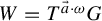 . Then,
$\mu (W)=\mu (G)>0$
 . We next show

Notice that for
$\epsilon \in \mathcal {V}_d$
 ,

thus, we have

When
$\epsilon =\omega $
 , as
$ \Phi (\omega )=\vec {0}$
 , we have

When
$\epsilon \in \kappa \backslash \{\omega \}$
 , we have

When
$\epsilon \in \mathcal {V}_d\backslash \kappa $
 , we have

This completes the induction procedure and, hence, the proof of the proposition.
4 Proof of Theorem 1.5
To end this paper, using Theorem 1.4, we show Theorem 1.5. Set
$\mathbb {N}^*=\{\infty \}\cup \{1,2,\ldots \}$
 . The proof of the following lemma is derived from [Reference Huang, Lian, Shao and Ye19, Proposition 3.7].
Lemma 4.1. Let
$\pi :(X,T)\to (Y,T)$
 be a factor map of systems. For
$i\in \mathbb {N}^*$
 , set

Then,
$Y_i$
 is Borel measurable for every
$i\in \mathbb {N}^*$
 .
Proof. Let
$2^X$
 be the hyperspace of X with Hausdorff metric
$\rho _{X,H}$
 and consider the map

Then, F is upper semi-continuous and, hence, Borel measurable. Define

Assume that
$B \in 2^X$
 is a finite set. Let

Then,
$\epsilon _B>0$
 and for any
$B' \in 2^X$
 with
$\rho _{X,H}(B,B') < \epsilon _B/2$
 , it follows that
$|B'| \geqslant |B|$
 .
Now, let
$A_0\in 2^X$
 . If
$|A_0|<\infty $
 , then
$|A|\geqslant |A_0|$
 for any
$A\in 2^X$
 with
$\rho _{X,H}(A_0,A) < \epsilon _{A_0}/2$
 . If
$|A_0|=\infty $
 , then for any positive integer m, one can choose
$A_m\subseteq A_0$
 with
$|A_m|=m$
 . Then,
$|A|\geqslant m$
 for any
$A\in 2^X$
 with
$\rho _{X,H}(A_0,A) < \epsilon _{A_m}/2$
 . This implies
$\lim _{A\to A_0}|A| =\infty $
 .
Equivalently, this can be expressed as

That is, G is lower semi-continuous. It follows that
$G \circ F : Y \to \mathbb {N}^*$
 is Borel measurable. This implies that
$Y_i = (G\circ F)^{-1}(i)$
 is Borel measurable for each
$i\in \mathbb {N}^*$
 .
Let X be a standard Borel space and let
$\mathcal {B}(X)$
 be the set of Borel sets of X. A subset A of X is analytic if there exist a standard Borel space
$X', A'\in \mathcal {B}(X')$
 and a measurable map
$f : X'\to X$
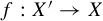 such that
$A = f(A')$
 . Let
$\mu $
 be a Borel measure on X. A subset A is called a
$\mu $
 -measurable set if
$A = B \triangle N$
 for some
$B \in \mathcal {B}(X)$
 and
$\mu $
 -null set N. A subset
$A\subseteq X$
 is called universally measurable if it is
$\mu $
 -measurable for every Borel measure
$\mu $
 . Lusin’s theorem says that every analytic set is universally measurable (see [Reference Kechris23, Theorem 21.10] for example).
Now, we can prove Theorem 1.5.
Proof of Theorem 1.5
Let
$(X,T)$
 be a minimal system without any non-trivial
$\mathrm {Ind}_{fip}$
 -
$(k+1)$
 -tuples. Let
$\pi :X\to X/\mathbf {RP}^{[\infty ]}=Y$
 be the factor map and suppose that
$m\in M(Y,T)$
 is the unique ergodic measure. For
$i\in \mathbb {N}^*$
 , set
$Y_i =\{y\in Y: |\pi ^{-1}(y)|=i\}$
 . Clearly,
$Y_i$
 is T-invariant and is measurable by Lemma 4.1 for every
$i\in \mathbb {N}^*$
 . Since m is ergodic, there exists
$j\in \mathbb {N}^*$
 such that
$m(Y_{j})=1$
 and
$m(Y_i)=0$
 for all
$i\neq j$
 .
Claim 1. We have
$j\leqslant k$
 .
Proof of Claim 1
Suppose for a contradiction that
$j\geqslant k+1$
 . Let
$\mu \in M(X,T)$
 be an ergodic measure. It follows from Theorem 1.4 that there exists a subset
$\Omega $
 of
$ X$
 with
$\mu (\Omega )=1$
 such that
$\{x\}\times (\pi ^{-1}(\pi (x)))^{2^d-1}\subseteq \overline {\mathcal {F}^{[d]}}(x^{[d]})$
 for any
$x\in \Omega $
 and any
$d\in \mathbb {N}$
 . Notice that
$(Y,T)$
 is uniquely ergodic, we have
$\pi _*(\mu )=m$
 and, thus,
$\mu (\Omega \cap \pi ^{-1}(Y_{j}))=1$
 . Now, let
$x\in \Omega \cap \pi ^{-1}(Y_{j})$
 and let
$x_1,\ldots ,x_{k+1}\in \pi ^{-1}(x)$
 be distinct points. It follows that
$\{x\}\times \{x_1,\ldots ,x_{k+1}\}^{2^{d+1}-1}\subseteq \overline {\mathcal {F}^{[d+1]}}(x^{[d+1]})$
 for any
$d\geqslant 1$
 and, thus,
$\{x_1,\ldots ,x_{k+1}\}^{[d]}\subseteq \mathbf {Q}^{[d]}(X)$
 for any
$d\geqslant 1$
 , which implies
$(x_1,\ldots ,x_{k+1})$
 is an
$\mathrm {Ind}_{fip}$
 -
$(k+1)$
 -tuple by Lemma 2.12, which is a contradiction. From this, we conclude that
$j\leqslant k$
 .
Claim 2. The system
$(X,T)$
 has at most
$j$
 ergodic measures.
Proof of Claim 2
Suppose for a contradiction that
$\mu _1,\ldots ,\mu _{j+1}$
 are distinct ergodic measures of
$(X,T)$
 . Let
$W_i$
 be the set of all
$\mu _i$
 -generic points for
$ i\in [j+1]$
 . By Proposition 2.1, we have
$\mu _i(W_i)=1$
 for every
$ i\in [j+1]$
 . By Lusin’s theorem,
$\{\pi (W_i)\}_{i=1}^{j+1}$
 are universally measurable as they are analytic sets.
Notice that
$\pi _*(\mu _1)=\cdots =\pi _*(\mu _{j+1})=m$
 ; hence, we have

Set
$Y'=\bigcap _{i=1}^{j+1}\pi (W_i)$
 . It follows that
$m(Y')=1$
 and
$|\pi ^{-1}(y)|\geqslant j+1$
 for any
$y\in Y'$
 . Thus,
$Y'\cap Y_j \neq \emptyset $
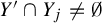 , which is a contradiction by Claim 2.
This shows Claim 2.
It follows from Proposition 2.14 that there exists
$j'\in [j]$
 such that
$Y_{j'}$
 contains a dense
$G_\delta $
 set, that is,
$\pi $
 is an almost
$j'$
 -to-one extension.
This finishes the proof.
A Appendix. Proof of Lemma 2.17
In this section, we give the proof of Lemma 2.17.
A.1 Measure
$\mu ^{[d]}$

Definition A.1. [Reference Host and Kra13, Reference Host and Kra14] Let
$(X,\mathcal {X},\mu ,T)$
 be an ergodic MPS. Let
$\mu ^{[1]}=\mu \times \mu $
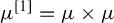 . For
$d\in \mathbb {N}$
 , let
$\mathcal {I}_{T^{[d]}}$
 be the
$T^{[d]}$
 -invariant
$\sigma $
 -algebra of
$(X^{[d]},\mathcal {X}^{[d]},\mu ^{[d]})$
 . Define
$\mu ^{[d+1]}$
 to be the relative independent joining of two copies of
$\mu ^{[d]}$
 over
$\mathcal {I}_{T^{[d]}}$
 . That is, for
$f_\epsilon \in L^\infty (\mu ), \epsilon \in \mathcal {V}_d$
 :

Proposition A.2. [Reference Host, Kra and Maass15, Lemmas 5.1, 5.6]
Let
$(X,T)$
 be a minimal system,
$d\in \mathbb {N}$
 , and
$\mu \in M(X,T)$
 be an ergodic measure. Then:
-
• $\mu ^{[d]}$
is a
$\mathcal {G}^{[d]}$
-invariant measure on
$\mathbf {Q}^{[d]}(X)$
; -
• $ \mu ^{[d]}(V^{[d]})\geqslant \mu (V)^{2^d}$
for any measurable subset V of X.



A.2 Topological models
Definition A.3. Let
$(X,\mathcal {X},\mu ,T)$
 be an MPS. We say that the system
$(\hat {X},\hat {\mathcal {X}},\hat {\mu },\hat {T})$
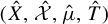 is a topological model (or just a model) for
$(X,\mathcal {X},\mu ,T)$
 if
$(\hat {X},\hat {T})$
 is a TDS and
$\hat {\mu }$
 is a
$\hat {T}$
 -invariant probability measure on
$\hat {\mathcal {X}}$
 , the Borel
$\sigma $
 -algebra of
$\hat {X}$
 , and the systems
$(X,\mathcal {X},\mu ,T)$
 and
$(\hat {X},\hat {\mathcal {X}},\hat {\mu },\hat {T})$
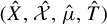 are measure theoretically isomorphic.
Theorem A.4. [Reference Huang, Shao and Ye21, Theorem A]
Let
$(X,\mathcal {X},\mu ,T)$
 be an ergodic MPS and
$d\in \mathbb {N}$
 . Then, it has a strictly ergodic (a TDS is strictly ergodic if it is minimal and has a unique ergodic measure) model
$(\hat {X},\hat {\mathcal {X}},\hat {\mu },\hat {T})$
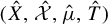 such that:
-
(1) $(\mathbf {Q}^{[d]}(\hat {X}),\mathcal {G}^{[d]})$
is strictly ergodic; -
(2) $(\overline {\mathcal {F}^{[d]}}(x^{[d]}),\mathcal {F}^{[d]})$
is strictly ergodic for all
$x\in \hat {X}$
.



A.3 Measure disintegration
Theorem A.5. [Reference Glasner8, Theorem A.7]
Let X and Y be two standard Borel spaces, and
$\pi : X \to Y$
 a Borel map. Let
$\mu \in M(X)$
 be a Borel probability measure of X and
$\nu =\pi _*(\mu )$
 its image in
$M(Y )$
 . Then, there is a Borel map
$y\mapsto \mu _y$
 , from Y into
$M(X)$
 such that:
-
• for $\nu $
-almost every (a.e.)
$y\in Y$
,
$\mu _y(\pi ^{-1}(y))=1$
; -
• $\mu =\int _{Y}\mu _y\,{d}\nu (y)$
.




Moreover, such a map is unique in the following sense. If
$y\mapsto \mu ^{\prime }_y$
 is another such map, then
$\mu _y=\mu _y'$
 for
$\nu $
 -a.e.
$y\in Y$
 . The collection
$\{\nu _y\}_{y\in Y}$
 is called a measure disintegration of
$\mu $
 .
A.4 Proof of Lemma 2.17
Theorem A.6. Let
$(X,T)$
 be a minimal system and
$\mu \in M(X,T)$
 be an ergodic measure. Then, for every
$d\in \mathbb {N}$
 , there exists a family
$\{\mu _x^{[d]}=\delta _x\times \mu _x^{[d]_*} \}_{x\in X}$
 of Borel probability measures on
$X^{[d]}$
 such that the following statements hold:
-
(1) for $\mu $
-a.e.
$x\in X$
,
$\mu _x^{[d]}$
is
$\mathcal {F}^{[d]}$
-ergodic and
$\mu _x^{[1]}=\delta _x\times \mu $
; -
(2) $\mu ^{[d]}=\int _X \mu _x^{[d]}\,{d}\mu $
; -
(3) the map $X\to M(X^{[d]}),x\mapsto \mu _x^{[d]}$
is measurable; -
(4) for any $k\in [d]$
and any morphism
$p: \mathcal {V}_k\to \mathcal {V}_d$
, one has
$\bar {p}_*(\mu _x^{[d]})=\mu _x^{[k]}$
for
$\mu $
-a.e.
$x\in X$
.


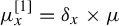







Proof. It follows from Theorem A.4 that there exists a strictly ergodic model
$(\hat {X},\hat {\mathcal {X}},\hat {\mu },\hat {T})$
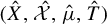 such that:
-
• $(\mathbf {Q}^{[d]}(\hat {X}),\mathcal {G}^{[d]})$
is strictly ergodic; -
• $(\overline {\mathcal {F}^{[d]}}(x^{[d]}),\mathcal {F}^{[d]})$
is strictly ergodic for all
$x\in \hat {X}$
.



By Proposition A.2,
$\hat {\mu }^{[d]}$
 is a
$\mathcal {G}^{[d]}$
 -invariant measure on
$\mathbf {Q}^{[d]}(\hat {X})$
 , which implies that
$\hat {\mu }^{[d]}$
 is the unique ergodic measure on
$(\mathbf {Q}^{[d]}(\hat {X}),\mathcal {G}^{[d]})$
 . For
$x\in \hat {X}$
 , let
$\hat {\mu }_x^{[d]}$
 be the unique ergodic measure on
$(\overline {\mathcal {F}^{[d]}}(x^{[d]}),\mathcal {F}^{[d]})$
 . Notice that for any
$\mathbf {x}\in \overline {\mathcal {F}^{[d]}}(x^{[d]})$
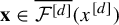 , the
$\vec {0}$
 -component of
$\mathbf {x}$
 is x. We write
$\hat {\mu }_x^{[d]}=\delta _x\times \hat {\mu }_x^{[d]_*}$
 for some Borel probability measure
$ \hat {\mu }_x^{[d]_*}$
 on
${\hat {X}_*^{[d]}{\kern-1pt}={\kern-1pt}\hat {X}^{2^d-1}}$
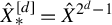 . In particular, when
$d{\kern-1pt}={\kern-1pt}1$
 , we get that
$(\overline {\mathcal {F}^{[1]}}(x^{[1]}),\mathcal {F}^{[1]}){\kern-1pt}={\kern-1pt}(\{x\}{\kern-1pt}\times{\kern-1pt} \hat {X},\mathrm {id}{\kern-1pt}\times{\kern-1pt} \hat {T})$
 and, thus,
$\hat {\mu }_x^{[1]}=\delta _x\times \hat {\mu }$
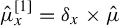 for every
$x\in \hat {X}$
 .
Claim 1. We have
$\hat {\mu }^{[d]}=\int _{\hat {X}}\hat { \mu }_x^{[d]}\,{d}\hat { \mu }$
 .
Proof of Claim 1
Recall that
$(\mathbf {Q}^{[d]}(\hat {X}),\mathcal {G}^{[d]})$
 is uniquely ergodic and

it suffices to show that
$\int _{\hat {X}}\hat { \mu }_x^{[d]}\,{d}\hat { \mu }$
 is
$\mathcal {G}^{[d]}$
 -invariant. Notice that every
$\hat { \mu }_x^{[d]}$
 is
$\mathcal {F}^{[d]}$
 -invariant and, thus, so is
$\int _{\hat {X}}\hat { \mu }_x^{[d]}\,{d}\hat { \mu }$
 .
As
$\hat {T}^{[d]}\hat {\mu }_x^{[d]}$
 is an
$\mathcal {F}^{[d]}$
 -ergodic measure on
$\hat {T}^{[d]}\overline {\mathcal {F}^{[d]}}(x^{[d]})=\overline {\mathcal {F}^{[d]}}((\hat {T}x)^{[d]})$
 and notice
$(\overline {\mathcal {F}^{[d]}}((\hat {T}x)^{[d]}),\mathcal {F}^{[d]})$
 is uniquely ergodic, we deduce that
$\hat {T}^{[d]}\hat {\mu }_x^{[d]}=\hat {\mu }_{\hat {T}x}^{[d]}$
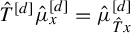 . This implies that

Since
$\mathcal {G}^{[d]}$
 is generated by
$\mathcal {F}^{[d]}$
 and
$\hat {T}^{[d]}$
 , we have
$\int _{\hat {X}}\hat { \mu }_x^{[d]}\,{d}\hat { \mu }$
 is
$\mathcal {G}^{[d]}$
 -invariant and, thus,

This shows Claim 1.
Claim 2. The map
$\hat {X}\to M(\hat {X}^{[d]}),x\mapsto \hat {\mu }_x^{[d]}$
 is measurable.
Proof of Claim 2
Let
$\theta :\mathbf {Q}^{[d]}(\hat {X})\to \hat {X}$
 be the projection to the
$\vec {0}$
 -coordinate. Then,
$\theta _*(\hat {\mu }^{[d]})$
 is a
$\hat {T}$
 -invariant measure on X and, thus,
$\theta _*(\hat {\mu }^{[d]})=\hat {\mu }$
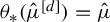 as
$(\hat {X},\hat {T})$
 is uniquely ergodic.
Set
$\mathbf {Q}^{[d]}_x(\hat {X})=(\{x\}\times {\hat {X}}^{2^d-1})\cap \mathbf {Q}^{[d]}(\hat {X})$
 for
$x\in \hat {X}$
 . We have
$\overline {\mathcal {F}^{[d]}}(x^{[d]})\subseteq \mathbf {Q}^{[d]}_x(\hat {X})$
 and, thus,
$\hat {\mu }_x^{[d]}(\mathbf {Q}^{[d]}_x(\hat {X}))=1$
 .
By Claim 1 and Theorem A.5, we conclude that the map
$\hat {X}\to M(\hat {X}^{[d]}),x\mapsto \hat {\mu }_x^{[d]}$
 is measurable. This shows Claim 2.
Claim 3. For any
$x\in \hat {X},k\in [d]$
 and morphism
$p: \mathcal {V}_k\to \mathcal {V}_d$
 , one has
$\bar {p}_*(\hat {\mu }_x^{[d]})=\hat {\mu }_x^{[k]}$
 .
Proof of Claim 3
Let
$k\in [d],x\in \hat {X}$
 and let
$p: \mathcal {V}_k\to \mathcal {V}_d$
 be a morphism. Then, there exist pairwise disjoint non-empty subsets
$\epsilon _1,\ldots ,\epsilon _k$
 of
$[d]$
 such that
$p(\emptyset )=\emptyset $
 and
$p(\eta )=\bigcup _{i\in \eta }\epsilon _i$
 for
$\eta \in \mathcal {V}_k^*$
 . For any
$\vec {n}\in \mathbb {Z}^d$
 , we have

which implies that
$\bar {p}(\overline {\mathcal {F}^{[d]}}(x^{[d]}))=\overline {\mathcal {F}^{[k]}}(x^{[k]})$
 . Hence,
$\bar {p}_*(\hat {\mu }_x^{[d]})$
 is an
$\mathcal {F}^{[k]}$
 -invariant measure on
$\overline {\mathcal {F}^{[k]}}(x^{[k]})$
 .
Observe that
$(\overline {\mathcal {F}^{[k]}}(x^{[k]}),\mathcal {F}^{[k]})$
 is also strictly ergodic, we deduce that
$p_*(\hat {\mu }_x^{[d]})=\hat {\mu }_x^{[k]}$
 .
This shows Claim 3.
Let
$\phi :X\to \hat {X}$
 be the isomorphism. Then,
$\phi ^{[d]_*}:X^{[d]}_*\to \hat {X}_*^{[d]}$
 is also an isomorphism. Define
$\mu _x^{[d]_*}=\hat {\mu }_{\phi (x)}^{[d]_*}\circ \phi ^{[d]_*}$
 for
$x\in X$
 . It is easy to check that
$\{\mu _x^{[d]}=\delta _x\times \mu _x^{[d]_*}\}_{x\in X}$
 is well defined and also satisfies statements (1)–(4).
This finishes the proof.
Proof of Lemma 2.17
Let
$\{\mu _x^{[d]}=\delta _x\times \mu _x^{[d]_*} \}_{x\in X,d\in \mathbb {N}}$
 be as in Theorem A.6. Then, there exists a subset
$\Omega $
 of X with full measure such that for any
$x\in \Omega $
 and any
$d\in \mathbb {N}$
 :
-
• $\mu _x^{[d]}$
is
$\mathcal {F}^{[d]}$
-ergodic and
$\mu _x^{[1]}=\delta _x\times \mu $
; -
• $\bar {p}_*(\mu _x^{[d]})=\mu _x^{[k]}$
for any
$k\in [d]$
and any morphism
$p: \mathcal {V}_k\to \mathcal {V}_d$
.


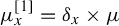



Moreover, we have:
-
• $\mu ^{[d]}=\int _X \mu _x^{[d]}\,{d}\mu $
; -
• the map $X\to M(X^{[d]}),x\mapsto \mu _x^{[d]}$
is measurable.


Claim 1. Let
$k\in [d]$
 and
$p: \mathcal {V}_k\to \mathcal {V}_d$
 be a morphism. Let
$W_\epsilon ,\epsilon \in \mathcal {V}_d$
 be measurable subsets of X and
$x\in \Omega $
 . Then,

Proof of Claim 1
Let

Since
$x\in \Omega $
 , we have
$\bar {p}_*(\mu _x^{[d]})=\mu _x^{[k]}$
 and, thus,

as
$W_\epsilon \subseteq W_\epsilon ',\epsilon \in \mathcal {V}_d$
 . This shows Claim 1.
Claim 2. For any measurable subset A of X and
$d\in \mathbb {N}$
 , there exists a measurable set
$A'\subseteq A$
 with
$\mu (A')=\mu (A)$
 such that
$\mu _x^{[d]}(A^{[d]})>0$
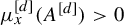 for any
$x\in A'$
 . (We remark this claim was also proved in [Reference Host, Kra and Maass15, Lemma 5.4].)
Proof of Claim 2
Let
$B=\{x\in A: \mu _x^{[d]}(A^{[d]})=0\}$
 . It follows from Theorem A.6(3) that B is measurable. Then, we have

which implies
$\mu (B)=0$
 .
This shows the claim.
Let
$\{V_i\}_{i\in \mathbb {N}}$
 be a countable base for the topology of X. For every
$i\in \mathbb {N}$
 , it follows from Claim 2 that there exists a measurable set
$U_{d,i}\subseteq M\cap V_i$
 with
$\mu (U_{d,i})=\mu ( M\cap V_i)$
 such that
$\mu _x^{[d]} ((M\cap V_i)^{[d]})>0$
 for every
$x\in U_{d,i}$
 .
Set
$M_0=\Omega \cap (\bigcap _{d\in \mathbb {N},i\in \mathbb {N}} U_{d,i}\cup (M\backslash V_i ))$
 . Then, we have
$\mu (M_0)=\mu (M)$
 . We next show that
$M_0$
 meets our requirement.
Let
$x\in M_0$
 and
$d\in \mathbb {N}$
 . Then, x satisfies statements (1) and (2) as
$x\in \Omega $
 . Let V be a neighborhood of x. Recall that
$\{V_i\}_{i\in \mathbb {N}}$
 is a base for the topology of X, we can choose
$V_i$
 with
$x\in V_i\subseteq V$
 , which implies that

This completes the proof.
Acknowledgements
The authors would like to express their gratitude to Professors Wen Huang, Song Shao, Hui Xu and Xiangdong Ye for their insightful discussions and valuable comments. This research is supported by National Key R&D Program of China (Nos. 2024YFA1013601, 2024YFA1013600), USTC Research Funds of the Double First-Class Initiative (YD0010002009), and NNSF of China (12401243, 12426201, and 12471188).



