Reading Clark suggests possible connections between proximate causes of animal – not just human – perception, mind, and action and their ultimate causes. We suggest that it is worth considering that nonhuman animals, not just humans, are Bayesian too, and that the world also appears to them as a set of intertwined probability density distributions. We think of all animals as Bayesian and we define (Gowaty & Hubbell Reference Gowaty and Hubbell2005; Reference Gowaty and Hubbell2009) animals as adaptively flexible individuals who “predict” (“visualize,” “imagine”) alternatives and make choices among them “controlling plasticity” to serve fitness. We have argued previously that animals predict their futures and act as though they are indeed perceiving and responding to “intertwined set[s] of probability density distributions” (see target article, sect. 4.1, para. 3). We say explicitly that animals behave as if playing the odds of fitness against the odds of time. Thus, we argue that animals are flexible individuals who act behaviorally and physiologically in real ecological time, not just evolutionary time, to enhance their real-time fitness. Could it be that the intertwined set of probability density distributions associated with the main problems of individuals – surviving and reproducing – are on a continuum of connected ultimate and proximate causes and perhaps fuel the organization of perception and action? Do Bayesian animals predict the future from a set of constantly updated priors to produce predictions of most importance: finding a mate, finding a better mate, or dying?
Fitness is a relative concept and demography-dependent. Here, we direct readers to a theoretical scenario (Figure 1) with its mathematical analytical solutions for the evolution of human and nonhuman Bayesian individuals who perceive their real time alternatives, predict the fitness that would accrue or not from those alternatives and modify their behavior accordingly. One of our main assumptions is that individuals are able to predict (unconsciously or consciously) their own demographic circumstances (how they are doing/will do relative to others). To some of our readers, our assumptions have seemed otherworldly. Clark's article suggests that our assumptions are not so odd in the human cognitive sciences and they signal new empirical research about the meanings of animal behavior in the unified contexts of linked proximate and ultimate causes.
From a Darwinian evolutionary perspective (Darwin Reference Darwin1871), who among potential mates to accept and/or reject is one of the most important of reproductive decisions. To be fitness enhancing in contemporary time, reproductive decisions must be flexible and made against the unavoidable context of demography (Gowaty & Hubbell Reference Gowaty and Hubbell2005). Demography is not static: things change; stochastic effects are inevitable. Potential mates enter and leave populations; some individuals may die and never appear again; and predators, parasites, and pathogens come and go, so that the survival likelihoods of decision-makers also change. The minimal set of parameters contributing to stochastic demography (Hubbell & Johnson Reference Hubbell and Johnson1987) are those providing sensory information about the availability of potential mates (encounter probability, e), the likelihood of continued life of decision-makers (survival probability, s), and the distribution within the population of fitness that would be conferred from mating with this or that potential mate (w-distribution). The minimal set of information necessary for making real-time, fitness-enhancing reproductive decisions is e, s and the w-distribution.
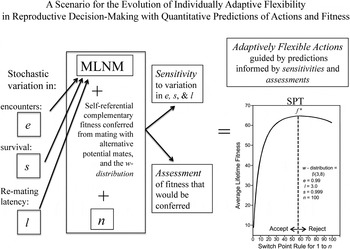
Gowaty and Hubbell (Reference Gowaty and Hubbell2005) hypothesized that individuals, not sexes, are under selection to flexibly modify their reproductive decisions moment-to-moment as their ecological and social circumstances change to enhance their instantaneous contributions to lifetime mean fitness (Fig. 1). Stochastic variation in e, s, and l (latency from the end of one mating, to onset, to receptivity, to the next mating) results in mean lifetime number of mates (MLNM). Variation in MLNM favors the evolution of sensitivity to e, s, and l, while variation in the w-distribution favors assessment of fitness that would be conferred through mating with this or that potential mate. Once sensitivity and assessment evolve, the stage is set for flexible individuals to modify their behavior in ways which their sensitivities and assessments predict are fitness enhancing. The analytical solution to this model is the Switch Point Theorem (SPT). An SPT graph shows the rule for acceptance and rejection of each potential mate, ranked from best at 1 to worst at n, by a single unique individual in the population, given variation in e, s, l, n and the w-distribution.
The assumptions of the analytical solution as to how many potential mates in a population will be acceptable or not to a given individual (Gowaty & Hubbell Reference Gowaty and Hubbell2009) are as follows:
-
1. Before there was natural selection to accept or reject potential mates, there was stochastic variation in encounters with potential mates and with decision-makers' likelihood of survival.
-
2. The encounter probability and survival probability determine the mean lifetime number of mates and the variance in lifetime number of mates.
-
3. Potential mates come in n-qualities, where n = the number of potential mates in the population.
-
4. Mate assessment is self-referential and depends upon information learned during development about self relative to others.
-
5. Individuals update their information to predict adaptive acceptance and rejection of potential mates thereby maximizing instantaneous contributions to lifetime fitness.
The analytical solution of whom to accept and reject for mating is the switch point theorem (SPT in Fig. 1).
Resistance to our assumptions from behavioral ecologists is perhaps not surprising, for we begin with individuals, rather than sexes, to predict sex differences. What surprises us, however, is that there are critics who resist our assumption that animals use probabilistic information as instantaneous clues to predict their next move, which the SPT proved theoretically is adaptive. The Bayesian updating that Clark describes as a fundamental aspect of neural processing of what the world is, suggests to us that his and our ideas are conceptually linked. Our use of the Bayesian metaphor suggests that there is something self-similar linking proximate and ultimate causes. But, what if animals too are Bayesians with linkages between how and why brains interpret the world?
We agree with Clark. What is on offer is a unified science of perception, attention, prediction, and flexibility of action. The SPT suggests that fitness drives all.





Reading Clark suggests possible connections between proximate causes of animal – not just human – perception, mind, and action and their ultimate causes. We suggest that it is worth considering that nonhuman animals, not just humans, are Bayesian too, and that the world also appears to them as a set of intertwined probability density distributions. We think of all animals as Bayesian and we define (Gowaty & Hubbell Reference Gowaty and Hubbell2005; Reference Gowaty and Hubbell2009) animals as adaptively flexible individuals who “predict” (“visualize,” “imagine”) alternatives and make choices among them “controlling plasticity” to serve fitness. We have argued previously that animals predict their futures and act as though they are indeed perceiving and responding to “intertwined set[s] of probability density distributions” (see target article, sect. 4.1, para. 3). We say explicitly that animals behave as if playing the odds of fitness against the odds of time. Thus, we argue that animals are flexible individuals who act behaviorally and physiologically in real ecological time, not just evolutionary time, to enhance their real-time fitness. Could it be that the intertwined set of probability density distributions associated with the main problems of individuals – surviving and reproducing – are on a continuum of connected ultimate and proximate causes and perhaps fuel the organization of perception and action? Do Bayesian animals predict the future from a set of constantly updated priors to produce predictions of most importance: finding a mate, finding a better mate, or dying?
Fitness is a relative concept and demography-dependent. Here, we direct readers to a theoretical scenario (Figure 1) with its mathematical analytical solutions for the evolution of human and nonhuman Bayesian individuals who perceive their real time alternatives, predict the fitness that would accrue or not from those alternatives and modify their behavior accordingly. One of our main assumptions is that individuals are able to predict (unconsciously or consciously) their own demographic circumstances (how they are doing/will do relative to others). To some of our readers, our assumptions have seemed otherworldly. Clark's article suggests that our assumptions are not so odd in the human cognitive sciences and they signal new empirical research about the meanings of animal behavior in the unified contexts of linked proximate and ultimate causes.
The hypothesis for the evolution of adaptively flexible behavior (modified from figures in Gowaty & Hubbell Reference Gowaty and Hubbell2005; Reference Gowaty and Hubbell2009).
From a Darwinian evolutionary perspective (Darwin Reference Darwin1871), who among potential mates to accept and/or reject is one of the most important of reproductive decisions. To be fitness enhancing in contemporary time, reproductive decisions must be flexible and made against the unavoidable context of demography (Gowaty & Hubbell Reference Gowaty and Hubbell2005). Demography is not static: things change; stochastic effects are inevitable. Potential mates enter and leave populations; some individuals may die and never appear again; and predators, parasites, and pathogens come and go, so that the survival likelihoods of decision-makers also change. The minimal set of parameters contributing to stochastic demography (Hubbell & Johnson Reference Hubbell and Johnson1987) are those providing sensory information about the availability of potential mates (encounter probability, e), the likelihood of continued life of decision-makers (survival probability, s), and the distribution within the population of fitness that would be conferred from mating with this or that potential mate (w-distribution). The minimal set of information necessary for making real-time, fitness-enhancing reproductive decisions is e, s and the w-distribution.
Gowaty and Hubbell (Reference Gowaty and Hubbell2005) hypothesized that individuals, not sexes, are under selection to flexibly modify their reproductive decisions moment-to-moment as their ecological and social circumstances change to enhance their instantaneous contributions to lifetime mean fitness (Fig. 1). Stochastic variation in e, s, and l (latency from the end of one mating, to onset, to receptivity, to the next mating) results in mean lifetime number of mates (MLNM). Variation in MLNM favors the evolution of sensitivity to e, s, and l, while variation in the w-distribution favors assessment of fitness that would be conferred through mating with this or that potential mate. Once sensitivity and assessment evolve, the stage is set for flexible individuals to modify their behavior in ways which their sensitivities and assessments predict are fitness enhancing. The analytical solution to this model is the Switch Point Theorem (SPT). An SPT graph shows the rule for acceptance and rejection of each potential mate, ranked from best at 1 to worst at n, by a single unique individual in the population, given variation in e, s, l, n and the w-distribution.
The assumptions of the analytical solution as to how many potential mates in a population will be acceptable or not to a given individual (Gowaty & Hubbell Reference Gowaty and Hubbell2009) are as follows:
1. Before there was natural selection to accept or reject potential mates, there was stochastic variation in encounters with potential mates and with decision-makers' likelihood of survival.
2. The encounter probability and survival probability determine the mean lifetime number of mates and the variance in lifetime number of mates.
3. Potential mates come in n-qualities, where n = the number of potential mates in the population.
4. Mate assessment is self-referential and depends upon information learned during development about self relative to others.
5. Individuals update their information to predict adaptive acceptance and rejection of potential mates thereby maximizing instantaneous contributions to lifetime fitness.
The analytical solution of whom to accept and reject for mating is the switch point theorem (SPT in Fig. 1).
Resistance to our assumptions from behavioral ecologists is perhaps not surprising, for we begin with individuals, rather than sexes, to predict sex differences. What surprises us, however, is that there are critics who resist our assumption that animals use probabilistic information as instantaneous clues to predict their next move, which the SPT proved theoretically is adaptive. The Bayesian updating that Clark describes as a fundamental aspect of neural processing of what the world is, suggests to us that his and our ideas are conceptually linked. Our use of the Bayesian metaphor suggests that there is something self-similar linking proximate and ultimate causes. But, what if animals too are Bayesians with linkages between how and why brains interpret the world?
We agree with Clark. What is on offer is a unified science of perception, attention, prediction, and flexibility of action. The SPT suggests that fitness drives all.