






No CrossRef data available.
Article contents
Adapting developmental science for a world of diverse families
Published online by Cambridge University Press: 03 July 2026
Abstract
As developmental science expands globally, its theories and methods must rise to the challenge. Children worldwide develop within caregiving ecologies that often differ from traditional family models. Understanding how infants adapt within these contexts reveals general principles of human development. Achieving this requires structural change: consensus-building, open methods, and theories grounded in the environments where most children actually grow up.
Information
- Type
- Open Peer Commentary
- Information
- Copyright
- © The Author(s), 2026. Published by Cambridge University Press
References
Chi, G., Abel, G. J., Johnston, D., Giraudy, E., & Bailey, M. (2025). Measuring global migration flows using online data. Proceedings of the National Academy of Sciences, 122, e2409418122. https://doi.org/10.1073/pnas.2409418122
CrossRefGoogle ScholarPubMed
Foushee, R., & Srinivasan, M. (2024). Infants who are rarely spoken to nevertheless understand many words. Proceedings of the National Academy of Sciences, 121, e2311425121. https://doi.org/10.1073/pnas.2311425121
CrossRefGoogle ScholarPubMed
Ghazanfar, A. A., & Gomez-Marin, A. (2024). The central role of the individual in the history of brains. Neuroscience & Biobehavioral Reviews, 163, 105744. https://doi.org/10.1016/j.neubiorev.2024.105744
CrossRefGoogle ScholarPubMed
UNICEF. (n.d.). Child migration and displacement. [dataset]. Retrieved October 1, 2025, from https://data.unicef.org/topic/child-migration-and-displacement/migration/
Google Scholar
United Nations, Department of Economic and Social Affairs Population Division. (2024). World population prospects 2024.Google Scholar
Visser, I., Bergmann, C., Byers-Heinlein, K., Dal Ben, R., Duch, W., Forbes, S., … & Zettersten, M. (2022). Improving the generalizability of infant psychological research: The manybabies model. Behavioral and Brain Sciences, 45, e35. https://doi.org/10.1017/S0140525X21000455
CrossRefGoogle ScholarPubMed
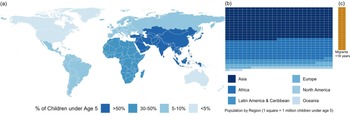
Figure 1. Global distribution of children under age 5 (a–b) and migrants under age 18 (c). Regions in (a) follow United Nations classifications. Darker shaded regions in (a) and (b) indicate a higher proportion of children. Each square in (b) and (c) represents one million children.
Target article
Related commentaries (25)
Adapting developmental science for a world of diverse families
 Jeremy I. Borjon
[Opens in a new window]Jeremy I. Borjon
, Valerie P. Bambha
[Opens in a new window]Valerie P. Bambha
, Dajie Zhang
[Opens in a new window]Dajie Zhang
, Luise Poustka
[Opens in a new window]Luise Poustka
, Christian P. Schaaf
[Opens in a new window]Christian P. Schaaf
and Peter B. Marschik
[Opens in a new window]Peter B. Marschik
An inclusive developmental science requires attention to neurodiversity
Culturally biased norms, discriminatory outcomes: Why developmental psychology must go WILD
Ethnographic methods can help psychology overcome its WEIRD problems
From weird-ness to wild-ness: Wordplay and worldviews in the social sciences
From “WILD” to “WILDER”: A proposed extension to the “WILD” framework
Global research requires global researchers: Opportunities and challenges for capacity-building
Rethinking “local” and “in situ” in WILD among migrant children
According to the 2024 United Nations World Population Prospects, there were an estimated 654 million children under the age of five worldwide (Figure 1). Roughly 50% of these children live in Asia (1 in every 2 young children), 33% in Africa (1 in every 3), 7% in Latin America and the Caribbean (1 in every 14), 5% in Europe (1 in every 19), 3% in North America (1 in every 32), and 0.5% in Oceania (1 in every 189). While migration between regions is difficult to estimate, recent findings leveraging social media suggest that at least 39.1 million people, including young children, crossed international borders in 2022 (Chi et al., Reference Chi, Abel, Johnston, Giraudy and Bailey2025). In 2020, UNICEF reported that about 36 million young people under 18 were living outside their country of birth, a population comparable in size to the number of children under the age of five in all of Europe, and equal to one in eight international migrants. In other words, those 654 million children represent 654 million individual developmental trajectories, each shaped by the cultural, ecological, and biological conditions that surround them.
Global distribution of children under age 5 (a–b) and migrants under age 18 (c). Regions in (a) follow United Nations classifications. Darker shaded regions in (a) and (b) indicate a higher proportion of children. Each square in (b) and (c) represents one million children.
Despite the sheer scale and diversity of children’s lives worldwide, developmental theories have been, and continue to be, built on observations from an alarmingly narrow slice of early development. If half of all young children live in Asia and a third in Africa, then developmental science has only covered a fraction of early child behavior as it is actually lived. To address this imbalance, Bard et al. urge the field to systematically broaden its empirical and theoretical reach by incorporating more cultures and local contexts into developmental research. While we are broadly aligned with their position, we argue that developmental science has yet to fully confront the theoretical consequences of such a shift.
Developmental scientists often presuppose caregiving environments that are stable, nuclear, and cooperative, assumptions rooted in Euro-American middle-class norms. In the pursuit of understanding infant behavior, such an assumption overlooks many other factors that impact development. Across cultures, children develop through fluid, heterogeneous, and often unpredictable caregiving ecologies that shape their behavior. Culture is not a monolith, and treating separate cultures as a proxy for diversity risks obscuring the profound variation that exists within them, within communities, families, and even individual developmental trajectories. Within any given society, families differ in caregiving practices, values, resources, and relationships. Caregiving may be shared, intermittent, institutionally mediated, transnational, or embedded within dynamic family constellations that shift with experience, migration, technology, or economic pressure. We argue that these diverse family structures are not edge cases; they are central to understanding how development unfolds in practice. The question is not how children thrive despite this variation, but how they adapt through it.
Efforts to increase the diversity of study populations often occur incidentally, whereby cultural or nationality labels are applied to the collected data without thoroughly characterizing the actual norms and circumstances of the individuals under study. Conclusions drawn from such data are then based on generalized assumptions about the culture as a whole that may not reflect the lived experience of the people from whom the data was collected. Moreover, developmental research produced outside the English-speaking world often remains untranslated, leaving it unincorporated into the English-dominant discourse of developmental science.
We propose that adaptation, not just diversity, is one of the conceptual centerpieces of developmental science. Infants and young children are biological and adaptive systems. Their capacity to creatively engage with, learn from, and adapt to the environments they inhabit is what catalyzes development in the first place (Ghazanfar & Gomez-Marin, Reference Ghazanfar and Gomez-Marin2024). A developmental science organized around adaptation would meet children where they are, across the globe, just as Bard et al. argue, and intentionally ground theories of development in the variable and fluid conditions where most children actually grow up. At present, we know remarkably little about the variability of infant behavior across the world: how often infants look, vocalize, move, are spoken to, or receive touch in daily life, among other behaviors. Without these reference points, we cannot distinguish what is universal to and necessary for early development from what is local, adaptive, or contingent. After all, even infants who are rarely spoken to adapt to the sparse linguistic input and are still able to understand many words, demonstrating that comprehension emerges from flexible, adaptive cognitive processes (Foushee & Srinivasan, Reference Foushee and Srinivasan2024).
Recalibrating developmental science around adaptation will also require structural change. To create a common ground from which innovations and discoveries can emerge, the field must continue pushing toward consensus grounded in open, accessible science and reciprocity. Consensus allows for transparent and shared tools, interoperable methods, and clearly defined yet falsifiable constructs, enabling research across contexts while remaining responsive to local meanings and practices. Such consensus is essential for identifying the commonality, variability, and diversity of infants’ and young children’s behavior. Initiatives such as the ManyBabies Consortium (Visser et al., Reference Visser, Bergmann, Byers-Heinlein, Dal Ben, Duch, Forbes and Zettersten2022) are steps in the right direction for creating consensus across research sites in the service of open and reproducible science. Yet large-scale replication efforts are not enough to address the limitations inherent to theories derived from a minority of the world’s children. Theories are produced by us, researchers whose perspectives and assumptions are themselves shaped and limited by our own cultural and individual histories. To understand adaptation, developmental science must build consensus not only in its methods and theories but also in recognizing and representing the full variability of human development as it occurs across the world.
Acknowledgments
This commentary benefited from discussions with the members of the Developing Systems Laboratory at the University of Houston, whose ongoing work continues to inform these ideas. The authors would like to thank Lydia J. Borjon for her careful reading and feedback. This commentary has been discussed within the framework of the Heidelberg University Flagship Initiative “Family Transitions.”
Financial support
Research reported in this publication was supported by the Eunice Kennedy Shriver National Institute of Child Health and Human Development of the National Institutes of Health under award number R00HD105920 (JIB, VPB). The content is solely the responsibility of the authors and does not necessarily represent the official views of the National Institutes of Health. This work was supported by the DFG (German Research Foundation; 456967546 [PBM, LP] and 454648639 – SFB 1528, C03 [PBM, DZ]; Volkswagen Foundation project IDENTIFIED [PBM]).
Competing interests
The authors declare none.