




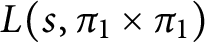
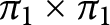
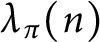
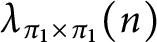

1 Introduction
It is an important problem in number theory to study the mean value of Dirichlet coefficients. For instance, in 1899, de la Vallée Poussin [Reference Iwaniec and Kowalski15] proved that
 $$ \begin{align*} \psi(x)=\sum _{n\leq x}\Lambda(n)=x+O(xe^{-c\sqrt{\log x} }). \end{align*} $$
Moreover, it is a central problem in the study of L-function to study the mean value of its Dirichlet coefficients. According to the conjectures of Langlands, the most general L-functions arise from automorphic representations of
 $\mathrm{GL}_{n}$
over a number field, and these can be decomposed into products of general L-functions, which are attached to cuspidal automorphic representations of
 $\mathrm{GL}_{m}$
over the field of rational numbers and we call primitive L-functions of degree m. Let
 $m \geq 2$
be an integer and
 $\pi $
be an automorphic irreducible cuspidal representation of
 $\mathrm{GL}_{m}$
over
 $\mathbb {Q}$
with unitary central character. Throughout the paper, p denotes a prime number. Then
 $\pi $
is a restricted tensor product,
 $$ \begin{align*}\pi=\otimes_{p} \pi_{p}, \end{align*} $$
when p runs over all prime numbers and the archimedean places. To
 $\pi $
one associates an Euler product
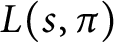
 $$ \begin{align} L(s, \pi)=\prod_{p} L(s, \pi_{p}) \end{align} $$
given by a product of local factors. Outside of a finite set of primes,
 $\pi _{p}$
is unramified. At every finite place p where
 $\pi _{p}$
is unramified we associate a semi-simple conjugacy class
 $$ \begin{align*}A_{\pi}(p)=\left(\begin{array}{llll} \alpha_{\pi, p}(1) & & \\ & \ddots & \\ & & \alpha_{\pi, p}(m) \end{array}\right) \end{align*} $$
and define the local L-function for the finite place p as
 $$ \begin{align*}L\left(s, \pi_{p}\right)=\operatorname{det}\left(I-p^{-s} A_{\pi}(p)\right)^{-1}=\prod_{j=1}^{m}\left(1-\alpha_{\pi, p}(j) p^{-s}\right)^{-1}, \end{align*} $$
where
 $\left \{\alpha _{\pi , j}(p)\right \}_{j=1}^{m}$
are local parameters associated with
 $\pi _{p}$
. The generalized Ramanujan conjecture states that for unramified places
 $$ \begin{align*}\left|\alpha_{\pi, j}(p)\right|=1. \end{align*} $$
The best known record is due to Kim and Sarnak [Reference Kim20]
 $(2 \leq m \leq 4)$
and Luo et al. [Reference Luo, Rudnick and Sarnak29]
 $(m \geq 5)$
:
 $$ \begin{align*}\left|\alpha_{\pi, j}(p)\right| \leq p^{\theta_{m}} \end{align*} $$
for all primes p and
 $1 \leq j \leq m,$
where
 $$ \begin{align} \theta_{2}=\frac{7}{64}, \quad \theta_{3}=\frac{5}{14}, \quad \theta_{4}=\frac{9}{22}, \quad \theta_{m}=\frac{1}{2}-\frac{1}{m^{2}+1}(m \geq 5). \end{align} $$
By (1.1), the product over primes gives a Dirichlet series representation,
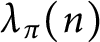
 $$ \begin{align*}L(s, \pi)=\sum_{n=1}^{\infty} \frac{\lambda_{\pi}(n)}{n^{s}}, \end{align*} $$
which converges absolutely for
 $\Re s>1$
.
In the case of
 $m = 2, \lambda _{\pi }(n)$
is the nth normalized Fourier coefficient of a holomorphic cusp form. In 1927, Hecke [Reference Hecke12] proved that
 $$ \begin{align*}\sum_{n \leq x} \lambda_{\pi}(n) \ll x^{\frac{1}{2}}. \end{align*} $$
Many scholars have made further improvements to this result, such as Kloosterman [Reference Kloosterman23], Davenport [Reference Davenport6], Weil [Reference Weil36], and Deligne [Reference Deligne7]. As for
 $m\geq 2, \lambda _{\pi }(n)$
is the nth normalized Fourier coefficient of a holomorphic or Maass cusp form form. Lü [Reference Lü26] has proved that for any
 $\varepsilon>0,$
 $$ \begin{align*}\sum_{n \leq x} \lambda_{\pi}(n) \ll _{\varepsilon, \pi}\left\{\begin{array}{@{\kern-7pt}ll}&x^{\frac{71}{192}+\varepsilon} \quad \quad \text { if } \quad m=2 \\[3pt] & x^{\frac{m^{2}-m}{m^{2}+1}+\varepsilon}\quad \text { if } \quad m \geq 3. \end{array}\right. \end{align*} $$
In this paper, we shall consider the cancellation of the nth coefficient
 $\lambda _{\pi }(n)$
over a Beatty sequence, i.e.,
 $$ \begin{align*}S(\alpha, \beta, X)=\sum_{n \leqslant X} \lambda_{\pi}\left([\alpha n+\beta]\right), \end{align*} $$
where
 $\alpha \geq 1, \beta \geq 0$
,
 $[x]$
denotes the greatest integer not exceeding x. The so-called Beatty sequence is the sequence of integers defined by
 $\mathcal {B}_{\alpha , \beta }=\{[\alpha n+\beta ]\}_{n=1}^{\infty }$
. Under some additional hypotheses, Gülo
 $\check{\mathrm{g}}$
lu and Nevans [Reference Güloǧlu and Nevans10] have obtained a general result. Lao [Reference Lao25] and Sun [Reference Sun33] studied the cancellation behavior of Fourier coefficients of cusp forms over Beatty sequences. Let
 $e(z)=e^{2\pi iz}$
. For any
 $\varepsilon>0,$
any
 $\vartheta \in \mathbb {R} $
and
 $\theta <1,$
Sun [Reference Sun33] has proved
 $$ \begin{align*}S(\alpha, \beta, X)=\sum_{n \leqslant X} A\left(n_{1}, \ldots, n_{m-2},[\alpha n+\beta]\right) \ll_{f, \alpha, \varepsilon, n_{1}, \ldots, n_{m-2}} X^{\theta+\varepsilon}, \end{align*} $$
provided that
 $$ \begin{align*}\sum_{n_{m-1} \leqslant X} A\left(n_{1}, \ldots, n_{m-1}\right) e\left(n_{m-1} \vartheta\right) \ll_{f, \varepsilon} X^{\theta+\varepsilon}, \end{align*} $$
where
 $\alpha $
is of type 1 and
 $A\left (n_{1}, n_{2}, \ldots , n_{m-1}\right )$
are the normalized Fourier coefficients of a Maass cusp form on
 $\mathrm{GL}_{m}.$
Type
 $\tau $
is explained later in the next section. The aim of this paper is to study the mean value of Dirichlet coefficients over Beatty sequences of the L-function without assumptions. Firstly, we consider the sum,
 $$ \begin{align*}S_{\lambda_{\pi}}(x)=\sum_{n \leq x} \lambda_{\pi}(n) e\left(n \alpha\right). \end{align*} $$
By the Rankin–Selberg theory, there is the trivial bound
 $$ \begin{align*}S_{\lambda_{\pi}}(x) \ll_{\pi} x. \end{align*} $$
We expect that nontrivial and uniform cancellation exists in the sum
 $S_{\lambda _{\pi }}(x)$
. In the case of
 $m=2,$
when
 $\lambda _{\pi }(n)$
are either the normalized Fourier coefficients of a modular form, or a Maass form on the upper half plane, one has the classical estimate on linear polynomials (see, for example, [Reference Iwaniec14, Theorem 8.1])
 $$ \begin{align*}\sum_{n \leq x} \lambda_{\pi}(n) e(n \alpha) \ll_{\pi, \varepsilon} x^{\frac{1}{2}+\varepsilon} \end{align*} $$
for any
 $\alpha \in \mathbb {R}$
. For the
 $m=3$
case,
 $\lambda _{\pi }(n)$
being coefficients of the L-function of automorphic cusp form
 $\pi $
on
 $\mathrm{GL}_{m}$
over
 $\mathbb {Q},$
Miller [Reference Miller30] proved the first result and showed that
 $$ \begin{align*}\sum_{n \leq x} \lambda_{\pi}(n) e(n \alpha) \ll_{\pi, \varepsilon} x^{\frac{3}{4}+\varepsilon}. \end{align*} $$
For
 $m \geq 3$
, Jiang and Lü [Reference Jiang and Lü18] used a technical hypothesis concerning the coefficients of
 $L(s, \pi )$
, which is the well known Hypothesis H of Rudnick and Sarnak [Reference Rudnick and Sarnak32], to give that
 $$ \begin{align*}S_{\lambda_{\pi}}(x)=\sum_{n \leq x} \lambda_{\pi}(n) e\left(n \alpha\right) \ll_{\pi} x \frac{\log \log x}{\log x}. \end{align*} $$
This is a nontrivial, uniform estimate for
 $S_{\lambda _{\pi }}(x).$
Hypothesis H For any fixed
 $k\geq 2$
,
 $$ \begin{align*}\sum_{p}\frac{|\lambda_{\pi}(p^{k})|^{2}(\log p)^{2}}{p^{k}}<\infty. \end{align*} $$
Applying the result of Jiang and Lü [Reference Jiang and Lü18], we can have a result without assumptions. So by the methods in [Reference Banks and Shparlinski2, Reference Kurpers and Niederreiter24, Reference Sun33], we can get
Theorem 1.1 Let
 $\alpha>1$
be of finite type
 $\tau $
,
 $\tau \geq 1$
, and
 $\pi $
be an automorphic irreducible cuspidal representation of
 $\mathrm{GL}_{m}$
over
 $\mathbb {Q}$
with unitary central character. Under Hypothesis H, we have
 $$ \begin{align*}S(\alpha, \beta, X)=\sum_{n \leqslant X} \lambda_{\pi}\left([\alpha n+\beta]\right) \ll_{\pi, \alpha} X\frac{(\log \log X)^2}{\log X} \end{align*} $$
uniformly in
 $\beta \geq 0$
.
Remark 1.2 In the cases of
 $m = 2,3$
, Hypothesis H follows from the Rankin–Selberg theory [Reference Rudnick and Sarnak32]. The
 $\mathrm{GL}_{4}$
case and the symmetric fourth power
 $sym^{4}\pi $
of a cuspidal representation
 $\pi $
of
 $\mathrm{GL}_{2}$
were proved by Kim [Reference Kim21].
By Theorem 1.1 and Remark 1.1, we have
Corollary 1.3 Let
 $\alpha>1$
and
 $2\leq m\leq 4$
or
 $\pi = sym^{4}\pi _{1}$
with an automorphic irreducible cuspidal representation
 $\pi _{1}$
of
 $\mathrm{GL}_{2}$
. We have
 $$ \begin{align*}S(\alpha, \beta, X)=\sum_{n \leqslant X} \lambda_{\pi}\left([\alpha n+\beta]\right) \ll_{\pi, \alpha} X\frac{(\log \log X)^2}{\log X} \end{align*} $$
uniformly in
 $\beta \geq 0$
.
Similarly, we are also interested in the cancellation of Rankin–Selberg coefficients over Beatty sequences. The Rankin–Selberg L-function
 $L(s, \pi \times \hat {\pi })$
associated to
 $\pi $
and its contragredient
 $\hat {\pi }$
is defined as a product of local factors
 $$ \begin{align*}L(s, \pi \times \hat{\pi})=\prod_{p<\infty} L\left(s, \pi_{p} \times \hat{\pi}_{p}\right). \end{align*} $$
By a result of Jacquet and Shalika [Reference Jacquet and Shalika16], the product
 $\textstyle \prod _{p} L\left (s, \pi _{p} \times \hat {\pi }_{p}\right )$
converges absolutely in
 $\Re s>1$
. We write this product as a Dirichlet series
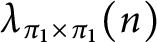
 $$ \begin{align*}L(s, \pi \times \hat{\pi})=\prod_{p} \sum_{k=0}^{\infty} \frac{\lambda_{\pi \times \hat{\pi}}\left(p^{k}\right)}{p^{k s}}=\sum_{n=1}^{\infty} \frac{\lambda_{\pi \times \hat{\pi}}(n)}{n^{s}}. \end{align*} $$
In order to obtain the mean value of Rankin–Selberg coefficients over Beatty sequences, we need
Theorem 1.4 Let
 $\pi $
be a unitary automorphic cuspidal representation of
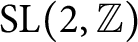
 $\mathrm{SL}(2,\mathbb {Z})$
and
 $\pi \simeq \hat {\pi }$
where
 $\hat {\pi }$
is the representation contragredient to
 $\pi .$
Suppose that
 $|\alpha -a / q| \leq 1 / q^{2}$
,
 $(a, q)=1 $
and
 $2 \leq \log ^{3}x \leq q \leq x^{(1-\delta )} /(\log ^{3}x)$
with some
 $0<\delta <1/10$
. Then we deduce
 $$ \begin{align*}S_{\lambda_{\pi \times \pi}}(x)=\sum_{n \leq x} \lambda_{\pi \times \pi}(n) e\left(n \alpha\right) \ll_{\pi} x\frac{ \log\log x}{(\log x)^{\frac{1}{2}}}. \end{align*} $$
Remark 1.5 We know when
 $m = 2,$
 $\lambda _{\pi }(n)$
essentially is the nth normalized Fourier coefficient of a holomorphic or Maass cusp form. When
 $\pi $
is an
 $\mathrm{SL}(2,\mathbb {Z})$
holomorphic cusp form, under the conditions of Theorem 1.4, Lü [Reference Lü28] has proved
 $$ \begin{align*}\sum_{n \leq x} \lambda_{\pi \times \pi}(n) e\left(n \alpha\right) \ll_{\pi,\varepsilon} x^{\frac{4}{5}+\varepsilon}, \end{align*} $$
for every
 $\varepsilon>0$
. However, as
 $\pi $
is a holomorphic cusp form or even a Maass cusp form, we obtain a uniform result in Theorem 1.4.
It follows from
 $\pi \simeq \hat {\pi }$
that
 $\lambda _{\pi \times \pi }>0$
. Hence, due to Landau’s lemma (see [Reference Barthel and Ramakrishnan3]), we have
 $$ \begin{align*}\sum_{n \leq X} \lambda_{\pi \times \pi}(n)=c_{\pi} X+O_{\pi}\left(X^{\frac{3}{5}}\right), \end{align*} $$
where
 $c_{\pi }$
is a positive constant. Further, we can prove an asymptotic formula,
Theorem 1.6 Let
 $\alpha>1, \beta \geq 0 $
and suppose that
 $\alpha $
is irrational and of finite type
 $\tau $
. Let
 $\pi $
be a unitary and irreducible automorphic cuspidal representation of
 $\mathrm{SL}(2,\mathbb {Z})$
and
 $\pi \simeq \hat {\pi }$
where
 $\hat {\pi }$
is the representation contragredient to
 $\pi .$
Then we have
 $$ \begin{align*}S(\alpha, \beta, X)=\sum_{n \leqslant X} \lambda_{\pi\times\pi}\left([\alpha n+\beta]\right) =c_{\alpha,\pi}X+O_{\pi,\alpha}\bigg(X \frac{(\log \log X)^2}{(\log X)^{\frac{1}{2}}}\bigg), \end{align*} $$
where
 $c_{\alpha ,\pi }$
is a positive constant.
Let
 $$ \begin{align*}M(f, x)=1+\max _{1 \leq m \leq x}|f(m)| \end{align*} $$
 $$ \begin{align*}S_{\alpha}(f, x)=\sum_{1 \leq m \leq x \atop m \in \mathcal{B}(\alpha)} f(m), \quad S(f, x)=\sum_{1 \leq m \leq x} f(m), \end{align*} $$
where
 $f:\mathbb {N} \rightarrow \mathbb {C}$
is an arbitrary arithmetic function. For any
 $\varepsilon>0, \alpha >1$
in a set depending on
 $\varepsilon $
and
 $f,$
of full Lebesgue measure, Abercrombie et al. [Reference Abercrombie, Banks and Shparlinski1] have proved
 $$ \begin{align*}S_{\alpha}(f, x)=\alpha^{-1} S(f, x)+O_{f, \alpha, \varepsilon}\left(x^{2 / 3+\varepsilon} M(f, x)\right). \end{align*} $$
Assume that f does not grow too quickly in the sense that
 $$ \begin{align*}\limsup _{r \rightarrow \infty} \frac{\left\|\left.f\right|{{}}_{2^{r+1}}\right\|_{2}}{\left\|\left.f\right|{{}}_{2^{r}}\right\|_{2}}<\infty, \end{align*} $$
where
 $$ \begin{align*}\left\|\left.f\right|{{}}_{x}\right\|_{2}^{2}=\sum_{1 \leq m \leq x}|f(m)|^{2}. \end{align*} $$
For all
 $\alpha>1$
in a set of full Lebesgue measure (depending on
 $f),$
Technau and Zafeiropoulos [Reference Technau and Zafeiropoulos34] have proved
 $$ \begin{align*}S_{\alpha}(f, x)=\alpha^{-1} S(f, x)+O_{f, \alpha, \varepsilon}\left(x^{1 / 2+\varepsilon} M(f, x)\right) \end{align*} $$
uniformly for
 $x \geq 8$
. By (1.2), in the case that f is an automorphic irreducible cuspidal representation of
 $\mathrm{GL}_{2}$
over
 $\mathbb {Q}$
, the result of Abercrombie et al. improves error terms Theorem 1.1 and Corollary 1.2. Moreover, by (1.2), the result of Technau and Zafeiropoulos can improve error terms in Theorem 1.1, Corollary 1.3 and Theorem 1.6. However, the results of [1] and [34] yield no further information on the set of admissible
 $\alpha>1$
other than having full Lebesgue measure and are, therefore, rather less explicit than our results which apply for all
 $\alpha $
of finite type (see Section 2).
2 Preliminaries
Following Kuipers and Niederreiter [Reference Kurpers and Niederreiter24], we give the definition of an irrational number of type
 $\tau $
.
Definition 2.1 Let
 $\tau $
be a positive real number or infinity. The irrational number
 $\alpha $
is said to be of type
 $\tau $
if
 $\tau $
is the supremum of all t for which
 $$ \begin{align*}\tau=\sup \left\{t \in \mathbb{R}: \liminf _{n \rightarrow \infty} n^{t} \| \alpha n \|=0\right\}, \end{align*} $$
where q runs through the positive integers. Here
 $\| \cdot \|$
denotes the distance to a nearest integer.
Note that the result of Khintchine [Reference Khintchine19] asserts that almost all real numbers are of finite type 1. By the Jarník–Besicovitch theorem [Reference Besicovitch4, Reference Jarnŕk17], we know that the Hausdorff dimension of all real numbers of type
 $>\tau $
is
 $$ \begin{align*}\operatorname{dim}_{\mathrm{H}}\{x \in \mathbb{R} \text { of type }>\tau\}=\frac{2}{\tau+1}. \end{align*} $$
Roth [Reference Roth31] has shown that all real algebraic irrational numbers are of type 1.
We recall that the discrepancy
 $D(M)$
of a sequence of (not necessarily distinct) real numbers
 $a_1,\ldots ,a_M\in [0,1)$
is defined by
 $$ \begin{align} D(M)=\sup_{\mathcal I\subseteq[0,1)}\bigg|\frac{V(\mathcal I,M)}{M}-|\mathcal I|\,\bigg|, \end{align} $$
where the supremum is taken over all subintervals
 $\mathcal I=(c,d)$
of the interval
 $[0, 1)$
,
 $V(\mathcal I,M)$
is the number of positive integers
 $m\le M$
such that
 $a_m\in \mathcal I$
, and
 $|\mathcal I|=d-c$
is the length of
 $\mathcal I$
.
The following result is taken from [Reference Kurpers and Niederreiter24].
Lemma 2.2 Let
 $\alpha $
be a fixed irrational number of type
 $\tau $
. For all
 $\beta \in {{\mathbb {R}}}$
, we have
 $$ \begin{align*} D_{\alpha,\beta}(M)\ll_{\alpha} M^{-1/\tau+o(1)} \quad (M\rightarrow\infty), \end{align*} $$
where the function implied by
 $o(1)$
depends only on
 $\alpha $
.
Also, it is important to have the following result (see [Reference Banks and Shparlinski2, Lemma 3.4]).
Lemma 2.3 Let
 $\alpha> 1$
. An integer m has the form
 $m= {\alpha n + \beta }$
for some integer n if and only if
 $$ \begin{align*} 0<\{\alpha^{-1}(m-\beta+1)\}\leq\alpha^{-1}. \end{align*} $$
The value of n is determined uniquely by m.
Let
 $\psi (x)$
be a periodic function of period 1 for which
 $$ \begin{align*}\psi(x)=\left\{\begin{array}{ll} 1 & \text { if } 0<x \leqslant \gamma \\ 0 & \text { if } \gamma<x \leqslant 1. \end{array}\right. \end{align*} $$
Then by a classical result of Vinogradov (see [Reference Vinogradov35, Chapter 2 and Lemma 2]), for any
 $\triangle \in \mathbb {R}$
such that
 $0<\triangle <1/8$
and
 $\triangle \leqslant 1/2 \min \{\gamma , 1-\gamma \},$
there exists a real-valued function
 $\psi _{\triangle }(x)$
of satisfying the following properties:
-
(1)
 $\psi _{\triangle }(x)$
is periodic with period one;
-
(2)
$0 \leqslant \psi _{\triangle }(x) \leqslant 1$
for all
$x \in \mathbb {R}$
; -
(3)
$\psi _{\triangle }(x)=\psi (x)$
if
$\triangle \leqslant x \leqslant \gamma -\triangle $
or
$\gamma +\triangle \leqslant x \leqslant 1-\triangle $
; and -
(4)
$\psi _{\triangle }(x)$
can be represented as a Fourier series (2.2)where the coefficients
$$ \begin{align} \psi_{\triangle}(x)=\gamma+\sum_{j=1}^{\infty}(g_{j} e(j x)+h_{j} e(-j x)), \end{align} $$
$g_{j}$
and
$h_{j}$
satisfy the uniform bound (2.3)
$$ \begin{align} \max \big\{\big|g_{j}\big|,\big|h_{j}\big|\big\} \ll \min \big\{j^{-1}, j^{-2} \triangle^{-1}\big\}, \quad(j \geqslant 1). \end{align} $$


Finally, we need the following result (see Jiang and Lü [Reference Jiang and Lü18]).
Lemma 2.4 Under Hypothesis H,
 $\pi $
is an automorphic irreducible cuspidal representation of
 $\mathrm{GL}_{m}$
over
 $\mathbb {Q}$
. For any real number
 $\alpha ,$
we have
 $$ \begin{align*}S_{\lambda_{\pi}, k}(x)=\sum_{n \leq x} \lambda_{\pi}(n) e\left(n^{k} \alpha\right) \ll_{\pi,k} x \frac{\log \log x}{\log x}, \end{align*} $$
where
 $k \geq 1.$
3 Proof of Theorem 1.1
Let
 $\alpha>1$
be of type
 $\tau $
and
 $\gamma =\alpha ^{-1} .$
Put
 $\delta =\alpha ^{-1}(1-\beta )$
,
 $x_{0}=[\alpha +\beta -1]$
and
 $x=[\alpha X+\beta ] .$
Then by Lemma 2.3 and the definition of
 $\psi (x)$
, we have
 $$ \begin{align*}S(\alpha, \beta, X)=\sum_{n \leqslant X} \lambda_{\pi}([\alpha n+\beta])=\sum_{x_{0} \leqslant n \leqslant x \atop 0<\{\gamma n+\delta\} \leqslant \gamma} \lambda_{\pi}(n)=\sum_{x_{0} \leqslant n \leqslant x} \lambda_{\pi}(n) \psi(\gamma n+\delta). \end{align*} $$
Applying the properties of
 $\psi _{\triangle }(x)$
, we obtain
 $$ \begin{align} S(\alpha, \beta, X)=\sum_{x_{0} \leqslant n \leqslant x} \lambda_{\pi}(n) \psi_{\triangle}(\gamma n+\delta)+O\bigg(\sum_{x_{0} \leqslant n \leqslant x \atop\{\gamma n+\delta\} \in \mathcal{I}}|\lambda_{\pi}(n)|\bigg), \end{align} $$
where
 $\mathcal {I}=[0, \triangle ) \cup (\gamma -\triangle , \gamma +\triangle ) \cup (1-\triangle , 1)$
with
 $|\mathcal {I}| \ll \triangle .$
Let
 $\mathcal {V}\left (\mathcal {I}, x_{0}, x\right )=\#\left \{x_{0} \leqslant n \leqslant x \mid \{\gamma n+\delta \} \in \mathcal {I}\right \} .$
Since the length of each interval above is at most
 $2\triangle ,$
by (2.1) and Lemma 2.2, we have
 $$ \begin{align*}\mathcal{V}\left(\mathcal{I}, x_{0}, x\right) \ll_{\alpha} X^{1-1/(2\tau)}+\triangle X . \end{align*} $$
By virtue of the Rankin–Selberg theory, it is easy to see that
 $$ \begin{align*}\sum_{n \leq x}\left|\lambda_{\pi}(n)\right|{{}}^{2} \leq \sum_{n \leq x} \lambda_{\pi \times \hat{\pi}}(n) \sim c_{\pi} x, \end{align*} $$
where
 $\lambda _{\pi \times \hat {\pi }}(n)$
is the Dirichlet series coefficient of the Rankin–Selberg L-function
 $L(s, \pi \times \hat {\pi })$
associated to
 $\pi $
and its contragredient
 $\hat {\pi }.$
Thus, by Cauchy’s inequality, we see that the O-term in (3.1) is bounded by
 $$ \begin{align*}\ll\bigg(\sum_{x_{0} \leqslant n \leqslant x}|\lambda_{\pi}(n)|^{2}\bigg)^{1 / 2}\bigg(\sum_{x_{0} \leqslant n \leqslant x \atop\{\gamma n+\delta\} \in \mathcal{I}} 1\bigg)^{1 / 2} \ll_{\pi, \alpha} X^{1 / 2}(X^{1-1/(2\tau)}+\triangle X)^{1 / 2}. \end{align*} $$
Therefore, by (2.2), we deduce that
 $$ \begin{align*}\begin{aligned} S(\alpha, \beta, X) &=\sum_{x_{0} \leqslant n \leqslant x} \lambda_{\pi}(n) \psi_{\triangle}(\gamma n+\delta)+O_{\pi, \alpha}\left(X^{1 / 2}( X^{1-1/(2\tau)}+\triangle X)^{1 / 2}\right) \\ &=\gamma \sum_{x_{0} \leqslant n \leqslant x} \lambda_{\pi}(n)+\sum_{j=1}^{\infty} g_{j} e(\delta j) \sum_{x_{0} \leqslant n \leqslant x} \lambda_{\pi}(n) e(\gamma j n) \\ &\quad +\sum_{j=1}^{\infty} h_{j} e(-\delta j) \sum_{x_{0} \leqslant n \leqslant x} \lambda_{\pi}(n) e(-\gamma j n) +O_{\pi, \alpha}\left(X^{1 / 2}( X^{1-1/(2\tau)}+\triangle X)^{1 / 2}\right) \\ & \ll_{\pi, \alpha} x\frac{\log \log x}{\log x}+x\frac{\log \log x}{\log x}\bigg\{\sum_{j \leqslant \triangle^{-1}} j^{-1}+\sum_{j>\triangle^{-1}} \triangle^{-1} j^{-2}\bigg\} \\ & \quad +X^{1 / 2}( X^{1-1/(2\tau)}+\triangle X)^{1 / 2} \\ & \ll_{\pi, \alpha} x\frac{\log \log x}{\log x}+x\frac{\log \log x}{\log x} \log \triangle^{-1}+X^{1 / 2}( X^{1-1/(2\tau)}+\triangle X)^{1 / 2}. \end{aligned} \end{align*} $$
On taking
 $\triangle =(\log x)^{-2},$
we conclude that
 $$ \begin{align*}S(\alpha, \beta, X)=\sum_{n \leqslant X} \lambda_{\pi}\left([\alpha n+\beta]\right) \ll_{\pi, \alpha} X\frac{(\log \log X)^2}{\log X}. \end{align*} $$
This finishes the proof of Theorem 1.1.
4 Four Lemmas for Theorem 1.4
Theorem 1.4 depends on the following lemmas.
Firstly, we recall some background from Bump [Reference Bump5] and Iwaniec [Reference Iwaniec13]. The symmetric square L-function associated to
 $\pi $
is
 $$ \begin{align*}L(s,sym^{2}\pi)=\sum_{n=1}^{\infty} \frac{\lambda_{sym^{2}\pi}(n)}{n^{s}}. \end{align*} $$
When
 $\pi $
is an automorphic cuspidal representation of
 $\mathrm{SL}(2,\mathbb {Z})$
and
 $ \Re s>1,$
it is well known that
 $$ \begin{align*}L(s,\pi\times \pi)=\zeta(s)L(s,sym^{2}\pi). \end{align*} $$
Then we have
 $$ \begin{align*}\lambda_{\pi \times \pi}(n)=\sum_{d|n} \lambda_{sym^{2}\pi}(d). \end{align*} $$
Although we lack the automorphy of
 $\pi \times \pi ,$
it is known from the work of Kim and Shahidi [Reference Kim and Shahidi22] that
 $sym^{2}\pi $
is an automorphic irreducible cuspidal representation.
Lemma 4.1 For any
 $\varepsilon>0,$
let
 $\pi $
be a unitary automorphic cuspidal representation of
 $\mathrm{SL}(2,\mathbb {Z})$
. Then we have
 $$ \begin{align*}\sum_{n \leq x} \lambda_{\pi \times \pi}(n)^{2} \ll_{\pi} x \log x. \end{align*} $$
Proof. Let
 $$ \begin{align*}L(s)=\sum\limits_{n \leq x} \frac{\lambda_{\pi \times \pi}(n)^{2}}{n^{s}}. \end{align*} $$
By the same method as in [Reference Lü27, Lemma 2.2], we have
 $$ \begin{align} L(s)=\zeta(s)^{2} L(s, sym^{2} \pi)^{3} L(s, sym^{4} \pi) H(s), \end{align} $$
where the function
 $H(s)$
is a Dirichlet series absolutely convergent in
 $ \Re s>1/2$
and
 $H(s)\neq 0$
for
 $\Re s= 1.$
Suppose that for
 $\Re s>1,$
 $$ \begin{align} \zeta(s)^{2} L(s, sym^{2} \pi)^{3} L(s, sym^{4} \pi)=\sum\limits_{n =1}^{\infty}b(n)n^{-s}. \end{align} $$
Then by Landau’s lemma (see [Reference Barthel and Ramakrishnan3]), we have
 $$ \begin{align} \sum\limits_{n \leq x}b(n)=xP(\log x)+O_{\pi,\varepsilon}(x^{\frac{15}{16}+\varepsilon}), \end{align} $$
where
 $P(t)$
is a polynomial depending on
 $\pi $
of degree 1.
By (4.1), we have
 $$ \begin{align*}\lambda_{\pi \times \pi}(n)^{2}=\sum\limits_{n=uv}b(u)c(v) \end{align*} $$
and
 $$ \begin{align} \sum_{v \geq 1}|c(v)| v^{-\sigma} \ll_{\sigma} 1 \quad\bigg( \sigma>\frac{1}{2}\bigg). \end{align} $$
Hence, by (4.2)-(4.4) and partial summation, we obtain
 $$ \begin{align*}\sum_{n \leq x} \lambda_{\pi \times \pi}(n)^{2} =\sum_{n \leq x}\sum_{n=uv}b(u)c(v)=\sum_{u\leq x}b(u)\sum_{v=1}^{[\frac{x}{u}]}c(v)\ll_{\pi} x \log x.\\[-32pt] \end{align*} $$
▪
The second lemma is given by Hall and Tenenbaum [Reference Hall and Tenenbaum11, Theorem 1]. We can get an upper bound for a class of general multiplicative functions.
Lemma 4.2 Let f be a multiplicative function such that
 $f(n) \geq 0$
for all n. Assume that there exist positive constants A and B such that for
 $x>1$
both inequalities
 $$ \begin{align*}\sum_{p \leq x} f(p) \log p \leq A x \quad \text { and } \quad \sum_{p} \sum_{k \geq 2} \frac{f\left(p^{k}\right) \log p^{k}}{p^{k}} \leq B \end{align*} $$
hold. Then
 $$ \begin{align*}\sum_{n \leq x} f(n) \leq(A+B+1) \frac{x}{\log x} \sum_{n \leq x} \frac{f(n)}{n}. \end{align*} $$
The next result is due to Rudnick and Sarnak [Reference Rudnick and Sarnak32]. It can be viewed as Mertens’ theorem or the Selberg orthogonality conjecture for automorphic L-functions.
Lemma 4.3 Under Hypothesis H, we have,
 $$ \begin{align*}\sum_{p \leq x} \frac{\left|\lambda_{\pi}(p)\right|{{}}^{2}}{p}=\log \log x+O(1). \end{align*} $$
Let
 $\mathcal {P}$
be defined as
 $$ \begin{align*}\mathcal{P}=\{\text{primes}\quad p: z<p \leq w\}, \end{align*} $$
where z and w are integers that are to be chosen later in Section 5. We denote by P the product of primes which belong to the set
 $\mathcal {P},$
that is
 $P=\textstyle \prod _{p \in \mathcal {P}} p.$
Lemma 4.4 Let
 $z<w<x$
. Then we have,
 $$ \begin{align*}\sum_{n \leq x \atop(n, P)=1}|\lambda_{\pi \times \pi}(n)|^{2} \ll x \prod_{p \mid P}\left(1-\frac{1}{p}\right), \end{align*} $$
where the implied constant depends on
 $\pi $
.
Proof. We shall apply Lemma 4.2 with the arithmetic function
 $$ \begin{align*}f(n)=\left\{\begin{array}{ll} |\lambda_{\pi \times \pi}(n)|^2 & \text { if }(n, P)=1 \\ \quad \\ 0 & \text { if }(n, P)>1. \end{array}\right. \end{align*} $$
Clearly,
 $f(n)$
is multiplicative and non-negative. Next we verify the conditions in Lemma 4.2. By Cauchy’s inequality and Lemma 4.3, we have
 $$ \begin{align*}\begin{aligned} \sum_{p \leq x}\frac{|\lambda_{sym^{2}\pi}(p)|}{p} & = \sum_{p \leq x}\bigg(\frac{|\lambda_{sym^{2}\pi}(p)|}{\sqrt{p}}\bigg)\bigg(\frac{1}{\sqrt{p}}\bigg) \\ & = \bigg(\sum_{p \leq x}\bigg(\frac{|\lambda_{sym^{2}\pi}(p)|}{\sqrt{p}}\bigg)^{2}\bigg)^{\frac{1}{2}}\bigg(\sum_{p \leq x}\bigg(\frac{1}{\sqrt{p}}\bigg)^{2}\bigg)^{\frac{1}{2}} \\ & =\log\log x+O(1), \end{aligned} \end{align*} $$
and we can get a result similar to Lemma 4.3,
 $$ \begin{align} \begin{aligned} \sum_{p \leq x}\frac{|\lambda_{\pi \times \pi}(p)|^{2}}{p} & = \sum_{p \leq x}\frac{\bigg|\displaystyle\sum_{d|p} \lambda_{sym^{2}\pi}(d)\bigg|^{2}}{p} \\ & = \sum_{p \leq x}\frac{|1+\lambda_{sym^{2}\pi}(p)|^{2}}{p}\\ & \ll \log \log x. \end{aligned} \end{align} $$
We obtain by using summation by parts,
 $$ \begin{align*}\sum_{p \leq x}\left|\lambda_{\pi \times \pi}(p)\right|{{}}^{2} \log p \ll x. \end{align*} $$
By the work of Gelbart and Jacquet [Reference Gelbart and Jacquet9], we know that the
 $sym^{2}\pi $
is an automorphic cuspidal representation of
 $\mathrm{GL}_{3}$
over
 $\mathbb {Q}$
. So by Remark 1.1, Hypothesis
 $\mathrm{H}$
implies that
 $$ \begin{align*}\sum_{p} \sum_{k \geq 2} \frac{\left|\lambda_{sym^{2}\pi}\left(p^{k}\right)\right|{{}}^{2} \log p}{p^{k}} \ll 1. \end{align*} $$
Furthermore, we can get
 $$ \begin{align} \begin{aligned} \sum_{p} \sum_{k \geq 2} \frac{|\lambda_{\pi \times \pi}(p^{k})|^{2} \log p}{p^{k}} & = \sum_{p} \sum_{k \geq 2} \frac{\bigg|\displaystyle\sum_{d|p^{k}}\lambda_{sym^{2}\pi}(d)\bigg|^{2} \log p}{p^{k}} \ll 1. \end{aligned} \end{align} $$
Hence, by Lemma 4.2, we get
 $$ \begin{align} \begin{aligned} \sum_{n \leq x \atop(n, P)=1} |\lambda_{\pi \times \pi}(n)|^{2} \ll \frac{x}{\log x} \sum_{n \leq x \atop(n, P)=1} \frac {|\lambda_{\pi \times \pi}(n)|^{2}}{n}. \end{aligned} \end{align} $$
Using the multiplicative property of
 $|\lambda _{\pi \times \pi }(n)|^{2}$
and the estimate (4.6), the logarithmic average of
 $|\lambda _{\pi \times \pi }(n)|^{2}$
can be estimated as follows:
 $$ \begin{align} \begin{aligned} \sum_{n \leq x \atop(n, P)=1} \frac{|\lambda_{\pi \times \pi}(n)|^{2}}{n} & \ll \prod_{p \leq x \atop p \nmid P}\bigg(1+\frac{|\lambda_{\pi \times \pi}(p)|^{2}}{p}+\sum_{k \geq 2} \frac{|\lambda_{\pi \times \pi}(p^{k})|^{2} \log p^{k}}{p^{k}}\bigg) \\ & \ll \exp \bigg(\sum_{p \leq x \atop p \nmid P}\bigg(\frac{|\lambda_{\pi \times \pi}(p)|^{2}}{p}+\sum_{k \geq 2} \frac{|\lambda_{\pi \times \pi}(p^{k})|^{2} \log p^{k}}{p^{k}}\bigg)\bigg) \\ & \ll \exp \bigg(\sum_{p \leq x \atop p \nmid P}\frac{|\lambda_{\pi \times \pi}(p)|^{2}}{p}+O(1)\bigg) \\ & \ll \exp \bigg(\sum_{p \leq x \atop p \nmid P} \frac{|\lambda_{\pi \times \pi}(p)|^{2}}{p}\bigg). \end{aligned} \end{align} $$
By (4.5), we derive
 $$ \begin{align} \begin{aligned} \sum_{p \leq x \atop p \nmid P} \frac{|\lambda_{\pi \times \pi}(p)|^{2}}{p} & =\sum_{p \leq x} \frac{|\lambda_{\pi \times \pi}(p)|^{2}}{p}-\sum_{p \leq w} \frac{|\lambda_{\pi \times \pi}(p)|^{2}}{p}+\sum_{p \leq z} \frac{|\lambda_{\pi \times \pi}(p)|^{2}}{p} \\ & =\log \log x-\log \log w+\log \log z+O(1). \end{aligned} \end{align} $$
By inserting (4.9) into (4.8) and Mertens’ theorem, we have
 $$ \begin{align} \begin{aligned} \sum_{n \leq x \atop(n, P)=1} \frac{|\lambda_{\pi \times \pi}(n)|^{2}}{n} \ll (\log x) \prod_{p \mid P}\bigg(1-\frac{1}{p}\bigg). \end{aligned} \end{align} $$
Finally, our lemma immediately follows from the above estimate together with (4.7). ▪
5 Proof of Theorem 1.4
Now it remains to prove Theorem 1.4. We mainly use the multiplicity of
 $\lambda _{\pi \times \pi }(n)$
and the method of sifting. In Section 5.1, we begin by splitting the range of integration
 $[1, x]$
into two disjoint sets
 $\mathcal {I}$
and
 $\mathcal {J}$
. Obviously, we have
 $$ \begin{align*}S_{\lambda_{\pi \times \pi}}(x)=S_{\mathcal{I}}(x)+S_{\mathcal{J}}(x). \end{align*} $$
Hence it remains to estimate for
 $S_{\mathcal {I}}(x)$
and
 $S_{\mathcal {J}}(x)$
. In Section 5.2, we can estimate for
 $S_{\mathcal {I}}(x)$
using the bound for exponential sums and the multiplicity of the involved functions. In Section 5.3, we need to apply Lemmas 4.1 and 4.4 to estimate the contribution of
 $S_{\mathcal {J}}(x)$
.
We always assume that x is sufficiently large.
5.1 Set up
We assume that
 $H=H(x)$
and
 $K=K(x)$
be two parameters satisfying
 $$ \begin{align} \log^{\delta}x < H < K < x^{\delta} \end{align} $$
with some
 $0 < \delta < 1/10.$
Moreover, we assume that z and w are integers satisfying
 $$ \begin{align*}H^{2} / 2 \leq z<w \leq 2 K^{2}. \end{align*} $$
Let
 $\nu \in [H,K]$
,
 $$ \begin{align} \begin{array}{c} \mathcal{I}_{\nu}=((\nu-1)^{2}, \nu^{2}], \quad P_{\nu}=\prod_{(H-1)^{2}<p \leq \nu^{2}} p \\ \\ \mathcal{P}_{\nu}=\{\text{primes} \quad p: p \in \mathcal{I}_{\nu}\}, \quad \mathcal{M}_{\nu}=\bigg\{m \in\bigg[1, \frac{x}{\nu^{2}}\bigg]:(m, P_{\nu})=1\bigg\} \\ \\ \mathcal{P}_{\nu} \mathcal{M}_{\nu}=\{p m: p \in \mathcal{P}_{\nu}, m \in \mathcal{M}_{\nu}\}, \\ \\ \mathcal{I}=\bigcup_{H \leq \nu \leq K} \mathcal{P}_{\nu} \mathcal{M}_{\nu}\ \mathrm{and}\ \mathcal{J}=[1, x] \backslash \mathcal{I}. \end{array} \end{align} $$
Each
 $n \in \mathcal {P}_{\nu } \mathcal {M}_{\nu }$
can be written as
 $n=pm$
with
 $p \in \mathcal {P}_{\nu }$
and
 $m \in \mathcal {M}_{\nu },$
hence
 $\left |\mathcal {P}_{\nu } \mathcal {M}_{\nu }\right |=\left |\mathcal {P}_{\nu } \| \mathcal {M}_{\nu }\right | $
, and that
 $ \mathcal {P}_{\nu } \mathcal {M}_{\nu } \subset [1, x]$
. For
 $H\leq \nu \leq K$
, the sets
 $\mathcal {P}_{\nu } \mathcal {M}_{\nu }$
are pairwise disjoint.
Later on we will need certain bounds related to the sets
 $\mathcal {P}_{\nu }$
, for
 $H\leq \nu \leq K$
. Clearly, in view of the definition of
 $\mathcal {P}_{\nu }$
, the Brun–Titchmarsh theorem [Reference Friedlander and Iwaniec8] immediately implies that
 $$ \begin{align} |\mathcal{P}_{\nu}| \ll \frac{\nu}{\log \nu}. \end{align} $$
Moreover, a standard sieve estimate gives
 $$ \begin{align} \bigg|\bigg\{n\in[1,x]: n \ \text{has no prime factors in} \bigcup_{H\leq \nu \leq K}\mathcal{P}_{\nu}\bigg\} \bigg|=\sum_{n \leq x \atop(n, P_{K})=1}1 \ll x \prod_{p|P_K}\bigg(1-\frac{1}{p}\bigg). \end{align} $$
Note that
 $K^{2} \leq x^{2 \delta }$
due to (5.1). We can estimate the product over primes in (5.4) using Mertens’ theorem,
 $$ \begin{align} \prod_{p|P_{K}}\bigg(1-\frac{1}{p}\bigg) \ll \frac{\log H}{\log K}. \end{align} $$
By the definition of intervals
 $ \mathcal {I}$
and
 $\mathcal {J},$
this leads to the basic decomposition
 $$ \begin{align} \begin{aligned} \sum_{n \leq x} \lambda_{\pi \times \pi}(n)e(n \alpha) &=\sum_{n \in \mathcal{I}}\lambda_{\pi \times \pi}(n) e(n \alpha)+\sum_{n \in \mathcal{J}} \lambda_{\pi \times \pi}(n)e(n \alpha) \\ & =S_{\mathcal{I}}(x)+S_{\mathcal{J}}(x). \end{aligned} \end{align} $$
5.2 Estimating
${\boldsymbol{S}}_{\boldsymbol{\mathcal {I}}}\textbf{(}\boldsymbol{x}\textbf{)}$

Since the sets
 $\mathcal {P}_{\nu } \mathcal {M}_{\nu }$
are pairwise disjoint for
 $H\leq \nu \leq K,$
we obtain that
 $$ \begin{align} \begin{aligned} S_{\mathcal{I}}(x) \ll \sum_{H \leq \nu \leq K}\bigg|\sum_{p m \in \mathcal{P}_{\nu} \mathcal{M}_{\nu}} \lambda_{\pi \times \pi}(p m) e(pm \alpha)\bigg|. \end{aligned} \end{align} $$
For
 $p m \in \mathcal {P}_{\nu } \mathcal {M}_{\nu },$
we have
 $p \in \mathcal {P}_{\nu }$
and
 $m \in \mathcal {M}_{\nu }$
. The
 $\lambda _{\pi \times \pi }(p m)$
in (5.7) can be factored as
 $\lambda _{\pi \times \pi }(p) \lambda _{\pi \times \pi }(m)$
by its multiplicativity. Thus, we use the Cauchy–Schwarz inequality and (5.2) to estimate the inner sum
 $$ \begin{align*}\begin{aligned} S_{\mathcal{I}_{\nu}}(x) & \ll \bigg(\sum_{m \in \mathcal{M}_{\nu}}|\lambda_{\pi \times \pi}(m)|^{2}\bigg)^{1 / 2}\bigg(\sum_{m \in \mathcal{M}_{\nu}}\bigg|\sum_{p \in \mathcal{P}_{\nu}} \lambda_{\pi \times \pi}(p) e(pm \alpha)\bigg|^{2}\bigg)^{1 / 2}\\ & \ll\bigg(\sum_{m \in \mathcal{M}_{\nu}}|\lambda_{\pi \times \pi}(m)|^{2}\bigg)^{1 / 2}\bigg(\sum_{m \in \mathcal{M}_{\nu}}\sum_{p \in \mathcal{P}_{\nu}}|\lambda_{\pi \times \pi}(p)|^{2}\bigg|\sum_{p, q \in \mathcal{P}_{\nu}} e((p-q)m \alpha) \bigg|\bigg)^{1 / 2} \\ & \ll\bigg(\sum_{m \in \mathcal{M}_{\nu}}|\lambda_{\pi \times \pi}(m)|^{2}\bigg)^{1 / 2}\bigg(\sum_{m \in \mathcal{M}_{\nu}}\sum_{p \in \mathcal{P}_{\nu}}|\lambda_{\pi \times \pi}(p)|^{2}\bigg|\sum_{|h| \leq 2 \nu} e(h m \alpha)\bigg|\bigg)^{1 / 2} \\ & \ll\bigg(\sum_{p m \in \mathcal{P}_{\nu} \mathcal{M}_{\nu}}|\lambda_{\pi \times \pi}(p m)|^{2} \bigg)^{1 / 2}\bigg(\sum_{|h| \leq 2 \nu}\bigg|\sum_{m \leq x / \nu^{2}} e(h m \alpha)\bigg|\bigg)^{1 / 2}, \end{aligned} \end{align*} $$
where
 $h=p-q$
. We use the following estimate [Reference Iwaniec and Kowalski15, Lemma 13.7] about exponential sums, for any
 $M, N \geq 1$
 $$ \begin{align} \sum_{|n| \leq N}\bigg|\sum_{m \leq M} e(\alpha m n)\bigg| \ll\bigg(M+N+\frac{M N}{q}+q\bigg) \log q, \end{align} $$
to have
 $$ \begin{align} \begin{aligned} & \ll\bigg(\sum_{p m \in \mathcal{P}_{\nu} \mathcal{M}_{\nu}}|\lambda_{\pi \times \pi}(p m)|^{2} \bigg)^{1 / 2}\bigg(\frac{x}{\nu^{2}}+\frac{x}{\nu q}+\nu \log q+q \log q\bigg)^{1 / 2}. \end{aligned} \end{align} $$
By summing over
 $\nu ,$
and applying Lemma 4.1 and the Cauchy–Schwarz inequality, we obtain
 $$ \begin{align} \begin{aligned} S_{\mathcal{I}}(x) & \ll \bigg(\sum_{n \leq x}|\lambda_{\pi \times \pi}(n)|^{2}\bigg)^{1 / 2}\bigg(\sum_{H \leq \nu \leq K}\bigg(\frac{x}{\nu^{2}}+\frac{x}{\nu q}+\nu \log q+q \log q\bigg)\bigg)^{1 / 2} \\ & \ll_{\pi} x(\log x)^{\frac{1}{2}}\bigg(\frac{1}{H}+\frac{\log K}{q}+\frac{K^{2} \log q}{x}+\frac{q K \log q}{x}\bigg)^{1 / 2}. \end{aligned} \end{align} $$
5.3 Estimating
${\boldsymbol{S}}_{\mathcal {J}}\textbf{(}{\boldsymbol{x}}\textbf{)}$

We first introduce the following subsets of
 $[1, x]$
:
 $$ \begin{align} \begin{aligned} &\mathcal{J}_{1}^{(\nu)}=\bigg\{n \in[1, x]: n \text{ has exactly one divisor in } \mathcal{P}_{\nu} \text{ and none in} \bigcup_{H \leq h<\nu} \mathcal{P}_{h}\bigg\}, \\ & \mathcal{J}_{1}=\bigcup_{H \leq \nu \leq K} \mathcal{J}_{1}^{(\nu)}, \\ & \mathcal{J}_{2}=\bigg\{n \in[1, x]: n \text{ has at least one prime factor in} \bigcup_{H \leq \nu \leq K} \mathcal{P}_{\nu}\bigg\}, \\ & \mathcal{J}_{3}=\bigg\{n \in[1, x]: n \text { has no prime factors in } \bigcup_{H \leq \nu \leq K} \mathcal{P}_{\nu}\bigg\}. \end{aligned} \end{align} $$
By the definitions of these subsets of
 $[1, x]$
, it is clear that
 $\mathcal {P}_{\nu } \mathcal {M}_{\nu } \subset \mathcal {J}_{1}^{(\nu )}.$
Thus, we have
 $\mathcal {I} \subset \mathcal {J}_{1}.$
Moreover,
 $\mathcal {J}_{2} \cup \mathcal {J}_{3}=[1, x]$
and
 $\mathcal {J}_{2} \cap \mathcal {J}_{3}=\emptyset .$
Thus, we get
 $$ \begin{align*}\mathcal{J} \subset\left(\mathcal{J}_{1} \backslash \mathcal{I}\right) \cup\left(\mathcal{J}_{2} \backslash \mathcal{J}_{1}\right) \cup \mathcal{J}_{3}. \end{align*} $$
As a consequence, by Cauchy’s inequality and Lemma 4.1, we obtain that
 $$ \begin{align} \begin{aligned} |S_{\mathcal{J}}(x)| & \ll \sum_{n \in \mathcal{J}_{1} \backslash \mathcal{I}}|\lambda_{\pi \times \pi}(n)|+\sum_{n \in \mathcal{J}_{2} \backslash \mathcal{J}_{1}}|\lambda_{\pi \times \pi}(n)|+\sum_{n \in \mathcal{J}_{3}}|\lambda_{\pi \times \pi}(n)| \\ & \ll_{\pi} x^{\frac{1}{2}}(\log x)^{\frac{1}{2}}\big(|\mathcal{J}_{1} \backslash \mathcal{I}|^{\frac{1}{2}}+|\mathcal{J}_{2} \backslash \mathcal{J}_{1}|^{\frac{1}{2}}\big)+\bigg(\sum_{n \in \mathcal{J}_{3}}|\lambda_{\pi \times \pi}(n)|^{2}\bigg)^{\frac{1}{2}}|\mathcal{J}_{3}|^{\frac{1}{2}}. \end{aligned} \end{align} $$
It is obvious that
 $$ \begin{align*}\mathcal{J}_{1}^{(\nu)} \backslash \mathcal{P}_{\nu} \mathcal{M}_{\nu} \subset \mathcal{P}_{\nu}\left(\frac{x}{\nu^{2}}, \frac{x}{(\nu-1)^{2}}\right]. \end{align*} $$
Hence, it follows from (5.3) that
 $$ \begin{align} \begin{aligned} |\mathcal{J}_{1} \backslash \mathcal{I}| \ll \sum_{H \leq \nu \leq K} \frac{\nu}{\log \nu} \frac{x}{\nu^{3}} \ll \frac{x}{H \log H}. \end{aligned} \end{align} $$
Moreover, on account of
 $$ \begin{align} \begin{aligned} \mathcal{J}_{2} \backslash \mathcal{J}_{1} \subset \bigcup_{H \leq \nu \leq K}\big\{n \in[1, x]: n \text{ has at least two prime factors in } \mathcal{P}_{\nu}\big\}, \end{aligned} \end{align} $$
we get by using (5.3) again that
 $$ \begin{align} \begin{aligned} |\mathcal{J}_{2} \backslash \mathcal{J}_{1}| \ll \sum_{H \leq \nu \leq K} \sum_{p, q \in \mathcal{P}_{\nu}} \frac{x}{p q} \ll x \sum_{H \leq \nu \leq K}\bigg(\frac{|\mathcal{P}_{\nu}|}{(\nu-1)^{2}}\bigg)^{2} \ll \frac{x}{H \log ^{2} H}. \end{aligned} \end{align} $$
Further, by Lemma 4.4,
 $z=(H-1)^2$
,
 $w=K^2 $
,
 $P=P_{K}$
, (5.5) and (5.4), we have
 $$ \begin{align} \begin{aligned} \sum_{n \in \mathcal{J}_{3}}|\lambda_{\pi \times \pi}(n)|^{2}=\sum_{n \leq x \atop(n, P_{K})=1}|\lambda_{\pi \times \pi}(n)|^{2} \ll x \frac{\log H}{\log K} \quad \text { and } \quad|\mathcal{J}_{3}| \ll x \frac{\log H}{\log K}. \end{aligned} \end{align} $$
Collecting (5.12)–(5.16), we obtain
 $$ \begin{align} \begin{aligned} S_{\mathcal{J}}(x) \ll_{\pi} x(\log x)^{\frac{1}{2}}\frac{1}{\sqrt{H \log H}}+x\frac{\log H}{\log K}. \end{aligned} \end{align} $$
By (5.10) and (5.17), we take
 $H=\log ^{2} x$
,
 $K=\frac {1}{2} x^{\delta }$
. Then we suppose that
 $|\alpha -a / q| \leq 1 / q^{2}$
,
 $(a, q)=1 $
and
 $2 \leq \log ^{3}x \leq q \leq x^{(1-\delta )} /(\log ^{3}x)$
, we deduce that
 $$ \begin{align} \begin{aligned} S_{\lambda_{\pi \times \pi}}(x)=\sum_{n \leq x} \lambda_{\pi \times \pi}(n) e(n \alpha) \ll_{\pi} x\frac{\log\log x}{(\log x)^{\frac{1}{2}}}. \end{aligned} \end{align} $$
6 Proof of Theorem 1.6
For brevity, let
 $\alpha>1$
be of finite type
 $\tau $
,
 $\tau \geq 1$
and
 $\gamma =\alpha ^{-1}.$
Put
 $\delta =\alpha ^{-1}(1-\beta )$
,
 $x_{0}=[\alpha +\beta -1]$
and
 $x=[\alpha X+\beta ].$
Then by Lemma 2.3 and the definition of
 $\psi (x)$
, we have
 $$ \begin{align*}S(\alpha, \beta, X)=\sum_{n \leqslant X} \lambda_{\pi \times \pi}([\alpha n+\beta])=\sum_{x_{0} \leqslant n \leqslant x\atop 0<\{\gamma n+\delta\} \leqslant \gamma} \lambda_{\pi \times \pi}(n)=\sum_{x_{0} \leqslant n \leqslant x} \lambda_{\pi \times \pi}(n) \psi(\gamma n+\delta). \end{align*} $$
Applying the properties of
 $\psi _{\triangle }(x)$
, we obtain
 $$ \begin{align} S(\alpha, \beta, X)=\sum_{x_{0} \leqslant n \leqslant x} \lambda_{\pi \times \pi}(n) \psi_{\triangle}(\gamma n+\delta)+O\bigg(\sum_{x_{0} \leqslant n \leqslant x \atop\{\gamma n+\delta\} \in \mathcal{I}}|\lambda_{\pi \times \pi}(n)|\bigg), \end{align} $$
where
 $\mathcal {I}=[0, \triangle ) \cup (\gamma -\triangle , \gamma +\triangle ) \cup (1-\triangle , 1)$
with
 $|\mathcal {I}| \ll \triangle .$
Let
 $\mathcal {V}\left (\mathcal {I}, x_{0}, x\right )=\#\left \{x_{0} \leqslant n \leqslant x \mid \{\gamma n+\delta \} \in \mathcal {I}\right \} .$
Since the length of each interval above is at most
 $2\triangle .$
Then by (2.1) and Lemma 2.2, we have
 $$ \begin{align*}\mathcal{V}\left(\mathcal{I}, x_{0}, x\right) \ll_{\alpha} X^{1-1/(2\tau)}+|\mathcal{I}| X \ll_{\alpha}X^{1-1/(2\tau)}+\triangle X . \end{align*} $$
Thus, by Cauchy’s inequality and Lemma 4.1, we see that the O-term in (6.1) is bounded by
 $$ \begin{align*}\ll\bigg(\sum_{x_{0} \leqslant n \leqslant x }|\lambda_{\pi \times \pi}(n)|^{2}\bigg)^{\frac{1}{2}}\bigg(\sum_{x_{0} \leqslant n \leqslant x \atop\{\gamma n+\delta\} \in \mathcal{I}} 1\bigg) \ll_{\pi \times \pi, \alpha} X^{\frac{1}{2}}(\log X)^{\frac{1}{2}}(X^{(1-\frac{1}{2\tau})}+\triangle X)^{\frac{1}{2}}. \end{align*} $$
Next, let
 $J \geq \triangle ^{-1}$
be a large real number (to be specified later), and let
 $\psi _{J}$
be the trigonometric polynomial given by
 $$ \begin{align*}\psi_{J}(y)=\gamma+\sum_{j\leq J}\left(g_{j} e(j y)+h_{j} e(-j y)\right) \quad(y \in \mathbb{R}). \end{align*} $$
Using (2.3), we see that the estimate
 $$ \begin{align*}\psi_{\triangle}(y)=\psi_{J}(y)+O\left(J^{-1} \triangle^{-1}\right) \end{align*} $$
holds uniformly for all
 $y \in \mathbb {R}$
; therefore, let
 $y=\gamma n+\delta $
 $$ \begin{align*}\sum_{n \leq x} \lambda_{\pi \times \pi}(n) \psi_{\triangle}(\gamma n+\delta)=\sum_{n \leq X} \lambda_{\pi \times \pi}(n) \psi_{J}(\gamma n+\delta)+O\left(J^{-1} \triangle^{-1} X\right), \end{align*} $$
where we have used the bound
 $\textstyle \sum _{n \leq X}| \lambda _{\pi \times \pi }(n)| \ll X$
. Then by (2.2), (2.3), and Lemma 2.4, we deduce that
 $$ \begin{align} \begin{aligned} S(\alpha, \beta, X) &=\sum_{x_{0} \leqslant n \leqslant x} \lambda_{\pi \times \pi}(n) \psi_{\triangle}(\gamma n+\delta) \\ & \quad + O_{\pi, \alpha}\bigg(X^{\frac{1}{2}}(\log X)^{\frac{1}{2}}(X^{(1-\frac{1}{2\tau})}+\triangle X)^{\frac{1}{2}}\bigg) \\ & = \sum_{x_{0} \leqslant n \leqslant x} \lambda_{\pi \times \pi}(n) \psi_{J}(\gamma n+\delta)+O(J^{-1} \triangle^{-1} X) \\ & \quad + O_{\pi, \alpha}\bigg(X^{\frac{1}{2}}(\log X)^{\frac{1}{2}}(X^{(1-\frac{1}{2\tau})}+\triangle X)^{\frac{1}{2}}\bigg)\\ &=\gamma \sum_{x_{0} \leqslant n \leqslant x} \lambda_{\pi \times \pi}(n)+\sum_{j\leq J} g_{j} e(\delta j) \sum_{x_{0} \leqslant n \leqslant x} \lambda_{\pi \times \pi}(n) e(\gamma j n) \\ & \quad +\sum_{j\leq J} h_{j} e(-\delta j) \sum_{x_{0} \leqslant n \leqslant x} \lambda_{\pi \times \pi}(n) e(-\gamma j n) \\ & \quad +O_{\pi, \alpha}\bigg(X^{\frac{1}{2}}(\log X)^{\frac{1}{2}}(X^{(1-\frac{1}{2\tau})}+\triangle X)^{\frac{1}{2}}+J^{-1}\triangle^{-1} X\bigg). \end{aligned} \end{align} $$
Due to
 $\pi \simeq \hat {\pi }$
and Landau’s lemma, we have
 $$ \begin{align} \begin{aligned} \sum_{n \leq X} \lambda_{\pi \times \pi}(n)=c_{\pi} X+O_{\pi}(X^{\frac{3}{5}}), \end{aligned} \end{align} $$
where
 $c_{\pi }$
is a positive constant.
Put
 $R= \log ^{3} X$
. We claim that if X is sufficiently large, then for every j in the above sum there is a reduced fraction
 $a / q$
such that
 $|j \gamma -a / q| \leq q^{-2}$
and
 $R \leq q \leq X^{1-\delta } / R$
. Assuming this is true for the moment, Theorem 1.4 implies that
 $$ \begin{align*}\sum_{x_{0} \leqslant n \leqslant x} \lambda_{\pi \times \pi}(n) e(\gamma j n) \ll \frac{x\log\log x}{(\log x)^{1/2}} \quad(0<|j| \leq J). \end{align*} $$
Therefore, it follows from (6.2), (6.3), and Theorem 1.4 that
 $$ \begin{align*}\begin{aligned} S(\alpha, \beta, X)& = c_{\pi} X+O_{\pi}\left(X^{\frac{3}{5}}\right)+X\frac{\log\log X}{(\log X)^{\frac{1}{2}}}\bigg\{\sum_{j \leqslant \triangle^{-1}} j^{-1}+\sum_{j>\triangle^{-1}} \triangle^{-1} j^{-2}\bigg\}\\[4pt] & \quad +O_{\pi, \alpha}\left(X^{\frac{1}{2}}(\log X)^{\frac{1}{2}}(X^{(1-\frac{1}{2\tau})}+\triangle X)^{\frac{1}{2}}+J^{-1}\triangle^{-1} X\right) \\[4pt] & =c_{\pi} X+O_{\pi}\left(X^{\frac{3}{5}}\right)+X\frac{\log\log X}{(\log X)^{\frac{1}{2}}} \log \triangle^{-1}\\[4pt] & \quad +O_{\pi, \alpha}\left(X^{\frac{1}{2}}(\log X)^{\frac{1}{2}}(X^{(1-\frac{1}{2\tau})}+\triangle X)^{\frac{1}{2}}+J^{-1} \triangle^{-1} X\right). \end{aligned} \end{align*} $$
To balance the error terms, we choose
 $\triangle =(\log X)^{-2}, J=\triangle ^{-3 / 2}=(\log X)^{3},$
thus obtaining the bound stated in the theorem.
To prove the claim (see [Reference Güloǧlu and Nevans10]), let j be an integer with
 $0<|j| \leq J=(\log X)^{3},$
and let
 $r_{i}=a_{i} / q_{i}$
be the ith convergent in the continued fraction expansion of
 $j \gamma .$
since
 $\gamma $
is of finite type
 $\tau , \tau \geq 1$
for every
 $\varepsilon>0$
there is a constant
 $C=C(\gamma , \varepsilon )$
such that
 $$ \begin{align*}C\left(|j| q_{i-1}\right)^{-(\tau+\varepsilon)}<\parallel \gamma|j| q_{i-1} \parallel \leq |\gamma| j\left|q_{i-1}-a_{i-1}\right| \leq q_{i}^{-1}. \end{align*} $$
Put
 $\varepsilon =\tau ,$
and let j be the least positive integer for which
 $q_{j} \geq R$
(note that
 $j \geq 2$
). Then
 $$ \begin{align*}R \leq q_{j} \ll\left(|j| q_{i-1}\right)^{2 \tau} \leq(J R)^{2 \tau}=\log^{12\tau}X. \end{align*} $$
It follows that
 $R \leq q_{j} \leq X^{1-\delta } / R$
if X is sufficiently large, depending only on
 $\alpha .$
This finishes the proof of Theorem 1.6.
Acknowledgment
The author is grateful to the referee for many very useful comments and suggestions. The author would like to thank Professor Guangshi Lü for his encouragement and advice.



