



1 Introduction
In the last century, one of the elegant results in operator theory, due to Sz.-Nagy and Foias ([Reference Sz-.Nagy and Foias31]), is that any contraction acting on a Hilbert space dilates to an isometry. That is, for a contraction T acting on a Hilbert space
$\mathcal {H}$
 , there exists an isometry V acting on a Hilbert space
$\mathcal {K}$
 such that
$\mathcal {H} \subseteq \mathcal {K}$
 and

Generalizing this, Ando ([Reference Ando4]) proved that for any pair of commuting contractions
$(T_1, T_2)$
 on
$\mathcal {H}$
 , there exists a pair of commuting isometries
$(V_1, V_2)$
 on
$\mathcal {K}$
 such that
$\mathcal {H} \subseteq \mathcal {K}$
 and

The pair
$(V_1,V_2)$
 is called an isometric dilation of
$(T_1,T_2)$
 . Different proofs of the Ando dilation have surfaced recently; see [Reference Bhattacharjee and Das17, Reference Das and Sarkar23, Reference Das, Sarkar and Sarkar24, Reference Sau35]. However, further generalization of Ando’s result for an n-tuples of commuting contractions
$(n\ge 3)$
 fails, and a counterexample was discovered in [Reference Parrott32]. It is still not very clear why the result fails in general, and it is essential to understand subtle differences between the case
$n=2$
 and
$n>2$
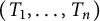
 . As a matter of course, it is important to identify n-tuples of commuting contractions each of which has an isometric dilation. By an isometric dilation of an n-tuple of commuting contractions
$(T_1,\dots ,T_n)$
 on
$\mathcal {H}$
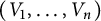
 , we mean an n-tuple of commuting isometries
$(V_1,\ldots , V_n)$
 on
$\mathcal {K}$
 such that
$\mathcal {H} \subseteq \mathcal {K}$
 and

for all
$(\alpha _1,\ldots ,\alpha _n)\in \mathbb{Z}^n_+$
 . A fair amount of research has been carried out to identify different classes of n-tuples of commuting contractions each of which possesses an isometric dilation. Often such a class is obtained by imposing certain positivity condition. For more details, see [Reference Barik and Das12, Reference Barik, Das, Haria and Sarkar13, Reference Barik, Das and Sarkar14, Reference Bhattacharjee, Das, Debnath and Panja18, Reference Brehmer20, Reference Curto and Vasilescu21, Reference Curto and Vasilescu22] for the polydisc setting, and for the setting of the unit ball in
$\mathbb C^n$
 , see [Reference Arveson7, Reference Müller and Vasilescu30], and references therein. Also see [Reference Ambrozie, Engli and Müller3, Reference Arazy and Engli5] for some general domains in
$\mathbb C^n$
 .
One of the main contributions of this article is the discovery of a new class of n-tuples of commuting contractions
$(n\ge 3)$
 , each of which possesses an isometric dilation. Our dilation result emerged from the study of a commutant lifting theorem (CLT), a very close neighbor of dilation theory. Indeed, this article is as much a study of dilation theory as of CLT. Commutant lifting theorem was first studied in the context of Nevanlinna-Pick interpolation by D. Sarason in [Reference Sarason34]. Soon after, Sz-Nagy and Foias extended the result in a general setting and proved that if V on
$\mathcal {K}$
 is an isometric dilation of a contraction T acting on
$\mathcal {H}$
 , and X is a contraction on
$\mathcal {H}$
 such that
$X T=T X$
 , then there exists a contraction Y on
$\mathcal {K}$
 satisfying

Because of the second identity above, Y is called a co-extension or lift of X. This result is known as Sz-Nagy and Foias’ commutant lifting theorem, and it is known to be equivalent to Ando dilation ([Reference Parrott33]). Multivariable analogue of Sz-Nagy and Foias’ commutant lifting theorem does not hold in general. See [Reference Müller29] and also see [Reference Archer6, Reference Ball, Li, Timotin and Trent9, Reference Ball, Trent and Vinnikov10, Reference Barik, Bhattacharjee and Das11, Reference Davidson and Le25, Reference Deepak, Pradhan, Sarkar and Timotin26, Reference Eschmeier and Putinar27] for related results. The best result known in the polydisc setting is due to Ball, Li, Timotin, and Trent ([Reference Ball, Li, Timotin and Trent9]), where the authors considered a class of n-tuples of commuting contractions along with their specific isometric dilations and found a necessary and sufficient condition for the commutant lifting theorem to hold. This shows that even if we restrict ourselves to a suitable class of n-tuples of commuting contractions and their isometric dilations, it may not always possible to lift every commutant in a commuting and norm-preserving way. Therefore, it raises the following natural question:
Is there a class of n-tuples of commuting contractions so that each of the n-tuples has an isometric dilation and every commutant can be lifted to the isometric dilation space in a commuting and norm-preserving way?
Needless to say that, the class of n-tuples requires to be nice enough for the above question to have a positive answer. We do not know the existence of any such class in the literature. In this article, we answer this question affirmatively by exhibiting a class and prove an exact analogue of Sz-Nagy and Foias’ commutant lifting theorem, which is another main contribution of this article. As a consequence, this leads us to identify a class of commuting contractions each of which possesses an isometric dilation.
We now proceed to describe some of our results. This requires to set few notations and terminologies. For a Hilbert space
$\mathcal {H}$
 , we denote by
$\mathcal {B}(\mathcal {H})$
 the space of all bounded operators acting on
$\mathcal {H}$
 . The set of all n-tuples of commuting contractions on
$\mathcal {H}$
 is denoted by
$\mathcal {T}^n(\mathcal {H})$
 ; that is,

For
$T=(T_1, \ldots ,T_n)\in \mathcal {T}^n(\mathcal {H})$
 , we denote by
$P_T$
 the product contraction of T, that is,
$P_T:=T_1 \cdots T_n$
 , and for
$A\in \mathcal {B}(\mathcal {H})$
 , we denote by
$C_A$
 the completely positive map on
$\mathcal {B}(\mathcal {H})$
 induced by A defined as

For any
$\gamma =(\gamma _1. \ldots , \gamma _n) \in \mathbb{Z}^n_+ $
 and
$T=(T_1, \ldots ,T_n)\in \mathcal {T}^n(\mathcal {H})$
 , we define

With this notation, it is easy to see that for
$i\neq j$
 ,

where for
$i=1, \ldots , n$
 ,

A contraction S acting on
$\mathcal {H}$
 is pure if
$S^{* n}\to 0$
 in the strong operator topology (SOT). The class of n-tuples of commuting contractions that we consider is defined as follows:

For the base case
$n=2$
 , if
$(T_1, T_2)$
 is a pair of commuting contractions on
$\mathcal {H}$
 such that
$T_1$
 is a co-isometry and
$T_2$
 is a pure contraction, then clearly,
$(T_1,T_2)\in \mathfrak{B}^2_{0}(\mathcal {H})$
 . In fact, it turns out that if
$\mathcal {H}$
 is finite-dimensional, then an arbitrary element of
$\mathfrak{B}^2_0(\mathcal {H})$
 is a direct sum of pairs of the above form (see Proposition 5.2). However, in infinite dimension, it is no longer the case. We have demonstrated this by finding an example in Section 5. It can be shown without much difficulty that for any
$T\in \mathfrak{B}^n_0(\mathcal {H})$
 and for a subset
$\{i_1, \ldots , i_k\}$
 of
$\{1, \ldots , n\}$
 ,

In other words,
$\mathfrak{B}^n_0(\mathcal {H})$
 is a subclass of Brehmer n-tuples on
$\mathcal {H}$
 (see [Reference Brehmer20]). Therefore, any element of
$\mathfrak{B}^n_0(\mathcal {H})$
 has an isometric dilation. However, we show that any
$T\in \mathfrak{B}^n_0(\mathcal {H})$
 has an isometric dilation of the form
$(M_{\Phi _1},\dots , M_{\Phi _n})$
 acting on the Hardy space
$H^2_{\mathcal {E}}(\mathbb D)$
 for some co-efficient Hilbert space
$\mathcal {E}$
 , where

and for all
$i=1,\dots ,n$
 ,
$U_i\in \mathcal {B}(\mathcal {H})$
 is a unitary,
$P_i\in \mathcal {B}(\mathcal {E})$
 is an orthogonal projection so that

Moreover, the tuple of isometries also belongs to the same class; that is,

In case the reader is wondering what properties are required for
$U_i$
 and
$P_i$
 so that (1.2) holds, see [Reference Berger, Coburn and Lebow16, Reference Bercovici, Douglas and Foias15] or Section 2 below. Here, the Hardy space
$H^2_{\mathcal {E}}(\mathbb{D})$
 is defined as

and the isometry
$M_{\Phi _i}:H^2_{\mathcal {E}}(\mathbb{D}) \to H^2_{\mathcal {E}}(\mathbb{D})$
 is the multiplication operator associated to
$\Phi _i$
 defined as

It is evident from (1.2) that
$(M_{\Phi _1},\dots , M_{\Phi _n})$
 is an n-tuple of commuting isometries and
$M_{\Phi _1}\cdots M_{\Phi _n}=M_z$
 , where
$M_z$
 is the shift on
$H^2_{\mathcal {E}}(\mathbb{D})$
 . Thus,
$M_z$
 can be factorized as the product of the n-tuple
$(M_{\Phi _1},\dots , M_{\Phi _n})$
 , and it is a remarkable result of Berger, Coburn, and Lebow ([Reference Berger, Coburn and Lebow16]) that any commuting contractive factor of
$M_z$
 arises in this way. For this reason,
$(M_{\Phi _1},\cdots , M_{\Phi _n})$
 is commonly known as a BCL n-tuple. Now coming back to the present context, the explicit isometric dilation of
$T\in \mathfrak{B}^n_0(\mathcal {H})$
 to a BCL n-tuple plays a pivotal role in what follows and aids to establish a sharp von Neumann type inequality. For a contraction
$T\in \mathcal {B}(\mathcal {H})$
 , the defect operator
$D_T$
 and the defect space
$\mathcal {D}_T$
 of T are defined as

If an n-tuple of commuting contractions T has an isometric dilation, then its von Neumann inequality holds on
$\overline {\mathbb{D}}^n$
 (see [Reference Sz-.Nagy and Foias31]); that is, for all polynomials
$p\in \mathbb{C}[z_1, \ldots , z_n]$
 ,

The above inequality is refined, and a significant reduction in terms of the dimension of the set where the inequality holds is obtained.
Theorem 1.1 Let
$T=(T_1,\ldots ,T_n)\in \mathfrak{B}^n_0(\mathcal {H})$
 and
$\text {dim}\, \mathcal {D}_{T_i}< \infty $
 (
$i=1,\ldots ,n$
 ). Then there exists a one-dimensional symmetric algebraic variety W in
$\mathbb{C}^n$
 such that for all polynomials
$p\in \mathbb{C}[z_1, \ldots , z_n]$
 ,

This result is proved in Theorem 3.4 below. Such a refined von Neumann inequality has been studied earlier for various other class of n-tuples of commuting contractions (see [Reference Agler and McCarthy2, Reference Barik, Das, Haria and Sarkar13, Reference Das and Sarkar23]), and most often, such a result is obtained on the basis of finding explicit and nice enough isometric dilations.
Using the explicit isometric dilation, as indicated above, we answer the question raised earlier and prove an analogue of Sz-Nagy and Foias’ commutant lifting theorem for
$\mathfrak{B}^n_0(\mathcal {H})$
 .
Theorem 1.2 Let
$T=(T_1,\ldots ,T_n)\in \mathfrak{B}^n_0(\mathcal {H})$
 and let
$(M_{\Phi _1},\dots , M_{\Phi _n})\in \mathfrak{B}^n_0(H^2_{\mathcal {E}}(\mathbb{D}))$
 be an isometric dilation of T for some Hilbert space
$\mathcal {E}$
 . If
$XT_i=T_iX$
 (
$i=1,\dots ,n$
 ) for some contraction
$X\in \mathcal {B}(\mathcal {H})$
 , then there exists
$Y\in \mathcal {B}(H^2_{\mathcal {E}}(\mathbb{D}))$
 such that Y is a lift of X,

This result is proved in Theorem 4.7 below. The proof heavily relies on a detailed analysis on the structure of commutants of T as well as the structure of commutants of its isometric dilation
$(M_{\Phi _1},\dots , M_{\Phi _n})$
 . For instance, we show that if
${T=(T_1,\ldots ,T_n)\in \mathfrak{B}^n_0(\mathcal {H})}$
 and
$XT_i=T_iX$
 for some contraction
$X\in \mathcal {B}(\mathcal {H})$
 , then

where
$G_i$
 ’s are positive operators on
$\mathcal {H}$
 (see Theorem 4.4 below). The above identity has some resemblance to the necessary and sufficient condition for CLT obtained in [Reference Ball, Li, Timotin and Trent9]. In fact, Theorem 1.2 is motivated from the above identity and the result of [Reference Ball, Li, Timotin and Trent9]. However, the proof of the theorem is entirely different from that of [Reference Ball, Li, Timotin and Trent9], partly because the isometric dilation and the dilation map are different, and one cannot directly use the result of [Reference Ball, Li, Timotin and Trent9] in this context as well. Finally, as CLT and dilation are closely related, the above theorem provides a new class of n-tuples of commuting contractions such that each of the tuples has an isometric dilation. The following result is proved in Theorem 4.10 below.
Theorem 1.3 Let
$(T_1,\dots ,T_n, T_{n+1})$
 be an
$(n+1)$
 -tuple of commuting contractions on
$\mathcal {H}$
 such that
$(T_1,\dots ,T_n)\in \mathfrak{B}^n_0(\mathcal {H})$
 . Then
$(T_1,\dots ,T_n, T_{n+1})$
 has an isometric dilation and, consequently, satisfies the von Neumann inequality.
This article is organized as follows. In the next section, we discuss some preparatory results. Section 3 is devoted to find an explicit isometric dilation for
$\mathfrak{B}^n_0(\mathcal {H})$
 and to obtain a sharper version of the von Neumann inequality for operator n-tuples in
$\mathfrak{B}^n_0(\mathcal {H})$
 with finite dimensional defect spaces. In Section 4, we prove CLT for
$\mathfrak{B}^n_0(\mathcal {H})$
 , and, as a consequence, we find a new class of n-tuples of commuting contractions, each of which possesses an isometric dilation. Examples on n-tuples in
$\mathfrak{B}^n_0(\mathcal {H})$
 are considered in Section 5.
2 Preparatory results
We set few definitions and conventions and also establish some preliminary results, in this section, which we need subsequently. All Hilbert spaces are assumed to be separable and over the complex field
$\mathbb{C}$
 .
2.1 Isometric dilation.
Let
$T\in \mathcal {T}^n(\mathcal {H})$
 . If there exist an n-tuple
$V=(V_1, \ldots ,V_n)$
 of commuting isometries on a Hilbert space
$\mathcal {K}$
 and an isometry
$\Pi :\mathcal {H} \to \mathcal {K}$
 such that

then

where
$\mathcal {Q}=\mbox {ran}\Pi $
 is a joint
$(V_1^*,\dots ,V_n^*)$
 -invariant subspace of
$\mathcal {K}$
 and the unitary equivalence is induced by
$\Pi $
 . Here, two tuples
$(A_1, \ldots , A_n)\in \mathcal {T}^n(\mathcal {H})$
 and
$(B_1, \ldots , B_n)\in \mathcal {T}^n(\mathcal {K})$
 are said to be unitarily equivalent, denoted by
$ (A_1,\ldots ,A_n)\cong (B_1,\ldots ,B_n)$
 , if there exists a unitary
$U:\mathcal {H} \to \mathcal {K}$
 such that
$UA_i=B_i U$
 for all
$i=1,\ldots ,n$
 . Since
$(V_1,\dots ,V_n)$
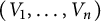 is a co-extension of
$(P_{\mathcal {Q}}V_1|_{\mathcal {Q}}, \ldots ,P_{\mathcal {Q}}V_n|_{\mathcal {Q}})$
 and co-extension is a special type of dilation, we say that V is an isometric dilation of T. In such a case, the isometry
$\Pi $
 is called the dilation map. Moreover, V is a minimal isometric dilation of T if

Throughout the article, most of the isometric dilations we obtained are of the above form.
2.2 Commuting tuples in
$\mathfrak{B}^n_0(\mathcal {H})$


Let
$T\in \mathcal {T}^n(\mathcal {H})$
 , and let
$P_T:=T_1 \cdots T_n$
 be the product contraction of T. Recall that for all
$k=2,\ldots , n$
 , and
$\{i_1, \ldots , i_k\}\subseteq \{1, \ldots , n\}$
 ,

and

We consider a couple of elementary properties of
$\mathfrak{B}^n_0(\mathcal {H})$
 in the next two lemmas. Both the lemmas remain valid even if we do not assume
$P_T$
 to be pure in the definition of
$\mathfrak{B}^n_0(\mathcal {H})$
 . The first lemma shows that any element of
$\mathfrak{B}^n_0(\mathcal {H})$
 satisfies Brehmer positivity.
Lemma 2.1 If
$T=(T_1, \ldots , T_n)\in \mathfrak{B}^n_0(\mathcal {H})$
 , then for all
$k=3,\dots , n$
 and
$\{i_1, \ldots , i_k\}\subseteq \{1, \ldots , n\}$
 ,

Proof Since
$\Delta _{T}^{\mathbf {e}_i+\mathbf {e}_j}=0$
 for all
$i \neq j$
 , the proof of the lemma follows from the definition of
$\Delta ^{\mathbf {e}_{i_1}+\cdots +\mathbf {e}_{i_k}}_{T}$
 ; that is,

Lemma 2.2 If
$T=(T_1,\ldots , T_n)\in \mathfrak{B}^n_0(\mathcal {H})$
 , then for any
$\emptyset \neq F\subseteq \{1, \ldots , i-1,i+1,\dots , n\}$
 ,

where for
$F=\{n_1, \ldots , n_j\}\subseteq \{i_1, \ldots , i_k\}$
 ,
$T_F:= T_{n_1}\cdots T_{n_j}$
 .
Proof We prove the lemma only for
$F=\{2,\dots ,n\}$
 , as the proof for arbitrary F is similar. Using Agler’s hereditary functional calculus ([Reference Agler1]) to the following identity, for
$z_1, \ldots , z_n \in \mathbb{D}$
 and
$w_1, \ldots , w_n\in \mathbb{D}$
 ,

we obtain

The proof now follows by Lemma 2.1.
2.3 BCL tuple.
Let
$\mathcal {E}$
 be a Hilbert space. The space of all bounded
$\mathcal {B}(\mathcal {E})$
 -valued holomorphic functions on
$\mathbb{D}$
 is denoted by
$H^\infty _{\mathcal {B}(\mathcal {E})}(\mathbb{D})$
 . For any
$\Psi \in H^\infty _{\mathcal {B}(\mathcal {E})}(\mathbb{D})$
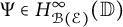 , the associated multiplication operator
$M_{\Psi }$
 is a bounded operator on the Hardy space
$H^2_{\mathcal {E}}(\mathbb{D})$
 and defined as

A BCL n-tuple on
$H^2_{\mathcal {E}}(\mathbb{D})$
 is an n-tuple of commuting isometries
$(M_{\Phi _1},\dots , M_{\Phi _n})$
 on
$H^2_{\mathcal {E}}(\mathbb{D})$
 such that
$M_{\Phi _1}\cdots M_{\Phi _n}=M_z$
 , where
$M_z$
 is the shift on
$H^2_{\mathcal {E}}(\mathbb{D})$
 . For a unitary U on
$\mathcal {E}$
 and an orthogonal projection
$P\in \mathcal {B}(\mathcal {E})$
 , it is easy to verify that
$M_\Phi $
 is an isometry, where

Berger, Coburn, and Lebow’s theorem shows that any BCL n-tuple arises in the same way as (2.2). We recall the theorem for further use.
Theorem 2.3 (cf. [Reference Berger, Coburn and Lebow16])
Let
$\Phi _1, \ldots , \Phi _n$
 be
$\mathcal {B}(\mathcal {E})$
 -valued bounded analytic function on
$\mathbb D$
 for some Hilbert space
$\mathcal {E}$
 . Then
$(M_{\Phi _1},\dots , M_{\Phi _n})$
 on
$H^2_{\mathcal {E}}(\mathbb{D})$
 is a BCL n-tuple if and only if for all
$i=1,\dots ,n$
 ,

for some unitaries
$U_i$
 ’s on
$\mathcal {E}$
 and orthogonal projections
$P_i$
 ’s in
$\mathcal {B}(\mathcal {E})$
 satisfying
-
(1) $U_i U_j=U_j U_i$
(
$i, j=1,\ldots ,n$
); -
(2) $U_1 \cdots U_n =I_{\mathcal {E}}$
; -
(3) $P_i + U^*_i P_j U_i=P_j + U^*_j P_i U_j \leq I_{\mathcal {E}} (i \neq j)$
; and -
(4) $P_1 +U^*_1 P_2 U_1 + \dots + U^*_1 \cdots U^*_{n-1} P_n U_1 \cdots U_{n-1}=I_{\mathcal {E}}$
.





It is evident from the above theorem that a BCL n-tuple is completely determined by a triple  , where
$\mathcal {E}$
 is a Hilbert space,
 is an n-tuple of unitaries on
$\mathcal {E}$
 ,
 is an n-tuple of projections in
$\mathcal {B}(\mathcal {E})$
 , and
$U_i$
 ’s and
$P_i$
 ’s satisfy conditions (1)–(4) in the above theorem. For the rest of the article, we use a triple
 to refer to a BCL n-tuple, and it would always inherit the meaning that the commuting unitary tuple
 and the projection tuple
 satisfy conditions (1)– (4), and the corresponding BCL n-tuple is given by
${\Phi _i(z)=U_i (P_i^\perp + z P_i) \,\, ( z\in \mathbb{D}, i=1,\dots ,n)}$
 . Few remarks are in order.
Remarks 2.4
-
(i) Condition (3) in the above theorem implies mutual orthogonality of the projections $P_i$
and
$U^*_i P_j U_i$
(
$i\neq j$
). That is, $$\begin{align*}P_i (U^*_i P_j U_i)=(U^*_i P_j U_i) P_i=0,\end{align*}$$which is also equivalent to
$$\begin{align*}(U_iP_iU_i^*)P_j= P_j(U_iP_iU_i^*)=0. \end{align*}$$
-
(ii) Conditions (2) and (4), in the above theorem, together imply that
$$\begin{align*}M_{\Phi_1}\cdots M_{\Phi_n} =M_z.\end{align*}$$
-
(iii) For $n=2$
, if
$(M_{\Phi _1}, M_{\Phi _2})$
is a BCL pair corresponding to , then
$U_2$
and
$P_2$
can be recovered from
$U_1$
and
$P_1$
. Indeed, by condition (2),
$U_2=U_1^*$
, and by condition (4),
$P_2=I-U_1 P_1 U^*_1$
. Thus, the BCL pair
$(M_{\Phi _1}, M_{\Phi _2})$
is completely determined by
$(\mathcal {E}, U, P)$
, where
$U=U_1$
and
$P=I-U_1 P_1 U^*_1$
, and consequently,
$\Phi _1$
and
$\Phi _2$
can be written as $$\begin{align*}\Phi_1(z)=(P+ z P^\perp)U \,\, and \,\, \Phi_2(z)=U^*(P^\perp+ z P)\quad ( z\in \mathbb{D}).\end{align*}$$


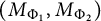
 , then



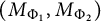





Lemma 2.5 Let
$(M_{\Phi _1}, \ldots , M_{\Phi _n})$
 be a BCL n-tuple corresponding to
 . Then for all
$i=1,\dots ,n$
 , the orthogonal projection
$(I_{H^2_{\mathcal {E}}(\mathbb{D})}-M_{\Phi _{i}}M^*_{\Phi _{i}})$
 has the block matrix representation

with respect to the decomposition
$H^2_{\mathcal {E}}(\mathbb{D})=\mathcal {E}\oplus zH^2_{\mathcal {E}}(\mathbb{D})$
 .
Proof Since
$M_{\Phi _i}$
 is an isometry,
$(I_{H^2_{\mathcal {E}}(\mathbb{D})}-M_{\Phi _{i}}M^*_{\Phi _{i}})$
 is a projection onto
$H^2_{\mathcal {E}}(\mathbb{D})\ominus M_{\Phi _{i}}H^2_{\mathcal {E}}(\mathbb{D})$
 . Also since
$M_z=M_{\Phi _1}\cdots M_{\Phi _n}$
 ,
$zH^2_{\mathcal {E}}(\mathbb{D})\subseteq \text {ran} M_{\Phi _i}$
 , and therefore,

However, for
$\eta \in \mathcal {E}$
 ,

This completes the proof.
Let
$(M_{\Phi _1}, \ldots , M_{\Phi _n})$
 be a BCL n-tuple corresponding to
 . Suppose that
$U_i P_j=P_j U_i$
 for all
$i,j=1,\dots ,n$
 . Then it follows from the condition (4) in Theorem 2.3 that

In other words,
$P_i$
 ’s are mutually orthogonal and
$\mathcal {E}=\oplus _{i=1}^n \mathcal {E}_i$
 , where
${\mathcal {E}_i=\text {ran}\, P_i (i=1,\ldots ,n)}$
 . Since
$U_i P_j=P_j U_i$
 , therefore,
$\mathcal {E}_i$
 is a
$U_j$
 -reducing subspace of
$\mathcal {E}$
 . Set
${U^{(i)}_j:= U_j|_{\mathcal {E}_i}}$
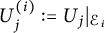 for all
$i,j=1,\dots ,n$
 . Then it is clear that with respect to the decomposition
$H^2_{\mathcal {E}}(\mathbb{D})=H^2_{\mathcal {E}_1}(\mathbb{D})\oplus \cdots \oplus H^2_{\mathcal {E}_n}(\mathbb{D})$
 ,
$M_{\Phi _i}$
 has the following block diagonal representation:

for all
$i=1,\dots ,n$
 . The above block diagonal representation will be used many times in the sequel, as most of the the BCL n-tuples, in this paper, will have the property that
$U_i P_j=P_j U_i$
 for all
$i,j=1,\dots ,n$
 . Finally, it follows from the commutativity of
$U_i$
 ’s that
$(M_{\Phi _1}, \ldots , M_{\Phi _n})$
 is doubly commuting; that is,
$M_{\Phi _i}^* M_{\phi _j}= M_{\Phi _j}M_{\Phi _i}^*$
 for all
$i\neq j$
 . We summarize this in the next lemma for future reference.
Lemma 2.6 Let
$(M_{\Phi _1}, \ldots , M_{\Phi _n})$
 be a BCL n-tuple corresponding to
 such that
$U_i P_j=P_j U_i$
 for all
$i,j=1,\ldots ,n$
 . Then
$(M_{\Phi _1}, \ldots , M_{\Phi _n})$
 is doubly commuting.
We now characterize BCL n-tuples on
$H^2_{\mathcal {E}}(\mathbb{D})$
 which are also in
$\mathfrak{B}^n_0(H^2_{\mathcal {E}}(\mathbb{D}))$
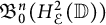 . The result is proved for the case
$n=2$
 in [Reference He, Qin and Yang28, Proposition 3.1], and we generalize it here for arbitrary n.
Proposition 2.7 Let
$M=(M_{\Phi _1}, \ldots , M_{\Phi _n})$
 on
$H^2_{\mathcal {E}}(\mathbb{D})$
 be a BCL n-tuple corresponding to
 . Then the following are equivalent.
-
(i) $M\in \mathfrak{B}^n_0(H^2_{\mathcal {E}}(\mathbb{D}))$
; -
(ii) $U_i P_j=P_j U_i$
for
$i, j =1,\ldots , n$
.



Proof of
$(i)\implies (ii).$

For a fix i, set
$\tilde {M}_{\Phi _{i}}:=M_{\Phi _{1}} \dots M_{\Phi _{i-1}} M_{\Phi _{i+1}} \dots M_{\Phi _{n}}$
 . Then,
$(M_{\Phi _i}, \tilde {M}_{\Phi _{i}})$
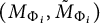 is a BCL pair and by Lemma 2.2,
$\Delta ^{(1,1)}_{(M_{\phi _i}\tilde {M}_{\Phi _{i}})}=0$
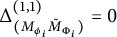 .
Therefore, by applying [Reference He, Qin and Yang28, Proposition 3.1] for the BCL pair
$(M_{\Phi _i}, \tilde {M}_{\Phi _{i}})$
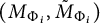 , we get
$U_i P_i =P_i U_i$
 for all
$i=1,\ldots ,n$
 . Now, for
$i\neq j$
 , it follows from Lemma 2.5 that for
$\eta \in \mathcal {E}$
 ,

Since
$\Delta _{M}^{\mathbf {e}_i+\mathbf {e}_j}=0$
 , the above computation shows that
$P_j- U_i P_j U^*_i=0$
 . That is,
$U_i P_j=P_j U_i$
 for all
$i\neq j$
 . This completes the proof.
Proof of
$(ii)\implies (i).$

By Lemma 2.6,
$M=(M_{\Phi _1}, \ldots , M_{\Phi _n})$
 is doubly commuting. Then for any
$i\neq j$
 ,

We have already observed in the proof of Lemma 2.6 that in this case,
$P_i$
 ’s are mutually orthogonal projections. The proof now follows from Lemma 2.5.
It has been observed in [Reference He, Qin and Yang28, Proposition 3.6] that for a BCL pair
$(M_{\Phi _1}, M_{\Phi _2})$
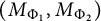 on
$H^2_{\mathcal {E}}(\mathbb{D})$
 , if
$\mathcal {E}$
 is finite dimensional, then
$\Delta ^{(1,1)}_{ (M_{\phi _1}, M_{\phi _2})}\geq 0$
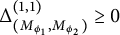 is equivalent to
$\Delta ^{(1,1)}_{ (M_{\phi _1}, M_{\phi _2})}=0$
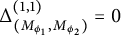 . We also prove a similar result for BCL n-tuples and which shows that in the case of finite dimensional co-efficient space
$\mathcal {E}$
 , the class
$\mathfrak{B}^n_0$
 is more relevant.
Proposition 2.8 Let
$M=(M_{\Phi _1}, \ldots , M_{\Phi _n})$
 be a BCL n-tuple corresponding to
 such that for
$i\neq j$
 ,
$\Delta _{M}^{\mathbf {e}_i+\mathbf {e}_j} \geq 0$
 . If
$\text {dim}\, \mathcal {E}<\infty $
 , then
$M\in \mathfrak{B}^n_0(H^2_{\mathcal {E}}(\mathbb{D}))$
 .
Proof As we have seen in the proof of the above proposition, for
$\eta \in \mathcal {E}$
 and
$i\neq j$
 ,

Then,
$\Delta _{M}^{\mathbf {e}_i+\mathbf {e}_j} \geq 0$
 (
$i\neq j$
 ) implies
$U_i P_i U^*_i-U_j U_i P_i U^*_i U^*_j\geq 0$
 ; that is,
$U_j P_i U^*_j\leq P_i$
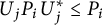 . Hence,
$\text {ran}\, P_i$
 is a
$U_j$
 -invariant subspace. Since
$\text {dim}\, \mathcal {E}<\infty $
 ,
$\text {ran}\, P_i$
 is also a
$U_j$
 -reducing subspace. In other words,
$U_j P_i=P_i U_j$
 (
$i\neq j$
 ). Therefore, by the above computation,
$ \Delta _{M}^{\mathbf {e}_i+\mathbf {e}_j}|_{\mathcal {E}}= 0$
 (
$i\neq j$
 ). However, it can be checked very easily that

even when
$\mathcal {E}$
 is infinite-dimensional. This completes the proof.
We end the section with a result which ensures that BCL n-tuples are crucial while studying isometric dilations of n-tuples of commuting contractions. Observe that if
$T=(T_1,\dots ,T_n)\in \mathcal {T}^n(\mathcal {H})$
 , then the product contraction
$P_T=T_1\cdots T_n$
 is pure if and only if
$T^{* \alpha }\to 0$
 in SOT as
$\alpha \to \infty $
 . Here, for
$\alpha =(\alpha _1, \ldots , \alpha _n)\in \mathbb{Z}_+^n$
 ,
$T^{\alpha }=T_1^{\alpha _1} \cdots T_n^{\alpha _n}$
 and
$\alpha \to \infty $
 means that
$\alpha _i \to \infty $
 for each
$i=1,\ldots , n$
 . Indeed, it follows from the following inequalities

where
$m= \text {min}\,\{\alpha _i:i=1,\ldots , n\}$
 and
$l=\text {max}\,\{\alpha _i:i=1,\ldots , n\}$
 .
Proposition 2.9 Let
$T=(T_1,\dots , T_n)\in \mathcal {T}^n(\mathcal {H})$
 be such that the product contraction
$P_T$
 is pure and T admits an isometric dilation. Then any minimal isometric dilation of T is unitarily equivalent to a BCL n-tuple
$(M_{\Phi _1}, \ldots , M_{\Phi _n})$
 on
$H^2_{\mathcal {E}}(\mathbb{D})$
 for some Hilbert space
$\mathcal {E}$
 .
Proof Let
$V=(V_1, \ldots ,V_n)$
 on
$\mathcal {K}$
 be a minimal isometric dilation of T. That is,

Since an n-tuple of commuting isometries with the product isometry being pure is unitarily equivalent to a BCL n-tuple [Reference Berger, Coburn and Lebow16, Theorem 3.1], it suffices to prove that the product isometry of V is pure or equivalently, by the observation made prior to this proposition,
$V^{* \alpha }\to 0$
 in SOT as
$\alpha \to \infty $
 . Since the product contraction
$P_T:=T_1\cdots T_n$
 is pure and the minimal isometric dilation is always a co-extension ([Reference Sz-.Nagy and Foias31]), we have for
$h\in \mathcal {H}$
 ,

Let
$h\in \mathcal {K}$
 be such that
$h=\sum _{0\le \beta \le \gamma } V^\beta h_\beta $
 (
$\gamma \in \mathbb Z_+^n, h_\beta \in \mathcal {H}$
 ). Then for
$\alpha \geq \gamma $
 , we have

and

Since
$\{\sum _{0\le \beta \le \gamma } V^\beta h_\beta :\gamma \in \mathbb Z_+^n, h_\beta \in \mathcal {H}\}$
 is a dense subspace of
$\mathcal {K}$
 and
$\{V^{*\alpha }\}_{\alpha \in \mathbb Z_+^n}$
 is a uniformly bounded family, it follows that
$V^{* \alpha }\to 0$
 in SOT as
$\alpha \to \infty $
 . This completes the proof.
3 Isometric dilation and von Neumann inequality for
$\mathfrak{B}^n_0(\mathcal {H})$

This section is devoted to find explicit BCL type isometric dilations for tuples in
$\mathfrak{B}^n_0(\mathcal {H})$
 . Isometric dilations of such tuples are known due to a result of Brehmer ([Reference Brehmer20]). However, we find explicit BCL type dilations of such tuples and prove a sharp von Neumann inequality in certain cases. Explicit BCL type dilations are the key to prove the commutant lifting theorem in the subsequent section. For a contraction
$T\in \mathcal {B}(\mathcal {H})$
 , recall that the defect operator and the defect space of T are defined as

For an n-tuple of commuting contractions
$T=(T_1,\ldots ,T_n)\in \mathcal {T}^n(\mathcal {H})$
 , the product contraction is denoted by
$P_T:=T_1 \cdots T_n$
 . We are now ready to prove the dilation result for the case when the defect spaces of
$T_i$
 ’s are finite dimensional.
Theorem 3.1 Let
$T=(T_1,\ldots ,T_n)\in \mathfrak{B}^n_0(\mathcal {H})$
 be such that
$\text {dim}\, \mathcal {D}_{T_i}< \infty $
 (
$i=1,\ldots ,n$
 ). Let
$\mathcal {E}=\bigoplus ^n_{i=1} \mathcal {D}_{T_i}$
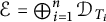 . Then there exist an isometry
$\Pi : \mathcal {H} \to H^2_{\mathcal {E}}(\mathbb{D})$
 and a BCL n-tuple
$(M_{\Phi _1}, \ldots , M_{\Phi _n})\in \mathfrak{B}^n_0(H^2_{\mathcal {E}}(\mathbb{D}))$
 such that

for all
$i=1,\dots ,n$
 .
Proof Since
$\Delta _{T}^{\mathbf {e}_i+\mathbf {e}_j}=0$
 for all
$i \neq j$
 ,

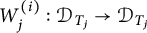
As the defect spaces are assumed to be finite dimensional, the above identities induce unitaries
$W_j^{(i)}: \mathcal {D}_{T_j} \to \mathcal {D}_{T_j}$
 for all
$i\neq j$
 , defined by

Then observe that for
$i, k=1,\ldots ,n$
 and
$i\neq k\neq j$
 ,
$W_j^{(i)} W_j^{(k)}=W_j^{(k)} W_j^{(i)}$
 . Indeed,

Now for
$i=j$
 , we set
$W^{(j)}_j:=W_j^{ *(1)}\cdots W_j^{ *(j-1)} W_j^{* (j+1)}\cdots W_j^{* (n)}$
 . Then it is clear from the definition that

and for each
$j=1,\dots ,n$
 , the tuple
$(W_j^{(1)},\dots , W_j^{(n)})$
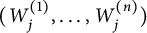 is a tuple of commuting unitaries and

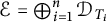
We now have all the ingredients to define the triple  corresponding to the dilating BCL n-tuple. We take
$\mathcal {E}=\bigoplus ^n_{i=1} \mathcal {D}_{T_i}$
 ,
 and
 , where for
$i=1,\dots ,n$
 ,

By the construction of
$U_i$
 and
$P_i$
 and the identity 3.2, it easy to observe that for
${i,j=1,\ldots ,n}$
 ,

Thus,  and
 satisfy all the conditions (1)–(4) as in Theorem 2.3, and by Proposition 2.7, the corresponding BCL n-tuple
$(M_{\Phi _1},\ldots ,M_{\Phi _n})\in \mathfrak{B}^n_0(H^2_{\mathcal {E}}(\mathbb{D}))$
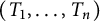
 . In the rest of the proof, we construct the dilation map and show that
$(M_{\Phi _1},\ldots ,M_{\Phi _n})$
 is an isometric dilation of
$(T_1,\dots , T_n)$
 . The following identity,

implies that the map
$\iota :\mathcal {D}_{P_T} \to \mathcal {E}$
 , defined by

is an isometry. Since
$P_T$
 is a pure contraction, the map
$\pi :\mathcal {H} \to H^2_{\mathcal {D}_{P_T}}(\mathbb{D})$
 , defined by
$\pi h=\sum _{k \in \mathbb{Z}_+} z^k (D_{P_T} P_T^{* k}h) $
 (
$z\in \mathbb{D}, h\in \mathcal {H}$
 ), is an isometry. In fact,
$\pi $
 is the well-known dilation map for
$P_T$
 . Finally, the dilation map for us is the isometry
$\Pi :=(I \otimes \iota )\pi : \mathcal {H}\to H^2_{\mathcal {E}}(\mathbb{D})$
 . To complete the proof, we show that for all
$i=1,\dots ,n$
 ,

Indeed, it is established by the rigorous computation below. For
$ k\in \mathbb{Z}_+, \eta \in \mathcal {E}, h\in \mathcal {H}$
 ,

However, for
$\eta \in \mathcal {E}, h\in \mathcal {H}, k\in \mathbb{Z}_+$
 ,

Hence,
$\Pi T^*_i=M_{\Phi _i}^* \Pi \,\, (i=1,\ldots ,n)$
 , as asserted.
An isometric dilation for arbitrary
$T=(T_1,\ldots , T_n)\in \mathfrak{B}^n_0(\mathcal {H})$
 can also be obtained in a similar way. Since the defect space
$\mathcal {D}_{T_j}$
 may not be necessarily finite dimensional, the operator
$W_j^{(i)} (j\neq i)$
 , as defined in 3.1, is an isometry and may not be necessarily a unitary. This forces us to take minimal unitary extension of the commuting tuple of isometries
$(W_j^{(1)}, \ldots , W_j^{(j-1)}, W_j^{(j+1)}, \ldots , W_j^{(n)})$
 defined on
$\mathcal {D}_{T_j}$
 . We denote the extended tuple of unitaries on
$\mathcal {K}_j$
 again by
$(W_j^{(1)}, \ldots , W_j^{(j-1)}, W_j^{(j+1)}, \ldots , W_j^{(n)})$
 . For
$i=j$
 , we let the unitary
$ W_j^{(j)}:\mathcal {K}_j \to \mathcal {K}_j$
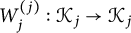 be

Then, by the same arguments as before, the tuple
$(W_j^{(1)},\dots , W_j^{(n)})$
 is a tuple of commuting unitaries,

The triple  corresponding to the dilating BCL n-tuple is defined similarly by taking
$\mathcal {E}=\bigoplus ^n_{i=1} \mathcal {K}_i$
 ,
 , and
 , where for
$i=1,\dots ,n$
 ,

Since
$\bigoplus ^n_{i=1} \mathcal {D}_{T_i}\subseteq \mathcal {E}$
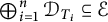 , the isometry
$\iota $
 , as in 3.3, can be viewed as an isometry from
$\mathcal {H}$
 to
$\mathcal {E}$
 . Then by the same computation as done in the proof of the previous theorem, one also has

where
$\Pi :=(I \otimes \iota )\pi : \mathcal {H}\to H^2_{\mathcal {E}}(\mathbb{D})$
 and the isometry
$\pi :\mathcal {H} \to H^2_{\mathcal {D}_{P_T}}(\mathbb{D})$
 is the dilation map of
$P_T$
 defined by
$\pi h=\sum _{k \in \mathbb{Z}_+} z^k (D_{P_T} P_T^{* k}h) $
 (
$z\in \mathbb{D}, h\in \mathcal {H}$
 ). Thus, we have proved the following dilation result.
Theorem 3.2 Let
$T=(T_1,\ldots , T_n)\in \mathfrak{B}^n_0(\mathcal {H})$
 . Then there exist a Hilbert space
$\mathcal {E}$
 , an isometry
$\Pi : \mathcal {H} \to H^2_{\mathcal {E}}(\mathbb{D})$
 , and a BCL n-tuple
$(M_{\Phi _1}, \ldots , M_{\Phi _n})\in \mathfrak{B}^n_0(H^2_{\mathcal {E}}(\mathbb{D}))$
 such that

for all
$i=1,\ldots ,n$
 .
Remark 3.3 For
$T\in \mathfrak{B}^n_0(\mathcal {H})$
 , by the definition, the product contraction
$P_T$
 is pure. The above dilation result remains valid even if we remove the requirement that the product contraction
$P_T$
 is pure. In such a case, the isometric dilation we get would not be a BCL n-tuple. Instead, it would be direct sums of a BCL n-tuple and an n-tuple of commuting unitaries. Indeed, if

then for each
$i=1,\dots ,n$
 , the operator
$\tilde {T_i}:\mathcal {Q}\to \mathcal {Q}$
 defined by
$\tilde {T_i}^*(Qh)= QT_i^* h$
 is a co-isometry and
$\tilde {T_i}\tilde {T_j}= \tilde {T_j}\tilde {T_i}$
 . Let
$(W_1,\dots W_n)$
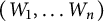 on
$\mathcal {K}$
 be the minimal unitary co-extension of
$(\tilde {T_1},\dots ,\tilde {T_n})$
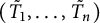 . Since the minimal isometric dilation map of
$P_T$
 can be taken to be

one can check that

where
$(M_{\Phi _1},\dots M_{\Phi _n})\in \mathfrak{B}^n_0(H^2_{\mathcal {E}}(\mathbb{D}))$
 is the BCL n-tuple as constructed in Theorem 3.2 and
$\Pi :\mathcal {H} \to H^2_{\mathcal {E}}(\mathbb{D})\oplus \mathcal {K}$
 is given by
$\Pi (h)=((I\otimes \iota )\pi (h),Qh)$
 with
$\iota $
 as in (3.3).
In the rest of this section, we prove a sharper version of the von Neumann inequality. Since any element T of
$\mathfrak{B}^n_0(\mathcal {H})$
 has an isometric dilation, T satisfies the von Neumann inequality for
$\mathbb{C}[z_1, \ldots , z_n]$
 , the ring of polynomials in n variables with complex coefficients. That is, for all polynomials
$p\in \mathbb{C}[z_1, \ldots , z_n]$
 ,

However, we show that, in this particular case, one only needs to consider a one-dimensional variety instead of whole
$\overline {\mathbb{D}}^n$
 . Before going into further details, we need to recall some results. Let
$T=(T_1,\ldots ,T_n)$
 be an n-tuple of commuting bounded operators on
$\mathcal {H}$
 . The Taylor joint spectrum ([Reference Taylor36]) of T is denoted by
$\sigma (T)$
 . In the case when T consists of commuting matrices,
$\sigma (T)$
 is the set of all joint eigenvalues. Let
$(M_{\Phi _1}, \ldots , M_{\Phi _n})$
 be a BCL n-tuple on
$H^2_{\mathcal {E}}(\mathbb{D})$
 such that
$\mathcal {E}$
 is finite dimensional. Then, it is proved in [Reference Bhattacharyya, Kumar and Sau19, Theorem 7.3] that the set

is a one-dimensional symmetric algebraic variety, where for
$\mathbf {z}=(z_1,\dots ,z_n)\in \mathbb C^n$
 ,
$\underline {\mathbf {z}}:=z_1\cdots z_n$
 . Here, the symmetric property of W simply means that for non-zero
$z_i (i=1,\ldots, n)$
 ,

We are now ready to prove the sharp von Neumann inequality.
Theorem 3.4 Let
$T=(T_1,\ldots ,T_n)\in \mathfrak{B}^n_0(\mathcal {H})$
 and
$\text {dim}\, \mathcal {D}_{T_i}< \infty $
 for all
$i=1,\ldots ,n$
 . Then there exists a one-dimensional symmetric algebraic variety W in
$\mathbb{C}^n$
 such that for all polynomials
$p\in \mathbb{C}[z_1, \ldots , z_n]$
 ,

Proof Let the BCL n-tuple
$(M_{\Phi _1}, \ldots , M_{\Phi _n})\in \mathfrak{B}^n_0(H^2_{\mathcal {E}}(\mathbb{D}))$
 be an isometric dilation of T such that
$\mathcal {E}$
 is finite dimensional. The existence of such a dilation is shown in Theorem 3.1. Moreover, it also follows from Theorem 3.1 that

where
$\mathcal {Q}=\Pi (\mathcal {H})\subseteq H^2_{\mathcal {E}}(\mathbb{D})$
 is a co-invariant subspace. Then, for
$p\in \mathbb{C}[z_1, \ldots , z_n]$
 ,

Now, it is easy to observe that

Clearly, the right-hand side is equal to

Thus, we have

Since
$\text {dim}\,(\mathcal {E})<\infty $
 , for
$z\in \mathbb{T}$
 ,
$(\Phi _1(z),\ldots , \Phi _n(z))$
 is an n-tuple of commuting unitary matrices. Also since
$\Phi _1(z)\cdots \Phi _n(z)=zI_{\mathcal {E}}$
 for all
$z\in \overline {\mathbb{D}}$
 , it follows that for any
$(z_1,\dots ,z_n)\in \sigma (\Phi _1(z),\dots ,\Phi _n(z))$
 ,

Therefore,

where W is the one-dimensional symmetric algebraic variety as in (3.4). The above computation implies that
$\sup _{\theta \in [0,2\pi ]}\|p(\Phi _1(e^{i\theta }),\ldots , \Phi _n(e^{i\theta }))\|_{\mathcal {B}(\mathcal {E})}\leq \sup _{\mathbf {z}\in W\cap \overline {\mathbb{D}}^n} |p(\mathbf {z})|$
 . This completes the proof.
4 Commutant lifting theorem for
$\mathfrak{B}^n_0(\mathcal {H})$

For
$T=(T_1,\ldots , T_n)\in \mathcal {T}^n(\mathcal {H})$
 , we denote by
$\{T\}^\prime $
 the set of all bounded operators on
$\mathcal {H}$
 which commute with each
$T_i$
 (
$i=1,\ldots ,n$
 ); that is,

The foundation of the commutant lifting theorem for
$\mathfrak{B}^n_0(\mathcal {H})$
 is the explicit isometric dilation of an element
$T\in \mathfrak{B}^n_0(\mathcal {H})$
 to a BCL n-tuple
$M\in \mathfrak{B}^n_0(H^2_{\mathcal {E}}(\mathbb{D}))$
 which we obtained in the previous section. As a result, our proof of the commutant lifting theorem hinges on the detailed analysis of the structure of
$\{T\}^\prime $
 as well as of
$\{M\}^{\prime }$
 , where
$T\in \mathfrak{B}^n_0(\mathcal {H})$
 and
$M\in \mathfrak{B}^n_0(H^2_{\mathcal {E}}(\mathbb{D}))$
 is a BCL n-tuple. To begin with, we consider the case of BCL n-tuples.
Proposition 4.1 Let
$M=(M_{\Phi _1},\ldots , M_{\Phi _n})\in \mathfrak{B}^n_0(H^2_{\mathcal {E}}(\mathbb{D}))$
 be a BCL n-tuple corresponding to
 . Suppose that
$\mathcal {E}_i=\text {ran}\,P_i $
 for all
$i=1,\dots ,n$
 . If X is a contraction in
$\{M\}^\prime $
 , then X has the following block matrix form with respect to decomposition
$H^2_{\mathcal {E}}(\mathbb{D})=H^2_{\mathcal {E}_1}(\mathbb{D})\oplus \cdots \oplus H^2_{\mathcal {E}_n}(\mathbb{D})$
 :

where for all
$i=1,\dots ,n$
 ,
$\Theta _i$
 is a contractive
$\mathcal {B}(\mathcal {E}_i)$
 -valued analytic function on
$\mathbb{D}$
 .
Proof For
$X\in \{M\}^\prime $
 , since
$X M_z=M_z X$
 , then there exists
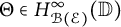
$\Theta \in H_{\mathcal {B}(\mathcal {E})}^\infty (\mathbb{D})$
 such that
$X=M_{\Theta }$
 . Let
$\Theta (z)=\sum _{ k \geq 0}A_k z^k$
 , where
$A_k \in \mathcal {B}(\mathcal {E})$
 (
$k \geq 0$
 ). We fix
$i\in \{1,\dots ,n\}$
 . Since
$X M_{\Phi _i}=M_{\Phi _i} X$
 , then the identity
$ \Phi _i(z) \Theta (z)=\Theta (z) \Phi _i(z)$
 implies that for all
$z\in \mathbb{D}$
 ,

Comparing the coefficients, we obtain

Note that as
$M\in \mathfrak{B}^n_0(H^2_{\mathcal {E}}(\mathbb{D}))$
 , we have
$U_i P_j=P_j U_i$
 for all
$i,j=1,\dots ,n$
 . Then the identity
$U_i P_i^\perp A_0=A_0 U_i P^\perp _i$
 together with
$A^*_0 P_i^\perp U_i^* = P^\perp _iU_i^*A_0^*$
 , obtained by taking adjoint, imply that
$\mathcal {E}_i^\perp $
 is a reducing subspace for
$A_0$
 . That is,
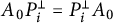
$A_0 P_i^{\perp }=P_i^{\perp }A_0$
 . Letting
$k=1$
 in 4.2, we get

Consequently,

By the same argument as before, the above identity together with
$P_i^\perp A^*_1 P^\perp _i U^*_i=P^\perp _i U^*_i A_1^*$
 imply that
$\mathcal {E}_i^\perp $
 is a reducing subspace for
$A_1$
 . Proceeding in the same way, we can show that
$\mathcal {E}_i^\perp $
 is a reducing subspace for
$A_k$
 for all
$k\ge 2$
 . We set
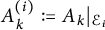
$A^{(i)}_k:=A_k|_{\mathcal {E}_i}$
 for all
$k\ge 0$
 , and
$\Theta _i(z):=\sum _{k\geq 0}A^{(i)}_k z^k$
 . Then
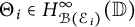
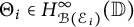
$\Theta _i\in H_{\mathcal {B}(\mathcal {E}_i)}^\infty (\mathbb{D})$
 . Since i was arbitrarily chosen, we have
$\Theta _i\in H_{\mathcal {B}(\mathcal {E}_i)}^\infty (\mathbb{D})$
 for all
$i=1,\dots ,n$
 , and it is now easy to see that

This completes the proof.
As a consequence of the above result, we find certain decomposition of the defect operator next.
Proposition 4.2 Let
$M=(M_{\Phi _1},\ldots , M_{\Phi _n})\in \mathfrak{B}^n_0(H^2_{\mathcal {E}}(\mathbb{D}))$
 be a BCL n-tuple corresponding to
 . If X is a contraction in
$\{M\}^\prime $
 , then there exist positive operators
$G_1, \ldots , G_n$
 on
$H^2_{\mathcal {E}}(\mathbb{D})$
 such that

Proof Since X is a contraction in
$\{M\}^\prime $
 , using Proposition 4.1, X has the block matrix from as in 4.1 for some
$\Theta _i \in H_{\mathcal {B}(\mathcal {E}_i)}^\infty (\mathbb{D}) (i=1,\dots ,n)$
 . We consider

where the block matrix representation is taken with respect to the decomposition
$H^2_{\mathcal {E}}(\mathbb{D})=H^2_{\mathcal {E}_1}(\mathbb{D})\oplus \cdots \oplus H^2_{\mathcal {E}_n}(\mathbb{D})$
 . Since
$M_{\Theta _i}$
 is a contraction, it follows that
$G_i\ge 0$
 and
$I-XX^*=G_1+\dots +G_n$
 . Now for
$i\neq j$
 , using the block matrix form 2.3 of
$M_{\Phi _j}$
 and
$M_{\Phi _j}X=XM_{\Phi _j}$
 , it can be easily verified that
$M_{\Phi _j}G_iM_{\Phi _j}^*=G_i$
 . The proof now follows.
Let
$T=(T_1,\ldots , T_d)\in \mathfrak{B}^n_0(\mathcal {H})$
 and
$M=(M_{\Phi _1}, \ldots , M_{\Phi _n})\in \mathfrak{B}^n_0(H^2_{\mathcal {E}}(\mathbb{D}))$
 be an isometric dilation of T. That is, there exists an isometry
$\Pi : \mathcal {H} \to H^2_{\mathcal {E}}(\mathbb{D})$
 such that

For a contractive
$X\in \{T\}^\prime $
 , if there exists a contractive multiplier
$\Theta \in H^\infty _{\mathcal {B}(\mathcal {E})}(\mathbb{D})$
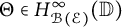 such that
$M_{\Theta }\in \{M\}^\prime $
 and
$\Pi X^*= M^*_{\Theta } \Pi $
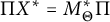 , then by the above proposition,
$I-M_{\Theta }M_{\Theta }^*= G_1+\dots +G_n$
 for some positive operators
$G_i$
 on
$H^2_{\mathcal {E}}(\mathbb{D})$
 such that
$(I-C_{M_{\Phi _j}})(G_i) =G_i -M_{\Phi _j} G_i M^*_{\Phi _j} = 0 \quad (i\neq j)$
 . Then observe that

and

Thus, the condition that there should exist positive operators
$\tilde {G_1},\dots \tilde {G_n}$
 on
$\mathcal {H}$
 for which

is necessary for the commutant lifting theorem to hold. In fact, we show below that every commutant of
$T\in \mathfrak{B}^n_0(\mathcal {H})$
 indeed satisfies the necessary condition for which we need the following lemma.
Lemma 4.3 Let
$T=(T_1,\ldots , T_n)\in \mathcal {T}^n(\mathcal {H})$
 be such that
$ \Delta ^{\mathbf {e}_i+\mathbf {e}_j}_{T}=0 (i\neq j)$
 . Then
${I-P_T P_T^* =\sum _{i=1}^n D^2_{T_i}}$
 , where
$P_T=T_1\cdots T_n$
 and
$D_{T_i}$
 is the defect operator of
$T_i$
 .
Proof Using Agler’s hereditary functional calculus ([Reference Agler1]) to the following identity, for
$(z_1, \ldots , z_n)$
 and
$(w_1, \ldots , w_n) \in \mathbb{D}^n$
 ,

we get

Hence, by Lemma 2.1,
$I-P_T P_T^* =\sum _{j=1}^n D^2_{T_j}$
 .
For
$T=(T_1,\ldots ,T_n)\in \mathcal {T}^n(\mathcal {H})$
 , we denote by
$\tilde {T}_j$
 the
$(n-1)$
 -tuple obtained from T by deleting
$T_j$
 ; that is,

Theorem 4.4 Let
$T=(T_1,\ldots , T_n)\in \mathfrak{B}^n_0(\mathcal {H})$
 . If X is a contraction in
$\{T\}^\prime $
 , then there exist positive operators
$G_1, \ldots , G_n$
 on
$\mathcal {H}$
 such that

Proof First, we define

Clearly, the above SOT limit exists as
$T_i$
 ’s are contractions. It then follows from the definition that
$(I-C_{T_i})(G_j)=G_j -T_i G_j T^*_i = 0$
 for all
$i\neq j$
 . Now,

To complete the proof, it is enough to show that
$\text {SOT}-\lim _{\alpha \to \infty } \sum _{j=1}^n \tilde {T}_j^\alpha \tilde {T}_j^{*\alpha }=I_{\mathcal {H}}$
 . Since
$\Delta ^{\mathbf {e}_i+\mathbf {e}_j}_{T}=0$
 (that is,
$D_{T_j}^2=T_i D^2_{T_j}T^*_i$
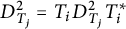 (
$i\neq j$
 )), then

Taking sum over j in both sides to the above identity, we get for all
$\alpha \in \mathbb{Z}^{n-1}_+$
 ,

Consequently, for
$\alpha \ge \mathbf e=(1,\dots , 1)$
 ,

Set
$Y_{\alpha }:= I_{\mathcal {H}}-\sum _{j=1}^n \tilde {T}_j^\alpha \tilde {T}_j^{*\alpha }, (\alpha \in \mathbb{Z}^{n-1}_+)$
 . By the above identity, for
$\alpha \ge \mathbf e$
 , if
$k=\text {min}\{\alpha _1,\dots ,\alpha _{n-1}\}$
 , then

Thus, for
$h\in \mathcal {H}$
 ,

Since
$P_T$
 is pure, it then follows that
$\text {SOT}-\lim _{\alpha \to \infty } Y_\alpha =0$
 . This completes the proof.
The identity (4.3), in the above theorem, is crucial for commutant lifting theorem to hold, which is one of the main results of this section. The reader familiar with the work of [Reference Ball, Li, Timotin and Trent9] could easily recognize the identity (4.3) and must be tempted to use [Reference Ball, Li, Timotin and Trent9] to prove the commutant lifting theorem. Despite the similarity, one cannot use [Reference Ball, Li, Timotin and Trent9] directly, as the isometric dilation of T as well as the dilation map are completely different. As a result, our proof is entirely different compared to that of [Reference Ball, Li, Timotin and Trent9]. Before going into the commutant lifting theorem, we need a couple of preparatory results. The first one of them is of independent interest. It is well-known that given any contractive
$\mathcal {B}(\mathcal {E})$
 -valued analytic function
$\Theta $
 , there exist an auxiliary Hilbert space
$\mathcal {F}$
 and a contraction

such that
$\Theta (z)=\tau _{W}(z)$
 , where
$\tau _{W}$
 is the transfer function corresponding to W; that is,

Moreover, the contraction W can be taken to be a unitary if necessary. This result is known as transfer function realizations for operator valued bounded analytic functions on the unit disc. Recall that a contraction T on
$\mathcal {H}$
 is said to be a completely non-coisometric if there is no nontrivial invariant subspace of
$T^*$
 on which
$T^*$
 is an isometry. A contraction T is said to be a completely nonunitary (cnu) if there is no nonzero T-reducing subspace
$\mathcal {S}$
 of
$\mathcal {H}$
 such that
$T|_{\mathcal {S}}$
 is a unitary operator. For a contraction T on
$\mathcal {H}$
 , there exist unique T-reducing subspaces
$\mathcal {H}_{cnu}$
 and
$\mathcal {H}_{u}$
 such that
$\mathcal {H}= \mathcal {H}_{cnu} \oplus \mathcal {H}_{u}$
 ,
$T_{cnu}:=T|_{\mathcal {H}_{cnu}}$
 is a cnu, and
$T_{u}:=T|_{\mathcal {H}_{u}}$
 is a unitary (see [Reference Sz-.Nagy and Foias31, Theorem 3.2]). Thus, T has the following block matrix representation of T with respect to the decomposition
$\mathcal {H}_{cnu}\oplus \mathcal {H}_{u}$
 :

Such a decomposition is commonly referred to as canonical decomposition of T. If
${U\in \mathcal {B}(\mathcal {E})}$
 is an isometry, in the result below, we find a necessary and sufficient condition for the commutativity of
$\tau _{W}(z)$
 and U for all
$z\in \mathbb{D}$
 in terms of W and U.
Theorem 4.5 Let
$\tau _{W}(z)=A+zB(I-z D)^{-1} C$
 be the transfer function corresponding to a unitary
$W=\begin {bmatrix} A& B\\ C& D \end {bmatrix}$
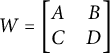 on
$\mathcal {E} \oplus \mathcal {F}$
 for some Hilbert spaces
$\mathcal {E}$
 and
$\mathcal {F}$
 , and let U be an isometry on
$\mathcal {E}$
 . Let

be the canonical decomposition of D into the cnu part
$D_1$
 and the unitary part
$D_2$
 with respect to the decomposition
$\mathcal {F}=\mathcal {F}_1\oplus \mathcal {F}_2$
 . Consider the following statements.
-
(1) $M_{\tau _{W}} (I_{H^2(\mathbb{D})}\otimes U)=(I_{H^2(\mathbb{D})}\otimes U) M_{\tau _{W}}$
. -
(2) There exists a contraction Y on $\mathcal {F}$
such that
$W \tilde {U}=\tilde {U} W$
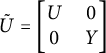
, where
$\tilde {U}=\begin {bmatrix} U& 0\\ 0& Y \end {bmatrix}$
.



Then
$(2)\Longrightarrow (1)$
 . Moreover, if
$D_1$
 is completely non-coisometric, then
$(1) \Longrightarrow (2)$
 .
Proof Using the power series expansion of
$\tau _{W}(z)$
 , it is easy to see that the identity in
$(1)$
 is equivalent to

Now we assume that
$(2)$
 holds. Then by a routine block matrix multiplication,
$AU=U A$
 ,
$BY=UB$
 ,
$CU=YC$
 , and
$DY=YD$
 . Thus,
$AU=U A$
 and

Hence, by the observation we made earlier,
$M_{\tau _W} (I_{H^2(\mathbb{D})}\otimes U)=(I_{H^2(\mathbb{D})}\otimes U) M_{\tau _W}$
 . This proves
$(2) \Longrightarrow (1)$
 .
For the proof of the moreover part, note that the block matrix representation of W with respect to the decomposition
$\mathcal {E}\oplus \mathcal {F}_1\oplus \mathcal {F}_2$
 is

Since W is a unitary,


Claim:

The proof of the claim follows from [Reference Ball and Cohen8, Theorem 4.2]. However, we supply a proof for the completeness. To this end, it is enough to show that
$\mathcal {S}:=(\mathcal {F}_1 \ominus \bigvee _{k\geq 0} D_1^k P_{\mathcal {F}_1} C (\mathcal {E}))=\{0\}$
 . Let
$h\in \mathcal {S}$
 ; that is,
$h\in \mathcal {F}_1$
 and
$h\perp \bigvee _{k\geq 0} D_1^k P_{\mathcal {F}_1} C (\mathcal {E})$
 . Therefore,
$h \perp D_1^k P_{\mathcal {F}_1} C \eta $
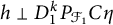 (
$k\geq 0, \eta \in \mathcal {E}$
 ). In particular,
$h \perp P_{\mathcal {F}_1} C \eta $
 (
$\eta \in \mathcal {E}$
 ); that is,

This implies
$h\in \text {ker }C^*$
 . In other words,
$\mathcal {S}\subseteq \text {ker }C^*$
 . Now it is easy to see that
$\mathcal {S}$
 is a
$D^*_1$
 -invariant subspace and the identity
$P_{\mathcal {F}_1} C C^*+ D_1 D_1^*=I_{\mathcal {F}}$
 restricted on
$\mathcal {S}$
 becomes
$D_1 D_1^*|_{\mathcal {S}}=I_{\mathcal {S}}$
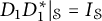 , which contradicts that
$D_1$
 is completely non-coisometric. Hence, the claim is proved.
We now proceed to construct a contraction Y on
$\mathcal {F}$
 such that
$W\tilde {U}=\tilde {U}W$
 ; that is,

Since
$\mathcal {F}_1=\bigvee _{k\geq 0} D_1^k P_{\mathcal {F}_1} C (\mathcal {E})$
 , we define

It remains to show that Y is a well-defined contraction on
$\mathcal {F}$
 and
$BY=UB$
 as the identities
$CU=YC$
 and
$D Y=YD$
 are immediate from the definition of Y. In fact, the reader must have noticed that it is the only way one could define Y with required properties, and therefore, Y is unique in this case. We show below that
$Y|_{\mathcal {F}_1}$
 is a unitary. To this end, it is enough to show that

for all
$k, l\in \mathbb{Z}_+$
 and
$\eta , \eta ^\prime \in \mathcal {E}$
 . When
$l=k=0$
 , note that

For the general case, we use the following identity repeatedly:

as
$P_{\mathcal {F}_1} B^* B|_{\mathcal {F}_1}+ D_1^* D_1=I_{\mathcal {F}_1}$
 , where
$m,n\ge 1$
 . Now consider the case when at least one of l and k is nonzero. We assume, without any loss of generality, that
$k\geq l$
 . Then for any
$\eta , \eta ^\prime \in \mathcal {E}$
 , by applying (4.5) l times, we have

In the above identity, replacing
$\eta $
 and
$\eta ^\prime $
 by
$U\eta $
 and
$U\eta ^\prime $
 , respectively, and using (4.4), we get

Thus, Y is a unitary on
$\mathcal {F}_1$
 . From the definition of Y, it follows that Y is a contraction. Now for
$g=\sum _{k=0}^lD_1^k P_{\mathcal {F}_1} C \eta _k$
 (
$\eta _k\in \mathcal {E}$
 ) and
$f\in \mathcal {F}_2$
 ,

Therefore,
$BY =UB$
 , and this completes the proof.
The other result that we need appeared in different contexts before (see [Reference Bhattacharjee and Das17, Lemma 4.1] and [Reference Das and Sarkar23, Lemma 2.1]). According to our need, we present a slightly modified version.
Lemma 4.6 Let
$(S,T,X)$
 be a triple of commuting contractions on
$\mathcal {H}$
 such that T is pure, and let G and Q be two contractions on
$\mathcal {H}$
 such that
$\overline {\text {ran}}\, G\subseteq \mathcal {G}$
 and
$\overline {\text {ran}}\, Q\subseteq \mathcal {K}$
 for some Hilbert spaces
$\mathcal {G}$
 and
$\mathcal {K}$
 . Assume that
$\Pi : \mathcal {H} \to H^2_{\mathcal {K}}(\mathbb{D})$
 , defined by
$h\mapsto \sum _{k\ge 0}z^k Q S^* T^{* k} h$
 , is a bounded operator and

is a contraction satisfying

Then the transfer function
$\Theta (z)=\tau _{W^*}(z)=A^*+C^*z (I-z D^*)^{-1} B^* (z \in \mathbb{D})$
 , corresponding to the contraction
$W^*$
 , satisfies

Proof Since

we have

and

Now, replacing h by
$T^* h$
 in 4.7, we have

Then, substituting
$G T^*h$
 by
$C Q T^*h+ D G T^{* 2} h$
 in 4.6, we obtain

By repeating the procedure m times, we get

Since T is pure, for all
$h\in \mathcal {H}$
 ,
$\|B D^m G T^{* m+1} h\|\leq \|T^{* m+1} h\|\to 0$
 as
$m\to \infty $
 . Therefore,

Now, for
$ k\in \mathbb{Z}_+, \eta \in \mathcal {E}, h\in \mathcal {H}$
 ,

and on the other hand,

Hence,
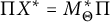
$\Pi X^* = M^*_{\Theta } \Pi $
 . This completes the proof.
For
$\alpha =(\alpha _1,\ldots , \alpha _n)\in \mathbb{Z}^n$
 , we define
$\alpha _+:=(\alpha _1^+,\ldots , \alpha ^+_n)\in \mathbb{Z}^n_+$
 and
$\alpha _-:=(\alpha _1^-,\ldots , \alpha ^-_n)\in \mathbb{Z}^n_+$
 , where
$\alpha _i^+=\text {max}\,\{\alpha _i, 0\}$
 and
$\alpha _i^-=\text {max}\,\{-\alpha _i, 0\}$
 (
$i=1,\ldots ,n$
 ). We are now ready to prove the commutant lifting theorem.
Theorem 4.7 Let
$T=(T_1,\ldots , T_n)\in \mathfrak{B}^n_0(\mathcal {H})$
 . Suppose that the isometric dilation of T is given by the BCL n-tuple
$M=(M_{\Phi _1}, \ldots , M_{\Phi _n})\in \mathfrak{B}^n_0(H^2_{\mathcal {E}}(\mathbb{D}))$
 via the dilation map
$\Pi : \mathcal {H} \to H^2_{\mathcal {E}}(\mathbb{D})$
 for some Hilbert space
$\mathcal {E}$
 , as in Theorem 3.2. If X is a contraction in
$\{T\}^\prime $
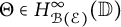
 , then there exists a contractive multiplier
$\Theta \in H^\infty _{\mathcal {B}(\mathcal {E})}(\mathbb{D})$
 such that
$M_{\Theta }\in \{M\}^\prime $
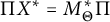
 and
$\Pi X^*= M^*_{\Theta } \Pi $
 .
Proof Since the proof uses the explicit isometric dilation of
$T\in \mathfrak{B}^n_0(\mathcal {H})$
 as constructed in Theorem 3.2, we first recall some of the necessary ingredients from the proof of Theorem 3.2. By Theorem 3.2, the Hilbert space
$\mathcal {E}$
 has the decomposition
$\mathcal {E}=\oplus ^n_{j=1}\mathcal {K}_j$
 , where
$\mathcal {D}_{T_j}\subseteq \mathcal {K}_j$
 for all
$j=1,\dots ,n$
 . The dilation map
$\Pi : \mathcal {H} \to H^2_{\mathcal {E}}(\mathbb{D})$
 is an isometry given by

The dilating BCL n-tuple M corresponds to the triple  , where
 and
 are defined as

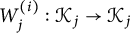
for some unitaries
$W_j^{(i)}: \mathcal {K}_j \to \mathcal {K}_j$
 satisfying

for all
$h\in \mathcal {H}$
 . Moreover, for all
$j=1,\dots ,n$
 ,

For all
$j=1,\ldots ,n$
 , we define

It is now clear that for all
$h\in \mathcal {H}$
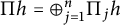
 ,
$\Pi h=\oplus _{j=1}^n \Pi _jh $
 . Suppose any contractive multiplier
$\Theta \in H^\infty _{\mathcal {B}(\mathcal {E})}(\mathbb{D})$
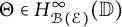 is in
$\{M\}^\prime $
 . Then, by Proposition 4.1,
$M_\Theta $
 has the form
$M_{\Theta }=\oplus _{j=1}^n M_{\Theta _j}$
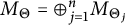 , where
$\Theta _j\in H_{\mathcal {B}(\mathcal {K}_j)}^\infty (\mathbb{D})$
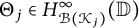 for all
$j=1,\dots ,n$
 . By the explicit form of
$M_{\Phi _i}$
 , as in 2.3,
$M_{\Theta }$
 commutes with
$M_{\Phi _i}$
 for all
$i=1,\dots ,n$
 if and only if

Moreover,
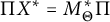
$\Pi X^*= M^*_{\Theta } \Pi $
 if and only if for all
$h\in \mathcal {H}$
 ,

Thus, by the above discussion, to complete the proof, we need to construct
${\Theta _j\in H_{\mathcal {B}(\mathcal {K}_j)}^\infty (\mathbb{D})}$
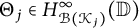 for all
$j=1,\dots ,n$
 such that (4.13) and (4.12) holds. To this end, for the rest of the proof, we fix j and find an auxiliary Hilbert space
$\mathcal {G}$
 and a contraction R on
$\mathcal {K}_j\oplus \mathcal {G}$
 such that
$\Theta =\tau _{R^*}$
 , the transfer function corresponding to
$R^*$
 . Also note that for
$\tau _{R^*}$
 to satisfy equation (4.12), by Theorem 4.5, it is sufficient to find contractions
$Y_i$
 on
$\mathcal {G}$
 such that

This is the point of departure to the construction of the space
$\mathcal {G}$
 and contractions R and
$Y_i$
 with required properties. Since X is a contraction in
$\{T\}^\prime $
 , by Theorem 4.4, there exist positive operators
$G_1, \ldots , G_n$
 on
$\mathcal {H}$
 such that

Repeated application of the second identity above yields
$T_jG_jT_j^*=P_T G_j P_T^*$
 . Now,

A rearrangement of the above identity is

We set
$\tilde {\mathcal {G}}:=\overline {\text {ran}}\, G_j^{1/2}$
 ,

Therefore, the identity 4.16 induces an isometry
$\tilde {R}:\mathcal {M} \to \mathcal {N}$
 , defined by

Again, using the identity
$G_j=T_i G_j T^*_i$
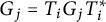 (
$i \neq j$
 ), we define an isometry for each
$i\neq j$
 ,

Since
$(\tilde {Y}_1, \ldots , \tilde {Y}_{j-1}, \tilde {Y}_{j+1}, \ldots , \tilde {Y}_n)$
 is an
$(n-1)$
 -tuple of commuting isometries on
$\tilde {\mathcal {G}}$
 , it has minimal unitary extension
$(Y_1, \ldots , Y_{j-1}, Y_{j+1}, \ldots , Y_n)$
 on
$\mathcal {G}$
 , say. We set

For the simplicity of notations, we set

The auxiliary space
$\mathcal {G}$
 and the required contractions
$Y_i$
 ’s on
$\mathcal {G}$
 are already constructed. To construct the contraction R, we take extension of
$\tilde {R}$
 , as in (4.17), in certain way so that (4.14) holds. It follows from (4.10) and (4.18) that
$\mathcal {M}$
 and
$\mathcal {N}$
 are invariant subspaces of each of the unitary
$V_i$
 on
$\mathcal {K}_j\oplus \mathcal {G}$
 with
$i\neq j$
 . Also note that for
$h\in \mathcal {H}$
 and
$i\neq j$
 ,

and on the other hand,

Thus,
$ \tilde {R} V_i|_{\mathcal {M}}=V_i \tilde {R}|_{\mathcal {M}}$
 for all
$i\neq j$
 . We consider

where
$\tilde {V}:=(V_1, \ldots , V_{j-1}, V_{j+1}, \ldots , V_n)$
 , and extend
$\tilde {R}$
 to get an operator from
$\tilde {\mathcal {M}}$
 onto
$\tilde {\mathcal {N}}$
 by the following prescription:

The extension is well-defined as

We denoted the extended operator again by
$\tilde {R}: \tilde {\mathcal {M}}\to \tilde {\mathcal {N}}$
 , and it follows from the definition that

Finally, we define the contraction R on
$\mathcal {K}_j\oplus \mathcal {G}$
 by setting
$R= \tilde {R}$
 on
$\tilde {\mathcal {M}}$
 and
$R\equiv 0$
 on
$\tilde {\mathcal {M}}^{\perp }$
 . Since
$\tilde {\mathcal {M}}$
 is a reducing subspace for
$V_i (i\neq j)$
 , we have
$RV_i=V_iR$
 for all
$i\neq j$
 . Also since
$V_j=V_1^*\cdots V_{j-1}^*V_{j+1}^*\cdots V_n^*$
 , which can be read off from (4.11) and (4.19), it follows that
$RV_j=V_jR$
 . Then by Fuglede-Putnam, we have (4.14). It only remains to prove that

where
$\Theta _j(z)=\tau _{R^*}(z)=A^*+C^*z (I-z D^*)^{-1} B^*$
 , transfer function of
$R^*$
 and

This is obtained by applying Lemma 4.6 for
$S:=T_1\cdots T_{j-1}$
 ,
$T:= P_T$
 ,
$G:=G_j^{1/2}$
 ,
$Q:=D_{T_j}$
 ,
$\Pi :=\Pi _j$
 ,
$W:=R$
 , and using 4.17. Hence, the theorem is proved.
Remark 4.8 For
$T=(T_1,\dots ,T_n)\in \mathfrak{B}^n_0(\mathcal {H})$
 and contractive X in
$\{T\}'$
 , the above theorem shows that X has a contractive lifting in the isometric dilation space of T. This in particular implies that one can find a norm-preserving lifting of X. Indeed, if
$\|X\|=1$
 , then there is nothing to prove. If
$0<\|X\| <1$
 , and if Y is a contractive lifting of
$\frac {X}{\|X\|}$
 , then
$\|Y\|=1$
 , and clearly,
$\|X\|Y$
 is a norm-preserving lifting of X.
The following result is a particular case of [Reference Sz-.Nagy and Foias31, Proposition 9.2]; we include a proof for the sake of completeness.
Proposition 4.9 Let
$(V_1,\ldots , V_n)$
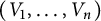 be an n-tuple of commuting isometries on
$\mathcal {H}$
 , and let X be a contraction on
$\mathcal {H}$
 such that
$X V_i=V_i X$
 for all
$i=1,\ldots ,n$
 . Then the tuple
$(X, V_1, \ldots , V_n)$
 has an isometric dilation on the minimal isometric dilation space of X.
Proof Since X is a contraction, suppose Y on
$\mathcal {K}$
 is the minimal isometric dilation of X. That is,

We define, for each
$i=1,\ldots ,n$
 ,
$\tilde {V_i}:\mathcal {K} \to \mathcal {K}$
 by

It is now enough to prove that each
$\tilde {V_i}$
 is well-defined, which readily follows from the following computation. For any
$h, h^\prime \in \mathcal {H}$
 and
$k, l\in \mathbb{Z}_+$
 with
$k\geq l$
 ,

This completes the proof.
As a consequence of Theorem 4.7 and Proposition 4.9, we have the following dilation result.
Theorem 4.10 Let
$(T_1,\dots ,T_n, T_{n+1})$
 be an
$(n+1)$
 -tuple of commuting contractions on
$\mathcal {H}$
 such that
$(T_1,\dots ,T_n)\in \mathfrak{B}^n_0(\mathcal {H})$
 . Then
$(T_1,\dots ,T_n, T_{n+1})$
 has an isometric dilation and, consequently, satisfies the von Neumann inequality.
5 Examples
In this section, we exhibit structures of tuples in
$\mathfrak{B}^n_0(\mathcal {H})$
 when
$\mathcal {H}$
 is finite dimensional. Also, we find an example to demonstrate that such a structure theorem does not hold for the general case of infinite-dimensional Hilbert space. We have pointed out earlier that if
$(T_1,T_2)$
 is a pair of commuting contractions on
$\mathcal {H}$
 such that
$T_1$
 is a co-isometry and
$T_2$
 is a pure contraction, then
$T_1T_2$
 is a pure contraction and
$\Delta ^{(1,1)}_{(T_1,T_2)}=0$
 , and therefore,
$(T_1, T_2)\in \mathfrak{B}^2_0(\mathcal {H})$
 . In fact, in the next proposition, we show that pureness of one of the contractions forces the other operators to be co-isometries and vice versa.
Proposition 5.1 Let
$T=(T_1,\ldots , T_n)\in \mathfrak{B}^n_0(\mathcal {H})$
 . Then
$T_i$
 is a pure contraction if and only if
$T_j$
 is a co-isometry for all
$j\neq i$
 .
Proof Without of loss generality, let
$T_1$
 be a pure contraction. Since
$(T_1,\ldots , T_n)\in \mathfrak{B}^n_0(\mathcal {H})$
 , then, for
$i=2, \ldots , n$
 ,
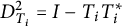
$\Delta ^{(1,1)}_{(T_1,T_i)}=D^2_{T_i}-T_1 D^2_{T_i} T^*_1=0$
 , where
$D^2_{T_i}=I-T_i T^*_i$
 . Iterating the identity k-times, we have

Using pureness of
$T_1$
 , we obtain
$D^2_{T_i}=0$
 , and therefore,
$T_i$
 is a co-isometry. Conversely, let
$T_2, \ldots , T_n $
 be co-isometries. Since
$P_T$
 is a pure contraction, for
$h\in \mathcal {H}$
 ,

This completes the proof.
It turns out that if
$\mathcal {H}$
 is finite dimensional, then any n-tuple
$(T_1, \ldots , T_n)$
 in
$\mathfrak{B}^n_0(\mathcal {H})$
 arises in this way. We first prove it for
$n=2$
 , as it is much simpler, and subsequently, we treat the general case. We denote by
$\mathbb{M}_m(\mathbb{C})$
 the space of all
$m\times m$
 complex matrices.
Proposition 5.2 Let
$(A,B)\in \mathfrak{B}^2_0(\mathbb{C}^m)$
 . Then there exist commuting pairs
$(U_1, T_1)$
 in
$\mathbb{M}_k(\mathbb{C})$
 and
$(T_2, U_2)$
 in
$\mathbb{M}_{m-k}(\mathbb{C})$
 , where
$k\le m$
 ,
$U_1$
 and
$U_2$
 are unitary, and
$T_1$
 and
$T_2$
 are matrices with no unimodular eigenvalues such that

Proof Since A and B are commuting matrices, then the pair
$(A^*,B^*)$
 can be simultaneously upper tringularizable. Suppose that

Then the joint eigenvalues of
$A^*$
 and
$B^*$
 are given by
$\{(a_{ii}, b_{ii}): i=1,\dots ,m\}$
 . Let
$v_i$
 be a joint eigenvector of norm one corresponding to the joint eigenvalues
$(a_{ii}, b_{ii})$
 . Then

This shows that either
$|a_{ii}|=1$
 or
$|b_{ii}|=1$
 . Also note that both
$a_{ii}$
 and
$b_{ii}$
 cannot have modulus one, as
$A^{*n}B^{* n}\to 0$
 in SOT as
$n\to \infty $
 . Now the result follows by rearranging all the unimodular eigenvalues of
$A^*$
 and
$B^*$
 .
Now we prove the result for any n-tuple (
$n\geq 3$
 ) of matrices in
$\mathfrak{B}^n_0({\mathbb{C}^m})$
 . Let
${A=(A_1, \ldots , A_n)\in \mathfrak{B}^n_0(\mathbb{C}^m)}$
 . Since
$(A_1, \ldots , A_n)$
 is a tuple of commuting matrices, the tuple
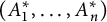
$(A_1^*,\ldots , A_n^*)$
 is simultaneously upper tringularizable. Let us assume that

Let us fix i (
$1\le i\le m$
 ). Since
$A_1^{*k}\cdots A_n^{* k}\to 0$
 in SOT as
$k\to \infty $
 and
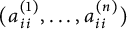
$(a^{(1)}_{ii},\ldots , a^{(n)}_{ii})$
 is a joint eigenvalues of
$(A_1^*,\ldots , A_n^*)$
 ,
$a_{ii}^{(k)}\in \mathbb{D}$
 for some
$1\le k\le n$
 .
On the other hand, for
$l\neq j$
 , a similar computation as in the proof of Proposition 5.2 reveals that

where
$v_i$
 is a joint eigenvector of norm one corresponding to the joint eigenvalue
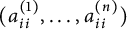
$(a^{(1)}_{ii},\ldots , a^{(n)}_{ii})$
 of the tuple
$(A^*_1, \ldots , A^*_n)$
 . The above identity implies that
$a_{ii}^{(k)}\in \mathbb{D}$
 for exactly one
$k\in \{1,\dots ,n\}$
 , and the rest are unimodular. Since this is true for all
$i=1, \ldots , m$
 , it leads to the following result.
Proposition 5.3 Let
$A=(A_1, \ldots , A_n)\in \mathfrak{B}^n_0(\mathbb{C}^m)$
 . Set
$k=\min \{n,m\}$
 . Then a rearrangement of the tuple A is unitarily equivalent to a commuting tuple
$(B_1, \ldots , B_k, W_1, \ldots , W_{n-k})$
 , where
$B_j$
 ’s and
$W_i$
 ’s are block diagonal matrices corresponding to the decomposition
$\mathbb C^m=\mathbb C^{m_1}\oplus \cdots \oplus \mathbb C^{m_k}$
 and have the form

for some matrices
$T_j$
 ’s in
$\mathbb{M}_{m_j}(\mathbb{C})$
 with no unimodular eigenvalues and for unitaries
$U^{(l)}_j (l\neq j)$
 and
$V^{(l)}_i$
 in
$\mathbb{M}_{m_l}(\mathbb{C})$
 .
It is worth mentioning here that a pair of commuting isometries
$(V_1,V_2)\in \mathfrak{B}^2_0(\mathcal {H}) $
 also has the form as in Proposition 5.2. Indeed, since
$V_1V_2$
 is pure, then
$(V_1,V_2)$
 is unitarily equivalent to a BCL pair
$(M_{\Phi _1}, M_{\Phi _2})\in \mathfrak{B}^2_0(H^2_{\mathcal {E}}(\mathbb{D}))$
 for some co-efficient Hilbert space
$\mathcal {E}$
 . Then it follows from Proposition 2.7 and (2.3) that
$(M_{\Phi _1}, M_{\Phi _2})$
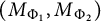 has the required form. However, Proposition 5.2 is not true for arbitrary elements in
$\mathfrak{B}^2_0(\mathcal {H})$
 when
$\mathcal {H}$
 is infinite-dimensional. We demonstrate this in the following example.
Example Let B be the bilateral shift on
$l^2(\mathbb{Z})$
 , defined by

Set
$\mathcal {E}:=l^2(\mathbb{Z})\oplus l^2(\mathbb{Z})$
 . Consider the unitary
$U:=B\oplus B$
 on
$\mathcal {E}$
 and define a projection

Let
$(M_\Phi , M_\Psi )$
 on
$H^2_{\mathcal {E}}(\mathbb{D})$
 be the BCL pair corresponding to U and P; that is,

Since
$UP=PU$
 , it follows from Proposition 2.7 that
$(M_\Phi , M_\Psi )\in \mathfrak{B}^2_0(H^2_{\mathcal {E}}(\mathbb{D}))$
 . Moreover, with respect to the decomposition
$H^2_{l^2(\mathbb{Z})}(\mathbb{D})\oplus H^2_{l^2(\mathbb{Z})}(\mathbb{D})$
 ,

For a fixed
$\lambda _0\in \mathbb{D}$
 , let us define a subspace
$\mathcal {Q}$
 of
$H^2_{\mathcal {E}}(\mathbb{D})$
 as follows:

where
$e_0=\{\ldots , 0,\mathbf {1}, 0,\ldots \}\in l^2(\mathbb{Z})$
 and
$K_{\lambda _0}$
 is the kernel function at
$\lambda _0$
 ; that is,

It is easy to see that
$\mathcal {Q}$
 is a joint
$(M_\Phi ^*, M_\Psi ^*)$
 invariant subspace. We define

Then
$(T_1, T_2)$
 is a pair of commuting contractions on
$\mathcal {Q}$
 with
$T_1T_2= P_{\mathcal {Q}}M_z|_{\mathcal {Q}}$
 . Moreover, since
$\Delta ^{(1,1)}_{(M_{\phi }. M_{\psi })}=0$
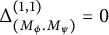 , we have
$\Delta ^{(1,1)}_{(T_1. T_2)}=0$
 . Therefore,
$(T_1,T_2)\in \mathfrak{B}^2_0(\mathcal {Q})$
 . We show below that the pair
$(T_1, T_2)$
 does not have the form as in Proposition 5.2. We divide the arguments in two cases.
Case I: We claim that neither
$T_1$
 nor
$T_2$
 is a co-isometry; equivalently, by Proposition 5.1 neither
$T_1$
 nor
$T_2$
 is a pure contraction. Without any loss of generality, suppose that
$T_1$
 is a pure contraction. Since
$K_{\lambda _0}\otimes (e_0, e_0)\in \mathcal {Q}$
 , for
$n\in \mathbb N$
 ,

This shows that
$\|T_1^{* n}\big (K_{\lambda _0}\otimes (e_0, e_0)\big )\|$
 does not converge to
$0$
 as
$n\to \infty $
 , which is a contradiction.
Case II: We show that there is no joint
$(T_1, T_2)$
 -reducing subspace
$\mathcal {Q}_1$
 of
$\mathcal {Q}$
 such that both
$T_1|_{\mathcal {Q}_1}$
 and
$T_2|_{\mathcal {Q}_2}$
 are co-isometry, where
$\mathcal {Q}=\mathcal {Q}_1 \oplus \mathcal {Q}_2$
 . Suppose on the contrary that there exists a joint
$(T_1, T_2)$
 -reducing subspace
$\mathcal {Q}_1$
 of
$\mathcal {Q}$
 so that both
$T_1|_{\mathcal {Q}_1}$
 and
$T_2|_{\mathcal {Q}_2}$
 are co-isometry. Since an arbitrary element of
$\mathcal {Q}$
 is of the form
$K_{\lambda _0}\otimes (x',y')$
 for some
$x', y' \in l^2(\mathbb{Z})$
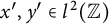 and
$\mathcal {Q}_1\subseteq \mathcal {Q}$
 , suppose that
$K_{\lambda _0}\otimes (x, y)\in \mathcal {Q}_1$
 . We claim that
$y=0$
 . Indeed, for any
$n\in \mathbb N$
 ,

Since
$M_z$
 is a pure isometry, by taking
$n\to \infty $
 in the above identity, we have
$\| (x, y)\|^2=\| x\|^2$
 , and therefore
$y=0$
 . Thus we have shown that
$\mathcal {Q}_1 \subseteq H^2_{l^2(\mathbb{Z})\oplus \{0\}}$
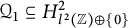 . By a similar set of arguments, along with the fact that
$T_2|_{\mathcal {Q}_2}$
 is a co-isometry, we also have
$\mathcal {Q}_2 \subseteq H^2_{\{0\}\oplus l^2(\mathbb{Z})}$
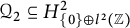 . Since
$\mathcal {Q}=\mathcal {Q}_1\oplus \mathcal {Q}_2$
 and
$K_{\lambda _0}\otimes (e_0, e_0)\in \mathcal {Q}$
 , then
$K_{\lambda _0}\otimes (e_0, 0)\in \mathcal {Q}_1$
 . Next, we claim that
$\mathcal {Q}$
 has the following orthogonal decomposition:

Indeed, note that for
$k=l$
 ,
$M_{\Phi }^{* k}M_{\Psi }^{* l}K_{\lambda _0}\otimes (e_0, e_0) = M_z^* K_{\lambda _0}\otimes (e_0, e_0)= K_{\lambda _0}\otimes \bar {\lambda }_0(e_0, e_0)$
 . Thus, we only need to show the orthogonality. Without any loss of generality, suppose that
$k>l$
 . Then

Here, we have used the fact that for
$k\in \mathbb{Z}_+$
 ,
$M_\Phi ^{* k}K_{\lambda _0}\otimes (e_0, e_0)=K_{\lambda _0} \otimes ( B^k e_0, \bar{\lambda }_0^k B^k e_0)$
 , which can be computed using 5.1. This proves the claim. Also, by the same computation as we have done above, for
$l\neq k$
 ,
$\langle M^{* k}_\Phi M^{* l}_\Psi K_{\lambda _0}\otimes (e_0, e_0), K_{\lambda _0}\otimes (e_0, 0) \rangle =0$
 . Therefore,
$K_{\lambda _0}\otimes (e_0, 0)\in \text {Span}\,\{K_{\lambda _0}\otimes (e_0, e_0)\}$
 , which is a contradiction.
Acknowledgements
The authors thank the anonymous referee for many helpful suggestions. The first author is supported by the Mathematical Research Impact Centric Support (MATRICS) grant, File No: MTR/2021/000560, by the Science and Engineering Research Board (SERB), Department of Science & Technology (DST), Government of India.
Conflict of interest
The authors states that there is no conflict of interest. No data sets were generated or analyzed during the current study.



