Clostridium difficile infection (CDI) is the most common healthcare-associated infection in the United States and is associated with significant patient morbidity, mortality, and high attributable acute care hospital costs. 1 – Reference Kwon, Olsen and Dubberke 3 Given the continued high incidence and severity of clinical outcomes associated with CDI, measures to prevent CDI are an area of ongoing interest. Current strategies for CDI prevention are focused on interrupting the cycle of transmission from individuals with CDI; however, it is important to evaluate other potential modes for C. difficile acquisition.
Although CDI is primarily associated with healthcare facilities, the precise source of C. difficile exposure is unknown. Recent studies have found that only 15%–25% of CDI cases could be attributed to ward-based or patient-to-patient transmission, indicating that there may be other sources of C. difficile acquisition in the hospital.Reference Walker, Eyre and Wyllie 4 , Reference Grundmann, Barwolff and Tami 5 A potential reservoir and source for C. difficile acquisition is the food of hospitalized patients. C. difficile has been isolated from retail foods worldwide, including ground meats, poultry, and vegetables.Reference Bakri, Brown, Butcher and Sutherland 6 – Reference Weese, Reid-Smith, Avery and Rousseau 17 The spores of C. difficile are heat-resistant and thus may have the potential to survive cooking temperatures.Reference Lund and Peck 10 Given the presence of C. difficile in food and its heat-resistant qualities, it is theoretically possible that hospitalized patients could be exposed to C. difficile from their food. We conducted a prospective cohort study with the objectives of determining whether C. difficile was present in the food of hospitalized patients and of estimating the risk of colonization associated with the presence of C. difficile in the food of hospitalized patients.
METHODS
Setting
This prospective cohort study was conducted at Barnes-Jewish Hospital (BJH), a 1,250-bed tertiary care center in St. Louis, MO, from May 9, 2011, through July 12, 2012, in conjunction with a study of C. difficile colonization in hospitalized patients.Reference Alasmari, Seiler, Hink, Burnham and Dubberke 18 , Reference Dubberke, Reske, Seiler, Hink, Kwon and Burnham 19 The study was approved by the Washington University Human Research Protection Office.
Subjects
Subjects at least 18 years old admitted to the medical and surgical wards with a projected length of stay (LOS) of at least 3 days and no diarrhea were invited to participate; all provided written, informed consent.
Data Sources and Statistical Analyses
Data collected included demographic characteristics, comorbidities, and CDI diagnoses from 1 year prior to enrollment to 1 year after enrollment. Data sources included patient interviews, medical chart review, and Medical Informatics queries. Data analyses were descriptive. SPSS, version 21 (IBM), was used. The model was implemented in NetLogo, version 5.1. R (R Foundation for Statistical Computing) was used for model parameterization and output analysis.
Specimen Collection
Stool or rectal swab specimens were collected from patients upon study enrollment, every 3 days, and at discharge. Rectal swab samples (ESwab; Becton, Dickinson) were obtained from patients unable to provide a stool specimen within 48 hours of admission or 24 hours of a postadmission specimen collection time.Reference Hink, Burnham and Dubberke 20 – Reference Kundrapu, Sunkesula, Jury, Sethi and Donskey 22
Each patient was provided with a cooler and 4 sterile specimen cups labeled breakfast, lunch, supper, or snack. Patients were instructed to place a piece of food from everything they ate into the corresponding container. If they did not eat a particular meal, no food was collected. As patients placed all components of their meal into the same container, there were multiple types of food per container.
Food specimens were transported to the laboratory and frozen at −30°C. Prior to culture, food specimens were thawed and the food types were documented. The food specimen was combined with 10 mL of sterile water and homogenized for approximately 1 minute.
Microbiological Analysis
Next, 1 mL of food homogenate was added to cycloserine-cefoxitin mannitol broth with taurocholate, lysozyme, and cysteine (CCMB-TAL; Anaerobe Systems), and the broth was subcultured to pre-reduced blood agar (Becton, Dickinson) as previously described.Reference Hink, Burnham and Dubberke 20 C. difficile in food was quantified by weighing initial specimens, processing via heat shock, plating onto a pre-reduced blood agar plate, then streaking for isolation. Colonies per gram of food were calculated. Additionally, food was diluted in CCMB-TAL broth in a series of five 10-fold dilutions to approximate the burden of C. difficile. C. difficile negative and positive controls were included with every set of cultures to monitor for contamination. Ribotyping was performed on all C. difficile isolates as previously described.Reference Westblade, Chamberland and Maccannell 23
Stool and rectal swabs were cultured for C. difficile using CCMB-TAL according to methods previously published.Reference Hink, Burnham and Dubberke 20 Isolates were evaluated for the presence of tcdA, tcdB, and binary toxin genes (cdtA/cdtB) by multiplex polymerase chain reaction as previously described.Reference Alasmari, Seiler, Hink, Burnham and Dubberke 18 Isolates were also characterized by polymerase chain reaction ribotyping for strain comparison.Reference Westblade, Chamberland and Maccannell 23
Model Overview
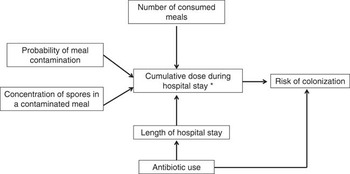
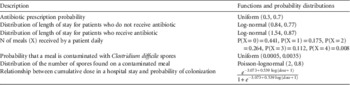
To estimate the risk of C. difficile acquisition associated with exposure to C. difficile-contaminated food during a hospital stay, we developed a stochastic, individual-based model that simulated the flow of patients admitted to BJH, antimicrobial exposures, number of meals eaten per day, and concentration of C. difficile in food (Figure 1). A formal description of the model, code, and parameters is available at http://www.lanzaslab.org/research/cdifficile#food. The hospital model simulated the 171 BJH general medicine hospital ward beds. Each patient was followed from admission to discharge. On admission, each patient was assigned a LOS. LOS depended on whether the patient received antibiotic treatment based on the distribution of LOS from 11,046 admissions from these wards to several distributions using maximum likelihood methods.Reference Delignette-Muller and Dutang 24 On the basis of these data, antibiotic use was used as a marker for longer LOS. Antibiotic use was also a marker for susceptibility to C. difficile colonization. The log-normal distribution, which provided the best fit, was used to parameterize LOS (Table 1).
Exposure assessment in study of Clostridium difficile in the food of hospitalized patients. *Cumulative dose calculated by total number of spores present in all contaminated meals eaten in a hospital stay.

Summary of Functions and Probability Distributions for the Exposure Model

NOTE. The parameters needed to characterize the probability distributions are indicated between brackets. For the uniform distribution (a,b): a is the minimum value and b is the maximum value. For the log-normal and Poisson-lognormal distributions (µ, σ): µ is the log mean and σ is the log standard deviation.
The number of meals consumed by a patient daily and the probability that a meal was contaminated were based on this study’s results (Table 1). A Poisson log-normal distribution was used to simulate the number of spores per contaminated meal. This distribution is often used to describe microbial counts.Reference Gonzales-Barron and Butler 25 The parameters of the distribution were chosen to generate a mean number of spores of approximately 10 colony-forming units/gm because this was the limit of detection of the culture methods. Data from a clinical trial in which healthy adults received escalating doses of nontoxigenic C.difficile spores were used to estimate the probability of C. difficile colonization upon dose exposure.Reference Villano, Seiberling, Tatarowicz, Monnot-Chase and Gerding 26 We used logistic regression to model the data from study subjects in cohort 4 who received 5 days of pretreatment with oral vancomycin before receiving a daily dose of 1×10⁴, 1×10⁶, or 1×10⁸ spores for 14 days. Because of the repeated measurements on the same subjects, the binary correlated data were analyzed by means of the generalized estimating equationReference Hosmer, Lemeshow and Sturdivant 27 as implemented in package geepack in R.Reference Halekoh, Hojsgaard and Yan 28
The model was iterated 5,000 times to assure output convergence. Each iteration simulated the patients’ admissions to the wards for 1 year. In each iteration, model inputs described as probability distributions were sampled and fed to the model. The model outcomes were the number of patients exposed to C. difficile through food and the number of colonization events due to food exposure per 1,000 admissions.
RESULTS
Enrollment and Demographic Characteristics
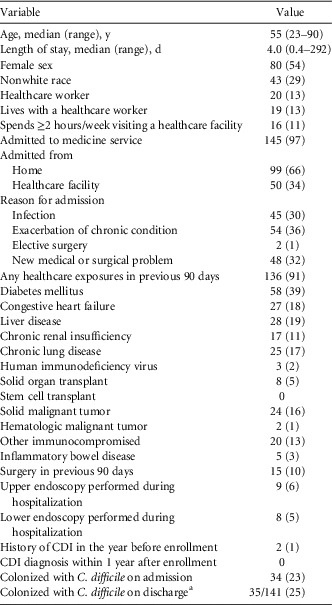
A total of 149 patients were enrolled, and food specimens from 910 meals were obtained and cultured for C. difficile. Patient characteristics are in Table 2. Most patients had healthcare exposures within the previous 90 days (136 [91%]), but only 2 patients had a history of CDI within the previous year (none within 60 days prior to enrollment).
Characteristics of 149 Patients in Study of Clostridium difficile in the Food of Hospitalized Patients

NOTE. Data are no. (%) of patients unless otherwise indicated. CDI, C. difficile infection.
a Discharge colonization status was unknown for 8 patients (5%).
Food Cultures
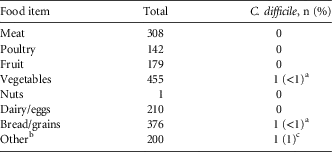
Toxigenic C. difficile was recovered from 2 food specimens from 2 separate patients, representing 0.2% of food cultures and 1.3% of patients (Table 3). The food items that tested positive were a gelatin dessert (ribotype 001) and a sample consisting of vegetables/bread/grains (ribotype 027). The concentration of C. difficile spores recovered from the positive food samples was less than or equal to 10 colony-forming units/mL. C. difficile was successfully recovered from all positive controls, and there was no growth in any of the negative controls.
Types of Food Positive for Clostridium difficile, by Food Type, for 910 Meals

NOTE. Percentages are percent of positive samples / all food items of that type. As patients placed all components of their meal into the same container, there were multiple types of food per container.
a The positive specimens for vegetables and bread/grains were combined in a single specimen cup.
b For example, veggie burger, sauce/gravy, pudding, jelly, fish, cake.
c Gelatin dessert.
C. difficile Colonization and CDI
Neither of the 2 patients exposed to C. difficile in food was colonized at baseline with C. difficile. A discharge stool specimen was available for 1 of the 2 patients and was negative. Neither was diagnosed with CDI during their hospitalization or during the year before or after study enrollment. No patients in the study developed CDI within a year of discharge.
Exposure Modeling
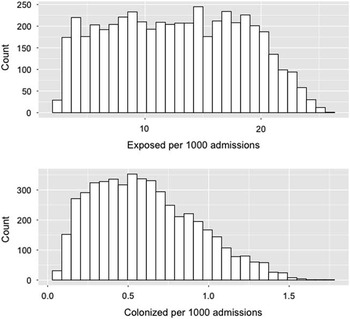
A summary of the functions and probability distributions for the exposure model are detailed in Table 1. On 44.1% of days, no meals were eaten; on 17.5% of days 1 meal was eaten; on 26.4% of days 2 meals were eaten; on 11.2% of days 3 meals were eaten; and on 0.8% of days 4 meals were eaten. Reasons for missing meals were variable but included instructions to take nothing by mouth in preparation for an upcoming procedure(s) or lack of appetite. The mean number of patients who were exposed to C. difficile through food was 12.70 per 1,000 admissions (95% CI, 12.542–12.858). The minimum and maximum simulated values were 2.34 and 25.85 exposed patients per 1,000 admissions, respectively (Figure 2). The mean number of predicted colonization events was 0.609 per 1,000 admissions (95% CI, 0.600–0.618), and the median number was 0.57. The minimum and maximum simulated colonization events were 0.04 and 1.73 per 1,000 admissions, respectively (Figure 2).
Histograms for the simulated number of patients exposed to Clostridium difficile in food and colonization events due to exposure to C. difficile spores in food. Counts are the number of exposed and colonized patients in each histogram bar.

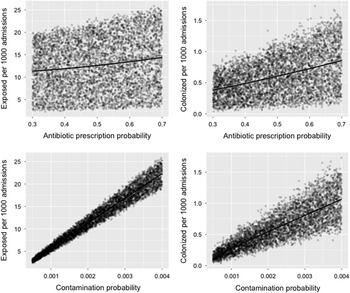
Both the predicted number of exposed and the predicted number of colonized patients were highly influenced by the probability of meal contamination (Figure 3). A 0.1% increase in the probability of meal contamination resulted in an increase of 5.5 exposures and 0.26 colonization events per 1,000 admissions (Figure 3). Overall, the simulated number of spores in contaminated food was low, reflecting the low counts recovered from hospital food. As a result, on average fewer than 5% of the patients exposed to C. difficile became colonized. Antibiotic prescription probability had a marginal effect on the number of predicted exposed and colonized patients compared with probability of meal contamination (Figure 3).
Scatterplots between the hospital-level variables (antibiotic prescription and meal contamination probability) and model outcomes (number of exposed and colonized patients per 1,000 admissions). The points indicate individual simulations (total number of simulations=5,000) and the line indicates the linear trend between variables.

DISCUSSION
In this study of C. difficile in the food of hospitalized patients, recovery of toxigenic C. difficile was rare, with only 0.2% of food specimens testing positive for C. difficile with a low estimated concentration (≤10 colony-forming units/mL). Stated differently, 1.5% of patients ingested food from which C. difficile was recovered. On the basis of this finding, theoretically hundreds of hospitalized patients could be exposed to C. difficile from food and develop CDI every year at BJH, which in 2014 alone had more than 53,300 inpatient admissions. Thus, our objective was to model the likelihood of C. difficile acquisition from food in the hospital setting. Using a similar modeling framework based on BJH data, we previously predicted that on average there were approximately 100 new colonization events per 1,000 admissions.Reference Lanzas and Dubberke 29 In this study, we found that at less than 1 new colonization event per 1,000 admissions, C. difficile acquisition linked to contaminated food was likely uncommon. The results of the modeling indicate that acquisition of C. difficile from food is likely a rare event at BJH and that the food of hospitalized patients was not a significant source of new C. difficile colonization.
Most previously published studies of C. difficile in food have focused on retail meat products, with prevalence rates reported in Europe and Canada ranging from 2.7% in chicken and 4.3%–20% in beef/pork, and with rates in US studies greater than 40% (ground meats).Reference Gould and Limbago 8 , Reference Lund and Peck 10 – Reference Rodriguez-Palacios, Reid-Smith and Staempfli 12 The presence of C. difficile in foods of non-animal origin (eg, fruits, vegetables, grains) has not been fully explored, with a Scottish study indicating that 7.5% of salads and a French study reporting 2.9% of raw vegetables were contaminated with C. difficile.Reference Bakri, Brown, Butcher and Sutherland 6 – Reference Gould and Limbago 8 These previous studies were based on singular food types, rather than a mixture of foods that constitute a meal that a patient might eat. In our study, we included all food that the patient would be consuming during that meal, which would better represent a hospitalized patient’s actual C. difficile exposure.
Although we were able to recover C. difficile from the food of hospitalized patients, this does not equate directly to C. difficile being a foodborne pathogen in the healthcare setting. The source of contamination is not known; contamination may have occurred at the food source (farm, factory), food handler, food transporter, and/or from the patient handling the food. The results of our study are consistent with those of Rodriguez et al,Reference Rodriguez, Korsak and Taminiau 13 who found C. difficile in less than 1% of food samples collected from the kitchens of a Belgian nursing home. C. difficile was isolated from only one meal sample composed of pork sausage, mustard sauce, and carrot salad.Reference Rodriguez, Korsak and Taminiau 13 Together, our study and the Rodriquez study suggest that C. difficile is present in hospital foods but at lower rates compared with retail foods. The reason for this discrepancy is unclear. Although C. difficile spores can survive cooking temperatures, it is possible that soaking, washing, and/or cooking food reduces the C. difficile burden and may have accounted for this difference.Reference Lund and Peck 10
This study had limitations: it was a single-center study, and results may not be generalizable to all institutions. Regarding specimen collection, patients placed food into containers for culture, potentially introducing variability. However, this provided a practical method of obtaining food samples that were actually consumed by the patient. There are no data available to indicate whether or not C. difficile is evenly distributed in food. Thus the amount of food included in each food culture may have impacted our findings, especially in the setting of a low contamination burden. In previously published studies the amount of food cultured varies widely, from 1 g samples to complete pieces of meat.Reference Songer, Trinh, Killgore, Thompson, McDonald and Limbago 14 , Reference Weese, Reid-Smith, Avery and Rousseau 17 Previous studies were limited to specific food types; however, this study focused on the variety of foods that a patient ingests per meal, providing a more realistic estimate of a patient’s entire meal.
A strength of our study was the collection of food that was actually consumed, rather than a single food type. In the studies of retail food products, the food would have likely been washed and/or cooked prior to consumption; therefore the prevalence of C. difficile detected may not represent what individuals would have consumed. Additional strengths include the collection of clinical data to examine CDI in the year after enrollment and culture of food specimens along with the culture of stool specimens throughout the patients’ hospitalizations. This allowed us to link C. difficile food contamination with acquisition. Our laboratory standards were rigorous, and we included both positive and negative controls to ensure against laboratory contamination.
C. difficile is a ubiquitous organism, and only a minority of new C. difficile acquisitions in the hospital have been linked to another patient with CDI.Reference Walker, Eyre and Wyllie 4 , Reference Grundmann, Barwolff and Tami 5 , Reference Fekety, Kim, Brown, Batts, Cudmore and Silva 30 , Reference McFarland, Mulligan, Kwok and Stamm 31 Therefore, understanding all potential sources of C. difficile exposure in the hospital is necessary to inform prevention measures for CDI. Our findings indicate that food is unlikely to be a significant source of C. difficile acquisition in hospitalized patients. Towards the goal of CDI prevention, future studies aimed at understanding modes of C. difficile transmission and acquisition are necessary.
ACKNOWLEDGMENTS
Financial support. National Institute of Diabetes and Digestive and Kidney Diseases (grant P30DK52574); the Washington University Institute of Clinical and Translational Sciences (grant UL1TR000448, sub-award KL2TR000450, from the National Center for Advancing Translational Sciences of the National Institutes of Health, to J.H.K.); and the joint National Science Foundation/ National Institute of General Medical Sciences Mathematical Biology Program (grant R01GM113239 to C.L.).
Potential conflicts of interest. C.-A.D.B. reports that she has received research support from bioMérieux, Cepheid, and Accelerate Diagnostics. E.R.D. reports that he has been a consultant to Sanofi Pasteur, Merck, Summit, Alere, Valenva, and Rebiotix. All other authors report no conflicts of interest relevant to this article.
Disclaimer: The content is solely the responsibility of the authors and does not necessarily represent the official view of the National Institutes of Health.