Introduction
Philo of Larissa (159/158 or c. 147–84/83 BC) was the last distinguished representative of the so-called sceptical Academy.Footnote 1 He succeeded Clitomachus as scholarch in 110/109 BC and fled from Athens to Italy on the eve of the Mithridatic War and Sulla's siege of Athens (88 BC). In Italy, Philo lectured on philosophy and attracted a lot of young noblemen, among them Cicero.Footnote 2 A lot of valuable information about Philo's life can be found exclusively in the final columns of Philodemus' Index Academicorum (PHerc. 1021, col. 33.34). Although several improvements that could be made to the text since Dorandi's edition (1991) have been published,Footnote 3 a fragmentary passage between the report of Philo's death and the mention of a person who obviously succeeded or deputised him during his absence continues to represent a puzzle to scholars (cols. 33.44–34.2). This is all the more regrettable if we take into consideration that the content of these lines could have a significant impact on the suggested supplements in the surrounding context, and the whole syntax. In any case, the lines seem to contain a pivotal statement about either Philo or another Academic.
So far, the passage in Dorandi's standard edition, modified by some subsequent improvements, reads as follows:Footnote 4
Philodemus, Index Academicorum (PHerc. 1021), cols. 33.42–34.7:
col. 33 |42 __ ̣ ̣[ ̣] ̣ ̣[ ̣]τωσεις. βιώσας [[ ( ̣)| ̣ ̣ω̣ ̣( ̣)]] δ̣᾿ ἑξήκοντ᾿ ἔτη `καὶ τρ̣ία´κ̣α̣τ̣έ|σ̣τ̣ρεψε̣ν ἐπὶ Νικήτου [κατ᾿|45 ᾿Ιτ]αλ̣ίαν ἐν τῶι τ[ρ]ίτωι ΠΡΟ̣|| col. 34 [ ̣ ̣] ̣ Υ̣ΠΕΝΗΓ̣ [̣] ἐπιδραμὼ[ν ̣ ̣| ̣ ̣ ̣]Τ̣ΑΡΡΩΙ. καὶ τὴν σχολὴ[ν] | αὐτοῦ Π̣ ̣ ̣ ̣[̣]Ο̣Σ Ο̣ Μ̣ΑΙΚΙΟΣ, ἐ|φ᾿ ἡ[[α]]`μων´Ἀθήνησ̣ι̣ν̣ π[αρ]α̣βαλόν|5των ἐξ Ἀ[λ]εξανδρείας|, κ̣α[ὶ] διακατ̣εῖχεν. ἦσαν|7 δ᾿ αὐτοῦ (i.e. Philo) μαθ[η]ταὶ κτλ.
_____________________________________________________________________
col. 33: 42–4 legi et supplevi 42–5 [ ̣ ̣ ̣]τωσεις. βιώσας δ̣᾿ [ ̣ ̣] | [καὶ] ἑξήκοντ᾿ ἔτη κατέστρε|[ψε]ν ἐπὶ Νικήτου [- - -| ̣ ̣] ̣ Ι̣ΑΝ ἐν τῶι τ[ρ]ίτωι Τ[- - -|| Dorandi; [ἕξ|? Dorandi; [ ̣ ̣ ̣]τώσεις. βιώσας δ̣᾿ [εννέα] | κ̣α̣[ὶ] ἑξήκοντ᾿ ἔτη`̣ ̣ ̣ ̣ ̣ ̣ ̣ ̣Α´ [ ̣ ̣ ̣ ̣ἀπ]έ|[θανε]ν ἐπὶ Νικήτου [κατ᾿| Ἰτ]αλ̣ίαν ἐν τῶι τ[ρ]ίτωι προ̣ Puglia
col. 34: 1–2 [ ̣ ̣] ̣ Υ̣ΠΕΝΗΓ̣ [ ̣] ἐπιδραμὼ[ν ̣ ̣| ̣ ̣ ̣]Τ̣ΑΡΡΩΙ. Puglia; [ ̣ ̣] ̣ Υ̣ΠΕΓ̣ΗΓ̣[ ̣] ἐπιδραμὼ[ν ̣ ̣| ̣ ̣ ̣]. ΑΡΡΩΙ Dorandi 3 Μαίκιος Dorandi; Ο̣Μ̣ΑΙΚΙΟΣ Puglia 4 Ἀθήνησ̣ι̣ν̣ Puglia
Having lived for 63 years, he (sc. Philo) died under the archonship of Niketes (84/83 BC) in Italy in the third … and his school … (and?) in charge of it when I (sc. Philodemus) arrived in Athens coming from Alexandria. His (sc. Philo's) disciples were …
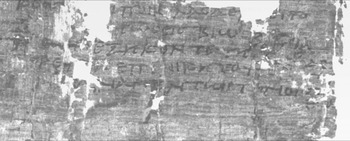
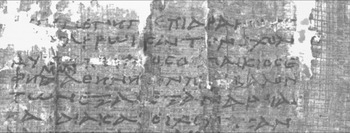
The papyrus tells us that Philo died at the age of 63 under the archon Niketes, who can be securely dated to 84/83 BC. Puglia (Reference Puglia2000) was the first to suggest the supplement/reading ‘Italy’. This suggestion is in accordance with all other sources, which do not report that Philo ever returned to Greece. An unknown person was in charge of Philo's school when Philodemus arrived in Athens. The lines in between (cols. 33.45–34.2) and especially the ordinal number (third) remain obscureFootnote 5 (see Figs. 1–3 Footnote 6 ).
Cols. 33.41–5.

Col. 34.1–6.

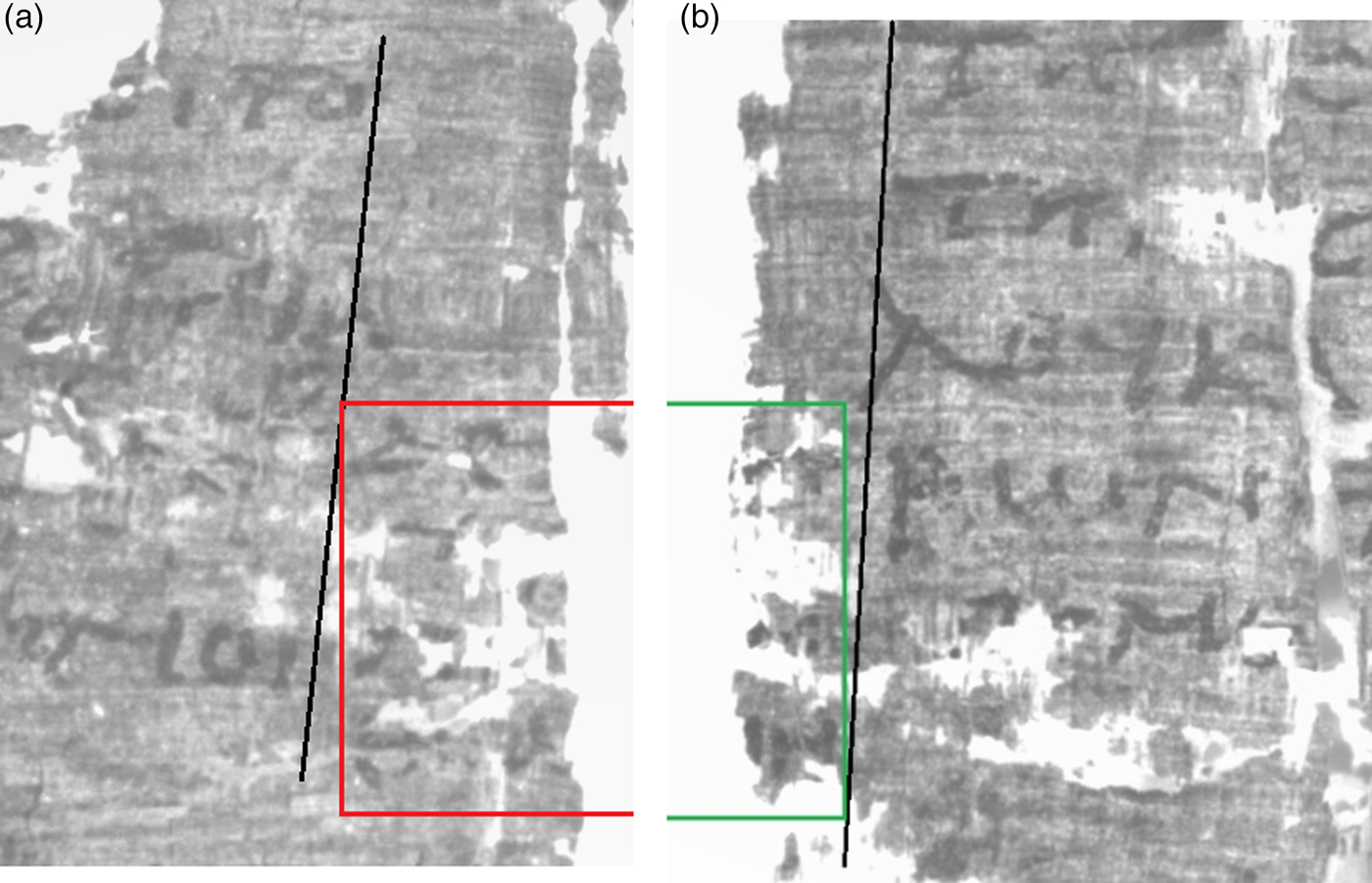
(a). Col. 33 lines 41–5 (end of lines), Cornice 7; (b). Col. 34 lines 42–5 (start of lines), Cornice 8. The square embraces an intercolumnar insertion. The slightly oblique lines mark the endings or the beginnings of the lines of the main text.

New transcription and translation (PHerc. 1021, cols. 33.42–34.7)
First, it is crucial to state that the digital images printed here (Figs. 1–3) reveal a detail for restoring these lines which editors have not taken notice of so far. Undoubtedly, a kind of intercolumnar supplement was inserted at the right-hand margin of col. 33.44–5. Previous editors erroneously believed that parts of this insertion belonged to the main column line 45, which complicated the possible reconstruction of the whole passage.Footnote 7 Insertions such as this occur at other passages in PHerc. 1021, which represents Philodemus' preliminary working draft, not the final version of the treatise.Footnote 8 The letters belonging to the insertion are slightly dislocated relative to the level of the lines of the main text and should not mistakenly be regarded as belonging to the main text, which is what scholars have done so far. My transcription of the intercolumnar insertion is as follows:
1 (ad marg. 44) δ̣ε̣ ( ̣) ̣
2 (ad marg. 44) ̣ ̣ ̣[ ̣( ̣)]
3 (ad marg. 45) ̣ ̣ ̣ ̣( ̣)
4 (ad marg. 45) ̣ ̣ ̣ ̣ν̣
_____________________________________________________________________
4 prima littera ε aut θ esse videtur; tertia littera fortasse α aut λ
The hypothesis that the insertion has some relation to the doublet reporting the death of Philo twice (col. 33.17–19 and 42–4) seems attractive. If ‘63 years’ was not the correct age,Footnote 9 one could think about an adjustment or additional information. However, the traces of the insertion do not support such an assumption.Footnote 10 Therefore, the insertion was perhaps an element corresponding to the bracket(s) drawn along lines 19–21,Footnote 11 and was made in order to ensure that Philo's death would not be reported twice in the final version of the Index Academicorum.
I transcribe π̣ε̣ρὶ at the end of line 44 of the main text and τ̣[ὴ]ν̣ at the beginning of line 45.Footnote 12 The phrasing περὶ τὴν Ἰταλίαν occurs dozens of times in ancient literature and often simply means ‘in (around) Italy’, synonymous with κατὰ τὴν Ἰταλίαν.Footnote 13 It could be that Philodemus or his source used that particular preposition in order to convey that they did not know the exact place where Philo had died or that he had died in the countryside.
The Greek letter sequence αρρωι is quite rare and turns out to be the key for restoring the whole passage. I could not find any personal name or place including this combination of letters and fitting the context. The letters are readable very clearly and no signs of correction can be detected; the lacunose context should prevent us from assuming a misspelling and arbitrarily correcting the fragmentary text (a methodological principle known as Youtie's law). Among the very few Greek words allowing for the ending -αρρωι only the reading/supplement [κα]τ̣άρρωι matches the requirements of space and context. The further restoration of the lines will illuminate what exactly is meant by [κα]τ̣άρρωι.
The presumed syntax was obviously responsible for Mekler's/Dorandi's reading of the nominative ἐπιδραμὼ[ν in col. 34.1.Footnote 14 Yet, there is no clear ω, and the dative ἐπιδραμό̣ν̣τ̣[ι] is perfectly compatible with the traces.Footnote 15 It is justified by the accusative I have read/supplemented in cols. 33.45 and 34.1: ἐν τῶ̣ι τὴ̣ν οἰ||[κ]ο̣υμένην̣.Footnote 16
The personal name in col. 34.2 might be Polus (Π̣ῶ̣λ̣ος), but the traces are difficult to discern and it is often dubious whether we are dealing with tiny sovrapposti (misplaced layers of the papyrus), ink or just dark fibres. Regardless of the uncertainty of the personal name, I find attractive Puglia's proposal to resolve the letters at the end of the line into ο[ἶ]μ̣αι, Κῖος, an issue that will be discussed below.Footnote 17
At the beginning of line 4 the letter cancelled seems to have been a ν and not an α.Footnote 18 In lines 4–5 I transcribe the participle πρ̣ο̣[σ]βαλόν|των. Traces and space are hardly compatible with the word παραβαλόντων, to be found in all previous editions.Footnote 19 In line 6 the transcription ἤ̣δη̣ is possible and fits the syntax much better than καὶ.Footnote 20
Before offering a closer analysis and interpretation of the new readings, I present below a new transcription and translation of the whole passage:
Philodemus, Index Academicorum (PHerc. 1021), cols. 33.42–34.7:
col. 33 42 βιώσα[ς] [[ ̣ ̣| ̣ ̣ω̣ ̣( ̣) ] ] `δ̣᾿´ ἑξήκοντ᾿ ἔτη `καὶ τρ̣ία´ κ̣α̣τ̣έ|σ̣τ̣ρεψε̣ν ἐπὶ Νικήτου π̣ε̣ρ̣ὶ|45 τ̣[ὴ]ν̣ ᾿Ι̣τ̣α̣λ̣ίαν ἐν τῶ̣ι τὴ̣ν οἰ|| col. 34 [κ]ο̣υμένην̣ ἐπιδραμό̣ν̣τ̣[ι] | [κα]τ̣ά̣ρρωι· καὶ τὴν σχολὴ[ν] | αὐτοῦ π̣ ̣ ̣[ ̣]ο̣σο[ ̣]μ̣αικιος ἐ|φ᾿ ἡ[[ν̣]]`μων´ Ἀθήνησ̣ι̣ν̣ πρ̣ο̣[σ]βαλόν|5των ἐξ Ἀ[λ]εξανδρείας|, ἤ̣δη̣ διακατ̣εῖχεν. ἦσαν|7 δ᾿ αὐτοῦ μαθ[η]ταὶ κτλ.
_____________________________________________________________________
col. 33: 43 `καὶ τρ̣ία´ legi 44 π̣ε̣ρ̣ὶ legi; κατὰ Puglia 45 legi et supplevi 44–5 supplementum quattuor linearum dextra margine scriptum: |1 marg. 44 δε̣ ̣( ̣) ̣|2 marg. 44 ̣ ̣ ̣ [ ̣( ̣)]|3 marg. 45 ̣ ̣ ̣ ̣( ̣)|4 marg. 45 ̣ ̣ ̣ ̣ν̣| id supplementum primum cognovi et legi
col. 34: 1 legi et supplevi 2 [κα]τ̣ά̣ρρωι supplevi 3 initio lineae fortasse Πῶ̣λ̣ος; ο[ἶ]μαι, Κῖος conieci, iam Puglia de ea divisione dubitanter cogitavit; Μαίκιος Dorandi 4 ἡ[[ν̣]]`μων´ legi; ἡ[[α]]`μων´ Dorandi/Puglia; Ἀθήνησ̣ι̣ν̣ Puglia 4–5 πρ̣ο̣[σ]βαλόντων legi/supplevi sequens Blank; π[αρ]α̣βαλόντων omnes editores 6 ἤ̣δη̣ legi; κ̣α[ὶ] Dorandi/Puglia
Having lived for 63 years, he (sc. Philo) died under the archonship of Niketes (84/83 BC) in the land of Italy by an influenza (catarrh) which spread then over the entire world. And his school already had (name dubious) in charge of it when I (sc. Philodemus) arrived (by ship) in Athens, coming from Alexandria. His (sc. Philo's) pupils were …
Philo's death during a catarrh (influenza) wave
The catarrh was a common illness in antiquity and the newly read passage obviously says that Philo died in the course of a catarrh wave spreading over the entire world. Since Philodemus (Apollodorus) reports in the Index Academicorum on other occasions that certain philosophers died from illness (or withdrew because of it),Footnote 21 a statement about the exact circumstances of Philo's death is not unexpected at all. The term κατάρρους (lat. destillatio) embraces a range of symptoms or illnesses, among them what in modern times would be typically called a cold or flu.Footnote 22 Philostratus gives us some evidence that the term catarrh was not only used to describe a chronic and, as it were, individual illness, but also an influenza-like epidemic:
Philostratus, Vita Apollonii 4.44: ἐμπεσόντος δὲ ἐν Ῥώμῃ νοσήματος, ὃ κατάρρουν οἱ ἰατροὶ ὀνομάζουσιν, ἀνίστανται δὲ ἄρα ὑπ' αὐτοῦ βῆχες καὶ ἡ φωνὴ τοῖς λαλοῦσι πονήρως ἔχει, τὰ μὲν ἱερὰ πλέα ἦν ἱκετευόντων τοὺς θεούς, ἐπεὶ διῳδήκει τὴν φάρυγγα Νέρων καὶ μελαίνῃ τῇ φωνῇ ἐχρῆτο …
Rome had an attack of the illness called by the doctors catarrh. It causes a cough and talking makes the voice hoarse. The sanctuaries were full of people praying to the gods, since Nero's throat was swollen and his voice was thick …Footnote 23
No doubt, Philostratus uses the term κατάρρους for a viral disease associated with cough and hoarseness and affecting a lot of people at the same time. Consequently, there is good reason to identify this ancient κατάρρους with what we would nowadays call influenza.Footnote 24 The (possible) endemic character of the κατάρρους, as attested by Philostratus (ἐμπεσόντος δὲ ἐν Ῥώμῃ νοσήματος), has a parallel in Philodemus' phrasing τὴν οἰκουμένην ἐπιδραμόντι. The participle must mean something like ‘to spread over’ or, even more dramatically, ‘to rage over’.Footnote 25 The localisation οἰκουμένην should not be taken too literally. Philodemus might only wish to indicate that this catarrh (influenza) wave affected some major cities in the Mediterranean area (e.g. Rome, Athens, Alexandria), not the ‘entire (Mediterranean) world’ in a strict sense.Footnote 26 Maybe Philo's health had already weakened when he was affected with the catarrh and/or the influenza virus was very aggressive.
It is true that the information τὴν οἰκουμένην ἐπιδραμόντι could simply emphasise that it was not a chronic catarrh of which Philo died; however, the explicit mention of the worldwide character of this catarrh would not be strictly necessary in such a case.Footnote 27 Hence, the information could imply that Philodemus or his source (or both) were directly or indirectly affected by the influenza wave and therefore remembered it as a shocking experience (note the definite article: ἐν τῶι … κατάρρωι, ‘during the (well-known) worldwide catarrh’). The possible οἶμαι in col. 34.2 and the self-reference in col. 34.3 and 4 might suggest that Philodemus had not copied the (whole) account of Philo’ death from another work, but rather embedded information based on his own experience (oral tradition). Although Philodemus' biography of Philo depends primarily on a written source, he may have relied on an oral source for the information about the catarrh or added the information on the worldwide spread of the disease.Footnote 28 Philodemus was most probably in Athens when this catarrh or influenza spread over the world (84/83 BC). The outbreak could be related to Sulla's military campaigns: we know of plagues in Rome during Marius and Cinna's attack on the city in 87 BC and in Athens at the same time as Sulla's siege.Footnote 29 The otherwise missing attestation of this particular catarrh (influenza) wave referred to by Philodemus should not be seen as problematic or as calling the new reading into question. Thus, for instance, Philostratus is our only source for the Neronian catarrh (influenza) wave and epidemics were quite common in antiquity, so that often no (or just one) source reports them, in particular when the number of victims was not extraordinarily high. Accordingly, it should not surprise us that the catarrh wave leading to Philo's death is not mentioned by any other author, especially if we consider that the overall number of victims, notwithstanding a possibly high rate of infection, might not have been remarkable and Philodemus' (or his source's) reference could have only been motivated by its relatively recent occurrence and/or his being personally affected by it.
There is some touch of tragic irony in the fact that Philo, seeking to escape war and distress, had left Athens for Italy and then died in this country just a few years later from an influenza epidemic. The new reading reveals that his death was to some extent premature and not strictly due to old age.Footnote 30
Some remarks on Philo's ‘successor(s)’
Both Mekler and Dorandi transcribe Μαίκιος in col. 34.3, assuming the rare Roman name Maecius, but, apart from the general improbability that a philosopher with a Roman name led the Academy in the first century BC, the sequence of the preceding legible letters practically rules out this possibility.Footnote 31 As already remarked above, the name of the person in charge of the Academy after Philo had left Athens or passed away might be Polus (Π̣ῶ̣λ̣ος), but this is far from certain.Footnote 32 Puglia suggested the sophisticated transcription οἶμαι, Κῖος which I approve of, not least because of the absence of alternatives, but the fragmentary status of the surrounding context prevents me from putting this attractive division/supplement in the text. Yet Puglia seems to be mistaken about associating the ethnicon with the Bithynian city of Cius.Footnote 33 By Philodemus' time Cius (Κίος) had already been renamed as Prusias on the Sea, and although the ethnicon Κῖος was occasionally used for the inhabitants of Bithynian Cius, other ethnica were more common.Footnote 34 For that reason it seems more plausible to suggest that the ethnicon Κῖος probably derives from the Cycladic island Κέως (Lat. Ceos, modern Kea, ethnicon Κεῖος, but occasionally also Κῖος, the spelling in the papyrus, which might be due to iotacism).Footnote 35
If we accept ‘οἶμαι, Κῖος’, Philodemus' restrictive ο[ἶ]μαι in col. 34.3 might be interpreted to the effect that the philosopher mentioned here was not a distinguished successor of Philo but merely a ‘leftover’ of the formerly glorious sceptical Academy, whose geographic origin Philodemus could barely tell.Footnote 36 In any case, the otherwise missing attestation of this person may suggest that he was more a kind of mediocre administrator rather than a renowned leader of the school. The site of the Academy may have suffered serious damage during Sulla's siege of Athens,Footnote 37 and from the fact that Philo never returned to Athens we might draw the conclusion that the sceptical Academy in Athens virtually ceased to exist, although some less distinguished followers may have tried to rescue Philo's heritage without great success and could claim to be his ‘successors’. To be sure, Philodemus uses the verb (δια)κατ̣εῖχεν for leading a philosophical school,Footnote 38 but it is doubtful whether the philosopher mentioned in line 3 really continued teaching Academic scepticism in a way that had any strong impact on the philosophical life in Athens. The assumption of a mediocre and unimportant institutional successor of Philo would be in accordance with Sedley's understanding of Cic. Fin. 5.6, which he thinks might imply still on-going sceptical lectures in 79 BC, and at the same time in accordance with Polito's rejection of this possibility, inasmuch as these lectures hardly attracted many people or were considered as a good alternative to Antiochus.Footnote 39 The last remaining ‘Academic’ (in a broader sense) of high reputation in Athens seems to have been Antiochus, who taught in the Ptolemaion. Cicero attended his lectures as he was apparently the most famous ‘Academic’ philosopher in Athens after Philo had left/died. It is telling that Philodemus himself was a personal friend of Antiochus and of some of his pupils, but not of the Philonian Academics, a school which obviously lost any significance and virtually died out. One could say that Antiochus became Philo's de facto (not institutional) successor in Athens, insofar as he was the last remaining philosopher of some reputation in Athens who claimed to be an ‘Academic’Footnote 40 and taught Old Academic, non-sceptical philosophy – but still ‘Academic’ philosophy – in his own school. Brittain regards Philo as the last of the Academic Sceptics and thinks of Antiochus as his institutional successor,Footnote 41 while taking account of the controversy of this issue.Footnote 42 However, the passage in the papyrus seems to imply that Antiochus was not Philo's officially elected successor in a strictly institutional sense. Philo's actual institutional successor was hardly a famous philosopher, but rather a negligible figure whose activities were completely overshadowed by the fame of Antiochus and his Old Academy, so that Antiochus, being a former pupil of Philo and lecturing successfully, was commonly regarded as the ‘real’ successor of Philo and (in later times) mistakenly or imprecisely also believed to be his institutional successor.Footnote 43
Some remarks concerning Philodemus' arrival in Athens
I have argued in some detail that col. 34.4 and 5 provide information that Philodemus went from Alexandria to Athens. This view is also shared by the majority of scholars.Footnote 44 I had given thought to the reading προσβαλόντων earlier, and it is now confirmed by a fresh look at the papyrus and the digital images.Footnote 45 Blank (Reference Blank2007) had already considered this participle in a note, but stated resignedly: ‘… though I cannot make any more sense of πρ̣[οσ]βαλόντων here’.Footnote 46 For reasons of content the former παραβαλόντων was supposed to express a movement (‘had gone’) or a teaching activity,Footnote 47 but the lexicography was somewhat problematic. The new reading smooths over the former's lexicographic roughness, if one considers the nautical meaning ‘to put in with a ship’ listed by the LSJ under προσβάλλω (with dative).Footnote 48 I think that a landing by ship in Athens fits the context very well, and προσβάλλω might also explain the genitive construction ἐξ Ἀλεξανδρείας to some extent. The newly read participle should dispel any remaining concerns about the sense of the passage, and should confirm that Philodemus refers to his arrival (landing by ship) in Athens, coming from Alexandria.
It would seem that Philodemus uses ἤ̣δη̣ in order to indicate that, arriving in Athens, it was not possible to meet Philo in person anymore. The καί of previous editions hardly fits the syntax and would have required another verb.Footnote 49 The passage refers to a time when Philo had already gone to Rome, but had not necessarily passed away yet. Philodemus probably arrived in Athens around 86 BC or not much later,Footnote 50 when Philo was possibly still alive, but the sceptical Academy, or what had remained of it, was already run or administered by the insignificant ‘successor’ mentioned in PHerc. 1021.