Introduction
The limitations of democratic institutions in Latin America represent a key challenge to achieving citizen security. Authoritarian legacies, limits to democratic consolidation, and the absence of reliable, equitable rule of law are often associated with pervasive forms of violence, with lethal violence being of particular concern.Footnote 1 While social and economic exclusion may exacerbate conditions for the occurrence of violence, these factors are generally poor at explaining subnational differences, or changes over time.Footnote 2 Moreover, despite steadily increasing lethal violence, poverty and inequality have declined in recent decades across Latin America.Footnote 3
Since Guillermo O'Donnell's work on democratisation and the rule of law,Footnote 4 scholars have emphasised how democratic and institutional contexts are critical to understanding violence.Footnote 5 Recent contributions suggest not merely that democratic political institutions have failed to deter violence, particularly lethal violence, but that violence is an inherent aspect of how political institutions function in Latin AmericaFootnote 6 and should not be seen as a failure of democratic politics per se, but as a product of it.Footnote 7
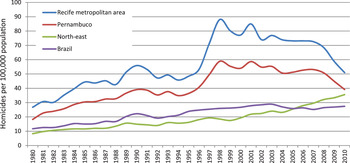
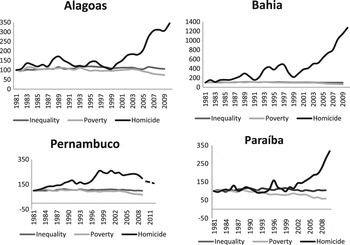
In engaging with this literature, this article considers how reforming institutions can improve public security – specifically how civil-society mobilisation, novel public-security policy, and political institutionalFootnote 8 reform can encourage the reduction of lethal violence.Footnote 9 It examines the case of Pernambuco in Brazil's north-east region and the state's reformist public-security programme, Pacto pela Vida (Pact for Life, PPV) between 2007 and 2013.Footnote 10 During the 1990s and early 2000s Pernambuco had Brazil's highest homicide rates (Figure 1). However, these began to decline dramatically in 2007 and continued to do so steadily until 2013. This trajectory is in stark contrast to the considerable increase in homicides in other north-eastern states since the turn of the century,Footnote 11 despite these states’ similar regional historiesFootnote 12 and recent socio-economic improvements (Figure 2).Footnote 13 Four of the nine north-eastern states are shown: Pernambuco, neighbours Paraíba and Alagoas, and Bahia, the region's largest. Other than Pernambuco, the states displayed are representative of all states in the region where violence has increased.
Homicide Rates in the Recife metropolitan area, Pernambuco, the North-east Region and Brazil, 1980–2010

Inequality, Poverty and Homicide Rates in Alagoas, Bahia, Paraíba and Pernambuco

Pernambuco is therefore a theoretically interesting case,Footnote 14 as its relatively rapid reduction in homicides and reformist public policy are unique to the region.Footnote 15 Studying institutional reform and violence reduction sub-nationally can also yield valuable insights,Footnote 16 as institutions may vary within national bordersFootnote 17 and path-dependent challenges to reform may exist at the macro-level.Footnote 18 In examining this case, the article applies a process-tracing methodologyFootnote 19 in order to identify ‘mechanism-based accounts of social change’ in a theoretically informed manner.Footnote 20 Primary data were gathered between February and April 2013 in approximately 50 semi-structured interviews and focus groups with persons including members of the civil and military police, judiciary, state ministries, opposition parties, Recife city council, NGOs, academics, journalists, community leaders and residents in the Recife metropolitan area.Footnote 21
The article highlights how civil-society support for violence reduction empowered the mobilisation of a political coalition led by former governor Eduardo CamposFootnote 22 to reshape how the state addressed the problem of lethal violence. This created political space for public-security policy changes that were rooted in deeper political institutional reforms focusing on the unacceptability of violence. This process largely accounts for reductions in lethal violence in Pernambuco between 2007 and 2013. These findings have implications for public security elsewhere in Latin America. They highlight the utility of central leadership in the design and oversight of more accountable, information-led public-security policy and the benefits of a cohesive public-security apparatus. As a novel theoretical contribution, the article highlights that the sequencing of mobilisation and institutional reforms can be important in explaining lethal-violence reduction,Footnote 23 offering new ways to understand successful and unsuccessful public-security policy interventions.Footnote 24
Institutions and Violence in Latin America
Lethal violence in Latin America is a fundamental public policy concern. A range of motivations underlie violence; and its expressions, including domestic violence, contact crimes, organised criminal violence and state-based violence, are often difficult to disentangle.Footnote 25 Whilst acknowledging this diversity, it is also important to understand lethal violence in the aggregate,Footnote 26 and how it relates to public-security policy and institutional reform. In this context, institutions are important as they formally and informally legitimise desirable behaviours and discourage undesirable ones; guide legal frameworks to incentivise compliance or punish transgression; and order societies in a predictable manner by regulating the use of violence.Footnote 27 Empirical evidence offers support. Countries with weaker democratic institutions are more prone to different forms of lethal violence;Footnote 28 and higher homicide rates are often linked with illegitimate political institutionsFootnote 29 or competitive politics in unconsolidated democracies.Footnote 30
Structural explanations often emphasise relationships between violence and the dynamics of poverty and inequality.Footnote 31 Yet a consensus position considers violence in Latin America to be tied to the failures of social and political institutions,Footnote 32 with examples including: weak democratic capacity undermining the rule of law;Footnote 33 an inability to govern sovereign territory;Footnote 34 state manipulation by political elites;Footnote 35 illegitimacy of institutions administering the rule of law;Footnote 36 inadequate criminal justice system reform;Footnote 37 and clandestine links between legal and illegal actors.Footnote 38 Thus Latin American violence – particularly lethal violence in urban areas – should be considered deeply political in nature.Footnote 39
In Brazil, political institutions are democratic but incompletely consolidated.Footnote 40 While electoral institutions function robustly, citizenship and civic rights are weak.Footnote 41 Elite behaviour often preserves structures of power that resist democratic consolidation,Footnote 42 and a prejudicial criminal justice system is ineffective vis-à-vis criminal deterrence and improving public security.Footnote 43 The criminal justice system – and police forces in particular – have also made the least progress towards democratisation over the past 30 years,Footnote 44 reflecting a resistance to reform and oversight,Footnote 45 a reputation for corruption and violence,Footnote 46 and an inability to impartially mediate private disputes.Footnote 47
Reforming political institutions, therefore, is important in addressing violence, and in this process elites can potentially play positive roles in incentivising change. Police reform is often essential to democratic consolidation,Footnote 48 and elite coalitions can be important in modifying values and operations of the police, security apparatus and criminal justice system.Footnote 49 Police reform has often been effective in encouraging restraint in the use of force, increasing credibility of deterrence and punishment, and reducing violence. While not without controversy, New York City's CompStat programmeFootnote 50 reduced homicides through decentralised, technology-driven policing strategies that increased accountability and improved operational effectiveness.Footnote 51 In Colombia, Bogotá’s homicide decline since the 1990s coincided with elite-enabled shifts toward ‘democratic policing’ and ‘pro-reform societal mobilization’ that increased horizontal accountability within the state and vertical accountability between state and citizens.Footnote 52 In São Paulo, fundamental changes focusing on human-rights approaches to policing and integrated investigation capacityFootnote 53 in combination with progressive social policies addressing alcohol and weapons availability contributed to the halving of the city's homicide rate during the 2000s.Footnote 54
Despite these examples, there have been limited successes in improving public-security policy and democratic policing in Latin America.Footnote 55 Any or all of the following features of reforms may be instrumental in undermining success: they may vary in form and sequencing; encounter internal resistance;Footnote 56 be hampered by high levels of violence; encourage heavy-handed responses;Footnote 57 or simply strengthen the state's repressive apparatus rather than supporting long-term violence reduction. Moreover, the oft-followed approach of strengthening coercive institutions to create ‘legal order’ through effective centralised punishment can overlook the ‘microfoundations of the rule of law’,Footnote 58 which suggests peaceful societies also require a ‘normative social order’, commonly derived from ‘community-based evaluations of behavior’.Footnote 59
Thus, in addition to the behaviour of elites in driving policy change or institutional reform, civil society can be an important catalyst for social change,Footnote 60 both in mobilising to put pressure on or support elites and in internalising norms of appropriate behaviour.Footnote 61 Therefore, where social and political mobilisations align over the issue of violence reduction, this has the potential to motivate and support public-security policy change and reforms which can improve institutional accountability and reduce lethal violence. This is examined in the Pernambucan case.
Lethal Violence in Pernambuco: A Reversal of Fortune
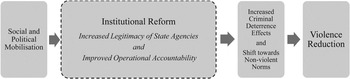
Prior to 2007, public-security policy failures and political institutional weakness coinciding with the growth of the narcotics trade saw violence expand and persist in Pernambuco. Conversely, from 2007 to 2013 political institutional reforms coincided with a marked reduction in lethal violence. Figure 3 suggests a process explaining this decline, where: 1) civil-society support for violence reduction created space and momentum for political actors to mobilise around the issue; 2) political actors encouraged policies which reformed institutions – particularly of criminal justice system – which in turn improved legitimacy and the ability to enforce the rule of law; 3) this altered expectations of a range of stakeholders as to the acceptability of violence; and 4) saw lethal violence markedly decline.
Dynamics of Violence Reduction in Pernambuco

Institutional Weakness and the Expansion of Violence: 1990s–mid-2000s
Whilst it is beyond the scope of this article to fully examine violence escalation processes, it is instructive to briefly highlight relevant factors prior to 2007 that provide context for the subsequent fall in violence. Broadly, the inability or unwillingness of the state to prioritise public security and address the expansion of the drug trade drove the surging violence in Pernambuco during the 1990s and early 2000s. Three factors are considered noteworthy.
The first concerns inadequate institutionalisation of public-security policy at the state level.Footnote 62 Despite active public-security policymaking, it was conceived and enacted ineffectively and reactively, and without clear long-term goals to reduce violence.Footnote 63 Multiple interviewees pointed to failures of successive state governments to develop an institutionalised commitment to public security, which exacerbated the challenges of violence facing Pernambuco. This included an absence of formal programming and state agencies lacking capacity to address violence under Governor Joaquim Francisco (1991–4); a general lack of interest in adopting institutionalised public-security policies under Governor Miguel Arraes (1995–8); and insufficient technocratic or managerial capacity under Governor Jarbas Vasconcelos (1999–2006).Footnote 64 A senior public-security official in Recife suggested:
There is a political reason behind [increasing violence in the 1990s and 2000s] … In this period, crime and narcotrafficking were powerfully strengthened … due to the absence of these [state] governors [addressing public security] … [They] didn't address this issue. They didn't want to know anything about it.Footnote 65
Second, this lack of focused public-security policy, combined with legacies of impunity within police forces, exacerbated the limitations of the criminal justice system. Collectively the Polícia Militar (Military Police, PM), Polícia Civil (Civil Police, PC), Ministério Público (prosecutor) and Poder Judiciário (judiciary) coordinated tasks poorly, lacking accountability to both the government and civil society. The judiciary was detached from rising criminality, acting in isolation from the police and prosecutor with almost non-existent communication and cooperation.Footnote 66 Formal relations between the PM and the PC were also poorly coordinated, and informal interactions antagonistic. Hindered by poor case-processing and evidence collection, only 10 per cent of homicides were investigated by the PC;Footnote 67 and investigations that were opened were politicised and manipulated by delegados (police investigators) to secure their own positions and promotions.Footnote 68 Moreover, the PM, responsible for repressive and preventative policing, have historically been structured in a manner resistant to oversight, and directly contributed to high rates of lethal violence through their indiscriminate use of force. Police participation in death squads (grupos de extermínio) became widespread during this periodFootnote 69 with the killing of ‘bandidos’ essentially encouraged, and ‘practically no penalties’ for excessive use of force.Footnote 70
Finally, these failures were particularly detrimental as they co-occurred with the expansion of crack cocaine trafficking in Pernambuco during the mid to late 1990s. In Recife, crack consumption increased sevenfold between 1997 and 2003,Footnote 71 the period representing the greatest expansion in lethal violence. The drug trade was (and largely remains) highly fractured, with multiple actors in a contested, illegal market. In this context, Recife – which has the most favelas of any metropolitan area in Brazil – became a city which saw widespread, continual contestation over territory between small, disorganised groups, whose use of lethal violence to gain access to lucrative markets contributed to the expansion of homicides.Footnote 72
While these challenges were not unique to Pernambuco, their co-occurrence was distinctive. Lethal violence surged as a result of police involvement in violence, institutional and policy failures which encouraged impunity, and successive governorships ignoring the encroaching narcotics trade as a public-security threat. This mirrors findings which suggest that
systematic entrenchment of drug trafficking, police participation in death squads and militias, ineffectiveness of homicide investigation processes, fragility in controlling at-risk youth and failings of the penal system are decisive factors in the continuation of high rates of homicides in Pernambuco.Footnote 73
Institutional Reform and the Decline of Violence
In January 2007, Eduardo Campos of the Partido Socialista Brasileiro (Brazilian Socialist Party, PSB) assumed the governorship of Pernambuco, introducing PPV in May 2007. As a technocratic, management-led approach to public security, PPV was designed principally to reduce lethal violence in the state by: addressing the operational weaknesses of state agencies governing public security; modifying the conduct of the police and building trust and legitimacy between state and citizens; reframing attitudes regarding the value of life; and supporting pathways away from violence.
PPV consisted of six key areas:
-
Qualified repression of violence, emphasising information-led, integrated police operations, with control mechanisms against police misconduct;
-
Institutional improvement, emphasising professional development and improving legitimacy of police and judiciary;
-
Information and knowledge management, to improve planning, monitoring and evaluation;
-
Training and capacity building focusing on reducing use of lethal force and respect for human rights;
-
Social prevention, to address risk factors through multi-sectoral interventions in urban planning, health, and education;
-
Democratic management, creating permanent mechanisms for civil society to engage in public security.Footnote 74
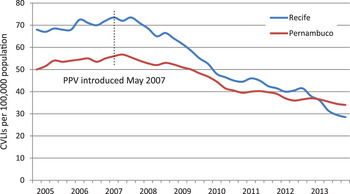
These changes under PPV reflected the political commitment to institutional reform, and coincided with a marked reduction in lethal violence as measured by rates of Crimes Violentos Letais e Intencionais (Lethal and Intentional Violent Crimes, CVLIs) (Figure 4).Footnote 75 This process is examined below, with the focus initially on civil-society and political mobilisation; then on the institutional reforms themselves; and finally on broader lethal-violence reduction processes.
Rate of CVLIs in Recife and Pernambuco, December 2004–December 2013

Civil-Society Mobilisation and Political Action
Civil-society and political mobilisation were important in supporting a consensus within the state to promote violence reduction. Prior to PPV, the attempted (yet unsuccessful) reforms under the Vasconcelos administrations (1999–2006) underlined the need to address public security, but they were undertaken in a manner that failed to stem the rising violence.Footnote 76 While the Secretaria de Defesa Social (Secretariat for Social Defence, SDS) was newly created in 2001 to oversee the PM, PC and Bombeiros (emergency services), the SDS relied on, and perpetuated, ‘friendly’ political appointments to high-level posts, with police remaining resistant to oversight. Despite the establishment of new state agencies, non-meritocratic governance persisted, with limited focus on improving the legitimacy of institutions responsible for public security.Footnote 77
These previous administrations’ attempted reforms did, however, respond to – and in many ways kindle – a greater awareness in Pernambucan civil society around the issue of violence.Footnote 78 Vasconcelos attempted heavy-handed approaches to public security and, to an extent, received support for this among the middle and upper classes. These attempts, however, failed disastrously, showing that repressive public-security policy on its own was inadequate to curb lethal violence in the state.Footnote 79 Furthermore, this failure also coincided with a period when the middle classes experienced a growing sense of insecurity. Public opinion was galvanised by the increase in violent crime in the years immediately prior to PPV,Footnote 80 sparked in particular by several cases of wealthy Recifenses killed in carjackings and robberies.Footnote 81 Importantly, latent support for positive approaches to lethal-violence reduction, rather than mano dura (‘iron fist’)-style responses,Footnote 82 was driven by certain actors in the media, who from the mid-2000s concertedly pushed the issue towards the front pages and into the consciousness of broader civil society.Footnote 83 Recife was compared to the Colombian cities of Bogotá and (to an extent) Medellín,Footnote 84 which saw considerable reductions in violence in the 1990s and 2000s due to police reform and novel violence-reduction polices.Footnote 85 Questions were asked why similar policies could not be pursued in Pernambuco.Footnote 86
In the year leading up to elections in 2006, civil society had become increasingly vocal about lethal violence being meaningfully reduced rather than being ignored or confined to the margins.Footnote 87 Reflecting Pernambuco's traditionally strong political activist culture,Footnote 88 civil society focused its attention on the burden of violence. Protests and vigils become commonplace, as did debates addressing the alarming rates of lethal violenceFootnote 89 and the public health burden of domestic violence;Footnote 90 and the need for a solution was increasingly the subject of discussion in multi-stakeholder fora.Footnote 91 The issue received, in addition to media attention, widespread NGO support. According to one NGO leader:
Here [in Pernambuco, unlike other states] you have [many] NGOs specifically focusing on security and justice. So there was this set of circumstances where everything [the NGOs did] related to the structure of the public-security apparatus, regardless of whether that was the [main] focus of a particular NGO or not. [The result was] a strong, articulate, civil society that could [engage in] issues of public safety as if attacked from all sides.Footnote 92
At this juncture, in late 2005 and 2006, broader civil-society concerns and the unique nature and intensity of mobilisation around the issue of lethal violence coincided with the changing political calculus and reformist tendencies within the new governing political coalition of the PSB. Here, social and political mobilisation galvanised around the issue of violence, creating mutually reinforcing conditions that made institutional and policy reform more likely. While violence had long been a key issue in civil society, it had not previously seen such a sustained mobilisation with the breadth of public outreach as that between 2005 and 2007.Footnote 93 Moreover, this coincided with the emergence of a PSB coalition which possessed a qualitatively different approach to addressing violence in Pernambuco. This social mobilisation represented a political opening for Campos, at that time candidate for the post of governor. Having ‘clearly appreciated the gravity’Footnote 94 of the situation in civil society, he leveraged public sentiment by making violence reduction the key pillar of his election campaign.Footnote 95 This should not be understated, as, across Brazil, civil-society concern over violence rarely translates into meaningful improvements without the requisite political mobilisation;Footnote 96 and political mobilisation without broader support is often ineffective in attempts to address public-security policy.Footnote 97 Thus the meeting of interests at this juncture appears distinctive and important in Pernambuco.
Following his victory in October 2006, Campos enacted fundamental changes to public-security policy and the structure of state agencies; and integrated civil-society actors and interests into a new public-security policy framework. While also cultivating political capital, the approach was unique in that it responded to public sentiment by making transparency and accountability core tenets of public-security policy.Footnote 98 It also resonated with political progressives, with reforms supported by early, widespread senior stakeholder buy-in. On entering office in January 2007, Campos gathered reform-minded actors within the police, judiciary and civil society to design and implement a new plan for public security. Planning processes brought together progressives, charged them with enacting change, and signalled to ‘spoilers’ that reform had a broad base of support.Footnote 99 Civil-society engagement was also important for state accountability in these early phases. One important initiative involved journalists independently counting homicides and cross-referencing them to figures released by the state. Key here was the PE-Bodycount advocacy group (2007–10), which gathered homicide figures, displaying them prominently on digital billboards; and painted outlines of bodies where homicides had occurred. Such civil-society actions were important in maintaining broader support for the programme; in critically examining the state's claims of progress; and represented an important check on commitments to PPV's institutional and operational changes, particularly given the failures of prior administrations.Footnote 100
Once enacted, transformations of oversight structures, incentives and, ultimately, behaviour within the bureaucracy, police and judiciary happened rapidly. In early 2007 an expert technical council was established to consult on programme design. This was presented in May 2007 to key stakeholders, including officials within the state's bureaucracy; the mayor of Recife; heads of the PC, PM, emergency services and chief forensic officers; presidents of the Court of Justice and Legislative Assembly; the Attorney General of Pernambuco; and community leaders, NGOs and civil-society representatives.Footnote 101 Involving this range of actors in programme design was a notable break from past practice, signalling credible commitments to improving public safety.Footnote 102 Describing this, a senior judicial member said:
PPV, in essence, created an institutional awareness of the problem of violence. The grand stride, the great merit of PPV, was this awakening of consciousness to which all organs [of the state] and people within them began to feel that violence was knocking on their door saying, ‘Look, you're also responsible!’ It was a call for collective responsibility. The executive, legislature, judiciary, prosecutors, public defender … Everybody began to feel an obligation to participate in this process.Footnote 103
Despite newly established coalitions, there was some embedded resistance to reform. Changes threatened police, judicial actors and bureaucrats who supplemented incomes and influence through corrupt or illegal activity.Footnote 104 Yet in the first 12 months of PPV, new forms of transparency and accountability became quickly apparent,Footnote 105 with senior figures in the SDS, police and other state agencies committed to a new reformist vision. This created the momentum to enact reforms increasing the accountability and effectiveness of the criminal justice system.
Institutional Reforms
From 2007, PPV's goal was to reduce CVLIs by 12 per cent annually. To achieve this, institutional reforms focused on improving criminal-justice system operations through technocratic solutions to measure criminality, evaluate policing operations and improve accountability. Yet beyond being merely a technical exercise, PPV was deeply concerned with reshaping attitudes among government and society about the value of life, and creating a new set of norms and institutions which worked towards achieving this.
Organisationally, formal weekly meetings have been held since PPV's inception in 2007, attended by approximately 100 members of the police, judiciary, relevant ministries and other key officials from across the state.Footnote 106 This approach was informed by US violence-reduction programmes such as CompStat and Operation Ceasefire, and New Public Management theory. It focused on: goal-setting in priority areas relevant to violence reduction; data collection and management to assist operations, monitoring and evaluation; and high levels of accountability for both successes and failures. The state was divided into inter-connected Áreas Integradas de Segurança (Integrated Security Areas, AISs) for which localised data about criminal activity was gathered and resources allocated accordingly.Footnote 107 Measurable weekly and monthly goals were set based on levels of violence and resources devoted to each AIS. These goals included, among others, reduction of CVLIs; weapons and drugs seized; arrests made; and cases brought to trial. By providing police with improved information, equipment, training and manpower to address violence, results were anticipated and expected – and financial incentives were also awarded for successfully meeting goals.Footnote 108
This ‘management focus’ was central in forming a new culture of accountability.Footnote 109 Weekly meetings allowed senior officers responsible for individual AISs to explain successes and failures; and to request further assistance or advice. While ostensibly to report on operational details and progress toward violence-reduction goals, meetings also served to strengthen institutional reforms, critically functioning as a forum which reinforced new practices and norms about the value of preserving life amongst actors in the state's coercive institutions. Such reforms created collective buy-in to reformist visions, and represented a critical break from undesirable past practices, including limited interest in monitoring and responding to lethal violence, anti-democratic police conduct and direct state involvement in violence during the 1990s and early 2000s. This changed radically with the introduction of PPV's credible state commitment to improving public security, vastly expanding information regarding: how and where violence occurred; how police conduct was able to be monitored and evaluated; and how officers were held accountable for their performance and behaviour.
This was exemplified during early commitments to removing officers involved with grupos de extermínio. In 2007 alone, 197 people were arrested for involvement in grupos. Over 600 PM and 16 PC were expelled,Footnote 110 with criminal charges brought against numerous senior PC.Footnote 111 Consequently, grupos in Pernambuco were all but eliminated, with numerous police officers arrested (or ceasing their involvement) and criminal leaders imprisoned or killed.Footnote 112 At the same time, PPV's management focus was making officers answerable for the conduct of their subordinates. Whereas senior officers had previously manoeuvred for promotion through political gamesmanship, they now became more greatly invested in their own and subordinates’ conduct and performance, as promotions had become predicated upon achieving goals that contributed to violence reduction.Footnote 113 Thus in tying career advancement to conduct and performance rather than to political appointment, PPV incentivised police accountability up and down the command chain, breaking with patterns where undemocratic, nepotistic or corrupt practices of professional advancement undermined public-security provision.Footnote 114
Additionally, increases in base salary and performance-based incentive programmes were introduced to motivate overworked and under-recompensed police. Street-level officers, for example, received financial bonuses for achieving targets, including reductions in CVLIs in geographical areas of responsibility, weapons apprehended, arrests made, and drugs seized. The initial efficacy of these approaches saw over 6,000 illegal firearms confiscated in 2007 compared to a fraction of this prior to PPV.Footnote 115 Importantly, performance-based incentive schemes also increased commitment of rank-and-file officers to new forms of management and oversight that might otherwise have been resisted. Furthermore, it encouraged respect for life and human rights-based principles in policing;Footnote 116 and reduced incentives to supplement salaries through petty corruption or ‘external jobs’ involving illegal activities such as participation in grupos.Footnote 117
Such meritocratic practices represented fundamental shifts in oversight and incentives within state institutions, making them more accountable in upholding the rule of law. Previously, governors across Brazil essentially ‘outsourced’ responsibility for public security to the heads of police forces, with little oversight or consequences for success or failure. Under PPV in Pernambuco, however, there was, uniquely, personal involvement by the governor in matters of public security. Reorganisation of incentive structures led to ‘normative’ changes within state agencies responsible for public security that made old practices of undemocratic policing and judicial indifference no longer acceptable. Regarding this, a judicial representative stated:
The uniqueness of [Pernambuco's success] is that of governance, the desire of the governor to turn a government policy into a state policy – and be at the head of it, achieving results. I was often amazed to see police officers concerned about goals. This is something I never imagined.Footnote 118
Reforms and changes in attitudes among state agencies altered operational practices, enhancing interactions between police and judiciary in important ways. The newly organised AIS areas of responsibility allowed more effective communication between police and judicial actors and enabled civil and military police to more effectively share intelligence, with information gathered in investigations fed back to assist with patrol operations, and vice versa.Footnote 119 Further, preventative policing was emphasised, with resources allocated to ‘hot-spots’ where lethal violence was common.Footnote 120 There were also important changes which underscored new attitudes encouraging restraint during operations. Where police had once engaged in favelas using highly aggressive tactics, they became guided by the use of ‘qualified repression’ requiring officers to justify use of lethal force. Reforms further focused on developing positive relations between police and communities suffering from violence. Reflecting this change, the Polícia Amiga (Friendly Police) community-policing initiative commenced in 2008, encouraging officers to patrol on foot, developing relationships with residents and community leaders to improve the positive presence of the state. Greater community engagement saw police actively involved in youth and social programmes, with concerted efforts made to change perceptions of police as violent and untrustworthy, particularly among young men.Footnote 121
It must, however, be reiterated that several community organisers across Recife emphasised that, despite overall improvements, certain police units remained violent and discriminatory.Footnote 122 One highlighted tensions between the old and new approaches, saying:
[A police captain] was here, in the community, talking to us … He came to meetings, listened, participated. He [became] closer to us. If another officer did something wrong [or was abusive], he asked them to come talk to us, apologise … [Did it] improve much? I don't know. But we could at least express our rights.Footnote 123
Such instances highlight that while policy changes have had positive effects on violence reduction and state–citizen relations, there are clear challenges in universally changing negative attitudes towards poor communities among police.
Beyond improved operational and preventative capacity of the PM, the effectiveness of investigation and prosecution mandated by the PC and judiciary increased. New leadership in the homicide investigation unit (Departamento de Homicídios e de Proteção à Pessoa – Homicide and Personal Protection Department, DHPP) introduced greater training and capacity building in crime-scene preservation, forensics and digital cataloguing of evidence.Footnote 124 Increased funding saw the introduction of digital evidence and case-processing databases in 2009, enabling tracking of all log-ins and changes. This increased operational effectiveness and information sharing, preventing evidence loss or contamination. It also increased accountability of officers, who were unable to alter case details or tamper with evidence without being personally identified.Footnote 125 Coordination between the PM, PC and judiciary also improved, with PPV incentivising communication and cooperation among police and judicial agencies. Focusing attention on solving homicide cases to address lethal violence, improved evidence collection and crime scene processing by the PC – assisted by coordinated intelligence-gathering by the PM – saw an increase in the apprehension of suspects. Higher-quality evidence and prompt delivery to the prosecutor and judiciary allowed for faster and more successful case processing.Footnote 126
Overall, PPV introduced institutional changes which altered attitudes regarding the acceptability of violence, incentivised the internalisation of new norms by key actors, and gave rise to key operational improvements within the criminal justice system. Whilst ostensibly a technocratic public-security programme, PPV also represented a policy shift encouraging collective buy-in to a new set of institutions, norms and practices that had violence reduction at their core.
Increased Deterrence, Shifting Norms and Lethal-Violence Reduction
PPV encouraged reduction in lethal violence in Pernambuco by increasing deterrence though greater credible threats of punishment and reshaping norms with respect to the use of violence. Police acted in a coordinated manner to increase resources available to areas where lethal violence was particularly concerning and engaged with communities to build trust in attempts to actively deter violence rather than ineffectively respond to it. Improved investigation capacities and coordination between police and judicial bodies reduced impunity in the criminal justice system, increasing trust that the state could be accountable for enforcing the law and punishing transgressions.Footnote 127
PPV changed expectations about the appropriateness of violence among politicians, police, criminal actors and citizens. Institutional and operational changes that increased the effectiveness of the criminal justice system also played a role in reinforcing informal social norms that violence – and lethal violence in particular – was unacceptable, and that those using or tolerating it would be held to account.Footnote 128 This was evidenced at the state level by the widespread buy-in of state agencies to these new practices, such as meritocratic and performance-based promotion and unacceptability of illegal activity among police forces; and new case-processing procedures across the criminal justice system. This was mirrored by broader civil-society demands for accountable and non-violent public service and civic behaviour, and reflected these new and often subtle normative shifts discouraging violence in Pernambuco that came with new institutional arrangements under PPV.
The effects of this were seen in many favelas in Recife, where lethal violence fell and security improved considerably.Footnote 129 Regular police patrols also increased trust between police and citizens, improving police intelligence gathering. By building relations in communities, police were increasingly aware of actors involved in illegal activity, and targeted operations to avoid harassing law-abiding citizens. Illustrating this was the introduction of the Polícia Amiga initiative, which coincided with above-target declines in CVLIs from late 2008 to 2010. In interviews, residents and community leaders readily acknowledged that increased police presence and effectiveness had seen violence – both lethal and non-lethal – decline, and emphasised the decreased visibility of and control exerted by the narcotics trade.Footnote 130 On the changes in neighbourhood policing, for example, a long-time favela resident remarked that ‘nowadays the cops are here often, almost all the time. It discourages the dealers … Before they killed people in their houses over every little thing. They are more careful and respectful of people now.’Footnote 131
Broadly, PPV's reforms were recognised as uniquely successful examples of public-security policy in Latin America,Footnote 132 with the programme conferred a United Nations Public Service Award in 2013.Footnote 133 Given these successes, there were concerted attempts to institutionalise reforms so that they would succeed beyond Campos’ governorship, with PPV becoming a policy of the state rather than a policy of the government.Footnote 134 Further examples of this were seen in the establishment of Pacto pela Vida do Recife in cooperation with Recife's municipal government in 2013. The programme enhanced PPV's coordination with the municipality, with actions under municipal policy remits supporting state policies in 13 vulnerable neighbourhoods.Footnote 135 Initiatives included improving street lighting and walkways, community outreach programming, drug treatment and community health programmes, and sports and recreation facilities.Footnote 136
Cause, Counterfactuals and Alternative Explanations
The changes within the state and criminal justice apparatus under PPV should not be regarded merely as shifts in policy. Rather, they represented a marked transformation in the institutions guiding public security. Moreover, the timing of PPV suggests these reforms were instrumental in homicide reduction in Pernambuco between 2007 and 2013, and that the sequencing of dynamics appears to have been causal. Robust civil-society mobilisation allowed a political commitment to broad policy and institutional reforms that would probably have been challenging without this support. Ensuing reforms saw newly accountable and coordinated state agencies better able to prevent and increase deterrence of violent crime,Footnote 137 reinforcing non-violent norms in broader society and meaningfully reducing lethal violence in Pernambuco.
Therefore, the narrative emerging from this study is that the process of civil-society and political mobilisation, policy and institutional reforms, and broader shifts in social norms ultimately contributed to the state's reductions in lethal violence. However, it is also plausible that other dynamics not accounted for in this process may have contributed to lethal-violence reduction. First, one could question the importance of civil society in this process, and postulate that similar declines could have occurred in the absence of popular mobilisation. This proposition is difficult to test decisively given the single-case nature of this study, and without the presence of a counterfactual. However, as suggested earlier, the mobilisation at this time certainly appears unique in its visibility and intensity compared both to past engagement in Pernambuco and with most other regions of Brazil. Collective, progressive sentiments regarding violence reduction among the middle classes and the media were generally uncommon, particularly in the north-east; yet the existence of this mobilisation in Pernambuco at the time does appear important in stimulating initial momentum for the changes that came under PPV.Footnote 138
A second uncertainty may be whether lethal-violence reduction in Pernambuco during this period should be viewed merely as a policy effect that might have occurred without any underlying change in institutions or norms. While, unarguably, there were important public-security policy changes, a necessary condition to implement these was changing the values and practices within state institutions regarding how they addressed lethal violence. Without altering attitudes towards the accountability of the criminal justice system and the use and acceptability of violence, policies would almost certainly have failed in a similar manner to several previous efforts that did not address deeper institutional and normative issues. Previous reforms under Jarbas Vasconcelos’ administration (1999–2006), for example, failed to reduce violence precisely because they did not address the foundational issues of police accountability and judicial responsiveness.
A third consideration is that declines may conceivably be related to the dynamics of the narcotics trade, representing a fall in use or consolidation of the market. This explanation, however, appears somewhat unlikely since there is little evidence that trafficking or consumption has declined in tandem with the decline in homicides; rather, the intensity of the narcotics trade has actually increased in Pernambuco during this period.Footnote 139 For example, the number of calls to Disque Denúncia (the state hotline for the anonymous reporting of crimes and suspicious activities) regarding the use and sale of crack tripled between 2010 and 2011 (and registered a tenfold increase over the previous decade).Footnote 140 While it is possible that reporting rates may have increased due to improved telecommunications, greater outreach and awareness, or feelings of safety in reporting crimes, it does not appear that the trafficking and availability of crack declined in this period.Footnote 141
A fourth possibility is that improvements in structural conditions have contributed to declines in violence. While improved livelihoods and reduced inequality may certainly have been a contributing factor in reducing violence, particularly with the redistributive programmes of the Partido dos Trabalhadores (Workers’ Party, PT) targeting the poor throughout Brazil in the 2000s, these are unlikely to account for the timing and magnitude of the fall in violence and for the uniqueness of the Pernambucan experience. The eight other north-eastern states have seen similar socio-economic improvements,Footnote 142 yet patterns of homicide contrast sharply with Pernambuco's.Footnote 143
Finally, when examining a successful policy intervention, interviewees – particularly where personally involved – may overstate the uniqueness of the Pernambucan case, its accomplishments, or its past failures. Aspects of data collection and research design, however, mitigate this concern. Interviews were conducted with a range of actors both close to and outside the government and PPV programme who voiced criticism as well as support. Furthermore, key stakeholders were frequently critical of the early stages of the PPV programme, and open about past and current failings. Primary interview material was triangulated across respondents, and also where possible by secondary sources including official documents, newspaper reports, and academic articles. While interviewees held a range of views, primary and secondary sources converged in ways that support conclusions drawn here.
Conclusion
This article shows how institutional reforms under PPV were associated with marked reductions in lethal violence in Pernambuco between 2007 and 2013. By prioritising public-security reform as a policy of the state rather than a policy of government, and particularly focusing on improvements in policing and judicial responsiveness, PPV successfully and sustainably reduced lethal violence between 2007 and 2013. This was supported by broad civil-society support and a political coalition committed to violence reduction. In this, PPV stands out for its success as a public-security programme in Brazil.
Despite the successes of PPV between 2007 and 2013, however, several reasons for concern remain. Though PPV was successful in reducing lethal violence, persistent inequality, poverty and the impact of the narcotics trade still present enormous social challenges in Pernambuco. Perceptions of crime and insecurity in Recife have also remained high, particularly among the middle classes;Footnote 144 reducing petty criminality and insecurity remain major challenges, just as they were in PPV's most successful years. Even at the height of PPV's success in 2012, for instance, the challenges of consolidating and continuing the gains under the programme were expressed,Footnote 145 particularly as other public-security policy programmes in Brazil had faced similar challenges.Footnote 146
It is therefore important to acknowledge that the public-security situation since 2014 in Pernambuco has changed in important ways. CVLIs increased by 13 per cent year on year between 2014 and 2015; and non-lethal crimes increased by over 20 per cent in the same period.Footnote 147 In 2016 concerns were raised over violence inching toward pre-2007 levels, and that sustainability over the long term may be an ongoing challenge despite the robust initial successes of reforms in reducing lethal violence.Footnote 148
In light of this, a core challenge is how public-security policies can both broaden and sustain initial successes. While it is beyond the scope of this paper to take up the detail of Pernambuco's recent increase in violent crime, several factors may have contributed to increasing CVLIs. Though it has been suggested that PPV's managerial focus failed to address underlying causes and forms of violence,Footnote 149 other explanations may include: the loss of a championing influence with the resignation and subsequent death of Governor Campos; the lack of direct involvement in the oversight of PPV by Campos’ deputy and immediate successor João Neto; a protracted police strike in 2014 that paralysed the state; and the deteriorating economic conditions in 2014 and 2015 which exacerbated challenges faced by Governor Paulo Câmara in managing PPV from 2015.Footnote 150
What then do these recent trends mean for the effectiveness of PPV and the consolidation of reforms? It is important to recognise that many of the institutional reforms that occurred under PPV since 2007 remain, and that these have been distinctive in changing the dynamics of public security in the state. Despite merited concerns, levels of lethal violence still remain below those prior to the introduction of PPV, and the programme achieved immense successes in its initial years. However, in light of recent trajectories of lethal violence, there are questions whether PPV can surmount the ‘big challenge for reformers’,Footnote 151 particularly overcoming the lack of continuation of party-related policy programmes following changes in government and the opposition that paradigmatic policy shifts may engender over time.Footnote 152
In summarising, the Pernambucan case is distinctive in that it offers new insights for understanding public-security policy interventions in the Americas, presenting evidence that the design of institutional reforms is important in explaining lethal-violence reduction. It also highlights important questions related to the challenges of policy continuity and the longevity of reform, and taps into a broader literature about politics and violence in Latin America and the role civil society, elites, states and institutions play in promoting, condoning or discouraging violence. In showing how institutional reforms can incentivise lethal-violence reduction, and reiterating the challenges to sustaining success, the Pernambucan experience is instructive.