





No CrossRef data available.
Two ecological approaches in social psychology
Published online by Cambridge University Press: 02 June 2026
Abstract
Ko and Neuberg’s affordance-management framework represents an important top-down approach to understanding how distal environments shape human psychology through evolutionarily recurrent problems. We contrast this evolutionary approach with the bottom-up socio-ecological approach, which focuses on current environmental arrangements, highlighting their complementary research strategies for understanding ecology–mind interactions.
Information
- Type
- Open Peer Commentary
- Information
- Copyright
- © The Author(s), 2026. Published by Cambridge University Press
References
Cheung, F. (2016). Can income inequality be associated with positive outcomes? Hope mediates the positive inequality–happiness link in rural China. Social Psychological and Personality Science, 7(4), 320–330.10.1177/1948550615619762CrossRefGoogle Scholar
Hovland, C. I., & Sears, R. R. (1940). Minor studies of aggression: VI. Correlation of lynchings with economic indices. The Journal of Psychology, 9(2), 301–310. https://doi.org/10.1080/00223980.1940.9917696
CrossRefGoogle Scholar
Mishra, S., Hing, L. S. S., & Lalumière, M. L. (2015). Inequality and risk-taking. Evolutionary Psychology, 13(3), 1474704915596295.10.1177/1474704915596295CrossRefGoogle ScholarPubMed
Milgram, S. (1970). The experience of living in cities. Science, 167, 1461–1468.10.1126/science.167.3924.1461CrossRefGoogle ScholarPubMed
Neuberg, S. L., Kenrick, D. T., & Schaller, M. (2010). Evolutionary social psychology. In Fiske, S. T., Gilbert, D. T., & Lindzey, G. (Eds.), Handbook of social psychology (5th ed., pp. 761–796). John Wiley & Sons, Inc.Google Scholar
Oishi, S. (2014). Socioecological psychology. Annual review of psychology, 65(1), 581–609.10.1146/annurev-psych-030413-152156CrossRefGoogle ScholarPubMed
Oishi, S. (2025). Social ecology. In Gilbert, D. T., Fiske, S. T., Finkel, E. J., & Mendes, W. B. (Eds.), The handbook of social psychology (6th ed.). Situational Press. https://openpublishing.princeton.edu/read/social-ecology/section/f8b2b4db-e6ae-4b25-a502-7066fe364989
Google Scholar
Oishi, S., & Graham, J. (2010). Social ecology: Lost and found in psychological science. Perspectives on Psychological Science, 5(4), 356–377.10.1177/1745691610374588CrossRefGoogle ScholarPubMed
Sales, S. M. (1972). Economic threat as a determinant of conversion rates in authoritarian and nonauthoritarian churches. Journal of Personality and Social Psychology, 23(3), 420–428. https://doi.org/10.1037/h0033157
CrossRefGoogle ScholarPubMed
Sales, S. M. (1973). Threat as a factor in authoritarianism: An analysis of archival data. Journal of Personality and Social Psychology, 28(1), 44–57. https://doi.org/10.1037/h0035588
CrossRefGoogle ScholarPubMed
Sng, O., Choi, M., & Ackerman, J. M. (2024). The ecology of relatedness: How living around family (or not) matters. Journal of Personality and Social Psychology, 128(6), 1243–1270. https://doi.org/10.1037/pspa0000428
CrossRefGoogle Scholar
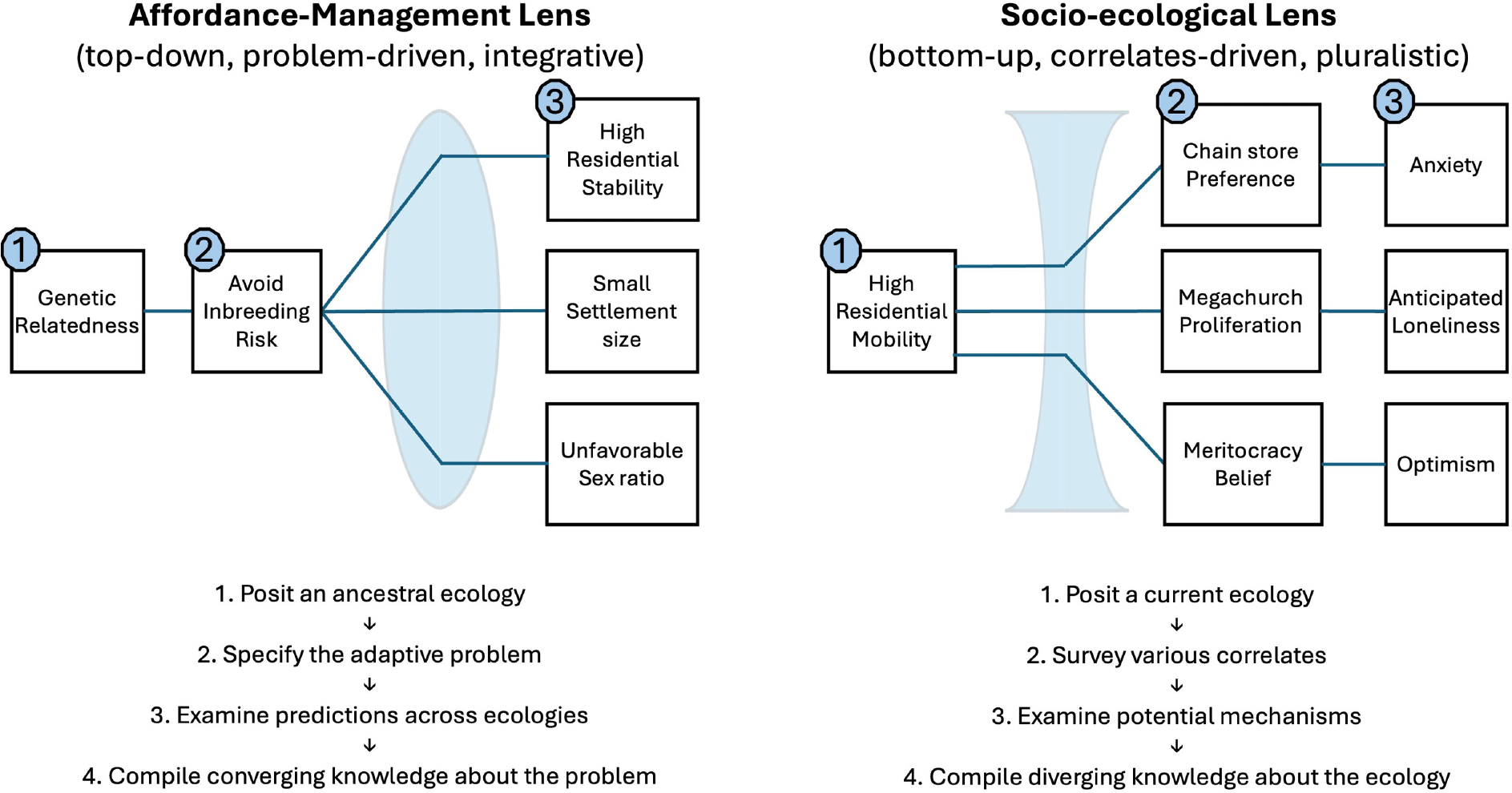
Figure 1. Two ecological approaches in social psychology. Left: an affordance-management, top-down program starts from an ancestral adaptive problem, specifies mechanisms, and derives predictions for multiple environmental inputs. Right: a socio-ecological, bottom-up program maps multi-level correlates of a current ecology and then tests mechanisms.
Target article
Related commentaries (29)
A contingency management framework of ecological affordances across the lifespan
Affordance management’s cultural-ecological extensions outside of the West
Affordances are for life (and not just for maximizing reproductive fitness)
 Edward Baggs
[Opens in a new window]Edward Baggs
, Guilherme Sanches de Oliveira
[Opens in a new window]Guilherme Sanches de Oliveira
, Miguel Segundo-Ortin
[Opens in a new window]Miguel Segundo-Ortin
, Paula Silva
[Opens in a new window]Paula Silva
, Vicente Raja
[Opens in a new window]Vicente Raja
and Anthony Chemero
[Opens in a new window]Anthony Chemero
Affordances in social ecologies: A biological markets extension
From life stages to micro-events: Ecological psychology and affordance management
Managing affordances in a complex world depends on social and cultural factors
The mind’s compass: semantic control as the guiding mechanism of affordance management
 You have
Access
How do distal macro environments influence human minds? We read Ko and Neuberg’s (henceforth K&N) target article with great interest, as they propose that this classic social psychological question can be fruitfully explained through the lens of affordances: it depends on whether an environment poses threats or opportunities to developmental goals. To generate testable hypotheses, K&N begin with evolutionarily recurrent environments – those our minds are presumed to have been designed to manage (e.g., contexts of high genetic relatedness). This approach has the generative utility of producing novel hypotheses, often in domains neglected by conventional theories (Neuberg, Kenrick, & Schaller, Reference Neuberg, Kenrick, Schaller, Fiske, Gilbert and Lindzey2010).
At the same time, however, beginning the inquiry top-down from ancient environments carries a theoretical burden: it must additionally account for how such adapted minds respond to modern ecologies. For example, the study on kin density cited by K&N (Sng et al., Reference Sng, Choi and Ackerman2024) found that the number of co-resident kin ranged from 0 to 15, with a median of only two individuals. In such modern contexts of extremely low genetic relatedness, how could the threat of inbreeding or kinship detection plausibly remain a primary force shaping where people live and with whom they form attachments?
In contrast, the socio-ecological approach (Hovland & Sears, Reference Hovland and Sears1940; Milgram, Reference Milgram1970; Oishi, Reference Oishi2014; Oishi, Reference Oishi, Gilbert, Fiske, Finkel and Mendes2025; Oishi & Graham, Reference Oishi and Graham2010; Sales, Reference Sales1972, Reference Sales1973) focuses on current social arrangements, such as the widespread reality that people often live far away from their kin. It typically proceeds bottom-up: first observing whether particular ecological conditions are associated with behavioral patterns, and then investigating the psychological mechanisms that account for these associations. Hypotheses about such mechanisms can be derived from diverse theoretical traditions, including sociology, political economy, history, culture, and even evolutionary perspectives.
Whereas K&N emphasize variation by developmental stage, the socio-ecological perspective emphasizes that the meaning of an ecological variable can shift with historical, economic, and cultural context. For example, an affordance-management theorist would predict that individuals in life stages in which status is especially valued (e.g., adolescence or early adulthood) are more likely to perceive the environment as threatening and to take risks to get ahead (Mishra et al., Reference Mishra, Hing and Lalumière2015). By contrast, a socio-ecological psychologist would highlight evidence that, in rural China during the period of rapid post-1980s growth, rising income inequality was at times interpreted as a signal of hope for future upward mobility (Cheung, Reference Cheung2016). Moreover, the socio-ecological approach emphasizes reciprocity between psychology and ecology, asking not only how ecology shapes minds but also how psychological tendencies reproduce or alter ecological conditions through the creation of norms, policies, and institutions.
Illustrative example: Research practices compared
Let us take residential mobility as an example. As K&N note, a researcher working within the affordance-management framework would pose a top-down, mechanism-first question: What adaptive problem does the mating stage pose in ancestral environments? In this program, one begins by positing an ancestral problem (e.g., inbreeding avoidance) and specifying the design features of the relevant mechanisms (e.g., kin-detection cues, incest-aversion heuristics, relocation motives). The researcher then derives predictions for multiple environmental inputs – such as residential mobility, settlement size, or local sex ratio – that modulate ecological genetic relatedness and, in turn, inbreeding risk (see Figure 1, left panel). Separately, research on vulnerable childhood stages examines whether mobility sharpens kinship-cue sensitivity. Knowledge accumulates under the umbrella of a specific adaptive problem. Each ecology is reduced to an evolutionarily meaningful unit (e.g., residential mobility → genetic relatedness).
Two ecological approaches in social psychology. Left: an affordance-management, top-down program starts from an ancestral adaptive problem, specifies mechanisms, and derives predictions for multiple environmental inputs. Right: a socio-ecological, bottom-up program maps multi-level correlates of a current ecology and then tests mechanisms.
By contrast, the socio-ecological approach proceeds bottom-up and pattern-first, beginning by broadly documenting correlates of residential mobility across levels (Figure 1, right panel). These include individual psychology (e.g., anxiety, anticipated loneliness, optimism) as well as cultural tendencies and institutional consequences (e.g., preference for familiar chain stores, proliferation of megachurches, meritocracy beliefs). Researchers then test candidate mechanisms – for example, whether mobility lowers reputation costs, weakens kin-based obligations, or strengthens institutional reliance – and map scope conditions (e.g., urbanicity, inequality, policy). The resulting body of evidence assembles ecology-centered knowledge, charting the diverse consequences and psychological processes associated with a given ecology.
Taken together, the two approaches are complementary yet distinct in their research strategies: the evolutionary approach begins with adaptive problems and integrates multiple phenomena under a unifying design logic, whereas the socio-ecological approach begins with observed phenomena and assembles multi-layered explanations that incorporate diverse mechanisms. K&N’s affordance framework has a clear merit in its ability to generate refined, testable hypotheses of specific evolutionary conditions and their societal outcomes. It also has the ability to unite seemingly unrelated socioecological phenomena into a broader, mid-level theory. For example, moving to a new city and avoidance of fathers during ovulation may appear unrelated, yet both can be understood through the adaptive goal of regulating genetic relatedness. However, the socioecological approach provides greater nuance for understanding how societal phenomena may shape psychological mechanisms and in turn have broader cultural, historical, and political implications.
Acknowledgments
N/A.
Financial support
N/A.
Competing interests
The authors have no competing interests to declare.