




No CrossRef data available.
Article contents
Extending predictive processing to the body: Emotion as interoceptive inference
Published online by Cambridge University Press: 10 May 2013
Abstract
The Bayesian brain hypothesis provides an attractive unifying framework for perception, cognition, and action. We argue that the framework can also usefully integrate interoception, the sense of the internal physiological condition of the body. Our model of “interoceptive predictive coding” entails a new view of emotion as interoceptive inference and may account for a range of psychiatric disorders of selfhood.
Information
- Type
- Open Peer Commentary
- Information
- Copyright
- Copyright © Cambridge University Press 2013
References
Barrett, L. F. & Bar, M. (2009) See it with feeling: Affective predictions during object perception. Philosophical Transactions of the Royal Society of London B: Biological Sciences
364(1521):1325–34.Google Scholar
Craig, A. D. (2003) Interoception: The sense of the physiological condition of the body. Current Opinion in Neurobiology
13(4):500–505.Google Scholar
Craig, A. D. (2009) How do you feel – now? The anterior insula and human awareness. Nature Reviews Neuroscience
10(1):59–70.Google Scholar
Critchley, H. D. & Seth, A. K. (2012) Will studies of macaque insula reveal the neural mechanisms of self-awareness?
Neuron
74(3):423–26.Google Scholar
Critchley, H. D., Wiens, S., Rotshtein, P., Ohman, A. & Dolan, R. J. (2004) Neural systems supporting interoceptive awareness. Nature Neuroscience
7(2):189–95.Google Scholar
Damasio, A. (2000) The feeling of what happens: Body and emotion in the making of consciousness. Harvest Books.Google Scholar
Evrard, H. C., Forro, T. & Logothetis, N. K. (2012) Von Economo neurons in the anterior insula of the macaque monkey. Neuron
74(3):482–89.Google Scholar
Frith, C. D. (2012) Explaining delusions of control: The comparator model 20 years on. Consciousness and Cognition
21(1):52–54.Google Scholar
Gilbert, D. T. & Wilson, T. D. (2009) Why the brain talks to itself: Sources of error in emotional prediction. Philosophical Transactions of the Royal Society of London B Biological Science
364(1521):1335–41.Google Scholar
Lange, C.G. (1885/1912). The mechanisms of the emotions. In: The Classical Psychologists, ed. Rand, B.. pp. 672–684. Houghton Mifflin.Google Scholar
Palaniyappan, L. & Liddle, P. F. (2012) Does the salience network play a cardinal role in psychosis? An emerging hypothesis of insular dysfunction. Journal of Psychiatry and Neuroscience
37(1):17–27.Google Scholar
Paulus, M. P. & Stein, M. B. (2006) An insular view of anxiety. [Review]. Biological Psychiatry
60(4):383–87.Google Scholar
Ploghaus, A., Tracey, I., Gati, J. S., Clare, S., Menon, R. S., Matthews, P. M. & Rawlins, J. N. (1999) Dissociating pain from its anticipation in the human brain. Science
284(5422):1979–81.Google Scholar
Schachter, S. & Singer, J. E. (1962) Cognitive, social, and physiological determinants of emotional state. Psychological Review
69:379–99.Google Scholar
Seth, A. K., Suzuki, K. & Critchley, H. D. (2011) An interoceptive predictive coding model of conscious presence. Frontiers in Psychology
2:395.Google Scholar
Singer, T., Critchley, H. D. & Preuschoff, K. (2009) A common role of insula in feelings, empathy and uncertainty. Trends in Cognition Science
13(8):334–40.Google Scholar
Synofzik, M., Thier, P., Leube, D. T., Schlotterbeck, P. & Lindner, A. (2010) Misattributions of agency in schizophrenia are based on imprecise predictions about the sensory consequences of one's actions. Brain
133(Pt. 1):262–71.Google Scholar
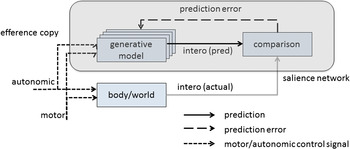
Figure 1. A model of interoceptive predictive coding according to which subjective feeling states are constituted by continually updated predictions of the causes of interoceptive input. Predictions are shaped by generative models informed by “efference copies” of visceral, autonomic, and motor control signals. These are generated, compared, and updated within a salience network anchored on the anterior insular and anterior cingulate cortices that engage brainstem regions as targets for visceromotor control and relays of afferent interoceptive signals. Adapted from Seth et al. (2011).
In his compelling survey, Clark powerfully motivates predictive processing as a framework for neuroscience by considering the “view from inside the black box,” the notion that the brain must discover information about the world without any direct access to its source. The ensuing discussion, and the large majority of the literature surveyed, is focused on just these relations between brain and (external) world. Perhaps underemphasized in this view is the question of how perceptions of the body and self arise. However, the brain's access to the facts of its embodiment and of its physiological milieu is arguably just as indirect as its access to the surrounding world. Here, we extend Clark's integrative analysis by proposing that interoception – the sense of the physiological condition of the body (see Craig Reference Craig2003) – can also be usefully considered from the perspective of predictive processing. Our model of “interoceptive predictive coding” (Critchley & Seth Reference Critchley and Seth2012; Seth et al. Reference Seth, Suzuki and Critchley2011) suggests a new view of emotional feelings as interoceptive inference, and sheds new light on dissociative disorders of self-consciousness.
Interoceptive concepts of emotion were crystallized by James (Reference James1890) and Lange (Reference Lange and Rand1885/1912), who argued that emotions arise from perception of changes in the body. This basic idea remains influential more than a century later, underpinning frameworks for understanding emotion and its neural substrates, such as the “somatic marker hypothesis” (Damasio Reference Damasio2000) and the “sentient self” model (Craig Reference Craig2009), both linked to the notion of “interoceptive awareness” or “interoceptive sensitivity” (Critchley et al. Reference Critchley, Wiens, Rotshtein, Ohman and Dolan2004). Despite the neurobiological insights emerging from these frameworks, interoception has remained generally understood along “feedforward” lines, similar to classical feature-detection or evidence-accumulation theories of visual perception as summarized by Clark. However, it has long been recognised that explicit cognitions and beliefs about the causes of physiological changes influence subjective feeling states and emotional behaviour. Fifty years ago, Schachter and Singer (Reference Schachter and Singer1962) famously demonstrated that injections of adrenaline, proximally causing a state of physiological arousal, would give rise to either anger or elation depending on the concurrent context (an irritated or elated confederate). This observation was formalized in their “two factor” theory, in which emotional experience is determined by the combination of physiological change and cognitive appraisal, that is, emotion as interpreted bodily arousal.
Though they involve expectations, two-factor theories fall considerably short of a full predictive processing model of emotion. By analogy with corresponding models of visual perception, predictive interoception involves hierarchically cascading top-down interoceptive predictions that counterflow with bottom-up interoceptive prediction errors. Subjective feeling states are then determined by the integrated content of these predictive representations across multiple levels (Seth et al. Reference Seth, Suzuki and Critchley2011). In other words, the model argues that emotional content is determined by a suite of hierarchically organized generative models that predict interoceptive responses to both external stimuli and the internal signals controlling bodily physiology (Fig. 1).
A model of interoceptive predictive coding according to which subjective feeling states are constituted by continually updated predictions of the causes of interoceptive input. Predictions are shaped by generative models informed by “efference copies” of visceral, autonomic, and motor control signals. These are generated, compared, and updated within a salience network anchored on the anterior insular and anterior cingulate cortices that engage brainstem regions as targets for visceromotor control and relays of afferent interoceptive signals. Adapted from Seth et al. (Reference Seth, Suzuki and Critchley2011).
It is important to distinguish interoceptive predictive coding or processing from more generic interactions between prediction and emotion (e.g., Gilbert & Wilson Reference Gilbert and Wilson2009; Ploghaus et al. Reference Ploghaus, Tracey, Gati, Clare, Menon, Matthews and Rawlins1999). Crucially, predictive coding involves prediction at synchronic, fast time-scales, such that predictions (and prediction errors) are constitutive of content. For example, while Paulus and Stein (Reference Paulus and Stein2006) hypothesize the existence of interoceptive prediction errors within insular cortex in the generation of anxiety, they do not contend, in the full predictive coding sense, that interoceptive predictions are the constitutive basis of emotions. Similarly, although Barrett and Bar (Reference Barrett and Bar2009) propose that affective (interoceptive) predictions within orbitofrontal cortex shape visual object recognition at fast time-scales, they again do not describe interoceptive predictive coding per se.
Several strands of evidence lend support to our model and point to its implications for dissociative psychiatric symptoms such as depersonalization and chronic anxiety (Seth et al. Reference Seth, Suzuki and Critchley2011). Anterior insular cortex (AIC) in particular provides a natural locus for comparator mechanisms underlying interoceptive predictive coding, through its demonstrated importance for interoceptive representation (Craig, Reference Craig2009; Critchley et al. Reference Critchley, Wiens, Rotshtein, Ohman and Dolan2004) and by the expression within AIC of prediction error signals across a variety of affect-laden contexts (Paulus & Stein Reference Paulus and Stein2006; Singer et al. Reference Singer, Critchley and Preuschoff2009; Palaniyappan & Liddle 2011). Human AIC is also rich in Von Economo neurons (VENs), large projection neurons which are circumstantially associated with self-consciousness and complex social emotions (Craig Reference Craig2009). In our model, fast VEN-mediated connections may enable the rapid registration of visceromotor and viscerosensory signals needed for efficient updating of generative models underlying interoceptive predictive coding. The recent discovery of VENs in the macaque monkey (Evrard et al. Reference Evrard, Forro and Logothetis2012) opens important new avenues for experimental tests of the potential role of VENs in this process and in conscious awareness more generally (Critchley & Seth Reference Critchley and Seth2012).
Disrupted interoceptive predictive coding may causally account for a range of psychiatric disorders. Chronic anxiety has been suggested to result from heightened interoceptive prediction error signals (Paulus & Stein Reference Paulus and Stein2006). By analogy with comparator models of schizophrenia (Frith Reference Frith2012; Synofzik et al. Reference Synofzik, Thier, Leube, Schlotterbeck and Lindner2010), we also suggest that dissociative symptoms, notably depersonalization and derealization arise from imprecise (as opposed to inaccurate) interoceptive prediction error signals. By the same token, the subjective sense of reality characteristic of normal conscious experience (i.e., “conscious presence”) may depend on the successful suppression by top-down predictions of informative interoceptive signals (Seth et al. Reference Seth, Suzuki and Critchley2011).
In summary, subjective emotions and even conscious presence may be usefully conceptualized in terms of interoceptive predictive coding. A key test of our model will be to identify specific interoceptive prediction error responses in the AIC or elsewhere. This challenge is also yet to be met for predictive processing models of perception in general, and the relevant evidence would go a long way towards experimentally validating the Bayesian brain hypothesis.