


Introduction
The world is undergoing a transformation of economic and social structures driven by digitisation. Against this backdrop, achieving inclusive growth has become a focal point of global attention. The concept of ‘inclusive growth’ was first introduced by the Asian Development Bank (ADB) in 2007, with the aim of ensuring that the fruits of economic development can be shared by the general populace, thereby emphasising the equality of opportunities, particularly providing necessary support for socially disadvantaged groups. When the United Nations Sustainable Development Goals (SDGs) launched in 2015, reducing global inequalities was set as one of its core objectives, a milestone for many as it positioned the issue of inequality at the heart of development discourse (Winkler and Satterthwaite Reference Winkler and Satterthwaite2017). This marks the first formal recognition by the international community that reducing inequality is a common task (Kuhn and Schularick Reference Kuhn, Schularick and Steins2020). The European Union’s ‘Europe 2020’ strategy also identified inclusive growth as one of its core objectives. It suggests that inclusive growth has become an international consensus, with its connotation constantly evolving, seeking a comprehensive and balanced sustainable growth that harmonises economic, social, and ecological aspects (Sheng and Jin Reference Sheng and Jin2020).
The World Inequality Report 2022 reveals that while inequality within most nations has intensified, inequality between countries has declined over the past two decades. At the global level, the income gap between the wealthiest 10% of the population and people experiencing poverty has diminished from approximately 50-fold to less than 40-fold. An open global economy has been instrumental in reducing poverty and increasing income worldwide, largely thanks to the transfer of knowledge from high-income countries to low-income ones – a hallmark of openness. As globalisation advances and digital technology rapidly evolves, existing research presents two opposing views on the impact of the digital economy on inclusive growth. One perspective suggests that digital technologies can be inclusive, enabling developing nations to improve labour productivity and the efficiency of resource allocation, thus potentially allowing them to catch up technologically and economically with developed countries, while promoting inclusive growth domestically (Mirmiran and Shams Reference Mirmiran and Shams2014). The second viewpoint highlights the disparity in the levels of digital economic development, suggesting that the rapid progress of the digital economy may exacerbate economic and social divides among countries and could also increase inequality within and between different groups (Hernandez and Roberts Reference Hernandez and Roberts2018).
However, the digital economy has profoundly impacted traditional trade. Digital trade, driven by Internet technologies and activities associated with their delivery (Lechman and Popowska Reference Lechman and Popowska2022), has become a focal point of international trade in the new era, giving rise to spontaneous digital service trade (from now on DST). Data from UNCTAD reveals that between 2010 and 2022, the global import and export volume of digital services doubled, accounting for 53.2% of total service trade. DST, supported by networking, intelligence, and digitisation, represents another opportunity for the transformation of traditional service trade. As an emerging form of trade based on digital technology, DST has broken through barriers in service trade and become a key force in driving economic growth and transformation, further facilitating the transnational transfer of knowledge and global industrial division of labour (Wen et al Reference Wen, Chen and Zhou2023). Digital services are automated, making replication and customisation both quick and easy, and in an interconnected society, distribution is virtually cost-free. Advances in communication technology have transformed traditional services from ‘non-tradable’ to ‘tradable’, reducing transaction costs and overcoming the barriers of time and space, leading to trends of ‘de-localisation’ and ‘globalisation’. Lower costs have allowed groups previously excluded from traditional trade to participate in international trade, profoundly impacting the global specialisation of labour and the construction of competitive advantages (Ren Tonglian Reference Tonglian2020). Nevertheless, as DST emerges from the digital economy, its impact on inclusive growth remains a pivotal research question. The inquiry seeks to determine whether DST will exacerbate existing inequalities or maintain its inherent inclusivity.
Current research on DST primarily examines its definition (Yue Yunsong Reference Yunsong and Rou2020), development status (Guanqun Reference Guanqun M2020), and influencing factors, but there is limited inquiry into its economic effects. Zhu et al (Reference Zhaoyi and Feng2022) explored the distributional impact of DST, finding it could alleviate income disparities by reducing domestic Gini coefficients. Yet, discussions on the mechanisms and heterogeneity remain scarce. Some studies suggest that DST has learning, competitive, and benefit effects (Goldberg et al Reference Goldberg, Khandelwal, Pavcnik and Topalova2009), which may narrow the gap between developed and developing nations. Conversely, others argue it could lead to a ‘low-end lock-in’ effect in developing countries (Humphrey and Schmitz Reference Humphrey and Schmitz2002; Buckley Reference Buckley2009; Ivasson and Alvstam Reference Ivarsson and Alvstam2010). However, the uncertainty in DST models suggests that the likelihood of significant advantages for developed nations (Guan and Ma Reference Guan and Ma2003), and hence the ‘lock-in’ effect, is relatively low, indicating that latecomers still could partake in the benefits of DST. The economic impacts of DST are likely to be diverse and complex, affecting not just income but also inclusive growth, encompassing ‘economic growth’, ‘social equity’, and ‘ecological sustainability’. To date, there is a gap in research addressing the impact of DST on inclusive growth.
This study aims to narrow this knowledge gap significantly by developing an analysis framework based on cross-national panel data to explore deeply the true impact of DST on domestic inclusive growth. In so doing, this article contributes to the literature by addressing the theoretical and empirical gaps concerning the relationship between DST and inclusive growth. It advances the understanding of the evolving connotations of DST and inclusive growth by offering an international panel data analysis framework built on the latest statistics and authoritative definitions. Through discussions of heterogeneity, the study provides fresh perspectives for comparing the dynamic developments and policy impacts across different nations. It identifies three fundamental mechanisms through which DST affects inclusive growth, enhancing our comprehension of digitalisation’s role in inclusivity. Finally, the study provides data-driven evidence to support policymakers in devising strategies for inclusive growth within the global digital economy. The significance of this study lies not only in its academic contributions but also in providing policy guidance for government decision-makers and non-governmental organisations. Through theoretical and empirical analysis, our findings can help policymakers understand the potential advantages and risks of DST in promoting inclusive growth. These insights can support the design of effective policies, ensuring that the benefits of digital transformation extend to all members of society.
The structure of the rest of the paper is as follows. The next section presents the literature in the related fields followed by the theoretical analysis and research hypothesis. The fourth section describes the model construction process, indicator measurement methods, and sample data sources, followed by an empirical analysis. The remaining two sections first provide and discuss the mechanism test, and then offer a brief discussion of the research conclusions.
Literature review
Concept definition and literature review
Research progress on digital trade and DST
The academic consensus is that digital trade originated from the digital economy, with a majority of scholars agreeing that the continual development of the digital economy has driven the upgrading of traditional industries, impacting the global trade structure and leading to the emergence of digital trade (Carlsson Reference Carlsson2004; Meltzer Reference Meltzer2019). As research on digital trade deepens, the concept of digital services trade has gradually emerged as a significant research branch within the field (Wen Huwei et al Reference Huwei, Szhe and Shufang2021).
The definition of digital services trade has not been universally accepted and varies across different institutions and studies. The United Nations Conference on Trade and Development (UNCTAD) distinguishes between digital and non-digital services trade based on whether services can be transmitted or delivered across borders via the Internet (UNCTAD 2015). This study defines digital services trade as services that provide through digital means, including financial services, insurance services, intellectual property services, information and communication technology (ICT) services, other business services, and personal entertainment services. Digital services trade represents a digitalised delivery form of service trade and is an expansion and iteration of service trade in the era of the digital economy. This digital transformation of services trade has significantly increased market scale and knowledge spillover, leading to fundamental changes in trade patterns within economies (Jiang and Jia Reference Jiang and Jia2022).
The connotation and research progress of inclusive growth
Inclusive growth, first proposed by the ADB, represents a new model of growth characterised by social progress, improvements in people’s well-being, and the balance of efficiency and equity under conditions of increasing wealth. This model focuses not only on efficiency but also emphasises fairness (Zhang et al Reference Zhang, Long and Ma2022). Following the Global Financial Crisis 2008, international organisations have increasingly turned their attention to inclusive growth, continuously enriching its scope and substance. Their focus extends beyond income equality to encompass many factors, including economic and social participation opportunities, employment, education, social security, and ecological sustainability. In 2017, the World Economic Forum (WEF) released the ‘Inclusive Growth and Development Report’, redefining inclusive growth from the perspectives of ‘growth and development’, to ‘inclusiveness’, and ‘sustainability’. The ADB released the ‘Inclusive Green Growth Index: New Measures for Growth Quality’ in 2018, which further divides the assessment of promoting inclusive growth into three critical aspects: ‘economic growth’ ‘social equity’, and ‘ecological sustainability’. Therefore, given the recent developments, this paper defines inclusive growth as the approach to fostering economic growth and development that simultaneously builds social equity and inclusion and considers ecological sustainability.
Existing research on the influencing factors of inclusive development mainly includes digital economy development (Ahmed and Al-Roubaie Reference Ahmed and Al-Roubaie2013), the structure of productive service exports (Ling and Yudan Reference Ling and Yudan2014), globalisation, service industry openness (Chen Ming et al Reference Ming, Meiyun and Xiaoling2022), and trade openness. Although the academic community has paid high attention to the rapid expansion of DST driven by emerging information technologies, the vast majority of research has focused on regulatory systems and growth drivers. By contrast, there is relatively little discussion on the economic and social benefits of DST, especially the consideration of its impact on inclusive growth.
Theoretical mechanisms and research hypotheses
This study explores the impact of DST on domestic inclusive growth based on three aspects: economic growth and development, social equity and inclusivity, and sustainable environmental development.
Impact of DST on economic growth and development
Some studies have pointed out that the development of the digital economy promotes inclusive growth, reduces transaction costs, improves efficiency, and thus improves overall economic outcomes (Mirmiran and Shams Reference Mirmiran and Shams2014; Zatonatska Reference Zatonatska2018). The digital economy creates new economic activities to promote employment, thereby increasing the number of participants in the labour market (World Bank Reference Paunov and Rollo2016). It increases the income of people experiencing poverty and can reduce poverty (Gao et al Reference Gao, Zang and Sun2018; Lechman and Popowska Reference Lechman and Popowska2022; Zhang et al Reference Zhang, Long and Ma2022). From a corporate perspective, service trade can foster innovation and knowledge spillovers, enhancing productivity and competitiveness. It, in turn, generates more employment opportunities and income sources for society (Qiuping and Yimiao Reference Qiuping and Yimiao2023). Additionally, DST significantly reduces information search costs for enterprises (Sun et al Reference Sun, Zhang and Jiang2017), allowing small- and medium-sized enterprises (SMEs) to improve performance without investing in significant assets or extra infrastructure. Instead, they can leverage core labour forces to integrate into the goods market, accelerate the circulation of goods, and effectively lower cross-border logistics costs (Hongsheng and Gangjian Reference Hongsheng and Gangjian2021). In essence, DST lowers trade costs due to virtual transaction methods and platform-based delivery models. Furthermore, digital works such as text, film, music, and art can replicate and trade across borders at nearly zero cost through the Internet, with service products embedded with digital technology showing explosive trade growth. According to new trade theory, the expansion of a firm’s market potential can foster economies of scale, thereby bringing increasing marginal returns through reduced production costs (Han Feng et al Reference Feng, Zongwu and Ligao2021). It can enhance a firm’s international market share and accelerate the growth of tangible goods and service transactions as the market scale grows, aiding exporting nations to integrate more effectively into the global supply chain and increasing a country’s trade income. Developing countries can more readily benefit from trade spillover effects, which potentially narrowing the gap with developed countries. It contributes to economic growth and the inclusive growth of global trade.
From an industrial development perspective, digital services trade indirectly fosters the expansion and development of the tertiary sector, advancing the further development of the industrial division of labour on a global scale. It stimulates the upgrading of a country’s financial and industrial structures, which in turn significantly drives economic growth (Gan Chunhui et al Reference Chunhui, Ruogu and Xiangfan2011). Additionally, digital services trade facilitates the movement of factors of production and ameliorates factor distortions. Research suggests that exports in digital services trade can significantly mitigate distortions in capital and labour factors, enhance the relative price differences between capital and labour, and thereby promote the rationalisation of global industrial structures while accelerating the transition and upgrading to more service-oriented economies (Zhu Zhaoyi et al Reference Zhaoyi and Feng2022).
Therefore, this article proposes hypothesis 1, H1: Digital service trade will promote economic growth and development.
Impact of DST on social equity and inclusion
Data resources and digital technologies are extensively utilised across various aspects of economic and social activities, profoundly influencing production activities and commercial trade circulation. The impact of digitalisation on service trade represents a long-term phenomenon (Azu and Nwauko Reference Azu and Nwauko2021). Piketty has pointed out that economic and other forms of inequality exist even within developed economies and are, in some cases, continuing to grow (Piketty Reference Piketty2015), leading to a significant population underserved by services. With the construction and upgrading of digital Internet infrastructure, the fruits of communication technologies such as 5G will be comprehensively applied within the service industry. The application of information technology to transform service activities in the economy has accelerated the diffusion of knowledge and information, promptly responding to consumer demands, enhancing consumer welfare, and enabling broader population segments to access services conveniently and rapidly (Wen et al Reference Wen, Zhong and Lee2022).
At the same time, from the perspective of labour, the development of DST will help to utilise the labour resources of various countries to remotely fulfil service orders required by others, such as online consultation, remote healthcare, and language training. To a certain extent, this breaks down the transactional boundaries of services and promotes the prosperity of the knowledge economy, making knowledge and services more readily monetisable than before. Some researchers believe that the growth of service trade will generate a vast number of employment opportunities, and due to the effects of industrial upgrading, jobs will shift from labour-intensive positions to technology-intensive ones, thus raising workers’ incomes (Li Rou et al Reference Rou, Yunsong and Pengyang2020). Marginalised groups within conventional trade now have more opportunities and lower costs to participate in global trade. For instance, cross-border e-commerce and online platforms provide many ordinary individuals with entrepreneurial and employment opportunities, increasing their income level, reducing the rate of poverty in society, and diminishing income inequality within labour demographics.
Therefore, this paper contends that DST could reduce poverty rates, increase median incomes, and narrow income disparities, fostering social equity and inclusivity. While disseminating of ICT has facilitated access to information and knowledge, the uneven distribution of communication technology within and between societies may lead to highly disparate effects on economic development and wealth. However, research indicates the existence of a digital divide (Guellec and Paunov Reference Guellec and Paunov2017; Daud et al Reference Mohd Daud, Ahmad and Ngah2021) that causes differences in the benefits reaped from the digital economy among various groups and nations. Therefore, this paper proposes
Hypothesis 2, H2: Digital services trade will contribute to domestic social equity and inclusiveness.
Impact of DST on environmental sustainable development
Data resources and digital technologies are extensively applied in various aspects of socio-economic activities. The development of DST cannot be separate from the broader trend of international trade towards increased service orientation, digitalisation, and greening; it will have a profound impact on the environment. The growing proportion of DST within the service trade sector also indicates a transformation and optimisation of a country’s industrial structure and a shift in the economic growth model. Due to the inherent characteristics of DST, its growth pattern significantly differs from that of traditional industries. For example, DST is unlike manufacturing or sectors such as mining and construction which rely heavily on physical transactions and require substantial investment in fixed assets and consequently generate a considerable environmental pollution impact. By contrast, DST reduces energy consumption through its characteristics of virtualisation, platform-based operations, intensification, and ecological focus. All of these attributes are conducive to green development and promote the sustainable development of the environment.
The transformational role of services in trade towards facilitating carbon emission reduction has also been demonstrated by numerous scholars. The expansion of the service trade sector has promoted the adoption and introduction of low-carbon technologies, driving the transformation of the industrial structure towards the tertiary sector, and led to a green and low-carbon transition of economic trade. For example, Han Jing et al (Reference Jing, Ruyue and Yawen2021) argue that digitalisation has a positive impact on carbon emission reduction through its effects on scale, structure, and technology. Similarly, Chen Ming et al (Reference Ming, Qianlong and Meiyun2023) confirmed with a sample from China that the liberalisation of DST had significantly improved China’s environmental pollution condition by reducing energy consumption intensity. On the other hand, some scholars hold opposing views, arguing that service trade does not necessarily contribute to carbon reduction (Xiaofeng and Chuangao Reference Xiaofeng and Chuangao2015, Shuli and Xiaolu Reference Shuli and Xiaolu2022). As an emerging mode of digital trade, the rapid growth of the digital services industry could lead to an increase in energy consumption – especially the energy demand of data centres – which in turn could increase carbon emissions. The relationship between DST and carbon emissions and the extent to which it might promote the sustainable development of a country’s environment have not yet reached a consensus. For developed and developing countries, factors such as the stage of economic development, the level of energy technology, the scale and structure of the industry, the intensity of environmental regulations, and the foundation of the digital economy all differ, which means the costs involved in the development of DST vary. The impact brought about by its development may also differ.
Therefore, this article proposes Competitive Hypothesis 3.
H3a: Digital service trade will reduce carbon emissions and promote sustainable environmental development.
H3b: Digital service trade will increase carbon emissions and hinder a country’s sustainable environmental development.
Indirect effects of DST on inclusive growth
This paper argues that digital trade in services promotes economic growth through the impact of job creation. It promotes domestic social fairness and inclusiveness through inclusive innovation effect, and indirectly affects ecological sustainability by increasing energy consumption demand.
From the perspective of the job creation effect, according to the derivation of the Melitz model, the reduction of trade costs leads to a leftward shift in the profit curve, enabling previously non-exporting companies and workers in remote areas to enter international trade, driving regional economic growth, and creating more job opportunities. Digital trade in services relies on digital technology, and services such as finance, education, healthcare, design, and consulting can be more deeply integrated with the expansion of online education and healthcare services, also entering international trade in data form, promoting the continuous improvement of human capital levels (Yao Zhanqi Reference Zhanqi2021).
Digital technology enables continuous innovation in the business models of the service industry. The development of digital trade in services leads to an increase in entrepreneurship and job opportunities in the tertiary sector, making knowledge and services more accessible to monetise, creating a large number of innovative entrepreneurial opportunities, generating more self-employed positions, and promoting the increase in workers’ income levels, thereby promoting economic growth.
From the perspective of inclusive innovation effects, trade liberalisation can enhance the quality of intermediate goods, accelerate the embedding of international standards, and foster industrial technological innovation (Grossman and Helpman Reference Grossman and Helpman1990). In the era of traditional foreign trade, SMEs faced significant barriers to participating in global trade. However, in the digital trade era, SMEs can directly connect with overseas businesses and consumers, significantly reducing the barriers to entering global trade. SMEs, in turn, focus more on product development and brand building, facilitating a shift in production and supply towards more personalised and diverse consumer demands (Chaofan and Hao Reference Chaofan and Hao2018). In the process of actively participating in DST, enterprises continuously strengthen their innovation capabilities to cater to the eclectic and customised demands of consumers. At the same time, the introduction of DST leads domestic enterprises to face more intense industry competition, thereby stimulating domestic enterprises to meet the need for technological improvements by imitating, learning from, and adopting advanced foreign technologies. Numerous studies have confirmed that technological innovations in information technology, such as the Internet, have a significant impact on optimising market functions, improving the welfare of low-income populations, and meeting the needs of marginalised groups, thereby achieving inclusive innovation (Jensen Reference Jensen2007; Conley and Udry Reference Conley and Udry2010). The so-called ‘inclusive innovation’ refers to addressing the issues of rights deficits and social exclusion faced by the societal marginal groups through innovative means, which can propel economic growth through innovation to benefit the wider populace (George et al Reference George, Mcgahan and Prabhu2012). The essence of inclusive innovation is to provide people experiencing poverty with equal opportunities to participate in the market through innovative ideas, models, and methods (Xing et al Reference Xing, Zhou and Tong2013). Therefore, DST may promote inclusive growth by fostering inclusive innovation.
From the perspective of the energy demand, although data inherently possess green and low-carbon attributes and can be infinitely replicated and shared instantaneously, the marginal benefits derived from its production and distribution greatly surpass the almost negligible marginal costs. However, the rapid growth of the digital services sector may lead to an increase in energy consumption, necessitating the expansion of data centres, servers, and communications infrastructure, all of which contribute to higher energy use. These facilities often require high performance and continuous operation, increasing carbon emissions. As such, trade in digital services will augment carbon emissions by driving up the energy demand, potentially hindering the sustainable development of the environment.
Based on the analysis above, this article proposes the following research hypotheses.
H4: Digital service trade indirectly affects domestic inclusive growth through employment promotion effect, inclusive innovation effect, and energy demand intensity effect.
Research design
Sample selection and data source
This paper has drawn on the national and regional DST data published by the UNCTAD database to match the data of the World Development Indicators database (World Bank) and the Penn Table PWT10.0 (Penn World Table 10.0). It excludes the countries with a severe lack of data. Due to data availability, the data comprise the annual observations of 46 major countries and regions in the world over 15 years during 2005–2019,Footnote 1 and which are used as research samples for the empirical tests. Table 1 shows the specific meaning and source of the main variables, Table 2 shows the descriptive statistics.
Variable description

Descriptive statistics

Variable selection and definition
Explained variable
This study explores the impact of DST on domestic inclusive growth based on three aspects: economic growth and development, social equity and inclusivity, and sustainable environmental development.
Economic Growth and Development: In this article, we use the growth rate of per capita GDP as a proxy for the efficiency aspect of inclusive growth, representing economic growth. In robustness checks, we also employ the logarithmic value of workers’ compensation to represent economic growth.
Social Equity and Inclusiveness: To measure social equity and inclusiveness within inclusive growth, we utilise the Gini coefficient indicators of different countries. The SWIID database provides Gini coefficients based on market income, serving as a cross-sectional indicator of income inequality within a country. The market-value Gini coefficient is calculated and adjusted based on income before taxes and transfer payments (Dongzhou Reference Dongzhou, Jinzhi and Yujin2018), offering a more accurate reflection of the actual level of income inequality. Thus, following the approach of Chen Yinmo et al (Reference Chen, Wang and Zhang2022), we use the market-value Gini coefficient, which reflects income inequality, as the proxy variable for the fairness aspect of inclusive growth in this study. In our robustness checks, we further assess social equity and inclusiveness using additional indicators such as the proportion of people experiencing poverty and the income growth rate of people experiencing poverty.
Ecological sustainability: Carbon dioxide emissions are a significant indicator of environmental quality and are commonly used by researchers to measure the environmental quality in empirical studies. For the aspect of ecological sustainability addressed in this article, we choose carbon dioxide emissions as the dependent variable, using the per capita carbon emissions of various countries to describe the level of carbon emissions. In the robustness check, we also consider total carbon emissions as an indicator.
Core explanatory variable
DST is defined as the provision of services via digital means. Based on the definition and scope of digital services trade, the UNCTAD has identified services that can be delivered across borders via online transmission using the principal product classification. This criterion is used to differentiate between digital and non-digital service trade. Furthermore, through statistical data and computational analysis, UNCTAD has derived total digital services trade data for various countries. Drawing upon the work of Yue Yunsheng and Li Rou (Reference Yunsong and Rou2020), this paper employs the indicators of DST delivery, as published by the UNCTAD database, to gauge the development level of a country’s digital services trade. The baseline regression utilises the total volume of the digital services trade indicator, while the robustness analysis employs the digital services trade’s global share indicator, denoted by digital1 and digital2, respectively.
Mediating variables
Employment: Drawing on existing literature, this paper uses employment rate from the World Bank database as a proxy variable for entrepreneurship and new job creation to test the employment promotion effect.
Technological Innovation: Technological innovation is used as a mediating variable in this paper to verify the effect of inclusive innovation, specifically represented by the logarithm of the total number of patents granted in each country each year, as recorded by the World Bank.
Energy demand: Energy demand intensity. Energy intensity refers to the level of energy consumption measured based on a unit of Gross Domestic Product (GDP), representing the amount of energy required to produce a certain value of economic output.
Control variables
Based on existing research, the determining factors of economic growth and income inequality include the level of human capital (EDU), population growth rate (popugrowth), taxation, and inflation. To control the impact of trade openness on inclusive growth, the ratio of trade to GDP is used as a measure. Considering the effects of institutional quality, provision of services to people experiencing poverty, and financial development on inclusive growth, as well as factors influencing social equity and income inequality, we control for variables such as innovation level, utilisation of foreign capital, degree of capital deepening, tax ratio, healthcare coverage, and government efficiency. To control for factors affecting ecological sustainability, we primarily use control variables such as environmental policies, energy structure, urbanisation rate, and population density. The data sources for the above variables are the World Bank database and the Penn World Table.
Table 1 reports the definitions and data sources of variables, while Table 2 reports the descriptive statistical results of each variable.
Model settings
To test the research hypothesis, based on the research of Mei Dongzhou (Reference Dongzhou, Jinzhi and Yujin2018) and Chen et al (Reference Chen, Wang and Zhang2022), this paper constructs the benchmark model as follows:
In the above model, Y represents inclusive growth, which is the explained variable of the econometric model, the digital_Index is the level of trade in digital services, which is the primary explanatory variable of this paper. I and t represent the country and year, respectively, and Control represents a series of control variables; Year and Country are year and country fixed effects, respectively. The relevant variables are logarithmised in the model. We are interested in the coefficient of DST in the model, which describes how the improvement of the level of digital trade will affect inclusive growth.
Empirical analysis
Benchmark estimates
This paper establishes an econometric model to estimate the coefficient according to the econometric norms and data. Before the empirical analysis, the variance inflation factor (VIF) test was conducted on the variables first, and it was found that the VIF of each variable was smaller than 10, meaning that there was no serious multicollinearity problem among the variables. The panel data passed the unit root test of the LLC and IPS panel, indicating that the data was stable. The fixed effect model was selected through the Hausman test to reduce the impact of heteroscedasticity and cross-section correlation on the regression results. We use the two-way fixed effect model to alleviate the above problems, and we control the relevant time-varying and time-invariant variables according to the national fixed effect and annual fixed effect.
Tables 3–5 illustrate the benchmark regression results on the impact of DST on three dimensions of domestic inclusive growth. The regression results in each column include control variables, country fixed effects, and time fixed effects.
Digital service trade and domestic economic growth and development

Note. Standard errors are in parentheses. ***, * *, and *, respectively, represent significant at the 1%, 5%, and 10% levels.
Digital service trade and social equity and inclusion

Note. Standard errors are in parentheses. ***, * *, and *, respectively, represent significant at the 1%, 5%, and 10% levels.
Digital service trade and ecological sustainable development

Note. Standard errors are in parentheses. ***, * *, and *, respectively, represent significant at the 1%, 5%, and 10% levels.
Table 3 presents the regression outcomes for the influence of DST on economic growth and development. Following existing studies, we have controlled for a variety of variables, including the ratio of fixed assets, trade openness, population growth rate, government efficiency, human capital levels, and the proportion of taxation.
The dependent variables in columns 1–6 are GDP per capita, and in columns 7 and 8, the dependent variable is labour compensation. The independent variables in columns 1–3 are the logarithmic values of a country’s DST volume, analysed using OLS regression, individual fixed effects regression, and individual and year fixed effects. The results indicate that the size of a nation’s DST positively affects its domestic GDP per capita at a significance level of 1%. This signifies that an increase in the scale of DST will result in an economic growth effect at the national level. Specifically, each one percentage point increase in the scale of DST is associated with a 5.9% rise in the country’s GDP per capita. The variables in columns 4–6 of Table 3 are the percentage of a country’s DST in the global total. The results show that, ceteris paribus, each one-percentage point increase in the world total percentage of DST scale is associated with a 3.6% growth in that nation’s GDP per capita. The findings presented in columns 7 and 8 indicate that when we replace the dependent variable with the logarithm of a country’s labour compensation, the growth in the scale of DST has a significantly positive impact on it.
Overall, the results suggest that DST stimulates domestic economic growth and development, providing empirical support for Hypothesis H1.
Table 4 presents the regression results of DST on societal equity and inclusiveness. In line with existing research, we controlled for variables such as R&D investment, foreign investment, trade openness, taxation, total GDP, government efficiency, human capital level, healthcare resource coverage, and population growth rate.
The dependent variable for columns 1–4 is the market value of the Gini coefficient, while columns 5 and 6 utilise the logarithmic value of the total income of the lowest 20% income group. For columns 7 and 8, the dependent variable is the percentage of the population below the national poverty line. The independent variable in columns 1–2 is the logarithmic value of the country’s DST amount, and for columns 3–4, it is the percentage of the country’s DST in the global total, controlling for individual fixed effects and for both individual and year fixed effects, respectively. The results show that the impact of a country’s DST volume on its domestic Gini coefficient market value is significantly negative at the 1% level, indicating that an increase in DST volume will reduce domestic income inequality. Specifically, with every percentage point increase in DST volume, the national level of income inequality decreases by 5.7%. Columns 5 and 6, with the dependent variable changed to the logarithmic value of the income of the lowest 20% income group, suggest that under constant other conditions, for every percentage point increase in DST volume, the income of the lowest 20% income group will increase by 19.8%. The results in columns 7 and 8 show that, with the dependent variable now being the logarithmic value of the percentage of the population below the poverty line, the growth in DST volume has a significantly negative impact, which means that an increase in the level of DST will reduce the proportion of the population below the poverty line in a country. These findings imply that DST will promote domestic social equity and inclusiveness, supporting Hypothesis H2.
The impact of DST on ecological sustainability. In line with existing studies, we control for several variables, including the proportion of renewable energy, technological innovation, industrial structure, trade openness, population density, urbanisation rate, and population growth rate.
The dependent variable in columns 1–4 is the logarithm of total carbon dioxide emissions of a country, whereas for columns 3 and 4, it is the logarithm of per capita carbon dioxide emissions. Columns 5 and 6 utilise carbon dioxide emissions per kilogram/purchasing power parity GDP as the dependent variable. The independent variable in columns 1, 3, and 5 is the logarithm of the country’s DST value, while in columns 2, 4, and 6, it is the percentage of the country’s DST in the global total. Each column regression controls for both individual fixed effects and year fixed effects. The results indicate that the scale of a country’s DST has a significant and positive impact on its domestic carbon dioxide emissions at the 1% level, suggesting that an increase in DST will lead to higher carbon dioxide emissions. Specifically, for every one percent increase in the scale of DST, the country’s income inequality level will increase by 6.2%. Moreover, the impact of a country’s level of DST development on its carbon emissions remains significantly positive regardless of changes to other indicators of ecological sustainability or when substituting the independent variable with the share of DST in the world, that is, the influence on the country’s ecological sustainability is negative. These findings imply that DST will hinder domestic ecological sustainability, supporting Hypothesis H3b. A possible explanation is that despite being considered relatively ‘clean’ because it does not require the consumption of significant natural resources like traditional manufacturing, the rapid growth of the digital services sector may lead to increased energy consumption – particularly the energy demands of data centres – which in turn increases carbon emissions.
The above results indicate that although the development of DST in a country can promote economic growth and development, as well as social equity and inclusiveness, it will harm sustainable ecological development and cannot promote inclusive domestic growth.
Robustness analysis
Substitute variable test
In the previous analysis, we examined how the level of DST in a country affects inclusive growth, by investigating it from three aspects. To further verify the reliability of the regression results, we conducted robustness tests. The main methods included using fixed effects models and substituting indicators. For the level of DST, in Tables 3–5, we set the independent variables as the total volume and the proportion of DST. For economic growth and development, we measured using two indicators: per capita GDP and total workers’ compensation. For social equity and inclusiveness, we used three indicators: the Gini coefficient, income of the lowest 20% population, and the proportion of population below the poverty line. For ecological sustainability, we measured it with three indicators: total carbon dioxide emissions, per capita carbon dioxide emissions, and carbon dioxide emissions per kg/purchasing power parity GDP. We found that changing the measurement method of DST or replacing the measured variables of the dependent variable did not change the baseline regression results. This indicates that our conclusions are robust.
Endogenous problems
We have controlled for unobserved country-specific characteristics, yearly features, and potential standard shocks related to inclusive growth that affect all countries through year and country-fixed effects. However, other explanations may exist for the relationship between a country’s level of DST and inclusive growth. A direct and effective method to address endogeneity issues is to choose suitable instrumental variables. We use the one-year lag of the core independent variable as an instrument to construct a dynamic panel model. As shown in Table 6, the two-stage least squares (2SLS) regression results, using the one-year lag of the endogenous variables as instruments, reveal that the coefficients of the core explanatory variables are stable and significant at the 1% level, consistent with the conclusions drawn from the baseline regressions. It indicates that the impact of DST on inclusive growth yields consistent findings regardless of whether the instrumental variable approach is used for estimation. The Kleibergen-Paap LM test is significant at the 1% level, rejecting the null hypothesis of insufficient identification of instrumental variables. The Cragg-Donald Wald F statistic is 51.28, rejecting the null hypothesis of weak instrumental variables; therefore, the selected instrumental variables are effective and reliable.
2SLS estimation results

Note. Standard errors are in parentheses. ***, * *, and *, respectively, represent significant at the 1%, 5%, and 10% levels.
Therefore, our baseline results are robust in terms of quality.
Considering the dynamic coherence and endogeneity of the development level of DST, to ensure the robustness of the regression results, this article also uses a dynamic differential GMM model to analyse the impact of DST on inclusive growth. Panel B represents the differential GMM regression results for three different dependent variables. The AR2 values in each model are greater than 0.1, and the Hansen statistic is not significant, indicating the effectiveness of the selected instrumental variable. The coefficient of the core explanatory variable is significant at least at the 10% level. This indicates that the model estimation results are reasonable and robust. The specific parameter estimation results are shown in Table 6 panel B.
Heterogeneity analysis
Import and export of DST
Some studies believe that foreign trade imports and exports have a significant impact on income inequality. Wang Shaojin (Reference S2007) divided foreign trade into exports and imports and concluded that the two have two opposite impacts on income inequality. It can be seen that import and export trade have different effects on factors affecting income inequality, and their conclusions on inclusive growth may differ. Therefore, it is necessary to examine the similarities and differences between the import and export of digital services trade in the process of studying the impact of digital services trade on inclusive growth.
We replace the explained variables in the benchmark equation with the import and export indicators of DST and obtain the following regression results:
As shown in panel A and panel B of Table 7, the regression results demonstrate the impact of DST exports and imports on inclusive growth. The results indicate that both DST exports and imports have a significant positive effect on economic growth and development at the 1% level, with DST exports having a more considerable effect. DST exports significantly promote domestic social equity and inclusivity, while the impact of DST imports on domestic social equity and inclusivity is insignificant. Both DST imports and exports have a significant positive effect on a country’s carbon emissions, thereby hindering domestic ecological sustainability, with DST exports having a more considerable impact. Overall, DST imports and exports significantly enhance a country’s economic growth, narrowing domestic income disparities and promoting inclusive growth primarily through the channel of DST exports. Both DST imports and exports are expected to increase a country’s carbon emissions, with more significant impact from DST exports.
Import and export of digital services trade and inclusive growth

Note. Standard errors are in parentheses. ***, * *, and *, respectively, represent significant at the 1%, 5%, and 10% levels.
The reasons for these differences may be that exporting digital services requires a higher level of technological expertise and innovation, leading to higher profits than importing digital services. Moreover, exporting digital services implies that domestic companies can compete and succeed in the global market, attracting talent, technology, and capital inflows, thereby increasing domestic employment levels and equalising income distribution. On the other hand, importing digital services may not directly promote domestic social equity and inclusivity as it may involve introducing foreign advanced technology and services, not necessarily reflecting the country’s education level and skill development.
Regarding the impact on ecological sustainability, export-oriented digital service industries may require more data centres, servers, and communication infrastructure with high performance and operational demands, leading to higher energy consumption and carbon emissions compared to local consumption or imports. On the other hand, imports, mainly related to consumer use, may result in relatively lower growth in energy demand.
Distinguish between different income countries
Due to potential differences in the development level of digital services trade between countries with different income levels, its inclusive impact on countries with different income levels may be heterogeneous. To explore this difference, this paper divides the sample into countries with higher and lower income levels for comparison, and the empirical results are shown in Table 8.
Distinguishing samples from different income countries

Note. Standard errors are in parentheses. ***, * *, and *, respectively, represent significant at the 1%, 5%, and 10% levels.
The research results show that the development of digital services trade has a significant positive impact on economic growth in higher- and lower-income countries. Still, the positive impact on higher-income countries is more remarkable. Digital services trade only has a significant negative impact on the poverty rate in higher-income countries, and it does not have a substantial effect on social equity and inclusiveness in lower-income countries. Furthermore, digital services trade does not have a substantial effect on carbon emissions in higher-income countries. Still, it has a significantly positive effect on carbon emissions in lower-income countries, thus significantly negatively affecting their ecological sustainability. The possible reason is that higher-income countries usually have more mature technological infrastructure and higher technology absorption capacity, enabling them to more effectively leverage the advantages of digital services trade to promote productivity enhancement and innovation activities. They may occupy a higher-end position in the global service trade value chain, benefiting more from specialisation and international division of labour. Therefore, the positive impact of the development of digital services trade on their economic growth is greater than that of lower-income countries.
Its impact on social equity is also better than that of lower-income countries. The possible reason is that higher-income countries often have stricter poverty standards and more comprehensive social security systems, and the job opportunities and income growth created by digital services trade may benefit marginalised groups and reduce the poverty rate. Higher-income countries generally have higher levels of education and more complex employment structures, which may make it easier for job opportunities of the expansion of the service industry to be fully utilised by members of society.
At the same time, we can see from the regression results of carbon emissions that the carbon emissions of higher-income countries do not significantly increase with the increase in digital services trade, while the carbon emissions of lower-income countries increase with the rise in digital services trade. The possible reason is that higher-income countries often have more advanced environmental protection technologies and more efficient energy utilisation, as well as more comprehensive environmental policies. The growth of digital services trade does not necessarily lead to a corresponding increase in carbon emissions. In some lower-income countries, the expansion of digital services trade may be accompanied by more industrial activities, especially in the background of low energy efficiency and weak environmental standards, directly leading to increased carbon emissions.
Countries with different levels of DST barriers
As global digital trade continues to develop, the importance of rule negotiations related to digital trade barrier and protection regime varies due to differences in the level of development of digital services trade in different countries. Developed countries tend to advocate for a highly open international trade environment, while developing countries may lean towards implementing more moderate protection to safeguard the development space of their domestic industries (Yue Yunsong Reference Yunsong and Rou2020). As a result, specific differences exist in the restrictions on digital services trade between countries. To investigate the impact of digital services trade on labour income share under different digital services trade operating environments, this paper conducts heterogeneity analysis on the sample based on the level of digital services trade barriers.
The quantifiable indicator of digital services trade barriers mainly includes the Digital Services Trade Restriction Index (Dstri) in the OECD database, which can serve as a proxy variable for digital services trade barriers. However, due to the limitation of the period of this indicator (starting in 2014) and the difficulty of supplementing its calculation method (relying on expert weighting), this paper adopts the method proposed by Francois (Reference Francois and Wooton2001) to measure digital services trade barriers. Precisely, by taking Singapore as the benchmark country for trade freedom, the proportion of digital services trade to GDP in Singapore is calculated and compared with that of other countries. The difference is then divided by the proportion of digital services trade to GDP in Singapore to measure digital services trade barriers. A more considerable value indicates higher barriers to digital services trade, implying more restrictive policies and vice versa.
The sample is divided into two groups based on the level of digital services trade barriers for regression analysis. As shown in Table 9, the scale of digital services trade has a significant positive impact on economic growth in both high- and low-barrier countries, with a more significant effect in high barrier countries. Digital services trade has a significant negative impact on the poverty rate in high barrier countries, positively promoting their social equity and inclusiveness. In contrast, it does not have a substantial effect on low barrier countries. Additionally, the scale of digital services trade significantly promotes carbon emissions in high-barrier countries but does not have a significant effect on carbon emissions in low barrier countries.
Countries with different levels of digital service trade barriers

Note. Standard errors are in parentheses. ***, * *, and *, respectively, represent significant at the 1%, 5%, and 10% levels.
Mechanism test
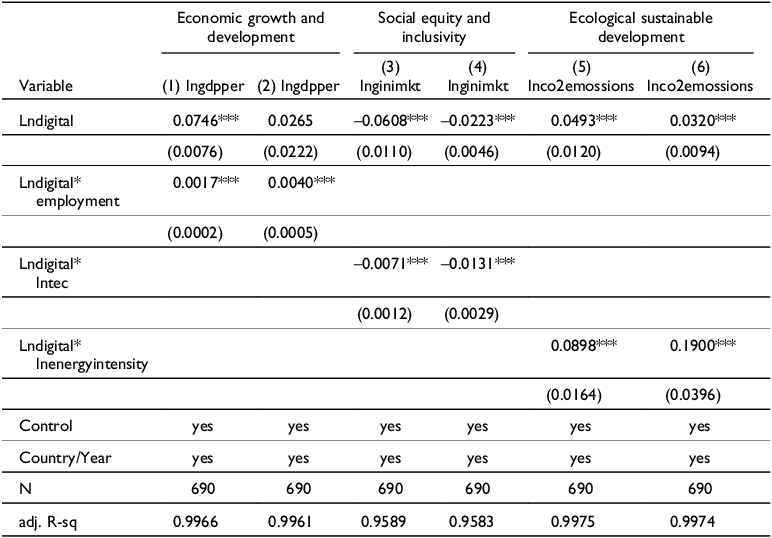
Note. Standard errors are in parentheses. ***, * *, and *, respectively, represent significant at the 1%, 5%, and 10% levels.
These results may be attributed to high barriers potentially protecting the domestic digital services industry to a certain extent, reducing foreign competition, and promoting the maturity and expansion of domestic industries, maximising the benefits of digital services trade, and consequently driving more significant economic growth. Simultaneously, digital services trade may create demand for skill improvement and new employment opportunities in high barrier countries, particularly for low-income individuals, thus positively impacting social equity. However, high barrier countries may rely more on carbon-intensive energy sources or have lower energy efficiency, leading to a positive association between the growth of digital services trade and carbon emissions. Additionally, if some high barrier countries are developing countries, their rapid carbon emissions growth may be due to their position in the accelerating industrialisation phase, with a rapid increase in energy demand, coinciding with the growth of the digital services trade as an emerging industry.
Mechanism test
Previous research has confirmed that DST has a positive impact on a country’s economic growth and development, as well as social equity and inclusiveness, while having a negative effect harming a country’s ecological sustainability.
Specifically, the theoretical analysis in the previous sections suggests that DST will achieve economic growth and development through the promotion of employment and promote domestic social equity and inclusiveness through inclusive innovation effects. From the perspective of employment promotion, the development of DST has created many innovative entrepreneurial opportunities, leading to an increase in self-employment positions, higher employment rates for workers, higher income levels, and promoting domestic inclusive growth. From the perspective of inclusive innovation effects, the competition effects of advanced and high-standard service technologies and products from foreign countries force host country enterprises to innovate actively, which may promote latecomer countries and enterprises to engage in innovation catch-up actively, ultimately achieving inclusive innovation effects, benefiting people experiencing poverty, and promoting social equity. However, DST has a negative impact on a country’s ecological sustainability by increasing carbon emissions. DST is considered relatively ‘clean’ because it does not require as much natural resources as traditional manufacturing industries. However, the rapid growth of the digital service industry may result in increased energy consumption, especially in data centres, leading to increased carbon emissions, which we summarise as the energy demand effect. Therefore, DST may increase a country’s carbon emissions through the energy demand effect.
To empirically analyse the above mechanisms, we constructed the following regression model based on the benchmark equation:
 $$In Y_{i,t}=\lambda0+\lambda1 digital_{i,t}+\lambda2digital_{i,t}*Med_{i,t}+\lambda3Control_{i,t}+Year_{t}+Country_{i}+\epsilon_{i,t}$$
In the equation, Med represents the mediating effect proxy variable, including the structural upgrading effect, employment promotion effect, and inclusive innovation effect. Combining benchmark regression results with equation 2 regression results, we can examine how DST influences inclusive growth through the aforementioned mechanisms.
Following the indicator selection in existing literature, this study uses the ratio of value added in the service sector to value added in the manufacturing sector from the World Bank database to represent a country’s industrial structure as a proxy variable for the structural effect. The employment rate represents a country’s employment promotion effect. The logarithm of patent applications represents the country’s technological innovation level, testing the mechanism of the inclusive innovation effect. Energy intensity index represents the energy demand effect.
The regression results in Table 10 show that the independent variables in columns 1, 3, and 5 represent the scale of DST, while the independent variables in columns 2, 4, and 6 represent the proportion of DST. The results indicate that the interaction term coefficient between DST and the employment rate is significantly positive, consistent with the coefficient of DST in the baseline regression in Table 3. It implies a transmission channel of DST → increased employment → promoting domestic economic growth between DST and domestic economic growth. The interaction term coefficient between DST and technological innovation level is negative, consistent with the coefficient of DST in the baseline regression in Table 4. This suggests that there is a transmission channel of DST → inclusive innovation → reducing income inequality, promoting domestic social equity. On the other hand, the interaction term coefficient between DST and energy consumption demand is positive, consistent with the coefficient of DST in the baseline regression in Table 5. This indicates that there is a transmission channel of DST → increasing energy consumption demand → increasing carbon emissions, hindering domestic ecological sustainability.
In the above mechanism test, the regression results obtained by replacing the DST amount with the DST proportion indicator are consistent, indicating the robustness of the proposition. Hypothesis 4 has been validated.
Conclusion and enlightenment
This study examines the impact of DST on inclusive growth from three aspects through theoretical and empirical research. The research findings indicate that DST significantly increases domestic per capita income, promotes economic growth, and reduces domestic income inequality, promoting domestic social equity and inclusiveness. However, the development of DST leads to increased carbon emissions in a country, hindering ecological sustainability. This research extends the breadth of DST studies, filling the gap in research on income distribution effects and environmental effects of DST. It provides empirical evidence to develop DST better, while also considering fairness, improving income distribution patterns, and promoting inclusive growth.
This study offers management implications for countries and governments engaging in DST. DST has become a new force driving global trade growth and a significant engine for development. As the costs of service trade decrease, opportunities are created for vulnerable groups to access affordable new services provided digitally. The development of DST has essential implications for income distribution, as it can promote domestic economic growth and social equity through employment promotion and inclusive innovation.
Moreover, to maximise economic benefits from DST, economies must enhance their populations’ digital skills and knowledge, continuously strengthen logistics and infrastructure development to support DST, and create an environment conducive to lowering barriers to DST through policy and regulatory reforms.
Currently, the global negotiations on digital trade rules are accelerating, and the digital global value chain is rapidly being constructed. Countries should deepen international cooperation, increase research and development investment in the digital service sector, enhance digital infrastructure to improve the completeness, actively participate in the division of labour in global DST, capitalise on specialisation and scale advantages, and simultaneously mitigate the adverse environmental impacts of DST development to achieve inclusive growth.
Funding statement
This research was funded by The General Project of the National Social Science Fund: ‘Research on the path of “Industrial Aid to Xinjiang” in the problem of Regional Coordinated Development Mechanism’ (funding number: 18BJL083) and Philosophy and Social Sciences Project of Xinjiang University: ‘Research on Innovation Driven Upgrading of Xinjiang’s Industrial Structure under the “Double Carbon” goal’ (funding number: 22GPY004).
Competing interests
The author declared no potential conflicts of interest concerning this article’s research, authorship, and/or publication.
Alai Yeerken (1989), female, born in Tacheng, Xinjiang, China, Kazak nationality, a doctoral candidate in the School of Economics and Management at Xinjiang University. Her research interests are global value chains and income inequality.
Deng Feng (1970), male, Hubei, China, doctor of management, professor and doctoral supervisor of the School of Economics and Management of Xinjiang University. His research interests are technological innovation and economic growth.



