Introduction
An ever-growing body of research is highlighting the challenges facing older people, particularly those in rural areas, in relation to Information and Communications Technology (ICT) and the use of the networked infrastructure of the global internet (for an overview, see Warburton, Cowan and Bathgate Reference Warburton, Cowan and Bathgate2013). To date, most research exploring the topic of ICT and older people in rural areas has focused on participants from higher socio-economic areas with high levels of education, as this cohort was amongst the earliest to adopt ICT (Chesters, Ryan and Sinning Reference Chesters, Ryan and Sinning2013: Feist et al. Reference Feist, Parker, Keough and Howard2012). The research reported in this article seeks to redress this imbalance by focusing on the challenges and opportunities facing disadvantaged older people in rural areas through the use of ICT. As the cost of accessing ICT decreases and both health and social services increasingly move to online delivery models, it is this group which arguably has the most to gain from access to the tools of the internet age.
Moreover, there is a gap in the research evidence grounded in appropriate theory. We respond to this gap by drawing on Castells's theory of the network society (Castells Reference Castells1996), which highlights the social, economic and cultural impact that ICT is having on society. We use Castells's approach in order to explore the potential for ICT use among one specific group of older people, that is older people with experience of long-term homelessness, social isolation and complex needs, who are now involved with an Australian homelessness agency. In doing so, we address the research question, ‘what are the challenges and opportunities for ICT use by disadvantaged older people from rural areas?’ We begin by presenting the theoretical framework for the study.
Manuel Castells and the network society
The theoretical framework for this article is provided by Spanish sociologist Manuel Castells's trilogy The Information Age, the first volume of which was published in 1996 (Castells Reference Castells2010, Reference Castells2011a , Reference Castells2011b ). Observing the social, economic and cultural changes occurring in the latter 20th century, Castells postulates that each have been transformed to such an extent that we are now living in a new type of society, the network society (Castells Reference Castells2011b ). Castells argues that, under the influence of the information technology revolution that began in the 1970s, networks have become the dominant social morphology of societies and that the logic of networks has substantially modified processes of production, the transmission of culture and the exercise of power within society (Castells Reference Castells1996). Although a thorough analysis of Castells's work is beyond the scope of this article, we do wish to draw upon two of his concepts in particular: the culture of real virtuality, and the notion of power and counterpower within such a culture (Castells Reference Castells1996). These concepts are particularly relevant as they provide a meta-theoretical base on which the social and technological challenges facing disadvantaged older people in rural areas can be better understood within the context of the broader changes occurring in the network society.
Castells (Reference Castells1996: 328), argues that, under the influence of ICT and blended ‘written, oral, and audio-visual modalities of human communication’, culture in the network society is experiencing profound change. Castells refers to this changed culture as the culture of real virtuality (Castells Reference Castells1996). Of particular note is that in such a culture there is ‘increasing stratification among users’, as some people have access to the new multimedia cultural environment, while others who lack access to the network are ‘provided with a restricted number of pre-packaged choices’ (Castells Reference Castells1996: 371). This phenomenon is often described as digital exclusion or the digital divide (Dupont, Slegers and De Grooff Reference Dupont, Slegers and De Grooff2011; Hearn et al. Reference Hearn, Tacchi, Foth and Lennie2009; Hill, Beynon-Davies and Williams Reference Hill, Beynon-Davies and Williams2008). The culture of real virtuality, Castells argues, has led to the transformation of the most fundamental dimensions of human life, space and time (Castells Reference Castells1996). These transformations lead to further marginalisation as people are separated between those with access to what Castells refers to as the space of flows, and those isolated within the space of places (Castells Reference Castells1996). Access to the space of flows is typified by a person's ability to access fully both the nodes and hubs of the technological infrastructure of information systems, telecommunications and transportation lines, while also having the ability to reside in physical environments where decisions about this infrastructure are being made, such as VIP lounges, international hotel chains and residences in close proximity to major central business districts (Castells Reference Castells1999). Those relegated to the space of places, in contrast, are left to construct their lives largely within the confines of their immediate geographic locations (Castells Reference Castells1999).
Power in the network society is exercised by people with access to the space of flows who programme the main networks on which people's lives depend, such as government, military, finance, media, and science and technology institutions (Castells Reference Castells2012). A second powerful group, referred to by Castells as switchers, connects these different networks in strategic partnerships that share their common interests and values (Castells Reference Castells2012). Examples of switchers in Castells's theory (2012) include financial and political elites, major media players and academic institutions, all through their mutual dependence. Social actors and social movements wishing to exercise counterpower in the network society must therefore disrupt the dominant switchers to alternative networks of resistance and social change (Castells Reference Castells2009, Reference Castells2011c , Reference Castells2012). Castells cites as evidence for the potential effectiveness of counterpower the networked social movements that have spread throughout the globe in the first decade of the twenty-first century, for example, the multifaceted movements collectively known as the Arab Spring and the Occupy Wall Street movement (Castells Reference Castells2012). Most importantly for our article, however, is that a fundamental precondition for the exercise of counterpower is full access to the network society.
The Information Age has been hailed by some as signalling a return to grand sociological macro-theory and as a rebuke to postmodernism (Stalder Reference Stalder2006). Such statements, however, also highlight a potential weakness in the theory, namely, that in its attempt to provide a grand narrative, cultural exceptions and contradictory findings might be ignored in order to preserve the integrity of the theory (Stalder Reference Stalder2006). One need only look at the history of other such grand narratives, such as eugenics, to see the human misery that can result from such an approach (Ghoshal Reference Ghoshal2005). Castells attempts to counter these risks by advocating for an approach to theory building that he calls ‘disposable theory’, that sees theory as first and foremost a research tool rather than an end-product (Castells Reference Castells2000: 6). Under such a regime, theory should be viewed as being in a constant exploratory stage that is open to rectification by ongoing research (Castells Reference Castells2000). Castells's commitment to such an approach can be seen in the decades-long cross-cultural case studies conducted by himself and his students, that led to the formulation of The Information Age and the continued effort that has seen multiple revisions to the text since it was first published in 1996 (Castells Reference Castells2000, Reference Castells2010, Reference Castells2011b ).
Ageing and the network society in rural Australia
Australia is undoubtedly a part of the new social milieu of the network society. Research published by the Australian Communications and Media Authority (ACMA) highlights the extent to which internet access and mobile technologies are profoundly impacting Australian lives as they increasingly turn to ICT for information, communication and commerce (ACMA 2014a ). ACMA's longitudinal research, however, also highlights segments of the Australian population that, despite making gains in the last decade, continue to be at a disadvantage to accessing the tools and services of the information age (ACMA 2014a , 2014b , 2014c ). The uptake of broadband services, usage of the internet outside the home and use of mobile phones to access the internet are all significantly lower for those living in rural areas (ACMA 2014c ). ACMA research suggests that both accessing the internet outside the home and accessing the internet via mobile phones are 17 per cent lower for rural Australians as compared with those living in major capital cities (ACMA 2014c ).
Older Australians continue to lag behind those in younger demographics in several key metrics related to the use of ICT (e.g. ACMA 2013: Feist, Parker and Hugo Reference Feist, Parker and Hugo2012). A recent report examining the uptake of new technologies by older Australians (Chesters, Ryan and Sinning Reference Chesters, Ryan and Sinning2013: 9) noted, for example, that approximately 39 per cent of men and 34 per cent of women aged 15–24 years used the internet for browsing on a daily basis compared with 8 per cent of men and just 3 per cent of women aged 65 years or more. Results in the same report also indicated that 65 per cent of men and 75 per cent of women aged 65 years or more have never used the internet to read or send e-mails (Chesters, Ryan and Sinning Reference Chesters, Ryan and Sinning2013: 9). Research demonstrates that those older people who do utilise ICT tend to be highly educated, from higher socio-economic groups and living in urban areas (Chesters, Ryan and Sinning Reference Chesters, Ryan and Sinning2013; Feist et al. Reference Feist, Parker, Keough and Howard2012). This all suggests that older people from rural areas experience multiple layers of disadvantage preventing their full participation in the network society.
Even though it is clear that older people, especially those from rural areas and lower socio-economic groups, are disadvantaged in relation to ICT uptake and use, there is a growing body of research that is examining ICT use by older people (Laganá et al. Reference Laganá, Oliver, Ainsworth and Edwards2011; Shapira, Barak and Gal Reference Shapira, Barak and Gal2007; Slegers, Van Boxtel and Jolles Reference Slegers, Van Boxtel and Jolles2008; Sum et al. Reference Sum, Mathews, Hughes and Campbell2008; Toler Woodward et al. Reference Toler Woodward, Freddolino, Wishart, Bakk, Kobayashi, Tupper, Panci and Blasche-Thompson2013; Warburton, Cowan and Bathgate Reference Warburton, Cowan and Bathgate2013; Warburton et al. Reference Warburton, Cowan, Winterton and Hodgkin2013; Xie Reference Xie2007). Research conducted by Shapira, Barak and Gal (Reference Shapira, Barak and Gal2007), that examined the effects of ICT training on a group of elderly participants with a mean age of 80 (N = 20), found significant improvements in measures such as life satisfaction, depression, loneliness and self-control when compared with a control group that did not receive the training. A number of subsequent studies have concurred with these findings (Sum et al. Reference Sum, Mathews, Hughes and Campbell2008; Xie Reference Xie2007). While these results are encouraging, continued research is needed to verify these findings as at least one large randomised control trial has questioned the effectiveness of ICT-based interventions (Slegers, Van Boxtel and Jolles Reference Slegers, Van Boxtel and Jolles2008).
Another body of research has highlighted the potential for ICT to counter social isolation (Institute for a Broadband-Enabled Society 2012; Kamel Boulos and Wheeler Reference Kamel Boulos and Wheeler2007; Warburton, Cowan and Bathgate Reference Warburton, Cowan and Bathgate2013; Xie Reference Xie2008). A review of the literature focused on the building of social capital among rural older people using ICT, conducted by Warburton, Cowan and Bathgate (Reference Warburton, Cowan and Bathgate2013), concluded that ICTs can contribute to both bridging and bonding social capital, providing opportunities for older people to access services and resources, and foster relationships with diverse groups of people from differing geographic areas.
This background of the literature surrounding ICT use by older people in rural areas highlights emerging evidence that there are barriers to adoption for this cohort, both in terms of access to infrastructure, such as broadband and mobile services, and due to factors relating to older people's exposure to ICT throughout their lifecourse. Within the broad demographic group of older people in rural areas, there is clear evidence of further barriers for those from low socio-economic backgrounds and those without high levels of education. If we accept Castells's assertion that full participation in the network society is only possible when we have access to the multimedia communication networks on which the culture of real virtuality is built, there is a critical need for research to be conducted with these disadvantaged groups to understand better the barriers and advantages of ICT use. In particular, there is a corresponding need to explore the potential of ICT access to enable older, socially isolated people in rural areas to participate more fully in the new cultural landscape and ultimately exercise counterpower. These are the gaps in the research literature which the current research project aimed to address.
Research background
The research question being addressed in this study is ‘what are the challenges and opportunities for ICT use by disadvantaged older people from rural areas?’ The research project was conducted at one homelessness service organisation based in Bendigo, in the Loddon Mallee region of Victoria, Australia. This diverse geographic area covering 58,961 square kilometres includes major regional centres such as Bendigo, as well as smaller rural townships and farms (Department of Human Services 2014). The findings presented in this article focus on one aspect of a larger study. The broader research study comprised a multi-level action research project, involving working with the organisation's staff and clients. In this article, we focus on the latter group, who were all recruited from the organisation's Assertive Outreach (AO) programme, a programme that provides long-term case management support for people living independently in the community with histories of homelessness, social isolation, and multiple and complex needs. ‘Complex needs’ is a catch-all term that comprises substance abuse, and physical and mental health issues. In order to participate in the research project, participants needed to be clients of the AO programme, be over the age of 50, and self-identify as being able to read and write English to a competent standard. The minimum age of 50 is specified by the programmes funding agreement in recognition of the likelihood of premature ageing in this cohort.
Following ethics approval from La Trobe University's Human Ethics Committee, participant information statements were circulated to clients of the programme throughout April and May 2014. Eight clients of the AO programme expressed an interest in participating in the research project, of whom seven were selected, as one was recovering from major surgery within the data collection period. Each participant was provided with an Apple iPad with cellular access for use during the project, with participants keeping the tablet at the conclusion of the research. Participants were also provided with vouchers for data access throughout the project and an Australian $30 App Store card for buying applications that were needed throughout the project. Data vouchers were chosen, rather than either monthly data plans or broadband connections, in order to protect participants from potential bill shock (ACMA 2013).
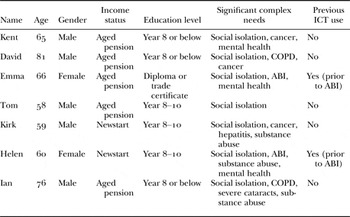
Data collection occurred between May and December 2014. During this period, the lead author met with the participants in their homes, with the exception of one participant who chose to meet in a local library. All of the participants lived within an 80 kilometre radius of the homelessness organisation. Key participant characteristics are presented in Table 1. This shows that participants were aged between 58 and 81 years of age, and five were male, two were female. Only two of the participants had ever used a computer of any type before the research project, and both of these had since suffered an Acquired Brain Injury (ABI). Three other participants had previously diagnosed mental health conditions. Many had a history of substance abuse, with three experiencing ongoing substance abuse issues. All but one participant had ongoing serious physical health issues including cancer, hepatitis and Chronic Obstructive Pulmonary Disease (COPD).
Participant characteristics

Notes: All names are pseudonyms. ABI: Acquired Brain Injury. COPD: Chronic Obstructive Pulmonary Disease.
Methodology
Action research was chosen as the research methodology for the project (Hearn et al. Reference Hearn, Tacchi, Foth and Lennie2009; Reason and Bradbury Reference Reason and Bradbury2008; Sarantakos Reference Sarantakos2005). Action research can be defined as:
A participatory process concerned with developing practical knowing in the pursuit of worthwhile human purposes. It seeks to bring together action and reflection, theory and practice, in participation with others, in the pursuit of practical solutions to issues of pressing concern to people, and more generally the flourishing of individual persons and their communities. (Reason and Bradbury Reference Reason and Bradbury2008: 4)
This description concisely encompasses the characteristics that made action research appropriate for the aims of the research project, namely its focus on collaboration and participation, its iterative research process that involves both action and reflection and its focus on individual flourishing, emancipation and creating change (Alston and Bowles Reference Alston and Bowles2003; Hearn et al. Reference Hearn, Tacchi, Foth and Lennie2009; Reason and Bradbury Reference Reason and Bradbury2008; Sarantakos Reference Sarantakos2005).
In addition to these central advantages, there is a growing body of research combining ICT and action research, especially in working with disadvantaged groups (Hearn et al. Reference Hearn, Tacchi, Foth and Lennie2009). A range of action research variants have been applied to ICT-related projects including Ethnographic Action Research, Network Action Research and Anticipatory Action Research (Foth Reference Foth2006; Hearn et al. Reference Hearn, Tacchi, Foth and Lennie2009), and this has provided a rich methodological toolbox from which the action researcher can draw when working in complex research environments, such as those that existed in the current project.
Data collection
In accordance with the action research methodology chosen for the project, data collection proceeded along a number of distinct yet overlapping phases. The initial phase involved gathering baseline data, setting up the tablet computer for use, and completing initial introductory training that focused on building confidence and engagement with the technology. The second phase, beginning approximately one month after the participants had received the tablets, involved more intensive one-to-one training on the device combined with goal setting, to establish what services and communication methods most appealed to each participant. During the third phase, which began approximately three months into the data collection, a re-evaluation of the progress made by participants was undertaken that led to subsequent decisions as to whether participants moved on to more advanced techniques related to the participants' goals or focused on areas that were proving more difficult for the participant to master. A final concluding stage of the project that covered the final six weeks of data collection involved assessing the participants' attitudes about their ICT usage and ensuring that each participant had the skills and knowledge to continue using the device at the end of the project, with ongoing support from their social workers. Each of these phases was also more broadly contextualised within a research design that involved periods of reflection and re-evaluation in accordance with action research methodology (Zuber-Skerritt and Perry Reference Zuber-Skerritt and Perry2002).
Throughout the project, a range of action research data collection methods were adopted. To complement the data to be collected, a questionnaire was administered at the beginning of the project. Questions were based on those used in an earlier research project that had examined older people from rural areas and ICT (Feist et al. Reference Feist, Parker, Keough and Howard2012). Both the researcher and a social work student on research placement, who spent the last three months of data collection assisting with the project, kept a reflective journal. Semi-structured interviews were conducted with each participant at various intervals throughout the data collection phase of the project. Finally, in addition to these data collection methods, a range of digital artefacts, such as e-mail and message correspondence, photographs and videos, that were produced by the participants were also collected. The reflective journals, transcribed semi-structured interviews and a selection of relevant digital artefacts were imported into the NVivo 10 Data Analysis software for coding and analysis.
Once data had been imported into the NVivo 10 software, it was subjected to an initial round of inductive coding that resulted in over 160 unique codes relating to the data. To ensure rigour in data analysis, three data extracts were coded independently by other members of the research team and the resulting coded material was cross-referenced to the initial codes, done by the lead author. Once this step was complete, a secondary round of thematic analysis was conducted that resulted in a number of key themes being identified (Denzin and Lincoln Reference Denzin and Lincoln1994; Reason and Bradbury Reference Reason and Bradbury2008).
Findings
Findings revealed three key themes related to the research question, which aimed to explore the challenges and opportunities facing the participants in relation to ICT use. First, the data showed technological barriers that impacted on participants' ability to engage with the tablet and stay reliably connected to the internet. Second, there were a range of geographic and economic factors linked to broader concepts such as digital exclusion and the digital divide, which acted as a further disincentive to ICT use by participants. Finally, findings highlighted issues relevant to social disadvantage and ICT use for this cohort that presented both significant barriers facing the participants but also the tremendous potential that ICT has to transcend these barriers and contribute to positive change. These results are discussed below and interpreted in terms of their relationship to the core concepts of Castells's theory of the network society.
Technological barriers
Technological issues presented a range of challenges to participants, particularly due to poor user interface (UI) design, that in turn, impacted on user experience (UX). These issues hampered engagement with the device and impacted on the participants' confidence in using the tablet. Three issues in particular stood out: the tablets system-wide notifications; applications that were not intuitive to the participant and UI elements that led to the participants accidentally disabling the tablet.
The tablets system-wide notification function proved to be a major disruption to the participants' use of the device. The tablets' software has been designed to occasionally interrupt the user with system notifications such as ‘iCloud Backup This iPad has not been backed up for X weeks. Backups happen when this iPad is plugged in, locked and connected to Wi-FI’ or ‘SOFTWARE UPDATE iOS 7.1.1 is now available for your iPad’. Unlike the notifications for individual applications, these system-wide notifications cannot be switched off. The random nature of these notifications, and the fact that they occurred while the participant was trying to accomplish another task, resulted in participants feeling that they had ‘broken the tablet’. This was compounded by the geographical distances involved, meaning that participants were unable to use the tablet, sometimes for several weeks, as they were unable to raise the problem promptly with the researcher.
There were additional UI issues that impacted on the participants' ability to use the device between face-to-face training sessions. A number of participants became confused when they inadvertently touched app icons for sufficient time that the interface went into its app deletion mode. This is characterised by the applications jiggling on the screen. Emma's comments were illustrative of the problem faced by a number of participants:
Researcher: So what technical issues have you had with the iPad?
Emma: (Laughs) What technical issues? It froze. It scrambled. It did the jelly wobbles on me … I couldn't get the cursor on it. Didn't know what to do? How did I solve the problems? … I hopped on a bus and came into [the] Telstra office and asked them to help … I was really upset when it happened.
Many UX issues related to specific applications. A number of participants were interested in using Facebook to connect with family or friends. While the participants enjoyed the ability to see their Facebook friends' walls, there were many elements of the application's design that proved problematic, particularly when the use of Facebook services were dependent on installing a number of different apps, such as Facebook's separate Messenger application. These issues were often compounded by the fact that many participants had low levels of literacy. Kent's experience here is indicative of the issue:
Well I get so far on Facebook then I don't know how to – what else to do. This is my daughter's right? (Points to application). It just says photos. I don't know how to put a message up there if I want to – on my Facebook page I just don't know how to do that… (Kent)
Access to welfare payments proved highly frustrating for participants, particularly as all relied on Centrelink payments, the Australian Governments welfare department, to survive financially. Participants found accessing the Centrelink website to monitor their welfare payments very frustrating. Logging on to the site required the participant to answer a number of randomly generated questions that they set when first using the website, in addition to their username and password. These additional requirements frustrated participants when they did not remember or accurately spell the answers during the login process and this caused participants to stop using the service until the next face-to-face training session. In addition to these issues, there were access issues related to the Centrelink website requiring that JavaScript, a common programming language used extensively on the World Wide Web, be turned on. Kirk spent several weeks without being able to access his payment and appointment schedule at Centrelink as the appropriate setting was disabled on his tablet. These issues are of particular concern, given the government's push to use online services rather than physically visiting a Centrelink office, and the potential loss of benefits if users do not adhere to appointment and reporting requirements.
A final UI-related difficulty involved participants inadvertently switching off vital services. David, in particular, experienced a number of these issues that included accidentally pressing the Airplane Mode button, which completely disabled his tablet's connection to the cellular network. On one occasion, David also inadvertently adjusted the brightness level of his tablet so low that the screen became black, convincing him that he had broken the device. After the problem was fixed at the following face-to-face training session, David joked that he would ‘put tape on the bottom of the screen so that he wouldn't be able to do it again’. Poor literacy skills, in addition to physical health issues such as cataracts, exacerbated these issues for several participants. If they were unable to read or understand text and graphic symbols, or struggled to physically ‘hit’ UI targets on the screen, some participants reverted to a scattergun technique of pushing a software button to see what happened. It was these participants who often had trouble due to accidentally disabling the device.
Geographic and economic barriers
In addition to these technological barriers, participants had issues with connecting to the cellular network and maintaining their pre-paid data plans. Several participants encountered persistent difficulties receiving a cellular network signal of sufficient strength to use their devices effectively. Emma, Tom and Kirk, in particular, faced persistent network connection issues that at times prevented all access to the network, which was problematic when it impeded communication with social workers. Thus, for example, Kirk missed important information from his social worker regarding his cancer treatment. Sometimes, messages sent by participants were not sent due to poor network connections, leading to uncertainty as to whether messages had been sent. Persistent network dropouts proved so frustrating to Emma that face-to-face training with the researcher had to be rescheduled from her home to the local library, yet Emma lived within the boundaries of the major regional centre.
Pre-paid data accounts were the preferred payment methods, as recharge vouchers can be easily purchased from many locations with which the participants are familiar from recharging the credit on their mobile phones. This included businesses such as supermarkets and corner stores, also more likely to be available in small rural locations. Another benefit was that this process required no lock-in contracts that might disadvantage the participant at the conclusion of the data collection period.
However, despite these advantages, there were a number of frustrations associated with the pre-paid data plans. Firstly, the plans were very expensive for the amount of data permitted (Aus $30 for 1.3 gigabytes per month). Effectively managing data caps are difficult even for an experienced user and many participants unwittingly exceeded their monthly data cap. A software quirk also meant that once the data cap had been reached and a tablet was recharged, it would only reconnect to the network after the tablet was completely powered down and restarted. On several occasions, this contributed to participants not being able to use their devices even though they had correctly recharged.
Social disadvantage and ICT
In addition to the UI and network/data-related issues faced by participants, issues that most people with no experience of ICT might be expected to struggle with, there were a number of more specific challenges and opportunities experienced by this particular sub-set of rural older people as a result of their social disadvantage. One of the exciting possibilities promised by introducing ICT skills to such a socially isolated cohort, especially those in geographically isolated areas, was the potential to use technology to transcend the limits of the participants' current social networks in real life and connect them to new social networks online. In practice, however, results indicated that there were significant barriers associated with achieving this goal. Perhaps most importantly, was the extent to which online social networks are dependent, at least initially, on a network of real-life social connections from which your online network can grow. Survey results conducted at the beginning of the project indicated that, with the exception of Tom, all participants had very little contact with other people. This ranged from no contact at all with family, friends or neighbours (Emma), through to, at most, ‘I have one or two friends that I rely on’ (Kent, Ian and Helen). As most participants were very socially isolated in real life, and often had very fractured family histories, establishing even a small online social network proved very difficult in many cases.
There were, however, a small number of exceptions to this finding that clearly illustrate the transformative role ICT can play in re-establishing and strengthening relationships for extremely socially isolated older people. These findings hint at the potential for disadvantaged older people to benefit from more fully engaging with what Castells refers to as the culture of real virtuality (Castells Reference Castells1996). One such exception was Kent, who had an adult daughter from whom he was estranged for a variety of complex reasons. One of Kent's early goals in the project was to learn to use Facebook so that he could try to re-establish a link to his daughter who lived 160 kilometres from his home. After Kent's daughter accepted his friend request, he was able to have limited contact with her online. Kent reported that he appreciated the ability to simply see her status updates and know that she was okay without the need to dredge up all the interpersonal issues that had soured their relationship. As Kent's ICT skills developed, he began using Facebook's messenger application to have brief conversations with his daughter. This, in turn, led to phone calls and finally a number of meetings in real life. For someone as isolated as Kent, this reconnection can have profound effects on his wellbeing. Several months after formal data collection had ended, the lead author had a chance encounter with Kent outside a supermarket. Kent was excited to report that he was about to book a brief vacation with his daughter and her partner.
Another encouraging finding relates to the potential for ICT to act as a virtual time machine that can reconnect socially isolated older people, especially those with few financial resources or mobility issues, to places of importance. As an engagement strategy, and in order to demonstrate the capability of the tablet, participants were asked to identify a place for which they had strong memories. For some participants such as Kent, this was a family home, for Ian, however, his place was the outback pubs that he had frequented during his time spent as a roo shooter, a person who shoots wild kangaroos for their pelts and meat. Ian's life, during this part of his history, revolved around shooting kangaroos at night and drinking at outback pubs during the day. Ian had significant mobility issues related to his COPD and severe cataracts that, combined with his limited finances, excluded him from ever visiting these locations for the foreseeable future. Using Google Street View, the researcher was able to show him the pubs, rotate around them in 360 degrees and even ‘walk’ up and down nearby streets. This technique had a number of very positive attributes. Firstly, ‘visiting’ these places unlocked a flood of new animated stories and powerful memories for the participants. So much so that one participant (Kent) was moved to tears when he saw the family home where he grew up in Tasmania that he had not seen since he was a young boy. For Ian, the ability to ‘visit’ his favourite pub allowed him to regale the researcher with tales of outback adventure and stories about infamous incidents and characters from his past. Perhaps more importantly, however, this technique served to motivate the participants to learn to use the tablet, despite being daunted by the prospect of learning ICT. This technique also directly resulted in the formulation of some tangible goals for which they wanted to use the device.
Discussion
Findings identified a range of challenges and benefits associated with the participants' use of ICT. While many of these challenges and benefits might be expected of any group of older people in a rural location being exposed to ICT for the first time, what sets the results of the project apart from other similar studies was the additional complexities faced as a result of issues such as substance abuse, poor literacy, physical and mental health conditions, financial hardship and social isolation. It is these issues, in combination with established challenges and opportunities faced by older people in relation to ICT, that highlights both additional barriers and fresh opportunities facing older people in rural areas from disadvantaged backgrounds.
These cumulative factors, in turn, have major implications when viewed from the perspective of Manuel Castells's theory of the network society. Many of the ICT-related technical, geographic and economic issues identified in the study highlight the many ways in which disadvantaged older people are being excluded from the emerging culture of real virtuality and their potential to exercise counterpower as programmers and switchers in the networks on which the culture of real virtuality is based.
The UX issues identified in the results, for example, clearly demonstrate the need for device manufacturers and software application developers to consider both those new to ICT and those with low literacy levels and physical impairments when designing hardware and software. Castells's work highlights the fact that these issues are far more than simple technical issues. Rather, they act to fundamentally restrict the participants' access to the crucial cultural networks of the internet age as exemplified by Castells's concept of the culture of real virtuality. Apple is to be commended for showing some leadership in beginning to address these issues with the accessibility features being introduced into the iPad's iOS software (https:// www.apple.com/au/accessibility/). These features allow users with physical impairments or poor literacy to modify the device to suit their needs better. Several such features proved beneficial to participants in the study, however, results indicate that much more is to be done if older people in rural areas, especially those from disadvantaged backgrounds, are to participate fully and exercise counterpower in the network society.
Similarly, a clear pattern of findings indicates that older rural people with complex needs face issues related to accessing the internet due to geographic and economic issues. From the perspective of Castells's theory, issues relating to digital exclusion and the digital divide relegate this cohort to the space of places, while simultaneously, key services go online and centre their service provision around online communication in the space of flows. Therefore, issues such as affordable and reliable connection to the internet become crucial. Internet service providers and telecommunication networks have a key role to play in ensuring disadvantaged people have affordable and reliable access to global information networks. The results from this study concur with similar studies that have identified that telecommunication ‘black spots’ continue to restrict rural service users in Australia. Ongoing advances need to be made in this area, particularly for older socially isolated people with complex needs who have the most pressing need for tele-health and assisted services that rely on fast, reliable internet access. From an economic perspective, results indicate significant barriers facing older people in rural areas from disadvantaged backgrounds, in terms of access to affordable internet plans. Pre-paid services are the primary method that disadvantaged older people use to access telecommunication services. Results illustrate that there is a clear need for plans to be developed that allow older people from low socio-economic backgrounds to access the internet without the severely restrictive data caps currently on offer in the Australian marketplace.
Findings also highlight the challenges and opportunities present for the participant group from the perspective of social disadvantage and ICT. It is clear from the current findings that people with severely restricted social networks in real life also face issues when trying to build online social networks. Having real-life social connections would appear to provide the crucial base from which ones' online networks can be built. Programmes that encourage a holistic approach to building social connections that incorporate both real-world and online aspects are crucial if socially isolated older people are to transcend the limitations of space and place and participate fully in the network society. One possible approach might be to connect small groups of socially isolated people together with volunteer online ‘buddies’ who can serve as mentors to encourage interaction between the group and broaden each users' networks. Results suggest that even a small number of real-world connections for socially isolated older people can enable social relationships online.
Further, online social networks may also offer a means through which socially isolated older people can begin to repair relationships with estranged social connections over time and without the added complications of face-to-face meetings. Once re-established online, results indicate that when these online relationships develop, reconnection in the real world is possible. Finally, results show the potential for socially isolated older people with mobility issues to use ICT to transcend the limitations imposed by physical and economic hardships. Results suggest that this can not only help older socially isolated people to connect in a meaningful way with their personal histories, but that it can also be used as an effective tool to help motivate older people to learn ICT skills.
Conclusion
Australia, and much of the world, is currently undergoing profound cultural change in response to the global information flows of the network society. Increasing social stratification that separates those with access to the network society and those excluded from its network logic threaten to marginalise older people in rural areas, particularly those from disadvantaged backgrounds. Manuel Castells's theory of the network society provides a strong theoretical base on which future research into the impact of ICT on older people can be assessed, particularly in relation to older people's ability to access fully the emerging culture of real virtuality and their ability to exercise counterpower. Castells's theoretical work also provides those studying the social connections of older people with a holistic framework within which social connectedness can incorporate relationships in the online networks of the space of flows alongside those grounded in the space of places. While the heterogeneous character of rural regions and modest sample size of this study support the need for further research, findings from this study suggest that there remains a range of areas where technological, economic and social exclusion are exacerbating the existing disadvantage being faced by many rural older people in relation to ICT use. There are also clear examples of the potential positive impact of ICT access for disadvantaged rural older people. Notwithstanding the limitations acknowledged above, the study's findings highlight a range of ICT-related issues that are likely to impact on vulnerable older people across a range of cultural and geographic spaces and, as such, contribute to a burgeoning field of enquiry that examines the impact of technological change on these groups. Governments, telecommunications agencies, hardware and software vendors all have a role to play in making ICT more accessible for disadvantaged rural older people. It is only through improvements to the accessibility and availability of ICT infrastructure and training that rural older people, particularly those from disadvantaged backgrounds, can engage meaningfully with ICT and reap the benefits of full access to the network society.
Acknowledgements
Support for the acquisition of the tablets used in this part of the study was provided by La Trobe University's ‘Building Healthy Communities’ research focus areas. Particular thanks to Haven; Home, Safe for their support, and to the staff and clients of the Assertive Outreach programme who participated in the project. Ethics approval for this research project was provided by La Trobe University's Human Ethics Committee (FHEC14/027).