



1 Introduction and main result
For
 $1 < p < \infty $
, a weight w in
 $\mathbb {R}^n$
(i.e.,
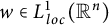 $w \in L^1_{loc}(\mathbb {R}^n)$
with
 $w \geq 0$
a.e. in
 $\mathbb {R}^n$
) is said to belong to the Muckenhoupt class
 $A_p(\mathbb {R}^n)$
if

where
 $Q \subset \mathbb {R}^n$
is a cube (always with sides parallel to the coordinate axes) and the notation
 stands for
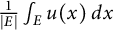 $\frac {1}{|E|}\int _E u(x) \, dx$
, that is, the average of u, with respect to Lebesgue measure, over a set E with Lebesgue measure
 $|E|>0$
, while the notation
 $u(E)$
will stand for
 $\int _E u(x) \, dx$
. The endpoint classes for
 $p=1$
and
 $p=\infty $
are defined by

and

As it turns out (see, for instance, [Reference Grafakos5, Section 9.3]),
 $$ \begin{align*}A_\infty(\mathbb{R}^n) = \bigcup\limits_{p\geq1}A_p(\mathbb{R}^n). \end{align*} $$
On the other hand, as a fundamental result in the regularity theory for nonnegative solutions to certain elliptic partial differential equations defined on a given domain
 $\Omega \subset \mathbb {R}^n$
stands the Harnack inequality, that is (see, for instance, [Reference Gilbarg and Trudinger4, Sections 8.8 and 9.8]), the existence of a constant
 $C_H \geq 1$
such that for every such nonnegative solution u and every cube Q with
 $2Q \subset \Omega $
we have
 $$ \begin{align} \sup\limits_Q u \leq C_H \inf\limits_Q u. \end{align} $$
The fact that an
 $A_\infty (\mathbb {R}^n)$
-weight w satisfies a Harnack-type inequality as (1.1) not necessarily in all of a given cube Q but in a subset
 $H_Q \subset Q$
with the measure of
 $Q \setminus H_Q$
being as small as desired (uniformly across the cubes Q and with respect to both the Lebesgue measure and the weight w itself) appears implicitly in the literature on analysis and PDEs. For instance, in [Reference Bortz, Hofmann, Martell and Nyström1, Lemma 4.9] by Bortz, Hofmann, Martell, and Nyström and in [Reference Hofmann, Le, Martell and Nyström6, Lemma 4.1] by Hofmann, Le, Martell, and Nyström. The purpose of this note is to reformulate this “Harnack-type” property, to show that, in fact, it characterizes
 $A_\infty $
-weights, and then to provide some applications of such characterization. More precisely, we prove the following theorem.
Theorem 1.1 Fix a weight w in
 $\mathbb {R}^n$
with
 $w(Q):=\int _Q w(x) \, dx> 0$
for every cube
 $Q \subset \mathbb {R}^n$
. Then the following are equivalent:
-
(1)
 $w \in A_\infty (\mathbb {R}^n)$
,
-
(2) for every
$\varepsilon \in (0,1),$
there exists
$C_\varepsilon \geq 1$
such that for every cube
$Q \subset \mathbb {R}^n,$
there is a “Harnack set”
$H_\varepsilon \subset Q$
satisfying (1.2)
$$ \begin{align} \min\left\{\frac{|H_\varepsilon|}{|Q|}, \frac{w(H_\varepsilon)}{w(Q)}\right\} \geq (1-\varepsilon) \quad \text{ and } \quad \mathop{\mathrm{ess\ sup }}\limits_{H_\varepsilon} w \leq C_\varepsilon \mathop{\mathrm{ess\ inf }}\limits_{H_\varepsilon} w, \end{align} $$
-
(3) there exist
$\varepsilon _0 \in (0,1)$
and
$C_0 \geq 1$
such that for every cube
$Q \subset \mathbb {R}^n,$
there is a “Harnack set”
$H_{\varepsilon _0} \subset Q$
satisfying (1.3)
$$ \begin{align} \min\left\{\frac{|H_{\varepsilon_0}|}{|Q|}, \frac{w(H_{\varepsilon_0})}{w(Q)}\right\} \geq (1-\varepsilon_0) \quad \text{ and } \quad \mathop{\mathrm{ess\ sup }}\limits_{H_{\varepsilon_0}} w \leq C_0 \mathop{\mathrm{ess\ inf }}\limits_{H_{\varepsilon_0}} w. \end{align} $$



In the next section, we lay out the background material required in the proof of Theorem 1.1 (our techniques differ from the ones in [Reference Bortz, Hofmann, Martell and Nyström1, Reference Hofmann, Le, Martell and Nyström6]), then Sections 3 and 4 are devoted to its proof and to some of its applications, respectively.
2 Preliminaries
The proof of Theorem 1.1 will be based on the following well-known real-analysis results: the Calderón–Zygmund lemma and basic characterizations of
 $A_\infty (\mathbb {R}^n)$
-weights (see, for instance, [Reference Grafakos5, Section 9.3.2]).
Theorem 2.1 (Calderón–Zygmund lemma)
Fix
 $\lambda> 0$
, a cube
 $Q_0 \subset \mathbb {R}^n$
, and a nonnegative function
 $w \in L^1(Q_0)$
such that

Then, there is a collection
 $\{Q_j\}_{j \in \mathbb {N}}$
of disjoint subcubes of
 $Q_0$
such that

and, by setting
 $\Omega := \bigcup \limits _{j \in \mathbb {N}} Q_j$
and
 $F:=Q_0 \setminus \Omega $
, we have
 $$ \begin{align} w(x) \leq \lambda \quad \text{for a.e. } x \in F. \end{align} $$
Theorem 2.2 (Characterizations of
$A_\infty (\mathbb {R}^n)$
-weights)

Let w be a weight in
 $\mathbb {R}^n$
. The following are equivalent:
-
(1)
$w \in A_\infty (\mathbb {R}^n)$
, -
(2) there exist constants
$0 < \theta \leq 1$
and
$C_\theta> 0$
such that for every cube
$Q \subset \mathbb {R}^n$
and every measurable set
$E \subset Q,$
we have (2.3)
$$ \begin{align} \frac{w(E)}{w(Q)} \leq C_\theta \left( \frac{|E|}{|Q|}\right)^\theta, \end{align} $$
-
(3) there exist constants
$\gamma , \beta \in (0,1)$
such that
$$ \begin{align*} \left\vert\left\{x \in Q: w(x) \geq \gamma \tfrac{w(Q)}{|Q|} \right\}\right\vert \geq \beta |Q| \quad \forall \, \mathrm{{cube }} \, Q \subset \mathbb{R}^n. \end{align*} $$



3 Proof of Theorem 1.1
Let us start begin with the following consequence of the Calderón–Zygmund lemma.
Lemma 3.1 Fix a weight w in
 $\mathbb {R}^n$
, a cube
 $Q \subset \mathbb {R}^n$
, and
 $N> 1$
. Then, there exists a measurable set
 $F \subset Q$
such that
 $$ \begin{align} |F| \geq \frac{N}{N+1} |Q| \end{align} $$
and

Proof Given a weight w in
 $\mathbb {R}^n$
, a cube
 $Q \subset \mathbb {R}^n$
, and
 $N> 1$
, take
 $Q_0:=Q$
and
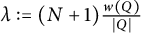 $\lambda :=(N+1) \frac {w(Q)}{|Q|}$
in (2.1), with these choices Theorem 2.1 implies
 $$ \begin{align*} |\Omega| = \sum\limits_{j=1}^\infty |Q_j| < \frac{1}{\lambda} \int_{\Omega} w(x) \, dx \leq \frac{1}{\lambda} \int_{Q} w(x) \, dx = \left(\frac{1}{N+1} \right) |Q|, \end{align*} $$
with the set
 $F:=Q \setminus \Omega $
satisfying
 $$ \begin{align*}|F| = |Q| - |\Omega| \geq \left(1 - \frac{1}{N+1}\right) |Q|= \frac{N}{N+1} |Q| \end{align*} $$
The proof of the implication (1)
 $\Rightarrow $
(2) from Theorem 1.1 will be a consequence of the next lemma and the fact that if
 $w \in A_\infty (\mathbb {R}^n)$
, then
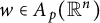 $w \in A_p(\mathbb {R}^n)$
for some
 $1 \leq p < \infty $
.
Lemma 3.2 Fix
 $1 \leq p < \infty $
and
 $w \in A_p(\mathbb {R}^n)$
. Then, for every cube Q and
 $N>1,$
there exists a set
 $F_N \subset Q$
such that
 $$ \begin{align} |Q| \leq \frac{(N+1)}{N-1} |F_N|, \end{align} $$
 $$ \begin{align} w(Q) \leq \frac{(N+1)^p}{N-1} [w]_{A_p} w(F_N), \end{align} $$
and

Proof Suppose first that
 $1 < p < \infty $
. Given a cube
 $Q \subset \mathbb {R}^n$
and
 $N> 1$
, let
 $F_N^+$
and
 $F_N^-$
be as in Lemma 3.1 applied to w and
 $w^{1/(1-p)}$
, respectively, that is,
 $F_N^+, F_N^- \subset Q$
satisfy

and

where the last inequality can be recast as

The fact that
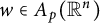 $w \in A_p(\mathbb {R}^n)$
, along with (3.6) and (3.8), yields

Now, if
 $p=1$
, we simply look at
 $F_N^+$
to get

and take
 $F_N^-:=F_N^+$
. Thus, for every
 $1 \leq p < \infty ,$
we have

and by defining
 $F_N:=F^+_N \cap F^-_N,$
we obtain (3.5). In addition, since
 $$ \begin{align*} \min\{|F^+_N|, |F^-_N| \} \geq \tfrac{N}{N+1} |Q|, \end{align*} $$
we can write
 $$ \begin{align*}|Q| \leq |F^+_N \cap F^-_N| + |Q \setminus F^+_N| + |Q \setminus F^-_N| \leq |F^+_N \cap F^-_N| + \tfrac{2}{N+1} |Q| \end{align*} $$
and therefore
 $$ \begin{align} |F_N| \geq \frac{(N-1)}{(N+1)} |Q|, \end{align} $$
which gives (3.3). Finally, from the second inequality in (3.5),

where for the last inequality we used (3.10), and (3.4) follows.
3.1 Proof of Theorem 1.1
(1)
 $\Rightarrow $
(2). Given a cube
 $Q \subset \mathbb {R}^n$
and
 $N> 1$
to be fixed later, let
 $F_N \subset Q$
the set from Lemma 3.2 corresponding to
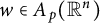 $w \in A_p(\mathbb {R}^n)$
for some
 $1 \leq p < \infty $
. Then, the size inequality (3.10) along with (2.3) from Theorem 2.2 applied to
 $E:=Q \setminus F_N$
yields
 $$ \begin{align} \frac{w(Q\setminus F_N)}{w(Q)} \leq C_\theta \left( \frac{|Q \setminus F_N|}{|Q|}\right)^\theta \leq 2^\theta C_\theta (N+1)^{-\theta}. \end{align} $$
Now, given
 $\varepsilon> 0$
, fix
 $N> 1$
large enough so that
 $$ \begin{align} \max\{2^\theta C_\theta (N+1)^{-\theta}, 2 (N+1)^{-1}\} \leq \varepsilon, \end{align} $$
which implies
 $$ \begin{align*}\frac{w(F_N)}{w(Q)} \geq 1 - \varepsilon \quad \text{ and } \quad \frac{|F_N|}{|Q|} \geq 1 - \varepsilon. \end{align*} $$
Finally, define
 $H_\varepsilon := F_N$
and
 $C_\varepsilon :=(N+1)^p [w]_{A_p}.$
(2)
 $\Rightarrow $
(3). Obvious, just take any
 $\varepsilon _0 \in (0,1)$
.
(3)
 $\Rightarrow $
(1). Given a cube
 $Q,$
let
 $H_{\varepsilon _0} \subset Q$
be as in (1.3) and we simply write
 $$ \begin{align*} \mathop{\mathrm{ess\ inf }}\limits_{H_{\varepsilon_0}} w \geq \frac{1}{C_0} \mathop{\mathrm{ess\ sup }}\limits_{H_{\varepsilon_0}} w \geq \frac{1}{C_0} \frac{w(H_{\varepsilon_0})}{ |H_{\varepsilon_0}|} \geq \frac{(1-\varepsilon_0)}{C_0} \frac{w(Q)}{ |Q|}, \end{align*} $$
so that by setting
 $\gamma :=(1-\varepsilon _0)/C_0 \in (0,1)$
it follows that (up to a null set)
 $$ \begin{align*}H_{\varepsilon_0} \subset \left\{x \in Q: w(x) \geq \gamma \tfrac{w(Q)}{|Q|} \right\} \end{align*} $$
with
 $|H_{\varepsilon _0}| \geq (1-\varepsilon _0)|Q|$
. Therefore, the condition (3) from Theorem 2.2 holds true with
 $\beta :=(1-\varepsilon _0) \in (0,1)$
and
 $w \in A_\infty (\mathbb {R}^n)$
.
4 Some applications
In the applications below, we will rely on the following consequence of Theorem 1.1: given
 $\varepsilon \in (0,1)$
, a cube
 $Q \subset \mathbb {R}^n$
, and
 $w \in A_\infty (\mathbb {R}^n)$
, let
 $H_\varepsilon \subset Q$
be as in Theorem 1.1, part (2). Then, for a.e.
 $x \in H_\varepsilon ,$
let us write
 $$ \begin{align*} w(x) &\leq \mathop{\mathrm{ess\ sup }}\limits_{H_\varepsilon} w \leq C_\varepsilon \mathop{\mathrm{ess\ inf }}\limits_{H_\varepsilon} w \leq \frac{C_\varepsilon}{|H_\varepsilon|} \int_{H_\varepsilon} w \leq \frac{C_\varepsilon}{(1-\varepsilon)} \frac{1}{|Q|} \int_{Q} w\\ & \leq \frac{C_\varepsilon}{(1-\varepsilon)^2} \frac{1}{|H_\varepsilon|} \int_{H_\varepsilon} w \leq \frac{C_\varepsilon}{(1-\varepsilon)^2} \mathop{\mathrm{ess\ sup }}\limits_{H_\varepsilon} w \leq \frac{C_\varepsilon^2}{(1-\varepsilon)^2}\mathop{\mathrm{ess\ inf }}\limits_{H_\varepsilon} w \leq \frac{C_\varepsilon^2}{(1-\varepsilon)^2} w(x). \end{align*} $$
That is,

where the implied constants depend only on
 $\varepsilon $
and
 $C_\varepsilon $
, with
 $C_\varepsilon $
depending only on
 $\varepsilon $
,
 $[w]_{A_\infty }$
, and n. We will also use the fact that given
 $\varepsilon \in (0,1)$
, a cube
 $Q \subset \mathbb {R}^n$
,
 $N \in \mathbb {N}$
, and weights
 $w_1, \ldots , w_N \in A_\infty (\mathbb {R}^n)$
, by letting
 $H_\varepsilon ^j$
denote the set
 $H_\varepsilon \subset Q$
from Theorem 1.1, part (2), corresponding to each
 $w_j \in A_\infty (\mathbb {R}^n)$
,
 $j=1, \ldots , N$
, we have
 $$ \begin{align*}|Q \setminus \cap_{j=1}^N H_\varepsilon^j| = |\cup_{j=1}^N (Q \setminus H_\varepsilon^j)| \leq \sum\limits_{j=1}^N |Q \setminus H_\varepsilon^j| \leq \varepsilon N |Q|, \end{align*} $$
since
 $|Q \setminus H_\varepsilon ^j| \leq \varepsilon |Q|$
for every
 $j=1, \ldots , N.$
Thus, by choosing
 $\varepsilon < 1/N,$
we obtain
 $$ \begin{align} |\cap_{j=1}^N H_\varepsilon^j| \geq (1-\varepsilon N) |Q|. \end{align} $$
Let us illustrate the above comments with the proof of the following corollary to Theorem 1.1.
Corollary 4.1 Given m weights
 $w_1, \ldots , w_m \in A_\infty (\mathbb {R}^n),$
there exists a constant
 $C> 0$
, depending only on n, m, and
 $[w_j]_{A_\infty (\mathbb {R}^n)}$
for
 $j=1, \ldots , m$
, such that

Proof Given
 $m \in \mathbb {N}$
,
 $\varepsilon \in (0,1/m)$
, weights
 $w_1, \ldots , w_m \in A_\infty (\mathbb {R}^n)$
, and a cube
 $Q \subset \mathbb {R}^n$
, let
 $H_\varepsilon ^j$
be the set
 $H_\varepsilon \subset Q$
from Theorem 1.1, part (2), corresponding to each
 $w_j \in A_\infty (\mathbb {R}^n)$
,
 $j=1, \ldots , m,$
and define
 $H:= \cap _{j=1}^m H_\varepsilon ^j.$
Now, (4.2) and (4.1) imply
 $|H| \geq (1-\varepsilon m) |Q|>0$
and

respectively; in particular (4.4) and the definition of
 $H:= \cap _{j=1}^m H_\varepsilon ^j,$
yield

Therefore,

and (4.3) follows.
For the next applications, recall that for
 $1 < s < \infty ,$
we write
 $w \in RH_s(\mathbb {R}^n)$
if

and
 $w \in RH_\infty (\mathbb {R}^n)$
if

As it turns out (see, for instance, [Reference Cruz-Uribe and Neugebauer3, p. 2948] and [Reference Grafakos5, Section 9.3]),
 $$ \begin{align} RH_\infty(\mathbb{R}^n) \subsetneq \bigcap_{s>1} RH_s(\mathbb{R}^n) \quad \text{ and } \quad \bigcup\limits_{s > 1} RH_s(\mathbb{R}^n) = A_\infty(\mathbb{R}^n). \end{align} $$
Also, if
 $w \in RH_s(\mathbb {R}^n),$
then
 $w^s \in A_\infty (\mathbb {R}^n)$
(see, for instance, [Reference Cruz-Uribe and Neugebauer3, Theorem 2.1]). The classes
 $\cap _{s>1} RH_s(\mathbb {R}^n)$
and
 $RH_\infty (\mathbb {R}^n)$
are closely related to the pointwise multipliers of
 $A_p(\mathbb {R}^n)$
and
 $A_\infty (\mathbb {R}^n)$
. More precisely, the class
 $\bigcap _{s>1} RH_s(\mathbb {R}^n)$
constitutes the multipliers of
 $A_\infty (\mathbb {R}^n)$
in the sense that given
 $w_2 \in \cap _{s>1} RH_s(\mathbb {R}^n)$
it follows that
 $w_1w_2 \in A_\infty (\mathbb {R}^n)$
for every
 $w_1 \in A_\infty (\mathbb {R}^n)$
. Conversely, if a weight
 $w_2$
possesses such multiplier property for
 $A_\infty (\mathbb {R}^n)$
, then
 $w_2 \in \bigcap _{s>1} RH_s(\mathbb {R}^n)$
(see [Reference Johnson and Neugebauer7, Theorem 3.5(3)]). On the other hand, for a fixed
 $1 < p < \infty $
, the multipliers of
 $A_p(\mathbb {R}^n)$
are exactly the weights w such that
 $w, w^{-1} \in \cap _{q> 1} A_q(\mathbb {R}^n)$
, as proved in [Reference Johnson and Neugebauer7, Lemma 2.3 and Theorem 2.12].
In particular, from the above comments on multipliers of
 $A_\infty (\mathbb {R}^n)$
, if
 $w_1 \in A_\infty (\mathbb {R}^n)$
and
 $w_2 \in RH_\infty (\mathbb {R}^n)$
, then
 $w_1 w_2 \in A_\infty (\mathbb {R}^n)$
. As consequence of Corollary 4.1, let us now prove the following “reverse multiplier” result for the
 $A_p(\mathbb {R}^n)$
classes.
Corollary 4.2 Fix
 $w_1 \in A_\infty (\mathbb {R}^n)$
and
 $w_2 \in RH_\infty (\mathbb {R}^n)$
. Then, given
 $1 \leq p < \infty $
,
 $$ \begin{align*}w_1w_2 \in A_p(\mathbb{R}^n) \Rightarrow w_1 \in A_p(\mathbb{R}^n). \end{align*} $$
Proof Since
 $w_1, w_2 \in A_\infty (\mathbb {R}^n)$
, given a cube Q, from Corollary 4.1, we get

where the implied constant depends only on
 $[w_1]_{A_\infty }, [w_2]_{A_\infty },$
and n.
Now, consider
 $1 \leq p < \infty $
with
 $w_1w_2 \in A_p(\mathbb {R}^n)$
. If
 $p=1$
, for a.e.
 $x \in Q,$
we have

which combined with (4.8) yields
 $w_1 \in A_1(\mathbb {R}^n)$
with
 $[w_1]_{A_1}\lesssim [w_1w_2]_{A_1} [w_2]_{RH_\infty }$
.
If
 $1 < p < \infty $
, we write

which together with (4.8) gives
 $w_1 \in A_p(\mathbb {R}^n)$
with
 $[w_1]_{A_p}\lesssim [w_1w_2]_{A_p} [w_2]_{RH_\infty }$
.
4.1 On multilinear reverse-Hölder inequalities
In this section, we relate Corollary 4.1 to two multilinear reverse-Hölder inequalities for
 $A_\infty (\mathbb {R}^n)$
-weights. Firstly, let us mentioned that by means of scaling properties of
 $A_\infty (\mathbb {R}^n)$
-weights Cruz-Uribe and Moen proved in [Reference Cruz-Uribe and Moen2] that given m exponents
 $1 < s_1, \ldots , s_m < \infty $
satisfying
 $$ \begin{align} \sum\limits_{j=1}^m \frac{1}{s_j} =1, \end{align} $$
and weights
 $w_j \in RH_{s_j}(\mathbb {R}^n)$
for
 $j=1, \ldots , m$
, the multilinear reverse-Hölder inequality

holds true for every cube
 $Q \subset \mathbb {R}^n$
, where
 $C>0$
depends on m, n, and on
 $[w_j]_{RH_{s_j}}$
and
 $s_j$
for
 $j=1, \ldots , m$
(see [Reference Cruz-Uribe and Moen2, Theorem 1.1]). As an application of Theorem 1.1, we will next see that the multilinear reverse-Hölder inequality (4.10) continues to hold true without the assumption (4.9) on the exponents
 $s_j$
. More precisely, we prove the following corollary.
Corollary 4.3 Fix
 $1 < s_1, \ldots , s_m < \infty $
not necessarily satisfying (4.9). Then, the multilinear reverse-Hölder inequality (4.10) holds true for
 $w_j \in RH_{s_j}(\mathbb {R}^n)$
,
 $j=1, \dots , m,$
and for every cube
 $Q \subset \mathbb {R}^n$
where C depends only on
 $[w_j]_{RH_{s_j}}$
and
 $s_j$
, for
 $j=1, \dots , m,$
as well as on m and n.
Proof The proof is a straightforward application of the inequality (4.3) from Corollary 4.1 (keeping (4.7) in mind) and the definition of
 $RH_s$
.
Next, let us discuss a second multilinear reverse-Hölder inequality for
 $A_\infty (\mathbb {R}^n)$
-weights. In [Reference Xue and Yan8], Xue and Yan proved that given
 $m \in \mathbb {N}$
and exponents
 $0 \leq \theta _1, \ldots , \theta _m \leq 1$
satisfying
 $$ \begin{align} \sum\limits_{j=1}^m \theta_j \leq 1, \end{align} $$
then the multilinear reverse-Hölder inequality

holds true for every cube
 $Q \subset \mathbb {R}^n$
and
 $w_1, \ldots , w_m \in A_\infty (\mathbb {R}^n)$
. Here,
 $C> 0$
depends only on
 $[w_j]_{A_\infty (\mathbb {R}^n)}$
and
 $\theta _j$
for
 $j=1, \ldots , m,$
as well as on m and n (see Theorem 1.1 and Corollary 1.1 in [Reference Xue and Yan8] as well as [Reference Cruz-Uribe and Moen2, Corollary 1.5]). As another consequence of Theorem 1.1, we will see that the multilinear reverse-Hölder inequality (4.12) continues to hold true without the assumption (4.11) on the exponents
 $\theta _j$
. We prove the following corollary.
Corollary 4.4 Fix
 $0 \leq \theta _1, \ldots , \theta _m \leq 1$
, not necessarily satisfying the inequality (4.11), and
 $w_1, \ldots , w_m \in A_\infty (\mathbb {R}^n)$
. Then the multilinear reverse-Hölder inequality (4.12) holds true for every cube
 $Q \subset \mathbb {R}^n$
, where
 $C> 0$
depends only on
 $[w_j]_{A_\infty (\mathbb {R}^n)}$
and
 $\theta _j$
for
 $j=1, \ldots , m$
, as well as on m and n.
Proof As in the proof of Corollary 4.1, given
 $\varepsilon \in (0,1/m)$
and a cube
 $Q \subset \mathbb {R}^n$
, let
 $H_\varepsilon ^j$
be the set
 $H_\varepsilon \subset Q$
from Theorem 1.1, part (2), corresponding to each
 $w_j \in A_\infty (\mathbb {R}^n)$
,
 $j=1, \ldots , m,$
and define
 $H:= \cap _{j=1}^m H_\varepsilon ^j.$
Again, (4.2) and (4.1) imply
 $|H| \geq (1-\varepsilon m) |Q|$
and, for each
 $\theta _j \in [0,\infty )$
, (4.4) yields

where for each
 $j=1, \ldots , m$
, the implied constants depend only on n,
 $[w_j]_{A_\infty (\mathbb {R}^n)}$
, and
 $\theta _j$
. In particular,

and again by taking averages over H and recalling that
 $|H| \geq (1-\varepsilon m) |Q|$
we obtain

and the multilinear reverse-Hölder inequality (4.12) follows.
4.2 A characterization for a product of
$A_\infty (\mathbb {R}^n)$
-weights to be an
$A_\infty (\mathbb {R}^n)$
-weight


As another application of Theorem 1.1, we will see that the validity of reverse inequality to (4.3) characterizes the fact that
 $\prod \limits _{j=1}^m w_j \in A_\infty (\mathbb {R}^n)$
whenever
 $w_j \in A_\infty (\mathbb {R}^n)$
for
 ${j=1, \ldots , m}$
. That is, we prove the following theorem.
Theorem 4.5 Fix
 $w_1, \ldots , w_m \in A_\infty (\mathbb {R}^n)$
. Then, the following are equivalent:
-
(1)
$\prod \limits _{j=1}^m w_j \in A_\infty (\mathbb {R}^n)$
, -
(2) for every
$0 < \beta _1, \ldots , \beta _m < \infty ,$
there exists a constant
$C_\beta> 0$
such that (4.13) -
(3) there exists a constant
$C> 0$
such that (4.14)
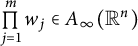


Proof (1)
 $\Rightarrow $
(2). Given m weights
 $w_1, \ldots , w_m \in A_\infty (\mathbb {R}^n)$
, let us introduce the
 $(m+1)$
th weight as their product, that is,
 $w_{m+1}:= \prod _{j=1}^m w_j$
. By hypothesis,
 ${w_{m+1} \in A_\infty }$
. Given a cube
 $Q \subset \mathbb {R}^n$
and
 $\varepsilon \in (0, 1/(m+1))$
, let
 $H_\varepsilon ^j$
be the set
 $H_\varepsilon \subset Q$
from Theorem 1.1, part (2), corresponding to each
 $w_j \in A_\infty (\mathbb {R}^n)$
,
 $j=1, \ldots , m, m+1$
, and define
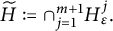 $\widetilde {H}:= \cap _{j=1}^{m+1} H_\varepsilon ^j.$
Then,

Next, (4.4) yields

so that raising both sides of (4.16) to
 $\beta _j$
, then taking the average over
 $H_\varepsilon ^j$
, and finally raising to the
 $1/\beta _j,$
we obtain

Thus, from (4.15), (4.16), and (4.17) (along with the fact that
 $\widetilde {H} \subset \cap _{j=1}^{m} H_\varepsilon ^j$
), we get

and the proof of (1)
 $\Rightarrow $
(2) is complete.
(2)
 $ \Rightarrow $
(3) simply by choosing
 $\beta _j=1$
for
 $j=1, \ldots , m$
.
(3)
 $ \Rightarrow $
(1). Given
 $Q \subset \mathbb {R}^n$
and
 $\varepsilon \in (0, 1/m)$
, let
 $H_\varepsilon ^j$
be always the set
 $H_\varepsilon \subset Q$
from Theorem 1.1, part (2), corresponding to each
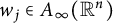 $w_j \in A_\infty (\mathbb {R}^n)$
,
 $j=1, \ldots , m,$
and define
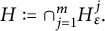 $H:= \cap _{j=1}^{m} H_\varepsilon ^j.$
As before, let us define
 $w_{m+1}:= \prod _{j=1}^m w_j$
. We need to show that
 $w_{m+1} \in A_\infty (\mathbb {R}^n)$
. Indeed, by hypothesis (3) followed by (4.5), we get

Hence,

with
 $|H| \geq (1- \varepsilon m) |Q|$
and from one of the characterizations of
 $A_\infty (\mathbb {R}^n)$
weights (namely, the implication (3)
 $ \Rightarrow$
(3) in Theorem 2.2), it follows that
 $w_{m+1} \in A_\infty (\mathbb {R}^n)$
.
A number of consequences from Theorem 4.5 can now be derived.
Corollary 4.6 Fix
 $w_1, \ldots , w_m \in A_1(\mathbb {R}^n)$
. Then,
 $$ \begin{align*}\prod\limits_{j=1}^m w_j \in A_1(\mathbb{R}^n) \quad \Leftrightarrow \quad \prod\limits_{j=1}^m w_j \in A_\infty(\mathbb{R}^n). \end{align*} $$
Proof Only the implication (
 $\Leftarrow $
) needs a proof, since
 $A_1(\mathbb {R}^n) \subset A_\infty (\mathbb {R}^n)$
. Now, given a cube Q, the assumption
 $\prod \limits _{j=1}^m w_j \in A_\infty (\mathbb {R}^n)$
, along with Theorem 4.5 and the fact that
 $w_j \in A_1(\mathbb {R}^n)$
for
 $j=1,\ldots , m$
, allows to write

It is well known that if
 $f \in L^1_{\mathrm {{loc}}}(\mathbb {R}^n)$
with
 $\mathcal {M}(f)(x) < \infty $
for a.e.
 $x \in \mathbb {R}^n$
(where
 $\mathcal {M}$
denotes the Hardy-Littlewood maximal function) and
 $\varepsilon \in (0,1)$
, then
 $\mathcal {M}(f)^\varepsilon \in A_1(\mathbb {R}^n)$
with
 $$ \begin{align*}[\mathcal{M}(f)^\varepsilon]_{A_1(\mathbb{R}^n)} \leq \frac{C_n}{1-\varepsilon}, \end{align*} $$
for a dimensional constant
 $C_n>0$
, see, for instance, [Reference Grafakos5, Theorem 9.2.7]. For exponents
 $q \geq 1$
, we have the following corollary.
Corollary 4.7 Let
 $f \in L^1_{\mathrm {{loc}}}(\mathbb {R}^n)$
with
 $\mathcal {M}(f)(x) < \infty $
for a.e.
 $x \in \mathbb {R}^n$
and
 $q \geq 1$
. Then,
 $$ \begin{align*}\mathcal{M}(f)^q \in A_1(\mathbb{R}^n) \quad \Leftrightarrow \quad \mathcal{M}(f)^q \in A_\infty(\mathbb{R}^n). \end{align*} $$
Proof Given
 $q \geq 1$
, let
 $m \in \mathbb {N}$
such that
 $\varepsilon :=q/m < 1$
and apply Corollary 4.6 with
 $w_1 = w_2 = \cdots =w_m = \mathcal {M}(f)^\varepsilon $
.
The next corollary forms part of the folklore on Muckenhoupt weights and will be mentioned in Section 4.3. We include its proof as a simple consequence Theorem 4.5.
Corollary 4.8 Let
 $1 < s_1, \ldots , s_m < \infty $
satisfy
 $$ \begin{align*}\sum\limits_{j=1}^m \frac{1}{s_j} =1. \end{align*} $$
If
 $w_j \in RH_{s_j}(\mathbb {R}^n)$
for
 $j=1, \ldots m$
, then
 $\prod \limits _{j=1}^m w_j \in A_\infty (\mathbb {R}^n)$
.
Proof From the m-Hölder inequality, given a cube
 $Q,$
we can write

and the condition (3) from Theorem 4.5 is met with
 $C:=\prod \limits _{j=1}^m [w_j]_{RH_{s_j}(\mathbb {R}^n)}$
. In addition, since
 $w_j \in RH_{s_j}(\mathbb {R}^n) \subset A_\infty (\mathbb {R}^n)$
for
 $j=1, \ldots , m$
, it follows from Theorem 4.5 that
 $\prod \limits _{j=1}^m w_j \in A_\infty $
.
The next result does not require the condition
 $\sum \limits _{j=1}^m \frac {1}{s_j} =1$
.
Corollary 4.9 Fix weights
 $w_1, \ldots , w_m \in A_\infty (\mathbb {R}^n)$
with
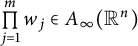 $\prod \limits _{j=1}^m w_j \in A_\infty (\mathbb {R}^n)$
and exponents
 $1 < s_1, \ldots , s_m < \infty $
. Suppose that there exists
 $C_0>0$
such that the multilinear reverse-Hölder inequality

holds true for every cube
 $Q \subset \mathbb {R}^n$
. Then
 $w_j \in RH_{s_j}(\mathbb {R}^n)$
for each
 $j=1, \ldots , m$
.
Proof Since
 $w_1, \ldots , w_m \in A_\infty (\mathbb {R}^n)$
with
 $\prod \limits _{j=1}^m w_j \in A_\infty (\mathbb {R}^n)$
, Theorem 4.5 yields

(where
 $C> 0$
depends only on m, n,
 $[\prod \limits _{j=1}^m w_j]_{A_\infty (\mathbb {R}^n)}$
, and
 $[w_j]_{A_\infty (\mathbb {R}^n)}$
for
 $j=1, \ldots , m$
) which combined with (4.18) gives

Then, the fact that  for
 $j=1, \ldots , m$
, implies
 $w_j \in RH_{s_j}(\mathbb {R}^n)$
with
 $[w_j]_ {RH_{s_j}(\mathbb {R}^n)} \leq C_0 C$
for each
 $j=1, \ldots , m$
.
4.3 On a question of Cruz-Uribe and Neugebauer
In [Reference Cruz-Uribe and Neugebauer3, Theorem 2.6], Cruz-Uribe and Neugebauer proved that given
 $p> 1$
,
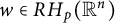 ${w \in RH_p(\mathbb {R}^n)}$
, and
 $v \in RH_{p'}(\mathbb {R}^n)$
(as usual,
 $1/p+1/p'=1$
), there exists a constant
 $C> 0$
, depending only on
 $[w]_{RH_p(\mathbb {R}^n)}$
,
 $[v]_{RH_{p'}(\mathbb {R}^n)}$
, p, and n, such that

and posed the (still open) question of characterizing the weights w and v satisfying (4.19). In this respect, they proved in [Reference Cruz-Uribe and Neugebauer3, Theorem 2.7] that if w and v satisfy (4.19) for some
 $p> 1$
and with
 $w \in RH_p(\mathbb {R}^n)$
, then
 $v \in RH_{p'}(\mathbb {R}^n)$
.
Notice that, for
 $p> 1,$
the assumptions
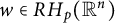 $w \in RH_p(\mathbb {R}^n)$
and
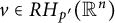 $v \in RH_{p'}(\mathbb {R}^n)$
along with Corollary 4.8 (used with
 $s_1 = p$
and
 $s_2 = p'$
) imply
 $wv \in A_\infty (\mathbb {R}^n)$
.
Next, as a consequence of Theorem 1.1, we characterize the weights w and v satisfying (4.19) under the hypothesis
 $wv \in A_\infty (\mathbb {R}^n)$
. More precisely, we prove the following theorem.
Theorem 4.10 Let w and v be positive and finite a.e. in
 $\mathbb {R}^n$
such that
 $wv \in A_\infty (\mathbb {R}^n)$
(notice that we are not assuming
 $w \in A_\infty (\mathbb {R}^n)$
or
 $v \in A_\infty $
) and suppose that (4.19) holds for some
 $C \geq 1$
and
 $p> 1$
. Then,
 $w \in RH_p(\mathbb {R}^n)$
and
 $v \in RH_{p'}(\mathbb {R}^n)$
with
 $[w]_{RH_p(\mathbb {R}^n)}$
and
 $[v]_{RH_{p'}(\mathbb {R}^n)}$
depending only on C, p, and n.
Proof Fix
 $\varepsilon \in (0,1)$
and given a cube
 $Q,$
let
 $H_\varepsilon \subset Q$
be a Harnack set from Theorem 1.1, part (2), corresponding to
 $wv \in A_\infty (\mathbb {R}^n)$
. In particular,
 $|H_\varepsilon | \geq (1-\varepsilon )|Q|$
and

where the implied constants depend only on
 $[wv]_{A_\infty (\mathbb {R}^n)}$
,
 $\varepsilon $
, and n.
Let us prove that
 $w \in RH_p(\mathbb {R}^n)$
, the proof for
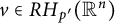 $v \in RH_{p'}(\mathbb {R}^n)$
being similar. From (4.20) and (4.19), we obtain

and, by taking averages over
 $H_\varepsilon $
,

Now, simply by Hölder’s inequality,

and from
 $|H_\varepsilon | \geq (1-\varepsilon )|Q|,$
we get

Consequently,

and then
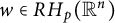 $w \in RH_p(\mathbb {R}^n)$
. The proof of
 $v \in RH_{p'}(\mathbb {R}^n)$
follows similarly just by switching the roles of w and v.
For the case of m weights, we have the following theorem.
Theorem 4.11 Fix
 $1 < p_1, \ldots , p_m < \infty $
and define
 $p>0$
by
 $$ \begin{align*} \frac{1}{p}:= \sum\limits_{j=1}^m \frac{1}{p_j}. \end{align*} $$
Let
 $w_1, \ldots , w_m$
be positive and finite a.e. in
 $\mathbb {R}^n$
(in particular, we are not assuming that a
 $w_j$
or some power of a
 $w_j$
belongs to
 $A_\infty (\mathbb {R}^n)$
) such that
 $$ \begin{align*}\prod\limits_{j=1}^m w_j^{\frac{p}{p_j}} \in A_\infty(\mathbb{R}^n). \end{align*} $$
Then the following are equivalent:
-
(1) there exists
$C \geq 1$
such that (4.21) -
(2)
$w_j \in A_\infty (\mathbb {R}^n)$
, for
$j=1, \ldots , m$
.


Proof The implication (2)
 $ \Rightarrow $
(1) has been proved in [Reference Cruz-Uribe and Moen2, Corollary 1.5] and it also follows from (4.12). For the implication (1)
 $\Rightarrow $
(2), fix
 $\varepsilon \in (0,1)$
. Given a cube Q, let
 $H_\varepsilon \subset Q$
be a Harnack set from Theorem 1.1, part (2), corresponding to
 $\prod \limits _{j=1}^m w_j^{\frac {p}{p_j}} \in A_\infty (\mathbb {R}^n)$
. In particular,
 $|H_\varepsilon | \geq (1-\varepsilon )|Q|$
and

where the implied constants depend only on
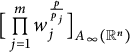 $\big [\prod \limits _{j=1}^m w_j^{\frac {p}{p_j}}\big ]_{A_\infty (\mathbb {R}^n)}$
,
 $\varepsilon $
, m, n, and the
 $p_j$
’s.
Fix
 $k \in \{1, \ldots , m\}$
. We will prove that
 $w_k \in A_\infty (\mathbb {R}^n)$
. From (4.21) and (4.22), we obtain

Let
 $\ell \in \{1, \ldots , m\}$
with
 $\ell \neq k$
so that

and by taking averages over
 $H_\varepsilon $

As in the proof of Theorem 4.10, Hölder’s inequality and
 $|H_\varepsilon | \geq (1-\varepsilon )|Q|$
give

and then

Next, notice that
 $$ \begin{align*}\eta:= \sum\limits_{j \neq \ell} \frac{p}{p_j} =1- \frac{p}{p_\ell} < 1, \end{align*} $$
that is,
 $\sum \limits _{j \neq \ell } \frac {p}{\eta p_j} =1$
with
 $\eta < 1$
. By the
 $(m-1)$
-Hölder inequality with the exponents
 $\eta p_j/p,$
we get

Therefore,

where for the last inequality we used
 $|H_\varepsilon | \geq (1-\varepsilon )|Q|$
again. Hence,

If
 $m=2$
, then
 $j = k$
and (4.23) means

consequently,
 $w_k \in RH_s(\mathbb {R}^n)$
for some
 $s> 1$
, due to Gehring’s lemma (since
 $\eta \in (0,1)$
), and thus
 $w_k \in A_\infty (\mathbb {R}^n)$
. If
 $m> 2,$
we use that

which along with (4.23) implies

thus leading to (4.24) again and hence
 $w_k \in A_\infty (\mathbb {R}^n)$
.
Remark 4.12 As pointed out in [Reference Cruz-Uribe and Moen2, Remark 1.10], the characterization of
 $w_1, \ldots , w_m$
satisfying (4.21) is an open question. Theorem 4.11 then provides one such characterization under the hypothesis
 $\prod \limits _{j=1}^m w_j^{\frac {p}{p_j}} \in A_\infty (\mathbb {R}^n)$
.
Acknowledgements
The author is thankful to David Cruz-Uribe and Simon Bortz for their insightful comments and references as well as to the referee for suggestions that improved the presentation of the results.



