


1. Introduction
Motivated by a range of considerations, such as the conceptual conflict between general relativity (GR) and quantum theory (Crowther, Reference Crowther2025), the observation that GR “breaks down” in certain domains (Earman, Reference Earman1995; Weatherall, Reference Weatherall2023), and the surprising cosmological observations associated with dark matter and dark energy (Martens and King, Reference Martens, King, Nora, Siska, Heng and Matarese2023; Smeenk and Weatherall, Reference Smeenk and Owen Weatherall2024), many physicists have been drawn to the idea that GR should be “modified.” In some cases, these “modified gravity” scenarios have been characterized as “gauge theories of gravity.” In part, this is a marketing scheme: Gauge theory—that is, Yang–Mills theory (YMT), which underlies the standard model of particle physics—has many virtues, such as being quantizable (at least in its linearized, weak-field regime) and pertubatively renormalizable. Authors of these gauge theories of gravity apparently hope to benefit by association. Even so, it is not entirely clear what the marketers intend to claim. In particular, as Weatherall (Reference Weatherall2016c) has emphasized, there are multiple distinct ways in which the term gauge is used in physics. For instance, gauge theory is sometimes used to refer to theories with “surplus” or “superfluous” structure (Redhead, Reference Redhead, Brading and Castellani2003; Ismael and van Fraassen, Reference Ismael, van Fraassen, Brading and Castellani2003; Earman, Reference Earman2004; Healey, Reference Healey2007). and it is sometimes used to refer to theories with a certain formal structure, that is, “any physical theory of a dynamic variable which [sic], at the classical level, may be identified with a connection on a principal bundle” (Trautman, Reference Trautman and Held1980, 306).Footnote 1
In the present article, I will investigate these issues within the context of the “geometric trinity” of gravity, as introduced by Jiménez et al. (Reference Jiménez, Heisenberg and Koivisto2019). As I describe in detail in section 2, the geometric trinity consists of three theories of gravitation that describe the same physical phenomena using different geometrical structures: curvature, as in GR; torsion, as in teleparallel gravity (TEGR) (Aldrovandi and Pereira, Reference Aldrovandi and José Pereira2013); and nonmetricity, as in symmetric teleparallel gravity (STEGR) (Nester and Yo, Reference Nester and Jang Yo1999).Footnote 2 Each of these is often described as a gauge theory; my goal here is to clarify the senses of gauge on which these claims come out as true. Previous work has shown that GR is a gauge theory in the second sense (Trautman, Reference Trautman and Held1980; Weatherall, Reference Weatherall2016 b) but arguably not the first (Weatherall, Reference Weatherall2016 c), so I will focus on TEGR and STEGR. In section 3, building on previous work by Weatherall and Meskhidze (Reference Weatherall and Meskhidze2025) and March et al. (Reference March, Read and Chen2025), I will show that both of these are gauge theories in the first sense; that is, they have surplus structure. Of course, this need not mean they are not also gauge theories in the second sense, and TEGR in particular has been described as both a gauge theory of the translation group and as a type of Poincaré gauge theory (PGT), in analogy to YMT.Footnote 3 In section 4, I will argue that although TEGR can be presented using similar tools as YMT, its interpretation is importantly different. Section 5 concludes.
2. The geometric trinity
I now introduce the geometric trinity. Let M be a smooth, four-dimensional manifold, which we assume to be Hausdorff, paracompact, and parallelizable.Footnote
4
For all three of the theories that we presently consider, we will assume that M is equipped with a smooth, Lorentz-signature metric, which determines the causal structure of spacetime. Although dynamics will play no role in what follows, in all three theories, the metric is dynamically related to the distribution of matter in space and time. Finally, in all three theories, the manifold is also equipped with a (smooth) covariant derivative operator
 $\nabla$
. The differences between the theories correspond to different choices of derivative operator, for some fixed distribution of matter. These different choices of
 $\nabla$
lead to different descriptions of gravitational phenomena.
Recall that in GR,
 $\nabla$
is taken to be the Levi–Civita derivative operator, that is, the unique covariant derivative operator on M with the properties that (a) for any smooth scalar field
 $\alpha$
,
 $\nabla_{[a}\nabla_{b]}\alpha = \mathbf{0}$
, and (b)
 $\nabla_a g_{bc}=\mathbf{0}$
. When a derivative operator satisfies (a), we say it is torsion-free; if it satisfies (b), we say it is metric compatible. In general, this derivative operator will have curvature; that is, it will have nonzero Riemann curvature tensor
 $R^a{}_{bcd}$
, defined as the unique tensor field such that for any smooth vector field
 $\xi^a$
,
 $$R^a{}_{bcd}\xi^b = -2\nabla_{[c}\nabla_{d]}\xi^a.$$
Curvature represents a failure of path independence of parallel transport, even locally, for vectors around closed curves. If curvature vanishes, the derivative operator is said to be flat. We can think of the curvature of a derivative operator as measuring a failure of integrability, in the following sense: Given a basis for the tangent space at a point p, one can extend that basis, by parallel transport, to constant vector fields on a neighborhood of the point just in case curvature vanishes.Footnote 5
It is standard to characterize models of GR as pairs,
 $(M,g_{ab})$
. For present purposes, it is useful to expand these somewhat to include explicit reference to the Levi–Civita derivative operator:
 $(M, g_{ab}, \nabla)$
. Doing so changes nothing because
 $\nabla$
is uniquely determined by
 $g_{ab}$
. We simply make implicit structure explicit. (This will not be the case for the other theories we consider.) Free massive test bodies in GR follow (time-like) geodesics of
 $\nabla$
, and light rays follow null geodesics. We take the empirical content of a model to be exhausted by the structure
 $(M,g_{ab})$
because
 $g_{ab}$
uniquely determines
 $\nabla$
, and
 $g_{ab}$
is determined, up to a constant, by the time-like and null geodesics (Weyl, Reference Weyl1922; Malament, Reference Malament2012).
Now consider TEGR. In this theory, we place different constraints on the derivative operator
 $\nabla$
. We still assume that
 $\nabla$
is metric compatible, but now we require it to be flat. To do this, we must relax the assumption that it is torsion-free because in general, a derivative operator cannot be metric compatible, torsion-free, and flat, except for very special metrics. Instead, the derivative operator will have a nonzero torsion tensor, defined so that for any smooth scalar field
 $\alpha$
,
 $$T^a{}_{bc}\nabla_a\alpha = 2\nabla_{[b}\nabla_{c]}\alpha.$$
Torsion is a measure of the asymmetry of a derivative operator. Note that whereas there is a unique torsion-free derivative operator compatible with any metric
 $g_{ab}$
, no analogous result holds for flat, metric-compatible ones once we drop the torsion-free condition. In other words, given a metric
 $g_{ab}$
, there are many flat derivative operators compatible with it. Torsion, too, can be thought of as measuring a failure of integrability, but now in a different sense. Because the derivative operator is flat, it also admits cobases of constant covector fields, at least locally. But those covector fields can be integrated to determine smooth surfaces to which they are normal only if the derivative operator is torsion-free.
As with GR, we can characterize models of TEGR as ordered triples
 $(M,g_{ab},\tilde{\nabla})$
, where
 $\tilde{\nabla}$
is metric compatible and flat. In this theory, free massive test particles no longer follow time-like (affine) geodesics. Instead, they accelerate according to a force law:
 $$\xi^n\tilde{\nabla}_n\xi^a = -K^a{}_{bc}\xi^a\xi^b,$$
where
 $\xi^a$
is the unit tangent vector to the particle’s worldline, and
 ${K^a}_{bc} = {1 \over 2}({T^a}_{bc} - {T_{cb}}^a - {T_{bc}}^a)$
is the contorsion tensor associated with
 $\tilde{\nabla}$
. Note that these curves, although not geodesics of
 $\tilde{\nabla}$
, do correspond to the locally extremal curves of the metric
 $g_{ab}$
and thus the geodesics of its Levi–Civita derivative operator. For this reason, we will once again take the empirical content of a model to be exhausted by the structure
 $(M,g_{ab})$
.Footnote
6
Finally, we turn to STEGR. Here, we assume that
 $\nabla$
is both flat and torsion-free, but we relax metric compatibility. Instead, we suppose
 $\nabla$
has a nonzero nonmetricity tensor, defined by
 $$Q_{abc}=\nabla_ag_{bc}.$$
Nonmetricity can be thought of as a measure of the degree to which vector lengths and angles, as measured by the metric, are preserved under parallel transport relative to
 $\nabla$
. Suppose, for instance, that
 $\xi^a$
is a constant vector field with respect to
 $\nabla$
. Then it need not follow that the vector have constant length; instead,
 $\nabla_a(\xi^n\xi^mg_{mn})=\xi^n\xi^mQ_{amn}$
. There are no failures of integrability associated with derivative operators on this theory; there is also no relationship between the metric structure of spacetime and its affine structure.
We can think of models of STEGR as triples
 $(M,g_{ab},\bar{\nabla})$
, where
 $\bar{\nabla}$
is flat and torsion-free. Free massive test particles follow accelerated curves, now given by
 $$\xi^n\bar{\nabla}_n\xi^a = -L^a{}_{mn}\xi^m\xi^n,$$
where
 ${L^a}_{bc} = {1 \over 2}{Q^a}_{bc} + {Q_{[b}}{^{a}{_{c]}}}$
is the distorsion tensor associated with
 $\bar{\nabla}$
. Once again, these curves turn out to be the extremal curves of the metric, and so again we take the empirical content of a model to be exhausted by the structure
 $(M,g_{ab})$
.
3. TEGR and STEGR have surplus structure
We now turn to assessing the sense of whether TEGR and STEGR are gauge theories. The first thing to say concerns their names: I have been using the acronyms TEGR and STEGR throughout the article because they are used by Jiménez et al. (Reference Jiménez, Heisenberg and Koivisto2019). These stand for “teleparallel equivalent of GR” and “symmetric teleparallel equivalent of GR,” respectively. But in fact, despite the names, these theories are not all (theoretically) equivalent.Footnote 7 In particular, Weatherall and Meskhidze (Reference Weatherall and Meskhidze2025) show that TEGR and GR fail to be categorically equivalent—which in turn means that they are not equivalent by any of the other, generally stronger, criteria that are widely discussed in the literature.Footnote 8
I will presently show that a similar result holds for STEGR. But first, it will be helpful to review the result from Weatherall and Meskhidze (Reference Weatherall and Meskhidze2025). The starting point is to define a pair of categories,
 $\bf{GR}$
and
 $\bf{TEGR}$
, whose objects are models of the respective theories and whose arrows are “structure-preserving maps.” For convenience, we will consider only isomorphisms.Footnote
9
In the case of
 $\bf{GR}$
, this means models are objects of the form
 $(M,g_{ab},\nabla)$
, defined as previously, and the arrows are isometries. (Note that because
 $\nabla$
is a Levi–Civita derivative operator, it is automatically preserved by every isometry.) For TEGR, the objects are structures
 $(M,g_{ab},\tilde{\nabla})$
, and the arrows are isometries that preserve
 $\tilde{\nabla}$
.
Because for both theories, the empirical significance of a model is entirely encoded in the substructure
 $(M,g_{ab})$
, there is a canonical functor relating these theories and preserving empirical content, namely, the functor
 $F:\bf{TEGR}\rightarrow\bf{GR}$
taking models
 $(M,g_{ab},\tilde{\nabla})$
to
 $(M,g_{ab},\nabla)$
and taking arrows to themselves. If these theories were categorically equivalent, in the sense of Weatherall (Reference Weatherall2016
a), that functor would be (one-half of) an equivalence of categories. But Weatherall and Meskhidze (Reference Weatherall and Meskhidze2025) show that it is not an equivalence. The reason is that it fails to be full; that is, the induced mapping on sets of arrows between pairs of objects of
 $\bf{TEGR}$
fails to be surjective. This is because not every isometry preserves arbitrary flat, metric-compatible derivative operators.
We now turn to STEGR. Nearly identical arguments establish that STEGR and GR are also inequivalent. We work with the same category
 $\bf{GR}$
as before, and we define a new category
 $\bf{STEGR}$
in the obvious way: The objects are structures
 $(M,g_{ab},\bar{\nabla})$
, and the arrows are isometries that preserve
 $\bar{\nabla}$
. Once again, there is a canonical functor
 $F':\bf{STEGR}\rightarrow \mathbf{GR}$
that takes models
 $(M,g_{ab},\bar{\nabla})$
to
 $(M,g_{ab},\nabla)$
and isometries to themselves. If these were categorically equivalent, F′ would be an equivalence of categories. But it is not. We have the following result.
Proposition 3.1 The functor
 $F':\bf{STEGR}\rightarrow\bf{GR}$
fails to be full.
Proof. Fix a model
 $(M,g_{ab},\nabla)$
of
 $\bf{GR}$
. For simplicity, we assume M admits global coordinate systems and that
 $(M,g_{ab},\nabla)$
has no automorphisms. Let
 $(M,g_{ab},\bar{\nabla})$
and
 $(M,g_{ab},\bar{\nabla}')$
be distinct, nonisomorphic objects of
 $\bf{STEGR}$
corresponding to the same object of
 $\bf{GR}$
. (These always exist. Pick two coordinate systems with distinct coordinate derivatives, and take the models of
 $\bf{STEGR}$
to have those derivative operators.) Then there is no arrow between
 $(M,g_{ab},\bar{\nabla})$
and
 $(M,g_{ab},\bar{\nabla}')$
, even though both map to the same model of
 $\bf{GR}$
under F′. It follows that F′ is not full, because no arrow between those objects maps to the identity on
 $(M,g_{ab},\nabla)$
. □
How do these results bear on the sense in which TEGR and STEGR are gauge theories? Weatherall (Reference Weatherall2016c), following Baez et al. (Reference Baez, Bartels, Dolan and Corfield2004), classifies functors according to what they “forget.” An equivalence of categories forgets nothing; any functor that fails to be an equivalence forgets something. In particular, when a functor fails to be full, one should think of it as “forgetting structure.” This is because it shows how the objects in the codomain category have more symmetries than those in the domain category, at least relative to that functor. In the present case, we see that both TEGR and STEGR involve making additional choices, above and beyond specifying a metric structure. Arrows of the corresponding categories need to preserve those choices—which is why there are fewer of them than the corresponding models of GR. This is the sense in which those theories have more structure.
Weatherall goes on to propose that we should say one theory has surplus structure just in case there exists another theory, empirically equivalent to the first, and a functor relating their categories of models that preserves the empirical content of those models while forgetting structure. In that case, one should say that there is an alternative theory that can represent the same phenomena but that does so with less structure. Hence, whatever structure distinguishes the theories from one another is unnecessary for representational purposes. Thus, we have a precise sense in which TEGR and STEGR are gauge theories, in the first sense given earlier.
4. Einstein–Cartan versus Yang–Mills
We have now seen that TEGR and STEGR both have surplus structure, relative to GR, and thus they are both gauge theories in the surplus structure sense. But what about the other sense of the term gauge? We will not consider STEGR further because it is relatively uncommon to present that theory as analogous to YMT.Footnote 10 But many authors working on TEGR have claimed that it should be understood as either a gauge theory of translations (Aldrovandi and Pereira, Reference Aldrovandi and José Pereira2013) or a special case of PGT (Hehl et al., Reference Hehl, von der Heyde, David Kerlick and Nester1976; Hehl, Reference Hehl, Peter and De Sabbata1980; Blagojevic and Vasilic, Reference Blagojevic and Vasilic2000). Advocates for both approaches claim that TEGR can be see as a theory of a dynamical connection on a principal bundle. To the extent that they are correct, TEGR apparently meets Trautman’s criterion to be a gauge theory. But what should we make of these claims? I will now argue that despite apparent similarities, there are important disanalogies between TEGR and YMT on both approaches.
It will be helpful to first recall how YMT deploys this formalism. YMT is a theory (or family of theories) of matter in space and time carrying some property—a type of charge that we will call YM-charge—that influences how that matter evolves. More precisely: Given a relativistic spacetime
 $(M,g_{ab})$
, states of YM-charged matter are represented by sections of a (typically complex) vector bundle
 $V \to E\mathop \to \limits^\pi M$
, usually equipped with some further structure, such as a Hermitian inner product, and an orientation, which we stipulate is not tangent to the manifold.Footnote
11
This vector bundle carries a linear connection, which figures in the matter field’s dynamics much like the Levi–Civita derivative operator does in GR. And also like in GR, this connection may be curved, where that curvature is related to the distribution of charge-current density from all matter carrying the same YM-charge by the Yang–Mills equation.
In what sense is this a theory of a dynamical connection on a principal bundle? The idea is that any vector bundle can be associated with a principal bundle
 $G \to P\mathop \to \limits^\wp M$
, where G, called the structure group of the bundle, is the symmetry group of the (structured) fibers of the vector bundle. So, for instance, if the fibers are three-dimensional complex vector spaces with a Hermitian inner product and orientation, the structure group G would be SU(3).Footnote
12
The linear connection on the vector bundle would then uniquely determine a (dynamical) principal connection on this principal bundle, and vice versa.
This perspective is especially useful because very often, different species of matter all carry the same YM-charge. (For instance, quarks, antiquarks, and gluons all carry the strong force, but their states are sections of different vector bundles.) In that case, the matter may have properties valued in different vector bundles. We can still make sense of them carrying the same kind of charge and participating in the same force, however, because all of them are associated to the same principal bundle, and the principal connection on that bundle determines linear connections on all of these associated vector bundles. Very often, physicists think of the principal connection as the primary object, with the Yang–Mills equation understood as an equation on the total space of the principal bundle. This is the sense in which YMT is a theory of a dynamical connection on a principal bundle.
What about TEGR? As noted, Aldrovandi and Pereira (Reference Aldrovandi and José Pereira2013) argue that TEGR can also be seen as a theory of a dynamical connection on a principal bundle over the spacetime manifold, where now the structure group of the principal bundle is the translation group
 $T^4$
on
 $\mathbb{R}^4$
. In fact, this proposal is controversial, and it is not clear precisely how the mathematics is supposed to work (Fontanini et al., Reference Fontanini, Huguet and Delliou2019; Delliou et al., Reference Delliou, Huguet and Fontanini2020; Huguet et al., Reference Huguet, Delliou and Fontanini2021
a, Reference Huguet, Delliou, Fontanini and Lin2021
b).Footnote
13
But for present purposes, the details of the approach, and of the dispute, do not matter. It suffices to observe that any theory with the general structure just described would be strikingly disanalogous to YMT. To see this, observe that because we are interested in gravitational phenomena, and we expect matter experiencing gravitational influences to be represented by sections of the tangent bundle (or tensor bundles based thereon), we should expect that for a theory analogous to YMT, the tangent bundle would be associated to whatever principal bundle carries the dynamical connection under consideration. A principal connection on that bundle would determine a linear connection on the tangent bundle (or some bundle isomorphic to it) via the standard associated bundle construction. But this cannot happen if the structure group is the translation group. Broadly, the issue is that the translation group is not the symmetry group of fibers of the tangent bundle, with or without metric. Indeed, there are no nontrivial representations of the translation group on four dimensions in a four-dimensional vector space because translations do not preserve the origin. So whatever else may be true, TEGR, viewed this way, uses the formalism differently from YMT.
To address problems closely related to this, Fontanini et al. (Reference Fontanini, Huguet and Delliou2019) suggest moving to (pseudo-)Riemann–Cartan geometry, which can be thought of as a generalization of the pseudo-Riemannian geometry usually used in GR to a context where we think of a manifold of having a local “Kleinian geometry” structure. This is the geometry of PGT.Footnote
14
A Riemann–Cartan geometry consists of a smooth manifold M; a principal bundle
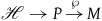 ${\mathcal H} \to P\mathop \to \limits^\wp M$
; and a Cartan connection, which is a Lie algebra-valued 1-form
 $\eta^{\mathfrak{A}}{}_{\alpha}$
on P satisfying certain further conditions.Footnote
15
This Cartan connection is not a principal connection because the Lie algebra in which it takes its values is not the Lie algebra of
 $\mathcal{H}$
. Instead, it is the Lie algebra of another group,
 $\mathcal{G}$
, which has dimension
 $dim(M)+dim(\mathcal{H})$
and contains
 $\mathcal{H}$
as a closed (normal) subgroup.Footnote
16
The torsor of the quotient group
 $\mathcal{G}/\mathcal{H}$
, which is a homogeneous space of the same dimension as M, is the “local Kleinian geometry” on which the Riemann–Cartan space is modeled.
We can think of
 $\eta^{\mathfrak{A}}{}_{\alpha}$
as encoding two kinds of information: a true principal connection
 $\omega^{\mathfrak{A'}}{}_{\alpha}$
, valued in the Lie algebra
 $\mathfrak{h}$
, and a solder form on P, which in this case is a 1-form valued in
 $\mathfrak{g}/\mathfrak{h}$
that can be interpreted as identifying elements of the tangent space of M at each point with tangent vectors of the “model space,” that is, the local Kleinian geometry
 $\mathcal{G}/\mathcal{H}$
. Note that
 $\eta^{\mathfrak{A}}{}_{\alpha}$
can also be viewed as (uniquely determining) a principal connection
 $\alpha^{\mathfrak{A}}{}_{\alpha}$
on a principal
 $\mathcal{G}$
-bundle
 $\mathcal{G}\rightarrow Q\rightarrow M$
, which we may understand as an associated bundle to P.
In PGT, we consider the special case where the structure group
 $\mathcal{H}$
is the Lorentz group in four dimensions, SO(1, 3), and the supergroup
 $\mathcal{G}$
is the Poincaré group,
 $SO(1, 3)$
⋉ T
4, where
 $T^4=\mathbb{R}^4$
is the translation group on Minkowski spacetime. Thus, we can think of PGT as a theory of a (dynamical) principal connection on a principal bundle, or as a theory of a (dynamical) Cartan connection on a (different) principal bundle. (TEGR arises in the special case where the Cartan connection determines a flat affine connection on the tangent bundle.)
Geometrically, the Riemann–Cartan geometry on which PGT is based is unimpeachable, and I am not aware of any criticisms that the theory is mathematically problematic. But as a matter of interpretation, there are several salient disanalogies with YMT. First, just as I argued earlier for the
 $T^4$
-bundle approach, four-dimensional vector spaces do not carry a nontrivial representation of the Poincaré group, so the tangent bundle cannot be thought of as associated to the principal bundle
 $\mathcal{G}\rightarrow Q\rightarrow M$
. So this bundle cannot play the role of the principal bundle in YMT. On the other hand, there are faithful representations of SO(1, 3) on a four-dimensional vector space, so under sensible assumptions about the topology of the bundle
 $\mathcal{H}\rightarrow P\rightarrow M$
, the tangent bundle will be isomorphic to a vector bundle associated to P; likewise, the Cartan connection is also a linear connection of that associated bundle. This is much closer to YMT.
But there remains a disanalogy because the Cartan connection does more than induce a connection on its associated bundles.Footnote 17 It also determines an isomorphism between fibers of the associated vector bundle and fibers of the tangent bundle to M, via the induced dynamical solder form, and via this isomorphism, it induces a metric field on the tangent bundle. This blocks an interpretation of P as the frame bundle for the tangent bundle because the frame bundle comes equipped with a canonical solder form. In other words, the Cartan connection—and Cartan geometry more generally—can represent the geometrical structure we use in GR and in TEGR, and it can generalize both to allow a combination of curvature and torsion in an elegant geometrical framework. But the sort of information it encodes, and the way it encodes it, is subtly different from in YMT.
Of course, this sort of disanalogy does not preclude including PGT (and TEGR) among the gauge theories in the second sense; whether one does so is a matter of semantics, and perhaps Trautman exegesis.Footnote 18 And of course, there are also disanalogies between GR and PGT, also related to torsion and solder forms (Trautman, Reference Trautman and Held1980; Weatherall Reference Weatherall2016b; March and Weatherall, Reference March and Owen Weatherallforthcoming). But from a conceptual perspective, the differences between PGT and YMT are nonetheless worth emphasizing, even if one does wish to classify them together as “gauge theories.”
5. Conclusion
This article has considered in what senses one should think of TEGR and STEGR as gauge theories of gravity. After introducing the theories in more detail, I argued that both TEGR and STEGR should be understood as gauge theories in the sense that they both posit “surplus structure.” In this, they should be sharply distinguished from GR, which does not posit surplus structure. I then considered the sense in which TEGR should be understood as a gauge theory by virtue of being a theory of a connection on a principal bundle, as suggested by Trautman. As I argued, although it is true that TEGR can be seen as a theory of a dynamical connection on a principal bundle, the details of the interpretation matter. The different geometrical structures in each case encode different information about their associated vector bundles. This does not necessarily mean that TEGR (or PGT) should not count as a gauge theory in the second sense, but it suggests that they are, at very least, distinct subspecies.
Acknowledgments
I am grateful to Helen Meskhidze for many discussions on these issues and to my fellow symposiasts, Eleanor Knox, Eleanor March, Ruward Mulder, James Read, and William Wolf, for an excellent discussion of the geometric trinity at the 2024 Philosophy of Science meeting.
Funding statement
This material is based on work supported by the National Science Foundation under grant no. 2419967.
Declarations
The author is the editor-in-chief of Philosophy of Science and a member of the Philosophy of Science Association Governing Board, which oversees the journal. Both are unpaid positions, and the author has no personal financial stake in journal publications. Moreover, the present article appears in the Proceedings of the 2024 Philosophy of Science Association Biennial Meeting. Although these proceedings are published as issues of Philosophy of Science, they have an independent editorial process, and the regular journal editor plays no role in editorial decisions.


 Open access

