






No CrossRef data available.
Article contents
The role of reference frames in memory recollection
Published online by Cambridge University Press: 03 January 2020
Abstract
In this commentary on Bastin et al., we suggest that spatial context plays a critical role in the encoding and retrieval of events. Specifically, the translation process between the viewpoint-independent content of a memory and the viewpoint-dependent stimuli activating the retrieval (mental frame syncing) plays a critical role in spatial memory recollection. This perspective also provides an explanatory model for pathological disturbances such as Alzheimer's disease.
Information
- Type
- Open Peer Commentary
- Information
- Copyright
- Copyright © Cambridge University Press 2020
References
Bertrand, E., Landeira-Fernandez, J. & Mograbi, D. C. (2016) Metacognition and perspective-taking in Alzheimer's disease: A mini-review. Frontiers in Psychology 7: article no.1812. Available at: https://www.ncbi.nlm.nih.gov/pmc/articles/PMC5112262/.CrossRefGoogle Scholar
Bicanski, A. & Burgess, N. (2018) A neural-level model of spatial memory and imagery. eLife 7: e33752. (Online publication). doi:10.7554/eLife.33752. Available at: https://www.ncbi.nlm.nih.gov/pmc/articles/PMC6122954/.CrossRefGoogle Scholar
Bird, C. M., Bisby, J. A. & Burgess, N. (2012) The hippocampus and spatial constraints on mental imagery. Frontiers in Human Neuroscience 6: article no. 142. doi:10.3389/fnhum.2012.00142. Available at: https://www.ncbi.nlm.nih.gov/pmc/articles/PMC3354615/.CrossRefGoogle Scholar
Burgess, N., Becker, S., King, J. A. & O'Keefe, J. O. (2001) Memory for events and their spatial context: Models and experiments. Philosophical Transactions of the Royal Society of London, 356, 1493–503.CrossRefGoogle ScholarPubMed
Byrne, P., Becker, S. & Burgess, N. (2007) Remembering the past and imagining the future: A neural model of spatial memory and imagery. Psychological Review 114(2):340–75.CrossRefGoogle ScholarPubMed
Colombo, D., Serino, S., Tuena, C., Pedroli, E., Dakanalis, A., Cipresso, P. & Riva, G. (2017) Egocentric and allocentric spatial reference frames in aging: A systematic review. Neuroscience and Biobehavioral Reviews 80, 605–21. doi:10.1016/j.neubiorev.2017.07.012.CrossRefGoogle ScholarPubMed
Gomez, A., Rousset, S. & Baciu, M. (2009) Egocentric-updating during navigation facilitates episodic memory retrieval. Acta Psychologica (Amsterdam) 132(3):221–27. doi:10.1016/j.actpsy.2009.07.003.CrossRefGoogle ScholarPubMed
Graham, K. S., Barense, M. D. & Lee, A. C. (2010) Going beyond LTM in the MTL: A synthesis of neuropsychological and neuroimaging findings on the role of the medial temporal lobe in memory and perception. Neuropsychologia 48(4):831–53. doi: 10.1016/j.neuropsychologia.2010.01.001.CrossRefGoogle ScholarPubMed
Hafting, T., Fyhn, M., Molden, S., Moser, M. B. & Moser, E. I. (2005) Microstructure of a spatial map in the entorhinal cortex. Nature 436(7052):801–806. doi:10.1038/nature03721.CrossRefGoogle ScholarPubMed
Julian, J. B., Keinath, A. T., Marchette, S. A. & Epstein, R. A. (2018) The Neurocognitive Basis of Spatial Reorientation. Current Biology 28(17):R1059–R1073. doi:10.1016/j.cub.2018.04.057.CrossRefGoogle ScholarPubMed
Lithfous, S., Dufour, A. & Despres, O. (2013) Spatial navigation in normal aging and the prodromal stage of Alzheimer's disease: Insights from imaging and behavioral studies. Ageing Research Review 12(1):201–13. doi:10.1016/j.arr.2012.04.007.CrossRefGoogle ScholarPubMed
Nadel, L., Samsonovich, A., Ryan, L. & Moscovitch, M. (2000) Multiple trace theory of human memory: Computational, neuroimaging, and neuropsychological results. Hippocampus 10(4):352–68. doi:10.1002/1098-1063(2000)10:4.3.0.CO;2-D>CrossRefGoogle ScholarPubMed
O'Keefe, J. & Dostrovsky, J. (1971) The hippocampus as a spatial map: Preliminary evidence from unit activity in the freely-moving rat. Brain research 34:171–75. doi:10.1016/0006-8993(71)90358-1.CrossRefGoogle ScholarPubMed
Serino, S., Morganti, F., Di Stefano, F. & Riva, G. (2015) Detecting early egocentric and allocentric impairments deficits in Alzheimer's disease: An experimental study with virtual reality. Frontiers in Aging Neuroscience 7: article 88. (Online publication). doi: 10.3389/fnagi.2015.00088. Available at: https://www.ncbi.nlm.nih.gov/pmc/articles/PMC4438252/CrossRefGoogle Scholar
Serino, S., Pedroli, E., Tuena, C., De Leo, G., Stramba-Badiale, M., Goulene, K., Mariotti, N. G. & Riva, G. (2017) A novel Virtual Reality-based training protocol for the enhancement of the “mental frame syncing” in individuals with Alzheimer's Disease: A development-of-concept trial. Frontiers in Aging Neuroscience 9: article no. 240. doi:10.3389/fnagi.2017.00240. Available at: https://www.ncbi.nlm.nih.gov/pmc/articles/PMC5529401/.CrossRefGoogle Scholar
Serino, S. & Riva, G. (2013) Getting lost in Alzheimer's disease: A break in the mental frame syncing. Medical Hypotheses 80(4):416–21. doi:10.1016/j.mehy.2012.12.031.CrossRefGoogle ScholarPubMed
Serino, S. & Riva, G. (2017) The proactive self in space: How egocentric and allocentric spatial impairments contribute to anosognosia in Alzheimer's disease. Journal of Alzheimer's disease: JAD 55(3):881–92. doi:10.3233/JAD-160676.CrossRefGoogle ScholarPubMed
Solstad, T., Boccara, C. N., Kropff, E., Moser, M. B. & Moser, E. I. (2008) Representation of geometric borders in the entorhinal cortex. Science 322(5909):1865–68. doi:10.1126/science.1166466.CrossRefGoogle ScholarPubMed
Taube, J. S., Muller, R. U. & Ranck, J. B. Jr. (1990) Head-direction cells recorded from the postsubiculum in freely moving rats. I. Description and quantitative analysis. Journal of Neuroscience 10(2):420–35.CrossRefGoogle Scholar
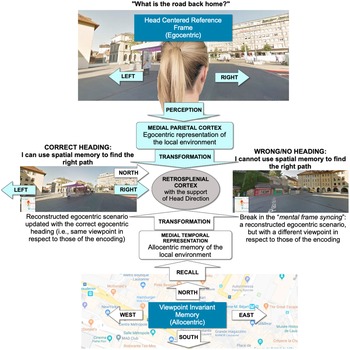
Figure 1. Mental Frame Syncing. Sensory inputs from the environment are processed in the egocentric reference frame in parietal areas and then transformed for long-term storage in hippocampal allocentric representations. When needed (for imagery or prompted by a retrieval cue), the reverse process permits the reconstruction of a parietal egocentric image from allocentric-based stored map. To correctly retrieve our location in space, it is necessary to synchronize our egocentric heading within the allocentric viewpoint-independent representation. Therefore, we have to update the retrieved allocentric representation with the correct egocentric heading. If there is a break in this process, we cannot use the retrieved representation to guide our spatial behavior.
Target article
Related commentaries (22)
Dual processes in memory: Evidence from memory of time-of-occurrence of events
Two processes are not necessary to understand memory deficits
In the target article, Bastin et al. convincingly propose an integrative memory model as a neurocognitive framework of episodic memory to describe the cognitive and neural mechanisms underlying both recollection and familiarity. However, a critical point not sufficiently addressed in their article is the role that spatial context plays in this process.
Each event we experience in our life is framed in a unique spatial scaffold (Bicanski & Burgess Reference Bicanski and Burgess2018; Bird et al. Reference Bird, Bisby and Burgess2012; Byrne et al. Reference Byrne, Becker and Burgess2007). Earlier, O'Keefe and Nadel (Reference O'Keefe and Nadel1978) pioneered the existence of a functional relationship between the episodic and spatial domain under the control of medial temporal lobes. This perspective has been revised and extended by the multiple trace theory (Nadel et al. Reference Nadel, Samsonovich, Ryan and Moscovitch2000), and evidence from both amnesic patients with hippocampal damage and experimental studies have consistently suggested that hippocampus is involved in both episodic and spatial processing (for a review, see Graham et al. Reference Graham, Barense and Lee2010).
In line with this perspective, the spatial mechanisms underlying episodic encoding and retrieval have been modeled in some detail (Burgess et al. Reference Burgess, Becker, King and O'Keefe2001), stressing the role of information provided by space-related brain cells playing in concert in the medial temporal lobes (place cells: O'Keefe & Dostrovsky [Reference O'Keefe and Dostrovsky1971]; head-direction: Taube et al. [Reference Taube, Muller and Ranck1990]; grid cells: Hafting et al. [Reference Hafting, Fyhn, Molden, Moser and Moser2005]; and boundary cells: Solstad et al. [Reference Solstad, Boccara, Kropff, Moser and Moser2008]).
In brief, egocentric (i.e., body-centered and corresponding to a specific point of view) representations of the local sensory environment are transformed thanks to the retrosplenial cortex into viewpoint-independent (allocentric, or world-centered) representations for long-term storage in the medial temporal lobes (Byrne et al. Reference Byrne, Becker and Burgess2007). In particular, head-direction cells (Bicanski & Burgess Reference Bicanski and Burgess2018) allow the transformation from egocentric directions (left, right, ahead) in allocentrically referenced directions (north, south, east, west).
This process, however, is bidirectional. In fact, the reverse process is used in memory retrieval to reconstruct viewpoint-dependent egocentric representations in parietal areas from stored hippocampal-based allocentric representations, supporting both imagery and recollection. According to this perspective, episodic retrieval implies the construction of a transient egocentric representation (i.e., the distances of the elements in a scene from the left, the right, or ahead of the individual) that can be inspected and used to retrieve the past event or envision future/imaginary events (Gomez et al. Reference Gomez, Rousset and Baciu2009). This reconstructed egocentric scenario is also updated with the egocentric heading (i.e., our viewpoint in the scene) for both successful navigation and effective episodic retrieval (Julian et al. Reference Julian, Keinath, Marchette and Epstein2018; Serino & Riva Reference Serino and Riva2013).
In our view, there is a specific cognitive process (i.e., the “mental frame syncing”) underlying this egocentric–allocentric transformation that is critical for the recollection of spatial scenarios (see our Figure 1). It is responsible for placing the egocentric heading into the stored abstract allocentric representation, providing the reconstructed scenario with the same viewpoint in respect to those of the encoding (Serino et al. Reference Serino, Morganti, Di Stefano and Riva2015; Serino & Riva Reference Serino and Riva2013). If there is a break in this process, we cannot use the retrieved representation to guide our spatial behavior.
Mental Frame Syncing. Sensory inputs from the environment are processed in the egocentric reference frame in parietal areas and then transformed for long-term storage in hippocampal allocentric representations. When needed (for imagery or prompted by a retrieval cue), the reverse process permits the reconstruction of a parietal egocentric image from allocentric-based stored map. To correctly retrieve our location in space, it is necessary to synchronize our egocentric heading within the allocentric viewpoint-independent representation. Therefore, we have to update the retrieved allocentric representation with the correct egocentric heading. If there is a break in this process, we cannot use the retrieved representation to guide our spatial behavior.
The mental frame syncing hypothesis provides a useful framework that can also be applied to pathological conditions that report episodic memory deficits along with spatial reference impairments. As an example, the scientific outcomes of different systematic reviews have critically underlined the presence of both allocentric and allocentric-to-egocentric transformation impairments in Alzheimer's disease (AD) population (Colombo et al. Reference Colombo, Serino, Tuena, Pedroli, Dakanalis, Cipresso and Riva2017; Lithfous et al. Reference Lithfous, Dufour and Despres2013; Serino et al. Reference Serino, Morganti, Di Stefano and Riva2015; Reference Serino, Pedroli, Tuena, De Leo, Stramba-Badiale, Goulene, Mariotti and Riva2017), where the episodic memory impairments characterizing the clinical profile of these patients are also accompanied by a more profound deficit in the synchronization between allocentric and egocentric reference frames (Serino et al. Reference Serino, Morganti, Di Stefano and Riva2015). In support of this, a recent proof-of-concept preliminary study demonstrated the efficacy of a novel virtual reality (VR) treatment based on enhancing the ability to synchronize an allocentric viewpoint-independent representation with an egocentric one, by providing participants with real-time information about their current egocentric heading in the environment (Serino et al. Reference Serino, Pedroli, Tuena, De Leo, Stramba-Badiale, Goulene, Mariotti and Riva2017). Results indicated a clear improvement in long-term spatial memory performance after the VR-based training for patients with AD.
Furthermore, a growing body of studies have highlighted that spatial factors might be implicated also in disordered awareness of memory deficits (commonly known as “anosognosia”). In particular, studies have suggested that the spatial perspective in which the information is presented (i.e., first- vs. third-person perspective) has a prominent role in affecting AD patients’ self-awareness of their memory deficits (Bertrand et al. Reference Bertrand, Landeira-Fernandez and Mograbi2016). Patients typically show better awareness when evaluating others’ abilities than their own, suggesting that shifting from a first-person perspective (i.e., egocentric) to third-person perspective (i.e., allocentric) might make them more aware of their deficits. Accordingly, it is possible to speculate that a “break” in the ability to update the allocentric representations (i.e., unrelated to the self) with egocentric information (i.e., related to the self) does not allow these patients to translate their spatial memories into a “lived space” that they can use to navigate and remember the past (Serino & Riva Reference Serino and Riva2017). Moreover, the break can also produce an impairment in their ability to use their spatial memories to place themselves in a “future space” and consequently to use the content of such memories to update their first-person perspective, which is required for self-awareness (Serino & Riva Reference Serino and Riva2017).
Acknowledgments
This commentary paper was supported by the Italian MIUR research project “Unlocking the memory of the body: Virtual Reality in Anorexia Nervosa” (201597WTTM), by the Italian Ministry of Health research project “High-end and Low-End Virtual Reality Systems for the Rehabilitation of Frailty in the Elderly” (PE-2013-0235594), and by the European Union's Horizon 2020 Research and Innovation Programme under the Marie Sklodowska-Curie grant agreement No. 794832 for the research project “VirtualSync – An embodied prospective on anosognosia.”