





No CrossRef data available.
Article contents
Sex differences in longevity are relative, not independent
Published online by Cambridge University Press: 25 July 2022
Abstract
I ask three questions related to the claims made within the staying alive theory (SAT): Is survival more fitness-enhancing for females than for males? Does the historical record on sex differences in mortality support the SAT? Is it possible to talk about “independent selective pressures on both male and female traits” when all we have are sex/gender comparisons?
Information
- Type
- Open Peer Commentary
- Information
- Copyright
- Copyright © The Author(s), 2022. Published by Cambridge University Press
References
Barclay, K., & Kolk, M. (2019). Parity and mortality: An examination of different explanatory mechanisms using data on biological and adoptive parents. European Journal of Population, 35(1), 63–85. doi: 10.1007/s10680-018-9469-1CrossRefGoogle ScholarPubMed
Beltrán-Sánchez, H., Finch, C. E., & Crimmins, E. M. (2015). Twentieth century surge of excess adult male mortality. Proceedings of the National Academy of Sciences, 112(29), 8993. doi: 10.1073/pnas.1421942112CrossRefGoogle ScholarPubMed
Campbell, A. (1999). Staying alive: Evolution, culture, and women's intrasexual aggression. Behavioral and Brain Sciences, 22(2), 203–214. doi: 10.1017/S0140525X99001818CrossRefGoogle ScholarPubMed
McArdle, P. F., Pollin, T. I., O'Connell, J. R., Sorkin, J. D., Agarwala, R., Schäffer, A. A., … Mitchell, B. D. (2006). Does having children extend life span? A genealogical study of parity and longevity in the Amish. Journals of Gerontology. Series A: Biological Sciences and Medical Sciences, 61(2), 190–195. doi: 10.1093/gerona/61.2.190CrossRefGoogle ScholarPubMed
mortality.org. Human Mortality Database. Retrieved 2021/12/21, from University of California, Berkeley (USA), and Max Planck Institute for Demographic Research (Germany).Google Scholar
Preston, S. H., & Wang, H. (2006). Sex mortality differences in The United States: The role of cohort smoking patterns. Demography, 43(4), 631–646. doi: 10.1353/dem.2006.0037CrossRefGoogle ScholarPubMed
Thorslund, M., Wastesson, J. W., Agahi, N., Lagergren, M., & Parker, M. G. (2013). The rise and fall of women's advantage: A comparison of national trends in life expectancy at age 65 years. European Journal of Ageing, 10(4), 271–277. doi: 10.1007/s10433-013-0274-8CrossRefGoogle ScholarPubMed
Wilmoth, J. R. (2007). Human longevity in a historical perspective. In Timiras, P. S. (Ed.), Physiological basis of aging and geriatrics (4th ed., pp. 11–22). Informa.Google Scholar
Zarulli, V., Kashnitsky, I., & Vaupel, J. W. (2021). Death rates at specific life stages mold the sex gap in life expectancy. Proceedings of the National Academy of Sciences, 118(20), e2010588118. doi: 10.1073/pnas.2010588118CrossRefGoogle ScholarPubMed
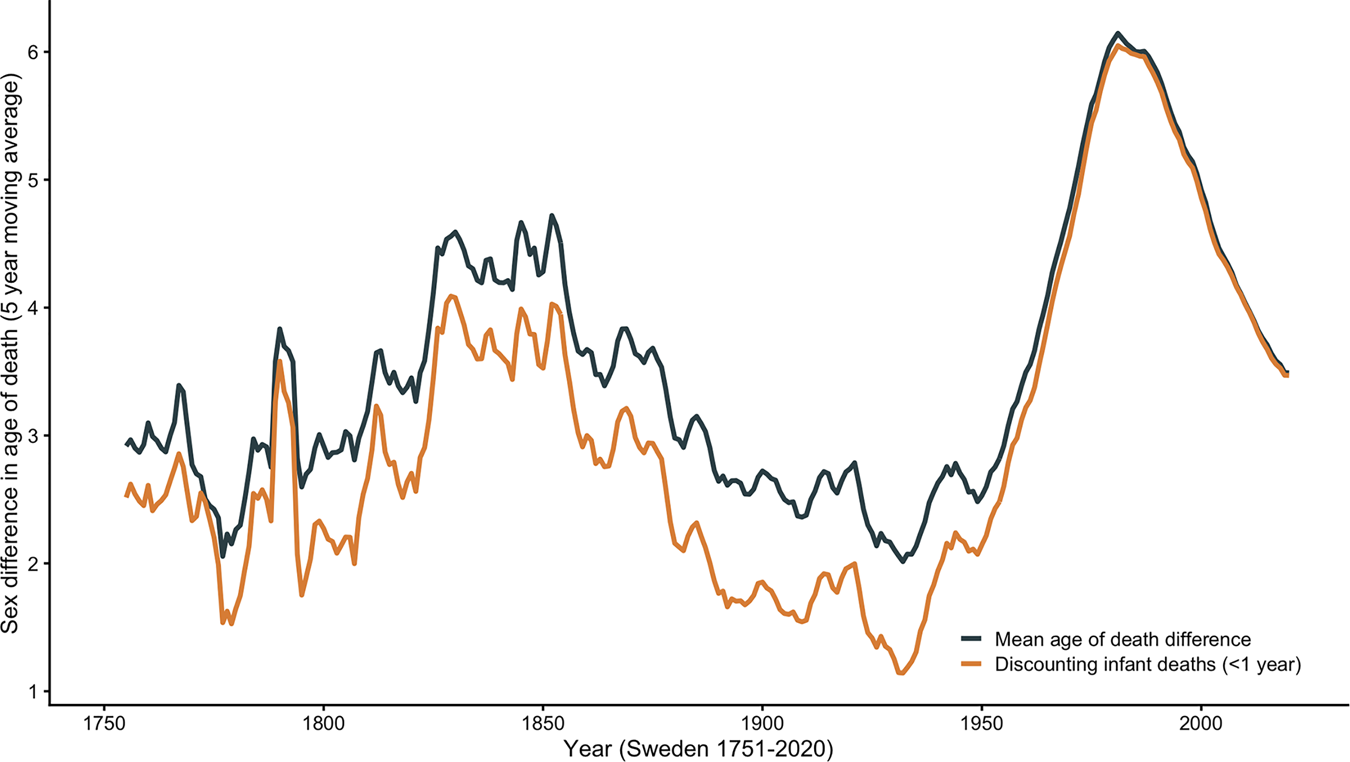
Figure 1. Differences in average age of death across time (moving average 5 years) when including or discounting infant deaths. The difference in life expectancy has varied through history, and much can been explained by differences in infant mortality. Data from Sweden, adapted from the Human Mortality Database (mortality.org).
Target article
Related commentaries (22)
Female advantage in threat avoidance manifests in threat reaction but not threat detection
Harm or protection? Two-sided consequences of females' susceptible responses to multiple threats
Pathological complexity and the evolution of sex differences
Psychological and behavioral implications of self-protection and self-enhancement
 You have
Access
A central tenet of the target paper is that “survival is more fitness-enhancing for females than for males.” There is something odd about this claim, since survival is a necessary condition for reproductive fitness. Without survival there is no reproduction. Without further specification it thus becomes meaningless to talk about sex-differences in fitness linked to survival. A favorable reading of the paper says that the authors are really aiming not at survival but longevity. In other words: survival beyond a certain point. One crucial time point is obviously mating. Before mating survival is infinitely fitness-enhancing for both sexes.
Beyond mating, the mother's reproductive fitness relies on her survival during pregnancy as well and this is where the paths of the two sexes diverge. The fitness of the father no longer depends on his own survival, but solely on the survival of the mother and the fetus. One may therefore argue that after this time point there is a stronger evolutionary pressure on the survival of the mother than on the father. After the child is born, the reproductive fitness of both parents depends on the survival of the child. The authors convincingly argue that mothers spend more time than fathers looking after their children and that her survival thus may be more important for the survival of the child than that of the father. This seems to be the evolutionary account behind females' longer life expectancies, according to the staying alive theory (SAT). However, it misses one crucial point. Males are fertile throughout their lives, and their fitness is not tied to one individual pregnancy. It is therefore difficult to see why longevity would not also increase male fitness equally, given that longer life would provide opportunities for additional mating. Data exist to support a correlation between parity (i.e., reproductive fitness) and longevity in both sexes (Barclay & Kolk, Reference Barclay and Kolk2019; McArdle et al., Reference McArdle, Pollin, O'Connell, Sorkin, Agarwala, Schäffer and Mitchell2006). Within this naive evolutionary framework for human reproduction, which disregards culture, family, and parental collaboration, longevity thus appears to be an advantage for both sexes. More effort is needed to flesh out why the evolutionary advantage of longevity would be greater for females than for males.
Does the historical record on sex differences in mortality support the SAT? Following the link to parental care, the authors predict “increased magnitudes of sex differences following puberty.” However, when making a detailed investigation of differences in mortality, the picture is not clear. Excess male deaths in reproductive years (between 15 and 40), where the evolutionary pressure would occur according to the SAT, account for less than 25% of the life expectancy gap, both presently and historically (Zarulli, Kashnitsky, & Vaupel, Reference Zarulli, Kashnitsky and Vaupel2021). The sex difference in life expectancy is also to some extent a recent phenomenon (Beltrán-Sánchez, Finch, & Crimmins, Reference Beltrán-Sánchez, Finch and Crimmins2015; Thorslund, Wastesson, Agahi, Lagergren, & Parker, Reference Thorslund, Wastesson, Agahi, Lagergren and Parker2013; Wilmoth, Reference Wilmoth and Timiras2007). The growth of the gap in mortality in the twentieth century (Fig. 1) can to a large extent be explained by differences in smoking habits (Preston & Wang, Reference Preston and Wang2006) and lung cancer is still one of the most significant predictors of sex differences in age of death (main article, Fig. 2). However, historically, most excess male death occurred during the pre-mating stage of life (0–14 years) (Zarulli et al., Reference Zarulli, Kashnitsky and Vaupel2021), with infant deaths carrying the majority of the burden (Fig. 1). Doesn't both the historical variability of sex/gender differences in life expectancy and the changing distribution of excess deaths in males across age-spans yield an explanatory challenge for the SAT which proposes that the difference is due to an independently adapted female trait linked to “parental investment”?
Differences in average age of death across time (moving average 5 years) when including or discounting infant deaths. The difference in life expectancy has varied through history, and much can been explained by differences in infant mortality. Data from Sweden, adapted from the Human Mortality Database (mortality.org).
Furthermore, is it possible to talk about “Independent selective pressures on both male and female traits” when all we have are sex/gender comparisons? The claim in SAT that lower levels of aggression forms “a positive female adaptation driven by the critical importance of the mother's survival for her own reproductive success” (Campbell, Reference Campbell1999) has an important flaw. If less is more, then having nothing may be even better. One could argue that not having antlers or peacock feathers are positive female adaptations. There is an infinite list of such adaptive lack of properties within this type of logic. It is therefore vital to focus on actual positive attributes and behaviors. This, however, rests on the assumption of independence. In the conclusion, the authors state that “independent consideration of each sex, along separate dimensions, is necessary for understanding the ways in which each sex's traits are optimized.” Specific male traits are argued to include: “direct competition, physical aggression, risk-taking, showing off, impulsivity, sensation-seeking, and resource accumulation.” The SAT, on the other hand, advocates that “females more than males evolved to avoid physical aggression.” It is not difficult to see that this is just a reversal of what is reported as a male adaptation. The critical claim “that lower rates of aggression by women reflect not just the absence of male risk-taking but are part of a positive female adaptation” remains untested and perhaps untestable in a binary comparison between males and females with only one effective degree of freedom. Thus, in the conclusion the authors state that “Had the evidence existed, we would have compared the reproductive success of females who varied in their degree of reactions to threats, and not included males at all.” Are the authors willing to stick their neck out and hypothesize that females who adhere to the description in their paper, that is, are more pain sensitive, who wake up at night, are more fearful and neurotic, also live longer and have greater reproductive success than females who do not? If so, would one end of the spectrum be less female than the other? Would that make the outcome independent?
Financial support
This study was supported by Independent Research Fund Denmark grant 0132-00081B.
Conflict of interest
The author has no conflicts of interest to declare.