



Response
Ghenciulescu et al’s recent article in the British Journal of Psychiatry offers valuable insights into the benefits of lurasidone for depressive symptoms across schizophrenia, bipolar disorder and major depressive disorder.Reference Ghenciulescu, Pearse, Minichino, Sampogna, De Giorgi and Fiorillo1 This caught our attention. Our group has previously examined the efficacy and dosing of lurasidone for bipolar depression and major depressive disorder, but not for schizophrenia.Reference Lin, Chen, Hung, Liang, Tseng and Carvalho2 We therefore undertook a secondary analysis using the seven schizophrenia trials reported by Ghenciulescu et alReference Ghenciulescu, Pearse, Minichino, Sampogna, De Giorgi and Fiorillo1 and applied a dose–response meta-analytic approach.
We performed a one-step dose–response meta-analysis to explore the association between lurasidone dose and outcomes. Placebo was coded as 0 mg (reference), and for each active arm we used the mean daily lurasidone dose. We modelled dose–response using restricted cubic splines with 3 knots at the 10th, 50th and 90th percentiles of the overall dose distribution.Reference Lin, Chen, Hung, Liang, Tseng and Carvalho2 All analyses were conducted using R statistical software (version 4.4.2; R Foundation for Statistical Computing, Vienna, Austria) on macOS platform, utilising the dosresmeta package (version 2.0.1). Statistical significance was set at P < 0.05. We calculated pre- to post-treatment change in depressive symptoms and expressed effects as standardised mean differences (SMDs) with 95% confidence intervals.
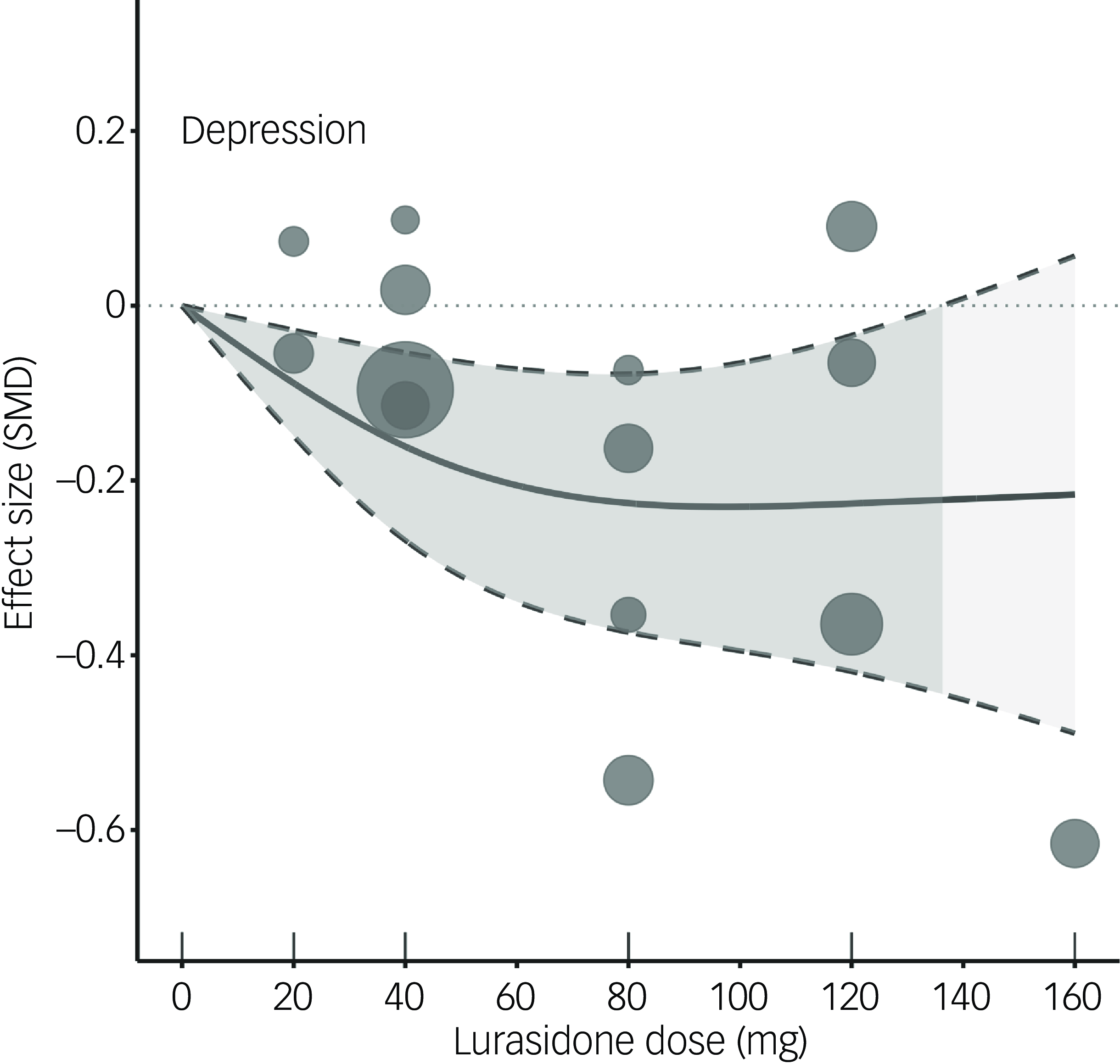
Across schizophrenia trials (daily doses 20–160 mg), 6 assessed depression symptoms with the Montgomery–Asberg Depression Rating Scale and 1 with the Calgary Depression Scale for Schizophrenia. The fitted curve suggested maximal benefit around 80–120 mg/day, with diminishing returns beyond this range (Fig. 1). Predicted SMDs (95% confidence intervals) at representative doses were: 20 mg, −0.09 (−0.15 to −0.03); 40 mg, −0.16 (−0.27 to −0.05); 60 mg, −0.21 (−0.34 to −0.07); 80 mg, −0.23 (−0.37 to −0.08); 100 mg, −0.23 (−0.39 to −0.07); 120 mg, −0.23 (−0.42 to −0.03); 140 mg, −0.22 (−0.45 to 0.01); and 160 mg, −0.22 (−0.49 to 0.06).
Dose–response relationship between daily lurasidone dose and change in depressive symptoms. SMD, standardised mean difference. Solid line, pooled point estimates; dashed lines, 95% CIs; short vertical lines on the x axis, lurasidone doses of the included studies; circles, outcome markers for all included studies, the sizes of which represent the reciprocal of the standard error of the effect size.

Consistent with Ghenciulescu et al’s conclusion that lurasidone is a potentially useful tool to treat depressive symptoms across severe mental illnesses,Reference Ghenciulescu, Pearse, Minichino, Sampogna, De Giorgi and Fiorillo1 a dose-based perspective suggests that the optimal range may differ by diagnosis. In schizophrenia, benefit emerges from ≥60 mg/day (SMD ≥ −0.21) and plateaus around 80–120 mg/day (SMD −0.23). By contrast, in bipolar depression, 40–60 mg/day yields larger effects (SMD −0.57 to −0.60). In essence, depressive symptoms in schizophrenia appear to require higher doses of lurasidone to achieve comparatively modest therapeutic effects (absolute magnitude around 0.2), whereas bipolar depression responds at lower doses with a larger effect size (absolute magnitude around 0.6). These dose–response findings in schizophrenia complement the authors’ transdiagnostic conclusions and, in our view, help to delineate diagnosis-specific dose–effect profiles.
Previous work on the acute phase of schizophrenia treatment indicates half-maximal effective dose (ED50) values for global psychosis and depressive symptoms above 80 mg/day, with efficacy often peaking near 160 mg/day,Reference Srisurapanont, Suttajit, Likhitsathian, Maneeton and Maneeton3 a pattern consistent with a dose-dependent antipsychotic contribution to mood improvement. By contrast, antidepressant effects in bipolar depression may be realised at 40–60 mg/day, plausibly reflecting serotonergic mechanisms – such as 5-hydroxytryptamine-7 (5-HT7) and 5-HT1A interactions – that do not require higher degrees of dopamine D2 blockade.Reference Lin, Chen, Hung, Liang, Tseng and Carvalho2 Consideration of these mechanisms provides a hypothesis-generating basis for subsequent research.
We commend Ghenciulescu et al for their important contribution.Reference Ghenciulescu, Pearse, Minichino, Sampogna, De Giorgi and Fiorillo1 Together with the authors’ call for dosing-related investigations, our results support future randomised trials and network meta-analyses explicitly comparing dose tiers across diagnoses. We hope these dose–response insights will encourage diagnosis-specific dosing strategies and reduce heterogeneity in future syntheses.
Data availability
The data supporting the findings of this study are available from the corresponding author, C.-W.H., upon reasonable request.
Author contributions
C.-W.H. conceived the idea for this study. C.-W.H. led the study design, with Y.-C.B.C. Y.-C.B.C. and C.-W.H. contributed to data acquisition and extraction. C.-W.H. performed statistical analyses. C.-W.H. drafted the manuscript first, then Y.-C.B.C., C.-S.L. and P.-T.T. revised it. All authors contributed important intellectual content during manuscript revision, had full access to all study data and accepted the responsibility to submit the manuscript for publication.
Funding
This study is supported by grants from the Taiwan National Science and Technology Council (no. 112-2314-B-182-070-MY3) and the Chang Gung Medical Foundation (no. BMRPJ30). The funding sources had no role in the design of the study.
Declaration of interest
None.



eLetters
No eLetters have been published for this article.