


1. Introduction
In [Reference Lorentz4], Lorentz fully characterized the existence of a plane set in terms of its cross-section. The main result reads as follows:
Theorem 1.1 Suppose that  $P(x)$,
 $Q(y)$ are two non-negative integrable functions defined for
 $- \infty < x < + \infty$,
 $- \infty < y < + \infty$. In order that a measurable set
 $A$ with cross functions
 $P(x)$,
 $Q(y)$ exists, it is necessary and sufficient that the non-increasing rearrangements
 $p(x)$,
 $q (y)$ of these functions satisfy the conditions:
 \begin{align} \int_0^{x}p(u)\,\textrm{d}u&\le\int_0^{x}q^{{-}1}(u)\,\textrm{d}u,\qquad x>0, \end{align}
 \begin{align} \int_0^{x}q(u)\,\textrm{d}u&\le\int_0^{x}p^{{-}1}(u)\,\textrm{d}u,\qquad x>0. \end{align}
In modern terminology, the nonincreasing rearrangement of a function  $f$ on a measurable space
 $(X,\mu )$ is defined as
 \[ f^{*}(t)=\inf\{s>0:\lambda_f(s)\le t\}, \]
where
 \[ \lambda_f(s)=\mu(\{x\in X:|f(y)|>s\}) \]
is the distribution function of  $f$ (see [Reference Bennett and Sharpley1] for standard definitions and classical properties in this setting). It is worth to mention that, according to Lorentz's notation, we have that
 $p^{-1}(u)=\lambda _p(u)$. It is also proved in [Reference Lorentz4] that (1.1) and (1.2) are equivalent to (1.1) and the condition
 $\|P\|_1=\|Q\|_1$.
A few years later, Gale and Ryser, studying some graph theoretical conditions for degree sequences on simple graphs [Reference Sierksma and Hoogeveen7], proved in [Reference Gale2, Reference Ryser6] a discrete version, namely, they characterized the existence of a  $(0,1)$-matrix
 $A$, with predetermined
 $r(A)$, the sums of its rows, and
 $c(A)$, the sums of its columns (which corresponds to fixing 2 partitions of a given
 $n\in \mathbb {N}$). For example, if
 $n=5=3+2=2+2+1$, then the matrix
 \begin{equation} A=\left(\begin{array}{@{}ccc@{}}1 & 1 & 1 \\1 & 1 & 0\end{array}\right) \end{equation}
satisfies that  $r(A)=\{3,2\}$ and for the columns we obtain
 $c(A)=\{2,2,1\}$, as desired. Similarly, it is easy to see that for the partitions
 $n=5=4+1=2+2+1$ there is not such a matrix. The aforementioned characterization is given as follows:
Theorem 1.2 Gale–Ryser, [Reference Gale2, Reference Ryser6]
Let  $p=\{p_1,\dots ,p_j\}$ and
 $q=\{q_1,\dots ,q_k\}$ be two nonincreasing partitions of a positive integer (i.e.,
 $p,q\subset \mathbb {N}$,
 $p_1\ge \cdots \ge p_j$,
 $q_1\ge \cdots \ge q_k$ and
 $p_1+\cdots +p_j=q_1+\cdots +q_k$). Then, there exists a
 $(0,1)$-matrix
 $A\in \mathcal {M}_{j\times k}$ such that
 $r(A)=p$ and
 $c(A)=q$ if and only if for all positive integers
 $m$,
 \[ \sum_{i=1}^{m}q_i\le \sum_{i=1}^{m}\widehat{p_i}, \]
where  $\widehat {p_i}=\operatorname {card}\{1\le l\le j:p_l\ge i\}$, if
 $1\le i\le p_1$,
 $\widehat {p_i}=0$, if
 $i>p_1$ and
 $q_i=0$, if
 $i>k$.
As we can readily see, these conditions are in exact analogy with those in theorem 1.1. Influenced by this matricial case, we find a new approach (using the geometrical definition of horizontal swappable squares), allowing us to extend and unify both theorems 1.1 and 1.2 by considering products of general resonant measure spaces (see theorem 2.10):
Problem 1.3 Let  $(X,\mu )$ and
 $(Y,\nu )$ be two
 $\sigma$-finite measure spaces and let
 $f:X\rightarrow \mathbb {R}^{+}$ and
 $g:Y\rightarrow \mathbb {R}^{+}$ be measurable functions. Does there exist a measurable subset
 $E\subset X\times Y$ such that
 $f$ and
 $g$ are the corresponding cross-sections of
 $E$:
 \begin{equation} f(x)=\int_{Y}\chi_E(x,y)\,\textrm{d}\nu(y)\quad\text{and}\quad g(y)=\int_{X}\chi_E(x,y)\,\textrm{d}\mu(x), \end{equation}
 $\mu$-a.e.
 $x\in X$ and
 $\nu$-a.e.
 $y\in Y$?
It is clear that a necessary condition for (1.4) to hold is that  $\|f\|_{L^{1}(\mathrm {\,d}\mu )}=\|g\|_{L^{1}(\mathrm {\,d}\nu )}$. However, as the previous matricial example shows for counting finite measures, this equality is not enough.
The following result gives the key estimate to solve problem 1.3 (which will be considered in § 2). For the rest of this section we will assume the following resonant condition on the measure space  $X$, which is equivalent to saying that
 $X$ is either nonatomic or completely atomic, with all atoms having equal measure [Reference Bennett and Sharpley1, theorem II.2.7].
Proposition 1.4 Let  $(X,\mu )$ and
 $(Y,\nu )$ be two
 $\sigma$-finite measure spaces, assume
 $X$ to be resonant and let
 $E\subset X\times Y$ be a measurable subset. Let
 $f$ and
 $g$ be the cross-sections of
 $E$ on
 $X$ and
 $Y$, respectively, as in (1.4). Then, for every
 $t>0$ we have that
 \begin{equation} \int_0^{t}f^{*}(s)\,{\rm d}s\le \int_0^{t}\lambda_g(s)\,{\rm d}s. \end{equation}
Proof. We first assume that  $t>0$ is in the range of
 $\mu$, and choose any set
 $A_t\subset X$, with
 $\mu (A_t)=t$. Then, setting
 \[ E_x=\{y\in Y:(x,y)\in E\}\quad\text{and}\quad E^{y}=\{x\in X: (x,y)\in E\}, \]
and using [Reference Bennett and Sharpley1, lemma II.2.1], we have that
 \begin{align*} \int_{A_t}f(x)\,\textrm{d}\mu(x)&=\int_{A_t}\int_{Y}\chi_E(x,y)\,\textrm{d}\nu(y)\,\textrm{d}\mu(x)=\int_{Y}\int_{A_t}\chi_E(x,y)\,\textrm{d}\mu(x)\,\textrm{d}\nu(y)\\ &=\int_{Y}\int_{A_t}\chi_{E^{y}}(x)\,\textrm{d}\mu(x)\,\textrm{d}\nu(y)\le\int_{Y}\int_{0}^{t}\chi_{(0,\mu(E^{y}))}(s)\,\textrm{d}s\,\textrm{d}\nu(y)\\ &=\int_{Y}\int_{0}^{t}\chi_{(0,g(y))}(s)\,\textrm{d}s\,\textrm{d}\nu(y)=\int_{0}^{t}\int_{Y}\chi_{(0,g(y))}(s)\,\textrm{d}\nu(y)\,{\rm d}s\\ &=\int_{0}^{t}\int_{Y}\chi_{\{y\in Y:g(y)>s\}}\,\textrm{d}\nu(y)\,ds=\int_0^{t}\lambda_g(s)\,{\rm d}s. \end{align*}
Finally, since  $X$ is resonant and using [Reference Bennett and Sharpley1, proposition II.3.3]
 \[ \int_0^{t}f^{*}(s)\,{\rm d}s=\sup_{\{A_t\subset X:\mu(A_t)=t\}}\int_{A_t}f(x)\,\textrm{d}\mu(x)\le \int_0^{t}\lambda_g(s)\,{\rm d}s. \]
Once we have proved (1.5) for  $t>0$ in the range of
 $\mu$, we observe that the inequality trivially holds for any
 $t\ge \mu (X)$, since then both sides of (1.5) are equal to the measure of
 $E$. Now, if
 $0< t<\mu (X)$ and
 $X$ is nonatomic, then we can find a measurable subset
 $A\subset X$ such that
 $\mu (A)=t$ (see [Reference Sierpiński8]) and we are done. To finish, if
 $0< t<\mu (X)$ and
 $X$ is a discrete (totally atomic) measure space, then
 $\int _0^{t}f^{*}(s)\,ds$ is a piecewise linear concave function and
 $\int _0^{t}\lambda _g(s)\,ds$ is a concave function greater than the previous integral at the nodes (the
 $\mu$-measure of a finite collection of atoms). Hence, by the concavity property, the inequality is also true for the intermediate values of
 $t>0$.
Remarks 1.5 A simple remark, when we work with arbitrary general measures, is that (1.4) implies that the cross-sections must take values in the image of the measure. For example, if  $X=\{1,2\}$ and
 $Y=\{1\}$, both with the cardinality measures, then
 $f:X\rightarrow \mathbb {R}^{+}$,
 $f(1)=f(2)=1/2$ and
 $g:Y\rightarrow \mathbb {R}^{+}$,
 $g(1)=1$ satisfy (1.5), but
 $f$ is not the cross-section of any set
 $E\subset X\times Y$, since the cardinality measure only takes nonnegative integer values.
We observe that (1.5) is not a homogeneous inequality. For example, if  $f\equiv g\equiv 1$ on
 $[0,1]$, corresponding to the case
 $E=[0,1]\times [0,1]$, then (1.5) trivially holds, but it is false for
 $2f$ and
 $2g$.
Condition (1.5) is not, a priori, symmetric on  $f$ and
 $g$. However, we are going to prove, in proposition 1.7, that we can reverse the role of
 $f$ and
 $g$ in (1.5), as long as they have the same
 $L^{1}$-norms, which, as we already know, is a necessary condition to solve problem 1.3 (to simplify the proof, continuity of the nonincreasing rearrangements will be also assumed). We start by recalling some well-known equalities:
Lemma 1.6 Let  $(X, \mu )$ be a
 $\sigma$-finite measure spaces and let
 $f:X\rightarrow \mathbb {R}^{+}$ be a measurable function, with
 $\|f\|_{L^{1}(\mathrm {\,d}\mu )}<+\infty$. Then, for every
 $t>0$,
 \begin{equation} \int_t^{\infty} \lambda_f(s) \, {\rm d}s+t\lambda_f(t)=\int_0^{\lambda_f(t)} f^{*}(s) \, {\rm d}s \end{equation}
and
 \begin{equation} \int_t^{\infty} f^{*}(s)\,{\rm d}s+t f^{*}(t)=\int_0^{f^{*}(t)} \lambda_f(s) \, {\rm d}s. \end{equation}
Proposition 1.7 Let  $(X, \mu )$ and
 $(Y,\nu )$ be two
 $\sigma$-finite measure spaces and suppose that
 $f:X\rightarrow \mathbb {R}^{+}$ and
 $g:Y\rightarrow \mathbb {R}^{+}$ are measurable functions such that
 $f^{*}$ and
 $g^{*}$ are continuous and
 $\|f\|_{L^{1}(\textrm {d}\mu )}=\|g\|_{L^{1}(\textrm {d}\nu )}<\infty$. If (1.5) holds, for
 $t>0$, then for every
 $r>0$,
 \begin{equation} \int_0^{r} g^{*}(s) \, {\rm d}s \leq \int_0^{r} \lambda_f(s) \, {\rm d}s. \end{equation}
Proof. Let us assume that (1.5) holds, for  $t>0$. Since
 \[ \|f\|_{L^{1}(\textrm{d}\mu)}=\int_0^{\infty} f^{*}(s)\,{\rm d}s=\int_0^{\infty}\lambda_g(s)\,{\rm d}s=\|g\|_{L^{1}(\textrm{d}\nu)}, \]
it is easy to see that (1.5) is equivalent to the inequality
 \begin{equation} \int_t^{\infty} \lambda_g(s) \, {\rm d}s \leq \int_t^{\infty} f^{*}(s) \, {\rm d}s. \end{equation}
Let us now prove (1.8). Using the hypothesis on  $f$ and
 $g$, and lemma 1.6, condition (1.9) is equivalent to the following inequality:
 \begin{equation} \int_0^{\lambda_g(t)} g^{*}(s) \, {\rm d}s -t\lambda_g(t) \leq \int_0^{f^{*}(t)} \lambda_f(s) \, {\rm d}s-tf^{*}(t). \end{equation}
To prove (1.8), we observe that if  $r\ge \|f\|_\infty$, the result is trivial since the right-hand side is equal to
 $\|f\|_1$. Now, if
 $0< r<\|f\|_\infty =f^{*}(0)$, then by the continuity of
 $f^{*}$ and the fact that
 $\lim _{s\to \infty }f^{*}(s)=0$, there exists a
 $t>0$ such that
 $r=f^{*}(t)$. Let us distinguish the following two possibilities:
If  $f^{*}(t)\leq \lambda _g(t)$, then
 $\lambda _g(t)>0$ and hence
 $0< t<\|g\|_\infty$. Now, since
 $g^{*}$ is nonincreasing, then (1.10) implies
 \begin{align*} \int_0^{f^{*}(t)} g^{*}(s) \, {\rm d}s-\int_0^{f^{*}(t)} \lambda_f(s) \, {\rm d}s & \leq t(\lambda_g(t)-f^{*}(t))-\int_{f^{*}(t)}^{\lambda_g(t)} g^{*}(s) \, {\rm d}s\\ & =\int_{f^{*}(t)}^{\lambda_g(t)}(t-g^{*}(s)) \, {\rm d}s\\ &\leq \int_{f^{*}(t)}^{\lambda_g(t)}(t-g^{*}(\lambda_g(t))) \, {\rm d}s\\ & = \int_{f^{*}(t)}^{\lambda_g(t)}(t-g^{*}(\lambda_{g^{*}}(t))) \, {\rm d}s=0, \end{align*}
which implies (1.8). The last equality follows because by the hypotheses on  $g^{*}$, we have that for every
 $0< s< t$,
 $|\{y>0:s< g^{*}(y)\le t\}|>0$, which is equivalent to the equality
 $g^{*}(\lambda _{g^{*}}(t))=t$. In fact,
 $g^{*}(\lambda _{g^{*}}(t))\le t$ is always true [Reference Bennett and Sharpley1, proposition II.1.7] and
 $g^{*}(\lambda _{g^{*}}(t))\ge t$ means that
 \[ t\le \inf\{s>0:\lambda_{g^{*}}(s)\le\lambda_{g^{*}}(t)\}; \]
that is, if  $s< t$, then
 $\lambda _{g^{*}}(s)>\lambda _{g^{*}}(t)$, which is the hypothesis.
Similarly, if  $f^{*}(t) > \lambda _g(t)$, (1.10) and the monotonicity of
 $g^{*}$ imply
 \[ \begin{aligned} \int_0^{f^{*}(t)} g^{*}(s) \, {\rm d}s-\int_0^{f^{*}(t)} \lambda_f(s) \, {\rm d}s & \leq t(\lambda_g(t)-f^{*}(t))+\int_{\lambda_g(t)}^{f^{*}(t)} g^{*}(s) \, {\rm d}s\\ & \leq (f^{*}(t)-\lambda_g(t))(g^{*}(\lambda_g(t))-t) \le 0, \end{aligned} \]
as desired.
This last result will also be clear once we prove, in theorem 2.10, that (1.5) is equivalent to the existence of a set  $E\subset X\times Y$ with
 $f$ and
 $g$ as its cross-sections. Changing
 $E$ by its transpose set
 $\widetilde {E}=\{(y,x):Y\times X, \text { such that } (x,y)\in E\}$ and applying proposition 1.4 to
 $\widetilde {E}$, we finally obtain (1.8).
To finish the section, we are going to work the details, for a couple of concrete and elementary cases, showing that the existence (or, rather, the construction) of the set  $E$ is not in general straightforward. Moreover, from these examples we will see that the solution is not, in general, uniquely determined.
Examples 1.8
(i) Let
 $X=Y=[0,1]$, with the Lebesgue measure, and consider $f(x)=g(x)=(1-x)/2$. Then, $f^{*}(t)=f(t)\chi _{[0,1]}(t)$ and $\lambda _g(t)=(1-2t)\chi _{[0,1/2]}(t)$. Thus,
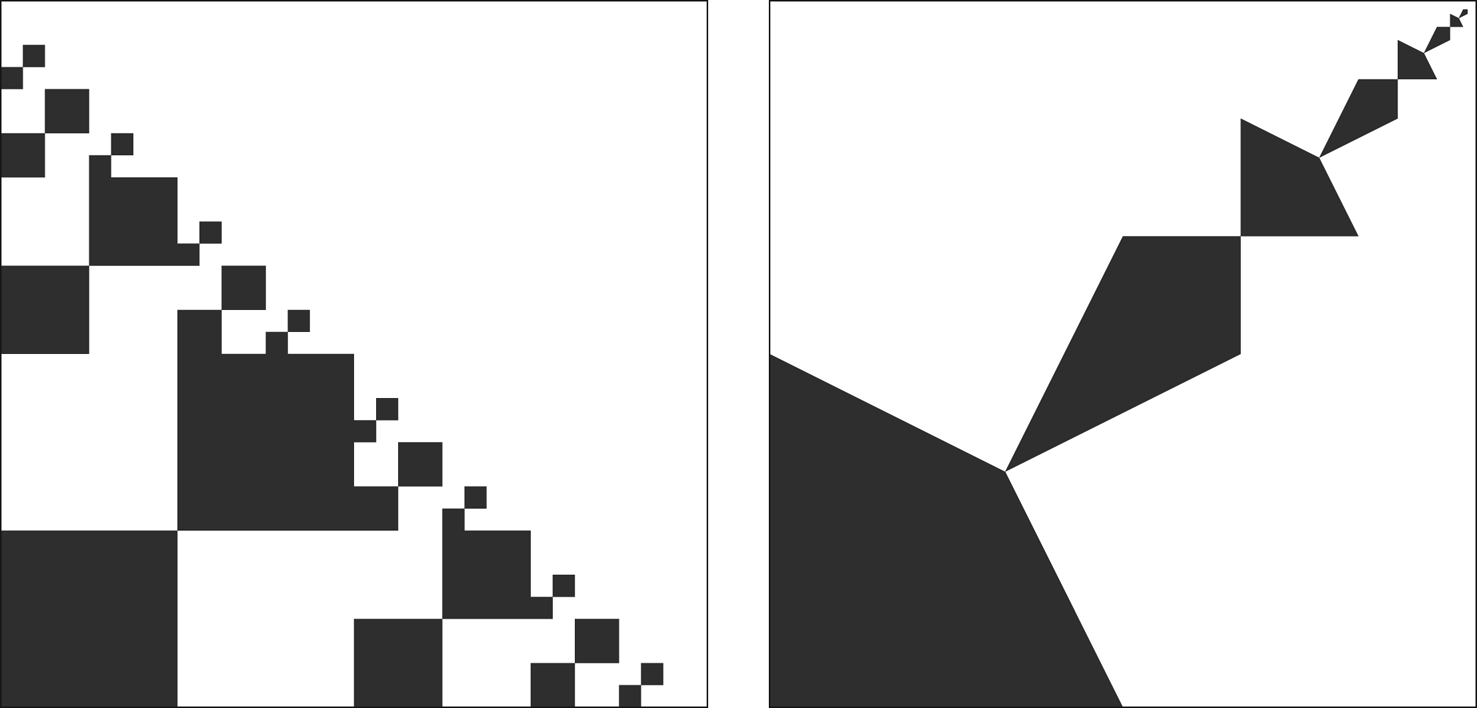
and\[ \int_0^{t} f(s)\,{\rm d}s=\bigg(\frac{t}2-\frac{t^{2}}4\bigg)\chi_{[0,1}](t)+\frac 14\chi_{(1,\infty)}(t) \]and (1.5) holds. For this case, it is easy to check that any of the sets on figure 1 give a positive solution to problem 1.3.\[ \int_0^{t}\lambda_g(s)\,{\rm d}s=(t-t^{2})\chi_{[0,1/2]}(t)+\frac 14\chi_{(1/2,\infty)}(t), \]
(ii) For
$0< a<1$, let $f(x)=g(x)=a\chi _{[0,1]}(x)$. Then (1.5) holds and two possible sets for which (1.4) is satisfied are shown in figure 2.


Two different approximations of a set  $E\subset [0,1]\times [0,1]$, with cross-sections equal to
 $f(x)=g(x)=(1-x)/2$.

Two different sets  $E\subset [0,1]\times [0,1]$, with cross-sections equal to
 $f(x)=g(x)=a\chi _{[0,1]}(x)$. In this example,
 $a=1/3$.

2. Existence of the set $E$ with a priori cross-sections

Our main result in this section is theorem 2.10, where we show that the necessary condition (1.5) of proposition 1.4 is actually sufficient to find a set  $E$, in the product space, with given cross-sections. The main geometric tool used for such construction is the notion of swappable squares in definition 2.5, which allows us to horizontally translate the mass of the hypograph of the function
 $g$ in such a way that in the limit, after suitable iterations for different grids of dyadic squares, we get precisely a set
 $E$ with the vertical cross-section equal to
 $f$. In the discrete case, this idea lies behind the proof of the Gale–Ryser theorem 1.2 given in [Reference Krause3].
To this end, we will start by proving some interesting properties of this swapping argument, as well as some measure theoretical estimates of the (lower) limit set obtained.
Definition 2.1 Dyadic squares For  $n\in \mathbb {N}$ and
 $i,j\in \{1,\ldots ,2^{n}\}$ define
 \[
{X_j^{n}}:= [2^{{-}n}(j-1),2^{{-}n}j),\qquad {Y_i^{n}} :=
[2^{{-}n}(i-1),2^{{-}n}i) \]
and
 \[ Q_{ij}^{n} := {X_j^{n}}\times {Y_i^{n}}. \]
We call  ${Q^{n}_{ij}}$ the dyadic squares of
 $n$-th generation with indices
 $i,j$.
Definition 2.2 Shifted set Let  $Q\subset \mathbb {R}^{2}$ and
 $(x_0,y_0)\in \mathbb {R}^{2}$. Then we define
 \[ Q + (x_0,y_0) := \{(x,y)\in\mathbb{R}^{2}: (x-x_0,y-y_0)\in Q\}. \]
Definition 2.3 Cross-sections of a set Let  $A\subset [0,1]^{2}$ be a measurable set. Define the vertical cross-section and the horizontal cross-section, respectively, of the set
 $A$ as
 \[ v_A(x) := \int_0^{1} \chi_A(x,z){\rm d}z,\qquad x\in[0,1], \]
and
 \[ h_A(y) := \int_0^{1} \chi_A(z,y){\rm d}z,\qquad y\in[0,1]. \]
Definition 2.4 Horizontal swapping Let  $A\subset [0,1]^{2}$ be a set. Let
 $n\in \mathbb {N}$ and
 $i,j,k\in \{1,\ldots ,2^{n}\}$,
 $j\ne k$. Then we define the set
 \begin{align*} \sigma^{n}_{ijk}(A) &:= (A {\setminus} ({Q^{n}_{ij}} \cup {Q^{n}_{ik}})) \cup (({Q^{n}_{ij}}\cap A) + (2^{{-}n}(k-j),0))\\ & \cup (({Q^{n}_{ik}}\cap A) - (2^{{-}n}(k-j),0)). \end{align*}
In other words,  $\sigma ^{n}_{ijk}(A)$ is the set
 $A$, whose subsets
 ${Q^{n}_{ij}}\cap A$ and
 ${Q^{n}_{ik}}\cap A$ have “changed their places”.
Definition 2.5 Swappable squares Let  $A\subset [0,1]^{2}$ be a measurable set and
 $f:[0,1]\to [0,1]$ be a measurable function such that
 \[ \int_0^{t} {f^{*}}(s){\rm d}s \le \int_0^{t} v_A^{*}(s) {\rm d}s, \quad \text{for all } t\in[0,1]. \]
Let  $n\in \mathbb {N}$ and
 $i,j,k \in \{1,\ldots ,2^{n}\}$,
 $j\ne k$. Then, given
 $f$ and
 $n\in \mathbb {N}$ as above, we say that the dyadic squares
 ${Q^{n}_{ij}}$ and
 ${Q^{n}_{ik}}$ are swappable (with respect to
 $f$,
 $A$ and
 $n$) if, with
 \[ A' := \sigma^{n}_{ijk} (A), \]
the following conditions are satisfied:
 $$\begin{gather} v_A \ge f + 2^{{-}n} \quad \text{a.e.~in } {X_j^{n}}, \end{gather}$$
 $$\begin{gather}v_A \le f - 2^{{-}n} \quad \text{a.e.~in } {X_k^{n}}, \end{gather}$$
 $$\begin{gather}\int_0^{t} {f^{*}}(s){\rm d}s \le \int_0^{t} v_{A'}^{*}(s) {\rm d}s \quad \text{for all } t\in[0,1], \end{gather}$$
 $$\begin{gather}(({Q^{n}_{ik}}\cap A) - (2^{{-}n}(k-j),0)) \subsetneq {Q^{n}_{ij}}\cap A\quad \text{and}\quad |A\,\Delta\, A'|>0. \end{gather}$$
Lemma 2.6 Let the function  $f$, the indices
 $n,i,j,k$, the squares
 ${Q^{n}_{ij}}$ and
 ${Q^{n}_{ik}}$, and the sets
 $A$ and
 $A'$ be as in definition 2.5. Then,
(i)
$h_A(y)=h_{A'}(y)$, for every $y\in [0,1]$, and hence $|A|=|A'|$.(ii)
\[ |A \setminus A'| = \int_{{X_j^{n}}} (v_{A}(x) - v_{A'}(x)) {\rm d}x\ \text{ and }\ |A' \setminus A| = \int_{{X_k^{n}}} (v_{A'}(x) - v_A(x)) {\rm d}x. \](iii)
\[ \int_0^{1} |f(x)-v_{A'}(x)| {\rm d}x =\int_0^{1} |f(x)-v_{A}(x)| {\rm d}x - |A\,\Delta\, A'|. \](iv) If
$l\in \{1,\dots ,2^{n}\}$, then:
\begin{align*} f \ge
v_{A'} \ge v_{A} \text{ in }X^{n}_l & \ \text{ if } f \ge
v_{A} \text{ in } X^{n}_l, \\ f \le v_{A'} \le v_{A} \text{
in } X^{n}_l& \ \text{ if } f \le v_{A} \text{ in }
X^{n}_l, \\ v_{A'} = v_{A} \text{ in } X^{n}_l & \ \text{
else.} \end{align*}


Proof. (i) The result is clear if  $y\in [0,1]\setminus Y_i^{n}$. Now, if
 $y\in Y_i^{n}$, then
 \begin{align*} h_{A'}(y)&=\int_0^{1}\chi_{A'}(x,y){\rm d}x=\int_0^{1}\chi_{(A \setminus ({Q^{n}_{ij}} \cup {Q^{n}_{ik}})) }(x,y){\rm d}x\\ &\quad+\int_0^{1}\chi_{(({Q^{n}_{ij}}\cap A) + (2^{{-}n}(k-j),0)) }(x,y){\rm d}x\\ &\quad +\int_0^{1}\chi_{ (({Q^{n}_{ik}}\cap A) - (2^{{-}n}(k-j),0)) }(x,y){\rm d}x\\ &=\int_0^{1}\chi_{(A \setminus ({Q^{n}_{ij}} \cup {Q^{n}_{ik}})) }(x,y){\rm d}x+\int_0^{1}\chi_{({Q^{n}_{ij}}\cap A) )}(x,y){\rm d}x+\int_0^{1}\chi_{ ({Q^{n}_{ik}}\cap A) }(x,y){\rm d}x\\ &=\int_0^{1}\chi_{A}(x,y){\rm d}x=h_{A}(y). \end{align*}
(ii) We prove the first equality (the second one is completely analogous). Now, using (2.4), we have that:
 \begin{align*} |A \setminus A'| & = |(A \setminus A') \cap {Q^{n}_{ij}}| = \int_{{X_j^{n}}} \int_{{Y_i^{n}}} \chi_{A\setminus A'}(x,y) {\rm d}y {\rm d}x \\ & = \int_{{X_j^{n}}} \int_{{Y_i^{n}}} (\chi_{A}(x,y) - \chi_{A'}(x,y) ){\rm d}y {\rm d}x = \int_{{X_j^{n}}}( v_{A\cap {Q^{n}_{ij}}}(x) - v_{A' \cap {Q^{n}_{ij}}} (x)) {\rm d}x \\ & = \int_{{X_j^{n}}} (v_{A}(x) - v_{A'}(x)) {\rm d}x. \end{align*}
Let us now prove (iii). Taking into account part (ii),
 \begin{align*} \int_0^{1} |f(x)-v_{A'}(x)| {\rm d}x &= \int_{[0,1]\setminus({X_j^{n}}\cup{X_k^{n}})} |f(x)-v_{A'}(x)| {\rm d}x\\ &\quad + \int_{{X_j^{n}}} |f(x)-v_{A'}(x)| {\rm d}x + \int_{{X_k^{n}}} |f(x)-v_{A'}(x)| {\rm d}x \\ &= \int_{[0,1]\setminus({X_j^{n}}\cup{X_k^{n}})} |f(x)-v_{A}(x)| {\rm d}x + \int_{{X_j^{n}}} (v_{A'}(x) - f(x) ){\rm d}x\\ &\quad + \int_{{X_k^{n}}}( f(x)-v_{A'}(x) ){\rm d}x \\ &= \int_{[0,1]\setminus({X_j^{n}}\cup{X_k^{n}})} |f(x)-v_{A}(x)| {\rm d}x + \int_{{X_j^{n}}}( v_{A}(x) - f(x)) {\rm d}x\\ &\quad + \int_{{X_k^{n}}}( f(x)-v_{A}(x) ){\rm d}x \\ & \quad + \int_{{X_j^{n}}} (v_{A'}(x) - v_{A}(x) ){\rm d}x + \int_{{X_k^{n}}} (v_{A}(x) - v_{A'}(x)) {\rm d}x \\ &= \int_{[0,1]\setminus({X_j^{n}}\cup{X_k^{n}})} |f(x)-v_{A}(x)| {\rm d}x + \int_{{X_j^{n}}} |v_{A}(x)\\ &\quad - f(x)| {\rm d}x + \int_{{X_k^{n}}} |f(x)-v_{A}(x)| {\rm d}x - | A \setminus A' | - |A'\setminus A|\\ &= \int_0^{1} |f(x)-v_{A}(x)| {\rm d}x - |A\,\Delta\, A'|. \end{align*}
(iv) Let us observe that, if we construct  $A'=\sigma _{ijk}^{n}(A)$ from
 $A$, we change the content of the square
 ${Q^{n}_{ij}}$, which is the only change in the
 $j$-th column. By (2.4), we obtain that
 ${Q^{n}_{ij}}\cap A'\subseteq {Q^{n}_{ij}}\cap A$. Hence we get
 $v_A\geq v_{A'}\geq v_A-2^{-n}$ in
 $X_j^{n}$, where the last inequality holds since
 $2^{-n}$ is the height of the square. Then, condition (2.1) gives
 \[ v_A\geq v_{A'}\geq v_{A}-2^{{-}n}\geq f \ \text{in}\ X_j^{n}. \]
Similarly, by looking at the  $k$-th column, since
 ${Q^{n}_{ik}}\cap A\subseteq {Q^{n}_{ik}}\cap A'$, condition (2.2) gives
 \[ v_A\leq v_{A'}\leq v_{A}+2^{{-}n}\leq f \ \text{in}\ X_k^{n}. \]
In any other case, since if neither (2.1) nor (2.2) holds with  $l$ in the role of
 $j$ or
 $k$, the
 $l$-th column remains unchanged, and thus
 $v_A=v_{A'}$ in
 $X_l^{n}$.
Remark 2.7 Given  $A$,
 $f,$ and
 $n$, let
 $\Omega _n$ be the collection of all sets
 $B$ obtained from
 $A$ by a finite number of swappings. It is obvious that
 $\Omega _n$ is finite, since, because of (2.4), no pair of squares can be swapped twice. Then
 $A_{\textrm {opt},n}$ is defined as such an element of
 $\Omega _n$ that
 \[ \|f -v_{A_{\textrm{opt},n}}\|_1 = \min_{B\in \Omega_n} \|f - v_B\|_1. \]
We need to recall the following classical result:
Lemma 2.8 Let  $\{E_n\}_{n\in \mathbb {N}}$ be a sequence of measurable subsets of
 $\mathbb {R}^{d}$ and let
 \begin{equation} E:= \bigcup_{m\in\mathbb{N}} \bigcap_{k=m}^{\infty} E_k \end{equation}
be its lower limit. If  $|E|<\infty$ and
 \begin{equation} \sum_{n\in\mathbb{N}} |E_n\setminus E_{n+1}| <\infty, \end{equation}
then  $E_n\to E$ in measure; i.e.,
 $|E_n\,\Delta \, E| \to 0$ as
 $n\to \infty$.
Similarly, the proof of the following result is straightforward and follows from the standard properties of the nonincreasing rearrangement of a function:
Lemma 2.9 Let  $u:[0,1]\to [0,\infty )$ be a measurable function. Assume that there exist
 $0< p\leq q <1$ and constants
 $C_1\ge C_2>0$ such that
 $u(x)\ge C_1,$ for a.e.
 $x\in [0,p)$,
 $C_2 \le u(x) \le C_1$, for a.e.
 $x\in [p,q)$ and
 $u(x)\le C_2$, for a.e.
 $x\in [q,1]$. Then
 \begin{align*} u^{*}(t) &= (u\chi_{[0,p)})^{*}(t) \text{ for all } t\in[0,p) \\ u^{*}(t) &= (u\chi_{[p,q)})^{*}(t-p) \text{ for all } t\in[p,q) \end{align*}
and
 \[ u^{*}(t) = (u\chi_{[q,1]})^{*}(t-q) \text{ for all } t\in[q,1]. \]
Furthermore, as a particular consequence, one has
 \begin{align} \int_0^{p} u^{*}(s){\rm d}s = \int_0^{p} u(z){\rm d}z, &\quad \int_p^{q} u^{*}(s){\rm d}s = \int_p^{q} u(z){\rm d}z,\\ \text{ and }\quad \int_q^{1} u^{*}(s){\rm d}s& = \int_q^{1} u(z){\rm d}z. \nonumber \end{align}
We will now prove our main result. To do this, we first address the case of cross-sections on  $[0,1]$ (moreover, under some monotone conditions) and the general setting will then follow using Ryff's Theorem and some measure preserving transformations (see [Reference Ryff5] and [Reference Bennett and Sharpley1, theorem II.7.5 and corollary II.7.6]).
Theorem 2.10 Let  $(X,\mu )$ and
 $(Y,\nu )$ be two finite resonant measure spaces and let
 $f:X\rightarrow \mathbb {R}^{+}$ and
 $g:Y\rightarrow \mathbb {R}^{+}$ be measurable functions satisfying
 $\|f\|_{L^{1}(\mu )}=\|g\|_{L^{1}(\nu )}$ and
 \[ \int_0^{t} {f^{*}}(s){\rm d}s \le \int_0^{t} \lambda_g(s){\rm d}s, \]
for all  $t>0$. Then, there exists a measurable set
 $E\subset X\times Y$ such that
 $v_E(x)=f(x)$,
 $\mu$-a.e.
 $x\in X$ and
 $h_E(y)=g(y)$,
 $\nu$-a.e.
 $y\in Y$.
Proof. We start by considering the case  $X=Y=[0,1]$, endowed with the Lebesgue measure, and assume also that
 $f$ is a nonincreasing function. Now, define
 $E_0$ by
 \[ E_0:= \left\{ (x,y)\in[0,1]^{2}: x< g(y)\right\} \]
and  $E_n=(E_{n-1})_{\textrm {opt},n}$, for each
 $n\in \mathbb {N}$, as in remark 2.7.
Observe that since  $v_{E_0}=\lambda _g$ in
 $[0,1]$, hence
 $v_{E_0}$ is nonincreasing and right-continuous, which in turn implies
 $v_{E_0} = v_{E_0}^{*}$ in
 $[0,1]$. Therefore we get
 \[ \int_0^{t} {f^{*}}(s) {\rm d}s \le \int_0^{t} \lambda_g(s){\rm d}s = \int_0^{t} v_{E_0}^{*}(s){\rm d}s, \]
for all  $t\in [0,1]$. Let
 $n\in \mathbb {N}$. Then, by the definition of
 $E_n$,
 \begin{equation} \int_0^{t} {f^{*}}(s) {\rm d}s \le \int_0^{t} v_{E_{n}}^{*}(s){\rm d}s. \end{equation}
Using lemma 2.6 (i), it immediately follows that
 \begin{equation} |E_n|=|E_{n-1}|, \ h_{E_n}=g \quad\text{a.e. in}\quad [0,1], \end{equation}
and
 \begin{equation} |E_n|=\|v_{E_n}\|_1=\|h_{E_n}\|_1=\|g\|_1 = \|f\|_1. \end{equation}
Furthermore, to fix the notation, suppose now that the set  $E_n$ is constructed from
 $E_{n-1}$ as follows: there exists an
 $m\in \mathbb {N}$ and sets
 $A_0, \ldots , A_m$ such that
 $A_0 = E_{n-1}$,
 $A_m = E_n$ and
 $A_{l} = (A_{l-1})'$ for all
 $l\in \{1,\ldots ,m\}$. Then, using lemma 2.6 (iii)
 \begin{align*} |E_{n-1}\,\Delta\, E_n| &\le \sum_{l=1}^{m} |A_{l-1}\,\Delta\, A_l| = \sum_{l=1}^{m} (\|f-v_{A_{l-1}}\|_1 - \|f-v_{A_l}\|_1)\\ & = \|f-v_{E_{n-1}}\|_1 - \|f-v_{E_n}\|_1. \end{align*}
Since the inequality  $\|f-v_{A_{l-1}}\|_1 - \|f-v_{A_l}\|_1 > 0$ holds for all
 $l\in \{1,\ldots ,m\}$ (see (2.4) and lemma 2.6), we have also
 $\|f-v_{E_{n-1}}\|_1 - \|f-v_{E_n}\|_1 >0$. Thus, we get
 \begin{align*} \sum_{n\in\mathbb{N}} |E_{n-1}\,\Delta\, E_n| & = \lim_{N\to\infty} \sum_{n=1}^{N} |E_{n-1}\,\Delta\, E_n| \\ & \le \lim_{N\to\infty} \sum_{n=1}^{N} \left( \|f-v_{E_{n-1}}\|_1 - \|f-v_{E_n}\|_1 \right)\\ & = \lim_{N\to\infty} \left( \|f-v_{E_0}\|_1 - \|f-v_{E_N}\|_1 \right) \\ & \le \|f-v_{E_0}\|_1 \le 1. \end{align*}
We finally define  $E$ by (2.5). Since
 $E\subset [0,1]^{2}$ obviously holds, the assumptions of lemma 2.8 are satisfied and it follows that
 $E_n$ converges to
 $E$ in measure. Observe that (2.9) and (2.10) give us that
 $h_E=g$, a.e. and
 $\|v_E\|_1=\|f\|_1$.
It remains to prove  $\|f-v_E\|_1=0$, which will be done in the rest of the proof. At first we need some auxiliary observations. We see that
 \begin{equation} \|v_{E_n}-v_E\|_1 \le \int_0^{1} \int_0^{1} |\chi_{E_n}(x,y)-\chi_{E}(x,y)|{\rm d}x{\rm d}y = |E_n\Delta E|\xrightarrow{n\to\infty} 0. \end{equation}
For every  $x\in [0,1]$ let
 $\{j_n(x)\}_{n\in \mathbb {N}}$ be the unique sequence of natural numbers such that
 $x\in {X^{n}_{j_n}}$ for each
 $n\in \mathbb {N}$. Now let
 $n\in \mathbb {N}$ be fixed. By the construction of
 $E_n$, for every
 $i\in \{1,\ldots , 2^{n}\}$ there exists a unique permutation
 $\pi _{ni}: \{1,\ldots , 2^{n}\} \to \{1,\ldots , 2^{n}\}$ such that
 $E_n \cap {Q^{n}_{ij}} = E_0 \cap Q^{n}_{i\pi _{ni}(j)}$ for all
 $j\in \{1,\ldots , 2^{n}\}$. Hence, for
 $x\in X^{n}_j$ we have
 \[ v_{E_n}(x) = \sum_{i=1}^{2^{n}} v_{E_n \cap Q^{n}_{ij}}(x) = \sum_{i=1}^{2^{n}} v_{E_0 \cap Q^{n}_{i\pi_{ni}(j)}}(x). \]
By the definition of  $E_0$, one has
 \[ v_{E_0 \cap Q^{n}_{i\pi_{ni}(j)}}(x) = v_{ \{ (u,z)\in Q^{n}_{i\pi_{ni}(j)}:u< g(z)\}}(x) = \int_{{Y_i^{n}}} \chi_{\{ (u,z)\in Q^{n}_{i\pi_{ni}(j)}: u< g(z)\}} (x,y) {\rm d}y, \]
for every pair  $i,j\in \{1,\ldots ,2^{n}\}$. Since the above integrand is nonincreasing on the variable
 $x$, then
 $x\mapsto v_{E_n \cap Q^{n}_{ij_n(x)}}(x)=v_{E_0 \cap Q^{n}_{i\pi _{ni}(j_n(x))}}(x)$ is a nonincreasing function on
 ${X_j^{n}}$, for every
 $i$ and
 $j$, and thus
 $v_{E_n}$ is also nonincreasing on every
 ${X_j^{n}}$,
 $j\in \{1,\ldots ,2^{n}\}$.
It is worth mentioning that, for any  $i,j,k \in \{1,\ldots ,2^{n}\}$, the following implication is valid:
 \begin{align} &\lim_{z\to 2^{{-}n}j-} v_{E_n \cap {Q^{n}_{ij}}}(z) > v_{E_n \cap {Q^{n}_{ik}}}(2^{{-}n}(k-1))\notag\\ &\quad \Longrightarrow (E_n \cap {Q^{n}_{ik}}) - (2^{{-}n}(k-j),0) \subsetneq E_n \cap {Q^{n}_{ij}}. \end{align}
This follows from the representation  $E_n \cap {Q^{n}_{ij}} = E_0 \cap Q^{n}_{i\pi _{ni}(j)}$,
 $E_n \cap {Q^{n}_{ik}} = E_0 \cap Q^{n}_{i\pi _{ni}(k)}$, the definition of
 $E_0$, and lemma 2.6 (iii).
Next, we have
 \begin{align*} & \sum_{j=1}^{2^{n}} \left( v_{E_n}(2^{{-}n}(j-1)) - \lim_{z\to 2^{{-}n}j-} v_{E_n}(z) \right) \\ & = \sum_{j=1}^{2^{n}} \sum_{i=1}^{2^{n}} \left( v_{E_n \cap {Q^{n}_{ij}}}(2^{{-}n}(j-1)) - \lim_{z\to 2^{{-}n}j-} v_{E_n \cap {Q^{n}_{ij}} }(z) \right) \\ & = \sum_{j=1}^{2^{n}} \sum_{i=1}^{2^{n}} \left( v_{E_0 \cap Q^{n}_{i\pi_{ni}(j)}}(2^{{-}n}(\pi_{ni}(j)-1)) - \lim_{z\to 2^{{-}n}\pi_{ni}(j)-} v_{E_0 \cap Q^{n}_{i\pi_{ni}(j)} }(z) \right)\\ &= \sum_{j=1}^{2^{n}} \sum_{i=1}^{2^{n}} \left( v_{E_0 \cap {Q^{n}_{ij}}}(2^{{-}n}(j-1)) - \lim_{z\to 2^{{-}n}j-} v_{E_0 \cap {Q^{n}_{ij}} }(z) \right), \end{align*}
where the last equality holds by switching the order of the two sums, rearranging all indices obtained when applying the permutation  $\pi _{ni}$ to the set
 $j\in \{1,\dots ,2^{n}\}$, and switching the indices
 $i$ and
 $j$ back again. Continuing from here we obtain:
 \begin{align*} \sum_{j=1}^{2^{n}} &\left( v_{E_n}(2^{{-}n}(j-1)) - \lim_{z\to 2^{{-}n}j-} v_{E_n}(z) \right)\\ &= \sum_{j=1}^{2^{n}} \sum_{i=1}^{2^{n}} \left( v_{E_0 \cap {Q^{n}_{ij}}}(2^{{-}n}(j-1)) - \lim_{z\to 2^{{-}n}j-} v_{E_0 \cap {Q^{n}_{ij}} }(z) \right) \\ & = \sum_{j=1}^{2^{n}} \left( v_{E_0}(2^{{-}n}(j-1)) - \lim_{z\to 2^{{-}n}j-} v_{E_0}(z) \right) \\ & = \sum_{j=1}^{2^{n}} \left( \lambda_g (2^{{-}n}(j-1)) - \lim_{z\to 2^{{-}n}j-} \lambda_g (z) \right) \\ & \le \sum_{j=1}^{2^{n}} \left( \lambda_g (2^{{-}n}(j-1)) - \lambda_g (2^{{-}n}j) \right) \\ & \le \lambda_g (0). \end{align*}
For every  $n\in \mathbb {N}$ and
 $x\in [0,1]$ define
 \[ \varphi_n(x) := v_{E_n}(2^{{-}n}(j_n(x)-1)) - \lim_{z\to 2^{{-}n}j_n(x)-} v_{E_n}(z). \]
As observed above,  $v_{E_n}$ is nonincreasing on each
 ${X_j^{n}}$, therefore
 $\varphi _n$ is nonnegative on
 $[0,1]$ and we have
 \[ \|\varphi_n\|_1 = \sum_{j=1}^{2^{n}} 2^{{-}n} \left( v_{E_n}(2^{{-}n}(j-1)) - \lim_{z\to 2^{{-}n}j-} v_{E_n}(z) \right) \le 2^{{-}n} \lambda_g(0) \xrightarrow{n\to\infty} 0. \]
Hence, there exists a subsequence  $\{\varphi _{n_m}\}_{m\in \mathbb {N}}$ converging a.e. in
 $[0,1]$. In particular, this implies that
 \[ \liminf_{n\to\infty} \left( v_{E_n}(2^{{-}n}(j_n(x)-1)) - \lim_{z\to 2^{{-}n}j_n(x)-} v_{E_n}(z) \right) = 0 \]
for a.e.  $x\in [0,1]$. By the monotonicity of
 $v_{E_n}$ on each
 ${X_j^{n}}$, we therefore get
 \begin{equation} \liminf_{n\to\infty} \sup_{z\in X^{n}_{j(x)}} |v_{E_n}(x) - v_{E_n}(z)| = 0 \end{equation}
for a.e.  $x\in [0,1]$. Consequently, using lemma 2.6 (iv), for every
 $x\in [0,1]$ the sequence
 $\{v_{E_n}(x)\}_{n\in \mathbb {N}}$ is monotone.
Next, for any  $n\in \mathbb {N}$ and
 $t\in [0,1]$ we have
 \begin{align} \int_0^{t} |v_{E_n}^{*}(s) \!-\! v_{E}^{*}(s)|{\rm d}s& \le \|v_{E_n}^{*}\!-\!v_E^{*}\|_1 = \|(v_{E_n}^{*}\!-\!v_E^{*})^{*}\|_1\\ & \le \|(v_{E_n}\!-\!v_E)^{*}\|_1 = \|v_{E_n}\!-\!v_E\|_1, \nonumber \end{align}
where the second inequality follows from the Lorentz–Shimogaki theorem [Reference Bennett and Sharpley1, theorem III.7.4, p. 169]. Hence, taking the limit as  $n\to \infty$ in (2.8), using (2.11) and (2.14) give
 \begin{equation} \int_0^{t} {f^{*}}(s) {\rm d}s \le \int_0^{t} v_{E}^{*}(s){\rm d}s, \end{equation}
for any fixed  $t\in [0,1]$.
Again, using (2.11) and the monotonicity of the sequence  $\{v_{E_n}(x)\}_{n\in \mathbb {N}}$, then, the sequence of functions
 $v_{E_n}$ converges to
 $v_E$ a.e. in
 $[0,1]$. Moreover, the pointwise limit in fact exists for every
 $x\in [0,1]$, and hence we may thus assume without loss of generality (modifying
 $E$ on a subset of measure zero, if necessary) that
 $v_{E_n}$ converges to
 $v_E$ everywhere in
 $[0,1]$. Thus, as a consequence of lemma 2.6 (iv), we obtain
 \begin{equation} f(z) \le v_E(z)\le v_{E_n}(z)\le v_{E_0}(z) \quad or \quad f(z) \ge v_E(z) \ge v_{E_n}(z) \ge v_{E_0}(z) \end{equation}
for all  $z\in [0,1]$ and
 $n\in \mathbb {N}$. In particular, this yields
 \begin{equation} \min\{f(x),v_{E_0}(x)\} \le v_E(x) \le \max\{f(x),v_{E_0}(x)\},\ \text{ for all }x\in[0,1]. \end{equation}
Define by  $S$ the set of all
 $x\in (0,1)$ such that both
 $f$ and
 $v_{E_0}$ are continuous in
 $x$ and (2.13) holds. Since
 $f$ and
 $v_{E_0}$ are nonincreasing, and, as shown before, (2.13) holds for a.e.
 $x\in [0,1]$, it follows that
 $|[0,1]\setminus S|=0$.
Now we can return to the main point. We are going to show that  $f(x)=v_{E}(x)$ for almost all
 $x\in S$, by contradiction. To do so, assume that the set
 \[ S_0 := \{ x\in S:v_E(x)>f(x) \} \]
has positive measure.
The function  $v_{E_0}$ is right-continuous. We may assume that
 $f$ is right-continuous, otherwise its values may be changed on a null set. Hence, the level set
 $V_+:=\{x\in [0,1]: v_{E_0}(x)-f(x)>0\}$ is right-open in the sense that for every
 $x\in V_+$ we have
 $(x,x+\delta )\subset V_+$, for some
 $\delta >0$. By (2.16), inequality
 $v_{E_0}(x)>f(x)$ holds whenever
 $v_{E}(x) > f(x)$. Hence
 $S_0 \subset V_+$. Thus, there exists an interval
 $(a,b)\subset V_+\subset [0,1]$ such that
 \begin{gather} v_{E_0} \ge v_E \ge f \text{ in }[a,b), \end{gather}
 \begin{gather} \lim_{x\to a-} v_{E_0}(x) ) \le \lim_{x\to a-}f(x), \end{gather}
 \begin{gather} v_{E_0}(b) \le f(b), \end{gather}
 \begin{gather} |S_0 \cap (a,b)| >0. \end{gather}
Notice that  $(a,b)\subset [0,1]$ and hence
 $b<1$. If
 $a>0$, let
 $x\in [0,a)$ be arbitrary. Using (2.17), (2.19) and monotonicity of
 $v_{E_0}$, we have
 \[ v_{E}(x) \ge \min\{f(x),v_{E_0}(x)\} \ge \lim_{y\to a-} \min\{f(y),v_{E_0}(y)\} = \lim_{y\to a-} v_{E_0}(y) \ge v_{E_0}(a). \]
Similarly, for any  $y\in [a,1]$ we have
 \[ v_{E}(y) \le \max\{f(y),v_{E_0}(y)\}\le \max\{f(a),v_{E_0}(a)\} = v_{E_0}(a). \]
Analogously, by (2.17), (2.18) and (2.20) we get, for any  $y\in [0,b)$,
 \begin{align*} v_{E}(y) &\ge \min\{f(y),v_{E_0}(y)\} \ge \lim_{z\to b-} \min\{f(z),v_{E_0}(z)\}\\ & = \lim_{z\to b-} f(z) \ge f(b) \ge v_{E_0}(b). \end{align*}
For every  $z\in [b,1]$ one has
 \[ v_{E}(z) \le \max\{f(z),v_{E_0}(z)\}\le \max\{f(b),v_{E_0}(b)\} =f(b). \]
Hence, we have
 \[ v_E(x) \ge v_{E_0}(a) \ge v_E(y) \ge f(b) \ge v_E(z) \]
for all  $x\in [0,a)$,
 $y\in [a,b)$ and
 $z\in [b,1]$. For the sake of correctness, we note that if
 $a=0$, the first term and inequality is simply omitted. Lemma 2.9 now gives
 \[ v_E^{*}(t) = (v_E\chi_{[b,1]})^{*}(t-b)\text{ for all } t\in[b,1], \]
and
 \[ \int_a^{b} v_{E}^{*}(s){\rm d}s = \int_a^{b} v_{E}(y){\rm d}y. \]
By (2.21), one has  $v_E>f$ on a subset of
 $(a,b)$ with positive measure. Thus, there exists a
 $\varrho >0$ such that
 \[ \int_a^{b} v_{E}(y){\rm d}y > \int_a^{b} f(y){\rm d}y + 4\varrho = \int_a^{b} {f^{*}}(s){\rm d}s + 4\varrho. \]
From this and (2.15) used with  $t=a$, we obtain
 \begin{align}
\int_0^{b} {f^{*}}(s) {\rm d}s + 4\varrho &= \int_0^{a}
{f^{*}}(s) {\rm d}s + \int_a^{b} {f^{*}}(s) {\rm d}s +
4\varrho\\ & < \int_0^{a} v_{E}^{*}(s){\rm d}s + \int_a^{b}
v_{E}^{*}(s){\rm d}s = \int_0^{b} v_{E}^{*}(s){\rm d}s.
\nonumber
\end{align}
Define
 \[ h:= \min\left\{ t\in(b,1): \int_0^{t} v_E^{*}(s){\rm d}s \le \int_0^{t} {f^{*}}(s){\rm d}s + 3\varrho \right\}. \]
The minimum is indeed attained since the function  $t\mapsto \int _0^{t} v_E^{*}(s)\mathrm {\,d}s - \int _0^{t} {f^{*}}(s)\mathrm {\,d}s$ is continuous and
 $\int _0^{1} v_E^{*}(s)\mathrm {\,d}s = \int _0^{1} {f^{*}}(s)\mathrm {\,d}s$, which is (2.10). Let us show that
 $f>v_E$ holds on a subset of
 $(b,h)$ with positive measure. To do so, assume, for contradiction, that
 $f\le v_E$ a.e. in
 $[b,h)$. Let
 $t\in [b,h)$. The assumption implies
 $(f\chi _{[b,h)})^{*}(t-b) \le (v_E\chi _{[b,h)})^{*}(t-b)$. Since
 $f$ is nonincreasing, by lemma 2.9 we have
 \[ (f\chi_{[b,h)})^{*}(t-b) = (f\chi_{[b,1]})^{*}(t-b) = {f^{*}}(t). \]
Consequently,
 \[ v_E^{*}(t) = (v_E\chi_{[b,1]})^{*}(t-b) \ge (v_E\chi_{[b,h)})^{*}(t-b) \ge (f\chi_{[b,h)})^{*}(t-b) = {f^{*}}(t). \]
Therefore we have  $v_E^{*}(t) \ge {f^{*}}(t)$ for all
 $t\in (b,h)$. However, this inequality together with (2.22) implies
 \begin{align*} \int_0^{h} v_E^{*}(s){\rm d}s &= \int_0^{b} v_E^{*}(s){\rm d}s + \int_b^{h} v_E^{*}(s){\rm d}s\\ & > \int_0^{b} {f^{*}}(s){\rm d}s + \int_b^{h} {f^{*}}(s){\rm d}s + 4\varrho = \int_0^{h} {f^{*}}(s){\rm d}s + 4\varrho. \end{align*}
This contradicts the definition of  $h$.
We have shown that  $|\{ y\in (b,h): f(y)>v_E(y) \}|>0$. Since
 $|[0,1]\setminus S|=0$, we have also
 $|\{ y\in (b,h)\cap S: f(y)>v_E(y) \}|>0$. Thanks to this and (2.21), there exist points
 $x\in (a,b)\cap S_0$ and
 $y\in (b,h)\cap S$ such that
 \begin{equation} v_E(x) > f(x) \ge f(y) > v_E(y)\ge v_{E_0}(y). \end{equation}
Define
 \[ \varepsilon:= \frac 14 \min \{ v_E(x)- f(x),\, f(y) - v_E(y) \}. \]
Since  $f$ and
 $v_{E_0}$ are both continuous in
 $x$ as well as in
 $y$ (recall the definition of
 $S$), there exists a
 $\delta >0$ satisfying
 \begin{equation} \min\{x-a,2(b-x),y-b,1-y\}>\delta>0 \end{equation}
such that
 \begin{align} &|v_{E_0}(z)-v_{E_0}(x)| < \varepsilon \text{ and } |f(z)-f(x)| < \varepsilon & \text{ for all }z\in(x-\delta, x+\delta),\nonumber\\ &|v_{E_0}(z)-v_{E_0}(y)| < \varepsilon \text{ and } |f(z)-f(y)| < \varepsilon & \text{ for all }z\in(y-\delta, y+\delta). \end{align}
In particular, we get  $v_{E_0}>f$ and
 $f> v_{E_0}$ on
 $(x-\delta , x+\delta )$ and
 $(y-\delta , y+\delta )$, respectively.
By (2.14) we have, for  $t\in [0,1]$,
 \[ \int_0^{t} |v_{E_n}^{*}(s) - v_E^{*}(s)| {\rm d}s \xrightarrow{n\to\infty} 0 \]
and this convergence is uniform in  $t$. Moreover, since
 $x,y\in S$, both
 $x$ and
 $y$ satisfy (2.13) (in the latter case with
 $y$ instead of
 $x$) and
 $f$ as well as
 $v_{E_0}$ are continuous in
 $x$ and
 $y$. Based on these properties, there exists a sufficiently large
 $n\in \mathbb {N}$ such that all the following conditions are satisfied:
 \begin{align} &\sup_{z\in X^{n}_{j_n(x)}} |v_{E_n}(x) - v_{E_n}(z)| < \varepsilon,& \quad \sup_{z\in X^{n}_{j_n(y)}} |v_{E_n}(y) - v_{E_n}(z)| < \varepsilon,\nonumber\\ & 2^{{-}n-1}< \varepsilon, \quad 2^{1-n}<\delta, \quad 2^{1-2n}<\varrho, \end{align}
and
 \begin{equation} \int_0^{t} |v_{E_n}^{*}(s)- v_E^{*}(s)| {\rm d}s < \varrho \quad \text{for all } t\in[0,1]. \end{equation}
In the following, we will write  $j:= j_n(x)$ and
 $k:= j_n(y)$ since
 $n$,
 $x$ and
 $y$ remain fixed. By (2.16), we have
 \[ v_{E_0}(x)\ge v_{E_n}(x) \ge v_E(x) \ge f(x) + 4\varepsilon. \]
Let  $z\in {X_j^{n}}$ be arbitrary. We have
 \begin{align*} v_{E_n}(z) & \ge v_{E_n}(x) - |v_{E_n}(x) - v_{E_n}(z)| > v_{E_n}(x) - \varepsilon = f(x) + v_{E_n}(x) - f(x) - \varepsilon \\ & \ge f(x) + 3 \varepsilon \ge f(2^{{-}n}(j-1))- |f(2^{{-}n}(j-1))-f(x)| + 3\varepsilon\\ & \ge f(2^{{-}n}(j-1))+2\varepsilon. \end{align*}
Taking the limit (or infimum), we get
 \begin{equation} \inf_{z\in{X_j^{n}}} v_{E_n}(z) = \lim_{z\to 2^{{-}n}j-} v_{E_n}(z) \ge f(2^{{-}n}(j-1))+2\varepsilon. \end{equation}
Proceeding analogously regarding the point  $y$, we obtain
 \begin{equation} \inf_{z\in{X_k^{n}}} f(z) = \lim_{z\to 2^{{-}n}k-} f(z) \ge v_{E_n}(2^{{-}n}(k-1))+2\varepsilon. \end{equation}
Taking into account the inequalities
 \[ f(2^{{-}n}(j-1)) \ge f(b) \ge f(y)\ge \lim_{z\to 2^{{-}n}k-} f(z), \]
we have
 \begin{equation} \lim_{z\to 2^{{-}n}j-} v_{E_n}(z) \ge v_{E_n}(2^{{-}n}(k-1)) + 4\varepsilon. \end{equation}
Recall that, for any  $i\in \{1,\ldots ,2^{n}\}$, the functions
 $v_{E_n\cap {Q^{n}_{ij}}}$ and
 $v_{E_n\cap {Q^{n}_{ik}}}$ are nonincreasing on
 ${X_j^{n}}$ and
 ${X_k^{n}}$, respectively. Inequality (2.30) thus yields
 \[ \sum_{i=1}^{2^{n}} \lim_{z\to 2^{{-}n}j-} v_{E_n\cap{Q^{n}_{ij}}}(z) > \sum_{i=1}^{2^{n}} v_{E_n\cap{Q^{n}_{ik}}}(2^{{-}n}(k-1)). \]
Hence, there exists an  $i\in \{1,\ldots ,2^{n}\}$ such that
 \begin{equation} \lim_{z\to 2^{{-}n}j-} v_{E_n\cap{Q^{n}_{ij}}}(z) > v_{E_n\cap{Q^{n}_{ik}}}(2^{{-}n}(k-1)). \end{equation}
If we are able to show that the squares  ${Q^{n}_{ij}}$ and
 ${Q^{n}_{ik}}$ are swappable with respect to
 $E_n$ and
 $n$, we will obtain the ultimate contradiction with the construction of
 $E_n$.
Thus, we set  $A:=E_n$ and
 $A':=\sigma _{ijk}^{n}(A)$ and want to show that (2.1)–(2.4) holds. By (2.31) and (2.12) we immediately obtain condition (2.4). Since
 $2^{-n-1}<\varepsilon$ was assumed and
 $f$ is nonincreasing, estimate (2.28) implies
 \[ \inf_{z\in{X_j^{n}}} v_{E_n}(z) > \max_{z\in{X_j^{n}}} f(z)+2^{{-}n}, \]
Therefore (2.1) is satisfied. Analogously, (2.29) yields (2.2).
It remains to prove (2.3). In this part, we will frequently use the inequality
 \begin{equation} \int_0^{t} v_A^{*}(s) {\rm d}s \ge \int_0^{t} {f^{*}}(s){\rm d}s \text{ for all } t\in[0,1], \end{equation}
which obviously holds since  $A = E_n$.
Since, by (2.23),  $v_{E_0}(y) < f(y)$, we can define
 $(c,d)$ as the maximal open subinterval of
 $(b,1)$ such that
 $y\in (c,d)$ and
 $v_{E_0} < f$ in
 $(c,d)$. Moreover, using (2.25) and (2.26), we have that
 \begin{equation} X^{n}_j\subset (a,b)\quad\text{ and }\quad X^{n}_k\subset (c,d). \end{equation}
Keeping in mind that  $A = E_n$, by applying (2.16) and (2.17) to (2.18)–(2.20) we get the estimates
 \begin{align} v_{A} \ge v_{E_0}(a) \text{ in } [0,a), \quad v_{E_0}(a)\ge v_{A} \ge f \ge f(b) \text{ in } [a,b), \quad f(b)\ge v_{A} \text{ in }[b,1]. \end{align}
Now we may proceed analogously with the interval  $(c,d)$. Its maximality and (2.16) guarantee that
 \begin{equation} v_{A} \ge f(c) \text{ in } [0,c), \quad f(c) \ge f \ge v_{A} \ge v_{E_0}(d)\text{ in } [c,d), \quad v_{E_0}(d)\ge v_{A} \text{ in }[d,1]. \end{equation}
Notice that (2.34) and (2.35) hold also with  $A'$ in place of
 $A$. To see this, recall that
 $A'=\sigma ^{n}_{ijk}(A)$ and then use lemma 2.6 (iv) and (2.33) which implies
 \begin{equation} |v_A - v_{A'}| \le 2^{{-}n}(\chi_{{X_j^{n}}} + \chi_{{X_k^{n}}}). \end{equation}
Based on (2.34), (2.35) and their analogues with  $A'$, by lemma 2.9 we obtain:
 \begin{equation} v_A^{*}(t) = (v_A\chi_{[p,q)})^{*}(t-p) \text{ and } v_{A'}^{*}(t) = (v_{A'}\chi_{[p,q)})^{*}(t-p) \text{ for } t\in[p,q), \end{equation}
whenever  $[p,q)$ is one of the intervals
 $[0,a),[a,b),[b,c),[c,d),[d,1)$. If
 $a=0$ or
 $b=c$, the intervals
 $[0,a)$ or
 $[b,c)$ are, of course, not considered.
In particular, using (2.37) with  $[p,q)=[a,b)$,
 $A'=\sigma ^{n}_{ijk}(A)$ and
 ${X_j^{n}}\subset (a,b)$, which is (2.33), we have
 \begin{align}
\int_0^{b} v_{A'}^{*}(s){\rm d}s& = \int_0^{b}
v_{A'}(z){\rm d}z = \int_0^{b} v_{A}(z) {\rm d}z -
|A\setminus A'| \notag\\ &= \int_0^{b} v_{A}^{*}(s){\rm d}s -
|A\setminus A'|.
\end{align}
Again, using (2.33) we have that  ${X_j^{n}}\subset (a,b)$ and
 ${X_k^{n}} \subset (c,d)$, and obtain
 \begin{equation} v_A = v_{A'} \text{ in } [0,a) \cup [b,c) \cup [d,1]. \end{equation}
If  $a>0$, let
 $t\in [0,a]$. By (2.39), (2.37) with
 $[p,q)=[0,a)$, and (2.32), we get
 \begin{equation} \int_0^{t} v_{A'}^{*}(s) {\rm d}s = \int_0^{t} v_{A}^{*}(s) {\rm d}s \ge \int_0^{t} {f^{*}}(s) {\rm d}s. \end{equation}
Let  $t\in [a,b]$. Since
 $v_{A'}\ge f$ in
 $[a,b)$ (recall that this is (2.34) with
 $A$ replaced by
 $A'$), (2.37) with
 $[p,q)=[a,b)$, and (2.32) provide
 \begin{align*} \int_0^{t} (v_{A'}^{*}(s)-{f^{*}}(s)) {\rm d}s& = \int_0^{a} (v_{A'}^{*}(s)-{f^{*}}(s)) {\rm d}s \\ &\quad+ \int_a^{t} ((v_{A'}\chi_{(a,b)})^{*}(s-a)-(f\chi_{(a,b)})^{*}(s-a)) {\rm d}s \ge 0, \end{align*}
thus (2.40) holds for  $t\in [a,b]$.
If  $b< c$, let
 $t\in [b,c]$. Since
 $c< h$, the definition of
 $h$ and (2.27) yield
 \[ \int_0^{t} v_{A}^{*}(s){\rm d}s > \int_0^{t} {f^{*}}(s){\rm d}s + 2\varrho. \]
Property (2.39) yields  $(v_{A'}\chi _{[b,c)})^{*}= (v_{A}\chi _{[b,c)})^{*}$. Considering (2.37) with
 $[p,q)=[b,c)$, (2.38), the assumption
 $\varrho > 2^{-2n}$, and (2.32), one has
 \begin{align*} \int_0^{t} v_{A'}^{*}(s){\rm d}s & = \int_0^{b} v_{A'}^{*}(s){\rm d}s + \int_b^{t} v_{A'}^{*}(s){\rm d}s\\ & = \int_0^{b} v_{A'}(z){\rm d}z + \int_b^{t} (v_{A'}\chi_{[b,c)})^{*}(s-b) {\rm d}s\\ & = \int_0^{b} v_{A}(z){\rm d}z - |A\setminus A'| + \int_b^{t} (v_{A}\chi_{[b,c)})^{*}(s-b) {\rm d}s \\ & = \int_0^{t} v_A^{*}(s) {\rm d}s - |A\setminus A'| > \int_0^{t} {f^{*}}(s){\rm d}s + 2\varrho - |A\setminus A'| \\ & \ge \int_0^{t} {f^{*}}(s){\rm d}s + 2\varrho - 2^{{-}2n} > \int_0^{t} {f^{*}}(s){\rm d}s + \varrho. \end{align*}
Hence, (2.40) is satisfied for  $t\in [b,c]$. In particular, the previous calculation gives
 \[ \int_0^{c} v_{A'}^{*}(s){\rm d}s = \int_0^{c} v_A^{*}(s) {\rm d}s - |A\setminus A'|. \]
Moreover, since  $A'=\sigma ^{n}_{ijk}(A)$ and
 ${X_k^{n}} \subset (c,d)$, by (2.37) with
 $[p,q)=[c,d)$ we have
 \[ \int_c^{d} v_{A'}^{*}(s){\rm d}s = \int_c^{d} v_{A'}(z){\rm d}z = \int_c^{d} v_A(z){\rm d}z + |A'\setminus A| = \int_c^{d} v_{A}^{*}(s){\rm d}s + |A'\setminus A|. \]
Thanks to these two relations, we have
 \begin{equation} \int_0^{d} v_{A'}^{*}(s){\rm d}s = \int_0^{c} v_{A'}^{*}(s){\rm d}s + \int_c^{d} v_{A'}^{*}(s){\rm d}s = \int_0^{d} v_A^{*}(s) {\rm d}s. \end{equation}
Let  $t\in [c,d]$. By (2.36) it follows that
 $f\ge v_{A'}$ holds in
 $[c,d)$, and therefore
 $(f\chi _{[c,d)})^{*} \ge (v_{A'}\chi _{[c,d)})^{*}$. Applying this to (2.37) with
 $[p,q)=[c,d)$, one has
 ${f^{*}} \ge v^{*}_{A'}$ in
 $[c,d)$. Using this fact, (2.41) and (2.32), we get
 \begin{align*} \int_0^{t} v_{A'}^{*}(s){\rm d}s & = \int_0^{d} v_{A'}^{*}(s){\rm d}s + \int_t^{d} ({f^{*}}(s) - v_{A'}^{*}(s)) {\rm d}s - \int_t^{d} {f^{*}}(s){\rm d}s \\ & \ge \int_0^{d} v_A^{*}(s){\rm d}s - \int_t^{d} {f^{*}}(s){\rm d}s \ge \int_0^{d} {f^{*}}(s){\rm d}s - \int_t^{d} {f^{*}}(s){\rm d}s\\ & = \int_0^{t} {f^{*}}(s) {\rm d}s. \end{align*}
In other words, (2.40) holds for  $t\in [c,d]$.
If  $d<1$, let
 $t\in [d,1]$. By (2.39) we have
 $(v_{A'}\chi _{(d,1)})^{*} = (v_{A}\chi _{(d,1)})^{*}$ which together with (2.37) for
 $[p,q)=[d,1)$, (2.41) and (2.32) provides
 \begin{align*} \int_0^{t} v_{A'}^{*}(s) {\rm d}s & = \int_0^{d} v_{A'}^{*}(s) {\rm d}s + \int_d^{t} v_{A'}^{*}(s) {\rm d}s = \int_0^{d} v_{A}^{*}(s) {\rm d}s + \int_d^{t} (v_{A'}\chi_{(d,1)})^{*}(s) {\rm d}s \\ & = \int_0^{d} v_{A}^{*}(s) {\rm d}s + \int_d^{t} (v_{A}\chi_{(d,1)})^{*}(s) {\rm d}s = \int_0^{t} v_{A}^{*}(s) {\rm d}s \ge \int_0^{t} {f^{*}}(s){\rm d}s. \end{align*}
This shows that (2.40) is satisfied for  $t\in [d,1]$. If
 $d=1$, this step is omitted.
Altogether we have shown that (2.40) is valid for all  $t\in [0,1]$, hence condition (2.3) is satisfied. Thus, all conditions (2.1)–(2.4) are met, which means that
 ${Q^{n}_{ij}}$ and
 ${Q^{n}_{ik}}$ are swappable with respect to
 $A$ and
 $n$.
Let us summarize what we have proven at this point. Having started with the assumption  $|\{ x\in S: v_E(x)>f(x) \}|>0$, we have found a set
 $E_n$ such that there exist swappable squares
 ${Q^{n}_{ij}}$,
 ${Q^{n}_{ik}}$ with respect to
 $E_n$ and
 $n$. This contradicts the construction of
 $E_n$, as explained in remark 2.7.
Recalling that  $|[0,1]\setminus S|=0$, we have therefore
 $v_E\le f$ a.e. in
 $[0,1]$. Since
 $\|v_E\|_1=\|f\|_1$ and both functions are nonnegative, it follows that
 $v_E = f$ a.e. in
 $[0,1]$.
The proof is now complete, under the conditions  $X=Y=[0,1]$ and
 $f$ nonincreasing. If
 $X$ and
 $Y$ are general finite resonant measure spaces (we can assume, without loss of generality, that they are probability spaces), we use Ryff's Theorem [Reference Bennett and Sharpley1, theorem II.7.5 and corollary II.7.6] to find a couple of measures preserving transformations
 \[ \sigma_\mu: X\rightarrow [0,1]\quad\text{ and }\quad\sigma_\nu: Y\rightarrow [0,1], \]
such that  $f=f^{*}\circ \sigma _\mu$,
 $\mu$-a.e. and
 $g=g^{*}\circ \sigma _\nu$,
 $\nu$-a.e. We now apply the previous case to the functions
 $f^{*}$ and
 $g^{*}$ on
 $[0,1]$ (observe that
 $f^{*}$ is nonincreasing and the hypothesis on the primitives of
 $f^{*}$ and
 $\lambda _{g^{*}}$ trivially holds), to obtain a set
 $\widehat E\subset [0,1]^{2}$ such that
 $h_{\widehat E}=g^{*}$ and
 $v_{\widehat E}=f^{*}$, a.e. We now define the measurable set
 $E\subset X\times Y$ as follows:
 \[ E=\{(x,y)\in X\times Y: (\sigma_\mu(x),\sigma_\nu(y))\in\widehat E\}. \]
Then, using [Reference Bennett and Sharpley1, proposition II.7.2]
 \begin{align*} h_E(y)&=\int_X\chi_E(x,y)\,d\mu(x)=\int_X\chi_{\widehat E}(\sigma_\mu(x),\sigma_\nu(y))\,d\mu(x)\\ &=\int_0^{1}\chi_{\widehat E}(s,\sigma_\nu(y)){\rm d}s=h_{\widehat E}(\sigma_\nu(y))=g^{*}((\sigma_\nu(y)))=g(y),\quad \nu\text{-a.e.} \end{align*}
Analogously, one can prove that  $v_E(x)=f(x)$,
 $\mu$-a.e.

Acknowledgments
We would like to thank the anonymous referee for some important comments and clarifications, which have greatly improved the final exposition of this work. The first and third author were partially supported by the Spanish Government grant MTM2016-75196-P (MINECO / FEDER, UE). The second author was supported by the project OPVVV CAAS CZ.02.1.01/0.0/0.0/16_019/0000778.