




No CrossRef data available.
Article contents
Representation development, perceptual learning, and concept formation
Published online by Cambridge University Press: 19 May 2011
Abstract
We argue for an example of “core cognition” based on Diamond and Carey's (1986) work on expertise and recognition, which is not made use of in The Origin of Concepts. This mechanism for perceptual learning seems to have all the necessary characteristics in that it is innate, domain-specific (requires stimulus sets possessing a certain structure), and demonstrably affects categorisation in a way that strongly suggests it will influence concept formation as well.
Information
- Type
- Open Peer Commentary
- Information
- Copyright
- Copyright © Cambridge University Press 2011
References
Aitken, M. R. F., Bennett, C. H., McLaren, I. P. L. & Mackintosh, N. J. (1996) Perceptual differentiation during categorization learning by pigeons. Journal of Experimental Psychology: Animal Behavior Processes
22:43–50.Google Scholar
Diamond, R. & Carey, S. (1986) Why faces are and are not special: An effect of expertise. Journal of Experimental Psychology: General
115:107–117.CrossRefGoogle Scholar
Fried, L. S. & Holyoak, K. J. (1984) Induction of category distributions: A framework for classification learning. Journal of Experimental Psychology
10(2):234–57.Google ScholarPubMed
Graham, S. & McLaren, I. P. L. (1998) Retardation in human discrimination learning as a consequence of preexposure: Latent inhibition or negative priming?
Quarterly Journal of Experimental Psychology
51B:155–72.Google Scholar
McLaren, I. P. L. (1997) Categorisation and perceptual learning: an analogue of the face inversion effect. Quarterly Journal of Experimental Psychology
50A:257–73.CrossRefGoogle Scholar
McLaren, I. P. L. & Mackintosh, N.J. (2000) An elemental model of associative learning: I. Latent inhibition and perceptual learning. Animal Learning and Behavior
38(3):211–46.CrossRefGoogle Scholar
McLaren, I. P. L., Leevers, H. L. & Mackintosh, N. J. (1994) Recognition, categorisation and perceptual learning. In: Attention & performance XV, ed. Umilta, C. & Moscovitch, M., pp. 889–911. Bradford Books, MIT Press.Google Scholar
Suret, M. B. & McLaren, I. P. L. (2003) Representation and discrimination on an artificial dimension. Quarterly Journal of Experimental Psychology
56B:30–42.CrossRefGoogle Scholar
Wills, A. J. & McLaren, I. P. L. (1998) Perceptual learning and free classification. The Quarterly Journal of Experimental Psychology
51B(3):235–70.Google Scholar
Wills, A. J., Suret, M. B. & McLaren, I. P. L. (2004) The role of category structure in determining the effects of stimulus pre-exposure on categorisation accuracy. Quarterly Journal of Experimental Psychology
57B, 79–88.CrossRefGoogle Scholar
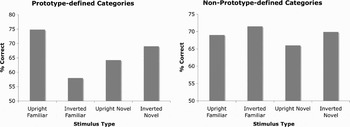
Figure 1. The left panel shows results for the discrimination test after familiarisation with prototype-defined categories, the right results after familiarisation with the shuffled-row chequerboards. Adapted from McLaren et al. (1997).
 You have
Access
In The Origin of Concepts (Carey Reference Carey2009), there is an in-depth examination and analysis of how we come to represent the world. The argument is that starting with both perceptual primitives and a newly-specified set of innate cognitive primitives labelled “core cognition,” we are able to bootstrap ourselves to the point where complex, abstract symbolic constructs such as “momentum” and “kinetic energy” are available to us. But in framing this argument, Carey neglects, to some extent, a portion of her own work. This commentary will argue that in so doing she omits some of the best evidence for her claim that “core cognition” is a key component of concept formation.
In 1986 Diamond and Carey published an influential article ostensibly on face recognition, but in actuality on representation development as a consequence of experience. In “Why faces are and are not special: An effect of expertise,” they make the case for the face inversion effect being, at least in part, a product of experience with a category (faces of a given ethnic type) that possesses the requisite structure. This latter qualification refers to the idea that the category must be prototype-defined, in the sense that its exemplars vary in their second-order relational structure, and that this variation can, for present purposes, be loosely characterised as small deviations about the first-order relational structure defined by the prototype. Diamond and Carey (Reference Diamond and Carey1986) made their case by showing that an inversion effect similar to that in faces could be obtained with certain classes of breed of dogs if the participants in the recognition experiment possessed the requisite expertise by virtue of being dog show judges of long standing. Novices, on the other hand, who were not as familiar with this category of stimuli, did not show a strong inversion effect.
We (McLaren Reference McLaren1997) have extended this result to abstract chequerboard categories defined by a prototype. In these experiments, randomly generated base patterns constructed from black and white squares (which served as prototypes) had noise added to them (some squares changed from black to white or from white to black) to create a number of exemplars of that category. Our participants were then trained to distinguish between two such categories, each defined by a different prototype or base pattern (i.e. between-category training), before being tested for their ability to discriminate between two members of a given category (i.e. a within-category test). The result was that discrimination was much better for the familiar categories than for exemplars taken from novel, control categories (Graham & McLaren Reference Graham and McLaren1998; McLaren et al. Reference McLaren, Leevers, Mackintosh, Umilta and Moscovitch1994), and this advantage was lost on inversion. We were also able to show that this result was not an inevitable consequence of familiarisation with a category constructed from chequerboards. By starting with base patterns as before, but then creating exemplars by randomly shuffling rows rather than randomly changing squares, we were able to create categories that could be discriminated just as easily as our earlier set, but when tested for within-category discrimination, participants were now no better on exemplars drawn from familiar categories than those drawn from novel categories, and there was no hint of an inversion effect. The results of one of these experiments (McLaren Reference McLaren1997, Experiment 1) are shown in Figure 1, and the necessary category type by familiarity by inversion interaction emerges to justify the assertion that the inversion effect is contingent upon familiarity with a category of the correct type. Our results, then, strongly support the Diamond and Carey thesis that inversion effects can be at least partly explained as a consequence of expertise with categories that have the requisite prototype-defined structure.
The left panel shows results for the discrimination test after familiarisation with prototype-defined categories, the right results after familiarisation with the shuffled-row chequerboards. Adapted from McLaren et al. (1997).
We have also shown (Wills & McLaren Reference Wills and McLaren1998) that categorisation does not require feedback for effective learning to take place (Fried & Holyoak Reference Fried and Holyoak1984), and that this type of perceptual learning effect, that is, an enhanced ability to tell category members apart after familiarisation with the category if the category is prototype-defined, also occurs under these “free classification” conditions. It also leads to a different classification scheme (a change in the number of groups used). Therefore, the effect is not contingent on training via feedback, and we have considerable data indicating that it occurs as a result of mere exposure rather than as a consequence of any particular training regimen, (Suret & McLaren Reference Suret and McLaren2003; Wills et al. Reference Wills, Suret and McLaren2004); and in animals other than human (Aitken et al. Reference Aitken, Bennett, McLaren and Mackintosh1996; McLaren & Mackintosh Reference McLaren and Mackintosh2000).
If the innate ability of indigo buntings to identify the axis of rotation of the night sky is an example of domain-specific and species-specific animal core cognition, then surely the ability of humans to engage in this sort of representation development contingent on the appropriate stimulus input is an example of core cognition as well, and one that is directly relevant to concept formation. Here we have a domain-specific learning device tuned to a certain type of stimulus structure that undoubtedly influences categorisation in a manner that must have implications for conceptual representation. Therefore, we would argue that the “expertise” identified by Diamond and Carey (Reference Diamond and Carey1986) is one of the best examples of core cognition in humans, and strengthens the thesis advanced by Susan Carey (Reference Carey2009).