












1 Introduction
In this paper, we study the Dirichlet problem of the reaction-diffusion equation involving h-degree infinity Laplacian

where
$\Omega \subset \mathbb {R}^n$
 is a bounded domain,
$\phi (x)\in C(\partial \Omega )$
 with
$\phi (x)\geq 0$
 ,
$f(x,t,p)\in C(\Omega \times \mathbb {R}\times \mathbb {R}^n), \,f(x,t,p)=0$
 in
$\Omega \times (-\infty ,0]\times \mathbb {R}^n, \, f(x,t,p)\geq 0$
 is non-decreasing with respect to t and satisfies
(f
$_b$
 )
$\sup _{\Omega \times I \times \mathbb {R}^n }f(x,t,p)$
 is bounded in every compact interval
$I \subseteq \mathbb {R};$

(f
$_\Lambda $
 )
${0\leq f(x,\delta t,p)\leq \Lambda (x)\delta ^{\gamma }f(x,t,p),}$
 where
$\Lambda (x)\in C(\overline {\Omega })$
 is positive,
$\gamma \in [0,h), t>0$
 , and
$\delta>0 $
 is small enough.
The h-degree infinity Laplacian
$\Delta _\infty ^h$
 is given by

Infinity Laplacians
$\Delta _\infty $
 originated from Aronsson’s work on absolutely minimizing Lipschitz extensions in the 1960s [Reference Aronsson6–Reference Aronsson10]. Since then, infinity Laplace equations have received much attention, such as Armstrong and Smart [Reference Armstrong and Smart5], Aronsson et al. [Reference Aronsson, Crandall and Juutinen11], Barron et al. [Reference Barron, Evans and Jensen12, Reference Barron, Jensen and Wang13], Crandall [Reference Crandall15], Crandall et al. [Reference Crandall, Evans and Gariepy16], Evans and Savin [Reference Evans and Savin24], Koch et al. [Reference Koch, Zhang and Zhou26, Reference Koch, Zhang and Zhou27], Lu and Wang [Reference Lu and Wang33, Reference Lu and Wang34], Peres et al. [Reference Peres, Schramm, Sheffield and Wilson35], and the references therein.
Reaction-diffusion models involving strong absorption terms have a wide range of applications in biology, physics, chemical engineering, and so forth. A typical example was given in [Reference Stakgold36] in studying the steady-state reaction-diffusion model

where the constant
$\lambda>0$
 is called the Thiele modulus to control the ratio of reaction rate to diffusion rate. If
$0\leq \gamma <1,$
 the lack of the strong minimum principle may cause the solution to present a dead-core region, that is, a region where the nonnegative solution vanishes. The solution
$u(x)$
 usually denotes the density of a certain reactant, such as a chemical gas or a solvent. In this case, the dead-core region presents an area where the reaction stops completely and the reaction changes significantly as it crosses the free boundary
$\partial \{u>0\}.$
 For the fully nonlinear uniformly elliptic equation, Teixeira [Reference Teixeira37] considered the strong absorption problem

da Silva et al. [Reference da Silva, Leitão Júnior and Ricarte20] established geometric regularity results for second-order nonlinear degenerate or singular reaction-diffusion equations. For p-Laplacians, da Silva et al. [Reference da Silva, Rossi and Salort21] established improved
$C^{{p}/({p-1-q})}$
 -regularity across the free boundary in the model

where
$\lambda _0(x)>0$
 is a bounded function,
$2\leq p<+\infty $
 , and
$0\leq q< p-1.$
 Under the assumption that
$l=\lim _{p \to +\infty } ({q(p)}/{p})\in [0,1),$
 they considered the limit equation

and proved sharp
$C^{{1}/({1-l})}$
 -regularity along the free boundary. da Sliva and Salort [Reference da Silva and Salort22] obtained geometric regularity for the p-Laplace type elliptic equations with strong absorptions. Ara
$\acute {\text {u}}$
 jo et al. [Reference Araújo, Leitão and Teixeira1] studied the infinity Laplace equation with strong absorptions

where
$0\leq \gamma <3.$
 In [Reference Diehl and Teymurazyan23], Diehl and Teymurazyan studied the reaction-diffusion problem

under some suitable conditions of
$f(\cdot )\in C(\mathbb {R}^+).$
 Ara
$\acute {\text {u}}$
 jo and S
$\acute {\text {a}}$
 [Reference Araújo and Sá2] investigated the singular absorption problem

where
$0 \le \gamma < 1$
 . In [Reference Lin and Liu29, Reference Lin and Liu30], inhomogeneous reaction-diffusion equations were considered when the inhomogeneous terms satisfy certain growth and monotonicity conditions. Ara
$\acute {\text {u}}$
 jo and Teymurazyan [Reference Araújo and Teixeira3] investigated the regularity of the solutions for fully nonlinear dead-core systems. Ara
$\acute {\text {u}}$
 jo and Teixeira [Reference Araújo and Teymurazyan4] investigated the optimal regularity of the solutions for fully nonlinear uniformly elliptic equations with singular absorption terms.
Motivated by these works, we study the geometric and analytic properties of (1-1).
Theorem 1.1 (Existence and uniqueness).
Let
$\phi (x)\in C(\partial \Omega )$
 with
$\phi (x)\geq 0,$
 a nonnegative function
$f(x,t,p)\in C(\Omega \times \mathbb {R}\times \mathbb {R}^n)$
 , and
$f(x,t,p)=0$
 in
$\Omega \times (-\infty ,0]\times \mathbb {R}^n$
 . Assume that
$f(x,t,p)$
 is nondecreasing with respect to t and
$\iota \longmapsto f(x,t,\iota p)$
 is nonincreasing in a small interval
$[1,1+\eta )$
 for some
$\eta>0.$
 If
$f(x,t,p)>0$
 for each
$(x,t,p)\in \Omega \times (0,+\infty )\times \mathbb {R} ^{n}$
 and
$f(x,t,p)$
 satisfies (
$\mathbf{f}_b$
 ), then (1-1) admits a nonnegative unique viscosity solution
$u(x)\in C(\overline \Omega )$
 .
The uniqueness is based on the comparison principle and the existence is derived by the standard Perron’s method. The crucial point is to construct a viscosity subsolution. For the case of
$\inf f>0 $
 or
$\sup f<0$
 , we refer the interested reader to [Reference Liu and Sun31]. For
$1\leq h\leq 3$
 , Liu and Yang [Reference Liu and Yang32] studied the existence and uniqueness of the Dirichlet problem of
$\Delta _\infty ^h$
 for
$\inf _{x\in \Omega }f(x)>0$
 or
$\sup _{x\in \Omega }f(x)<0.$

Theorem 1.2 (Geometric regularity along the free boundary).
Suppose that
$f(x,t,p)\in C(\Omega \times \mathbb {R} \times \mathbb {R} ^{n} )$
 is nonnegative and satisfies Conditions (
$\mathbf{f}_b$
 ) and (
$\mathbf{f}_\Lambda $
 ). Let
$u(x)$
 be a nonnegative bounded viscosity solution to (1-1) in
$\Omega $
 . If
$x_0\in \partial \{u>0\}\cap \Omega ,$
 then there exists a positive constant C depending on
$\gamma , \Arrowvert u\Arrowvert _{L^\infty (\Omega )}, {\mathrm {dist}}\ (x_0,\partial \Omega )$
 , and the dimension such that

for
$x\in \{u>0\}$
 near
$x_0.$

Theorem 1.2 shows that the nonnegative viscosity solution touches the dead-core region with the smoothness of
$C^{({h+1})/({h-\gamma })}.$
 To establish Theorem 1.2, we first establish a flattening estimate and then use iterative techniques. The flattening estimate is a useful method in solving free boundary problems. Here,
$\Delta _\infty ^h$
 is singular and degenerate if
$1<h<3$
 , and the degeneracy increases with respect to the index
$h.$
 Due to the dependence of gradient
$Du$
 of
$f(x,u,Du)$
 , we must impose appropriate structural conditions and make subtle analysis. Since
$u(x_1,x_2)=({h^{(h+1)/h} })/({h+1}) (x_1^2+x_2^2)^{({h+1})/{2h}} $
 is a solution of
$\Delta _\infty ^hu(x)=1$
 in
$\mathbb {R}^2\setminus \{0\},$
 we remark that the regularity of the viscosity solution of the strong absorption problem (1-1) is superior to
$C^{({h+1})/{h}}.$
 Hence, such an improved regularity estimate cannot be extended to the whole region. This means that it is interesting to study the fully nonlinear equation (1-1).
To give the rate of the solution leaving the free boundary, we need the following growth condition:
$(\textbf {f}_\lambda ) \quad 0\leq \lambda (x)\delta ^{\gamma }f(x,t,p)\leq f(x,\delta t,p),$
 where the continuous function
$\lambda (x)$
 satisfies
$\inf _{x\in \Omega }\lambda (x)>0$
 ,
$\inf _{(x,p)\in \Omega \times \mathbb {R} ^{n} } f(x,1,p)>0, \, \gamma \in [0,h), \, t>0$
 , and
$\delta>0 $
 is small enough.
Theorem 1.3 (Nondegeneracy).
Let
$f(x,t,p)\in C(\Omega \times \mathbb {R}\times \mathbb {R} ^{n} )$
 be nonnegative. Suppose that
$f(x,t,p)$
 is nondecreasing with respect to t in
$[0,+\infty )$
 and
$\iota \longmapsto f(x,t,\iota p)$
 is nonincreasing in a small interval
$[1,1+\eta )$
 for some
$\eta>0.$
 Let
$u(x)$
 be a nonnegative bounded viscosity solution to (1-1) in
$\Omega .$
 If
$f(x,t,p)>0$
 for each
$(x,t,p)\in \Omega \times ( 0,+\infty )\times \mathbb {R} ^{n} $
 and satisfies Condition (
$\mathbf{f}_\lambda $
 ), then there exists a universal constant
$c>0$
 such that

for any
$x_0\in \overline {\{u>0\}}\cap {{\Omega }} $
 and
$0<r<{\mathrm {dist}}(x_0,\partial \Omega ).$

Theorem 1.3 shows that the solution leaves the dead-core region with the
${({h+1})/({h-\gamma })}$
 -order of dist
$(x,\partial \{u>0\})$
 . The key to the proof is to construct an appropriate viscosity supersolution to compare with
$u(x).$
 Thanks to the good structure of
$\Delta _\infty ^h$
 , we can construct an
${({h+1})/({h-\gamma })}$
 -power cone as a viscosity supersolution and then use the comparison principle. It is clear that Theorems 1.2 and 1.3 show that the geometric regularity
$C^{({h+1})/({h-\gamma })}$
 is sharp. The optimal regularity estimate shows the free boundary is a porous set and then has Lebesgue measure zero. Using the sharp regularity, we can also give a quantitative estimate at infinity for the blow-up solution (see Theorem 4.4 for details).
Liouville-type theorems play a vital part in the development of modern mathematical analysis and applications. We establish two different Liouville-type theorems for dead-core problems. One is based on the comparison principle via a suitable radical-barrier function (see Theorem 5.1). The other comes from the improved
$C^{({h+1})/({h-\gamma })}$
 -regularity estimate (see Theorem 5.3). The key is to compare the growth rate of solutions at infinity with
$|x|^{({h+1})/({h-\gamma })}$
 . It is worth highlighting that the constant in Theorem 5.1 is optimal in the sense that we cannot remove the strict inequality in (5-2). For the special case
$f(x,t,p)=t_+^{\gamma },$
 we remark that the conditions in Theorem 5.1 are weaker than those in Theorem 5.3. For
$1\leq h\leq 3,$
 Biswas and Vo [Reference Biswas and Vo14] established Liouville theorems for the infinity Laplacian with gradient and KPP type equations.
To consider the limit case
$\gamma =h$
 , we propose the extra growth condition:
(f
$_h$
 )
${0\leq f(x,\delta t,p)\leq \Lambda (x)\delta ^{h}f(x,t,p),}$
 where
$\Lambda (x)\in C(\overline {\Omega })$
 is positive,
$t>0$
 and
${\delta>0 }$
 small enough.
Theorem 1.4 (The limit case
$\gamma =h$
 ).

Let
$f(x,t,p)\in C(\Omega \times \mathbb {R}\times \mathbb {R} ^{n} )$
 be nonnegative. Assume that
$f(x,t,p)$
 is nondecreasing with respect to t in
$[0,+\infty )$
 and
$\iota \longmapsto f(x,t,\iota p)$
 is nonincreasing in a small interval
$[1,1+\eta )$
 for some
$\eta>0.$
 Suppose that
${f(x,t,p)>0}$
 for each
$(x,t,p)\in \Omega \times ( 0,+\infty )\times \mathbb {R} ^{n} $
 and satisfies Conditions (
$\mathbf{f}_b$
 ) and (
$\mathbf{f}_h$
 ). Let
$u(x)$
 be a nonnegative bounded viscosity solution to (1-1) in
$\Omega $
 . If
$u(x)$
 vanishes at some point in
$\Omega ,$
 then
$u(x)\equiv 0$
 in
$\Omega .$

For the limit case
$\gamma =h$
 , it is reasonable to conjecture that a nonnegative nonconstant solution is prevented from vanishing at an interior point. In fact, Theorem 1.4 shows that the dead-core region must disappear. To overcome the high degeneracy of
$\Delta _\infty ^h$
 , the crucial point is to construct a viscosity subsolution with strictly positive gradient modulus and then we can adopt Jensen’s idea in [Reference Jensen25]. By Theorem 1.2, the regularity of the solution is
$C^{({h+1})/({h-\gamma })}.$
 Clearly,
$({h+1})/({h-\gamma })\to +\infty $
 as
$\gamma \to h^-$
 . Hence, Theorem 1.4 is in fact a strong unique continuation principle.
The paper is organized as follows. In Section 2, we give the definition of a viscosity solution, and establish the comparison principle and existence theorem. In Section 3, we establish a flattening estimate for the viscosity solution and then give the regularity results along its free boundary. In Section 4, we establish the nondegeneracy estimate and blow-up analysis. In Section 5, we prove two different Liouville-type theorems. In Section 6, we show that the dead-core region vanishes in the limit case
$\gamma =h$
 .
2 Existence and uniqueness
In this section, we first give the definition of a viscosity solution for the equation

Since
$\Delta _\infty ^h$
 is singular at the points where the gradient vanishes, we adopt the viscosity solutions based on the semi-continuous extension [Reference Crandall, Evans and Lions17–Reference Crandall and Lions19]. Let

where
$\mathcal {S}_{n\times n}$
 denotes the set of real symmetric matrices. Equation (2-1) can be rewritten as

Observing
$\lim _{p\to 0} F(p,M)=0$
 , we define the continuous extension

Definition 2.1. For
$f(x,t,p)\in C(\Omega \times \mathbb {R}\times \mathbb {R}^n),$
 an upper semi-continuous function
$u:\Omega \to \mathbb {R}$
 is called a viscosity subsolution to (2-1) in
$\Omega $
 if for any
$x\in \Omega $
 and
$\varphi \in C^2(\Omega ) $
 such that
$u-\varphi $
 has a local maximum at x, there holds

Similarly, a lower semi-continuous function
$u:\Omega \to \mathbb {R}$
 is called a viscosity supersolution to (2-1) in
$\Omega $
 if for any
$x\in \Omega $
 and
$\varphi \in C^2(\Omega ) $
 such that
$u-\varphi $
 has a local minimum at x, there holds

We say that
$u(x)$
 is a viscosity solution to (2-1) in
$\Omega $
 if
$u(x)$
 is both a viscosity subsolution and supersolution to (2-1) in
$\Omega $
 .
Let us recall some useful lemmas.
Lemma 2.2 [Reference Aronsson, Crandall and Juutinen11].
If
$u(x)$
 is a viscosity subsolution (supersolution) of
$\Delta _{\infty }u(x)=0$
 in
$ \Omega $
 , then
$u(x)$
 attains its maximum (minimum) only on the boundary unless
$u(x)$
 is a constant.
Since
$f(x,u,Du)$
 is nonnegative, Lemma 2.2 implies that the viscosity supersolutions of (1-1) are nonnegative in
$\Omega $
 .
Lemma 2.3 [Reference Liu and Sun31].
Let
$\alpha $
 be a constant. If
$u(x)\in C(\Omega )\cap L^{\infty }(\Omega )$
 satisfies
$\Delta _\infty ^hu(x)\ge \alpha $
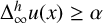 in the viscosity sense, then
$u(x)$
 is locally Lipschitz continuous in
$\Omega $
 . Moreover, for any given
$x_0\in \Omega $
 , there exists a constant C such that

where C depends on
$x_0$
 ,
$\mathrm {diam}(\Omega )$
 ,
$ | \alpha |$
 , and
${ \| u \|}_{L^\infty (\Omega )}$
 .
Lemma 2.4 [Reference Liu and Sun31, Theorem 1.2].
Let
$\Omega \subseteq \mathbb {R}^n$
 be a bounded domain and
$\phi (x)\in C(\partial \Omega )$
 . Assume that
$f(x,t,p):\Omega \times \mathbb {R}\times \mathbb {R}^n\to \mathbb {R}$
 is a continuous function and satisfies

for every compact interval
$I \subseteq \mathbb {R}$
 . Suppose that
$\underline {u}(x)\in C(\overline {\Omega } )$
 is a viscosity subsolution and
$\overline {u}(x)\in C(\overline {\Omega } )$
 is a viscosity supersolution of

If
$\underline {u}(x)\leq \overline {u}(x)$
 in
$\Omega $
 , then (2-2) admits a viscosity solution
$u(x)\in C(\overline {\Omega } )$
 such that
${\underline {u}(x)\leq u(x) \leq \overline {u}(x)}$
 in
$\Omega $
 .
Now, we establish the comparison principle.
Theorem 2.5. Let
$f(x,t,p)\in C(\Omega \times \mathbb {R}\times \mathbb {R} ^{n} )$
 be nonnegative. Suppose that
$f(x,t,p)$
 is nondecreasing with respect to t in
$[0,+\infty )$
 and
$\iota \longmapsto f(x,t,\iota p)$
 is nonincreasing in a small interval
$[1,1+\eta )$
 for some
$\eta>0.$
 Suppose also that
$f(x,t,p)>0$
 for each
$(x,t,p)\in \Omega \times ( 0,+\infty )\times \mathbb {R} ^{n} .$
 Let
$u(x)$
 and
$v(x) \,\in C(\overline {\Omega })$
 satisfy

and

in the viscosity sense. If
$u(x)\leq v(x) \ on\ \partial \Omega $
 and
$v(x)\geq 0\ in\ \Omega $
 , then
$u(x)\leq v(x) \ in\ \Omega $
 .
Proof. Consider

Since
$u_{\tau }(x)\leq u(x)$
 ,
$f(x,t,p)\ge 0$
 is nondecreasing in t, and
$\iota \longmapsto f(x,t,\iota p)$
 is nonincreasing in
$[1,1+\eta )$
 , we have

in the viscosity sense. That is,
$u_{\tau }(x)$
 is a viscosity subsolution of
$\Delta _\infty ^hu(x)= (1+\tau )^hf(x,u(x),Du(x))$
 in
$\Omega $
 .
We argue by contradiction that there exists
$ M_{0}>0$
 such that

For each
$\epsilon>0$
 small enough, define

and

Let
$(x_{\epsilon },y_{\epsilon })\in \overline {\Omega }\times \overline {\Omega }$
 be the point where
$\mathfrak {m} _{\epsilon }(x,y)$
 attains its maximum.
By [Reference Crandall, Ishii and Lions18, Proposition 3.7], we have

Obviously,

Due to
$M_0>0\geq \sup \limits _{\partial \Omega }(u_{\tau }-v)(x)$
 , we conclude that
$x_{\epsilon }\in \widetilde {\Omega }\Subset \Omega .$

Applying [Reference Crandall, Ishii and Lions18, Theorem 3.2], there exist
$X_\epsilon $
 and
$ Y_\epsilon \in \mathcal {S}_{n\times n}$
 such that

and

where
$p_\epsilon =({|z_\epsilon |^2z_\epsilon })/({\epsilon })$
 ,
$z_\epsilon =x_{\epsilon }-y_{\epsilon }$
 , and
$\mathrm {Id}_{n\times n}$
 is the
$n\times n$
 identity matrix. By (2-5), we have
$X_\epsilon \leq Y_\epsilon $
 .
If
$x_{\epsilon }=y_{\epsilon }$
 for any
$\epsilon>0,$
 then we have
$p_{\epsilon }=0$
 . Thus, the continuous extension
$\overline {F}$
 equals zero. By (2-3),

Letting
$\epsilon \to 0^+$
 ,

which is impossible due to
$M_0>0$
 and
${v(x)}\geq 0$
 in
$\Omega $
 .
If there exists a subsequence such that
$x_{\epsilon }\ne y_{\epsilon }$
 , then
$p_{\epsilon }\ne 0.$
 We have


one has

By the Lipschitz continuity of
$u_{\tau }(x)$
 , we see that

where L is the Lipschitz constant of
$u_{\tau }(x)$
 . Therefore,

Without loss of generality, we can assume

where
${B_{4L}}$
 denotes the ball of radius
$4L$
 centered at the origin. By (2-6),

Since
$f(x,t,p)$
 is nondecreasing with respect to t and
$f(x,t,p)>0$
 for each
$(x,t,p)\in \Omega \times ( 0,+\infty )\times \mathbb {R} ^{n}$
 ,

which contradicts to
$f(x_0,{v}({x_0})+M_0,\widetilde {p})>0$
 . Thus, we have proven that
$u_{\tau }(x)\leq v(x) $
 in
$ \Omega .$
 Letting
$\tau \to 0^+$
 , we have
$u(x)\leq v(x) $
 in
$ \Omega .$

Note that if
$\inf _{(x,t,p)\in \Omega \times \mathbb {R}\times \mathbb {R} ^{n} } f(x,t,p)> 0,$
 the comparison principle was proven in [Reference Liu and Sun31].
Proof of Theorem 1.1.
The uniqueness follows by the comparison principle. The existence reduces to finding a viscosity subsolution and a supersolution based on Lemma 2.4. Let

We can choose constants
$K_1$
 and
$d_1$
 such that

Construct

We can demonstrate that
$\underline {u}(x)\in C(\overline \Omega ), \, \Delta _{\infty }^h\underline {u}(x)=K_1^h\geq \sup _{(x,p)\in \Omega \times \mathbb {R} ^{n} } f(x,L_1,p)$
 and
$\underline {u}(x)\leq L_1$
 by the choice of
$K_1$
 and
$d_1.$
 Since
$f(x,t,p)$
 is nondecreasing with respect to t, we have

Hence,
$\underline {u}(x)$
 is a viscosity subsolution of (1-1) in
$\Omega $
 . Let

It is obvious that
$\overline {u}(x)$
 satisfies

That is,
$\overline {u}(x)$
 is a viscosity supersolution of (1-1) in
$\Omega $
 . By Lemma 2.4, we obtain the existence of a viscosity solution to (1-1).
3 Geometric regularity results across the free boundary
In this section, our goal is to establish an improved geometric regularity of viscosity solutions for (1-1) along the free boundary
$\partial \{u>0\}.$
 We give a flattening estimate and use iteration techniques to prove the
$C^{({h+1})/({h-\gamma })}$
 -regularity of viscosity solutions for (1-1) along the free boundary. The flattening estimate plays a crucial role in characterizing the decay of geometric properties, which was established for the fully nonlinear uniformly elliptic operator in [Reference Araújo and Teymurazyan4, Reference Teixeira37]. We extend the idea in [Reference Araújo, Leitão and Teixeira1, Reference Diehl and Teymurazyan23] to obtain the flattening estimate for the operator
$\Delta _\infty ^h$
 .
Lemma 3.1 (Flattening estimate).
Let
$f(x,t,p)\in C(\Omega \times \mathbb {R}\times \mathbb {R}^n)$
 be nonnegative and satisfy Conditions (
$\mathbf{f}_b$
 ) and (
$\mathbf{f}_\Lambda $
 ). Suppose that
$G(x,\tilde {t},p)\in C(\Omega \times [0,1]\times \mathbb {R} ^{n} )$
 and

For any
$x_0\in \Omega $
 and
$\mu>0,$
 there exists a constant
$\kappa _{\mu ,n}=\kappa (\mu ,n)>0$
 such that if
${\xi (x)\in C(B_1(x_0))}$
 satisfies

and

in the viscosity sense for
$0<\kappa \leq \kappa _{\mu ,n},$
 then

Proof. We argue by contradiction assuming that there exist
$\mu _*>0$
 and sequences
$\{\kappa _i\}$
 ,
$\{\xi _i\}$
 (
$i\in \mathbb {N}$
 ) with
$\kappa _i=o(1),$


and

such that

Noting that
$\{\xi _i\}$
 is uniformly bounded and satisfies

in the viscosity sense, Lemma 2.3 demonstrates that
$\{\xi _i\}$
 is a family of locally Lipschitz continuous functions in
$\Omega .$
 By the Arzela–Ascoli compact theorem, up to a subsequence,
$\xi _i(x)$
 converges locally uniformly to a function
$\xi _{\infty }(x)$
 in
$ \overline {B_{2/3} (x_0)}\cap \Omega .$
 Moreover, by the stability of viscosity solutions,
$\xi _{\infty }(x)$
 satisfies that
$\xi _{\infty }(x_0)=0, 0\leq \xi _{\infty }(x)\leq 1$
 , and

in the viscosity sense. By the maximum principle of infinity harmonic functions, we conclude that
$\xi _{\infty }(x)\equiv 0$
 . This is impossible for i large enough.
We are ready to prove Theorem 1.2, which reveals that the regularity along the free boundary is of class
$C^{({h+1})/({h-\gamma })}.$

Proof of Theorem 1.2.
Set
$\tau :=\min \{1,\Arrowvert u\Arrowvert _{L^\infty (\Omega )}^{-1}\}$
 ,
$\rho :=\overline \kappa \tau ^{-({h-\gamma })/({h+1})}$
 and

where
$\overline \kappa $
 is to be determined later. Since
$u(\cdot )$
 is a viscosity solution of (1-1) in
$\Omega $
 ,

in the viscosity sense. Moreover, by the selection of
$\tau ,$
 we find
$w_1(0)=0$
 ,
${0\leq w_1(x)\leq 1}$
 , and

If we take
$\mu =2^{-({h+1})/({h-\gamma })}$
 and get the corresponding constant
$\kappa _{\mu ,n}>0$
 from Lemma 3.1, then we can verify that
$w_1(x)$
 satisfies the conditions of Lemma 3.1 by choosing
$\overline \kappa \leq \min \{1,\kappa _{\mu ,n}, \tau ^{({h-\gamma })/({h+1})}\}.$
 This means

Let

By direct computations, we observe that

in the viscosity sense. Since
$ \tau \leq 1$
 ,
$w_2(0)=0$
 ,
$0\leq w_2(x)\leq 1$
 , and

applying Lemma 3.1 again,

For each
$k\in \mathbb {N},\ k\geq 2$
 , we construct a series of iterative functions

Similarly, we can verify that
$w_k(x)$
 satisfies the conditions of Lemma 3.1 and then

By the iterative relationship of
$\{w_k\},$
 we obtain

For any
$0<r\leq ({\rho }/{2})$
 , we can select some
$k\in \mathbb {N}$
 such that

Therefore, by the construction of
$w_1(x)$
 and (3-1),

This completes the proof of Theorem 1.2.
Remark 3.2. Theorem 1.2 implies that if
$x_0\in \partial \{u>0 \}$
 , then
$Du(x_0)=0.$

4 Nondegeneracy estimate and blow-up analysis
In this section, we establish a nondegeneracy estimate for the nonnegative solution on the free boundary
$\partial \{u>0\}$
 . Nondegeneracy is an important topic in the dead-core problem since it can provide the minimal growth rate of solutions away from the free boundary. In fact, we can prove the optimal regularity is
$C^{({h+1})/({h-\gamma })}$
 . Based on the nondegeneracy estimate, we can give a characterization of the weak geometric properties of the free boundary including the Hausdorff dimension and so on.
We first give the proof of the nondegeneracy estimate.
Proof of Theorem 1.3.
By continuity, we only need to prove (1-2) for the point
$x_0\in {\{u>0\}}\cap {{\Omega }^{\prime }} .$

Consider a function

where the constant
$c>0$
 is to be determined later. For
$x\ne x_0,$


We can verify

where we have chosen

For
$x=x_0,$
 we can also derive
$\Delta _\infty ^h\varphi (x)-f(x,\varphi (x),D\varphi (x))\leq 0.$
 Hence,
$\varphi (x)$
 is a viscosity supersolution of
$\Delta _{\infty }^hu(x)=f(x,u(x),Du(x))$
 in
$B_r(x_0).$

Now, we illustrate that there must exist a point
$\bar {x}\in \partial B_r(x_0)$
 such that
$u(\bar {x})> \varphi (\bar {x}).$
 In fact, if
$u(x)\leq \varphi (x)$
 on
$\partial B_r(x_0)$
 , we can conclude
$u(x)\leq \varphi (x)$
 in
$B_r(x_0)$
 by the comparison principle. This contradicts
$u(x_0)>0= \varphi (x_0)$
 . Therefore,

Theorems 1.2 and 1.3 show that the sharp regularity of
$u(x)$
 at the free boundary is
$C^{({h+1})/({h-\gamma })}$
 .
In the following, we demonstrate that the free boundary is a porous set. We first present the definition of porosity.
Definition 4.1. The set
$P\subset \mathbb {R}^n$
 is porous with porosity
$\sigma $
 if there exists a radius
${R>0}$
 such that for any
$x\in P$
 and
$0<r<R,$
 there exists a point
$y\in \mathbb {R}^n$
 such that
${B_{\sigma r}(y)\subset B_r(x)\setminus P.}$

Remark 4.2 [Reference Koskela and Rohde28].
The Hausdorff dimension of a porous set with porosity
$\sigma $
 is at most
$n-c{\sigma }^n$
 , where c is a positive dimensional constant.
Corollary 4.3. Let
$f(x,t,p)\in C(\Omega \times \mathbb {R}\times \mathbb {R} ^{n} )$
 be nonnegative and satisfy Conditions (
$\mathbf{f}_b$
 ), (
$\mathbf{f}_\Lambda $
 ), and (
$\mathbf{f}_\lambda $
 ). Assume that
$f(x,t,p)$
 is nondecreasing with respect to t in
$[0,+\infty )$
 and
$\iota \longmapsto f(x,t,\iota p)$
 is nonincreasing in a small interval
$[1,1+\eta )$
 for some
$\eta>0.$
 Suppose that
$f(x,t,p)>0$
 for each
$(x,t,p)\in \Omega \times ( 0,+\infty )\times \mathbb {R} ^{n} $
 . If
$u(x)$
 is a nonnegative bounded viscosity solution to (1-1) in
$\Omega ,$
 then
$\partial \{u>0\}$
 is a porous set and has Lebesgue measure zero.
Proof. For any
$r>0$
 and
$x\in \partial \{u>0\}$
 , we can select some
$\xi \in \overline {B_r(x)}$
 such that

According to Theorem 1.3,
$u(\xi )$
 satisfies the following nondegeneracy estimate:

By Theorem 1.2,

where
$d(\xi ):={\mathrm {dist}}(\xi ,\partial \{u>0\})>0.$
 By (4-1) and (4-2),

Selecting
$\sigma =\tfrac 12({c}/{C})^{({h-\gamma })/({h+1})},$


For
$\overline {\eta }\in (0,1),$
 choosing a point
$z=\overline {\eta }\xi +(1-\overline {\eta })x $
 such that
$|\xi -z|=\sigma r$
 ,

which means that
$\partial \{u>0\}$
 is porous with porosity
$\sigma .$

Using Remark 4.2, we can immediately demonstrate that the Lebesgue measure of
$\partial \{u>0\}$
 is zero.
For any
$x_0\in \partial \{u>0\}$
 and
$r>0$
 such that
$B_r(x_0)\subset \Omega $
 , we consider the blow-up sequence
$ \{ u_\varsigma \}$
 ,

Note that
$u_\varsigma (\tilde {x})$
 stands for a
$\varsigma $
 -zoom-in of u in the sense of appropriate re-scaling. By the scaling invariance, we can apply Theorem 1.2 to obtain

where the constant C is independent of
$\varsigma $
 . Hence,
$u_\varsigma (\tilde {x})$
 is locally bounded in
$B_{({r}/{3})\varsigma ^{-1 } }.$
 Since
$\Delta _\infty ^hu_\varsigma (\tilde {x})\geq 0$
 in the viscosity sense, we have that
$u_\varsigma (\tilde {x})$
 is locally Lipschitz equicontinuous, based on Lemma 2.3. By the Arzela–Ascoli compact theorem, up to a subsequence if necessary, we can assume that
$u_\varsigma (\tilde {x})$
 locally uniformly converges to an entire function
$u_0(\tilde {x}) :\mathbb {R} ^n\to \mathbb {R} $
 as
$\varsigma \to 0^+.$
 Since
$u_0$
 intrinsically reflects the limit case of the blow-up sequence
$u_\varsigma ,$
 we call
$u_0$
 the blow-up solution at point
$x_0.$

Theorem 4.4 (Blow-up solution).
Let
$f(x,t,p)\in C(\Omega \times \mathbb {R}\times \mathbb {R} ^{n} )$
 be nonnegative and satisfy Conditions (
$\mathbf{f}_b$
 ), (
$\mathbf{f}_\Lambda $
 ), and (
$\mathbf{f}_\lambda $
 ). Assume that
$f(x,t,p)>0$
 for each
$(x,t,p)\in \Omega \times ( 0,+\infty )\times \mathbb {R} ^{n}.$
 Suppose that
$f(x,t,p)$
 is nondecreasing with respect to t in
$[0,+\infty )$
 and
$\iota \longmapsto f(x,t,\iota p)$
 is nonincreasing in a small interval
$[1,1+\eta )$
 for some
$\eta>0.$
 If
$u(x)$
 is a nonnegative bounded viscosity solution of (1-1) and
$u_0(\tilde {x})$
 is a blow-up solution at
$x_0\in \partial \{u>0\},$
 then
$u_0(0)=0$
 and
$u_0(\tilde {x})$
 satisfies

in the viscosity sense. Furthermore, there exists a universal constant
$\overline {C}$
 such that

Proof. For each
$\varsigma>0$
 , we have
$u_\varsigma (0) =({u(x_0)})/({\varsigma ^{({h+1})/({h-\gamma })}})=0$
 and

in the viscosity sense. By (
$\mathbf{f}_\Lambda $
 ),

We can also conclude

according to Condition (f
$_\lambda $
 ). By Remark 3.2 and the stability of viscosity solutions under uniform limits, we have (4-3). The lower and upper estimates of (4-4) follow immediately by Theorems 1.3 and 1.2, respectively.
It should be pointed out that Theorem 4.4 provides a growth estimate at infinity for the blow-up solution
$u_0$
 , which is a specific entire solution to the dead-core problem. In the following section, we give two Liouville-type theorems for any entire solution.
5 Liouville-type theorems
In this section, we give Liouville-type theorems. For any
$x_0\in \mathbb {R}^n,$
 we first consider the strong absorption problem in
$B_R(x_0)$
 :

where
$a>0$
 and
$b>0$
 are constant. Let
$v(x)\geq 0$
 be the unique solution of (5-1), where the existence of solution
$v(x)$
 is guaranteed by Theorem 1.1.
To find the radial solution of (5-1), we solve the following ordinary differential equation (ODE):

where
$g(r)$
 satisfies the boundary conditions
$g(0)=0$
 and
$g(R)=a.$
 If
$({a}/{\rho (b,\gamma )})^{({h-\gamma })/({h+1})} <R,$


where

Hence, we obtain the solution

and the dead-core region is
$B_{\overline {r}}(x_0),$
 where
$\overline {r}=R-({a}/{\rho (b,\gamma )})^{({h-\gamma })/({h+1})}.$

Based on the comparison principle, we establish the following Liouville-type theorem. The key is to construct a suitable barrier function via the radical solution. Now, we give the following growth condition:
(f
$_{\lambda '}$
 )
$0\leq \lambda '(x)\delta ^{\gamma }f(x,t,p)\leq f(x,\delta t,p),$
 where the continuous function
$\lambda '(x)$
 satisfies
$\inf _{x\in \mathbb {R}^{n}}\lambda '(x)>0$
 ,
$\inf _{(x,p)\in \mathbb {R} ^{n}\times \mathbb {R} ^{n} } f(x,1,p)>0, \, \gamma \in [0,h), \, t>0$
 , and
$\delta>0 $
 is small enough.
Theorem 5.1 (Liouville type theorem).
Let
$f(x,t,p)\in C(\mathbb {R} ^{n} \times \mathbb {R}\times \mathbb {R} ^{n} )$
 be nonnegative and satisfy Condition (
$\mathbf{f}_{\lambda '}$
 ). Suppose that
$f(x,t,p)$
 is nondecreasing with respect to t in
$[0,+\infty )$
 and
$f(x,t,p)>0$
 for each
$(x,t,p)\in \mathbb {R}^n\times ( 0,+\infty )\times \mathbb {R} ^{n} $
 . Assume that
$\iota \longmapsto f(x,t,\iota p)$
 is nonincreasing in a small interval
$[1,1+\eta )$
 for some
$\eta>0.$
 Let
$u(x)$
 be a nonnegative bounded viscosity solution to

and
$b= \tilde {\eta }^{-\gamma }\inf _{x\in \mathbb {R} ^{n} }\lambda '(x)\inf _{(x,p)\in \mathbb {R} ^{n} \times \mathbb {R} ^{n} } f(x,1,p)>0,$
 where
$\tilde {\eta }>0$
 is large enough. If

for some point
$x_0\in \mathbb {R}^n,$
 then
$u(x)\equiv 0$
 in
$\mathbb {R}^n.$

Proof. By (5-2), taking
$R\gg 1$
 sufficiently large,

for some
$0<\theta <1.$
 Choosing
$a=\sup _{\partial B_{R}(x_0) } u(x)$
 in (5-1), we get that

is the unique viscosity solution of (5-1) in
$B_{R}(x_0)$
 .
The selection of b implies that
$u(x)$
 is a viscosity subsolution of (5-1) in
$B_{R}(x_0)$
 . Since
$u(x)\leq \sup _{\partial B_{R}(x_0) } u(x)$
 on
$\partial B_{R}{(x_{0})},$
 by the comparison principle, we conclude
$u(x)\leq v(x) $
 in
$ B_{R}{(x_{0})}$
 . Combining (5-3),

Letting
$R \to +\infty $
 , we observe
$u(x)\equiv 0$
 , which completes the proof.
Remark 5.2. Inequality (5-2) is sharp. Indeed, if we choose
$f(x,u(x),Du(x))=b{(u(x)_+)}^{\gamma }$
 , then
$f(x,t,p)$
 satisfies the conditions in Theorem 5.1. Setting

we can verify that
$T(x)$
 is a viscosity solution of
$\Delta _\infty ^hu(x)=b{(u(x)_+)}^{\gamma } $
 in
$\mathbb {R}^n$
 and

Therefore, this means that (5-2) cannot be weakened.
If the solution satisfies some growth condition at infinity, we can also establish a Liouville-type theorem by Theorem 1.2.
Theorem 5.3. Suppose that
$f(x,t,p)\in C(\mathbb {R} ^{n} \times \mathbb {R} \times \mathbb {R} ^{n} )$
 is nonnegative and satisfies Conditions (
$\mathbf{f}_{b}$
 ) and (
$\mathbf{f}_{\Lambda }$
 ). Let
$u(x)$
 be a nonnegative bounded viscosity solution to

If
$u(x_0)=0$
 for some
$x_0\in \mathbb {R}^n$
 with

then
$u(x)\equiv 0$
 in
$\mathbb {R}^n.$

Proof. For
$k\in \mathbb {N}$
 and
$0<r\ll 1$
 , let

By computations, it is easy to check

and
$\hat {G}$
 satisfies Conditions (f
$_{b}$
 ) and (f
$_{\Lambda }$
 ).
We are going to prove

Let
$x_k$
 be the maximum point of
$u_k(x)$
 in
$\overline {B_r}.$
 Now, we consider two cases of
$|kx_k|$
 . If
$|kx_k|$
 remains bounded as
$k\rightarrow +\infty ,$
 then

If
$|kx_k|$
 goes to infinity as
$k\rightarrow +\infty $
 , we can use (5-4) to get

Applying Theorem 1.2,

where
$C_k>0$
 and
$C_k\rightarrow 0^+$
 for
$k\rightarrow +\infty .$

We complete the rest of the proof by contradiction. Suppose that there exists some point
$y\in \mathbb {R}^n$
 such that
$u(x_0+y)>0.$
 Choosing k large enough so that
$| y| \leq kr$
 and

where (5-6) follows from (5-5), we can show

That is,
$u(x_0+y)=0,$
 which is a contradiction.

6 The limit case
$\gamma =h$

In this section, we prove that the dead-core region vanishes for the limit case
$\gamma =h$
 . Due to the dependence of gradient
$Du$
 on
$f(x,u,Du)$
 , the construction of the barrier function is more complex. The method is based on the scaling technique and comparison principle. The cases of
$f(x,t,p)=t^3$
 and
$f(x,t,p)=f(t)$
 were respectively demonstrated in [Reference Araújo, Leitão and Teixeira1, Reference Diehl and Teymurazyan23] for infinity Laplace equations.
Proof of Theorem 1.4.
We argue by contradiction. Assume that there exists a point
$y_0\in \Omega $
 such that
$u(y_0)>0$
 and

Now, we aim to construct a suitable barrier function as a viscosity subsolution to (1-1). Let

where
$\xi $
 is a positive constant to be determined later. Direct computations show that there exists some
$\varepsilon _0>0$
 such that

Choosing
$0<\beta \ll 1$
 and
$\xi \gg 1,$
 we can verify

and

Thus,
$\beta \Gamma _\xi (x)$
 is a viscosity subsolution to (1-1) in
$B_{r}(y_0) \backslash B_{({r}/{2})}(y_0)$
 and then

by the comparison principle.
Based on Condition (f
$_h$
 ),

where
$\Lambda '(x)=\Lambda (x)\delta ^{h-1}>0, \, t>0$
 , and
$\delta>0 $
 is small enough. By Theorem 1.2,

for
$z\in \partial B_r(y_0)\cap \partial \{u>0\}$
 and
$0<d\ll ({\beta \varepsilon _0}/{8C})^{({h-1})/{2}}.$
 Hence,

which provides us with a contradiction.

Acknowledgments
The authors thank the anonymous referee for their careful reading of the manuscript, and useful suggestions and comments.



