1 Introduction and statement of results
Given a compact set in the plane defined dynamically by iteration of conformal contractions, this article focuses on the variations of Hausdorff dimension and packing dimension of the harmonic measure under perturbations of the conformal contractions. In a natural framework, which is precisely stated below, we demonstrate that these functions are continuous.
Let
$\mathbb {K}\subset \mathbb {C}$
 be a compact set and
$\omega $
 the harmonic measure of
$\hat {\mathbb {C}}\setminus \mathbb {K}$
 evaluated at
$\infty $
 . Since the works of Makarov [Reference Makarov15], and Jones and Wolff [Reference Jones and Wolff13], it is known that the Hausdorff dimension of
$\omega $
 is less than or equal to
$1$
 . This result was generalized by Bourgain to
$\mathbb {R}^d$
 in [Reference Bourgain4], where he proved the existence of a constant
$\ell (d)>0$
 such that the dimension of the harmonic measure of any open set in
$\mathbb {R}^d$
 is less than
$d-\ell (d)$
 . According to Makarov, Jones, and Wolff, we know that
$\ell (2)=1$
 .
If
$\mathbb {K}$
 has Hausdorff dimension in
$]1,2]$
 , the previous results tell us that harmonic measure only ‘sees’ a small part of
$\mathbb {K}$
 of dimension less than or equal to
$1$
 . Let, for instance,
$\mathbb {K}$
 be the Mandelbrot set. This is a compact and connected set, so that
$\mathbb {C}\setminus \mathbb {K}$
 , is simply connected, and we know by [Reference Makarov15] that the support of harmonic measure, which by definition is a subset of the boundary of
$\mathbb {K}$
 , has Hausdorff dimension equal to
$1$
 . However, Shishikura proved in [Reference Shishikura20] that any intersection of this boundary with an open set has Hausdorff dimension
$2$
 .
When the compact set
$\mathbb {K}$
 is fractal and has Hausdorff dimension less than one, it is still reasonable to believe that in many cases, the dimension of harmonic measure remains strictly less than the Hausdorff dimension of
$\mathbb {K}$
 (sometimes called the ‘dimension drop’ phenomenon). This has been proved to be true for several types of conformal Cantor sets [Reference Batakis2, Reference Carleson8, Reference Lyubich and Volberg14, Reference Urbański and Zdunik22]. More recently, Batakis and Zdunik proved in [Reference Batakis and Zdunik7] that this remains true for a class of non-autonomous Cantor sets generated by similitudes. Note that to the best of the authors’ knowledge, the question whether this is true for all conformal Cantor sets is still open. Azzam [Reference Azzam1] and Tolsa [Reference Tolsa21] have recently shown that for flat Ahlfors regular sets in
$\mathbb {R}^{nd+1}$
 of dimension
$\rho $
 with
$d-\frac 12<\rho <d$
 , we also have a dimension drop phenomenon. However, the first author exhibits in [Reference Batakis2] examples of Cantor sets for which harmonic measure has full dimension, and very recently, David, Jeznach, and Julia in [Reference David, Jeznach and Julia9] give an example of an Alhfors-regular Cantor set in the plane, of small dimension
$\rho <\frac 12$
 , for which harmonic measure is equivalent with the
$\rho $
 -dimensional Hausdorff measure.
In this paper, the work of [Reference Batakis3] is generalized in two distinct directions. First, the functions defining the Cantor set are no longer piecewise linear but rather piecewise conformal. Second, the number of pieces is also modified at each step of the construction. These generalizations, which would be impossible without precise control of certain quantities, required the development of a robust theoretical framework to handle tools such as entropy, Lyapunov exponents, pressure, and dimensions in a non-autonomous symbolic context. Most of the results are, in fact, proven in this symbolic setting in §2. While these results are of independent interest, the primary focus of this paper is harmonic measure and continuity properties of its packing and Hausdorff dimensions. Consequently, we do not explore their broader implications in further detail here.
To state our results precisely, we describe now our settings and we introduce some notation.
Following [Reference Rempe-Gillen and Urbański19], given a Jordan domain U that we will assume to be the unit disc
$\mathbb {D}$
 , a non-autonomous conformal iterated function system (NACIFS) is a sequence
 of finite collections of conformal contractions
 verifying the following properties (1), (2), and (3) for some
$\boldsymbol {\eta }>0$
 . For the sake of simplicity, we have chosen to encode the geometric constraints we work with into this single constant
$\boldsymbol {\eta }>0$
 .
-
(1) Conformality. There is a fixed neighborhood $V\supset \mathbb {D}_{1+\eta }:=\{|z|=1+\eta \}$
 of
$\mathbb {D}$
such that
extends to a conformal diffeomorphism from V to V, for all
$1\le i\le d_n$
and all
$n\in \mathbb {N}$
.
-
(2) Open set condition. ${\vphantom {{V}_{j}}}_{{{n}}}{V}_{i}\cap {\vphantom {{V}_{j}}}_{{{n}}}{V}_{j}=\varnothing $
for all
$1\le i\not =j\le d_n$
, where
.Annulus condition. Moreover, for any n and any $1{\kern-1pt}\le{\kern-1pt} i{\kern-1pt}\le{\kern-1pt} d_n$
, we have
${\vphantom {{V}_{j}}}_{{{n}}}{V}_{i}{\kern-1pt}\subset{\kern-1pt} (1{\kern-1pt}-{\kern-1pt}\boldsymbol {\eta })U$
. -
(3) Bounded contraction. For all $n\in \mathbb {N}$
, all
$1\le i\not =j\le d_n$
, and all
$x\in {\vphantom {{V}_{j}}}_{{{n}}}{V}_{i}$
,


Combining the open set and the bounded contraction conditions, we get a uniform bound on
$d_n$
 :

Notation.
-
• For any $E\subset V$
, any
$n\in \mathbb {N}$
, and any
$1\le i\le d_n$
, let
. The index on the left stands for the generation of the map, while the one on the right stands for the chosen branch of the map. -
• For $n{\kern-1pt}\in{\kern-1pt} \mathbb {N}$
, we denote by
${\mathcal U}_n$
the collection
$\{{\vphantom {{U}_{j}}}_{{{n}}}{U}_{1},\ldots ,{\vphantom {{U}_{j}}}_{{{n}}}{U}_{d_{n}}\}$
. Let
, where
, defined on
${\vphantom {{U}_{j}}}_{{{n}}}{U}_{i}$
, is the inverse conformal dilatation of
, i.e.,
and
.


In this way, we have introduced piecewise conformal maps denoted again by
 defined on the union of topological discs:
 by the formula

Remark 1.1. Note that the condition of bounded contraction is stronger than that of [Reference Rempe-Gillen and Urbański19] (uniform contraction). This is due to the fact that dealing with harmonic measure requires estimates on capacity and, hence, on the size of the sub-components. Also, the conformality condition has been strengthened to ensure existence of conformal annuli with bounded from below moduli. This is crucial to be able to use Harnack’s principle (cf. [Reference Carleson8]).
Furthermore, without loss of generality, we can suppose that U is the unit disc.
We consider the following non-autonomous limit set.
Definition 1.1. Given a NACIFS
 on a Jordan domain U, we define the limit set
${\mathbb {X}\subset \mathbb {C}}$
 by

where
 is the sequence of piecewise conformal dilatations introduced above.
For any n, the map
 is well defined on
$\mathbb {X}$
 and for any
$x\in \mathbb {X}$
 , we have
$T_{n}(x)\in U$
 . Moreover, there exists
 conformal inverse branches of
$T_{n}$
 defined on V. Each of these branches sends U onto a conformal disc included in U, and each point in
$\mathbb {X}$
 belongs to one and only one of these conformal discs. Remember that
$\mathcal {U}_{n}$
 is the collection of connected components of
$T_n^{-1}(U)$
 .
There is an obvious way to code the situation.
For any integer n, let
$\mathcal {A}_{n}:=\{1\cdots d_{n}\}$
 and set
 . There is a one-to-one correspondence from
$\mathbb {K}$
 to
$\mathbb {X}$
 . More precisely, if
$\mathtt {a}=(a_{n})$
 is an element of
$\mathbb {K}$
 , then the sequence of subsets of V defined by
$U_{0}=\bar {U}$
 and
 is a decreasing sequence of compact sets with diameters converging to
$0$
 , thus converging to a point x, which is obviously an element of
$\mathbb {X}$
 . Reciprocally, if
$x\in \mathbb {X}$
 , then for any n, we have:
 and there exists
$\mathtt {a}=(a_{n})\in \mathbb {K}$
 such that
$x\in {\vphantom {{U}_{j}}}_{{{1}}}{U}_{a_{1}}$
 ,
 .
If
$x\in \mathbb {X}$
 is associated with
$\mathtt {a}\in \mathbb {K}$
 , then for any n, we have
 , which is the conformal disc mentioned above. In the following, we use
$X_{n}(x):=a_{1}\cdots a_{n}$
 to denote the set
 , which we call a cylinder of size n, and
 will be the map
 .
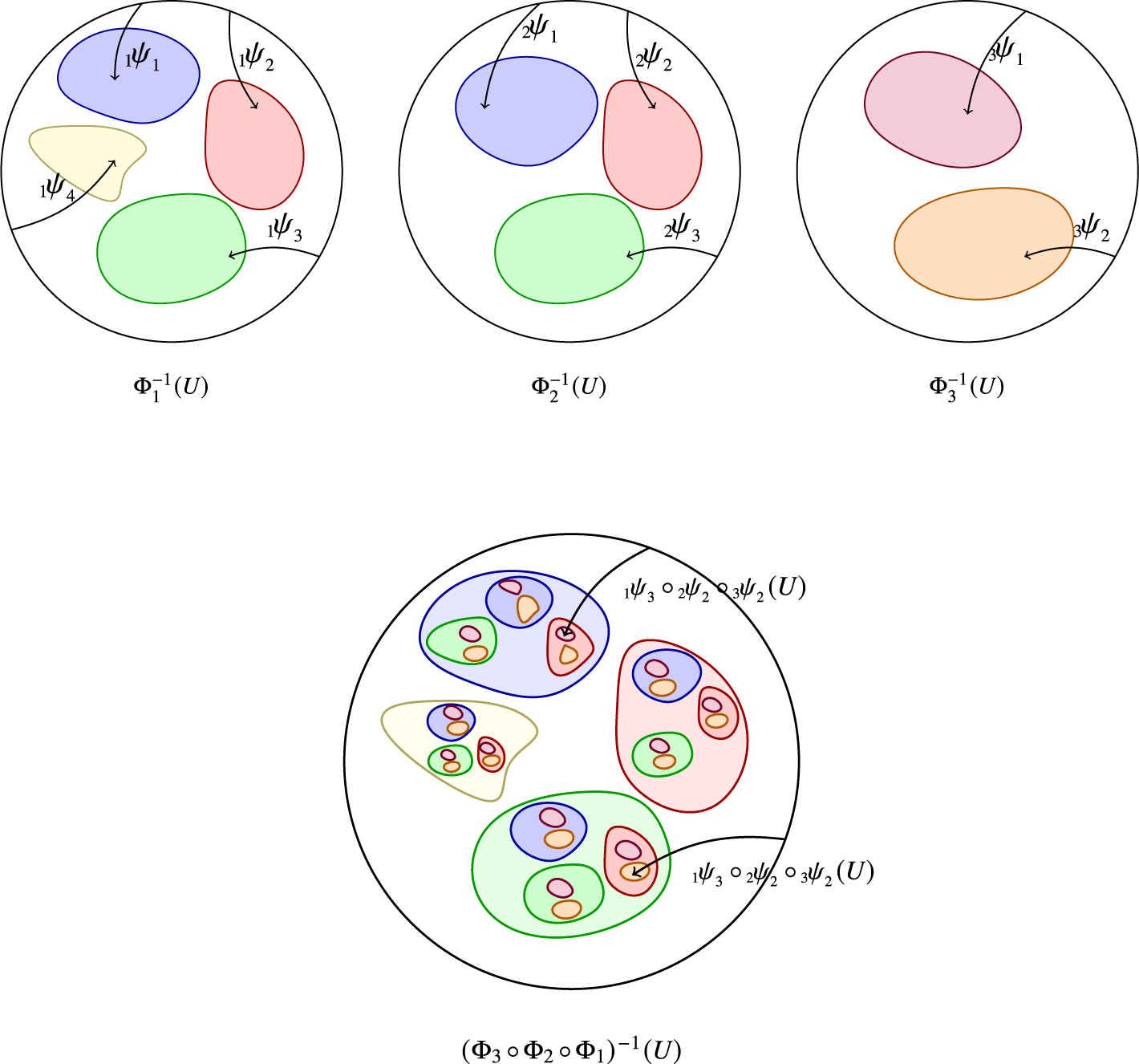
Figure 1 illustrates the three first steps of the construction in a given example.
First steps of the construction in a given example (colour online).

Figure 1 Long description
The diagram consists of four panels. The top row contains three smaller circles, and the bottom row contains one large circle.
Top-left panel: A circle labeled Phi sub 1 super -1 (U) contains four colored regions. A blue region at the top is pointed to by 1 psi 1. A red region on the right is pointed to by 1 psi 2. A green region at the bottom is pointed to by 1 psi 3. A yellow region on the left is pointed to by 1 psi 4.
Top-middle panel: A circle labeled Phi sub 2 super -1 (U) contains three colored regions. A blue region at the top is pointed to by 2 psi 1. A red region on the right is pointed to by 2 psi 2. A green region at the bottom is pointed to by 2 psi 3.
Top-right panel: A circle labeled Phi sub 3 super -1 (U) contains two colored regions. A pink region at the top is pointed to by 3 psi 1. An orange region at the bottom is pointed to by 3 psi 2.
Bottom panel: A large circle labeled (Phi sub 3 circle Phi sub 2 circle Phi sub 1) super -1 (U) shows a fractal-like nesting. It contains the four primary colored regions from the first panel (blue, red, green, yellow). Inside each of these regions are smaller versions of the sets from the second panel, and inside those are even smaller versions of the sets from the third panel. Two specific nested points are labeled with composition functions: 1 psi 3 circle 2 psi 2 circle 3 psi 2 (U) points to a tiny orange region inside a red region inside the top blue region, and another identical label points to a tiny orange region inside a red region inside the bottom green region.
We briefly recall here a few definitions; further details and generalities can be found in [Reference Falconer10, Ch. 2 and 10]. Given a measure μ in the plane, we define its Hausdorff dimension and packing dimension as follows:

the infimum and the supremum being taken over all Borel subsets Z of the support of
$\mu $
 .
We also define its lower and upper local dimension as follows:

In our setting, since we work with conformal mappings, which ensure that cylinders are comparable to balls, it is straightforward to verify that for any measure
$\mu $
 supported on
$\mathbb {K}$
 and any
$\mathtt {x}\in \mathbb {K}$
 ,

where
$X_n(\mathtt {x})$
 is the cylinder of size n containing
$\mathtt {x}$
 .
When these local dimensions are
$\mu $
 -almost surely (a.s.) constant, we then have, see [Reference Falconer10, Remark above Proposition 10.5],

While the Hausdorff dimension captures the minimal covering complexity of a set in the complex plane, the packing dimension reflects its maximal packing efficiency. The packing dimension of the harmonic measure is far less studied than its Hausdorff dimension. However, it is worth noting that, in the context of autonomous conformal dynamical systems, these two dimensions typically coincide.
Let
$\omega $
 be the harmonic measure on
$\hat {\mathbb {C}}\setminus \mathbb {X}$
 evaluated at
$\infty $
 . By the celebrated results of Makarov [Reference Makarov15] and Jones and Wolff [Reference Jones and Wolff13], the Hausdorff dimension of
$\omega $
 is not larger than one. However, it is clear that the Hausdorff dimension of
$\omega $
 is at most
$HD(\mathbb {X})$
 .
For any continuous function f defined on U and any set
$E\subset U$
 , let
$\|f\|_E:=\sup _{E}|f|$
 , which is simply noted
$\|f\|$
 when
$E=U$
 , where
$|\cdot |:\mathbb {C}\to \mathbb {R}^+$
 is the modulus.
Let
$\mathbb {X}$
 and
$\tilde {\mathbb {X}}$
 be two non-autonomous limit sets associated to the conformal iterated systems
 and
 , respectively. We define

Using general results on the symbolic space
$\mathbb {K}$
 , and studied in the second and third part of this paper, we prove the following theorem.
Theorem 1.2. Le
$\mathbb {X}$
 and
$(\mathbb {X}_{k})_{k\in \mathbb {N}}$
 be non-autonomous limit sets associated with the conformal iterated systems
 and
 , respectively. Let
$\omega $
 and
$\omega _{k}$
 be the harmonic measures of their complementaries. Assume that
 , then,

We also discuss the validity of well-known formulas to calculate these dimensions. In particular, we show that an adapted form of Manning’s formula applies.
Theorem 1.3. Let
$\omega $
 be the harmonic measure of
$\mathbb {C}\setminus \mathbb {X}$
 , where
$\mathbb {X}$
 is the limit set of a non-autonomous conformal iterated system
 .
We have

where
$H_{\omega ,n}{\kern-1pt}=-(1/n)\sum _{X\in {\mathcal U}_n}\omega (X){\kern-1pt}\log \omega (X)$
 and
$\chi _{\omega ,n}{\kern-1pt}={\kern-1pt}(1/n)\sum _{X\in {\mathcal U}_n}{\kern-2pt}\omega (X)\log{\kern-1pt} \|T_{n}'\|_X$
 .
Moreover,
$\omega $
 -a.s.

where for any
$x\in \mathbb {X}_{0}$
 ,
$h_{\omega ,n}(x)=-({1}/{n})\log \omega (X_{n}(x))$
 , and
$\chi _{n}(x)=({1}/{n})\log |T_{n}'(x)|$
 .
2 Symbolic point of view
This section deals exclusively with symbolic Cantor sets. More precisely, for any integer n, let
$\mathcal {A}_{n}$
 be a finite alphabet with
$d_{n}$
 symbols. Set
 . We are mainly interested in
$\mathbb {K}_{1}$
 that we denote by
$\mathbb {K}$
 .
All measures discussed in this section have their support that is one of the
$\mathbb {K}_n$
 , and in most cases,
$n=1$
 .
Let
$T:\mathbb {K}_{n}\to \mathbb {K}_{n+1}$
 be the shift map sending a sequence
$\mathtt {a}=(a_{i})_{i\ge 0}$
 to
$T(\mathtt {a})=(a_{i})_{i\ge 1}$
 . It should be emphasized that T goes from
$\mathbb {K}_{n}$
 to
$\mathbb {K}_{n+1}$
 . This is a bit ambiguous, since the same letter designates different maps, but it lightens considerably the notation. We let
 be the degree of
$T^n$
 on
$\mathbb {K}_{p}$
 .
Given a sequence of symbols
$\mathtt {a}=(a_{i})_{i\in \mathbb {N}}\in \mathbb {K}$
 , we set

The set
$X_{n}(\mathtt {a})$
 is the cylinder (word) of length (size) n to which
$\mathtt {a}$
 belongs. Given a cylinder X, we denote by
$|X|$
 its length and, for any n, by
$\mathcal {C}_{n}$
 the set of all cylinders of length
$n\ge 1$
 , in which, for practical reasons, we add
$\varnothing $
 with the convention
$\varnothing X=X\varnothing =X$
 and
$|\varnothing |=0$
 . Note that
$\mathcal {C}_{n}$
 is a finite partition of
$\mathbb {K}$
 by
$D_n^1$
 cylinders.
Obviously, for any integer p, one can also define cylinders in
$\mathbb {K}_p$
 and we will denote
$T^p\mathcal {C}$
 their set.
Notation. To simplify notation with cylinders, we are a little bit imprecise, and instead of writing
$XY$
 with
$X\in \mathcal {C}_{n}$
 and
$Y\in T^n\mathcal {C}_{n+k}$
 , we write
$XY\in \mathcal {C}$
 with
$|X|=n$
 and
$|Y|=k$
 , the context reminding us that Y is not in
$\mathcal {C}_{k}$
 but in
$T^n\mathcal {C}_{n+k}$
 .
The set
$\mathbb {K}$
 endowed with the product topology is compact. Let
$\mathsf {d}$
 be any metric on
$\mathbb {K}$
 that generates this topology. If
$E\subset \mathbb {K}$
 , we denote by
$|E|_{\mathsf {d}}:=\sup \{\mathsf {d}(x,y)\mid (x,y)\in E\times E\}$
 its diameter and we assume that
$|\mathbb {K}|_{\mathsf {d}}=1$
 .
Actually, since the planar Cantor sets that we consider are conformal repellers, they are well described using the coding and the symbolic point of view. It is then natural to choose a metric which ensures that a cylinder in
$\mathbb {K}$
 and its ‘image’ in the plane have approximately the same diameters.
2.1 Asymptotic siblings invariance
Because of the strong intra-scalar-similarity of the Cantor sets with which we are dealing, one expects that natural geometric measures, or natural geometric objects, defined on them have nice scaling or invariance properties.
Note that in this section, we do not need to make any assumption on the finite numbers
$d_n$
 .
To define precisely the properties we have in mind, we need to introduce some definitions.
For any integer
$p\ge 1$
 , let
$\mathfrak {F}_{p}$
 be the set of real positive maps defined on the set of cylinders
$T^p(\mathcal {C})$
 . For
$p=0$
 , we denote by
$\mathfrak {F}=\mathfrak {F}_{0}$
 the set of maps defined on the set of cylinders
$\mathcal {C}:=\bigcup _{n\ge 0}\mathcal {C}_{n}$
 with values in
$]0,{{{+}}}\infty [$
 .
In this paper, we will mainly consider the following elements
$\nu \in \mathfrak {F}_{p}$
 :
-
• $\nu (X)=\mu (X)$
, where
$\mu $
is a measure on
$\mathbb {K}_p$
; -
• $\nu (X)=|X|_{\mathsf {d}}$
.


For
$\nu =\nu _{\varnothing }\in \mathfrak {F}$
 and any
$XY\in \mathcal {C}$
 , we note
$\nu _{X}(Y):=({\nu (XY)}/{\nu (X)})$
 . Note that
$\nu _{X}$
 is an element of
$\mathfrak {F}_{|X|}$
 .
A finite measure
$\nu $
 on
$\mathbb {K}_p$
 that gives positive mass to any open set is naturally an element of
$\mathfrak {F}_p$
 . Reciprocally, we say that
$\nu \in \mathfrak {F}_p$
 is a (finite) measure if it projects as such on the compact set defined asymptotically by the cylinders, which is if and only if:

Definition 2.1.
-
• Given $\nu $
and
$\nu '$
in
$\mathfrak {F}_{p}$
, we naturally define
$\nu +\nu '$
,
$\unicode{x3bb} \nu $
for any
$\unicode{x3bb} \in \mathbb {R}$
, and
$\nu .\nu '$
. -
• For any real function $\varphi $
and any
$\nu \in \mathfrak {F}_{p}$
, we denote
$\varphi (\nu )$
the map from
$T^p\mathcal {C}$
to
$\mathbb {R}$
defined by
$\varphi (\nu )(X)=\varphi (\nu (X))$
. Clearly, this only makes sense if
$\varphi $
is well defined on
$\nu (T^p\mathcal {C})$
. -
• Given $\nu $
and
$\nu '$
in
$\mathfrak {F}_{p}$
and
$n\ge 1$
, let
$\langle \nu ,\nu ' \rangle _{n}:=\sum _{X\in T^p\mathcal {C}_{n+p}}\nu (X)\nu '(X)$
. -
• For any $\nu \in \mathfrak {F}_{p}$
, we define its mass on
$\mathcal {C}_{n}$
(with
$n\ge p$
), $$ \begin{align*}\mathfrak{m}_{n}(\nu):=\langle \nu,1 \rangle_{n}.\end{align*} $$Note that $\nu $
is a measure on
$\mathbb {K}_p$
if
$\mathfrak {m}_{n}(\nu _{X})=1$
for any n and any
$X\in \mathcal {C}$
.
-
• We say that $\nu $
and
$\nu '$
in
$\mathfrak {F}_{p}$
are equivalent if there exists
$C>1$
such that for any X, we have
$ {1}/{C}\le ({\nu (X)}/{\nu '(X)})\le C.$
We then note
$\nu \sim \nu '$
.


Note that we use the notation
$\langle \cdot ,\cdot \rangle _{n}$
 with
$\nu $
 a probability measure and
$\nu '$
 of the form
$\log s$
 , where s is an element of
$\mathcal {F}$
 . For instance, if
$\nu $
 is a probability measure with
${\nu '=\log (1/\nu )}$
 , then

which corresponds to an entropy.
We give some elementary properties that are used later on.
Properties. For any
$s\in \mathfrak {F}$
 and any
$XYZ\in \mathcal {C}_{n}$
 , we have

For any finite measure
$\nu \in \mathfrak {F}$
 , any cylinder
$X\in \mathcal {C}$
 , and any integers n and p, we have

Proof. Since equality (2.2) will be used extensively in what follows, and since it allows one to become familiar with the introduced notation, we provide a proof.
Starting from the definition, we have

Since
$\nu $
 is a finite measure, we have
$\mathfrak {m}_{p}(\nu _{XY})=1$
 so that we get the desired equality:

The following is an application of the Jensen inequality.
Proposition 2.1. Let
$\nu $
 and
$\nu '$
 be two elements of
$\mathfrak {F}_{p}$
 . For any n, we have

with equality if and only if there exists k such that
$\nu (X)=k\nu '(X)$
 for any
$X\in T^p\mathcal {C}_{n+p}$
 .
Proof. We make use of Jensen’s inequality for the function
$\log $
 , evaluated at
$({\nu '(Y)}/{\nu (Y)})_{|Y|=n} $
 , and the convex combination defined by the coefficients
$({\nu (Y)}/{\mathfrak {m}_{n}(\nu )})_{|Y|=n}$
 . We get

Multiplying this inequality by
$\mathfrak {m}_{n}(\nu )$
 , we obtain the result.
Since
$\log $
 is strictly concave, equality holds if and only if
$ {\nu '(Y)}/{\nu (Y)}$
 does not depend on Y.
We introduce now our main assumption that we refer to as asymptotic sibling invariance (ASI). It is a kind of long-range Markov property of a functional that asserts that along cylinders which share a big common part of history, the relative functional does not depend on its origin.
Definition 2.2. Let
$\nu $
 be an element of
$\mathfrak {F}$
 and
$(\beta _{n})$
 a sequence of positive numbers converging to
$0$
 . We say that
$\nu $
 satisfies ASI with sequence
$(\beta _{n})$
 if for any integers n, k, and p, we have

Note that we sometimes use the following version of the inequality:

Definition 2.3. Given two sequences of positive real numbers
$(\gamma _{n})$
 and
$(\beta _{n})$
 , we say that they are compatible if (
$\gamma _{n}$
 ) is increasing, (
$\beta _{n}$
 ) converges towards
$0$
 , and there exists a sequence of integers,
$(p_{n})$
 , such that
$p_{n}\le n$
 and
$(({1}/{n})\max (\gamma _{p_{n}}, \gamma _{n}\beta _{p_{n}}))$
 converges towards
$0$
 , so that

As an example, one may consider the situation that we will have to deal with in studying the harmonic measure and the diameters of the cylinders. In that case, we will have
$\gamma _{n}=O(n)$
 , and it appears that such a sequence is compatible with any sequence
$(\beta _{n})$
 converging towards
$0$
 . As a matter of fact, we have
$({1}/{n})\max (\gamma _{p_{n}}, \gamma _{n}\beta _{p_{n}})=\max ({O(p_n)}/{n}, ({O(n)}/{n})\beta _{p_{n}}) $
 , and any
$p_{n}=\text {o}(n)$
 , for instance,
$p_n=\lfloor \sqrt {n}\rfloor $
 , fulfilling the desired growth condition.
This is the only case we will need to consider in the geometric setting, but since the proofs are given in the symbolic setting, it seemed appropriate to present them in full generality, as they may be useful in other contexts.
We recall that the notation
$s\sim s'$
 has been introduced in Definition 2.1
Proposition 2.2. Let
$(\gamma _{n})$
 and
$(\beta _{n})$
 be two compatible sequences.
Assume that s and
$\nu $
 are two elements of
$\mathfrak {F}$
 , that
$\nu $
 is a finite measure, and that they both satisfied ASI with
$(\beta _{n})$
 . Assume moreover that one of these conditions is fulfilled:

or

Then, for any
$\tilde {s}\sim s$
 :
-
• there exists $C>0$
such that (2.6) $$ \begin{align} \alpha_{n}(\nu,\tilde{s}):=\sup_k\Big\{\!\max_{|X|=k}\langle \nu_{X},\log \tilde{s}_{X} \rangle_{n}-\min_{|X|=k}\langle \nu_{X},\log \tilde{s}_{X} \rangle_{n}\Big\}\le Cc(\gamma_{n},\beta_{n}); \end{align} $$
-
• for any $(X,X')\in \mathcal {C}^2$
, we have $$ \begin{align*} \lim_{n\to{{{+}}}\infty}\bigg(\frac{1}{n}\langle \nu_{X'},\log \tilde{s}_{X'} \rangle_{n}- \frac{1}{n}\langle \nu_{X},\log \tilde{s}_{X} \rangle_{n}\bigg)=0. \end{align*} $$


Proof. The constant C will change from line to line, but will stay independent of integers or cylinders, only depending on
$\nu $
 and s.
For any
$\tilde {s}\sim s$
 , we have, for any
$XY\in \mathcal {C}$
 ,
$-2\log C \le \log \tilde {s}_X(Y)-\log s_X(Y)\le 2\log C$
 .
We then deduce, because
$\nu $
 is a finite measure,

This tells us that conclusions of the theorem are true for
$\tilde {s}$
 as soon as they are true for s, and in the following, we focus on s.
Let:
-
• for any $X\in \mathcal {C}$
,
$g_{n}(X):=\langle \nu _{X},\log s_{X} \rangle _{n},$
with
$g_{n}:=g_{n}({\varnothing })$
; -
• $\alpha _{n}:=\alpha _{n}(\nu ,s)=\sup _k\{\max _{|X|=k}g_{n}(X)-\min _{|X|=k}g_{n}(X)\}$
.


We first note that (2.5.1) and the fact that
$\nu $
 is a finite measure imply that for any
$X\in \mathcal {C}$
 , we have

an inequality that is also true with (2.5.2) and leads to

Note also that given any
$X\in \mathcal {C}$
 , and any integers n and p, we have from (2.2):

From this, we deduce that for any
$X ' \in \mathcal {C}_{|X|}$
 , we have

Let
$\mathcal {B}^+$
 be the subset of
$T^{|X|}\mathcal {C}_{|X|+n}$
 for which we have
$\nu _{X}(Y)-\nu _{X'}(Y)\ge 0$
 and let
$\mathcal {B}^-$
 be its complementary. Then, we have

Since
$\nu $
 is a finite measure, we have
$ \sum _{|Y|=n}\nu _{X}(Y)=\sum _{|Y|=n}\nu _{X'}(Y)=1$
 .
This implies that
$ \sum _{|Y|=n}(\nu _{X}(Y)-\nu _{X'}(Y))=0$
 .
Therefore,
$ \sum _{Y\in \mathcal {B}^+}(\nu _{X}(Y)-\nu _{X'}(Y))=-\sum _{Y\in \mathcal {B}^-}(\nu _{X}(Y)-\nu _{X'}(Y))$
 , which leads to

We thus have

From ASI, we deduce that

and also

This implies the following.
-
• If (2.5.1) is fulfilled, then we have $ |\!\log s_{X'Y}(Z)|\le \gamma _{|Z|}$
so that $$ \begin{align*} \begin{aligned} \nu_{XY}(Z)\log s_{XY}(Z)&-\nu_{X'Y}(Z)\log s_{X'Y}(Z)\\ &= (\nu_{XY}(Z)-\nu_{X'Y}(Z))\log s_{XY}(Z)+\nu_{X'Y}(Z)\log \frac{s_{XY}(Z)}{s_{X'Y}(Z)}\\ & \le |\nu_{XY}(Z)-\nu_{X'Y}(Z)| \gamma_{|Z|}+\nu_{X'Y}(Z)\bigg|\!\log \frac{s_{XY}(Z)}{s_{X'Y}(Z)}\bigg|\\ \end{aligned}\end{align*} $$and since $\nu $
and s fulfill ASI, we get $$ \begin{align*} \begin{aligned} & \le \beta_{|Y|}\nu_{X'Y}(Z)\gamma_{|Z|}+\nu_{X'Y}(Z)\beta_{|Y|}\\ & \le \beta_{|Y|}(1+\gamma_{|Z|})\nu_{X'Y}(Z). \end{aligned} \end{align*} $$Summing over all cylinders Z of length p and using once again the fact that $\nu $
is a finite measure, we get (2.12) $$ \begin{align} g_{p}(XY)-g_{p}(X'Y)\le (1+\gamma_{p})\beta_{|Y|}\le C\gamma_{p}\beta_{|Y|}. \end{align} $$
-
• If (2.5.2) is fulfilled, then we have
$$ \begin{align*} \begin{aligned} & \nu_{XY}(Z)\log s_{XY}(Z)-\nu_{X'Y}(Z)\log s_{X'Y}(Z) \\ & \quad \le \beta_{|Y|}(\nu_{X'Y}(Z)\log s_{X'Y}(Z)+C\nu_{X'Y}(Z)). \end{aligned} \end{align*} $$
Summing over all cylinders Z of length p and using (2.7), we also get (2.12).


Injecting (2.12) and (2.11) into (2.10) leads to

from which we get that

which might be rewritten, for any
$p\le n$
 , in the following form:

Using (2.8), we get

Let q and
$r\le p$
 be the quotient and the remainder of the Euclidean division of n by p. By induction, we get

Since
$(\gamma _{n})$
 and
$(\beta _{n})$
 are compatible, one may take
$p=p_{n}$
 to get

which is the first part of the proposition and tells us that for any X and
$X'$
 in
$\mathcal {C}$
 , with
$|X|=|X'|$
 , we have

We show now that we can get rid of the condition
$|X|=|X'|$
 .
Let
$X\in \mathcal {C}$
 and let a be a cylinder of length 1. Applying (2.9) with
$n=1$
 and
$p=q$
 ,

Apply now (2.9) with
$n=q$
 and
$p=1$
 :

We thus have

By hypothesis on
$\nu $
 and s, there exists
$C>0$
 such that for any cylinder
$Z\in \mathcal {C}$
 , we have
$g_{1}(Z)\le C$
 . This leads to

and this easily leads, for any Y with
$|Y|=p$
 , to

Let
$X'\in \mathcal {C}_{|X|}$
 and
$XY\in \mathcal {C}$
 . We have

and then,

which finishes the proof.
2.2 A continuity result
Let
$\nu $
 and
$\nu '$
 be two elements of
$\mathfrak {F}$
 . We define

Note that we obviously have
$\mathcal {D}(\nu ,\nu ')=\mathcal {D}(\nu ',\nu )$
 and
$\mathcal {D}(\nu ,\nu ')=0$
 if and only if
$\nu =\nu '$
 . Moreover, it is also clear that we have

Therefore,
$\mathcal {D}$
 could be seen as a metric on
$\mathfrak {F}$
 if
$\mathcal {D}(\nu ,\nu ')<{{{+}}}\infty $
 for any
$\nu $
 and
$\nu '$
 , which is not the case. Nevertheless, if
$\mathcal {D}(\nu ,\nu _{k})$
 converges to
$0$
 , when
$k\to {{{+}}}\infty $
 , this tells us that
$(\nu _{k})$
 is ‘converging’ to
$\nu $
 .
Let
$ Y=y_{1}\cdots y_{p}\in T^n\mathcal {C}$
 ,
$Y_{0}=\varnothing $
 and, for any
$1\le k \le p$
 ,
$Y_{k}=y_{1}\cdots y_{k}$
 . Since

we conclude that for any
$X\in \mathcal {C}$
 and any Y, we have

This also implies, for any
$XY\in \mathcal {C}_{n+p}$
 , with
$|Y|=n$
 , that we have

Let
$g_{n}(X):=\langle \nu _{X},\log s_{X} \rangle _{n}$
 and
$g_{n}'(X):=\langle \nu _{X}',\log s_{X}' \rangle _{n}$
 .
We have

Assume that
$\nu $
 and
$\nu '$
 are both finite measures so that
$\langle \nu _X,1 \rangle _{n}=\langle \nu _X',1 \rangle _{n}=1$
 .
Assume moreover that, for any n, we have

Then, from (2.15), we deduce

so that

Theorem 2.3. Let
$\nu $
 and s be two elements of
$\mathfrak {F}$
 , and let
$(\nu _{k})$
 and
$(s_{k})$
 be two sequences of elements in
$\mathfrak {F}$
 .
For any
$n\in \mathbb {N}$
 , set
$g_{n}=\langle \nu ,\log s \rangle _{n}$
 and
$g_{k,n}=\langle \nu _{k},\log s_{k} \rangle _{n}$
 .
Assume that:
-
• $\nu $
and
$\nu _{n}$
are finite measures; -
• all those elements of $\mathfrak {F}$
verify ASI, with a same sequence
$(\beta _{n})$
; -
• there exists a sequence $(\gamma _{n})$
, compatible with
$(\beta _{n})$
, such that for any
$s'\in \{s,\,s_{n}\}_{n\in \mathbb {N}}$
and any
$XY\in \mathcal {C}$
, -
• $\lim _{k\to {{{+}}}\infty }\mathcal {D}(\nu ,\nu _{k})=\lim _{k\to {{{+}}}\infty }\mathcal {D}(s,s_{k})=0$
.


Then, we have

and, in particular, we have

Moreover, the conclusions are still valid for any
$\tilde {s}$
 and
$({\tilde {s_n}})$
 such that
$\tilde {s}\sim s$
 and
$\tilde {s}_n\sim s_n$
 for any n.
Proof. By hypothesis, we are in a position to apply Proposition 2.2 with
$\nu $
 and s, and
$\nu _{n}$
 and
$s_{n}$
 , and we use the notation therein.
Let
$p\le n$
 , with
$q\in \mathbb {N}$
 such that
$qp<n\le (q+1)p$
 . Using (2.9), we get

from which we get

and also

By hypothesis, we have
$|g_r(Y)|\le \gamma _r\le \gamma _p$
 and
$|g_{k,r}(Y)|\le \gamma _r\le \gamma _p$
 , so that

Using once again (2.9), we get

so that

and, thus,

Using (2.16), we get

which leads to

However, we have

Inequalities (2.19) and (2.20) lead to

Using now (2.18), we get

Let
$\varepsilon>0$
 .
Fix p big enough to ensure that
$ C({c(\gamma _{p},\beta _{p})}/{p})< {\varepsilon }/{3}$
 and let
$n_{0}\in \mathbb {N}$
 such that
$ 2({\gamma _{p}}/{n_{0}})<{\varepsilon }/{3}$
 .
Finally, let
$k_{0}$
 such that for any
$k\ge k_{0}$
 , we have

Then, for any
$k\ge k_{0}$
 and any
$n\ge n_{0}$
 , we have
$ | {g_{n}}/{n}-{g_{k,n}}/{n}|<\varepsilon $
 , from where the result follows.
2.3 Almost sure convergence
In the previous section, we work with a probability measure
$\mu $
 supported on
$\mathbb {K}$
 . We are interested in almost sure asymptotic values of sequences of the form:
$Z_{n}(\mathtt {x}):=\log s(X_{n}(\mathtt {x}))$
 , where
$s\in \mathfrak {F}$
 , with
$s\ge 1$
 , and for any
$\mathtt {x}\in \mathbb {K}$
 ,
$X_{n}(\mathtt {x})$
 is the unique element of
$\mathcal {C}_{n}$
 containing
$\mathtt {x}$
 . We will use the following version of the strong large numbers law, see for instance [Reference Hall and Heyde12, Theorem 2.19].
Theorem 2.4. Let
$\{ Y_{n}, n \ge 1\}$
 be a sequence of random variables in a probability space. Let
$\{ \mathcal {F}_{n}, n \ge 1\}$
 be an increasing sequence of
$\sigma $
 -fields with
$Y_{n}$
 measurable with respect to
$\mathcal {F}_{n}$
 for each n. Assume that
$(Y_{n})$
 is uniformly bounded. Then, a.s.,

Theorem 2.5. Let
$\nu $
 be a probability measure and let
$s\in \mathfrak {F}$
 .
Assume that
$\nu $
 and s fulfilled ASI with sequence
$(\beta _{n})$
 , that there exists a sequence
$(\gamma _{n})$
 , compatible with
$(\beta _{n})$
 and such that

Then, for any
$\tilde {s}\sim s$
 , there is a set
$\mathcal {U}\subset \mathbb {K}$
 of full
$\nu $
 -measure such that for any
$\mathtt {a}\in \mathcal {U}$
 , we have

Proof. Let us first observe that if the result holds for s, then it also holds for every
$\tilde {s} \sim s$
 . Indeed,

Given any
$n\in \mathbb {N}$
 , let
$X_n:\mathbb {K}\to \mathcal {C}_n$
 ,
$\mathtt {x}\mapsto X_n(\mathtt {x})$
 be the cylinder of size n containing
$\mathtt {x}$
 . We define
$Z_{n}(x):=\log s(X_{n}(x))$
 .
If we adopt the notation introduced in Proposition 2.2, with
$g_n=\langle \nu ,\log (s) \rangle _{n}$
 , the theorem asserts that the sequence
$ ({1}/{n})(g_n-Z_n(\cdot ))$
 converges to
$0 \nu $
 -a.s.
For any integer
$p>0$
 , let
$Y_{n,p}:=({1}/{p})(Z_{np}-Z_{(n-1)p})$
 . Let also
$\mathcal {F}_{n}$
 be the
$\sigma $
 -algebra generated by cylinders in
$\mathcal {C}_{n}$
 . The idea, once again taken from [Reference Batakis3], is to apply Theorem 2.4 on
$(Y_{n,p})_{n}$
 , with respect to
$(\mathcal {F}_{np})_{n}$
 , and to prove that the conditional expectations are asymptotically, on n and p, independent of
$\mathtt {x}\in \mathbb {K}$
 .
Fix
$p>0$
 , and
$n>p$
 and let
$n=pq+r$
 be the Euclidian division of n by p. We define

so that

We treat each of the five terms in the sum separately.
${\text {Term}\ \unicode{x2460}}$
 . By definition, we have

Therefore,

There exists a cylinder Y, with
$\vert Y\vert \le p$
 , such that
$X_{(q+1)p}=X_nY$
 . By hypothesis on s, we thus have

This tells us that

${\text {Terms}\ \unicode{x2463}\ \text {and}\ \unicode{x2464}}$
 . Recall that by (2.9), we have

Therefore,

However, by (2.13) and Proposition 2.2, we have

which allows us to conclude that

${\text {Term}\ \unicode{x2462}}$
 . By definition, the conditional expectation
$\mathbb {E}_{\nu }[Y_{k+1,p} |\mathcal {F}_{kp}]$
 is constant on any cylinder of size
$kp$
 . More precisely, for any
$\mathtt {x}\in X_{kp}\in \mathcal {C}_{kp}$
 , it is equal to the average of
$Y_{k+1,p}$
 on
$X_{kp}$
 , so that we have

Recall that by (2.9), for any integer k, we have

Therefore,

Summing from
$1$
 to q and dividing by
$pq$
 , we get

Since by Proposition 2.2 for any Y of length
$(k-1)p$
 , we have
$\vert g_p(X_pY)-g_p{X_{kp}}\vert \le Cc(\gamma _p,\beta _p)$
 , we get

${\text {Term}\ \unicode{x2461}}$
 . Note that for any n, we have by hypothesis that

We may thus apply Theorem 2.4 with
$(Y_{n,p})_{n}$
 to conclude that p being fixed,
$|{\unicode{x2461}}| \nu $
 -a.s. converges towards
$0$
 as
$q\to {{{+}}}\infty $
 , and we can easily conclude that there exists a set of full measure, denoted by
$\mathcal {U}$
 , such that it occurs for any p.
We may now conclude the proof.
Let
$\mathtt {x}\in \mathcal {U}$
 and
$\varepsilon>0$
 . Choose p big enough to have
$ C({c(\gamma _p,\beta _p)}/{p})<{\varepsilon }/{5}$
 .
Let
$n_{0}\ge p$
 be such that for any
$n\ge n_{0}$
 , we have
${\gamma _p}/{n}<{\varepsilon }/{5}$
 .
Since p is fixed, q goes to infinity with n and we may choose
$n_0$
 big enough to have
$\vert {\unicode{x2461}}\vert <{\varepsilon }/{5}$
 . Combining this with (2.22), (2.25), (2.23), and (2.24), we deduce that

3 Pressures, entropies, Lyapunov exponents, and dimensions
In this section, using results from the previous section, we show how natural generalizations of notions coming from thermodynamical formalism are possible.
3.1 Lyapunov exponents and entropies
Given a sequence
$(u_{n})$
 of real numbers, we let
$\overline {u_{n}}$
 be its limsup and
$\underline {u_{n}}$
 its liminf.
For any positive integer n and any probability measure on
$\mathbb {K}$
 ,
$\mu $
 , we define

where the sum is taken over all cylinders
$X\in \mathcal {C}_{n}$
 , with the usual convention
$0\ln (0)=0$
 .
We set
$\overline {h_{\mu }}:=\overline {H_{\mu ,n}}$
 ,
$\underline {h_{\mu }}:=\underline {H_{\mu ,n}}$
 ,
$\overline {\mathcal {X}_{\mu }}:=\overline {\mathcal {X}_{\mu ,n}}$
 , and
$\underline {\mathcal {X}_{\mu }}:=\underline {\mathcal {X}_{\mu ,n}}$
 .
Given any
$\mathtt {a}\in \mathbb {K}$
 and any positive number n, we define

As previously, let us note
$\overline {h_{\mu }}(\mathtt {a}):=\overline {h_{\mu ,n}(\mathtt {a})}$
 ,
$\underline {h_{\mu }}(\mathtt {a}):=\underline {h_{\mu ,n}}(\mathtt {a})$
 ,
$\overline {\chi }(\mathtt {a}):=\overline {\chi _{n}}(\mathtt {a})$
 , and
$\underline {\chi }(\mathtt {a}):=\underline {\chi _{n}}(\mathtt {a})$
 . Remember that
$\mathcal {F}_{n}$
 is the
$\sigma $
 -algebra generated by cylinders of length less or equal to n. We have

Note also that with
$s:X\mapsto {1}/{|{X}|_{\mathsf {d}}}$
 , we have

Remark 3.1. In this section, we work within a symbolic framework and do not specify a metric. In certain contexts, the choice of metric is a delicate issue. For instance, in [Reference Barral and Qu5], the pressure of a potential is studied using a metric tailored to the potential itself. It should be noted that in the remainder of this paper, when applying our results to measures in the complex plane, we shall adopt the ‘symbolic metric’ to ensure that the ‘symbolic’ and ‘geometric’ diameters coincide.
Applying Proposition 2.1 to that setting, remembering that
$D_n=d_0\cdots d_{n-1}$
 is the degree of
$T^n$
 , which is also the number of cylinder in
$\mathcal {C}_n$
 , we get the following proposition.
Proposition 3.2. For any n and any
$t\in \mathbb {R}$
 ,

In particular, for
$t=0$
 ,

Moreover, if
$X_{m}$
 and
$X_{M}$
 in
$\mathcal {C}_{n}$
 are such that
$\text { for all } X\in \mathcal {C}_{n}$
 , we have
$|{X_{m}}|_{\mathsf {d}}\le |{X}|_{\mathsf {d}}\le |{X_{M}}|_{\mathsf {d}}$
 , then

Remark 3.3. It is worth noting that this inequality is akin to a variational principle, whereby, the metric pressure of a potential, with respect to any probability measure, is bounded above by its topological pressure. The non-autonomous setting would require a precise definition of these objects; in particular, the notion of a potential must be replaced by that of a ‘sequence of potentials’. While these tools are of intrinsic interest, they are not essential to the present discussion and will be addressed in future work.
Proof. We use Proposition 2.1 with
$\nu =\mu $
 and
$\nu '=|\cdot|_{\mathsf {d}}^t$
 . We thus have for any n,

Theorem 3.4. Let
$\mu $
 be a probability measure that fulfilled ASI with sequence
$(\beta _{n})$
 and assume that there exists a sequence
$(\gamma _{n})$
 , compatible with
$(\beta _{n})$
 , and such that

Then, there exists a set
$\mathcal {U}$
 of full
$\mu $
 -measure such that for any
$\mathtt {a}\in \mathcal {U}$
 ,

and, in particular, we have
$\mu $
 -a.s.

Assume moreover that
$s:X\mapsto {1}/{|{X}|_{\mathsf {d}}}$
 fulfilled ASI and that there exist
$0<\delta <1$
 such that for any
$XY\in \mathcal {C}$
 , we have

then there exists a set of full
$\mu $
 -measure,
$\mathcal {V}$
 , such that for any
$\mathtt {a}\in \mathcal {V}$
 ,

and, in particular, we have
$\mu $
 -a.s.

Proof. The hypothesis allows us to apply Theorem 2.5, with
$\nu (X)=\mu (X)$
 and
$s(X)={1}/{\mu (X)}$
 , to conclude that

Let now
$s:X\mapsto {1}/{|{X}|_{\mathsf {d}}}$
 .
From the assumption
$ \delta ^{\gamma _{|Y|}}\le {|{XY}|_{\mathsf {d}}}/{|{X}|_{\mathsf {d}}}\le 1$
 , we deduce that
$1\le s_{X}(Y)\le \delta ^{-\gamma _{|Y|}}$
 , and we easily conclude that for any
$XY\in \mathcal {C}$
 , with
$|Y|=n$
 , we have

We may once again apply Theorem 2.5 to conclude.
3.2 Pressure of a measure and dimensions
In the previous subsection, we assume uniform bounds for the diameters, which is a very natural hypothesis in our context: there exists
$\delta \in ]0,1[$
 such that for any
$n\in \mathbb {N}$
 , any cylinder
$XY$
 with
$|Y|=n$
 , we have

In particular, for any n, we have

and also for any
$\mathtt {a}\in \mathbb {K}$
 ,

Definition 3.1. For any real number t and any integer n, let
$P_{\mu ,n}(t):=H_{\mu ,n}-t\mathcal {X}_{\mu ,n}$
 .
We define
$\underline {P_{\mu }}(t)=\underline {P_{\mu ,n}}(t)$
 and
$\overline {P_{\mu }}(t)=\overline {P_{\mu ,n}}(t)$
 .
Proposition 3.5. Assume that
$|\cdot|_{\mathsf {d}}$
 satisfies condition (3.2), and that
$\mu $
 and
$|\cdot|_{\mathsf {d}}$
 both fulfill ASI with sequence
$(\beta _n)$
 compatible with
$(\gamma _n=n)$
 , then the functions
$t\mapsto \underline {P_{\mu }}(t)$
 and
$t\mapsto \overline {P_{\mu }}(t)$
 are strictly decreasing and bi-Lipschitz.
We have:
-
(1) $0\le \underline {P_{\mu }}(0)=\underline {h_{\mu }}\le \overline {P_{\mu }}(0)=\overline {h_{\mu }}$
; -
(2) $\text { for all } t\in \mathbb {R}, \underline {h_{\mu }}-t\log (1-\delta )\le \underline {P_{\mu }}(t)\le \overline {P_{\mu }}(t)\le \overline {h_{\mu }}-t\log \delta $
; -
(3) let $HD(\mu )$
be the Hausdorff dimension of
$\mu $
and
$PD(\mu )$
its packing-dimension. Then, $$ \begin{align*} \underline{P_{\mu}}(HD(\mu))=0=\overline{P_{\mu}}(PD(\mu));\end{align*} $$
-
(4) for any $\mathtt {a}$
in a set of full
$\mu $
-measure, we have $$ \begin{align*}\liminf \frac{H_{\mu,n}}{\mathcal{X}_{\mu,n}}=\liminf \frac{h_{\mu,n}(\mathtt{a})}{\chi_{n}(\mathtt{a})}=HD(\mu) \end{align*} $$and
$$ \begin{align*}\limsup \frac{H_{\mu,n}}{\mathcal{X}_{\mu,n}}=\limsup \frac{h_{\mu,n}(\mathtt{a})}{\chi_{n}(\mathtt{a})}=PD(\mu). \end{align*} $$


Proof. From (3.2), we easily get for any
$t< t+h$
 and any
$n\in \mathbb {N}$
 ,

from which we deduce, with P standing either for
 or
 , that we have

which tells us that
$\underline {P_{\mu }}$
 and
$\overline {P_{\mu }}$
 are strictly decreasing and bi-Lipschitz.
Points (1) and (2) are obvious from definitions and hypotheses.
We turn to results about dimensions.
Hypotheses on
$\mu $
 and
$|\cdot|_{\mathsf {d}}$
 allow us to apply Theorem 2.5 with, for any
$X\in \mathcal {C}$
 ,
$\nu (X)=\mu (X)$
 and
$s(X)={|{X}|_{\mathsf {d}}^t}/{\mu (X)}$
 , as well as Theorem 3.4. In particular,
$\mu $
 -a.s. we have


Since
$\underline {P_{\mu }}$
 and
$\overline {P_{\mu }}$
 are strictly decreasing, continuous with positive and negative values, there exists a unique
$(\underline {t},\overline {t})\in \mathbb {R}^2$
 , with
$0\le \underline {t}\le \overline {t}\in \mathbb {R}$
 such that
$\underline {P_{\mu }}(\underline {t})=0=\overline {P_{\mu }}(\overline {t})$
 .
We focus on the result with liminf.
Take a point
$\mathtt {a}\in \mathbb {K}$
 such that items (E) and (L) are true.
Let
$(n_{k})$
 be a sequence of integers such that

see (1.2) for the definition of
$\underline {d}_{\mu }(\mathtt {a})$
 .
Using items (E) and (L), and extracting again if necessary, one may suppose that

By hypothesis on
$|\cdot|_{\mathsf {d}}$
 , we have
$0<\chi <{{{+}}}\infty $
 , thus
$\underline {d}_{\mu }(\mathtt {a})=\frac {h}{\chi }$
 , and we have

from which we deduce that
$\underline {d}_{\mu }(\mathtt {a})\ge \underline {t}$
 .
Fix
$t>0$
 and assume that
$n_{k}$
 is such that

As before, using items (E) and (L) and extracting a further subsequence if necessary, we may assume that (3.3) is fulfilled. Note that h and
$\chi $
 denote limits that are different from the previous case. In particular, we can only assert that
${h}/{\chi }\ge \underline {d}_{\mu }(\mathtt {a})$
 , since

We have

We deduce that
$\underline {P_{\mu }}(\underline {d}_{\mu }(\mathtt {a}))\ge 0$
 so that
$\underline {d}_{\mu }(\mathtt {a})\le \underline {t}$
 .
This tells us that
$\mu $
 -a.s.
$\underline {d}_{\mu }({\cdot })$
 is constant equal to
$\underline {t}$
 . By classical results on Hausdorff dimension of measures, see [Reference Falconer10, Remark above Proposition 10.5], we can conclude that
$\mu $
 -a.s.

Consider a sequence of integers
$(n_k)$
 such that

Since
$(\mathcal {X}_{\mu ,n_{k}})$
 is bounded away from zero, we have

We now conclude by considering a sequence of integers
$(n_k)$
 such that

Using the fact that
$(\mathcal {X}_{\mu ,n_{k}})$
 is bounded, we deduce that

which implies that
$ HD(\mu )=\underline {t}\le \liminf ({H_{\mu ,n}}/{\mathcal {X}_{\mu ,n}})$
 .
We thus have proved that for any
$\mathtt {a}$
 in a set of full
$\mu $
 -measure, we have

3.3 Continuity of dimension
Theorem 3.6. Let
$\mu $
 be a probability measure on
$\mathbb {K}$
 and
$(\mu _{k})$
 be a sequence of probability measures.
Let
$\mathsf {d}$
 be a metric on
$\mathbb {K}$
 and
$\mathsf {d}_{k}$
 a sequence of metrics. For any
$X\in \mathcal {C}$
 , we let
$\tilde {s}(X)=|{X}|_{\mathsf {d}}$
 and
$\tilde {s}_{k}(X)=|{X}|_{\mathsf {d}_{\mathsf {k}}}$
 .
Assume that:
-
• the metrics $|{\cdot }|_{\mathsf {d}}$
and
$|{\cdot }|_{\mathsf {d}_{\mathsf {k}}}$
,
$k\in \mathbb {N}$
, verify condition (3.2) with a common constant
$\delta $
; -
• $\mu $
, s, and for any k,
$s_{k}$
, and
$\mu _{k}$
, fulfilled ASI with a common sequence
$(\beta _{n})$
; -
• there exists a sequence $(\gamma _{n})$
, compatible with
$(\beta _{n})$
, such that for any
$XY\in \mathcal {C}$
and any k, $$ \begin{align*} \log\frac{\mu(X)}{\mu(XY)}\le \gamma_{|Y|} \quad \text{and} \quad \log\frac{\mu_{k}(X)}{\mu_{k}(XY)}\le \gamma_{|Y|}; \end{align*} $$
-
• we have $\lim _{k\to {{{+}}}\infty }\mathcal {D}(\mu ,\mu _{k})=\lim _{k\to {{{+}}}\infty }\mathcal {D}(s,s_{k})=0$
; -
• $(t_{k})$
is a real sequence converging towards t.


Then,

In particular,


(We would like to emphasize the fact that when the metrics are changing with k, those dimensions are also changing, since Hausdorff and packing dimensions rely on the metric used.)
Proof. For any
$X\in \mathcal {C}$
 , let

Let
$C=(1+\sup _{k}\{|t|, |t_{k}|\})$
 . For any
$XY\in \mathcal {C}$
 , we have

In the same way, we check that
$|\!\log p_{k_{X}}(Y)|\le C\gamma _{|Y|}.$
 Thus, one may take
 .
We also have for any
$XYZ\in \mathcal {C}$
 and any
$X'\in \mathcal {C}_{|X|}$
 ,

We may thus take
 . It is easy to prove that
 and
 are compatible. We also have that
$\mathcal {D}(p,p_{k})\to 0$
 , so that we can apply Theorem 2.3. Using notation therein, we have

and Theorem 2.3 asserts that

From this, we conclude that

With
$t_{k}={\vphantom {{HD}_{j}}}_{{{{{k}}}}}{HD}_{\, }(\mu _{k})$
 and
$\delta $
 any limit value of
$(t_{k})$
 , we conclude, using Proposition 3.5, that

which, by Proposition 3.5, tells us that
$\delta =HD(\mu )$
 , so that
$({\vphantom {{HD}_{j}}}_{ {{{{k}}}}}{HD}_{\, }(\mu _{k}))$
 converges towards
$HD(\mu )$
 .
4 Harmonic measure of non-autonomous conformal repellers
In this last section, we apply results of the previous sections to study the harmonic measure of the complementary of non-autonomous conformal repellers.
In the first subsection, we study geometric aspects of a given NACIFS
 , proving that diameter and harmonic measure fulfilled the desired conditions.
Then, we deal with sequence of such iterated function systems proving continuity of Hausdorff and Packing dimensions of harmonic measures.
Let
 be a NACIFS satisfying our assumptions with a constant
$\boldsymbol {\eta }$
 controlling contraction and modulus of the annulus, and a fixed neighborhood of
$\mathbb {D}$
 , V. We note
$\mathbb {X}$
 its limit set. In this last section, we adopt the following notation.
-
• For any symbolic cylinder $X=a_{1}\cdots a_{n}$
, we note
the contraction
, and
its inverse. -
• If X is a symbolic cylinder, we also denote its geometric realization by X. That is,
. -
• If $E\subset V$
and X is a cylinder, then
. In particular, we denote
and
, where
$\mathbb {D}_{\gamma }=\{|z|\le \gamma \}$
. -
• For precise definitions and detailed proofs about harmonic measure, we refer to the online book of Prats and Tolsa [Reference Prats and Tolsa18].
Given a smooth open set $\Omega \subset \mathbb {C}$
, a point
$x\in \Omega $
, and a Borel set F, we will denote
$\omega (x,F,\Omega )$
the harmonic measure assigned to the domain
$\Omega $
of F at x. Throughout this paper,
$\Omega $
will always take the form
$\mathbb {C}\setminus X$
, or
$\mathbb {D}_X\setminus XY$
, with
$XY$
a given cylinder. -
• In particular, we will note $\omega :=\omega (\infty , \cdot , \hat {\mathbb {C}}\setminus \mathbb {X})$
, and for any k,
$\omega _{k}:=\omega (\infty , \cdot , \hat {\mathbb {C}}\setminus \mathbb {X}_{k})$
, where
$\mathbb {X}_{k}=T^k(\mathbb {X})$
.


4.1 Controlling diameters of cylinders
As one may expect, we use the Kœbe distortion theorem and, more precisely, its quantified versions to cope with diameters.
Proposition 4.1. For any
$0<\delta <1$
 fixed, there exists
$C>1$
 such that for any conformal map,
$f:\mathbb {D}\to \mathbb {C}$
 , any compact set
$\mathbb {k}\subset \{|z|\le 1-\delta \}$
 , and any
$(x,y)\in \mathbb {k}\times \mathbb {k}$
 ,

and

Proof. First, note that relations (4.1) and (4.2) are relevant only if
$\operatorname {\mathrm {diam}} (\mathbb {k})$
 is small. Otherwise, it is nothing else than the standard Kœbe distortion theorem. In addition, we assume from now on that
$\operatorname {\mathrm {diam}}(\mathbb {k})\le {\delta }/{2}$
 .
Let x and y be two points in
$\mathbb {k}$
 . We apply [Reference Pommerenke17, Corollary 1.5], with
$ z=({x-y})/({1-\bar {y}x})$
 , we have

Since
$\mathbb {k}\subset \{|z|\le 1-\delta \}$
 , we have
$|z|\le {1}/{\delta }|x-y|\le {1}/{\delta }\operatorname {\mathrm {diam}} \mathbb {k}$
 . We also have
$|z|<1$
 and we can deduce that we have

By exchanging x and y, we also get the opposite inequality.
Let
$Z=1-x\bar {y}$
 . Then, [Reference Fan11, Theorem 1] asserts that we have

Since
$Z=1-|x|^2 -x(\overline {y-x})$
 , we have

which leads to

However,
$|x|\le 1-\delta $
 , so
$\delta \le 1-|x|^2\le 1$
 and
$|x-y|\le \operatorname {\mathrm {diam}} \mathbb {k}$
 , which gives

We have assumed that
$\operatorname {\mathrm {diam}} \mathbb {k}\le {\delta }/{2}$
 ; thus,

and we prove in the same way that

Using those two last inequalities and (4.5) in (4.4), we end up with

Using (4.3), with an adjustment of the constant, we may change
$|f'(x)|$
 with
$|f'(z)|$
 for any
$z\in \mathbb {k}$
 , so that for any
$x,y$
 and z in
$\mathbb {k}$
 , we have

We easily conclude that for any
$z\in \mathbb {k}$
 ,

We use this results to verify that the functionals encountered in the course of the proof satisfy the conditions required to apply the general results from §§2 and 3. We are particularly interested in the ASI property.
It should be noted that, in what follows, we identify symbolic cylinders with their geometric realizations, as the context allows us to avoid any ambiguity. In particular, if
$XYZ$
 is a ‘geometric’ cylinder in
$\mathbb {X}$
 , with
$|X|=k$
 , then
$YZ$
 is a ‘geometric’ cylinder in
$\mathbb {X}_k$
 .
For any
$X\in \mathcal {C}$
 , let
$s(X):=\operatorname {\mathrm {diam}} (X)$
 , where
$\operatorname {\mathrm {diam}}$
 is the Euclidean diameter of the geometric cylinder X, and let
 . We recall that
$U=\mathbb {D}$
 so that
$\tilde {s}$
 is well defined.
Corollary 4.2. There exists
$C>1$
 and
$q\,{\in}\, ]0,1[$
 such that for any cylinder
$XYZ\in \mathcal {C}$
 , we have

and

We have
$s\sim \tilde {s}$
 and they both verify ASI with
$(\beta _n=Cq^n)$
 .
Proof. If we apply classical Kœbe distortion estimates with
 ,
$\mathbb {k}=\mathbb {X}_{k}$
 , and
$x=0$
 , we get

Thus, s and
$\tilde {s}$
 are equivalent.
We have

Since
 and
 both lie in Y, by (4.1), we have

from where we deduce, using also the fact that by hypothesis, we have
$\operatorname {\mathrm {diam}} (Y)\le Cq^{|Y|}$
 , that

This can be rewritten as

The same is also true with
$X'$
 instead of X and this leads to

One can apply relation (4.2) with
 ,
$\mathbb {k}=YZ$
 , and also
$\mathbb {k}=Y$
 and
$x\in YZ$
 , to get

We have
$\operatorname {\mathrm {diam}} (YZ)<\operatorname {\mathrm {diam}} (Y)$
 , and by hypothesis, we know that
$\operatorname {\mathrm {diam}} (Y)\le C q^{|Y|}$
 . Adjusting the constant C, we easily conclude that we have

which is exactly

As a matter of fact, this implies that for any other geometric cylinder
$X'\subset \mathbb {X}$
 , with
$|X'|=|X|$
 , we have

4.2 Controlling diameters under perturbation
We say that two NACIFSs
 and
 are compatible if for any n:
-
• the degree of
and the degree of
are the same; -
• for any i and j,
if and only if
$i=j$
.


For two compatible NACIFSs
 and
 , we define

with
$\|f\|_{\infty }= \sup _{z\in \bar {\mathbb {D}}_{\gamma }}|f(z)|$
 . Let us also recall that
$\mathcal {D}(s,\tilde {s})$
 is introduced in the beginning of §2.2, (2.14).
Proposition 4.3. We denote
 and
 , where
$\mathbb {D}_{\gamma }=\{|z|\le \gamma \}$
 .
Assume that
 and
 are two compatible NACIFSs and that
$0<\boldsymbol {\eta }<1$
 is the constant controlling their annulus and their contractions. Let
$\alpha = ({\log (1-\boldsymbol {\eta })})/({\log (\boldsymbol {\eta }(1-\boldsymbol {\eta }))})$
 . For any symbolic cylinder X, let
 and
 . There exists
$C>0$
 such that

Proof. Let
 . Note that we have
 .
Let
$Xa$
 be a cylinder with
$|X|=n$
 and
$|a|=1$
 . For any
$z\in \mathbb {D}_{\gamma }$
 , we have

from where we deduce that

Using Cauchy representation theorem, for any cylinder X with
$|X|=k$
 , we have

Since, by assumption,
 , we deduce that

Inequality is true for any cylinder X such that
$|X|\le k$
 , and stays true if we exchange the role played by
 and
 .
Let now
$X=YX_{k}$
 be any cylinder of length n, with
$X_{k}=\varnothing $
 if
$n\le k$
 , and
$|X_{k}|=k$
 otherwise.
By the chain rule, we have

Therefore, for any cylinder a of length 1, we have

From (4.1) in Proposition 4.1, there exists
$C>0$
 such that

In addition, from (4.7),

Using the fact that
$\text {diam} X_{k}$
 and
$\text {diam} \tilde {X}_{k}$
 are both smaller than
$(1-\boldsymbol {\eta })^k$
 , and adjusting the constant C, we end up with

Let k be the integer part of
 , then
 and
 , so that we have

Alternatively, we have
 so that

which leads, with
$\alpha ={\log (1-\boldsymbol {\eta })}/{\log (\boldsymbol {\eta }(1-\boldsymbol {\eta }))}$
 , to

and gives

This being true for any cylinder X, we conclude that

4.3 Controlling harmonic measure
In this section, we extend well-known properties of harmonic measure of usual IFS to NACIFSs. We have tried to give all the ideas without drowning the reader with the total amount of technicalities.
Let
$\Omega $
 be a domain in
$\mathbb {R}^2$
 and
 . For
$x\in \Omega $
 , we denote
$\omega (x,F,\Omega )$
 the harmonic measure of F in
$\Omega $
 evaluated at x. If
$\Omega ^c$
 is bounded, we denote
$\omega (F,\Omega )$
 the harmonic measure of F in
$\Omega $
 evaluated at infinity.
We frequently make use of the following (see, for instance, [Reference Brelot6]). If
$\Omega \subset \Omega '$
 are two domains,
 and
$x\in \Omega $
 , then

For
$\alpha ,\beta $
 positive real functions, we write
$\alpha \stackrel {c}{\sim } \beta $
 if
$1/c\alpha \leq \beta \leq c \alpha $
 with
$c>0$
 constant. Finally, with no loss of generality, we take
$U=\mathbb {D}$
 the unit disc.
Remember that for any symbolic cylinder
$X=a_1\cdots a_n$
 , we note
 , and that we also denote X the geometric cylinder
 .
In the following, we deal with two NACIFSs
 and
 , and we denote
 the geometric cylinder for
 .
To apply the previous machinery, we need to prove the following result.
Theorem 4.4. Let
 and
 be two NACIFSs,
$\mathbb {X}$
 ,
$\tilde {\mathbb {X}}$
 the corresponding limit (Cantor) sets, and
$\omega $
 ,
$\tilde \omega $
 the harmonic measures on these sets.
We have

The proof follows the ideas of [Reference Batakis3] and heavily relies on a repeated use of the following well-known results.
Proposition 4.5. [Reference Carleson8, Reference Makarov and Volberg16]
Let
$\Omega $
 be a domain containing
$\infty $
 and let
$A_1 \subset B_1 \subset A_2\subset B_2 \subset \cdots \subset A_n\subset B_n\subset \Omega $
 be conformal discs such that the annuli
$B_i\setminus A_i$
 are contained in
$\Omega $
 for
$1\le i\le n$
 . If the modules of the annuli are uniformly bounded away from zero and if
$\infty \in \Omega \setminus B_n$
 , then, for all pairs of positive harmonic functions u, v vanishing on
 , and for all
$x \in \Omega \setminus B_n$
 , we have

where
$q<1$
 and K are two constants that depend only on the lower bound of the modules of the annuli.
We recall the notation introduced at the beginning of §4:
 and
 , where
$\mathbb {D}_{\gamma }=\{|z|\le \gamma \}$
 .
Lemma 4.6. Let
 be a NACIFS,
$\mathbb {X}$
 the corresponding limit (Cantor) set, and
$\omega $
 the harmonic measures on this set. There exists
$c>0$
 depending only on
$1+\boldsymbol {\eta }=\gamma>1$
 such that
$\omega (x,\mathbb {X},\mathbb {D}_\gamma \setminus \mathbb {X})\ge c$
 whenever
$|x|=1$
 .
Proof. The proof relies on standard techniques involving capacity theory and harmonic measure in the context of Cantor-type sets: we hence leave some details to the reader (see [Reference Prats and Tolsa18, §6] and also [Reference Batakis2]). In particular, we use the fact that every point in
$\mathbb {X}$
 is Wiener regular so that any harmonic functions is uniquely determined by its boundary values.
Let
$\Omega =\mathbb {D}_\gamma \setminus \mathbb {X}$
 . Recall from (1.1) that for any n, we have
$2\le d_n\le D$
 .
Let
$\mu $
 be the uniform probability measure on
$\mathbb {X}$
 so that for any cylinder
$X\in \mathcal {C}_n$
 , we have
$\mu (X)=1/(d_1\cdot \cdots \cdot d_n)$
 .
For each
$x\in \Omega $
 , let
$G^x:\Omega \to \mathbb {R}$
 denote the Green function of
$\mathbb {D}_{\gamma }$
 with pole at x. There exists
$C_1$
 and
$C_2$
 , only depending on
$\boldsymbol {\eta }$
 such that for any
$y\in \mathbb {D}$
 , we have

Let
$h:\mathbb {D}_{\gamma }\to \mathbb {R}$
 ,
$x\mapsto \int _{\mathbb {X}} G^x(y)\mu (dy)$
 .
For
$x\in \mathbb {X}$
 , if
$(X_n)$
 , with
$|X_n|=n$
 , is the sequence of cylinders converging to x, we have

For any n, we have
$\mu (X_n\setminus X_{n+1})=({d_{n+1}-1})/({d_1\cdots d_{n+1}})$
 , from which we deduce

However, for
$y\in X_n\setminus X_{n+1}$
 , we have
$(1-\boldsymbol {\eta })^{-n}\le |x-y|\le \boldsymbol {\eta }^{-n}$
 . Consequently, there exist constants
$c_1>0$
 and
$c_2>0$
 such that

Injecting those inequalities in (4.11) leads to

Since the function
$x\mapsto \omega (x,\mathbb {X},\mathbb {D}_\gamma \setminus X)$
 is constant and equal to
$1$
 on
$\mathbb {X}$
 , and since by definition
$h(x)=\omega (x,\mathbb {X},\mathbb {D}_\gamma \setminus X)= 0$
 for any
 , we have proved, for any
 , that we have

By the maximum principle, those inequalities are true for any
$x\in \Omega $
 .
Clearly,
$h(x)\ge c>0$
 for
 and hence the result.
The following lemma is a first application of this result. It will subsequently be used several times to obtain ‘localization’ results for harmonic measure.
Lemma 4.7. Let
 be a NACIFS and
$\mathbb {X}$
 its limit Cantor set. There exists
$C>0$
 depending only on
$1+\boldsymbol {\eta }=\gamma $
 , so that for any cylinder
$X\in \mathcal {C}$
 and any
 , we have

Proof. Let
$\Gamma := \{|x|=\gamma \}$
 ,
$u: x\mapsto \omega (x,X,\hat {\mathbb {C}}\setminus \mathbb {X})$
 ,
$\tilde {u}:x\mapsto \omega (x,X,\mathbb {D}_{\gamma X}\setminus X)$
 , and
$h=u-\tilde {u}$
 . The function h is harmonic on
$\mathbb {D}_{\gamma X}\setminus X$
 , with
$h=0$
 on X and
$h=u$
 on
 so that

Let
 be such that for any
 ,
$u(x)\le u(x_{\gamma })$
 , and
 be such that for any
 , we have
$u(x)\le u(x_{m})$
 .
The function
$x\mapsto u(x)-u(x_{\gamma })$
 is harmonic outside
$\mathbb {D}_{X}\cup \mathbb {X}$
 , non-positive on
 , and it is thus negative on
$\mathbb {C}\setminus \mathbb {D}_{X}$
 and, in particular, we have
$u(x_{m})<u(x_{\gamma })$
 .
We deduce the following:

By conformal invariance, with
$n=|X|$
 , we have

with, by definition,
 . Lemma 4.6 leads to
$\tilde {u}(x_{\gamma })\ge u(x_{\boldsymbol {\eta }})c,$
 since
$\mathbb {X}_{n}$
 is the limit Cantor set associated to a NACIFS with the same constant than
$\mathbb {X}$
 .
We conclude that we have
$ 1\le {u(x_{\gamma })}/{\tilde {u}(x_{\gamma })}\le C.$

By Harnack inequality on
 , we conclude that
$ 1\le {u(x)}/{\tilde {u}(x)}\le C$
 is true for any
 , with a different C, still uniquely depending on
$\gamma $
 .
We also need to establish the following lemma that restrains the number of generations necessary to establish an estimate on distribution of harmonic measure.
Remember that
$\omega _k$
 was introduced at the beginning of §4 as the harmonic measure of
$\mathbb {C}\setminus {\mathbb {X}_k}$
 .
Lemma 4.8. Let
 be a NACIFS,
$\mathbb {X}$
 its limit Cantor set, and for any
$\ell \ge 1$
 , let
$\mathbb {X}_{\ell }=T^{\ell }(\mathbb {X})$
 .
There exist
$q<1$
 and
$K>0$
 depending only on
$\boldsymbol {\eta }$
 such that for any
$XYZ\in \mathcal {C}$
 with
$|X|=k$
 ,
$|Y|=n$
 , we have

The proof of this lemma follows the lines of that [Reference Batakis3]; therefore, we will only give the highlights and main ideas of proof to facilitate the reading.
Proof. Let
$u:x\mapsto ({\omega (x,XYZ,\hat {\mathbb {C}}\setminus \mathbb {X})}/{\omega (XYZ)})$
 and
$v:x\mapsto ({\omega (x,XY,\hat {\mathbb {C}}\setminus \mathbb {X})}/ {\omega (XY)})$
 . Note that
$u(\infty )=v(\infty )=1$
 .
Assume that
$Y=y_{1}\cdots y_{n}$
 and for any
$\ell \in [1,n]$
 , let
$X_{0}=X$
 ,
$X_{\ell }=Xy_{1}\cdots y_{\ell }$
 ,
$A_{\ell }=\mathbb {D}_{X_{n-\ell }}$
 , and
$B_{\ell }=\mathbb {D}_{\gamma X_{n-\ell }}$
 .
We have
$A_{0}\subset B_{0}\subset \cdots \subset A_{n-1}\subset B_{n-1}\subset \hat {\mathbb {C}}\setminus \mathbb {X}$
 , and each annulus
$B_{i}\setminus A_{i}$
 is conformally equal to
$\mathbb {D}_{\gamma }\setminus \mathbb {D}$
 .
The functions u and v are both harmonic in
$\hat {\mathbb {C}}\setminus \mathbb {X}$
 , and they vanish on
$\mathbb {X}\setminus XY$
 .
We are thus in a position to apply Proposition 4.5 to conclude that for any
$x\notin \mathbb {X}\cup \mathbb {D}_{\gamma Xy_{1}}$
 , and in particular for any
 ,

Let now
$\tilde {u}:x\mapsto ({\omega (x,XYZ,\mathbb {D}_{\gamma X}\setminus X)}/{\omega (XYZ)})$
 and
$\tilde {v}:x\mapsto ({\omega (x,XY,\mathbb {D}_{\gamma X}\setminus X)}/{\omega (XY)})$
 . We have for any
$x\in \mathbb {D}_{\gamma X}\setminus X$
 ,

and also

We thus have

which may be written as

Since (4.13) is true for any
 , and by Lemma 4.7, we conclude that there exist
$C>0$
 and
$q<1$
 such that for any
 ,

From this, we conclude that for any
 , we have

By conformal invariance of harmonic measure, we conclude that for any
 ,

Applying (4.13) with
$\mathbb {X}_{k}$
 and
$\omega _{k}$
 , which is possible since the NACIFS giving birth to
$\mathbb {X}_{k}$
 is comparable to that giving birth to
$\mathbb {X}$
 , we get for any
 ,

Combining (4.13), (4.14), and (4.15), we end up with

From this result, we easily deduce that harmonic measure verifies the two assumptions needed to apply the main results of the previous section: ASI and uniform control on the measure of cylinders.
Corollary 4.9. Let
 be a NACIFS,
$\mathbb {X}$
 its limit set, and
$\omega $
 the harmonic measure on
$\mathbb {C}\setminus \mathbb {X}$
 evaluated at
$\infty $
 . Under our geometric assumptions on the NACIFS, there exists
$q\in ]0,1[$
 and
$C>0$
 such that for any geometric cylinders
$XYZ\in \mathcal {C}$
 and
$X'YZ\in \mathcal {C}$
 , with
$|X|=|X'|$
 and
$|Y|=n$
 ,


Proof. Relation (4.16) asserts that for any
$XYZ\in \mathcal {C}$
 with
$|X|=k$
 and
$|Y|=n$
 ,

from which we get, for any
$X'\in \mathcal {C}$
 with
$|X'|=|X|$
 ,

From (4.16), we deduce that there exists
$C>1$
 such that

Assume that
$Z=z_0\cdots z_{n-1}$
 and for any
$i\in {[\![0,n-1]\!]}$
 , let
$Z_i=z_0\cdots z_{i}$
 , then

since for any
$i\in {[\![1,n-1]\!]}$
 , (4.16) tells us that
${1}/{C} \omega _{k+i}(z_{i})\le ({\omega _k(Z_i)}/ {\omega _k(Z_{i-1})})\le 1$
 , and we conclude that

From Lemma 4.6, we can deduce that given a NACIFS
 , there exists a constant
$\alpha>0$
 , depending only the geometric constants that constrain the geometry of the NACIFS such that for any
$\ell \ge 0$
 and any
$a\in \mathcal {C}_{\ell }$
 with
$|a|=1$
 , we have
$\omega _{\ell } (a)\ge \alpha $
 , so we conclude that

and the result follows.
4.4 Controlling harmonic measure under perturbation
We turn to a comparison of harmonic measures of the limit sets
$\mathbb {X}$
 and
$\tilde {\mathbb {X}}$
 .
Lemma 4.10. Let
$\gamma =1+\boldsymbol {\eta }>1$
 such that
$\mathbb {D}_\gamma \subset V$
 appearing in the definition of the NACIFS
 . There exist
$K>0$
 and
$\alpha>0$
 such that for any
$x\in \mathbb {D}\setminus \mathbb {X}$
 ,

Proof. Given any
$x\in \mathbb {D}\setminus \mathbb {X}$
 , let
$n(x)=\max \{k\in \mathbb {N}\mid \text { there exists } X\in \mathcal {C}_n,\,x\in \mathbb {D}_X\}$
 . Note that
$n(x)$
 is such that there exists
$X\in \mathcal {C}_n$
 with
$x\in \mathbb {D}_X$
 and
$x\notin \mathbb {D}_{Xa}$
 for any cylinder
$Xa \in \mathcal {C}_{n+1}$
 .
Using open set and bounded contraction hypothesis, we deduce from the Kœbe distortion theorem that there exist three constants
$K'>0$
 and
$0<\beta '<\beta $
 such that

It is important to note that
$K'$
 ,
$\beta '$
 , and
$\beta $
 only depend on the constant
$\boldsymbol {\eta }$
 used to control the geometry of the NACIFS.
Let
$x\in \mathbb {D}_X$
 , with
$X=a_1\cdots a_n$
 and
$|X|=n(x):=n$
 . Let
$X_0=\mathbb {X}$
 and, for any
$1\le k\le n$
 ,
$X_k=a_1\cdots a_k$
 and set
$u_k:y\mapsto \omega (y, X_k,\mathbb {D}_{\gamma X_k}\setminus X_k)$
 . The function
$u_k$
 is harmonic on
$\mathbb {D}_{\gamma X_k}\setminus X_k$
 and equal
$1$
 on
$X_k$
 . Our goal is to prove that

First, we note using Lemma 4.6, conformal invariance, and maximum principle that there exists
$c>0$
 such that for any
$x\in \mathbb {D}$
 ,

For any
$1\le k\le n$
 , we have

Because of our geometric assumptions on the NACIFS and Harnack inequalities, there exists a constant
$\unicode{x3bb}>0$
 such that for any
$Y\in \mathcal {C}$
 , any continuous function
$h>0$
 , defined on
$\mathbb {D}_Y$
 and harmonic on
$\mathbb {D}_Y\setminus Y$
 , and any y and
$y'$
 in
$\mathbb {D}_Y\setminus Y$
 ,
$ \unicode{x3bb} h(y)\le h(y')$
 .
From this, we deduce that

Let
$v_k=1-u_k$
 . We drop x to lighten notation.
Using (4.20), we get
$\unicode{x3bb} c v_k\le \unicode{x3bb} u_kv_k\le v_k-v_{k-1}$
 and

Summing for
$1\le k\le n$
 ,

so that

We use (4.19) to conclude that
$ u_0(x)=\omega (x,\mathbb {X},\mathbb {D}_\gamma \setminus \mathbb {X})\ge 1-({1}/{K'}\operatorname {\mbox {{dist}}}(x,\mathbb {X})^\beta )^{c\unicode{x3bb} }$
 . This is the desired result with
 and
$\alpha =c\unicode{x3bb} \beta $
 .
This corollary happens to be crucial to prove continuity of dimensions.
Corollary 4.11. Let
$\varepsilon>0$
 . There exists
$n\in \mathbb {N}$
 such that for any
$XY\in \mathcal {C}$
 with
$|Y|=n$
 and any
$x\in \mathbb {D}_{XY}$
 ,

Proof. Let
$\varepsilon>0$
 .
With
$K>0$
 and
$\alpha>0$
 appearing in Lemma 4.10, let
$\unicode{x3bb} $
 be such that
$K\unicode{x3bb} ^{\alpha }<\varepsilon $
 .
Let n big enough so that for any
$k\in \mathbb {N}$
 and any
$Y\in \mathcal {C}$
 , with
$|Y|=n$
 , we have
$\operatorname {\mathrm {diam}} \mathbb {D}_{\gamma Y} < \unicode{x3bb} $
 . Let
$X \in \mathcal {C}$
 and
 , with
$|Y|=n$
 . We have

By conformal invariance, with
$k=|X|$
 , we have

Since
 , we have
 , so that
$\operatorname {\mbox {{dist}}} (\varphi _X(x),\mathbb {X}_k)\le \operatorname {\mathrm {diam}} \mathbb {D}_{\gamma Y}<\unicode{x3bb} $
 and Lemma 4.10 gives
$\omega _k(\varphi _X(x),\mathbb {X}_k,\mathbb {D}_\gamma \setminus \mathbb {X}_k)>1-\varepsilon $
 .
We have proved that for any
 , we have

This inequality extends to
$\mathbb {D}_{XY}$
 by maximum principle.
Proof of Theorem 4.4
Let
$\varepsilon>0$
 and
$N_1\in \mathbb {N}$
 be big enough so that
$Kq^{N_1}$
 in Corollary 4.8 is strictly less than
$\varepsilon $
 .
We use this first assumption to show that the proof of continuity may be restricted to cylinders of length less than or equal to
$N_1$
 . More precisely, let
$X\in \mathcal {C}_n$
 , with
$n>N_1$
 . One may write
$X=YZ$
 , with
$|Y|=k>N_1$
 and
$|Z|=\ell < N_1$
 . Let a, with
$|a|=1$
 , we have

The choice made for
$N_1$
 , together with Proposition 4.8, allows us to conclude that

The same being true for
$\tilde \omega $
 , we deduce that

From Corollary 4.9, we know that
$cq^{N_1}\le \omega _k(Z)$
 for any
$k\in \mathbb {N}$
 , any
$Z\in T^k(\mathcal {C})$
 with
$|Z|\le N_1$
 . Let
$\varepsilon ' =cq^{N_1}\varepsilon $
 . For any
$k\in \mathbb {N}$
 , any
$Z\in T^k(\mathcal {C})$
 with
$|Z|\le N_1$
 , we have

Let
$N_2$
 be given by Corollary 4.11 with
$\varepsilon '>0$
 so that for any
$XY\in \mathcal {C}$
 with
$|Y|=N_2$
 and any
 , we have
$\omega (x,X,\mathbb {C}\setminus \mathbb {X})\ge 1-\varepsilon '$
 .
Let now
 be as small as necessary to ensure that for any
$k\in \mathbb {N}$
 , any
$Y\in T^k(\mathcal {C})$
 with
$|Y|\le N_1+N_2$
 , we have
$\tilde Y\subset \mathbb {D}_{Y}$
 , where
$\tilde Y$
 is the geometric cylinder associated to
 with coding Y. This means that, geometrically speaking, cylinders of length less than or equal to
$N_1+N_2$
 are very close to one another.
By (4.21), we are led to prove that
$\log ({\omega _k(X)}/{\tilde \omega _k(X)})$
 is small for any cylinder X with
$|X|\le N_1$
 and any k.
To simplify the notation, we omit the index k. Recall that our estimates for the harmonic measure depend only on the geometric constants appearing in our assumptions, namely, the Bounded Contraction and Annulus conditions, and are therefore uniform in k.
Let
$|X|=k\le N_1$
 ,
$F=\bigcup _{|Z|=N_1+N_2}\mathbb {D}_{Z}$
 , and
$\Omega =\mathbb {C}\setminus F$
 . Our choices imply that for any Z with
$|Z|=N_1+N_2$
 , we have
$\tilde Z \subset \mathbb {D}_Z$
 so that
$\tilde {\mathbb {X}}\subset F$
 .
The functions
$u:x\mapsto \omega (x,X,\mathbb {C}\setminus \mathbb {X})$
 and
$v:x\mapsto \omega (x,\tilde X,\mathbb {C}\setminus \tilde {\mathbb {X}})$
 are harmonic on
$\Omega $
 .
Let
$|Z|=N_1+N_2$
 with
$Z\subset X$
 , then from Corollary 4.11, we deduce, for any
 , that
$u(x)\ge 1-\varepsilon $
 as well as
$v(x)\ge 1-\varepsilon '$
 , which implies that
$|u(x)-v(x)|\le \varepsilon '$
 for any
 .
Let now
$Z=YW$
 , with
$|Y|=|X|$
 ,
$|Z|=N_1+N_2$
 , and
$Z\not \subset X$
 . By Corollary 4.11, we have
$\omega (x,Y,\mathbb {C}\setminus \mathbb {X})>1-\varepsilon '$
 and also
$\omega (x,\tilde Y,\mathbb {C}\setminus \tilde {\mathbb {X}})>1-\varepsilon '$
 for any
 .
Since

we deduce that
$u(x)\le 1-\omega (x,Y,\mathbb {C}\setminus \mathbb {X})\le \varepsilon '$
 and
$v(x)\le 1-\omega (x,\tilde Y,\mathbb {C}\setminus \tilde {\mathbb {X}})\le \varepsilon '$
 . We thus have, for any
 ,
$|u(x)-v(x)|\le 2\varepsilon '$
 .
The functions u and v are both harmonic on
$\Omega $
 and for any
 , we have
$|u(x)-v(x)|\le 2\varepsilon '$
 . By maximum principle, we have
$|u(x)-v(x)|\le 2\varepsilon '$
 for any
$x\in \Omega $
 and in particular for
$x=\infty $
 , so that
$|\omega (X)-\tilde \omega (X)|\le 2\varepsilon '$
 .
We deduce from (4.22) that for any cylinder X with
$|X|\le N_1$
 , we have

From here, it is easy to deduce that we have, for such cylinders,

With inequality (4.21), we can conclude that for any cylinder X of any length, we have

which tells us that
$\mathcal {D}(\omega ,\tilde \omega )\le 6\varepsilon $
 and concludes the proof.
4.5 Back to the complex plane
We are now in a position to give a proof of the main results of this paper about harmonic measure on the plane: Theorems 1.2 and 1.3.
Let
$\mathbb {X}$
 be a non-autonomous Cantor set associated with the conformal iterated systems
 and let
$\omega $
 be the harmonic measures of its complementary in
$\mathbb {C}$
 .
We defined on the symbolic space
$\mathbb {K}$
 the metric d. For any
$\mathtt {a}=(a_{n})\in \mathbb {K}$
 and
$\mathtt {b}=(b_{n})\in \mathbb {K}$
 , let
$d(\mathtt {a},\mathtt {b})=|x(\mathtt {a})-x(\mathtt {b})|$
 , which is the Euclidian distance in
$\mathbb {C}$
 of the points encoded by
$\mathtt {a}$
 and
$\mathtt {b}$
 . In that way, symbolic cylinders and geometric cylinders have the same diameters.
From the discussions in §4.1, we easily get

Hypothesis bounded contraction implies that there exists a constant
$\boldsymbol {\eta }\in ]0,1[$
 such that
 .
In addition, we can conclude that d satisfies condition (3.2).
By Corollary 4.2, we also know that
$s(X):=|{X}|_{\mathsf {d}}$
 satisfies ASI with sequence
$(\beta _n=Cq^n)$
 with
$0<q<1$
 .
Corollary 4.9 expresses the fact that
$\omega $
 also fulfills ASI with sequence
$(\beta _n=Cq^n)$
 , with
$0<q<1$
 , with an adjustment of the constant q, as well as condition (2.5.1) with
$\gamma _n\sim Cn$
 .
We are thus in a position to apply Theorem 3.5 with
$\mu =\omega $
 to conclude that Theorem 1.3 is true.
Let now
$(\mathbb {X}^k)_{k\in \mathbb {N}}$
 be a sequence of non-autonomous Cantor sets associated with the conformal iterated systems
 , and let
$(\omega ^k)_{k\in \mathbb {N}}$
 be the harmonic measures of their complementaries. Assume that
 .
We define for any k a metric
$d_k$
 such that geometric cylinders for
 and symbolic cylinders for
$d_k$
 have the same diameter.
We know that
$d_k$
 and
$\omega ^k$
 fulfill the same properties as d and
$\omega $
 , with the same constants, because of our hypothesis: annulus condition and bounded contraction, and the fact that
 is converging towards
 .
Let
$s_k(X)=|{X}|_{\mathsf {d}_{\mathsf {k}}}$
 . Since
 , by Proposition 4.3, we know that
$\lim _k \mathcal {D}(s,s_k)=0$
 , and by Theorem 4.4 that
$\lim _k\mathcal {D}(\omega ,\omega ^k)=0$
 . We may thus apply Theorem 3.6 to conclude for the continuity of the dimensions of harmonic measure.
Acknowledgements
The authors would like to express their sincere gratitude to the anonymous referee for the careful reading of the manuscript and for the numerous suggestions that have substantially improved its quality.