INTRODUCTION
Studies of communication in new media have seen an explosion of interest in recent years. In sociolinguistics and discourse analysis, computer-mediated communication was in the past a niche area of interest only to a handful of scholars who pioneered its study in the late 1990s (Herring Reference Herring1996, Reference Herring, Schiffrin, Tannen and Hamilton2001), but nowadays the field has become more and more important for understanding semiotic practices in the digital age. The reasons for such change are obvious: media and mediated communication occupy an increasing space in our lives. As Deuze (Reference Deuze2014:3) notes, we live in a ‘media saturated world’ and experience ‘a way of living that fuses life with material and mediated conditions of living in ways that bypass the real or perceived dichotomy between such constituent elements of human existence’.
For millions of people around the world, face-to-face interaction is increasingly being complemented, and often substituted, with mediated communication through digital technologies and social media that shape and are shaped by the way people go about sharing information, creating bonds, and expressing themselves. Although research on mediated communicative processes is growing and becoming more and more mainstream, online storytelling is still a relatively virgin territory, particularly from a sociolinguistic and discourse analytic perspective. In this article, I contribute to this little explored field by analyzing storytelling in a computer-mediated environment—a public blog—and focusing on an aspect that has received surprisingly little attention in inquiry about stories in computer-mediated communication: audience participation. Indeed, one of the defining characteristics of the digital culture as seen by many is its ‘participatory’ nature (Jenkins Reference Jenkins2006). Few studies, however, have addressed the concrete participatory practices that users put in place within different media, particularly in relation to storytelling. In order to contribute to filling this gap, I investigate audience comments to a story posted online, concentrating on three aspects of participation: the frames that comments focus on, the type of interaction that commenters establish among themselves, and the resources that they use to convey their points and stances. Such analysis is intended both to shed light on usage patterns in these kinds of environments, and to offer insights into more general communicative processes in social media. In particular, I highlight how in such environments the center of attention shifts from story content to storytelling context and to participation in the activity. Such a reflexive focus, as I argue, is a consequence of a general trend away from content-focused interaction and towards performance as a central component of digitally mediated communication, especially within social media.
First, I provide some background on studies of computer-mediated communication relevant to discourse analysis. Then, I introduce the theoretical framework that inspires the study, focusing on approaches to storytelling as practice, and review work on storytelling in computer-mediated-communication contexts. Subsequently, I discuss two theoretical constructs that are important for the analysis of participation in computer mediated environments, namely framing and participation frameworks. Finally, I present the analysis and discuss its implications for the study of communication in the digital age and for narrative analysis.
COMPUTER-MEDIATED COMMUNICATION AND DISCOURSE ANALYSIS
Computer-mediated communication (CMC) started attracting the attention of discourse analysts in the late 1990s. Early studies concentrated on structure, in that they attempted to describe the kinds of genres that have developed in mediated environments and the way they differ from face-to-face interactional genres. These studies described and analyzed, for example, blogs (Miller & Shepherd Reference Miller and Shepherd2004), electronic mail (Eklundh Reference Eklundh, van Waes, Woudstra and van den Hoven1994), chat-room conversations (Cherny Reference Cherny1999), and personal homepages (Chandler Reference Chandler1998). They investigated general characteristics of internet language (Herring Reference Herring, Barab, Kling and Gray2004) and some sociolinguistic aspects such as gender differences in discourse patterns among users (see Matheson Reference Matheson1991; Savicki Reference Savicki1996). In this sense, their focus was on comparing and contrasting face-to-face discursive genres and forms of discourse with their computer mediated counterparts from a structural and taxonomic perspective.
Evaluating these early investigations that he characterizes as ‘first wave’, Androutsopoulos (Reference Androutsopoulos2006:420) notes that due to its focus on formal properties of texts ‘this work has paid less attention to the socially situated discourses in which these features are embedded’, and that the variety of practices that emerge in it ‘is customarily noted, but not accounted for in any systematic way, thus inevitably sustaining homogenized and simplified conceptions of language use in CMC’.
In the second wave, represented in more recent approaches (see e.g. papers in Tannen & Trester Reference Tannen and Trester2013), the attention has shifted from a description of genres and structure to a focus on users and practices. Researchers do not take for granted the existence or indeed homogeneity of CMC discourse genres and characteristics, but investigate the practices that participants engage in and the specific types of interactions that take place within them. Central to these more recent approaches is the idea that in order to understand CMC it is important to attend to the particular affordances that characterize different environments. The notion of affordances, defined by Hutchby as ‘functional and relational aspects which frame, while not determining, the possibilities for agentic action in relation to an object’ (Reference Hutchby2001:444), is central to these more recent endeavors in that it has helped understand interactions of humans with technology in dialectic, rather than mechanistic terms.
This shift in focus is, in my view, also related to two main factors. One is the growing influence in discourse studies and sociolinguistics of approaches to the analysis of discourse phenomena that stress the importance of the notion of ‘practice’ as a defining element for both identity and community building. This notion is central to theories that have deeply influenced sociolinguistics such as, for example, the Community of Practice framework proposed by Wenger (Reference Wenger1998) and Bourdieu's theory of habitus as based on unconscious practices (Bourdieu Reference Bourdieu, Thompson, Raymond and Adamson1991), and, as we see presently, it has become pivotal also in narrative studies.
The second important factor in this change of focus has been the theoretical reflection spurred by the advent of Web 2.0 technologies (O'Reilly Reference O'Reilly2005). Definitions are still somewhat controversial, but here I take as my point of reference Herring's (Reference Herring, Tannen and Trester2013:4) characterization of Web 2.0 as ‘web-based platforms that emerged as popular in the first decade of the twenty-first century, and that incorporate user-generated content and social interaction, often alongside or in response to structures or (multimedia) content provided by the sites themselves’.
The characteristics of Web.2.0 described above demonstrate the profoundly interactive nature of social media today and therefore also explain why practice oriented, user focused approaches are the most adequate to analyze communication within them.
STORYTELLING PRACTICES IN CMC CONTEXTS
Before reviewing the studies in the area, I introduce a terminological clarification and some considerations on the theoretical methodological approach taken here. I use the term story to refer to a narrative centered on past events, temporally and causally organized, and generally following the canonical structure described by Labov (Reference Labov1972) as consisting of abstract, orientation, complicating action, resolution, and coda. Canonical stories in the Labovian sense are also centered on unexpected events and have a specific point, which lies at the heart of the narrator's evaluation. I refer to other genres as narratives.
The distinction is important as narrative analysis has moved more and more from a view of narratives as texts, which predominated until the end of the 1990s under the influence of Labov & Waletzky's (Reference Labov, Waletzky and Helm1967) model, towards a conception of storytelling as a discourse and semiotic practice (see De Fina & Georgakopoulou Reference De Fina and Georgakopoulou2008, Reference De Fina and Georgakopoulou2012; De Fina Reference De Fina2009; Goodwin Reference Goodwin, Fina and Georgakopoulou2015). From this perspective, narrating is a process of reconstructing, reevaluating, and making sense of events and characters that is embedded within specific interactional and institutional contexts and that both shapes and is shaped by those contexts. Thus storytelling is not only about stories, but also about the people who tell and listen to them and the different social activities and worlds in which those narratives take shape and are used. In addition, narratives are the result of storytelling practices that determine norms regulating both generic expectations and relationships among participants. Thus, the study of narratives should not be equated with the analysis of text structure and content exclusively. Indeed, a practice-centered approach involves not only the close observation of storytelling in context but also particular attention to participant norms and frameworks and the role of affordances in specific media.
The study of storytelling in CMC from a discourse analytic or sociolinguistic perspective is still in its infancy, but it appears to be in line with this approach as it is moving more and more towards a focus on practices rather than texts. Genres that have been investigated include narratives told within hoax mail messages (Chiluwa Reference Chiluwa2009), narratives in email messages (Georgakopoulou Reference Georgakopoulou2004), advice narratives told in support groups (Harrison & Barlow Reference Harrison and Barlow2009), social media narratives such as Facebook and Twitter entries (Page Reference Page2012), coming out narratives (Wong Reference Wong2009), and online retelling of public events (Georgakopoulou Reference Georgakopoulou2014). Without doubt, the most studied narrative genre (although as I discuss below, not a unified genre at all) are narratives told in blogs. Since data for this article come from a blog, I devote some attention to research in this area.
It has been noted by scholars of CMC that weblogs, or blogs, have become amongst the most popular media, so much so that it is hard to obtain precise figures on their number as they come into being continuously in all parts of the world. Einslauer & Hoffman (Reference Einslauer, Hoffmann and Hoffmann2010:80–81) define blogs as writing spaces that involve ‘hyper-textual collections of entries in reverse chronological order’, which also often allow for recipients to generate content through comments. This definition recognizes that blogs are not genres, but spaces that have in common only very general characteristics. Throughout the years many classifications of weblogs have been created. One of the most widely used is the one proposed by Blood (Reference Blood2002), who distinguished between three basic types: filters, personal journals, and notebooks. Filters are blogs focused on external context such as news or information related to specific interests of the blog community; personal journals are created as means of self-expression and networking by individuals; notebooks are in-between genres in that they may combine personal expression with public content. These typologies have been enriched to include more specific categories of authors, themes, and purposes, since blogs may be created not only by individuals but also, for example, by corporations or commercial enterprises, or by public media such as newspapers for a variety of purposes. With respect to storytelling specifically, Eilsauer & Hoffman (2010) have shown that blogs may present a variety of storytelling genres, from personal narratives to news stories, with different production formats (from single teller to multiple co-tellers) and also with a variety of participation formats. Thus, general classifications have proved inadequate to capture the variety of existing blogs and blogging practices.
STORY STRUCTURES AND GENRES IN SOCIAL MEDIA
The storytelling practices that emerge in each of the mediated environments discussed above differ in terms of the media used, the platforms in which narratives are embedded, and the communities that access and use such media. Thus, it is hard to make generalizations. There are some general characteristics of social media interactions, however, that deeply influence storytelling practices. According to Page (Reference Page2012:8–9), social media interactions are collaborative and dialogic in that they usually involve different authors and participants. They are also emergent in that they develop over time and do not have a definite beginning or end. Social media content is often episodic, in the sense that entries and exchanges do not have a linear continuity but revolve around specific instances and moments; and it is personalized in that it is tailored to the individual user through photos, personal details, and often marketing choices (as in the case of Facebook). These characteristics and the affordances that each medium provides have a clear impact on the types of narratives that are found on social media and on the way they are interactionally managed. For example, many have noted how social media stories usually depart from the Labovian canonical narrative form. Narratives told on Facebook updates or on Twitter revolve around recent events, are not long or elaborated, do not have a canonical structure, and often recount trivial and everyday happenings and encounters. But it must also be noted that this is not true of many other narratives found in social media. Personal blogs, for example, are often sites for the telling of stories that are very close to the canonical form and the same can be said of narratives told in internet fora, or shared by communities that have social or political objectives. Digital stories, which have been the object of great interest in pedagogy and in the study of a variety of communities (Elia Reference Elia2007; Norton & Early Reference Norton and Early2011; Porto & Belmonte Reference Porto and Belmonte2014), are another genre in which canonical stories are the norm. Thus, what is most distinctive about storytelling in social media is precisely the way narratives are shared, recontextualized, commented upon, and subject to continuous reconfigurations and reinterpretations, how they are embedded within different media, how they are often recounted through multimodal resources, and how their production and circulation are as much a focus of attention as their content. In other terms, what is distinctive about such environments is the dialogicity and openness of storytelling practices rather than the characteristics of the text used, which may vary widely. Indeed, online narrative types can go from autobiographical or biographical stories, to stories of personal experience, to anecdotes, to small stories, and even though there may be some genres that are specific to online communication, the differences from face-to-face environments reside in storytelling practices rather than in story structures.
AUDIENCES AND PARTICIPATION
As discussed above, many Web 2.0 environments are characterized by their openness to users' participation. Studies of CMC have shown that online commentary features allow users to express their views about many issues, including the use of dialects and language varieties (Androutsopoulos Reference Androutsopoulos, Tannen and Trester2014; Porto & Belmonte Reference Porto and Belmonte2014), race and ethnicity (Chun Reference Chun2013; Doerr & Kumagai Reference Doerr and Kumagai2014), political news (Neurauter-Kessels Reference Neurauter-Kessels2011), and commercial products (Vasquez Reference Vasquez2011). The analysis of users' comments constitutes, in my view, a window into a better understanding of the function of particular texts and practices. In the case of storytelling as a form of communication in social media environments, such analysis throws light on how stories are received and manipulated in these environments and what kinds of users' practices are established around them.
Audience participation in storytelling was first systematically analyzed by Goodwin (Reference Goodwin1986), who built on Harvey Sacks' ideas about stories in interaction and on Erving Goffman's theories about participation frameworks. Goodwin showed that stories are not texts uttered by a solitary narrator, but that they are joint enterprises from the moment they are told by someone to someone. This is of course true of online environments as well, as tellers shape their stories in view of their possible audiences and audiences interact with stories. As in the case of face-to face communication, however, simple notions of teller and audience are inadequate to account for this process, which is rather complex. Goffman's (Reference Goffman1981) notion of participation formats helps explain these complexities. Goffman regarded communicative events as characterized among other things by different formats of production and reception. In terms of production, he proposed decomposing the category of ‘speaker’ into the ‘animator’ (the individual who utters the words), the ‘author’ (the individual who produces the text) and the ‘principal’ (the individual who takes responsibility for the content of the text). In terms of reception, he distinguished between addressed and unaddressed recipients, and between different ways in which participants may make their presence felt. If we think of online environments such as blogs, these distinctions are important. Bloggers who originally post a story may not be the story authors, but its mere animators. They may also not be the ‘principals’ of the story as they bear no responsibility for its content. If bloggers have posted somebody else's story, however, they may be seen to some extent as co-tellers, since, having regarded it as worthwhile posting, they share the responsibility for telling it. The audience of the story is generically composed by everyone who has access to the blog, but participants may choose as their principal and ratified addressees other commenters, the blogger, or the storyteller, or they may not orient to a specific addressee at all. Participation roles are always related to the various frames that may be available in an interaction and therefore both concepts—participation and frames—are important to analyze participation patterns.
A particularly fruitful way of combining these notions and applying them to storytelling has been proposed by Young (Reference Young1987) and, as I show here, her framework is a useful tool for approaching the analysis of comments. Young argues that when people tell stories there are always two realms involved. One is the taleworld—the world where characters move and live—and the other is the storyrealm—the storytelling event at the center of which the taleworld lies, which in turn is embedded in a conversation (or in other kinds of communicative practices). Young combines the construct of realms with Goffman's (Reference Goffman1974:21) notion of frames as ‘schemata of interpretation’ used by people ‘to locate, perceive, identify, and label events and occurrences’ to understand participants' perspectives on stories. She also takes from Bateson (Reference Bateson1954) the idea that frames constitute meta-communicative tools, that is, that they provide a bracketing of current activities that characterize them for the participants as they develop in real time and thus provide tools for interpreting what is going on in an instance of communication.
Young distinguishes between types of story frames. A first distinction should be made between frames that ‘set the realm status of the Taleworld or the Storyrealm’ and frames that ‘reveal attitudes towards either’ (Reference Young1987:21). Within frames that ‘set the status’ there are those that distinguish stories from other discursive sequences such as explanations, arguments, confessions, and those that distinguish them from other sorts of narrative-centered encounters such as films, theatre productions, or the telling of fairy tales. There are also frames that separate story genres. The second category of story-specific frames applies to the evaluation and the expression of attitudes towards story events or the story itself. These frames may describe a story as a whole as boring or exciting, witty or pertinent, or may apply to individual events qualifying them as ‘disgusting or enchanting, as romantic, adventurous, daunting, dreadful, or dreary’ (Reference Young1987:21). If we extend these insights, we can include in the category of evaluative frames not only evaluations or stances about the story itself, but also evaluations about tellers, other participants, and the activity in which they are all engaged. Thus, applying these notions to the analysis of comments, it is possible to distinguish different frames for comments depending on whether they focus on the taleworld, the storyrealm, or the external world outside the interaction.
The notions of participant roles and frames are applied in the analysis that follows in order to understand participation in the blog, as they point to aspects of the storytelling that become the main focus of participant comments and kinds of interactional dynamics that they establish among themselves.
DATA AND CONTEXT
The story that is the focus of the participants’ comments analyzed here was told in video format by a radio host and TV personality called Charlamagne Tha God, a man who is fairly well known to followers of celebrities and entertainment in general in the US. He was the teller of the story posted by the blogger Jordan Sargent on Gawker on January 25, 2014, but the video itself had originally been posted on the Vlad TV website on that same day under the title ‘Charlamagne “Rihanna is the realest since Tupac”’, and then reposted on a number of social media. What attracted my attention to this particular narrative was that, in contrast to many narratives that are distributed and shared online, this one was a canonical story in the Labovian sense. It was the telling of a highly unusual encounter that Charlamagne had with the pop singer Rihanna. It also had high tellability since it involved a character who is both popular and extremely controversial, as Rihanna has been at the center of an affair involving physical abuse by her former boyfriend. In addition, it was a monologic and highly performed narrative since the teller deployed many performance strategies including intonation, gesture, constructed dialogue, detail, and the use of slang and of African American Vernacular accent and vocabulary at different points. Space considerations prevent me from analyzing this story in depth as I am concentrating here on comments, but I provide a synopsis below.Footnote 1
Charlamagne recounts that he was in the lobby of a hotel in Los Angeles after the MTV Awards with some friends and that he sent a tweet saying to his followers that he was “drunk in LA”. To his surprise, the pop star Rihanna tweeted back telling him that she wanted to join him. After that, he describes how he and his friends met the singer who came out of a black SUV and took them to “the hood” for a night of drinking and pot smoking. The evaluation of the story revolves around his big surprise at the fact that Rihanna had decided to join him, but also around his regarding her as “the coolest chick” and the “realest nigga in the game since Tupac”, presumably because she was up for a whole night of fun and because she was not afraid of going around with people who were not celebrities.
As mentioned, the story was reposted on Gawker under the title ‘This is an amazing story about Rihanna partying’ and with the following caption: From New York hip-hop radio and TV personality Charlamagne Da God, who calls Rihanna “the realest n*gga in the game since Tupac” (gawker.com/this-is-an-amazing-story-about-rihanna-partying-1509002561; accessed January 26, 2015).
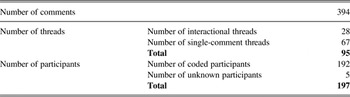
The story elicited 394 comments posted by a total of 197 participants. Most of the comments were posted on the day on which the story was published, a few were added in the following days, and some of the comments that I collected have since disappeared from the website. Before proceeding to the coding and analysis of the comments, I provide some background information on Gawker.
THE BLOG
Gawker is a North American web blog founded in 2003 by Nick Denton and Elizabeth Spiers and based in New York City. It promotes itself as ‘the source for daily Manhattan media news and gossip’ and focuses on celebrities and the media industry. Gawker is the flagship blog for Denton's Gawker Media being just one of the subject specific blogs owned by the company, which is regarded as one of the most popular blog networks. What is interesting about Gawker is that it has devoted a great deal of attention to readers’ comments. In 2013, it added a new platform for comments and posts called Kinja, which allows users to write their own headlines and introductions (Coddington Reference Coddington2014). Gawker has also eliminated the traditional format consisting of comments in reverse order in favor of a two-column format with much greater space for photos, video, and images. Indeed, the two-column format presents entries mostly in chronological reverse order on the right and a summary of ‘trending’ entries on the left (see gawker.com).
Following Blood's classification (2002), Gawker can be regarded as a filter: it is a public blog with a focus on entertainment and gossip about the entertainment world, and even though it encourages reader participation, its bloggers still filter content and comments. It is not easy to find exact data on the blog's readership but data on Gawker media in generalFootnote 2 indicate that the audience is composed of men and women (with a slight majority of men) of different ethnicities, whose most frequent age range is twenty-five to thirty-four, and mostly composed of middle-class individuals who have a college or postgraduate education.
In terms of the platform's affordances: comments can only be posted by people who sign up for an account with Kinja, but all content is public. Comments are posted within a thread defined by an initiating comment. The criteria for appearance of the threads and comments on the blog seem to be a combination of number of responses and time of posting. Thus, most popular threads appear first in the blog, but they are not in strict reverse chronological order as, in the case of the posts analyzed here, threads with fewer comments posted earlier may appear before threads with a greater number of comments but posted later. Within each thread, comments appear in chronological order, with the comment originating the thread in first place.
Participants identify themselves through a pseudonym and sometimes a photo or some kind of visual symbol.
CODING
Comments were collected within one week of the first posting and then I checked periodically to see whether new comments had been posted. Since literature on online comments has focused mainly on reactions to Youtube videos (see e.g. Leppänen & Häkkinen Reference Leppänen and Häkkinen2012; Chun Reference Chun2013; Koven & Marques Reference Koven and Marques2015), no system for coding comments was available for the present analysis. Thus, in order to characterize the frame focus of the comments, the type of interactions among participants, and the use of different media, I devised a system of coding that was first applied to the data by myself and a research assistant and then subsequently refined until we arrived at a number of agreed upon categories that we could apply to our data with little or no disagreement. Based on this system, each comment was coded for the categories given in (1) below.
-
(1) Categories of comments
-
a. Thread to which the comment belonged
-
b. Participant name
-
c. Interactional dynamics
-
d. Frame focus of the comment
-
e. Medium
-
f. Tone
-
With respect to ‘interactional dynamics', each comment was coded for its relation to the other comments within each thread in order to ascertain to what extent participants engaged with each other in a sustained way. The subcategories devised are given below in (2).
-
(2) Interactional dynamics subcategories
-
a. Initiating thread comment: Comments that start a new thread
-
b. Response to initiating thread comment: Comments that are direct responses to the first comment in a thread
-
c. Response to previous comment: Comments that respond to the comment directly preceding them in the thread
-
d. Response to a comment: Comments that respond to another comment in the thread that does not directly precede them or initiates the thread
-
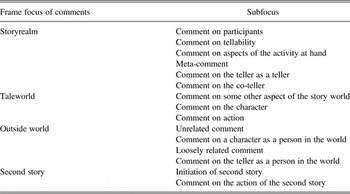
In the ‘frame focus’ category we looked for the main topic of the message. Based on the frames discussed above, we recognized the following foci: the storyrealm, the taleworld, the outside world, or a second story. Each of these frame foci was then subdivided into more specific categories, as shown in Table 1.
Frame focus on comments.

Frame foci were coded based on the most prominent message. If a comment went in more than one direction, we coded for the most prominent category, understood as the category that best summarized the content and function of the message. Thus, there were cases of comments that contained references to more than one category, particularly the longer ones. In those cases, we made a decision based on what appeared to be the most prominent focus of the comment. We coded for the thematic foci below since, as noted above, each of them makes different participant roles and frames potentially relevant.
Storyrealm
As explained in Table 1, comments on the storyrealm focused on the participants (teller, co-teller, and fellow commenters), on the story's tellability, or on aspects of the activity at hand, as can be see from the subcategories specified in (3).
-
(3) Storyrealm subcategories
-
a. Comment on the teller as a teller: Comments about Charlamagne Tha God as the teller of the Rihanna story
-
b. Comment on the co-teller: Comments about Jordan Sargent as the person who posted the story
-
c. Comment on participants: Comments about fellow commenters, who were also participating in the online discussions on Gawker. Comments made by participants about themselves also are captured in this category.
-
d. Comment on tellability: Comments about how interesting and worthy of being told the story is
-
e. Comment on aspects of the activity at hand: Comments about the discussions occurring in Gawker, on a thread in particular, or more in general on the blog as a medium
-
f. Meta-comment: Comments clarifying or commenting about the linguistic meaning of something that has been written
-
Taleworld
Comments about the taleworld focused on the characters and the actions in the story itself.
-
(4) Taleworld subcategories
-
a. Comment on the character: Comments about the characters in the story world
-
b. Comment on action: Comments about actions in the story world
-
c. Comment on some other aspect of the story world: Comments about anything else that specifically relates to the story world
-
Outside world
Comments on the outside world focused on the participants and the story characters as people in the world, not as storytellers, audiences, or blog participants.
-
(5) Subcategories of outside world
-
a. Comment on a character as a person in the world: Comments about people who were characters in the story, discussed outside the context of their actions in the story
-
b. Comment on the teller or co-teller as a person in the world: Comments about Charlamagne or Jordan outside the story world context
-
c. Loosely related comment: Comments about other celebrities, the celebrity world, or anything else that is tangentially related to aspects of the story
-
d. Unrelated comment: Comments that have no relation to the story or any second story
-
Second story
Comments on a second story sometimes initiated a second story based on the originally posted narrative or followed up on someone else's second story.
-
(6) Subcategories of second story
-
a. Initiation of second story: Comments that introduce a new story
-
b. Continuation of second story: Comments that further develop a second story that has already been introduced
-
c. Comment on the action of the second story: Comments about the action that occurs in the second story
-
d. Comment on some other aspect of the second story world: Comments about the second story that do not focus on the characters or actions
-
Medium
Each comment was coded for the medium (or media) that the participant used.
-
(7) Subcategories for medium used
-
a. Text only
-
b. Text and video
-
c. Text and photo
-
d. Text and GIF
-
e. Photo only
-
f. Video only
-
Tone
Each comment was coded for the overall tone of the message.
-
(8) Subcategories for tone of message
-
a. Aggressive: Comments that have a negative or hostile tone towards something or someone
-
b. Neutral: Comments that are neither positive or negative
-
c. Amicable: Comments that have a positive or friendly tone towards something or someone
-
d. Ironic: Comments that have a humorous, sarcastic, or mocking tone towards something or someone
-
Of course these categories are not as clear-cut as they may look. It is not easy, for example, to distinguish between irony and aggressiveness. Thus, in order to decide whether a comment was aggressive rather than ironic we relied on the direct use of insults, bad words, and disparaging expressions. Cues for irony included exaggeration or the use of metaphoric and sophisticated vocabulary. Positive comments were characterized basically by the presence of expressions of praise and solidarity with previous commenters. Coding tone was important in order to understand how confrontational or nonconfrontational these online exchanges were.
I consider examples of most of the categories described above later, together with the discussion of the results of the analysis, since these concrete instances help illustrate their implications.
ANALYSIS
As mentioned, most of the comments analyzed here were published on the day the story was posted on the web and in the immediately following days. Those comments that disappeared after some time were included in the analysis but remained uncoded in terms of the participant's name. As can be seen in Table 2, the discussion included 394 comments that were posted by 197 participants. Most of the comments (about 83%) were posted as part of a discussion thread, which was separated on the blog from other threads by a dotted line. There were ninety-five threads, but only twenty-eight of them (29%) had more than one participant, while sixty-seven (71%) were constituted by single comments that did not have a follow up.
Comments and participants.

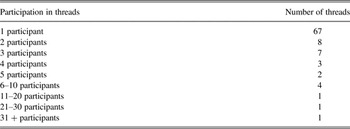
As seen in Table 3 below, only three threads had more than ten participants. The thread with the most participants and comments had 154 comments, which constitute almost 40% of the total. Thus, while interaction was sustained in some cases, in other cases there was practically no interaction.
Threads by number of participants.

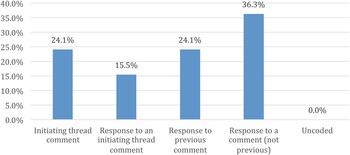
Figure 1 shows the interactional dynamics in more detail. What emerges is that almost one quarter of the comments were in the initiating thread category and the most populated category was a response to some (not a previous) comment (36%).
Interactional dynamics.

Thus, most of the comments were not posted in response to a previous comment in the thread, which means that sustained dialogues on the same topic were not the most typical kind of interaction. Rather, as we see below, users tended either to put out their own opinions without paying much attention to what had come before, or to digress into new topics. This lack of topic development, which is compatible with the findings of previous research (see Herring Reference Herring, Tannen and Trester2013) points to the fact that participants are not really focused on the content and informational components of online communication, but rather on other aspects of it, and therefore they do not feel particularly obliged to stay on point.
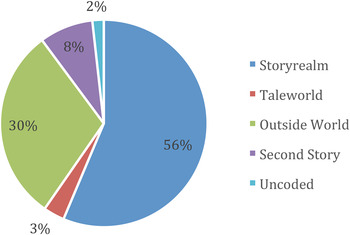
The most important results of the analysis of frame foci of comments are summarized in Figure 2. The main focus of comments was the storyrealm (56%), followed by the outside world context (30%), then by comments on a second story (8%), and finally by comments in the taleworld (2%). Thus, more than half of the comments were devoted to the storytelling context and more than one third to the world outside of the story.
Main thematic focus.

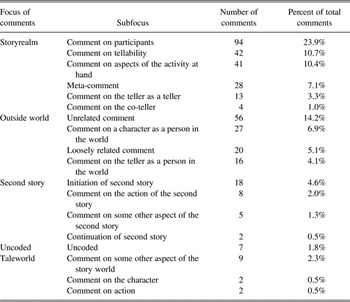
Table 4 summarizes the data for all of the subcategories analyzed. Among other things, Table 4 shows that while in the storyrealm the most discussed objects were the participants, in the taleworld the least discussed were the characters. It is also worth noting the importance of ‘tellability’ and ‘activity at hand’ as topics of discussion. Also notable is the highest category in the ‘outside world’ context: the unrelated comment. This shows once again how blog participants tend to go off in different directions when engaged in a discussion.
Focus of comments organized by subfocus.

Let us now look closely at examples of comments in the different categories. With respect to the storyrealm, as mentioned above, a lot of attention was devoted by the participants to other participants, either as commenters or as teller and co-teller. These kinds of comments contained (usually negative) judgments about other participants' personal traits, attitudes, or states, and, while touching upon what the other commenter said, actually evaluated him or her as a person. See, for example, the following comments addressed to fellow commenters:
-
(1) Fess up: How high are you right now.
-
(2) You are ordinary. If you party with people who are not ordinary let Gawker know and they might report it.
-
(3) Man you are dumb! Glad we have a record of it here.
In examples (1) through (3), commenters are targeting negative traits of the interlocutor, who is being described as on drugs, ordinary, or dumb. Comments on the teller and co-teller (the blogger who posted the story) were not very different. In (4) the blogger is presented as an unsuccessful storyteller:
-
(4) Half way through, I started to feel embarased [sic] for him. [referring to the blogger]
Comments on tellability directly challenged the interest and significance of the story. Many criticized the fact that just being about a celebrity made the story worthwhile. See, for example, the following comments that showed strong disagreement with the story evaluation as ‘amazing’:
-
(5) So she's [referring to Rihanna] amazing because she went to a party with ordinary people? I'm going to a party with ordinary people tomorrow, can I get an article on Gawker about that
-
(6) I'm trying to understand what about that story is “amazing”. Charlamagne, who has an influential NYC radio show, goes to L.A. and publicity-savvy Rihanna takes him to where the after-hours party is. Amazing.
Comments on the activity at hand are interesting because of their reflexive nature, as they demonstrate participants' attention to their own role in the storyrealm. Indeed, they focus on posting on the blog as an activity and to the actions of other commenters as participants in the blog:
-
(7) I LOVE GAWKER COMMENTS!!!!!!!!!!!! HAHAHHAHA
-
(8) You could call this thread a Trivial Pursuit into the nothingness.
Meta-comments were also reflexive in that they referred to language as a code. They included clarifications about meaning and clarity and observations on how words or expressions were written. In (9) below, one of the participants quotes another participant's words and explains them to a third one.
-
(9) I don't understand why you don't understand that. “You kind of have to though. Go to a party with ordinary people.”
You kind of have to go to parties with ordinary people, since you are presumably not famous enough to get invited to parties with celebrities. Whereas Rihanna is famous, so she doesn't have to go to parties with ordinary people.
In (10) a participant asks for a clarification about the meaning of an expression used by another commenter.
-
(10) What does “with two roadies in her coat pocket” mean? a) Two people who work on concert tours somehow became small enough to fit in a pocket. b) There was a very large coat and two normal-sized roadies in the pockets. c) Roadies does not mean what I think it means.
The second more popular category of comments refers to the outside world. In this case, participants talk about the tellers and the characters as entertainment personalities or just as people. Thus, the general frame of the comment refers to a domain that is external to the storytelling and mostly has to do with the world of entertainment. For example, see the following comments, both quite ironic, about Charlamagne making fun of his ‘ego’ as reflected in the name in (11) and Rihanna as a bad singer in (12).
-
(11) I sincerely hope that the gentleman who calls himself Charlamagne Da God has a sidekick who calls himself Will.i.am. Da Klonkerer.
-
(12) It would be more amazing if someone told me that she was capable of singing more than four different musical notes.
Included in the outside world category were loosely related or completely unrelated comments, that is, statements and observations that deviated from the topics described above and that sometimes initiated a side sequence. For example, the comment in (13) initiated a whole side sequence about names.
-
(13) You know we were actually asked in class the other day what the name of Gwyneth Paltrow's son was? Everyone knew Apple, nobody knew Moses.
Comments classified as second stories were narratives (and narrative components) that presented alternative developments to the ones offered by the teller and co-teller or follow-ups to them. Example (14) represents a beginning to a second story, again with a critical twist.
-
(14) This one time I was walking down the street and I saw Rihanna. She was also walking down the street.
Seriously……. SHE WAS FUCKING WALKING DOWN THE STREET.
Cray Cray.
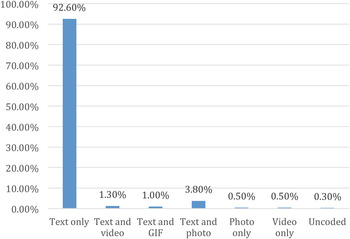
Data on the medium used by participants confirms the primacy of textual resources with respect to other media in many online environments (see Page Reference Page2012). Figure 3 summarizes the analysis:
Media used in comments.

Figure 3 shows that about 93% of comments used text only, about 4% used text and a photo, 1.3% used text and video, and 1% used text and GIF. Only rarely did people use a photo or a video without text. Some photos and GIFs featured, of course, Rihanna herself in all kinds of poses.
Sometimes the image clarified and complimented the text, while at other times photos were posted without text so that their implications and meanings were left to the reader. In other cases, commenters creatively played on related or unrelated topics through their use of videos, photos, and GIFs.
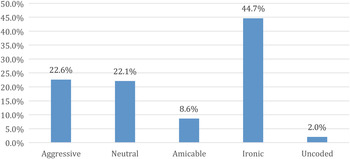
With respect to tone of the messages, the results are summarized in Figure 4.
Tone of the message.

As mentioned above, the coding here had a certain level of subjectivity as the boundaries between aggressiveness, irony, and sarcasm are not that clear. But, in any case, if we put together ironic and aggressive comments, what unsurprisingly emerges is that they constitute more than half of the data (about 67%), while amicable comments were the least frequent, and neutral comments only constituted 22% of the data.
DISCUSSION
The analysis of this data offers the basis for some interesting reflections on the directions taken by participant-initiated practices in social media. The results confirm the lure of the participatory culture. When given the opportunity, blog readers like to speak their minds and take advantage of the possibilities for interaction and opinion sharing offered by the media. We are now in a position, however, to be more specific about the kind of participation that takes place in this type of digital environment. It is clear, for example, that interactions among participants are mostly neither sustained, nor very much on topic. Most of the posts do not receive direct comments, that is, authors are rarely chosen as principal addressees by other participants, and when comments are issued they are usually not part of a set of turns by the same participants. Because there are so few commenters that enter into dialogue with each other, topics and frame foci change both from one thread to another and within the same thread. Another tendency, which has been observed elsewhere in social media exchanges (Oegema, Kleinnijenhuis, Anderson, & van Hoop Reference Oegema, Kleinnijenhuis, Anderson, van Hoop, Konijn, Utz, Tanis and Barnes2008) and is confirmed here, is the generally ‘unfriendly’ nature of many online environments. Researchers have talked a great deal about aggressiveness in online environments (see papers in Dery Reference Dery1994). In this case, we see that most of the comments have a non-neutral tone and more than half are either directly negative or ironic. It is also remarkable how in cases where two participants disagree with each other, when there is a continuation of the interaction, there is also an escalation in negativity. This too is in line with research suggesting that online environments, very likely because of their ability to afford anonymity or the assumption of virtual identities, facilitate what has been called ‘emotional excess’ (Deuze Reference Deuze2014:52).
The analysis of frame foci also provides very interesting insights into participation trends. As we have seen, the most important frame foci of comments are the storyrealm and the outside world, while comments that center on the taleworld and characters constitute a minimal part of the data. Even though a direct comparison with offline environments is not possible, as studies of story evaluation in face-to-face interaction are scarce, literature on story openings and closings (e.g. Jefferson Reference Jefferson and Schenkein1978) suggests that audiences usually comment on the story itself and try to make their talk topically relevant and in line with the message of the story. Labov (Reference Labov1972) talked of story evaluation as being fundamentally about the point of the story, intended as the main message. He and many others have talked about stories being a prime genre for audience engrossment and involvement. According to his and many others’ view of stories, particularly canonical ones like the story that initiated the comments analyzed, these have the power to draw audiences into the taleworld, making them forget the interaction where the telling is happening.
Storytelling is also usually regarded as a cooperative environment, so much so that analyses of uncooperative or challenging audience reactions are not common. Of course, these observations refer to everyday storytelling and not to more competitive environments such as legal or political settings. On the contrary, in the data analyzed here, challenges to tellers' personalities and rights and to tellability are common. This focus on aspects of the storytelling event is compounded by attention to the medium and the activity at hand and to the use of language (meta-comments), which together make up about 18% of the comments in the storyrealm focus category. These results point to the enhanced reflexivity that online environments afford. Such reflexivity may be regarded as related to different factors. On the one hand, the fact that comments are posted and written paradoxically allows for greater permanence of opinions and therefore for less spontaneous reactions to a story or to other participants' contributions. On the other hand, the participatory culture and online environments encourage performance as a central act of self-presentation. Indeed, according to Bauman (Reference Bauman2010:20), media environments are not so much about ‘being known but about being seen’. And being witty or funny or confrontational makes individuals definitely more visible than being cooperative or friendly, as it allows them to put forth their individuality. Miller (Reference Miller2008) argues that new media culture is becoming less and less focused on content and on the exchange of information and more and more phatic. In this case, therefore, the story itself loses its attraction, while other aspects of the storytelling come into prominence. And of course, with Gawker being a gossip blog, the outside world, which in this case is the world of celebrities and their fans, acquires a more prominent focus than the story world, too.
The study also has some wider implications for narrative analysis as it demonstrates that online environments do not always represent the demise of the big, highly performed monological story. Indeed, Charlemagne's story responds to all of the criteria of a canonical narrative: it presents a series of chronologically ordered events, a complicating action, a resolution, and it is highly evaluated and performed. What happens to the big story in social media is that it becomes, as everything else, subject to recontextualizations, contestations, and all sorts of manipulations that would not have been possible in offline environments.
To conclude, let me go back to the beginning. At the start of this article, I quoted Androutsopoulos' call for contextualized studies of online practices and his caution against easy generalizations. The observations made here are very much tied to the context in which this storytelling took place: a blog focused on gossip. It is therefore important to note that the characteristics of audience participation described here are closely related to this kind of environment. However, many of the phenomena discussed—that is, the enhancement of reflexivity, the performative aspects of communication, the reduced topicality of interactions, and the mostly non-neutral tone of exchanges that were found in the participatory practices of this community—seem to be the norm in other social media environments. Thus, looking at online communication as semiotic practice offers a glimpse into both ways in which resources and affordances are deployed by users of particular platforms and more general ways in which the use of technologies is shaping interaction and culture in the late-modern world.
APPENDIX A: PARTIAL TRANSCRIPT OF THE YOUTUBE VIDEO ‘CHARLAMAGNE “RIHANNA IS THE REALEST SINCE TUPAC”’
In the absence of permission from the copyright holder, the transcript of the video cannot be reproduced in its entirety, but a partial transcript is given below. Dotted lines indicate missing parts of the transcript. The video was originally posted on the Vlad TV YouTube channel (https://www.youtube.com/watch?v=ejRwLJcXjGQ) and reposted on many social media. The transcript was made by the author, from a reposting on Gawker (gawker.com/this-is-an-amazing-story-about-rihanna-partying-1509002561; accessed 26 January 2015).
-
1. ………………
-
2. I'm in LA. I'm in LA for the MTV Movie Awards.
-
3. ………………
-
4. ………………
-
5. ………………
-
6. ………………
-
7. ………………
-
8. We in the lobby drunk as hell,
-
9. ………………
-
10. ………………
-
11. I put on Twitter, “I'm drunk in LA.”
-
12. Rihanna retweets me and says “I want in.”
-
13. So I retweet her and say “Check your DM.”
-
14. ………………
-
15. I send her a DM like “Yo, I'm at the Beverly Hills SLS Hotel, you know, waon't you
-
16. come trough, have some drinks?”
-
17. ………………
-
18. She hits me back, “Word.”
-
19. ………………
-
20. ………………
-
21. ………………
-
22. ………………
-
23. She was like “Well what-chu wanna do?”
-
24. I said, “Well this your town, take me somewhere.”
-
25. She was like “A-ight I'm on da way.”
-
26. ………………
-
27. ………………
-
28. Bout fifteen-twenty minutes later, black SUV pulls up.
-
29. Rihanna jumps out.
-
30. ………………
-
31. Coolest chick in the world.
-
32. ………………
-
33. ………………
-
34. ………………
-
35. ………………
-
36. She like “Let's go.”
-
37. ………………
-
38. Wsh- we go to the hood.
-
39. ………………
-
40. Like, when I tell you Rihanna is the realest nigga in the game since Tupac,
-
41. ………………
-
42. ………………
-
43. And it wasn't even like a club.
-
44. ………………
-
45. Da club was so hood, Beanie Sigel was in da club, my nigga
-
46. ………………
-
47. ………………
-
48. ………………
-
49. We orderin mad bottles of Patron, you know, d-f- mad weed bein rolled up,
-
50. ………………
-
51. ………………
-
52. I'm in a fuckin hood club, with Rihanna.
-
53. ………………
-
54. End of the night comes, Rihanna's like, “Yo,”
-
55. ………………
-
56. She was like “I got a car outside for you.”
-
57. ………………
-
58. ………………
-
59. She went outside, paid the car, we got in the car service, and left.
-
60. And so it's like, n- people don't even really believe that that story happened.
-
61. “………………
-
62. took you to the hood? Beanie Sigel was in da club?”
-
63. ………………
-
64. ………………
-
65. ………………
-
66. This shit really happened.
-
67. That's why I say Rihanna, Robyn Rihanna Fenty is one real-ass nigga.
-
68. She is the realest mother-fucka, in the game, since Tupac.
-
69. ………………
-
70. ………………
-
71. ………………
-
72. And when I tell you she jumped out the spot at this hood club, and all the hoodniggas
-
73. was showin her respect,
-
74. ………………
-
75. ………………
-
76. ………………
-
77. ………………
-
78. She ain't even had no- it was just and her- when she picked me up it was just her
-
79. and the driva.
-
80. ………………
-
81. ………………
-
82. ………………
-
83. ………………
-
84. This was, super pop star Rihanna.
-
85. Eh, I got numbas love, and respect for her, I gotta salute her.
APPENDIX B: TRANSCRIPTION CONVENTIONS
- ?
-
rising intonation
- .
-
falling intonation
- ,
-
slight pause, but not end of unit
- !
-
emphasis
- “word”
-
constructed dialogue (determined by context, often including a higher pitch)
- (word)
-
sounds in conversation, descriptions of voice/sounds
- word
-
emphatic stress
- :
-
elongated sound (placed after a vowel)
- -
-
abrupt stop in speech, sometimes after a false start