



1 Introduction and preliminary results
Throughout this note, for a semigroup
 $S,$
the set of idempotents of S is denoted by E. A semigroup S is called completely regular if and only if it is a disjoint union of groups. A semigroup S is called orthodox if E is a subsemigroup of S. A semigroup S is an orthodox union of groups (or an orthogroup) if it is completely regular and orthodox (see [Reference Petrich16]). A semigroup S is called a band of groups if there exists a congruence
 $\beta $
such that
 $S / \beta $
is a band and each
 $\beta $
-class is a group. A semigroup is an orthodox band of groups if S is an orthodox semigroup which is a band of groups. Recall that by [Reference Nagy14, Theorem 1.29] an orthogroup S is an orthodox band of groups if and only if the Green’s equivalence relation
 $\mathcal {H}^S$
is a congruence on S. The family of orthodox bands of groups contains the families of Clifford semigroups and rectangular groups (for more details, see [Reference Nagy14]).
Recall that a semigroup S is called left amenable if there is a mean on
 $\ell _\infty (S),$
which is invariant under the natural left action of S on the dual space
 $\ell _\infty (S)'$
. Equivalently [Reference Paterson15, Problem 0.32], S is left amenable if it admits a finitely additive probability measure
 $\mu $
, defined on all the subsets of S, which is left invariant, in the sense that
 $\mu (t^{-1}X) = \mu (X)$
for all
 $X \subseteq S$
and
 $t \in S$
, where
 $t^{-1}X=\{s\in S \mid ts \in X\}$
. Recall that all commutative semigroups and all semigroups with zero are left amenable (see [Reference Gray and Kambites6]). These semigroups are studied extensively and several authors presented necessary or sufficient conditions for a semigroup to be left amenable (for more details and a list of related works, see [Reference Gray and Kambites6, Reference Guba7]).
As the main part of this study, conditions are investigated under which the left amenability of a semigroup S can be determined by the properties of E and its equivalent classes with respect to Green’s relation
 $\mathcal {H}^S$
. For this purpose, the case “all
 $\mathcal {H}^S$
-classes of a semigroup are its subsemigroups” is considered. Since by [Reference Howie9, Theorem 2.2.5], an
 $\mathcal {H}^S$
-class of S is a semigroup if and only if it is a subgroup of S, I consider the family of semigroups S for which all
 $\mathcal {H}^S$
-classes of S are groups. Note that for these semigroups, there exists a natural measure on E induced by the quotient
 $S/\mathcal {H}^S$
. On the other hand, note that for a left amenable semigroup S, the measure of an
 $\mathcal {H}^S$
-class may be zero. Hence, to be able to determine a left amenable semigroup by the properties of its
 $\mathcal {H}^S$
-classes and E, also it is supposed that E is a subsemigroup of S. So from now on, the family of orthodox bands of groups is mainly considered and studied.
In this note, I focus on the study of left amenable orthodox bands of groups using Green’s relations. First, by proving Theorem 2.2, it is shown that in a left amenable regular semigroup, the measures of every pair of
 $\mathcal {H}^S$
-classes in the same
 $\mathcal {L}^S$
-class are equal. Then, in Theorem 2.6, for an orthodox band of groups
 $S,$
using this fact we show that under some assumptions, the left amenablity of S can be determined by the left amenability of E and the left amenability of its
 $\mathcal {H}^S$
-classes. As we will see, the proof of the sufficiency part of the this theorem provides us an explicit method for constructing left amenable semigroups using semilattice of groups, Rees matrix semigroups, or extensions of a left amenable group by a semilattice (see [Reference Margolis and Pin13], Equation 2.1, and Theorem 3.7).
In Section 3, for an arbitrary monoid
 $S,$
a connection between left amenability of S and injectivity of two-element right S-Boolean algebra in the category of S-Boolean algebras is established (see Remark 3.1 and Theorem 3.4). Then, in Theorem 3.6, for an orthodox band of groups S under some assumptions, it is proved that when E has a zero element z, then the left amenability of S can be determined by the left amenability of the subgroup of S which contains z. Also, when E is commutative, this relation is studied and especially it is proved that if E is finite and commutative, then it has a zero element. Finally, in this note, in Theorem 3.7, as a consequence of Theorems 3.4 and 3.6, left amenable Clifford semigroups and left amenable rectangular groups are explicitly determined when E is finite, or E is countable and it is left amenable with a measure which is countably additive.
Now, some notions and facts are recalled which are needed in the sequel. For every set X by
 $2^X$
, we mean the power set of X. For a semigroup S and
 $t\in S,$
let
 $\lambda _t:S\to S$
and
 $\rho _t:S\to S$
be defined by
 $\lambda _t(s)=ts$
and
 $\rho _t(s)=st$
for every
 $s\in S$
, respectively. Recall that an element t of a semigroup S is called regular if there exists x in S such that
 $txt = t$
. The semigroup S is called regular if all its elements are regular. A semigroup S is called completely regular if there exists a unary operation
 $t\mapsto t^{-1}$
on S with the properties
 $(t^{-1})^{-1}=t$
,
 $tt^{-1}t=t,$
and
 $tt^{-1}=t^{-1}t$
.
An idempotent semigroup is called a band and a commutative band is called a semilattice. Recall that a semigroup S is called a semilattice of semigroups,
 $S_\alpha $
,
 ${\alpha \in Y}$
, if:
-
(1) Y is a semilattice;
-
(2)
 $S=\dot {\cup }_{\alpha \in Y}S_\alpha $
, where
$\dot {\cup }$
denotes the disjoint union of
$S_\alpha $
’s;
-
(3)
$S_\alpha S_\beta \subseteq S_{\alpha \beta }$
, where
$\alpha \beta $
is the product of
$\alpha $
and
$\beta $
in Y.


An element c in a semigroup S is called central if
 $cs = sc$
for every s in S. A Clifford semigroup is defined as a completely regular semigroup S together with a unary operation
 $^{-1}:S\to S$
in which, for all x, y in
 $S,$
we have
 $(xx^{-1})(yy^{-1}) = (yy^{-1} )(xx^{-1})$
. It is a known fact that the following conditions are equivalent (see [Reference Howie9, Theorem 4.2.1]): (i) S is a Clifford semigroup; (ii) S is a semilattice of groups; and (iii) S is regular, and the idempotents of S are central. Based on this theorem, to prove our results for Clifford semigroups, it is proved for a semilattice of groups. Furthermore, without loss of generality, it is supposed that Y is the set of idempotents of S.
Let G be a group, let I,
 $\Gamma $
be non-empty sets and let
 $P = (P_{\gamma i})$
be a
 ${\Gamma \times I}$
matrix with entries in G. Let
 $S = (I \times G \times \Gamma )$
, and define a multiplication on S by
 $(i_1,a,\gamma _1)(i_2,b,\gamma _2) = (i_1,ap_{\gamma _1 i_2}b,\gamma _2)$
. This semigroup is denoted by
 ${S=\mathcal {M}[G; I, \Gamma; P]}$
and it is called a Rees matrix semigroup congruence over G (see [Reference Howie9]). A semigroup S is completely simple if S is simple and if it contains a primitive idempotent (by which we mean an idempotent which is minimal within the set of all idempotents of S). By [Reference Howie9, Theorem 3.3.1] completely simple semigroups are exactly Rees matrix semigroups over groups.
Recall that a semigroup S is a Clifford semigroup if and only if it is a semilattice of groups (see [Reference Howie9, Theorem 4.2.1]). Also recall that a semigroup S is completely simple if and only if it is isomorphic to a Rees matrix semigroup
 $\mathcal {M}[G; I, \Gamma; P]$
for some group G (see [Reference Howie9, Theorem 3.3.1]). A semigroup S is called a rectangular band if
 $aba = a$
for all
 $a, b\in S$
. By [Reference Howie9, Theorem 1.1.3], a semigroup S is a rectangular band if and only if S is isomorphic to a semigroup of the form
 $A \times B$
, where A and B are non-empty sets, and where multiplication is given by
 $(a_1,b_1)(a_2,b_2) = (a_1,b_2)$
. A semigroup S is called a rectangular group if it is isomorphic to the direct product of a group and a rectangular band. By [Reference Nagy14, Theorem 1.26], a semigroup is a rectangular group if and only if it is a completely simple semigroup in which the idempotents form a subsemigroup. By [Reference Howie9, Theorem 4.2.1], the family of rectangular groups and the family of Clifford semigroups are contained in the family of orthogroups.
For two equivalence relations
 $R_1$
and
 $R _2$
on a set X, by
 $R_2\circ R_1,$
we mean the relation
 $$ \begin{align*}R_2\circ R_1=\{(x_1,x_2)\in X\times X\mid \exists z\in X \text{ such that } (x_1,z)\in R_1 \text{ and } (z,x_2)\in R_2\}.\end{align*} $$
The equivalence relations
 $\mathcal {L}^S$
and
 $\mathcal {R}^S$
on a semigroup S are defined by
 $$ \begin{align*}(a\mathcal{L}^S b \Leftrightarrow Sa\cup\{a\}=Sb\cup\{b\}) \text{ and } (a\mathcal{R}^S b\Leftrightarrow aS\cup\{a\}=bS\cup\{b\})\end{align*} $$
for every
 $a,b\in S$
, respectively. Also recall
 $\mathcal {H}^S=\mathcal {R}^S\cap \mathcal {L}^S$
and
 $\mathcal {D}^S=\mathcal {R}^S\circ \mathcal {L}^S$
. Note that if there is no ambitious about S, these relations are simply denoted by
 $\mathcal {L}$
,
 $\mathcal {R}$
,
 $\mathcal {H,}$
and
 $\mathcal {D}$
.
For a regular semigroup
 $S,$
recall that the relation
 $\mathcal {R}^S$
on S can be defined by
 ${(a,b)\in \mathcal {R}^S}$
if and only if
 $aS = bS$
. Similarly, the relation
 $\mathcal {L}^S$
can be defined by
 $(a,b)\in \mathcal {L}^S$
if and only if
 $Sa=Sb$
(see [Reference Howie9, Section 2.4]). It is a known fact for an orthodox band of groups, every
 $\mathcal {H}^S$
-class of S is a subgroup of S and so it has a unique idempotent element (see [Reference Howie9, Theorem 2.2.5]) and every two
 $\mathcal {H}^S$
-classes H and K in a
 $\mathcal {D}^S$
-class are isomorphic (see [Reference Howie9, Proposition 2.3.6]). The
 $\mathcal {L}^S$
-class [
 $\mathcal {R}^S$
-class,
 $\mathcal {H}^S$
-class] containing the element
 $a\in S$
will be denoted by
 $L_a$
[
 $R_a$
,
 $H_a$
]. Recall that the following partial orders are defined on
 $S/\mathcal {L}^S$
and
 $S/\mathcal {R}^S$
:
 $$ \begin{align*}L_a \leq L_b \text{ if } Sa\subseteq Sb;\ \text{ }\ R_a\leq R_b \text{ if } aS\subseteq bS.\end{align*} $$
Let U be a subsemigroup of S. Then, the relation
 $\mathcal {R}^U$
on U is defined as follows: for every
 $u,v\in U,$
let
 $(u,v)\in \mathcal {R}^U$
if and only if
 $uU^1=vU^1$
, where
 $U^1$
denotes the semigroup U with an adjoined identity
 $1$
. Also by
 $\mathcal {R}_u^U$
, we mean the
 $\mathcal {R}^U$
-class of which contains
 $u\in U$
. Note that by [Reference Howie9, Proposition 2.4.1], if
 $U=S$
, then the above definitions for
 $\mathcal {R}^S$
and
 $\mathcal {L}^S$
are equivalent.
A semigroup S is said to satisfy the Klawe condition if whenever s,
 $x,$
and y in S are such that
 $sx = sy$
, there exists
 $t\in S$
so that
 $xt = yt$
(see [Reference Gray and Kambites6, Reference Klawe11]). Finally, recall that there are some combinatorial conditions related to the left amenability of semigroups, which are used for presenting necessary or sufficient conditions for this property. In the following, two main conditions are recalled, which are based on the sizes of subsets of a semigroup. For more details about these conditions and their applications, see [Reference Dikranjan, Fornasiero, Giordano Bruno and Salizzani2, Reference Gray and Kambites6]. A semigroup S satisfies the Følner condition (FC) if for every finite subset K of S and every
 $\epsilon> 0$
, there is a finite subset F of S with
 $|sF \setminus F|\leq \epsilon |F|$
for all
 $s \in K$
. A semigroup S satisfies the strong FC (SFC) if for every finite subset K of S and every
 $\epsilon> 0$
, there is a finite subset F of S with
 $|F \setminus sF| \leq \epsilon |F|$
for all
 $s\in K$
. Recall that SFC implies left amenability, and amenability implies FC, but neither of these implications is reversible.
2 Left amenability of regular semigroups and Green relations
Recall that every two group
 $\mathcal {H}^S$
-classes of a regular semigroup in the same
 $\mathcal {D}^S$
-class are isomorphic and so they have the same cardinality (see [Reference Howie9, Proposition 2.3.6]). In the next results, it is shown that there is a similar statement about
 $\mathcal {H}^S$
-classes in the same
 $\mathcal {L}^S$
-class of a left amenable semigroup.
Lemma 2.1 Let S be a regular semigroup which is left amenable for some measure
 $\mu $
. Then, for every pair of group
 $\mathcal {H}^S$
-classes
 $H_1$
and
 $H_2$
contained in an
 $\mathcal {L}^S$
-class L of
 $S,$
we have
 $\mu (H_1)=\mu (H_2)$
.
Proof To prove the assertion, it is shown that if f is the idempotent of
 $H_1=H_f$
, then for every
 $a\mathcal {L}^S f,$
which is in a group
 $\mathcal {H}^S$
-class of
 $S,$
we have
 $\mu (H_a)=\mu (H_1)$
. If f is the only idempotent of
 $D_f$
, then we have nothing to prove because
 $H_f$
is the only group
 $\mathcal {H}^S$
-class of
 $D_f$
. So suppose that
 $e\in S$
is an idempotent such that
 $e\in D_f$
. Then, by [Reference Howie8, Theorem 2.3.4] and [Reference Howie8, Lemmas 2.2.1 and 2.2.2], there exists an inverse
 $a'\in R_f\cap L_e$
of a for which
 $aa'=e$
and
 $a'a=f$
such that
 $\lambda _{a'}:R_a\to R_f$
and
 $\rho _a:L_e=L_{a'}\to L_f$
are two bijections which preserve
 $\mathcal {L}^S$
-classes and
 $\mathcal {R}^S$
-classes, respectively.
Therefore,
 $\lambda _{a'}(H_a)=H_f$
and
 $\rho _a(H_e)=H_a$
. Since
 $H_a\subseteq a^{\prime -1}(a'H_a)=a^{\prime -1}H_f$
, we have
 $$ \begin{align*}\mu(H_a)\leq \mu(a^{\prime-1}(a'H_a))=\mu(a'H_a)=\mu(H_f).\end{align*} $$
On the other hand, since every group
 $\mathcal {H}^S$
-classes of S is regular, without loss of generality, we suppose that a is an idempotent element of S. So by the symmetry, we have
 $\mu (H_a)\geq \mu (H_f)$
. Hence, for every pair of group
 $\mathcal {H}^S$
-classes
 $H_1$
and
 $H_2$
in
 $L,$
we have
 $\mu (H_1)=\mu (H_2)$
.
Now, we are in the position to prove our first main result, which shows the close connection between Green’s relation
 $\mathcal {L}^S$
and left amenability of regular semigroups. Recall that by [Reference Howie9, Lemma 2.2.3], every two
 $\mathcal {H}^S$
-classes in the same
 $\mathcal {L}^S$
-class of a semigroup S have the same cardinality.
Theorem 2.2 Let S be a regular semigroup which is left amenable for some measure
 $\mu $
. Then, for every pair of
 $\mathcal {H}^S$
-classes
 $H_1$
and
 $H_2$
contained in the same
 $\mathcal {L}^S$
-class of
 $S,$
we have
 $\mu (H_1)=\mu (H_2)$
.
Proof To prove the assertion first, it is shown that for an
 $\mathcal {L}^S$
-class L of S and an
 $\mathcal {H}^S$
-class H in
 $L,$
there exists a group
 $\mathcal {H}^S$
-class
 $H_f$
of L for some
 $f\in E$
such that
 $\mu (H)=\mu (H_f)$
. For
 $h\in H,$
since S is regular, by [Reference Howie9, Proposition 2.3.2] L and
 $R_h$
contain idempotents f and e, respectively. Since
 $h\in H=L\cap R_h$
, by [Reference Howie9, Theorem 2.3.4] there exists
 $h^*\in R_f\cap L_e$
such that
 $h^*h=f$
and
 $hh^*=e$
.
Since
 $h^{*}h=f$
and
 $hf=h$
, by [Reference Howie9, Lemma 2.2.2]
 $\lambda _{h^*}:R_h\to R_f$
and
 $\lambda _h:R_f\to R_h$
are bijections which preserve
 $\mathcal {L}^S$
-classes. Hence,
 $$ \begin{align*}h^*H=\lambda_{h^*}(R_h\cap L)=H_f\text{ and } hH_f=\lambda_h(H_f)=\lambda_h(L\cap R_f)=H.\end{align*} $$
Since S is left amenable and
 $H\subseteq (h^*)^{-1}H_f$
, we have
 $ \mu (H)\leq \mu ((h^*)^{-1}H_f)=\mu (H_f)$
. Similarly, since
 $H_f\subseteq h^{-1}H$
, we have
 $\mu (H_f)\leq \mu (h^{-1}H)=\mu (H)$
. Therefore,
 ${\mu (H)=\mu (H_f)}$
and since H is arbitrary, by Lemma 2.2, every two
 $\mathcal {H}^S$
-classes in the same
 $\mathcal {L}^S$
-class have the same measure.
Corollary 2.3 Let S be a regular semigroup which is left amenable for some measure
 $\mu $
. Then, the following hold.
-
(1) If for every
$s\in S$
and
$X\subseteq S,$
we have
$\mu (Xs^{-1})=\mu (X)$
in which
$Xs^{-1}=\{t\in S\mid ts\in X\}$
, then every pair of group
$\mathcal {H}^S$
-classes of S in the same
$\mathcal {D}^S$
-class have the same measure. -
(2) The
$\mathcal {L}^S$
-classes of S are partitioned into the following collections: and
$$ \begin{align*}\mathcal{L}^S(0)=\{L\mid \mu(H)=0 \text{ for every } \mathcal{H}^S\text{-class } H\subseteq L\}\end{align*} $$
$$ \begin{align*}\mathcal{L}^S(1)=\{L\mid \mu(H)\neq 0 \text{ for every } \mathcal{H}^S\text{-class } H\subseteq L\}.\end{align*} $$


Proof (i) By Theorem 2.2, it is only needed to show that for every pair of
 $\mathcal {H}^S$
-classes
 $H_e$
and
 $H_f$
contained in the same
 $\mathcal {R}^S$
-class of
 $S,$
we have
 $\mu (H_e)=\mu (H_f)$
, where
 $e,f\in E$
. Since
 $e\mathcal {R}f$
, then
 $ef=f$
and
 $fe=e$
. Therefore, by [Reference Howie9, Lemma 2.2.1] the map
 $\rho _e:H_f\to H_e$
and
 $\rho _f:H_e\to H_f$
are two bijections. Now, by the assumption, since
 $\mu (H_e)=\mu (H_e e^{-1})\geq \mu (H_f) \text { and } \mu (H_f)=\mu (H_f f^{-1})\geq \mu (H_e)$
, the assertion holds.
(ii) It is clear by Theorem 2.2.
The above partitioning of
 $\mathcal {L}^S$
-classes of a regular semigroup is a fundamental fact which will be used in the rest of this note.
Remark 2.4 Suppose that
 $\{a_\gamma \mid \gamma \in \Gamma \}$
is a set of nonnegative real numbers, where
 $\Gamma $
is a non-empty set. Recall that
 $$ \begin{align*}\sum_{\gamma\in \Gamma}a_\gamma=\sup_{\Gamma_0\in \mathcal{S}}\sum_{\gamma\in\Gamma_0}a_\gamma,\end{align*} $$
where
 $\mathcal {S}=\{\Gamma _0\mid \Gamma _0 \text { is a finite subset of }\Gamma \}$
. Note that if
 $\Gamma $
is uncountable, then the series
 $\sum _{\gamma \in \Gamma }a_\gamma $
converges only if there exists a countable subset B of
 $\Gamma $
such that for every
 $\gamma \in \Gamma \setminus B,$
we have
 $a_\gamma =0$
(note that if
 $\sum _{\gamma \in \Gamma }a_\gamma $
converges and uncountably number of
 $a_\gamma $
’s are nonzero, then there exists a natural number N for which
 ${I_N=\{\gamma \in \Gamma \mid a_\gamma \geq {1\over N}\}}$
is uncountable. So for every k-element subset
 $ \Gamma _0\subset I_N,$
we have
 $\sum _{\gamma \in \Gamma _0}a_\gamma \geq {k\over N}$
, which is a contradiction).
Lemma 2.5 Let S be an orthodox band of groups which is a left amenable semigroup with some measure
 $\mu $
such that the union of every collection of
 $\mathcal {H}^S$
-classes of S with zero measure has zero measure. Then, the following hold.
-
(1) E is a left amenable semigroup for the measure defined by
$\eta (\emptyset )=0$
and
${\eta (A)=\sum _{a\in A} \mu (H_a)}$
for every non-empty subset
$A\subseteq E$
. Furthermore, there exists a countable subset
$E'$
of E such that
$\eta (E\setminus E')=0$
. -
(2) There exists
$e^*\in E$
such that
$R_{e^*}^E$
is the minimum element of
$\Sigma =\{R_f^E\mid f\in E \text { and } \eta (R_f^E)\neq 0\}$
. -
(3) For every
$\mathcal {H}^S$
-class
$H_e$
of S such that
$\mu (H_e)\neq 0,$
we have
$e\in R_{e^*}^E$
. Moreover, if E is commutative, then
$e^*$
is the zero element of E and
$\mathcal {N}=\{e\in E\mid \mu (H_e)\neq 0\}=\{e^*\}$
.


Proof (i) Recall that in an orthodox band of groups, there exists a one-to-one correspondence between idempotents of S and
 $\mathcal {H}^S$
-classes of S. First note that by Remark 2.4, since the union of every collection of
 $\mathcal {H}^S$
-classes of S with zero measure has zero measure, the set
 $E'=\{e\in E\mid \mu (H_e)\neq 0\}\subseteq E$
is non-empty and countable because by the assumption, we have
 $$ \begin{align*}1=\mu(S)=\mu\big((\cup_{e\in E'}H_e)\cup(\cup_{e\not\in E'}H_e)\big)=\mu(\cup_{e\in E'}H_e)\end{align*} $$
and so by Remark 2.4,
 $E'$
is countable.
Now, to prove the assertion and to show the connection between the left amenability of S and left amenability of E (which clarifies the necessity part of Theorem 2.6), it is shown that E is left amenable with the measure
 $\eta :2^E \to [0,1]$
. Since
 $\mathcal {H}^S$
is congruence on S and because the set of idempotents e for which
 $\mu (H_e)\neq 0$
is countable,
 $\eta (E)=1$
and
 $\eta (\emptyset )=0$
. Let
 $W\subseteq E$
and
 $e\in E$
. I claim that
 $$ \begin{align*}\cup_{f\in e^{-1}W}H_f= e^{-1}(\cup_{f\in W}H_f).\end{align*} $$
Again since
 $\mathcal {H}^S$
is a congruence and S is orthodox, for every
 $f\in e^{-1}W,$
we have
 ${eH_f=H_{ef}}$
. Conversely, if
 $t\in e^{-1}(\cup _{f\in W}H_f) $
, then there exists an idempotent
 $f_1\in E$
such that
 $t\in e^{-1}H_{f_1}$
. Since
 $et\in \cup _{f\in W}H_f$
, by the assumption
 $ef_1=f\in W$
. Hence, the assertion holds and especially
 $$ \begin{align*}\eta(e^{-1}W)=\mu(\cup_{f\in e^{-1}W}H_f)=\mu(e^{-1}(\cup_{f\in W}H_f))=\mu(\cup_{f\in W}H_f)=\eta(W).\end{align*} $$
Finally, since
 $\mathcal {H}^S$
is an equivalence relation, for every disjoint subsets A and B of
 $E,$
we have
 $\eta (A\cup B)=\eta (A)+\eta (B)$
and therefore E is a left amenable semigroup with measure
 $\eta $
.
(ii) To the contrary, suppose that
 $\Sigma $
has no minimum element. Note that by the assumption and part (i), if
 $\eta (R_f^E)\neq 0$
, then there exists an idempotent
 $e\in R_f^E$
such that
 $\mu (H_e)\neq 0$
. So without loss of generality, it is supposed that
 $f_1\in E$
such that
 ${\mu (H_{f_1})\neq 0}$
. By the assumption, there exists
 $f_2\in E$
such that
 $R_{f_2}^E<R_{f_1}^E$
and
 $\mu (R_{f_2}^E)\neq 0$
. Since
 $f_2E\subsetneq f_1E$
, we conclude that
 $f_1\not \in f_2E$
. On the other hand, note that
 $$ \begin{align*}0\neq \mu(H_{f_1})=\mu(f_2^{-1}H_{f_1})=\mu(\{t\in S\mid \exists e\in f_2^{-1}\{f_1\}\text{ such that } t\in H_e\})=\mu(\cup_{e\in f_2^{-1}\{f_1\}}H_e)\end{align*} $$
and so
 $f_2^{-1}\{f_1\}$
is non-empty. Therefore, there exists
 $e\in E$
such that
 $f_1=f_2e\in f_2E$
which is a contradiction. Hence, there exists
 $e^*\in E,$
which is the minimum element of
 $\Sigma $
.
(iii) Let
 $H_e$
be an
 $\mathcal {H}^S$
-class of S with nonzero measure, where
 $e\in E$
. Then,
 ${0\neq \mu (H_e)\leq \mu (R_e)}$
and so
 $R_e^E\in \Sigma $
. Hence, by the previous part, we have
 $R_{e^*}^E\subseteq R_e^E$
. Now, if
 $e\not \in R_{e^*}^E$
, then by the proof of the previous part for
 $f_1=e$
and
 $f_2=e^*$
, we have a contradiction, and so the result holds.
Finally, when E is commutative, we show that
 $\mathcal {N}$
is an ideal of E; and then we conclude that
 $\mathcal {N}=\{e^*\}$
. Note that E is commutative and so
 $\mathcal {H}^E=\mathcal {L}^E=\mathcal {R}^E$
. Now, for every
 $f\in \mathcal {N}$
and
 $e\in E,$
since
 $$ \begin{align*}\eta(R_{ef}^E)=\eta(H_{ef}^E)=\eta(\{ef\})=\eta(e\{f\})= \eta(e^{-1}(e\{f\}))\geq \eta(\{f\})>0,\end{align*} $$
it is clear that
 $ef$
belongs to
 $\mathcal {N}$
and so
 $\mathcal {N}$
is an ideal of E. Now, since for every
 $f\in E,$
we have
 $e^*\geq e^*f\in \mathcal {N}$
and because
 $R^E_{e^*}=H^E_{e^*}=\{e^*\}$
is the minimum element of
 $\Sigma $
, we conclude that
 $e^*f=e^*$
and especially
 $e^*$
is the zero element of E. Finally, note that if
 $f\in \mathcal {N}=\{e\in E\mid \mu (H_e)\neq 0\}$
, then by the above discussion,
 $f\in R^E_{e^*}=\{e^*\}$
and especially
 $f=e^*$
. Therefore,
 $\mathcal {N}=\{e^*\}$
and the assertion holds.
We have already established some connections between the left amenability of a semigroup and its
 $\mathcal {L}^S$
-relation and
 $\mathcal {H}^S$
-relation. In Theorem 2.6, it is shown that there is another connection between this property and
 $\mathcal {R}^S$
-classes in an orthodox band of groups.
Theorem 2.6 Let S be an orthodox band of groups. Then, S is a left amenable semigroup with some measure
 $\mu $
for which
-
(1) the union of every collection of
$\mathcal {H}^S$
-classes of S with zero measure has zero measure; -
(2) for every
$e\in \mathcal {N}$
and
$f\in E,$
we have
$f^{-1}\{e\}\cap \mathcal {N}\neq \emptyset $
, where
$\mathcal {N}=\{e\in E \mid \mu (H_e)\neq 0\}$


if and only if the following conditions hold.
-
(1) E is a left amenable semigroup for some measure
$\eta $
such that the measure of every subset of
$\{e\in E\mid \eta (\{e\})=0\}$
is zero; -
(2) there exists
$e^*\in E$
such that
$R_{e^*}^E$
is the minimum element of
$\Sigma =\{R_f^E\mid f\in E \text { and } \eta (R_f^E)\neq 0\}$
; -
(3) every
$\mathcal {H}^S$
-class of
$R_{e^*}^S$
is a left amenable group; -
(4)
$R_{e^*}^E$
is countable.


Proof
 $(\Rightarrow )$
First note that since
 $\mu (S)=1$
, by Lemma 2.5, conditions (i) and (ii) in the statement of the theorem hold. I claim that
 $H=H_{e^*}$
is a left amenable group. Note that the map
 $\nu =\mu |_{2^H}/\mu (H)$
is well-defined and
 $\nu (\emptyset )=0$
,
 $\nu (H)=1$
. Also for every
 $A,B\subseteq H$
such that
 $A\cap B=\emptyset ,$
we have
 $\nu (A\cup B)=\nu (A)+\nu (B)$
. Let
 $h\in H$
and
 $X\subseteq H$
. First, we claim that
 $\mu ((h^{-1}X)\cap (\cup _{f\in E\setminus \{e^*\}}H_f))=0$
. Note that by Lemma 2.5(iii), we have
 $$ \begin{align*}\mu(h^{-1}X\cap (\cup_{f\in E\setminus E_{R_{e^*}}}H_f))\leq \mu(\cup_{f\in E\setminus E_{R_{e^*}}}H_f)=\sum_{f\in E\setminus E_{R_{e^*}}}\mu(H_f)=0,\end{align*} $$
where
 $E_{R_{e^*}}=\{e\in E\mid R_{e^*}\cap H_e\neq \emptyset \}$
is countable. Now, we claim that
 $$ \begin{align*}\mu(h^{-1}X\cap (\cup_{f\in E_{R_{e^*}}\setminus \{e^*\}}H_f))=0.\end{align*} $$
Let
 $f\in E_{R_{e^*}}\setminus \{e^*\}$
. If there exists
 $t\in H_f\cap h^{-1}X$
, then
 $ht\in X\subseteq H$
and especially
 $e^*f=e^*$
. Now, recall that by [Reference Howie9, Proposition 2.3.2] every idempotent e in a semigroup S is a left identity for
 $R_e$
. Since
 $f\in R_{e^*}$
and especially
 $\mu (H_f)\neq 0$
, we have
 ${e^*=e^*f=f,}$
which is a contradiction. Hence,
 $h^{-1}X\cap (\cup _{f\in E_{R_{e^*}}\setminus \{e^*\}}H_f)$
is the empty set and so
 $\mu (X)=\mu (h^{-1}X)=\mu (H\cap h^{-1}X)$
. Therefore, it is clear that
 $\nu (X)=\nu (h^{-1}X)$
and H is left amenable. On the other hand, since
 $R_{e^*}^S\subseteq D_{e^*}^S$
, by [Reference Howie9, Proposition 2.3.6] every other
 $\mathcal {H}^S$
-class in
 $R_{e^*}$
is isomorphic to H and especially all
 $\mathcal {H}^S$
-classes of
 $R_{e^*}$
are left amenable.
 $\mathbf {(\Leftarrow )}$
For every idempotent element
 $e\in R_{e^*}^E$
, let
 $H_e$
be a left amenable group with the measure
 $\mu _e$
. For every idempotent
 $e\not \in R_{e^*}^E$
, let
 $\mu _e:2^{H_e}\to [0,1]$
be the constant zero function. Also, suppose that E is left amenable with measure
 $\eta $
. We define
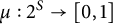 ${\mu :2^S\to [0,1]}$
for every subset X of S as follows:
 $$ \begin{align} \mu(X)=\sum_{e\in R_{e^*}^E}\eta(\{e\})\mu_e(X\cap H_e). \end{align} $$
For
 $R_{e^*}^E=\{e_1,e_2,\dots \}$
and every
 $n\in \mathbb {N,}$
since
 $$ \begin{align*}a_n=\eta(\{e_1\})+\cdots+\eta(\{e_n\})=\eta(\{e_1,\dots,e_n\})\leq \eta(R_{e^*})\leq 1,\end{align*} $$
and because the sequence
 $\{a_n\}_{n\in \mathbb {N}}$
is strictly increasing, it is clear that
 $\{a_n\}_{n\in \mathbb {N}}$
converges to some limit
 $0<\ell \leq 1$
. Similarly, it can be shown that for every
 $X\subset S,$
the value
 $\mu (X)$
exists and
 $\mu $
is well-defined.
Let A and B be two disjoint subsets of S. Since for every
 $e\in E\cap R_{e^*}^S$
, we have
 $\mu _e((A\cup B)\cap H_e)=\mu _e(A\cap H_e)+\mu _e(B\cap H_e)$
, it is straightforward to see that
 $\mu (A\cup B)=\mu (A)+\mu (B)$
because for every
 $e\in E$
the numbers
 $\eta (\{e\})\mu _e(B\cap H_e)$
and
 $\eta (\{e\})\mu _e(A\cap H_e)$
are not negative and the series
 $\mu (A\cup B)$
converges absolutely.
We claim that
 $\mu (s^{-1}X)=\mu (X)$
, where
 $s\in S$
and
 $X \subseteq S$
. First, for
 $f\in E$
and
 $e_i\in R_{e^*}^E$
, it is shown that
 $f^{-1}\{e_i\}\cap R_{e^*}^E$
has just one element. Since
 $R_{e^*}^E$
is the minimum element of
 $\Sigma $
, we have
 $e_iE=e^*E\subseteq fE$
. Therefore, there exists
 $e'\in E$
such that
 $e_i=fe'$
and especially
 $fe_i=e_i$
. So the set
 $f^{-1}\{e_i\}\cap R_{e^*}^E$
is non-empty. Suppose that
 $e_j\in f^{-1}\{e_i\}\cap R_{e^*}^E$
. Then,
 $fe_i=e_j$
and there exist
 $u_1,u_2\in E$
such that
 $ e_j=e_iu_1$
and
 $e_i=e_ju_2$
. Since
 $fe_i=e_i$
, we have
 $ e_i=fe_j=fe_iu_1=e_iu_1=e_j$
and especially
 $f^{-1}\{e_i\}\cap R_{e^*}^E=\{e_i\}$
. Now, it is shown that for
 $s\in H_f \subseteq S$
and
 $X\subseteq S,$
we have
 $\mu (s^{-1}X)=\mu (X)$
. Let
 $e_i\in R_{e^*}$
and
 $t\in H_{e_j}\cap s^{-1}X $
for some
 $e_j\in R_{e^*}^E$
such that
 $st\in X\cap H_{e_i}$
. Since by the assumption,
 $\mathcal {H}^S$
is a congruence and E is a subsemigroup of S, we have
 $fe_j=e_i$
and especially
 $e_j\in f^{-1}\{e_i\}$
. So by the above discussion,
 $e_j=e_i$
and
 $se_i\in sH_{e_i}\subseteq H_{e_i}$
. Since
 $$ \begin{align*}t\in (s^{-1}X)\cap H_{e_i} \Leftrightarrow \Big(t\in H_{e_i}\text{ and } st=s(e_it)=(se_i)t\Big)\Leftrightarrow t\in (se_i)^{-1}(X\cap H_{e_i}),\end{align*} $$
it is clear that
 $(s^{-1}X)\cap H_{e_i}=(se_i)^{-1}(X\cap H_{e_i})$
. Now because
 $f^{-1}\{e_i\}\cap R_{e^*}^E=\{e_i\}$
and
 $se_i\in H_{fe_i}=H_{e_i}$
we have
 $$ \begin{align*}\mu_{e_i}((s^{-1}X)\cap H_{e_i}))=\mu_{e_i}((se_i)^{-1}(X\cap H_{e_i}))=\mu_{e_i}(X\cap H_{e_i}).\end{align*} $$
Since in the above discussion,
 $e_i\in R_{e^*}^E$
is arbitrary, we have
 $$ \begin{align*}\mu(s^{-1}X)=\sum_{e\in R_{e^*}^E}\eta(\{e\})\mu_e((s^{-1}X)\cap H_e)=\sum_{e\in R_{e^*}^E}\eta(\{e\})\mu_e(X\cap H_e)=\mu(X).\end{align*} $$
Therefore, it is clear that the semigroup S is left amenable with the measure
 $\mu ^*= \mu / \ell $
, because
 $$ \begin{align*}\mu^*(S)= {1\over \ell}\sum_{e\in R_{e^*}^E}\eta(\{e\})\mu_e(H_e)={1\over \ell}\sum_{e\in R_{e^*}^E}\eta(\{e\})={\lim_{n\to\infty} a_n\over \ell}=1.\\[-47pt]\end{align*} $$
3 Left amenable semigroup and injective right S-Boolean algebras
For a semigroup S recall that a (right) S-act is a set A together with functions
 ${\nu :A\times S\to A}$
, called actions, such that denoting
 $\nu (a,s)$
by
 $as$
for each
 $a\in A$
,
 $s, t\in S,$
we have
 $(at)s=a(ts)$
. If S is a monoid, then we suppose that for every
 $a\in A,$
we have
 $a1=a$
. For every
 $s\in S,$
let
 $\lambda _s:A\to A$
be defined by
 $\lambda _s(a)=sa$
for every
 $a\in A$
. The definition of a subact of an S-act is clear. For two S-acts A and B, a map
 $\phi :A\to B$
is called an S-map (equivariant) if
 $\phi (as)=\phi (a)s$
for every
 $a\in A$
and
 $s\in S$
.
Recall that Boo is the category whose objects are Boolean algebras and their morphisms are functions which preserve binary joins and meets and
 $\mathbf {1}$
(the top element) and
 $\mathbf {0}$
(the bottom element). For a semigroup S, by a (right) S-Boolean algebra, we mean a Boolean algebra which is also a (right) S-act and such that for every
 $s\in S$
, the action
 $\lambda _s:B\to B$
is a Boolean algebra homomorphism. The category of (right) S-Boolean algebras with equivariant Boolean algebra homomorphisms between them is denoted by Boo-S (for more details about this structure, see [Reference Ebrahimi3, Reference Mahmoudi12]). Similarly, left S-boolean algebras are defined.
Algebraic and categorical properties of Boolean algebras and S-Boolean algebras (which are the category of Boolean algebras in the category of S-act) were studied by several authors and they are useful tools in Mathematics and Computer Science (see [Reference Ebrahimi3, Reference Ebrahimi and Mahmoudi4, Reference Mahmoudi12]).
For a semigroup S and a non-empty set X, on
 $X^{(S)}$
, we mean the S-act defined by the set of all maps from S to X with the action defined by
 $(f s)(t) = f (st)$
for every
 $s,t \in S$
and
 $f \in X^{(S)}$
.
Remark 3.1 (i) For a semigroup
 $S,$
let
 $\cdot :2^S\times S\to 2^S$
be the action defined by
 $X\cdot s=s^{-1}X=\lambda _s^{-1}(X)=\{t\in S\mid st\in X\}$
for every
 $s\in S$
and
 $X\subseteq S$
. It is a known fact that when S is a monoid,
 $2^S$
with this action (which is usually called the action by division) is isomorphic to
 $\{0,1\}^{(S)}$
, the cofree S-act over
 $\{0,1\}$
(see [Reference Kilp, Knauer and Mikhalev10, Proposition II.4.8]). From now on, this S-act is denoted by
 $(2^S)_S$
.
(ii) Let S be a left amenable semigroup with measure
 $\mu $
. Then, by considering
 $2^S$
with the action by division, it is easy to see that
 $\mu :(2^S)_S\to [0,1]_S$
is an S-map, where
 $[0,1]_S$
is the set
 $[0,1]$
with the identity action. Furthermore, it is straightforward to see that
 $\mu $
is a Boolean algebra homomorphism. This is our main idea in using S-Boolean algebras in the study of left amenable semigroups.
Recall that for every semigroup S, an S-Boolean algebra
 $B_S$
is injective in the category Boo-S if and only if for any morphism
 $h: B_S \to A_S$
, and any monomorphism
 $g: B_S \to C_S$
, there exists a morphism
 $f : C_S\to A_S$
such that
 $fg = h$
. Note that
 ${\mathbf {2}=\{0,1\}}$
with the order
 $0<1$
and the trivial action defined by
 $xs=x$
for every
 $x\in \mathbf {2}$
is an S-Boolean algebra. From now on, this S-Boolean algebra is denoted by
 $\mathbf {2}_S$
. An ideal in a Boolean algebra B is a subset M of B such that
 $0\in M$
, if
 $p,q\in M$
, then
 $p\vee q\in M$
, if
 $p\in M$
and
 $q\in B$
, then
 $p\wedge q\in M$
. An ideal is maximal if it is a proper ideal that is not properly included in any other proper ideal. An ideal M is said to be prime if it is proper and if the presence of
 $p \wedge q$
in M always implies that at least one of p and q is in M (for more details, see [Reference Ebrahimi3] or [Reference Mahmoudi12]). For ordinary Boolean algebra
 $\mathbf {2}$
being injective in Boo is equivalent to the prime ideal theorem that every non-trivial Boolean algebra has a prime ideal.
Recall that a collection
 $\mathcal {F}$
of subsets of
 $2^S$
is called a filter, if the following conditions hold: (i)
 $S\in \mathcal {F}$
and
 $\emptyset \not \in \mathcal {F}$
; (ii) for every
 $A,B\in \mathcal {F,}$
we have
 $A\cap B\in \mathcal {F}$
; and (iii) for every
 $A,B\subseteq S$
such that
 $A\subseteq B$
and
 $A\in \mathcal {F,}$
we have
 $B\in \mathcal {F}$
. A maximal proper filter is called an ultrafilter. It is straightforward to see that for every prime ideal
 $\mathbb {P}$
of a Boolean algebra B, the set
 $\mathbf {F}=B\setminus \mathbb {P}$
is an ultrafilter.
For a semigroup S, an S-ideal of an S-Boolean algebra B is an ideal of the Boolean algebra B which is closed under the action. By a prime S-ideal of an S-Boolean algebra
 $B_S$
, we mean an S-ideal of
 $B_S$
which is a prime ideal of B. Recall that by [Reference Givant and Halmos5, Theorem 12, Chapter 20] every proper ideal in a Boolean algebra is included in a maximal ideal. On the other hand, note that by [Reference Givant and Halmos5, Corollary 1, Chapter 20] we know that a Boolean ideal is maximal if and only if it is prime.
Mahmoudi in [Reference Mahmoudi12] remarked that this result has two versions in the category Boo-S, and she studied these versions in some classes of monoids, including the class of idempotent monoids. Recall that a semigroup S is said to satisfy the Klawe condition if whenever s,
 $x,$
and y in S are such that
 $sx = sy$
, there exists
 $t\in S$
so that
 $xt = yt$
. On the other hand, recall that a monoid S is good if for every
 $t, t'\in S$
,
 $ts=t's$
for some
 $s\in S$
implies
 $ut=ut'$
for some
 $u\in S$
(see [Reference Mahmoudi12, Definition 3. 18]). For left S-Boolean algebras, by Remark 3.15(b) (EPIT) is equivalent to
 $\mathbf {2}$
(as a left S-Boolean algebra) being injective in the category of left S-Boolean algebras. By the dual of this result for right S-Boolean algebras, we see that the Klawe condition is equivalent to
 $\mathbf {2}_S$
being injective in Boo-S, the category of right S-Boolean algebras. Especially, by [Reference Mahmoudi12, Theorem 3.16(c)] and [Reference Mahmoudi12, Theorem 3.20] she proved the following result.
Lemma 3.2 [Reference Mahmoudi12]
If S is an idempotent monoid, which satisfies the Klawe condition (which is called good condition in [Reference Mahmoudi12]), then every non-trivial
 $A\in {\mathbf {Boo}-}S$
has a prime S-ideal.
Recall that by [Reference Givant and Halmos5, Corollary 3, Chapter 20], for every proper ideal J in a Boolean algebra B, and for every element p in B that does not belong to J, there exists a maximal ideal that includes J and does not contain p (for more details, see [Reference Givant and Halmos5]). For every subset A of a set X by
 $\chi _A:X\to \{0,1\},$
we mean the characteristic function of A. In the next result, a connection between left amenable semigroups and the existence of a prime S-ideal in
 $(2^S)_S$
is established.
Lemma 3.3 For a semigroup S, the following conditions are equivalent.
-
(1) S is left amenable and there exists an S-ideal K of
$(2^S)_S$
such that
$S\not \in K$
and
$X\cap Y\not \in K$
for every
$X,Y\in 2^S\setminus K$
; -
(2) there exists a prime S-ideal
$\mathbb {P}$
of
$(2^S)_S$
.


Proof
(i)
 $\mathbf {\Rightarrow }$
(ii) It is straightforward to see that
 $\mathbb {P}=\{X\subset S\mid \mu (X)=0\}$
is a prime S-ideal of
 $(2^S)_S,$
which fulfills the condition in (i).
(ii)
 $\mathbf {\Rightarrow }$
(i) First, it is shown that
 $2^S\setminus \mathbb {P}$
is a subact of
 $(2^S)_S$
. Let
 $X\in 2^S\setminus \mathbb {P}$
and
 $s\in S$
. To the contrary, suppose that
 $s^{-1}X\not \in 2^S\setminus \mathbb {P}$
. Since by [Reference Givant and Halmos5, Corollary 1, Chapter 20] every prime ideal of a Boolean algebra is a maximal ideal,
 $X^c=S\setminus X\in \mathbb {P}$
. Since
 $S=s^{-1}S=s^{-1}(S\setminus X)\cup s^{-1}X$
and
 $s^{-1}(S\setminus X)\in \mathbb {P}$
, we have a contradiction, because
 $S\not \in \mathbb {P}$
. Therefore,
 $2^S\setminus \mathbb {P}$
and
 $\mathbb {P}$
are subacts of
 $2^S$
.
Let
 $\mathbb {F}=2^S\setminus \mathbb {P}$
and consider the characteristic function of
 $\mathbb {F}$
. Since
 $\mathbb {P}$
is a prime ideal of
 $2^S$
and because
 $\mathbb {F}$
and
 $\mathbb {P}$
are subacts of
 $(2^S)_S$
, it is clear that
 $\chi _{\mathbb {F}}(S)=1$
,
 $\chi _{\mathbb {F}}(\emptyset )=0$
and
 $\chi _{\mathbb {F}}(X)=\chi _{\mathbb {F}}(s^{-1}X)$
for every
 $X\subseteq S$
and
 $s\in S$
. Finally, note that for every pair of disjoint subsets A and B of S, by the assumption either A and B belong to
 $\mathbb {P}$
, or without loss of generality,
 $A\in \mathbb {F}$
and
 $B\in \mathbb {P}$
. Since
 $\mathbb {F}$
is an ultrafilter (equivalently,
 $\mathbb {P}$
is a prime ideal), we have
 $\chi _{\mathbb {F}}(A\cup B)=\chi _{\mathbb {F}}(A)+\chi _{\mathbb {F}}(B)$
. Therefore, S is a left amenable semigroup with measure
 $\chi _{\mathbb {F}}$
.
The next result presents a new necessary and sufficient condition for left amenability of semigroups, which is based on injective S-Boolean algebras.
Theorem 3.4 For a monoid S, the following conditions are equivalent.
-
(1)
$\mathbf {2}_S$
is a retract of
$(2^S)_S$
in the category of Boo-S; -
(2) S is left amenable for some probability measure
$\textrm {D}:2^S\to \{0,1\}$
.


Especially, if
 $\mathbf {2}_S$
is injective in the category of Boo-S for some monoid S, then S is left amenable for a probability measure
 $\textrm {D}:2^S\to \{0,1\}$
.
Proof
(i)
 $\mathbf {\Rightarrow }$
(ii) Let
 $\alpha :\mathbf {2}_S\to (2^S)_S$
be defined by
 $\alpha (0)=\emptyset $
and
 $\alpha (1)=S$
. Since
 $\alpha $
is a Boolaen algebra homomorphism and an S-map, and because by the assumption,
 $\mathbf {2}_S$
is a retract of
 $(2^S)_S$
in Boo-S, there exists a Boolean algebra homomorphism
 $\textrm {D}:(2^S)_S\to \mathbf {2}_S$
, which is an S-map and
 $\textrm {D}\alpha =\beta $
. We only need to show that
 $\textrm {D}$
is finitely additive. Let
 $A, B\subseteq S$
such that
 $A\cap B=\emptyset $
. Since
 $\textrm {D}$
is a Boolean algebra homomorphism, we have
 $\textrm {D}(A)\wedge \textrm {D}(B)=\textrm {D}(A\cap B)=0$
and note that
 $\textrm {D}(A\cup B)=\textrm {D}(A)\vee \textrm {D}(B)$
. Hence, either
 $\textrm {D}(A)=\textrm {D}(B)=0$
or without loss of generality,
 $\textrm {D}(A)=1$
and
 $\textrm {D}(B)=0$
. In the first case,
 $$ \begin{align*}\textrm{D}(A\cup B)=\textrm{D}(A)\vee \textrm{D}(B)=0=\textrm{D}(A)+ \textrm{D}(B)\end{align*} $$
and in the latter case,
 $$ \begin{align*}\textrm{D}(A\cup B)=\textrm{D}(A)\vee\textrm{D}(B)=1=\textrm{D}(A)+ \textrm{D}(B).\end{align*} $$
(ii)
 $\mathbf {\Rightarrow }$
(i) Let
 $\alpha :\mathbf {2}_S\to (2^S)_S$
be the morphism in the category Boo-S defined by
 $\alpha (0)=\emptyset $
and
 $\alpha (1)=S$
. It is straightforward to show that
 $\textrm {D}$
is a map in Boo-S and
 $\textrm {D}\alpha =id_{\mathbf {2}}$
.
Finally, the proof of the special case is straightforward by the above discussions.
To apply Lemma 3.2 for amenable semigroups, recall that a semigroup S is left amenable if and only if
 $S^1$
is left amenable. Also note that if a band E satisfies the Klawe condition, then
 $E^1$
satisfies it, too. Now, as an immediate consequence of the above theorem and Lemma 3.3, since every semigroup which satisfies (SFC) is left amenable, by Lemma 3.2, [Reference Mahmoudi12, Remark 3.15(b)] and [Reference Gray and Kambites6, Theorems 2.5 and 2.6] we have the following result which shows the connection between injectivity of
 $2_E$
and (SFC) condition.
Corollary 3.5 For an idempotent semigroup
 $E,$
which satisfies the Klawe condition, the following conditions are equivalent.
-
(1)
$\mathbf {2}_E$
is injective in
$\mathbf {Boo}$
-E; -
(2) every non-trivial
$A\in {\mathbf {Boo}-}E$
has a prime E-ideal (EPIT in [Reference Mahmoudi12]); -
(3) E is a left amenable semigroup with a measure
$\textrm {D}:2^E\to \{0,1\}$
; -
(4) E satisfies SFC.


3.1 Left amenable regular semigroups for which E is commutative; or with a zero element
Now, as an immediate consequence of the previous discussions, left amenable semigroups for which their idempotent sets form a finite commutative semigroup or a countable semigroup with a zero are determined.
Theorem 3.6 Let S be an orthodox band of groups. Then, the following results hold.
-
(1) If E is a semigroup with zero z, then S is a left amenable semigroup with some measure such that the union of every collection of
$\mathcal {H}^S$
-classes of S with zero measure has zero measure (especially, when E is finite) if and only if
$H_z$
is a left amenable group. -
(2) If E is a commutative semigroup and S is a left amenable semigroup with some measure such that the union of every collection of
$\mathcal {H}^S$
-classes of S with zero measure has zero measure (especially, when E is finite), then E is left amenable with some measure
$\eta $
and it has a zero element
$z,$
which is also the minimum element of
$\{f\in E\mid \eta (\{f\})\neq 0\}$
.


Proof (i) If S is left amenable and
 $\mu $
is finitely additive, then similar to the proof of Lemma 2.5, it can be shown that condition (a) in Theorem 2.6 holds. On the other hand, for every
 $e\in E,$
for which
 $L_e$
has nonzero measure by the assumption and applying Theorem 2.2, every
 $\mathcal {H}^S$
-class of
 $L_e$
and especially
 $H_e$
has nonzero measure. I claim that
 $e=z$
. To the contrary, suppose that
 $e\neq z$
. Since S is left amenable and
 $\mathcal {H}^S$
is a congruence on S, we have
 $\mu (H_e)=\mu (z^{-1}H_e)$
and
 $$ \begin{align*}z^{-1}H_e=\{t\in S\mid t\in H_f\text{ and } f\in z^{-1}\{e\}\}.\end{align*} $$
Since
 $\mu (z^{-1}H_e)\neq 0$
, there exists
 $f\in E$
such that
 $zf=e\neq z$
and z is the zero element of E. This contradiction shows that
 $\mathcal {L}(1)=\{L_z\}$
and
 $L_z=H_z$
. Therefore, condition (b) in Theorem 2.6 holds, and so
 $H_z$
is a left amenable group. Conversely, since E has a zero element z, and because the group
 $H_z$
is left amenable and
 $R_z^E=\{z\}$
, by Theorem 2.6, the semigroup S is left amenable.
(ii) Since E is commutative, by [Reference Argabright and Wilde1, Theorem 4] it is left amenable. On the other hand, since E is commutative,
 $\mathcal {H}^E=\mathcal {R}^E=\mathcal {L}^E$
and so by Lemma 2.5, E has a zero element z and
 $H_z^E=\{z\}$
is the minimum element of
 $\Sigma $
. Therefore, the assertion holds by part (i).
Finally, in this note, by proving Theorem 3.7, left amenable Clifford semigroups and rectangular groups under our assumptions are determined.
Theorem 3.7
(i) Let
 $S=\cup _{\alpha \in Y}G_\alpha $
be a Clifford semigroup, and
 $G_\alpha $
be a group for every
 $\alpha \in Y$
. Then, S is left amenable with some measure
 $\mu $
such that the union of every collection of
 $\mathcal {H}^S$
-classes of S with zero measure has zero measure if and only if the semilattice Y has a zero element z and
 $G_z$
is a left amenable group.
(ii) Let
 $S=I\times G\times \Gamma $
be a rectangular group. Then, S is a left amenable semigroup with some measure such that the union of every collection of
 $\mathcal {H}^S$
-classes of S with zero measure has zero measure if and only if
 $|I|=1$
and G is a left amenable group.
Proof (i) It is clear by Theorem 3.6(ii).
(ii) Note that if S is left amenable rectangular group, then E is a left amenable rectangular band. On the other hand, if E is a left amenable rectangular band with measure
 $\eta $
, then we claim that it has only one right ideal. Since for every
 $(a,b)$
with nonzero measure and every
 $(i,\gamma ),$
we have
 $\eta ((i,\gamma )^{-1}\{(a,b)\})=\eta (\{(a,b)\})\neq 0$
, there exists
 $(i',\gamma ')$
such that
 $(i,\gamma ')=(i,\gamma )(i',\gamma ')=(a,b)$
. Hence,
 $a=i$
and because i is arbitrary,
 $|I|=1$
. Therefore, every left amenable rectangular band is a right zero semigroup and for every
 $r\in E$
, the set
 $J=\{Y\subseteq E\mid r\not \in Y\}$
is a prime E-ideal of
 $(2^E)_E$
(J is closed under the action because E is right zero and for every
 $e,f\in E,$
we have
 $f^{-1}\{e\}=\{e\}$
). Therefore, by Lemma 3.3, E is left amenable if and only if E is a right zero semigroup (equivalently,
 $|I|=1$
). Now, the rest of the proof is clear by the assumption and applying Theorem 2.6 because
 $\Sigma =\{E\}$
.
Based on the results in this note, raising the following question is natural.
Question 3.8 For a regular semigroup S, when we are able to determine the left amenability of S based on its
 $\mathcal {H}^S$
-classes and the properties of E?
Acknowledgments
The author expresses his gratitude to the referee for very valuable suggestions, which help him to improve the manuscript. Also, he expresses his gratitude to the organizers of the workshop “Topics in Geometric Semigroup Theory” held at the University of York.



