1. INTRODUCTION
Can groups make reasoned decisions? Can a group itself have a belief or make an argument? The sentiment is common enough. We think nothing of hearing that a legislature decided on a policy because it believed A, B and C, or that voters re-elected a Senator because of electorate opinion on education and defence. Logical deduction at the group level is equally commonplace.
Using the framework of judgment aggregation (JA) theory, I argue that it is generally impossible to guarantee a group will be logically consistent in the domain of decision-making, hence we cannot rationalize decisions purely at the group level. What I take to be special about decision-making, and where I depart from the existing JA literature, is that individuals may disagree on how a decision is logically connected to other considerations. Even allowing for this subjective diversity, I prove it is generally impossible to derive group decisions from group opinions on supporting reasons. We must either abandon the aim of describing group decisions in terms of reasoned arguments or accept the possibility of group inconsistency.
The subjective group-decision model considered here is more flexible and realistic than the fixed logical frame assumed by existing JA theory. In particular, the model applies to political representation. An individual's vote choice may flow logically from independent issue opinions, but not necessarily in an objective and universal manner. Some in the electorate value education more than defence, and others the opposite. A pressing question is whether, given these individual opinions and votes, we can define group issue opinions consistent (by some given rule) with a group choice of representative. Whereas existing JA theory cannot deal with such subjectivity, this paper's model demonstrates that consistency generally cannot be guaranteed. Not only may a representative disagree on some group opinions, but the set of group opinions may also imply that a different representative should have been chosen.
Section 1 reviews past results in JA theory, then describes my model and how it relates to this literature. Some concrete examples of the model are given. Section 2 rigorously presents the model and several results. I have structured the paper so it is possible to skip Section 2 and still understand the central argument. Section 3 analyses the results and applies them to democratic and political theory. I present a normative argument for unanimity rule in the social contract and jury trials, and illustrate problems for deliberative democratic theory and political representation. Section 4 suggests future work that can expand the model and analysis.
1.1. Past results
The central insight of JA theory is the difficulty of translating sets of logically interconnected individual judgments into a set of logically consistent group judgments. The social representation focus is similar to that of preference aggregation theory, and several papers have reproduced major preference aggregation results within a JA framework (List and Pettit, Reference List and Pettit2004; Dokow and Holzman, Reference Dokow and Holzman2005; Dietrich and List, Reference Dietrich and List2007a). However, whereas a narrow preference focus can be questioned because of its connection to the rational choice frame, the relevance of JA is not so easy to escape. Since it operates in the far more general domain of logical beliefs instead of preferences, JA can capture a wider range of group relationships and behaviour. This paper concentrates on subjective group decision-making; previous work has had more of a pure judgment focus.
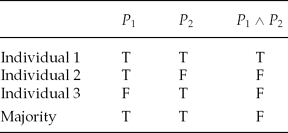
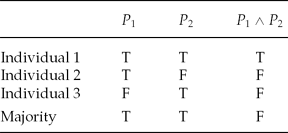
A curious paradox in legal theory called the “doctrinal paradox” provided some initial inspiration (Kornhauser and Sager Reference Kornhauser and Sager1986; Brennan Reference Brennan2001). Suppose a panel of three judges is deciding whether “Mary is guilty of slander”. To vote guilty, a judge must find that “Mary lied” (proposition P 1) and that “Mary intentionally defamed” (proposition P 2). Each judge applies True or False to each of the three propositions. As Table 1 demonstrates, if we aggregate these judgments to a group judgment by majority vote, the panel's judgments may be logically inconsistent. Pettit (Reference Pettit2001) refers to the general problem of group inconsistency under majority voting on interrelated propositions as the “discursive dilemma”. List and Pettit (Reference List and Pettit2002) arrived at the first systematic result in JA theory with an impossibility result focused on the doctrinal paradox. They show that no aggregation rule can guarantee consistency in the group result under the assumptions of universal domain (individuals are allowed to hold any logically consistent set of beliefs), systematicity (a proposition's group judgment depends only on the proposition's individual judgments, with the same dependence for different propositions and for and against a proposition), and anonymity (equal treatment of different individuals).
The doctrinal paradox/discursive dilemma. Each individual is consistent, but the majority is not.
From this beginning, JA theory has retained the basic framework of aggregating from individual to group judgments on separate logical propositions, but has rapidly broadened its scope along two dimensions. First, the set of logical propositions being aggregated, called the agenda, has been generalized. Instead of referring to a specific agenda, most results now apply to all agendas meeting certain logical conditions, such as atomic closedness (Pauly and van Hees, Reference Pauly and van Hees2006), strong connectedness (Dietrich and List, Reference Dietrich and List2007a), and total blockedness (Nehring and Puppe, Reference Nehring and Puppe2007). The field has also been extended beyond propositional logic to more general logics (Pauly and van Hees, Reference Pauly and van Hees2006; Dietrich, Reference Dietrich2007; van Hees, Reference van Hees2007). Recent work has relaxed completeness, the assumption that each individual judges every proposition in the agenda (Gärdenfors, Reference Gärdenfors2006; Dietrich and List, forthcoming).
Second, the conditions placed on the aggregation rule have varied. For instance, the original List and Pettit (Reference List and Pettit2002) result can replace anonymity with non-dictatorship (the group judgments do not always agree with a single individual) and retain impossibility (Pauly and van Hees, Reference Pauly and van Hees2006). In most impossibility results, the strong systematicity condition used in List and Pettit (Reference List and Pettit2002) is weakened to independence (the group judgment on a proposition depends only on the proposition's individual judgments) by dropping the requirement of equal treatment of different propositions. Variations on independence have been particularly diverse (Dietrich, Reference Dietrich2006). For general discussions, see Chapman (Reference Chapman2002), List (Reference List2006), and List and Puppe (forthcoming).
Despite these generalizations, the literature has retained the assumption that the logical connections among propositions are constant across individuals. The individual faces a fixed logical frame and, for each proposition, judges it or chooses not to (if we relax completeness). Although sensible for a purely logical focus, it is a substantial assumption of homogeneity when we think about realistic group decisions. Much of the complexity in group decision-making arises because members disagree about the importance of different considerations. In this study, I broaden the existing JA approach by allowing for distinct individual reasoning.Footnote 1 Each individual is allowed her own understanding of how a decision logically relates to other propositions.
1.2. A new model
I now introduce the basic elements of the model. In brief, each individual judges a decision based on her judgments on independent considerations, or premises, and individuals may do so in different ways. If we then aggregate to group judgments on each premise and the decision, it is generally not possible to describe the group decision as derived from group judgments. Expressed in the usual tabular form (e.g. Table 1), decisions are horizontal, and aggregation is vertical. The impossibility of reasoned group decision-making concerns the potential disagreement between horizontal and vertical implications. I introduce two distinct ways of looking at this impossibility, and conclude with three illustrative examples.
What is the usual method by which decisions are made? Frequently, there is a substantive Yes/No decision under consideration, such as whether to build a bridge across the Hudson River or not, to elect Grover Cleveland or another man, or to declare war or sue for peace. Such central decisions are typically based on ancillary premises that together determine the choice of action. In the last case, they may include judgments on whether the war can be won, whether victory would be worth the cost, and so on. In particular, this structure parallels how legislators decide policy, how voters elect representatives, and how financial experts invest.
In this paper's model, each individual judges a central decision as a function of her judgments on several premises. This premise-decision structure has been investigated in Nehring and Puppe (forthcoming) and Dokow and Holzman (Reference Dokow and Holzman2005), the former of which calls it the “truth-functional model”. However, both papers assume there exists a fixed logical frame.Footnote 2 The key innovation of this paper's model is that the function, or decision rule, connecting the premises and decision may differ between individuals. In this way, the model can capture both objectively logical and subjective decisions. For example, suppose a legislator is deciding whether to support funding for stem cell research. She may begin by considering whether the research will cure certain diseases, if it involves the taking of potential life, and other relevant questions. But not only are the judgments themselves a matter of opinion, there is also no clear rule for which sets of judgments should lead to support for stem cell research. That, too, is subjective, and the choice of connection is embodied in the individual decision rule. This generalization considerably expands the territory of JA, and the examples below explore some of the new avenues.
Next, we aggregate the individual judgments to a group judgment on each premise and the decision.Footnote 3 The central question is: Does the group itself obey a decision rule? In other words, can we describe the group decision as a function of group beliefs? The surprising answer is that, in general, we cannot. Generally, no decision rule exists that will always be followed by the group. Assuming overlap in the premises considered by different individuals, the only exception is if we aggregate by a type of unanimity rule and every decision rule is such that each premise can “veto” the decision.Footnote 4 A group aggregating by majority rule cannot follow a group decision rule. Hence, assuming all individuals reason in the same way is not necessary for the discursive dilemma to apply.
This general impossibility can be interpreted in two distinct ways:
Interpretation 1: Given any aggregation rule, there generally does not exist any decision rule guaranteed to be consistent with the group judgments. For each decision rule, some set of individual judgments will violate the rule after being aggregated. By this interpretation, we do not need to wonder where the group decision rule comes from, since no such rule can exist. Absent a group decision rule, there is no way to specify how group premise judgments lead to the group decision. We are confronted with the general impossibility of reasoned group decision-making.
Interpretation 2: Given any group decision rule, there generally does not exist any aggregation rule that can guarantee the group judgments will be consistent with the decision rule. This may be the favoured interpretation if a formal or sensible group standard exists or the decision is a matter of objective logic. Should such a group standard exist, the individuals will not necessarily follow it. The third example presents such a case.
I now illustrate the model and its implications with three examples. To demonstrate its versatility, I consider in turn a legislature, an electorate and a team of financial experts.
Example: Political decision-making
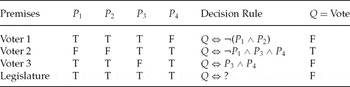
Consider a legislature deciding on a bill supporting stem cell research. As noted before, individual legislators may disagree about how to decide their vote, not just what that vote will be. To capture this situation, the model imagines that each legislator bases her vote (the decision) on her judgments on several premises, with the connection between premises and vote expressed through her decision rule. Suppose we then aggregate to group opinions on each premise and to a group vote, which represents the passage or defeat of the bill. Table 2 displays an example of such a legislature (using majority rule for aggregation). In this example, the bill is defeated.
A legislature, deciding on a bill supporting stem cell research. P 1 = “The research (R) will destroy embryos”, P 2 = “Embryos should be considered life”, P 3 = “R holds promise for curing disease”, P4 = “R is cost-effective”, and the vote Q = “R should be supported”.

It is sensible to then ask whether the legislature can provide a reasoned argument for its decision. In other words, is there a group decision rule that can connect the group premise judgments to the legislative outcome? As Interpretation 1 above indicates, the general answer is no. If the aggregation rule is by majority, for example, there exists no group decision rule guaranteed to be consistent. For the Table 2 example, we can of course devise a group decision rule consistent for this set of judgments. However, this rule cannot describe group reasoning since the group would violate this rule for a different set of consistent individual judgments. If some individuals changed their opinions, a group contradiction may result. Hence, we cannot say the group decides for group reasons. The implication of this conclusion for deliberative democratic theory is explored in Section 3.2.
Example: Political representation
This paper's connection to political representation is brought out by a somewhat obscure result called the Ostrogorski Paradox. The paradox concerns a set of voters who each favour one of two parties on different issues. Suppose that each person votes for the party he or she favours on the majority of issues. Suppose further that we define the group opinion on each issue and the vote winner by majority rule. The resulting paradox is the possibility that the group will favour the losing party on a majority of issues, or even all issues, meaning that an unpopular platform will win (Rae and Daudt, Reference Rae and Daudt1976; Nurmi, Reference Nurmi1998).Footnote 5
In a more general Ostrogorski model, any rule could be applied to either the decision of how to vote or the aggregation of group opinion.Footnote 6 Despite the absence of truth values, any rule indicating how a person votes based on his issue opinions can be captured by an individual decision rule. It follows that the generalized Ostrogorski model (without the assumption of majority rule for votes or aggregation, nor that voters decide similarly) is identical to this paper's model, with issues as the premises and the vote as the decision.
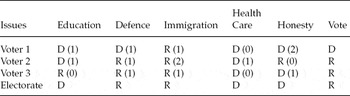
To illustrate, imagine each voter favours either candidate D or R on a set of issues (which may include character judgments like honesty). I write “D” if the voter affirms the statement “I prefer D on this issue” and “R” otherwise. Suppose each voter determines his vote (D or R) from his issue judgments using a decision rule, and that an aggregation rule produces group issue opinions and a group choice of representative. Table 3 displays a case in which voters differently weight each issue and vote by the higher weighted sum, and aggregation is by majority rule.
An electorate. Parentheses indicate weights voters place on issues.

We may ask: Is there a group decision rule that can justify the winning candidate from group issue opinions? Is the winner representative of what the group believes? Under Interpretation 1, such a validation is generally impossible. There exists no group decision rule guaranteed to be consistent with the group opinions. Interpretation 2 offers a different insight: If there does exist a group decision rule, there is no guarantee the choice of representative will be consistent with the group judgments. In other words, the decision rule may indicate the losing candidate better represents group opinion. These conclusions are explored further in Section 3.3.
Example: Expert prediction
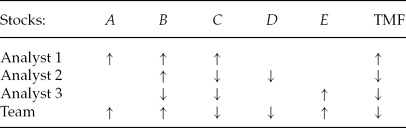
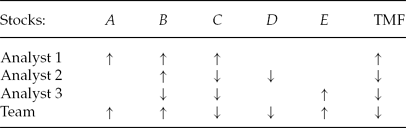
A corporation is deciding if it should invest in the Tiger Mutual Fund (TMF), and consults its team of financial analysts. Suppose that each analyst gives an ↑ or ↓ on stocks in TMF, and recommends investment in TMF if a majority of these judgments are ↑. (I give these symbols a similar treatment as D and R in the last example.) To make it interesting, suppose each analyst is an expert on a different (but overlapping) set of stocks, and derives the TMF judgment from these only. One knows biotech, another knows the Midwest, and so on. Notice that the differing decision rules result from differing information, not subjective distinctions. In this case, there exists a sensible group decision rule we suppose the corporation adopts: Invest in TMF if the team judges ↑ on a majority of stocks. Unfortunately, as Interpretation 2 above indicates, there generally does not exist any aggregation rule – whether or not it treats each analyst or each stock equally – that will always be consistent with the group decision rule. For some sets of judgments, the team will recommend a majority of stocks, and not recommend TMF. Such a paradox (with majority rule on expert judgments, and non-expert judgments omitted for clarity) is displayed in Table 4.
A team of financial analysts.
2. THE MODEL
Section 2.1 defines the basic elements of the model. As a preliminary, Section 2.2 considers the case of a common decision rule (Theorem 1). Section 2.3 is the technical core of the paper, demonstrating in Theorem 2 a strong (im)possibility result even when allowing for differing decision rules. Theorem 3 strengthens the result by adding a monotonicity assumption. In Section 2.4, Theorem 4 fills in a few details on the full catalog of consistent decision and aggregation rules.
2.1. Basic structure
A simple agenda is a list of K (≥3) logical propositions (P 1, P 2, . . ., PK −1, Q). Each proposition takes on a value from {T, F}, the 2-valued Boolean logic. The first K−1 propositions of a simple agenda, called premises, are logically independent (any assignment of truth values is allowed).
A decision rule is a logical rule (or Boolean function) that uniquely determines the value of Q, called the decision, from the values of the premises. For the sake of brevity in future definitions, I sometimes denote Q = PK. A premise is relevant to a decision rule if Q's entailed value depends in some way on the value of the premise. I assume that a decision rule has at least two relevant premises. Some premises in the simple agenda may not be relevant to a particular decision rule.
Consider N (≥2) agents who each make judgments, or assignments from {T, F}, on the propositions in a simple agenda. Each agent i affirms a decision rule Di. For example, if i judges Q as true if and only if P 1 and P 2 are true, then for Di I write: Q ⇔ P 1 ∧ P 2. Footnote 7 The key innovation of this paper is that each agent may obey a different decision rule.
Define a decision frame X to be a simple agenda combined with a list of decision rules (D 1, D 2, . . ., DN, DS), one for each agent and society. I use “society” and “group” interchangeably.
A judgment set is a list J ∈ {T, F}K of judgments on each proposition in a given simple agenda. I assume completeness (agents judge every proposition).Footnote 8 A judgment set for agent i (or society) is consistent if its assignment of truth values obeys i's (or society's) decision rule. A profile is an N-tuple (J 1, J 2, . . ., JN) of judgment sets, representing the N individuals' judgments on each proposition in the simple agenda.
A judgment aggregation rule (JAR) g (for a decision frame X) maps a profile for the simple agenda in X to a complete social judgment set. If J = {T, F}K is the space of possible judgment sets, g : D → J, for some D ⊆ JN. A JAR thus aggregates a set of individual judgments on each proposition to a group judgment on each proposition.
For any profile R and JAR g, I use the following notation:
P ij= Agent i's judgment on Pj (the jth element of the ith element of R)
P Sj= The social judgment on Pj (the jth element of g(R))
∝P ij = “Agent i's judgment on Pj changes”.
∝P Sj = “The social judgment on Pj changes”.
Thus, Qi indicates agent i's decision, and QS indicates the group's ultimate decision. Using this notation, premise Pj is relevant to i's decision rule (or simply, relevant to i) if there exists a judgment set for i such that ∝ P ij ⇒ ∝ Q i.
I now define the conditions I place on each JAR g. Recall that PK = Q.
1. Universal domain: g's domain is the set of all profiles consisting of consistent judgment sets. This condition assumes all individuals obey their own decision rules.
2. Independence: A proposition's social judgment depends only on that proposition's individual judgments. Formally, for all profiles R, R′, and j ∈ (1, 2, . . ., K), the following holds: (For all i ∈ (1, 2, . . ., N), Pij in profile R = P ij in profile R′) ⇒ (P Sj in profile R = P Sj in profile R′).
3. Non-triviality: QS is not pre-determined, so that for each θ ∈ {T, F}, Q S = θ for some profile.
4. Non-authoritarianism: No agent i exists such that the social judgments depend only on i's judgments. This strengthens non-dictatorship, since a social judgment may be the opposite of an authoritarian's judgment on some proposition. Formally, i is an authoritarian if, for each j ∈ (1, 2, . . ., K), P ij=P Sj for all profiles or P ij ≠P Sj for all profiles.
5 Collective rationality: For every profile R, g(R) is a consistent social judgment set. This condition guarantees the group obeys the social decision rule.
Call a JAR democratic if it satisfies these five conditions. Note the minimal demand of this characteristic, since no assumption of equal treatment of voters or propositions is being made.
Example. Take (P 1, P 2, P 3, Q) as our simple agenda, and consider two agents. A decision frame X combines this simple agenda with a set of decision rules for both agents and society. Say that D 1 is Q ⇔ P 1 ∨ P 3, D2 is Q ⇔ P 1 ∧ ¬P 3, and DS is Q ⇔ P 1 ∨ ¬P 2. Both P 1 and P 3 are relevant to D 1.
Each agent produces a judgment set for (P 1, P 2, P 3, Q). If agent 1's judgment set is (T, F, F, T), it is consistent, as it obeys D 1. A profile is an ordered pair of judgment sets on (P 1, P 2, P 3, Q). A JAR (for X) maps this profile to a social judgment set on (P 1, P 2, P 3, Q). The JAR is independent if P S1 depends only on P 11 and P 21 and the equivalent holds for the other propositions. If a potential output of the JAR is (F, T, T, T), then the JAR fails collective rationality, as this social judgment set violates D S.
2.2. Group decisions with a common decision rule
As a warm-up to the main results, this section swims in familiar waters by assuming all individuals and the group employ a common decision rule, which is equivalent to the truth-functional model. Theorem 1 parallels very similar results in Nehring and Puppe (forthcoming) (their Theorem 1), which adds a monotonicity condition, and Dokow and Holzman (Reference Dokow and Holzman2005) (their Theorem 4.8), which adds a Pareto condition and allows the decision to consist of a multi-proposition set.Footnote 9
Assume all premises are relevant to the common decision rule (since otherwise they can be ignored). I now define two classes of JARs and two types of decision rules:
Oligarchy rule and conjunctivity: Say that a JAR is an oligarchy rule on Pj if there exists a group of agents who must unanimously assign θ ∈ {T, F} to Pj to give P Sj the value θ, and P Sj cannot be affected by non-members. As a result, all members of the group have veto power over P Sj. Formally, there exists a group of agents M (|M|≥ 2) and θ ∈ {T, F} such that for all profiles: (P ij = θ for all i ∈ M) ⇔ (P Sj = θ). Otherwise, P Sj takes the default value ¬θ.
A decision rule Di is conjunctive if there exists a truth-value for every premise sufficient to determine Q. In other words, every premise has veto power over Q. Formally, for some θ ∈ {T, F} and set of Yj ∈ {T, F}, the following holds for Di: (P ij=Y j for all j ∈ (1, 2, . . ., K−1)) ⇔ (Qi = θ). These are decision rules of the form Q ⇔ (P 1 ∧ ¬ P 2) ∧ ⋅ ⋅ ⋅ ∧ PK −1, or any variation with added negations, or the equivalent rules with all ∨ signs. As a counter-example, the decision rule Q ⇔ (P 1 ∧ P 2) ∨ P 3 is not conjunctive.
Even/odd: Say that a JAR is an even/odd rule on Pj if there exists a group of agents such that P Sj is determined by an even/odd count of supporters in the group. Equivalently, in any profile, any member of this group can switch P Sj, and non-members have no effect. Formally, there exists a group of agents M (|M| ≥ 2) such that for all profiles: (i ∈ M) ⇔ ∝ P ij ⇒ ∝ P Sj).
Similarly, a decision rule Di is even/odd if Q is affirmed depending on whether an even or odd number of premises are affirmed. For example, the decision rule Q ⇔ (P 1 ↔ P 2) is even/odd.
Theorem 1.Suppose a decision frame contains a common decision rule D for all individuals and society. If D is not conjunctive and not even/odd, no democratic JAR exists. If D is conjunctive, the only democratic JARs are oligarchy rules on all propositions. If D is even/odd, the only democratic JARs are even/odd rules on all propositions.
All proofs are contained in the Appendix.
Besides even/odd decision rules, only conjunctive decision rules can have a democratic JAR, which must then be an oligarchy rule. This implies the Ostrogorski Paradox and the original doctrinal paradox result (List and Pettit, Reference List and Pettit2002). If D is even/odd, the JAR can be an even/odd rule on each proposition. This combination implies that every judgment switch by an agent in M switches QS. Thus, any democratic JAR must force a change in QS for any judgment change by an agent in M, or allow a change only to or from a single profile of unanimous agreement.
What is there to make of even/odd rules? Barring an inspired argument, they must be considered a strange artifact of the model. Since an even/odd determination is so intuitively unappealing as an aggregation rule, and a non-even/odd assumption could easily be added to the list of JAR constraints, my later analysis in Section 3 ignores this option.
2.3. Group decisions with differing decision rules
I now turn to this paper's key innovation: the possibility of differing decision rules. Agents may rely on premises in different ways, and may even disagree on what premises are relevant.
A few definitions describe the agents' connections through relevant premises. An agent i is empowered if there exists a profile in which ∝ Qi ⇒ ∝ QS. A premise is shared if it is relevant to more than one empowered agent. Although one expects the agents' decisions to be based on many of the same premises, a concept is needed for when that is not the case. A JAR is partitioned if there exists a partition of the empowered agents into at least two (non-empty) subgroups such that no premise is shared between two agents in different subgroups.
Assume for simplicity that each socially relevant premise is relevant to at least one empowered agent. This is unrestrictive, since if a premise is not relevant to any empowered agent, there is no way for the premise's social judgment to change and affect QS.
Because of the added complexity, slightly broader versions of oligarchy rule and conjunctive and even/odd decision rules are needed. A JAR is a unitary rule on Pj if there exists a group of agents who all have veto power over P Sj, and P Sj cannot be affected by non-members. Formally, there exist a set of agents M (|M|≥ 2), θS ∈ {T, F}, and a (possibly distinct) set of θi ∈ {T, F} for each i ∈ M, such that the following holds for all profiles: (P ij = θi for all i ∈ M) ⇔ (P Sj = θS). Otherwise, P Sj takes the default value ¬θS.
For a set of premises P, a decision rule Di is semi-conjunctive on P if there exists a truth-value for every premise in P sufficient to determine Q. Thus, it may be that only some premises (namely, all those in P) have veto power over Q. Formally, for θ ∈ {T, F}, non-empty P ⊆ {P 1, P 2, . . ., PK −1}, and Yj ∈ {T, F} for each Pj ∈ P, the following holds for Di: (Qi = θ) ⇒ (P ij=Y j for all Pj ∈ P). For example, the decision rule Q ⇔ P 1 ∧ P 2 ∧ (P 3 ∨ P 4) is semi-conjunctive on {P 1, P 2}.
For a set of premises P, a decision rule Di is semi-even/odd on P if, holding all non-P judgments fixed, Q is affirmed depending on whether an even or odd number of premises in P are affirmed. Equivalently, the following holds for Di: For non-empty P ⊆ {P 1, P 2, . . ., PK −1}, ∝P ij ⇒ ∝ Q i for any Pj ∈ P. For example, the decision rule Q ⇔ (P 1 ↔ P 2) ↔ (P 3 ∨ P 4) is semi-even/odd on {P 1, P 2}.
Theorem 2.Given a non-partitioned, democratic JAR g (for decision frame X), one of the following holds:
(a) g is a unitary rule on all propositions, society's decision rule in X is semi-conjunctive on the set of shared premises, and all empowered agents' decision rules in X are semi-conjunctive on the set of premises shared by the agent.
(b) g is an even/odd rule on all propositions, society's decision rule in X is semi-even/odd on the set of shared premises, and all empowered agents' decision rules in X are semi-even/odd on the set of premises shared by the agent.
A proposition Pj is dominated if there exists an agent i such that ∝ P ij ⇒ ∝ P Sj in every profile. Say that a JAR is full-democratic if it satisfies universal domain, independence, non-triviality, collective rationality, and no proposition is dominated.
Corollary 2.1.Every non-partitioned, full-democratic JAR (for decision frame X) is a unitary rule on all propositions, and requires the decision rules in X of all empowered agents and society to be semi-conjunctive on the set of relevant premises.
A stronger result than Theorem 2 obtains with the additional assumption of monotonicity on each proposition, meaning that increased support for a particular judgment cannot switch the social judgment in the opposite direction. Formally, a JAR is monotonic on Pj if the following holds: For θ ∈ {T, F}, if {For all i ∈ (1, 2, . . ., N), (P ij = θ in profile R) ⇒ (P ij = θ in profile R′)}, then {(P Sj = θ in profile R) ⇒ (P Sj = θ in profile R′)}. Say that a JAR is monotone-democratic if it is democratic and monotone on every proposition.
Theorem 3.Every non-partitioned, monotone-democratic JAR (for decision frame X) is an oligarchy rule on all propositions, and requires society's decision rule in X to be semi-conjunctive on the set of shared premises and all empowered agents' decision rules in X to be semi-conjunctive on the set of premises shared by the agent.
2.4. Partitioned subgroups
The previous theorems provide strong limiting results for non-partitioned JARs. The final theorem and corollaries consider several partitioned subgroups, demonstrating that only a little freedom is gained. For a partitioned subgroup G, the subgroup's profile segment is the subset of the profile restricted to the judgments of G's members on Q and each premise relevant to a member of G.
Theorem 4.Suppose a democratic JAR g contains R (≥2) partitioned subgroups. For r ∈ (1, 2, . . ., R), each subgroup Gr has a profile segment Ar in the space Ar. Say that QS is described by a function h: A1 × A2 × ⋅ ⋅ ⋅ × AR → {T, F}. The following hold:
1. We can construct functions gr : Ar → {T, F} and a function f: {T, F}R → {T, F} such that h (A 1, A 2, . . ., AR) = f (g 1 (A 1), g2 (A 2), . . ., gR (AR)).
2. There are three possibilities for each gr: (a) Gr has a single member, (b) gr is a unitary rule, or (c) gr is an even/odd rule.
3. The space of possible gr's and all functions f : {T, F}R → {T, F} delimits all the possible choices for h.
Corollary 4.1.Using the formalism of Theorem 4: For any monotone-democratic JAR g, every gr is an oligarchy rule and f is monotonic.
Corollary 4.2.If a democratic JAR aggregates the group decision by majority rule (or any supermajority rule short of unanimity), then no premises are shared and every empowered agent dominates the set of premises relevant to the agent.
3. ANALYSIS
The theorems of Section 2 share a similar structure: Assuming all individuals and the group employ decision rules and the aggregation rule satisfies five minimal constraints, the allowed combinations of decision and aggregation rules are severely restricted.Footnote 10 The five constraints are universal domain (all individual judgments consistent with the individuals' decision rules are allowed), independence, non-triviality (non-fixed group decision), non-authoritarianism (a single individual does not determine the group judgments, which slightly strengthens non-dictatorship), and collective rationality (the group judgments are always consistent with the group decision rule). I make no restrictive assumptions like anonymity or the neutrality part of systematicity, according to which all propositions must be aggregated in the same way. With the possible exception of independence (discussed in Section 3.2), the first four constraints appear essential. Thus, we can interpret the theorems in the following way: If the decision and aggregation rules are not one of the required combinations and we retain the four necessary constraints, then collective rationality cannot be satisfied. Hence, the group cannot consistently follow the given decision rule.
For Theorem 1, I make the simplifying assumption that individuals and the group employ a common decision rule, which makes the model identical to the truth-functional model. Collective rationality then requires aggregation on every proposition to be made by oligarchy rule (unanimity rule restricted to a fixed group) and the common decision rule to be conjunctive (every premise can veto the decision). Nehring and Puppe (forthcoming) and Dokow and Holzman (Reference Dokow and Holzman2005) obtain very similar results. For example, if a group wants to make a decision based on whether at least two out of three premises are true, there is no way to guarantee a consistent group result.Footnote 11
Starting with Theorem 2, I allow differing decision rules, the central innovation of this paper. The major complication that arises concerns how premises individuals use to make their decisions overlap, or are shared. An exception to each of the results in Section 2.3 is if there exist partitioned subgroups of individuals such that members of different subgroups have no premises of shared concern. In the general case without such a partition, Theorem 2, collective rationality requires aggregation to be made by an analogue of oligarchy rule (every member of a fixed group can veto the group decision and any shared premise) and each decision rule to be semi-conjunctive (every shared premise can veto the decision). For example, if we aggregate by majority rule, collective rationality cannot be satisfied regardless of the chosen decision rules. Also, if just one individual makes a “two out of three” decision, collective rationality cannot be satisfied.
Theorem 3 adds monotonicity to the aggregation constraints and strengthens the conclusion of Theorem 2 to requiring oligarchy rule for collective rationality. This is probably the most useful result. However, non-monotonic aggregation rules are worth considering, such as when a group finds a particular individual's judgment unreliable.
Theorem 4 considers partitioned subgroups, concluding that only a little freedom is gained. Essentially, partitioning breaks down the group decision into a “vote” by each subgroup, where now the determination of each subgroup vote is limited in the manner of Theorem 2. However, we are freed up somewhat in that we can use any rule to derive the group decision from the subgroup votes. For example, we can satisfy collective rationality if each subgroup votes by unanimity rule and the group decision is determined by the majority of these votes. Ironically, the more the group as a whole agrees on what issues are relevant, the more difficult it becomes to guarantee a consistent decision. Corollary 4.2 notes that assuming collective rationality, if we make the group decision by majority or supermajority rule across all individuals, then every individual must form his own subgroup, meaning that no two voters care about the same premise. Thus, for the most common aggregation method, the group decision can only be linked consistently to group judgments that are determined by single individuals, which hardly rings true as a reasoned group decision.
The central claim of this paper is that decision-making cannot be understood purely at the group level. If one follows Dahl (1989: 5) in seeing democracy as primarily “a unique process of making collective and binding decisions”, then certainly these results are relevant to democratic theory, and may help to illuminate some of the “half-hidden premises, unexplored assumptions, and unacknowledged antecedents [that] form a vaguely perceived shadow theory that forever dogs the footsteps of explicit, public theories of democracy” (Dahl 1989: 3). In that spirit, this section explores this paper's implications for unanimity rule, the deliberative democratic tradition, and political representation.
3.1. Unanimity
When a consistent, reasoned group argument is essential, unanimity rule (or a close parallel) is required. Despite majority rule's ubiquity, unanimity rule does appear in the democratic tradition in two highly important cases this paper may help illuminate. One case is the ultimate basis for democratic government. The other concerns the most consequential of interpersonal decisions.
3.1.1. Contract theory
For both Locke and Rousseau, unanimity is a core requirement for the social contract, from which majority rule is established as a more efficient mode of decision-making. Coleman (Reference Coleman and Christiano2003: 235) sees this founding act as a bargain that requires everyone's consent: “Only unanimity could possibly guarantee both that no person is made worse off by collective policy and that the outcome of collective policy is stable”.
Bargaining, in general, accords with this paper's model. Suppose each party to a proposed bargain judges if each aspect of the arrangement is acceptable (or as good as can be expected from further bargaining). If an individual finds some aspect unacceptable, she rejects the bargain; otherwise, she accepts it. It follows that each decision rule is semi-conjunctive, hence unanimity rule enables the group to consistently judge the acceptability of each provision in the bargain and decide on the bargain itself.Footnote 12 In the context of the social contract, acceptability criteria can be regarded as justice criteria, so that unanimity rule allows a state to have a consistent justice rationale.
In effect, this paper suggests that founding a state may be the only group decision guaranteed to be consistent. Although subsequent majority rule decisions may not be rationally supported, the rule itself may derive from a collectively rational decision. In effect, a form of group consistency holds prior to any group decision; it is actuated by the very existence of the group.
3.1.2. Juries
Of course, at least one major institution employs unanimity rule: the jury. Previous formal work has assessed the unanimity requirement for juries mainly in terms of the rule's effect on individuals. Feddersen and Pesendorfer (Reference Feddersen and Pessendorfer1998) contend that unanimity rule encourages strategic voting, increasing the chance an innocent defendant is convicted. Jurors, they argue, may strategically vote guilty because their vote can only matter if everyone else is already voting to convict, which strongly suggests guilt. Coughlan (Reference Coughlan2000) responds that non-strategic voting is expected when factoring in mistrials and juror communication. However, the rule may inhibit jurors' incentives to gather and communicate information (Persico, Reference Persico2004).
This paper provides a strong normative and logical argument in favour of unanimity rule in jury trials. The decision rule structure is analogous to the logical requirement for conviction. Jurors must judge several independent issues, such as motive, intent and opportunity, that together decide guilt or innocence.Footnote 13 Reaching a publicly declared, logically consistent argument for the final decision is essential in the deliberative context of a jury. With a few sensible assumptions, this has been shown to only be possible with unanimity rule and semi-conjunctive decision rules. As it happens, legal requirements for guilt tend to have little wiggle room; every condition in the logical chain must be met. Hence, jury decision rules can be well-described as semi-conjunctive, and only unanimity rule will facilitate social consistency. It may not be accidental that the jury employs the only aggregation rule that can guarantee collective rationality.
3.2. Deliberative democratic theory
Inspired by Oakeshott's “politics as conversation” and Habermas's “ideal speech situation”, deliberative democratic theory idealizes “decision making by discussion among free and equal citizens” (Elster Reference Elster and Elster1998: 1). In addition, the theory considers it “necessary for democratic legitimacy to supplement collective decisions on actions or policies with supporting reasons” (List Reference List2006: 365).
This paper puts in stark light the fact that deliberative democracy's core ideals, the individual contribution to group opinions and the public display of accepted reasons, are at loggerheads. Even allowing for pluralistic, subjective decision-making, a group cannot consistently present reasons for its decisions (short of unanimity rule). As List and Pettit (Reference List and Pettit2002: 89) put it, JA “highlights a tension between two plausible demands: on the one hand, that a group be responsive to the judgments of individual members in forming collective judgments and, on the other, that it be rational in the judgments it collectively endorses”. For Pettit (Reference Pettit2001: 268), deliberative democrats falter because they have made “an implicit assumption that it does not matter whether the discipline of reason is imposed at the individual or at the collective level”. This assumption fails not only for the exercise of cold logic, but for any manner of subjective decision-making.
A possible response is that this failure indicates the need for deliberation. Deliberative democrats stress that “democracy revolves around the transformation rather than simply the aggregation of preferences” (Elster Reference Elster and Elster1998: 1). Deliberation can expand consensus by “revealing private information, lessening bounded rationality, or encouraging more public-spirited proposals” (Fearon Reference Fearon and Elster1998: 56). However, unless deliberative democrats restrict themselves to small, homogeneous groups for which unanimity is practical, it remains unclear how they can elucidate group decision-making.
A final try for collective rationality without unanimity rule is to discard one of the four remaining constraints. Since universal domain, non-triviality and non-authoritarianism appear essential, we are stuck with abandoning independence, meaning that group judgments need not be derived solely from individual judgments on the same proposition.Footnote 14 Although adding consistency considerations for determining group judgments may ensure collective rationality, this route is especially problematic for reasoned decision-making. As Dietrich and List (Reference Dietrich and List2007b) demonstrate, independence is a necessary condition for non-manipulability and strategy-proofness, calling into question the genuineness of the reasoning process under non-independent aggregation. Moreover, what is meant by a group opinion not derived from individual opinions on the same issue? Surely we cannot interpret a group reason as authoritative if the members themselves do not endorse it. Non-independent aggregation is promising when the goal is mediation among conflicting opinions, but much less so if each group judgment can be scrutinized and needs to stand on its own. A similar problem arises if deliberative democrats hope individuals factor in group consistency for their own judgments. What is meant by an individual opinion if it is influenced by group consistency demands? The relationship between judgments at the individual and group level is not as clear as deliberative theory assumes.
3.3. Representation
It is a common lament that political representatives fail to remain faithful to the voters. This assumes they were in accord in the first place. Generally, an elected representative cannot be guaranteed to cohere to any rule that indicates the proper choice of representative based on the list of group issue opinions. Given any rule, group opinions may imply a different representative should have been chosen.
Thus, an elected representative cannot consistently be justified purely based on group opinions. An inherent incommensurability exists between the representative as an embodiment of the electorate and the representative as an embodiment of electorate opinion. Schumpeter (Reference Schumpeter1950: 245 – 6) similarly challenges the coherency of popular representation, with the exception of “small and primitive communities with a simple social structure in which there is not much to disagree on”, so that one can speak of the “will or the action of the community”.
On the positive side for representation, direct democracy cannot guarantee consistent group opinions, whereas a representative can be consistent. (Of course, inconsistency rematerializes in a representative assembly, so think of an executive.) Brennan (Reference Brennan2001: 208) notes this advantage in application to political parties, which must rationalize their policy ideas: “That consistency requirement constrains those parties to consider and to declare their reasons for action. Reasons weigh in a manner that they do not in direct democratic processes where voters simply offer a judgment on the outcome – with no requirement at all that the reasons of different voters need be the same or logically consistent in the aggregate”.
What can we make of a representative system that guarantees logically consistent beliefs will stand in for a population, but the beliefs will not necessarily be those supported by popular opinion? More than anything, the dilemma questions the meaning of the representative: Do voters elect a person or a set of beliefs? The answer offers a tentative claim about whether political representatives should rule in accordance with their own beliefs or with their electors'. It also contests the common assumption that these two aspects of representation are not in conflict. Like majority rule, even if representation is the best practicable standard for a modern democracy, it may exist without the solid theoretical basis we might hope for it.
4. FUTURE WORK
This paper has investigated a JA model widely applicable to group decision-making, including decisions that are subjective in nature. A number of avenues exist for generalizing and extending the results. More interrelated agendas can be considered, as well as more general logics. I claim, but cannot prove here, that the results hold if individuals can assign to each premise any of a finite number of arguments. For example, instead of judging whether unemployment will go up or down, an individual could give a predicted unemployment rate (say, in steps of 0.1%). A probabilistic analysis can ascertain how common inconsistency is for different aggregation and decision rules. Social choice theory has focused great attention on adjusting universal domain to engineer combinable preference orderings. Similar modifications may help guarantee collective rationality.
Finally, the debate continues as to what JA results like this paper say, if anything, about democratic theory. The parallel debate concerning preference aggregation theory has been impassioned and illuminating. Since JA theory is more general, and avoids the divisive rational choice framework, its contribution ought to be even more informative. Unfortunately, it appears that we cannot expect the academic community to reach any consistent conclusions on the matter.
Appendix: Proofs
I prove Theorems 2 and 4, from which the corollaries and Theorem 3 follow immediately. Theorem 1 follows directly from Corollary 2.1. These further proofs are omitted.
Proof of Theorem 2. Some definitions: An agent i is pivotal on Pj in profile R if ∝ P ij ⇒ ∝ P Sj. Note that an agent i is empowered if there exists a profile in which i is pivotal on Q. For an agent i, a profile A′ is an i-variant of A if the judgment sets are identical in both profiles for all agents l ≠ i. Note that A itself is an i -variant of A. If i's decision rule is semi-conjunctive (respectively, semi-even/odd) on a set P, I abbreviate this as Qi is semi-conjunctive (semi-even/odd) on P.
Consider a democratic JAR g for decision frame X. For each i ∈ (1, 2, . . ., N, S), Xi is the set of premises relevant to i's decision rule. M* is the set of empowered agents for g.
Lemma 2.1.If an agent i is pivotal on Q in a profile A, then in any i-variant of A, the agent is pivotal on Q and Pj for all Pj ∈ Xi.
Proof. Suppose ∝ Qi ⇒ ∝ QS in profile A. Since Qi is uniquely determined by the other judgments in i's judgment set, there exists a k such that ∝ P ik ⇒ ∝ Qi ⇒ ∝ QS. As QS is similarly determined by the other judgments in the social judgment set, by independence we must have ∝ P Sk. Hence, i is pivotal on Pk in profile A.
For any Pj ∈ Xi, there exists a set of i's judgments such that ∝ P ij ⇒ ∝ Qi. By independence, i is pivotal on Q in any i-variant of A. As above, this implies i is pivotal on Pj in some i-variant of A. By independence, i is pivotal on Pj in any i-variant of A.
Lemma 2.2. ∪i∈M*X i = X S.
Proof. Consider any i ∈ M* and Pj ∈ Xi. There must exist a profile in which i is pivotal on Q and ∝ P ij ⇒ ∝ Qi. By independence, ∝ P Sj ⇒ ∝ QS. Thus, Pj is relevant to the social decision rule, meaning Pj ∈ XS. It follows that ∪i∈M*X i ⊆ X S. By assumption, X S ⊆ ∪i∈M*X i.
Lemma 2.3.QS and P Sj for each Pj ∈ XS depend only on the judgments of empowered agents.
Proof. If P Sj (for Pj ∈ XS) depends on the judgment P ij for i ∉ M*, then there exists a profile A in which ∝ P ij ⇒ ∝ P Sj. There also exists a profile with the same judgments on Pj as in A, and in which ∝ P Sj ⇒ ∝ QS, which implies ∝ P ij ⇒ ∝ Q S, but ∝ Qi ⇏ ∝ Q s, a contradiction.
Lemma 2.4.Consider shared Pj ∈ Xi for i ∈ M*. If i is non-pivotal on Pj in some profile, then Qi is semi-conjunctive on a set of premises including Pj.
Proof. Suppose that agent i ∈ M* is pivotal on Q in profile A. Consider any shared Pj ∈ Xi. From Lemma 2.1, i is pivotal on Pj in profile A, but suppose that i is non-pivotal on Pj in some profile.
From profile A, we can change the agents' judgments on Pj one by one. We must reach a profile B in which i is pivotal on Pj, but, for l ≠ i, ∝ P ij ⇒ i is no longer pivotal on Pj (call this profile B′). By Lemma 2.1, i is not pivotal on Q in B′. By independence, in B′, i is pivotal on all Pk ≠j such that Pk ∈ Xi. It follows that with the social judgments outside of Xi unchanged from B′, the value of P Sj in B′ is sufficient to decide the value of QS in B′. Starting at profile A, let i set P Sj to its value in B′ (call this profile A′). In A′, ∝ Qi ⇒ ∝ QS (by independence), but P Sj decides QS. Hence, Qi cannot change without P ij changing. It follows that P ij in A′ is sufficient to decide Qi in A′.
Lemma 2.5.If i is pivotal on shared P jin every profile, then ∝ P ij ⇒ ∝ Q iin every profile.
Proof. Suppose i is pivotal on some shared Pj in every profile, and consider k ∈ M* with Pj ∈ Xk. From Lemma 2.2, Pj ∈ XS. Using Lemma 2.1, there exists a profile A in which k is pivotal on Pj, and thus both i and k are pivotal on Pj. Starting from A, adjust the non-Pj judgments as necessary so that ∝ P Sj ⇒∝ QS. Call this profile B and note that (by independence) both i and k are pivotal on P j in B. It follows that i and k are both pivotal on Q in B.
From B, ∝ P kj ⇒ ∝ P Sj ⇒ ∝ QS, which implies ∝ P kj ⇒ ∝ Q k ⇒ ∝ QS. Following these changes, both i and k are still pivotal on Q since i is always pivotal on Pj. To be consistent, after ∝ P ij ⇒ ∝ Q i ⇒ ∝ QS starting from B, both i and k are still pivotal on Q.
Suppose there exists an i-variant of B (call it profile C) for which ∝ P ij ⇒ ∝ Qi. Since i is pivotal on Pj in C, but ∝ P ij ⇒ ∝ QS by independence, it follows that ∝ P Sj ⇒ ∝ QS in C. However, k is still pivotal on Q (by the last paragraph), so ∝ P kj ⇒ ∝ Qk ⇒ ∝ QS (since k's judgment set in C is the same as in B), requiring ∝ P Sj ⇒ ∝ QS, a contradiction. Therefore, ∝ P ij ⇒ ∝ Qi in each of i's judgment sets, and thus in every profile.
Lemma 2.6.If i is pivotal on Pj in every profile and Pj ∈ Xk for k ∈ M*, then k is pivotal on Pj in every profile.
Proof. For the purpose of contradiction, suppose i is pivotal on Pj in every profile and Pj ∈ Xk for k ∈ M*, but there exists a profile such that k is non-pivotal on Pj. As in Lemma 2.5, consider a profile A in which ∝ P Sj ⇒ ∝ QS and both i and k are pivotal on Pj. From A, ∝ P kj ⇒ ∝ Qk ⇒ ∝ QS, and then both i and k are still pivotal on Q.
From Lemma 2.4, Qk is semi-conjunctive on a set of premises containing Pj, so there exist Zkj, θ ∈ {T, F} such that P kj = Z kj ⇒ Qk = θ. Since more than one premise is relevant to k's decision rule by assumption, there must be two different sets of values for k's non-Pj judgments such that, with P kj ≠ Z kj, Qk = θ in one and Qk ≠ θ in the other. It follows that there exists a set of values for k's non-Pj judgments such that ∝ Pkj ⇏ ∝ Qk. Let A′ be a k-variant of A such that ∝ P kj ⇏ ∝ Qk.
From the first paragraph, both i and k are pivotal on Q in A′. By Lemma 2.5, from A′, ∝ P ij⇒ ∝ Qi ⇒ ∝ QS, so ∝ P Sj ⇒ ∝ QS. However, k is pivotal on Pj by Lemma 2.1, hence ∝ P kj ⇒ ∝ P Sj ⇒ ∝ QS, but ∝ P kj ⇏∝ Qk, a contradiction by independence.
Lemma 2.7.Suppose, for each agent i ∈ M*, Qi is semi-conjunctive on the set of shared premises in Xi, and for each shared Pj ∈ Xi, i is non-pivotal on Pj in some profile. If g is not partitioned, then g is a unitary rule on Q and every shared premise, and QS is semi-conjunctive on the set of all shared premises.
Proof. I use the following notation: For each agent i ∈ M*, there exist θi ∈ {T, F} and Y ij ∈ {T, F} for each shared Pj ∈ Xi such that (P ij = Y ij for all Pj ∈ Xi) ⇔ (Qi = θi). For each shared Pj ∈ Xi, i is non-pivotal on Pj in some profile. Assume g is not partitioned, so that every empowered agent shares at least one premise.
Sublemma 2.7.1.Suppose i is pivotal on Q in profile A and Qi = θi. If i shares Pj with k ∈ M*, then k is pivotal on Q in A and Qk = θk in A.
Proof. Suppose i is pivotal on Q in profile A, with Qi = θi, and Pj ∈ Xi ∩ Xk. If k ∈ M*, there exists a profile B in which k is pivotal on Q. For each r ∈ M*, Xr is semi-conjunctive with at least two relevant premises, so setting P rj=Y rj is not sufficient to decide Qr. Hence, there exists a profile B′ with the same judgments on Q as in B, and in which P rj = Y rj for all r ∈ M*. By independence, k is pivotal on Q in profile B′ and thus pivotal on Pj by Lemma 2.1. By the same logic, there exists a profile A′ with the same judgments on Q as in A, and in which P rj = Y rj for all r ∈ M*. Note that i must be pivotal on Q in A′ and Qi = θi in A′ by construction.
In profile A′, ∝ P ij ⇒ ∝ Qi ⇒ ∝ QS, hence ∝ P Sj ⇒ ∝ QS. By independence, k is still pivotal on Pj in A′, so ∝ P kj ⇒ ∝ P S j ⇒ ∝ QS, and thus k is pivotal on Q in A′ and A. By independence, ∝ P kj ⇒ ∝ Qk in A′ and P kj = Y kj in A′ by construction. It follows that Qk = θk in profile A′ and A.
Sublemma 2.7.2.QS is semi-conjunctive on the set of all shared premises.
Proof. Consider i ∈ M* and a profile A in which i is pivotal on Q. Take any shared Pj ∈ Xi.
Changing the judgments on Pj one by one, there must exist a profile B in which i is pivotal on Pj, but, for l ≠ i, ∝ P lj ⇒ i is no longer pivotal on Pj (call this profile B′). By Lemma 2.1, i is not pivotal on Q in B′. By independence, i is pivotal on all Pk ≠j for Pk ∈ Xi. Thus, with the social judgments on premises outside of Xi fixed, the value of P Sj in profile B′ is sufficient to decide the value of QS in profile B′.
Suppose a set of agents M ⊆ M* are all pivotal on Q in profile C. Call X M = ∪r∈MX r. It follows that with the social judgments on premises outside of XM fixed, then for each shared Pk ∈ XM, there exists a value for P Sk sufficient to decide QS.
Since g is not partitioned, repeated application of Sublemma 2.7.1 demonstrates that there exists a profile D in which all members of M* are pivotal on Q. Since ∪r∈M*X i = X S (by Lemma 2.2), it follows that with the social judgments on premises outside of XS fixed, then for each shared Pk ∈ XS, there exists a value for P Sk sufficient to decide QS. But there are no premises outside of XS, so for every profile there exists a value for P Sk sufficient to decide QS. Thus, QS is semi-conjunctive on all shared premises.
Proof of Lemma 2.7. From the argument of Sublemma 2.7.2, there exists a profile D in which all members of M* are pivotal on Q. Moreover, there exist θS ∈ {T, F} and Y Sj ∈ {T, F} for each shared Pj ∈ XS such that (P Sj = Y Sj for all Pj ∈ XS) ⇔ (QS = θS). From Sublemma 2.7.1, it also follows that Qi = θi in D for all i ∈ M*.
For any r ∈ M* and shared premise Pj ∈ Xr, from D, ∝ P rj ⇒ ∝ Qr ⇒ ∝ QS, so ∝ P Sj ⇒ ∝ QS. It follows that QS = θS in D. Hence, (Qi = θi for all i ∈ M*) ⇒ (QS = θS).
Suppose there exists a profile E in which QS = θS, but there is an agent l ∈ M* such that Ql ≠ θl. As in the proof to Lemma 2.7.1, we can move from the Q judgments in D to the Q judgments in E without changing any judgments on shared Pk ∈ Xl (call this profile E′). In E′, P lk = Y lk, Ql ≠ θl, Q S = θS, and l is still pivotal on Pk. It follows that ∝ P lk ⇒ ∝ P Sk ⇒ ∝ QS (since QS is semi-conjunctive on all shared premises), but ∝ P lk ⇏ ∝ Ql (since Ql is semi-conjunctive on all shared premises in Xl), a contradiction. Thus, (Qi = θi for all i ∈ M*) ⇔ (QS = θS).
Proof of Theorem 2. It is not possible that Qi is semi-conjunctive on a set of premises and another premise always changes Qi, so Lemmas 2.4 and 2.5 prove that there are two possibilities for each i ∈ M*:
1. Qi is semi-conjunctive on the set of shared premises in Xi. Also, for each shared premise in Xi, the agent is non-pivotal on the premise in some profile.
2. All shared premises in Xi can change Qi in any profile, hence Qi is semi-even/odd on the set of shared premises in Xi. Also, i is pivotal on all shared premises in Xi in every profile.
From Lemma 2.6, the two types cannot share a premise. If we suppose g is not partitioned, it follows that all empowered agents must be the same type.
If all are the first type, Lemma 2.7 proves that g must be a unitary rule on Q and every shared premise, and QS is semi-conjunctive on the set of all shared premises.
Suppose all are the second type. Every shared premise is determined by an even/odd rule since all sharing agents are pivotal on the premise in every profile. If i ∈ M* is pivotal on Q in a profile A and shares Pj with k, then ∝ P ij⇒ ∝ Qi ⇒ ∝ QS, so ∝ P Sj ⇒ ∝ QS, which implies ∝ P kj ⇒ ∝ P Sj ⇒ ∝ QS, demonstrating that k is pivotal on Q in A. Since all empowered agents are connected to one another by shared premises (assuming g is not partitioned), repeated application of this argument proves that all empowered agents are pivotal on Q in A. Moreover, if ∝ Qi from A, then i is still pivotal on Q, hence all empowered agents are still pivotal on Q. It follows that g is an even/odd rule on Q and every shared premise, and that QS is semi-even/odd on the set of all shared premises.
Proof of Theorem 4. Define a function h(A 1, A 2, . . ., AR) = QS. We find R functions gr : Ar → {T, F} that each capture all the information in Ar that can affect QS. If Gr contains a single member i, then Gr can only affect QS by changing Qi, so setting gr(Ar) = Qi retains all the information that can affect QS.
Now suppose Gr has multiple members. Suppose the total profile is such that changing Ar can change QS. If we restrict our attention to only the profile segment Ar, the social judgments on the propositions included in Ar, and QS, the relationship must be the same as if they represented an entire profile. For this hypothetical (non-partitioned) profile, define a function gr(Ar) = QS. As proved in Theorem 2, the empowered agents either (a) all have semi-even/odd decision rules and aggregate with an even/odd rule on Q or (b) all have semi-conjunctive decision rules and aggregate with a unitary rule on Q. Since the aggregation rule must be the same in any total profile (because the decision rules do not change), gr must also follow the same rule. It follows that gr captures the entire effect of Ar on QS.
This ordered set (g 1(A 1), g 2(A 2), . . ., gR(AR)) thus determines h(A 1, A 2, . . ., AR), so there is a function f : {T, F}R → {T, F} such that f(g 1(A 1), g 2(A 2), . . ., gR(AR)) = h(A 1, A 2, . . ., AR). Since no premises are shared between subgroups, any choice of gr for each Gr and any choice of f is possible. This space of functions delimits the possible choices for h.