INTRODUCTION
New Caledonia is a French overseas ‘sui generis collectivity’ (COM, Communauté d'Outre Mer), situated in the south-western Pacific Ocean, approximately 950–2450 km east of the Mackay/Gladstone regions, Central Queensland, Australia. It comprises the main island, Grande Terre, with the Îles Bélep in the north and the Île des Pins in the south of the Grande Terre group, the Loyalty Islands, the islands of Walpole (southern Loyalty Ridge), Matthew and Hunter (Vanuatu–Fiji Ridge), and the Chesterfield Islands and Bellona Reefs (Lord Howe Rise). The exclusive economic zone (EEZ) of New Caledonia also includes part of the northern Norfolk Ridge. The major submarine ridges in New Caledonia are isolated from each other, and zoogeographically distinct. The fish fauna of New Caledonia has been studied since the late 18th Century. In a recent checklist of the fishes of New Caledonia, a total of 2328 species in 246 families was recorded from the region (Fricke et al., Reference Fricke, Kulbicki and Wantiez2011). Among the New Caledonian marine species, 905 were recorded from the East Coral Sea, including the Chesterfield Islands, 193 from the New Caledonian Basin, 1860 from the Grande Terre group, 85 from the Norfolk Ridge and 1029 from the Loyalty Ridge including the Loyalty Islands; the ichthyofauna of the Matthew-Hunter Ridge was mostly unknown, with just 28 species reported from the region. Subsequently, the following species have been described: Microbrotula hamata (Bythitidae) from Grande Terre, described by Schwarzhans & Nielsen (Reference Schwarzhans and Nielsen2011); Samariscus neocaledonia (Samaridae) from the northern Norfolk Ridge, described by Kawai et al. (Reference Kawai, Amaoka and Séret2011); Bathyraja leucomelanos (Arhynchobatidae) from the Coriolis Bank in the eastern Coral Sea, by Iglésias & Lévy-Hartmann (Reference Iglésias and Lévy-Hartmann2012); Eviota atriventris (Gobiidae) from Grande Terre, by Greenfield & Suzuki (Reference Greenfield and Suzuki2012); Glossogobius illimis (Gobiidae) from Grande Terre, by Hoese & Allen (Reference Hoese and Allen2012); Hoplostethus grandperrini (Trachichthyidae) from the Norfolk Ridge, by Roberts & Gomon (Reference Roberts and Gomon2012); Phenacoscorpius longilineatus (Scorpaenidae) from the Norfolk Ridge, by Motomura et al. (Reference Motomura, Causse and Struthers2012); Siphamia fraseri and Siphamia spinicola (Apogonidae) from Grande Terre, by Gon & Allen (Reference Gon and Allen2012); Apristurus nakayai (Pentanchidae) from the eastern Coral Sea, by Iglésias (Reference Iglésias2013); Chaunax reticulatus (Chaunacidae) from the Norfolk Ridge, by Ho et al. (Reference Ho, Roberts and Stewart2013b); Epigonus lifouensis (Epigonidae) from the Loyalty Islands, by Okamoto & Motomura (Reference Okamoto and Motomura2013); Gymnocranius satoi and Gymnocranius superciliosus (Lethrinidae) from Grande Terre and the Chesterfield Islands, by Borsa et al. (Reference Borsa, Béarez, Paijo and Chen2013); Malthopsis asperata and Malthopsis parva (Ogcocephalidae) from the northern Norfolk Ridge, by Ho et al. (Reference Ho, Roberts and Shao2013a); Lophiodes iwamotoi (Lophiidae) was recorded from the southern Loyalty Ridge, New Caledonia by Ho & Chen (Reference Ho and Chen2013); and Chaunacops spinosus (Chaunacidae) was described from the eastern Coral Sea by Ho & McGrouther (Reference Ho and McGrouther2015). The description of a new species of Centrodraco Regan 1913 (Draconettidae) from the southern Loyalty Ridge (Fricke, in press) and a new record of Parapercis fuscolineata Fourmanoir 1985 (Pinguipedidae) from the New Caledonian EEZ (Ho et al., in press) will be published soon.
Benthic fish specimens were collected in south-eastern Grande Terre, on the northern and southern Loyalty Ridge, and on the Matthew-Hunter Ridge. The present paper reports several new records of fish species from these ridges, and a few new records from New Caledonia.
MATERIALS AND METHODS
During the EXBODI Cruise in 2011, benthic fish specimens were collected using dredges and trawls in south-eastern Grande Terre, on the northern and southern Loyalty Ridge, and on the Matthew-Hunter Ridge. The EXBODI Cruise was performed from 28 August to 29 September 2011 by the R/V Alis, principal investigator Sarah Samadi, deployed by the French Oceanographic Fleet on seamounts off New Caledonia; dredges and trawls were used at a total of 162 stations off south-eastern Grande Terre, the northern and southern Loyalty Ridge, and the Matthew-Hunter Ridge (Gourtay-Le Hingrat, Reference Gourtay-Le Hingrat2012; Ho & Chen, Reference Ho and Chen2013; Richer de Forges et al., Reference Richer de Forges, Chan, Corbari, LeMaitre, Macpherson, Ahyong, Ng, Ahyong, Chan, Corbari and Ng2014). Additional new records were provided by aquarium fish collections of Antoine Teitelbaum in southern Grande Terre and by Laurent Wantiez based on underwater photographs. The material described in the present paper is deposited in the National Taiwan University Museum, Taipei, Taiwan (NTUM) and the Forschungsinstitut Senckenberg, Frankfurt am Main, Germany (SMF).
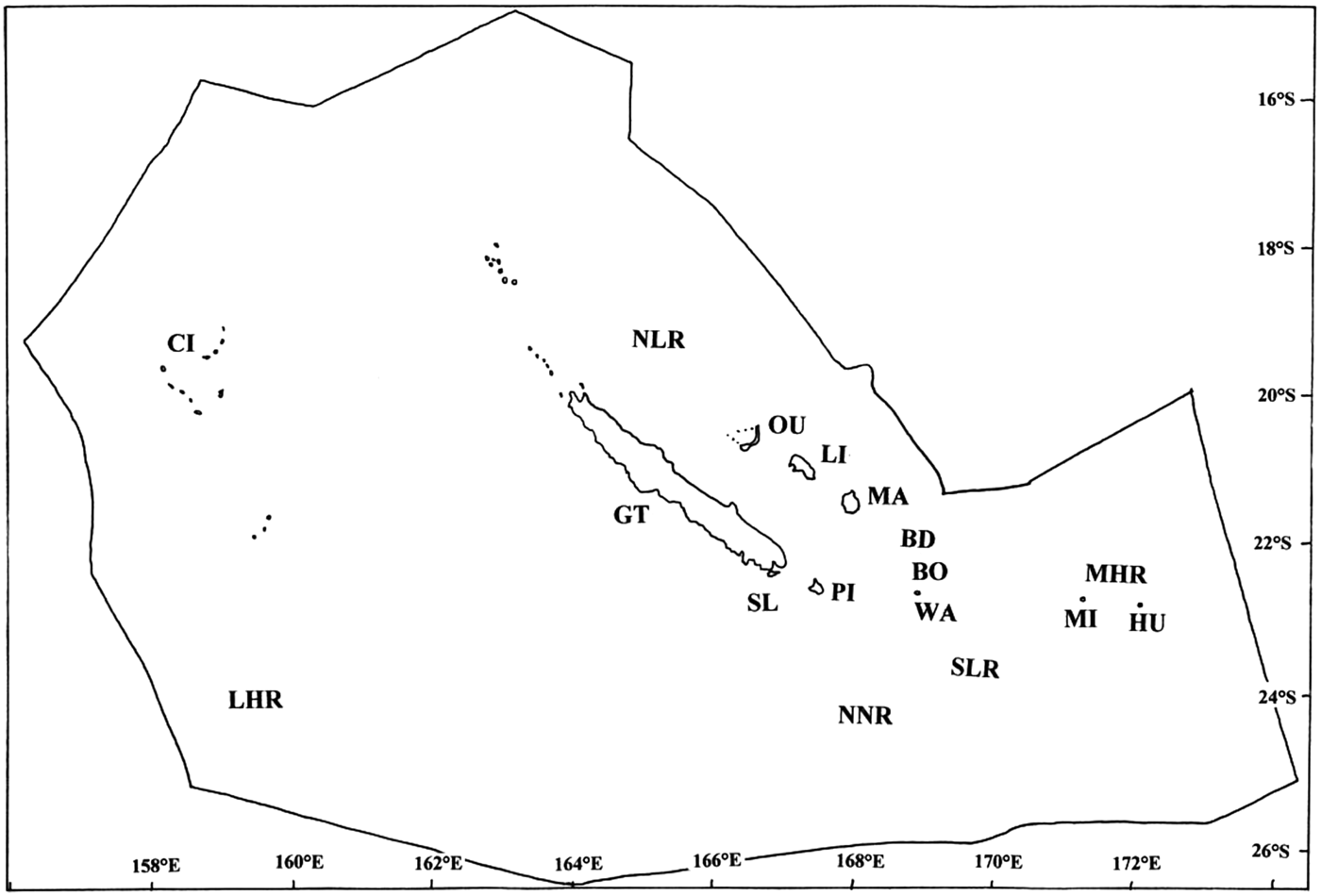
The family classification and arrangement follows Nelson (Reference Nelson2006), updated according to Eschmeyer (Reference Eschmeyer2015). The genus and species classification also follows Eschmeyer (Reference Eschmeyer2015), unless otherwise noted. In addition to the scientific name of a species, English vernacular names are provided. For the new records, information on the source is provided, as well as short diagnostic descriptions and, if available, illustrations. The fin-ray counts follow the method of Fricke (Reference Fricke1983). References follow Fricke (Reference Fricke2015). The descriptions also include detailed information on the general distribution of the species, especially the distribution in the Pacific. A map of the marine area of the New Caledonian EEZ with its major geographical features is provided in Figure 1. Information on the depth range of the species is provided as well; in some cases, new minimum or maximum depth records are provided.
Map of the EEZ of New Caledonia, south-western Pacific Ocean. BD, Banc Durand; BO, Banc de l'Orne; CI, Chesterfield Islands; GT, Grande Terre; HU, Hunter Island; LHR, Lord Howe Ridge; LI, Lifou (Loyalty Islands); MA, Maré Island (Loyalty Islands); MHR, Matthew-Hunter Ridge; MI, Matthew Island; NLR, Northern Loyalty Ridge; NNR, Northern Norfolk Ridge; OU, Ouvéa (Loyalty Islands); PI, Ile des Pins; SL, Southern lagoon; SLR, Southern Loyalty Ridge; WA, Walpole Island.

RESULTS
SYSTEMATICS
Family STERNOPTYCHIDAE
Polyipnus aquavitus Baird, Reference Baird1971 – Aquavit hatchetfish)
(Figure 2)
Polyipnus aquavitus Baird, Reference Baird1971, NTUM 10666, one specimen, 25.5 mm SL, New Caledonian EEZ, Matthew-Hunter Ridge (preserved specimen; photograph: Wei-Jen Chen).
MATERIAL
NTUM 10666, one specimen, 25.5 mm standard length (SL), New Caledonian EEZ, Matthew-Hunter Ridge, 31 km east of Matthew Island, 22°21′S 171°39′E, 433–516 m depth, Station CP 3883, Wei-Jen Chen, R/V Alis, 18 September 2011.
DIAGNOSIS
Posttemporal spine single, long; supra-anal photophores not markedly raised above anal group; posterior lateral margin of preopercle smooth; ventral keel scales smooth; dorsal spine short. Body sides silver, back black.
DISTRIBUTION
New record from Matthew-Hunter Ridge. Outside the area, South China Sea and Indonesia south to eastern Australia and northern New Zealand, east to New Caledonia. Known from depths of 0–1000 m.
REMARKS
This species was described in detail by Baird (Reference Baird1971).
Family OPHIDIIDAE
Porogadus melampeplus (Alcock, Reference Alcock1896) – Largeeye snake cuskeel
(Figure 3)
Porogadus melampeplus (Alcock, Reference Alcock1896), NTUM 10684, one specimen, 60.9 mm SL, New Caledonian EEZ, northern Loyalty Ridge, Récif Petrié (fresh specimen; photograph: Wei-Jen Chen).
MATERIAL
NTUM 10684, one specimen, 60.9 mm SL, New Caledonian EEZ, northern Loyalty Ridge, Récif Petrié, 18°36′S 164°24′E, 380–430 m depth, Station DW 3940, Wei-Jen Chen, R/V Alis, 27 September 2011; NTUM 10685, one specimen, 62.5 mm SL, New Caledonian EEZ, southern Loyalty Ridge, Southern Durand Seamount, 93 km south-east of Maré Island, 22°19′S 168°41′E, 338 m depth, Station DW3856, Wei-Jen Chen, R/V Alis, 14 September 2011.
DIAGNOSIS
Spines on head moderately long, dorsal-fin rays 162, anal-fin rays 141, caudal rays 5, pectoral rays 16, pelvic rays 2. Head and body yellowish, densely scattered with melanophores; peritoneum black.
DISTRIBUTION
New record from northern and southern Loyalty Ridge. Outside the area, Madagascar and Mascarene Plateau east to New Caledonia. Known from depths of 150–2400 m.
REMARKS
This species was originally described from the Arabian Sea by Alcock (Reference Alcock1896); it was reported from Madagascar, the Mascarene Plateau and the north-eastern Indian Ocean by Shcherbachev (Reference Shcherbachev1980), and from the New Caledonian Basin south-west of Grande Terre (New Caledonia) by Nielsen (Reference Nielsen and Séret1997).
Family SETARCHIDAE
Lioscorpius trifasciatus Last, Yearsley & Motomura, Reference Last, Yearsley and Motomura2005 – Threeband scorpionfish
(Figure 4)
Lioscorpius trifasciatus Last, Yearsley & Motomura, Reference Last, Yearsley and Motomura2005, NTUM 10663, one specimen, 61.0 mm SL, New Caledonia, Grande Terre, south-east of Yaté (fresh specimen; photograph: Wei-Jen Chen).
MATERIAL
NTUM 10663, one specimen, 61.0 mm SL, New Caledonia, Grande Terre, south-east of Yaté, 22°13′S 167°07′E, 264–273 m depth, Station CP 3788, Wei-Jen Chen, R/V Alis, 3 September 2011; NTUM 10650, three specimens, 61.0–147.7 mm SL, New Caledonian EEZ, Matthew-Hunter Ridge, 31 km east of Matthew Island, 22°23′S 171°39′E, 558–584 m depth, Station CP 3885, Wei-Jen Chen, R/V Alis, 18 September 2011; NTUM 10660, one specimen, 31.9 mm SL, New Caledonian EEZ, southern Loyalty Ridge, Durand Seamount, 71 km south-east of Maré Island, 22°04′S 168°38′E, 396 m depth, Station DW3846, Wei-Jen Chen, R/V Alis, 13 September 2011.
DIAGNOSIS
Anal spines III, anal rays 5: body slender; two dorsal spines before last spine very small. Body pale yellowish, with irregular grey spots, peritoneum dark; pectoral fin with three red stripes.
DISTRIBUTION
New record from the Loyalty and Matthew-Hunter ridges, and from New Caledonia. Outside the area, Eastern Australia. Known from depths of 250–400 m.
REMARKS
This species was described in detail by Last et al. (Reference Last, Yearsley and Motomura2005), with a distribution range from off eastern Australia and western Coral Sea and northern Tasman Sea.
Family SCORPAENIDAE
Neomerinthe megalepis Fowler 1938 – Yellow deepwater scorpionfish
(Figures 5 & 6)
Neomerinthe megalepis Fowler 1938, NTUM 10648, specimen 1, 52.3 mm SL, New Caledonia, Grande Terre, south-east of Yaté (preserved specimen; photograph: Wei-Jen Chen).
Neomerinthe megalepis Fowler 1938, NTUM 10648, specimen 2, 30.9 mm SL, New Caledonia, Grande Terre, south-east of Yaté (preserved specimen; photograph: Wei-Jen Chen).
MATERIAL
NTUM 10648, two specimens, 30.9–51.3 mm SL, New Caledonia, Grande Terre, south-east of Yaté, 22°13′S 167°07′E, 264–273 m depth, Station CP 3788, Wei-Jen Chen, R/V Alis, 3 September 2011.
DIAGNOSIS
Dorsal fin rays XII, 9, anal fin rays III, 4, pectoral fin rays 18; 4 spines in suborbital row. Body pale yellowish, with scattered brown spots along the back.
DISTRIBUTION
New record from Grande Terre, New Caledonia. Outside the area, eastern South China Sea east to Wallis and Futuna. Known from depths of 200–505 m.
REMARKS
This species was previously recorded by Fricke et al. (Reference Fricke, Kulbicki and Wantiez2011) from the Chesterfield Islands.
Phenacoscorpius megalops Fowler 1938 – Noline scorpionfish (Figure 7).
Phenacoscorpius megalops Fowler 1938, NTUM 10647, one specimen, 73.1 mm SL, New Caledonian EEZ, Matthew-Hunter Ridge, 34 km east-southeast of Matthew Island (fresh specimen; photograph: Wei-Jen Chen).
MATERIAL
NTUM 10647, two specimens, 26.8–73.1 mm SL, New Caledonian EEZ, Matthew-Hunter Ridge, 34 km east-southeast of Matthew Island, 22°25′S 171°40′E, 380 m depth, Station DW 3895, Wei-Jen Chen, R/V Alis, 19 September 2011; NTUM 10658, two specimens, 32.8–41.8 mm SL, New Caledonian EEZ, southern Loyalty Ridge, Banc Durand, 43 km north-west of Walpole Island, 22°18′S 168°42′E, 342 m depth, Station DW 3857, Wei-Jen Chen, R/V Alis, 14 September 2011.
DIAGNOSIS
Dorsal fin with XI spines and 9 rays; anal fin with III spines and 5 rays; pectoral-fin rays 17; lachrymal bone with 2 spines over maxillary; lateral line only consisting of four tubed scales. Body pale yellowish, back with brown blotches, caudal peduncle with enlarged black melanophores.
DISTRIBUTION
New record from the southern Loyalty and Matthew-Hunter ridges, and from the New Caledonian EEZ. Outside the area, Vietnam east to Hawaiian islands, north to Taiwan and Emperor Seamounts, south to New Caledonia. Known from depths of 68–622 m.
REMARKS
This species was previously reported from Grande Terre (New Caledonia) by Fricke et al. (Reference Fricke, Kulbicki and Wantiez2011).
Family PLECTROGENIIDAE
Plectrogenium nanum Gilbert 1905 – Pygmy stinger flathead
(Figure 8)
Plectrogenium nanum Gilbert 1905, NTUM 10651, one specimen, 61.0 mm SL, New Caledonia, Matthew-Hunter Ridge, 31 km east of Matthew Island (fresh specimen; photograph: Wei-Jen Chen).
MATERIAL
NTUM 10651, one specimen, 61.0 mm SL, New Caledonia, Matthew-Hunter Ridge, 31 km east of Matthew Island, 22°22′S 171°38′E, 521–567 m depth, Station CP 3884, Wei-Jen Chen, R/V Alis, 18 September 2011.
DIAGNOSIS
Anal spines II; body slender; two dorsal spines before last spine very small. Body pale yellowish, with irregular grey spots, peritoneum dark.
DISTRIBUTION
New record from the Matthew-Hunter Ridge. Outside the area, Philippines north to southern Japan, south to northern Western Australia and Matthew-Hunter Ridge. Known from depths of 250–650 m.
REMARKS
This species was previously reported by Fricke et al. (Reference Fricke, Kulbicki and Wantiez2011) from southern Grande Terre. It was described in detail by Eschmeyer & Randall (Reference Eschmeyer and Randall1975).
Family TETRAROGIDAE
Ocosia apia Poss & Eschmeyer, Reference Eschmeyer and Randall1975 – Stoutspine waspfish
(Figure 9)
Ocosia apia Poss & Eschmeyer, Reference Poss and Eschmeyer1975, NTUM 10664, one specimen, 48.6 mm SL, New Caledonia, Grande Terre, south-east of Yaté (preserved specimen; photograph: Wei-Jen Chen).
MATERIAL
NTUM 10664, two specimens, 31.9–48.6 mm SL, New Caledonia, south-east of Yaté, 22°13′S 167°07′E, 264–273 m depth, Station CP 3788, Wei-Jen Chen, R/V Alis, 3 September 2011.
DIAGNOSIS
Dorsal rays XVI, 8, anal rays III, 5, pectoral 12; a small spine on lower margin of second infraorbital bone. Body pale yellowish, with grey spots and blotches.
DISTRIBUTION
New record from Grande Terre, New Caledonia. Outside the area, Chesterfield and Kermadec Islands. Known from depths of 29–350 m.
REMARKS
This species was previously reported from the Chesterfield Islands by Rivaton (Reference Rivaton1989); it was described in detail by Poss & Eschmeyer (Reference Poss and Eschmeyer1975).
Family HOPLICHTHYIDAE
Hoplichthys citrinus Gilbert 1905 – Lemon ghost flathead
(Figure 10)
Hoplichthys citrinus Gilbert 1905, NTUM 10656, two specimens, 137.7 mm SL, New Caledonia, Matthew-Hunter Ridge, 31 km east of Matthew Island (fresh specimens; photograph: Wei-Jen Chen).
MATERIAL
NTUM 10656, two specimens, 137.7 mm SL, New Caledonia, Matthew-Hunter Ridge, 31 km east of Matthew Island, 22°21′S 171°40′E, 288–361 m depth, Station CP 3882, Wei-Jen Chen, R/V Alis, 18 September 2011.
DIAGNOSIS
Total anal fin elements 17; lateral margin of head strongly spinose, with a distinct gap between the spine rows below eye; interorbital much less than one-third of eye diameter; free rays of pectoral fins shorter than longest joined rays. Body bright lemon yellow, eyes dark grey.
DISTRIBUTION
New record from the Matthew-Hunter Ridge. Outside the area, eastern Australia to Grande Terre (New Caledonia); Hawaiian Islands; Nazca and Sala-y-Gomez Ridges. Known from depths of 183–490 m.
REMARKS
This species was recorded previously from the Grande Terre Group of New Caledonia by Fourmanoir & Rivaton (Reference Fourmanoir and Rivaton1979) and Fricke et al. (Reference Fricke, Kulbicki and Wantiez2011).
Family TRACHICHTHYIDAE
Hoplostethus atlanticus Collett 1889 – Orange roughy
(Figure 11)
Hoplostethus atlanticus Collett 1889, NTUM 10688, one specimen, 60.9 mm SL, New Caledonia, Grande Terre, south-east coast, 26 km east to Port-Bouquet (preserved specimen; photograph: Wei-Jen Chen).
MATERIAL
NTUM 10688, one specimen, 60.9 mm SL, New Caledonia, Grande Terre, south-east coast, 26 km east to Port-Bouquet, 21°43′S 166°39′E, 598–645 m depth, Station CP 3808, Wei-Jen Chen, R/V Alis, 5 September 2011.
DIAGNOSIS
Spines on head moderately long, dorsal-fin rays 162, anal-fin rays 141, caudal rays 5, pectoral rays 16, pelvic rays 2. Head and body yellowish, densely scattered with melanophores; peritoneum black.
DISTRIBUTION
New record from Grande Terre (New Caledonia). Outside the area, Atlantic and southern temperate sites in Indo-Pacific. Known from depths of 180–1809 m.
REMARKS
This species was previously reported from the Loyalty Ridge (New Caledonia) by Fricke et al. (Reference Fricke, Kulbicki and Wantiez2011).
Family ZENIONTIDAE
Zenion longipinnis Kotthaus, Reference Kotthaus1970 – Longfin zenion
(Figure 12)
Zenion longipinnis Kotthaus, Reference Kotthaus1970, NTUM 10686, one specimen, 137.7 mm SL, New Caledonian EEZ, Matthew-Hunter Ridge, Vauban Seamount, 31 km east of Matthew Island (fresh specimen; photograph: Wei-Jen Chen).
MATERIAL
NTUM 10686, one specimen, 137.7 mm SL, New Caledonian EEZ, Matthew-Hunter Ridge, Vauban Seamount, 31 km east of Matthew Island, 22°22′S 171°38′E, 521–567 m depth, Station CP 3884, Wei-Jen Chen, R/V Alis, 18 September 2011.
DIAGNOSIS
Dorsal rays VI, 29; anal rays I, 26; pectoral rays 16; head large, head length 2.7 in SL; eye large, eye diameter 1.9 in SL; pelvic fin long, pelvic fin length 2.6 in head length. Body bright lemon yellow, eyes dark grey.
DISTRIBUTION
New record from the Matthew-Hunter Ridge. Outside the area, probably worldwide in warm oceanic waters of the southern hemisphere. Known from depths of 200–521 m.
REMARKS
This species was originally described from near Ascension Island (south Atlantic) by Kotthaus (Reference Kotthaus1970); it was recorded from the western Indian Ocean by Karrer (Reference Karrer, Quéro, Hureau, Karrer, Post and Saldanha1990).
The present specimen extends the lower depth record for the species to at least 521 m (previously 450 m). This species was recorded previously from the Grande Terre Group of New Caledonia by Fourmanoir (Reference Fourmanoir1971) and Fricke et al. (Reference Fricke, Kulbicki and Wantiez2011).
Family SERRANIDAE
Plectranthias foresti Fourmanoir 1977 – Forest's perchlet
(Figure 13)
Plectranthias foresti Fourmanoir 1977, NTUM 10668, one specimen, 29.9 mm SL, New Caledonian EEZ, Matthew-Hunter Ridge, 31 km east of Matthew Island (preserved specimen; photograph: Wei-Jen Chen).
MATERIAL
NTUM 10668, one specimen, 29.9 mm SL, New Caledonian EEZ, Matthew-Hunter Ridge, 31 km east of Matthew Island, 22°22′S 171°42′E, 249–269 m depth, Station CP 3886, Wei-Jen Chen, R/V Alis, 18 September 2011.
DIAGNOSIS
Dorsal rays X, 15; anal rays III, 7; pectoral rays 13; lateral line scales 29. Body pale yellowish, sides with large grey blotches in characteristic arrangement, the largest below the lateral line on level with the anterior portion of the anal fin.
DISTRIBUTION
New record from the Matthew-Hunter Ridge. Outside the area, Philippines; Loyalty Ridge (New Caledonia). Known from depths of 183–260 m.
REMARKS
This species was recorded from the Loyalty Ridge by Fricke et al. (Reference Fricke, Kulbicki and Wantiez2011). The holotype from the Philippines was described in detail by Randall (Reference Randall1980).
Plectranthias pelicieri Randall & Shimizu, Reference Randall and Shimizu1994 – Pelecier's perchlet (Figures 14 & 15).
Plectranthias pelicieri Randall & Shimizu, Reference Randall and Shimizu1994, SMF 35746, one specimen, 54.4 mm SL, New Caledonia, Grande Terre, Lagon Sud (preserved specimen).
Plectranthias pelicieri Randall & Shimizu, Reference Randall and Shimizu1994 in its habitat, New Caledonia, Grande Terre, Lagon Sud, Mato Pass (photograph: Colette Wabnitz).
MATERIAL
SMF 35746, one specimen, 54.4 mm SL, New Caledonia, Grande Terre, Province Sud, Mato Pass, 22°41′02″S 166°40′43″E, 50 m depth, Antoine Teitelbaum, 28 February 2013.
DIAGNOSIS
Dorsal rays X, 16; anal rays III, 7; pectoral rays 13; lateral line scales 29. Body red, head with orange and blue spots, opercle with a red ocellus surrounded by yellow, sides with vertical blue streaks, dorsal and anal fins spotted with orange.
DISTRIBUTION
New record from the Grande Terre and New Caledonia. Outside the area, South Africa and Mauritius; Ryukyu Islands; Tonga (record based on a specimen shown in video, 2008, https:// www.youtube.com/watch?v=FaLkUJ086_A). Known from depths of 35–95 m. The species is hiding in coral gravel; the habitat with mixed corals and rocks covered with algae is documented in Figure 14.
REMARKS
This species was originally described from Mauritius by Randall & Shimizu (Reference Randall and Shimizu1994: 109). Senou & Yunokawa (Reference Senou and Yunokawa1995) extended the distribution range to the Ryukyu Islands. Heemstra & Randall (Reference Heemstra and Randall2009) recorded the species from KwaZulu-Natal, South Africa. The present record from New Caledonia suggests that a much wider distribution of this species can be expected.
Plectranthias rubrifasciatus Fourmanoir & Randall, Reference Fourmanoir and Randall1979 – Red-banded perchlet (Figure 16).
Plectranthias rubrifasciatus Fourmanoir & Randall, Reference Fourmanoir and Randall1979, NTUM 10669, one specimen, 31.3 mm SL, New Caledonian EEZ, Matthew-Hunter Ridge, 31 km east of Matthew Island (fresh specimen; photograph: Wei-Jen Chen).
MATERIAL
NTUM 10669, one specimen, 31.3 mm SL, New Caledonian EEZ, Matthew-Hunter Ridge, 31 km east of Matthew Island, 22°22′S 171°42′E, 249–269 m depth, Station CP 3886, Wei-Jen Chen, R/V Alis, 18 September 2011; NTUM 10665, one specimen, 31.8 mm SL, New Caledonian EEZ, southern Loyalty Ridge, Southern Durand Seamount, 93 km south-east of Maré Island, 22°19′S 168°41′E, 338 m depth, Station CP3856, Wei-Jen Chen, R/V Alis, 14 September 2011.
DIAGNOSIS
Dorsal rays X, 15; anal rays III, 7; pectoral rays 14; lateral line scales 29. Body pale yellowish, sides with traces of vertical bars.
DISTRIBUTION
New record from the Loyalty and Matthew-Hunter ridges. Outside the area, Grande Terre (New Caledonia). Known from depths of 200–338 m.
REMARKS
The lower depth range of this species is expanded to 338 m (formerly 200 m). This species was originally described from Grande Terre (New Caledonia) by Fourmanoir & Randall (Reference Fourmanoir and Randall1979). The holotype was described in detail by Randall (Reference Randall1980). The species was later reported from the Tuamotu Archipelago by Randall (Reference Randall1996), and from the Mariana Islands by Myers & Donaldson (Reference Myers and Donaldson2003).
Plectropomus maculatus (Bloch 1790) – Spotted coralgrouper (Figure 17).
Plectropomus maculatus (Bloch 1790), New Caledonia, Grande Terre, Province Sud, near southern entrance of Baie de Prony (fresh specimen; photograph: Philippe Frolla).
DIAGNOSIS
Dorsal spines VIII, dorsal rays 12; anal spines III, anal rays 8; pectoral rays 16. Head and body brown, with numerous blue spots on head, body and fins. Pectoral fin blackish, with yellow margin; distal margin of caudal fin white.
DISTRIBUTION
Record from New Caledonia (southern Grande Terre) confirmed. Outside the area, Indonesia east to Solomon Islands, south to northern Australia. Found in silty coral reefs, at depths of 5–50 m.
REMARK
A specimen of this species was collected and photographed by Philippe Frolla near the southern entrance of the Baie de Prony, Province Sud, Grande Terre, New Caledonia (22°23′51.3″S 166°53′10.4″E), below 5 m depth, on 23 January 2012. A previous record of Plectropomus maculatus in a checklist by Whitley (Reference Whitley1961), without any further information, was considered to be a misidentification of Plectropomus laevis (Lacepède [ex Commerson], 1801 by Fricke et al. (Reference Fricke, Kulbicki and Wantiez2011). The present record demonstrates that the species actually occurs off southern Grande Terre, New Caledonia; therefore, Whitley's (Reference Whitley1961) record is confirmed.
Rabaulichthys squirei Randall & Walsh, Reference Randall and Walsh2010 – Southern sailfin anthias (Figure 18).
Rabaulichthys squirei Randall & Walsh, Reference Randall and Walsh2010, male, New Caledonia, Grande Terre, Lagon Sud (live specimen; photograph: Antoine Teitelbaum).
DIAGNOSIS
Dorsal fin very high, dorsal rays X, 16, the first 3–6 rays unbranched; anal rays III, 7, all soft rays branched; pectoral rays 19–21; lateral line scales 51–59. Body and vertical fins of male red, with an orange bar across eye and cheeks. Female red, with greyish white marblings.
DISTRIBUTION
New record from Grande Terre and New Caledonia. Outside the area, western Coral Sea off Queensland, Australia. Known from depths of 6–54 m.
REMARKS
This species was originally described from reefs in the western Coral Sea, Queensland, Australia (Randall & Walsh, Reference Randall and Walsh2010). The present specimens, which were collected in the southern lagoon of Grande Terre (coll. by Antoine Teitelbaum, 25 July 2013), which agree well in colouration with the type series, represent the first record of the species outside Australia. In New Caledonia, the species was collected together with Cirrhilabrus bathyphilus Randall & Nagareda 2002. The second author found two males in the Mato Pass area, inside the lagoon, and he has seen but not collected a school of more than 50 specimens of small females and juveniles at a depth of 55 m on the outer barrier reef, Récif Mbere.
Family ACROPOMATIDAE
Synagrops philippinensis (Günther 1880) – Sharptooth seabass
(Figure 19)
Synagrops philippinensis (Günther 1880), NTUM 10683, one specimen, 31.7 mm SL, New Caledonian EEZ, northern Loyalty Ridge, Récif Petrié (fresh specimen; photograph: Wei-Jen Chen).
MATERIAL
NTUM 10682, two specimens, 34.7–35.6 mm SL, New Caledonian EEZ, southern Loyalty Ridge, South Durand Seamount, 22°18′S 168°42′E, 340–346 m depth, Station CP 3898, Wei-Jen Chen, R/V Alis, 20 September 2011; NTUM 10683, one specimen, 31.7 mm SL, northern Loyalty Ridge, Récif Petrié, 18°36′S 164°20′E, 381 m depth, Station CP 3927, Wei-Jen Chen, R/V Alis, 26 September 2011.
DIAGNOSIS
First dorsal fin with IX spines, second dorsal fin with I spine and 9 rays, anal fin with II spines and 7 rays; 24 lateral-line scales; pelvic-fin spine serrated. Head and body yellowish, scattered with melanophores; inside of mouth and gill cavities pale.
DISTRIBUTION
New record from northern and southern Loyalty Ridge. Outside the area, South China Sea and Indonesia, south to eastern Australia and northern New Zealand, east to New Caledonia. Known from depths of 186–381 m.
REMARKS
The lower depth range of this species is expanded to 381 m (previously 370 m). The species was previously reported from Grande Terre (New Caledonia) by Fourmanoir & Rivaton (Reference Fourmanoir and Rivaton1979), and from the Chesterfield Bank by Fricke et al. (Reference Fricke, Kulbicki and Wantiez2011).
Family POMACENTRIDAE
Stegastes insularis Allen & Emery, Reference Allen and Emery1985 – Island gregory
(Figure 20)
Stegastes insularis Allen & Emery 1995, New Caledonia, Grande Terre, southern lagoon (live specimen; photograph: Philippe Frolla).
DIAGNOSIS
First dorsal fin with XII spines, second dorsal fin with 15–17 rays, anal fin with II spines and 11–13 rays; 28 lateral-line scales. Head and body dark grey, posterior part of body and caudal fin with yellowish shine, anal fin with a broad blackish margin.
DISTRIBUTION
New record from Grande Terre and New Caledonia. Outside the area, Christmas Island (eastern Indian Ocean); Minami Tori Shima (western Pacific Ocean). Known from depths of 1–6 m.
REMARKS
This species was originally described by Allen & Emery (Reference Allen and Emery1985) from Christmas Island (eastern Indian Ocean) and Minami Tori Shima (western Pacific). Shao et al. (Reference Shao, Kuo and Lee1986) recorded it from Orchid Island south-east of Taiwan. The new record from New Caledonia is based on specimens photographed by Antoine Teitelbaum from the southern lagoon of Grande Terre, New Caledonia, and by Philippe Frolla, also from the southern lagoon of Grande Terre (22°50′36.6″S 166°47′33.9″E), at a depth of 3 m, on 27 August 2013 (Figure 20); it adds another wide distribution extension. As noticed by Allen & Emery (Reference Allen and Emery1985), this species has a relict distribution around isolated, offshore islands.
Family LABRIDAE
Cirrhilabrus rubrimarginatus Randall 1992 – Red-margin fairy-wrasse
(Figure 21)
Cirrhilabrus rubrimarginatus Randall 1992, New Caledonia, Grande Terre, Province Sud, Mato Pass (live specimen; photograph: Antoine Teitelbaum).
MATERIAL
SMF 35747, one specimen, 91.1 mm SL, New Caledonia, Grande Terre, Province Sud, inside Mato Pass, 22°41′02″S 166°40′43″E, 25 m depth, Antoine Teitelbaum, 11 October 2013.
DIAGNOSIS
Dorsal rays XI, 9; anal rays III, 9; pectoral rays 14–16; lateral line scales 15–18 + 5–8. Body in male lavender pink, with fine yellow lines on head and back, yellow patch on top of snout, reddish spots on side, and distal parts of dorsal fin as well as caudal fin bright red, bordered with light blue.
DISTRIBUTION
New record from the Grande Terre and New Caledonia. Outside the area, Indonesia, Philippines and Papua New Guinea east to Fiji and Tonga. Known from depths of 25–52 m.
REMARKS
In New Caledonia, this species was observed together with Cirrhilabrus lineatus Randall & Lubbock 1982. While Cirrhilabrus lineatus was always abundant, Cirrhilabrus rubrimarginatus is very rare in this habitat.
Family PERCOPHIDAE
Pteropsaron neocaledonicus Fourmanoir & Rivaton, Reference Fourmanoir and Rivaton1979 – New Caledonian duckbill
(Figure 22)
Pteropsaron neocaledonicus Fourmanoir & Rivaton, Reference Fourmanoir and Rivaton1979, NTUM 10667, one specimen, 30.5 mm SL, New Caledonian EEZ, Matthew-Hunter Ridge, 31 km east of Matthew Island (fresh specimen; photograph: Wei-Jen Chen).
MATERIAL
NTUM 10662, one specimen, 54.0 mm SL, New Caledonian EEZ, southern Loyalty Ridge, Durand Seamount, 71 km south-east of Maré Island, 22°03′S 168°41′E, 360–560 m depth, Station DW3849, Wei-Jen Chen, R/V Alis, 13 September 2011; NTUM 10667, one specimen, 30.5 mm SL, New Caledonian EEZ, Matthew-Hunter Ridge, 31 km east of Matthew Island, 22°22′S 171°42′E, 249–269 m depth, Station CP 3886, Wei-Jen Chen, R/V Alis, 18 September 2011.
DIAGNOSIS
Dorsal fin rays IV, 15, anal fin rays 24, pectoral fin rays 22; barbel absent at tip of snout; anteriorly directed maxillary spine externally apparent; lower jaw not projecting above upper jaw. Body pale yellowish, with a longitudinal series of ocelli; first dorsal black.
DISTRIBUTION
New record from Loyalty and Matthew-Hunter Ridgs. Outside the area, Ile des Pines (Grande Terre Group), New Caledonia. Known from depths of 269–360 m.
REMARKS
This species was originally described from south of the Ile des Pins by Fourmanoir & Rivaton (Reference Fourmanoir and Rivaton1979).
Family DRACONETTIDAE
Centrodraco ornatus (Fourmanoir & Rivaton, 1979) – Ornate slope dragonet
(Figure 23)
Centrodraco ornatus (Fourmanoir & Rivaton, Reference Fourmanoir and Rivaton1979), NTUM 10659, one specimen, 40.9 mm SL, New Caledonian EEZ, southern Loyalty Ridge, Durand Seamount, 71 km south-east of Maré Island (fresh specimen; photograph: Wei-Jen Chen).
MATERIAL
NTUM 10659, one female, 40.9 mm SL, New Caledonian EEZ, southern Loyalty Ridge, Durand Seamount, 71 km south-east of Maré Island, 22°04′S 168°38′E, 396 m depth, Station DW3846, Wei-Jen Chen, R/V Alis, 13 September 2011.
DIAGNOSIS
Dorsal spines III, dorsal rays 14 (unbranched, last divided at base); anal rays 13 (branched, last divided at base), pectoral rays 22–24; dorsal-fin spines stout. Eye large. Head and body dorsally with short ocellate lines.
DISTRIBUTION
New record from the Loyalty Ridge. Outside the area, Kyushu-Palau Ridge; New Caledonia (Isle des Pins; Jumeau Seamount on Norfolk Ridge). Known from depths of 300–530 m.
REMARK
This species was originally described by Fourmanoir & Rivaton (Reference Fourmanoir and Rivaton1979) from south of the Ile des Pins, New Caledonia, and was subsequently reported from Jumeau Seamount, Norfolk Ridge by Fricke (Reference Fricke2002); this is the first record from the Loyalty Ridge. This species was described in detail by Fricke (Reference Fricke1992).
Draconetta xenica Jordan & Fowler 1903 – Highfin slope dragonet (Figure 24).
Draconetta xenica Jordan & Fowler 1903, NTUM 10652, one specimen, 39.6 mm SL, New Caledonian EEZ, submarine volcano 35 km east of Matthew Island (fresh specimen; photograph: Wei-Jen Chen).
MATERIAL
NTUM 10649, 47.5 mm SL, New Caledonia, Grande Terre, south-east of Yaté, 22°13′S 167°07′E, 264–273 m depth, Station CP3788, Wei-Jen Chen, R/V Alis, 3 September 2011; NTUM 10652, one specimen, 39.6 mm SL, New Caledonian EEZ, submarine volcano 35 km east of Matthew Island, 22°22′S 171°42′E, 249–269 m depth, Station DW3886, Wei-Jen Chen, R/V Alis, 18 September 2011.
DIAGNOSIS
Dorsal spines III, dorsal rays 12 (unbranched, last divided at base); anal rays 12 (branched, last divided at base), pectoral rays 21–25; dorsal-fin spines flexible. Eye large. Head and body yellowish, side with dark brown spots and bars, first dorsal fin dark grey.
DISTRIBUTION
New record from Grande Terre and Matthew Island, New Caledonia. Outside the area, East Africa east to Hawaiian Islands, north to southern Japan, south to Norfolk Rise (New Caledonian EEZ). Known from depths of 128–264 m.
REMARK
This species was recorded from the Norfolk Ridge, New Caledonia, by Fricke (Reference Fricke2002); this is the first record from the main island of Grande Terre, and from the Matthew-Hunter Ridge. The lower depth range is also expanded to at least 264 m (previously 241 m). This species was described in detail by Fricke (Reference Fricke1992).
Family ACANTHURIDAE
Acanthurus maculiceps (Ahl 1923) – White-freckled surgeonfish
(Figure 25)
Acanthurus maculiceps (Ahl 1923), New Caledonia, Grande Terre, Province Nord, north-eastern lagoon (live specimen; photograph: Philippe Frolla).
DIAGNOSIS
Dorsal spines IX, dorsal rays 24–25; anal spines III, anal rays 23–24; pectoral rays 16. Head and body dark, head with numerous yellowish white blotches, horizontally dark streak surrounded by yellowish white behind upper edge of gill cover, caudal spine pale with black margin, white bar at base of caudal fin.
DISTRIBUTION
New record from New Caledonia. Outside the area, Maldives east to Marshall Islands and Line Islands, south to Queensland (Australia), Solomon Islands and Samoa, north to Ryukyu Islands, south to northern Australia; waifs reaching Hawaiian Islands. Known from seaward coral reefs, at depths of 1–30 m.
REMARK
Specimens of this species were photographed by Philippe Frolla in the north-eastern lagoon of Grande Terre, New Caledonia (20°25′32.7″S 164°41′25.7″E), at a depth of 5 m, on 13 October 2013 (see Figure 25).
DISCUSSION
The present paper adds 10 fish species to the known fish fauna of the New Caledonian EEZ. Fricke et al. (Reference Fricke, Kulbicki and Wantiez2011) recorded 2320 native species. Subsequently, a total of 18 species were added to the New Caledonian ichthyofauna (see Introduction). Together with the new records, a total of 2348 species is now known from New Caledonian waters. The description of additional (previously undescribed) species is in preparation.
As discussed by Fricke et al. (Reference Fricke, Kulbicki and Wantiez2011), the major ridges within the New Caledonian EEZ are zoogeographically isolated and harbour partly separate fish faunas and local endemic species; therefore, new records from ridges within New Caledonian waters are also reported herein. Within the New Caledonian EEZ, ten species are recorded for the first time from Grande Terre, seven species from the Loyalty Ridge, and ten species from the Matthew-Hunter Ridge. This adds to a total number (Fricke et al., Reference Fricke, Kulbicki and Wantiez2011, plus subsequently recorded species and new records of the present paper) of 1877 species in Grande Terre, 1038 species on the Loyalty Ridge including Loyalty Islands, but only 38 species on the Matthew-Hunter Ridge.
Three of the new records are highly unusual. Lioscorpius trifasciatus was previously thought to be restricted to off eastern Australia. The species has now been found on the Matthew-Hunter Ridge of the New Caledonian EEZ. The record of Plectranthias pelicieri from Grande Terre (New Caledonia) is likewise unexpected, as the species was previously only known from the south-western Indian Ocean and the Ryukyu Islands in the north-western Pacific. These findings, however, may be due to poor knowledge of the deepwater fish fauna of the tropical Western Pacific. Stegastes insularis, now known from Grande Terre (New Caledonia), was previously known only from Christmas Island (eastern Indian Ocean) and Minami Tori Shima (western Pacific). This species, however, is restricted to scattered oceanic islands.
ACKNOWLEDGEMENTS
The EXBODI Cruise was performed by the Institute de Recherche pour le Développement (IRD), Centre de Nouméa, in September 2011. We appreciate the efforts of the crews of the R/V Alis and participants of the oceanographic cruise (campaign: EXBODI; PIs, Sarah Samadi and Laure Corbari) who were involved in organizing the survey and collecting the samples (Ho & Chen, Reference Ho and Chen2013). EXBODI was supported by UMS Flotte Océanographique Française. We would like to thank Wei-Jen Chen (NTUM) for his hospitality during a visit in Taiwan, and for providing access to the material, catalogue numbers, photographs and information. Tilman Alpermann (SMF) provided catalogue numbers for fish specimens deposited in his collection. The following aquarium fish collectors were involved in sighting and collecting some of the newly recorded fish species together with the second author, so we would like to thank Hernan Rikkers, Albert Joseph and Julio Metmetsan, as well as Colette Wabnitz who contributed an underwater photograph of Plectranthias pelicieri. We are grateful to Philippe Frolla, the member of the scientific diving team of the third author who is in charge of underwater photographs. We also want to thank Maël Imirizaldu (Conservation International) who first spotted Acanthurus maculatus and informed Laurent Wantiez of its probable presence on the East lagoon of New Caledonia.