A well-preserved blonde in her late fifties wearing a silvery-blue, décolletage-revealing dress looks deeply into the camera lens. A synthesised string section swells in the background. Her carefully groomed brows furrow with pained emotion, her outstretched arms convey an exhausted supplication, and her voice almost breaks as she sings:
Since the 1979 establishment of the Islamic Republic of Iran, Iranian law has dictated that all women within the country's borders must be veiled; women must also refrain from singing in public except under circumscribed conditions. Both policies were instituted to dismantle the prior regime's attempts to ‘Westernise’ and ‘modernise’ the nation and create a revolutionised society guided by a novel application of Shiite Islam to law and politics. If one were to imagine post-revolutionary Iran in human form, it might more likely be a turbaned, bearded cleric, not a bareheaded, revealingly dressed female pop singer. How could this woman credibly claim to represent the Iranian nation? Or, more precisely, which Iran does she perform, and for whom?
The woman in question is Fā`egheh Ātashin, known to her fans by her stage name Googoosh. Googoosh is Iran's most famous and beloved pop vocalist of the 20th century and has been a vital part of Iranian consciousness for some 50 years. Born in 1950, the charismatic performer came to national awareness as a singer and actress on television and in films before she was 10 years old; by her twenties, she was the country's primary female interpreter of musiqi-ye pāp (Western-influenced ‘pop music’) and its biggest female celebrity. Before 1979, Googoosh appeared in over 25 feature films, released wildly popular albums, and was a ubiquitous presence in the popular press. During the revolution, Googoosh was charged with propagating moral corruption and supporting the monarchy, but instead of fleeing the country as did so many of her entertainment industry colleagues, she opted to stay in Iran and remove herself from the public eye. Then, in 2000, she emerged from Iran to begin her career anew in exile from the expatriate Iranian stronghold of Los Angeles. Since her comeback, she has performed her best-loved repertoire, released a new corpus of albums, and courted controversy as she has given voice to some of the most sensitive social issues facing Iranians today.
Following the revolution and the forcible absenting of the country's female singing stars, for many Iranians Googoosh became an object of both nostalgia and political metaphorisation. If the absence of Googoosh and her fellow female performers marked the sacralisation of public culture in revolutionary Iran, the continued presence and prominence of these same figures in unofficial popular culture is one indication of many Iranians' refusal to let go of the country's pre-revolutionary history. This is perhaps especially true of Googoosh's age cohort, who grew up listening to her music and watching her film and television programmes, but is also the case for their children who have ‘inherited nostalgia’ for the Pahlavi period from their parents (Maghbouleh Reference Maghbouleh2010). For the diasporic generation that left Iran around the revolutionary period and their offspring – many of whom settled in the United States – the Iran coincident with the reign of Mohammad Reza Pahlavi (r. 1949–1979) represents the last version of Iran that they truly knew or, in the case of the second generation (who often have limited exposure to pre- or post-revolutionary Iran), the only Iran they understand in positive terms (Maghbouleh Reference Maghbouleh2010; Naghibi Reference Naghibi2016).Footnote 2 That Googoosh's performances of the nation and national issues take place outside of the nation-states' geopolitical boundaries is faithful to the tenor of the highly developed transnational Iranian culture industries in which the icon has worked since her 2000 comeback. Produced in networked Iranian diasporic nodes including northern and southern California, London, Washington, DC, and the United Arab Emirates, debating and symbolically formulating the Iranian nation through past and present symbols has preoccupied expatriate media producers since the revolution (Naficy Reference Naficy1993; Hemmasi Reference Hemmasi and Van Nieuwkerk2011; Hemmasi Reference Hemmasi2017a).
Revolution and regime change – those moments when public culture is swiftly dismantled, purged and reassembled – ripen symbols of the old order for politically infused re-appropriation, preservation and historical memory practices (Berdahl Reference Berdahl1995; Boym Reference Boym2001). The diasporic inclination to re-imagine the nation and positively evaluate the Pahlavi past ‘in response to a deficient present world’ of post-revolutionary Iran is a manifestation of the dynamic, creative and politically provocative aspects of ‘nostalgia [as] critique’ (Tannock Reference Tannock1995, p. 454). I conceptualise this orientation through anthropologist Esra Özyürek's notion of ‘nostalgia for the modern’. In her study of 1990s Turkey, Özyürek documents the private practices of secular nationalists who fear that a politically mobilised Islamic movement will undermine the legacy of Atatürk and his era of secular reformers. Özyürek's subjects miniaturised and made intimate various artefacts of the secular national state, ordering their personal spaces and practices around the symbolic preservation of secular nationalism and thus realising their attachment to a historically specific iteration of the nation embedded in discrete images, practices, and ways of being in the world. In linking affection for Googoosh, Pahlavi Iran and ‘the modern’, I do not position the Islamic Republic of Iran as ‘traditional’ or assert the incompatibility of religious government with modernity. My questions are instead aimed at determining which ‘modern’ Iran is desired, and how and why these desires have taken shape in relation to Googoosh, the most visible and audible representative of the kind of ‘modern’, unveiled, singing, dancing woman that publicly emerged during Pahlavi rule (1925–1979). While revolutionaries understood the phenomenon of the ‘West-stricken’ (gharbzadeh) woman embodied by Googoosh as both a victim of modernity and an agent of the nation's corruption, I show how Googoosh has in turn been re-evaluated – and has reframed herself – as ‘victim’ of the revolution.
The article examines Googoosh primarily through her reception in the North American Iranian diaspora and through an evaluation of discourse and artistic productions that link Googoosh, nation and nostalgia. I begin with a brief overview of Googoosh's pre-revolutionary career and milieu and then analyse expatriate media productions – a documentary film, a website and several of Googoosh's own post-migration songs and music videos – to show how multiple parties project national drama and desire onto her persona. As some fans have embraced Googoosh as the embodiment of a lost ‘golden’ era of Iranian history and invested her pre-revolutionary musical and filmic corpus with narratives of loss and remembering, others consider her biography of success and victimisation at the hands of men as an allegory for a national ‘family history’ of suffering under successive patriarchal regimes. Yet Googoosh is not merely a symbol reflecting others' projections. Since her voluntary exile the singer has attempted to expand her role from an object – of nostalgia, desire, emulation, derision and so on – to an active agent who has taken control of her celebrity and her controversial songs and music videos within a transnational public sphere generated by Iranians living abroad. In so doing, she has not dispensed with victimisation but rather transformed it in relation to historical tropes linking nation, the erotic, patriotism and motherhood while capitalising on the nostalgia that surrounds her. I close with reflections on Googoosh's 2015 concert and song called ‘Nostalgie’ to consider her ambivalent perpetuation of nostalgia in diaspora.
Googoosh's pre-revolutionary milieu
Outside the realm of religious performance, prior to the early 20th century, professional female Muslim vocalists of good social standing were a rare phenomenon in Iran. Music (musiqi) long occupied an ambivalent position in Shiite Islamic jurisprudence owing to its unsettling effects on listeners and the immoral acts and contexts that surrounded its performances. As a result, professional musicianship was left to low-status motreb entertainers, who were often Jewish.Footnote 3 While women were employed to perform sung religious genres and other entertainments for all-female audiences, the exposure of a woman's voice to unrelated males was generally conceived as unacceptably immodest – just as a woman's body should be veiled in public, so too should her singing voice be muted (Chehabi Reference Chehabi, Matthee and Baron2000). The public audibility and general perception of music began to change in the early 1900s as public concerts were staged, recording technologies made music available to more listeners and music education opportunities grew. Qamar ol-Moluk Vazirizādeh's 1924 concert was a watershed moment for the history of Iranian women in music: Qamar was not only the first woman to sing on stage before a mixed-sex audience but also did so unveiled (Chehabi Reference Chehabi, Matthee and Baron2000; Khaliqi 1373/1995). Veiling and the segregation of urban women to homes and homosocial spaces that had been in practice for several centuries began to change in the early 20th century, both at the grassroots level as in the case of Qamar and eventually through official policies, such as Reza Khan's controversial 1936 decree that all women unveil in public. While interpreted by some Iranians as ‘freeing’ women from the veil and ‘tradition’, others – including many women – considered unveiling and mixing of the genders an unacceptable rejection of religious and cultural norms in favour of ‘modern’ and ‘Western’ ways. As the 20th century progressed, more and more women attended schools, took jobs and participated in civic and political life while their new lifestyles were represented in literature, periodicals and film. Scores of female vocalists followed in Qamar's path, dancing, acting and singing on the country's stages and in its recorded and broadcast media. While professional female entertainers never fully acquired respectability, or escaped the accusations that their arts were synonymous with ‘prostitution’, from the 1950s until the Iranian Revolution of 1979, the country's female stars were wildly popular and – according to pre-revolutionary popular music producer Manuchehr Bibiyan – significantly outsold their male counterparts (Bibiyan, personal communication 25 May 2007).
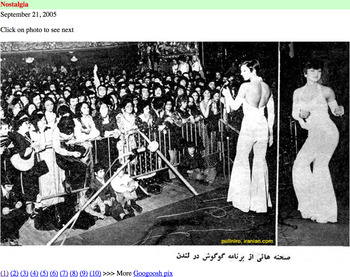
Googoosh occupies a unique place in the Iranian imagination because of her dominant position in mainstream, cosmopolitan pre-revolutionary Iranian popular culture and her close association with the period of the 1960s and 1970s. Googoosh's father was a professional entertainer, and he incorporated his charismatic daughter into his acrobatics acts when she was three years old (see Figure 1). She soon moved to acting in musical films and television programmes in the burgeoning popular culture industries: Googoosh was the star of the first nationally broadcast television programme when she was 10 years old (Chehabi Reference Chehabi, Matthee and Baron2000, p.162) and acted in 15 films before she was 20. Throughout her teens and twenties, Googoosh became a beloved singer of musiqi-ye pāp, a sophisticated Western–Iranian hybrid genre featured on state-controlled television and radio. Polished and cosmopolitan, musiqi-ye pāp was organised around solo singers supported by large instrumental ensemble (including string sections, electric guitars, trap set, flute and others) playing complex arrangements. Its attractive young vocalists wore the latest Western fashions and projected an air of modern sophistication at a time when ‘Western’ and ‘modern’ were often equated.
“Scenes from Googoosh's program in London.” Partial screen grab from http://iranian.com/Nostalgia/2005/September/gg1.html.

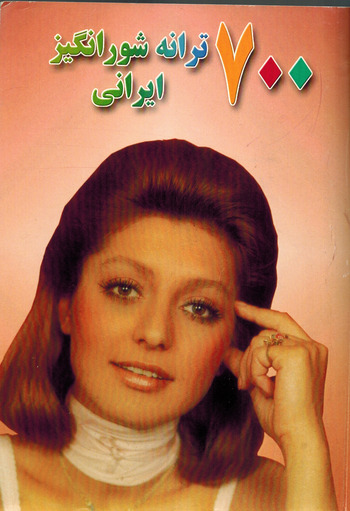
Some remember Googoosh's appearance as more important to her fame than her voice (Zamani Reference Zamani2000; Breyely Reference Breyley2010; Manuchehr Kashef, personal communication 2010). Although Googoosh's female peers in light classical music such as Mahasti (1946–2007), Hayedeh (1942–1990) and Homeira (b. 1945) were arguably more technically accomplished, Googoosh's beauty, fashion plate image and dancing abilities set her apart. A talented actress who had been on stage since her toddler years, Googoosh performed her songs with her face and body as much as her voice, her large, expressive eyes, heart-shaped mouth, lithe body and delicate hands underscoring her sung expressions. Her malleability was also manifest in her constantly changing image. Magazine covers and television appearances featured the star in a wide array of hairstyles and flamboyant attire; one week she would appear as a long-haired blond wearing jeans and a cowboy hat, the next with her signature pixie hairstyle in a bell-bottomed white sleeveless jumpsuit and long gloves (see Figure 2). When Googoosh lopped off her hair into this short style, women all over the country copied the look, which became known as the ‘googooshi’ (see Figure 3). Googoosh's gift for self-transformation was also on display in her many films. Like many other actresses in Iranian popular cinema, she often played the roles of ‘damsel in distress’ or ‘fallen woman’, but Googoosh's characters spanned innocent ingénue, sexually mature (and active) woman and even a cross-dressing thief named ‘Reza’ in the film Shab-e gharibān (Delju Reference Delju1975).
“A new picture of Googoosh with her new look;…” Partial screen grab from https://iranian.com/Nostalgia/2006/February/70s/35.html.

Googoosh's face appearing on the cover of the predominantly prerevolutionary popular music lyrics book 700 exciting Iranian songs (Haftsad tarāneh shurangiz Irāni). Used by permission of Pars Publishing, Reseda, California.

Googoosh's mercurial appearance aligned with her vocal flexibility. From a very young age, Googoosh was an adept performer of many distinct regional and international vocal repertoires and techniques (see Breyley Reference Breyley2010 for a description), but the vocal sound she eventually settled on incorporated numerous influences in a unique combination that was truly her own. She had a sweet lower register that became somewhat strident as she ascended, belting her way through her songs' climaxes and switching to a soft coo and delicately wavering vibrato a moment later (see her ‘Hamsafar’ (‘Fellow Traveller’)). Although it was within her abilities, like other musiqi-ye pāp starts she only occasionally utilised the yodelling-style vocal effect (tahrir) that is a hallmark of Iranian art and light classical music, instead agilely ornamenting her vocal lines in a blend of head and chest voice. Her repertoire displayed more diversity than those of her competitors: Googoosh performed disco, regional folk songs and even R&B, and sang in English, French, Italian, Spanish and other languages.
The height of Googoosh's fame in the 1960s and 1970s coincided with broad-based social and political discontent. If full-colour magazines, musical films and nightclubs where men and women flirted and danced represented one vision of this time, the other was the rampant political repression, particularly following the 1953 British- and American-led coup. Official fears of dissent led to censorship and the torture and exile of dissidents and political opponents. The two dominant strands of the critique of Pahlavi modernity were Islamist and secular leftist, whose adherents would be instrumental in the coming revolution. While differing in ideology and approach, historian Afsaneh Najmabadi (1991) argues that secular leftists and Islamists were united in their anxiety over contemporary women's ‘immodesty’, which they attributed to ‘gharbzadegi’ or ‘Westoxification’ (also translated as ‘Occidentosis’). A concept popularised by intellectual Jalal Al-e Ahmad, gharbzadegi represented the colonisation of Iranian culture and mentality by state-led Westernisation and the country's political and economic entanglements with Western powers (Al-e Ahmad Reference Al-e Ahmad1977). The caricatured gharbzadeh (‘West-stricken’) woman transgressed the boundaries of morality and nation alike: ‘she was a propagator of the corrupt culture of the West … who wore “too much” make-up, “too short” a skirt … “too low-cut” a shirt, who was “too loose” in her relations with men, who laughed “too loudly”, who smoked in public’ (Najmabadi Reference Najmabadi and Kandiyoti1991, p. 65).Footnote 4 This gendered figure of excess littered popular culture, embodied by Googoosh and a host of female performers who have described themselves has having been compelled to play these roles on film and television (see Meftahi Reference Meftahi2016a, Reference Meftahib; Talattof Reference Talattof2011). While leftist critics viewed the flourishing media and entertainment of the 1960s and 1970s as a ‘degenerate’ (mobtazal) and depoliticising distraction from social reality, Islamists decried its immorality.Footnote 5
As various opposition movements coalesced into the revolution that overthrew Mohammad Reza Pahlavi, popular music, popular entertainers and ‘West-stricken’ men and women came under fire. The veil that had been forcibly removed some 40 years prior to create the ‘modern’ woman was now compulsory while female entertainers were banned from performing and recording. These singers, dancers and actresses were replaced by male performers of Shiite lamentation and patriotic anthems that communicated the new state's ideology while purifying the nation of the prior regime's corrupting influence.Footnote 6 In this environment, Googoosh's fame became a liability: she was charged with propagating corruption and her passport was revoked. While Googoosh's colleagues in the pre-revolutionary popular culture industries faced similar treatment following the revolution, the vast majority fled the country and continued their careers in exile, typically in the large Iranian diasporic centre of southern California.Footnote 7 Googoosh decided instead to remain in Iran for the next 21 years and disappeared from the public eye.
Evaluating the Pahlavi modern through Googoosh
In today's Iran, women are officially restricted from singing solos in public just as they were at the time of Googoosh's entrance into silence. On the ground, however, the reality is more complicated than governmental policies imply. In private, plenty of male and female vocalists perform and record their solo voices, but women must exercise greater caution than their male counterparts because the stakes are much higher. Women-only concerts are regularly approved, while concerts in homes, basements and gardens attended by mixed audiences provide private alternatives to those who either cannot acquire – or do not wish to submit to – the many permissions required to stage a public performance. Women singers also utilise private and home studios to record, while social networks, music sellers and the internet provide means for recording and music video distribution.Footnote 8 The inconsistent enforcement of official policy within and between the different responsible organisations and between different performance media, the impossibility of monitoring and controlling unofficial media, performance spaces, and the creativity of female singers and their collaborators all demonstrate the complexity of the conditions surrounding women vocalists in contemporary Iran.Footnote 9 Yet the fundamental ‘red line’ surrounding solo female singing before mixed-sex audiences means that the act is still risky, which has led many Iranians to look back to the decades in which women's voices and dancing bodies suffused the national mediascape.
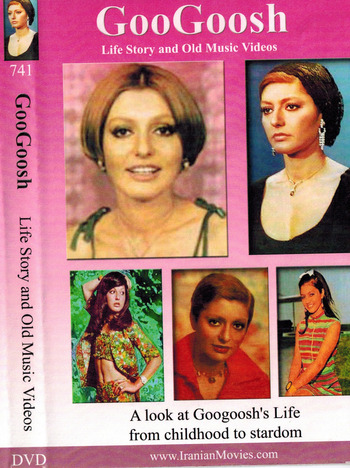
Remediating salvaged pre-revolutionary films, television and audio recordings of pre-revolutionary female performers is a prime means for expressing nostalgia for the Pahlavi era. Googoosh was often the focus of these efforts. Immediately following the revolution, Iranian expatriate media companies in Los Angeles compiled salvaged collections of Googoosh's films, music and television clips (See Figure 3 & 4). These and other pre-revolutionary media were soon available internationally through emerging transnational distribution networks, which afforded Iranians in diaspora in North America and Western Europe the opportunity to access this lost era via reassembled fragments and grainy copies (Khosravi and Graham Reference Khosravi and Graham1997; Hemmasi Reference Hemmasi and Van Nieuwkerk2011). After the advent of the internet, collectors around the world uploaded rare images, newspaper clippings, recordings and television footage in which Googoosh and other female stars featured, making the audio-visual fragments of popular 1960s and 1970s media available online and – through platforms like YouTube and Facebook – affording audiences the opportunity to comment on the past and present.
Front cover of a DVD compilation of Googoosh's prerevolutionary film and performance clips. Used with permission of IranianMovies.com, San Clemente, California.

Today, the effort to piece together the past through Googoosh is a project that involves both diasporic and homeland-based participants. The images of Googoosh throughout this article come from this transnational exchange and literally bear the stamp of their circulations. In the lower corners of Figures 1 and 2 is the name of the San Francisco-based website Iranian.com founded by journalist Jahanshah Javid in 1995. Until around 2010, the bilingual Persian and English-language site was a popular online location for exchanging opinions, gathering news about Iranian diaspora affairs, and accessing photographs and recordings from pre-revolutionary Iran, including pages devoted to Googoosh.Footnote 10 Both images were posted in a series of pages entitled ‘Delicious escape: Magazine clips of movie stars in the 70s'. Next to the Iranian.com attribution is the word ‘Pullniro’, the pseudonym of one of the most active online disseminators of Googoosh memorabilia. According to a profile entitled ‘Private devotion: The world of Googoosh's biggest fan’, Pullniro is a Tehran-based Iranian man of approximately Googoosh's age, who has contributed hundreds of photos to Iranian.com (Azimi Reference Azimi2005). Another of Pullniro's photo collections of pre-revolutionary celebrity journalism in which Googoosh features heavily is titled ‘Forget politics: Celebrities just before the revolution’. While notions of ‘escape’ and ‘forgetting politics’ in the collections' titles might suggest that the images provide a pleasurable distraction from the tense political environment of the 1970s or from the tensions continually surrounding Iran today, the photos also encourage a different sort of politics of memory and nostalgia that records and disseminates what – officially – should be either forgotten or rejected.Footnote 11
The diasporic impulse to reconstruct and re-narrate Googoosh finds its most elaborate expression to date in Farhad Zamani's experimental documentary Googoosh: Iran's daughter (2000). The film's subject is ‘Googoosh as a metaphor’ (Zamani, personal communication 2004), a topic the director explores through interviews with 20 of Googosh's fans, critics, colleagues and associates, as well as historians of Iran, and through carefully edited excerpts from her feature films and pre-revolutionary songs. As the film was made before Googoosh's migration in 2000, in the film she is, in Zamani's words (and in a Derridean turn of phrase) ‘a presence of absence’ (Zamani in Bahmani Reference Bahmani2001): while her recorded voice and image are ubiquitous, she is only present in the film in representation, through her contemporaries' memories, platitudes and sly digs, and Zamani's own painstaking selection of illustrative scenes and songs from her large corpus of films and audio recordings. Zamani's decision to highlight diverse individuals' reactions to Googoosh conveys a sense of her broad impact on Iranian society, albeit exclusively from the perspective of Iranians in diaspora, by a director in diaspora (Zamani moved to New Jersey as a child during the revolution), and largely for a diasporic audience.Footnote 12
One of Zamani's favourite sections of the film is a clear representation of the national metaphorisation of Googoosh as Iran's abused daughter (Zamani, personal communication 2004). Zamani first shows well-known footage of Khomeini descending the steps of the plane he took to Tehran in 1979, followed by the Shah's coronation in 1967. We are then presented with a scene from one of Googoosh's first films, Fereshteh farāri (‘Runaway angel’, c. 1960), in which her real-life professional entertainer father Sāber Ātashin guides her through an acrobatic and contortion act for an audience of children. Googoosh, who was around 10 years old when the film was made, cuts both an impressive and pitiable figure: she is completely poised as her father places her on two stacked chairs which he then precariously balances on his chin some eight feet in the air, but it is impossible not to feel sorry for this painfully thin little girl whose father seems completely unconcerned with her safety and whose act relies entirely on his daughter's talents. At different points in his film, Zamani uses this scene to highlight Googoosh's victimisation as emblematic of Iranian women's suffering generally, but he also hoped to make a larger point about the father archetype in Iranian culture and politics. As he explained to me in an interview, the film sequentially shows ‘Khomeini, the Shah, Googoosh's father, [and implicitly] all our fathers', a reverse chronological progression that expresses his understanding of the roots of Iranians' political troubles regardless of gender: a history of abusive father–child relationships that is then writ large in Iranians' self-sabotaging acceptance (or selection) of abusive patriarchs as national leaders (Zamani, personal communication 2004). The jump from the national to the familial and back again is illustrative of Zamani's thesis for the film and the national possession of Googoosh as ‘Iran's daughter’. Her persona is particularly open to these kinds of intimate national metaphorisations by virtue of her unparalleled celebrity and her embodiment of the victimised child-woman role.
Zamani's film points to a central tension in Googoosh's relationship to 20th century Iran as both victim and beneficiary of the Pahlavi era. Zamani's interviews reveal that some remember Googoosh as representative of a new, modern Iranian woman who moved effortlessly between different song styles, hairstyles and romantic partners, enjoying the new choices and mobility afforded her by the spirit of the times. This perception is complicated by the popular narratives surrounding Googoosh's early years, which suggest not that she was a woman in control of her own destiny but that she was manipulated by men: first her father, then a series of producers, songwriters and directors, domineering and even abusive husbands and, in Zamani's view, both the Shah and Khomeini. Any perception of Googoosh's professional self-determination and personal self-expression is further undermined by the fact that she is not remembered as a woman in possession of her own voice in the agentive sense of the phrase.Footnote 13 As was the case for most musiqi-ye pāp singers, Googoosh did not write her own lyrics. Yet while her male contemporaries Farhad Mehrad, Fereidun Forughi or Dariush – and her female progenitor Qamar– gained audience respect for performing songs (written by others) containing political critiques – Googoosh did not acquire a reputation for choosing lyrics that correlated to her personal sentiments, even if she sang them with conviction. Indeed, some of the commentators in Googoosh: Iran's Daughter even question whether she understood the political undertones of her pre-revolutionary songs like ‘Āghā jān-e khub’ (‘My dear, wonderful sir’) and ‘Shekāyat’ (‘Complaint’) which some have interpreted as expressing support for Khomeini and criticism of life under the Shah, respectively.
While one could dismiss such responses by songwriters and lyricists as attempts to divert attention from Googoosh toward themselves, I suggest that it is precisely this narrative of lack of agency, both pre- and post-revolution, that has allowed Googoosh's personal and professional victimhood to map onto the tragic depictions of both Iranian women's post-revolutionary subjectification and the nation itself. Both of these narratives are intensely nostalgic and profoundly sceptical of post-revolutionary Iranian cultural and political developments. Zamani's tagline for his film, which was released before Googoosh emerged from Iran in 2000, is illustration: ‘Her silence made her the voice of a nation’. The title is remarkable for how it identifies Googoosh's lack of (agentive) voice as the key to her national political metaphorisation. Zamani's film then illustrates his tagline's claim by showing how he and his exiled interlocutors fill the emptiness of Googoosh's absence with their interpretations of her life, her choices and her relationship to Iranian history. The contrast between the treatment of Googoosh and the depiction of Egyptian superstar Umm Kulthum, the most influential female vocalist of Middle Eastern modernity, is striking: Virginia Danielson's (Reference Danielson1997) classic text on Umm Kulthum proclaims her to be ‘the voice of Egypt’ while interviews from the related documentary reveal the tremendous and lasting influence that her vocal performances and political manoeuvres had on Egyptians. Laura Lohman's (Reference Lohman2010) recent book likewise emphasises Umm Kulthum's exceptional ‘artistic agency’ and her enduring impact on Egypt and the rest of the Arab world.Footnote 14 While Umm Kulthum's story is one of triumph, Googoosh's (in Zamani's telling) is tragic: Googoosh does not define history so much as she has been subjected to it.Footnote 15
Googoosh's comeback
In the year 2000, Googoosh was granted a passport for the first time since the revolution. What sort of deal Googoosh made to acquire these permissions is the subject of many rumours; some suggested that she collaborated with Iranian officials, a cardinal sin among many Iranians in diaspora who are opposed to the Islamic Republic. Whatever the conditions, Googoosh took the opportunity to leave the country and never returned, landing first in Toronto and eventually making her way to Los Angeles, where she settled and successfully restarted her career in exile.
In her very first press conference, Googoosh addressed a crowd of reporters in Persian, answering questions about her experiences during and following the revolution, the conditions of her emergence and her artistic intentions. On this latter point, she declared: ‘I shall sing my old songs because these are full of memories both for myself and for those who lived with my songs … But …over these past twenty years, I have found poems that have more specific and profound meanings [than my past work]’ (Googoosh 2000). These were the basis of Zartosht (Zoroaster), her first album in over two decades.Footnote 16 Indeed, a number of the new songs on this album distinguished themselves from her pre-revolutionary ‘`āsheqāneh’ or romantic repertoire by subtly but unmistakably referring to the Iranian homeland as a ‘captive land’, a barren garden (‘Khāk-e asir’ (‘Captive land’)), and a ‘palm [tree] without bird or flower’ (‘Zartosht’ (‘Zoroaster’)).Footnote 17 Googoosh described herself as lacking a ‘political mind-set’ at the time of the revolution and suggested that the ensuing decades had made her a wiser, more politically savvy woman who now intended to express herself, perhaps for the first time in her professional life.Footnote 18
Googoosh's first performances after her migration were wildly successful – she played the Air Canada Centre of Toronto, which reportedly sold out its 15,000 seats with tickets selling for $30–250 – they were sold unofficially for much more. Her two concerts in Dubai in March 2001, timed to coincide with the Iranian New Year holiday, drew more than 10,000 Iranian residents to the popular Gulf destination (Moaveni Reference Moaveni2001a). Reports from the early concerts focused on both the star's and audiences' intense emotional experiences: articles in the Western press repeatedly describe Googoosh and her fans weeping as they faced each other (Moaveni Reference Moaveni2001b), while a report by an Iranian attending Googoosh's concert in New York described ‘the tears shed by the dentist from Connecticut, the taxi driver from Queens, the teenager who left Iran when she was two and the grandmother who still speaks no English’, demonstrating the breadth of Googoosh's fan base (Sabety Reference Sabety2001). Another report posted to Iranian.com states the powerful desire for ‘a sense of connectedness to the past’ that drove expatriates to her concerts:Footnote 19
It was as if [audiences] had made a pilgrimage to the concert to forget the last 23 years and step into a time machine back to an era when they had never heard of revolution, [the Islamic R]epublic, war, and exodus. This was true even among the young who were attending the concert. They would voice the same nostalgia even though many had not even been born in Googoosh's prime years. The young fans reflected a sense of awe and regret that they had probably picked up from their parents. In effect, many Iranians saw in Googoosh's re-emergence a connection with a time (in contrast to their present discontent) which presented content and security. (Tabib Reference Tabib2001)
Videos of these early concerts reveal that Googoosh's voice remained true to her pre-revolutionary sound, touched by age but still agile and forceful, suggesting years of vocal maintenance during her extended ‘silence’.
Since her re-emergence, Googoosh has reworked her pre-revolutionary repertoire and her association with the Pahlavi modern. These include the song and video ‘QQ bang bang’ (2003) in which she sings of her age cohorts' flourishing in the pre-revolutionary ‘spring’ in contrast with the post-revolutionary ‘winter’ (Rahimieh Reference Rahimieh2016; Hemmasi Reference Hemmasi, Barendregt and Weintruab2017b) and her ‘Hamsedā Medley’ (2005) a seamless arrangement of seven of her best-known hits from the 1970s and an accompanying video in which the Googoosh of the present lip-syncs alongside footage of herself prior to the revolution. However, Googoosh has not only looked backwards to move her career forwards: her most provocative new material builds on the association between her persona and the Iranian nation projected onto her in her absence. Crucially, she has now taken the reins of her own political metaphorisation, releasing songs and videos in which she claims to sing to and for the Iranian people.Footnote 20
In representing Iran and Iranians, Googoosh has often continued to occupy the ‘victim’ role, using it as a position of moral superiority to call attention to the exploitation and neglect of Iranian women and the nation itself. Googoosh tackled the topic of abuse of women in her 2004 song ‘Āy mardom mordam’ (‘Oh People, I'm Dying’). In the music video, Googoosh appears dressed in black as if in mourning, sometimes with her hair pulled back into a tight bun, and other times with her hair covered with a black scarf, her eyes welling up with tears, performing the suffering she and other Iranian women have endured. The screen is intermittently filled with images of flames burning photographs of the young Googoosh along with headlines from Persian-language newspapers that describe violence against women: ‘I've been hit so much I don't feel pain anymore’; ‘A man murdered his wife – his daughter couldn't take it and killed herself’; ‘Tehran's streets are clogged with runaway girls'. The interspersion of Googoosh's image on the same plane as the anonymous abused women that her video represents collapses, momentarily, the distance between the celebrity and ordinary women, emphasising their shared experience as female victims of familial and state violence.
While it may be tempting to dismiss the comparison as disingenuous given her fame, fortune and distance from Iran, Googoosh's suffering at the hands of the men in her life has made her, for some fans at least, a relatable and inspiring figure. The following excerpted letter to the editor of Iranian.com by a self-identified Tehran-based female biology student expresses this point:
[Googoosh] is and has always been a symbol of persecution of iranian women. like all of us she was born and grew up and lived under the dictatorship of father and husband. like all of us she tried to free herself a couple of times and like all of us she experienced islamic fundamentalism. like all of us her beauty, art and talent was buried for 21 years but i praise her courage for coming out of that cocoon and flying again. this time much higher and stronger … (Nobari Reference Nobari2004; capitalisation preserved from original)
For this fan, Googoosh's performance of anger at the victimisation of Iranian women, and the performance of her own victimisation, are credible and even inspirational because of her metaphorical and literal transformation from a silenced to vocal woman.
From ‘Iran's daughter’ to ‘Mother Iran’
Five years later, Googoosh launched a new song and video described in this article's introduction, ‘Man hamun Irānam’ (‘I am Iran itself’), in which she assumed the voice of the Iranian motherland. The song was released around the time of the 2009 violent citizen uprisings contesting the re-election of then-president Mahmood Ahmadinejad, events that filled many Iranians with momentary hope followed by deep dismay at the ensuing repression. While during this period many musicians in the diaspora and within Iran produced songs responding to the election and ensuing protests, Googoosh's song stands out for voicing not only nationalist sentiment from her position in exile but also embodying and voicing the nation itself as a feminine entity.
In ‘I am Iran itself’, the Motherland is depicted in ruins (virān) at the hands of her ostensible stewards and protectors – implicitly, the Islamic state. Singing in the first person, Googoosh expresses the nation's plight while pleading with her dispersed ‘children’ to come to her aid.
When you all left, I cried/But you promised you would be back
That was the only hope I had/You promised, so I waited with sleepless eyes
My dearest children, what happened to our promise to see each other again?
‘I am Iran itself’ draws on a pre-existing ‘matriotic’ (as opposed to ‘patriotic’) trope that first became prominent in secular Iranian counter-official nationalist discourse and imagery in the late 19th and early 20th centuries.Footnote 21 This discourse, which appeared in periodicals, poetry, cartoons and other popular genres, depicted a helpless, forsaken Motherland – the mām-e vatan or mādar-e vatan – who calls to her wayward citizen-children to defend her from both domestic threats and foreign incursions. Tracing the trope's relation to early 20th century political transformations, historian Mohamad Tavakoli-Targhi has argued that imagining Iran as a woman ‘symbolically eliminated’ the official depiction of the nation as ‘the home headed by the crowned father’ while it also contributed to ‘the development of a public sphere and popular sovereignty … [and] the participation of the “nation's children” (both male and female) in determining the future of the “motherland”’ (Tavakoli-Targhi2001, p. 218).Footnote 22 However, while the Motherland is a female figure of self-determination, she does not particularly symbolise women's self-determination: in both the trope's historical iterations and the 2009 song, Iran ‘herself’ is portrayed as enfeebled, under attack and unable to help herself, requiring the intervention of her guardians – most often imagined as males in dereliction of their duty. Googoosh's transformation into Mother Iran reinscribes her as victim as it uses victimhood to invigorate her audiences' protective impulses.
For all its resonances with ‘progressive’ early 20th century Iranian political transformations, ‘I am Iran itself’ represents an expression of contemporary expatriate nationalism as much as the revival of a historically relevant national trope, and as such marks Googoosh's further association with diaspora. The principal tragedy the song describes is the Motherland's abandonment by those who have emigrated – if they had kept their promise to visit Iran and were responsive to her needs, perhaps she would not suffer so. Performed by Googoosh in exile, the song imagines Iranian migrants as more crucial to the nation than its ‘faithful’ citizen-children who stayed in Iran; in this sense the song reads as migrant self-aggrandisement or a reassurance of relevance to the Iranian nation. At the same time, the song is rather ironic and even hypocritical: it would not be unreasonable to view Googoosh as a deserter who left the country to its fate – precisely the kind of irresponsible ‘child’ the song decries – while in the space of the song, she not only audaciously claims to represent the homeland but also calls on other Iranians in diaspora to engage.Footnote 23 To refer back to one of this article's opening questions, the answer to ‘which Iran’ and ‘whose Iran’ Googoosh represents is, here, the imagined Iran of migrants materialised in exile through performance and transnational media. In this intra-migrant dialogue, Iranians within Iran do not figure at all.
Rather than taking Googoosh or her collaborators to task, I want to draw attention to the fact that, through ‘I am Iran itself’, the icon has once again taken the reins of her political metaphorisation to frame herself once more as victim. ‘I am Iran Itself’ marked her transformation into a new iteration of the female national icon: Iran's silenced, mistreated daughter became the Motherland herself, her voice echoing back from exile. Through the Mother Iran role, she also revives a historical trope that predates the Pahlavi dynasty, expanding her symbolic synthesis with national figures from the pre-revolutionary era to the pre-20th century. This feminine national symbolism points to an extensive array of current and historical alternative nationalisms that build on past models while asserting difference in diaspora. Most audaciously, Googoosh sings the demanding words of the motherland, using her female voice, the very musical medium most restricted in Iran.
In the years since Googoosh performed ‘I am Iran Itself’ she has continued to sing and speak on behalf of marginalised Iranians. In 2014, Googoosh released a love song called ‘Behesht’ (‘Heaven’) which caused tremendous controversy because of its video, a sympathetic portrayal of a romantic relationship between two women that concluded with the English words ‘Freedom to Love for All’. This piece marks another transition in Googoosh's self-representation as she directs attention to her ‘daughters’ who – like the icon in her own youth – push the boundaries of acceptable sexual and gendered behaviour. It is the female protagonists of the video – lovers who pledge to marry and are cruelly rejected by family members – who are the heroines of the piece, not Googoosh; she only appears at the video's conclusion, singing to the women from stage, looking down on them benevolently to give them her blessing. Many Iranians of all political and religious persuasions in and outside of the country find homosexuality unacceptable and official punishments for homosexual conduct include lashes and, in some cases, the death penalty; the video consequently generated a great deal of debate in Iranian domestic and international media.Footnote 24
Even more controversial was the televised talent competition Googoosh Music Academy, in which the star provided young men and women with motherly guidance (and publicity) to help them become professional pop vocalists. This programme, developed in 2011 in partnership with the London-based Iranian satellite television channel Manoto1, reportedly attracted an enormous audience within Iran and raised the ire of the conservative Iran-based press. The controversy was never greater than in 2013, when the competition was won by Ermia, a young Iranian woman who grew up in Iran and lived in Germany, and who wore the veil out of religious observance. Ermia was precisely opposite to the kind of woman that Iranians would expect to appear on a programme with the ‘monarchist counter-revolutionary’ Googoosh (as the conservative press sometimes characterises her), much less competently sing pop songs in public. In the firestorm of reactions that swept across transnational Iranian media, blogs and conversations in the wake of her win, Ermia's combination of solo pop singing and Muslim piety was treated on the one hand as a bizarre anomaly and, on the other hand, as potentially representative of a new generation of Iranian women for whom public singing and veiling are not mutually exclusive (Hemmasi Reference Hemmasi2017a). It was profoundly ironic that Googoosh – the embodiment of the ‘Western doll’ of the Pahlavi regime – would appear to support and nurture a veiled woman like Ermia, and yet Ermia's declarations of her longstanding affection for Googoosh's music indicated that reductionist binaries of religious versus secular or modest vs. corrupt fell short in defining either woman – or their relationship to one another.
Conclusion: the ambivalence of nostalgia
At the time of writing, 17 years have passed since Googoosh's comeback, nearly the length of time she spent in obscurity in Iran. She now tours the world regularly, focusing on Canada and the United States, where she is based and where much of her family lives. In 2014, I attended her concert in Toronto at the Air Canada Centre. The hall was full but not sold out; most its seats were occupied by Iranians in their forties and fifties, with a smattering of elderly people and teenagers in the audience. The name of the tour and the concert's opening number was ‘Nostalgie’ (the French word for nostalgia, sometimes used in Persian), taken from the title of Googoosh's duet with Ebi (Ebrahim Hamadi), a fellow expatriate Iranian vocalist living in southern California. Framing the evening as nostalgic seemed fitting given the character of many fans' attachments to these stars, but the song itself described nostalgia as a state in which Iranians were ‘mired’. This grim sentiment was delivered in a dramatic musical arrangement that left both singers straining at the top of their ranges:
We remained mired in nostalgia (nostālzhi)
Under the dirt and dust …
Whether we have left [Iran] or have stayed
We have all lost the game.
‘Nostalgie’ met with a lacklustre response that night, perhaps because its newness meant that people were not familiar with it but also, I suspected, because its negative depiction of nostalgia was so out of line with audience expectations. Given the audience's enthusiastic singing with both performers and explosions of cheers and wolf whistles when favourite pre-revolutionary songs were introduced, it appeared that it was nostalgia that audiences wanted and that Googoosh and Ebi ultimately delivered.
Initially I understood ‘Nostalgie’ as bemoaning Iranians' failure to ‘move forward’ and their being caught in longing for an irretrievable past: like Googoosh, ‘we’ were victims the revolution and our national family history of abuse, and now, the disease of nostalgia as well. However, considering the piece as introduction to an evening of collective return to pre-revolutionary Iran through song, I came to understand the song as asserting nostalgia as basis for shared Iranian identification, a disparate group united in ambivalence about the present and in desire for their individual cherished pasts to which Googoosh's voice might momentarily transport them. The Nostalgie tour would likewise transport Googoosh and Ebi to Anaheim and Washington, DC as well as Dubai and Anatalya, where they would encounter Iranians living in the United Arab Emirates and Turkey alongside large crowds who had flown in from Iran to hear the exiled stars in the flesh. Although Googoosh's pre-revolutionary stardom was built on her newness, malleability and ‘modern-ness’, and although her post-migration career has held numerous transformations, today she may not be rewarded for innovation as much as for conjuring the past. Perhaps it is Googoosh who is ‘mired’ in nostalgia for the Pahlavi modern, at least on stage.
Diasporic desire for this female representative of pre-revolutionary Iran has been ‘articulated with the desire for commodities …, fused with nostalgia for the homeland, [and has become] inseparable from longings for modernity’ (Mankekar and Schein Reference Mankekar, Schein, Mankekar and Schein2012, p. 4). Googoosh has emerged as a focal point for these desires because of her deep association with the pre-revolutionary period but especially because her persona resonates with gendered themes of helplessness and agency to which many Iranians relate in the wake of dramatic political and cultural change. It may be tempting to write off as ‘regressive’ both Googoosh and nostalgia for the Pahlavi modern, first for the emphasis on victimhood rather than empowerment and, second, because nostalgia is so often conceived as the opposite of progress – as if the impulse to revisit the past prevents movement towards the future (cf. Boym Reference Boym2001). I suggest instead that we think of Googoosh once again as mother and in her generative capacity to ‘conceive’ new perspectives on the past. Within the swirl of performances and products that Googoosh has created and continues to create – and the responses that others formulate in reaction – the Iranian nation, what kinds of modernity Iranians ought to embrace and the ideal role of women within these modernities are all central concerns. Googoosh's ambivalent perpetuation of nostalgia and its continuing appeal for dispersed Iranian audiences indicate a collective desire to revisit, rethink and reformulate the past and imagine new futures through Iran's daughter and mother.
Acknowledgements
I sincerely thank for their comments Daniel Anisfeld, Mohammad Hemmasi, Tyler Bickford, Lauren Ninoshvili, Ida Meftahi, Morgan Luker, Golbarg Rekabtalaei, Jairan Gahan, Afsaneh Najmabadi and two anonymous reviewers for Popular Music. This research was undertaken with the generous support of the University of Toronto's Connaught Fund.