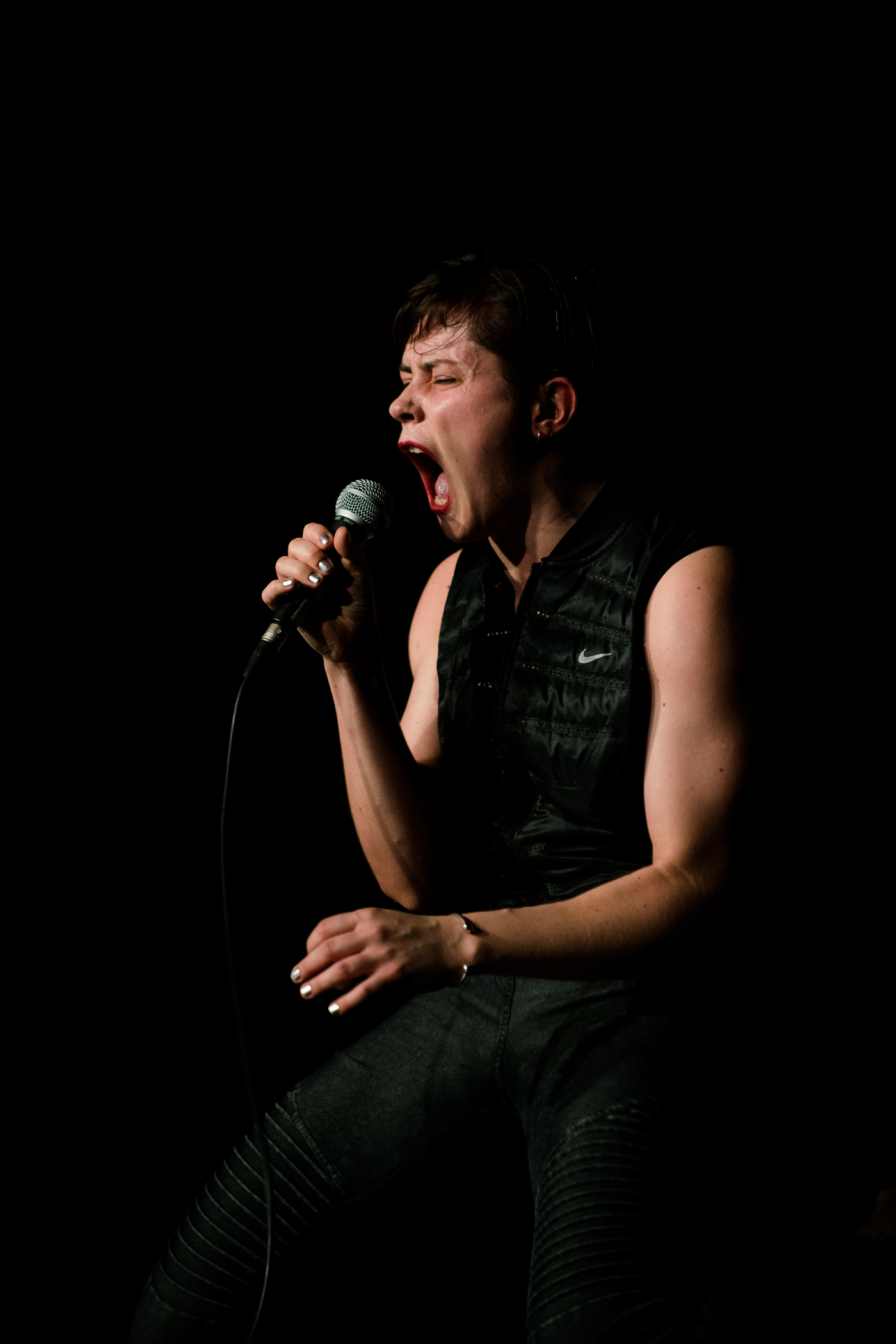
A deep guttural cry bursts through the quiet rhythmic unity of the scene. Ewa Dziarnowska's scream rises from the depths of her body. Swelling. Piercing. Persistent. An animalistic cry. With its sharp edges, the acoustic figure cuts open the darkened space of the stage. Moments ago, a single dancer was still crouching on the floor. Softly swinging and swaying his rounded shoulders, he seemed to recede into the inner spaces of his body. As if kneading and being kneaded in a soft rhythm, the dancer seemed enveloped in a cocoon of intimate movement. The scream wipes out all sense of intimacy and marks a clear cut in Boom Bodies (2016), Doris Uhlich's third installment of her Techno Trilogie (2014–16). The acoustic caesura opens an aesthetic space of difference, forming an audible, as opposed to visible, embodiment of trance. A disconcerting and destructive frenzy hits the audience's ears, before the trance dance that the cry is part of becomes visible. The scream drives an invisible force into the scene, triggering an experience that the following group of eight dancers transforms into a scene of fervent movement.Footnote 1
Introduction: Trance as an Aesthetic Bodily Practice
In Europe we are currently witnessing an active interest in trancelike states and ecstatic experiences in contemporary dance and performance productions.Footnote 2 Fundamentally different than ritual, but also different than the body practices used in modernist dance, they create states of intensity by presenting bodily scenes as force fields of transgressive energy. My use of the term “scene,” here, indicates that I am addressing states of ecstasy that are produced by theatrical techniques and technologies rather than by pharmacological or ritualistic means. It also indicates that I am addressing bodily movement as a scene which is embedded in the mise-en-scène of a staged environment. Trance presents itself as a form of aesthetic activation of the body.Footnote 3 While trance as a cultural body practice addresses specific states of consciousness (Feustel Reference Feustel2013), trancelike scenes in dance performances ultimately aim at the audience's perception of intense states of physical exaltation.Footnote 4 On the aesthetic level of movement, extended, expanded and unleashed bodily forces seek to create space for such perceptions. Choreographed bodies present themselves in seemingly out-of-body states and scenes of physical frenzy: from heaving to repetitive loops, to convulsing fits, we see how shaking and vibrating bodies are relentlessly driven to an outermost degree of exhaustion. These scenes invoke a range of experiences, which—in the sense of the etymologies of trance and ecstasyFootnote 5—employ out-of-body and out-of-mind practices and choreograph them as sensory, kinetic scenes of transgression. The limits between performance and experience become blurred here, entailing undecidable events which unfold their effects not least because of this undecidability.
Contemporary choreographers such as Doris Uhlich (Techno Trilogie 2014–2016), Meg Stuart/Damaged Goods (Violet, 2011), Anouk van Dijk (Rausch, 2012), Kat Válastur (lang, 2009; Ah! Oh! A Contemporary Ritual, 2014) or Eszter Salamon (MONUMENT 0.4: Lores & Praxes, a ritual of transformation, 2017) explore out-of-body and out-of-mind states in their aesthetic practice. They use specific body techniques to establish energetic fields of bodies-in-movement, which, in turn, are based on the interplay of reciprocal forces. Bodies are caught up in often chaotic articulations of movement, presenting calculated forms of abandon. At times choreographers play with vegetative or psychotic states, in other instances they seek out-of-mind conditions or invoke somnambulistic experience. Even though the effects created by the growing intensity of movement are not induced by drugs or other mind-altering substances, they coincide with a spectrum of sensory experiences that seek out ecstatic states of kinetic-sensory transgression. I will argue that these choreographers engage in an aesthetic quest for the energetic expansion of movement, allowing the body to detach from the mind as an instance of control. One might even speak of the body becoming the site of a force field. What specific techniques of movement and perception do they employ? What practices of activating and channeling, of unearthing or even exposing inner forces are at play? Which strategies of ordering or dramatizing come together in the aesthetic creation of ecstatic states? How does one structure choreographies so that they bring about transgressive experiences that affect both performers and audience? Which spatial-temporal frames are allotted to trance and ecstasy as bodily scenes? In other words, how do trance and ecstasy appear and with which bodily/choreographic figurations do they coincide? In what follows, I address these questions and examine trance as an aesthetic scene of sensory activation.Footnote 6 Most of all, trance pushes toward transgression in the sense of aesthetic expansion, of opening and exaggerating the body. Transgression seeks to energetically charge the performative events on stage. Contemporary figurations of trance in the works of Doris Uhlich, Meg Stuart or Eszter Salamon deal with diverse contexts of experience and representation. They all push toward creating perceptual aesthetics of intensity. Compared to one another, and to historical modernist dance, they come up with highly differentiated aesthetic concepts of how to produce ecstasy.
I explore these concepts as strategies and politics of what I call “trance-gression.” They initiate a fundamental intervention into the body as a site of movement and thus, render the subject of movement untraceable. What specific aesthetic and choreographic approaches are used to activate, subdue and reveal, order and dramatize, and transgress forces? Which perceptual and aesthetic functions, potentials, and promises can these scenes of trance agree on? The point of reference for the following ideas is not so much the function of liminality that we find in a theoretical context, which, in analogy to cultural figurations of trance and ritual, marks the transformative power of theater as an aesthetic experience.Footnote 7 The aesthetic experience of trance in its modalities of excitement or shock do not feature in my analysis. Rather, in light of my current research, I trace the sensory and reflective potential of the transgressive body as means of critical intervention.
Research Context: Trance as an Aesthetic Politics of Perception
The context of this analysis is my current research project Transgressions: Energetic Processes of Body and Scene, which examines energetic forces as forms of expansion and transgression in scenes of (bodily) action.Footnote 8 I investigate the processes, procedures, and functions of energized bodies in the interplay between hidden and exposed forces. The focus lies on the perceptual politics and the aesthetic potential of choreographed bodies as they create specific transgressions within this force field. The approach is based on the idea that choreographed bodies command specific forms of transgression, informing specific strategies that energize movement, action, space, and gaze. In correlation to the visible/invisible, these transgressions create specific perceptual politics which pertain to the larger dispositif of theater. I am using the term “dispositif” with reference to Michel Foucault (Reference Foucault and Bouchard1977) as an epistemological concept that pertains to the singular performative event as instance of a much broader theatrical order of knowledge. The aesthetic perception of choreographed bodies is based on a precise technique of choosing what is perceptible; it is a finely tuned process of tracing space, creating temporalities, initiating movement, and generating relations that culminate in a kinetic-sensory conglomeration.
Ewa Dziarnowska in Boom Bodies (2016). Choreography: Doris Uhlich (Tanz in Bern 2016). Photo: Sabine Burger, © Sabine Burger.

The means which are used to mobilize bodies go hand in hand with the somatic and technical treatment of forces and are directed toward choreographically initiated transformation processes. These processes, in turn, create transcorporal and interactive relationships within the performance. On an analytical level, the ability of bodies to move becomes a choreographic and aesthetic strategy of energetic processes with the potential to take on critical functions. These strategies come into practice as they address the gaze of the audience within the performance. The perceptual strategies taking place at the interface of body and scene stem from the mobilization of movement and impressions of movement, which form the specific aesthetic parameters that define a choreography and its reception.Footnote 9
I propose trance and ecstasy as aesthetically produced and exhibited force fields of choreography. At times, choreographed trance works with cultural and ritual body practices, but it is not identical to them. While shamanistic trance dances or the ecstatic dance rituals of the Sufi are used to address and produce experience-specific states of (un)consciousness,Footnote 10 practices of trance and ecstasy in performative art seek to create perceptual fields of increasing intensity, which only indirectly concur with individual realms of experience. The artistic context of dance and performance employs trance and ecstasy as aesthetic manifestations and thus as representational events. They play with specific modes of aesthetic perception, but without substantiating actual ecstatic experiences or mind-expanding altered states.Footnote 11 Within performance, altered states and ecstasy rather function as aesthetic forces. In other words, they form choreographic constellations and aesthetic approaches to movement, serving the purpose of transgressing the limits of physicality and creating a web of scenic expressions of movement. In stage dance, figurations of trance and ecstasy can therefore be described as aesthetic forces that initiate exceptional states.Footnote 12 An interplay of body and movement techniques unfolds, marking the transgressive forces of the physical as a choreographic event.
Thus, I aim to analyze the choreographic dispositifs of trance, brought about by physical techniques and formed in dance as exhaustion and frenzy, as releasing and unleashing forces. The way bodies mobilize, the sensory and technical work with inner forces, the body's gift to move, to create scenes—all this reveals certain perceptual strategies. As aesthetic strategies of choreographies, they pursue an aesthetic politics of perception. My analytical attention is thus directed toward the doubled and intertwined site of body and scene and the perceptual strategies that take place within it. Concurrently, I focus on the transformational and interactive exchange processes in performance: Which perceptual aesthetic techniques can we identify in the sense of what can be made perceptible? Which processes of spatialization, temporalization, and sensibilization, creating awareness and controlling movement, are applied?
Trance-gression
Trance as an event of aesthetic performance is based on movement techniques and choreographic strategies. Choreographic scenes of trance are revealed as aesthetic strategies and explorations, aimed at undermining the dominant gaze on stage and intensifying sensory impressions through strategies of physical movement and choreographed gazes. Subject to the theatrical dispositif of difference, trance in the field of dance and performance becomes an aesthetic act of transgression. This trance-gression, specific to each staging and performance, introduces something into the divided space between stage and audience that breaks open the boundaries between them. Immersed in the constituting setup of theater, where performers and viewers are inherently separated, ecstasy works with this constitutive difference. Indeed, these transgressions, constantly pushing the boundaries and creating sparks of exchange, emerge from the seemingly irrevocable division into actors and viewers, which is often cemented in a spatial separation as well. As aesthetical acts, trance-gressions seek to open up a divided space of experience, which, in the sense of Michel Foucault's reflections on transgression, always “opens onto a scintillating and constantly affirmed world” (Foucault Reference Foucault and Bouchard1977, 37) as “limit and transgression depend on each other” (34):
Transgression carries the limit right to the limit of its being; transgression forces the limit to face the fact of its imminent disappearance, to find itself in what it excludes (perhaps, to be more exact, to recognize itself for the first time), to experience its positive truth in its downward fall? (34)Footnote 13
The aesthetic impact of transgression is contingent on the limits of the dispositif of theater. It is this boundary between performers and viewers that makes it possible to employ trance as an aesthetic strategy. It proposes modalities of the aesthetic within the mode of theatricality. By pushing and testing this boundary, artists like Uhlich establish their performance as a contention in the form of aesthetic movement.
Discourse Figures of Trance-gression in Mary Wigman: Merging with the Current of Life
In early twentieth-century dance, trance and ecstasy were considered techniques—or perhaps even phantasms—used to create moments of scenic transgressions. As aesthetic figures and symbolic formations, they were interpreted as cosmological. By employing trancelike sequences in their choreography, groundbreaking modern dance choreographers like Mary Wigman and Rudolf von Laban created awareness for the kinesthetic sensory potential of movement. This potential unfolded as the stage space was presented as a symbolic setting for movement. For Mary Wigman, trancelike bodily practices such as spinning or whirling, which she appropriated from various cultural and spiritual contexts, indicated a transcendental communion with space. Rudolf von Laban choreographed the body's forces of mobilization, which he considered intrinsic forms of movement, into spatially geometric formations, aimed at becoming one with the universe. For both choreographers, initiating energetic forces as a symbolically charged image of movement approximated a religious/spiritual sphere of experience that was to be passed on to the audience. The aesthetic endeavor of Ausdruckstanz was focused on natural cosmological origins of bodily movement, equally drawing from maenadic poses from ancient artworks and religious or ritualistic practices. Exalted poses and bacchantic gestures were (re)enacted and displayed as moving images of maenadic acts, ranging from grotesque, critical exaggerations (Valeska Gert) to religious pathos (Mary Wigman) (Brandstetter Reference Brandstetter1995, 182–206). Aesthetic adaptations of different forms of cultural/spiritual knowledge of trance and ecstasy tie dance back to a ritualistic/cultural understanding of its physical practices—and their origins in theater.
How thoroughly cultural/historical and philosophical images and discourses of ecstasy and trance shape the aesthetic fabric of formations of trance becomes exemplarily evident in concepts of Ausdruck (expression). Rudolf von Laban and Mary Wigman resorted to specific movements in order to express formations of trance. Drawing on Ludwig Klages's Lebensphilosophie (life philosophy or vitalism), this included appropriating Sufi whirling. Laban's and Wigman's aim was to stage the dancing subject as an entity carried by the current of life. The vision was to perform how the body, intoxicated by movement, became immersed in the current of life, which, in the sense of Klages, aims at a cosmogonic dissolving of the subject. As Robert Feustel explains, Klages's idea of trance expressed “a transcendental experience of the origins of the world … as an untainted, flowing and thus unformed idea of life,” which Ausdruckstanz sought to reflect in a cosmogonic image of movement (Feustel Reference Feustel2013, 183).Footnote 14
Particularly Wigman's work from the early 1910s onward is marked by dancerly experiments with ecstatic movement, accompanied by her aesthetic quest for the Empfindungsgrund (principle of sensation) of dance. In the context of Lebensphilosophie, which was so prevalent at the time, Wigman developed her hallmark narrative of Tanzerlebnis,Footnote 15 the experience of dance (Wigman Reference Wigman and Sorell1986a). Its motives would become the philosophical and choreographic “mindscape” and aesthetic principle of her work, as we find abundantly in her prose, her specialized texts, and educational writings. In her work, Wigman translates the ecstatic experience of rotation into an aesthetic strategy. Rotation becomes a figure of her own descriptive discourse as much as a figure of performance:
[…] circling and turning the body moves forth up and down like a spiral, without beginning and end—tender swaying, arms in a hold full of pain and joy—then, in self-destructive pleasure, it speeds up, it swells and ebbs away—higher and faster, even faster—the whirl has grasped me, the waters rise. A surge pulls me down. Ever higher and faster, I am hunted, whipped, urged on.— … A jerk seizes the body, forces it to come to a halt at the peak of its ecstatic whirling, lifted up on tiptoe, arms thrown up to cling on to an absent support. Breathing ceases for an eternity which only lasts for seconds. And then, suddenly, the body lets go, sinking down fully relaxed. (Wigman Reference Wigman and Wigman1986b, 39)
While Wigman conjures up the circling force as an external power, her body is ultimately able to bring this power to a halt. The act of whirling thus becomes a source of inspiration, meant to spark states of emotional excitement in the dancer. On stage, she frames her choreographed whirling sequences with gestures of incantation, elegiac pacing, and posing, all of which present images of a body that is guided by a higher force, but also masters this guiding. Wigman was on a choreographic quest to find an archetype, the basis of all movement, which she subsequently formed in figures of pathos and propagated in phantasmic projections of a “pure” body. The aesthetics of her portrayals ultimately culminate in a type of Tanztheologie, a theology of dance, in which ecstasy serves to represent the transcendence of the body—now immersed in the flow of life.Footnote 16 Immersion becomes a form of controlled subjection to ecstatic forces, contained by representational—not least discursive—frames and mastered through movement technique. Wigman displays bodily figurations of an autonomous subject which remains in charge of the forces that it unleashes.
Trance-gression as Force that Affects: Contemporary Body Images of the Dionysian
Contemporary modulations of trance challenge the idea of an autonomous subject. They put the force field of dancing bodies to the test. At the edge of losing oneself, movements flirt with losing control, creating a sense of instability. Suspended between moving and being moved, energetic forces articulate themselves and transgress the body. An external force affects the body and marks the experience of trance as a specific event of movement.
Unlike Wigman and her peers, contemporary choreographers deal with trance and ecstasy as a force field, which gives the mobilized body over to an external energy without fully controlling its impact. It is a force field from within that invokes nervously spreading, pulsating, and irritating, eruptive and space-consuming forces from the outside.Footnote 17 Remarkably, we can find a contemporary aesthetic echo of the Greek mythological figure of Dionysus here. As Susanne Gödde has elaborated, Dionysus, in his alterity, embodies a “form of difference: dynamic, transformative, cathartic and subversive” (Gödde Reference Gödde and Schlesier2011, 87).Footnote 18 As god of madness, he rages ecstatically and knows how to induce trance and transgression in humans. And yet, he is also the ancient god who, as Renate Schlesier points out, “shares the ecstatic experience with the humans he has put into this state” (Reference Gödde and Schlesier2011, 177).Footnote 19 Figurations of movement associated with Dionysian frenzy are marked by a quality of the untamed, of destructive and fundamental fury, which envelops the body completely. The god is ascribed a “potentially harmful frenzy, juxtaposed with a fascinating mysteriousness, which can occur independently from states that are induced by wine or other mind-altering substances” (175).Footnote 20 As the god of ecstasy, Dionysus embodies a transgressive force that always induces a complete transformation, which can have positive or negative effects.Footnote 21
Certain works by Berlin and Brussels-based choreographer Meg Stuart impressively invoke a dangerous Dionysian quality as they brush up against the edge of an all-engulfing and irrevocable transformation. She achieves this by bringing bodies to the edge of frenzied destruction with an energetic impact that pushes them to seemingly calamitous distortions. In Stuart's piece Violet (2011), bodies interspersed with uncontrollable impulses, convulsions, resistant blockings, and other unbridled exaltations present scenes of frenzy erupting from within in a successively increasing dynamic. The frenzy reveals itself as an untamable force field of uncontrolled impulses of movement, permeating and corroding everything organic in its wake. We witness a defying and compulsive desire for ecstasy, which choreographically leads to an overwhelmed state. Thus, the destructive power of trance is exposed. Here is otherness-in-movement, a physical state, which, as Bernhard Waldenfels (Reference Waldenfels2002) shows, is intrinsically linked to the moving self. However, in this scene of displayed trance, Stuart elevates otherness in the sense of other-within-the-own-body to a key principle of movement.
To achieve an aesthetic quality of movement in the field of tension between the self that moves, and that which is being moved, Stuart's dance training was based on somatic approaches such as Body-Mind-Centering and Release Technique.Footnote 22 These approaches are based on the idea of alignment, which dissolves tensions within the body. By training the body to become permeable to movement, it begins to move as a whole and can tap into different energy fields.Footnote 23 This, in turn, stimulates intensities that are uncovered as specific energetic approaches. The movements aim at an aligned, alternately active-passive/passive-active use of the body, thus initiating a multidimensional exchange of energy with its immediate surroundings. Dancers are taught to expand and open their bodies to the situation. Processes of creating awareness, perception exercises for proprioception, organic and vegetative processes, envisioning and breathing techniques—all of these approaches substantially reduce the muscular effort needed to move. They also create a smoother flow of movement, which is marked by a qualitative increase of dynamic processes. The training program briefly outlined here helped choreographers like Meg Stuart, Doris Uhlich, and others maneuver their bodies in a performative energetic field, producing movement events that are exceptional in regard to both coordination and energy.
Austrian choreographer and performer Uhlich particularly addresses choreographic figurations of trance in her Techno Trilogie (2014–2016). Including the solo Universal Dancer (2014), the duo Ravemachine (Sketch) (2015) and the group piece Boom Bodies (2016), Uhlich's trilogy works with the aesthetic potential of movement as an energizing transgressive strategy. Doris Uhlich's approach to mobilizing bodies is directed at initiating energetic impulses through external forces, which are then expansively led into the space. The dancing body as the site of movement loses aesthetically identifiable ground. Countering concepts of modernist dance, it is shown as a de-subjectified zone permeated by external forces.
Doris Uhlich: Trembling Bodies
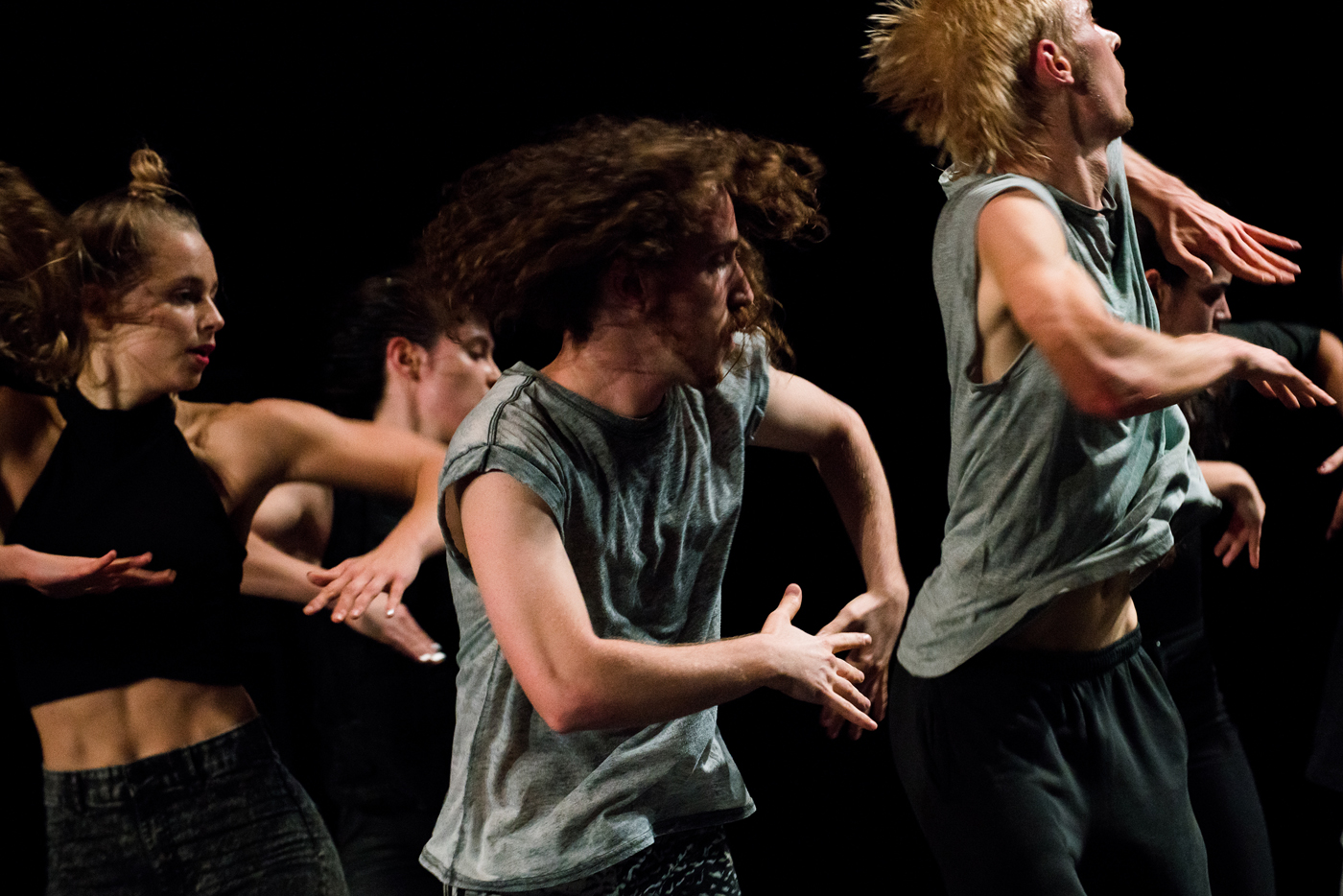
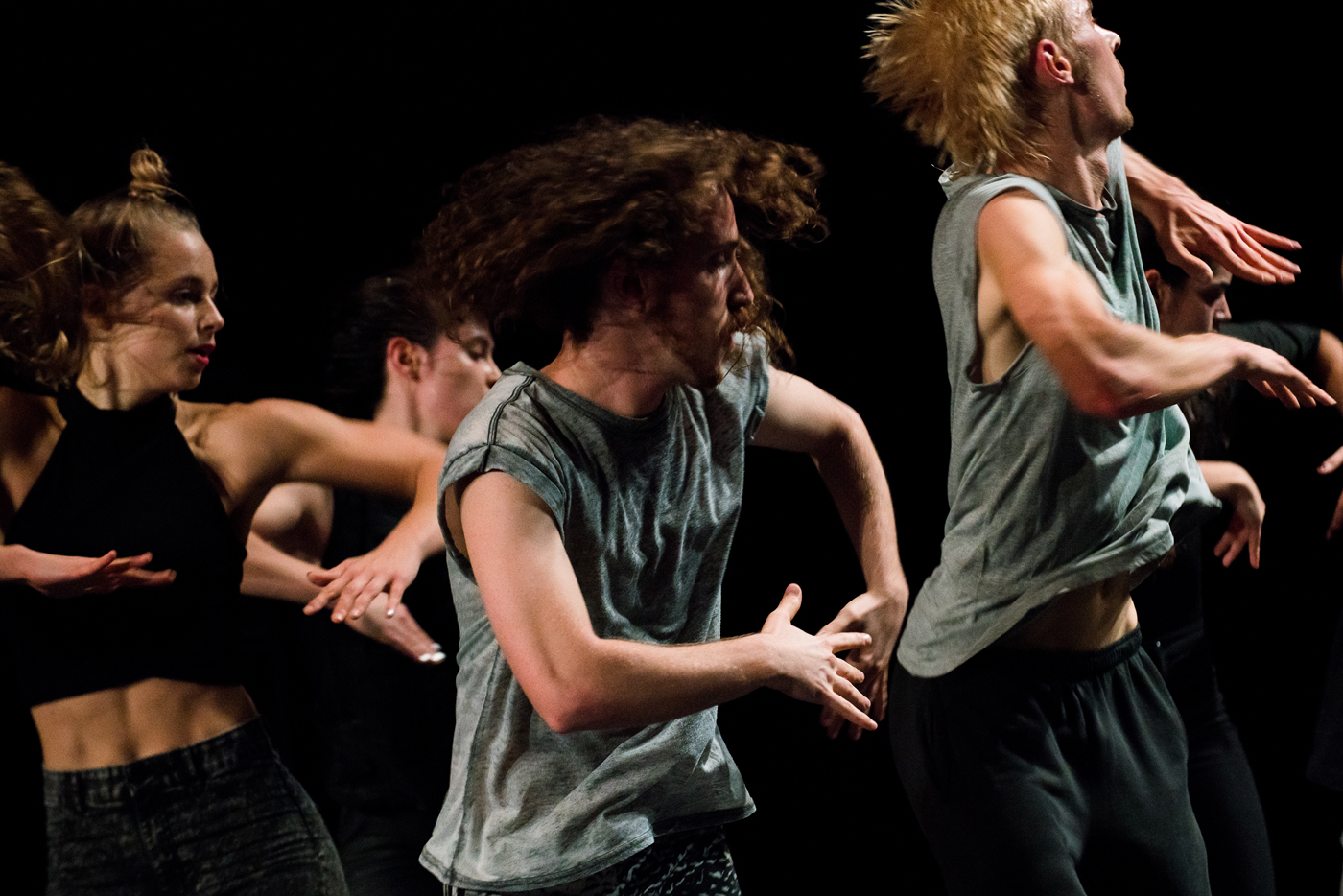
Doris Uhlich addresses trance as a figuration of an aesthetic strategy of trembling. The aesthetic potential of an energizing transgression is the result of a specific conglomeration of initiated and automated, internal and external impulses. Uhlich explores opposed force fields, which bring forth mobilized bodies and opens up aesthetic twilight zones of trance-gression. Contrary to Meg Stuart's choreographies, Uhlich develops force fields in her movements and choreographies that present themselves as trancelike states ignited by the boundaries they push. Her movements emerge as moments of resistance, which stem from confrontations with objects that are set into movement by external forces or from confrontations with self-induced changes in the surrounding atmosphere, namely air. This results in the initiation of resistant force fields. And so, for example, the airy space around her becomes a moved and moving mass through the movements of her own body. In the case of the group choreography Boom Bodies, Footnote 24 a scene of undulating, shaking movement unfolds between the dancers. Physical and imagined modes of movement initiated by the force field of movement and counter movement find their echo in repetitive patterns. The twilight zone between external and internal forces expand time and space into a surging, shaking floating mass, which is no longer like the nervous overexertion of the body in Stuart's work, nor does it enact scenes of swirling, twirling formations framed by pathos-filled gestures like in modernist dance. In Boom Bodies, the dancers rather extend their bodies in a continuously shifting and ambiguous web of movement, at once immersed in themselves and opening up, at once singular and in synchrony. Their energetic immersion and exaltation expresses a pulsating organic quality of body-spaces. We see materialized kinesthetic forces as they engage in the potential of trance to unleash trance-gressive bodily forces.
Dancers in Boom Bodies (2016). Choreography: Doris Uhlich (Tanz in Bern 2016). Photo: Sabine Burger, © Sabine Burger.
Universal Dancer: Bodily Scenes of Ecstatic Figurations
Aesthetic figurations of trance, when staged, are always both experienced and exhibited. Uhlich addresses this situation by introducing a prop that induces the ecstatic state. Her solo piece Universal Dancer (2014),Footnote 25 the first part of her techno trilogy, expands the constitutive force field between the self that moves and the one that is being moved by an external source of movement, a wooden platform, under which a vibrating motor is placed that causes the construction to shake. Uhlich uses the contraption to theatrically unfold scenes of a body exposed to and in conflict with the force field of this foreign body. Within the choreography, the vibrating platform becomes a foreign force to which Uhlich exposes her body, allowing it to shake her.Footnote 26 Over long stretches of time, the performer stands, sits, or lies on the platform, allowing the vibrations to spread out through her body, where they become visible as kinetic/kinesthetic movements. Uhlich allows her flesh to shudder, shake, and vibrate in released tonicity.Footnote 27 The machine becomes the medializing source of movement as it transmits energy.Footnote 28
Universal Dancer thus deals with trance as the scene of a both haphazard and systematic interplay of forces between the radical external movement of the body and the kinetic/kinesthetic force field of the body's own movement. This interplay continuously blurs the line between energetic boundaries. Uhlich changes her position and varies the scope of self-activated energy as she carries out different acts of movement on the platform. The mechanical force of the vibrating machine visibly manifests itself on her body, only to be rerouted into a range of phrases of movement. The mechanical shaking of the construction is translated into a kinetic-kinesthetic field of tension between body and machine. Uhlich seeks to energetically transgress the boundaries of a body-in-motion. During the sixty minutes of her performance, she works with choreographic strategies as she intertwines, entangles, and disentangles the different threads of movement. The scene of movement, left to its own devices in the gap between external and internal movement, makes room for the disentanglement of the difference between machine and body by means of spatial distance. As in Boom Bodies, Doris Uhlich inserts choreographic cuts of disrupted movements with intensive eye contact resonating in and fading into the audience. The unfolded force field of trancelike exaltation and exhaustion is exposed in the reversed gaze, which is volleyed from performer to viewer. Uhlich establishes a new gaze structure, seeking to create an echo of the waves of movement which she produces.
Boom Bodies: Trance as Excess
With the last piece of her current trilogy, Boom Bodies (2016),Footnote 29, Footnote 30 Doris Uhlich situates her choreographic approach in rave and techno culture, using high frequency beats and sound collages as energetic frames of her work.Footnote 31 Uhlich adopts motifs from the rave and club scene into her dance vocabulary and cites the strategies and settings of club culture. Electronic and media artist Boris Kopeinig acts as the DJ at the back of the stage, providing the scene with rhythmic and atmospherically oscillating sound samples. The sound and its temporal segments structure the choreography with sequences of voice and movement as the thumping beat and throbbing clusters set the rhythm of the dancers’ actions. The vibrating pool of music initiates the physically consuming movements of eight dancers; in fact, it carries them to the limits of exhaustion, mobilizing even the last bit of energy within them.Footnote 32 The bodies, strictly following the music's beat, correspond with each other in uniformly rhythmic, accelerating, or deflating cascades of impulses. Spread out before us we find a spectrum of repetitively structured phrases of movement, which—thanks to the continuous influence and saturation of impulses—brings the bodies to resonate with and through each other.Footnote 33 The ebbing and flowing rhythmic mobilization of the dancers, paralleled in the similar frequency of the bodily phrases, establishes a specific structure of movement in space. We see a bodily scene permeated with ecstatic patterns of movement, collectively merged and gradually expanding in both bodies and space.
The choreographic figure of steadily repeated phrases of movement creates an atmospheric structure of self-perpetuating movements, aesthetically closing in on trancelike states but never reaching them because of the piece's temporal framing. Thus, the frequency phrases are interlaced with precise cuts between different motives of movement. With this choreographic structure of changing motives, Boom Bodies resists the pull of the ecstatic. It counters the intoxicating effect of monotonous cascades of movement by continuously opening up new perceptual spaces.
Interestingly, in this work the aesthetical moment of trance coincides with a foreign intrusion, marking the ecstatic and creating a trance-gressive opening. While Meg Stuart presents trance as a divided event of movement, in which bodies become a scene of alienation, Doris Uhlich raises the knowledge of an unavoidable duality to a choreographic level. She works with intrusions of foreignness, of frenzy. Thus, the pulsating flow of movement in Boom Bodies is irritatingly disrupted. In the middle of the performance, the pulsating, floating energy breaks into a scene in which the dancers’ bodies become subject to a radically transformed sequence of external-internal forces. The rhythmic unison of moving bodies in a group scene disperses as it is split into decelerated singular phrases of movement. As individual dancers slow down, we sense a crease in the space's fabric of movement, marking a caesura. Shortly afterward, Ewa Dziarnowska's scream occurs. This acoustic figure cuts through the intimate corporeal scene of movement and forms a second caesura, which opens up an aesthetic space of difference: ecstasy emerges in audible shape, to form another kind of force field next to the choreographic one. Ecstatic frenzy makes itself heard in disturbing and almost destructive ways, without becoming visible.Footnote 34 The scream induces something invisible into the scene. It indicates elements of ecstasy which, in the realm of aesthetics, can only be experienced under the sign of a caesura. The ensuing choreography of Boom Bodies levels the monstrous quality of ecstasy. The intensity of the scream is succeeded by calmly framed sequences of group sections whereby monstrosity recedes into the background of our perception. The choreography then successively speeds up again in highly energetic group dances. Heated movement weaves the dancers into a rhythmic texture. They become choreographic clusters of synchronous, techno-physical sound: boom bodies. Ecstasy becomes an emphatically presented experience of being together in motion.
Trance as a Critical Force
Uhlich invokes presentations and experiences of trance by employing choreographic techniques that produce out-of-body states as a strong physical manifestation of the transformative potential of movement in space. Her movement practices, which involve objects and other resistant materialities, produce staged phenomena of transgression with strong energetic impact.Footnote 35 Neither Universal Dancer, nor Boom Bodies, exhibit distorted bodies to articulate the alienated force within the self. Uhlich's pieces rather seek to establish a rhythmic, energetically charged body as a force field of energetic scenes. In Uhlich own words, the artist's aim is to “flood the theater space with energy” and “transfer energies.”Footnote 36 Her movement scenes gain critical potential as they negotiate the effects of external forces that permeate the body, to be returned to the space where they came from. They form a force field between autonomous and heteronomous movement that ultimately transcends the body. Uhlich appeals to the potential of energyFootnote 37 as a transformative force and as a force that encourages an “opening” of the body. This is where she sees the critical impact of her choreographies: in stark opposition to the controlled states of modernist ecstasy in Wigman, they create ecstatic states in which the guiding agency of the subject becomes obsolete. Uhlich's bodily scenes do not project symbolic gestures of power, as in Wigman's discourse figures. They do not overwhelm, despite their intensity. They rather explore a force field of energy, and how it impacts the human body. The term energy refers here to the bodily and performative potential to trigger transformative processes. This is reflected in the original meaning of the Greek term “energeia” (ένέργεια), describing “activity, activating force.” Uhlich's choreographies thus activate force in order to spark processes of transformation and create states of exaltation. The resulting energetic force field, generating an impact that is “inexplicable” even to the artist herself,Footnote 38 manifests in scenes of moving and being moved. They launch a transgressive force, which presents the body as a radically changeable zone of internally initiated and externally driven movement.