



1. Introduction
Adaptive behavior among great apes including humans is considered to be mediated by affective traits. Indeed, human-specific behavioral traits – especially our enhanced prosociality and cooperativeness – have been linked to affective traits such as reduced aggression and increased social tolerance (Hare, Reference Hare2017). Research directly comparing affective traits between humans and other great apes has shown that already at the young age of 2.5 years, humans display significantly higher levels of fearfulness than chimpanzees, bonobos, and orangutans (Herrmann, Hare, Cissewski, & Tomasello, Reference Herrmann, Hare, Cissewski and Tomasello2011). The current review is aimed at addressing the question, what are the origins for this human-specific enhancement of fearfulness traits?
The novel evolutionary framework presented here – the fearful ape hypothesis – proposes that, in the context of the strong interdependence reflected in cooperative caregiving and provisioning unique to human great ape group life (Hrdy & Burkart, Reference Hrdy and Burkart2020; Kramer, Reference Kramer2011; Tomasello, Melis, Tennie, Wyman, & Herrmann, Reference Tomasello, Melis, Tennie, Wyman and Herrmann2012), heightened fearfulness was adaptive. The central hypothesis put forth is that, starting early in human ontogeny, fearfulness traits facilitate care-based responding and provisioning from, while concurrently increasing cooperation with, mothers and others. Within this framework, enhanced fearfulness is assumed to be of adaptive value because of its functions in facilitating cooperative care across the lifespan, which improved survival and reproduction in human evolution (see Kramer [Reference Kramer2019], for a review showing that human cooperative care supports survival and reproductive success).
In order to support this hypothesis, empirical work with human infants and children will be systematically reviewed, suggesting a link between fearfulness traits, parental care, greater sensitivity to detect fear in others, and enhanced levels of cooperative behavior. This synthesis of the research on this question points to the existence of a virtuous caring cycle that views fearfulness as a key adaptive affective trait supporting human-unique levels of cooperative concern and care. In light of this new evolutionary-developmental synthesis a major paradox emerges. Namely, in the existing clinical and psychological work, heightened fearfulness is predominately viewed as maladaptive, as it is associated with an increased risk of developing anxiety and depression. A further goal of this review is consequently to better understand, explain, and ultimately deconstruct this seeming human fear paradox. For this purpose, it will be important to acknowledge that construing fearfulness as a maladaptive trait is likely linked to the predominant research and cultural focus on large-scale Western, educated, industrialized, rich, and democratic (WEIRD) societies and their emphasis of independence (Henrich, Heine, & Norenzayan, Reference Henrich, Heine and Norenzayan2010). Viewing fearfulness traits through this WEIRD lens is at odds with the presumed social environment of interdependence in which human group life evolved. Therefore, the exceedingly high rates of anxiety and depression seen in WEIRD societies (Chiao & Blizinsky, Reference Chiao and Blizinsky2010) might need to be added to the list of potential evolutionary mismatch diseases (Kohrt, Ottman, Panter-Brick, Konner, & Patel, Reference Kohrt, Ottman, Panter-Brick, Konner and Patel2020). In other words, fearfulness is adaptive in small-scale, interdependent human societies primarily built on cooperative care and success, whereas fearfulness can become maladaptive in large-scale, independent human societies built more on individual success and less on cooperative care.
This review is aimed at providing a systematic analysis and synthesis across multiple levels, illuminating the ultimate (adaptive and phylogenetic level) and proximate mechanisms (ontogenetic and brain level) that account for the emergence of heightened fearfulness traits in human evolution (Tinbergen, Reference Tinbergen1963) (see Fig. 1). Section 2 outlines the novel evolutionary framework and provides arguments for the adaptive value (functions) of fearfulness in the context of human cooperative care. After laying out the foundation for the current proposal, Section 3 presents an analysis focused on reviewing and synthesizing research on phylogenetic, ontogenetic, and brain origins in which human fearfulness emerged. Section 4 discusses the emerging fear paradox and its cultural, societal, and health implications, while outlining specific predictions to be tested in future research.
Overview of the arguments put forth in support of the fearful ape hypothesis, organized according to proximate (ontogeny and brain mechanisms) and ultimate (phylogeny and adaptive value) levels of explanation for humans' enhanced fearfulness traits.

2. Rethinking fearfulness: The adaptive framework
The fearful ape hypothesis presents a novel evolutionary framework stipulating that heightened fearfulness was adaptive in the context of the strong interdependence unique to human cooperative caregiving systems (Hrdy, Reference Hrdy2011; Hrdy & Burkart, Reference Hrdy and Burkart2020; Kramer, Reference Kramer2011; Tomasello et al., Reference Tomasello, Melis, Tennie, Wyman and Herrmann2012). Humans are the only great apes that have evolved cooperative care, which is extremely rare among primates (Burkart, Hrdy, & Van Schaik, Reference Burkart, Hrdy and Van Schaik2009; Hrdy, Reference Hrdy2011; Hrdy & Burkart, Reference Hrdy and Burkart2020). Human cooperative care is considered special among great apes because human infants and children are cared and provided for not only by their mothers but also by many others, including other kin and even non-kin (Bogin, Bragg, & Kuzawa, Reference Bogin, Bragg and Kuzawa2014; Kramer, Reference Kramer2019; Kramer & Otárola-Castillo, Reference Kramer and Otárola-Castillo2015). This alloparental form of care and provisioning of the young only seen in humans has led to the notion that humans can be classified as cooperative breeders; however, human offspring care is considered distinct from other cooperative breeding species, in that alloparental behavior is defined culturally rather than by genetic kinship alone, allowing for care from unrelated individuals (see Bogin et al., Reference Bogin, Bragg and Kuzawa2014). Cooperative caregiving and provisioning are thought to have developed early in hominid evolution as a result of evolutionary pressures necessitating extra-maternal help with raising helpless and highly costly human infants (Hrdy, Reference Hrdy2011; Kramer & Otárola-Castillo, Reference Kramer and Otárola-Castillo2015; Rosenberg, Reference Rosenberg2021). Specifically, the evolutionary pressures at play have been identified as: ecological changes (drier and cooler climate), foraging in novel habitats (savanna), and increases in body and brain size, seen with the emergence of Homo erectus about 1.8 million years ago (Hrdy, Reference Hrdy2011; Rosenberg, Reference Rosenberg2021; Vaesen, Reference Vaesen2012). Modeling work suggests that human-specific life-history traits – characterized by much shorter inter-birth intervals, prolonged child dependence, and an extended life span – likely only emerged in their full-fledged form in Homo sapiens (Kramer, Reference Kramer2019; Kramer & Otárola-Castillo, Reference Kramer and Otárola-Castillo2015). Considering this evolutionary scenario, heightened fearfulness presumably emerged gradually over the last 1.8 million years, first in response to the emergence of infant helplessness and cooperative caregiving, and then became consolidated with the emergence of the above human-specific life-history traits.
According to what has become known as the cooperative breeding hypothesis, cooperative care as seen in humans is thought to have contributed critically to the evolution of human emotion, cognition, and behavior (Burkart et al., Reference Burkart, Hrdy and Van Schaik2009, Reference Burkart, Allon, Amici, Fichtel, Finkenwirth, Heschl and van Schaik2014; Hrdy, Reference Hrdy2011). The cooperative breeding hypothesis has been criticized, however, because research with nonhuman primate cooperative breeders fails to provide clear evidence for human-like cognitive adaptations (Thornton et al., Reference Thornton, McAuliffe, Dall, Fernandez-Duque, Garber and Young2016; Thornton & McAuliffe, Reference Thornton and McAuliffe2015). Notwithstanding this criticism regarding cognitive traits, a different aspect of the cooperative breeding hypothesis proposes that human infants possess critical affective features that are thought to “ingratiate” mothers and others into providing them with attention and care (Hrdy, Reference Hrdy2011; Hrdy & Burkart, Reference Hrdy and Burkart2020). The current proposal builds on this line of theorizing and extends it into the specific domain of the emergence of heightened fearfulness as an affective trait and its potential adaptive significance for human cooperation. More explicitly, in the current proposal cooperative care is primarily viewed as a precondition (“breeding ground”) enabling heightened fearfulness to emerge and become adaptive in human infants and children through eliciting more care and provisioning from mothers and others. Yet the current proposal goes beyond this first step (fearful infants eliciting and benefitting from cooperative care). Specifically, in a second step, the emergence of heightened fearfulness traits within a context of cooperative care resulted in these infants growing up to become more caring and cooperative children, adolescents, adults, parents, and alloparents, in the long term. This proposal is largely based on work identifying intergenerational/cooperative childcare, including juvenile help, as a key adaptation, enabling human reproductive success (Kramer, Reference Kramer2011, Reference Kramer2019).
Put plainly, according to the hypothesized evolutionary scenario, infants and children displaying increased signals of fearfulness elicit greater cooperative care and provisioning from mothers and others. While parenting factors interact in complex ways with infant- and child-affective traits (Belsky, Rha, & Park, Reference Belsky, Rha and Park2000; Kiff, Lengua, & Zalewski, Reference Kiff, Lengua and Zalewski2011; Klein et al., Reference Klein, Lengua, Thompson, Moran, Ruberry, Kiff and Zalewski2018), there is evidence to show that greater displayed fearfulness among infants and children principally elicits caring and especially protective behaviors from parents (Kiel & Buss, Reference Kiel and Buss2011). Within the current framework, the assumed increase in care and provisioning during infancy – a developmental time of great dependence on others – is likely to have direct fitness and survival benefits as may be reflected in reduced mortality rates (Kramer, Reference Kramer2019). In fact, heightened fearfulness might at least partially account for the significantly increased survival rates (reduced mortality rates) seen in humans during early development when compared to other great apes (Kramer, Reference Kramer2019). The increased fearfulness traits, which are thought to be relatively stable across the human lifespan (see Kagan & Snidman, Reference Kagan and Snidman2004), were likely associated with an enhancement of fearfulness among parents and alloparents. This enhanced fearfulness among (allo)parents would have been associated with a greater sensitivity to perceive fear and distress in others and thus in eliciting concern and care for others including infants and children (Grossmann, Reference Grossmann2018; Hrdy & Burkart, Reference Hrdy and Burkart2020; Marsh, Reference Marsh2015; Warneken, Reference Warneken2015). In other words, in a developmental cascade, fearful infants growing up in a highly cooperative and supportive environment become more concerned, caring, and cooperative children, adolescents, alloparents, and parents. In this context, it is important to mention that cooperative caregiving among humans is characterized by what has been coined intergenerational care including juvenile help, whereby also children and adolescents, especially siblings and cousins, play a vital role in caring for infants and young children (Kramer, Reference Kramer2011, Reference Kramer2019). In fact, in traditional societies across various cultures, allomaternal care on average makes up about 43% of infant care, with juvenile help coming from siblings as the most common form of allomaternal care for infants (Kramer & Veile, Reference Kramer and Veile2018). More generally, intergenerational care has been argued to be the key adaptation that allowed for humans' reproductive success by reducing inter-birth intervals and increasing child-survival rates (Kramer, Reference Kramer2019). Within the current proposal, humans' unique life history, characterized by much prolonged early development, dependency, and reliance on alloparental care and sustenance, including juvenile help (Kramer, Reference Kramer2011, Reference Kramer2019), is considered another critical factor providing the ontogenetic conditions that contribute to and ultimately consolidate the adaptive benefits of enhanced fearfulness over the course of human evolution.
Notably, the current proposal further implies that, at a more mechanistic level, enhanced fearfulness displayed and perceived represents an integrated system that supports adaptive functioning in the context of cooperative care. More specifically, an essential part of the integrated system idea relies on the notion that a self-other link is established through some form of perception–action coupling, which is commonly seen in social cognition (Keysers & Gazzola, Reference Keysers and Gazzola2006; Knoblich & Sebanz, Reference Knoblich and Sebanz2008; Preston & de Waal, Reference Preston and de Waal2002; Prinz, Reference Prinz, O. and W.1990) and is presumed to be elevated in the context of fear here. However, perception–action coupling alone, as it is present in other apes and primates (Preston & de Waal, Reference Preston and de Waal2002), is unlikely to account for the human-specific effects of perceived and displayed fear on cooperative behavior. Therefore, the current framework proposes a pivotal mediating mechanism that links fear to cooperation.
Before introducing the stipulated mechanism, it seems important to at least briefly contemplate the general experience of fear and the typically associated behaviors, which presumably exists in most mammals. One prominent line of thinking is that the experience of fear in light of a perceived threat in an animal leads to what has become commonly known as fight-or-flight (or freeze) responses (Adolphs, Reference Adolphs2013). However, for highly social animals including humans there appears to be a further option, which is to approach and be approached by supportive conspecifics to help and be helped (“tend and befriend”). This response has received much less attention in both theory and research with humans (Sosna et al., Reference Sosna, Twomey, Bak-Coleman, Poel, Daniels, Romanczuk and Couzin2019) but might perhaps represent the most effective and adaptive response in the face of fear, particularly in our ultrasocial species (Tomasello, Reference Tomasello2014).
Returning to the hypothesized mechanism, the proposal is that it is motivational in nature and depends upon approach and reward systems previously shown to be involved in instantiating caring behaviors directed toward offspring in most mammals. In consequence, neither the perception–action coupling nor the caring behavior mechanism by itself is evolutionarily novel. What is presumed to constitute its novelty in human evolution is (1) a matter of degree – heightened fearfulness rather than fearfulness per se – and (2) the way in which these two mechanisms – perception–action coupling and caring – work in conjunction in a species with heightened fearfulness. Put succinctly, in addition to so-called fight and flight responses seen in many animals, among ultrasocial humans, heightened levels of fear when detected in self or in others is hypothesized to elicit motivational approach responses and may result in help, comfort, and support being provided. This response is thought to be adaptive because it allows for: (1) Potential threats or uncertainties in novel environments to be cooperatively managed and avoided, and (2) mutually beneficial cooperative relationships to be established, maintained, or strengthened. Moreover, the hypothesized approach response in the context of heightened fear may be particularly strong and beneficial for the youngest and most vulnerable members of our species. Indeed, there is a body of evidence from the area of attachment research, showing that infants and young children use parents as a secure base and safe haven, meaning that they approach them, seek protection and help when experiencing fear in the face of threat or uncertainty (Ainsworth, Blehar, Waters, & Wall, Reference Ainsworth, Blehar, Waters and Wall2015; Bretherton, Reference Bretherton2013; Cassidy et al., Reference Cassidy, Brett, Gross, Stern, Martin, Mohr and Woodhouse2017; Cassidy, Ehrlich, & Sherman, Reference Cassidy, Ehrlich and Sherman2014; Stern & Cassidy, Reference Stern and Cassidy2018). Intriguingly, when considered in the context of alloparental care, as only seen among humans, this implies that there might not only be one safe haven, which is the primary caregiver but rather a multitude of safe havens beyond the primary caregiver including allomothers such as siblings, cousins, aunts, uncles, grandparents, and other genetically unrelated close group members (Howes & Spieker, Reference Howes and Spieker2008). This scenario further supports the presumed adaptiveness and uniqueness among great apes of enhanced fearfulness traits in humans, because we find ourselves surrounded by alloparents that provide safe havens.
Consequently, the hypothesized ontogenetic scenario also allows for interactions between mostly biologically determined individual fearfulness traits and the caregiving environment (Belsky et al., Reference Belsky, Jonassaint, Pluess, Stanton, Brummett and Williams2009; Belsky & van Ijzendoorn, Reference Belsky and van Ijzendoorn2017). In particular, more fearful infants and children may thrive in environments characterized by enhanced levels of cooperative care as evident in traditional hunter–gatherer societies, which are similar to our presumed ancestral caregiving environment (Kohrt et al., Reference Kohrt, Ottman, Panter-Brick, Konner and Patel2020; Konner, Reference Konner2018). In this context, it is important to emphasize that, within the current proposal, heightened levels of interdependence and intergenerational cooperative child care (Hrdy & Burkart, Reference Hrdy and Burkart2020; Kohrt et al., Reference Kohrt, Ottman, Panter-Brick, Konner and Patel2020; Konner, Reference Konner2018; Kramer, Reference Kramer2011, Reference Kramer2019; Tomasello et al., Reference Tomasello, Melis, Tennie, Wyman and Herrmann2012) can be considered the experience–expectant social environment for human infants' and children's brains, bodies, and behavior to develop in (Greenough, Black, & Wallace, Reference Greenough, Black and Wallace1987; Konner, Reference Konner2018). In other words, human infants and children expect to be cared for by others and in the process develop traits and competencies in caring for others.
Taken together, a framework emerges that views enhanced fearfulness – when embedded in human-specific cooperative care – as a key adaptive affective trait linked to cooperative cognition and behavior from early in ontogeny. After outlining the conceptual framework let us now turn to reviewing the existing evidence in support of this proposal in more detail. In particular, the next section will apply an evolutionary-developmental analysis focused on reviewing and synthesizing research on the phylogenetic, ontogenetic, brain, and cooperative origins in which human fearfulness evolved (the following sections address phylogeny at the ultimate level and ontogeny and [brain] mechanisms at the proximate level; see Fig. 1 for an overview).
3. The evidence
3.1. Phylogenetic origins
Adaptive behavior among primates, especially humans, is thought to be significantly impacted by affective traits that impact behavior (Hare, Reference Hare2017; Hrdy, Reference Hrdy2011; Hrdy & Burkart, Reference Hrdy and Burkart2020). An affective trait is an emotional tendency or characteristic, sometimes referred to as temperament, that is individually stable and seen across contexts, situations, and time (Davidson, Reference Davidson2003; Davidson & Irwin, Reference Davidson and Irwin1999; Garstein & Rothbart, Reference Garstein and Rothbart2003; Gartstein et al., Reference Gartstein, Gonzalez, Carranza, Ahadi, Ye, Rothbart and Yang2006; Kagan & Snidman, Reference Kagan and Snidman2004). Fearfulness is one such affective trait characterized by enhanced reactivity to, and inhibited approach of, novel situations, objects, and people (Garstein & Rothbart, Reference Garstein and Rothbart2003; Kagan & Snidman, Reference Kagan and Snidman2004). Human infants who display heightened reactivity to novelty as reflected in the first year have been shown to be more likely to become inhibited toddlers who are less likely to approach novelty in the second year (Kagan & Snidman, Reference Kagan and Snidman2004). In humans, this pattern of fearfulness and behavioral inhibition is largely preserved into adolescence and associated with increased amygdala reactivity to novelty and heightened levels of anxiety in adulthood (Henderson, Pine, & Fox, Reference Henderson, Pine and Fox2015; Kagan & Snidman, Reference Kagan and Snidman2004; Kagan, Snidman, Kahn, & Towsley, Reference Kagan, Snidman, Kahn and Towsley2007; Schwartz, Wright, Shin, Kagan, & Rauch, Reference Schwartz, Wright, Shin, Kagan and Rauch2003).
In the most comprehensive existing study, comparing between a large sample of human and nonhuman great apes, fearfulness was examined by measuring the reaction of bonobos, chimpanzees, orangutans, and 2.5-year-old human infants to novel objects and people (Herrmann et al., Reference Herrmann, Hare, Cissewski and Tomasello2011). Human infants displayed much higher levels of fearfulness indexed by avoiding novelty in social and nonsocial contexts significantly more than the other great ape species tested in this study. In fact, this study showed that only human infants avoided novelty, whereas the other species of nonhuman great apes were either attracted (chimpanzees, orangutans) or indifferent (bonobos) to novelty.
One consideration offered by the authors of this comparative study is that the chimpanzees' and orangutans' reported boldness (attraction to novelty) may be attributed to their feeding ecologies characterized by much greater uncertainty than either the bonobos' or the humans' cousins, which would make chimpanzees' and orangutans' approach of novelty an adaptive strategy in their less predictable ecological context (Herrmann et al., Reference Herrmann, Hare, Cissewski and Tomasello2011). While this proposal based on feeding ecology may account for the similarities between orangutans and chimpanzees and differences between chimpanzees and bonobos, it cannot explain the quantitatively and qualitatively distinct fear responses seen in human infants, especially as far as the differences between bonobos and human infants are concerned. Another consideration in regards to Herrmann et al.'s (Reference Herrmann, Hare, Cissewski and Tomasello2011) study is that the social novelty manipulations for the nonhuman great apes took place in response to familiar and unfamiliar humans, whereas the human infants in this study were responding to familiar and unfamiliar adult conspecifics, which represents a limitation of this study. Prior work employing conspecific tests indicates that, in contrast to human infants (who, as mentioned above, display fearful [xenophobic] behavior in the context of strangers [Herrmann et al., Reference Herrmann, Hare, Cissewski and Tomasello2011]), bonobos have been shown to share food with conspecific strangers (Tan & Hare, Reference Tan and Hare2013; Tan, Ariely, & Hare, Reference Tan, Ariely and Hare2017). This xenophilic behavior directed toward unfamiliar conspecifics appears to be contingent on the opportunity for social interaction, because bonobos do not share food when a social interaction with the unfamiliar conspecific is not possible (Tan & Hare, Reference Tan and Hare2013). This tendency of bonobos to approach and engage with conspecifics in a xenophilic manner has been argued to have evolved as a function of specific ecological changes increasing the benefits of relationship formation as the risk of intergroup aggression dissolved (Tan et al., Reference Tan, Ariely and Hare2017). Returning to the only existing study systematically comparing fearfulness traits across great ape species (Herrmann et al., Reference Herrmann, Hare, Cissewski and Tomasello2011), it is important to emphasize that human infants' enhanced fear responses were replicated in two different contexts, that is, absence of parents and removing physical barriers to increase comparability to nonhuman apes, attesting to the robustness of the displayed fearfulness behavior among humans (see Herrmann et al., Reference Herrmann, Hare, Cissewski and Tomasello2011). This comparative study clearly represents a critical step in delineating heightened fearfulness as an essential affective feature of human psychology.
It has been also argued that the findings from Herrmann et al.'s (Reference Herrmann, Hare, Cissewski and Tomasello2011) study are in general agreement with the view articulated in the conceptual framework provided within the self-domestication hypothesis (see Hare, Reference Hare2017). According to this view, human-specific behavioral traits – especially our enhanced prosocial tendencies – have been linked to a domestication syndrome seen in other domesticated animals, especially concerning affective traits linked to tameness such as reduced aggression and the concomitant increase in social tolerance (Hare, Reference Hare2017). Yet again the reduction of aggression alone, presumably driven by negative selection against genes linked to aggression, is unlikely to account for the heightened fearfulness seen in humans, which rather indexes positive selection on genes linked to enhanced fearfulness. Moreover, enhanced fearfulness and increased reactivity to novelty are undesirable traits in domesticated animals, and selection against fearfulness is considered to represent a key component in the successful domestication of animals (Zeder, Reference Zeder2012). Consistent with this view, domesticated animals have generally been shown to display reduced fearfulness. For example, experimental studies measuring responses to novelty have demonstrated that dogs are less fearful than wolves (Hansen Wheat, van der Bijl, & Temrin, Reference Hansen Wheat, van der Bijl and Temrin2019), suggesting that self-domestication is an unlikely candidate to explain enhanced human fearfulness.
At the neurochemical level, reduced aggression and increased social tolerance have been attributed to reduced levels of acetylcholine and particularly to increased levels of serotonin (Hirter et al., Reference Hirter, Miller, Stimpson, Phillips, Hopkins, Hof and Raghanti2021; Raghanti et al., Reference Raghanti, Edler, Stephenson, Munger, Jacobs, Hof and Lovejoy2018). With respect to species differences in serotonergic function, there is important evidence comparing humans' closest living ape relatives, the bonobos and chimpanzees, who are known to differ considerably from each other in terms of their social behavior. Specifically, bonobos are reported to be more socially tolerant of conspecifics, whereas chimpanzees more commonly engage in aggression with conspecifics (Hare, Reference Hare2017; Tan et al., Reference Tan, Ariely and Hare2017; Tan & Hare, Reference Tan and Hare2013; Wobber et al., Reference Wobber, Hare, Maboto, Lipson, Wrangham and Ellison2010). When comparing between bonobos' and chimpanzees' brains, the amygdala of bonobos had more than twice the density of serotonergic axons than chimpanzees (Stimpson et al., Reference Stimpson, Barger, Taglialatela, Gendron-Fitzpatrick, Hof, Hopkins and Sherwood2016). Considering the role of serotonin in regulating amygdala function and fear reduction, the findings from this study suggest that the demonstrated variation in serotonergic innervation of the amygdala may contribute to the observed behavioral differences exhibited by bonobos and chimpanzees. This difference in serotonergic innervation of the amygdala may also account for the differences in fear behaviors seen between bonobos and chimpanzees discussed above (Herrmann et al., Reference Herrmann, Hare, Cissewski and Tomasello2011). However, work assessing ape species comparisons including human amygdala serotonin innervation is currently lacking.
Directly assessing the neurochemical profile within the brain and comparing it between humans, chimpanzees, and different monkey species revealed that the human-unique profile is characterized by enhanced dopamine levels in addition to increased serotonin and reduced acetylcholine (Hirter et al., Reference Hirter, Miller, Stimpson, Phillips, Hopkins, Hof and Raghanti2021; Raghanti et al., Reference Raghanti, Edler, Stephenson, Munger, Jacobs, Hof and Lovejoy2018). This human-specific neurotransmitter profile was obtained for the striatum, which is a subcortical brain structure, interconnected with the amygdala and prefrontal cortex (Raghanti et al., Reference Raghanti, Edler, Stephenson, Munger, Jacobs, Hof and Lovejoy2018). The striatum is crucially involved in a host of behavioral functions related to reward processing, decision making, and social appetitive behaviors (Bhanji & Delgado, Reference Bhanji and Delgado2014). Considering the importance of dopamine and the striatum in motivating and regulating social behavior and decision making in the context of reward and approach, this finding of enhanced dopamine in humans points to an additional neurochemical mechanism that goes beyond a reduction of aggression and increased tolerance. More specifically, it may indicate that human evolution was associated with an increase and extension of behaviors linked to the brain's reward and approach systems. With respect to this suggestion, it is critical to note that there is considerable evidence linking the brain's dopamine system and especially the striatum to parental care in humans and other mammalian species (Feldman, Reference Feldman2015, Reference Feldman2017; Preston, Reference Preston2013; Rilling, Reference Rilling2013; Rilling & Young, Reference Rilling and Young2014). In particular, it has been reported that viewing or listening to infant stimuli results in enhanced activation of the striatum in human parents and even in non-parents (Feldman, Reference Feldman2015, Reference Feldman2017; Rilling & Young, Reference Rilling and Young2014). Moreover, in human parents including fathers, the strength of the striatum responses to infant stimuli predicted positive caring behaviors (Feldman, Reference Feldman2015, Reference Feldman2017; Rilling, Reference Rilling2013; Rilling & Young, Reference Rilling and Young2014). Taken together, the brain's dopamine system with its human-unique elevated dopamine profile likely is a major player in caring behaviors that may contribute to enhanced parental and alloparental caring responses.
Another neurotransmitter system that has been identified as playing an important role in brain functions associated with mammalian parental caring behavior is the oxytocin system (Carter, Reference Carter2014). Oxytocin administration in human adults has also been associated with a number of effects on social cognition and behavior, including greater attention to eyes (Guastella, Mitchell, & Dadds, Reference Guastella, Mitchell and Dadds2008; Kemp & Guastella, Reference Kemp and Guastella2011). Furthermore, meta-analyses of oxytocin administration studies showed that a single dose of intranasal oxytocin significantly improved the recognition of facial emotional expressions, particularly for fearful faces (Leppanen, Ng, Tchanturia, & Treasure, Reference Leppanen, Ng, Tchanturia and Treasure2017; Shahrestani, Kemp, & Guastella, Reference Shahrestani, Kemp and Guastella2013). Considering that eye cues – widened eyes with large exposure of white sclera – play a critical role in detecting fear in others' faces, oxytocin may facilitate fearful face recognition through its effect on increasing attention to the eyes (see Grossmann [Reference Grossmann2017], for a review including an extensive discussion of the role of oxytocin in social perception and behavior). When comparing between chimpanzees and bonobos, oxytocin administration increased attention to the eye contact in bonobos, but not in chimpanzees (Brooks et al., Reference Brooks, Kano, Sato, Yeow, Morimura, Nagasawa and Yamamoto2021). The oxytocin administration effect seen in bonobos is similar to what has previously been shown in human adults (Guastella et al., Reference Guastella, Mitchell and Dadds2008), suggesting a commonality in how oxytocin modulates face-to-face social interactions in humans and bonobos. However, similar to the work assessing amygdala serotonin innervation discussed above, a direct comparison with humans is currently lacking. The picture emerging from the existing work suggests greater similarities between humans and bonobos than humans and chimpanzees, particularly with regard to serotonin and oxytocin system functions linked to affect and behavior. Clearly, more research systematically comparing between humans', chimpanzees', and bonobos' brain, neurotransmitter, and behavioral systems, which include developmental data, is needed to provide a more comprehensive understanding of commonalities and differences between great apes.
Notwithstanding the mentioned similarities between bonobos and humans that have been discussed and analyzed in much greater details elsewhere (see Hare, Reference Hare2017), the intriguing puzzle of what exactly accounts for the emergence of the documented heightened fearfulness (see Herrmann et al., Reference Herrmann, Hare, Cissewski and Tomasello2011) in human evolution remains. The scenario presented herein favors an explanation based on a socioecological variable that sets humans apart from other great apes, which is our cooperative child-rearing practices (Hrdy & Burkart, Reference Hrdy and Burkart2020; Kramer, Reference Kramer2019). This phylogenetically novel feature within the hominoid clade likely provided a socioecological context in which offspring that displayed, experienced, and processed fear more strongly than others, were cared for by mothers and others more effectively, which increased not only their survival rates but also their own cooperative tendencies. In this context, it is important to point out that displays of fearfulness are not limited to the face but are also expressed vocally. Crying during separation from the mother as a form of distress vocalization is seen among many animals including human infants, while producing tears that accompany crying events appears to represent a unique expression of distress in humans (Gračanin, Bylsma, & Vingerhoets, Reference Gračanin, Bylsma and Vingerhoets2018). Particularly relevant to the current proposal, previous research shows that greater fearfulness traits in human infants are also associated with more frequent crying and may hence elicit more frequent caring behavior (Kagan & Snidman, Reference Kagan and Snidman2004).
Recent studies (Kret, Prochazkova, Sterck, & Clay, Reference Kret, Prochazkova, Sterck and Clay2020) also show that, in contrast to humans who display an attentional bias toward fearful (and other negative) facial expressions, chimpanzees and bonobos fail to show such a bias in their attention when viewing conspecific distress displays (Kret, Jaasma, Bionda, & Wijnen, Reference Kret, Jaasma, Bionda and Wijnen2016; Kret, Muramatsu, & Matsuzawa, Reference Kret, Muramatsu and Matsuzawa2018). Specifically, across two experiments chimpanzees did not show an emotional bias toward conspecific and human distress displays (Kret et al., Reference Kret, Muramatsu and Matsuzawa2018). Furthermore, bonobos do show an attentional bias to sexual, grooming, and yawning displays, attesting to the fact that they possess attentional biases to other emotionally charged stimuli, but critically this bias does not extend to distress (fear) displays (Kret et al., Reference Kret, Jaasma, Bionda and Wijnen2016). Interestingly, humans' biased attention to fear displays is even seen in response to bonobo displays of distress (Kret & van Berlo, Reference Kret and van Berlo2021), suggesting that it generalizes from humans to other apes and might at least partly rely on expressive features shared among apes.
Taken together, while the phylogenetic comparisons based on the existing work are still rather sparse, there is clear evidence that, humans when compared to our closest living primate relatives possess what can be considered heightened fearfulness traits that might be linked to a unique neurochemical profile characterized by heightened serotonin, dopamine, and oxytocin levels in the brain. Furthermore, the reviewed evidence suggests that humans differ from their closest living primate relatives with regard to not only how they express fear themselves (Herrmann et al., Reference Herrmann, Hare, Cissewski and Tomasello2011) but also in how they perceive fear/distress in others (Kret et al., Reference Kret, Jaasma, Bionda and Wijnen2016, Reference Kret, Muramatsu and Matsuzawa2018, Reference Kret, Prochazkova, Sterck and Clay2020). Humans are the only great apes showing enhanced fear in expression and perception, supporting the hypothesized notion that enhanced fearfulness emerged as an integrated (perception–action coupling) system during human evolution. This raises the question of when in human evolution this affective trait emerged. The bioanthropological work hints at a scenario whereby cooperative caregiving and infant helplessness emerged early in hominid evolution and likely already existed in H. erectus, whereas the characteristic traits of human life history – including shorter inter-birth intervals, prolonged child dependence, and intergenerational cooperative care – only emerged in their full-fledged form with the arrival of H. sapiens (Hrdy, Reference Hrdy2011; Kramer, Reference Kramer2019; Kramer & Otárola-Castillo, Reference Kramer and Otárola-Castillo2015; Rosenberg, Reference Rosenberg2021; Vaesen, Reference Vaesen2012). Considering this scenario, human fearfulness may have emerged gradually over the last 1.8 million years, first in response to the emergence of infant helplessness and cooperative caregiving, and might then have been consolidated with the evolution of human life-history traits (see Fig. 1).
3.2. Ontogenetic origins
There is now a body of work showing that among human adults, responses vary markedly when viewing others in fear and that heightened sensitivity to fearful faces is associated with enhanced cooperative behavior (Marsh, Reference Marsh2015). One prominent line of work concerned with capturing and examining this intra-species variability in responding to fear has shown that highly cooperative anonymous kidney donors show heightened sensitivity, whereas highly antisocial psychopaths show hampered sensitivity when viewing fearful faces (Marsh et al., Reference Marsh, Stoycos, Brethel-Haurwitz, Robinson, VanMeter and Cardinale2014; Marsh & Blair, Reference Marsh and Blair2008). Notably, enhanced recognition of fearful faces has also been linked with higher levels of cooperative behavior among neurotypical adults (Marsh & Ambady, Reference Marsh and Ambady2007; Marsh, Kozak, & Ambady, Reference Marsh, Kozak and Ambady2007). These findings stress the importance of examining intra-species variability in fear responding in order to understand its origins, mechanisms, and adaptive functions, supporting the view that a caring continuum exists along which individual humans differ in their propensity to display sensitive responses to others' fear that motivate cooperative behavior (Grossmann, Reference Grossmann2018; Marsh, Reference Marsh2015).
Previous work with adults also shows that fearful facial expressions predominantly evoke behavioral approach tendencies in the onlooker. There is work to support the hypothesis that this approach effect relies upon fearful facial expressions' resemblance to helpless, vulnerable infantile faces (Hammer & Marsh, Reference Hammer and Marsh2015). In this study, adults demonstrated an implicit association between fearful facial expressions and infant faces; the study also showed that both fearful expressions and infant faces predominantly elicit behavioral approach tendencies. Furthermore, this study reports that approach responses to both fearful and infant faces were diminished as psychopathic personality traits increased. The pattern of results from this study suggests that fearful faces through their association with infantile faces might be viewed as social signals that convey vulnerability and a need for help. These findings from adults, in conjunction with the research discussed above (see Marsh, Reference Marsh2015), imply that the link between responses to fearful faces and cooperative behavior observed across these various studies might originate from this association with infantile faces and its effect on approach. Taken together, this line of research with adults demonstrates that variability in responding to fearful faces is linked to variability in cooperative behavior, raising the question of when this link emerges in human development.
Heightened sensitivity to fearful faces has also been found to be linked to enhanced cooperative behavior in preschool children across two different cultures (Rajhans, Altvater-Mackensen, Vaish, & Grossmann, Reference Rajhans, Altvater-Mackensen, Vaish and Grossmann2016). In this study, children in India and Germany who were faster to orient to fearful faces displayed greater cooperative behavior – sharing of a valued resource – in a dictator game. Consequently, the essential link between variability in responding to fearful faces and cooperative behavior already exists in preschool-aged children. It is vital to emphasize that the ability to detect and differentiate between various emotional facial expressions including fear emerges during the first year of life (Grossmann, Reference Grossmann, P., S. and T.2012). This is much before the age of 14 months at which cooperative behavior has first been described to be exhibited by infants in experimental contexts (Warneken & Tomasello, Reference Warneken and Tomasello2007). By 7 months of age, but not younger, human infants show increased neural and attentional responses to fearful faces and distinguish them from other positive and negative facial expressions (Grossmann & Jessen, Reference Grossmann and Jessen2017; Jessen & Grossmann, Reference Jessen and Grossmann2014, Reference Jessen and Grossmann2016; Krol, Monakhov, Lai, Ebstein, & Grossmann, Reference Krol, Monakhov, Lai, Ebstein and Grossmann2015; Peltola, Leppänen, Mäki, & Hietanen, Reference Peltola, Leppänen, Mäki and Hietanen2009). Given this evidence from behavioral and neuroscience research, infancy can be considered a sensitive developmental period during which fear-processing skills come online. Prominently, this is around the same time in early human ontogeny when infants first begin to experience and display fear themselves (Brand, Escobar, & Patrick, Reference Brand, Escobar and Patrick2020; Gaensbauer, Emde, & Campos, Reference Gaensbauer, Emde and Campos1976; Sroufe, Reference Sroufe1977). This raises the possibility that there is a connection between the ability to experience and display fear in self and the ability to detect fear in others. In congruence with this kind of perception–action coupling account of the emergence of fear systems in human infancy, recent neuroimaging data show that variability in fearfulness traits among 7-month-old infants maps onto differences in the neural processing of others' fearful faces in brain regions implicated in perception–action coupling (Krol, Puglia, Morris, Connelly, & Grossmann, Reference Krol, Puglia, Morris, Connelly and Grossmann2019).
With respect to the question of when the link between fearful face processing and cooperative behavior emerges in development, it is important to look at research that has investigated this link in early human ontogeny at a time when fear processing and cooperative behavior first come online. A recent longitudinal developmental study reported that variability in brain responses measured by functional near-infrared spectroscopy (fNIRS) and attentional responses to fearful faces at 7 months of age measured by eye tracking (using a visual-paired comparison task) predict cooperative behavior – instrumental helping at 14 months of age (Grossmann, Missana, & Krol, Reference Grossmann, Missana and Krol2018). This finding establishes a clear link to existing work with adults summarized above (Marsh, Reference Marsh2015) and thus demonstrates that heightened fear processing is associated with enhanced cooperative behavior from early in ontogeny.
Furthermore, variability in infants' attention to fearful faces in the first year measured by eye tracking (using a gap task) has been linked to attachment quality in the second year (Peltola, Forssman, van Puura, & Leppänen, Reference Peltola, Forssman and Leppänen2015). Specifically, this study shows that enhanced biased attention to fearful faces at 7 months of age predicts secure attachment at 14 months of age, whereas the absence of biased attention to fear was associated with disorganized attachment (Peltola et al., Reference Peltola, Forssman and Leppänen2015). With regard to this finding it is important to point out that secure attachment in 3- to 5-year-old children has recently been shown to be associated with greater levels of cooperativeness seen across various prosocial behavioral tasks involving helping, sharing, and comforting (Beier et al., Reference Beier, Gross, Brett, Stern, Martin and Cassidy2019). However, employing the same eye-tracking paradigm using a gap task as in prior work (Peltola et al., Reference Peltola, Forssman and Leppänen2015) failed to show a direct association between biased attention to fearful faces at 7 months of age and spontaneous helping behavior at 24 months of age (Peltola, Yrttiaho, & Leppänen, Reference Peltola, Yrttiaho and Leppänen2018). These studies thus hint at a developmental trajectory, whereby secure attachment, presumably as a reflection of early supportive caregiving experiences (Ainsworth et al., Reference Ainsworth, Blehar, Waters and Wall2015), mediates the link between fearful face processing in infancy and cooperative behavior in childhood. In this context, it is also critical to acknowledge that, while there is inter-individual variability, the great majority of infants and children show: (1) biased attention to fear, (2) secure attachment, and (3) robust cooperative behavioral tendencies (Ainsworth et al., Reference Ainsworth, Blehar, Waters and Wall2015; Krol et al., Reference Krol, Monakhov, Lai, Ebstein and Grossmann2015; Peltola et al., Reference Peltola, Yrttiaho and Leppänen2018; Tomasello, Reference Tomasello2019), supporting the notion that this represents the developmentally normative pattern of social functioning.
Another line of developmental research relevant to the ontogenetic origins of heightened fearfulness and its adaptive significance in the context of human cooperative behavior comes from work on children's moral emotions and behavior. For example, children from 2 to 4 years of age who displayed more fearfulness in fear-inducing experimental paradigms also showed more guilt in an experiment where they caused harm to others (Kochanska, Gross, Lin, & Nichols, Reference Kochanska, Gross, Lin and Nichols2002). Furthermore, in this study, children who displayed more guilt were reported to be less likely to violate rules of conduct at 5–6 years of age. These findings are in support of a mediation model whereby heightened fearfulness enhanced guilt proneness, which in turn served to reduce children's tendency to violate social rules. This points to an additional or interrelated pathway through which heightened fearfulness may serve adaptive cooperative functions, namely, through its effects on enhancing harm aversion in the form of experiencing guilt. However, while fearfulness may also function as a deterrent to wrongdoing (misbehavior) as suggested by this line of work, harm avoidance effects cannot directly explain why enhanced sensitivity to fear in others, as shown in the work discussed above (see Grossmann et al., Reference Grossmann, Missana and Krol2018), promotes cooperative behavior in the form of instrumental helping.
Furthermore, as argued in much more detail elsewhere (Hare, Reference Hare2017), affective and motivational traits may have directly or indirectly impacted the evolution of human social-cognitive capacities. In regards to this notion, it is important to mention work demonstrating that heightened fearfulness among human children is systematically linked to enhanced social-cognitive competencies, especially theory-of-mind skills (Wellman, Lane, LaBounty, & Olson, Reference Wellman, Lane, LaBounty and Olson2011). This points to the possibility that human-specific affective traits – such as heightened fearfulness – facilitate adaptive perspective taking skills, likely in the service of cooperative behavior (Tomasello, Carpenter, Call, Behne, & Moll, Reference Tomasello, Carpenter, Call, Behne and Moll2005).
The proposal here is that in early human ontogeny heightened fearfulness leads to enhanced pursuit of eliciting cooperative concern and care from mothers and others. In the context of highly interdependent group life characterized by intergenerational cooperative care (Kramer, Reference Kramer2019), this fear-guided pursuit is hypothesized to result in fearful infants receiving greater care, attention, and provision, which in turn not only increases survival and reduces childhood mortality but also increases cooperative tendencies among fearful children who benefitted from heightened cooperative care. This hypothesized ontogenetic scenario also allows for developmental epigenetic effects, whereby biologically determined individual fearfulness traits interact with caregiving environments (Belsky & Pluess, Reference Belsky and Pluess2009; Belsky & van Ijzendoorn, Reference Belsky and van Ijzendoorn2017). In other words, highly fearful infants may thrive in rearing environments characterized by enhanced levels of cooperative care as seen in traditional hunter–gatherer groups, which may serve as a model for our ancestral caregiving environment (Kohrt et al., Reference Kohrt, Ottman, Panter-Brick, Konner and Patel2020; Konner, Reference Konner2018). Conversely, highly fearful infants may suffer the most in rearing environments characterized by much reduced levels of cooperative care as seen in many modern, anonymous, urban environments (Lederbogen et al., Reference Lederbogen, Kirsch, Haddad, Streit, Tost, Schuch and Meyer-Lindenberg2011). Furthermore, the hypothesized ontogenetic scenario is presumed to play out in the context of a unique human life history characterized by much prolonged early development, dependency, and reliance on alloparental care and sustenance (Hrdy, Reference Hrdy2011; Hrdy & Burkart, Reference Hrdy and Burkart2020; Kohrt et al., Reference Kohrt, Ottman, Panter-Brick, Konner and Patel2020; Konner, Reference Konner2018; Kramer, Reference Kramer2011, Reference Kramer2019). This prolonged, increased dependency on others' cooperative care not seen among our great ape cousins may have critically contributed to the adaptive benefits of enhanced fearfulness among infants and children.
3.3. Brain (mechanistic) origins
At the brain level, detecting, processing, and expressing fear has been linked to inter-connected brain systems centered on the amygdala and various prefrontal brain regions (Adolphs, Reference Adolphs2013; Adolphs, Tranel, Damasio, & Damasio, Reference Adolphs, Tranel, Damasio and Damasio1995; Ochsner & Gross, Reference Ochsner and Gross2005; Ochsner, Silvers, & Buhle, Reference Ochsner, Silvers and Buhle2012). Lateral prefrontal brain regions primarily serve regulatory functions and have been shown to be inversely related to amygdala responses (Ochsner et al., Reference Ochsner, Silvers and Buhle2012; Ochsner & Gross, Reference Ochsner and Gross2005). There exists an immense amount of work on the brain circuits involved in fear, which is well beyond the scope of the current article to review. Thus, here the focus is on research that has assessed the link of fear detection to cooperative behavior, which is relatively sparse even in adults. The most prominent line of work with adults reports that amygdala shows diminished responding to fearful faces in highly antisocial psychopaths and enhanced responding in highly cooperative anonymous kidney donors (Marsh, Reference Marsh2015). This study further showed that heightened amygdala response to fearful faces was associated with enhanced recognition rates of fearful faces in a behavioral experiment. Importantly, from a developmental perspective, similar effects particularly between regarding amygdala responses and fearful faces and its link to caring behaviors have also been obtained in 10- to 17-year-old children and adolescents (Lozier, Cardinale, VanMeter, & Marsh, Reference Lozier, Cardinale, VanMeter and Marsh2014). Together, this indicates that enhanced amygdala responses when viewing others in fear are associated with greater cooperative tendencies.
Most neuroimaging research with human infants has used fNIRS, which due to methodological constrains, is limited to mapping variability in cortical brain regions in response to viewing fearful faces and does not allow to directly measure amygdala responses (Grossmann, Reference Grossmann2008; Lloyd-Fox, Blasi, & Elwell, Reference Lloyd-Fox, Blasi and Elwell2010). This work shows that infants who display reduced lateral prefrontal cortex involvement during fear processing behave more cooperatively (Grossmann et al., Reference Grossmann, Missana and Krol2018). As outlined above, in adults, greater amygdala responses to fearful faces is linked with greater levels of cooperative behavior (Marsh et al., Reference Marsh, Stoycos, Brethel-Haurwitz, Robinson, VanMeter and Cardinale2014). Moreover, previous work shows that greater lateral prefrontal cortex involvement is linked to reduced amygdala activity (Ochsner et al., Reference Ochsner, Silvers and Buhle2012; Ochsner & Gross, Reference Ochsner and Gross2005). The neuroimaging findings suggest that infants who display reduced lateral prefrontal cortex involvement during fear processing behave more cooperatively raising the possibility that a similar inverse functional relation between lateral prefrontal cortex and amygdala may exist in them. However, inverse coupling between prefrontal cortex and amygdala is not thought to mature until adolescence, according to previous work (Gee et al., Reference Gee, Humphreys, Flannery, Goff, Telzer, Shapiro and Tottenham2013). In this context, it is important to mention the eye-tracking findings also obtained in this neuroimaging study with infants (Grossmann et al., Reference Grossmann, Missana and Krol2018). Specifically, this study showed that lateral prefrontal responses, while predicting reduced sustained attention to fearful faces, did not predict initial heightened attention to fearful eyes, measured as the duration of infants' first look. One possible interpretation of these findings is that reduced engagement of lateral prefrontal cortex represents more effective cognitive control (disengagement) when responding to fear in others, which might be required in order to initiate helping actions when seeing others in distress. This interpretation is in agreement with work suggesting that emotion regulation and control play a key role in enabling prosocial responding and cooperative behavior (Cowell & Decety, Reference Cowell and Decety2015; Eisenberg et al., Reference Eisenberg, Fabes, Miller, Fultz, Shell, Mathy and Reno1989; Steinbeis, Bernhardt, & Singer, Reference Steinbeis, Bernhardt and Singer2012).
Another recent fNIRS study with 7-month-old infants demonstrates that fearful face processing engages inferior frontal brain system implicated in perception–action coupling (Krol et al., Reference Krol, Puglia, Morris, Connelly and Grossmann2019). As already mentioned above, this study further showed that variability in fearfulness traits among these 7-month-old infants maps onto differences in the neural processing of others' fearful faces in these inferior frontal brain regions. The emerging picture from the neuroimaging work with infants suggests that by around 7 months of age, infants differentially engage various prefrontal brain systems when processing fearful faces. Tentatively, there appears to be an association between displayed fearful behavioral traits for the self and how this accounts for variability in processing fear displays in others, with greater engagement of inferior frontal brain systems among infants with greater fearfulness (Krol et al., Reference Krol, Puglia, Morris, Connelly and Grossmann2019).
In addition, there is a host of research using event-related brain potentials (ERPs) to examine the neural correlates of emotional face processing in infants (see Grossmann [Reference Grossmann, P., S. and T.2012] for a review). This line of work further supports the notion that by around 7 months of age human infants begin to distinguish fearful from non-fearful faces and typically show an enhanced negative component in response to fearful faces (Peltola et al., Reference Peltola, Leppänen, Mäki and Hietanen2009). This ERP response has been linked to attention allocation and is thought to be generated in prefrontal cortex, especially medial prefrontal cortex (Johnson et al., Reference Johnson, Griffin, Csibra, Halit, Farroni, de Haan and Richards2005; Reynolds & Richards, Reference Reynolds and Richards2005). Medial prefrontal cortex is a key brain region involved in social cognition and behavior, particularly theory of mind, that is, attributing emotional and mental state to others (Amodio & Frith, Reference Amodio and Frith2006; Grossmann, Reference Grossmann2013). Together with previous behavioral work (Krol et al., Reference Krol, Monakhov, Lai, Ebstein and Grossmann2015) showing increased looking time to fearful faces when compared to other positive and negative facial expressions, neuroimaging work suggests that infants show what has also been called a fear bias reflected in heightened attention and neural processing when viewing others' facial expressions of fear (Grossmann & Jessen, Reference Grossmann and Jessen2017).
Strikingly, as shown in another line of ERP studies, by 7 months of age, infants display the ability to detect fearful faces independent of conscious perception (Jessen & Grossmann, Reference Jessen and Grossmann2015). This subliminal detection of fearful faces appears to be underpinned by infants' sensitivity to eyes, especially the white sclera of the eyes, which is unique to humans (Grossmann, Reference Grossmann2017). Specifically, prior work shows that 7-month-old infants, when presented with eye stimuli below their visibility threshold, still can distinguish between fearful and non-fearful eyes as shown in their ERP responses (Jessen & Grossmann, Reference Jessen and Grossmann2014, Reference Jessen and Grossmann2020). In previous work with adults, the human brain's capacity to detect fearful eyes has been shown to be linked to the amygdala (Whalen et al., Reference Whalen, Kagan, Cook, Davis, Kim, Polis and Johnstone2004). This may indicate that infants, similar to adults, recruit the amygdala when processing fear. A recent prospective longitudinal study provides evidence that the amygdala indeed plays a role in the developmental emergence of the fear bias (Tuulari et al., Reference Tuulari, Kataja, Leppänen, Lewis, Nolvi, Häikiö and Karlsson2020). This study showed that at 8 months infants displayed a fear bias, that is, they were less likely to disengage from fearful than from happy or neutral faces. This study further showed that amygdala volume (corrected for intracranial volume) measured when the same infants were neonates was positively associated with the displayed fear bias. These findings are the first to directly implicate the amygdala in the emergence of heightened attention to fear during infancy.
In summary, the existing ERP research further bolsters the neuroimaging work based on fNIRS reviewed above and points to the emergence of fear-processing systems in the human brain during the second half of the first year of postnatal life. The question of why this development takes place during that time in human ontogeny has not been explicitly assessed. One possibility is that this is when infants first begin to experience fear themselves, which then enables them to relate to, detect and identify others in fear. There certainly is correlational evidence suggestive of this possibility, especially when referring to developmental work identifying the emergence of “stranger anxiety” as a form of fear, which substantially increases by this time in human infancy (Brand et al., Reference Brand, Escobar and Patrick2020; Gaensbauer et al., Reference Gaensbauer, Emde and Campos1976; Sroufe, Reference Sroufe1977). There might also be maturational brain changes that take place during this time in early development. Specifically, prior work measuring functional connectivity from the amygdala indicates that during the second half of the first year there are significant changes in functional connectivity centered on the amygdala (Ulfig, Setzer, & Bohl, Reference Ulfig, Setzer and Bohl2003). Ultimately, experiential and maturational changes may go hand in hand during the second half of the first year, particularly as the developing infant begins to more independently locomote through its physical and social environments using reaching, crawling, and walking as means to approach, explore, and withdraw (Brand et al., Reference Brand, Escobar and Patrick2020; Campos et al., Reference Campos, Anderson, Barbu-Roth, Hubbard, Hertenstein and Witherington2000).
Another insight gleaned from the host of infant neuroscience studies concerned with fearful face processing is that there is considerable variability in infants' processing of fearful faces (see, e.g., Grossmann et al., Reference Grossmann, Missana and Krol2018). In particular, genetic variability in the dopamine system has been shown to be linked to systematic differences in infants' brain responses to fearful faces (Grossmann et al., Reference Grossmann, Johnson, Vaish, Hughes, Quinque, Stoneking and Friederici2011). In this study, infants with a genetic variant associated with higher levels of dopamine in the prefrontal cortex displayed greater Negative component (Nc) responses to fearful faces than infants with a genetic variant associated with lower levels of dopamine. Intriguingly, the gene variant linked to heightened brain sensitivity to fear in others is novel among humans and does not exist in other great apes such as chimpanzees, who only have the ancestral gene, which in human infants is linked to reduced fear sensitivity (Palmatier, Kang, & Kidd, Reference Palmatier, Kang and Kidd1999). In this context, it is important to mention that adults with this novel gene variant have been shown to display greater levels of fearfulness, specifically, anxiety symptoms (Heinz & Smolka, Reference Heinz and Smolka2006; Smolka et al., Reference Smolka, Schumann, Wrase, Grüsser, Flor, Mann and Heinz2005). Considering the general role of the dopamine system in guiding behavior and decision making (Bromberg-Martin, Matsumoto, & Hikosaka, Reference Bromberg-Martin, Matsumoto and Hikosaka2010; Schultz, Reference Schultz2007a, Reference Schultz2007b), this finding may be seen as tentative support for the hypothesized mechanism regarding fear processing and its link to brain systems involved in reward and approach behaviors. The aforementioned enhanced looking time seen in 7-month-old infants while viewing fearful faces when interpreted as a sign of approach or preference may further support this viewpoint (Krol et al., Reference Krol, Monakhov, Lai, Ebstein and Grossmann2015; Peltola et al., Reference Peltola, Leppänen, Mäki and Hietanen2009). Furthermore, prior work examining variability in ERP responses of 8-month-old infants' viewing fearful body expressions indicates that the Nc to fearful bodies is enhanced among infants with greater approach tendencies (Rajhans, Missana, Krol, & Grossmann, Reference Rajhans, Missana, Krol and Grossmann2015). While the existing evidence is certainly rather limited at this stage, the prior work reviewed above hints at the possibility that from early in human ontogeny there is systematic variability in brain systems linked to approach and reward that may support the adaptive responding scenario to fear laid out herein.
When considering the brain level findings reviewed in this section it becomes evident that from early in human ontogeny viewing fearful faces engages key social-cognitive brain processes linked to: (a) perception–action coupling in inferior frontal cortex, (b) cognitive control and emotion regulation in lateral prefrontal cortex, and (c) social attention and theory of mind in medial prefrontal cortex (Grossmann et al., Reference Grossmann, Johnson, Vaish, Hughes, Quinque, Stoneking and Friederici2011, Reference Grossmann, Missana and Krol2018; Johnson et al., Reference Johnson, Griffin, Csibra, Halit, Farroni, de Haan and Richards2005; Krol et al., Reference Krol, Puglia, Morris, Connelly and Grossmann2019; Peltola et al., Reference Peltola, Leppänen, Mäki and Hietanen2009). This engagement appears to develop around 7 months of age, occurs at least partly without conscious perception and varies as a function of individual differences in infants' fearfulness traits, genetic differences in the dopamine system, and behavioral approach tendencies (Grossmann et al., Reference Grossmann, Johnson, Vaish, Hughes, Quinque, Stoneking and Friederici2011; Krol et al., Reference Krol, Puglia, Morris, Connelly and Grossmann2019; Rajhans et al., Reference Rajhans, Missana, Krol and Grossmann2015). Together, these neuroscience findings begin to shed light on the neurocognitive underpinnings of enhanced fear processing, confirming the hypotheses that: (a) processing fear in self and others is intricately linked, (b) fear processing elicits cognitive control and regulation processes, and (c) seeing others in fear taps into motivational systems related to approach.
4. Discussion and implications
As laid out in the previous sections, the reviewed evidence principally supports the fearful ape hypothesis as a novel evolutionary-developmental framework arguing that, in the context of the strong interdependence present in cooperative caregiving and provisioning unique to human great ape group life (Hrdy, Reference Hrdy2011; Konner, Reference Konner2018; Kramer, Reference Kramer2019; Tomasello et al., Reference Tomasello, Melis, Tennie, Wyman and Herrmann2012), heightened fearfulness and sensitivity to fear in others emerged as an adaptive trait. A host of studies with human infants and children favor the main hypothesis that from early in human ontogeny fearfulness traits enhanced care-based responding, social-cognitive brain processes, and cooperative behaviors. Together, the synthesis of the reviewed research points to the existence of a virtuous caring cycle that understands fearfulness as a key adaptive affective trait supporting human-unique levels of cooperative concern and care.
In light of the insights gleaned about fearfulness within this new evolutionary-developmental synthesis, a major paradox emerges. Specifically, when examining most of the existing clinical psychological and psychiatric work, heightened fearfulness is predominately viewed as maladaptive, as it has been shown to be linked with an increased risk of developing anxiety and depression (Fox et al., Reference Fox, Buzzell, Morales, Valadez, Wilson and Henderson2021; Sandstrom, Uher, & Pavlova, Reference Sandstrom, Uher and Pavlova2020). This view of heightened fearfulness as a risk factor for developing anxiety and depression ignores the reviewed comparative, developmental, and neuroscience work, indicating that fearfulness is uniquely elevated in humans and linked to cooperative mind reading and behavior from early in ontogeny.
How can this seeming human fear paradox be explained? In order to tackle this question, it is critical to first recognize that construing fearfulness as a maladaptive trait is likely also rooted in cultural biases and the fact that most research has been focused on large-scale Western, educated, industrialized, rich, and democratic (WEIRD) societies (Henrich et al., Reference Henrich, Heine and Norenzayan2010). This has been identified as a general problem plaguing much of research in the psychological, brain and behavioral sciences (Henrich et al., Reference Henrich, Heine and Norenzayan2010). In addition to the obvious issues concerning representativeness of existing research, which also apply here, perhaps more problematic might be that within WEIRD societies there is a great emphasis on independence of the individual as a culturally highly regarded value that drives socialization goals, education, and clinical practice in mental health (Chiao & Blizinsky, Reference Chiao and Blizinsky2010; Tsai, Reference Tsai2017). In other words, what psychological traits are viewed as adaptive and healthy critically depend on cultural values and norms. With respect to the heightened fearfulness traits under examination here, fearfulness might be considered adaptive in small-scale, interdependent human societies primarily build on cooperative care and success, whereas fearfulness has become maladaptive in large-scale, independent human societies build more strongly on individual success and less so on cooperative care. It is thus possible that the exceedingly high rates of anxiety and depression seen in WEIRD societies and anonymous urban centers across the world might need to be added to the list of potential evolutionary mismatch diseases (Chiao & Blizinsky, Reference Chiao and Blizinsky2010; Gluckman, Hanson, & Low, Reference Gluckman, Hanson and Low2019). In this context, it is also important to stress that the argument here is not to undermine the clinical relevance and individual suffering associated with extremely enhanced fearfulness traits in the etiology of anxiety and depression particularly among WEIRD samples (Henderson et al., Reference Henderson, Pine and Fox2015; Sandstrom et al., Reference Sandstrom, Uher and Pavlova2020), but rather to point to the importance of evolutionary, developmental, and cultural considerations when dealing with fear, anxiety, and depression.
In addition to supporting efforts in conducting cross-cultural research on fearfulness in non-WEIRD cultures, it seems critical to foster an interdisciplinary discourse that brings clinically orientated and evolutionarily orientated approaches together when studying fearfulness. For example, a recent behavioral study with children showed that greater anxiety was associated with greater accuracy when processing fearful faces (Thompson & Steinbeis, Reference Thompson and Steinbeis2021). The authors interpret their findings as indicating greater threat bias in childhood anxiety and go on to make recommendations as to how their findings inform treatment using threat bias modification. When taking into account the body of research reviewed here, a considerably different interpretation emerges. Specifically, fearful faces, rather than communicating direct threat, more likely reflect signs of distress and helplessness (Hammer & Marsh, Reference Hammer and Marsh2015; Marsh, Reference Marsh2015), which changes the interpretation of children with greater anxiety from showing a threat bias to children who show an enhanced sensitivity to others in distress. Moreover, considering previous work demonstrating that more sensitive responding and enhanced recognition of fearful faces is linked to greater cooperative behavior, this raises the possibility that children with anxiety may even be more inclined to behave cooperatively. This speculative interpretation is supported by the reviewed research showing greater levels of moral emotion and behavior among more fearful children (Kochanska et al., Reference Kochanska, Gross, Lin and Nichols2002). Therefore, when considering this specific example, a dramatically different picture emerges depending on whether the same data are interpreted in a clinically orientated threat bias anxiety framework or in an evolutionarily orientated fear bias and cooperation framework.
Perhaps even more important from a societal perspective than the conceptual issues and interpretations, which are the heart of the current proposal, applying these two different views radically changes how we tend to treat and deal with fearfulness-related symptoms. Within the clinically orientated threat bias and anxiety framework the focus appears to be on treating an individual's disordered mental functioning through psychopharmacological and cognitive-behavioral therapeutic interventions designed to reduce fearfulness. In contrast, an evolutionarily orientated fear bias and cooperation framework, which identifies the issue as arising out of a presumed mismatch between heightened fearfulness characteristics and the social environment, allows for a more systems- and community-based interventions that could help improve outcomes, especially if interventions foster greater supportive caregiving opportunities during sensitive periods of early human development (Gluckman et al., Reference Gluckman, Hanson and Low2019). Again, this is not meant to undermine existing clinical work demonstrating an association between extreme forms of fearful temperament among children and its role in the etiology of anxiety and depression (Henderson et al., Reference Henderson, Pine and Fox2015; Sandstrom et al., Reference Sandstrom, Uher and Pavlova2020), but rather to offer a different level of analysis from a fundamentally evolutionary perspective that takes cultural factors relating to the social and caregiving environment into account.
In this context it is important to emphasize that a more extensive and comprehensive discussion of the potentially far-reaching clinical and societal implications of rethinking fearfulness in evolutionary terms while warranted and important is beyond the scope of this article (and the primary expertise of the author). Nonetheless, it appears worthwhile to more closely examine the hypothesized ontogenetic scenario and its potential relations to existing developmental theories. Specifically, a main takeaway from the current proposal was the argument that highly fearful infants may thrive in rearing environments characterized by enhanced levels of cooperative care as seen in traditional hunter–gatherer groups, whereas highly fearful infants may suffer the most in rearing environments characterized by much reduced levels of cooperative care as seen in many modern, anonymous, urban environments. To a certain extent this idea connects to and may be seen as an extension of the differential susceptibility model (Belsky & Pluess, Reference Belsky and Pluess2009; Belsky & van Ijzendoorn, Reference Belsky and van Ijzendoorn2017). According to this model, individuals differ in their developmental plasticity, such that some children may be more susceptible than others to environmental influences than others and over the course of development this may play out in a for-better-and-for-worse manner. When applied to the current framework, fearfulness may be seen as a sign of heightened developmental susceptibility to the cooperative caregiving environment, whereby fearful children are more likely to benefit and thrive under supportive caregiving conditions and be detrimentally impacted under suboptimal caregiving conditions. In fact, there is evidence suggesting that individuals who have a genetic variant of the serotonin transporter gene (5-HTTLPR) linked to fearfulness are impacted in this for-better-and-for-worse way as a function of their childhood caregiving experience (Belsky & van Ijzendoorn, Reference Belsky and van Ijzendoorn2017; Canli & Lesch, Reference Canli and Lesch2007; Lesch et al., Reference Lesch, Bengel, Heils, Sabol, Greenberg, Petri and Murphy1996; van Ijzendoorn, Belsky, & Bakermans-Kranenburg, Reference van Ijzendoorn, Belsky and Bakermans-Kranenburg2012).
Importantly, the frequency of this genetic variant of the serotonin transporter gene and fearfulness has been shown to vary as a function of cultural characteristics. Specifically, there is work to show that there is an association between cultural values of individualism–collectivism and genetic frequency of 5-HTTLPR, which in turn explains global variability in the prevalence of anxiety and mood disorders (Chiao & Blizinsky, Reference Chiao and Blizinsky2010). In this study, comparing across 29 nations, it was shown that collectivistic cultures were significantly more likely to include individuals carrying the variant of the serotonin transporter gene (short allele) also linked to fearfulness. Furthermore, this study indicates that collectivistic cultural norms and values interact with the variant of the serotonin transporter gene linked to fearfulness to negatively predict global prevalence of anxiety and mood disorders. This has been taken to suggest that some form of culture–gene coevolution with cultural values buffering genetically susceptible populations from increased prevalence of affective disorders. The current proposal, while acknowledging the likely importance of culture–gene coevolutionary processes at play here, offers a different interpretation of these observations, leading to novel predictions. Namely, according to the fearful ape hypothesis, rather than a buffering against susceptibility, cultural values, and norms characteristic of collectivism through its effects on increasing interdependence and cooperative care might in fact have benefitted fearful individuals' development the most.
To return to the proposed ontogenetic scenario, this research on gene–culture coevolution (Chiao & Blizinsky, Reference Chiao and Blizinsky2010) may be viewed in support of the prediction that more fearful infants and children thrive more in rearing environments characterized by enhanced levels of cooperative care as seen in collectivistic societies, whereas they may suffer more in rearing environments characterized by much reduced levels of cooperative care as seen in highly individualistic environments. Indeed, there is evidence from cross-cultural research showing that fearfulness among infants and young children is more common in Eastern- collectivistic societies than in Western-individualistic societies (Gartstein et al., Reference Gartstein, Gonzalez, Carranza, Ahadi, Ye, Rothbart and Yang2006; Slobodskaya, Gartstein, Nakagawa, & Putnam, Reference Slobodskaya, Gartstein, Nakagawa and Putnam2012). More importantly, longitudinal work attests that, fearfulness in infancy, which in WEIRD individualistic contexts has been associated with a heightened risk for maladaptive developmental outcomes (Henderson et al., Reference Henderson, Pine and Fox2015; Sandstrom et al., Reference Sandstrom, Uher and Pavlova2020), predicted largely positive developmental outcomes including greater cooperative behavior and better peer relationships in a sample of Chinese children (Chen, Chen, Li, & Wang, Reference Chen, Chen, Li and Wang2009). Clearly, more work that directly assesses the predicted relation between fearfulness and the social and cultural environment by bridging between genes, brain, behavior, and culture is needed to explicitly investigate this theoretical claim.
To conclude, the empirical work reviewed and synthesized here advances the fearful ape hypothesis by demonstrating a link between human fearfulness traits and enhanced levels of cooperative behavior. The pattern of findings supports the notion of a virtuous caring cycle that views enhanced fearfulness as a key adaptive affective trait, enabling human-unique levels of cooperative concern and care. This new synthesis based on the fearful ape hypothesis stands in contrast to existing clinical work relying on WEIRD samples, conceptualizing heightened fearfulness as a predominately maladaptive trait increasing the risk of developing anxiety and depression. Viewing fearfulness traits through a WEIRD lens focused on risk conflicts with the presumed social environment that interdependent human group life evolved in and is adapted to (Hrdy, Reference Hrdy2011; Hrdy & Burkart, Reference Hrdy and Burkart2020; Konner, Reference Konner2018; Kramer, Reference Kramer2019; Tomasello et al., Reference Tomasello, Melis, Tennie, Wyman and Herrmann2012). In contrast, according to the fearful ape hypothesis, fearfulness is considered an evolved adaptive trait that enhances cooperative care and success, which emerged in and is maintained by highly interdependent and supportive human societies. When viewed through this evolutionary lens, novel predictions are generated (see Fig. 1) and a radically different picture arises, painting an image of humans as fearful apes, trading off a risk for anxiety and depression with the affective foundations for cooperative care.
Financial support
This work was supported by the National Science Foundation (no. 2017229).
Competing interest
None.
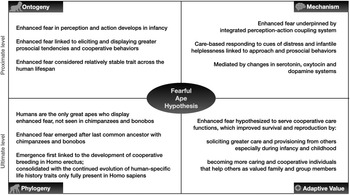



Target article
The human fear paradox: Affective origins of cooperative care
Related commentaries (28)
A novel(ty) perspective of fear bias
Are we virtuously caring or just anxious?
Beyond the fearful ape hypothesis: Humans are also supplicating and appeasing apes
Conceptualization, context, and comparison are key to understanding the evolution of fear
Cooperative care as origins of the “happy ape”?
Cultural evolution needed to complete the Grossmann theory
Developmental and evolutionary models of social fear can address “the human fear paradox”
Fear can promote competition, defensive aggression, and dominance complementarity
Fear signals vulnerability and appeasement, not threat
Fearful apes or emotional cooperative breeders?
Fearful apes or nervous goats? Another look at functions of dispositions or traits
Fearful apes, happy apes: Is fearfulness associated with uniquely human cooperation?
Fearfulness: An important addition to the starter kit for distinctively human minds
Heightened fearfulness as a developmental adaptation
Heightened fearfulness in infants is not adaptive
Hominin life history, pathological complexity, and the evolution of anxiety
How “peer-fear” of others' evaluations can regulate young children's cooperation
Infants aren't biased toward fearful faces
Is there a human fear paradox? A more thorough use of comparative data to test the fearful ape hypothesis
More than fear: Contributions of biobehavioral synchrony and infants' reactivity to cooperative care
Social learning and the adaptiveness of expressing and perceiving fearfulness
The adaptiveness of fear (and other emotions) considered more broadly: Missed literature on the nature of emotions and its functions
The dark side of fear expression: Infant crying as a trigger for maladaptive parental responses
The human fear paradox turns out to be less paradoxical when global changes in human aggression and language evolution are considered
The power of the weak: When altruism is the equilibrium
The suffering ape hypothesis
Under greater cooperative care, childhood fear is more accommodated, but less warranted
We aren't especially fearful apes, and fearful apes aren't especially prosocial
Author response
Extending and refining the fearful ape hypothesis