In an effort to establish that perceptual learning is not a top-down effect on perception, Firestone & Scholl (F&S) state that the “would-be penetrator is just the low-level input itself” (sect. 2.5). In other words, the authors claim, perceptual learning is not mediated by knowledge about the environment but is internal to the perceptual system, arising from repeated experience with a stimulus. Regardless of whether you agree with the guidelines and definitions F&S propose, Emberson and Amso (Reference Emberson and Amso2012) provide a clear example of perceptual learning that bypasses the authors “pitfalls” and in which knowledge, not simply repeated experience, changes perception.
Emberson and Amso (Reference Emberson and Amso2012) examined participants' visual percept of a complex Target Scene before and after a perceptual learning task. Participants were explicitly asked to color the scene according to their visual percept and no other factors, thereby meeting the criterion set out by F&S to dissociate perception from judgment (sect. 4.2, Pitfall 2).
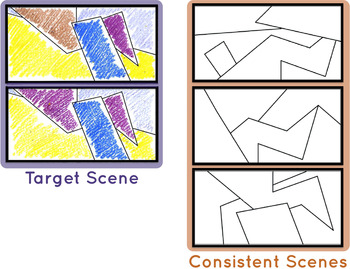
Unbeknownst to participants, the Target Scene was ambiguous such that the novel object in the middle could be viewed as two disconnected objects or a single object behind an occluder (Fig. 1). The participants were selected based on having an initial disconnected percept and, after exposure, were categorized as Non-Perceivers or Perceivers depending on whether they changed their percept to connect the novel object.
Figure 1
Complex scenes viewed during the perceptual learning task in Emberson and Amso (2012). Left panel: The Target Scene with two sample colorings depicting a typical disconnected percept (top) and a connected percept of the novel object (bottom). Participants all began with the disconnected percept (top). Participants viewed black-and-white scenes; color is for illustrative purposes only. Right panel: When participants viewed the Target Scene along with Consistent Scenes, half changed their percept to a connected percept (i.e., became Perceivers).
In a crucial control, Emberson and Amso established that simple repeated exposure to the Target Scene did not result in perceptual learning. Instead, changes in visual percepts arose when participants sequentially viewed additional scenes containing the novel object in different orientations and visual contexts (Fig. 1: Consistent Scenes). Because the novel object was always occluded, participants needed to integrate visual information across the scenes to create a globally unambiguous representation of the novel object. Even with exposure to the consistent scenes, only half of the participants changed their percept of the Target Scene (i.e., become Perceivers). Having established that neither simple repetition of the Target Scene nor the novel object biases perception, what differentiates Perceivers and Non-Perceivers?
One possibility is that attention orienting (a measure of selective attention) distinguishes Perceivers from Non-Perceivers (sect. 4.5, Pitfall 5), but that is not the case. Emberson and Amso measured eye movements to the Target Scene.
Though there are subtle differences between Perceivers and Non-Perceivers, they are not significant at the group level and are dwarfed by the differences between participants in the control condition and those who viewed the Consistent Scenes. Therefore, attention orienting is most directly affected by whether information exists in the environment that can change perception and not a participant's visual percept per se.
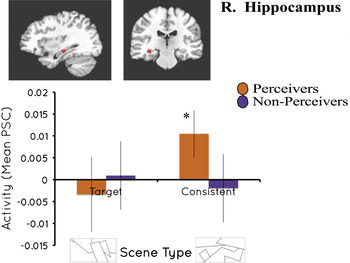
It is neural activity in learning and memory systems that distinguishes Perceivers from Non-Perceivers. The pattern of activity observed for the hippocampus (Fig. 2) suggests that Perceivers are engaging learning and memory circuitry while viewing the Consistent Scenes to acquire knowledge about the novel object. Given that participants must integrate perceptual information across consistent scenes to obtain an unambiguous representation of the novel object, there is a natural match between this perceptual learning task and the hippocampus' neurobiological and computational abilities to encode conjunctive information (Frank et al. Reference Frank, Rudy and O'Reilly2003). Indeed, recent work has demonstrated hippocampal involvement in associating information across sequentially presented episodes (Tubridy & Davachi Reference Tubridy and Davachi2011) and tracking the spatial relationship between an object and its context (Howard et al. Reference Howard, Kumaran, Ólafsdóttir and Spiers2011). Because that is the case for Perceivers only, the knowledge appears to bias conscious perception of the Target Scene, but through indirect means, because the circuitry is not active during viewing of the Target Scene.
Figure 2
The pattern of activity in the right hippocampus responds to Consistent Scenes in Perceivers but not in Non-Perceivers. This region does not respond in either group to the presentation of the Target Scene. PSC, percent signal change; R. Hippocampus, right hippocampus; *, p<0.05.
What about Pitfall 6, Memory and Recognition? This pitfall is the least well supported by F&S. F&S's major argument is that top-down effects must be on “what we see [and not] how we recognize various stimuli” (sect. 4.6, para. 1), but this distinction is not motivated by, nor does it directly follow from, their definition of perception. Indeed, their argument is entirely definitional: “Given that visual recognition involves both perception and memory as essential but separable parts, it is incumbent on reports of top-down effects on recognition to carefully distinguish between perception and memory” (sect. 4.6.3). F&S do not establish, however, why this assumption must be made in the first place. Therefore, the door is left open for memory effects that avoid the remaining pitfalls to be clear evidence of cognitive penetration of the perceptual system according to their framework.
F&S also attempt to circumvent neuroimaging evidence for top-down effects by claiming that “nearly all brain regions subserve multiple functions” (sect. 2.2, para. 1). Regardless of whether you agree with F&S' line of reasoning, that criticism does not hold up for the current neural evidence. The argument made by Emberson and Amso (Reference Emberson and Amso2012) is not that one can find activity in perceptual systems as evidence for a top-down effect but rather that changes in visual percepts arise from activity in learning and memory systems. For the F&S criticism of neural evidence to hold water, F&S would have to show that activity in these learning and memory systems has been associated with both perceptual and nonperceptual tasks (i.e., that the hippocampus subserves multiple functions). Evidence exists that regions of the medial temporal lobe are indeed crucial for perceptual as well as memory tasks (e.g., the perirhinal cortex; Graham et al. Reference Graham, Barense and Lee2010). However, this work stops short of finding perceptual effects for the hippocampus proper, the region that differentiates Perceivers and Non-Perceivers. The hippocampus is one of the few regions of the brain that has not been found to subserve multiple functions, despite intense study for decades, and therefore, inferring that activity in this area is nonperceptual and related to the creation of memory or knowledge about the environment is well substantiated.
Finally, the remaining pitfalls are clearly circumvented in Emberson and Amso (Reference Emberson and Amso2012): It does not have low-level stimulus differences to account for (Pitfall 4), is not subject to the El Greco fallacy (Pitfall 1), and has no difference in task demands (Pitfall 3).





In an effort to establish that perceptual learning is not a top-down effect on perception, Firestone & Scholl (F&S) state that the “would-be penetrator is just the low-level input itself” (sect. 2.5). In other words, the authors claim, perceptual learning is not mediated by knowledge about the environment but is internal to the perceptual system, arising from repeated experience with a stimulus. Regardless of whether you agree with the guidelines and definitions F&S propose, Emberson and Amso (Reference Emberson and Amso2012) provide a clear example of perceptual learning that bypasses the authors “pitfalls” and in which knowledge, not simply repeated experience, changes perception.
Emberson and Amso (Reference Emberson and Amso2012) examined participants' visual percept of a complex Target Scene before and after a perceptual learning task. Participants were explicitly asked to color the scene according to their visual percept and no other factors, thereby meeting the criterion set out by F&S to dissociate perception from judgment (sect. 4.2, Pitfall 2).
Unbeknownst to participants, the Target Scene was ambiguous such that the novel object in the middle could be viewed as two disconnected objects or a single object behind an occluder (Fig. 1). The participants were selected based on having an initial disconnected percept and, after exposure, were categorized as Non-Perceivers or Perceivers depending on whether they changed their percept to connect the novel object.
Complex scenes viewed during the perceptual learning task in Emberson and Amso (2012). Left panel: The Target Scene with two sample colorings depicting a typical disconnected percept (top) and a connected percept of the novel object (bottom). Participants all began with the disconnected percept (top). Participants viewed black-and-white scenes; color is for illustrative purposes only. Right panel: When participants viewed the Target Scene along with Consistent Scenes, half changed their percept to a connected percept (i.e., became Perceivers).
In a crucial control, Emberson and Amso established that simple repeated exposure to the Target Scene did not result in perceptual learning. Instead, changes in visual percepts arose when participants sequentially viewed additional scenes containing the novel object in different orientations and visual contexts (Fig. 1: Consistent Scenes). Because the novel object was always occluded, participants needed to integrate visual information across the scenes to create a globally unambiguous representation of the novel object. Even with exposure to the consistent scenes, only half of the participants changed their percept of the Target Scene (i.e., become Perceivers). Having established that neither simple repetition of the Target Scene nor the novel object biases perception, what differentiates Perceivers and Non-Perceivers?
One possibility is that attention orienting (a measure of selective attention) distinguishes Perceivers from Non-Perceivers (sect. 4.5, Pitfall 5), but that is not the case. Emberson and Amso measured eye movements to the Target Scene.
Though there are subtle differences between Perceivers and Non-Perceivers, they are not significant at the group level and are dwarfed by the differences between participants in the control condition and those who viewed the Consistent Scenes. Therefore, attention orienting is most directly affected by whether information exists in the environment that can change perception and not a participant's visual percept per se.
It is neural activity in learning and memory systems that distinguishes Perceivers from Non-Perceivers. The pattern of activity observed for the hippocampus (Fig. 2) suggests that Perceivers are engaging learning and memory circuitry while viewing the Consistent Scenes to acquire knowledge about the novel object. Given that participants must integrate perceptual information across consistent scenes to obtain an unambiguous representation of the novel object, there is a natural match between this perceptual learning task and the hippocampus' neurobiological and computational abilities to encode conjunctive information (Frank et al. Reference Frank, Rudy and O'Reilly2003). Indeed, recent work has demonstrated hippocampal involvement in associating information across sequentially presented episodes (Tubridy & Davachi Reference Tubridy and Davachi2011) and tracking the spatial relationship between an object and its context (Howard et al. Reference Howard, Kumaran, Ólafsdóttir and Spiers2011). Because that is the case for Perceivers only, the knowledge appears to bias conscious perception of the Target Scene, but through indirect means, because the circuitry is not active during viewing of the Target Scene.
The pattern of activity in the right hippocampus responds to Consistent Scenes in Perceivers but not in Non-Perceivers. This region does not respond in either group to the presentation of the Target Scene. PSC, percent signal change; R. Hippocampus, right hippocampus; *, p<0.05.
What about Pitfall 6, Memory and Recognition? This pitfall is the least well supported by F&S. F&S's major argument is that top-down effects must be on “what we see [and not] how we recognize various stimuli” (sect. 4.6, para. 1), but this distinction is not motivated by, nor does it directly follow from, their definition of perception. Indeed, their argument is entirely definitional: “Given that visual recognition involves both perception and memory as essential but separable parts, it is incumbent on reports of top-down effects on recognition to carefully distinguish between perception and memory” (sect. 4.6.3). F&S do not establish, however, why this assumption must be made in the first place. Therefore, the door is left open for memory effects that avoid the remaining pitfalls to be clear evidence of cognitive penetration of the perceptual system according to their framework.
F&S also attempt to circumvent neuroimaging evidence for top-down effects by claiming that “nearly all brain regions subserve multiple functions” (sect. 2.2, para. 1). Regardless of whether you agree with F&S' line of reasoning, that criticism does not hold up for the current neural evidence. The argument made by Emberson and Amso (Reference Emberson and Amso2012) is not that one can find activity in perceptual systems as evidence for a top-down effect but rather that changes in visual percepts arise from activity in learning and memory systems. For the F&S criticism of neural evidence to hold water, F&S would have to show that activity in these learning and memory systems has been associated with both perceptual and nonperceptual tasks (i.e., that the hippocampus subserves multiple functions). Evidence exists that regions of the medial temporal lobe are indeed crucial for perceptual as well as memory tasks (e.g., the perirhinal cortex; Graham et al. Reference Graham, Barense and Lee2010). However, this work stops short of finding perceptual effects for the hippocampus proper, the region that differentiates Perceivers and Non-Perceivers. The hippocampus is one of the few regions of the brain that has not been found to subserve multiple functions, despite intense study for decades, and therefore, inferring that activity in this area is nonperceptual and related to the creation of memory or knowledge about the environment is well substantiated.
Finally, the remaining pitfalls are clearly circumvented in Emberson and Amso (Reference Emberson and Amso2012): It does not have low-level stimulus differences to account for (Pitfall 4), is not subject to the El Greco fallacy (Pitfall 1), and has no difference in task demands (Pitfall 3).