






No CrossRef data available.
Article contents
Explaining the gradient: Requirements for theories of visual awareness
Published online by Cambridge University Press: 23 March 2022
Abstract
We propose that any theory of visual awareness must explain the gradient of different awareness measures over experimental conditions, especially when those measures form double dissociations among each other. Theories meeting this requirement must be specific to the measured facets of awareness, such as motion, contrast, or color. Integrated information theory (IIT) lacks such specificity because it is an underconstrained theory with unspecific predictions.
Information
- Type
- Open Peer Commentary
- Information
- Copyright
- Copyright © The Author(s), 2022. Published by Cambridge University Press
References
Albrecht, T., Klapötke, S., & Mattler, U. (2010). Individual differences in metacontrast masking are enhanced by perceptual learning. Consciousness and Cognition, 19(2), 656–666. https://doi.org/10.1016/j.concog.2009.12.002CrossRefGoogle ScholarPubMed
Albrecht, T., & Mattler, U. (2012). Individual differences in metacontrast masking regarding sensitivity and response bias. Consciousness and Cognition, 21(3), 1222–1231. https://doi.org/10.1016/j.concog.2012.04.006CrossRefGoogle ScholarPubMed
Albrecht, T., & Mattler, U. (2016). Individually different weighting of multiple processes underlies effects of metacontrast masking. Consciousness and Cognition, 42, 162–180. https://doi.org/10.1016/j.concog.2016.03.006CrossRefGoogle ScholarPubMed
Biafora, M., & Schmidt, T. (2020). Induced dissociations: Opposite time-courses of priming and masking induced by custom-made mask-contrast functions. Attention, Perception, & Psychophysics, 82, 1333–1354. https://doi.org/10.3758/s13414-019-01822-4CrossRefGoogle ScholarPubMed
Breitmeyer, B. G., & Öğmen, H. (2006). Visual masking. Oxford University Press. https://doi.org/10.1093/acprof:oso/9780198530671.001.0001CrossRefGoogle Scholar
Doerig, A., Schurger, A., & Herzog, M. H. (2020). Hard criteria for empirical theories of consciousness. Cognitive Neuroscience, 12(2), 41–62. doi: 10.1080/17588928.2020.1772214CrossRefGoogle ScholarPubMed
Irvine, E. (2017). Explaining what? Topoi, 36, 95–106. https://doi.org/10.1007/s11245-014-9273-4CrossRefGoogle Scholar
Kahneman, D. (1968). Method, findings, and theory in studies of visual masking. Psychological Bulletin, 70(6, Pt.1), 404–425. https://doi.org/10.1037/h0026731CrossRefGoogle ScholarPubMed
Koster, N., Mattler, U., & Albrecht, T. (2020). Visual experience forms a multidimensional pattern that is not reducible to a single measure: Evidence from metacontrast masking. Journal of Vision, 20(3), 2, 1–27. https://doi.org/10.1167/jovi.20.3.2CrossRefGoogle Scholar
Oizumi, M., Albantakis, L., & Tononi, G. (2014). From the phenomenology to the mechanisms of consciousness: Integrated information theory 3.0. PLoS Computational Biology, 10(5), e1003588. https://doi.org/10.1371/journal.pcbi.1003588CrossRefGoogle Scholar
Schmidt, F., Haberkamp, A., & Schmidt, T. (2011). Dos and don'ts in response priming research. Advances in Cognitive Psychology, 7, 120–131.CrossRefGoogle ScholarPubMed
Schmidt, T., & Vorberg, D. (2006). Criteria for unconscious cognition: Three types of dissociation. Perception & Psychophysics, 68(3), 489–504. https://doi.org/10.3758/BF03193692CrossRefGoogle ScholarPubMed
Tononi, G. (2004). An information integration theory of consciousness. BMC Neuroscience, 5, 42. https://doi.org/10.1186/1471-2202-5-42CrossRefGoogle ScholarPubMed
Tononi, G., & Edelman, G. M. (1998). Consciousness and complexity. Science (New York, N.Y.), 282(5395), 1846–1851. https://doi.org/10.1126/science.282.5395.1846CrossRefGoogle ScholarPubMed
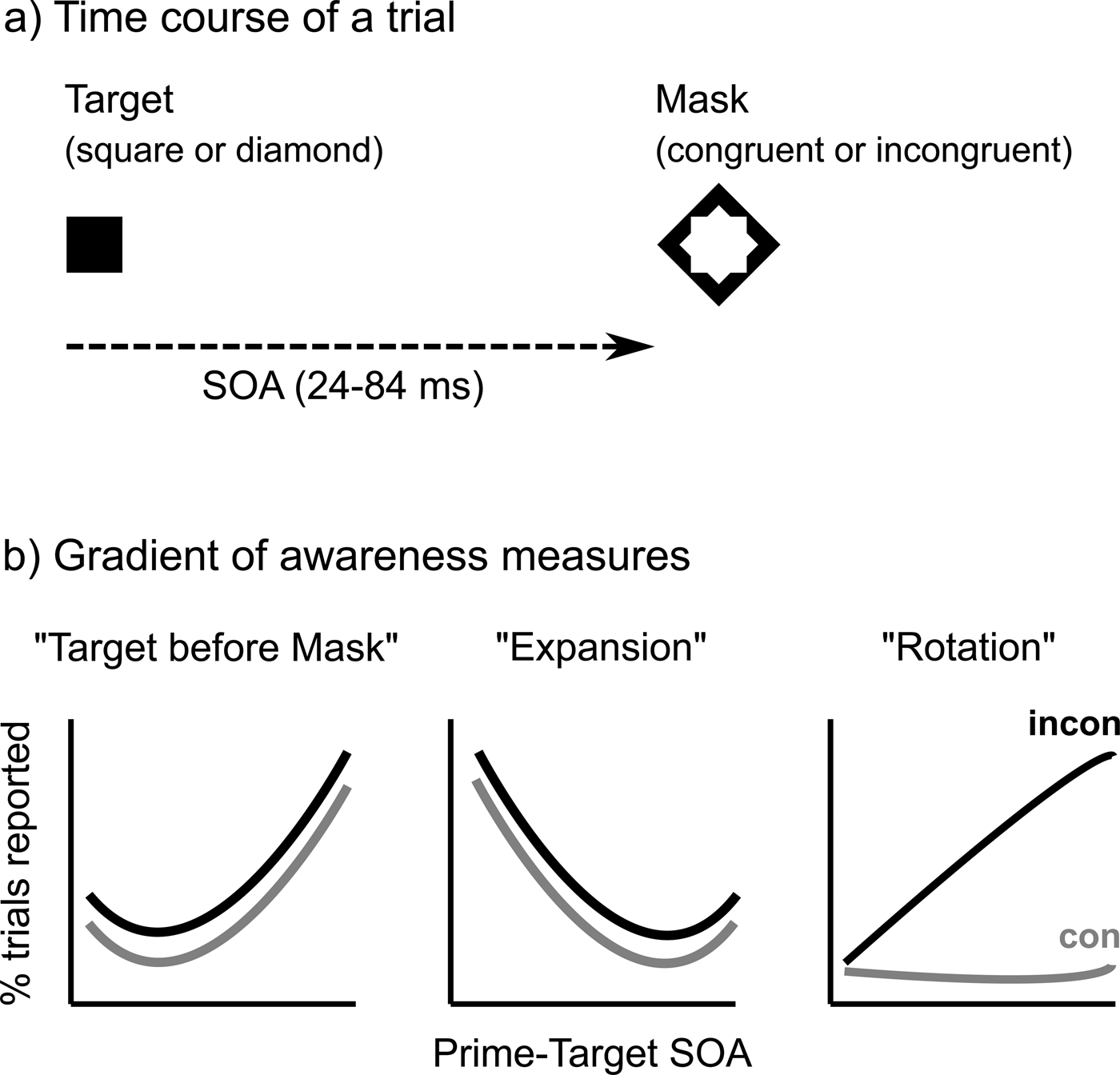
Figure 1. (A) In Koster et al.,'s (2020) experiment, a target (square or diamond) was followed by a metacontrast mask (congruent or incongruent in shape to the target). In each trial, participants reported a single subjective percept. (B) Time-courses for three of the percepts (schematized to facilitate our own argument). The original paper contained additional awareness measures.
Target article
Related commentaries (23)
A call for comparing theories of consciousness and data sharing
Encapsulation and subjectivity from the standpoint of viewpoint theory
Measures of differentiation and integration: One step closer to consciousness
The disintegrated theory of consciousness: Sleep, waking, and meta-awareness
When several measures of awareness are employed in the same experiment, surprising dissociations can occur among them. Koster, Mattler, and Albrecht (Reference Koster, Mattler and Albrecht2020) presented square- or diamond-shaped targets followed by metacontrast masks whose shape was congruent or incongruent with the target (Fig. 1A). Metacontrast masking gives rise to a rich phenomenology of subjective percepts that depend on stimulus factors (timing, contrast, eccentricity, shape, and relative energy; Breitmeyer & Öğmen, Reference Breitmeyer and Öğmen2006; Kahneman, Reference Kahneman1968) and vary strongly between observers (Albrecht & Mattler, Reference Albrecht and Mattler2012, Reference Albrecht and Mattler2016; Albrecht, Klapötke, & Mattler, Reference Albrecht, Klapötke and Mattler2010). The authors first classified the subjective percepts reported by trained observers, and then asked them on each trial to indicate whether a particular percept had occurred. The results offer a rich picture of subjective experience of which we only pick three interesting measures (Fig. 1B). The likelihood of perceiving a target before the mask increased with stimulus-onset asynchrony (SOA) between target and mask, whereas the likelihood of perceiving an expansion decreased (in concordance with objective discrimination performance). Interestingly, the likelihood of perceiving rotation between target and mask increased with SOA, but only when prime and mask were incongruent in shape. Several pairs of measures form double dissociations where one measure increases whereas the other decreases. Schmidt and Vorberg (Reference Schmidt and Vorberg2006) and Biafora and Schmidt (Reference Biafora and Schmidt2020) showed that double dissociations exclude the possibility that both measures are monotonic functions of a single source of conscious information, therefore implying at least one additional source of information.
(A) In Koster et al.,'s (Reference Koster, Mattler and Albrecht2020) experiment, a target (square or diamond) was followed by a metacontrast mask (congruent or incongruent in shape to the target). In each trial, participants reported a single subjective percept. (B) Time-courses for three of the percepts (schematized to facilitate our own argument). The original paper contained additional awareness measures.
We call such a set of measures a gradient of awareness measures – a set of at least two measures of awareness observed over a specific set of experimental conditions (ideally in a parametric experiment; Schmidt, Haberkamp, and Schmidt, Reference Schmidt, Haberkamp and Schmidt2011). Whenever double dissociations are observed among the measures in a gradient, it is immediately clear that visual awareness can never be fully characterized by only a single measure or explained by only a single process (Koster et al., Reference Koster, Mattler and Albrecht2020).
We propose that theories of consciousness should be judged by their ability to explain gradients of awareness, especially those containing double dissociations (for further criteria, see Doerig, Schurger, and Herzog, Reference Doerig, Schurger and Herzog2020). A theory unable to fulfill this minimum requirement fails to address the contents of conscious experience and remains disconnected from the crucial processing mechanisms that produced the facets of experience. The requirement to predict gradients with double dissociations excludes any theory explaining conscious experience with only a single process:
Proposition: Assume two awareness measures A, B that are scaled with the same polarity and are observed under experimental conditions i, i ∈ {1, 2}. Assume a theory T that explains variations in A and B as monotonic functions f, g of a single variable p, so that A = f(p) and B = g(p), with f(p′) ≤ f(p) and g(p′) ≤ g(p) for any p′ ≤ p. Then T is falsified by a double dissociation between A and B.
Proof: Suppose that A 1 << A 2 whereas B 1 >> B 2, where “<<” and “>>” stand for numerical differences that are statistically indisputable. We show that the postulates A = f(p) and B = g(p) lead to a contradiction. By assumption of monotonicity of f and g, both A and B are monotonic functions of p. The observation that A 1(p) << A 2(p) thus implies that p's value has increased from condition 1 to condition 2. At the same time, the observation that B 1(p) >> B 2(p) implies that p has decreased in value from condition 1 to condition 2, which completes the contradiction.
At first glance, it seems that integrated information theory (IIT) is a theory with only a single explanatory device, namely the amount of integrated information, Φ. However, different versions of the theory seem to differ in falsifiability by double dissociations between awareness measures. In the formulation by Tononi (Reference Tononi2004; Tononi & Edelman, Reference Tononi and Edelman1998), IIT seems to escape all possible falsification by allowing a system of high Φ to create a multifaceted phenomenological representation in a vast qualia space. Each conscious experience has a coordinate, and the flow of experiences is a trajectory through qualia space. Given that the human brain's Φ value is incalculably high, it is easy for the theory to accommodate every possible experience imaginable, including the gradient in Figure 1B. This theory is severely underconstrained in a Popperian sense; it may explain anything in hindsight but can predict nothing in particular. Things may be different in the formulation of the theory by Oizumi, Albantakis, and Tononi (Reference Oizumi, Albantakis and Tononi2014). If we interpret their byzantine paper correctly, the relative contributions of different facets of experience are represented as “constellations in concept space,” with the strength of the ith facet represented by a value, φi Max. Because φi Max (say, perceived rotation in our gradient) is a structural property of the network, it is difficult to see how it should change only because the SOA changes. And even if the varying SOA leads to a structural change in the network and hence the amount of φi Max, why does it do so only in incongruent trials? The theory would clearly require additional assumptions to accommodate the observations and further immunize itself against falsification.
In sum, we challenge theories of awareness to be specific enough to explain gradients including double dissociations. But, for a theory to explain the time-course of even one facet of awareness, it must first include a theory of that facet: Any testable theory of conscious color vision must include a theory of color, any theory of conscious motion a theory of motion. Because gradients are specific to measures and experimental manipulations, theories of awareness will have to be similarly constrained: Instead of being sweeping “theories of consciousness,” they will have to “accept the fragmentation” among multiple awareness measures (Irvine, Reference Irvine2017, p. 103).
Financial support
This research received no specific grant from any funding agency, commercial, or not-for-profit sectors.
Conflict of interest
None.