1. Introduction
1·1. Historical background and motivation
Recently, there has been considerable development on the p-energy defined on fractals and general metric measure spaces (initiated by [
Reference Herman, Peirone and Strichartz31
]). For a smooth Euclidean domain D, its associated p-energy is defined as
 $\int_{D}|\nabla u(x)|^{p}dx$
, but for many fractals or metric measure spaces, it is not easy to define proper gradient structures to characterise the smoothness of certain ‘core’ functions arising naturally from analysis. Previous constructions of p-energy (
 $1\lt p\lt\infty $
) are based on the graph-approximation to the underlying space, including post-critically finite (p.c.f.) self-similar sets (see definition in Section 4) by Cao, Gu and Qiu [
Reference Cao, Gu and Qiu16
], the Sierpiński carpet by Shimizu [
Reference Shimizu46
] and more general fractal spaces by Kigami [
Reference Kigami37
].
In this paper, we propose an alternative way to define p-energy norms via equivalent Besov-type norms, which naturally generalise the energy of Dirichlet forms when
 $p=2$
, and do not make use of the graph-approximation for their definition. Heat kernel-based p-energy norms were introduced by K. Pietruska-Pałuba in [
Reference Pietruska-Pałuba45
], and heat semigroup-based norms were later studied by Alonso Ruiz, Baudoin et al. for
 $1\leq p \lt \infty $
in [
Reference Alonso-Ruiz, Baudoin, Chen, Rogers, Shanmugalingam and Teplyaev1–Reference Alonso-Ruiz, Baudoin, Chen, Rogers, Shanmugalingam and Teplyaev3
]. There, the authors focus on generalising classical analysis results including Sobolev embedding, isoperimetric inequalities and bounded variation functions. It is possible to use heat kernel-based p-energy norms to construct equivalent (or exactly the same) p-energy given by the graph-approximation approach, to satisfy further restrictions like convexity or self-similarity for self-similar sets, see for example [
Reference Cao, Gu and Qiu16
,
Reference Gao, Yu and Zhang23
].
Recall the celebrated ‘Bourgain–Brezis-Mironescu (BBM) convergence’ in [ Reference Bourgain, Brezis and Mironescu13 , corollary 2]:
 \begin{equation}\lim_{\sigma \uparrow 1}(1-\sigma )\int_{D}\int_{D}\frac{|u(x)-u(y)|^{p}}{|x-y|^{n+p\sigma }}dxdy=C_{n,p}\int_{D}|\nabla u(x)|^{p}dx \ \ \ (1\lt p\lt\infty) \end{equation}
where D is a smooth domain in
 $\mathbb{R}^{n}$
. It states that multiplying by a scaling factor
 $1-\sigma $
, the fractional Gagliardo semi-norms of a function converge to the first-order Sobolev semi-norm as
 $\sigma \rightarrow 1$
. The BBM type characterisation thus corresponds to the convergence of Besov semi-norms
 $(\sigma ^{\ast }-\sigma )B_{p,p}^{\sigma }$
to
 $B_{p,\infty }^{\sigma ^{\ast }}$
on metric measure spaces, where
 $\sigma^{\ast }$
is a certain critical exponent. This characterisation has been studied for instance on fractals with ‘property (E)’ [
Reference Gao, Yu and Zhang23
, theorem 1·6], and on spaces supporting a p-Poincaré inequality [
Reference Di Marino and Squassina20
,
Reference Górny29
,
Reference Munnier41
].
In this paper, we establish a BBM type characterisation for both bounded and unbounded metric measure spaces under appropriate weak-monotonicity properties that replace property (E) on fractals from [
Reference Gao, Yu and Zhang23
]. We utilise the concept of property
 $(KE)_{\sigma}$
introduced in [
Reference Alonso-Ruiz, Baudoin, Chen, Rogers, Shanmugalingam and Teplyaev1
, definition 6·7] and
 $(NE)_{\sigma}$
defined in [
Reference Baudoin11
, definition 4·5] (all termed
 $P(p,\alpha)$
therein), and use
 $(VE)_{\sigma}$
for bounded and unbounded fractals based on [
Reference Gao, Yu and Zhang23
, definition 3·1], where the letters ‘E’ stands for energy control and ‘K’,‘N’,‘V’ represent (heat) kernel, (Besov) norm, vertex respectively. Additionally, we explore their slightly weaker variants by replacing ‘sup’ with ‘limsup’.
These weak-monotonicity properties correspond to certain energy-control conditions, which are essentially required and important in all the studies related to p-energy (norms) mentioned above, to guarantee ‘some level of
 $L^p$
infinitesimal regularity and global controlled
 $L^p$
geometry’, as stated in [
Reference Baudoin11
]. In analysis on fractals, weak-monotonicity appears in the form of a p-resistance estimate in [
Reference Cao, Gu and Qiu16
,
Reference Kigami37
,
Reference Shimizu46
], which is not easy to obtain. Verifying the weak-monotonicity properties
 $(KE)_{\sigma}$
,
 $(NE)_{\sigma}$
and
 $(VE)_{\sigma}$
for certain fractal-type spaces, like nested fractals and their blow-ups, is one of the main contributions of this paper.
To do so, we establish the equivalence of
 $(KE)_{\sigma}$
and
 $(NE)_{\sigma}$
on metric measure spaces, the equivalence of
 $(NE)_{\sigma}$
and
 $(VE)_{\sigma}$
on certain fractals (including nested fractals), and then verify a relatively easier condition
 $(VE)_{\sigma}$
using the arguments in a main theorem of [
Reference Cao, Gu and Qiu16
]. Such properties are not easy to examine when
 $p\neq 2$
in general (but property
 $(KE)_{\sigma}$
holds automatically when
 $p=2$
). Alonso Ruiz, Baudoin et al. examined property
 $(KE)_{\sigma}$
in the case
 $p=1$
using a weak Bakry-Emery type estimate and in the case
 $p\neq 2$
for spaces with the same critical exponent as Euclidean smooth manifolds (see for example [
Reference Alonso-Ruiz, Baudoin, Chen, Rogers, Shanmugalingam and Teplyaev3
, lemma 4·13]). But for fractal-type spaces, different ideas are required, since the critical exponents
 $\sigma^*$
from (1·1) are different from manifolds (
 $\sigma^*=1$
for smooth manifolds; but even when
 $p=2$
,
 $\sigma^*=\log15/\log9 $
on the Vicsek set [
Reference Baudoin and Chen12
] and
 $\sigma^*=\log5/\log4$
on the Sierpiński gasket [
Reference Barlow and Perkins10
]) and (bi-)linearity is missing.
1·2. Preliminaries
1·2·1. Basic definitions
Let
 $(M,d,\mu )$
be a metric measure space, that is, (M,d) is a locally compact, separable metric space and
 $\mu $
is a Radon measure with full support on M. Fix a value (which could be infinite)
 \begin{equation*}R_{0}\in (0,\mathrm{diam}(M)]\end{equation*}
that will be used for localisation throughout the paper, where
 \begin{equation*}\mathrm{diam}(M)\;:\!=\;\sup \{d(x,y)\;:\;x,y\in M\}\in (0,\infty]\end{equation*}
is infinite if M is unbounded and is finite if M is bounded.
The measure
 $\mu$
is assumed to be Borel regular with the following positivity and volume doubling property: there exists a constant
 $C_{d}\gt0$
such that for every
 $x\in M$
,
 $0\lt r\lt\infty $
,
 \begin{equation}0\lt\mu (B(x,2r))\leq C_{d}\mu (B(x,r))\lt\infty, \end{equation}
where
 $B(x,r)\;:\!=\;\{y\in M\;:\;d(x,y)\lt r\}$
denotes the open metric ball centered at
 $x\in M$
with radius
 $r\gt0$
. Denote
 \begin{equation*}V(x,r)\;:\!=\;\mu (B(x,r)).\end{equation*}
It is known from [
Reference Grigor’yan and Hu24
, proposition 5·1] that if (1·2) holds, then there exists
 $\alpha _{1}\gt0$
such that
 \begin{equation}\frac{V(x,R)}{V(x,r)}\leq C_{d}\left( \frac{R}{r}\right) ^{\alpha _{1}},\end{equation}
for all
 $x\in M$
,
 $0\lt r\leq R\lt\infty$
.
For
 $\alpha\gt0$
, we say that
 $\mu $
is
 $\alpha $
-regular if there exists a constant
 $C\geq 1$
such that for all
 $0\lt r\lt R_{0}$
,
 \begin{equation}C^{-1}r^{\alpha }\leq V(x,r)\leq Cr^{\alpha }. \end{equation}
We remark that when
 $\mu $
is
 $\alpha $
-regular, then (1·3) holds with
 $\alpha _{1}=\alpha $
.
A family
 $\{p_{t}\}_{t\gt0}$
of non-negative measurable functions on
 $M \times M$
is a heat kernel if it satisfies, for all
 $x, y\in M$
and
 $s, t\gt0$
:
-
(1) symmetry:
 $p_t(x,y) =p_t(y,x)$
;
-
(2) Markov property:
$\int_M p_t(x,y)d\mu(y) \leq 1$
; -
(3) semigroup property:
$p_{s+t}(x,y)=\int_{M}p_{s}(x,z)p_{t}(z,y)d\mu (z)$
; -
(4) identity approximation: for any
$f\in L^{2}(M,\mu )$
,
$\int_{M}p_{t}(x,y)f(y)d\mu (y)\rightarrow f(x)$
as
$t\downarrow 0$
, strongly in
$L^{2}(M,\mu )$
.







For some parameter
 $\beta ^{\ast }\gt1$
, we consider the following two conditions on the heat kernel:
We say that
 $\{p_{t}\}_{t\gt0}$
satisfies the lower heat kernel estimate (LHE), if for all
 $t\in (0,R_{0}^{\beta ^{\ast }}) $
and
 $\mu $
-almost all
 $x,y\in M$
,
 \begin{equation}p_{t}(x,y)\geq \frac{c_{1}}{V(x,t^{1/\beta ^{\ast }})}\exp \left(-c_{2}\left( \frac{d(x,y)}{t^{1/\beta ^{\ast }}}\right) ^{\frac{\beta ^{\ast}}{\beta ^{\ast }-1}}\right). \end{equation}
We say that
 $\{p_{t}\}_{t\gt0}$
satisfies the upper heat kernel estimate (UHE), if for all
 $t\in (0,R_{0}^{\beta ^{\ast }}) $
and
 $\mu $
-almost all
 $x,y\in M$
,
 \begin{equation}p_{t}(x,y)\leq \frac{c_{3}}{V(x,t^{1/\beta ^{\ast }})}\exp \left(-c_{4}\left( \frac{d(x,y)}{t^{1/\beta ^{\ast }}}\right) ^{\frac{\beta ^{\ast}}{\beta ^{\ast }-1}}\right). \end{equation}
Conditions (UHE) and (LHE) hold in many cases. The classical Gauss-Weierstrass function
 \begin{equation}p_{t}(x,y)=\frac{1}{(4\pi t)^{n/2}}\exp \left( -\frac{|x-y|^{2}}{4t}\right) ,\end{equation}
is a heat kernel for the standard Brownian motion in
 $\mathbb{R}^{n}$
. Li and Yau have shown in [
Reference Li and Yau40
] that, for a complete Riemannian manifold with non-negative Ricci curvature, two-sided estimates (UHE) and (LHE) hold with
 $\beta ^{\ast }=2$
:
 \begin{equation}p_{t}(x,y)\asymp \frac{C}{V(x,\sqrt{t})}\exp \left( -\frac{d(x,y)^{2}}{ct}\right) , \end{equation}
where d is the geodesic metric and V(x,r) is the Riemannian volume. The following sub-Gaussian heat kernel estimates
 \begin{equation}p_{t}(x,y)\asymp \frac{C}{t^{\alpha /\beta ^{\ast }}}\exp \left( -c\left(\frac{d(x,y)}{t^{1/\beta ^{\ast }}}\right) ^{\frac{\beta ^{\ast }}{\beta^{\ast }-1}}\right) \end{equation}
also hold on many fractal spaces with different
 $\beta ^{\ast }$
, such as the Sierpiński carpet and nested fractals [
Reference Barlow and Bass6
,
Reference Barlow and Bass7
,
Reference Fitzsimmonsm, Hambly and Kumagai21
,
Reference Kumagai38
].
1·2·2. Besov and Korevaar-Schoen norms
From now on we fix
 $p\in (1,\infty)$
. As in [
Reference Baudoin11
], for
 $\sigma \gt0$
, define the semi-norm
 $[u]_{B_{p,\infty }^{\sigma }}$
for
 $u\in L^{p}(M,\mu )$
by
 \begin{equation}\lbrack u]_{B_{p,\infty }^{\sigma }}^{p}\;:\!=\;\sup_{r\in (0,R_{0})}r^{-p\sigma}\int_{M}\frac{1}{V(x,r)}\int_{B(x,r)}|u(x)-u(y)|^{p}d\mu (y)d\mu (x),\end{equation}
and define
 \begin{equation*}B_{p,\infty }^{\sigma }\;:\!=\;B_{p,\infty }^{\sigma }(M)=\{u\;:\;||u||_{B_{p,\infty }^{\sigma }}\lt\infty \},\end{equation*}
with the norm
 $||u||_{B_{p,\infty }^{\sigma }}\;:\!=\;||u||_p+[u]_{B_{p,\infty }^{\sigma }}$
. Further, define the semi-norm
 $[u]_{B_{p,p}^{\sigma }}$
by
 \begin{equation}\lbrack u]_{B_{p,p}^{\sigma }}^{p}\;:\!=\;\int_{0}^{R_{0}}r^{-p\sigma }\left(\int_{M}\frac{1}{V(x,r)}\int_{B(x,r)}|u(x)-u(y)|^{p}d\mu (y)d\mu (x)\right)\frac{dr}{r} \end{equation}
and
 \begin{equation*}B_{p,p}^{\sigma }\;:\!=\;B_{p,p}^{\sigma }(M)=\{u\;:\;||u||_{B_{p,p }^{\sigma }}\lt\infty \},\end{equation*}
with the norm
 $||u||_{B_{p,p }^{\sigma }}\;:\!=\;||u||_p+[u]_{B_{p,p }^{\sigma }}$
.
The space
 $B_{p,\infty }^{\sigma }$
coincides with the Korevaar-Schoen space
 $KS_{p,\infty }^{\sigma }$
in [
Reference Baudoin11
, section 4·2] where the Korevaar-Schoen semi-norm
 $[u] _{KS_{p,\infty }^{\sigma }}$
is given by
 \begin{equation}[u]^p _{KS_{p,\infty }^{\sigma }}=\limsup_{r\rightarrow 0}\int_{M}\frac{1}{V(x,r)}\int_{B(x,r )}\frac{|u(x)-u(y)|^{p}}{r ^{p\sigma }}d\mu(y)d\mu (x)\lt\infty. \end{equation}
In our paper, we define the critical exponent of
 $(M,d,\mu )$
by
 \begin{equation*}\sigma _{p}^{\#}=\sup \{\sigma \gt0\;:\;B_{p,\infty }^{\sigma }\text{ contains non-constant functions}\}.\end{equation*}
In many related studies, the critical exponent is defined by
 \begin{equation*}\sigma _{p}^{\ast }=\sup \{\sigma \gt0\;:\;B_{p,\infty }^{\sigma }\text{ is dense in }L^{p}(M,\mu )\}.\end{equation*}
Clearly,
 $\sigma _{p}^{\ast }\leq \sigma _{p}^{\#}$
. Whenever the critical exponents appear in our paper, we assume that they are finite. It is known by [
Reference Baudoin11
, theorem 4·2] that when the chain condition holds,
 \begin{equation*}\sigma _{p}^{\#}\leq 1+\frac{\alpha_1}{p}\lt\infty .\end{equation*}
1·2·3. Heat kernel-based p-energy norm
It is well known that, a heat kernel
 $\{p_{t}\}_{t\gt0}$
can induce a Dirichlet form on
 $L^{2}(M,\mu )$
by
 \begin{align*}\mathcal{E}(u,u)& =\lim_{t\rightarrow 0^{+}}\mathcal{E}_{t}(u,u),\ u\in L^{2}(M,\mu) \\\mathcal{D}(\mathcal{E})& =\{u\in L^{2}(M,\mu )\;:\;\mathcal{E}(u,u)\lt\infty \}\end{align*}
(see for example [ Reference Fukushima, Oshima and Takeda22 , section 1·3]), where
 \begin{equation}\mathcal{E}_{t}(u,u)\;:\!=\;\frac{1}{2t}\int_{M}\int_{M}|u(x)-u(y)|^{2}p_{t}(x,y)d\mu (y)d\mu (x). \end{equation}
The limit exists, since for any given
 $u\in L^{2}(M,\mu )$
,
 $\mathcal{E}_{t}(u,u)$
decreases in t by using the spectral theorem.
Following [
Reference Alonso-Ruiz, Baudoin, Chen, Rogers, Shanmugalingam and Teplyaev1
,
Reference Pietruska-Pałuba45
], given a heat kernel
 $\{p_{t}\}_{t\gt0}$
, we denote its
 $p $
-energy semi-norm on
 $L^{p}(M,\mu )$
by
 $\left(E_{p,\infty}^\sigma(\cdot)\right)^{1/p}$
, where
 \begin{equation*}E_{p,\infty }^{\sigma }(u)\;:\!=\;\sup_{t\in (0,R_{0}^{\beta ^{\ast }})}\frac{1}{t^{{p\sigma }/{\beta ^{\ast }}}}\int_{M}\int_{M}|u(x)-u(y)|^{p}p_{t}(x,y)d\mu (y)d\mu (x),\end{equation*}
with its domain
 \begin{equation*}\mathcal{D}(E_{p,\infty }^{\sigma })\;:\!=\;\{u\in L^{p}(M,\mu )\;:\;E_{p,\infty}^{\sigma }(u)\lt\infty \}.\end{equation*}
We call
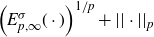 $\left(E_{p,\infty}^\sigma(\cdot)\right)^{1/p}+||\cdot||_p$
the heat kernel-based
 $p $
-energy norm. This is a natural way to extend the Dirichlet form case for
 $p=2$
to
 $p\in(1,\infty)$
.
 $E_{p,\infty }^{\sigma_{p}^{\#}}$
is equivalent to the p-energy on certain fractals (see Section 4).
To extend the BBM type characterisation from
 $p=2$
to
 $1\lt p\lt\infty$
, we define
 \begin{equation*}E_{p,p}^{\sigma }(u)\;:\!=\;\int_{0}^{R_{0}^{\beta ^{\ast }}}\frac{1}{t^{{p\sigma }/{\beta ^{\ast }}}}\left( \int_{M}\int_{M}|u(x)-u(y)|^{p}p_{t}(x,y)d\mu(x)d\mu (y)\right) \frac{dt}{t},\end{equation*}
with domain
 \begin{equation*}\mathcal{D}(E_{p,p}^{\sigma })\;:\!=\;\{u\in L^{p}(M,\mu )\;:\;E_{p,p}^{\sigma}(u)\lt\infty \}.\end{equation*}
It is known that (see for example [
Reference Pietruska-Pałuba44
]), when the two-sided heat kernel estimates hold, the proper scaling of
 $E_{2,2}^{\sigma} $
converges to
 $E_{2,\infty }^{\sigma _{2}^{\#}}$
thanks to the fact that
 $E_{2,2}^{\sigma }$
is equivalent to the Dirichlet form defined by the subordinated heat kernel. In this paper, we establish an analogous convergence of
 $E_{p,p}^{\sigma }$
to
 $E_{p,\infty }^{\sigma_{p}^{\#}}$
. However,
 $(E_{p,p}^{\sigma })^{1/p}$
does not seem to be the p-energy semi-norm of the subordinated heat kernel, so we need weak-monotonicity properties to replace the subordination technique in the case
 $p=2$
(see Theorem 2·2).
1·3. Weak-monotonicity properties and main results
We introduce some notions that will be used for weak-monotonicity properties and rewrite the above notions in the following way. For
 $u\in L^{p}(M,\mu )$
and
 $\sigma ,t\gt0$
, denote
 \begin{equation}\Psi _{u}^{\sigma }(t)=\frac{1}{t^{{p\sigma }/{\beta ^{\ast }}}}\int_{M}\int_{M}|u(x)-u(y)|^{p}p_{t}(x,y)d\mu (y)d\mu (x), \end{equation}
then
 \begin{equation}E_{p,\infty }^{\sigma }(u)=\sup_{t\in (0,R_{0}^{\beta ^{\ast }})}\Psi_{u}^{\sigma }(t),\ E_{p,p}^{\sigma }(u)=\int_{0}^{R_{0}^{\beta ^{\ast}}}\Psi _{u}^{\sigma }(t)\frac{dt}{t}. \end{equation}
Similarly, denote
 \begin{equation}\Phi _{u}^{\sigma }(r)=r^{-p\sigma }\int_{M}\frac{1}{V(x,r)}\int_{B(x,r)}|u(x)-u(y)|^{p}d\mu (y)d\mu (x), \end{equation}
then
 \begin{equation*}\lbrack u]_{B_{p,\infty }^{\sigma }}^{p}=\sup_{r\in (0,R_{0})}\Phi_{u}^{\sigma }(r),\ [u]_{B_{p,p}^{\sigma }}^{p}=\int_{0}^{R_{0}}\Phi_{u}^{\sigma }(r)\frac{dr}{r},\ [u] _{KS_{p,\infty }^{\sigma}}^{p}=\limsup_{r\rightarrow 0}\Phi _{u}^{\sigma }(r).\end{equation*}
Definition 1·1. We say that a metric measure space
 $(M,d,\mu )$
with heat kernel
 $\{p_{t}\}_{t\gt0}$
satisfies property
 $(KE)_{\sigma}$
with
 $\sigma\gt0$
, if there exists a constant
 $C\gt0$
such that for all
 $u\in \mathcal{D}(E_{p,\infty }^{\sigma })$
,
 \begin{equation} \sup_{t\in (0,R_{0}^{\beta ^{\ast }})}\Psi _{u}^{\sigma }(t)\leq C\liminf_{t\rightarrow 0}\Psi _{u}^{\sigma }(t), \tag*{$(KE)_{\sigma}$}\end{equation}
where
 $\Psi _{u}^{\sigma }(t)$
is defined as in (1·14). We further say that property
 $(\widetilde{KE})_{\sigma}$
is satisfied with
 $\sigma \gt0$
, if there exists a constant
 $C\gt0$
such that for all
 $u\in \mathcal{D}(E_{p,\infty}^{\sigma }) $
,
 \begin{equation} \limsup_{t\rightarrow 0}\Psi _{u}^{\sigma }(t)\leq C\liminf_{t\rightarrow0}\Psi _{u}^{\sigma }(t), \tag*{$(\widetilde{KE})_{\sigma}$}\end{equation}
Remark 1·2. When
 $p=2$
, property
 $(KE)_{\beta^{\ast }/2}$
automatically holds as
 $\mathcal{E}_{t}(u,u)$
decreases in t for any
 $u\in \mathcal{D}(E_{2,\infty}^{\beta^{\ast }/2 })$
.
Definition 1·3. We say that a metric measure space
 $(M,d,\mu )$
satisfies property
 $(NE)_{\sigma}$
with
 $\sigma \gt0$
if there exists
 $C\gt0$
such that for all
 $u\in B_{p,\infty }^{\sigma }$
,
 \begin{equation} \sup_{r\in (0,R_{0})}\Phi _{u}^{\sigma }(r)\leq C\liminf_{r\rightarrow0}\Phi _{u}^{\sigma }(r). \tag*{$(NE)_{\sigma}$}\end{equation}
We further say that property
 $(\widetilde{NE})_{\sigma}$
is satisfied with
 $\sigma \gt0$
, if there exists
 $C\gt0$
such that for all
 $u\in B_{p,\infty}^{\sigma }$
,
 \begin{equation} \limsup_{r\rightarrow 0}\Phi _{u}^{\sigma }(r)\leq C\liminf_{r\rightarrow0}\Phi _{u}^{\sigma }(r). \tag*{$(\widetilde{NE})_{\sigma}$}\end{equation}
Remark 1·4. It is known from [
Reference Baudoin11
, lemma 4·7] that, property (NE)
 $_\sigma$
can only hold when
 $\sigma \geq \sigma _{p}^{\#}$
. So property
 $(NE)_{\sigma}$
is only interested when
 $\sigma=\sigma _{p}^{\#},$
and whenever we say that property
 $(NE)_{\sigma}$
is satisfied, we automatically assume
 $\sigma=\sigma _{p}^{\#}$
. Recently, property
 $(NE)_{\sigma}$
was verified on nested fractals by Chang and the authors [
Reference Chang, Gao, Yu and Zhang17
, theorem 2·3] with the help of a lemma in this paper, on Sierpiński carpets for
 $p\gt\dim_{ARC}(K, d)$
by Yang [
Reference Yang50
, theorem 2·8] and for all
 $p\gt1$
by Murugan and Shimizu [
Reference Murugan and Shimizu43
, theorem 1·4]. Kajino and Shimizu [
Reference Kajino and Shimizu34
, section 5] studied property
 $(NE)_{\sigma}$
under the ‘p-contraction property’ based on Kigami’s partition of metric spaces [
Reference Kigami37
].
Our first result is that, two kinds of BBM type characterisation under
 $(KE)_{\sigma}$
and
 $(NE)_{\sigma}$
are established in Theorems 2·2 and 2·4, without using heat kernel estimates.
Our second result is that, under the heat kernel estimates (UHE) and (LHE), we show the equivalence of the heat kernel-based p-energy semi-norms and Besov-Korevaar-Schoen semi-norms on bounded and unbounded metric measure spaces in Lemma 3·1, and the following weak-monotonicity equivalence.
Theorem 1·5. If a metric measure space
 $(M,d,\mu )$
admits a heat kernel
 $\{p_{t}\}_{t\gt0}$
satisfying (UHE) and (LHE), then we have the following equivalences for
 $\sigma\gt0$
:
-
(i)
$(\widetilde{KE})_{\sigma}\Longleftrightarrow (\widetilde{NE})_{\sigma}$
; -
(ii)
$(KE)_{\sigma}\Longleftrightarrow (NE)_{\sigma}$
.


Now we introduce our results for fractals. In what follows, we assume that K is a connected homogeneous p.c.f. self-similar set. Let
 $\alpha =\mathrm{dim}_{H}(K) $
and denote the
 $\alpha$
-dimensional Hausdorff measure on K by
 $\mu $
. Let
 $K^{F}\;:\!=\;\bigcup_{f\in F}f(K)$
be a fractal glue-up where F is a proper set of functions (see details in Subsection 4·1) and equip it with a natural glue-up measure
 $\mu ^{F}$
as in (4·4). This notion is used to unify bounded and unbounded fractals. Following [
Reference Gao, Yu and Zhang23
], let
 \begin{equation}E_{n}^{(p)}(u)\;:\!=\;\sum_{x,y\in V_{w},|w|=n}|u(x)-u(y)|^{p}\text{ and }\mathcal{E}_{n}^{\sigma }(u)\;:\!=\;\rho ^{-n(p\sigma -\alpha )}E_{n}^{(p)}(u).\end{equation}
Similarly, let
 \begin{equation}E_{n}^{(p),F}(u)\;:\!=\;\sum_{f\in F}E_{n}^{(p)}(u\circ f)\text{ and }\mathcal{E}_{n}^{\sigma ,F}(u)\;:\!=\;\rho ^{-n(p\sigma -\alpha)}E_{n}^{(p),F}(u). \end{equation}
Definition 1·6. We say that a fractal glue-up
 $K^{F}$
satisfies property
 $({VE})_{\sigma}$
with
 $\sigma \gt0$
, if there exists a constant
 $C\gt0$
such that for all
 $u \in L^p(K^{F},\mu^F)$
,
 \begin{equation} \sup_{n\geq 0}\mathcal{E}_{n}^{\sigma ,F}(u)\leq C\liminf_{n\rightarrow\infty }\mathcal{E}_{n}^{\sigma ,F}(u). \tag*{$(VE)_{\sigma}$}\end{equation}
We say that a fractal glue-up
 $K^{F}$
satisfies property
 $(\widetilde{VE})_{\sigma}$
with
 $\sigma \gt0$
, if there exists
 $C\gt0$
such that for all
 $u \in L^p(K^{F},\mu^F)$
,
 \begin{equation} \limsup_{n\rightarrow \infty }\mathcal{E}_{n}^{\sigma ,F}(u)\leq C\liminf_{n\rightarrow \infty }\mathcal{E}_{n}^{\sigma ,F}(u).\tag*{$(\widetilde{VE})_{\sigma}$}\end{equation}
The proof of the following equivalence is more delicate. It involves proper truncation, an improvement of the p-energies equivalence in [ Reference Gao, Yu and Zhang23 ] with annulus decomposition, and comparing the vertex-energies of different levels. Also, analysis on unbounded fractals requires more arguments than the bounded cases.
Theorem 1·7. Let
 $K^{F}$
be a fractal glue-up, where K is a connected homogeneous p.c.f. self-similar set, then we have the following equivalences:
-
(i)
$(\widetilde{VE})_{\sigma} \Longleftrightarrow (\widetilde{NE})_{\sigma}$
when
$\sigma\gt\alpha /p$
; -
(ii)
$(VE)_{\sigma_{p}^{\#}} \Longleftrightarrow (NE)_{\sigma_{p}^{\#}}$
when
$\sigma_{p}^{\#}\gt\alpha /p$
and
$R_0=C_H$
(a positive number determined by
$K^{F}$
).





Remark 1·8. The equivalence of the integral-type properties
 $(KE)_{\sigma}$
,
 $(NE)_{\sigma}$
and of the discrete-type property
 $(VE)_{\sigma}$
does not rely on the p.c.f. property, but requires the continuity of the functions in
 $B_{p,\infty}^{\sigma}$
. The reason why we consider p.c.f. fractals is to avoid complexity in defining
 $(VE)_{\sigma}$
properly. Also verifying
 $(VE)_{\sigma}$
is relatively easier under the p.c.f. property (see Proposition 4·13 and Lemma 4·14).
Theorem 1·5 and Theorem 1·7 are very important in our paper with many corollaries. In Section 4·4, we will apply them to obtain Corollary 4·20, and further deduce Theorem 4·21 focusing on nested fractals and their blow-ups. Moreover, they also deduce Corollary 3·11 and Corollary 4·22 that are important to Dirichlet forms when
 $p=2$
.
1·4. Structure of the paper
The organisation of the paper is as follows. In Section 2, we establish a BBM type characterisation under appropriate weak-monotonicity properties (Theorems 2·2 and 2·4). In Section 3, we demonstrate the equivalence between heat kernel-based and Besov-Korevaar-Schoen p-energy semi-norms under two-sided estimates (UHE) and (LHE) (Lemma 3·1), and the equivalence of the corresponding weak-monotonicity properties (Theorem 1·5). In Section 4, we study fractal glue-ups
 $K^F$
. In Subsection 4·1, we introduce some geometric properties of
 $K^F$
and present some useful lemmas. In Subsection 4·2, we verify
 $(VE)_{\sigma}$
for nested fractal glue-ups. In Subsection 4·3, we prove Theorem 1·7. In Subsection 4·4, we show that the BBM type characterisation and Gagliardo-Nirenberg inequality hold true for nested fractal blow-ups (Theorem 4·21).
Notation. The letters C,
 $C^{\prime }$
,
 $C_{i}$
,
 $C_{i}^{\prime }$
,
 $C_{i}^{\prime\prime }$
, c are universal positive constants depending only on M which may vary at each occurrence. The sign
 $\asymp $
means that both
 $\leq $
and
 $\geq $
are true with uniform values of C depending only on M.
2. Consequence of
$(KE)_{\sigma}$
and
$(NE)_{\sigma}$
: BBM type characterisation


In this section, we present our BBM type characterisation for heat kernel-based and Besov-Korevaar-Schoen p-energy semi-norms. Under the settings in Section 3, these two BBM type characterisation results will coincide.
2·1. BBM type characterisation of heat kernel-based p-energy semi-norms
In our proof, we need the following embedding relation.
Proposition 2·1. For any
 $\delta \in (0,\sigma )$
, we have
 \begin{equation}\mathcal{D}(E_{p,\infty }^{\sigma })\subseteq \mathcal{D}(E_{p,p}^{\sigma-\delta }). \end{equation}
Proof. By the elementary inequality
 $|a-b|^{p}\leq 2^{p-1}(|a|^{p}+|b|^{p})$
, we have
 \begin{align}& \int_{M}\int_{M}|u(x)-u(y)|^{p}p_{t}(x,y)d\mu (x)d\mu (y) \nonumber \\[5pt] & \quad \leq 2^{p-1}\int_{M}\int_{M}(|u(x)|^{p}+|u(y)|^{p})p_{t}(x,y)d\mu (x)d\mu(y) \nonumber \\[5pt] & \quad = 2^{p}\int_{M}|u(x)|^{p}\left( \int_{M}p_{t}(x,y)d\mu (y)\right) d\mu(x)\leq 2^{p}||u||_{p}^p. \end{align}
Fix
 $\epsilon \in (0,R_{0}^{\beta ^{\ast }})$
. By (2·2),
 \begin{eqnarray*}E_{p,p}^{\sigma -\delta }(u) &=&\int_{0}^{R_{0}^{\beta ^{\ast }}}\frac{1}{t^{{p(\sigma -\delta )}/{\beta ^{\ast }}}}\left(\int_{M}\int_{M}|u(x)-u(y)|^{p}p_{t}(x,y)d\mu (x)d\mu (y)\right) \frac{dt}{t}\\[5pt] &\leq &\int_{0}^{\epsilon }\frac{1}{t^{{p(\sigma -\delta )}/{\beta ^{\ast }}}}\left( \int_{M}\int_{M}|u(x)-u(y)|^{p}p_{t}(x,y)d\mu (x)d\mu (y)\right)\frac{dt}{t} \\[5pt] &&+\int_{\epsilon }^{\infty }\frac{1}{t^{{p(\sigma -\delta )}/{\beta ^{\ast }}}}\left( \int_{M}\int_{M}|u(x)-u(y)|^{p}p_{t}(x,y)d\mu (x)d\mu (y)\right)\frac{dt}{t} \\[5pt] &\leq &\int_{0}^{\epsilon }t^{-1+p\delta /{\beta ^{\ast }}}dt\sup_{t\in(0,R_{0}^{\beta ^{\ast }})}\Psi _{u}^{\sigma }(t)+2^{p}||u||_{p}^{p}\int_{\epsilon }^{\infty }\frac{dt}{t^{1+{p(\sigma -\delta )}/{\beta^{\ast }}}} \\[5pt] &=&\frac{{\beta ^{\ast }}\epsilon ^{p\delta /{\beta ^{\ast }}}}{p\delta }\sup_{t\in (0,R_{0}^{\beta ^{\ast }})}\Psi _{u}^{\sigma }(t)+2^{p}\Vert u\Vert _{p}^{p}\frac{{\beta ^{\ast }}\epsilon ^{-p(\sigma -\delta )/{\beta^{\ast }}}}{p(\sigma -\delta )} \\[5pt] &=&\frac{{\beta ^{\ast }}\epsilon ^{p\delta /{\beta ^{\ast }}}}{p\delta }E_{p,\infty }^{\sigma }(u)+\frac{2^{p}{\beta ^{\ast }}||u||_{p}^p}{p(\sigma -\delta )}\epsilon ^{-p(\sigma -\delta )/{\beta ^{\ast }}}\lt\infty ,\end{eqnarray*}
thus showing (2·1).
Theorem 2·2. Suppose that
 $(M,d,\mu )$
admits heat kernel
 $\{p_{t}\}_{t\gt0}$
satisfies property
 $(KE)_{\tilde{\sigma}_{p}}$
with some
 $\tilde{\sigma}_{p}\gt0$
. Then there exists a constant
 $C\geq 1$
such that for all
 $u\in \mathcal{D}(E_{p,\infty }^{\tilde{\sigma}_{p}})$
,
 \begin{equation}C^{-1}{E}_{p,\infty }^{\tilde{\sigma}_{p}}(u)\leq \liminf_{\sigma \uparrow\tilde{\sigma}_{p}}(\tilde{\sigma}_{p}-\sigma ){E}_{p,p}^{\sigma }(u)\leq\limsup_{\sigma \uparrow \tilde{\sigma}_{p}}(\tilde{\sigma}_{p}-\sigma ){E}_{p,p}^{\sigma }(u)\leq C{E}_{p,\infty }^{\tilde{\sigma}_{p}}(u).\end{equation}
Proof. Let
 $u\in \mathcal{D}(E_{p,\infty }^{\tilde{\sigma _{p}}})$
and
 $\sigma \in(0,\tilde{\sigma}_{p})$
. By Proposition 2·1,
 $u\in \mathcal{D}(E_{p,p}^{\sigma })$
. Note that
 \begin{equation*}\Psi _{u}^{\sigma }(t)=t^{p(\tilde{\sigma}_{p}-\sigma )/{\beta ^{\ast }}}\Psi _{u}^{\tilde{\sigma}_{p}}(t).\end{equation*}
For the left-hand side, by (1·15), we have
 \begin{align}\liminf_{\sigma \uparrow \tilde{\sigma}_{p}}(\tilde{\sigma}_{p}-\sigma ){E}_{p,p}^{\sigma }(u)=& \liminf_{\sigma \uparrow \tilde{\sigma}_{p}}(\tilde{\sigma}_{p}-\sigma )\int_{0}^{R_{0}^{{\beta ^{\ast }}}}t^{p(\tilde{\sigma}_{p}-\sigma )/{\beta ^{\ast }}}\Psi _{u}^{\tilde{\sigma}_{p}}(t)\frac{dt}{t}\nonumber \\[3pt] \geq & \liminf_{\sigma \uparrow \tilde{\sigma}_{p}}(\tilde{\sigma}_{p}-\sigma )\int_{0}^{\tilde{\sigma}_{p}-\sigma }t^{p(\tilde{\sigma}_{p}-\sigma )/{\beta ^{\ast }}}\Psi _{u}^{\tilde{\sigma}_{p}}(t)\frac{dt}{t}\nonumber \\[3pt] \geq & \liminf_{\sigma \uparrow \tilde{\sigma}_{p}}(\tilde{\sigma}_{p}-\sigma )\int_{0}^{\tilde{\sigma}_{p}-\sigma }t^{p(\tilde{\sigma}_{p}-\sigma )/{\beta ^{\ast }}}\frac{dt}{t}\inf_{t\in (0,\tilde{\sigma}_{p}-\sigma )}\Psi _{u}^{\tilde{\sigma}_{p}}(t) \nonumber \\[3pt] =& \frac{{\beta ^{\ast }}}{p}\liminf_{\sigma \uparrow \tilde{\sigma}_{p}}(\tilde{\sigma}_{p}-\sigma )^{p(\tilde{\sigma}_{p}-\sigma )/{\beta ^{\ast }}}\inf_{t\in (0,\tilde{\sigma}_{p}-\sigma )}\Psi _{u}^{\tilde{\sigma}_{p}}(t)\nonumber \\[3pt] =& \frac{{\beta ^{\ast }}}{p}\liminf_{\sigma \uparrow \tilde{\sigma}_{p}}\inf_{t\in (0,\tilde{\sigma}_{p}-\sigma )}\Psi _{u}^{\tilde{\sigma}_{p}}(t)=\frac{{\beta ^{\ast }}}{p}\liminf_{t\rightarrow 0}\Psi _{u}^{\tilde{\sigma}_{p}}(t). \nonumber\end{align}
It follows from property
 $(KE)_{\tilde{\sigma}_{p}}$
that
 \begin{equation*}\liminf_{\sigma \uparrow \tilde{\sigma}_{p}}(\tilde{\sigma}_{p}-\sigma ){E}_{p,p}^{\sigma }(u)\geq \frac{C{\beta ^{\ast }}}{p}E_{p,\infty }^{\tilde{\sigma}_{p}}(u).\end{equation*}
For the right-hand side, let
 $A\in (0,R_{0})$
be a finite positive number. By (2·2), for any
 $\sigma \in (0,\tilde{\sigma _{p}})$
,
 \begin{eqnarray*}{E}_{p,p}^{\sigma }(u) &=&\int_{0}^{R_{0}^{\beta ^{\ast }}}\frac{1}{t^{{p\sigma }/{\beta ^{\ast }}}}\left(\int_{M}\int_{M}|u(x)-u(y)|^{p}p_{t}(x,y)d\mu (x)d\mu (y)\right) \frac{dt}{t}\\[3pt] &\leq &\int_{0}^{A^{\beta ^{\ast }}}\frac{1}{t^{{p\sigma }/{\beta ^{\ast }}}}\left( \int_{M}\int_{M}|u(x)-u(y)|^{p}p_{t}(x,y)d\mu (x)d\mu (y)\right)\frac{dt}{t}+\int_{A^{\beta ^{\ast }}}^{\infty }\frac{2^{p}||u||_{p}^{p}}{t^{{p\sigma }/{\beta ^{\ast }}}}\frac{dt}{t} \\[3pt] &=&\int_{0}^{A^{\beta ^{\ast }}}t^{p(\tilde{\sigma}_{p}-\sigma )/{\beta^{\ast }}}\Psi _{u}^{\tilde{\sigma}_{p}}(t)\frac{dt}{t}+\frac{2^{p}{\beta^{\ast }}||u||_{p}^p}{p\sigma A^{{p\sigma }}}.\end{eqnarray*}
It follows that
 \begin{align*}\limsup_{\sigma \uparrow \tilde{\sigma}_{p}}(\tilde{\sigma}_{p}-\sigma ){E}_{p,p}^{\sigma }(u)& \leq \limsup_{\sigma \uparrow \tilde{\sigma}_{p}}(\tilde{\sigma}_{p}-\sigma )\int_{0}^{A^{\beta ^{\ast }}}t^{p(\tilde{\sigma}_{p}-\sigma )/{\beta ^{\ast }}}\Psi _{u}^{\tilde{\sigma}_{p}}(t)\frac{dt}{t}\nonumber\\[3pt] &\quad +\limsup_{\sigma \uparrow \tilde{\sigma}_{p}}(\tilde{\sigma}_{p}-\sigma )\frac{2^{p}{\beta ^{\ast }}||u||_{p}^p}{p\sigma A^{{p\sigma }}}\nonumber \\[3pt] & \leq \limsup_{\sigma \uparrow \tilde{\sigma}_{p}}(\tilde{\sigma}_{p}-\sigma )\int_{0}^{A^{\beta ^{\ast }}}t^{p(\tilde{\sigma}_{p}-\sigma )/{\beta ^{\ast }}}\frac{dt}{t}\sup_{t\in (0,A^{{\beta ^{\ast }}})}\Psi _{u}^{\tilde{\sigma}_{p}}(t)+0 \end{align*}
 \begin{align} & =\frac{{\beta ^{\ast }}}{p}\limsup_{\sigma \uparrow \tilde{\sigma}_{p}}A^{p(\tilde{\sigma}_{p}-\sigma )}\sup_{t\in (0,A^{{\beta ^{\ast }}})}\Psi _{u}^{\tilde{\sigma}_{p}}(t) \nonumber \\[5pt] & =\frac{{\beta ^{\ast }}}{p}\sup_{t\in (0,A^{{\beta ^{\ast }}})}\Psi _{u}^{\tilde{\sigma}_{p}}(t)\leq \frac{{\beta ^{\ast }}}{p}E_{p,\infty }^{\tilde{\sigma}_{p}}(u). \end{align}
The proof is complete.
2·2. BBM type characterisation of Besov-Korevaar-Schoen p-energy semi-norms
The proof of this version is similar to the previous one.
Proposition 2·3. For any
 $\delta \in (0,\sigma )$
, we have
 \begin{equation}B_{p,\infty }^{\sigma }\subseteq B_{p,p}^{\sigma -\delta }. \end{equation}
Proof. By the elementary inequality
 $|a-b|^{p}\leq 2^{p-1}(|a|^{p}+|b|^{p})$
, we have
 \begin{align}& \int_{M}\frac{1}{V(x,r)}\int_{B(x,r)}|u(x)-u(y)|^{p}d\mu (y)d\mu (x)\nonumber \\[5pt] &\quad \leq 2^{p-1}\int_{M}\frac{1}{V(x,r)}\int_{B(x,r)}(|u(x)|^{p}+|u(y)|^{p})d\mu (y)d\mu (x) \nonumber \\[5pt] &\quad = 2^{p-1}\left( ||u||_{p}^p+\int_{M}\int_{M}\frac{\mathbf{1}_{\{d(y,x)\lt r\}}}{V(x,r)}|u(y)|^{p}d\mu (y)d\mu (x)\right) \nonumber \\[5pt] &\quad = 2^{p-1}\left( ||u||_{p}^p+\int_{M}\left( \int_{B(y,r)}\frac{1}{V(x,r)}d\mu (x)\right) |u(y)|^{p}d\mu (y)\right) \nonumber \\[5pt] & \quad \leq 2^{p-1}\left( ||u||_{p}^p+\sup_{x\in M}\frac{V(x,2r)}{V(x,r)}\int_{M}|u(y)|^{p}d\mu (y)\right) \leq C||u||_{p}^p. \end{align}
Fix
 $\epsilon \in (0,R_{0})$
. By (2·6),
 \begin{eqnarray*}\lbrack u]_{B_{p,p}^{\sigma -\delta }}^{p} &=&\int_{0}^{R_{0}}r^{-(p\sigma-p\delta )}\int_{M}\frac{1}{V(x,r)}\int_{B(x,r)}|u(x)-u(y)|^{p}d\mu (y)d\mu(x)\frac{dr}{r} \\[5pt] &\leq &\int_{0}^{\epsilon }r^{-(p\sigma -p\delta )}\int_{M}\frac{1}{V(x,r)}\int_{B(x,r)}|u(x)-u(y)|^{p}d\mu (y)d\mu (x)\frac{dr}{r} \\[5pt] &&+\int_{\epsilon }^{\infty }r^{-(p\sigma -p\delta )}\int_{M}\frac{1}{V(x,r)}\int_{B(x,r)}|u(x)-u(y)|^{p}d\mu (y)d\mu (x)\frac{dr}{r} \\[5pt] &\leq &\int_{0}^{\epsilon }r^{-1+p\delta }dr\sup_{r\in (0,R_{0})}\Phi_{u}^{\sigma }(r)+C||u||_{p}^p\int_{\epsilon }^{\infty}r^{-(p\sigma -p\delta )}\frac{dr}{r} \\[5pt] &=&\frac{\epsilon ^{p\delta }}{p\delta }\sup_{r\in (0,R_{0})}\Phi_{u}^{\sigma }(r)+C||u||_{p}^p\frac{\epsilon ^{-p(\sigma -\delta )}}{p(\sigma -\delta )}=\frac{\epsilon ^{p\delta }}{p\delta }[u]_{B_{p,\infty}^{\sigma }}^{p}+C^{\prime }||u||_{p}^p\lt\infty ,\end{eqnarray*}
thus showing (2·5).
Theorem 2·4. Suppose that
 $(M,d,\mu )$
satisfies property
 $(NE)_{\sigma _{p}^{\#}}$
, then there exists a positive constant C such that for all
 $u\in B_{p,\infty }^{\sigma_{p}^{\#}}$
,
 \begin{equation}C^{-1}[u]_{{B}_{p,\infty }^{\sigma _{p}^{\#}}}^{p}\leq \liminf_{\sigma\uparrow \sigma _{p}^{\#}}(\sigma _{p}^{\#}-\sigma )[u]_{{B}_{p,p}^{\sigma}}^{p}\leq \limsup_{\sigma \uparrow \sigma _{p}^{\#}}(\sigma_{p}^{\#}-\sigma )[u]_{{B}_{p,p}^{\sigma }}^{p}\leq C[u]_{{B}_{p,\infty}^{\sigma _{p}^{\#}}}^{p}. \end{equation}
Suppose that
 $(M,d,\mu )$
satisfies property
 $(\widetilde{NE})_{\sigma_p}$
with some
 $\sigma_{p}\gt0$
, then there exists a positive constant C such that for all
 $u\in B_{p,\infty }^{\sigma _{p}}$
,
 \begin{equation}C^{-1}[u] _{{KS}_{p,\infty }^{\sigma _{p}}}^{p}\leq \liminf_{\sigma\uparrow \sigma _{p}}(\sigma _{p}-\sigma )[u]_{{B}_{p,p}^{\sigma }}^{p}\leq\limsup_{\sigma \uparrow \sigma _{p}}(\sigma _{p}-\sigma )[u]_{{B}_{p,p}^{\sigma }}^{p}\leq C[u] _{{KS}_{p,\infty }^{\sigma_{p}}}^{p}. \end{equation}
Proof. We show (2·7) first. For the left-hand side, similarly, we have that for any
 $\sigma _{p}\gt0,$
 \begin{align}\liminf_{\sigma \uparrow \sigma _{p}}(\sigma _{p}-\sigma )[u]_{{B}_{p,p}^{\sigma }}^{p}=& \liminf_{\sigma \uparrow \sigma _{p}}(\sigma_{p}-\sigma )\int_{0}^{R_{0}}r^{p(\sigma _{p}-\sigma )}\Phi _{u}^{\sigma_{p}}(r)\frac{dr}{r} \nonumber \\\geq & \liminf_{\sigma \uparrow \sigma _{p}}(\sigma _{p}-\sigma)\int_{0}^{\sigma _{p}-\sigma }r^{p(\sigma _{p}-\sigma )}\Phi _{u}^{\sigma_{p}}(r)\frac{dr}{r} \nonumber \\\geq & \liminf_{\sigma \uparrow \sigma _{p}}(\sigma _{p}-\sigma)\int_{0}^{\sigma _{p}-\sigma }r^{p(\sigma _{p}-\sigma )}\frac{dr}{r}\inf_{r\in (0,\sigma _{p}-\sigma )}\Phi _{u}^{\sigma _{p}}(r) \nonumber \\=& \frac{1}{p}\liminf_{\sigma \uparrow \sigma _{p}}\inf_{r\in (0,\sigma_{p}-\sigma )}\Phi _{u}^{\sigma _{p}}(r)=\frac{1}{p}\liminf_{r\rightarrow0}\Phi _{u}^{\sigma _{p}}(r). \end{align}
Therefore, by property
 $(NE)_{\sigma _{p}^{\#}}$
, we have for
 $\sigma _{p}=\sigma _{p}^{\#}$
in (2·9) that
 \begin{equation}\liminf_{\sigma \uparrow \sigma _{p}^{\#}}(\sigma _{p}^{\#}-\sigma )[u]_{{B}_{p,p}^{\sigma }}^{p}\geq \frac{C^{-1}}{p}[u]_{{B}_{p,\infty }^{\sigma_{p}^{\#}}}^{p}. \end{equation}
For the other side, let
 $A\in (0,R_{0})$
be a finite positive number. We have from (2·6) that
 \begin{eqnarray}\lbrack u]_{{B}_{p,p}^{\sigma }}^{p} &=&\int_{0}^{R_{0}}r^{-p\sigma }\left(\int_{M}\frac{1}{V(x,r)}\int_{B(x,r)}|u(x)-u(y)|^{p}d\mu (y)d\mu (x)\right)\frac{dr}{r} \nonumber \\&\leq &\int_{0}^{A}r^{-p\sigma }\left( \int_{M}\frac{1}{V(x,r)}\int_{B(x,r)}|u(x)-u(y)|^{p}d\mu (y)d\mu (x)\right) \frac{dr}{r}+C\int_{A}^{\infty }r^{-p\sigma }||u||_{p}^p\frac{dr}{r} \nonumber \\&=&\int_{0}^{A}r^{p(\sigma _{p}^{\#}-\sigma )}\Phi _{u}^{\sigma _{p}^{\#}}(r)\frac{dr}{r}+\frac{C||u||_{p}^p}{p\sigma A^{p\sigma }}.\end{eqnarray}
It follows that
 \begin{align}\limsup_{\sigma \uparrow \sigma _{p}^{\#}}\!(\sigma _{p}^{\#}-\sigma )[u]_{{B}_{p,p}^{\sigma }}^{p}& \leq \limsup_{\sigma \uparrow \sigma_{p}^{\#}}\!(\sigma _{p}^{\#}-\sigma )\int_{0}^{A}r^{p(\sigma _{p}^{\#}-\sigma)}\Phi _{u}^{\sigma _{p}^{\#}}(r)\frac{dr}{r}+\limsup_{\sigma \uparrow\sigma _{p}^{\#}}\!(\sigma _{p}^{\#}-\sigma )\frac{C||u||_{p}^p}{p\sigma A^{p\sigma }} \nonumber \\& \leq \limsup_{\sigma \uparrow \sigma _{p}^{\#}}(\sigma _{p}^{\#}-\sigma)\int_{0}^{A}r^{p(\sigma _{p}^{\#}-\sigma )}\frac{dr}{r}\sup_{r\in(0,R_{0})}\Phi _{u}^{\sigma _{p}^{\#}}(r)+0 \nonumber \\& =\frac{1}{p}\limsup_{\sigma \uparrow \sigma _{p}^{\#}}A^{p(\sigma_{p}^{\#}-\sigma )}\sup_{r\in (0,R_{0})}\Phi _{u}^{\sigma _{p}^{\#}}(r)=\frac{1}{p}[u]_{B_{p,\infty }^{\sigma _{p}^{\#}}}^{p}, \end{align}
thus showing (2·7).
Next, we show (2·8). By property
 $(\widetilde{NE})_{\sigma_p}$
and (2·9), we have
 \begin{equation}\liminf_{\sigma \uparrow \sigma _{p}}(\sigma _{p}-\sigma )[u]_{{B}_{p,p}^{\sigma }}^{p}\geq C^{-1}[u] _{KS_{p,\infty}^{\sigma _{p}}}^{p}.\end{equation}
Then for the other side of (2·8), by the definition of
 $\limsup $
, there exists
 $\epsilon \in (0,R_{0})$
such that
 \begin{equation*}\sup_{r\in (0,\epsilon )}\Phi _{u}^{\sigma _{p}}(r)\leq2\limsup_{r\rightarrow 0}\Phi _{u}^{\sigma _{p}}(r).\end{equation*}
It follows from replacing
 $\sigma _{p}^{\#}$
by
 $\sigma _{p}$
and taking
 $A=\epsilon $
in (2·11) that,
 \begin{align}\limsup_{\sigma \uparrow \sigma _{p}}(\sigma _{p}-\sigma )[u]_{{B}_{p,p}^{\sigma }}^{p}& \leq \limsup_{\sigma \uparrow \sigma _{p}}(\sigma_{p}-\sigma )\int_{0}^{\epsilon }r^{p(\sigma _{p}-\sigma )}\Phi _{u}^{\sigma_{p}}(r)\frac{dr}{r}+\limsup_{\sigma \uparrow \sigma _{p}}(\sigma_{p}-\sigma )\frac{C|| u||_{p}^p}{p\sigma \epsilon ^{p\sigma }}\nonumber \\& \leq \limsup_{\sigma \uparrow \sigma _{p}}(\sigma _{p}-\sigma)\int_{0}^{\epsilon }r^{p(\sigma _{p}-\sigma )}\frac{dr}{r}\sup_{r\in(0,\epsilon )}\Phi _{u}^{\sigma _{p}}(r)+0 \nonumber \\& =\frac{1}{p}\sup_{r\in (0,\epsilon )}\Phi _{u}^{\sigma _{p}}(r)\leq \frac{2}{p}\limsup_{r\rightarrow 0}\Phi _{u}^{\sigma _{p}}(r)=\frac{2}{p}[u] _{{KS}_{p,\infty }^{\sigma _{p}}}^{p}. \end{align}
The proof is complete.
3. Equivalences on metric measure spaces
In this section, we assume that the underlying metric measure space
 $(M,d,\mu )$
admits a heat kernel satisfying (UHE) and (LHE).
3·1. Equivalence of integral-type semi-norms
In this subsection, fix
 $\sigma\gt0$
. The main result of this subsection is the following.
Lemma 3·1. If
 $(M,d,\mu )$
admits a heat kernel
 $\{p_{t}\}_{t\gt0}$
satisfying (UHE) and (LHE), then
 $\mathcal{D}(E_{p,\infty}^{\sigma })=B_{p,\infty }^{\sigma }$
and for all
 $u\in B_{p,\infty}^{\sigma }$
,
 \begin{equation}E_{p,\infty }^{\sigma }(u)\asymp \lbrack u]_{B_{p,\infty }^{\sigma }}^{p}\text{ and }[u] _{KS_{p,\infty }^{\sigma }}^{p}\asymp\limsup_{t\rightarrow 0}\Psi _{u}^{\sigma }(t). \end{equation}
In addition,
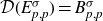 $\mathcal{D}(E_{p,p}^{\sigma })=B_{p,p}^{\sigma }$
and for all
 $u\in B_{p,p}^{\sigma }$
,
 \begin{equation}E_{p,p}^{\sigma }(u)\asymp \lbrack u]_{B_{p,p}^{\sigma }}^{p}. \end{equation}
We prove Lemma 3·1 by pure elementary analysis (without probability arguments) under slightly milder assumptions, and split the proof into Propositions 3·2-3·6. Part of Lemma 3·1 was also studied by K. Pietruska-Pałuba in [ Reference Pietruska-Pałuba45 , theorems 3·1 and 3·2] using probability arguments, and by Alonso Ruiz, Baudoin et al. in [ Reference Alonso-Ruiz, Baudoin, Chen, Rogers, Shanmugalingam and Teplyaev2 , proposition 4·2] under Gaussian heat kernel estimate. Recently, Cao and Qiu in [ Reference Cao and Qiu15 ] proved the equivalence of the Korevaar-Schoen norm and another type of Besov norm.
Proposition 3·2. If
 $(M,d,\mu )$
admits a heat kernel
 $\{p_{t}\}_{t\gt0}$
satisfying (LHE), then there exists a positive constant C such that for all
 $u\in \mathcal{D}(E_{p,p}^{\sigma })$
,
 \begin{equation}\lbrack u]_{B_{p,p}^{\sigma }}^{p}\leq CE_{p,p}^{\sigma }(u). \end{equation}
Proof. By (LHE), we have
 \begin{align}& \frac{1}{t^{{p\sigma }/{\beta ^{\ast }}}}\int_{M}\int_{B(x, t^{{1}/{\beta^{\ast }}})}|u(x)-u(y)|^{p}p_{t}(x,y)d\mu (y)d\mu (x) \nonumber \\&\quad \geq \frac{c_{1}}{t^{p\sigma /\beta ^{\ast }}}\int_{M}\frac{1}{V(x,t^{1/\beta ^{\ast }})}\int_{B(x, t^{{1}/{\beta ^{\ast }}})}|u(x)-u(y)|^{p} \exp \left(-c_2\left(\frac{d(x,y)}{t^{1/\beta^*}}\right)^{\frac{\beta^*}{\beta^*-1}}\right)d\mu (y)d\mu (x) \nonumber \\&\quad \geq c_{1}e^{-c_2} \Phi_u^{\sigma}( t^{1/\beta^*}) . \end{align}
Therefore,
 \begin{align*}E_{p,p}^{\sigma }(u)&=\int_{0}^{R_{0}^{\beta ^{\ast }}}\frac{1}{t^{{p\sigma }/{\beta ^{\ast }}}}\left( \int_{M}\int_{M}|u(x)-u(y)|^{p}p_{t}(x,y)d\mu(x)d\mu (y)\right) \frac{dt}{t} \\& \geq \beta ^{\ast }c_{1}e^{-c_2}\int_{0}^{R_{0}} \Phi_u^{\sigma}(r)\frac{dr}{r} =\beta ^{\ast}c_{1}e^{-c_2}\lbrack u]_{B_{p,p}^{\sigma }}^{p},\end{align*}
which completes the proof.
Proposition 3·3. If
 $(M,d,\mu )$
admits a heat kernel
 $\{p_{t}\}_{t\gt0}$
satisfying (UHE), then there exists a positive constant C such that for all
 $u\in B_{p,p}^{\sigma }$
,
 \begin{equation*}E_{p,p}^{\sigma }(u)\leq C[u]_{B_{p,p}^{\sigma }}^{p}.\end{equation*}
Proof. We decompose
 $B(x,t^{1/\beta ^{\ast }})^{c}$
as the union of annuli
 $B(x,2^{n}t^{1/\beta ^{\ast }})\setminus B(x,2^{n-1}t^{1/\beta ^{\ast }})$
for
 $x\in M$
, where the integers
 $1\leq n\leq \log _{2}(R_{0}t^{-1/\beta^{\ast }})$
, then by (1·6),
 \begin{align}& \frac{1}{t^{{p\sigma }/{\beta ^{\ast }}}}\int_{M}\int_{B(x,t^{1/\beta^{\ast }})^{c}}|u(x)-u(y)|^{p}p_{t}(x,y)d\mu (y)d\mu (x) \nonumber \\[2pt] & =\frac{1}{t^{{p\sigma }/{\beta ^{\ast }}}}\int_{M}\sum_{n=1}^{[\log_{2}(R_{0}t^{-1/\beta ^{\ast }})]}\int_{B(x,2^{n}t^{1/\beta ^{\ast}})\setminus B(x,2^{n-1}t^{1/\beta ^{\ast }})}|u(x)-u(y)|^{p}p_{t}(x,y)d\mu(y)d\mu (x) \nonumber \\[2pt] & \leq \frac{1}{t^{{p\sigma }/{\beta ^{\ast }}}}\int_{M}\frac{c_{3}}{V(x,t^{1/\beta ^{\ast }})}\sum_{n=1}^{[\log _{2}(R_{0}t^{-1/\beta ^{\ast}})]}\int_{B(x,2^{n}t^{1/\beta ^{\ast }})\setminus B(x,2^{n-1}t^{1/\beta^{\ast }})}|u(x)-u(y)|^{p}\nonumber \\[2pt] &\times \exp \left( -c_{4}2^{\frac{(n-1)\beta ^{\ast }}{\beta ^{\ast }-1}}\right) d\mu (y)d\mu (x) \nonumber \\[2pt] & \leq \sum_{n=1}^{[\log _{2}(R_{0}t^{-1/\beta ^{\ast }})]}\frac{1}{t^{{p\sigma }/{\beta ^{\ast }}}}\int_{M}\frac{c_{3}}{V(x,t^{1/\beta ^{\ast }})}\int_{B(x,2^{n}t^{1/\beta ^{\ast }})}|u(x)-u(y)|^{p}\nonumber \\[2pt] &\times \exp \left( -c_{4}2^{\frac{(n-1)\beta ^{\ast }}{\beta ^{\ast }-1}}\right) d\mu (y)d\mu (x) \nonumber\\[2pt] & \leq \sum_{n=1}^{[\log _{2}(R_{0}t^{-1/\beta ^{\ast }})]}\exp \left(-c_{4}2^{\frac{(n-1)\beta ^{\ast }}{\beta ^{\ast }-1}}\right) \frac{2^{np\sigma }}{(2^{n}t^{1/\beta ^{\ast }})^{p\sigma }}\int_{M}\frac{c_{3}C_{d}2^{n\alpha _{1}}}{V(x,2^{n}t^{1/\beta ^{\ast }})} \end{align}
 \begin{align*}&\times \int_{B(x,2^{n}t^{1/\beta ^{\ast }})}|u(x)-u(y)|^{p}d\mu (y)d\mu (x) \nonumber\\& =c_{3}C_{d}\sum_{n=1}^{\infty }1_{\{n\leq \log _{2}(R_{0}t^{-1/\beta^{\ast }})\}}\exp \left( -c_{4}2^{\frac{(n-1)\beta ^{\ast }}{\beta ^{\ast }-1}}\right) 2^{(p\sigma +\alpha _{1})n}\Phi _{u}^{\sigma }(2^{n}t^{1/\beta^{\ast }}), \end{align*}
where we use the volume doubling property (1·3) in the last inequality above
 \begin{equation}\frac{V(x,2^{n}t^{1/\beta ^{\ast }})}{V(x,t^{1/\beta ^{\ast }})}\leq C_{d}2^{n\alpha _{1}}. \end{equation}
Using (1·6) again, we have
 \begin{eqnarray}&&\frac{1}{t^{{p\sigma }/{\beta ^{\ast }}}}\int_{M}\int_{B(x,t^{1/\beta^{\ast }})}|u(x)-u(y)|^{p}p_{t}(x,y)d\mu (y)d\mu (x) \nonumber \\&\leq &\frac{1}{t^{{p\sigma }/{\beta ^{\ast }}}}\int_{M}\int_{B(x,t^{1/\beta^{\ast }})}|u(x)-u(y)|^{p}\frac{c_{3}}{V(x,t^{1/\beta ^{\ast }})}\exp \left(-c_{4}\left( \frac{d(x,y)}{t^{1/\beta ^{\ast }}}\right) ^{\frac{\beta ^{\ast}}{\beta ^{\ast }-1}}\right) d\mu (y)d\mu (x) \nonumber \\&\leq &c_{3}\Phi _{u}^{\sigma }(t^{1/\beta ^{\ast }}). \end{eqnarray}
Therefore, by (3·5) and (3·7),
 \begin{align}\Psi _{u}^{\sigma }(t) &\leq c_{3}C_{d}\sum_{n=1}^{\infty }1_{\{n\leq \log_{2}(R_{0}t^{-1/\beta ^{\ast }})\}}\exp \left( -c_{4}2^{\frac{(n-1)\beta^{\ast }}{\beta ^{\ast }-1}}\right) 2^{(p\sigma +\alpha _{1})n}\Phi_{u}^{\sigma }(2^{n}t^{1/\beta ^{\ast }})+c_{3}\Phi _{u}^{\sigma}(t^{1/\beta ^{\ast }}) \nonumber \\&\leq c_{3}C_{d}\sum_{n=0}^{\infty }1_{\{n\leq \log _{2}(R_{0}t^{-1/\beta^{\ast }})\}}\exp \left( -c_{4}2^{\frac{(n-1)\beta ^{\ast }}{\beta ^{\ast }-1}}\right) 2^{(p\sigma +\alpha _{1})n}\Phi _{u}^{\sigma }(2^{n}t^{1/\beta^{\ast }}), \end{align}
it follows that
 \begin{align*}& E_{p,p}^{\sigma }(u)=\int_{0}^{R_{0}^{\beta ^{\ast }}}\Psi _{u}^{\sigma}(t)\frac{dt}{t}\leq c_{3}C_{d}\sum_{n=0}^{\infty }\exp \left( -c_{4}2^{\frac{(n-1)\beta ^{\ast }}{\beta ^{\ast }-1}}\right) \int_{0}^{2^{-n\beta^{\ast }}R_{0}^{\beta ^{\ast }}}2^{(p\sigma +\alpha _{1})n}\Phi _{u}^{\sigma}(2^{n}t^{1/\beta ^{\ast }})\frac{dt}{t} \\& \quad =c_{3}\beta ^{\ast }C_{d}\sum_{n=0}^{\infty }\exp \left( -c_{4}2^{\frac{(n-1)\beta ^{\ast }}{\beta ^{\ast }-1}}\right) 2^{(p\sigma +\alpha_{1})n}\int_{0}^{R_{0}}\Phi _{u}^{\sigma }(r)\frac{dr}{r}=c_{3}\beta ^{\ast}C_{d}C_{0}[u]_{B_{p,p}^{\sigma }}^{p},\end{align*}
where
 \begin{equation}C_{0}=\sum_{n=0}^{\infty }\exp \left( -c_{4}2^{\frac{(n-1)\beta ^{\ast }}{\beta ^{\ast }-1}}\right) 2^{(p\sigma +\alpha _{1})n}\lt\infty. \end{equation}
The proof is complete.
The following two propositions deal with the ‘local’ semi-norms.
Proposition 3·4. If
 $(M,d,\mu )$
admits a heat kernel
 $\{p_{t}\}_{t\gt0}$
satisfying (LHE), then there exists a positive constant C such that for all
 $u\in \mathcal{D}(E_{p,\infty }^{\sigma })$
,
 \begin{equation*}\lbrack u]_{B_{p,\infty }^{\sigma }}^{p}\leq CE_{p,\infty }^{\sigma }(u).\end{equation*}
Proof. By (3·4), we have
 \begin{align*}& E_{p,\infty }^{\sigma }(u)=\sup_{t\in (0,R_{0}^{\beta ^{\ast }})}\frac{1}{t^{{p\sigma }/{\beta ^{\ast }}}} \int_{M}\int_{M}|u(x)-u(y)|^{p}p_{t}(x,y)d\mu (x)d\mu (y) \\[5pt] &\quad \geq c_{1}e^{-c_2}\sup_{t\in (0,R_{0}^{\beta ^{\ast }})}\Phi_u^{\sigma}(t^{1/\beta^*}) =c_{1}e^{c_2}\sup_{r\in (0,R_{0})}\Phi_u^{\sigma}(r)=c_{1}e^{c_2}[u]_{B_{p,\infty }^{\sigma }}^{p},\end{align*}
which ends the proof.
Proposition 3·5. If
 $(M,d,\mu )$
admits a heat kernel
 $\{p_{t}\}_{t\gt0}$
satisfying (UHE), then there exists a positive constant C such that for all
 $u\in B_{p,\infty }^{\sigma }$
,
 \begin{equation*}E_{p,\infty }^{\sigma }(u)\leq C[u]_{B_{p,\infty }^{\sigma }}^{p}.\end{equation*}
Proof. By (3·8) and (3·6), we have
 \begin{align}& \Psi _{u}^{\sigma }(t)\leq c_{3}C_{d}\sum_{n=0}^{\infty }1_{\{n\leq \log_{2}(R_{0}t^{-1/\beta ^{\ast }})\}}\exp \left( -c_{4}2^{\frac{(n-1)\beta^{\ast }}{\beta ^{\ast }-1}}\right) 2^{(p\sigma +\alpha _{1})n}\Phi_{u}^{\sigma }(2^{n}t^{1/\beta ^{\ast }}) \nonumber \\[5pt] &\quad = c_{3}C_{d}\sum_{n=0}^{\infty }\exp \left( -c_{4}2^{\frac{(n-1)\beta^{\ast }}{\beta ^{\ast }-1}}\right) 2^{(p\sigma +\alpha_{1})n}[u]_{B_{p,\infty }^{\sigma }}^{p}=c_{3}C_{d}C_{0}[u]_{B_{p,\infty}^{\sigma }}^{p}, \end{align}
where
 $C_{0}$
is finite by (3·9). The proof is complete by taking the supremum in
 $(0,R_{0}^{\beta ^{\ast }})$
on both sides of (3·10).
The following proposition concerns the Korevaar-Schoen semi-norm.
Proposition 3·6. If
 $(M,d,\mu )$
admits a heat kernel
 $\{p_{t}\}_{t\gt0}$
satisfying (UHE) and (LHE), then for all
 $u\in B_{p,\infty }^{\sigma }$
,
 \begin{equation}\limsup_{t\rightarrow 0}\Psi _{u}^{\sigma }(t)\asymp \limsup_{r\rightarrow0}\Phi _{u}^{\sigma }(r). \end{equation}
Proof. By Proposition 3·4, we have
 \begin{equation}\sup_{r\in (0,R_{0})}\Phi _{u}^{\sigma }(r)\leq C\sup_{t\in (0,R_{0}^{\beta^{\ast }})}\Psi _{u}^{\sigma }(t), \end{equation}
for any
 $R_{0}\in (0,$
diam(M)]. Therefore, if we choose
 $R_{0}=\epsilon $
in (3·12), then
 \begin{align*}\limsup_{t\rightarrow 0}\Psi _{u}^{\sigma }(t)& =\lim_{\epsilon \rightarrow0}\sup_{t\in (0,\epsilon )}\Psi _{u}^{\sigma }(t) \\[5pt] & \geq C_{1}\lim_{\epsilon \rightarrow 0}\sup_{r\in (0,\epsilon ^{1/\beta^{\ast }})}\Phi _{u}^{\sigma }(r)=C_{1}\limsup_{r\rightarrow 0}\Phi_{u}^{\sigma }(r).\end{align*}
Next, we consider the left-hand side of (3·11). By (3·8) and the dominated convergence theorem, we have that
 \begin{align*}& \limsup_{t\rightarrow 0}\frac{1}{t^{p\sigma /\beta ^{\ast }}}\int_{M}\int_{M}|u(x)-u(y)|^{p}p_{t}(x,y)d\mu (y)d\mu (x) \\&\quad \leq C_{1}\sum_{n=0 }^{\infty }\exp \left( -c_{4}2^{\frac{(n-1)\beta^{\ast }}{\beta ^{\ast }-1}}\right) \limsup_{t\rightarrow 0}\frac{1_{\{n\leq\log _{2}(R_{0}t^{-1/\beta ^{\ast }})\}}}{(2^{n}t^{1/\beta ^{\ast}})^{p\sigma }}\int_{M}\frac{2^{(p\sigma +\alpha _{1})n}}{V(x,2^{n}t^{1/\beta ^{\ast }})}\\&\qquad \times \int_{B(x,2^{n}t^{1/\beta ^{\ast}})}|u(x)-u(y)|^{p}d\mu (y)d\mu (x) \\&\quad \leq C_{1}\sum_{n=0 }^{\infty }\exp \left( -c_{4}2^{\frac{(n-1)\beta^{\ast }}{\beta ^{\ast }-1}}\right) 2^{(p\sigma +\alpha_{1})n}\limsup_{r\rightarrow 0}\Phi _{u}^{\sigma }(r)\leq C_{1}C_{0}\limsup_{r\rightarrow 0}\Phi _{u}^{\sigma }(r),\end{align*}
where
 $C_{1}=c_{3}C_{d}$
and the constant
 $C_{0}$
is defined in (3·9). The proof is complete.
Proof of Lemma
3·1. By Propositions 3·2 and 3·3, we obtain
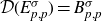 $\mathcal{D}(E_{p,p}^{\sigma })=B_{p,p}^{\sigma }$
and (3·2). By Propositions 3·4 and 3·5, we obtain
 $\mathcal{D}(E_{p,\infty }^{\sigma })=B_{p,\infty }^{\sigma }$
and
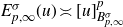 $E_{p,\infty }^{\sigma }(u)\asymp \lbrack u]_{B_{p,\infty }^{\sigma }}^{p}$
. By Proposition 3·6, we finally obtain (3·1). The proof is complete.
3·2. Equivalence between
$(KE)_{\sigma}$
and
$(NE)_{\sigma}$


We start with an easy side
 $(NE)_{\sigma}\Rightarrow (KE)_{\sigma}$
.
Proposition 3·7. Suppose that
 $(M,d,\mu )$
admits a heat kernel
 $\{p_{t}\}_{t\gt0} $
satisfying (LHE). Then there exists
 $C\gt0$
such that for all
 $u\in \mathcal{D}(E_{p,\infty }^{\sigma })$
,
 \begin{equation*}\Psi _{u}^{\sigma }(t)\geq C\Phi _{u}^{\sigma }(t^{1/\beta ^{\ast }}).\end{equation*}
Consequently,
 \begin{equation}\liminf_{t\rightarrow 0}\Psi _{u}^{\sigma }(t)\geq C\liminf_{r\rightarrow0}\Phi _{u}^{\sigma }(r), \end{equation}
where the constant C depends only on
 $c_{1}$
in (LHE).
Proof. By (3·4), we have
 \begin{align*}\Psi _{u}^{\sigma }(t)& \geq \frac{1}{t^{p\sigma /\beta ^{\ast }}}\int_{M}\int_{B(x,\delta t^{1/\beta ^{\ast }})}|u(x)-u(y)|^{p}p_{t}(x,y)d\mu(y)d\mu (x) \\[5pt] & \geq \frac{c_{1}C_{d}^{-1}\delta ^{\alpha _{1}}}{t^{p\sigma /\beta ^{\ast}}}\int_{M}\frac{1}{V(x,\delta t^{1/\beta ^{\ast }})}\int_{B(x,\delta t^{{1}/{\beta ^{\ast }}})}|u(x)-u(y)|^{p}d\mu (y)d\mu (x) \\[5pt] & =c_{1}C_{d}^{-1}\delta ^{p\sigma +\alpha _{1}}\Phi _{u}(\delta t^{1/\beta^{\ast }}).\end{align*}
Taking the lower limit on both sides of the above inequality, we have
 \begin{equation*}\liminf_{t\rightarrow 0}\Psi _{u}^{\sigma }(t)\geq c_{1}C_{d}^{-1}\delta^{p\sigma +\alpha _{1}}\liminf_{t\rightarrow 0}\Phi _{u}^{\sigma}(t^{1/\beta ^{\ast }})=c_{1}C_{d}^{-1}\delta ^{p\sigma +\alpha_{1}}\liminf_{r\rightarrow 0}\Phi _{u}^{\sigma }(r),\end{equation*}
which implies (3·13).
We give a proof for the following claim which appeared in [ Reference Alonso-Ruiz, Baudoin, Chen, Rogers, Shanmugalingam and Teplyaev3 , The proof of Lemma 4·13].
Proposition 3·8. Suppose that
 $(M,d,\mu )$
admits a heat kernel
 $\{p_{t}\}_{t\gt0} $
satisfying (UHE) and (LHE). Then there exist
 $C,c\gt1$
and
 $c^{\prime }\gt0 $
such that for any
 $\delta \gt0$
and for
 $\mu$
-almost all
 $x,y\in M$
with
 $d(x,y)\gt\delta t^{1/\beta ^{\ast }}$
,
 \begin{equation*}p_{t}(x,y)\leq C\exp \left( -c^{\prime }\delta ^{\frac{\beta ^{\ast }}{\beta^{\ast }-1}}\right) p_{ct}(x,y).\end{equation*}
Proof. By (UHE) and the volume doubling property (1·3), we have
 \begin{align*}p_{t}(x,y)& \leq \frac{c_{3}}{V(x,t^{1/\beta ^{\ast }})}\exp \left(-c_{4}\left( \frac{d(x,y)}{t^{1/\beta ^{\ast }}}\right) ^{\frac{\beta ^{\ast}}{\beta ^{\ast }-1}}\right) \\& \leq \frac{c_{3}C_{d}c^{\alpha _{1}/\beta ^{\ast }}}{V(x,(ct)^{1/\beta^{\ast }})}\exp \left( -c_{4}\left( \frac{d(x,y)}{(ct)^{1/\beta ^{\ast }}}\right) ^{\frac{\beta ^{\ast }}{\beta ^{\ast }-1}}\cdot c^{\frac{1}{\beta^{\ast }-1}}\right) \\& =\frac{c_{3}C_{d}c^{\alpha _{1}/\beta ^{\ast }}}{c_{1}}\frac{c_{1}}{V(x,(ct)^{1/\beta ^{\ast }})}\exp \left( -c_{4}\left( \frac{d(x,y)}{(ct)^{1/\beta ^{\ast }}}\right) ^{\frac{\beta ^{\ast }}{\beta ^{\ast }-1}}\cdot c^{\frac{1}{\beta ^{\ast }-1}}\right) ,\end{align*}
for
 $\mu $
-almost all
 $x,y\in M$
. Taking
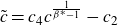 $\tilde{c}=c_{4}c^{\frac{1}{\beta^{\ast }-1}}-c_{2}$
, we use (LHE) to obtain
 \begin{equation*}p_{t}(x,y)\leq \frac{c_{3}C_{d}c^{\alpha _{1}/\beta ^{\ast }}}{c_{1}}\exp\left( -\tilde{c}\left( \frac{d(x,y)}{(ct)^{1/\beta ^{\ast }}}\right) ^{\frac{\beta ^{\ast }}{\beta ^{\ast }-1}}\right) p_{ct}(x,y).\end{equation*}
We choose
 $c\gt1$
to ensure
 $c^{\frac{1}{\beta ^{\ast }-1}}c_{4}\gt c_{2}$
so that
 $\tilde{c}\gt0$
. Let
 $c^{\prime }={\tilde{c}}/{c^{\frac{1}{\beta ^{\ast}-1}}}$
, then for
 $d(x,y)\gt\delta t^{1/\beta ^{\ast }}$
,
 \begin{equation*}p_{t}(x,y)\leq \frac{c_{3}C_{d}c^{\alpha _{1}/\beta ^{\ast }}}{c_{1}}\exp\left( -c^{\prime }\left( \frac{d(x,y)}{t^{1/\beta ^{\ast }}}\right) ^{\frac{\beta ^{\ast }}{\beta ^{\ast }-1}}\right) p_{ct}(x,y)\leq C\exp \left(-c^{\prime }\delta ^{\frac{\beta ^{\ast }}{\beta ^{\ast }-1}}\right)p_{ct}(x,y),\end{equation*}
where
 $C={c_{3}C_{d}c^{\alpha _{1}/\beta ^{\ast }}}/{c_{1}}$
. The proof is complete.
The proof of the implication
 $(KE)_{\sigma}\Rightarrow (NE)_{\sigma}$
is inspired by [
Reference Alonso-Ruiz, Baudoin, Chen, Rogers, Shanmugalingam and Teplyaev3
, lemma 4·13] where
 $p=1$
there.
Lemma 3·9. Suppose that
 $(M,d,\mu )$
admits a heat kernel
 $\{p_{t}\}_{t\gt0} $
satisfying (UHE) and (LHE). Assuming the property
 $(\widetilde{KE})_{\sigma} $
with
 $\sigma \gt0$
, we have
 \begin{equation}\liminf_{t\rightarrow 0}\Psi _{u}^{\sigma }(t)\leq C\liminf_{r\rightarrow0}\Phi _{u}^{\sigma }(r), \end{equation}
for all
 $u\in \mathcal{D}(E_{p,\infty }^{\sigma })$
.
Proof. Temporally fix
 $u\in \mathcal{D}(E_{p,\infty }^{\sigma })$
. Without loss of generality, assume that
 $\liminf_{t\rightarrow 0}\Psi _{u}^{\sigma }(t)\gt0$
. Fix
 $\delta \gt1$
which will be determined later in (3·17). For
 $t\in (0,R_{0}^{\beta^{\ast }})$
, decompose
 \begin{equation*}\Psi _{u}^{\sigma }(t)=\Psi _{1}(t)+\Psi _{2}(t),\end{equation*}
where
 \begin{align*}\Psi _{1}(t)& =\frac{1}{t^{{p\sigma }/{\beta ^{\ast }}}}\iint_{\{d(x,y)\leq\delta t^{1/\beta ^{\ast }}\}}|u(x)-u(y)|^{p}p_{t}(x,y)d\mu (y)d\mu (x), \\\Psi _{2}(t)& =\frac{1}{t^{{p\sigma }/{\beta ^{\ast }}}}\iint_{\{d(x,y)\gt\delta t^{1/\beta ^{\ast }}\}}|u(x)-u(y)|^{p}p_{t}(x,y)d\mu (y)d\mu (x).\end{align*}
For
 $\Psi _{1}(t)$
, when
 $d(x,y)\leq \delta t^{1/\beta ^{\ast }}$
, we have
 \begin{align*}\frac{c_{1}}{V(x,t^{1/\beta ^{\ast }})}\exp \left( -c_{2}\delta ^{\frac{\beta ^{\ast }}{\beta ^{\ast }-1}}\right) &\leq \frac{c_{1}}{V(x,t^{1/\beta^{\ast }})}\exp \left( -c_{2}\left( \frac{d(x,y)}{t^{1/\beta ^{\ast }}}\right) ^{\frac{\beta ^{\ast }}{\beta ^{\ast }-1}}\right) \\& \leq p_{t}(x,y)\leq \frac{c_{3}}{V(x,t^{1/\beta ^{\ast }})}\exp \left(-c_{4}\left( \frac{d(x,y)}{t^{1/\beta ^{\ast }}}\right) ^{\frac{\beta ^{\ast}}{\beta ^{\ast }-1}}\right)\\ & \leq \frac{c_{5}}{V(x,t^{1/\beta ^{\ast }})}.\end{align*}
Therefore, noting that
 $\delta\gt1$
, we have from (1·3) that
 \begin{align}\Psi _{1}(t)& \leq \frac{c_{3}}{t^{p\sigma /\beta ^{\ast }}}\iint_{\{d(x,y)\leq \delta t^{1/\beta ^{\ast }}\}}\frac{|u(x)-u(y)|^{p}}{V(x,t^{1/\beta ^{\ast }})}d\mu (y)d\mu (x) \nonumber \\& \leq \frac{c_{3}C_{d}\delta ^{\alpha _{1}}}{t^{p\sigma /\beta ^{\ast }}}\iint_{\{d(x,y)\leq \delta t^{1/\beta ^{\ast }}\}}\frac{|u(x)-u(y)|^{p}}{V(x,\delta t^{1/\beta ^{\ast }})}d\mu (y)d\mu (x)=C_{1}\Phi _{u}^{\sigma}(\delta t^{1/\beta ^{\ast }}), \end{align}
where
 $C_{1}=c_{3}C_{d}\delta ^{p\sigma +\alpha _{1}}$
.
For
 $\Psi _{2}(t)$
, by Proposition 3·8, we have that
 \begin{equation}\Psi _{2}(t)\leq A\Psi _{u}^{\sigma }(ct), \end{equation}
where
 $A=Cc^{p\sigma /\beta ^{\ast }}\exp (\!-c^{\prime }\delta ^{\frac{\beta ^{\ast }}{\beta ^{\ast }-1}}) $
can be sufficiently small by choosing sufficiently large
 $\delta $
(since
 $C,c,c^{\prime }$
are independent constants). So, from now on, we choose sufficiently large
 $\delta $
such that
 \begin{equation}A=Cc^{p\sigma /\beta ^{\ast }}\exp \left( -c^{\prime }\delta ^{\frac{\beta^{\ast }}{\beta ^{\ast }-1}}\right) \lt\frac{1}{2}. \end{equation}
Combining (3·15) and (3·16), we have
 \begin{equation}\Psi _{u}^{\sigma }(t)\leq C_{1}\Phi _{u}^{\sigma }(\delta t^{1/\beta ^{\ast}})+A\Psi _{u}^{\sigma }(ct). \end{equation}
By property
 $(\widetilde{KE})_{\sigma}$
, there exists
 $t_{0}\gt0$
such that for all
 $t\in (0,t_{0})$
,
 \begin{equation*}\Psi _{u}^{\sigma }(t)\leq \sup_{0\lt t\lt t_{0}}\Psi _{u}^{\sigma }(t)\leq2\limsup_{t\rightarrow 0}\Psi _{u}^{\sigma }(t)\leq C_{2}\liminf_{t\rightarrow 0}\Psi _{u}^{\sigma }(t),\end{equation*}
where
 $C_{2}$
comes from property
 $(\widetilde{KE})_{\sigma}$
. Therefore, we have from (3·18) that, for all
 $t\in (0,\frac{t_{0}}{c})$
,
 \begin{equation*}\Psi _{u}^{\sigma }(t)\leq C_{1}\Phi _{u}^{\sigma }(\delta t^{1/\beta ^{\ast}})+AC_{2}\liminf_{t\rightarrow 0}\Psi _{u}^{\sigma }(t).\end{equation*}
Fix
 $\delta\gt0 $
such that
 $AC_{2}\lt 1$
with the aforementioned requirement
 $A\lt{1}/{2}$
. It follows that
 \begin{equation*}\liminf_{t\rightarrow 0}\Psi _{u}^{\sigma }(t)\leq C_{1}\liminf_{t\rightarrow 0}\Phi _{u}^{\sigma}(t)+AC_{2}\liminf_{t\rightarrow 0}\Psi _{u}^{\sigma }(t),\end{equation*}
which implies
 \begin{equation*}\liminf_{t\rightarrow 0}\Psi _{u}^{\sigma }(t)\leq C_{3}\liminf_{t\rightarrow 0}\Phi _{u}^{\sigma }(t),\end{equation*}
where
 $C_{3}=\frac{C_{1}}{1-AC_{2}}$
. The proof is complete.
Proof of Theorem
1·5. Since the two-sided estimates (UHE) and (LHE) hold, we have that
 $\mathcal{D}(E_{p,\infty }^{\sigma })=B_{p,\infty }^{\sigma }$
for any
 $\sigma \gt0$
by Lemma 3·1.
By (3·11) and (3·14),
 $(\widetilde{KE})_{\sigma}$
implies
 $(\widetilde{NE})_{\sigma}$
since for all
 $u\in B_{p,\infty }^{\sigma }=\mathcal{D}(E_{p,\infty }^{\sigma })$
,
 \begin{equation}\limsup_{r\rightarrow 0}\Phi _{u}^{\sigma }(r)\leq C\limsup_{t\rightarrow0}\Psi _{u}^{\sigma }(t)\leq C^{\prime }\liminf_{t\rightarrow 0}\Psi_{u}^{\sigma }(t)\leq C^{\prime \prime }\liminf_{r\rightarrow 0}\Phi_{u}^{\sigma }(r). \end{equation}
By (3·11) and (3·13),
 $(\widetilde{NE})_{\sigma}$
implies
 $(\widetilde{KE})_{\sigma}$
since
 \begin{equation}\limsup_{t\rightarrow 0}\Psi _{u}^{\sigma }(t)\leq C_{1}\limsup_{r\rightarrow 0}\Phi _{u}^{\sigma }(r)\leq C_{1}^{\prime}\liminf_{r\rightarrow 0}\Phi _{u}^{\sigma }(r)\leq C_{1}^{\prime \prime}\liminf_{t\rightarrow 0}\Psi _{u}^{\sigma }(t). \end{equation}
Therefore, by (3·19) and (3·20), we show Theorem 1·5 (i).
By (3·14) and Proposition 3·4,
 $(KE)_{\sigma}$
implies
 $(NE)_{\sigma}$
since
 \begin{equation}\sup_{r\in (0,R_{0})}\Phi _{u}^{\sigma }(r)\leq C_{2}\sup_{t\in(0,R_{0}^{\beta ^{\ast }})}\Psi _{u}^{\sigma }(t)\leq C_{2}^{\prime}\liminf_{t\rightarrow 0}\Psi _{u}^{\sigma }(t)\leq C_{2}^{\prime \prime}\liminf_{r\rightarrow 0}\Phi _{u}^{\sigma }(r), \end{equation}
where we use the simple fact
 $(KE)_{\sigma}$
 $\Rightarrow (\widetilde{KE})_{\sigma}$
. Similarly, by (3·13) and Proposition 3·5 adjoint with the fact
 $(NE)_{\sigma}$
 $\Rightarrow (\widetilde{NE})_{\sigma}$
, we immediately derive
 $(KE)_{\sigma}$
since
 \begin{equation}\sup_{t\in (0,R_{0}^{\beta ^{\ast }})}\Psi _{u}^{\sigma }(t)\leq C_{3}\sup_{r\in (0,R_{0})}\Phi _{u}^{\sigma }(r)\leq C_{3}^{\prime}\liminf_{r\rightarrow 0}\Phi _{u}^{\sigma }(r)\leq C_{3}^{\prime \prime}\liminf_{t\rightarrow 0}\Psi _{u}^{\sigma }(t). \end{equation}
Remark 3·10. We say that a heat kernel
 $\{p_{t}\}_{t\gt0}$
satisfies the near diagonal lower estimate (NLE), if there exists
 $\delta \in (0,\infty)$
such that, for all
 $t\in (0,R_{0}^{\beta^{\ast}}) $
and
 $\mu $
-almost all
 $x,y\in M$
:
 \begin{equation}p_{t}(x,y)\geq \frac{c_{1}}{V(x,t^{1/\beta ^{\ast }})}\ \ \ \text{whenever }\ d(x,y)\leq \delta t^{1/\beta ^{\ast }}. \end{equation}
We conjecture that Lemma 3·1 and Lemma 3·9 cannot be derived from the weaker heat kernel estimates (UHE) and (NLE) without further assumptions (like the chain condition).
By Theorem 1·5 and Remark 1·2, we have the following interesting corollary for
 $p=2$
, which is important for the construction of local Dirichlet forms based on Besov norms.
Corollary 3·11. Suppose that
 $(M,d,\mu )$
admits a heat kernel
 $\{p_{t}\}_{t\gt0}$
satisfying (UHE) and (LHE), then
 $(NE)_{\beta^{\ast }/2}$
holds when
 $p=2$
.
4. Connected homogeneous p.c.f self-similar sets and their glue-ups
In this section, we analyse bounded and unbounded ‘fractal glue-ups’ by using connected homogeneous p.c.f self-similar sets as ‘tiles’. We first obtain equivalent discrete semi-norms (vertex energies) in Subsection 4·1. Then in Subsection 4·2, we introduce weak-monotonicity properties for vertex energies, including property (E) in [
Reference Gao, Yu and Zhang23
, definition 3·1], properties
 $(VE)_{\sigma}$
and
 $(\widetilde{VE})_{\sigma}$
. We will verify property (E) on nested fractals. In Subsection 4·3, we show the equivalence between
 $(KE)_{\sigma}$
and
 $(VE)_{\sigma}$
. Lastly, we show that aforementioned consequences hold for certain ‘fractal glue-ups’, for example, nested fractals and their fractal blow-ups in Subsection 4·4.
4·1. Equivalent discrete semi-norms of fractal glue-ups
We first introduce connected homogeneous p.c.f. self-similar sets in
 $\mathbb{R}^{d}$
(
 $d\geq 2$
). Let
 $\{\phi _{i}\}_{i=1}^{N}$
 $(N\geq 2)$
be an IFS where each
 $\phi _{i}\;:\;\mathbb{R}^{d}\rightarrow \mathbb{R}^{d}$
is of the form
 \begin{equation}\phi _{i}(x)=\rho (x-b_{i})+b_{i}, \end{equation}
with
 $\rho \in (0,1)$
,
 $b_{i}\in \mathbb{R}^{d}$
for
 $i=1,...,N$
. Let K be the attractor of the iterated function system (IFS)
 $\{\phi _{i}\}_{i=1}^{N}$
, namely, K is the unique non-empty compact set in
 $\mathbb{R}^{d}$
satisfying
 \begin{equation*}K=\bigcup_{i=1}^{N}\phi _{i}(K).\end{equation*}
To explain what ‘p.c.f’ is, we introduce the natural symbolic space associated with the IFS
 $\{\phi _{i}\}_{i=1}^{N}$
. Let
 $W=\{1,2,...,N\}$
,
 $W_{n}$
be the set of words with length n over W, and
 $W^{\mathbb{N}}$
be the set of all infinite words over W. For
 $w=\mathrm{w_{1}w_{2}}\cdots\in W^{\mathbb{N}}$
, the canonical projection
 $\pi :$
 $W^{\mathbb{N}}\rightarrow K$
is defined by
 $\pi (w)\;:\!=\;\bigcap\limits_{n\in \mathbb{N}^{\ast }}F_{\mathrm{w_{1}...w_{n}}}(K),$
where
 $F_{\mathrm{w_{1}...w_{n}}}\;:\!=\;F_{\mathrm{w_{1}}}\circ \cdots\circ F_{\mathrm{w_{n}}}$
. Then the critical set
 $\Gamma $
and the post-critical set
 $\mathcal{P}$
is defined by
 \begin{equation*}\Gamma =\pi ^{-1}\left( \bigcup_{1\leq i\lt j\leq N}\left( \phi _{i}(K)\cap\phi _{j}(K)\right) \right) ,\quad \mathcal{P}=\bigcup_{m\geq 1}\tau^{m}(\Gamma ),\end{equation*}
where
 $\tau $
is the left shift by one index on
 $W^{\mathbb{N}}$
(see for example [
Reference Kigami36
, definition 1·3·13]). We say that the IFS
 $\{\phi _{i}\}_{i=1}^{N}$
is post-critically finite (p.c.f.) if
 $\mathcal{P}$
is finite. Define
 \begin{equation}V_{0}=\pi (\mathcal{P}),\quad V_{w}\;:\!=\;F_{w}\left( V_{0}\right), \quad V_{n}=\bigcup_{w\in W_{n}}V_{w} ,\quad V_{\ast }=\bigcup_{n\geq 1}V_{n}, \end{equation}
then K is the closure of
 $V_{\ast }$
with respect to the Euclidean metric. For
 $w\in W_n$
,
 \begin{equation*}K_{w}\;:\!=\;F_{w}\left( K\right) \end{equation*}
is called an n-cell of K. Without loss of generality, we always assume that
 \begin{equation}\textrm{diam}(K)=1\end{equation}
by an affine transformation on
 $\{b_{i}\}_{i=1}^{N}$
. From now on, denote by K a homogeneous p.c.f. self-similar set that is connected. It is known that a homogeneous p.c.f. IFS in the form of (4·1) satisfies the open set condition (OSC) (see for example [
Reference Deng and Lau19
, theorem 1·1]). Hence the Hausdorff dimension of K is
 \begin{equation*}\alpha =\mathrm{dim}_{H}(K)=-\log N/\log \rho,\end{equation*}
and the
 $\alpha$
-dimensional Hausdorff measure on K, denote by
 $\mu $
, is
 $\alpha $
-regular.
It is known from [
Reference Gu and Lau27
, proposition 2·5] that Condition (H) holds for connected homogeneous p.c.f. self-similar sets. That is, there exists
 $c\gt0$
depending only on K such that, for any two words w and
 $w^{\prime }$
with the same length
 $m\geq 1$
,
 $K_{w}\cap K_{w^{\prime}}=\emptyset $
implies that
 $\mathrm{dist}\left( K_{w},K_{w^{\prime }}\right)\geq c\rho ^{m}$
.
In order to unify the notation for bounded and unbounded fractals, we introduce the concept of fractal glue-ups. The definition is adapted from the idea of fractafold in [
Reference Strichartz and Teplyaev48
] although it is not the same. Given a compact set
 $K\subset \mathbb{R}^d$
and a set F of similitudes on
 $\mathbb{R}^d$
, define
 \begin{equation*}K^F\;:\!=\;\bigcup_{f\in F}f(K)\subset \mathbb{R}^d.\end{equation*}
In this paper, we need the following requirements:
-
(1) isometries: all similitudes in F are isometries;
-
(2) just-touching property: for any
$f\neq g\in F$
,
\begin{equation*}f(K)\bigcap g(K)=f(V_0)\bigcap g(V_0);\end{equation*}
-
(3) condition (H): There exists a constant
$C_{H}\in (0,1)$
such that, if
$|x-y|\lt C_{H}\rho ^{m}$
and
$x\in f_{1}(K_{w})$
and
$y\in f_{2}(K_{\tilde{w}}) $
for two words w and
$\tilde{w}$
with the same length
$m\geq0$
and
$f_1,f_2\in F$
, then
$f_{1}(K_{w})$
intersects
$f_{2}(K_{\tilde{w}})$
; -
(4) connectedness:
$K^{F}$
is connected.


From now on, whenever we mention a fractal glue-up
 $K^{F}$
, we automatically assume that these four conditions are satisfied. We call each
 $f(K)$
a tile (
 $f\in F$
). The above conditions (2) and (3) imply the following uniform finitely-joint property.
Proposition 4·1. For any metric ball B(x,R) of radius
 $R\gt0$
in
 $K^F$
, the number of tiles that intersect it is bounded by a constant
 $C_K(R)\lt\infty$
, which depends only on
 $C_H$
and the IFS. Thus for any tile f(K), the number of tiles
 $\tilde{f}(K)$
that intersect it is bounded by
 $C_K(1)$
.
Proof. Denote all the tiles that intersect B(x,R) by
 $f_{n}(K),\ 1\leq n\leq N_{0} $
(here
 $N_{0}$
might be
 $\infty $
). Denote by t the smallest integer satisfying
 \begin{equation*}N^t\gt|V_0|.\end{equation*}
Choose a level-t cell
 $\phi_{w}(K)$
(
 $|w|=t$
) that does not intersect
 $V_{0}$
. Such a cell exists by the pigeonhole principle. Condition (H) implies that all
 $f_{n}(\phi _{w}(K))$
are separated by distance
 $C_{H}\rho ^{t}$
for
 $1\leq n\leq N_{0}$
, but they all belong to the ball
 $B(x,R+1)$
by (4·3). Let
 $C_K(R)$
be the maximal cardinality of disjoint balls of radii
 $C_{H}\rho ^{t}/2$
inside a ball with diameter
 $R+1$
in
 $\mathbb{R}^d$
. Since there are
 $N_{0}$
disjoint balls
 $B(f_{n}(\phi _{w}(v)),C_{H}\rho ^{t}/2)$
inside
 $B(x,R+1)$
, we obtain
 $N_{0}\leq C_K(R)$
. The second inclusion follows from choosing
 $R=1$
and
 $x\in f(K)$
.
Remark 4·2. The concept of the fractal glue-up unifies the notions of bounded and unbounded fractals. For example,
 $K=K^{F}$
when
 $F=\{Id\}$
. We are mainly interested in the following unbounded fractal by blowing up K in [
Reference Strichartz47
, section 3]. However, fractal glue-ups may lack self-similarity on large scales.
Example 4.3. (Fractal blow-up). Let
 $\{\phi _{i}\}_{i=1}^{N}$
be defined as in (4·1). Define
 \begin{equation*}K_{l}\;:\!=\;\underbrace{\phi _{1}^{-1}\circ \phi _{1}^{-1}\circ \cdots \circ \phi_{1}^{-1}}_{l}K=\rho^{-l}K=\bigcup _{f\in F_{l}}f(K),\end{equation*}
where
 $F_{l}=\left\{x+\sum_{j=1}^{l}\rho ^{-j}c_{j}\;:\; c_{j}\in \{(1-\rho)b_{i}\}_{i=1}^{N}\right\}$
.
Clearly,
 $F_{l}$
and
 $K_{l}$
are increasing sequences, so that
 $K=K_{0}\subseteq K_{1}\subseteq K_{2}\subseteq \cdots $
.
The final fractal blow-up of K given by
 \begin{equation*}K_{\infty }=\bigcup _{l=1}^{\infty }K_{l}= \lim_{l\rightarrow\infty} K_l,\end{equation*}
is in the form
 $K^{F}$
with
 $F=\bigcup_{l=1}^{\infty }F_{l}= \lim_{l\rightarrow\infty} F_l$
.
From now on, we assume that K is a connected homogeneous p.c.f. self-similar set when we say that
 $K^{F}$
is a fractal glue-up. In what follows, we use the superscript F to distinguish the underlying space K and
 $K^{F}$
for the energies and norms etc.
Let
 \begin{equation}\mu ^{F}\;:\!=\;\sum_{f\in F}\mu \circ f^{-1}, \end{equation}
be the glue-up measure on
 $K^{F}$
. Then
 $\mu ^{F}$
is
 $\alpha $
-regular by our assumptions on F. Let
 \begin{equation}\lbrack u]_{B_{p,\infty }^{\sigma ,F}}^{p}\;:\!=\;\sup_{n\geq 0}\Phi _{u}^{\sigma,F}(C_H\rho ^{n}), \end{equation}
where
 $\Phi _{u}^{\sigma ,F}(r)\;:\!=\;r^{-(p\sigma +\alpha)}\int_{K^{F}}\int_{B(x,r)}|u(x)-u(y)|^{p}d\mu ^{F}(y)d\mu ^{F}(x)$
, and
 \begin{equation*}B_{p,\infty }^{\sigma ,F}\;:\!=\;\{u\in L^{p}(K^{F},\mu ^{F})\;:\;[u]_{B_{p,\infty}^{\sigma ,F}}\lt\infty \}.\end{equation*}
It is easy to see that
 \begin{equation}\sup_{n\geq 0}\Phi _{u}^{\sigma ,F}(C_H\rho ^{n})\asymp \sup_{r\in(0,C_H)}\Phi _{u}^{\sigma ,F}(r), \end{equation}
which implies that
 \begin{equation}B_{p,\infty }^{\sigma ,F}=B_{p,\infty }^{\sigma }(K^{F})\text{ and }[u]_{B_{p,\infty }^{\sigma ,F}}\asymp \lbrack u]_{B_{p,\infty }^{\sigma}(K^{F})}(\text{with}\ R_{0}=C_H\ \text{in}\ (1{\cdot}10)). \end{equation}
Also, we have
 \begin{equation}\liminf_{n\rightarrow \infty }\Phi _{u}^{\sigma ,F}(\rho ^{n})\asymp\liminf_{r\rightarrow 0}\Phi _{u}^{\sigma ,F}(r)\text{ and }\limsup_{n\rightarrow \infty }\Phi _{u}^{\sigma ,F}(\rho ^{n})\asymp\limsup_{r\rightarrow 0}\Phi _{u}^{\sigma ,F}(r). \end{equation}
We need the following Morrey-Sobolev inequality to show that
 $B_{p,\infty}^{\sigma }(K^F)$
essentially embeds into
 $C(K^F)$
when
 $\sigma \gt\alpha /p$
.
Lemma 4·4 ([
Reference Baudoin11
, theorem 3·2]). Let
 $(M,d,\mu )$
be a metric measure space with
 $\mu $
satisfying (1·4). When
 $\sigma\gt\alpha /p$
, for any
 $u\in B_{p,\infty }^{\sigma }(M)$
, there exists a continuous version
 $\tilde{u}\in C^{(p\sigma -\alpha )/p}(M)$
satisfying
 $\tilde{u}=u$
 $\mu $
-almost everywhere in M and
 \begin{equation}|\tilde{u}(x)-\tilde{u}(y)|\leq C|x-y|^{(p\sigma -\alpha )/p}\sup_{r\in(0,3d(x,y)]}\Phi _{u}^{\sigma }(r)\leq C|x-y|^{(p\sigma -\alpha)/p}[u]_{B_{p,\infty }^{\sigma }(M)}, \end{equation}
for all x,
 $y\in M$
with
 $d(x,y)\lt R_{0}/3$
, where C is a positive constant. Here
 $C^{\beta }(M)$
denotes the class of Hölder continuous functions of order
 $\beta $
on M.
Next, we estimate
 \begin{equation*}I_{\infty ,n}^{F}(u)\;:\!=\;\int_{K^{F}}\int_{B(x,C_{H}\rho^{n})}|u(x)-u(y)|^{p}d\mu ^{F}(y)d\mu ^{F}(x).\end{equation*}
By (4·5), for all
 $u\in B_{p,\infty }^{\sigma ,F}$
,
 \begin{equation}\rho ^{-n(p\sigma +\alpha )}I_{\infty ,n}^{F}(u)=C_{H}^{p\sigma +\alpha}\Phi _{u}^{\sigma ,F}(C_{H}\rho ^{n}). \end{equation}
Define
 \begin{equation*}\mu _{m}\;:\!=\;\frac{1}{|V_{m}|}\sum_{a\in V_{m}}\delta _{a}\end{equation*}
and
 \begin{equation}\mu _{m}^{F}\;:\!=\;\sum_{f\in F}\mu_m\circ f^{-1}=\sum_{f\in F}\frac{1}{|V_{m}|}\sum_{a\in V_{m}}\delta _{f(a)}, \end{equation}
where
 $\delta _{a}$
is the Dirac measure at point a and
 $|A|$
denotes the cardinality of a finite set A. Let
 \begin{equation}I_{m,n}^{F}(u)\;:\!=\;\int_{K^{F}}\int_{B(x,C_{H}\rho ^{n})}|u(x)-u(y)|^{p}d\mu_{m}^{F}(y)d\mu _{m}^{F}(x). \end{equation}
We will use these discrete sums to estimate the integral
 $I_{\infty ,n}^{F}(u)$
.
Lemma 4·5. Let
 $K^{F}$
be a fractal glue-up. Then for all
 $u\in C(K^F)$
,
 \begin{equation}\liminf_{m\rightarrow \infty }I_{m,n}^{F}(u)\geq I_{\infty ,n}^{F}(u).\end{equation}
The proof of this lemma is based on the proof of [
Reference Gu and Lau27
, lemma 3·2]. The key is to establish the following Proposition 4·6, which is not obvious since K is uncountable. We may assume that K is not contained in any hyperplane
 $H\subset \mathbb{R}^{d}$
. Otherwise, we could reduce the IFS to H by restricting each similitude
 $\phi_{i}$
to H and applying a reversible affine transformation from H to
 $\mathbb{R}^{d^{\prime }}$
, where
 $d^{\prime }$
is the Hausdorff dimension of H. The attractor of this reduced IFS is a scaled copy of K. Thus we can apply [
Reference Gu and Lau27
, lemma 3·2].
Proposition 4·6. Assume that K is not contained in any hyperplane
 $H\subset\mathbb{R}^{d}$
. For any
 $r\gt0$
, let
 $E(r)\;:\!=\;\bigcup_{x\in K}\{x\}\times \partial B(x,r).$
Then
 $\mu \times \mu (E(r))=0$
.
Proof. Let
 \begin{equation*}R_{x}(a,b)=\overline{B(x,a)}\setminus B(x,b).\end{equation*}
Fix
 $x_{w}\in K_{w}$
for each
 $w\in W_n$
. Then
 \begin{equation*}\bigcup_{x\in K_{w}}\partial B(x,r)\subset R_{x_{w}}(r-\rho ^{n},r+\rho^{n}),\end{equation*}
since for any
 $y\in \partial B(x,r)$
,
 $d(x,y)=r$
and
 $d(x,x_{w})\leq \rho^{n}$
, thus
 $d(y,x_{w})\in \lbrack r-\rho ^{n},r+\rho ^{n}].$
Note that
 \begin{equation*}E(r)\;:\!=\;\bigcup_{x\in K}\{x\}\times \partial B(x,r)\subset \bigcup_{w\in W_{n}}K_{w}\times R_{x_{w}}(r-\rho ^{n},r+\rho ^{n}),\end{equation*}
thus
 \begin{align}\mu \times \mu (E(r))& \leq \sum_{w\in W_{n}}\mu (K_{w})\mu(R_{x_{w}}(r-\rho ^{n},r+\rho ^{n}))\nonumber \\&\leq \mu (K)\sup_{w\in W_{n}}\mu (R_{x_{w}}(r-\rho ^{n},r+\rho ^{n}))\nonumber \\&\leq \mu (K)\sup_{x\in K}\mu (R_{x}(r-\rho ^{n},r+\rho ^{n})).\end{align}
We claim that
 \begin{equation*}\sup_{x\in K}\mu (R_{x}(r-\rho ^{n},r+\rho ^{n}))\rightarrow 0\text{ as }n\rightarrow \infty .\end{equation*}
Otherwise, if
 $\mu (R_{x_{n}}(r-\rho ^{n},r+\rho ^{n}))\geq \delta \gt0$
for a subsequence
 $\{x_{n}\}_n\subset K$
, we may choose a subsequence
 $\{x_{n_{i}}\}_i$
that converge to
 $x_{\infty }\in K$
due to the compactness of K, and further require that
 $d(x_{n_{i}},x_{\infty })$
decrease in i. Then
 \begin{equation*}A_{i}\;:\!=\;R_{x_{\infty }}(r-\rho ^{n_{i}}-d(x_{n_{i}},x_{\infty }),r+\rho^{n_{i}}+d(x_{n_{i}},x_{\infty }))\supset R_{x_{n_{i}}}(r-\rho^{n_{i}},r+\rho ^{n_{i}})\end{equation*}
and
 $A_{i}\downarrow \partial B(x_{\infty },r)$
, thus
 \begin{equation*}\mu (\partial B(x_{\infty },r))=\lim_{i\rightarrow \infty }\mu (A_{i})\geq\delta ,\end{equation*}
which contradicts [
Reference Gu and Lau27
, proposition 2·4] that
 $\mu(\partial B(x,r))=0$
for any
 $x\in K$
.
The proof is complete by letting
 $n\rightarrow\infty$
in (4·14).
Proof of Lemma
4·5. Let
 $F=\{f_{i}\}_{i\geq 1}$
, and let
 $F_{k}=\{f_{i}\}_{1\leq i\leq k}$
. As
 $\mu _{m}$
weak
 $\ast $
-converges to
 $\mu $
, we know by definition that the finite glue-up measure
 $\mu _{m}^{F_{k}}$
weak
 $\ast $
-converges to
 $\mu^{F_{k}}$
on
 $K^{F_{k}}$
(the pieces
 $f_{i}(K)$
are mutually measure-disjoint), and that
 $\mu ^{F_{k}}$
is exactly the restriction of
 $\mu ^{F}$
to
 $K^{F_{k}}$
. Using the same argument as in that of [
Reference Gu and Lau27
, lemma 3·2], for
 $u\in C(K^F)$
, we have
 \begin{align*}\lim_{m\rightarrow \infty }I_{m,n}^{F_{k}}(u)&=\lim_{m\rightarrow \infty}\int_{K^{F_{k}}}\int_{B(x,C_{H}\rho ^{n})}|u(a)-u(b)|^{p}d\mu_{m}^{F_{k}}(b)d\mu _{m}^{F_{k}}(a) \\&=\int_{K^{F_{k}}}\int_{B(x,C_{H}\rho ^{n})}|u(a)-u(b)|^{p}d\mu^{F_{k}}(b)d\mu ^{F_{k}}(a)\;:\!=\;I_{\infty ,n}^{F_{k}}(u).\end{align*}
Note that the nonnegative sequence
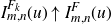 $I_{m,n}^{F_{k}}(u)\uparrow I_{m,n}^{F}(u)$
when
 $k\rightarrow \infty $
. Denote
 $I_{m ,n}^{F_{0}}(u)=0$
, then
 \begin{equation}I_{m,n}^{F}(u)=\sum_{k=0}^{\infty }(I_{m,n}^{F_{k+1}}(u)-I_{m,n}^{F_{k}}(u)) \end{equation}
and, by noting that
 \begin{equation*}\liminf_{m\rightarrow \infty }(I_{m,n}^{F_{k+1}}(u)-I_{m,n}^{F_{k}}(u))=I_{\infty,n}^{F_{k+1}}(u)-I_{\infty ,n}^{F_{k}}(u),\end{equation*}
our conclusion directly follows from Fatou’s Lemma.
We are now in the position to prove the first estimate lemma.
Lemma 4·7. Let
 $K^{F}$
be a fractal glue-up. If
 $\sigma \gt\alpha /p$
, then for all
 $u\in B_{p,\infty }^{\sigma ,F}$
,
 \begin{equation}I_{\infty ,n}^{F}(u)\leq C\rho ^{2n\alpha }\sum_{k=n}^{\infty}E_{k}^{(p),F}(u)\leq C^{\prime }\rho ^{n(p\sigma +\alpha )}\sup_{k\geq n}\mathcal{E}_{k}^{\sigma ,F}(u). \end{equation}
Proof. Let
 $I_{m,n}^{F}(u)$
be defined as in (4·12) (
 $m\gt n)$
. Since
 $K^{F}$
is connected and satisfies the condition
 $(\mathrm{H})$
,
 $|x-y|\leq C_{H}\rho^{n}$
implies that x,y lie in the same or the neighbouring n-cells. For every
 $w\in W_{n}$
and
 $x\in f(K_{w})$
, if
 $y\in B(x,C_{H}\rho ^{n})$
, then there exists
 $(g,\tilde{w})\in F\times W_{n}$
such that
 $y\in g(K_{\tilde{w}})$
and
 \begin{equation*}g(K_{\tilde{w}})\cap f(K_{w})\neq \emptyset .\end{equation*}
Therefore,
 \begin{align*}I_{m,n}^{F}(u)\leq & \sum_{|w|=n}\sum_{f\in F}\int_{f(K_{w})}\left( \sum_{|\tilde{w}|=n}\sum_{g\in F}\int_{g(K_{\tilde{w}})}|u(x)-u(y)|^{p}1_{\{g(K_{\tilde{w}})\cap f(K_{w})\neq \emptyset \}}d\mu _{m}^{F}(y)\right) d\mu_{m}^{F}(x) \\=& \sum_{|w|=n}\sum_{f\in F}\sum_{|\tilde{w}|=n}\sum_{g\in F}\sum_{x\in f(K_{w}\cap V_{m})}\sum_{y\in g(K_{\tilde{w}}\cap V_{m})}\frac{1_{\{g(K_{\tilde{w}})\cap f(K_{w})\neq \emptyset \}}}{|V_{m}|^{2}}|u(x)-u(y)|^{p}.\end{align*}
When
 $g(K_{\tilde{w}})\cap f(K_{w})\neq \emptyset $
, we can find a common vertex of these two cells and denote it by
 $z\in f(V_{w})\cap g(V_{\tilde{w}})$
, due to the just-touching property when
 $f\neq g$
and the p.c.f. structure when
 $f=g$
. Furthermore, by the inequality
 $|u(x)-u(y)|^{p}\leq 2^{p-1}\left( |u(x)-u(z)|^{p}+|u(z)-u(y)|^{p}\right) $
,
 \begin{equation*}1_{\{g(K_{\tilde{w}})\cap f(K_{w})\neq \emptyset \}}|u(x)-u(y)|^{p}\leq2^{p-1}\sum_{z\in f(V_{w})\cap g(V_{\tilde{w}})}\left(|u(x)-u(z)|^{p}+|u(z)-u(y)|^{p}\right) .\end{equation*}
It follows that
 \begin{align*}I_{m,n}^{F}(u)&\leq 2^{p-1}\sum_{|w|=n}\sum_{f\in F}\sum_{|\tilde{w}|=n}\sum_{g\in F}\sum_{x\in f(K_{w}\cap V_{m})}\sum_{y\in g(K_{\tilde{w}}\cap V_{m})}\sum_{z\in f(V_{w})\cap g(V_{\tilde{w}})}\frac{1}{|V_{m}|^{2}}\nonumber \\& \times \left( |u(x)-u(z)|^{p}+|u(z)-u(y)|^{p}\right) \nonumber \\[5pt] & \leq C_{1}\sum_{|w|=n}\sum_{f\in F}\sum_{|\tilde{w}|=n}\sum_{g\in F}\sum_{z\in f(V_{w})\cap g(V_{\tilde{w}})}\sum_{x\in f(K_{w}\cap V_{m})}\sum_{y\in g(K_{\tilde{w}}\cap V_{m})}N^{-2m}\nonumber \\& \times \left(|u(x)-u(z)|^{p}+|u(z)-u(y)|^{p}\right) \nonumber \\[5pt] & \leq C_{1}N^{-2m}\sum_{|w|=n}\sum_{f\in F}\sum_{z\in f(V_{w})}\sum_{x\in f(K_{w}\cap V_{m})}|u(x)-u(z)|^{p}\nonumber \\& \times \left( \sum_{|\tilde{w}|=n}\sum_{g\in F}1_{\{z\in f(V_{w})\cap g(V_{\tilde{w}})\}}|g(K_{\tilde{w}}\cap V_{m})|\right) \\& +C_{1}N^{-2m}\sum_{|\tilde{w}|=n}\sum_{g\in F}\sum_{z\in g(V_{\tilde{w}})}\sum_{y\in g(K_{\tilde{w}}\cap V_{m})}|u(z)-u(y)|^{p}\nonumber \\& \times \left(\sum_{|w|=n}\sum_{f\in F}1_{\{z\in f(V_{w})\cap g(V_{\tilde{w}})\}}|f(K_{w}\cap V_{m})|\right) \nonumber \\[5pt] & \leq C_{2}N^{-(m+n)} \Bigg(\sum_{|w|=n}\sum_{f\in F}\sum_{z\in f(V_{w})}\sum_{x\in f(K_{w}\cap V_{m})}|u(x)-u(z)|^{p}\nonumber \\& \quad \qquad +\sum_{|\tilde{w}|=n}\sum_{g\in F}\sum_{z\in g(V_{\tilde{w}})}\sum_{y\in g(K_{\tilde{w}}\cap V_{m})}|u(z)-u(y)|^{p} \Bigg) \nonumber \\[5pt] & = 2C_{2}N^{-(m+n)}\sum_{|w|=n}\sum_{f\in F}\sum_{x\in f(K_{w}\cap V_{m})}\sum_{z\in f(V_{w})}|u(x)-u(z)|^{p}, \end{align*}
where we use Proposition 4·1 for each common vertex
 $z\in f(V_{w})\cap g(V_{\tilde{w}})$
in the last inequality, so that
 \begin{equation*}\sum_{|\tilde{w}|=n}\sum_{g\in F}1_{\{z\in f(V_{w})\cap g(V_{\tilde{w}})\}}\end{equation*}
is uniformly bounded for any
 $(f,w)\in F\times W_{n}$
, and the estimates
 \begin{equation}|V_{m}| \asymp N^{m}=\rho ^{-\alpha m},\end{equation}
 \begin{equation}\text{ }|K_{w}\cap V_{m}| \asymp N^{m-n}\text{ for every }w\in W_{n}.\end{equation}
For
 $x\in f(V_{m}),z\in f(V_{n})$
, one can naturally fix a decreasing sequence of cells
 $K_{w_{k}}$
with
 $|w_{k}|=k$
for
 $k=n,\ldots ,m$
and vertices
 $x_{k}(x,z)\in V_{w_{k}}$
such that,
 $z=x_{n}(x,z),\ x=x_{m}(x,z)$
, so by Hölder’s inequality we have
 \begin{align}|u(z)-u(x)|^{p}\leq & \left( \sum_{k=n}^{m-1}N^{(n-k)q/p}\right)^{p/q}\left(\sum_{k=n}^{m-1}N^{k-n}|u(x_{k}(x,z))-u(x_{k+1}(x,z))|^{p}\right) \nonumber \\\leq & C_{3}\sum_{k=n}^{m-1}N^{k-n}|u(x_{k}(x,z))-u(x_{k+1}(x,z))|^{p},\end{align}
where
 $q=p/(p-1)$
. Note that for every pair
 $(a,b)\in f(K_{w^{\prime }}\cap V_{k})\times f(K_{w^{\prime }}\cap V_{k+1})$
, the cardinality of
 $(x,z)\in{\kern.8pt} f(K_{w}\cap V_{m})\times f(V_{w})$
with
 $(x_{k}(x,z),x_{k+1}(x,z))=(a,b)$
is no greater than
 $C^{\prime }N^{m-k}$
for some
 $C^{\prime }\gt0$
, due to the p.c.f. structure. Plugging (4·20) into (4·17), we obtain
 \begin{align*}I_{m,n}^{F}(u)& \leq C_{4}N^{-(m+n)}\sum_{|w|=n}\sum_{f\in F}\sum_{(x,z)\in f(K_{w}\cap V_{m})\times f(V_{w})}\sum_{k=n}^{m-1}N^{k-n}|u(x_{k}(x,z))-u(x_{k+1}(x,z))|^{p} \nonumber\\& \leq C_{4}N^{-(m+n)}\sum_{|w|=n}\sum_{k=n}^{m-1}\sum_{f\in F}\sum\limits_{\substack{|w^{\prime }|=k\\ f(K_{w^{\prime }})\subset f(K_{w})}}\sum\limits_{\substack{(x,z)\in f(K_{w}\cap V_{m})\times f(V_{w}),\\ (a,b)\in f(K_{w^{\prime }}\cap V_{k})\times f(K_{w^{\prime }}\cap V_{k+1})}}N^{k-n}|u(a)-u(b)|^{p} \\& \leq C_{5}N^{-(m+n)}\sum_{|w|=n}\sum_{k=n}^{m-1}\sum_{f\in F}\sum\limits_{\substack{|w^{\prime }|=k\\ f(K_{w^{\prime }})\subset f(K_{w})}}\sum_{a,b\in f(K_{w^{\prime }}\cap V_{k+1})}N^{k-n}\cdot N^{m-k}|u(a)-u(b)|^{p} \nonumber \\ & =C_{5}\rho ^{2n\alpha }\sum_{k=n}^{m-1}\sum_{|w|=n}\sum_{f\in F}\sum\limits_{\substack{|w^{\prime }|=k\\ f(K_{w^{\prime }})\subset f(K_{w})}}\sum_{a,b\in f(K_{w^{\prime }}\cap V_{k+1})}|u(a)-u(b)|^{p} \nonumber \\ & \leq C_{6}\rho ^{2n\alpha }\sum_{k=n}^{m-1}\sum_{f\in F}E_{k+1}^{(p)}(u\circ f)\leq C_{6}\rho ^{2n\alpha}\sum_{k=n}^{m}E_{k}^{(p),F}(u), \end{align*}
where we use (1·18) in the last line. It follows that
 \begin{equation*}I_{m,n}^{F}(u)\leq C_{6}\rho ^{2n\alpha }\rho ^{n(p\sigma -\alpha)}\sum_{k=n}^{m}\rho ^{-n(p\sigma -\alpha )}E_{k}^{(p),F}(u)\leq C_{7}\rho^{n(p\sigma +\alpha )}\sup_{k\geq n}\mathcal{E}_{k}^{\sigma ,F}(u),\end{equation*}
which completes the proof by letting
 $m\rightarrow \infty $
and using Lemma 4·5.
The following simple proposition is required.
Proposition 4·8. For all
 $u\in B_{p,\infty }^{\sigma ,F}$
, we have
 \begin{equation}\liminf_{n\rightarrow \infty }\rho ^{-n(p\sigma +\alpha )}I_{\infty,n}^{F}(u) \geq \rho ^{p\sigma +\alpha }C_{H}^{p\sigma +\alpha}\liminf_{n\rightarrow \infty }\Phi _{u}^{\sigma ,F}(\rho ^{n}),\end{equation}
 \begin{equation}\limsup_{n\rightarrow \infty }\rho ^{-n(p\sigma +\alpha )}I_{\infty,n}^{F}(u) \geq \rho ^{p\sigma +\alpha }C_{H}^{p\sigma +\alpha}\limsup_{n\rightarrow \infty }\Phi _{u}^{\sigma ,F}(\rho ^{n}).\end{equation}
Proof. Since
 $C_{H}\in (0,1)$
, assume that
 $\rho ^{s+1}\leq C_{H}\lt\rho ^{s}$
for some nonnegative integer s. Then, for any integer n,
 \begin{align}& \rho ^{-n(p\sigma +\alpha )}I_{\infty ,n}^{F}(u)\nonumber \\[5pt] &\quad =\rho ^{-n(p\sigma+\alpha )}\int_{K^{F}}\int_{B(x,C_{H}\rho ^{n})}|u(x)-u(y)|^{p}d\mu^{F}(y)d\mu ^{F}(x) \nonumber \\[5pt] &\quad \geq \rho ^{-n(p\sigma +\alpha )}\int_{K^{F}}\int_{B(x,\rho^{n+s+1})}|u(x)-u(y)|^{p}d\mu ^{F}(y)d\mu ^{F}(x) \\[5pt] &\quad =\rho ^{(s+1)(p\sigma +\alpha )}\rho ^{-(n+s+1)(p\sigma +\alpha)}\int_{K^{F}}\int_{B(x,\rho ^{n+s+1})}|u(x)-u(y)|^{p}d\mu ^{F}(y)d\mu^{F}(x) \nonumber \\[5pt] &\quad \gt\rho ^{p\sigma +\alpha }C_{H}^{p\sigma +\alpha }\rho ^{-(n+s+1)(p\sigma+\alpha )}\int_{K^{F}}\int_{B(x,\rho ^{n+s+1})}|u(x)-u(y)|^{p}d\mu^{F}(y)d\mu ^{F}(x). \nonumber\end{align}
Taking
 $\liminf_{n\rightarrow \infty }$
and
 $\limsup_{n\rightarrow \infty }$
on both sides, we obtain (4·22) and (4·23).
Denote
 \begin{equation*}I_{n}^{F}(u)\;:\!=\;\int_{K^{F}}\int_{\{\rho ^{n+1}\leq d(x,y)\lt\rho^{n}\}}|u(x)-u(y)|^{p}d\mu ^{F}(y)d\mu ^{F}(x).\end{equation*}
Lemma 4·9. Let
 $K^{F}$
be a fractal glue-up. If
 $\sigma \gt\alpha /p$
, then for any
 $\delta \in (0,p\sigma -\alpha )$
and
 $u\in B_{p,\infty}^{\sigma ,F}$
,
 \begin{equation}\mathcal{E}_{n}^{\sigma ,F}(u)\leq C\sum_{k=0}^{\infty }\rho ^{(-2\alpha-\delta )k}\rho ^{-(p\sigma +\alpha )n}I_{k+n}^{F}\leq C^{\prime}\sup_{k\geq 0}\Phi _{u}^{\sigma ,F}(\rho ^{n+k}). \end{equation}
Proof. For
 $a,b\in f(K_{w})$
, we have
 $|u(a)-u(b)|^{p}\leq2^{p-1}(|u(a)-u(x)|^{p}+|u(x)-u(b)|^{p})$
, where
 $x\in f(K_{w})$
and
 $f\in F$
. Approximate F with increasing finite sets
 $F_{j}$
so that
 $F=\lim_{j\rightarrow \infty }F_{j}$
. Integrating with respect to x and dividing by
 $\mu ^{F}(f(K_{w}))$
, we have
 \begin{align}E_{n}^{(p),F_{j}}(u)& =\sum_{f\in F_{j}}\sum_{a,b\in f(V_{w}),|w|=n}|u(a)-u(b)|^{p} \nonumber \\& \leq 2^{p-1}\sum_{f\in F_{j}}\sum_{a,b\in f(V_{w}),a\neq b,|w|=n}\nonumber \\&\quad \times \left(\frac{1}{\mu ^{F}(f(K_{w}))}\int_{f(K_{w})}|u(a)-u(x)|^{p}+|u(x)-u(b)|^{p}d\mu ^{F}(x)\right) \nonumber \\& \leq 2^{p-1}|V_{0}|\sum_{f\in F_{j}}\sum_{a\in f(V_{w}),|w|=n}\frac{1}{\mu^{F}(f(K_{w}))}\int_{f(K_{w})}|u(a)-u(x)|^{p}d\mu ^{F}(x). \end{align}
For every
 $a\in f(V_{w})$
with
 $|w|=n$
, we can fix a decreasing sequence of cells
 $\{f(K_{w_{k}})\}_{k=n}^{m}$
where
 $|w_{k}|=k$
for all large enough
 $m\gt n$
, such that
 $a\in \cap _{k=n}^{m}f(K_{w_{k}})$
with
 $w_{n}=w$
. We choose
 $x_{k}\in f(K_{w_{k}})$
for
 $k=n,n+1,\ldots,m$
. Let
 $\delta \in (0,p\sigma-\alpha )$
. By Hölder’s inequality,
 \begin{align}& |u(a)-u(x_{n})|^{p} \nonumber \\&\quad \leq 2^{p-1}|u(a)-u(x_{m})|^{p}+2^{p-1}\left( \sum_{k=n}^{m-1}\rho^{\delta (k-n)q/p}\right) ^{p/q}\left( \sum_{k=n}^{m-1}\rho ^{\delta(n-k)}|u(x_{k})-u(x_{k+1})|^{p}\right) , \end{align}
where
 $q=p/(p-1)$
. Integrating (4·27) with respect to
 $x_{k}\in K_{w_{k}}$
and dividing by
 $\mu ^{F}(f(K_{w_{k}}))$
,
 \begin{align*}E_{n}^{(p),F_{j}}(u)&\leq C_{1}\sum_{f\in F_{j}}\sum_{a\in f(V_{w}),|w|=n}\frac{2^{p-1}}{\mu ^{F}(f(K_{w_{m}}))}\int_{f(K_{w_{m}})}|u(a)-u(x_{m})|^{p}d\mu ^{F}(x_{m}) \\& \quad +C_{2}\sum_{f\in F_{j}}\sum_{k=n}^{m-1}\frac{\rho ^{\delta (n-k)}}{\mu^{F}(f(K_{w_{k}}))\mu ^{F}(f(K_{w_{k+1}}))}\\& \quad \times \int_{f(K_{w_{k}})}\int_{f(K_{w_{k+1}})}|u(x_{k})-u(x_{k+1})|^{p}d\mu ^{F}(x_{k+1})d\mu^{F}(x_{k}).\end{align*}
Using Lemma 4·4, (4·7) and (4·18), the first term of the right-hand side above vanishes as
 $m\rightarrow \infty $
since
 \begin{align*}& \sum_{a\in f(V_{w}),|w|=n}\frac{2^{p-1}}{\mu ^{F}(f(K_{w_{m}}))}\int_{f(K_{w_{m}})}|u(a)-u(x_{m})|^{p}d\mu ^{F}(x_{m}) \\&\quad \leq C|f(V_{n})|2^{p-1}\rho ^{(p\sigma -\alpha )m}[u]_{B_{p,\infty}^{\sigma }(K^{F})}^{p}\leq C^{\prime }|f(V_{n})|2^{p-1}\rho ^{(p\sigma-\alpha )m}[u]_{B_{p,\infty }^{\sigma ,F}}^{p} \\&\quad \leq C_{3}\rho ^{(p\sigma -\alpha )m-\alpha n}[u]_{B_{p,\infty }^{\sigma,F}}^{p}\rightarrow 0.\end{align*}
Letting
 $m\rightarrow \infty $
, we have
 \begin{align}E_{n}^{(p),F_{j}}(u)& \leq C_{4}\sum_{k=n}^{\infty }\rho ^{\delta (n-k)}\rho^{-2\alpha k}\int_{K^{F}}\int_{B(x,\rho ^{k})}|u(x)-u(y)|^{p}d\mu^{F}(y)d\mu ^{F}(x) \nonumber \\& =C_{4}\sum_{k=n}^{\infty }\rho ^{\delta (n-k)}\rho ^{-2\alpha k}\sum_{l=k}^{\infty }I_{l}^{F}(u)=C_{4}\sum_{k=0}^{\infty }\rho ^{-\delta k}\rho ^{-2\alpha (n+k)}\sum_{l=k}^{\infty }I_{l+n}^{F}(u) \nonumber \\& =C_{4}\sum_{l=0}^{\infty }\left( \sum_{k=0}^{l}\rho ^{-\delta k}\rho^{-2\alpha (n+k)}\right) I_{l+n}^{F}(u)\nonumber \\& =C_{4}\sum_{l=0}^{\infty }\left(\sum_{k=0}^{l}\rho ^{\delta (l-k)}\rho ^{2\alpha (l-k)}\right) \rho^{-\delta l}\rho ^{-2\alpha (l+n)}I_{l+n}^{F}(u) \nonumber \\& \leq C_{5}\sum_{l=0}^{\infty }\rho ^{-\delta l}\rho ^{-2\alpha(l+n)}I_{l+n}^{F}(u)=C_{5}\sum_{k=0}^{\infty }\rho ^{-\delta k}\rho^{-2\alpha (k+n)}I_{k+n}^{F}(u). \end{align}
Letting
 $j\rightarrow \infty $
, we have
 \begin{eqnarray*}\mathcal{E}_{n}^{\sigma ,F}(u) &=&\rho ^{-(p\sigma -\alpha)n}E_{n}^{(p),F}(u)\leq C_{5}\sum_{k=0}^{\infty }\rho ^{(-2\alpha -\delta)k}\rho ^{-(p\sigma +\alpha )n}I_{k+n}^{F}(u) \\&\leq &C_{5}\sum_{k=0}^{\infty }\rho ^{(-2\alpha -\delta )k}\rho ^{-(p\sigma+\alpha )n}\int_{K^{F}}\int_{B(x,\rho ^{n+k})}|u(x)-u(y)|^{p}d\mu^{F}(y)d\mu ^{F}(x) \\&\leq &C_{5}\sum_{k=0}^{\infty }\rho ^{(p\sigma +\alpha -2\alpha -\delta)k}\sup_{k\geq 0}\Phi _{u}^{\sigma ,F}(\rho ^{n+k}) \\&=&C_{5}\left( \sum_{k=0}^{\infty }\rho ^{(p\sigma -\alpha -\delta)k}\right) \sup_{k\geq 0}\Phi _{u}^{\sigma ,F}(\rho ^{n+k})=\frac{C_{5}}{1-\rho ^{p\sigma -\alpha -\delta }}\sup_{k\geq 0}\Phi _{u}^{\sigma ,F}(\rho^{n+k}),\end{eqnarray*}
where the second inequality follows from enlarging the integral region.
We need the following proposition to manage the transitions between different levels of vertex energies.
Proposition 4·10. Let K be a connected homogeneous p.c.f. self-similar set, then there exists
 $C\gt0$
such that for all
 $u\in L^{p}(K,\mu )$
and nonnegative integer
 $n$
,
 \begin{equation*}E_{n}^{(p)}(u)\leq CE_{n+1}^{(p)}(u).\end{equation*}
Moreover, there exists
 $C\gt0$
such that for all
 $u\in L^{p}(K^{F},\mu ^{F})$
,
 \begin{equation}E_{n}^{(p),F}(u)\leq CE_{n+1}^{(p),F}(u). \end{equation}
Proof. We start with the basic case
 $n=0$
. For any
 $x,y\in V_{0}$
, we can fix a vertex-disjoint path
 $x=z_{1}(x,y),z_{2}(x,y),\ldots ,z_{k}(x,y)=y$
such that
 $z_{j}(x,y)$
and
 $z_{j+1}(x,y)$
(
 $1\leq j\leq k$
) belong to the same
 $V_{w}$
for some
 $w\in W_{1}$
, and
 $2\leq k\leq |V_{1}|$
. Using Jensen’s inequality,
 \begin{align*}|u(x)-u(y)|^{p}& \leq(k-1)^{p-1}\sum_{j=1}^{k-1}|u(z_{j}(x,y))-u(z_{j+1}(x,y))|^{p} \\& \leq |V_{1}|^{p-1}\sum_{j=1}^{k-1}|u(z_{j}(x,y))-u(z_{j+1}(x,y))|^{p}.\end{align*}
It follows that
 \begin{align*}E_{0}^{(p)}(u)& \leq \sum_{x,y\in V_{0}}|V_{1}|^{p-1}\sum_{j=1}^{k-1}|u(z_{j}(x,y))-u(z_{j+1}(x,y))|^{p} \\& \leq |V_{0}|^{2}|V_{1}|^{p-1}\sum_{a,b\in V_{w},|w|=1}|u(a)-u(b)|^{p} \\& =|V_{0}|^{2}|V_{1}|^{p-1}E_{1}^{(p)}(u),\end{align*}
since for each pair
 $(a,b)\in V_{w}$
with
 $|w|=1$
, there exists at most one
 $j\in \{1,2,...k\}$
(depending on (x,y)) with
 $(z_{j}(x,y),z_{j+1}(x,y))=(a,b)$
for any
 $x,y\in V_{0}$
. Thus, we show the desired for
 $n=0$
with
 $C\;:\!=\;|V_{0}|^{2}|V_{1}|^{p-1}$
for any u. The rest simply follows from that
 \begin{align*}E_{n}^{(p)}(u)& =\sum_{x,y\in V_{w},|w|=n}|u(x)-u(y)|^{p}=\sum_{|w|=n}E_{0}^{(p)}(u\circ \phi _{w}) \\& \leq C\sum_{|w|=n}E_{1}^{(p)}(u\circ \phi _{w})=C\sum_{a,b\in V_{wi},|w|=n,|i|=1}|u(a)-u(b)|^{p}=CE_{n+1}^{(p)}(u).\end{align*}
The second inclusion follows from the definition of
 $K^{F}$
.
In [ Reference Gao, Yu and Zhang23 , theorem 1·4], for a homogeneous p.c.f. self-similar set K, we established the equivalence
 \begin{equation}\sup\limits_{n\geq 0}\rho ^{-n(p\sigma -\alpha )}E_{n}^{(p)}(u)\asymp\lbrack u]_{B_{p,\infty }^{\sigma }(K)}^{p}\text{ (}p\sigma \gt\alpha \text{)}, \end{equation}
where
 $E_{n}^{(p)}(u)$
is from (1·17).
Using Lemma 4·7 and Lemma 4·9, we immediately derive such equivalence for
 $K^{F}$
. Define the discrete local p-energy for
 $K^{F}$
by
 \begin{equation*}\mathcal{E}_{p,\infty }^{\sigma ,F}(u)\;:\!=\;\sup\limits_{n\geq 0}\rho^{-n(p\sigma -\alpha )}E_{n}^{(p),F}(u)=\sup_{n\geq 0}\mathcal{E}_{n}^{\sigma ,F}(u).\end{equation*}
Corollary 4·11. Let
 $K^{F}$
be a fractal glue-up. If
 $\sigma\gt\alpha /p$
, then for all
 $u\in B_{p,\infty }^{\sigma ,F}$
,
 \begin{equation}\limsup_{n\rightarrow \infty }\mathcal{E}_{n}^{\sigma ,F}(u)\asymp\limsup_{n\rightarrow \infty }\Phi _{u}^{\sigma ,F}(\rho ^{n}),\ \mathcal{E}_{p,\infty }^{\sigma ,F}(u)\asymp \lbrack u]_{B_{p,\infty}^{\sigma ,F}}^{p}.\end{equation}
Proof. Taking limsup and sup (of n) on both sides of (4·16) and (4·25), we have
 \begin{equation}\limsup_{n\rightarrow \infty }\rho ^{-n(p\sigma +\alpha )}I_{\infty,n}^{F}(u) \leq C\limsup_{n\rightarrow \infty }\mathcal{E}_{n}^{\sigma,F}(u)\leq C^{\prime }\limsup_{n\rightarrow \infty }\Phi _{u}^{\sigma,F}(\rho ^{n}), \end{equation}
 \begin{equation}\sup\limits_{n\geq 0}\rho ^{-n(p\sigma +\alpha )}I_{\infty ,n}^{F}(u) \leq C\sup\limits_{n\geq 0}\mathcal{E}_{n}^{\sigma ,F}(u). \end{equation}
By (4·23), we have
 \begin{equation*}\limsup_{n\rightarrow \infty }\rho ^{-n(p\sigma +\alpha )}I_{\infty,n}^{F}(u)\geq \rho ^{p\sigma +\alpha }C_{H}^{p\sigma +\alpha}\limsup_{n\rightarrow \infty }\Phi _{u}^{\sigma ,F}(\rho ^{n}),\end{equation*}
thus showing
 \begin{equation*}\limsup_{n\rightarrow \infty }\mathcal{E}_{n}^{\sigma ,F}(u)\asymp\limsup_{n\rightarrow \infty }\Phi _{u}^{\sigma ,F}(\rho ^{n})\end{equation*}
by (4·32). On the other hand, we have from (4·10) and (4·5) that
 \begin{equation}\sup\limits_{n\geq 0}\rho ^{-n(p\sigma +\alpha )}I_{\infty,n}^{F}(u)=C_{H}^{p\sigma +\alpha }\sup\limits_{n\geq 0}\Phi _{u}^{\sigma,F}(C_{H}\rho ^{n})=C_{H}^{p\sigma +\alpha }[u]_{B_{p,\infty }^{\sigma,F}}^{p}. \end{equation}
Since
 $C_{H}\in (0,1)$
, assume that
 $\rho ^{s+1}\leq C_{H}\lt\rho ^{s}$
for some nonnegative integer s. Replacing n by
 $n+s+1$
in (4·25), we obtain
 \begin{equation}\mathcal{E}_{n+s+1}^{\sigma ,F}(u)\leq C\sup_{k\geq 0}\Phi _{u}^{\sigma,F}(\rho ^{n+s+1+k})\leq C^{\prime }\sup_{k\geq 0}\Phi _{u}^{\sigma,F}(C_{H}\rho ^{n+k}). \end{equation}
By (4·29),
 \begin{align*}\mathcal{E}_{n+s+1}^{\sigma ,F}(u)&=\rho ^{-(n+s+1)(p\sigma -\alpha)}E_{n+s+1}^{(p),F}(u)\geq C^{-s-1}\rho ^{-(n+s+1)(p\sigma -\alpha)}E_{n}^{(p),F}(u)\\&=C^{-s-1}\rho ^{-(s+1)(p\sigma -\alpha )}\mathcal{E}_{n}^{\sigma ,F}(u),\end{align*}
thus by (4·35),
 \begin{equation}\mathcal{E}_{n}^{\sigma ,F}(u)\leq C^{\prime \prime }C_{H}^{p\sigma -\alpha}\sup_{k\geq 0}\Phi _{u}^{\sigma ,F}(C_{H}\rho ^{n+k}). \end{equation}
We conclude from (4·33), (4·34) and (4·36) that
 \begin{equation*}\mathcal{E}_{p,\infty }^{\sigma ,F}(u)\asymp \lbrack u]_{B_{p,\infty}^{\sigma ,F}}^{p}.\end{equation*}
The proof is complete.
4·2. Property (E) holds for nested fractals
For a set V, let
 $l (V)=\{u\;:$
u maps V into
 $\mathbb{R}\}$
.
Definition 4·12 ([
Reference Gao, Yu and Zhang23
, definition 3·1]). We say that a connected homogeneous p.c.f. self-similar set K satisfies property (E), if there exist
 $\sigma\gt\alpha/p$
and a positive constant C such that:
-
(i) for any
$u\in B_{p,\infty }^{\sigma}$
and for all
$n\geq 0$
,
$\mathcal{E}_{0}^{\sigma}(u)\leq C\mathcal{E}_{n}^{\sigma}(u)$
; -
(ii) for any
$u\in \ell (V_{0})$
, there exists an extension
$\tilde{u}\in B_{p,\infty }^{\sigma}$
.





We know from [
Reference Gao, Yu and Zhang23
, remark 3·2] that, if property (E) holds with
 $\sigma$
, then
 $\sigma=\sigma _{p}^{*}(K)$
, and for all
 $n\geq m$
,
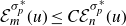 $\mathcal{E}_{m}^{\sigma_{p}^{*}}(u)\leq C\mathcal{E}_{n}^{\sigma _{p}^{*}}(u)$
. Thus we omit the index
 $\sigma$
. The following proposition shows the importance of property (E).
Proposition 4·13. If a connected homogeneous p.c.f. self-similar set K satisfies property (E), then
 \begin{equation}\sigma _{p}^{\ast }(K)=\sigma _{p}^{\#}(K)=\sigma _{p}^{\#}(K^{F}).\end{equation}
Moreover,
 $K^{F}$
satisfies property
 $(VE)_{\sigma _{p}^{\#}(K)}$
, and
 $B_{p,\infty }^{\sigma _{p}^{\#}(K),F}$
contains non-constant functions.
Proof. The fact
 $\sigma _{p}^{\ast }(K)=\sigma _{p}^{\#}(K)$
follows from [
Reference Gao, Yu and Zhang23
, the proof of Proposition 3·4]. It is also clear that
 $\sigma_{p}^{\#}(K)\geq \sigma _{p}^{\#}(K^{F})$
, since any non-constant function
 $u\in l(K^{F})$
in
 $B_{p,\infty }^{\sigma ,F}$
naturally gives a non-constant function in
 $B_{p,\infty }^{\sigma }(K)$
for any
 $\sigma \gt0$
: just restrict
 $u$
to a tile f(K) where it is non-constant (for some
 $f\in F$
).
For the reverse inclusion
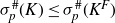 $\sigma _{p}^{\#}(K)\leq \sigma _{p}^{\#}(K^{F})$
to hold, we use property (E)(ii) to find a non-constant function in
 $B_{p,\infty }^{\sigma _{p}^{\#}(K),F}$
. To see this, we pick a contraction
 $f\in F$
, and determine the values of u on
 $f(V_{1})$
by
 $u(f(V_{0}))=0$
while
 $u(f(V_{1}\setminus V_{0}))=1$
. We can then extend u from
 $f(V_{1})$
to f(K) and make sure that
 $u\circ f\in B_{p,\infty}^{\sigma _{p}^{\#}(K)}$
by property (E)(ii), and simply define
 $u=0$
outside of f(K) on
 $K^{F}$
. Then u is an extended non-trivial function in
 $B_{p,\infty }^{\sigma _{p}^{\#}(K),F}$
since by (4·31) and (4·30),
 \begin{equation*}\lbrack u]_{B_{p,\infty }^{\sigma _{p}^{\#}(K),F}}^{p}\asymp \mathcal{E}_{p,\infty }^{\sigma _{p}^{\#}(K),F}(u)=\mathcal{E}_{p,\infty }^{\sigma_{p}^{\#}(K)}(u\circ f)\asymp \lbrack u\circ f]_{B_{p,\infty }^{\sigma_{p}^{\#}(K)}(K)}^{p}\lt\infty.\end{equation*}
Thus we show (4·37) and that
 $B_{p,\infty }^{\sigma _{p}^{\#}(K),F}$
contains non-constant functions.
Finally, since K satisfies property (E), that is for all n,
 \begin{equation*}\mathcal{E}_{n}^{\sigma _{p}^{\#}}(u)\leq C\liminf_{k\rightarrow \infty }\mathcal{E}_{k}^{\sigma _{p}^{\#}}(u),\end{equation*}
summing over F gives that for all n,
 \begin{equation*}\mathcal{E}_{n}^{\sigma _{p}^{\#},F}(u)\leq C\sum_{f\in F}\liminf_{k\rightarrow \infty }\mathcal{E}_{k}^{\sigma _{p}^{\#}}(u\circ f)\leq C\liminf_{k\rightarrow \infty }\sum_{f\in F}\mathcal{E}_{k}^{\sigma_{p}^{\#}}(u\circ f)=C\liminf_{k\rightarrow \infty }\mathcal{E}_{k}^{\sigma_{p}^{\#},F}(u),\end{equation*}
where we use Fatou’s lemma to obtain the desired.
When property (E) fails,
 $\sigma _{p}^{\#}=\sigma _{p}^{\ast }$
does not always hold for connected homogeneous p.c.f. self-similar sets (see [
Reference Gu and Lau28
]). Moreover, we mention in passing that, the critical domain
 $B_{p,\infty }^{\sigma _{p}^{\ast }}$
can be trivial for some metric measure spaces (bounded or unbounded).
We present the following key lemma for nested fractals, a class of connected homogeneous p.c.f. self-similar sets defined in [
Reference Kumagai38
] satisfying conditions (A-0
 $)\sim (A $
-3) and
 $|V_{0}|\geq 2$
therein.
Lemma 4·14. For a nested fractal, property (E) holds and
 $\sigma_{p}^{\#}\gt\alpha/p$
for all
 $1\lt p\lt\infty$
.
Proof. In this proof, we use the same terminology and notions as in [
Reference Cao, Gu and Qiu16
]. Let K be a nested fractal. We fix the components
 $r_{i}$
of
 $\mathbf{r}$
in [
Reference Cao, Gu and Qiu16
, theorem 6·3] to be the same number r, so it is ‘
 $\mathscr{G}$
-symmetric’ (see [
Reference Cao, Gu and Qiu16
, section 3] for definition). Then [
Reference Cao, Gu and Qiu16
, theorem 6·3] states that, ‘condition
 $\left( \mathbf{A}\right) $
’ (see [
Reference Cao, Gu and Qiu16
, the beginning of Section 4] for definition) holds for affine nested fractals, including K. By multiplying
 $\mathbf{r}$
with a constant (still denoted by
 $\mathbf{r}$
), [
Reference Cao, Gu and Qiu16
, theorem 4·2] guarantees that
 \begin{equation}\mathcal{T}E=E \end{equation}
(see [
Reference Cao, Gu and Qiu16
, definition 2·8, definition 3·1] for related definitions), thus showing ‘condition
 $\left( \mathbf{A}^{\prime }\right) $
’ (see [
Reference Cao, Gu and Qiu16
, the beginning of Section 5]). So by [
Reference Cao, Gu and Qiu16
, lemma 5·4], we can fix
 \begin{equation}r\lt 1 \end{equation}
to further satisfy condition
 $\left( \mathbf{A}^{\prime }\right) $
on K.
The equivalence of E and
 $E_{0}^{(p)}$
(for functions
 $u\in l(V_{0})$
, see the statement of [
Reference Cao, Gu and Qiu16
, theorem 5·1]) is stated in the proof of [
Reference Cao, Gu and Qiu16
, proposition 5·3 (b)], which implies that
 \begin{equation}\Lambda ^{n}E(u)\asymp \Lambda ^{n}E_{0}^{(p)}(u)=r^{-n}E_{n}^{(p)}(u)\end{equation}
for all
 $n\geq 0$
and all functions
 $u\in l(V_{n})$
by the definition of
 $\Lambda $
in [
Reference Cao, Gu and Qiu16
, definition 3·1] and
 $E_{n}^{(p)}$
given in (1·17).
Now fix
 \begin{equation}\sigma =\frac{\log _{\rho }r+\alpha }{p}, \end{equation}
so that
 $r=\rho ^{p\sigma -\alpha }$
.
Property (E)(i) holds with this
 $\sigma $
, by using the monotonicity property in [
Reference Cao, Gu and Qiu16
, proposition 5·3 (a)] and (4·40) that
 \begin{equation}E_{0}^{(p)}(u)\asymp E(u)\leq \Lambda E(u)\leq \cdots \leq \Lambda^{n}E(u)\asymp r^{-n}E_{n}^{(p)}(u)=\rho ^{-n(p\sigma -\alpha)}E_{n}^{(p)}(u)=\mathcal{E}_{n}^{\sigma}(u). \end{equation}
To see Property (E)(ii), we show the existence of piecewise harmonic functions (see definition in [
Reference Cao, Gu and Qiu16
, section 5·1]) using a standard iterative construction as in [
Reference Herman, Peirone and Strichartz31
]. The iteration part is that, for any boundary value of a cell
 $u_{w}\in l(f_{w}(V_{0}))$
, by (4·38), we can take its next-level harmonic extension
 $\tilde{u}_{w}\in l(f_{w}(V_{1}))$
such that
 $\Lambda E(\tilde{u}_{w})=E(u_{w})$
and
 $\tilde{u}_{w}|_{f_{w}(V_{0})}=u_{w}$
. The iteration starts from
 $V_{0}$
to
 $V_{1}$
, and from each level-1 cell to level-2 cells in the above way, then finally to
 $V_{\ast }$
. Such an extension satisfies the definition of piecewise harmonic functions in [
Reference Cao, Gu and Qiu16
, section 5·1], so we know by [
Reference Cao, Gu and Qiu16
, section 5·2] that it embeds into C(K) and this gives an extension to K instead of
 $V_{\ast }$
.
Therefore, we conclude from above that K satisfies property (E) with
 $\sigma $
defined as in (4·41). By (4·37), we have
 $\sigma =\sigma_{p}^{\#}$
, thus
 \begin{equation}r=\rho ^{p\sigma -\alpha }=\rho ^{p\sigma _{p}^{\#}-\alpha }. \end{equation}
The inclusion
 $\sigma _{p}^{\#}\gt\alpha /p$
follows from (4·39).
Remark 4·15. This lemma also indicates that,
 $E_{p,\infty }^{\sigma _{p}^{\#}}(u)$
,
 $[u]_{B_{p,\infty}^{\sigma _{p}^{\#}}}^p$
and the homogeneous discrete p-energy in [
Reference Cao, Gu and Qiu16
, theorem 5·1] are equivalent for a nested fractal K. It is known from [
Reference Barlow4
, theorem 8·18] that K admits a heat kernel satisfying (1·9), so (3·1) holds by Lemma 3·1. The critical exponents
 $\sigma_{p}^{\#}(K)=\sigma _{p}^{\ast }(K)$
due to property (E) by Proposition 4·13. Using
 $\Lambda ^{n}E_{0}^{(p)}(u)\asymp \Lambda^{n}E(u) $
in (4·40), the p-energy in [
Reference Cao, Gu and Qiu16
, theorem 5·1] with
 $r_{i}=r$
is equivalent to
 $\lim_{n\rightarrow \infty}\Lambda ^{n}E(u)$
(which exists by [
Reference Cao, Gu and Qiu16
, proposition 5·3]), where
 $r=\rho ^{p\sigma _{p}^{\#}(K)-\alpha }$
is given by (4·43). By (4·30) and (4·42),
 \begin{equation*}[u]_{B_{p,\infty }^{\sigma _{p}^{\#}}}^{p}\asymp \lim_{n\rightarrow \infty}\Lambda ^{n}E(u).\end{equation*}
4·3. Equivalence between
$(VE)_{\sigma}$
and
$(NE)_{\sigma}$


Our goal is to show the equivalence between
 $(VE)_{\sigma}$
and
 $(NE)_{\sigma}$
for
 $K^{F}$
. It is quite different and more delicate to obtain the lower limit equivalence, compared with the equivalence in Corollary 4·11 using the upper limit.
Lemma 4·16. If a fractal glue-up
 $K^{F}$
satisfies
 $(\widetilde{VE})_\sigma$
with
 $\sigma \gt\alpha /p$
, then there exists
 $C\gt0$
such that for all
 $u\in B_{p,\infty }^{\sigma ,F}$
,
 \begin{equation}\liminf_{n\rightarrow \infty }\mathcal{E}_{n}^{\sigma ,F}(u)\leq C\liminf_{n\rightarrow \infty }\Phi _{u}^{\sigma ,F}(\rho ^{n}).\end{equation}
Proof. Since
 $C_{H}\in (0,1)$
, we can assume that
 $\rho ^{s+1}\leq C_{H}\lt\rho ^{s}$
for some
 $s\in \mathbb{N}$
. For all
 $n\gt0$
, we have by (4·24) that
 \begin{equation}I_{\infty ,n}^{F}(u)\geq \int_{K^{F}}\int_{B(x,\rho^{n+s+1})}|u(x)-u(y)|^{p}d\mu ^{F}(y)d\mu ^{F}(x)\geq I_{n+s+1}^{F}(u).\end{equation}
Note that there exists a positive integer
 $n_{0}$
such that
 \begin{equation*}\sup_{k\geq n_{0}}\mathcal{E}_{k}^{\sigma ,F}(u)\leq 2\limsup_{n\rightarrow\infty }\mathcal{E}_{n}^{\sigma ,F}(u).\end{equation*}
By (4·45), we have for all
 $n\geq n_{0}+s+1$
that
 \begin{eqnarray}I_{n}^{F}(u) &\leq &I_{\infty ,n-s-1}^{F}(u) \nonumber \\&\leq &C\rho ^{(n-s-1)(p\sigma +\alpha )}\sup_{k\geq n-s-1}\mathcal{E}_{k}^{\sigma ,F}(u)\text{ (using \eqref{eq6.3})} \nonumber \\&\leq &CC_{H}^{-(p\sigma +\alpha )}\rho ^{n(p\sigma +\alpha )}\sup_{k\geq n_{0}}\mathcal{E}_{k}^{\sigma ,F}(u)\leq 2CC_{H}^{-(p\sigma +\alpha )}\rho^{n(p\sigma +\alpha )}\limsup_{n\rightarrow \infty }\mathcal{E}_{n}^{\sigma,F}(u) \nonumber \\&\leq &C_{1}\rho ^{n(p\sigma +\alpha )}\liminf_{n\rightarrow \infty }\mathcal{E}_{n}^{\sigma ,F}(u)\text{ (by property }(\widetilde{VE})_\sigma\text{)}. \end{eqnarray}
By Lemma 4·9, for any positive integer
 $L\geq n_{0}+s+1 $
and
 $0\lt\delta \lt p\sigma -\alpha $
,
 \begin{align*}\mathcal{E}_{n}^{\sigma ,F}(u)& \leq C_{2}\sum_{k=0}^{\infty }\rho^{(-2\alpha -\delta )k}\rho ^{-(p\sigma +\alpha )n}I_{k+n}^{F}(u) \\& = C_{2}\sum_{k=0}^{L}\rho ^{(-2\alpha -\delta )k}\rho ^{-(p\sigma +\alpha)n}I_{k+n}^{F}(u)+C_{2}\sum_{k=L}^{\infty }\rho ^{(-2\alpha -\delta )k}\rho^{-(p\sigma +\alpha )n}I_{k+n}^{F}(u) \\& \leq C_{2}\sum_{k=0}^{L}\rho ^{(-2\alpha -\delta )k}\rho ^{-(p\sigma+\alpha )n}I_{k+n}^{F}(u)+C_{1}C_{2}\sum_{k=L}^{\infty }\rho ^{(p\sigma-\alpha -\delta )k}\liminf_{n\rightarrow \infty }\mathcal{E}_{n}^{\sigma,F}(u); \\& =C_{2}\left( \sum_{k=0}^{L}\rho ^{(-2\alpha -\delta )k}\rho ^{-(p\sigma+\alpha )n}I_{k+n}^{F}(u)+\frac{C_{1}\rho ^{(p\sigma -\alpha -\delta )L}}{1-\rho ^{(p\sigma -\alpha -\delta )}}\liminf_{n\rightarrow \infty }\mathcal{E}_{n}^{\sigma ,F}(u)\right),\end{align*}
where we use (4·46) in the third line. Taking
 $\liminf_{n\rightarrow\infty }$
in the right-hand side above, we have
 \begin{equation*}C_{3}\liminf_{n\rightarrow \infty }\mathcal{E}_{n}^{\sigma ,F}(u)\leq\liminf_{n\rightarrow \infty }\sum_{k=0}^{L}\rho ^{-(2\alpha +\delta )k}\rho^{-(p\sigma +\alpha )n}I_{k+n}^{F}(u),\end{equation*}
where
 $C_{3}\;:\!=\;{1}/{C_{2}}-{C_{1}\rho ^{(p\sigma -\alpha -\delta )L}}/({1-\rho ^{(p\sigma -\alpha -\delta )}})$
.
Fix a large integer L such that
 $C_{3}\gt0$
, then
 \begin{align*}C_{3}\rho ^{(2\alpha +\delta )L}\liminf_{n\rightarrow \infty }\mathcal{E}_{n}^{\sigma ,F}(u)& \leq \rho ^{(2\alpha +\delta )L}\liminf_{n\rightarrow\infty }\left( \sum_{k=0}^{L}\rho ^{-n(p\sigma +\alpha )}\rho ^{-(2\alpha+\delta )k}I_{n+k}^{F}(u)\right) \\& \leq \liminf_{n\rightarrow \infty }\rho ^{-n(p\sigma +\alpha)}\sum_{k=0}^{L}I_{n+k}^{F}(u)\leq \liminf_{n\rightarrow \infty }\Phi_{u}^{\sigma ,F}(\rho ^{n}),\end{align*}
thus showing (4·44).
Next, we show the reverse inequality of (4·44) by using (4·29) under property
 $(\widetilde{NE})_{\sigma}$
.
Lemma 4·17. If property
 $(\widetilde{NE})_{\sigma}$
holds for a fractal glue-up
 $K^{F}$
with
 $\sigma \gt\alpha /p$
, then there exists
 $C\gt0$
such that for all
 $u\in B_{p,\infty }^{\sigma ,F}$
,
 \begin{equation}\liminf_{n\rightarrow \infty }\Phi _{u}^{\sigma ,F}(\rho ^{n})\leq C\liminf_{n\rightarrow \infty }\mathcal{E}_{n}^{\sigma ,F}(u).\end{equation}
Proof. By (4·21), we have
 \begin{align}\rho ^{-n(p\sigma +\alpha )}I_{m,n}^{F}(u)&\leq C\rho ^{-n(p\sigma -\alpha)}\sum_{k=n}^{m}\rho ^{k(p\sigma -\alpha )}\rho ^{-k(p\sigma -\alpha)}E_{k}^{(p),F}(u) \nonumber \\&\leq C\sum_{k=n}^{m}\rho ^{(k-n)(p\sigma -\alpha )}\mathcal{E}_{k}^{\sigma,F}(u)\leq C\sum_{k=0}^{\infty }\rho ^{k(p\sigma -\alpha )}\mathcal{E}_{k+n}^{\sigma ,F}(u). \end{align}
Note that there exists
 $n_{0}\gt0$
such that for all positive integer
 $L\gt n_{0}$
,
 \begin{eqnarray*}\sup_{n\geq L}\mathcal{E}_{n}^{\sigma ,F}(u) &\leq &2\limsup_{n\rightarrow\infty }\mathcal{E}_{n}^{\sigma ,F}(u) \\&\asymp &\limsup_{n\rightarrow \infty }\Phi _{u}^{\sigma ,F}(\rho ^{n})\text{ (by Corollary 4.11)} \\&\leq &C\liminf_{n\rightarrow \infty }\Phi _{u}^{\sigma ,F}(\rho ^{n})\text{ (by property }(\widetilde{NE})_{\sigma}\text{)}.\end{eqnarray*}
It follows from (4·48) that
 \begin{eqnarray*}\rho ^{-n(p\sigma +\alpha )}I_{m,n}^{F}(u) &\leq &C\sum_{k=0}^{\infty }\rho^{k(p\sigma -\alpha )}\mathcal{E}_{k+n}^{\sigma ,F}(u) \\&=&C\sum_{k=0}^{L}\rho ^{k(p\sigma -\alpha )}\mathcal{E}_{k+n}^{\sigma,F}(u)+C\sum_{k=L+1}^{\infty }\rho ^{k(p\sigma -\alpha )}\mathcal{E}_{k+n}^{\sigma ,F}(u) \\&\leq &C\sum_{k=0}^{L}\rho ^{k(p\sigma -\alpha )}\mathcal{E}_{k+n}^{\sigma,F}(u)+C\sum_{k=L+1}^{\infty }\rho ^{k(p\sigma -\alpha )}\sup_{n\geq L}\mathcal{E}_{n}^{\sigma ,F}(u) \end{eqnarray*}
 \begin{eqnarray*}&\leq &C\sum_{k=0}^{L}\rho ^{k(p\sigma -\alpha )}\mathcal{E}_{k+n}^{\sigma,F}(u)+C^{\prime }\sum_{k=L+1}^{\infty }\rho ^{k(p\sigma -\alpha)}\liminf_{n\rightarrow \infty }\Phi _{u}^{\sigma ,F}(\rho ^{n}) \\&=&C\sum_{k=0}^{L}\rho ^{k(p\sigma -\alpha )}\mathcal{E}_{k+n}^{\sigma,F}(u)+C^{\prime }\frac{\rho ^{(p\sigma -\alpha )(L+1)}}{1-\rho ^{p\sigma-\alpha }}\liminf_{n\rightarrow \infty }\Phi _{u}^{\sigma ,F}(\rho ^{n}).\end{eqnarray*}
Using Lemma 4·5, we have
 \begin{align*}\rho ^{-n(p\sigma +\alpha )}I_{\infty ,n}^{F}(u)\leq & \rho ^{-n(p\sigma+\alpha )}\liminf_{m\rightarrow \infty }I_{m,n}^{F}(u) \\\leq & C\sum_{k=0}^{L}\rho ^{k(p\sigma -\alpha )}\mathcal{E}_{k+n}^{\sigma,F}(u)+\frac{C^{\prime }\rho ^{(p\sigma -\alpha )(L+1)}}{1-\rho ^{p\sigma-\alpha }}\liminf_{n\rightarrow \infty }\Phi _{u}^{\sigma ,F}(\rho ^{n}).\end{align*}
Combining this with (4·22), we have
 \begin{align*}\rho ^{p\sigma +\alpha }C_{H}^{p\sigma +\alpha }\liminf_{n\rightarrow \infty}\Phi _{u}^{\sigma ,F}(\rho ^{n})&\leq C\liminf_{n\rightarrow \infty}\sum_{k=0}^{L}\rho ^{k(p\sigma -\alpha )}\mathcal{E}_{k+n}^{\sigma ,F}(u)\\&+\frac{C^{\prime }\rho ^{(p\sigma -\alpha )(L+1)}}{1-\rho ^{p\sigma -\alpha }}\liminf_{n\rightarrow \infty }\Phi _{u}^{\sigma ,F}(\rho ^{n}).\end{align*}
For sufficiently large L (
 $\gt n_{0}$
), we have
 \begin{equation*}C^{\prime \prime }\;:\!=\;\frac{1}{C}\left( \rho ^{p\sigma +\alpha }C_{H}^{p\sigma+\alpha }-\frac{C^{\prime }\rho ^{(p\sigma -\alpha )(L+1)}}{1-\rho ^{p\sigma-\alpha }}\right) \gt0.\end{equation*}
Then for this L, we obtain
 \begin{align}C^{\prime \prime }\liminf_{n\rightarrow \infty }\Phi _{u}^{\sigma ,F}(\rho^{n})& \leq \liminf_{n\rightarrow \infty }\sum_{k=0}^{L}\rho ^{k(p\sigma-\alpha )}\mathcal{E}_{k+n}^{\sigma ,F}(u) \nonumber \\& =\liminf_{n\rightarrow \infty }\sum_{k=0}^{L}\rho ^{k(p\sigma -\alpha)}\rho ^{-(k+n)(p\sigma -\alpha )}E_{k+n}^{(p),F}(u) \nonumber \\& =\liminf_{n\rightarrow \infty }\sum_{k=0}^{L}\rho ^{-n(p\sigma -\alpha)}E_{k+n}^{(p),F}(u). \end{align}
Using (4·29), there exists
 $c\gt0$
such that for all positive integer n and
 $u\in B_{p,\infty }^{\sigma ,F}$
,
 \begin{equation*}E_{n}^{(p),F}(u)\leq cE_{n+1}^{(p),F}(u).\end{equation*}
Applying the above inequality to (4·49), we have
 \begin{align*}C^{\prime \prime }\liminf_{n\rightarrow \infty }\Phi _{u}^{\sigma ,F}(\rho^{n})& \leq \liminf_{n\rightarrow \infty }C_{L}\ \rho ^{-(n+L)(p\sigma-\alpha )}E_{n+L}^{(p),F}(u) \\& =C_{L}\liminf_{n\rightarrow \infty }\mathcal{E}_{n+L}^{(p),F}(u)=C_{L}\liminf_{n\rightarrow \infty }\mathcal{E}_{n}^{(p),F}(u),\end{align*}
where
 $C_{L}=(({1-c^{L}})/({1-c}))\rho ^{L(p\sigma -\alpha )}$
does not depend on n, which gives (4·47).
Proof of Theorem
1·7. Let
 $\sigma \gt\alpha /p$
. By (4·31), (4·44) and (4·8),
 $(\widetilde{VE})_{\sigma}$
implies
 $(\widetilde{NE})_{\sigma}$
since
 \begin{equation}\limsup_{r\rightarrow 0}\Phi _{u}^{\sigma ,F}(r) \leq C\limsup_{n\rightarrow\infty }\mathcal{E}_{n}^{\sigma ,F}(u)\leq C^{\prime }\liminf_{n\rightarrow\infty }\mathcal{E}_{n}^{\sigma ,F}(u)\leq C^{\prime \prime}\liminf_{r\rightarrow 0}\Phi _{u}^{\sigma ,F}(r). \end{equation}
By (4·31), (4·8) and (4·47),
 $(\widetilde{NE})_{\sigma}$
implies
 $(\widetilde{VE})_{\sigma}$
since
 \begin{equation}\limsup_{n\rightarrow \infty }\mathcal{E}_{n}^{\sigma ,F}(u)\leq C_{1}\limsup_{r\rightarrow 0}\Phi _{u}^{\sigma ,F}(r)\leq C_{1}^{\prime}\liminf_{r\rightarrow 0}\Phi _{u}^{\sigma ,F}(r)\leq C_{1}^{\prime \prime}\liminf_{n\rightarrow \infty }\mathcal{E}_{n}^{\sigma ,F}(u).\end{equation}
Thus, by (4·50) and (4·51), we show Theorem 1·7 (i).
By (4·31) and (4·44) adjoint with
 $(VE)_{\sigma}\Rightarrow (\widetilde{VE})_{\sigma}$
, we immediately have from (4·6), (4·8) that
 \begin{equation}\sup_{r\in (0,C_H)}\Phi _{u}^{\sigma ,F}(r)\leq C_{2}\sup_{n\geq 0 }\mathcal{E}_{n}^{\sigma ,F}(u)\leq C_{2}^{\prime }\liminf_{n\rightarrow \infty }\mathcal{E}_{n}^{\sigma ,F}(u)\leq C_{2}^{\prime \prime}\liminf_{r\rightarrow 0}\Phi _{u}^{\sigma ,F}(r). \end{equation}
Similarly, by (4·31) and (4·47) adjoint with the fact
 $(NE)_{\sigma}\Rightarrow (\widetilde{NE})_{\sigma}$
, we immediately have
 \begin{equation}\sup_{n\geq 0}\mathcal{E}_{n}^{\sigma ,F}(u)\leq C_{3}\sup_{n\geq 0}\Phi_{u}^{\sigma ,F}(C_H\rho ^{n})\leq C_{3}^{\prime }\liminf_{n\rightarrow\infty }\Phi _{u}^{\sigma ,F}(\rho ^{n})\leq C_{3}^{\prime \prime}\liminf_{n\rightarrow \infty }\mathcal{E}_{n}^{\sigma ,F}(u).\end{equation}
Remark 4·18. The definition of discrete energies in (1·18) uses point-wise values of functions as opposed to cell-averaged values in [
Reference Kigami37
,
Reference Kusuoka and Zhou39
]. When
 $p\sigma \gt\alpha$
, the domain of p-energy
 $\mathcal{E}_{p,\infty}^{\sigma,F}$
is a subset of
 $C(K^F)$
, and both definitions are equivalent for a connected homogeneous p.c.f. self-similar set by modifying the arguments in [
Reference Hino and Kumagai32
, lemma 3·1] and [
Reference Shimizu46
, section 5].
4·4. Consequences of
$(VE)_{\sigma}$
: BBM type characterisation and Gagliardo-Nirenberg inequality

Let us state the following embedding inequality given by Baudoin, using our notions.
Lemma 4·19 ([
Reference Baudoin11
, theorem 4·3]). Suppose that property
 $(NE)_{\sigma_{p}^{\#}}$
holds with
 $R_0=\infty$
for the metric measure space
 $(M,d,\mu )$
, and there exists
 $R\gt0$
such that
 $\inf_{x\in M}\mu (B(x,R))\gt0$
. When
 $p\sigma_{p}^{\#}\neq \alpha_1 $
, where
 $\alpha_1$
is from (1·3), let
 $q={p\alpha_1 }/({\alpha_1 -p\sigma_{p}^{\#}})$
. For
 $r,s\in (0,\infty ]$
,
 $\theta\in (0,1]$
satisfying:
 \begin{equation*}\frac{1}{r}=\frac{\theta }{q}+\frac{1-\theta }{s},\end{equation*}
there exists a constant
 $C\gt0$
such that for any
 $f\in B_{p,\infty }^{\sigma_{p}^{\#}}$
,
 \begin{equation}\Vert f\Vert _{r}\leq C(\Vert f\Vert _{p}+[f]_{B_{p,\infty }^{\sigma_{p}^{\#}}})^{\theta }\Vert f\Vert _{s}^{1-\theta }. \end{equation}
By Theorem 1·5 and Theorem 1·7, we have the following corollary.
Corollary 4·20. Suppose that
 $K^{F}$
is a fractal glue-up that admits a heat kernel satisfying (1·9), where K is a connected homogeneous p.c.f. self-similar set. Let
 $R_0=C_H$
. Then properties
 $(\widetilde{KE})_{\sigma},(\widetilde{NE})_{\sigma},(\widetilde{VE})_{\sigma}$
are equivalent with the same
 $\sigma\gt\alpha /p$
, and properties
 $(KE)_{\sigma_{p}^{\#}}$
,
 $(NE)_{\sigma_{p}^{\#}}$
,
 $(VE)_{\sigma_{p}^{\#}}$
are equivalent when
 $\sigma_{p}^{\#}\gt\alpha /p$
on
 $K^{F}$
.
The following theorem can be regarded as a summary of our paper when the underlying space is a fractal.
Theorem 4·21. Let K be a connected homogeneous p.c.f. self-similar set with property (E), and let
 $K^{F}$
be a fractal glue-up. Then
 $K^{F}$
satisfies
 $(NE)_{\sigma_{p}^{\#}(K)}$
with
 $R_{0}=C_H$
and
 $B_{p,\infty }^{\sigma_{p}^{\#}(K^{F})}(K^{F})\;:\!=\;B_{p,\infty }^{\sigma _{p}^{\#}}(K^{F})$
contains non-constant functions. Also, BBM type characterisation (2·7) holds for
 $K^{F}$
with
 $R_{0}=C_H$
, that is, for
 $R_{0}=C_H$
, there exists a positive constant C such that for all
 $u\in B_{p,\infty }^{\sigma_{p}^{\#}}(K^{F})$
,
 \begin{align}C^{-1}[u]_{{B}_{p,\infty }^{\sigma _{p}^{\#}}(K^{F})}^{p}&\leq\liminf_{\sigma \uparrow \sigma _{p}^{\#}(K^{F})}\left( \sigma_{p}^{\#}(K^{F})-\sigma \right) [u]_{{B}_{p,p}^{\sigma }(K^{F})}^{p}\leq\limsup_{\sigma \uparrow \sigma _{p}^{\#}(K^{F})}\left( \sigma_{p}^{\#}(K^{F})-\sigma \right) [u]_{{B}_{p,p}^{\sigma }(K^{F})}^{p}\nonumber \\&\leq C[u]_{{B}_{p,\infty }^{\sigma _{p}^{\#}}(K^{F})}^{p}. \end{align}
Furthermore, if K is a nested fractal and
 $K^{F}=K_{\infty }$
, where
 $K_{\infty }$
is defined in Example 4·3, then
 $(NE)_{\sigma_{p}^{\#}(K)}$
and
 $(KE)_{\sigma_{p}^{\#}(K)}$
hold for
 $K_{\infty }$
with
 $R_{0}=\infty $
, and the Gagliardo-Nirenberg inequality (4·54) holds.
Proof. By Proposition 4·13,
 $K^{F}$
satisfies
 $(VE)_{\sigma _{p}^{\#}(K)}$
and the critical domain
 $B_{p,\infty }^{\sigma _{p}^{\#}}(K^{F})$
contains non-constant functions, where
 $\sigma _{p}^{\#}=\sigma _{p}^{\#}(K)=\sigma_{p}^{\#}(K^{F})$
. Thus
 $(NE)_{\sigma _{p}^{\#}}$
holds true for
 $K^{F}$
by Theorem 1·7(ii) with
 $R_{0}=C_H$
, and (4·55) holds by Theorem 2·4.
Since a nested fractal K satisfies property (E) by Lemma 4·14, these inclusions hold for nested fractals. Next, we state how to upgrade
 $R_0=C_H$
to
 $R_0=\infty $
for
 $(NE)_{\sigma_{p}^{\#}}$
on
 $K_{\infty }$
.
For
 $n\in \mathbb{N}$
, define the scaling function
 $g_{n}:K^{F}\rightarrow \rho ^{-n}K^{F}$
by
 $g_{n}(x)=\rho ^{-n}x.$
Due to the global self-similarity of
 $K_{\infty }$
, we have
 \begin{equation}g_{n}(K_{\infty })=K_{\infty }. \end{equation}
For any
 $u\in B_{p,\infty }^{\sigma _{p}^{\#} ,F}$
, clearly
 $u\circ g_{n}\in B_{p,\infty }^{\sigma _{p}^{\#} ,F}$
. By definition, for all
 $r\gt0$
,
 \begin{eqnarray}\Phi _{u\circ g_{n}}^{\sigma _{p}^{\#} ,F}(\rho ^{n}r) &=&(\rho ^{n}r)^{-p\sigma _{p}^{\#}-\alpha }\int_{K_{\infty }}\int_{B(x,\rho^{n}r)}|u(g_{n}(x))-u(g_{n}(y))|d\mu ^{F}(y)d\mu ^{F}(x) \nonumber \\&=&(\rho ^{n}r)^{-p\sigma _{p}^{\#} -\alpha }\int_{K_{\infty}}\int_{B(g_{n}(x),r)}|u(g_{n}(x))-u(y)|d(\mu ^{F}\circ g_{n}^{-1})(y)d\mu^{F}(x) \nonumber \\&=&(\rho ^{n}r)^{-p\sigma _{p}^{\#} -\alpha }\int_{g_{n}(K_{\infty})}\int_{B(x,r)}|u(x)-u(y)|d\mu ^{F}(\rho ^{n}y)d\mu ^{F}(\rho ^{n}x) \nonumber\\&\asymp &(\rho ^{n}r)^{-p\sigma _{p}^{\#} -\alpha }\rho ^{2n\alpha }\int_{K_{\infty}}\int_{B(x,r)}|u(x)-u(y)|d\mu ^{F}(y)d\mu ^{F}(x)\ \nonumber \\&=&\rho ^{-n(p\sigma _{p}^{\#} -\alpha )}\Phi _{u}^{\sigma _{p}^{\#} ,F}(r), \end{eqnarray}
where we use (4·56) and that
 $\mu ^{F}$
is
 $\alpha $
-regular in the fourth line. For any
 $u\in B_{p,\infty }^{\sigma _{p}^{\#} ,F}$
, there exists
 $n\lt\infty$
such that
 \begin{equation*}\sup_{r\in (0,\infty )}\Phi _{u}^{\sigma _{p}^{\#} ,F}(r)\leq 2\sup_{r\in (0,C_{H}\rho^{-n})}\Phi _{u}^{\sigma _{p}^{\#} ,F}(r).\end{equation*}
Combined with (4·57),
 \begin{equation}\sup_{r\in (0,\infty )}\Phi _{u}^{\sigma _{p}^{\#} ,F}(r)\leq C\sup_{r^{\prime }\in(0,C_{H})}\Phi _{u\circ g_{n}}^{\sigma _{p}^{\#} ,F}(r^{\prime })\rho ^{n(p\sigma _{p}^{\#}-\alpha )}. \end{equation}
As
 $(NE)_{\sigma _{p}^{\#}}$
holds for
 $R_{0}=C_{H}$
,
 \begin{eqnarray*}\sup_{r^{\prime }\in (0,C_{H})}\Phi _{u\circ g_{n}}^{\sigma_{p}^{\#},F}(r^{\prime })\rho ^{n(p\sigma _{p}^{\#}-\alpha )} &\leq&C\liminf_{r^{\prime }\rightarrow 0}\Phi _{u\circ g_{n}}^{\sigma_{p}^{\#},F}(r^{\prime })\rho ^{n(p\sigma _{p}^{\#}-\alpha )} \\&=&C\liminf_{r^{\prime }\rightarrow 0}\Phi _{u}^{\sigma _{p}^{\#},F}(\rho^{-n}r^{\prime })\text{ (by (4$\cdot$57))} \\&=&C\liminf_{r\rightarrow 0}\Phi _{u}^{\sigma _{p}^{\#},F}(r),\text{ }\end{eqnarray*}
where the constant C does not depend on u and n. Thus
 $(NE)_{\sigma _{p}^{\#}}$
also holds with
 $R_{0}=\infty $
by (4·58). Since
 $\mu ^{F}$
is
 $\alpha $
-regular, we know by Lemmas 4·14 and 4·19 that (4·54) holds true. Finally, for a nested fractal K, it is known by [
Reference Kumagai38
] (see also [
Reference Fitzsimmonsm, Hambly and Kumagai21
, theorem 1·1]) that
 $K_{\infty }$
admits a heat kernel satisfying (1·9), thus
 $(KE)_{\sigma _{p}^{\#}}$
is verified by Theorem 1·5. The proof is complete.
When
 $p=2$
, we use heat kernel estimates to verify weak-monotonicity properties in the following corollary, which is analytical (compared with the algebraic resistance-estimate arguments for
 $(VE)_{\sigma}$
).
Corollary 4·22. When
 $p=2$
, if a fractal glue-up
 $K^{F}$
admits a heat kernel with sub-Gaussian estimates (1·9), then
 $(VE)_{\beta^{\ast }/2}$
and
 $(NE)_{\beta^{\ast }/2}$
automatically hold for
 $K^F $
.
Proof. By Remark 1·2, property
 $(KE)_{\beta^{\ast }/2}$
automatically holds for
 $K^F$
when
 $p=2$
. The conclusion then follows from Corollary 4·20.
We use an example based on [ Reference Hambly and Kumagai30 , section 4] to show that Corollaries 4·20 and 4·22 are also meaningful for some non-nested fractal blow-ups. That is, there exists a connected homogeneous p.c.f. self-similar set which is not a nested fractal, such that, its fractal blow-up admits a heat kernel satisfying (1·9).
Example 4·23. Let S be a unit equilateral triangle in
 $\mathbb{R}^2$
. Its vertices are located at
 $q_0=(0, 0)$
,
 $q_1=(1, 0)$
, and
 $q_2=(1/2, \sqrt{3}/2)$
. Divide S into a mesh of sub-triangles of side length
 $1/12$
, and pick 34 sub-triangles as shown in Figure 1. Let
 $\{\phi_i\}_{i=1}^{34}$
be the IFS on
 $\mathbb{R}^2$
that maps S to these 34 sub-triangles with attractor K. Then
 $K=\bigcup_{i=1}^{34}\phi_i(K)$
is a connected homogeneous p.c.f. self-similar set, which is also a uniformly finitely ramified fractal (u.f.r. fractal for short, see definition in [
Reference Hambly and Kumagai30
, section 2]). However, K is not a nested fractal. Its Hausdorff dimension is
 $ \alpha = \dim_H(K) = {\log 34}/{\log 12} $
, and the
 $ \alpha $
-dimensional Hausdorff measure exists since the open set condition is satisfied. Define
 $V_0=\{q_{k}\}_{k=0}^2$
and
 $V_{n+1}=\bigcup_{i=1}^{34}\phi_i(V_n)$
as in (4·2). Let
 $K_\infty$
be the fractal blow-up of K (defined in Example 4·3 as
 $ \bigcup_{l=1}^\infty K_l $
, where
 $ K_l = 12^l K $
). Let
 $d_\infty$
be the shortest path length between any two points in
 $ K_\infty $
. By the global self-similarity of blow-ups,
 $ d_\infty $
is bi-Lipschitz equivalent to the Euclidean metric
 $ d_{\mathbb{R}^2}|_{K_\infty} $
.
A uniformly finitely ramified fractal.

Define
 $V=\bigcup_{i=0}^\infty 12^n V_n$
and
 $E \;:\!=\; \{(x, y) \in V \times V : d(x, y) = 1\}$
. Consider the graph (V, E) with weights
 $\mu$
satisfying the
 $p_0$
-condition in [
Reference Barlow and Bass8
, formula (1·5)]. By substituting each edge in E with an isometric copy of the line segment [0, 1] (referred to as a cable), and connecting them in a natural way at the vertices, we obtain an unbounded connected closed set
 $X_0 \subset \mathbb{R}^2$
, known as the cable system associated with (V, E). The metric
 $d_0$
is defined on
 $X_0\times X_0$
by employing the Euclidean distance along each cable, and this is extended to a metric over
 $X_0\times X_0$
that is consistent with the graph distance on V. We define
 $\Phi_0(r)\;:\!=\;r \vee r^{\alpha}$
and
 $\Psi_0(r)\;:\!=\;r^2 \vee r^{d_w}$
. Denote by
 $m_0$
the Hausdorff measure on
 $(X_0,d_0)$
, then we have
 $m_0(B(x,r))\asymp\Phi_0(r)$
by [
Reference Barlow and Bass8
, lemma 2·1], where
 $B(x,r)\;:\!=\;\{z\in X_0\;:\; d_0(x,z)\lt r\}$
. Define a regular Dirichlet form
 $(\mathcal{E}_0,\mathcal{F}_0)$
corresponding to the cable process on
 $(X_0,d_0,m_0)$
as in [
Reference Barlow and Bass8
, section 2], which is conservative and strongly local. By [
Reference Hambly and Kumagai30
, corollary 4·14], there exist constants
 $c_1$
,
 $c_2$
,
 $c_3$
and
 $c_4\gt0$
such that for all
 $x,y\in V$
,
 $k\geq d_0(x,y)$
 \begin{equation} \begin{aligned} p_k(x, y) & \leq c_{1} k^{-\alpha/d_w} \exp\left(-c_{2} \left( \frac{d_0(x, y)^{d_w}}{k} \right)^{1/(d_w-1)}\right), \\ p_k(x, y) + p_{k+1}(x, y) & \geq c_{3} k^{-\alpha/d_w} \exp\left(-c_{4} \left( \frac{d_0(x, y)^{d_w}}{k} \right)^{1/(d_w-1)}\right).\end{aligned}\end{equation}
Therefore, (4·59) implies [
Reference Barlow and Bass8
, formulae (1·12) and (1·13)]. By [
Reference Barlow and Bass8
, theorem 1·2, Corollary 2·5 and Lemma 2·6], the elliptic Harnack inequality
 $(\mathrm{EHI})$
and the mean exit time estimate
 $(\mathrm{E}_{\Psi_0})$
(see [
Reference Grigor’yan and Telcs26
, definition 3·10]) hold for the cable process. Thus the metric measure Dirichlet space
 $ (X_0, d_0, m_0, \mathcal{E}_0,\mathcal{F}_0)$
admits a heat kernel
 $\{p_t\}_{t\gt0}$
satisfying HKE(
 $\Psi_0$
) by [
Reference Grigor’yan and Telcs26
, theorem 5·15], where the condition
 $HKE(\Psi)$
(for the metric measure space (X,d,m)) is defined in [
Reference Chen18
, definition 1·1] as follows: there exist
 $c_{1},c_{2},c_{3}, \delta\gt0$
and a heat kernel
 $\{p_t\}_{t\gt0}$
such that for any
 $t\gt0$
,
 \begin{equation} {} {}p_{t}(x,y) \leq \frac{c_{1}}{V(x,\Psi^{-1}(t))} \exp\left(-c_{2}t\Phi\left(c_{3}\frac{d(x, y)}{t}\right)\right) {} {}\qquad \mbox{for}\,{{m}-{\rm a.e.}\,x,y \in X} {}\end{equation}
 \begin{equation}\text{and }\ p_{t}(x,y) \geq \frac{c_{1}^{-1}}{V(x,\Psi^{-1}(t))} {} {}\qquad \mbox{for} \,{{m}-{\rm a.e.}\ x,y\in X with \, d(x,y) \leq \delta \Psi^{-1}(t)}, {}\end{equation}
where
 $V(x,r)\;:\!=\;m(\{z\in X\;:\; d(z,x)\lt r\})$
and
 \begin{equation*} {} {}\Phi(s)\;:\!=\;\Phi_{\Psi}(s)\;:\!=\;\sup_{r\gt0}\left({\frac{s}{r}-\frac{1}{\Psi(r)}}\right). {}\end{equation*}
Next, we construct a sequence of metric measure spaces
 $ (X_n, d_n, m_n, \mathcal{E}_n,\mathcal{F}_n)$
(
 $n\in \mathbb{N}$
), by
 \begin{align*}&X_n = X_0,\; d_n = 12^{-n} d_0\; \text{and}\; m_n\;:\!=\;12^{-\alpha n} m_0,\\&\mathcal{E}_n=12^{(d_w-\alpha)n} \mathcal{E}_0,\; u,v\in \mathcal{F}_n\;:\!=\;\mathcal{F}_0.\end{align*}
To apply the pointed Gromov-Hausdorff convergence results in [
Reference Chen18
], we need to verify that the spaces
 $ (X_n, d_n, m_n, q_0) $
satisfy Conditions (A1)-(A6) in [
Reference Chen18
, theorem 1·2]. For the scaled sequence
 $ (X_n, d_n, m_n) $
, the heat kernel
 $ p^{(n)}_t( x, y) $
is related to the original heat kernel
 $\{p_t\}_{t\gt0}$
by
 \[ p^{(n)}_t(x, y) = 12^{\alpha n} \cdot p_{12^{d_w n} t}( x, y). \]
This scaling preserves the sub-Gaussian form, so
 $ (X_n, d_n, m_n,\mathcal{E}_n,\mathcal{F}_n)$
satisfies
 $ HKE(\Psi_n) $
with constants independent of n and
 $ \Psi_n(r) \;:\!=\; 12^{-d_w n} \Psi_0(12^n r)$
. Therefore, condition (A1) in [
Reference Chen18
, theorem 1·2] holds. It is easy to verify that conditions (A2-A5) in [
Reference Chen18
, theorem 1·2] also hold.
It remains to verify condition (A6) in [ Reference Chen18 , theorem 1·2]. Define
 \[\widetilde{X}_{n}\;:\!=\;12^{-n}X_{0}=\{12^{-n}x\;:\;x\in X_{0}\},\ n\geq 1\]
and
 \begin{equation*}\widetilde{d}_{n}(x,y)\;:\!=\;12^{-n}d_{0}(12^{n}x,12^{n}y),\ \forall x,y\in \widetilde{X}_{n}.\end{equation*}
This scaling satisfies the consistency relation with
 $ d_\infty $
:
 \begin{equation*} d_\infty(x, y) = \widetilde{d}_{n}(x, y) \quad \forall x, y \in \widetilde{X}_{n}.\end{equation*}
Note that
 $\bigcup_{n=1}^\infty X_n=K_\infty$
and the map
 $x\mapsto 12^{-n}x$
is a bijective isometry from
 $(X_n, d_n) $
to
 $(\widetilde{X}_{n},\widetilde{d}_{n})$
. Clearly,
 $(\widetilde{X}_{n},\widetilde{d}_{n})$
is a proper length space, since the intrinsic metric
 $ \widetilde{d}_{n}$
coincides with the shortest path length between points, so
 $ (\widetilde{X}_{n},\widetilde{d}_{n}, q_0) $
is an eventually proper sequence of pointed length spaces. Similar to [
Reference Chen18
, example 8·1(6) on Page 41], we know that
 $(\widetilde{X}_{n},\widetilde{d}_{n},q_0)$
pointed Gromov-Hausdorff converge to
 $(K_{\infty},d_{\infty},q_0)$
.
Finally, applying [
Reference Chen18
, theorem 1·2 and remark 1·3 (i)], we conclude that there is a measure
 $m_{\infty}$
on
 $(K_{\infty},d_{\infty})$
satisfies
 $m_{\infty}(B_{\infty}(x,r))\asymp r^{\alpha}$
, and there is a regular strongly local Dirichlet form on
 $L^{2}(K_{\infty},d_{\infty},m_{\infty})$
that satisfies (1·9).
Acknowledgements
The authors thank Jiaxin Hu and Hua Qiu for helpful suggestions, and Aobo Chen and Qingsong Gu for helpful discussions on Example 4·23. The authors appreciate the suggestions and revisions made by anonymous referees. Jin Gao was supported by National Natural Science Foundation of China (Grant. No. 12271282), and Zhejiang Provincial Natural Science Foundation of China (Grant. No. LQN25A010019). Zhenyu Yu was supported by the Natural Science Foundation of Hunan Province, China (Grant. No. 2025JJ60039) and National University of Defense Technology (Grant. No. ZK25-05).