


Archaeologists curate assemblages because material culture possesses inherent value and because preserving the past is foundational to understanding humanity's heritage, diversity, and technological evolution. Curated artifacts can also be excellent teaching tools, and they can display items that allow students or the public at large to connect with the past empirically and acquire knowledge of it more effectively. Another reason archaeologists curate collections of artifacts is so that any interpretations or conclusions drawn from them can be reassessed by colleagues and then subsequently confirmed or questioned. Finally, archaeologists curate assemblages so that future generations—armed with new questions, new methods, and new technologies—can potentially learn something about the past that was beyond the grasp of current practitioners or previous generations.
Despite the importance of curating and studying archaeological collections, the procedure of doing so is not always without challenges (e.g., Dibble et al. Reference Dibble, McPherron, Sandgathe, Goldberg, Turq and Lenoir2009; Lengyel Reference Lengyel2007; Prendergast et al. Reference Prendergast, Luque, Domínguez-Rodrigo, Diez-Martín, Mabulla and Barba2007), such as collections that have poor associated contextual information, which makes it difficult to address new questions about a collection. Curated assemblages may be difficult to access due to “roadblocks” resulting from personalities, bureaucracy, or geography. Collections may not ever be fully washed or labeled. As collections get older (i.e., relative to the time they were accessioned), further problems can arise. Archaeological collections may be housed at different institutions, information can get lost, and artifacts may break.
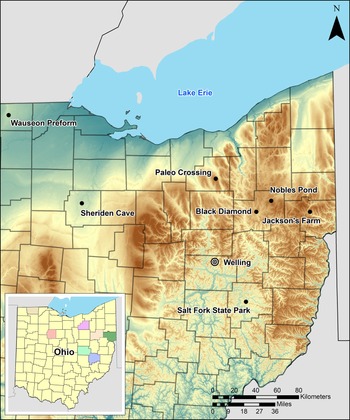
One important collection with a troubled research past is that from the Welling site in Coshocton County, Ohio. Welling is a multicomponent, stratified site with a substantial Clovis component in its lower levels (Figure 1). It is located in the Muskingum River drainage of east-central Ohio, specifically a “commanding position” at the mouth of the narrow Mohawk Creek valley on a glacial outwash terrace delineated by the confluence of two minor streams (Prufer and Wright Reference Prufer and Wright1970:259). The site faces northeast and is approximately 76 m in diameter. Directly in and around the site and surrounding hills are outcrops of Upper Mercer chert.
The Welling site, Coshocton County, Ohio, and surrounding Clovis occupations, including Paleo Crossing (Eren et al. Reference Eren, Redmond, Miller, Buchanan, Boulanger, Morgan, O'Brien and Gingerich2018), Sheriden Cave (Redmond and Tankersley Reference Redmond and Tankersley2005), Nobles Pond (Seeman et al. Reference Seeman, Summers, Dowd, Morris and Dancey1994), Jackson's Farm (Bebber, Miller, et al. Reference Bebber, Miller, Boulanger, Andrews, Redmond, Jackson and Eren2017), Black Diamond (Eren et al. Reference Eren, Miller, Buchanan, Boulanger, Bebber, Redmond, Coates, Boser, Sponseller and Slicker2019), Salt Fork State Park (Werner et al. Reference Werner, Jones, Miller, Buchanan, Boulanger, Key, Reedy, Bebber and Eren2017), and the Wauseon Preform (Eren, Redmond, et al. Reference Eren, Redmond, Miller, Buchanan, Boulanger, Hall and Hall2016). (Color online)

The Welling collection's problems began in 1967 when Olaf Prufer, the site's principal investigator (Supplemental Figure 1), moved to Amherst, Massachusetts, and began the process of analyzing the Paleoindian component from the Welling site. Prufer also began plotting the location of Paleoindian material at the site, focusing on excavated material. Unfortunately, early in 1968, a house fire consumed Prufer's home, resulting in the loss of most of the excavation documentation, field notes, and photographs (Prufer and Pedde Reference Prufer and Pedde1997). Furthermore, the map that Prufer had been using to plot artifact provenience was burned, although not completely destroyed in the conflagration (Supplemental Figure 2).
As detrimental a blow as the fire was, more problems followed. First, the site's collections were divided among Prufer's home institution of Kent State University (KSU; approximately 56,000 specimens), the Johnson-Humrickhouse Museum (JHM; several hundred specimens), and private collectors (an unknown number, but probably including several fluted points that are on record but not present at KSU or JHM). Second, because Prufer designated his excavation test units by the names of philosophers, academics, and musicians (e.g., the Keats unit, the Mills unit, the Milton unit) rather than by a coordinate grid system, we currently have no understanding of how each unit relates to any other unit in horizontal space across the site. Third, some individual tools and cores were pulled from their original unit boxes and placed in different boxes with similar artifact types, but without any sort of marking on the artifacts to indicate from where they had originally derived. Consequently, the proveniences for the artifacts are permanently lost.
Due to this series of unfortunate events, we are restricted in the types of questions we can investigate using the Welling assemblage and therefore limited in what we can learn about Welling's prehistoric occupants. Nevertheless, in recent years, several researchers have made the best of a frustrating situation by focusing their efforts on artifact-related issues. For example, Miller and colleagues (Reference Miller, Bebber, Rutkoski, Haythorn, Boulanger, Buchanan, Bush, Lovejoy and Eren2019) assessed the microwear on several diagnostic Clovis tools from Welling. In another example, Williams and colleagues (Reference Williams, Simone, Buchanan, Boulanger, Bebber and Eren2019) developed a new quantitative geochemical measure of toolstone quality and used it to assess the stone quality of Welling's Archaic and Woodland projectile points. Several chert sourcing studies are also currently in preparation, as is a radiocarbon assessment of recently discovered charcoal samples from the site. Here, we continue the investigation of the Welling site, but we focus on a holistic, assemblage-level analysis.
Clovis Settlement of the Great Lakes and Base Camps
The Clovis presence in the Great Lakes region appears to be a colonization pulse into a recently deglaciated landscape (e.g., Boulanger et al. Reference Boulanger, Buchanan, O'Brien, Redmond, Glascock and Eren2015; Ellis Reference Ellis2008, Reference Ellis2011; Eren Reference Eren2013; Jennings and Smallwood Reference Jennings and Smallwood2019; Loebel Reference Loebel2005). Although there are oft-repeated claims for a “pre-Clovis” presence in the Great Lakes—such as the Fenske, Hebior, Mud Lake, and Schaefer sites in southeastern Wisconsin—none of these is valid when scrutinized (Grayson and Meltzer Reference Grayson and Meltzer2015). As such, Clovis people colonized not only a recently deglaciated landscape but one that was probably entirely devoid of people. By the time Clovis people arrived, the Late Pleistocene Great Lakes was a “spruce parkland” (e.g., Ellis et al. Reference Ellis, Carr and Loebel2011; Eren Reference Eren, Shea and Lieberman2009).
As predicted from colonization theory (e.g., Meltzer Reference Meltzer and Jablonski2002, Reference Meltzer, Rockman and Steele2003, Reference Meltzer, Barton, Clark, Yesner and Pearson2004, Reference Meltzer2009), the Clovis colonization of the Great Lakes appears to have been archaeologically instantaneous, occurring around 11,000 BP (Ellis and Deller Reference Ellis and Deller2000:27; Gramly Reference Gramly1999; Jackson et al. Reference Jackson, Ellis, Morgan and McAndrews2000; Redmond and Tankersley Reference Redmond and Tankersley2005; Storck and Spiess Reference Storck and Spiess1994; Tankersley Reference Tankersley1996; Tankersley et al. Reference Tankersley, Vanderlaan, Holland and Bland1997; Waters et al. Reference Waters, Stafford, Redmond and Tankersley2009). Yet, there is a clear south-to-north colonization of the Great Lakes supported by toolstone-source-to-discard patterns (Ellis Reference Ellis2011; Ellis et al. Reference Ellis, Carr and Loebel2011; see also Anderson Reference Anderson, Tankersley and Isaac1990:190–196; Boulanger et al. Reference Boulanger, Buchanan, O'Brien, Redmond, Glascock and Eren2015; Loebel Reference Loebel2005; Simons Reference Simons, Jackson and Thacker1997:115–118; Tankersley Reference Tankersley, Tankerseley and Isaac1990:288, Figure 10). Current evidence suggests that Clovis colonizers primarily utilized a “collector-like” mobility strategy (e.g., Binford Reference Binford1980) that emphasized logistical mobility to and from large base camps (e.g., Eren and Buchanan Reference Eren, Buchanan and Gingerich2018; Eren et al. Reference Eren, Chao, Hwang and Colwell2012, Reference Eren, Miller, Buchanan, Boulanger, Bebber, Redmond, Coates, Boser, Sponseller and Slicker2019; Loebel Reference Loebel2005; Miller et al. Reference Miller, Bebber, Rutkoski, Haythorn, Boulanger, Buchanan, Bush, Lovejoy and Eren2019). These larger camps were situated in “staging areas” (Anderson Reference Anderson, Tankersley and Isaac1990, Reference Anderson, Nassaney and Sassaman1995, Reference Anderson, Anderson and Sassaman1996; Smallwood Reference Smallwood2012; Smith Reference Smith, Tankerseley and Isaac1990; Tankersley Reference Tankersley1995) that would be used to “gear up” with tools and supplies before migration north into the next potential staging area (Boulanger et al. Reference Boulanger, Buchanan, O'Brien, Redmond, Glascock and Eren2015; Eren et al. Reference Eren, Miller, Buchanan, Boulanger, Bebber, Redmond, Coates, Boser, Sponseller and Slicker2019; Miller et al. Reference Miller, Bebber, Rutkoski, Haythorn, Boulanger, Buchanan, Bush, Lovejoy and Eren2019). The stone technologies produced, carried, used, and resharpened were portable, maintainable, and flexible (Eren Reference Eren2011, Reference Eren2012, Reference Eren2013; Eren and Andrews Reference Eren and Andrews2013; Thomas et al. Reference Thomas, Story, Eren, Buchanan, Andrews, O'Brien and Meltzer2017; but see Buchanan et al. Reference Buchanan, Eren, Boulanger and O'Brien2015). Clovis tool producers in the Great Lakes appear to have centered their technology around stone flakes, even producing fluted points on flakes (Eren et al. Reference Eren, Redmond, Miller, Buchanan, Boulanger, Morgan, O'Brien and Gingerich2018) rather than emphasizing whole nodules or bifacial cores.
Relevant to this colonization context is whether the Welling Clovis was an outcrop-related base camp (Lepper Reference Lepper1986, Reference Lepper, Bonnichsen and Turnmire2005) or a lithic workshop (Prufer and Wright Reference Prufer and Wright1970; Seeman et al. Reference Seeman, Summers, Dowd, Morris and Dancey1994). On the one hand, if it had been an outcrop-related base camp, then the site would have served as a known, immobile “hub” (Waters et al. Reference Waters, Pevny and Carlson2011) on the landscape where several Clovis groups would have been able to not only meet and procure rock but learn, feast, play games, share stories and information around the campfire, renew old acquaintances, make new alliances, and mourn the passing of friends and family who had died in the past year (Lepper Reference Lepper, Bonnichsen and Turnmire2005:45; see also Eren et al. Reference Eren, Miller, Buchanan, Boulanger, Bebber, Redmond, Coates, Boser, Sponseller and Slicker2019; Meltzer Reference Meltzer2009; Miller et al. Reference Miller, Bebber, Rutkoski, Haythorn, Boulanger, Buchanan, Bush, Lovejoy and Eren2019). On the other hand, if Welling had been a lithic workshop, then it would have served only as a short-term locale where individual bands or task groups came to retool projectile points (Seeman et al. Reference Seeman, Summers, Dowd, Morris and Dancey1994:81). Determining the activities that took place at Welling and Welling's potential role in the Clovis colonization of the Great Lakes is important given the key role of outcrop-related base camps in a colonization pulse and the longer-term occupation of base camps in a “collector-like” mobility strategy (Miller et al. Reference Miller, Bebber, Rutkoski, Haythorn, Boulanger, Buchanan, Bush, Lovejoy and Eren2019; see also Carr Reference Carr, Michael Stewart, Stanford, Frank and Gingerich2013; Ellis Reference Ellis, Ellis and Lothrop1989; Eren et al. Reference Eren, Buchanan and O'Brien2015, Reference Eren, Miller, Buchanan, Boulanger, Bebber, Redmond, Coates, Boser, Sponseller and Slicker2019; Gardner Reference Gardner1977, Reference Gardner1983; Lepper Reference Lepper1986, Reference Lepper, Carr and Adovasio2002, Reference Lepper, Bonnichsen and Turnmire2005; Meltzer Reference Meltzer and Jablonski2002, Reference Meltzer, Rockman and Steele2003, Reference Meltzer, Barton, Clark, Yesner and Pearson2004, Reference Meltzer2009; Sholts et al. Reference Sholts, Stanford, Flores and Warmlander2012; Smallwood Reference Smallwood2010, Reference Smallwood2012; Waters et al. Reference Waters, Pevny and Carlson2011; Wright Reference Wright, Ellis and Lothrop1989). With respect to colonization pulses, Clovis sites such as Welling at the Upper Mercer outcrops would have been the gearing-up point for more northern Upper Mercer–dominated assemblages such as Gainey in Michigan or Lamb in New York (Eren et al. Reference Eren, Miller, Buchanan, Boulanger, Bebber, Redmond, Coates, Boser, Sponseller and Slicker2019). With respect to a “collector-like” mobility strategy, Welling could have been either a central hub connecting smaller camps and hunting locales—if it had been a base camp—or merely a resource procurement locale for a nearby non-outcrop-related base camp such as Nobles Pond in Ohio (Eren et al. Reference Eren, Miller, Buchanan, Boulanger, Bebber, Redmond, Coates, Boser, Sponseller and Slicker2019).
The hypothesis that Welling was an outcrop-related base camp has recently been supported by microwear analysis of its Clovis stone tools. Miller and colleagues (Reference Miller, Bebber, Rutkoski, Haythorn, Boulanger, Buchanan, Bush, Lovejoy and Eren2019) found that these tools possessed evidence of a variety of camp functions including dry- and fresh-hide scraping, hide cutting, meat butchering, sawing and scraping bone/antler, sawing and scraping wood, and plant scraping. The tools also showed evidence of transport. In sum, the microwear evidence suggested that Clovis foragers carried out a variety of base-camp activities and regularly traveled to and from the site. There should be little to no microwear evidence if Welling had only been a “lithic workshop” where Clovis foragers predominately retooled and discarded manufacturing failures.
One way to further support or question the hypotheses of whether Welling was a “base camp” or “lithic workshop” is via the creation of an experimental model against which the Welling Clovis assemblage can be compared (Eren and Andrews Reference Eren and Andrews2013; Eren, Lycett, et al. Reference Eren, Lycett, Patten, Buchanan, Pargeter and O'Brien2016; Lycett and Chauhan Reference Lycett, Chauhan, Lycett and Chauhan2010). Specifically, we used experimental stone tool replication on the same stone raw materials used by the Welling Clovis Paleoindians to better understand the size distribution of Clovis bifacial debitage on the assemblage level (e.g., Ahler Reference Ahler1989; Andrefsky Reference Andrefsky2007; Bradbury and Carr Reference Bradbury and Carr2004, Reference Bradbury and Carr2009; Bradbury and Franklin Reference Bradbury and Franklin2000). One of us (Eren) used hard and soft hammers to reduce nodules of Upper Mercer chert via archaeologists’ current understanding of Clovis biface reduction (e.g., Bradley et al. Reference Bradley, Collins and Hemmings2010; Eren and Buchanan Reference Eren and Buchanan2016; Jennings and Smallwood Reference Jennings and Smallwood2019; Smallwood Reference Smallwood2010, Reference Smallwood2012; Smallwood and Jennings Reference Smallwood and Jennings2015). We then compared the debitage size distributions of the experimental model assemblage against that of the Welling Clovis debitage.
We hypothesized that if Welling had been a lithic workshop and people had gone there sporadically “mainly to retool” (Seeman et al. Reference Seeman, Summers, Dowd, Morris and Dancey1994:81), then its Clovis debitage assemblage size distribution should match that of the experimental model assemblage, the latter representing a “pure” bifacial reduction assemblage. Alternatively, if Welling had been an outcrop-related base camp, then its Clovis debitage assemblage size distribution should not match that of the experimental model. This is because people would have been using Welling not only to produce tools but to use, resharpen, rejuvenate, and recycle their tools—all activities that would modify a “pure” Clovis bifacial debitage distribution.
Materials and Methods
The Welling Clovis Assemblage
Although Welling no longer possesses contextual data over horizontal space, it does still possess information regarding stratigraphy and artifact location in terms of depth. From what survives of the excavation documentation and the two short reports (Prufer and Pedde Reference Prufer and Pedde1997; Prufer and Wright Reference Prufer and Wright1970), we know that Welling was excavated using 5 × 5 ft (1.524 × 1.524 m) test units using arbitrary levels of either two or four inches to maintain vertical control (although sometimes levels exceeded this thickness; Miller et al. Reference Miller, Bebber, Rutkoski, Haythorn, Boulanger, Buchanan, Bush, Lovejoy and Eren2019). The stratigraphy consisted of three zones, designated “A,” “B,” and “C” (Prufer and Wright Reference Prufer and Wright1970). The A zone varied in thickness from 6 to 18 inches and consisted of redistributed yellow glacial outwash gravel (Blank Reference Blank1970; Prufer and Wright Reference Prufer and Wright1970). This top layer was a result of the redeposition of zone C from elsewhere (the result of the digging of a railroad cut in the 1890s; Prufer and Wright Reference Prufer and Wright1970:260). This redeposition functioned to effectively seal off the original land surface. The C zone is described as yellow clay-gravel outwash occurring on top of Wisconsin outwash. Zone B, situated between zones A and C, is a layer of brown-black clay loam varying in thickness from 10 to 16 inches (Blank Reference Blank1970). This is described as the result of a forest loam, which formed over time after the glacial retreat (Prufer and Wright Reference Prufer and Wright1970).
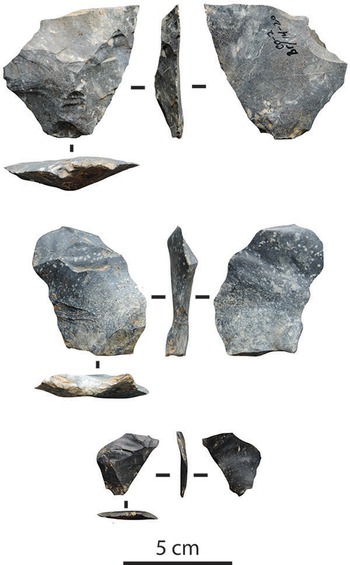
Welling appears to possess temporal/stratigraphic integrity in that almost all of the diagnostic Archaic materials are found in zone B or on the surface (Blank Reference Blank1970), whereas the diagnostic Clovis materials are predominantly found just above the surface of the yellow clay at the B/C boundary and below (Blank Reference Blank1970; Prufer and Pedde Reference Prufer and Pedde1997). Therefore, conservatively, we only selected for analysis the Welling artifact boxes whose uppermost depth was 13 inches (33.02 cm) below zone A, or 3 inches (7.62 cm) above the average depth of the B/C boundary. This process resulted in a presumed Clovis assemblage of 1,965 specimens, all of which are macroscopically consistent with Upper Mercer chert (Figure 2). Of these, 1,868 were debitage specimens included in the analyses presented below (see also Supplemental Materials).
Examples of bifacial debitage. The Welling collection is curated at the Ohio History Connection. (Color online)

As of August 2019, the entire Welling stone tool assemblage, previously housed at Kent State University, is now curated by the Ohio History Connection.
Stone Tool Replication
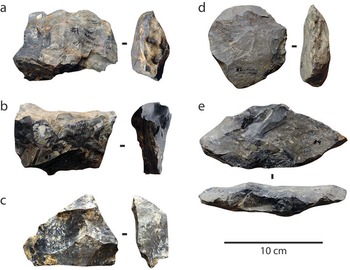
There was one core present in the Welling Clovis assemblage (Figure 3c), which was 321 g in mass, 91.37 mm in length, 82.47 mm in width, and 45.18 mm in thickness. We used this nodule as our template for selecting four similar nonarchaeological nodules of Upper Mercer chert for the experimental replication of Clovis bifacial tools (Table 1a). As shown in Figure 3, the Clovis core (Figure 3c) is morphologically comparable to the nodules selected for experimental Clovis biface reduction (Figure 3a, b, d, e). The Clovis core was slightly smaller than its experimental counterparts, due to the former having already had a few flake removals. The Clovis core also possessed less cortex, again, due to the flake removals, and it was less weathered than the experimental nodules.
Experimental Core Data: Unmodified Nodule Mass, Core Mass after 50% Mass Removal, and Final Core (Biface) Mass.

Flake Platform Types for the Welling and Experimental Assemblage.

The four experimental nodules (a, b, d, e) and the Welling Clovis core (c). (Color online)

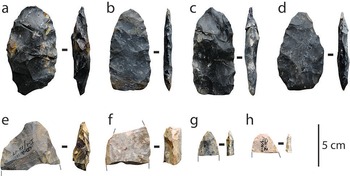
The experimental flintknapping was conducted by one of the authors (Eren), a knapper with nearly two decades of experience, who produced four Clovis late-stage bifacial tools, one from each experimental nodule. We limited our experimental models to an expert knapper in order to achieve a level of consistency among each nodule and to ensure that knapping products and debris readily recognizable as Clovis were produced. As shown in Figure 4, the four experimental bifaces (top row) are visually consistent with Clovis bifaces from Welling (bottom row) in terms of size, shape, and production. To further illustrate that the experimental bifaces and resulting experimental bifacial debitage assemblage are appropriate Clovis models, we conducted a statistical analysis of platform type frequencies. We assessed the proportions of broken, cortical, lineal, punctiform, and faceted platforms of all lithic specimens that possessed platforms. There was no statistical difference among the “flintknapper-prepared” platform types: lineal, punctiform, and faceted (χ2 = 0.98; df = 2; p = 0.612). However, when flintknapper-prepared and natural platform types were assessed together, there was a statistical difference (Table 1b; χ2 = 14.34; df = 4; p = 0.006). This comparison shows that the experimental assemblage possesses more broken and cortical platforms relative to Welling. These differences in the “natural” platform types are easily explained by the greater weathering of the experimental nodules likely experienced relative to the cores used by the Welling Clovis flintknappers. The broken and cortical platforms, however, are also the least abundant platform types in both the Welling and experimental debitage assemblages, together consisting of only 5.6% of the former and 14.8% of the latter (Table 1b). The other platform types—those most meaningful to production and the most abundant—are statistically identical in frequency between the Welling and experimental debitage assemblages.
The four replicated bifaces (top row) and examples of bifaces from the Welling assemblage (bottom row). (Color online)

After the first 50% of a core's mass was knapped, the debitage was collected and labeled as “early stage reduction.” After each core's knapping was finished—that is, the last 50% of a core's mass—the resulting debitage was again collected and labeled as “late stage reduction.” This procedure was repeated for each of the four experimental cores (Table 1a).
Analyses and Predictions
We compared the flake size distributions between Welling and the experimental assemblage in two ways. We first compared the maximum dimension distribution of the Welling flakes against the maximum dimension distribution of the entire experimental debitage sample. We then compared the mass distribution of the Welling flakes against the mass distribution of the entire experimental debitage sample. Consequently, we have two model comparisons examining “pure” bifacial tool productions that are potentially representative of a “lithic workshop.” If the Welling flake size distribution does not match either of these model iterations, then we can propose that Welling was not simply a lithic workshop, but instead an outcrop-related base camp where other sorts of activities significantly altered the flake size distributions.
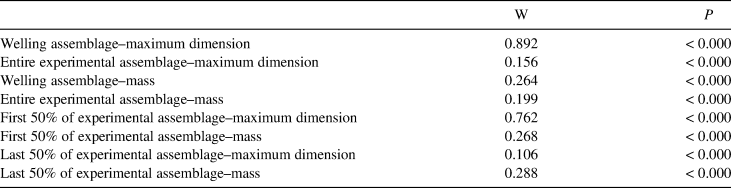
Prior to conducting our analyses, we examined the variables used in the analyses visually and with summary statistics, both of which indicated that the variables are significantly skewed (Supplemental Materials). We then carried out a Shapiro-Wilk test to statistically determine if the variables conformed to an underlying normal distribution (Table 2). Because the variables were significantly different from normal, we used nonparametric tests to examine differences in median, distribution equality, and variation between the Welling flake assemblage and the experimental flake assemblage. To test for differences in median maximum dimension and mass we used Mann-Whitney tests to make our comparisons. We used the Anderson-Darling test for equal distributions to compare the Welling and experimental distributions. The Anderson-Darling test has been shown to be more powerful and more sensitive to differences in the tails of distributions than the related Kolmogorov-Smirnov test (Engmann and Cousineau Reference Engmann and Cousineau2011). Lastly, we used the Fligner-Killeen test to compare coefficients of variation (hereafter, CV; Donnelly and Kramer Reference Donnelly and Kramer1999; Fligner and Kileen Reference Fligner and Killeen1976; see Buchanan et al. Reference Buchanan, O'Brien, David Kilby, Huckell and Collard2012). All of our statistical tests were run in PAST 3.23 (Hammer et al. Reference Hammer, Harper and Ryan2001).
Results of Shapiro-Wilk Tests for Normality on Flake Maximum Dimension and Mass for the Welling and Experimental Assemblages.

Results
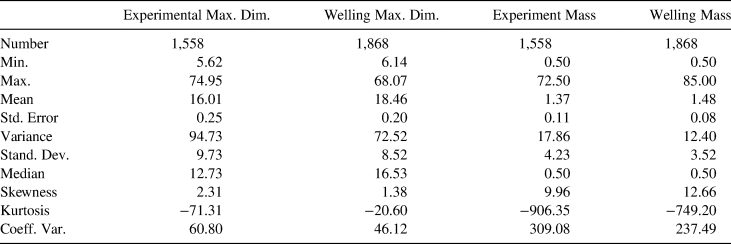
Comparison of summary statistics of the maximum dimension and mass of the Welling flake assemblage (n = 1,868) to the experimental flake assemblage (n = 1,558) indicates that, on average, the Welling assemblage is larger and has less variation for both variables (Table 3), although both variables for the assemblages are skewed. The results of the Mann-Whitney tests indicate that flake maximum dimension (U < 0.000; z = 12.98; p < 0.000) and mass are significantly different (U < 0.000; z = 10.47; p < 0.000), with the Welling assemblage having greater median maximum dimension and mass than the experimental assemblage. For both tests the effect sizes are small to medium (maximum dimension r = 0.22, mass r = 0.18). The results of the Anderson-Darling test indicate that the maximum dimension (z = 124.85; p < 0.000) and mass (z = 18,131; p < 0.000) distributions are significantly different. The CVs also differ, with the experimental assemblage being significantly more variable than the Welling assemblage for maximum dimension (z = 3.57; p = 0.0002) and mass (z = −6.08; p < 0.0000).
Summary Statistics for the Welling and Experimental Flake Assemblages for Maximum Dimension and Mass.

Discussion
We carried out three statistical tests comparing the flakes from the Welling Clovis assemblage to a model assemblage of flakes produced from experimental Clovis bifacial reduction, the results of which indicated statistical differences. These results suggest that the experimental flake assemblage is a poor model for Welling's flake assemblage: the latter does not match a “pure” biface reduction sequence assemblage. These results do not support the hypothesis that Welling was merely a “lithic workshop” where people briefly visited mainly to produce tools. Instead, the differences between the Welling and the experimental assemblage is consistent with the hypothesis that Welling was a outcrop-related base camp in which camp activities—tool use, resharpening, rejuvenation, function alteration—modified an otherwise “pure” Clovis bifacial tool debitage distribution.
The comparison of the Welling assemblage to the experimental model was consistent with the hypothesis of outcrop-related base camp in that the result of “statistically different” complied with the prediction of the hypothesis. Of course, it is possible that such conformity with the prediction could have also been achieved by other means. One potential way that differences between the Welling and experimental assemblages could arise is due to individual knapper variation. Although the experimental knapper in this study (Eren) successfully reproduced Clovis-like bifaces and used inferred Clovis production techniques, minor differences in terms of where flakes are removed, in what particular order they are removed, the frequency in which soft or hard hammers are used to remove them, the skill of the knapper, and other variables may still create significant differences between biface assemblages (Schillinger et al. Reference Schillinger, Mesoudi and Lycett2017). In other words, significant differences between the experimental model assemblage and the Welling assemblage may be present simply because bifacial flake size distributions are inherently variable due to individual knapper choices and skill. One way to further test this possibility is to have other modern knappers compare their bifacial reductions against the experimental and Welling flake size distributions. The data for both are present in the Supplemental Materials.
Another possible reason the Welling and the experimental assemblages were significantly different may have to do with stratigraphic mixing. Given that Welling was excavated during the 1960s, it is entirely possible there is more vertical mixing between layers than was understood or documented at the time. The mixing of younger debitage into the Clovis levels could be skewing the latter's flake size distributions. To test this possibility, field excavations should be carried out, which is feasible given that the site is currently protected by its private landowners.
A third possible reason that the Welling and the experimental assemblages were significantly different may have to do with sampling across the site. To our knowledge, the only surviving documentation of where excavation units were placed across the site is a photograph of a poster board (Supplemental Figure 3). Although this photograph does not reveal the names of individual excavation units, it does show that some areas of the site were excavated more intensely than others, whereas some areas of the site were not tested at all. Perhaps slope wash or some other factor influenced the Welling Clovis assemblage in a way that contributed to it being different from the experimental one. Future field excavations can test this possibility as well.
A fourth possible reason that the Welling and experimental assemblages were significantly different could be a result of core size and shape. Larger core sizes, or different core shapes, may yield different bifacial flake debitage size distributions. Here, we were intentionally explicit and specific in what we tested in that our experimental core sizes were based on what is actually present in the archaeological record at Welling. Although it is a good starting point, a greater variety of core sizes and shapes can be, and should be, examined in the future.
Finally, we note that there are a handful of “typical” Clovis reduction strategies across North America, including, but not necessarily limited to, bifacial, prismatic blade, bipolar, and amorphous (Bradley et al. Reference Bradley, Collins and Hemmings2010; Eren and Buchanan Reference Eren and Buchanan2016; Jennings and Smallwood Reference Jennings and Smallwood2019). Indeed, certain reduction strategies, such as prismatic blade reduction, are mostly Western or Southern Clovis phenomena, having mostly disappeared by the time Clovis foragers colonized parts of Great Lakes and northeastern North America (Eren Reference Eren2013; Eren, Chao, et al. Reference Eren, Chao, Chiu, Colwell, Buchanan, Boulanger, Darwent and O'Brien2016; Kilby Reference Kilby, Smallwood and Jennings2015). At Welling, current assessments of the collection suggest that bifacial reduction was the predominant, if not the only, reduction strategy. Consequently, our experimental models presented here were limited to bifacial reduction. It is entirely possible, however, that there is debitage from undocumented or unrecognized reduction strategies that are skewing the archaeological assemblages relative to the experimental bifacial model. This is why a profitable avenue for future research would be the assessment of mixed reduction sequence models.
Future work should certainly investigate the proposed tests outlined in the previous five paragraphs, and as such, following Bebber, Lycett, and Eren (Reference Bebber, Lycett and Eren2017:80), we stress the importance of the “consistent with” element of our results. Bebber, Lycett, and Eren (Reference Bebber, Miller, Boulanger, Andrews, Redmond, Jackson and Eren2017:80) also note, however, that multiple sets of data or distinct analyses can facilitate the support of a hypothesis. In this way, when taken together, the microwear analysis of Miller and colleagues (Reference Miller, Bebber, Rutkoski, Haythorn, Boulanger, Buchanan, Bush, Lovejoy and Eren2019) described in the introduction and the results presented here make a strong case for Welling as a Clovis outcrop-related base camp.
Consequently, we can ask, how exactly does Welling differ from the experimental model beyond overall flake size distribution? In other words, can further comparisons of the archaeological and experimental assemblages reveal how the Welling bifacial flake assemblage was being altered? To assess this question, we carried out follow-up analyses, in which we split the experimental assemblage into halves and grouped the flakes associated with the first 50% of the reduction sequence (by mass) and the last 50% of the bifacial reduction. We then compared both variables for the Welling assemblage with each half of the split experimental assemblage to assess which segment of the experimental bifacial assemblage best fits the Welling assemblage. To do this, we used a multivariate discriminant function analysis (DFA). We entered maximum dimension and mass into the analysis and used Welling, the first 50% of the experimental reduction, and the last 50% of the experimental reduction as the grouping category. The results show that the two discriminant functions (DF1 makes up 72.3% of the overall variation, and DF2 contains 27.7% of the overall variation) correctly classify flakes at a rate of 47.9% (derived using a jackknife procedure). Given this poor classification rate, it is clear that there is significant overlap in these datasets. If we compare the rate at which a flake from the first 50% of the experimental assemblage gets misclassified as coming from the Welling assemblage, however, this occurrence is nearly 3% more likely than a flake from the last 50% of the experimental assemblage being misclassified as coming from the Welling assemblage (162/543, or 30%, for the former; 277/1,015, or 27.3%, for the latter).
These latter findings—although highly provisional—suggest that the Welling assemblage is more similar to, or contains more of a signal of, an initial bifacial reduction sequence. Concomitantly, these results also mean that it was the later-stage Welling bifacial flakes being used, altered, or transported in such a way as to cause the Welling assemblage to differ significantly from the last 50% of the experimental model. The exact reason for this situation is not entirely clear. Presumably, later-stage flakes would likely be smaller, flatter, and thinner, and they would possess more acute-edge angles. Smaller flakes provide benefits in transport costs and maximizing utility per unit mass (Kuhn Reference Kuhn1994). Flatter flakes provide advantages in terms of resharpening and tool flexibility (Eren Reference Eren2013; Eren and Lycett Reference Eren and Lycett2012). In a base-camp context, thinner tools may be more easily retouched into delicate tools such as graver spurs, whereas flakes with sharp, acute-edge angles might be expediently seized for a quick cut, slice, or butchery. The presence of children at a base camp might also explain why the Welling assemblage differs significantly from the last 50% of the experimental model: small hands may prefer small flakes. In any case, a morphometric assessment of bifacial flakes throughout the reduction sequence may shed light on these speculations by pinpointing exactly how bifacial flake form differs between early- and late-stage flakes.
Another possible reason for the difference between the Welling debitage assemblage and the last 50% of the experimental model may have to do with teaching, skill, and novice knapping rather than flake use. Outcrops of stone have been suggested to be excellent locales for teaching flintknapping, and current evidence suggests that Clovis people did exactly that (Bradley et al. Reference Bradley, Collins and Hemmings2010; Eren et al. Reference Eren, Buchanan and O'Brien2015; Sholts et al. Reference Sholts, Stanford, Flores and Warmlander2012; Smallwood Reference Smallwood2010, Reference Smallwood2012; Waters et al. Reference Waters, Pevny and Carlson2011). If the teaching of novices is occurring at an outcrop-related base camp such as Welling, then the frequency of later-stage debitage will be less simply because novices will be less likely to reach later-stage biface production due to knapping errors and manufacturing failures. This explanation also may account for the reason the Welling debitage assemblage is less different from the first 50% of the experimental model.
To conclude, the Welling microwear results of Miller and colleagues (Reference Miller, Bebber, Rutkoski, Haythorn, Boulanger, Buchanan, Bush, Lovejoy and Eren2019) and the main results presented here are consistent with the hypothesis that the site was a Clovis outcrop-related base camp. However, much of the discussion above, especially the DFA, is less about making a case for any one explanation, and more about illustrating how productive the integration of experimental and archaeological data can be. The simple comparison of an experimental model to an archaeological collection presented here generated future experimental questions, testable inquiries involving future fieldwork, and hypotheses incorporating morphometrics, tool function, and social learning. We suggest, as have others, that the integration of collections analysis with experimental archaeology is increasingly becoming a critical source of new archaeological insight and findings (Eren and Bebber Reference Eren and Bebber2019; Magnani et al. Reference Magnani, Grindle, Loomis, Kim, Egbers, Clindaniel, Hartford, Johnson, Weber and Campbell2019; see also Surovell et al. Reference Surovell, Toohey, Myers, LaBelle, Ahern and Reisig2017). If we were to retest only a limited number of knapping variables discussed above—for instance, two more individual knappers, two more core sizes, and two more reduction sequences—this would result in eight additional experimental iterations, all of which should be compared against Welling. Add in two more core shapes, and we would have 16 experimental iterations. We, as a discipline, have our work cut out for us.
Such work, however, requires the preservation of collections—even troubled ones, such as Welling—in public repositories. Consequently, we facilitated Kent State's recent transfer of the Welling assemblage to the Ohio History Connection. Only the curation of the actual artifacts (as opposed to 3D scans, images, or recorded data) in public repositories ensures that all researchers have access to them. Such curation and access is not only the way to fully combat the “reproducibility crisis” (Marwick and Jacobs Reference Marwick and Jacobs2017; Marwick et al. Reference Marwick, Guedes, Barton, Bates, Baxter, Bevan, Bollwerk, Bocinsky, Brughmans, Carter, Conrad, Contreras, Costa, Crema, Daggett, Davies, Drake, Dye, France, Fullagar, Giusti, Graham, Harris, Hawks, Heath, Huffer, Kansa, Kansa, Madsen, Melcher, Negre, Neiman, Opitz, Orton, Przystupa, Raviele, Riel-Salvatore, Riris, Romanowska, Strupler, Ullah, Van Vlack, Watrall, Webster, Wells, Winters and Wren2017; Ram and Marwick Reference Ram, Marwick, Kitzes, Turek and Deniz2017; see also Haythorn et al. Reference Haythorn, Buchanan and Eren2018), but it also allows researchers to ask new questions of collections. As experimental archaeology continues to mature, surge in practitioners, and exert progressively more influence on archaeological interpretations and conclusions (Eren and Bebber Reference Eren and Bebber2019; Eren, Lycett, et al. Reference Eren, Lycett, Patten, Buchanan, Pargeter and O'Brien2016; Lin et al. Reference Lin, Rezek and Dibble2018; Magnani et al. Reference Magnani, Grindle, Loomis, Kim, Egbers, Clindaniel, Hartford, Johnson, Weber and Campbell2019), new questions will likely be posed at an increasingly furious pace. As a result, the curation and accessibility of both archaeological and experimental collections will become one of our discipline's most important challenges in the years and decades ahead.
Acknowledgments
Fernando Diez-Martin's research stay at Kent State University was made possible by the Salvador de Madariaga program of Spain's Ministry of Science, Innovation and Universities (grant PRX18/00054). Metin I. Eren is supported by the Kent State University College of Arts and Sciences.
Data Availability Statement
All data used in this manuscript are available online or in public repositories.
Supplemental Materials
For supplemental material accompanying this article, visit https://doi.org/10.1017/aaq.2020.81.
Supplemental Table 1. Data for test presented in the main text.
Supplemental Table 2. Extra data about the Welling assemblage.
Supplemental Figure 1. Excavations at the Welling site (top); the Welling site's principal excavator, Olaf Prufer (bottom left); a stone tool in situ (bottom right).
Supplemental Figure 2. Remnants of an artifact back-plot that survived Prufer's house fire.
Supplemental Figure 3. The only known documentation of where excavation units were placed on the Welling site.






Target article
Was Welling, Ohio (33-Co-2), a Clovis Basecamp or Lithic Workshop? Employing Experimental Models to Interpret Old Collections
Related commentaries (2)
Current Evidence Supports Welling as an Outcrop-Related Base Camp
Purpose at Welling: Additional Considerations Regarding Interpretation