


1. INTRODUCTION
Poverty indexes are essential for monitoring poverty, setting targets for poverty reduction, and tracking progress on these goals (Cranfield et al. Reference Cranfield, Preckel and Hertel2007; UNDP 2007; Pogge Reference Pogge2010). No single paper could review, never mind evaluate, every proposed poverty measure in the literature. This paper suggests, however, that further justification is necessary for using the main poverty indexes in the literature in any of these ways (including those the World Bank makes easily available for empirical research).Footnote 1 It does so by arguing that poverty should not decline with the mere addition of a rich person to a population. It, then, demonstrates that the standard poverty indexes do not satisfy this Weak Population Focus Axiom. Weak Population Focus is similar to, but less demanding than, what some have called the Poverty Focus and Non-Poverty-Invariance axioms (Subramanian Reference Subramanian2002; Paxton Reference Paxton2003).Footnote 2 So, it is significant that, unless the main poverty indexes in the literature are modified, they do not satisfy Weak Population Focus. In suggesting a modification of the standard indexes, this paper also isolates the reason why they fail to satisfy this axiom.Footnote 3
Unlike most work on poverty indexes that focuses on income as a proxy for poverty, this paper will not presuppose an answer to the question: ‘What is the proper basis for poverty measurement?’ Poverty may, for instance, be deprivation in the space of welfare, capabilities, resources, or opportunities. To stay neutral on the proper basis for poverty measurement, this paper will refer to this basis as need. It will refer to whatever alleviates need or brings someone up higher above the poverty line as a good. Material goods, capabilities, opportunities, and welfare may be goods in this sense and they may alleviate need.
Like most work on axiomatic poverty measurement, however, this paper will assume that there are better and worse answers to questions such as: ‘What is poverty?’ ‘How much poverty is there in a population?’ and ‘Which population is poorer?’ There may be room for multiple answers to these questions. What counts as poverty may, for example, be different in some contexts (e.g. in the USA and Peru).Footnote 4 Still, some things do not count as appropriate answers to the questions above. On any good account, for instance, most of the people living in the slums of New Delhi must count as poor.Footnote 5
Moreover, for simplicity, this paper will assume that we know each individual's poverty level and that full interpersonal comparisons of need are possible.Footnote 6 That is, it assumes that questions like ‘How do individual identities and histories matter to their poverty?’ and ‘Is poverty absolute or relative?’ have already been answered.Footnote 7
Keeping these preliminaries in mind, the first part of this paper will consider methods for calculating poverty. It will argue that, when the main indexes in the literature are interpreted as providing a measure of the poverty in a population, these indexes violate an axiom or intuition that Hassoun and Subramanian (Reference Hassoun and Subramanian2012) have called:
(1) Weak Population Focus: Poverty in a population is not reduced by changes in the non-poor population which leave the distribution of goods amongst the poor unchanged.Footnote 8
The next section will consider why the main indexes in the literature violate this axiom if they are interpreted as measures of poverty in a population. It will then explain how it is easy to modify these indexes to avoid this problem.
2. AXIOM FOR A PLAUSIBLE ACCOUNT OF POVERTY IN VARIABLE POPULATIONS
Before defending Weak Population Focus, it is important to distinguish between poverty in a population and related concepts like a population's poverty.Footnote 9 Considering two populations, X and Y, saying there is more poverty in population X than in Y means:
(1) X has more poverty than Y (that is: there is more poverty present in X than in Y).
This is not necessarily equivalent to the following statement about these populations’ poverty:
(2) X is poorer than Y (that is: X is less wealthy overall than Y).
If ‘poorer’ is the converse of ‘richer’ like, e.g. ‘worse’ is the inverse of ‘better’), (2) is equivalent to:
(3) Y is richer than X.
But (3) is not equivalent to (1). Suppose X and Y only contain rich people but each person in Y is much richer than each person in X. Y is richer than X but it is not the case that X has more poverty than Y. Neither contains any poverty at all.
Another way of seeing the distinction is to consider the following claims:
(4) Merely adding rich people to a population can make a population richer.
(5) Merely adding rich people to a population cannot reduce poverty.
(6) Making a population less poor is the same as making it richer.
(7) Making a population less poor is the same as reducing poverty.
Each of these claims is plausible on its own but, together, they are inconsistent.
Combining (4) and (6) we get:
(8) Merely adding rich people to a population can make a population less poor.
Combining (8) and (7) we get:
(9) Merely adding rich people to a population can reduce poverty.
This contradicts:
(5) Merely adding rich people to a population cannot reduce poverty.
The problem is that ‘less poor’ is ambiguous – it may mean ‘more rich’ or ‘contain(s) less poverty’. The first definition is only clearly appropriate when we are considering a population's poverty.Footnote 10 Judgements about a population's poverty entail that if population A is poorer than B, B is richer than A. Saying there is more poverty in population A than B means A has more poverty than B but does not necessarily entail B is richer than A. Rather, this paper will argue that this claim is false.
It is also possible to distinguish between the poverty in a population and the average poverty.Footnote 11 The later will presumably divide the poverty in the population by the population size. Though, there are many possible measures of both the poverty in a population and the average poverty.
Keeping these distinctions in mind, it is possible to put this paper's point this way: it may be precisely because people have not distinguished carefully between the poverty in a population and related concepts like a population's poverty or the average poverty that most poverty indexes entail that merely adding a rich person to a population reduces poverty. This may be appropriate where we are concerned about a population's poverty (and ‘poorer’ is the inverse of ‘richer’) or the average poverty. It is not clearly true that merely adding rich people to a population will reduce the poverty in a population. Rather, this paper will argue that merely adding rich people to a population will not reduce the poverty in a population.
More precisely, this paper suggests adopting Weak Population Focus on which the poverty in a population cannot decline with additions to the rich population that leave the number and needs of the poor unchanged (though a population's poverty or the average poverty may decline with additions to the rich population that leave the number and needs of the poor unchanged). The rich may, of course, do a lot to alleviate poverty in a population. They might voluntarily or involuntarily give money (or other things) to the poor or their money (etc.) might trickle down to the poor. But, their mere existence in a population does not reduce poverty in a population. To illustrate the import of this axiom consider the following population:
Figure 1.

Here the (dotted) poverty line is at three units of good. The first person, P1, has one unit of good, so needs two units to reach the poverty line. The second person, P2, has two units of good, so needs one more unit to reach the poverty line. The last person, P3, has more than three units of good, so is not poor. The Weak Population Focus Axiom suggests that simply adding more people who can meet their needs to the population does not reduce its poverty. So, adding an additional person P4 who can meet his or her needs to the population does not reduce the poverty in the population.
Figure 2.
Nor would poverty in this population decline if P4 were much richer or there were additional rich people in it.
If some of the rich become poor, the poverty in a population might change. Even if some poor become rich at the same time, one might say poverty in the population has increased. This might be so if the newly poor are poorer than the newly rich were when they were poor or if there are more poor people.
As Amartya Sen puts it, it is also important to distinguish between descriptive indexes which are concerned with ‘the state of the poor’ and indexes intended to measure other things like a population's ‘potential ability to meet the challenge of poverty’ (Sen Reference Sen1981: 190). The burden of poverty might, for instance, be less if rich people are added to a population and nothing else changes.Footnote 12 That is, it might be much easier to alleviate poverty by redistributing some goods from the rich to the poor. There may also be some respects in which adding rich people to a population makes it better (or worse) than the initial population. The new population might be better able to support the arts or sciences. Still, the mere addition of P4 does not in itself reduce poverty in this population.Footnote 13
The intuition supporting Weak Population Focus is along the same lines as the intuition Sen expresses in objecting to the idea ‘that some increase in the income shortfall of the poor may be compensated by a sufficiently high rise in the income of the non-poor’ (Sen Reference Sen1981: 190). He says ‘poverty is a characteristic of the poor, and a reduction of the incomes of the poor must increase the measure of poverty, no matter how much the incomes of the non-poor go up at the same time’ (Sen Reference Sen1981: 190). Similarly, if poverty is a characteristic of the poor, an increase in the number of rich people should not alone reduce poverty in a population. A change in the number of rich people does not affect the poor any more than if the incomes of the rich increase. That is, adequate measures of poverty in a population will satisfy Weak Population Focus.
One might, however, object to Weak Population Focus by noting that, even though a measure of the poverty in a population is not necessarily a measure of how it is best to fulfil needs, these things are related. Perhaps the best explanation for intuitions about how it is best to meet need is that poverty in a population decreases when the only change is that more people who can meet their needs are added to the population. Consider an argument for this conclusion inspired by David Miller's work on how we should fulfil need. Miller is concerned with distribution according to need and claims that it is important, in deciding whom to help, to consider not only P1's claims vs. P2 and P3's claims but P1's claims against P4's claims (e.g. to what they need). He believes it is important to consider ‘the relative position of everyone’ in determining whom we should aid in a population (Miller Reference Miller1999: 219). Miller thinks it is better to help those in the middle of the stack when there are a greater number of rich people around. Perhaps this is because poverty in the population with more rich people is worse. This might support the intuition that it is best to ‘equalize degrees of unmet need, which means distributing in favor of those in greater need until they are brought up to the same level as others’ (Miller Reference Miller1999: 74).
Miller suggests that his intuition about how to distribute according to need underlies some empirical evidence from experiments in social psychology. In one experiment, there were two students, one of whom needed extra money for books. Subjects had to decide how to split a set amount of money between them. Most subjects wanted to give the needy student enough to buy the textbooks before splitting the rest equally (Miller Reference Miller1999: 74). In another experiment, intended to mimic John Rawls’ original position, subjects had to choose the rules for remuneration for work they were to perform. Most subjects chose to maximize average income subject to a floor constraint.
The empirical evidence does not support Miller's intuition about how to distribute according to need so one cannot use this evidence to argue that there is less poverty in a population when the only change is that more people who can meet their needs are added to the population. The first experiment only provides evidence that sometimes people will try to help others meet their needs before distributing the remaining goods equally. The second experiment only provides evidence that most people want to provide a flat minimum for everyone (Frohlich and Oppenheimer 1992; Miller Reference Miller1999: 79). The results just show that people are concerned about need, not that ‘people will aim to equalize degrees of unmet need’ (Miller Reference Miller1999: 74).Footnote 14 The evidence does not support Miller's intuition about what distribution according to need requires (Hassoun Reference Hassoun2008). Hence, one cannot argue that the best explanation for why people share Miller's intuition about how we should meet need is that poverty in a population decreases when the only change is that more people who can meet their needs are added to the population. Unless there is a better reason to reject Weak Population Focus, we should accept it.
3. PROBLEMS WITH THE EXISTING POVERTY INDEXES AND A SOLUTION
Many of the most common poverty indexes fail to satisfy the Weak Population Focus Axiom because these indexes normalize for population size by dividing by the total number of people in the population. These indexes are better interpreted as measures of the average poverty. Consider the simplest example – the Headcount Index (H) which measures the proportion of people below the poverty line.
 \begin{equation}
H = q/n\end{equation}
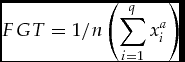
n is the number of people in the population and q the number of people who have an amount of good yi less than the amount necessary to reach the poverty line z. The problem is that adding a person above the poverty line to the population only increments n and, so, poverty declines. Many other common poverty indexes fail to satisfy Weak Population Focus. The Appendix demonstrates that this is so for Sen's Index and the Sen-Shorrocks-Thon Index. Consider, here, just the Foster, Greer, Thorbecke (FGT) Index (Foster et al. Reference Foster, Greer and Thorbecke1984).
 \begin{equation}
FGT = 1/n\left(\sum\limits_{i = 1}^q {x_i^a } \right)\end{equation}
x i is the poverty gap of individual i that is (z − yi)/z. Since ∑qi = 1xi aaggregates the (weighted) poverty gaps of the poor only, it is unchanged by the mere addition of a rich person to a population. Because the addition of a rich person increases n, however, poverty declines on the FGT when the only change is that a rich person is added to the population.
It, thus, seems that some justification is necessary for using the main poverty indexes in the literature in tracking poverty, setting poverty reduction targets, and so forth. If one is concerned to measure the poverty in a population, one should not use these indexes because they suggest poverty decreases with the mere addition of a rich person to a population. These indexes are better interpreted as providing measures of a population's poverty or the average poverty.
If the above indexes are interpreted as measuring a population's poverty or the average poverty, it is easy to see how to modify them to arrive at a measure of the poverty in a population: Do not divide by the total number of people in the population. So, for instance, H would just become q and the FGT would become the Aggregate Gap Index: ∑qi = 1xi a. Modifying the standard poverty indexes in this way will ensure that they satisfy Weak Population Focus.
Moreover, there seems to be some reason to accept a version of the Aggregate Gap Index as a measure of the poverty in a population. As least this is so if researchers can arrive at the correct account of individuals’ poverty. The Aggregate Gap Index (with a = 1) just adds up each individual's poverty. So it is plausible to hold that the Aggregate Gap Index yields the (total) poverty in a population.Footnote 15
4. CONCLUSION
This paper argued that the main poverty indexes in the literature may not be appropriate for tracking poverty, setting poverty reduction goals, and monitoring progress in meeting those targets. If the main poverty indexes in the literature are interpreted as measures of poverty in a population and are not modified, they unintuitively suggest that poverty in a population declines with the mere addition of rich people. So some justification for using these indexes is necessary, especially since it is easy to modify them so that they satisfy Weak Population Focus. Moreover, assuming that researchers can arrive at the proper basis for poverty measurement, there is some reason to accept the Aggregate Gap Index as a measure of poverty in a population; there is reason to believe it tells us the sum-total amount of poverty in the population. In any case, further work on variable population poverty comparisons is pressing and important.
APPENDIX
Consider the Sen-Shorrocks-Thon Index (SST) and Sen's Index (S) Here is the SST:
 \begin{equation}
{\rm P}^{SST} (a;z) = \sum\limits_{i = 1}^q {((2(n - i)) + 1)/n^2 )((z - x_i )/z)^{} }\end{equation}
Here is S:
PS(a; z) =
 \begin{equation}
P^S (a;z) = 2/((q + 1)nz)\sum\limits_{i = 1}^q {(q + 1 - i)(z - x_i )}\end{equation}
where a is a vector of goods, n is the number of people in the population, q is the number of poor individuals in the population, i is the order of the individuals in the distribution of goods – where n has the most, and x i is the amount of good individual i has.
It is easy to demonstrate that the SST and S do not satisfy Weak Population Focus.Footnote 16 It will suffice to present a counter-example. Consider the following vectors of goods x and y such that y is derived from x by the addition of a non-poor person. Without loss of generality, supposing an exclusive definition of poverty (that is that those with 0 good do not count as poor), and in line with the statement above, let x = (0, z) and y = (0, z, z), where z denotes the poverty line.
Proposition 1. The Sen-Shorrocks-Thon index (SST) does not satisfy Weak Population Focus.
Proof.
We have:
 \begin{equation}
P^{\rm SST} ((0,z);z) = {{(2^{\ast} 1 + 1)}}/{{2^2 }} {}^{\ast} (z/z) + {{(2^{\ast} 0 + 1)}}/{{2^2 }} {}^{\ast} ({0}/{z}) = 3/4\\
P^{\rm SST} ((0,z,z);z) = {{(2 {}^{\ast} 2 + 1)}}/{{3^2 }} {}^{\ast} (z/z) + 0 + 0 = 5/9\end{equation}
So according to the SST, poverty in y < x. This violates Weak Population Focus. ●
Proposition 2. The Sen Index (S) does not satisfy Weak Population Focus.
Proof:
We have:
 \begin{equation}
P^S ((0,z);z) = {2}/{{(2 {}^{\ast} 2 {}^{\ast} z)}} {}^{\ast} (1 {}^{\ast} (z)) = {1}/{{(2z)}} {}^{\ast} z = 1/2\\
P^S ((0,z,z);z) = {2}/{{(2 {}^{\ast} 3 {}^{\ast} z)}} {}^{\ast} (1 {}^{\ast} z) = {1}/{{(3z)}} {}^{\ast} z = 1/3\end{equation}
So according to S, poverty in y < x. This violates Weak Population Focus. ●



