1 Introduction
1.1 Summary
The study of the Weihrauch lattice aims to measure the computability theoretic difficulty of finding a choice function witnessing the truth of a given
 $\forall \exists $
-theorem (cf. [Reference Brattka, Gherardi, Pauly, Brattka and Hertling3]) as an analogue of reverse mathematics [Reference Simpson19]. In this article, we investigate the uniform computational contents of the axiom of choice
 $\Sigma ^1_1$
-AC and dependent choice
 $\Sigma ^1_1$
-DC for
 $\Sigma ^1_1$
formulas in the context of the Weihrauch lattice.
The computability-theoretic strength of these choice principles is completely independent of their proof-theoretic strength, since the meaning of an impredicative notion such as
 $\Sigma ^1_1$
is quite unstable among models of second-order arithmetic. Nevertheless, it is still interesting to examine the uniform computational contents of
 $\Sigma ^1_1$
-AC and
 $\Sigma ^1_1$
-DC in the full model
 $\mathcal {P}\mathbb {N}$
. For instance, this setting is particularly relevant for descriptive set theory and related areas, and indeed, the complexity of the axiom of choice has already been studied a lot in descriptive set theory, under the name of uniformization.
For a set
 $A\subseteq X\times Y$
define the x-th section of A as
 $A(x)=\{y\in Y:(x,y)\in A\}$
. We say that a partial function
 $g\colon \!\!\!\subseteq X\to Y$
is a choice function for A if
 $g(x)$
is defined and
 $g(x)\in A(x)$
whenever
 $A(x)$
is nonempty. Such a choice function is also called a uniformization of A. In descriptive set theory and related areas, there are a number of important results on measuring the complexity of choice functions: Let X and Y be standard Borel spaces. The Jankov–von Neumann uniformization theorem (cf. [Reference Kechris13, Theorem 18.1]) states that if A is analytic, then there is a choice function for A which is measurable w.r.t. the
 $\sigma $
-algebra generated by the analytic sets. The Luzin–Novikov uniformization theorem (cf. [Reference Kechris13, Theorem 18.10]) states that if A is Borel each of whose section is at most countable, then there is a Borel-measurable choice function for A. Later, Arsenin and Kunugui (cf. [Reference Kechris13, Theorem 35.46]) showed that the same holds even if each section is allowed to be
 $\sigma $
-compact.
In our setting, (a
 $\Sigma ^1_1$
definition
 $\varphi _A$
of) a set
 $A\subseteq X\times Y$
is considered to be an instance of the “uniformization problem,” and any choice function
 $g_A:\subseteq X\to Y$
for A to be a solution of the instance. Then we examine the degree of difficulty of such a transformation
 $\varphi _A\mapsto g_A$
. In other words, we investigate not only the complexity of a choice function
 $g_A$
itself, but also of the uniform content
 $\varphi _A\mapsto g_A$
of the uniformization problem. By the technique of relativization one can solve problems in this area with results about uniform choice. Also, uniform results can be more precise and one can wonder whether results about non-uniform choice are still true in their uniform version.
The main tool for comparing these degrees of difficulty is Weihrauch reduction. The notion of Weihrauch degree is used as a tool to classify certain
 $\forall \exists $
-statements by identifying
 $\forall \exists $
-statements with a partial multivalued function. Informally speaking, a (possibly false) statement
 $S\equiv \forall x\in X\;[Q(x)\rightarrow \exists yP(x,y)]$
is transformed into a partial multivalued function
 $f\colon \!\!\!\subseteq X\rightrightarrows Y$
such that
 $\text {dom}(f)=\{x:Q(x)\}$
and
 $f(x)=\{y:P(x,y)\}$
. Then, measuring the degree of difficulty of witnessing the truth of S is identified with that of finding a choice function for f. Here, we consider choice problems for partial multivalued functions rather than relations in order to distinguish the hardest instance
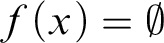 $f(x)=\emptyset $
and the easiest instance
 $x\in X\setminus \text {dom}(f)$
.
In this article, we only consider subspaces of
 $\mathbb {N}^{\mathbb {N}}$
, so we can use the following version of Weihrauch reducibility. For partial multivalued functions
 $f,g$
, we say that f is Weihrauch reducible to g (written
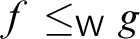 $f\leq _{\mathsf {W}}g$
) if there are partial computable functions
 $h,k$
such that
 $x\mapsto k(x,G\circ h(x))$
is a choice for f whenever G is a choice for g. In other words,
 $$ \begin{align*} (\forall x\in\text{dom}(f))(\forall y)\;[y\in g(h(x))\implies k(x,y)\in f(x)]. \end{align*} $$
In recent years, a lot of researchers have employed this notion to measure uniform computational strength of
 $\forall \exists $
-theorems in analysis as an analogue of reverse mathematics. Roughly speaking, the study of the Weihrauch lattice can be thought of as “reverse mathematics plus uniformity minus proof theory.” But this disregard for proof theory provides us a new insight into the classification of impredicative principles as we see in this article. For more details on the Weihrauch lattice, we refer the reader to a recent survey article [Reference Brattka, Gherardi, Pauly, Brattka and Hertling3].
Coming back to our study of analytic axioms of choice, we write
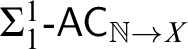 $\Sigma ^1_1\mbox {-}\mathsf {AC}_{\mathbb {N}\to X}$
for the independent axiom of countable choice on X seen as a partial multivalued function. As the countable axiom of choice corresponds to countably many independent choice, it is noted in Observation 2.1 that this Weihrauch problem corresponds to the parallelization of the
 $\Sigma ^1_1$
single choice,
 $\widehat {\Sigma ^1_1\mbox {-}\mathsf {C}_X}$
. In particular,
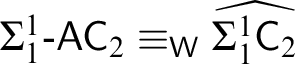 $\Sigma ^1_1\mbox {-}\mathsf {AC}_2\equiv _{\mathsf {W}}\widehat {\Sigma ^1_1{\mathsf {C}}_2}$
. The dependent choice
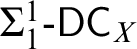 $\Sigma ^1_1\mbox {-}\mathsf {DC}_X$
corresponds to finding a path through a
 $\Sigma ^1_1$
tree, where a finite path contains the choices already made, and the possible extensions the choices to come. For instance, we note in Observation 2.3 that
 $\Sigma ^1_1\mbox {-}\mathsf {DC}_2\equiv _{\mathsf { W}}\Sigma ^1_1\mbox {-}\mathsf {WKL}$
, the problem of finding an infinite path in a binary
 $\Sigma ^1_1$
tree (see Section 2.1). We have the following, proved in Proposition 2.5:
Fact 1.1. We have
 $\Sigma ^1_1\mbox {-}\mathsf {DC}_{2}\equiv _{\mathsf {W}}\Sigma ^1_1\mbox {-}\mathsf {AC}_{\mathbb {N}\to 2}$
.
However, using the equivalences noted in the above paragraph, Lemma 4.7 in [Reference Kihara, Marcone and Pauly14] asserts:
Fact 1.2 (Kihara, Marcone, and Pauly [Reference Kihara, Marcone and Pauly14, Lemma 4.7])
In contrast to the previous fact, we have
 $\Sigma ^1_1\mbox {-}\mathsf {AC}_{\mathbb {N}\to \mathbb {N}}\not \leq _{\mathsf {W}}\Sigma ^1_1\mbox {-}\mathsf { DC}_{2}$
.
This suggests the following question about dependent and independent choices when the objects are chosen from subsets of the integers:
Question 1.3 (Brattka et al. [Reference Brattka, Gherardi, Hölzl, Nobrega and Pauly2] and Kihara et al. [Reference Kihara, Marcone and Pauly14, Question 4.10])
Do we have
 $\Sigma ^1_1\mbox {-}\mathsf {DC}_{\mathbb {N}}\leq _{\mathsf {W}}\Sigma ^1_1\mbox {-}\mathsf {AC}_{\mathbb {N}\to \mathbb {N}}$
?
Note that this question was not asked in these terms in [Reference Brattka, Gherardi, Hölzl, Nobrega and Pauly2] and [Reference Kihara, Marcone and Pauly14, Question 4.10]; however, the two formulations are equivalent by Proposition 2.2.
To negatively solve this question, we will employ the notion of a pseudo-hierarchy: A remarkable discovery by Harrison is that some non-well-ordering
 $\prec $
admits a transfinite hierarchy based on an arithmetical formula. Furthermore, a basic observation is that, without deciding if a given countable linear ordering
 $\prec $
is well-ordered or not, one can either produce an arithmetical transfinite hierarchy along
 $\prec $
or construct an infinite
 $\prec $
-decreasing sequence. Indeed, we will see that the degree of difficulty of such a construction is quite close to that of uniformizing analytic sets with compact sections, which is drastically easier than deciding well-orderedness of a countable linear ordering.
In conclusion, we have an interesting difference between countable choice on 2 and on
 $\mathbb {N}$
: In the former, independent and dependent choices correspond, while in the latter they differ. One can wonder when this transition happens, for various restrictions of the set we choose from. Many restrictions on the principle of choice on a single set have already been studied, as for instance those defined in [Reference Brattka, Gherardi, Pauly, Brattka and Hertling3, Definition 7.4]. In this article, we will study the axioms of dependent and independent countable choices for the restrictions to finite, cofinite, all-or-finite, all-or-unique, and finite-or-cofinite sets of natural numbers. In summary, we will show the following in the Weihrauch context:
-
• Countable choice on finite
 $\Sigma ^1_1$
sets is strictly easier than countable choice on all-or-finite
$\Sigma ^1_1$
sets (Corollary 3.13).
-
• Countable choice on cofinite
$\Sigma ^1_1$
sets is incomparable with countable choice on (all-or-)finite
$\Sigma ^1_1$
sets (Corollary 3.19). -
• Countable choice on all-or-finite
$\Sigma ^1_1$
sets is strictly easier than countable choice on
$\Sigma ^1_1$
sets (Corollary 3.19). -
• Countable choice on finite
$\Sigma ^1_1$
sets has the same difficulty (modulo arithmetical equivalence) as some disjunctive form of arithmetical transfinite recursion (Theorem 2.12). -
• Countable choice on (all-or-)finite
$\Sigma ^1_1$
sets has the same difficulty as dependent choice on (all-or-)finite
$\Sigma ^1_1$
sets (Theorems 3.3 and 3.10). -
• Countable choice on
$\Sigma ^1_1$
sets is strictly easier than dependent choice on
$\Sigma ^1_1$
sets (Theorem 3.30).


1.2 Preliminaries
1.2.1 Weihrauch reducibility
We use several operations on the Weihrauch lattice (see also [Reference Brattka, Gherardi, Pauly, Brattka and Hertling3, Reference Brattka and Pauly4]). Given a partial multivalued function f, the parallelization of f is defined as follows:
 $$ \begin{align*} \widehat{f}((x_n)_{n\in\mathbb{N}})=\prod_{n\in\mathbb{N}}f(x_n)=\{(y_n)_{n\in\mathbb{N}}:(\forall n)\;y_n\in f(x_n)\}. \end{align*} $$
If
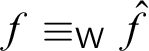 $f\equiv _{\mathsf {W}}\hat {f}$
, then we say that f is parallelizable. Given partial multivalued functions f and g, the compositional product of f and g (written
 $g\star f$
) is a function which realizes the greatest Weihrauch degree among
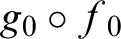 $g_0\circ f_0$
for
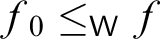 $f_0\leq _{\mathsf {W}}f$
and
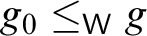 $g_0\leq _{\mathsf {W}}g$
. It is known that such an operation
 $\star $
exists. For basic properties of parallelization and compositional product, see also [Reference Brattka and Pauly4].
1.2.2 Analytic sets as co-enumeration
In this article, we are mainly interested in analytic sets, in other words in sets that are
 $\Sigma ^1_1$
relative to some oracle A. It is well-known that
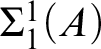 $\Sigma ^1_1(A)$
sets can be seen as a co-enumeration process along
 $\omega _1^A$
(the supremum of all A-computable ordinals), where at each step the co-enumeration is
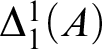 $\Delta ^1_1(A)$
in a uniform manner. This is one of the most fundamental ideas in the study of
 $\Sigma ^1_1$
sets; see any textbook on hyperarithmetic theory or higher computability theory, cf. [Reference Hinman12].
This fact essentially follows from the Spector–Gandy theorem, i.e.,
 $\Pi _1(L_{\omega _1^{\text {CK}}})=\Sigma ^1_1$
. More precisely,
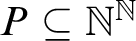 $P\subseteq \mathbb {N}^{\mathbb {N}}$
is
 $\Sigma ^1_1$
if and only if there is a
 $\Pi _1$
formula
 $\varphi $
in the language of set theory such that
 $X\in P\iff L_{\omega _1^{X}}[X]\models \varphi (X)$
. Obviously, this idea is uniformly relativizable to any oracle by applying the above equivalence to a universal
 $\Sigma ^1_1$
set which parametrizes all analytic sets (and then consider its cross-sections).
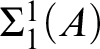
One can utilize this fact to describe a construction of a
 $\Sigma ^1_1(A)$
set as a uniform (co-enumeration) algorithm along an
 $\omega _1^A$
-step computation. There are a lot of recursion-theoretic frameworks to rigorously describe the idea of ordinal step computations, such as admissible sets, norms, and inductive operators; see e.g., [Reference Hinman12, Reference Moschovakis17]. In particular, we use the following notions:
A
 $\Pi ^1_1$
-norm on a
 $\Pi ^1_1$
set
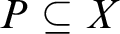 $P\subseteq X$
, where X is either
 $\mathbb {N}$
or
 ${\mathbb {N}^{\mathbb {N}}}$
, is a map
 $\varphi \colon X\to \omega _1\cup \{\infty \}$
such that
 $\forall x\in X, (\varphi (x)<\omega _1^{x}\lor \varphi (x)=\infty )$
, such that
 $P=\{x\in X:\varphi (x)<\infty \}$
, and such that the following relations
 $\leq _\varphi $
and
 $<_\varphi $
are
 $\Pi ^1_1$
:
 $$ \begin{align*} a\leq_\varphi b\iff \varphi(a)<\infty\mbox{ and }\varphi(a)\leq\varphi(b),\\ a<_\varphi b\iff\varphi(a)<\infty\mbox{ and }\varphi(a)<\varphi(b). \end{align*} $$
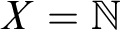
In our case, we will focus on the case where
 $X=\mathbb {N}$
. In this case,
 $\varphi $
has value in
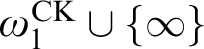 $\omega _1^{\text {CK}}\cup \{\infty \}$
. It is well-known that every
 $\Pi ^1_1$
set admits a
 $\Pi ^1_1$
-norm (in an effective, uniform, manner): Consider a many-one reduction from a
 $\Pi ^1_1$
set P to the set
 $\text {WO}$
of well orderings. Then we define
 $P_\alpha =\{n:\varphi (n)<\alpha \}$
, which is a
 $\Delta ^1_1$
set, and if
 $\alpha $
is limit then we have
 $P_\alpha =\bigcup _{\beta <\alpha }P_\beta $
. If
 $n\in P_\alpha $
, it is natural to say that n is enumerated into P by step
 $\alpha $
. Similarly, a
 $\Sigma ^1_1$
set S can be written as the intersection
 $S=\{S_\alpha :\alpha <\omega _1^{\text {CK}}\}$
of a decreasing sequence of
 $\Delta ^1_1$
sets, and if
 $n\not \in S_\alpha $
, we say that n is removed from S by step
 $\alpha $
. We often use some other sentences which have similar meanings.
This argument is uniformly relativizable to any oracle by using a
 $\Pi ^1_1$
norm on a
 $\Pi ^1_1$
set which parametrizes all coanalytic sets (cf. [Reference Moschovakis17]). In particular, every
 $\Sigma ^1_1(A)$
set can uniformly be seen as a co-enumeration of
 $\Delta ^1_1(A)$
sets, of length
 $\omega _1^{\text {CK}}$
. In the case of a
 $\Sigma ^1_1$
set
 $P\subseteq {\mathbb {N}^{\mathbb {N}}}$
, P can be seen as a coenumeration of length
 $\omega _1$
, where an element x can only be removed before stage
 $\omega _1^{x}$
.
The reversal is also well-known (which is essentially Kleene’s HYP quantification, whose uniform version is also clearly effective). This fact can also be presented as an ordinal step construction as follows: If we describe a
 $\Delta ^1_1$
rule
 $\Gamma \colon P_{<\alpha }\mapsto P_\alpha $
, which satisfies the property
 $R\subseteq \Gamma (R)$
, then the least fixed point P of
 $\Gamma $
is
 $\Pi ^1_1$
; and indeed the iteration
 $(\Gamma ^\alpha (\emptyset ))_\alpha $
always stabilizes to the fixed point at
 $\omega _1^{\text {CK}}$
steps, i.e.,
 $P=\bigcup \{P_\alpha :\alpha <\omega _1^{\text {CK}}\}$
. Such a
 $\Gamma $
is known as a
 $\Delta ^1_1$
inductive operator, which is a fundamental notion in generalized recursion theory, cf. [Reference Hinman12]; see also [Reference Moschovakis17, Section 7C] for uniformity. A typical example of a
 $\Delta ^1_1$
inductive operator is the standard construction of the H-hierarchy of Turing jumps (see also Section 2.4). Similarly, if we describe a
 $\Delta ^1_1$
rule
 $\Theta \colon S_{<\alpha }\mapsto S_\alpha $
with
 $\Theta (R)\subseteq R$
we eventually obtain a
 $\Sigma ^1_1$
set
 $S=\bigcap \{S_\alpha :\alpha <\omega _1^{\text {CK}}\}$
. We consider
 $S_\alpha =\Theta ^\alpha ({\mathbb {N}^{<\mathbb {N}}})$
as the stage
 $\alpha $
approximation of S in our
 $\Delta ^1_1$
-construction of a
 $\Sigma ^1_1$
set S. Again, this is uniformly relativizable as above.
There is an important result of recursion theory, known as Spector’s
 $\Sigma ^1_1$
bounding principle (admissibility of
 $\omega _1^{\text {CK}}$
). This theorem says that during an enumeration, on certain conditions, an event will already happen at some stage of computation (and not only at stage
 $\omega _1^A$
, outside the scope of the enumeration).
Theorem 1.4 (Spector’s bounding principle)
If
 $f\colon \mathbb {N}\to \mathcal O^A$
is a
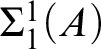 $\Sigma ^1_1(A)$
definable function from
 $\mathbb {N}$
to the ordinals, then it must be bounded strictly below
 $\omega _1^A$
. Here,
 $\mathcal O^A$
defines the set of codes for ordinals recursive in A.
We will use this way of defining
 $\Sigma ^1_1$
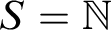
sets together with Spector’s bounding principle quite often in this paper. For instance, let us show that there exists a computable function f such that
 $f(a)$
is an index for a
 $\Sigma ^1_1$
set
 $S\subseteq \mathbb {N}$
such that:
-
• if a is an index for a nonempty
$\Sigma ^1_1$
set, then
$S=\mathbb {N}$
, -
• if a is an index for an empty
$\Sigma ^1_1$
set, then
$S=\emptyset $
.



Indeed, let a be an index for a
 $\Sigma ^1_1$
set
 $E\subseteq \mathbb {N}$
, and define
 $f(a)$
to be the index of the
 $\Sigma ^1_1$
set defined by the following co-enumeration: at stage
 $\alpha $
, do nothing if
 $E_\alpha $
(E at stage
 $\alpha $
) is not empty, and remove everything if
 $E_\alpha =\emptyset $
.
Let
 $S_a$
be the set of index
 $f(a)$
. If
 $S_a$
is empty, then at some stage
 $\alpha $
,
 $E_\alpha $
is empty, so
 $E=\emptyset $
. Otherwise, suppose that E is empty. Then, we claim that there must exists a stage
 $\alpha $
at which
 $E_\alpha $
is already empty: indeed, consider the function which to n associates the stage where n is removed is
 $\Sigma ^1_1$
, and by Spector’s bounding principle (Theorem 1.4) let
 $\alpha <\omega _1^{\text {CK}}$
be a bound to it. Then, at stage
 $\alpha $
,
 $E_\alpha $
is empty and therefore
 $S_a$
is also empty. So
 $S_a$
is empty if and only if
 $E_\alpha $
is empty. To conclude, it is clear from the definition of
 $S_a$
that if it is nonempty, then
 $S_a=\mathbb {N}$
.
An easy but important observation is that this construction is uniformly relativizable. To proceed the construction (of an inductive operator), we only need the existence of a bound
 $\alpha <\omega _1^A$
, but do not need to know the value of such an
 $\alpha $
, and this fact is ensured by Theorem 1.4; that is, we do not require a uniform version of Spector’s bounding principle, although it is not hard to see that Spector’s bounding principle is uniformly relativizable.
2 Equivalence results in the Weihrauch lattice
2.1
$\Sigma ^1_1$
-choice principles

One of the main notions in this article is the
 $\Sigma ^1_1$
-choice principle. In the context of the Weihrauch degrees, the
 $\Sigma ^1_1$
-choice principle on a space X is formulated as the partial multivalued function which, given a code of a nonempty analytic set A, chooses an element of A.
We fix a coding system of all analytic sets in a Polish space X, and let
 $S_p$
be the analytic subset of X coded by
 $p\in \mathbb {N}^{\mathbb {N}}$
. For instance, let
 $S_p$
be the projection of the p-th closed subset of
 $X\times \mathbb {N}^{\mathbb {N}}$
(i.e., the complement of the union of all basic open balls of index
 $p(n)$
for some n) into the first coordinate (cf. [Reference Kihara, Marcone and Pauly14]). Such a p is called an analytic code (or a
 $\Sigma ^1_1$
-name) of
 $S_p$
and a coanalytic code (or a
 $\Pi ^1_1$
-name) of the complement of
 $S_p$
.
The
 $\Sigma ^1_1$
-choice principle on X,
 $\Sigma ^1_1$
-
 $\mathsf {C}_X$
, is the partial multivalued function which, given a code of a nonempty analytic subset of X, chooses one element from X. Formally speaking, it is defined as the following partial multivalued function:
 $$ \begin{align*} \text{dom}(\Sigma^1_1\mbox{-}\mathsf{C}_X)&=\{p\in\mathbb{N}^{\mathbb{N}}:S_p\not=\emptyset\},\\ \Sigma^1_1\mbox{-}\mathsf{C}_X(p)&=S_p. \end{align*} $$
For the basics on the
 $\Sigma ^1_1$
-choice principle on X, see also [Reference Kihara, Marcone and Pauly14]. In a similar manner, one can also consider the
 $\Gamma $
-choice principle on X,
 $\Gamma $
-
 $\mathsf {C}_X$
, for any represented space X and any collection
 $\Gamma $
of subsets of X endowed with a representation
 $S\colon \!\!\!\subseteq \mathbb {N}^{\mathbb {N}}\to \Gamma $
(where we write
 $S_p$
in place of
 $S(p)$
). We first describe how this choice principle is related to several very weak variants of the axiom of choice.
In logic, the axiom of
 $\Sigma $
choice,
 $\Sigma $
-AC, is known to be the following statement:
 $$ \begin{align*} \forall a\exists b\;\varphi(a,b)\;\longrightarrow\;\exists f\forall a\;\varphi(a,f(a)), \end{align*} $$
where
 $\varphi $
is a
 $\Sigma $
formula. If we require
 $a\in X$
and
 $b\in Y$
, the above statement is written as
 $\Sigma $
-
 $\mathsf {AC}_{X\to Y}$
. We examine the complexity of a procedure that, given a
 $\Sigma ^1_1$
formula
 $\varphi $
(with a parameter) satisfying the premise of
 $\Sigma ^1_1$
-
 $\mathsf {AC}_{X\to Y}$
, returns a choice for
 $\varphi $
. In other words, we interpret
 $\Sigma ^1_1$
-
 $\mathsf {AC}_{X\to Y}$
as the following partial multivalued function:
 $$ \begin{align*} \text{dom}(\Sigma^1_1\mbox{-}\mathsf{AC}_{X\to Y})&=\{p\in\mathbb{N}^{\mathbb{N}}:\forall a\exists b\;\langle a,b\rangle\in S_p\},\\ \Sigma^1_1\mbox{-}\mathsf{AC}_{X\to Y}(p)&=\{f\in Y^X:(\forall a)\;\langle a,f(a)\rangle\in S_p\}. \end{align*} $$
Unfortunately, this interpretation is different from the usual (relative) realizability interpretation. However, the above interpretation of
 $\Sigma ^1_1$
-
 $\mathsf {AC}_{X\to \mathbb {N}}$
is related to a descriptive-set-theoretic notion known as the generalized reduction property (or equivalently, the number uniformization property) for
 $\Sigma ^1_1$
(cf. [Reference Kechris13, Definition 22.14]).
The equivalence
 $\Sigma ^1_1\mbox {-}\mathsf {C}_X\equiv _{\mathsf {W}}\Sigma ^1_1\mbox {-}\mathsf {AC}_{1\to X}$
is obvious. In this article, we are mainly interested in countable choice
 $\Sigma \mbox {-}\mathsf {AC}_{\mathbb {N}\to X}$
. The countable choice principles
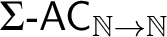 $\Sigma \mbox {-}\mathsf {AC}_{\mathbb {N}\to \mathbb {N}}$
and
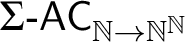 $\Sigma \mbox {-}\mathsf { AC}_{\mathbb {N}\to \mathbb {N}^{\mathbb {N}}}$
are also known as
 $\Sigma \mbox {-}\mathsf {AC}_{0,0}$
and
 $\Sigma \mbox {-}\mathsf {AC}_{0,1}$
, respectively. In the context of Weihrauch degrees, the interpretation of the countable choice,
 $\Sigma ^1_1\mbox {-}\mathsf {AC}_{\mathbb {N}\to X}$
, is obviously related to the parallelization of the
 $\Sigma ^1_1$
-choice principle.
Observation 2.1. If X is an initial segment of
 $\mathbb {N}$
, then we have
 $\widehat {\Sigma ^1_1\mbox {-}\mathsf {C}_X}\equiv _{\mathsf {W}}\Sigma ^1_1\mbox {-}\mathsf { AC}_{\mathbb {N}\to X}$
.
In logic, the axiom of
 $\Sigma ^1_1$
-dependent choice on X is the following statement:
 $$ \begin{align*} \forall a\exists b\;\varphi(a,b)\;\longrightarrow\;\forall a\exists f\;[f(0)=a\;\&\;\forall n\;\varphi(f(n),f(n+1))], \end{align*} $$
where
 $\varphi $
is a
 $\Sigma ^1_1$
-formula, and a and b range over X. It is known that dependent choice is equivalent to the statement saying that if T is a definable pruned tree of height
 $\omega $
, then there is an infinite path through T. However, this is achieved by using dependent choice on the set of finite strings of elements of X,
 $X^{<\mathbb {N}}$
. As this is the principle that is actually used, and the one that makes sense for X being finite, this is how we define
 $\Sigma ^1_1\mbox {-}\mathsf {DC}_{X}$
:
 $$ \begin{align*} \text{dom}(\Sigma^1_1\mbox{-}\mathsf{DC}_{X})&=\{p\in(\mathbb{N}^{\mathbb{N}}):S_p\subseteq X^{<\mathbb{N}} \text{ is a tree with } [S_p]\neq\emptyset\},\\ \Sigma^1_1\mbox{-}\mathsf{DC}_{X}(p)&=[S_p]. \end{align*} $$
Note that this formulation is different from
 $\Sigma ^1_1$
-dependent choice on X in the context of second order arithmetic. Indeed, our formulation falls between
 $\Sigma ^1_1$
-dependent choice and strong
 $\Sigma ^1_1$
-dependent choice (cf. Simpson [Reference Simpson19, Definition VII.6.1]). Now, it is easy to see the following:
Proposition 2.2.
 $\mathsf {C}_{\mathbb {N}^{\mathbb {N}}}\equiv _{\mathsf {W}}\Sigma ^1_1\mbox {-}\mathsf {C}_{\mathbb {N}^{\mathbb {N}}}\equiv _{\mathsf {W}}\Sigma ^1_1\mbox {-}\mathsf { DC}_{\mathbb {N}^{\mathbb {N}}}\equiv _{\mathsf {W}}\Sigma ^1_1\mbox {-}\mathsf {DC}_{\mathbb {N}}$
.
Proof We prove the following Weihrauch inequality, in their order from left to right:
 $\Sigma ^1_1\mbox {-}\mathsf {DC}_{\mathbb {N}^{\mathbb {N}}}\leq _{\mathsf {W}}\Sigma ^1_1\mbox {-}\mathsf {C}_{\mathbb {N}^{\mathbb {N}}}\leq _{\mathsf {W}}\mathsf { C}_{\mathbb {N}^{\mathbb {N}}}\leq _{\mathsf {W}}\Sigma ^1_1\mbox {-}\mathsf {DC}_{\mathbb {N}}\leq _{\mathsf {W}}\Sigma ^1_1\mbox {-}\mathsf { DC}_{\mathbb {N}^{\mathbb {N}}}$
.
 $\Sigma ^1_1\mbox {-}\mathsf {DC}_{\mathbb {N}^{\mathbb {N}}}\leq _{\mathsf {W}}\Sigma ^1_1\mbox {-}\mathsf {C}_{\mathbb {N}^{\mathbb {N}}}$
: The set of all solutions to an instance of
 $\Sigma ^1_1\mbox {-}\mathsf {DC}_{\mathbb {N}^{\mathbb {N}}}$
is obviously
 $\Sigma ^1_1$
relative to the given parameter, and one can easily find its
 $\Sigma ^1_1$
-index.
 $\Sigma ^1_1\mbox {-}\mathsf {C}_{\mathbb {N}^{\mathbb {N}}} \leq _{\mathsf {W}} \mathsf {C}_{\mathbb {N}^{\mathbb {N}}}$
: Let
 $P\subseteq \mathbb {N}^{\mathbb {N}}$
be a
 $\Sigma ^1_1$
set. From its index, one can compute the index of a closed set
 $Q\subseteq \mathbb {N}^{\mathbb {N}}\times \mathbb {N}^{\mathbb {N}}$
such that the first projection of Q is P. Thus, given an element of Q, one can find an element of P by applying the first projection, and
 $\mathsf {C}_{\mathbb {N}^{\mathbb {N}}}\geq _{\mathsf {W}}\Sigma ^1_1\mbox {-}\mathsf { C}_{\mathbb {N}^{\mathbb {N}}}$
.
 $\mathsf {C}_{\mathbb {N}^{\mathbb {N}}}\leq _{\mathsf {W}}\Sigma ^1_1\mbox {-}\mathsf {DC}_{\mathbb {N}}$
: Given a code q of a closed subset
 $C_q$
of
 $\mathbb {N}^{\mathbb {N}}$
, compute a code of a pruned
 $\Sigma ^1_1$
tree T such that
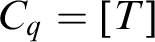 $C_q=[T]$
(which is given by
 $\sigma \in T$
iff
 $C_q$
contains an extension of
 $\sigma $
). Then, let
 $\varphi _T(\sigma ,\tau )$
be the formula expressing that
 $\tau $
is an immediate successor of
 $\sigma $
in T. Moreover,
 $\langle p,q,\varepsilon \rangle $
where
 $S_q=\mathbb {N}^{<\mathbb {N}}$
and
 $S_p=\{\langle \sigma ,\tau \rangle :\varphi _T(\sigma ,\tau )\}$
satisfies the premise of
 $\Sigma ^1_1\mbox {-}\mathsf {DC}_{\mathbb {N}}$
since T is pruned. Let f be a solution to this instance of
 $\Sigma ^1_1\mbox {-}\mathsf {DC}_{\mathbb {N}}$
. Since T is pruned, f must be a path through T.
 $\Sigma ^1_1\mbox {-}\mathsf {DC}_{\mathbb {N}}\leq _{\mathsf {W}}\Sigma ^1_1\mbox {-}\mathsf {DC}_{\mathbb {N}^{\mathbb {N}}}$
: This is obvious as
 $\mathbb {N}$
can be computably embedded in
 $\mathbb {N}^{\mathbb {N}}$
.
2.2 Compact choice principles
According to the Arsenin–Kunugui uniformization theorem (cf. [Reference Kechris13, Theorem 18.10]), the choice principle for
 $\sigma $
-compact
 $\Delta ^1_1$
sets is much simpler than the one for arbitrary
 ${\Delta }^1_1$
sets. We are interested in whether an analogous statement holds for
 $\Sigma ^1_1$
-choice, while we know that even compact
 $\Sigma ^1_1$
-choice does not admit a Borel uniformization.
We now consider subprinciples of the
 $\Sigma ^1_1$
choice principle by restricting its domain. Recall that
 $S_p$
is the analytic set in X coded by
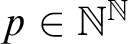 $p\in \mathbb {N}^{\mathbb {N}}$
. Let
 $\mathcal {R}$
be a collection of subsets of X. Define
 $\Sigma ^1_1\mbox {-}\mathsf {C}_X\! \upharpoonright _{\mathcal {R}}$
, the
 $\Sigma ^1_1$
-choice principle restricted to sets in
 $\mathcal {R}$
, as follows:
 $$ \begin{align*} \Sigma^1_1\mbox{-}\mathsf{C}_{X}\! \upharpoonright_{\mathcal{R}}&:\subseteq\mathbb{N}^{\mathbb{N}}\rightrightarrows X,\\ \text{dom}(\Sigma^1_1\mbox{-}\mathsf{C}_{X}\! \upharpoonright_{\mathcal{R}})&=\{p\in\mathbb{N}^{\mathbb{N}}:S_p\not=\emptyset\mbox{ and }S_p\in\mathcal{R}\},\\ \Sigma^1_1\mbox{-}\mathsf{C}_{X}\! \upharpoonright_{\mathcal{R}}(p)&=S_p. \end{align*} $$
First, we consider the
 $\Sigma ^1_1$
choice principle restricted to compact sets, that is, we define compact
 $\Sigma ^1_1$
-choice,
 $\Sigma ^1_1\mbox {-}\mathsf {KC}_X$
, as follows:
 $$ \begin{align*} \Sigma^1_1\mbox{-}\mathsf{KC}_X=\Sigma^1_1\mbox{-}\mathsf{C}_X\! \upharpoonright_{\{A\subseteq X:A\text{ is compact}\}.} \end{align*} $$
In other words, the
 $\Sigma ^1_1$
-compact choice principle,
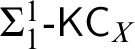 $\Sigma ^1_1\mbox {-}\mathsf {KC}_X$
, is the multivalued function which, given a code of a nonempty
 $\Sigma ^1_1$
set which happens to be compact, chooses one element from the set. As the code contains no information about compactness, the principle of compact
 $\Sigma ^1_1$
choice on
 $\mathbb {N}^{\mathbb {N}}$
should be considered as a
 $\Sigma ^1_1$
-version of König’s lemma rather than of weak König’s lemma. In contrast, a
 $\Sigma ^1_1$
-version of weak König’s lemma and related principles are studied in [Reference Kihara, Marcone and Pauly14]; e.g.,
-
• The principle
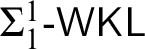
$\Sigma ^1_1\mbox {-}\mathsf {WKL}$
, the weak König’s lemma for
$\Sigma ^1_1$
-trees, is the partial multivalued function which, given a
$\Sigma ^1_1$
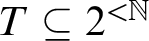
-name of a binary tree
$T\subseteq 2^{<\mathbb {N}}$
, chooses an infinite path through T. -
• The principle
$\Pi ^1_1\mbox {-}\mathsf {Sep}$
, the problem of separating a disjoint pair of
$\Pi ^1_1$
sets, is the partial multivalued function which, given a
$\Pi ^1_1$
-name of a pair of disjoint sets
$A,B\subseteq \mathbb {N}$
, chooses (the characteristic function of) a set
$C\subseteq \mathbb {N}$
separating A from B, that is,
$A\subseteq C$
and
$B\cap C=\emptyset $
.




Here, recall that p is called a
 $\Sigma ^1_1$
-name of
 $S_p$
, and a
 $\Pi ^1_1$
-name of its complement.
Observation 2.3.
 $\Sigma ^1_1\mbox {-}\mathsf {DC}_2\equiv _{\mathsf {W}}\Sigma ^1_1\mbox {-}\mathsf {WKL}$
.
Note that in [Reference Kihara, Marcone and Pauly14, Lemma 4.6] these principles are shown to be equivalent to the parallelization of two-valued
 $\Sigma ^1_1$
choice:
Fact 2.4 (Kihara et al. [Reference Kihara, Marcone and Pauly14])
 $\widehat {\Sigma ^1_1\mbox {-}\mathsf {C}_2}\equiv _{\mathsf {W}}\Pi ^1_1\mbox {-}\mathsf {Sep}\equiv _{\mathsf {W}}\Sigma ^1_1\mbox {-}\mathsf {WKL}$
.
Although König’s lemma and weak König’s lemma are different in the computability theoretic context, these are equivalent modulo some arithmetical power. Using this observation, we now see that the
 $\Sigma ^1_1$
versions of König’s lemma and weak König’s lemma are computably equivalent, and thus, the principles mentioned in Fact 2.4 are equivalent to
 $\Sigma ^1_1$
-compact choice.
Proposition 2.5.
 $\Sigma ^1_1\mbox {-}\mathsf {KC}_{\mathbb {N}^{\mathbb {N}}}\equiv _{\mathsf {W}}\Sigma ^1_1\mbox {-}\mathsf {AC}_{\mathbb {N}\to 2}\equiv _{\mathsf { W}}\Sigma ^1_1\mbox {-}\mathsf {WKL}\equiv _{\mathsf {W}}\Sigma ^1_1\mbox {-}\mathsf {DC}_2$
.
Proof By Observation 2.1, we have
 $\widehat {\Sigma ^1_1\mbox {-}\mathsf {C}_2}\equiv _{\mathsf {W}}\Sigma ^1_1\mbox {-}\mathsf {AC}_{\mathbb {N}\to 2}$
. By Fact 2.4,
 $\Sigma ^1_1\mbox {-}\mathsf {AC}_{\mathbb {N}\to 2}\equiv _{\mathsf {W}}\Sigma ^1_1\mbox {-}\mathsf {WKL}$
. By Observation 2.3, we have
 $\Sigma ^1_1\mbox {-}\mathsf {WKL}\equiv _{\mathsf {W}}\Sigma ^1_1\mbox {-}\mathsf {DC}_2$
.
It remains to show that these are equivalent to the
 $\Sigma ^1_1$
compact choice principle. First note that the reduction
 $\Sigma ^1_1\mbox {-}\mathsf {WKL}\leq _{\mathsf {W}}\Sigma ^1_1\mbox {-}\mathsf {KC}_{\mathbb {N}^{\mathbb {N}}}$
is obvious, as if
 $T\subseteq {2^{\mathbb {N}}}$
is
 $\Sigma ^1_1$
, then
 $[T]$
is compact and
 $\Sigma ^1_1$
. For the converse, we claim that if a set
 $A\subseteq {\mathbb {N}^{\mathbb {N}}}$
is
 $\Sigma ^1_1$
and compact then it is arithmetically isomorphic to a closed set
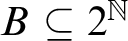 $B\subseteq {2^{\mathbb {N}}}$
.
So suppose that A is
 $\Sigma ^1_1$
and compact. First, it is clearly closed, so let
 $T_A\subseteq {\mathbb {N}^{<\mathbb {N}}}$
be a
 $\Sigma ^1_1$
tree such that
 $A=[T_A]$
and
 $T_A$
has no dead-end; that is,
 $T_A$
is defined as
 $\sigma \in T_A$
iff
 $\exists X\succ \sigma $
with
 $X\in A$
. By compactness and the fact that the tree is pruned, for every
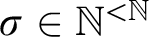 $\sigma \in {\mathbb {N}^{<\mathbb {N}}}$
, there exist finitely many
 $i\in \mathbb {N}$
such that
 $\sigma \mbox {}^\smallfrown i\in T_A$
. We define
 $T_B$
by
 $\forall \sigma \in {2^{<\mathbb {N}}}$
,
 $\sigma \in T_B$
if and only if
 $\exists \tau \in T_A$
such that
 $\sigma \prec 0^{\tau (0)}10^{\tau (1)}\cdots 0^{\tau (|\tau |-1)}1$
. Then, the transformation
 $T_B\mapsto T_A$
is computable, while
 $T_A\mapsto T_B$
is
 $T_A'$
-computable; hence
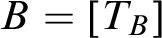 $B=[T_B]$
is arithmetically isomorphic to A.
In particular, B is
 $\Sigma ^1_1$
, and moreover, from the above explicit definition of
 $T_B$
, one can effectively compute a
 $\Sigma ^1_1$
-code of B from a given
 $\Sigma ^1_1$
-code of A. It is easy to compute an element of A from a given element of B. This argument shows that
 $\Sigma ^1_1\mbox {-}\mathsf {WKL}\equiv _{\mathsf {W}}\Sigma ^1_1\mbox {-}\mathsf {KC}_{\mathbb {N}^{\mathbb {N}}}$
.⊣
Next, we show that the compact
 $\Sigma ^1_1$
-choice principle is also Weihrauch equivalent to the following principles:
-
• The principle
$\Pi ^1_1\mbox {-}\mathsf {Tot}_2$
, the totalization problem for partial
$\Pi ^1_1$
two-valued functions, is the partial multivalued function which, given a
$\Pi ^1_1$
-name of (the graph of) a partial function
$\varphi \colon \!\!\!\subseteq \mathbb {N}\to 2$
, chooses a total extension
$f\colon \mathbb {N}\to 2$
of
$\varphi $
. -
• The principle
$\Pi ^1_1\mbox {-}\mathsf {DNC}_2$
, the problem of finding a two-valued diagonally non-
$\Pi ^1_1$
function, is the partial multivalued function which, given a
$\Pi ^1_1$
-name of a sequence of (the graphs of) partial functions
$(\varphi _e)_{e\in \mathbb {N}}$
, chooses a total function
$f\colon \mathbb {N}\to 2$
diagonalizing the sequence, that is,
$f(e)\not =\varphi _e(e)$
whenever
$\varphi _e(e)$
is defined.


The latter notion has also been studied by Kihara et al. [Reference Kihara, Marcone and Pauly14, Section 4.2]. The former notion is easily seen equivalent to
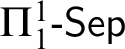 $\Pi ^1_1\mbox {-}\mathsf {Sep}$
, which has also been studied in [Reference Kihara, Marcone and Pauly14], with the advantage of being generalizable to
 $\mathbb {N}$
. The following proposition is a consequence of [Reference Kihara, Marcone and Pauly14, Theorem 4.3 and Proposition 4.5] and Observation 2.1:
Proposition 2.6.
 $\Sigma ^1_1\mbox {-}\mathsf {AC}_{\mathbb {N}\to 2}\equiv _{\mathsf {W}}\Pi ^1_1\mbox {-}\mathsf {Tot}_2\equiv _{\mathsf {W}}\Pi ^1_1\mbox {-}\mathsf {DNC}_2$
.
A set is
 $\sigma $
-compact if it is a countable union of compact sets. By Saint Raymond’s theorem (cf. [Reference Kechris13, Theorem 35.46]), any Borel set with
 $\sigma $
-compact sections can be written as a countable union of Borel sets with compact sections. In particular, a Borel code for a
 $\sigma $
-compact set S can be computably transformed into a sequence of Borel codes of compact sets whose union is S. However, there is no analogous result for analytic sets (cf. Steel [Reference Steel21]). Therefore, we do not introduce
 $\sigma $
-compact
 $\Sigma ^1_1$
-choice as
 $$ \begin{align*} \Sigma^1_1\mbox{-}\mathsf{C}_X\! \upharpoonright_{\{A\subseteq X:A\text{ is } \sigma\text{-compact}\}}\!\!. \end{align*} $$
Instead, we directly code an analytic
 $\sigma $
-compact set as a sequence of analytic codes of compact sets. In other words, the
 $\sigma $
-compact
 $\Sigma ^1_1$
-choice principle,
 $\Sigma ^1_1\mbox {-}\mathsf {K}_{\sigma }\mathsf {C}_{X}$
, is the partial multivalued function which, given a
 $\Sigma ^1_1$
-name of a sequence
 $(S_n)_{n\in \mathbb {N}}$
of compact sets such that at least one is nonempty, chooses an element from
 $\bigcup _{n\in \mathbb {N}}S_n$
. Equivalently (modulo Weihrauch equivalence), one can formalize
 $\Sigma ^1_1\mbox {-}\mathsf {K}_\sigma \mathsf {C}_{\mathbb {N}^{\mathbb {N}}}$
as the compositional product
 $\Sigma ^1_1\mbox {-}\mathsf {KC}_{\mathbb {N}^{\mathbb {N}}}\star \Sigma ^1_1\mbox {-}\mathsf {C}_{\mathbb {N}}$
:
Lemma 2.7.
 $\Sigma ^1_1\mbox {-}\mathsf {K}_\sigma \mathsf {C}_{\mathbb {N}^{\mathbb {N}}}\equiv _{\mathsf {W}}\Sigma ^1_1\mbox {-}\mathsf { KC}_{\mathbb {N}^{\mathbb {N}}}\star \Sigma ^1_1\mbox {-}\mathsf {C}_{\mathbb {N}}$
.
Proof We start by proving
 $\Sigma ^1_1\mbox {-}\mathsf {K}_\sigma \mathsf {C}_{\mathbb {N}^{\mathbb {N}}}\leq _{\mathsf {W}}\Sigma ^1_1\mbox {-}\mathsf { KC}_{\mathbb {N}^{\mathbb {N}}}\star \Sigma ^1_1\mbox {-}\mathsf {C}_{\mathbb {N}}$
. Given a sequence
 $(S_n)$
of compact
 $\Sigma ^1_1$
sets, first use
 $\Sigma ^1_1\mbox {-}\mathsf {C}_{\mathbb {N}}$
to get n with
 $S_n\not =\emptyset $
(as the set
 $\{n\in \mathbb {N}:\exists x\in S_n\}$
is
 $\Sigma ^1_1$
), and then
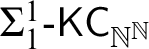 $\Sigma ^1_1\mbox {-}\mathsf {KC}_{\mathbb {N}^{\mathbb {N}}}$
to choose an element of
 $S_n$
.
For the converse direction, let
 $((S_n)_{n\in \mathbb {N}},P)$
be an instance of
 $\Sigma ^1_1\mbox {-}\mathsf { KC}_{\mathbb {N}^{\mathbb {N}}}\star \Sigma ^1_1\mbox {-}\mathsf {C}_{\mathbb {N}}$
, that is, for any
 $n \ S_n$
is a
 $\Sigma ^1_1$
set which is non-empty and compact whenever
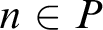 $n\in P$
. Let
 $\hat S_n$
be the
 $\Sigma ^1_1$
set defined by
 $x\in \hat S_n$
if and only if
 $n\in P$
and
 $x\in S_n$
. The collection
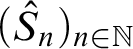 $(\hat S_n)_{n\in \mathbb {N}}$
is an instance of
 $\Sigma ^1_1\mbox {-}\mathsf {K}_\sigma \mathsf {C}_{\mathbb {N}^{\mathbb {N}}}$
, and any solution for it is a solution for the initial instance
 $(S_n)_{n\in \mathbb {N}},P$
.⊣
2.3 Restricted choice principles
Next, we consider several variations of the axiom of choice for
 $\varphi $
:
-
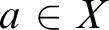
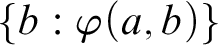
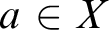
1. The axiom of unique choice: If for any
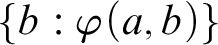
$a\in X$
,
$\{b:\varphi (a,b)\}$
is a singleton, then there is a choice function for
$\varphi $
, that is,
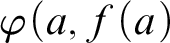
$\exists f\forall a\;\varphi (a,f(a))$
. -
2. The axiom of finite choice: If for any
$a\in X$
,
$\{b:\varphi (a,b)\}$
is nonempty and finite, then there is a choice function for
$\varphi $
, that is,
$\exists f\forall a\;\varphi (a,f(a))$
. -
3. The axiom of cofinite choice: If for any
$a\in X$
,
$\{b:\varphi (a,b)\}$
is nonempty and cofinite, then there is a choice function for
$\varphi $
. -
4. The axiom of finite-or-cofinite choice: If for any
$a\in X$
,
$\{b:\varphi (a,b)\}$
is nonempty and either finite or cofinite, then there is a choice function for
$\varphi $
. -
5. The axiom of all-or-finite choice: If for any
$a\in X$
,
$\{b:\varphi (a,b)\}$
is nonempty and is either equal to X, or finite, then there is a choice function for
$\varphi $
. -
6. The axiom of all-or-unique choice: If for any
$a\in X$
,
$\{b:\varphi (a,b)\}$
is nonempty and is either equal to X, or a singleton, then there is a choice function for
$\varphi $
. -
7. The axiom of total unique choice: There is a function such that whenever
$\{b:\varphi (a,b)\}$
is a singleton, for
$a\in X$
, we have
$\varphi (a,f(a)$
).






The last notion is a modification of a variant of hyperarithmetical axiom of choice introduced by Tanaka [Reference Tanaka22] in the context of second order arithmetic, where the original formulation is given as follows:
 $$ \begin{align*}\exists Z\forall n\;[\exists !X\varphi(n,X)\ \longrightarrow\ \varphi(n,Z_n)],\end{align*} $$
where
 $\varphi $
is a
 $\Sigma ^1_1$
formula. We will only consider the above principles restricted to countable domains; that is, the principles of countable choice.
2.3.1 Restricted single choice
As in Observation 2.1, we may interpret these axioms of countable choice as parallelization of partial multivalued functions. To do so, we define:
 $$ \begin{align*} \Sigma^1_1\mbox{-}{\mathsf{UC}}_{X}&=\Sigma^1_1\mbox{-}{\mathsf{C}}_{X}\! \upharpoonright_{\{A\subseteq X:|A|=1\}},\\[-2pt] \Sigma^1_1\mbox{-}{\mathsf{C}}^{\mathsf{fin}}_{X}&=\Sigma^1_1\mbox{-}{\mathsf{C}}_{X}\! \upharpoonright_{\{A\subseteq X:A\text{ is finite}\}},\\[-2pt] \Sigma^1_1\mbox{-}{\mathsf{C}}^{\mathsf{cof}}_{X}&=\Sigma^1_1\mbox{-}{\mathsf{C}}_{X}\!\upharpoonright_{\{A\subseteq X:A\text{ is cofinite}\}},\\[-2pt] \Sigma^1_1\mbox{-}{\mathsf{C}}^{\mathsf{foc}}_{X}&=\Sigma^1_1\mbox{-}{\mathsf{C}}_{X}\! \upharpoonright_{\{A\subseteq X:A\text{ is finite or cofinite}\}},\\[-2pt] {\Sigma^1_1\mbox{-}{\mathsf{C}}^{\mathsf{aof}}_{X}}&=\Sigma^1_1\mbox{-}{\mathsf{C}}_{X}\! \upharpoonright_{\{A\subseteq X:A=X\text{ or } A \text{ is finite}\}},\\[-2pt] \Sigma^1_1\mbox{-}{\mathsf{C}}^{\mathsf{aou}}_{X}&=\Sigma^1_1\mbox{-}{\mathsf{C}}_{X}\! \upharpoonright_{\{A\subseteq X:A= X\text{ or }|A|=1\}}\kern-2pt. \end{align*} $$
Note that the all-or-unique choice is often denoted by
 $\mathsf {AoUC}_X$
instead of
 $\mathsf {C}^{\mathsf {aou}}_X$
, cf. [Reference Kihara, Pauly, Faliszewski, Muscholl and Niedermeier15]. In order to interpret the axiom of total unique choice as a multivalued function, we introduce the totalization of the
 $\Sigma ^1_1$
-choice principle
 $($
restricted to
 $\mathcal {R})$
on X. Recall that
 $S_p$
is the analytic set in X coded by
 $p\in \mathbb {N}^{\mathbb {N}}$
. Then we define
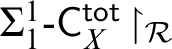 $\Sigma ^1_1\mbox {-}\mathsf {C}^{\mathsf {tot}}_X\! \upharpoonright _{\mathcal {R}}$
as follows:
 $$ \begin{align*} \Sigma^1_1\mbox{-}{\mathsf{C}}^{\mathsf{tot}}_{X}\! \upharpoonright_{\mathcal{R}}&:{\mathbb{N}}^{\mathbb{N}}\rightrightarrows {\mathbb{N}},\\ \text{dom}(\Sigma^1_1\mbox{-}{\mathsf{C}}^{\mathsf{tot}}_{X}\! \upharpoonright_{\mathcal{R}})&={\mathbb{N}}^{\mathbb{N}},\\[-3pt] \Sigma^1_1\mbox{-}\mathsf{C}^{\mathsf{tot}}_{X}\! \upharpoonright_{\mathcal{R}}(p)&= \begin{cases} S_p&\text{ if } S_p\in\mathcal R,\\[-3pt] X&\text{ otherwise.} \end{cases} \end{align*} $$
Roughly speaking, if a given
 $\Sigma ^1_1$
set S is nonempty and belongs to
 $\mathcal {R}$
, then any element of S is a solution to this problem as a usual choice problem, but even if a set S is either empty or does not belong to
 $\mathcal {R}$
, there is a need to feed some value, although any value is acceptable as a solution.
In second order arithmetic, the totalization of dependent choice is known as strong dependent choice (cf. Simpson [Reference Simpson19, Definition VII.6.1]). Here we consider the totalization
 $\Sigma ^1_1\mbox {-}\mathsf {UC}^{\mathsf {tot}}_{X}$
of
 $\Sigma ^1_1\mbox {-}\mathsf {UC}_{\mathbb {N}^{\mathbb {N}}}$
, which can be viewed as the multivalued version of the axiom of total unique choice mentioned above:
 $$ \begin{align*}\Sigma^1_1\mbox{-}\mathsf{ UC}^{\mathsf{tot}}_{X}=\Sigma^1_1\mbox{-}\mathsf{C}^{\mathsf{ tot}}_{X}\upharpoonright_{\{S\subseteq{\mathbb{N}^{\mathbb{N}}}:|S|=1\}}\!\!. \end{align*} $$
2.3.2 Restricted countable choice
Hereafter, we will consider several restrictions of
 $\Sigma ^1_1$
countable choice and
 $\Sigma ^1_1$
dependent choice for numbers. Recall from Observation 2.1 that
 $\Sigma ^1_1\mbox {-}\mathsf {AC}_{\mathbb {N}\to \mathbb {N}}$
can be identified with the parallelization of
 $\Sigma ^1_1\mbox {-}\mathsf {C}_{\mathbb {N}}$
, and from Proposition 2.2 that
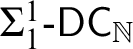 $\Sigma ^1_1\mbox {-}\mathsf { DC}_{\mathbb {N}}$
can be identified with
 $\Sigma ^1_1\mbox {-}\mathsf {C}_{\mathbb {N}^{\mathbb {N}}}$
.
Definition 2.8. We define several versions of axiom of choice where the set we have to choose from is restricted to special kinds:
 $$ \begin{align*} \Sigma^1_1\mbox{-}\mathsf{AC}^{\mathsf{\triangledown}}_{\mathbb{N}\to\mathbb{N}}&=\widehat{\Sigma^1_1\mbox{-}\mathsf{ C}^{\triangledown}_{\mathbb{N}}}, \end{align*} $$
where
 $\triangledown \in \{\mathsf {fin, cof, foc, aof, aou}\}$
respectively corresponding to “finite,” “cofinite,” “finite or cofinite,” “all or finite,” and “all or unique.” We will also consider the Dependent Choice with the same restricted sets:
 $$ \begin{align*} \Sigma^1_1\mbox{-}\mathsf{DC}^{\triangledown}_{\mathbb{N}}&=\Sigma^1_1\mbox{-}\mathsf{C}_{\mathbb{N}^{\mathbb{N}}}\! \upharpoonright_{\{[T]: \forall\sigma\in T, \{n:\sigma^{\smallfrown} n\in T\}\text{ is }\triangledown\}}, \end{align*} $$
where
 $\triangledown \in \{\mathsf {fin, cof, foc, aof, aou}\}$
has the same meaning. For any
 $\sigma \in \mathbb {N}^{<\mathbb {N}}$
a string corresponding to a choice for the previous sets,
 $\{n:\sigma ^{\smallfrown } n\in T\}$
corresponds to the next possible choice, and this set has to satisfy the condition specified by
 $\triangledown $
. Note that it corresponds to a particular formulation of
 $\Sigma ^1_1$
dependent choice, as explained just before Proposition 2.2.
In the following, we will say that a tree T is homogeneous if the set
 $[T]$
of all infinite paths through T is equal to some
 $\prod _{n\in \mathbb {N}}A_n$
, that is
 $[T]$
is truly an instance of the axiom of choice. In other words, a homogeneous tree T is a tree where the set
 $\{n\in \mathbb {N}:\sigma \mbox {}^\smallfrown n\in T\}$
depends only on
 $|\sigma |$
when
 $\sigma \in T$
. Note that if T is homogeneous then the set
 $H:=[T]$
satisfies the following property: We have
 $h\in H$
iff
 $\forall i\in \mathbb {N}$
,
 $\exists f\in H$
with
 $h(i)=f(i)$
.
2.3.3 Weihrauch equivalences
Among others, we see that “all-or-unique” choice is quite robust. Recall from Proposition 2.6 that the
 $\Pi ^1_1$
-totalization principle
 $\Pi ^1_1\mbox {-}\mathsf {Tot}_2$
and the
 $\Pi ^1_1$
-diagonalization principle
 $\Pi ^1_1\mbox {-}\mathsf { DNC}_2$
restricted to two valued functions are equivalent to the
 $\Sigma ^1_1$
compact choice principle. We now consider the
 $\mathbb {N}$
-valued versions of the totalization and the diagonalization principles:
-
• The principle
$\Pi ^1_1\mbox {-}\mathsf {Tot}_{\mathbb {N}}$
, the totalization problem for partial
$\Pi ^1_1$
functions, is the partial multivalued function which, given a
$\Pi ^1_1$
-name of (the graph of) a partial function
$\varphi \colon \!\!\!\subseteq \mathbb {N}\to \mathbb {N}$
, chooses a total extension of
$\varphi $
. -
• The principle
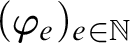
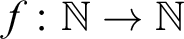
$\Pi ^1_1\mbox {-}\mathsf {DNC}_{\mathbb {N}}$
, the problem of finding a diagonally non-
$\Pi ^1_1$
function, is the partial multivalued function which, given a
$\Pi ^1_1$
-name of a sequence of (the graphs of) partial functions
$(\varphi _e)_{e\in \mathbb {N}}$
, chooses a total function
$f\colon \mathbb {N}\to \mathbb {N}$
diagonalizing the sequence, that is,
$f(e)\not =\varphi _e(e)$
whenever
$\varphi _e(e)$
is defined.




It is clear that
 $\Pi ^1_1\mbox {-}\mathsf {DNC}_{\mathbb {N}}\leq _{\mathsf {W}}\Pi ^1_1\mbox {-}\mathsf {DNC}_2\equiv _{\mathsf {W}}\Pi ^1_1\mbox {-}\mathsf { Tot}_2\leq _W\Pi ^1_1\mbox {-}\mathsf {Tot}_{\mathbb {N}}$
. One can easily see the following.
Proposition 2.9.
 $\Sigma ^1_1\mbox {-}\mathsf {AC}^{\mathsf {aou}}_{\mathbb {N}\to \mathbb {N}}\equiv _{\mathsf {W}}\Pi ^1_1\mbox {-}\mathsf {Tot}_{\mathbb {N}}$
.
Proof The argument is almost the same as Proposition 2.6. Given a
 $\Pi ^1_1$
-name of a partial function
 $\varphi $
, define
 $S_{n}=\{a:\varphi (n)\downarrow \;\rightarrow \;a=\varphi (n)\}$
, which is uniformly
 $\Sigma ^1_1$
(relative to the given name). Clearly, either
 $S_n=\mathbb {N}$
or
 $S_n$
is a singleton. Hence, the all-or-unique choice principle chooses an element of
 $S_{n}$
, which produces a totalization of
 $\varphi $
.
Conversely, we first claim that for a
 $\Sigma ^1_1$
set
 $S=\bigcap \{S_\alpha :\alpha <\omega _1^{\text {CK}}\}$
(which is induced from a given
 $\Pi ^1_1$
norm as explained in Section 1.2), if S is a singleton, say
 $S=\{n\}$
, then there is
 $\alpha <\omega _1^{\text {CK}}$
such that
 $S_\alpha =\{n\}$
. This is because, for any
 $m\not =n$
, we have
 $m\not \in S=\bigcap _\alpha S_\alpha $
, so there is a smallest
 $\alpha (m)<\omega _1^{\text {CK}}$
such that
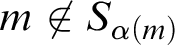 $m\not \in S_{\alpha (m)}$
. As
 $\alpha $
is a
 $\Delta ^1_1$
function, by Spector bounding (Theorem 1.4), we must have
 $\alpha =\sup _{m\not =n}\alpha (m)<\omega _1^{\text {CK}}$
. Then
 $S_\alpha =\{n\}$
, which verifies the claim.
Now, for the n-th
 $\Sigma ^1_1$
set
 $S_n\subseteq \mathbb {N}$
with a
 $\Delta ^1_1$
-approximation
 $(S_{n,\alpha })_{\alpha <\omega _1^{\text {CK}}}$
, we define a
 $\Delta ^1_1$
sequence
 $(f_\alpha )$
of partial functions on
 $\mathbb {N}$
. First, let
 $f_0$
be the empty function, and then wait until
 $S_{n,\alpha }$
becomes a singleton (which is a
 $\Delta ^1_1$
property as
 $S_{n,\alpha }$
is
 $\Delta ^1_1$
) at some stage
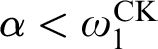 $\alpha <\omega _1^{\text {CK}}$
, say
 $S_{n,\alpha }=\{s_n\}$
. If it happens, we define
 $f_\alpha (n)\downarrow =s_n$
; otherwise
 $f_\alpha (n)\uparrow $
. We eventually obtain (an index of) a partial function f with a
 $\Pi ^1_1$
graph (i.e., a partial
 $\Pi ^1_1$
function), which satisfies
 $f(n)=s_n$
whenever
 $S_n=\{s_n\}$
by the above claim. In particular, for any total extension
 $\widehat {f}$
of f, we have
 $\widehat {f}(n)\in S_n$
whenever
 $S_n=\mathbb {N}$
or
 $S_n$
is a singleton.
Now, the construction (i.e., the inner reduction) from S to f is clearly uniform, and relativizable (see also the argument in Section 1.2). The outer reduction is trivial. Therefore, these give a Weihrauch reduction.⊣
We now show that all-or-unique choice is also Weihrauch equivalent to total unique choice.
Proposition 2.10. Let X be a
 $\Delta ^1_1$
subset of
 $\mathbb {N}$
. Then,
 $\Sigma ^1_1\mbox {-}\mathsf {UC}^{\mathsf {tot}}_{X}\equiv _{\mathsf {W}}\Sigma ^1_1\mbox {-}\mathsf {C}^{\mathsf {aou}}_{X}$
.
Proof We start by proving that
 $\Sigma ^1_1\mbox {-}\mathsf {UC}^{\mathsf {tot}}_{X}\leq _{\mathsf {W}}\Sigma ^1_1\mbox {-}\mathsf {C}^{\mathsf {aou}}_{X}$
. Consider the following computable inner reduction, which given an index for a
 $\Sigma ^1_1$
set
 $S=\bigcap \{S_\alpha :\alpha <\omega _1^{\text {CK}}\}$
, output an index for the following
 $\Sigma ^1_1$
set
 $R\subseteq X$
(that we describe as a co-enumeration along
 $\omega _1^{\text {CK}}$
): First R does nothing until an ordinal stage where (the co-enumeration of) S is a singleton; that is, for each stage
 $\alpha <\omega _1^{\text {CK}}$
, check if the
 $\Delta ^1_1$
set
 $S_\alpha $
is a singleton or not (which is a
 $\Delta ^1_1$
property). If it happens, R removes all integers so that
 $R_\alpha =S_\alpha $
; if not, we keep
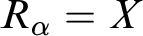 $R_\alpha =X$
. Since either
 $R=X$
or R is a singleton, R is an instance of
 $\Sigma ^1_1\mbox {-}\mathsf {UC}^{\mathsf {tot}}_{X}$
. By the claim in the proof of Proposition 2.9, if S is a singleton then it is witnessed at some stage before
 $\omega _1^{\text { CK}}$
and so
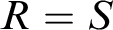 $R=S$
; therefore, the identity map trivially gives an outer reduction. Moreover, the construction is effective; that is, given a
 $\Sigma ^1_1$
-code of S, one can effectively find a
 $\Sigma ^1_1$
-index of R.
We now prove that
 $\Sigma ^1_1\mbox {-}\mathsf {C}^{\mathsf {aou}}_{X}\leq _{\mathsf {W}}\Sigma ^1_1\mbox {-}\mathsf {UC}^{\mathsf {tot}}_{X}$
. Every instance of
 $\Sigma ^1_1\mbox {-}\mathsf {C}^{\mathsf {aou}}_{X}$
is an instance of
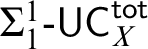 $\Sigma ^1_1\mbox {-}\mathsf {UC}^{\mathsf {tot}}_{X}$
with the same solution, so this is trivial.⊣
In particular, the totalization of two-valued unique choice is equivalent to the compact choice.
Corollary 2.11.
 $\widehat {\Sigma ^1_1\mbox {-}\mathsf {UC}^{\mathsf {tot}}_{\mathsf {2}}}\equiv _{\mathsf {W}}\Sigma ^1_1\mbox {-}\mathsf {KC}_{\mathbb {N}^{\mathbb {N}}}$
.
Proof It is clear that
 $\Sigma ^1_1\mbox {-}\mathsf {C}^{\mathsf {aou}}_{\mathsf {2}}\equiv _{\mathsf {W}}\Sigma ^1_1\mbox {-}\mathsf {C}_{\mathsf {2}}$
, so
 $\widehat {\Sigma ^1_1\mbox {-}\mathsf {C}^{\mathsf {aou}}_{\mathsf {2}}}\equiv _{\mathsf {W}}\widehat {\Sigma ^1_1\mbox {-}\mathsf {C}_{\mathsf {2}}}\equiv _{\mathsf {W}}\Sigma ^1_1\mbox {-}\mathsf {AC}_{\mathbb {N}\to 2}$
by Observation 2.1. Thus, the assertion follows from Fact 2.4 and Proposition 2.5.⊣
2.4 Arithmetical transfinite recursion
In reverse mathematics, the axiom of
 $\Sigma ^1_1$
-choice is known to be weaker than the arithmetical transfinite recursion scheme
 $\mathsf {ATR}_0$
(cf. [Reference Simpson19, Section VIII.4]). However, an analogous result does not hold in the Weihrauch context. The purpose of this section is to clarify the relationship between the
 $\Sigma ^1_1$
-choice principles and the arithmetical transfinite recursion principle in the Weihrauch lattice.
Kihara et al. [Reference Kihara, Marcone and Pauly14] first introduced an analogue of arithmetical transfinite recursion,
 $\mathsf {ATR}_0$
, in the context of Weihrauch degrees, and studied two-sided versions of several dichotomy theorems related to
 $\mathsf {ATR}_0$
, but they have only considered the one-sided version of
 $\mathsf {ATR}_0$
. Then, Goh [Reference Goh9] introduced the two-sided version of
 $\mathsf {ATR}_0$
to examine the Weihrauch strength of König’s duality theorem for infinite bipartite graphs. Roughly speaking, the above two Weihrauch problems are introduced as follows:
-
• The one-sided version,
$\mathsf {ATR}$
, by [Reference Kihara, Marcone and Pauly14] is the partial multivalued function which, given a countable well-ordering
$\prec $
, returns the jump hierarchy for
$\prec $
. -
• The two-sided version,
$\mathsf {ATR}_2$
, by [Reference Goh9] is the total multivalued function which, given a countable linear ordering
$\prec $
, chooses either a jump hierarchy for
$\prec $
or an infinite
$\prec $
-decreasing sequence.


Here, a jump hierarchy for a partially ordered set
 $(P,<_P)$
is a sequence
 $(H_p)_{p\in P}$
of sets satisfying the following property: For all
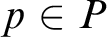 $p\in P$
,
 $$ \begin{align*}H_p=\bigoplus_{q<_Pp}H_q',\end{align*} $$
where
 $\bigoplus _nS_n$
denotes the usual Turing join (i.e., the coproduct) defined by
 $\bigoplus _nS_n=\{\langle n,x\rangle :x\in S_n\}$
, and
 $H'$
denotes the Turing jump of H. Note that the definition of a jump hierarchy is clearly described by an arithmetical condition. For more details, see also Sacks [Reference Sacks18, Section II.4].
Even if
 $\prec $
is not well-founded, some solution to
 $\mathsf {ATR}_{2}(\prec )$
may produce a jump hierarchy for
 $\prec $
(often called a pseudo-hierarchy) by Harrison’s well-known result that there exists pseudo-well-orders which admit a jump hierarchy (but in this case the jump hierarchy is not necessarily unique). Regarding
 $\mathsf {ATR}_{2}$
, we note that, sometimes in practice, what we need is not a full jump hierarchy for a pseudo-well-ordering, but a jump hierarchy for an initial segment of
 $\prec $
containing its well-founded part. Therefore, we introduce another two-sided version
 $\mathsf {ATR}_{2'}$
as follows:
Let L be a linearly ordered set. The well-founded part of L is the largest initial segment of L which is well-founded. We say that an initial segment I of L is large if it contains the well-founded part of L.
We consider a variant of the arithmetical transfinite recursion
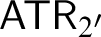 $\mathsf {ATR}_{2'}$
, which states that for any linear order
 $\prec _x$
coded by x, one can find either a jump hierarchy for a large initial segment of
 $\prec _x$
or an infinite
 $\prec _x$
-decreasing sequence:
 $$ \begin{align*} \mathsf{ATR}_{2'}(x)=\ &\{0{}^{\smallfrown} H:H\text{ is a jump hierarchy for a large initial segment of } \prec_x\} \\ \cup\ &\{1{}^{\smallfrown} p:p \text{ is an infinite decreasing sequence with respect to } \prec_x\}. \end{align*} $$
Seemingly,
 $\mathsf {ATR}_{2'}$
is completely unrelated to any other choice principles. Surprisingly, however, we will see that the parallelization of
 $\mathsf {ATR}_{2'}$
is arithmetically equivalent to the choice principle for
 $\Sigma ^1_1$
-compact sets. We say that f is arithmetically Weihrauch reducible to g (written
 $f\leq _{\mathsf {W}}^ag$
) if we are allowed to use arithmetic functions H and K (i.e.,
 $H,K\leq _{\mathsf {W}}\lim ^{(n)}$
for some
 $n\in \mathbb {N}$
) in the definition of Weihrauch reducibility.
Theorem 2.12.
 $\widehat {\mathsf {ATR}_{2'}}\equiv _{\mathsf {W}}^a\Sigma ^1_1\mbox {-}\mathsf {KC}_{\mathbb {N}^{\mathbb {N}}}\equiv _{\mathsf {W}}^a\Sigma ^1_1\mbox {-}\mathsf { AC}^{\mathsf {aou}}_{\mathbb {N}\to \mathbb {N}}\equiv _{\mathsf {W}}^a\Sigma ^1_1\mbox {-}\mathsf {AC}^{\mathsf {aof}}_{\mathbb {N}\to \mathbb {N}}$
.
We divide the proof of Theorem 2.12 into two lemmas.
Lemma 2.13.
 $\mathsf {ATR}_{2'}\leq _{\mathsf {W}}^a\Sigma ^1_1\mbox {-}\mathsf {KC}_{\mathbb {N}^{\mathbb {N}}}$
.
Proof By Corollary 2.11, it suffices to prove
 $\mathsf {ATR}_{2'}\leq _{\mathsf {W}}^a\widehat {\Sigma ^1_1\mbox {-}\mathsf {UC}^{\mathsf {tot}}_2}$
. Fix x a code for a linear order. Given
 $n\in \mathbb {N}$
, let
 $JH_{n}$
be the set of jump hierarchies for
 $\prec _x\! \upharpoonright _{n}$
(where
 $\prec _x\! \upharpoonright _{n}$
is the restriction of
 $\prec _x$
up to
 $\{y:y\prec _x n\}$
). Note that
 $\{(n,H):H\in JH_n\}$
is arithmetical (since the definition of a jump hierarchy is described by an arithmetical condition as mentioned above). For
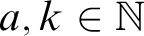 $a,k\in \mathbb {N}$
, if
 $a\prec _x n$
then we consider the set
 $S^n_{a,k}$
of all possible values of
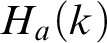 $H_a(k)$
, the k-th value of the a-th level of H, for some jump hierarchy
 $H\in JH_n$
, i.e.,
 $S^n_{a,k}=\{H_a(k):H\in JH_n\}$
. If
 $a\not \prec _x n$
then put
 $S^n_{a,k}=\{0\}$
. Clearly,
 $S^n_{a,k}$
is
 $\Sigma ^1_1$
uniformly in
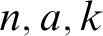 $n,a,k$
, and therefore there is a computable function f such that
 $S^n_{a,k}$
is the
 $f(n,a,k)$
-th
 $\Sigma ^1_1$
set. Note that if
 $\prec _x\! \upharpoonright _{n}$
is well-founded, then the product
 $S^n:=\prod _{\langle a,k\rangle }S^n_{a,k}$
essentiallyFootnote
1
consists of the unique jump hierarchy for
 $\prec _x\! \upharpoonright _{n}$
. In particular,
 $S^n_{a,k}$
is a singleton for any
 $a\prec _xn$
and
 $k\in \mathbb {N}$
whenever
 $\prec _x\! \upharpoonright _{n}$
is well-founded.
Given
 $p_{n,a,k}\in \Sigma ^1_1\mbox {-}\mathsf {UC}^{\mathsf {tot}}_{2}(f(n,a,k))$
(that is,
 $p_{n,a,k}\in S^n_{a,k}$
whenever
 $S^n_{a,k}$
is a singleton), define
 $H_n=\bigoplus _{\{\langle a,k\rangle : a\prec _x n\}}p_{n,a,k}$
. Note that if n is contained in the well-founded part of
 $\prec _x$
, then
 $H_n$
must be the jump hierarchy for
 $\prec _x\! \upharpoonright _{n}$
. By using arithmetical power (being a jump hierarchy is a
 $\Pi ^0_2$
statement), first ask if
 $H_n$
is a jump hierarchy for
 $\prec _{x}\! \upharpoonright _{n}$
for every n. If yes,
 $\bigoplus _nH_n$
is a jump hierarchy along the whole ordering
 $\prec _x$
. In particular, the whole ordering includes the well-founded part of
 $\prec _x$
, and therefore is large.
If no, we claim that there is no
 $\prec _{x}$
-least n such that
 $H_n$
is not a jump hierarchy for
 $\prec _{x}\! \upharpoonright _{n}$
. Indeed, suppose there exists one, then obviously n is not contained in the well-founded part of
 $\prec _x$
. Hence,
 $\prec _x\! \upharpoonright _{n}$
is a large initial segment of
 $\prec _x$
. Moreover, by minimality of n, every
 $H_j$
for
 $j\prec _x n$
is a jump hierarchy, so by definition of a jump hierarchy,
 $\bigoplus \{H_j':j\prec _x n\}$
is the jump hierarchy for
 $\prec _x\! \upharpoonright _{n}$
. But then, none of the
 $S^n_{a,k}$
are empty, and
 $H_n$
must be a jump hierarchy for
 $\prec _x\! \upharpoonright _{n}$
, a contradiction proving the claim.
Let
 $j_0$
be the
 $<_{\mathbb {N}}$
-least number such that
 $H_{j_0}$
is not a jump hierarchy for
 $\prec _x\! \upharpoonright _{j_0}$
, and
 $j_{n+1}\prec _{x}j_n$
be the
 $<_{\mathbb {N}}$
-least number such that
 $H_{j_{n+1}}$
is not a jump hierarchy for
 $\prec _x\! \upharpoonright _{j_{n+1}}$
. Finding such a sequence is
 $\Delta ^0_3$
, so one can arithmetically find such an infinite sequence
 $(j_n)_{n\in \mathbb {N}}$
, which is clearly decreasing with respect to
 $\prec _x$
.⊣
Lemma 2.14.
 $\Sigma ^1_1\mbox {-}\mathsf {C}^{\mathsf {aof}}_{\mathbb {N}}\leq _{\mathsf {W}}^a\widehat {\mathsf {ATR}_{2'}}$
.
Proof First, consider a computable instance S of
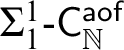 $\Sigma ^1_1\mbox {-}\mathsf {C}^{\mathsf {aof}}_{\mathbb {N}}$
. Let
 $\prec _n$
be a linear order on an initial segment
 $L_n$
of
 $\mathbb {N}$
such that
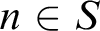 $n\in S$
iff
 $\prec _n$
is ill-founded. Let
 $H_n$
be a solution to the instance
 $\prec _n$
of
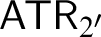 $\mathsf {ATR}_{2'}$
. Ask the arithmetic question whether there exists n such that
 $H_n$
is an infinite decreasing sequence w.r.t.
 $\prec _n$
. If so, one can computably find such an n, which belongs to S. Otherwise, each
 $H_n$
is (essentially) a jump hierarchy along a large initial segment
 $J_n$
of
 $L_n$
. In an arithmetical way, one can obtain
 $J_n$
. Then ask if
 $L_n\setminus J_n$
is nonempty, and has no
 $\prec _n$
-minimal element. If the answer to this arithmetical question is yes, we have
 $n\in S$
.
Thus, we are left with the case where for any n either
 $L_n=J_n$
holds or
 $L_n\setminus J_n$
has a
 $\prec _n$
-minimal element. In this case, if
 $n\in S$
then
 $J_n$
is ill-founded. This is because if
 $J_n$
is well-founded, then
 $J_n$
is exactly the well-founded part of
 $L_n$
since
 $J_n$
is large, and thus
 $L_n\setminus J_n$
is nonempty and has no
 $\prec _n$
-minimal element. Moreover, since
 $J_n$
admits a jump hierarchy while it is ill-founded,
 $J_n$
is a pseudo-well-order; hence
 $H_n$
computes all hyperarithmetical reals (see [Reference Enderton and Putnam6]). Conversely, if
 $n\not \in S$
then
 $H_n$
is a jump hierarchy along the well-order
 $J_n=L_n$
, which is hyperarithmetic.
Now, ask if the following
 $(H_n)_{n\in \mathbb {N}}$
-arithmetical condition holds:
 $$ \begin{align} (\exists i)(\forall j)\;H_i\not<_TH_j. \end{align} $$
By our assumption that
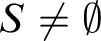 $S\not =\emptyset $
, there is
 $k\in S$
, so that
 $H_k$
computes all hyperarithmetic reals. Therefore, if (1) is true with witness i, the hierarchy
 $H_i$
cannot be hyperarithmetic; hence
 $i\in S$
. Then one can arithmetically find such an i. If (1) is false, for any i there is j such that
 $H_i<_TH_j$
. In this case, start from
 $i:=k\in S$
, and obtain an infinite sequence
 $j_0,j_1,j_2,\dots $
such that
 $H_k<_TH_{j_0}<_TH_{j_1}<_T\dotsb $
. Since
 $H_k$
computes all hyperarithmetical sets,
 $H_{j_n}$
is not hyperarithmetical for any n, i.e.,
 $j_n\in S$
. This implies that S is an infinite set. However, by our assumption, if S is infinite, then
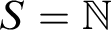 $S=\mathbb {N}$
. Hence, any i is solution to S.
Finally, one can uniformly relativize this argument to any instance of
 $\Sigma ^1_1\mbox {-}\mathsf {C}^{\mathsf {aof}}_{\mathbb {N}}$
.⊣
Proof of Theorem 2.12 By Lemma 2.13,
 $\widehat {\mathsf {ATR}_{2'}}\leq _{\mathsf {W}}^a\widehat {\Sigma ^1_1\mbox {-}\mathsf {KC}_{\mathbb {N}^{\mathbb {N}}}}$
. By Corollary 2.11,
 $\widehat {\Sigma ^1_1\mbox {-}\mathsf {KC}_{\mathbb {N}^{\mathbb {N}}}}\equiv _{\mathsf { W}}\widehat {\widehat {\Sigma ^1_1\mbox {-}\mathsf {UC}^{\mathsf {tot}}_{\mathsf {2}}}}\equiv _{\mathsf {W}}{\widehat {\Sigma ^1_1\mbox {-}\mathsf {UC}^{\mathsf { tot}}_{\mathsf {2}}}}\equiv _{\mathsf {W}}\Sigma ^1_1\mbox {-}\mathsf {KC}_{\mathbb {N}^{\mathbb {N}}}$
. By Proposition 2.10 and Definition 2.8,
 ${\widehat {\Sigma ^1_1\mbox {-}\mathsf {UC}^{\mathsf {tot}}_{\mathsf {2}}}}\equiv _{\mathsf { W}}\widehat {\Sigma ^1_1\mbox {-}\mathsf {C}^{\mathsf {aou}}_{X}}\equiv _{\mathsf {W}}\Sigma ^1_1\mbox {-}\mathsf {AC}^{\mathsf {aou}}_{\mathbb {N}\to \mathbb {N}}$
.
Clearly,
 $\Sigma ^1_1\mbox {-}\mathsf {AC}^{\mathsf {aou}}_{\mathbb {N}\to \mathbb {N}}\leq _{\mathsf {W}}\Sigma ^1_1\mbox {-}\mathsf {AC}^{\mathsf {aof}}_{\mathbb {N}\to \mathbb {N}}$
, as witnessed by the identity reductions. By Definition 2.8 and Lemma 2.14,
 $\Sigma ^1_1\mbox {-}\mathsf {AC}^{\mathsf { aof}}_{\mathbb {N}\to \mathbb {N}}\equiv _{\mathsf {W}}\widehat {\Sigma ^1_1\mbox {-}\mathsf {C}^{\mathsf {aof}}_{\mathbb {N}}}\leq _{\mathsf { W}}^a\widehat {\widehat {\mathsf {ATR}_{2'}}}\equiv _{\mathsf {W}}{\widehat {\mathsf {ATR}_{2'}}}$
.⊣
One can also consider a jump hierarchy for a partial ordering. Then, we consider the following partial order version of Goh’s arithmetical transfinite recursion. Let
 $(\prec _x)$
be a coding system of all countable partial orderings.
 $$ \begin{align*} \mathsf{ATR}_{2}^{\mathsf{po}}(x)=\ &\{0{}^{\smallfrown} H:H\text{ is a jump hierarchy for } \prec_x\}\\ \cup\ &\{1{}^\smallfrown p:p\text{ is an infinite decreasing sequence with respect to } \prec_x\}. \end{align*} $$
Note that
 $\mathsf {ATR}_{2}^{\mathsf {po}}(x)$
is an arithmetical subset of
 $\mathbb {N}^{\mathbb {N}}$
. Obviously,
 $$ \begin{align*}\mathsf{ATR}\leq_{\mathsf{W}}\mathsf{ATR}_{2'}\leq_{\mathsf{W}}\mathsf{ATR}_2\leq_{\mathsf{W}}\mathsf{ATR}_{2}^{\mathsf{po}}\leq_{\mathsf{W}}\Sigma^1_1\mbox{-}\mathsf{C}_{\mathbb{N}^{\mathbb{N}}}.\end{align*} $$
This version of arithmetical transfinite recursion directly computes a solution to all-or-finite choice on the natural numbers without using parallelization or arithmetical Weihrauch reductions.
Proposition 2.15.
 $\Sigma ^1_1\mbox {-}\mathsf {C}^{\mathsf {aof}}_{\mathbb {N}}\leq _{\mathsf {W}}\mathsf {ATR}_{2}^{\mathsf {po}}$
.
Proof Let S be a computable instance of
 $\Sigma ^1_1\mbox {-}\mathsf {C}^{\mathsf {aof}}_{\mathbb {N}}$
. Let
 $T_n$
be a computable tree such that
 $n\in S$
iff
 $T_n$
is ill-founded. Define
 $$ \begin{align*} T=00\sqcup_nT_n=\{\langle\rangle,\langle 0\rangle,\langle 00\rangle\}\cup\{\langle 00n\rangle\sigma:\sigma\in T_n\}. \end{align*} $$
Let
 $i\mbox {}^\smallfrown H$
be a solution to the instance T (ordered by reverse inclusion) of
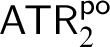 $\mathsf {ATR}_{2}^{\mathsf {po}}$
. If
 $i=1$
, i.e., if H is an infinite decreasing sequence w.r.t. T, then this provides an infinite path p through T. Then, choose n such that
 $00n\prec p$
, which implies
 $T_n$
is ill-founded, and thus
 $n\in S$
. Otherwise,
 $i=0$
, and thus H is a jump hierarchy for T. We define
 $H^\ast _n=H_{\langle 00n\rangle }$
. Note that if
 $n\not \in S$
then
 $H^\ast _n$
is hyperarithmetic, and if
 $n\in S$
then
 $H^\ast _n$
computes all hyperarithmetical reals. By the definition of a jump hierarchy, we have
 $(H^\ast _n)''\leq _TH$
. Thus, the following is an H-computable question:
 $$ \begin{align} (\exists i)(\forall j)\;H^\ast_i\not<_TH^\ast_j. \end{align} $$
As in the proof of Lemma 2.14, one can show that if (2) is witnessed by i then
 $i\in S$
, and if (2) is false then any i is a solution to S. As before, one can uniformly relativize this argument to any instance S.⊣
Question 2.16.
 $\mathsf {ATR}_{2}\equiv ^a_{\mathsf {W}}\mathsf {ATR}_{2'}\equiv ^a_{\mathsf {W}}\mathsf {ATR}_{2}^{\mathsf {po}}$
?
3 An analysis of the analytic axioms of choice and dependent choice
In this section, we investigate the structure of different restrictions of the axiom of analytical choice under the Weihrauch reducibility. We compare the dependent and independent axioms of choice for the various restrictions, and the relative strength of the restrictions.
We show both Weihrauch reductions and nonreductions. A powerful tool for proving the latter is Medvedev reduction, introduced in [Reference Medvedev16] to classify problems according to their degree of difficulty, as for Weihrauch reducibility. However, when Weihrauch reducibility compares problems that have several instances, each of them with multiple solutions, Medvedev reducibility compares “mass problems,” which correspond to problems with a single instance. A mass problem is a set of functions from natural numbers to natural numbers, representing the set of solutions. For two mass problems
 $P,Q\subseteq \mathbb {N}^{\mathbb {N}}$
, we say that P is Medvedev reducible to Q if every solution for Q uniformly computes a solution for P.
Definition 3.1 (Medvedev reduction)
Let
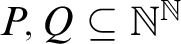 $P,Q\subseteq \mathbb {N}^{\mathbb {N}}$
be sets. We say that P is Medvedev reducible to Q, written
 $P\leq _M Q$
if there exists a single computable function f such that for every
 $x\in Q$
,
 $f(x)\in P$
.
If
 $P:\subseteq X\rightrightarrows \mathbb {N}^{\mathbb {N}}$
is now a Weihrauch problem, that is a partial multivalued function, then for any instance
 $x\in X$
, one can consider the mass problem
 $P(x)$
(the set of all solutions of the x-th instance of P). Then, if
 $P\leq _WQ$
, then for every computable instance x of P, there is a computable instance y of Q such that
 $P(x)\leq _MQ(y)$
. Using Medvedev reducibility, we are able to compare the degree of complexity of different instances of the same problem, and we will be interested in the structural property of their complexity: Given a Weihrauch problem P, we define the Medvedev partial order of P to be the partial order of Medvedev degrees of
 $P(x)$
for all computable instances
 $x\in \text {dom}(P)$
, under the Weihrauch reduction. We will see below Definition 2.8 that when P corresponds to a restriction of the axiom of choice, the corresponding partial order is an upper semi-lattice, while when it corresponds to a restriction of the axiom of dependent choice, the corresponding partial order is a lattice. For instance,
 $P=\Sigma ^1_1\mbox {-}\mathsf {DC}^{{}}_{\mathbb {N}}$
yields the Medvedev lattice of
 $\Sigma ^1_1$
-closed sets, which is interesting in its own right.
We will be mainly interested in the existence of maximal elements of Medvedev semi-lattices of P, for P being various choice problems, as it can be used to Weihrauch-separate two problems. Suppose that
 $P\leq _WQ$
and the Medvedev semi-lattice of Q has no maximal element, while the Medvedev semi-lattice of P has one. Then, we have
 $P<_WQ$
: Let
 $x\in \text {dom}(P)$
be any computable instance realizing a maximal Medvedev degree in P, and take
 $y\in \text {dom}(Q)$
computable such that
 $P(x)\leq _MQ(y)$
(as
 $P\leq _WQ$
). By the fact that Q has no maximal element, let
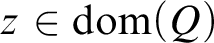 $z\in \text {dom}(Q)$
be computable and such that
 $Q(z)>_MQ(y)$
. Then, it cannot be that there is
 $t\in \text {dom}(P)$
computable such that
 $P(t)\geq _MQ(z)$
, as it would contradict maximality of x. Therefore, z is a witness that
 $P<_WQ$
.
Throughout this section, we use the following abuse of notation.
Notation. Given a Weihrauch problem P, we abuse notation by writing “
 $A\in P$
” or “A in P” to mean that A is a computable instance of P, that is,
 $A=P(x)$
for some computable
 $x\in \text {dom}(P)$
.
Given
 $\triangledown \in \{\mathsf {fin, cof, foc, aof, aou}\}$
, the partial order on the computable instances of
 $\Sigma ^1_1\mbox {-}\mathsf {AC}^{\mathsf { \triangledown }}_{\mathbb {N}\to \mathbb {N}}$
under Medvedev reducibility forms an upper semi-lattice. Indeed, if
 $A=\prod _n A_n$
and
 $B=\prod _n B_n$
are two computable instances of
 $\Sigma ^1_1\mbox {-}\mathsf {AC}^{\mathsf {\triangledown }}_{\mathbb {N}\to \mathbb {N}}$
, then
 $C=\prod _n C_n$
where
 $C_{2n} = A_n$
and
 $C_{2n+1} = B_n$
are computable instances of
 $\Sigma ^1_1\mbox {-}\mathsf {AC}^{\mathsf {\triangledown }}_{\mathbb {N}\to \mathbb {N}}$
which is a least upper bound of A and B. Similarly, the partial order on the computable instances of
 $\Sigma ^1_1\mbox {-}\mathsf {DC}^{\mathsf {\triangledown }}_{\mathbb {N}}$
under Medvedev reducibility forms a lattice: If A and B are instances of
 $\Sigma ^1_1\mbox {-}\mathsf {DC}^{\mathsf {\triangledown }}_{\mathbb {N}}$
, then
 $C=\{\tau \in \mathbb {N}^{<\mathbb {N}}: \sigma _0:n\mapsto \tau (2n)\in A\land \sigma _1:n\mapsto \tau (2n+1)\in B\}$
is a computable instance of
 $\Sigma ^1_1\mbox {-}\mathsf {DC}^{\mathsf {\triangledown }}_{\mathbb {N}}$
which is a least upper bound of A and B, and for
 $\triangledown \in \{\mathsf { fin, foc, aof}\}$
(respectively
 $\triangledown \in \{\mathsf {cof, aou}\}$
) the set
 $D=0\mbox {}^\smallfrown A\cup 1\mbox {}^\smallfrown B$
(respectively
 $D=\bigcup _n (2n\mbox {}^\smallfrown A)\cup (2n+1\mbox {}^\smallfrown B)$
) is a computable instance of
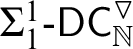 $\Sigma ^1_1\mbox {-}\mathsf {DC}^{\mathsf {\triangledown }}_{\mathbb {N}}$
which is a greatest lower bound for A and B.
This structural difference imply that no matter the restriction on analytical AC and DC, the corresponding semi-lattices will always be different under Medvedev reducibility, as there exist two homogeneous sets whose product is not Medvedev equivalent to a homogeneous set.
Proposition 3.2. For every
 $\triangledown \in \{\mathsf {fin, cof, foc, aof, aou}\}$
, there exists
 $A\in \Sigma ^1_1\mbox {-}\mathsf {DC}^{\mathsf {\triangledown }}_{\mathbb {N}}$
such that there is no
 $B\in \Sigma ^1_1\mbox {-}\mathsf {AC}^{\mathsf {\triangledown }}_{\mathbb {N}\to \mathbb {N}}$
with
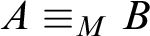 $A\equiv _M B$
.
Proof Simply take
 $A_0$
and
 $A_1$
in
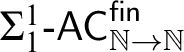 $\Sigma ^1_1\mbox {-}\mathsf {AC}^{\mathsf {fin}}_{\mathbb {N}\to \mathbb {N}}$
which are not Medvedev equivalent, and consider
 $C=0\mbox {}^\smallfrown A_0\cup 1\mbox {}^\smallfrown A_1$
, which is in
 $\Sigma ^1_1\mbox {-}\mathsf {DC}^{\mathsf {fin}}_{\mathbb {N}}$
. Now, toward a contradiction, suppose also that there exists H in
 $\Sigma ^1_1\mbox {-}\mathsf {AC}^{\mathsf {fin}}_{\mathbb {N}\to \mathbb {N}}$
(actually there is no need for H to be
 $\Sigma ^1_1$
) such that
 $C\equiv _MH$
. Let
 $\phi $
and
 $\psi $
be witnesses of this, i.e.,
 $\phi $
(resp.
 $\psi $
) is total on C (resp. H) and its image is included in H (resp. C).
Now, we describe a way for some
 $A_{i}$
to Medvedev compute
 $A_{1-i}$
: Let
 $i\in 2$
and
 $\sigma $
be extendible in H such that
 $\psi ^\sigma (0)=1-i$
. Given
 $x\in A_{i}$
, apply
 $\phi $
on
 $i\mbox {}^\smallfrown x$
to obtain an element y of H. Define
 $\widetilde y$
to be y with its beginning replaced by
 $\sigma $
. Then, by homogeneity,
 $\widetilde y$
is still in H, so
 $\phi (\widetilde y)$
has to be in
 $(1-i)\mbox {}^\smallfrown A_{1-i}$
.
For other values of
 $\triangledown $
, the proof is exactly the same or very similar.⊣
Note that the above proof used the fact that there always exists infimum in
 $\Sigma ^1_1\mbox {-}\mathsf {DC}^{\mathsf {\triangledown }}_{\mathbb {N}}$
while this is not clear in
 $\Sigma ^1_1\mbox {-}\mathsf {AC}^{\mathsf {\triangledown }}_{\mathbb {N}\to \mathbb {N}}$
.
3.1 Axioms of finite analytic choice
We already have defined
 $\Sigma ^1_1\mbox {-}\mathsf {KC}_{\mathbb {N}^{\mathbb {N}}}$
in Section 2.2, which is clearly the same problem as
 $\Sigma ^1_1\mbox {-}\mathsf {DC}^{\mathsf {fin}}_{\mathbb {N}}$
up to the coding of the instance. Using our previous work, we show that the finite choice can always be weakened to independent choice over two possibilities:
Theorem 3.3.
 $\Sigma ^1_1\mbox {-}\mathsf {AC}^{\mathsf {fin}}_{\mathbb {N}\to \mathbb {N}}\equiv _W\Sigma ^1_1\mbox {-}\mathsf {DC}^{\mathsf { fin}}_{\mathbb {N}}\equiv _W\Sigma ^1_1\mbox {-}\mathsf {WKL}$
.
Proof First, it is clear that we have
 $\Sigma ^1_1\mbox {-}\mathsf {AC}^{\mathsf {fin}}_{\mathbb {N}\to \mathbb {N}}\leq _{\mathsf {W}}\Sigma ^1_1\mbox {-}\mathsf { DC}^{\mathsf {fin}}_{\mathbb {N}}$
. Up to the coding of the instance, we also have
 $\Sigma ^1_1\mbox {-}\mathsf {DC}^{\mathsf {fin}}_{\mathbb {N}}\equiv _{\mathsf {W}}\Sigma ^1_1\mbox {-}\mathsf {KC}_{\mathbb {N}^{\mathbb {N}}}$
. By Proposition 2.5,
 $\Sigma ^1_1\mbox {-}\mathsf {KC}_{\mathbb {N}^{\mathbb {N}}}\equiv _{\mathsf {W}}\Sigma ^1_1\mbox {-}\mathsf {AC}_{\mathbb {N}\to 2}\equiv _{\mathsf { W}}\Sigma ^1_1\mbox {-}\mathsf {WKL}$
. But clearly,
 $\Sigma ^1_1\mbox {-}\mathsf {AC}_{\mathbb {N}\to 2}\leq _{\mathsf {W}}\Sigma ^1_1\mbox {-}\mathsf {AC}^{\mathsf {fin}}_{\mathbb {N}\to \mathbb {N}}$
.⊣
In the following, we are interested in a finer analysis of
 $\Sigma ^1_1\mbox {-}\mathsf {AC}^{\mathsf {fin}}_{\mathbb {N}\to \mathbb {N}}$
and
 $\Sigma ^1_1\mbox {-}\mathsf {DC}^{\mathsf {fin}}_{\mathbb {N}}$
using Medvedev reducibility. In particular, we show that both of these semi-lattices admit a maximal element: Indeed, we show that there is a single nonempty compact homogeneous
 $\Sigma ^1_1$
set coding all information of nonempty compact
 $\Sigma ^1_1$
sets. This can be viewed as an effective version of Dellacherie’s theorem (cf. Steel [Reference Steel21]) in descriptive set theory.
Theorem 3.4. There exists a maximum in the Medvedev semi-lattices of
 $\Sigma ^1_1\mbox {-}\mathsf {AC}^{\mathsf {fin}}_{\mathbb {N}\to \mathbb {N}}$
and
 $\Sigma ^1_1\mbox {-}\mathsf {DC}^{\mathsf {fin}}_{\mathbb {N}}$
.
Proof To construct a greatest element in
 $\Sigma ^1_1\mbox {-}\mathsf {DC}^{\mathsf {fin}}_{\mathbb {N}}$
, by Proposition 2.5, we only need to enumerate all nonempty compact
 $\Sigma ^1_1$
subsets of
 $2^{\mathbb {N}}$
. Let
 $S_e$
be the e-th
 $\Sigma ^1_1$
subtree of
 $2^{<\mathbb {N}}$
. Then, consider a
 $\Delta ^1_1$
co-enumeration
 $(S_{e,\alpha })_{\alpha <\omega _1^{\text {CK}}}$
of
 $S_e$
(induced from a
 $\Pi ^1_1$
-norm, as explained in Section 1.2). If
 $[S_e]$
is empty, by compactness,
 $S_e$
is finite.
If
 $S_e$
is finite, we claim that there is
 $\alpha <\omega _1^{\text {CK}}$
such that
 $S_{e,\alpha }$
is finite, and the least such
 $\alpha $
is a successor ordinal. To see this, first note that for each
 $\sigma \in 2^{<\mathbb {N}}\setminus S_e$
, there is
 $\alpha (\sigma )<\omega _1^{\text {CK}}$
such that
 $\sigma \not \in S_{e,\alpha (\sigma )}$
. Now,
 $2^{<\mathbb {N}}\setminus S_e$
is cofinite, and in particular, computable, so by Spector bounding (Theorem 1.4), we have
 $\alpha =\sup \{\alpha (\sigma ):\sigma \in 2^{<\mathbb {N}}\setminus S_e\}<\omega _1^{\text {CK}}$
. For the second assertion of our claim, by minimality of
 $\alpha $
, we have
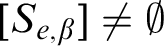 $[S_{e,\beta }]\not =\emptyset $
for any
 $\beta <\alpha $
, and moreover, if
 $\alpha $
is a limit ordinal, then
 $[S_{e,\alpha }]=\bigcap [S_{e,\alpha [n]}]$
. However, by compactness, this intersection is nonempty, which contradicts our choice of
 $\alpha $
.
Now we construct a uniform
 $\Delta ^1_1$
approximation of a sequence
 $(T_e)_{e\in \mathbb {N}}$
of nonempty
 $\Sigma ^1_1$
sets such that if
 $[S_e]\not =\emptyset $
then
 $T_e=[S_e]$
. Define
 $T_{e,0}=2^{\mathbb {N}}$
, and for any
 $\alpha>0$
,
 $T_{e,\alpha }=[S_{e,\alpha }]$
if
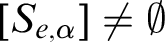 $[S_{e,\alpha }]\not =\emptyset $
(which is a
 $\Pi ^0_1(S_{e,\alpha })$
property by compactness, so in particular
 $\Delta ^1_1$
). If
 $\alpha>0$
is the first stage such that
 $[S_{e,\alpha }]=\emptyset $
, then, by the above claim,
 $\alpha $
is a successor ordinal, say
 $\alpha =\beta +1$
. In this case, define
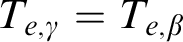 $T_{e,\gamma }=T_{e,\beta }$
for any
 $\gamma \geq \alpha $
, and end the construction. By minimality of
 $\alpha $
, we have
 $T_{e,\beta }\not =\emptyset $
since
 $\beta <\alpha $
. Then consider
 $T_e=\bigcap _{\alpha }T_{e,\alpha }$
, and it is not hard to check that the sequence
 $(T_e)_{e\in \mathbb {N}}$
has the desired property. It is easy to check that this argument is uniformly relativizable to any oracle.
As a maximal instance of
 $\Sigma ^1_1\mbox {-}\mathsf {DC}^{\mathsf {fin}}_{\mathbb {N}}$
, it suffices to take the one consisting of the product of all
 $T_e$
. Note that by Theorem 3.3 this also shows the maximality result for
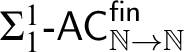 $\Sigma ^1_1\mbox {-}\mathsf {AC}^{\mathsf {fin}}_{\mathbb {N}\to \mathbb {N}}$
.⊣
As a special property of
 $\Sigma ^1_1$
compact sets, we have the following analog of the hyperimmune-free basis theorem. For
 $p,q\in \mathbb {N}^{\mathbb {N}}$
we say that p is higher Turing reducible to q (written
 $p\leq _{hT}q$
) if there is a partial
 $\Pi ^1_1$
-continuous function
 $\Phi \colon \!\!\!\subseteq \mathbb {N}^{\mathbb {N}}\to \mathbb {N}^{\mathbb {N}}$
such that
 $\Phi (q)=p$
(see Bienvenu, Greenberg, and Monin [Reference Bienvenu, Greenberg and Monin1] for more details). Here,
 $\Phi $
is
 $\Pi ^1_1$
-continuous if
 $\Phi (q)(n)\downarrow =m$
is a
 $\Pi ^1_1$
relation.
Lemma 3.5. For any
 $\Sigma ^1_1$
compact set
 $K\subseteq \mathbb {N}^{\mathbb {N}}$
there is an element
 $p\in K$
such that every
 $f\leq _{hT}p$
is majorized by a
 $\Delta ^1_1$
function.
Proof Let
 $(\psi _e)$
be a list of higher Turing reductions. Let
 $K_0=K$
. For each e, let
 $Q_{e,n}=\{x\in \mathbb {N}^{\mathbb {N}}:\psi _e^x(n)\uparrow \}$
. Then
 $Q_{e,n}$
is a
 $\Sigma ^1_1$
closed set. If
 $K_e\cap Q_{e,n}$
is nonempty for some n, define
 $K_{e+1}=K_e\cap Q_{e,n}$
for such n; otherwise define
 $K_{e+1}=K_e$
. Note that if
 $K_e\cap Q_{e,n}$
is nonempty for some n, then
 $\psi _e^x$
is not total for any
 $x\in K_{e+1}$
. If
 $K_e \cap Q_{e,n}$
is empty for all n, then
 $\psi _e$
is total on the
 $\Sigma ^1_1$
compact set
 $K_e$
, one can find a
 $\Delta ^1_1$
function majorizing
 $\psi _e^x$
for all
 $x\in K_e$
(cf. the proof of [Reference Kihara, Marcone and Pauly14, Lemma 4.7]). Define
 $K_\infty =\bigcap _nK_n$
, which is nonempty since
 $K_n$
is compact. Then, for any
 $p\in K_\infty $
, every
 $f\leq _{hT}p$
is majorized by a
 $\Delta ^1_1$
function.⊣
Note that continuity of higher Turing reduction is essential in the above proof. Indeed, one can show the following:
Proposition 3.6. There is a nonempty
 $\Sigma ^1_1$
compact set
 $K\subseteq \mathbb {N}^{\mathbb {N}}$
such that for any
 $p\in K$
, there is
 $f\leq _{T}p'$
which dominates all
 $\Delta ^1_1$
functions.
Proof Let
 $(\varphi _e)$
be an effective enumeration of all partial
 $\Pi ^1_1$
functions
 $\varphi _e\colon \!\!\!\subseteq \mathbb {N}\to 2$
. As in the argument in Proposition 2.6 or Proposition 2.9, one can see that the set
 $S_e$
of all two-valued totalizations of the partial
 $\Pi ^1_1$
function
 $\varphi _e$
is nonempty and
 $\Sigma ^1_1$
. Then the product
 $K=\prod _eS_e$
is also a nonempty
 $\Sigma ^1_1$
subset of
 $2^{\mathbb {N}}$
. It is clear that every
 $p\in K$
computes any two-valued total
 $\Delta ^1_1$
function, so (non-uniformly) computes any total
 $\Delta ^1_1$
function on
 $\mathbb {N}$
. Let
 $BB$
be a total
 $p'$
-computable function which dominates all p-computable functions. In particular,
 $BB\leq _Tp'$
dominates all
 $\Delta ^1_1$
functions.⊣
3.2 Axioms of all-or-finite and all-or-unique analytic choices
We now discuss choice when the sets from which we choose can be either everything, or finite. We will show that under the Weihrauch scope, this principle is a robust one, in the sense of having multiple characterization, that is strictly above
 $\Sigma ^1_1\mbox {-}\mathsf {DC}^{\mathsf {fin}}_{\mathbb {N}}$
. All-or-finite choice shares with finite choice the same properties that dependent and independent choices are equivalent and the existence of a maximal element containing all the information, with very similar proof as for
 $\Sigma ^1_1\mbox {-}\mathsf {DC}^{\mathsf {fin}}_{\mathbb {N}}$
.
In Proposition 2.9, we hinted that
 $\Sigma ^1_1\mbox {-}\mathsf {AC}^{\mathsf {aou}}_{\mathbb {N}\to \mathbb {N}}$
is robust. We give two other evidences of this in the following theorems.
Theorem 3.7.
 $\Sigma ^1_1\mbox {-}\mathsf {AC}^{\mathsf {aof}}_{\mathbb {N}\to \mathbb {N}}\equiv _{\mathsf {W}}\Sigma ^1_1\mbox {-}\mathsf {AC}^{\mathsf {aou}}_{\mathbb {N}\to \mathbb {N}}$
.
Proof It is clear that
 $\Sigma ^1_1\mbox {-}\mathsf {AC}^{\mathsf {aof}}_{\mathbb {N}\to \mathbb {N}}\geq _{\mathsf {W}}\Sigma ^1_1\mbox {-}\mathsf {AC}^{\mathsf {aou}}_{\mathbb {N}\to \mathbb {N}}$
, by the identity function. It remains to prove
 $\Sigma ^1_1\mbox {-}\mathsf {AC}^{\mathsf { aof}}_{\mathbb {N}\to \mathbb {N}}\leq _{\mathsf {W}}\Sigma ^1_1\mbox {-}\mathsf {AC}^{\mathsf {aou}}_{\mathbb {N}\to \mathbb {N}}$
. Let
 $A=\prod _n A_n\in \Sigma ^1_1\mbox {-}\mathsf {AC}^{\mathsf {aof}}_{\mathbb {N}\to \mathbb {N}}$
. We define uniformly in A the set
 $B=\prod _{\langle m,n\rangle } B^m_n$
such that
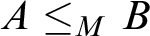 $A\leq _MB$
and
 $B\in \Sigma ^1_1\mbox {-}\mathsf {AC}^{\mathsf {aou}}_{\mathbb {N}\to \mathbb {N}}$
. We will ensure that there exists a single computable function
 $\Phi $
such that for any m and
 $X\in \prod _nB^m_n$
we have
 $\Phi ^X\in A_m$
.
We first describe the co-enumeration of
 $B^m_n$
. Let
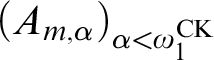 $(A_{m,\alpha })_{\alpha <\omega _1^{\text {CK}}}$
be an approximation of
 $A_m\subseteq \mathbb {N}$
(induced from a
 $\Pi ^1_1$
-norm, as explained in Section 1.2). First, wait for the first stage where
 $A_m$
is finite (if this never happens then
 $B_n^m=\mathbb {N}$
). Here note that if
 $A_m$
is finite then its finiteness is witnessed at some stage before
 $\omega _{1}^{\text {CK}}$
by Spector bounding (Theorem 1.4) as seen in the proof of Theorem 3.4. If it happens, wait for exactly n additional elements to be removed from
 $A_m$
. If this happens, let
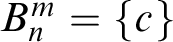 $B^m_n=\{c\}$
where c is the code for the finite set
 $A_m$
at this stage
 $\alpha _n$
. More formally, we suppose that in the co-enumeration of
 $A_m$
at most one element is removed at each stage, and we let
 $\alpha _0$
be the least stage such that
 $A_{m,\alpha _0}$
is finite, and
 $\alpha _{n+1}$
be the least stage such that
 $A_{m,\alpha _{n+1}}\subsetneq A_{m,\alpha _n}$
if it exists. Then, let
 $D_e$
be the finite set coded by e, and set
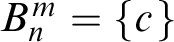 $B^m_n=\{c\}$
with
 $D_c=A_{m,\alpha _n}$
.
Now, we describe the function
 $\Phi $
. Given X, find the first i such that we do not have the following:
 $D_{X(i)}\supsetneq D_{X(i+1)}\not =\emptyset $
. Note that
 $X(0)$
codes a finite set, so the length of the chain
 $D_{X(0)}\supsetneq D_{X(1)}\supsetneq \cdots $
has to be finite. Therefore, there exists such an i. Then, output any element
 $\Phi ^X$
from
 $D_{X(i)}$
. If
 $X\in \prod _nB_n^m$
, whenever we reach stage
 $\alpha _n$
, we have
 $D_{X(n)}=A_{m,\alpha _n}$
, and thus
 $i\geq n$
. Assume that
 $\alpha _k$
is the last stage such that some element is removed from
 $A_m$
. Then,
 $k\leq i$
and
 $D_{X(k)}=A_{m,\alpha _k}=A_m\supseteq D_{X(i)}$
. This implies that if
 $X\in \prod _nB_n^m$
, then the chosen element
 $\Phi ^X$
is contained in
 $A_m$
, as required.⊣
We have seen by combining Proposition 2.6, Theorem 3.3, and Proposition 2.5 that
 $\Sigma ^1_1\mbox {-}\mathsf {AC}^{\mathsf {fin}}_{\mathbb {N}\to \mathbb {N}}$
is Weihrauch equivalent to
 $\Pi ^1_1\mbox {-}\mathsf {Tot}_2$
and
 $\Pi ^1_1\mbox {-}\mathsf {DNC}_2$
. Moreover, we have also shown in Proposition 2.9 that
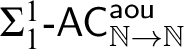 $\Sigma ^1_1\mbox {-}\mathsf {AC}^{\mathsf {aou}}_{\mathbb {N}\to \mathbb {N}}$
is Weihrauch equivalent to
 $\Pi ^1_1\mbox {-}\mathsf {Tot}_{\mathbb {N}}$
. Recall from Section 2.3 we have introduced the
 $\Pi ^1_1$
-diagonalization principle
 $\Pi ^1_1\mbox {-}\mathsf {DNC}_{\mathbb {N}}$
, which is a special case of the cofinite
 $\Sigma ^1_1$
-choice principle. For this principle, we know in advance a bound of the number of elements removed by a cofinite set. Such a principle is bounded by the following principle for
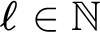 $\ell \in \mathbb {N}$
:
 $$ \begin{align*} \Sigma^1_1\mbox{-}\mathsf{C}^{\mathsf{cof}\upharpoonright \ell}_X=\Sigma^1_1\mbox{-}\mathsf{C}_{X}\! \upharpoonright_{\{A\subseteq X:|X\setminus A|\leq \ell\}}\!\!. \end{align*} $$
Namely, we have
 $\Pi ^1_1$
-
 $\mathsf {DNC}_{\mathbb {N}}\leq _{\mathsf {W}}\Sigma ^1_1\mbox {-}\mathsf {C}^{\mathsf {cof}\upharpoonright 1}_{\mathbb {N}^{\mathbb {N}}}$
. One can consider the coproduct of
 $(\Sigma ^1_1\mbox {-}\mathsf {C}^{\mathsf {cof}\upharpoonright \ell }_{X})_{\ell \in \mathbb {N}}$
and call it strongly-cofinite choice on X. One can show that this principle is strictly weaker than the cofinite choice (Proposition 3.8 and Theorem 3.17 below). Even more generally, we consider finite-or-strongly-cofinite choice, denoted
 $\Sigma ^1_1\mbox {-}\mathsf {AC}^{\mathsf {fosc}}_{\mathbb {N}\to \mathbb {N}}$
, which accepts an input of the form
 $(p,\psi )$
, where for any
 $n\in \mathbb {N}$
,
 $p(n)$
is a code of a
 $\Sigma ^1_1$
subset
 $S_{p(n)}$
of
 $\mathbb {N}$
such that either
 $S_{p(n)}$
is nonempty and finite, or
 $|\mathbb {N}\setminus S_{p(n)}|\leq \psi (n)$
. If
 $(p,\psi )$
is an acceptable input, then
 $\Sigma ^1_1\mbox {-}\mathsf {AC}^{\mathsf {fosc}}_{\mathbb {N}\to \mathbb {N}}$
chooses one element from
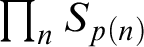 $\prod _nS_{p(n)}$
.
We show that all-or-unique choice is already strong enough to compute finite-or-strongly-cofinite choice:
Proposition 3.8.
 $\Sigma ^1_1\mbox {-}\mathsf {AC}^{\mathsf {fosc}}_{\mathbb {N}\to \mathbb {N}}\equiv _{\mathsf {W}}\Sigma ^1_1\mbox {-}\mathsf {AC}^{\mathsf {aof}}_{\mathbb {N}\to \mathbb {N}}$
.
Proof First, it is clear that
 $\Sigma ^1_1\mbox {-}\mathsf {AC}^{\mathsf {fosc}}_{\mathbb {N}\to \mathbb {N}}\geq _{\mathsf {W}}\Sigma ^1_1\mbox {-}\mathsf {AC}^{\mathsf { aof}}_{\mathbb {N}\to \mathbb {N}}$
as witnessed by the identity function. It remains to prove
 $\Sigma ^1_1\mbox {-}\mathsf {AC}^{\mathsf {fosc}}_{\mathbb {N}\to \mathbb {N}}\leq _{\mathsf {W}}\Sigma ^1_1\mbox {-}\mathsf { AC}^{\mathsf {aof}}_{\mathbb {N}\to \mathbb {N}}$
. Let
 $A=\prod _nA_n$
with a bound
 $\psi $
given. We will construct a uniformly
 $\Sigma ^1_1$
sequence
 $(B^n_m)_{m\leq \psi (n)}$
of subsets of
 $\mathbb {N}$
. We use
 $B^{n}_{0},B^{n}_{1},\dots ,B^{n}_{\psi (n)-1}$
to code information which element is removed from
 $A_n$
whenever
 $A_n$
is cofinite, and use
 $B^{n}_{\psi (n)}$
to code full information of
 $A_n$
whenever
 $A_n$
is finite. If
 $a_0$
is the first element removed from
 $A_n$
, then put
 $B^n_0=\{a_0\}$
, and if
 $a_1$
is the second element removed from
 $A_n$
, then put
 $B^n_1=\{a_1\}$
, and so on. If
 $A_n$
becomes a finite set, then
 $B_{\psi (n)}^n$
just copies
 $A_n$
, otherwise
 $B_{\psi (n)}^n=\mathbb {N}$
. One can easily ensure that for any
 $n\in \mathbb {N}$
and
 $m<\psi (n)$
, if
 $A_n$
is finite, then
 $B^n_m$
is a singleton disjoint from
 $A_n$
; otherwise
 $B^n_m=\mathbb {N}$
. Moreover, we can also see that either
 $B^n_{\psi (n)}$
is nonempty and finite or
 $B^n_{\psi (n)}=\mathbb {N}$
.
Now, assume that
 $X\in \prod _{n,m}B^n_m$
is given. If
 $X(n,\psi (n))\not \in \{X(n,i):i<\psi (n)\}$
, then put
 $Y(n)=X(n,\psi (n))$
. Otherwise, choose
 $Y(n)\not \in \{X(n,i):i<\psi (n)\}$
. Clearly, the construction of Y from X is uniformly computable.
If
 $A_n$
becomes a finite set, the first case happens, and
 $Y(n)=X(n,\psi (n))\in B^n_{\psi (n)}=A_n$
. If
 $A_n$
remains cofinite, it is easy to see that
 $\mathbb {N}\setminus A_n\subseteq \{X(n,i):i<\psi (n)\}$
, and therefore
 $Y(n)\in A_n$
. Consequently,
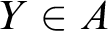 $Y\in A$
.⊣
Corollary 3.9.
 $\Sigma ^1_1\mbox {-}\mathsf {AC}^{\mathsf {aou}}_{\mathbb {N}\to \mathbb {N}}\equiv _{\mathsf {W}}\Sigma ^1_1\mbox {-}\mathsf {AC}^{\mathsf {aof}}_{\mathbb {N}\to \mathbb {N}}\equiv _{\mathsf {W}}\Sigma ^1_1\mbox {-}\mathsf {AC}^{\mathsf {fosc}}_{\mathbb {N}\to \mathbb {N}}$
.
In the following we will only consider all-or-finite choice, by convenience. We now prove that dependent choice does not add any power, and the existence of an instance that codes all the other, with very similar proofs as in the
 $\Sigma ^1_1\mbox {-}\mathsf {DC}^{\mathsf {fin}}_{\mathbb {N}}$
case.
Theorem 3.10.
 $\Sigma ^1_1\mbox {-}\mathsf {AC}^{\mathsf {aof}}_{\mathbb {N}\to \mathbb {N}}\equiv _{\mathsf {W}}\Sigma ^1_1\mbox {-}\mathsf {DC}^{\mathsf {aof}}_{\mathbb {N}}$
.
Proof It is clear that
 $\Sigma ^1_1\mbox {-}\mathsf {AC}^{\mathsf {aof}}_{\mathbb {N}\to \mathbb {N}}\leq _{\mathsf {W}}\Sigma ^1_1\mbox {-}\mathsf {DC}^{\mathsf {aof}}_{\mathbb {N}}$
. The argument for
 $\Sigma ^1_1\mbox {-}\mathsf {DC}^{\mathsf {aof}}_{\mathbb {N}}\leq _{\mathsf {W}}\Sigma ^1_1\mbox {-}\mathsf {AC}^{\mathsf {aof}}_{\mathbb {N}\to \mathbb {N}}$
is similar to the finite case (Theorem 3.4). If T is a
 $\Sigma ^1_1$
tree, for every
 $\sigma $
define
 $T_\sigma $
by the following
 $\Sigma ^1_1$
procedure: First, put
 $T_\sigma =\mathbb {N}$
, and then wait for
 $\text {succ}_T(\sigma ):=\{n:\sigma \mbox {}^\smallfrown n\in T\}$
to be finite but nonempty. As in the proof of Theorem 3.4, if
 $\text {succ}_T(\sigma )$
is finite, its finiteness is witnessed at some stage
 $<\omega _1^{\text {CK}}$
by Spector bounding (Theorem 1.4). For the first such stage
 $\alpha $
(which is not necessarily a successor ordinal), if
 $\text {succ}_T(\sigma )$
becomes empty, we just keep
 $T_\sigma =\mathbb {N}$
, and end the construction. If
 $\text {succ}_T(\sigma )$
turns out to be finite but nonempty, at every stage after
 $\alpha $
define
 $T_\sigma $
to be
 $\text {succ}_T(\sigma )$
except if this one becomes empty. Note that if
 $\text {succ}_T(\sigma )$
becomes a finite set at some stage
 $\alpha _0$
, but an empty set at a later stage
 $\alpha _1$
, then the least such stage
 $\alpha _1$
must be a successor ordinal, and therefore we can keep
 $T_\sigma $
being nonempty (see also the proof of Theorem 3.4). Clearly,
 $T_\sigma $
is either finite or
 $\mathbb {N}$
. If T is an instance of
 $\Sigma ^1_1\mbox {-}\mathsf {DC}^{\mathsf {aof}}_{\mathbb {N}}$
, then
 $T_\sigma =\text {succ}_T(\sigma )$
and therefore
 $\prod _{\sigma \in \mathbb {N}^{<\mathbb {N}}} T_\sigma \geq _M[T]$
.⊣
The absence of a maximal element in the Medvedev semi-lattice of the axiom of choice on “all-or-finite” sets would allow us to Weihrauch separate it from its “finite” version. However,
 $\Sigma ^1_1\mbox {-}\mathsf {AC}^{\mathsf {aof}}_{\mathbb {N}\to \mathbb {N}}$
does also have a maximum element.
Theorem 3.11. There exists a single maximum Medvedev degree in
 $\Sigma ^1_1\mbox {-}\mathsf {AC}^{\mathsf {aof}}_{\mathbb {N}\to \mathbb {N}}$
and
 $\Sigma ^1_1\mbox {-}\mathsf {DC}^{\mathsf {aof}}_{\mathbb {N}}$
.
Proof The argument is again similar to Theorem 3.4, even though we have no compactness assumption.
By Theorem 3.10 that
 $\Sigma ^1_1\mbox {-}\mathsf {AC}^{\mathsf {aof}}_{\mathbb {N}\to \mathbb {N}}\equiv _W\Sigma ^1_1\mbox {-}\mathsf {DC}^{\mathsf {aof}}_{\mathbb {N}}$
, it suffices to prove the result for one of the functions, let us say
 $\Sigma ^1_1\mbox {-}\mathsf {AC}^{\mathsf {aof}}_{\mathbb {N}\to \mathbb {N}}$
. Let
 $A_e=\prod _n S^e_n$
be the e-th
 $\Sigma ^1_1$
homogeneous set. We set
 $\tilde {A_e}=\prod _n\tilde {S^e_n}$
to be defined by the following
 $\Sigma ^1_1$
procedure: First, set
 $\tilde {S^e_n}=\mathbb {N}$
, and then wait for some
 $S^e_n$
to become finite and nonempty. If this happens, define
 $\tilde {S^e_n}=S^e_n$
until it removes its last element. At this point, leave
 $\tilde {S^e_n}$
nonempty, which is possible since it can happen only at a successor stage (this is because
 $S^e_n$
has already become a finite set at some previous stage). Then, one can see that
 $\tilde {A_e}$
is in
 $\Sigma ^1_1\mbox {-}\mathsf {AC}^{\mathsf {aof}}_{\mathbb {N}\to \mathbb {N}}$
, and if
 $A_e$
is also an instance of
 $\Sigma ^1_1\mbox {-}\mathsf {AC}^{\mathsf {aof}}_{\mathbb {N}\to \mathbb {N}}$
then
 $\tilde {A_e}=A_e$
.
Then
 $(\tilde {A_e})_{e\in \mathbb {N}}$
is an enumeration of all nonempty elements of
 $\Sigma ^1_1\mbox {-}\mathsf {AC}^{\mathsf {aof}}_{\mathbb {N}\to \mathbb {N}}$
. Define the maximum to simply be
 $\prod _e\prod _n\tilde {S^e_n}$
.⊣
We now prove that the relaxed constraint on the sets that allows them to be full does increase the power of the choice principle, making
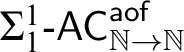 $\Sigma ^1_1\mbox {-}\mathsf {AC}^{\mathsf {aof}}_{\mathbb {N}\to \mathbb {N}}$
strictly above
 $\Sigma ^1_1\mbox {-}\mathsf {AC}^{\mathsf {fin}}_{\mathbb {N}\to \mathbb {N}}$
. We use the fact that the semi-lattice of
 $\Sigma ^1_1\mbox {-}\mathsf {AC}^{\mathsf {fin}}_{\mathbb {N}\to \mathbb {N}}$
has a maximal element (Theorem 3.4), and we show that it must be strictly below some instance of
 $\Sigma ^1_1\mbox {-}\mathsf {AC}^{\mathsf {aof}}_{\mathbb {N}\to \mathbb {N}}$
.
Theorem 3.12. For every
 $A\in \Sigma ^1_1\mbox {-}\mathsf {AC}^{\mathsf {fin}}_{\mathbb {N}\to \mathbb {N}}$
, there exists
 $B\in \Sigma ^1_1\mbox {-}\mathsf {AC}^{\mathsf { aof}}_{\mathbb {N}\to \mathbb {N}}$
such that
 $A<_MB$
.
Proof We will find
 $C=\prod _nC_n\in \Sigma ^1_1\mbox {-}\mathsf {AC}^{\mathsf {aof}}_{\mathbb {N}\to \mathbb {N}}$
such that
 $C\not \leq _MA$
. Then,
 $B=A\times C$
will witness the theorem.
Now, let us describe the co-enumeration of
 $C_n$
. First, wait for
 $x\mapsto \Phi _n^x(n)$
to be total on A, where
 $\Phi _n$
is the n-th partial computable function: More precisely, as
 $\Phi ^x_n(n)\downarrow $
is
 $\Sigma ^0_1$
, the formula
 $\forall x(x\in A\rightarrow \Phi ^x_n(n))$
is
 $\Pi ^1_1$
. Hence, if it holds, it is witnessed at some stage before
 $\omega _1^{\text {CK}}$
(via a
 $\Pi ^1_1$
norm assigned to this formula). Next, since A is compact and
 $\Phi $
is continuous,
 $\Phi $
takes only finitely many values on A; that is,
 $\Phi _n^A(n):=\{\Phi ^x_n(n):x\in A\}$
is finite. Clearly,
 $\Phi _n^A(n)$
is
 $\Sigma ^1_1$
, and therefore, again, as in the proof of Theorem 3.4, the finiteness of
 $\Phi _n^A(n)$
is witnessed at some stage
 $\alpha $
before
 $\omega _1^{\text {CK}}$
. At this point, remove everything from
 $C_n$
except
 $\max \Phi _{n,\alpha }^A(n)+1$
, where
 $\Phi _{n,\alpha }^A(n)$
is the stage
 $\alpha $
approximation of
 $\Phi _n^A(n)$
.
We have that
 $C_n$
is either
 $\mathbb {N}$
if the co-enumeration is stuck waiting for
 $x\mapsto \Phi _n^x(n)$
to be total on A, or a singleton otherwise. Also, it is clear that for any n,
 $\Phi _n$
cannot be a witness that
 $C\leq _MA$
, so
 $C\not \leq _MA$
.⊣
Corollary 3.13. We have
 $\Sigma ^1_1\mbox {-}\mathsf {AC}^{\mathsf {fin}}_{\mathbb {N}\to \mathbb {N}}<_W\Sigma ^1_1\mbox {-}\mathsf {AC}^{\mathsf {aof}}_{\mathbb {N}\to \mathbb {N}}$
.
One can also use the domination property to separate the all-or-finite choice principle and the (
 $\sigma $
-)compact principle.
Proposition 3.14. There exists
 $A\in \Sigma ^1_1\mbox {-}\mathsf {AC}^{\mathsf {aof}}_{\mathbb {N}\to \mathbb {N}}$
such that every element
 $p\in A$
computes a function which dominates all
 $\Delta ^1_1$
functions.
Proof Let
 $(\varphi _e)_{e\in \mathbb {N}}$
be an effective enumeration of all partial
 $\Pi ^1_1$
functions on
 $\mathbb {N}$
. Define
 $A_{\langle e,k\rangle }\subseteq \mathbb {N}$
for
 $k, e\in \mathbb {N}$
as follows. Begin with
 $A_{\langle e,k\rangle }=\mathbb {N}$
. Wait until we see
 $\varphi _e(k)\downarrow $
. If it happens, set
 $A_{\langle e,k\rangle }=\{\varphi _e(k)\}$
. Define
 $A=\prod _nA_n$
. Then define
 $\Psi ^p(k)=\sum _{e\leq k}p(\langle e,k\rangle )$
, which is clearly computable in p. It is easy to see that
 $\Psi ^p$
dominates all
 $\Delta ^1_1$
function whenever
 $p\in A$
.⊣
This shows that all-or-finite
 $\Sigma ^1_1$
-choice is not Weihrauch-reducible to
 $\sigma $
-compact
 $\Sigma ^1_1$
-choice.
Corollary 3.15.
 $\Sigma ^1_1\mbox {-}\mathsf {AC}^{\mathsf {aof}}_{\mathbb {N}\to \mathbb {N}}\not \leq _{\mathsf {W}}\Sigma ^1_1\mbox {-}\mathsf {K}_\sigma \mathsf { C}_{\mathbb {N}^{\mathbb {N}}}$
.
Proof Recall that a computable instance of
 $\Sigma ^1_1\mbox {-}\mathsf {K}_\sigma \mathsf {C}_{\mathbb {N}^{\mathbb {N}}}$
is a countable union of compact
 $\Sigma ^1_1$
sets. Thus, by Lemma 3.5, there is a solution p to any given computable instance of
 $\Sigma ^1_1\mbox {-}\mathsf { K}_\sigma \mathsf {C}_{\mathbb {N}^{\mathbb {N}}}$
such that any function which is higher Turing reducible to p is majorized by a
 $\Delta ^1_1$
function. However, by Proposition 3.14, there is a computable instance of
 $\Sigma ^1_1\mbox {-}\mathsf {AC}^{\mathsf {aou}}_{\mathbb {N}\to \mathbb {N}}$
whose solution consists of
 $\Delta ^1_1$
dominants.⊣
Corollary 3.16.
 $\Sigma ^1_1\mbox {-}\mathsf {K}_\sigma \mathsf {C}_{\mathbb {N}^{\mathbb {N}}}$
is not parallelizable, and
 $\Sigma ^1_1\mbox {-}\mathsf {K}\mathsf { C}_{\mathbb {N}^{\mathbb {N}}}<_{\mathsf {W}}\Sigma ^1_1\mbox {-}\mathsf {K}_\sigma \mathsf {C}_{\mathbb {N}^{\mathbb {N}}}$
.
Proof Clearly,
 $\Sigma ^1_1\mbox {-}\mathsf {AC}^{{}}_{\mathbb {N}\to \mathbb {N}}$
(and therefore
 $\Sigma ^1_1\mbox {-}\mathsf {AC}^{\mathsf {aof}}_{\mathbb {N}\to \mathbb {N}}$
) is Weihrauch reducible to the parallelization of
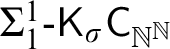 $\Sigma ^1_1\mbox {-}\mathsf {K}_\sigma \mathsf {C}_{\mathbb {N}^{\mathbb {N}}}$
. Therefore, by Corollary 3.15,
 $\Sigma ^1_1\mbox {-}\mathsf {K}_\sigma \mathsf {C}_{\mathbb {N}^{\mathbb {N}}}$
is not parallelizable. By definition, any
 $\Sigma ^1_1\mbox {-}\mathsf {AC}^{\mathsf {\triangledown }}_{\mathbb {N}\to \mathbb {N}}$
is parallelizable, and so is
 $\Sigma ^1_1\mbox {-}\mathsf {K}\mathsf { C}_{\mathbb {N}^{\mathbb {N}}}$
by Proposition 2.5.⊣
3.3 Axioms of cofinite analytic choice
The choice problem when all sets are cofinite is quite different from the other restricted choices we study. It is the only one that does not include
 $\Sigma ^1_1\mbox {-}\mathsf {AC}^{\mathsf {fin}}_{\mathbb {N}\to \mathbb {N}}$
.
Let us fix an instance
 $A=\prod _n A_n$
of
 $\Sigma ^1_1\mbox {-}\mathsf {AC}^{\mathsf {cof}}_{\mathbb {N}\to \mathbb {N}}$
. For every n,
 $A_n$
is cofinite, so there exists
 $a_n$
such that for any
 $i\geq a_n$
, we have
 $i\in A_n$
. Now, call f the function
 $n\mapsto a_n$
. We have that
 $f\in A$
, and for every g pointwise above f, we must have
 $g\in A$
. So we clearly have
 $A\leq _{\mathsf {W}}\{g\in \mathbb {N}^{\mathbb {N}}:\forall i\ f(i)\leq g(i)\}=A_f$
. This essential property of
 $\Sigma ^1_1\mbox {-}\mathsf {AC}^{\mathsf {cof}}_{\mathbb {N}\to \mathbb {N}}$
prevents an instance to have more computational power than
 $A_f$
for some
 $f\in \mathbb {N}^{\mathbb {N}}$
.
The cofiniteness still allows some more power, as we will prove in this section that
 $\Sigma ^1_1\mbox {-}\mathsf {AC}^{\mathsf {cof}}_{\mathbb {N}\to \mathbb {N}}$
is Weihrauch incomparable with both
 $\Sigma ^1_1\mbox {-}\mathsf {AC}^{\mathsf {fin}}_{\mathbb {N}\to \mathbb {N}}$
and
 $\Sigma ^1_1\mbox {-}\mathsf {AC}^{\mathsf {aof}}_{\mathbb {N}\to \mathbb {N}}$
.
Theorem 3.17. There exists
 $A\in \Sigma ^1_1\mbox {-}\mathsf {AC}^{\mathsf {cof}}_{\mathbb {N}\to \mathbb {N}}$
such that for any
 $B\in \Sigma ^1_1\mbox {-}\mathsf {AC}^{\mathsf {aof}}_{\mathbb {N}\to \mathbb {N}}$
 ${A\not \leq _M B}$
.
Proof We use the existence of a maximum all-or-finite degree of Theorem 3.11 to actually only prove
 $$ \begin{align*}\forall B\in\Sigma^1_1\mbox{-}\mathsf{AC}^{\mathsf{aof}}_{\mathbb{N}\to\mathbb{N}},\exists A\in\Sigma^1_1\mbox{-}\mathsf{AC}^{\mathsf{cof}}_{\mathbb{N}\to\mathbb{N}}: A\not\leq_M B.\end{align*} $$
Fix a
 $B=\prod _{n\in \mathbb {N}}B_n$
, with
 $B_n\subseteq \mathbb {N}$
being either
 $\mathbb {N}$
or finite. We will construct
 $A=\prod _{e\in \mathbb {N}}A_e$
, and use
 $A_e$
to diagonalize against
 $\Phi _e$
being a witness for the reduction, by ensuring that either
 $\Phi _e$
is not total on B, or
 $\exists k\in \mathbb {N}, \sigma \in \prod _{n<k}B_n$
with
 $\Phi _e^\sigma (e)\downarrow \not \in A_e$
. Here is a description of the construction of
 $A_e$
, along with sequences of string
 $(\sigma _n)$
and
 $(\tau _n)$
:
-
1. First,
$A_e=\mathbb {N}$
. Wait for a stage where
$B\subseteq \text {dom}(\Phi _e)$
, that is
$\Phi _e$
is total on the current approximation of B. Define
$\sigma _0=\epsilon =\tau _0$
, and move to step (2). -
2. Let n be the maximum such that
$\tau _n$
is defined. Find
$\sigma _{n+1}\succ \tau _n$
in the current approximation of B such that
$\Phi _e^{\sigma _{n+1}}(e)\downarrow $
. Take
$\sigma _{n+1}$
to be the leftmost such, and remove
$\Phi _e^{\sigma _{n+1}}(e)$
from
$A_e$
. Move to step (3). -
3. Wait for some stage where
$\Phi _e^B(e):=\{\Phi _e^X(e):X\in B\}\subseteq A_e$
. If it happens, wait again for the current approximation of B to be “all or finite,” which will happen. Take
$\tau _{n+1}$
to be the greatest prefix of
$\sigma _{n+1}$
still in B, and return to step (2).


As in the proof of Theorem 3.12, the property
 $B\subseteq \text {dom}(\Phi _e)$
is
 $\Pi ^1_1$
, so it is witnessed at some stage
 $<\omega _1^{\text {CK}}$
. Let us prove that
 $A_e$
is cofinite. If the co-enumeration of
 $A_e$
stays at step (1), then
 $A_e=\mathbb {N}$
is cofinite. Otherwise, let us prove that there can only be finitely many
 $\tau _n$
defined.
Suppose all
 $\tau _n$
are defined. Then, the pointwise limit of the
 $\tau _n$
must be defined: Let
 $\ell $
be an integer such that
 $(\tau _n(\ell '))_{n\in \mathbb {N}}$
stabilizes for big enough n, for all
 $\ell '<\ell $
. Start from a stage
 $n_0$
where they have stabilized. For
 $n>n_0$
, if
 $\tau _{n+1}(\ell )$
changes, that is
 $\tau _{n+1}(\ell )\neq \tau _n(\ell )$
, it must be that
 $\tau _n(\ell )$
has been removed from
 $B_\ell $
. But then,
 $B_\ell $
will become finite before the co-enumeration continues, and
 $\tau _n(\ell )$
can only take values in
 $B_\ell $
and never twice the same. Therefore,
 $(\tau _n(\ell ))_n$
becomes constant at some point. Now, let
 $X\in \mathbb {N}^{\mathbb {N}}$
be the limit of
 $(\tau _n)$
. As
 $X(\ell )\in B_\ell $
for every
 $\ell $
, we have
 $X\in B$
. Since
 $B\subseteq \text {dom}(\Phi _e)$
is already witnessed at some previous stage, and this is a positive property, we must have
 $X\in \text { dom}(\Phi _e)$
. Thus, there is
 $\sigma \prec X$
such that
 $\Phi _e^\sigma (e)\downarrow $
. Let s be such that
 $\sigma \preceq \tau _t$
for any
 $t\geq s$
. However, our algorithm can reach step (2) at most once after s: This is because, as
 $\sigma \preceq \tau _s\preceq \sigma _{s+1}$
, we must have
 $\Phi _e^{\sigma _{s+1}}(e)=\Phi _e^\sigma (e)$
, which is removed from
 $A_e$
at step (2). This ensures that
 $\Phi _e^X(e)=\Phi _e^\sigma (e)\not \in A_e$
, so
 $\Phi _e^B(e)\subseteq A_e$
is never witnessed, and thus
 $\tau _{s+1}$
is undefined.
Hence, there is an
 $n_0$
such that
 $\tau _n$
is defined only for
 $n<n_0$
, and thus
 $\sigma _n$
can be defined only for
 $n\leq n_0$
, therefore by construction at most
 $n_0+1$
elements are removed from
 $A_e$
, and thus
 $A_e$
is cofinite.
It remains to prove that
 $A\not \leq _M B$
. Suppose
 $\Phi _e$
is a witness for the Medvedev reduction.
 $\Phi _e$
must be total on B, so we get past step (1) in the definition of
 $A_e$
. Then, as only finitely many
 $\tau _n$
are defined, the co-enumeration has to be stuck at some step, waiting for something to happen. It cannot be stuck in step (2), as
 $\Phi _e$
is total on B, and any finite sequence
 $\tau \in \prod _{n<|\sigma |} B_n$
can be extended in an element of B by homogeneity. This means that the co-enumeration is stuck at step (3), waiting for
 $\Phi _e^B(e)\subseteq A_e$
, to never happen. This leaves us with
 $\Phi _e^B(e)\not \subseteq A_e$
, so there is
 $X\in B$
such that
 $\Phi _e^X(e)\not \in A_e$
, and so
 $\Phi _e^X\not \in A$
.⊣
Theorem 3.18. For any
 $A\in \Sigma ^1_1\mbox {-}\mathsf {AC}^{\mathsf {aof}}_{\mathbb {N}\to \mathbb {N}}$
and
 $B\in \Sigma ^1_1\mbox {-}\mathsf {AC}^{\mathsf {cof}}_{\mathbb {N}\to \mathbb {N}}$
, if
 $A\leq _MB$
, then A contains a
 $\Delta ^1_1$
path.
Proof Assume that
 $A\leq _MB$
via some partial computable function
 $\Phi $
, and A and B are of the forms
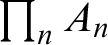 $\prod _nA_n$
and
 $\prod _nB_n$
, respectively. We describe the
 $\Delta ^1_1$
procedure to define
 $C\in A$
:
Given n, in parallel, wait for n to be enumerated in one of those two
 $\Pi ^1_1$
sets:
-
1. If n is enumerated in
$\{n:\exists k\in \mathbb {N}, \forall f\in {\mathbb {N}^{\mathbb {N}}}, \exists \sigma \geq f,\ \Phi ^\sigma (n)=k\}$
, define
$C(n)$
to be one of these k. -
2. If n is enumerated in
$\{n:\forall f\in {\mathbb {N}^{\mathbb {N}}}, \forall k, \exists k'>k, \exists \sigma \geq f$
such that
$\Phi ^\sigma (n)=k'\}$
then define
$C(n)=0$
.


Here,
 $\sigma \geq f$
denotes the pointwise domination order, that is,
 $\sigma (n)\geq f(n)$
for all
 $n<|\sigma |$
. As the items (1) and (2) are both
 $\Pi ^1_1$
, it is easy to check that C is
 $\Delta ^1_1$
.
We claim that one of the two options will happen. Assume that case (2) fails. Then, there are
 $f\in \mathbb {N}^{\mathbb {N}}$
and
 $k\in \mathbb {N}$
such that for any
 $\sigma \geq f$
, if
 $\Phi ^\sigma (n)\downarrow $
then
 $\Phi ^\sigma (n)\leq k$
. If moreover case (1) fails, then for any
 $\ell \leq k$
, there is
 $f_\ell $
such that if
 $\sigma \geq f_\ell $
and
 $\Phi ^\sigma (n)\downarrow $
then
 $\Phi ^\sigma (n)\not =\ell $
. We define
 $g\in \mathbb {N}^{\mathbb {N}}$
by
 $g(j)=\max \{f(j),f_0(j),\dots ,f_k(j)\}$
for any j. Then we have
 $g\geq f,f_0,\dots ,f_k$
, and therefore, if
 $\sigma \geq g$
then
 $\Phi ^\sigma (n)$
cannot take any value. Hence, as
 $B_j$
is cofinite for any j, there is
 $b_j\in \mathbb {N}$
such that
 $[b_j,\infty )\subseteq B_j$
. As
 $\Phi $
is total on B, if
 $h(j)\in B_j$
for every j then
 $\Phi ^h(n)$
is defined for any n. However, if we define
 $h(j)=\max \{g(j),b_j\}$
then
 $h(j)\in B_j$
and therefore
 $\Phi ^h(n)\downarrow $
, a contradiction. This verifies our claim.
As before, by cofiniteness, there exists
 $b\in \mathbb {N}^{\mathbb {N}}$
such that
 $g\geq b$
implies
 $g\in B$
. Fix n. In case (1), for
 $k=C(n)$
, there is
 $\sigma \geq b$
such that
 $\Phi ^\sigma (n)=k$
. Therefore,
 $C(n)\in \Phi ^B(n):=\{\Phi ^X(n):X\in B\}$
, and moreover
 $\Phi ^B(n)\subseteq A_n$
since
 $\Phi $
witnesses
 $A\leq _MB$
and
 $A=\prod _nA_n$
. Hence we get
 $C(n)\in A_n$
. In case (2), there are infinitely many k and there is
 $\sigma \geq b$
such that
 $\Phi ^\sigma (n)=k$
. This means that
 $\Phi ^B(n)$
is infinite, and therefore
 $A_n$
is infinite since
 $\Phi ^B(n)\subseteq A_n$
as above. Hence
 $A_n=\mathbb {N}$
and
 $C(n)\in A_n$
. Consequently, we obtain
 $C\in A$
.⊣
Corollary 3.19. We have both
 $\Sigma ^1_1\mbox {-}\mathsf {AC}^{\mathsf {cof}}_{\mathbb {N}\to \mathbb {N}}\not \leq _W\Sigma ^1_1\mbox {-}\mathsf {AC}^{\mathsf { aof}}_{\mathbb {N}\to \mathbb {N}}$
and
 $\Sigma ^1_1\mbox {-}\mathsf {AC}^{\mathsf {fin}}_{\mathbb {N}\to \mathbb {N}}\not \leq _W\Sigma ^1_1\mbox {-}\mathsf { AC}^{\mathsf {cof}}_{\mathbb {N}\to \mathbb {N}}$
.
Proof The first part is implied by Theorem 3.17 (see the argument in the paragraph below Definition 3.1). The second part is implied by Theorem 3.18 and the fact that there exist
 $\Sigma ^1_1$
finitely branching homogeneous trees with no
 $\Delta ^1_1$
member (cf. [Reference Kihara, Marcone and Pauly14, Theorem 4.3 and Lemma 4.4]).⊣
We now show that
 $\Sigma ^1_1\mbox {-}\mathsf {AC}^{\mathsf {cof}}_{\mathbb {N}\to \mathbb {N}}$
does not admit a maximal element, using a proof similar to the one of Theorem 3.17.
Theorem 3.20. For every
 $B\in \Sigma ^1_1\mbox {-}\mathsf {AC}^{\mathsf {cof}}_{\mathbb {N}\to \mathbb {N}}$
, there exists
 $A\in \Sigma ^1_1\mbox {-}\mathsf {AC}^{\mathsf { cof}}_{\mathbb {N}\to \mathbb {N}}$
such that
 $A\not \leq B$
. Thus,
 $\Sigma ^1_1\mbox {-}\mathsf {AC}^{\mathsf {cof}}_{\mathbb {N}\to \mathbb {N}}$
does not have a maximal element.
Proof Fix a
 $B=\prod _{n\in \mathbb {N}}B_n$
, with each
 $B_n\subseteq \mathbb {N}$
cofinite. We will construct
 $A=\prod _{e\in \mathbb {N}}A_e$
, and use
 $A_e$
to diagonalize against
 $\Phi _e$
being a witness for the reduction, by ensuring that either
 $\Phi _e$
is not total on B, or
 $\exists k\in \mathbb {N}, \sigma \in \prod _{n<k}B_n$
with
 $\Phi _e^\sigma (e)\downarrow \not \in A_e$
. Here is a description of the construction of
 $A_e$
, along with sequences of string
 $(\sigma _n)$
and
 $(\tau _n)$
:
-
1. First,
$A_e=\mathbb {N}$
. Wait for a stage where
$B\subseteq \text {dom}(\Phi _e)$
, that is
$\Phi _e$
is total on the current approximation of B. Define
$\sigma _0=\epsilon =\tau _0$
and move to step (2). -
2. Let n be the maximum such that
$\tau _n$
is defined. Find
$\sigma _{n+1}\succ \tau _n$
in the current approximation of B such that
$\Phi _e^{\sigma _{n+1}}(e)\downarrow $
. Take
$\sigma _{n+1}$
to be the leftmost such, and remove
$\Phi _e^{\sigma _{n+1}}(e)$
from
$A_e$
. Move to step (3). -
3. Wait for some stage where
$\Phi _e^B(e)\subseteq A_e$
. Take
$\tau _{n+1}$
to be the greatest prefix of
$\sigma _{n+1}$
still in B, and return to step (2).


Let us prove that
 $A_e$
is cofinite. If the co-enumeration of
 $A_e$
stays at step (1), then
 $A_e=\mathbb {N}$
is cofinite. Otherwise, let us prove that there can only be finitely many
 $\tau _n$
defined, just as in Theorem 3.17.
Suppose infinitely many
 $(\tau _n)$
are defined. Then, this must have a limit: Let
 $\ell $
be a level such that
 $(\tau _n(\ell '))_n$
stabilizes for all
 $\ell '<\ell $
. Start from a stage where they have stabilized. From this stage, if
 $\tau _n(\ell )$
changes, it must have been removed from
 $B_\ell $
. But that can happen only finitely many times, as
 $B_\ell $
is cofinite. Therefore,
 $(\tau _n(\ell ))$
becomes constant at some point. However, this is impossible: Let
 $X\in \mathbb {N}^{\mathbb {N}}$
be the limit of
 $(\tau _n)$
. As
 $X(\ell )\in B_\ell $
for every
 $\ell $
, we have
 $X\in B$
. Since
 $B\subseteq \text {dom}(\Phi _e)$
is already witnessed at some previous stage, and this is a positive property, we must have
 $X\in \text { dom}(\Phi _e)$
. Thus, there is
 $\sigma \prec X$
such that
 $\Phi _e^\sigma (e)\downarrow $
. Let s be such that
 $\sigma \preceq \tau _t$
for any
 $t\geq s$
. However, our algorithm can reach step (2) at most once after s: This is because, as
 $\sigma \preceq \tau _s\preceq \sigma _{s+1}$
, we must have
 $\Phi _e^{\sigma _{s+1}}(e)=\Phi _e^\sigma (e)$
, which is removed from
 $A_e$
at step (2). This ensures that
 $\Phi _e^X(e)=\Phi _e^\sigma (e)\not \in A_e$
, so
 $\Phi _e^B(e)\subseteq A_e$
is never witnessed, and thus
 $\tau _{s+1}$
is undefined. Hence, there is an
 $n_0$
such that
 $\tau _n$
is defined only for
 $n<n_0$
, and thus
 $\sigma _n$
can be defined only for
 $n\leq n_0$
, therefore by construction at most
 $n_0+1$
elements are removed from
 $A_e$
, and thus
 $A_e$
is cofinite.
Hence, there is an
 $n_0$
such that
 $\tau _n$
is defined only for
 $n<n_0$
, and thus
 $\sigma _n$
can be defined only for
 $n\leq n_0$
, therefore by construction at most
 $n_0+1$
elements are removed from
 $A_e$
, and thus
 $A_e$
is cofinite.
It remains to prove that
 $A\not \leq _M B$
. Suppose
 $\Phi _e$
is a potential witness for the inequality. Either
 $\Phi _e$
is not total on B, or we get stuck at some step in the co-enumeration of
 $A_e$
, waiting for
 $\Phi _e^B(e)\subseteq A_e$
to never happen, leaving us with
 $\Phi _e^B(e)\not \subseteq A_e$
, so there is
 $X\in B$
such that
 $\Phi _e^X(e)\not \in A_e$
, and so
 $\Phi _e^X\not \in A$
.
We now prove the last assertion:
 $\Sigma ^1_1\mbox {-}\mathsf {AC}^{\mathsf {cof}}_{\mathbb {N}\to \mathbb {N}}$
does not have a maximal element. Let
 $B=\prod _nB_n\in \Sigma ^1_1\mbox {-}\mathsf {AC}^{\mathsf {cof}}_{\mathbb {N}\to \mathbb {N}}$
. Let
 $A=\prod _n A_n$
given by the first part of the proof. Then,
 $C=\prod _nA_n\times \prod _m B_m\in \Sigma ^1_1\mbox {-}\mathsf {AC}^{\mathsf {cof}}_{\mathbb {N}\to \mathbb {N}}$
and
 $A,B\leq _M C$
so
 $B<_MC$
.⊣
We here also note some domination property of the cofinite choice. The following fact is implicitly proved by Kihara et al. [Reference Kihara, Marcone and Pauly14, Lemma 4.7] to separate
 $\Sigma ^1_1\mbox {-}\mathsf {WKL}$
and
 $\widehat {\Sigma ^1_1\mbox {-}\mathsf { C}_{\mathbb {N}}}$
.
Fact 3.21 [Reference Kihara, Marcone and Pauly14]
There exists
 $A\in \Sigma ^1_1\mbox {-}\mathsf {AC}^{\mathsf {cof}}_{\mathbb {N}\to \mathbb {N}}$
such that every element
 $p\in A$
computes a function which dominates all
 $\Delta ^1_1$
functions.
Therefore, as in the proof of Corollary 3.15, we can observe the following.
Corollary 3.22.
 $\Sigma ^1_1\mbox {-}\mathsf {AC}^{\mathsf {cof}}_{\mathbb {N}}\not \leq _{\mathsf {W}}\Sigma ^1_1\mbox {-}\mathsf {K}_\sigma \mathsf {C}_{\mathbb {N}}$
.
3.4 Axioms of finite-or-cofinite analytic choice
In this part, we study the weakened restriction to sets that are either finite, or cofinite. This restriction allows any instance from the stronger restrictions, thus
 $\Sigma ^1_1\mbox {-}\mathsf {AC}^{\mathsf {aof}}_{\mathbb {N}\to \mathbb {N}}$
,
 $\Sigma ^1_1\mbox {-}\mathsf {AC}^{\mathsf {fin}}_{\mathbb {N}\to \mathbb {N}}$
, and
 $\Sigma ^1_1\mbox {-}\mathsf {AC}^{\mathsf {cof}}_{\mathbb {N}\to \mathbb {N}}$
are Weihrauch reducible to
 $\Sigma ^1_1\mbox {-}\mathsf {AC}^{\mathsf {foc}}_{\mathbb {N}\to \mathbb {N}}$
(and similarly for dependent choice). It is the weakest form of restriction other than “no restriction at all” that we will consider. However, we don’t know if this restriction does remove some power and is strictly below
 $\Sigma ^1_1\mbox {-}\mathsf {AC}^{{}}_{\mathbb {N}\to \mathbb {N}}$
or not, as asked in Question 3.24.
In the following, we will show that
 $\Sigma ^1_1\mbox {-}\mathsf {AC}^{\mathsf {foc}}_{\mathbb {N}\to \mathbb {N}}$
,
 $\Sigma ^1_1\mbox {-}\mathsf {DC}^{\mathsf {foc}}_{\mathbb {N}}$
and
 $\Sigma ^1_1\mbox {-}\mathsf {AC}^{{}}_{\mathbb {N}\to \mathbb {N}}$
,
 $\Sigma ^1_1\mbox {-}\mathsf {DC}^{{}}_{\mathbb {N}}$
do not admit a maximal computable instance. We will give several different proofs of this result. Theorem 3.23 is an attempt to answer Question 3.24 positively, but the conclusion turns out to be too weak, by lacking the effectivity required for a diagonalization.
Theorem 3.23. For every
 $A\in \Sigma ^1_1\mbox {-}\mathsf {AC}^{\mathsf {foc}}_{\mathbb {N}\to \mathbb {N}}$
, there exists
 $B\in \Sigma ^1_1\mbox {-}\mathsf {AC}^{\mathsf { }}_{\mathbb {N}\to \mathbb {N}}$
such that
 $B\not \leq _MA$
.
Proof We will build
 $B=\prod _e B_e\in \Sigma ^1_1\mbox {-}\mathsf {AC}^{{}}_{\mathbb {N}\to \mathbb {N}}$
by defining
 $B_e$
in a uniform
 $\Sigma ^1_1$
way, such that if
 $\Phi _e$
is total on A, then
 $\Phi _e^A(e)\not \subseteq B_e$
.
Fix
 $e\in \mathbb {N}$
, and
 $A=\prod _n A_n\in \Sigma ^1_1\mbox {-}\mathsf {AC}^{\mathsf {foc}}_{\mathbb {N}\to \mathbb {N}}$
. In our definition of the co-enumeration of
 $B_e$
along the ordinals, there will be two main steps: The first one forces that if
 $\Phi _e^A(e)\subseteq B_e$
, then for every l,
 $|\Phi _e^{A_{\upharpoonright \leq l}}(e)|<\omega $
where
 $A_{\upharpoonright \leq l}=\{\sigma \in \mathbb {N}^{\leq l}:[\sigma ]\cap A\neq \emptyset \}$
. The second step will force that if
 $\Phi _e^A(e)\subseteq B_e$
, then A is empty or
 $\Phi _e$
is not total on A.
In order to conduct all these steps, we will need to remove several times an element of
 $B_e$
, but we do not want it to become empty. This is why in parallel of removing elements from
 $B_e$
, we also mark some as “saved for later,” so we know that even after infinitely many removals,
 $B_e$
is still infinite.
We now describe the first part of the co-enumeration. For clarity, we use the formalism of an infinite time algorithm, that could easily be translated into a
 $\Sigma ^1_1$
formula.

Let us first argue that for a fixed l, the “while” part can only be executed a finite number of times. At every execution of the “for
 $i\in \mathbb {N}$
” loop, either one element of
 $A_{\upharpoonright \leq l}$
is removed, or
 $\Phi _e^{A_{\upharpoonright \leq l}}(e)$
is finite and we exit the while loop (this is because at every step, only finitely many elements are marked as saved). But this means that if a “for” loop loops infinitely many times, by the pigeon hole principle there must exists a specific level
 $l_0\leq l$
such that
 $A_{l_0}$
went from cofinite to finite. But this can happen only
 $l+1$
times, and the “while” loop can only run
 $l+1$
many times.
Let us now argue that at every stage of the co-enumeration, including its end, every
 $B_e$
is infinite. Fix a level l, and suppose that at the beginning of the corresponding “while” loop,
 $B_e$
is infinite. As after every loops of the “for
 $i\in \mathbb {N}$
” loop one element is saved, it means that after all these infinitely many loop,
 $B_e$
contains infinitely many elements. This will happen during only finitely many loops of the “while” loop, so at the beginning of level
 $l+1$
,
 $B_e$
is infinite. A similar argument with the elements saved by the first “for
 $l\in \mathbb {N}$
” loop shows that if the first part of the co-enumeration ends,
 $B_e$
is still infinite.
Now we split into two cases. If the first part of the co-enumeration never stops, as the “while” loop is in fact bounded, it means that the co-enumeration is forever stuck waiting for
 $\Phi _e^A(e)\subseteq B_e$
. But as this never happens,
 $B_e$
has the required property. Otherwise, the first part of the co-enumeration ends, and we are at a stage where for every l,
 $\Phi _e^{A_{\upharpoonright \leq l}}(e)$
is finite, but
 $B_e$
is infinite. We now continue to the second part of the co-enumeration of
 $B_e$
:

We argue that this co-enumeration never finishes. Let
 $x\in A$
, and
 $\sigma \prec x$
such that
 $\Phi _e^\sigma (e)\downarrow =k$
. The co-enumeration will never reach the stage where
 $l=|\sigma +1|$
, as it cannot go through
 $l=|\sigma |$
: If it reaches such stage, it will remove k from
 $B_e$
and never have
 $\Phi _e^A(e)\subseteq B_e$
. So, the co-enumeration has to stop at some step of the “for” loop, waiting for
 $\Phi _e^A(e)\subseteq B_e$
never happening. As
 $B_e$
is infinite, it has the required property.⊣
In order to Weihrauch-separate
 $\Sigma ^1_1\mbox {-}\mathsf {AC}^{\mathsf {foc}}_{\mathbb {N}\to \mathbb {N}}$
from the unrestricted
 $\Sigma ^1_1\mbox {-}\mathsf {AC}^{{}}_{\mathbb {N}\to \mathbb {N}}$
, one would need a stronger result with a single
 $B\in \Sigma ^1_1\mbox {-}\mathsf { AC}^{{}}_{\mathbb {N}\to \mathbb {N}}$
not Medvedev reducible to any
 $A\in \Sigma ^1_1\mbox {-}\mathsf {AC}^{\mathsf {foc}}_{\mathbb {N}\to \mathbb {N}}$
. We could try to apply the same argument to define
 $\prod _{\langle n,e\rangle }B_{\langle n,e\rangle }$
, this time diagonalizing against an enumeration
 $(S^e)_{e\in \mathbb {N}}$
of
 $S^e=\prod _n S^e_n\in \Sigma ^1_1\mbox {-}\mathsf {AC}^{{}}_{\mathbb {N}\to \mathbb {N}}$
. If
 $S^e$
is not in
 $\Sigma ^1_1\mbox {-}\mathsf {AC}^{\mathsf { foc}}_{\mathbb {N}\to \mathbb {N}}$
, the co-enumeration will be stuck somewhere in the co-enumeration of some level, with no harm to the global diagonalization.
However, if some particular
 $S^e$
is empty, we could end up with some
 $B_{\langle n,e\rangle }=\emptyset $
, making B empty. Indeed, suppose we reach the second part of the co-enumeration. Then, the malicious
 $S^e$
can make sure that every step of the second loop are achieved, by removing from
 $S^e$
all strings
 $\sigma $
such that
 $\Phi _e^\sigma (e)\downarrow \not \in B_{\langle n,e\rangle }$
, at every stage of the co-enumeration. As a result, both
 $S^e$
and
 $B_{\langle n,e\rangle }$
will become empty.
Question 3.24. Do we have
 $\Sigma ^1_1\mbox {-}\mathsf {AC}^{\mathsf {foc}}_{\mathbb {N}\to \mathbb {N}} <_{\mathsf {W}} \Sigma ^1_1\mbox {-}\mathsf {AC}^{{}}_{\mathbb {N}\to \mathbb {N}}$
?
We now give a stronger result with a much simpler, but not effective, proof. As a corollary, we will obtain the fact that
 $\Sigma ^1_1\mbox {-}\mathsf { AC}^{{}}_{\mathbb {N}\to \mathbb {N}}$
and
 $\Sigma ^1_1\mbox {-}\mathsf {DC}^{{}}_{\mathbb {N}}$
do not admit a maximal computable instance.
Theorem 3.25. For every
 $A\in \Sigma ^1_1\mbox {-}\mathsf {DC}^{{}}_{\mathbb {N}}$
, there exists
 $B\in \Sigma ^1_1\mbox {-}\mathsf {AC}^{{}}_{\mathbb {N}\to \mathbb {N}}$
such that
 $B\not \leq _MA$
.
Proof We first claim that there is no enumeration of all nonempty elements of
 $\Sigma ^1_1\mbox {-}\mathsf {AC}^{{}}_{\mathbb {N}\to \mathbb {N}}$
. More than that, we will prove that there is no
 $\prod _{n,e\in \mathbb {N}}S^e_n\in \Sigma ^1_1\mbox {-}\mathsf {AC}^{{}}_{\mathbb {N}\to \mathbb {N}}$
uniformly
 $\Sigma ^1_1$
such that for every
 $B=\prod _n B_n\in \Sigma ^1_1\mbox {-}\mathsf {AC}^{{}}_{\mathbb {N}\to \mathbb {N}}$
, there exists an e such that
 $\prod _nS^e_n\subseteq B$
. Let
 $(S^e_n)_{n,e\in \mathbb {N}}$
be any uniformly
 $\Sigma ^1_1$
enumeration. We construct
 $(B_e)_{e\in \mathbb {N}}$
, a witness that this enumeration is not a counterexample to our claim. We define
 $B_e$
by stages: At stage
 $\alpha $
,
 $B_e[\alpha ]$
is equal to the open interval
 ${]}\min (S^e_e[\alpha ]);\infty {[}$
, where
 $S^e_e[\alpha ]$
is the stage
 $\alpha $
approximation of
 $S^e_e$
. Then
 $B_e=\bigcap _\alpha B_e[\alpha ]$
defines a
 $\Sigma ^1_1$
set. We have
 $\prod _n B_n\not \supseteq \prod _nS^e_n$
for every
 $e\in \mathbb {N}$
and the claim is proved.
Now, suppose that there exists
 $A\in \Sigma ^1_1\mbox {-}\mathsf {DC}^{{}}_{\mathbb {N}}$
such that for every
 $B\in \Sigma ^1_1\mbox {-}\mathsf {AC}^{{}}_{\mathbb {N}\to \mathbb {N}}$
, we have
 $B\leq _MA$
. Let us define
 $S^e_n$
by
 $$ \begin{align*} m\in S^e_n\iff\exists X\in A\;[\Phi_e^X(n)\downarrow=m\text{ or } \Phi_e \text{ is not total on } A]. \end{align*} $$
Here, it is easy to check that non-totality of
 $\Phi _e$
on the
 $\Sigma ^1_1$
set A is a
 $\Sigma ^1_1$
property (see also the proof of Theorem 3.12). Hence,
 $(S^e_n)$
is
 $\Sigma ^1_1$
uniformly in e and n. Given any
 $B\in \Sigma ^1_1\mbox {-}\mathsf {AC}^{{}}_{\mathbb {N}\to \mathbb {N}}$
, as
 $B\leq _M A$
, fix a witness
 $\Phi _e$
. Then
 $\Phi _e$
is total on A, and therefore
 $S^e_n=\Phi ^A_e(n):=\{\Phi _e^X(n):X\in A\}$
. By our choice of
 $\Phi _e$
, we also have
 $\Phi _e^A:=\prod _n\Phi _e^A(n)\subseteq B$
, and as B is homogeneous we obtain
 $\prod _nS^e_n\subseteq B$
. Then,
 $(S^e_n)_{e,n\in \mathbb {N}}$
would be a contradiction to our first claim.⊣
Corollary 3.26. Neither
 $\Sigma ^1_1\mbox {-}\mathsf {AC}^{{}}_{\mathbb {N}\to \mathbb {N}}$
nor
 $\Sigma ^1_1\mbox {-}\mathsf {DC}^{{}}_{\mathbb {N}}$
admits a maximal element.
Proof Let
 $A=\prod _nA_n\in \Sigma ^1_1\mbox {-}\mathsf {AC}^{{}}_{\mathbb {N}\to \mathbb {N}}$
. By Theorem 3.25, let
 $B=\prod _nB_n\in \Sigma ^1_1\mbox {-}\mathsf {AC}^{{}}_{\mathbb {N}\to \mathbb {N}}$
such that
 $B\not \leq _M A$
. Then,
 $C=\prod _nA_n\times \prod _mB_m\in \Sigma ^1_1\mbox {-}\mathsf {AC}^{{}}_{\mathbb {N}\to \mathbb {N}}$
is such that
 $A<_MC$
. A similar argument works for
 $\Sigma ^1_1\mbox {-}\mathsf {DC}^{{}}_{\mathbb {N}}$
.⊣
There is another non-effective proof showing that
 $\Sigma ^1_1\mbox {-}\mathsf {DC}^{{}}_{\mathbb {N}}$
does not have a maximal element (but the proof does not work for
 $\Sigma ^1_1\mbox {-}\mathsf {AC}^{{}}_{\mathbb {N}\to \mathbb {N}}$
). Indeed, remarkably, the result shows that there is no greatest nonempty
 $\Sigma ^1_1$
closed set even with respect to hyperarithmetical Muchnik degrees. We say that
 $A\subseteq \mathbb {N}^{\mathbb {N}}$
is hyperarithmetically Muchnik reducible to
 $B\subseteq \mathbb {N}^{\mathbb {N}}$
(written
 $A\leq ^{\mathsf {HYP}}_wB$
) if for any
 $x\in B$
there is
 $y\in A$
such that
 $y\leq _hx$
, that is, y is hyperarithmetically reducible to x.
Fact 3.27 (cf. Gregoriades [Reference Gregoriades11, Theorem 3.13])
If P is a
 $\Delta ^1_1$
closed set with no
 $\Delta ^1_1$
element, then there exists a clopen set C such that
 $P\cap C\not =\emptyset $
and
 $P<^{\mathsf {HYP}}_wP\cap C$
.
Proof This is what Gregoriades essentially obtained in the proof of [Reference Gregoriades11, Theorem 3.13]. If
 $P=[T]$
for a computable tree T, the “key remark” in the proof of [Reference Gregoriades11, Theorem 3.13] gives us a clopen neighborhood
 $C=[u]$
of some
 $\gamma \in P$
such that
 $\Delta ^1_1(\gamma )\cap P\cap C=\emptyset $
, so
 $\emptyset \not =P\cap C\not \leq _{w}^{\mathsf {HYP}}\{\gamma \}\subseteq P$
. The tree T can be replaced with a
 $\Delta ^1_1$
tree since the “key remark” follows from the equivalence (1) in the proof of [Reference Gregoriades11, Theorem 3.13], as it gives an implicit
 $\Sigma ^1_1$
definition of the leftmost path
 $\alpha _L$
of P, which leads to a contradiction. Observe that, even if we replace T with a
 $\Delta ^1_1$
tree, the condition is still
 $\Sigma ^1_1$
, which concludes the proof.⊣
Note that any P satisfying the conclusion of the above fact cannot be homogeneous since if P is homogeneous, C is clopen, and
 $P\cap C$
is nonempty, then we always have
 $P\cap C\equiv _MP$
. So, Fact 3.27 does not imply Theorem 3.25.
Corollary 3.28. For any nonempty
 $\Sigma ^1_1$
set
 $A\subseteq \mathbb {N}^{\mathbb {N}}$
, there is a nonempty
 $\Pi ^0_1$
set
 $B\subseteq \mathbb {N}^{\mathbb {N}}$
such that
 $A<_w^{\mathsf {HYP}}B$
.
Proof For any nonempty
 $\Sigma ^1_1$
set A, it is easy to see that there is a nonempty
 $\Pi ^0_1$
set
 $A^\ast $
such that
 $A\leq _MA^\ast $
. If
 $A^\ast $
has a
 $\Delta ^1_1$
element, then the assertion is clear as any
 $\Pi ^0_1$
set B with no
 $\Delta ^1_1$
element is such that
 $A^\ast <_w^{\mathsf {HYP}}B$
. If
 $A^\ast $
has no
 $\Delta ^1_1$
element, by Fact 3.27, there is clopen C such that
 $A\leq _MA^\ast <_w^{\mathsf {HYP}}A^\ast \cap C$
.⊣
In [Reference Cenzer and Hinman5], Cenzer and Hinman showed that the lattice of
 $\Pi ^0_1$
classes in Cantor space is dense. Here we already showed the lack of maximal elements; we now prove the lack of minimal elements:
Theorem 3.29. For every
 $A\in \Sigma ^1_1\mbox {-}\mathsf {DC}^{{}}_{\mathbb {N}}$
with no computable member, there exists
 $B>_M{\mathbb {N}^{\mathbb {N}}}$
in
 $\Sigma ^1_1\mbox {-}\mathsf {DC}^{{}}_{\mathbb {N}}$
such that
 $$ \begin{align*}{\mathbb{N}^{\mathbb{N}}}<_MA\cup B<_MA.\end{align*} $$
Proof We first reduce the problem to finding a non-computable hyperarithmetical real X such that A contains no X-computable point. If such an X exists, then we have
 $\mathbb {N}^{\mathbb {N}}<_MA\cup \{X\}<_MA$
.
It suffices to show that
 $\Phi _e^X\not \in A$
for any e, and
 $\emptyset <_TX$
. The latter condition is ensured by letting X be sufficiently generic. To describe a strategy for ensuring the first condition, fix a pruned
 $\Sigma ^1_1$
tree
 $T_A$
such that
 $[T_A]=A$
. There are two ways for
 $\Phi _e$
to not be a witness that A has an X-computable element: either
 $\Phi _e^\sigma \not \in T_A$
for some
 $\sigma \prec X$
, or
 $X\not \in \text {dom}(\Phi _e)$
. Let us argue that we have the following: For any
 $e\in \mathbb {N}$
and
 $\sigma \in \mathbb {N}^{<\mathbb {N}}$
there exists a finite string
 $\tau $
extending
 $\sigma $
such that
 $$ \begin{align} \text{either } \Phi_e^\tau\not\in T_A \text{ or } [\tau]\cap\text{dom}(\Phi_e)=\emptyset. \end{align} $$
Indeed, if it were not the case for some
 $e\in \mathbb {N}$
, we would have a string
 $\sigma $
such that for every
 $\tau $
extending
 $\sigma $
,
 $\Phi _e^\tau \in T_A$
and there exists an extension
 $\rho \succ \tau $
such that
 $\Phi _e^\rho $
strictly extends
 $\Phi _e^\tau $
, allowing us to compute a path of
 $T_A$
, which is impossible as
 $A>_M\mathbb {N}^{\mathbb {N}}$
.
Begin with the empty string
 $\sigma _0=\emptyset $
. For e let
 $D_e$
be the e-th dense
 $\Sigma ^0_1$
set of strings. Given
 $\sigma _e$
, in a hyperarithmetical way, one can find a string
 $\sigma ^\ast _{e}\in D_e$
extending
 $\sigma _e$
. Now, we have a
 $\Pi ^1_1$
function assigning e to the first
 $\sigma _{e+1}$
extending
 $\sigma _{e}^\ast $
we find verifying (3). This function is total, and then
 $\Delta ^1_1$
. Moreover, it is clear that
 $\Phi _e^X$
does not define an element of A for any X extending
 $\sigma _{e+1}$
.⊣
3.5 Axiom of choice versus dependent choice
H. Friedman showed that the axiom of
 $\Sigma ^1_1$
-dependent choice is strictly stronger than the axiom of
 $\Sigma ^1_1$
-choice in the context of second order arithmetic (cf. [Reference Simpson19, Corollary VIII.5.14]). Although the Weihrauch degrees of the principles
 $\Sigma ^1_1\mbox {-}\mathsf {DC}_{\mathbb {N}^{\mathbb {N}}}$
and
 $\Sigma ^1_1\mbox {-}\mathsf { AC}_{\mathbb {N}\to \mathbb {N}^{\mathbb {N}}}$
are the same (Observation 2.1 and Proposition 2.2), we will see that
 $\Sigma ^1_1\mbox {-}\mathsf {DC}_{\mathbb {N}}$
is strictly stronger than
 $\Sigma ^1_1\mbox {-}\mathsf {AC}_{\mathbb {N}\to \mathbb {N}}$
, which finally solves Question 1.3:
Theorem 3.30.
 $\mathsf {ATR}_2\not \leq _{\mathsf {W}}\Sigma ^1_1\mbox {-}\mathsf {AC}^{{}}_{\mathbb {N}\to \mathbb {N}};$
hence
 $\Sigma ^1_1\mbox {-}\mathsf {AC}^{\mathsf { }}_{\mathbb {N}\to \mathbb {N}}<_{\mathsf {W}}\Sigma ^1_1\mbox {-}\mathsf {DC}^{{}}_{\mathbb {N}}$
.
Proof Let
 $A_e$
be the set of solutions to the e-th computable instance of
 $\mathsf {ATR}_2$
, that is,
 $0\mbox {}^\smallfrown H\in A_e$
if and only if H is a jump hierarchy for the e-th computable linear order
 $\prec _e$
, and
 $1\mbox {}^\smallfrown p\in A_e$
if p is an infinite decreasing sequence w.r.t.
 $\prec _e$
. Suppose for the sake of contradiction that
 $A=\prod _eA_e$
is Medvedev reducible to a homogeneous
 $\Sigma ^1_1$
set S. Let B be the set of all indices
 $e\in \mathbb {N}$
such that the set of all infinite decreasing sequences w.r.t.
 $\prec _e$
is not Medvedev reducible to S, and let C be the set of all indices
 $e\in \mathbb {N}$
such that the set of all jump-hierarchies for
 $\prec _e$
is not Medvedev reducible to S. Note that B and C are
 $\Sigma ^1_1$
.
Moreover, we claim that B and C are disjoint. To see this, let
 $\Phi $
be a continuous function witnessing
 $A\leq _MS$
. If there is
 $X\in S$
such that
 $\Phi ^X(0)$
is i then, by continuity of
 $\Phi $
, there is a finite initial segment
 $\sigma $
of X such that
 $\Phi ^Y(0)=i$
for any Y extending
 $\sigma $
. However, by homogeneity of S,
 $S\cap [\sigma ]$
is Medvedev equivalent to S. This means that, for any e, S Medvedev bounds either the set of infinite paths or the set of jump-hierarchies for the e-th computable tree. This concludes the proof of the claim.
Let
 $\mathsf {WO}$
be the set of all indices of well-orderings, and
 $\mathsf {NPWO}$
be the set of all indices for computable linear orderings with infinite hyperarithmetic decreasing sequences (i.e., linear orderings which are not pseudo-well-ordered). Clearly,
 $\mathsf {WO}$
is contained in B. Moreover, by H. Friedman’s theorem [Reference Friedman7] saying that a computable linear order which supports a jump hierarchy cannot have a hyperarithmetical descending sequence (see also Friedman [Reference Friedman8] for a simpler proof based on Steel’s result [Reference Steel20]),
 $\mathsf {NPWO}$
is contained in C. Since B and C are disjoint
 $\Sigma ^1_1$
sets, by the effective version of the Lusin separation theorem (cf. [Reference Moschovakis17, Exercise 4B.11]), there is a
 $\Delta ^1_1$
set A separating B from C. This contradicts (Goh’s refinement [Reference Goh10, Theorem 3.3] of) Harrington’s unpublished result, which states that if a
 $\Sigma ^1_1$
set separates
 $\mathsf {WO}$
from
 $\mathsf {NPWO}$
, then it must be
 $\Sigma ^1_1$
-complete. So A cannot be Medvedev below a homogeneous set, and thus
 $\mathsf {ATR}_2\not \leq _{\mathsf {W}} \Sigma ^1_1\mbox {-}\mathsf {AC}^{{}}_{\mathbb {N}\to \mathbb {N}}$
.
Clearly,
 $\mathsf {ATR}_2\leq _{\mathsf {W}}\Sigma ^1_1\mbox {-}\mathsf {C}_{\mathbb {N}^{\mathbb {N}}}$
since being a jump hierarchy and being an infinite decreasing sequence are arithmetical properties. Since
 $\Sigma ^1_1\mbox {-}\mathsf {C}_{\mathbb {N}^{\mathbb {N}}}$
is Weihrauch equivalent to
 $\Sigma ^1_1\mbox {-}\mathsf {DC}^{{}}_{\mathbb {N}}$
by Proposition 2.2, we obtain
 $\Sigma ^1_1\mbox {-}\mathsf {AC}^{{}}_{\mathbb {N}\to \mathbb {N}} <_{\mathsf {W}}\Sigma ^1_1\mbox {-}\mathsf { DC}^{{}}_{\mathbb {N}}$
.⊣
Finally, we decompose the axiom of countable
 $\Sigma ^1_1$
choice into finite
 $\Sigma ^1_1$
choice and cofinite
 $\Sigma ^1_1$
choice.
Theorem 3.31.
 $\Sigma ^1_1\mbox {-}\mathsf {AC}^{{}}_{\mathbb {N}\to \mathbb {N}}\leq _{\mathsf {W}}\Sigma ^1_1\mbox {-}\mathsf {AC}^{\mathsf {fin}}_{\mathbb {N}\to \mathbb {N}}\star \Sigma ^1_1\mbox {-}\mathsf {AC}^{\mathsf {cof}}_{\mathbb {N}\to \mathbb {N}}$
.
Proof Given a homogeneous
 $\Sigma ^1_1$
tree
 $T\subseteq \mathbb {N}^{<\mathbb {N}}$
, let
 $f_T$
be the leftmost path through T. Then
 $f_T$
has a finite-change higher approximation, i.e., there is a
 $\Delta ^1_1$
sequence approximating f with finite mind-changes (cf. [Reference Bienvenu, Greenberg and Monin1] for the definition). Let
 $m_T(n)$
be the number of changes of the approximation procedure for
 $f_T\upharpoonright {n+1}$
. One can assume that
 $f_T(n)\leq m_T(n)$
. Then, one can effectively construct a
 $\Sigma ^1_1$
sequence
 $(S_n)_{n\in \mathbb {N}}$
of cofinite subsets of
 $\mathbb {N}$
such that
 $m\in S_n$
implies
 $m>m_T(n)$
. In particular, any element
 $g\in \prod _n S_n$
majorizes
 $m_T$
, and thus
 $f_T$
. Use
 $\Sigma ^1_1\mbox {-}\mathsf {AC}^{\mathsf {cof}}_{\mathbb {N}\to \mathbb {N}}$
to choose such a g, and consider the
 $\Sigma ^1_1(g)$
tree
 $T^g=\{\sigma \in T:(\forall n<|\sigma |)\;\sigma (n)<g(n)\}$
. Then
 $T^g$
is a finite branching infinite tree since
 $f_T\in [T^g]$
. Therefore, as in the proof of Proposition 2.5, one can effectively covert
 $T^g$
into a
 $\Sigma ^1_1(g)$
infinite binary tree
 $T^\ast $
. Use
 $\Sigma ^1_1\mbox {-}\mathsf {WKL}$
(which is Weihrauch equivalent to
 $\Sigma ^1_1\mbox {-}\mathsf {AC}^{\mathsf {fin}}_{\mathbb {N}\to \mathbb {N}}$
, as seen in Theorem 3.3) to get an infinite path p through
 $T^\ast $
. From p one can easily construct an infinite path through
 $T^g\subseteq T$
.⊣
3.6 Summary of this section
In summary, we obtain the following:
Theorem 3.32. We have

Here, arrows
 $\rightarrow $
and
 $\Rightarrow $
denote
 $\geq _{\mathsf {W}}$
and
 $>_{\mathsf {W}}$
, respectively. See also Figure 1.
Key principles between
 $\mathsf {UC}_{\mathbb {N}^{\mathbb {N}}}$
and
 $\mathsf {C}_{\mathbb {N}^{\mathbb {N}}}$
(where dashed lines denote parallel arithmetical Weihrauch reducibility.)

A few questions about
 $\Sigma ^1_1\mbox {-}\mathsf {AC}^{\mathsf {foc}}_{\mathbb {N}\to \mathbb {N}}$
remain open:
Question 3.33. Is
 $\Sigma ^1_1\mbox {-}\mathsf {AC}^{\mathsf {foc}}_{\mathbb {N}\to \mathbb {N}}<_{\mathsf {W}}\Sigma ^1_1\mbox {-}\mathsf {DC}^{\mathsf {foc}}_{\mathbb {N}}$
? Is
 $\Sigma ^1_1\mbox {-}\mathsf {AC}^{\mathsf {foc}}_{\mathbb {N}\to \mathbb {N}}<_{\mathsf {W}}\Sigma ^1_1\mbox {-}\mathsf {AC}^{{}}_{\mathbb {N}\to \mathbb {N}}$
?
We also do not know if the dependent and independent choices for cofinite sets coincide.
Question 3.34. Is
 $\Sigma ^1_1\mbox {-}\mathsf {AC}^{\mathsf {cof}}_{\mathbb {N}\to \mathbb {N}}<_{\mathsf {W}}\Sigma ^1_1\mbox {-}\mathsf {DC}^{\mathsf {cof}}_{\mathbb {N}}$
?
We solved the main question by showing
 $\Sigma ^1_1\mbox {-}\mathsf {AC}^{{}}_{\mathbb {N}\to \mathbb {N}}<_{\mathsf {W}}\Sigma ^1_1\mbox {-}\mathsf { DC}^{{}}_{\mathbb {N}}$
(Theorem 3.30), but it is just a computable separation. Therefore, it is natural to ask if
 $\Sigma ^1_1\mbox {-}\mathsf {AC}^{{}}_{\mathbb {N}\to \mathbb {N}}$
and
 $\Sigma ^1_1\mbox {-}\mathsf {DC}^{\mathsf { }}_{\mathbb {N}}$
can be separated even in the hyperarithmetical sense. In other words, the following is one of the most important open questions, where
 $\mathsf {UC}_{\mathbb {N}^{\mathbb {N}}}$
is the unique choice principle (or equivalently, the choice principle for
 $\Sigma ^1_1$
singletons; cf. [Reference Kihara, Marcone and Pauly14]).
Question 3.35. Is
 $\mathsf {UC}_{\mathbb {N}^{\mathbb {N}}}\star \Sigma ^1_1\mbox {-}\mathsf {AC}^{{}}_{\mathbb {N}\to \mathbb {N}}<_{\mathsf {W}}\Sigma ^1_1\mbox {-}\mathsf { DC}^{{}}_{\mathbb {N}}$
?
We also ask a question purely on the structure of Medvedev degrees for finite axioms of choice. Define more generally
 $\Sigma ^1_1\mbox {-}\mathsf { AC}^{\mathsf {P}}_{\mathbb {N}\to \mathbb {N}}$
to be
 $\Sigma ^1_1\mbox {-}\mathsf {AC}^{{}}_{\mathbb {N}\to \mathbb {N}}$
where the set from which we choose have to be taken from
 ${\mathsf P}$
. For instance, if
 $\mathsf {P}=\{A\subseteq \mathbb {N}:|A|<\omega \}$
, then
 $\Sigma ^1_1\mbox {-}\mathsf {AC}^{\mathsf { P}}_{\mathbb {N}\to \mathbb {N}}=\Sigma ^1_1\mbox {-}\mathsf {AC}^{\mathsf {fin}}_{\mathbb {N}\to \mathbb {N}}$
.
Question 3.36. Let
 $\mathsf {P}=\{A\subseteq \mathbb {N}:A\subseteq 2\}$
and
 $\mathsf {Q}=\{A\subseteq \mathbb {N}:|A|\leq 2\}$
. Is every element of
 $\Sigma ^1_1\mbox {-}\mathsf {AC}^{\mathsf {Q}}_{\mathbb {N}\to \mathbb {N}}$
Medvedev equivalent to some element of
 $\Sigma ^1_1\mbox {-}\mathsf {AC}^{\mathsf { P}}_{\mathbb {N}\to \mathbb {N}}$
?
We are also interested in comparing various kinds of arithmetical transfinite recursion.
Question 3.37.
 $\mathsf {ATR}_{\mathsf {2}}\equiv ^a_{\mathsf {W}}\mathsf {ATR}_{\mathsf {2'}}\equiv ^a_{\mathsf {W}}\mathsf {ATR}_{\mathsf {2}}^{\mathsf {po}}$
?
Finally, we mention a few descriptive set theoretic results deduced from our results. For a set
 $A\subseteq \mathbb {N}^{\mathbb {N}}\times \mathbb {N}^{\mathbb {N}}$
, each
 $A_x=\{y\in \mathbb {N}^{\mathbb {N}}:(x,y)\in A\}$
is called a section. If the section
 $A_x$
is nonempty for each
 $x\in \mathbb {N}^{\mathbb {N}}$
then A is called total. Below, we use
 $\leq _{\mathsf {W}}^c$
to denote the continuous version of Weihrauch reducibility; see [Reference Brattka, Gherardi, Pauly, Brattka and Hertling3].
Theorem 3.38.
-
1. There is a total analytic set A with compact homogeneous sections such that any total analytic set with compact sections is
$\leq _{\mathsf {W}}^c$
-reducible to A. -
2. For any total analytic set A with closed sections, there is a total analytic set with homogeneous sections which is not
$\leq _{\mathsf { W}}^c$
-reducible to A. -
3. There is a total
$F_{\sigma \delta }$
set with
$G_\delta $
sections which is not
$\equiv _{\mathsf {W}}^c$
-equivalent to any analytic set with closed sections. -
4. There is a total closed set which is not
$\leq _{\mathsf {W}}^c$
-reducible to any total analytic set with homogeneous sections.


Proof (1) follows from the relativization of Theorem 3.4 since
 $\Sigma ^1_1\mbox {-}\mathsf {AC}^{\mathsf {fin}}_{\mathbb {N}\to \mathbb {N}}\equiv _{\mathsf {W}}\Sigma ^1_1\mbox {-}\mathsf {KC}_{{\mathbb {N}^{\mathbb {N}}}}$
by Proposition 2.5 and Theorem 3.3. (2) follows from the relativization of Theorem 3.25. For (3), let S be the set of pairs
 $(x,y)$
with
 $y\not \leq _Tx$
. Then S is
 $F_{\sigma \delta }$
, and each
 $S(x)=\{y:y\not \leq _Tx\}$
is co-countable; hence
 $G_\delta $
. Suppose that S is
 $\equiv _{\mathsf {W}}^c$
-equivalent to an analytic set A with closed sections. In particular, there are x-computable functions
 $h_0,h_1$
such that
 $S(x)\leq _M^xA(h_0(x))\leq _M^xS(h_1\circ h_0(x))$
, where
 $\leq _M^x$
indicates the Medvedev reducibility relative to x. By definition of S,
 $z\leq _Tx$
implies
 $S(z)\supseteq S(x)$
, so
 $S(z)\leq _MS(x)$
. Hence,
 $S(h_1\circ h_0(x))\leq _MS(x)$
, and thus, we have
 $S(x)\equiv ^x_MA(h_0(x))$
. Since
 $A(h_0(x))$
is closed, one can apply (a relativization of) Theorem 3.29 to get a
 $\Sigma ^1_1(x)$
closed set B such that
 $\mathbb {N}^{\mathbb {N}}<_M^xB<_M^xA(h_0(x))$
. However, this implies
 $\mathbb {N}^{\mathbb {N}}<_M^xB<_M^xS(x)$
, which is impossible by definition of S. Finally, (4) follows from the relativization of Theorem 3.30.⊣
Acknowledgments
The authors would like to thank Jun Le Goh for helpful discussion. Finally, the authors deeply grateful to the anonymous referees for their valuable comments and enormous suggestions. Anglès d’Auriac would like to thank the JSPS, as the paper was prepared during the Summer Program of the Japan Society for the Promotion of Science. Kihara’s research was partially supported by JSPS KAKENHI Grant 19K03602 and 15H03634, and the JSPS Core-to-Core Program (A. Advanced Research Networks).