



1 Introduction
Operators that localize in time and frequency serve as an important mathematical instrument for examining functions across different areas on the time–frequency plane. These can be considered transformations that alter a function’s characteristics in both time and frequency domains, resulting in a reconstructed filtered signal. Daubechies in [Reference Daubechies9–Reference Daubechies and Paul11] and Ramanathan and Topiwala in [Reference Ramanathan and Topiwala23] introduced the time–frequency localization operators, and these operators were extensively investigated in [Reference Feichtinger, Nowak, Feichtinger and Strohmer16, Reference Wong28, Reference Wong30]. This category of operators is found across diverse fields of both applied and pure mathematics and has attracted the attention of numerous researchers. Recognized as a significant novel mathematical instrument, localization operators have been widely applied in areas, such as differential equations theory, signal processing, time–frequency analysis, and quantum mechanics (see [Reference Cordero and Gröchenig6, Reference De Mari, Feichtinger and Nowak12, Reference De Mari and Nowak13, Reference Gröchenig18, Reference Ramanathan and Topiwala23, Reference Wong30]). These operators are also referred to as Gabor multipliers, anti-Wick operators, Toeplitz operators, or wave packets (see [Reference Berezin2, Reference Córdoba and Fefferman7, Reference De Mari and Nowak13, Reference Feichtinger, Nowak, Feichtinger and Strohmer16]). For an in-depth exploration of localization operators theory, we direct readers to the series of papers authored by Wong [Reference Boggiatto and Wong3, Reference Liu and Wong20, Reference Wong and Pathak29, Reference Wong31, Reference Wong32], and the book of Wong [Reference Wong30]. In this article, our aim is to explore the localization operators on Orlicz modulation spaces on
${\mathbb {Z}}^n$
 .
Localization operators have been characterized through the Schrödinger representation and the short-time Fourier transform (STFT), indicating their study as components of time–frequency analysis. To gain a deeper insight into these operators, modulation spaces serve as suitable function spaces, given their connection with the STFT. Introduced by Feichtinger in [Reference Feichtinger, Krishna, Radha and Thangavelu14], modulation spaces constitute a family of spaces for functions and distributions. Since then, the theory of these spaces has been expanded in various ways (see [Reference Gröchenig18]). The concept of modulation spaces was extended and investigated using Orlicz spaces and mixed-norm Orlicz spaces in [Reference Schnackers and Führ25]. Orlicz spaces are important types of Banach function spaces that are considered in mathematical analysis. These spaces naturally generalize
$L^p$
 -spaces and contain certain Sobolev spaces as subspaces. Orlicz spaces appear in various computations, such as the Zygmund space
$L \log ^+ L$
 , which is a Banach space related to Hardy–Littlewood maximal functions. Like many other function spaces, there has been a recent interest in the case of Orlicz modulation spaces. Such spaces are obtained by imposing Orlicz norm estimates on the STFTs of the involved functions and distributions. Since the family of Orlicz spaces contains all Lebesgue spaces, the family of Orlicz modulation spaces contains all classical modulation spaces. In particular, the Orlicz modulation spaces are a subfamily of broader classes of modulation spaces. For a detailed study on comparisons of the existing modulation spaces and Orlicz modulation spaces, we refer to [Reference Gumber, Rana, Toft and Üster19]. Some recent investigations on Orlicz modulation spaces can be found in [Reference Schnackers and Führ25, Reference Toft, Üster, Nabizadeh and Öztop27]. In this article, we introduce Orlicz spaces on
${\mathbb {Z}}^n \times {\mathbb {T}}^n$
 , and Orlicz modulation spaces on
${\mathbb {Z}}^n$
 , and study inclusion relations, convolution relations, and duality properties of these spaces. Moreover, we prove that the Orlicz modulation space
$M^{\Phi }({\mathbb {Z}}^n)$
 is close to the modulation space
$M^{2}({\mathbb {Z}}^n)$
 for some particular Young function
$\Phi $
 .
Given that localization operators fall within the category of pseudo-differential operators, recent research on pseudo-differential operators on
${\mathbb {Z}}^n$
 (see [Reference Botchway, Kabiti and Ruzhansky5]) and
$\hbar {\mathbb {Z}}^n$
 (see [Reference Botchway, Chatzakou and Ruzhansky4]) has inspired us to investigate the localization operator on
${\mathbb {Z}}^n$
 . Also, our recent works on localization operators on discrete modulation spaces established a strong connection between the theory of pseudo-differential operators and localization operators on
${\mathbb {Z}}^n$
 (see [Reference Dasgupta and Poria8]). In this article, our main aim is to introduce the Orlicz modulation space on
${\mathbb {Z}}^n$
 using the STFT on
${\mathbb {Z}}^n \times {\mathbb {T}}^n$
 . Then, using suitable conditions on symbols and windows, we show that the localization operators are bounded on Orlicz modulation spaces on
$\mathbb Z^n$
 , compact and in the Schatten–von Neumann class.
In the exploration of the localization operator on
$\mathbb {Z}^n$
 , an important question emerges regarding the appropriate types of spaces to be used for the symbol. For the localization operator on
$\mathbb {R}^{n}$
 , the symbol is represented by a function on
$\mathbb {R}^{n} \times \mathbb {R}^{n} $
 . Recent studies on pseudo-differential operators on topological groups G indicate that the ideal phase space for operation is
$G \times \widehat {G}$
 , with
$\widehat {G}$
 being the dual group of G (see [Reference Molahajloo and Wong22]). Given that the dual group of
$\mathbb {R}^{n}$
 is identical to
$\mathbb {R}^{n}$
 itself, the phase space for defining symbols is thus
$\mathbb {R}^{n} \times \mathbb {R}^{n}$
 . In the case of the group
$\mathbb {Z}^n$
 , its dual group is
${\mathbb {T}}^n$
 , making the phase space
$\mathbb {Z}^n \times {\mathbb {T}}^n$
 . In our article, we consider the symbol as a function defined on
$\mathbb {Z}^n \times {\mathbb {T}}^n$
 and focus our investigation on the localization operator on
$\mathbb {Z}^n$
 .
This article is organized as follows. In Section 2, we recall some basic facts on the STFT and Orlicz spaces. Also, we study the mixed Orlicz spaces on
$ {\mathbb {Z}}^n \times {\mathbb {T}}^n $
 parameterized with two (quasi-)Young functions. In Section 3, we introduce the Orlicz modulation spaces on
${\mathbb {Z}}^n$
 , and study inclusion relations, convolution relations, and duality properties of these spaces. Then, we show that the Orlicz modulation space
$M^{\Phi }({\mathbb {Z}}^n)$
 is close to the modulation space
$M^{2}({\mathbb {Z}}^n)$
 for some particular Young function
$\Phi $
 . Finally, in Section 4, using suitable modulation spaces, Lebesgue spaces, or mixed Orlicz spaces on
${\mathbb {Z}}^n \times {\mathbb {T}}^n$
 as appropriate classes for symbols, we study the localization operator on
${\mathbb {Z}}^n$
 and show that these operators are bounded on Orlicz modulation spaces on
${\mathbb {Z}}^n$
 , compact and in the Schatten–von Neumann class.
2 Preliminaries
In this section, we recall some necessary definitions and results related to the STFT and Orlicz spaces. Let us start with some basic definitions.
Definition 2.1 Let
$1 \leq p<\infty $
 .
-
(1) We define $\ell ^{p}(\mathbb {Z}^n)$
 to be the set of all measurable functions F on
$\mathbb {Z}^n$
such that $$\begin{align*}\|F\|_{\ell^{p}(\mathbb{Z}^n)}^{p}=\sum_{k \in \mathbb{Z}^n}|F(k)|^{p}<\infty. \end{align*}$$
-
(2) We define $L^{p}({\mathbb {T}}^n)$
to be the set of all measurable functions f on
${\mathbb {T}}^n$
for which $$\begin{align*}\|f\|_{L^{p} ({\mathbb{T}}^n )}^{p}= \int_{{\mathbb{T}}^n} |f(w)|^{p} \;dw < \infty. \end{align*}$$
-
(3) The Fourier transform $\mathcal {F}_{\mathbb {Z}^n} F$
of
$F \in \ell ^{1}(\mathbb {Z}^n)$
is the function on
${\mathbb {T}}^n$
, and defined by $$\begin{align*}\left(\mathcal{F}_{\mathbb{Z}^n} F \right)(w)=\sum_{k \in \mathbb{Z}^n} e^{-2 \pi i k \cdot w} F(k), \quad w \in {\mathbb{T}}^n. \end{align*}$$
-
(4) Let f be a function on ${\mathbb {T}}^n$
. The Fourier transform
$\mathcal {F}_{{\mathbb {T}}^n} f$
of f is the function on
$\mathbb {Z}^n$
, and defined by $$\begin{align*}\left(\mathcal{F}_{{\mathbb{T}}^n} f\right)(k)= \int_{{\mathbb{T}}^n} e^{2 \pi i k \cdot w} f(w) \;dw, \quad k \in \mathbb{Z}^n. \end{align*}$$
-
(5) The space of all measurable functions H on $\mathbb {Z}^n \times {\mathbb {T}}^n$
such that $$\begin{align*}\|H\|_{L^{p}\left(\mathbb{Z}^n \times {\mathbb{T}}^n \right)}^{p}= \sum_{k \in \mathbb{Z}^n} \int_{{\mathbb{T}}^n} |H(k, w)|^{p} \;dw < \infty \end{align*}$$is denoted by $L^{p}\left (\mathbb {Z}^n \times {\mathbb {T}}^n \right )$
.


Notice that,
$\mathcal {F}_{\mathbb {Z}^n}=\mathcal {F}_{{\mathbb {T}}^n}^{-1}=\mathcal {F}_{{\mathbb {T}}^n}^{*} $
 , and for
$F \in \ell ^{2}(\mathbb {Z}^n)$
 ,
$\left \|\mathcal {F}_{\mathbb {Z}^n} F\right \|_{L^{2}\left ({\mathbb {T}}^n\right )}=\|F\|_{\ell ^{2}(\mathbb {Z}^n)}$
 . Moreover,
$\mathcal {F}_{\mathbb {Z}^n}: \ell ^{2}(\mathbb {Z}^n) \rightarrow L^{2} ({\mathbb {T}}^n)$
 is a surjective isomorphism.
Next, we define the Schwartz space
$\mathcal {S}\left (\mathbb {Z}^{n}\right )$
 on
$\mathbb {Z}^{n}$
 to be the space of rapidly decreasing functions
$g: \mathbb {Z}^{n} \rightarrow \mathbb {C}$
 . That is,
$g \in \mathcal {S}\left (\mathbb {Z}^{n}\right )$
 if for any
$M<\infty ,$
 there exists a constant
$C_{g, M}$
 for which

For
$j \in \mathbb {N}_{0}= {\mathbb {N}} \cup \{0\}$
 , we define the seminorms
$p_{j}(g):=\sup \limits _{k \in \mathbb {Z}^{n}}(1+|k|)^{j}|g(k)|$
 . Then, the topology on
$\mathcal {S}\left (\mathbb {Z}^{n}\right )$
 is given by seminorms
$p_{j}$
 . Also, we define the space of tempered distributions
$\mathcal {S}^{\prime }\left (\mathbb {Z}^{n}\right )$
 to be the space of all continuous linear functionals on
$\mathcal {S}\left (\mathbb {Z}^{n}\right )$
 .
Now, we define the STFT on
${\mathbb {Z}}^n \times {\mathbb {T}}^n$
 . Let
$f \in \ell ^2({\mathbb {Z}}^n)$
 , and fix
$k \in {\mathbb {Z}}^n$
 ,
$w \in {\mathbb {T}}^n$
 . For
$m \in {\mathbb {Z}}^n$
 , we define the translation operator
$T_k$
 by
$T_k f(m)=f(m-k)$
 and the modulation operator
$M_w$
 by
$M_w f(m)=e^{2 \pi i w \cdot m} f(m)$
 . For a fixed window function
$g \in \mathcal {S}\left (\mathbb {Z}^{n}\right )$
 , we define the STFT of a function
$f \in \mathcal {S}^{\prime }\left (\mathbb {Z}^{n}\right )$
 with respect to g to be the function on
${\mathbb {Z}}^n \times {\mathbb {T}}^n$
 given by

Let
$\tilde {g}(k)=g(-k)$
 , for
$k \in {\mathbb {Z}}^n$
 . Using the convolution on
${\mathbb {Z}}^n$
 , we write
$V_g f$
 as

The STFT on
${\mathbb {Z}}^n \times {\mathbb {T}}^n$
 satisfies the following properties (see [Reference Dasgupta and Poria8]).
Proposition 2.2
-
(1) For any $f_1, f_2, g_1, g_2 \in \ell ^2({\mathbb {Z}}^n)$
, (1) $$ \begin{align} \left\langle V_{g_1} f_1, V_{g_2} f_2 \right\rangle_{L^2({\mathbb{Z}}^n \times {\mathbb{T}}^n)}=\langle f_1, f_2 \rangle_{\ell^2({\mathbb{Z}}^n)} \; \langle g_2, g_1 \rangle_{\ell^2({\mathbb{Z}}^n)}. \end{align} $$
-
(2) Let $g \in \ell ^2({\mathbb {Z}}^n)$
. For any
$f \in \ell ^2({\mathbb {Z}}^n)$
, we have (2) $$ \begin{align} \left\Vert V_g f \right\Vert{}_{L^2({\mathbb{Z}}^n \times {\mathbb{T}}^n)} = \Vert f \Vert_{\ell^2({\mathbb{Z}}^n)} \; \Vert g \Vert_{\ell^2({\mathbb{Z}}^n)}. \end{align} $$
-
(3) Let $g, h \in \ell ^2({\mathbb {Z}}^n)$
and
$\langle g, h \rangle _{\ell ^2({\mathbb {Z}}^n)} \neq 0$
. For any
$f \in \ell ^2({\mathbb {Z}}^n)$
, we have $$\begin{align*}f=\frac{1}{\langle h, g \rangle_{\ell^2({\mathbb{Z}}^n)}} \sum_{m \in {\mathbb{Z}}^n} \int_{{\mathbb{T}}^n} V_g f(m,w) \; M_w T_m h \; dw.\end{align*}$$


Next, we define the Orlicz spaces on
${\mathbb {Z}}^n \times {\mathbb {T}}^n$
 . We first need to define the convex function. A function
$\Phi :[0, \infty ] \rightarrow [0, \infty ]$
 is called convex if

where
$x_j, y_j \in \mathbb {R}$
 satisfy
$x_j, y_j \geq 0$
 for
$j=1,2$
 and
$x_1+x_2=1$
 .
We recall the definition of the Young function and quasi-Young function (see [Reference Gumber, Rana, Toft and Üster19]).
Definition 2.3
-
(1) A function $\Phi : [0, \infty ] \rightarrow [0, \infty ]$
is called a Young function if
$\Phi $
is convex,
$\Phi (0)=0$
and
$\lim \limits _{t \rightarrow \infty } \Phi (t)=\Phi (\infty )=\infty $
. -
(2) A function $\Phi _0 : [0, \infty ] \to [0, \infty ]$
is called a quasi-Young function of order
$p \in (0,1]$
if there is a Young function
$\Phi $
such that
$\Phi _0(t)=\Phi \left (t^{p}\right )$
, where
$t \in [0, \infty ]$
.


Now, we recall the definition of the continuous and discrete Orlicz spaces (see [Reference Gumber, Rana, Toft and Üster19, Reference Maligranda and Mastylo21]).
Definition 2.4 Let
$\Phi $
 be a (quasi-)Young function.
-
(1) The continuous Orlicz space $L^{\Phi } (\mathbb {R}^n)$
consists of all measurable functions
$f: \mathbb {R}^n \rightarrow \mathbb {C}$
such that $$ \begin{align*}\|f\|_{L^{\Phi}\left(\mathbb{R}^n\right)}:=\inf \left\{b>0: \int_{\mathbb{R}^n} \Phi\left(\frac{|f(x)|}{b}\right) d x \leq 1\right\} <\infty .\end{align*} $$
-
(2) The discrete Orlicz space $\ell ^{\Phi } (\mathbb {Z}^n)$
consists of all measurable functions
$F: \mathbb {Z}^n \rightarrow \mathbb {C}$
such that $$ \begin{align*}\|F\|_{\ell^{\Phi}\left(\mathbb{Z}^n\right)}:=\inf \left\{b>0: \sum_{k \in \mathbb{Z}^n} \Phi\left(\frac{\left|F(k)\right|}{b}\right) \leq 1\right\}<\infty .\end{align*} $$


Note that, if
$\Phi (t):=t^p$
 for some
$p \geq 1$
 , then
$L^{\Phi } (\mathbb {R}^n)=L^p (\mathbb {R}^n)$
 , the Lebesgue spaces of p the integrable functions on
$\mathbb {R}^n$
 . Hence, the continuous Orlicz spaces are the generalization of the Lebesgue spaces. Also, note that, if
$\Phi (t)=t^p$
 for some
$p \geq 1$
 , then we get
$\ell ^{\Phi }(\mathbb {Z}^n)=\ell ^p (\mathbb {Z}^n)$
 . Therefore, the discrete Orlicz spaces are the generalization of
$\ell ^p (\mathbb {Z}^n)$
 spaces. Next, we will define Orlicz spaces on
${\mathbb {Z}}^n \times {\mathbb {T}}^n$
 parameterized with two (quasi-)Young functions.
Definition 2.5 Let
$\Phi _1$
 and
$\Phi _2$
 be two (quasi-)Young functions.
-
(1) The mixed Orlicz space $L^{\Phi _1, \Phi _2} ({\mathbb {Z}}^n \times {\mathbb {T}}^n)$
consists of all measurable functions
$F: {\mathbb {Z}}^n \times {\mathbb {T}}^n \rightarrow \mathbb {C}$
such that $$ \begin{align*}\|F\|_{L^{\Phi_1, \Phi_2} ( {\mathbb{Z}}^n \times {\mathbb{T}}^n)} := \left\|F_{1}\right\|_{L^{\Phi_2}({\mathbb{T}}^n)} < \infty,\end{align*} $$where
$$ \begin{align*}F_{1} \left(w\right)=\left\| F\left(\cdot, w \right) \right\|_{\ell^{\Phi_1} ({\mathbb{Z}}^n)}.\end{align*} $$
-
(2) The mixed Orlicz space $L_{*}^{\Phi _1, \Phi _2} ({\mathbb {Z}}^n \times {\mathbb {T}}^n)$
consists of all measurable functions
$F: {\mathbb {Z}}^n \times {\mathbb {T}}^n \rightarrow \mathbb {C}$
such that $$ \begin{align*}\| F \|_{L_{*}^{\Phi_1, \Phi_2}({\mathbb{Z}}^n \times {\mathbb{T}}^n)} := \| G \|_{L^{\Phi_2, \Phi_1} ({\mathbb{T}}^n \times {\mathbb{Z}}^n)} < \infty,\end{align*} $$where
$$ \begin{align*}G(w, m)=F(m, w), \quad m \in {\mathbb{Z}}^n, \; w \in {\mathbb{T}}^n.\end{align*} $$


In this article, we mainly assume that
$\Phi $
 ,
$\Phi _1$
 , and
$\Phi _2$
 above are Young functions.
3 Orlicz modulation spaces on
${\mathbb {Z}}^n$

In this section, we define and study Orlicz modulation spaces on
${\mathbb {Z}}^n$
 . Modulation spaces were first introduced by Feichtinger in [Reference Feichtinger, Krishna, Radha and Thangavelu14, Reference Feichtinger and Gröchenig15]. To define discrete Orlicz modulation spaces, it is essential to revisit the concept of modulation spaces defined on
${\mathbb {Z}}^n$
 (see [Reference Dasgupta and Poria8]).
Definition 3.1 Let
$1 \leq p \leq \infty $
 and
$g \in \mathcal {S}({\mathbb {Z}}^n)$
 . We define the modulation space
$M^{p}({\mathbb {Z}}^n)$
 to be the space of all tempered distributions
$f \in \mathcal {S'}({\mathbb {Z}}^n)$
 for which
$V_g f \in L^{p}({\mathbb {Z}}^n \times {\mathbb {T}}^n)$
 . The norm on
$M^{p}({\mathbb {Z}}^n)$
 is

with the usual adjustments if p is infinite.
We have the following inclusions:

In particular,
$M^p({\mathbb {Z}}^n) \hookrightarrow \ell ^p({\mathbb {Z}}^n)$
 for
$1 \leq p \leq 2$
 , and
$\ell ^p({\mathbb {Z}}^n) \hookrightarrow M^p({\mathbb {Z}}^n)$
 for
$2 \leq p \leq \infty $
 . Moreover, for
$p < \infty $
 ,
$(M^{p}({\mathbb {Z}}^n))^{'} =M^{p'}({\mathbb {Z}}^n)$
 , where
$p'$
 is the conjugate exponent of p. We have similar inclusion relations for modulation spaces on
${\mathbb {Z}}^n \times {\mathbb {T}}^n$
 , which can be derived by employing techniques similar to those used in the study of modulation spaces on locally compact abelian groups (see [Reference Bastianoni and Cordero1, Reference Feichtinger, Krishna, Radha and Thangavelu14]). For more information on the properties and applications of modulation spaces, we refer to the book by Gröchenig [Reference Gröchenig18].
Definition 3.2 Fix a nonzero window
$g \in \mathcal {S}({\mathbb {Z}}^n)$
 , and
$0 < p,q \leq \infty $
 . Let
$\Phi $
 and
$\Psi $
 be (quasi-)Young functions.
-
(1) The discrete modulation space $M^{p, q} ({\mathbb {Z}}^n)$
is the set of all
$f \in \mathcal {S'}({\mathbb {Z}}^n)$
such that (3) $$ \begin{align} \|f\|_{M^{p, q}({\mathbb{Z}}^n)} := \left\|V_g f\right\|_{L^{p, q}({\mathbb{Z}}^n \times {\mathbb{T}}^n)}<\infty. \end{align} $$The topology of $M^{p, q}({\mathbb {Z}}^n)$
is induced by the norm (3).
-
(2) The discrete Orlicz modulation spaces $M^{\Phi } ({\mathbb {Z}}^n), M^{\Phi , \Psi }({\mathbb {Z}}^n),$
and
$W^{\Phi , \Psi }({\mathbb {Z}}^n)$
are the sets of all
$f \in \mathcal {S'}({\mathbb {Z}}^n)$
such that (4) $$ \begin{align} \|f\|_{M^{\Phi}({\mathbb{Z}}^n)} := \left\|V_g f\right\|_{L^{\Phi}({\mathbb{Z}}^n \times {\mathbb{T}}^n)}< \infty, \;\; \|f\|_{M^{\Phi, \Psi}({\mathbb{Z}}^n)} := \left\|V_g f\right\|_{L^{\Phi, \Psi}({\mathbb{Z}}^n \times {\mathbb{T}}^n)} < \infty \end{align} $$and
(5) $$ \begin{align} \|f\|_{W^{\Phi, \Psi}({\mathbb{Z}}^n)} := \left\|V_g f\right\|_{L_{*}^{\Phi, \Psi}({\mathbb{Z}}^n \times {\mathbb{T}}^n)} < \infty, \end{align} $$respectively. The topologies of $M^{\Phi }({\mathbb {Z}}^n), M^{\Phi , \Psi }({\mathbb {Z}}^n),$
and
$W^{\Phi , \Psi }({\mathbb {Z}}^n)$
are induced by the respective norms in (4) and (5).


Note that the definitions of the discrete Orlicz modulation spaces are independent of the choice of the window function
$g \in \mathcal {S}({\mathbb {Z}}^n)$
 . In addition, the difference between the spaces
$M^{\Phi , \Psi }({\mathbb {Z}}^n)$
 and
$W^{\Phi , \Psi }({\mathbb {Z}}^n)$
 is in terms of their topological differences. The topology of
$M^{\Phi , \Psi }({\mathbb {Z}}^n)$
 is induced by the mixed Orlicz space
$L^{\Phi , \Psi }({\mathbb {Z}}^n \times {\mathbb {T}}^n)$
 norm, whereas the topology of
$W^{\Phi , \Psi }({\mathbb {Z}}^n)$
 is induced by the mixed Orlicz space
$L_{*}^{\Phi , \Psi }({\mathbb {Z}}^n \times {\mathbb {T}}^n)$
 norm.
Next, we present some basic properties of discrete Orlicz modulation spaces. For some recent investigations of Orlicz modulation spaces, we refer to [Reference Gumber, Rana, Toft and Üster19, Reference Toft, Üster, Nabizadeh and Öztop27]. We use q as the conjugate exponent of p to define the dual space for a Lebesgue space. Similar to the theory of Lebesgue spaces, we can define the complementary function as a counterpart to the conjugate exponent. Also, in the theory of Orlicz spaces, the Young functions are classified using their growth properties. In particular, the
$\Delta _2$
 -condition plays an important role in defining the dual space of an Orlicz space (see [Reference Schnackers and Führ25]).
Definition 3.3
-
(1) (Complementary function) Let $\Psi : \mathbb R \to \overline {\mathbb R^+}$
be defined by
$\Psi (y) =\sup \{ x|y|- \Phi (x); x \geq 0\}$
. Then,
$\Psi $
is called the complementary function to the Young function
$\Phi $
. -
(2) ( $\Delta _2$
-condition) A Young function
$\Phi : \mathbb R \to \mathbb R^+$
is said to satisfy the
$\Delta _2$
-condition, if there exists a constant
$C>0$
and
$x_0 \in \mathbb R^+_0$
, such that
$\Phi (2x) \leq C \Phi (x)$
for all
$x \geq x_0 \geq 0$
. The Young function
$\Phi $
is said to satisfy local
$\Delta _2$
-condition, if there are constants
$r>0$
and
$C>0$
such that
$\Phi (2x) \leq C \Phi (x)$
holds when
$x \in [0, r]$
.


Next, we give a characterization of the dual space to the Orlicz space on
${\mathbb {Z}}^n \times {\mathbb {T}}^n$
 . If
$(\Phi , \Psi )$
 is a complementary Young pair and
$\Phi $
 satisfies a local
$\Delta _2$
 -condition, then
$\left ( L^{\Phi } (\mathbb {R}^n)\right )^*$
 is isometrically isomorphic to
$L^{\Psi } (\mathbb {R}^n)$
 . Similarly, we can show that
$\left (\ell ^{\Phi } ({\mathbb {Z}}^n)\right )^*$
 is isometrically isomorphic to
$\ell ^{\Psi } ({\mathbb {Z}}^n)$
 . Let
$\left (\Phi _i, \Psi _i \right )$
 be complementary Young pairs which satisfy local
$\Delta _2$
 -condition and are strictly convex for
$i = 1, 2$
 . Then,
$\left (L^{\Phi _1, \Phi _2} ({\mathbb {Z}}^n \times {\mathbb {T}}^n)\right )^*$
 is isometrically isomorphic to
$L^{\Psi _1, \Psi _2} ({\mathbb {Z}}^n \times {\mathbb {T}}^n)$
 . The proofs of these properties can be obtained using a similar method as in [Reference Rao and Ren24].
Let
$\left (\Phi _i, \Psi _i \right )$
 be complementary Young pairs for
$i = 1, 2$
 . If
$f \in \ell ^{\Phi _1} ({\mathbb {Z}}^n)$
 and
$g \in \ell ^{\Psi _1} ({\mathbb {Z}}^n)$
 , then we have the following Hölder’s inequality for the Orlicz spaces:

In addition, if we assume that
$\Phi _2$
 satisfies a local
$\Delta _2$
 -condition, then for
$F \in L^{\Phi _1, \Phi _2} ({\mathbb {Z}}^n \times {\mathbb {T}}^n) $
 and
$G \in L^{\Psi _1, \Psi _2} ({\mathbb {Z}}^n \times {\mathbb {T}}^n)$
 , we have the following Hölder’s inequality for the Orlicz spaces:

The proofs of inequalities (6) and (7) can be obtained using a similar method as in [Reference Rao and Ren24]. If
$\Phi $
 is continuous, then the Schwartz class
$\mathcal {S}({\mathbb {Z}}^n)$
 is embedded into the Orlicz space
$\ell ^{\Phi } ({\mathbb {Z}}^n)$
 . Also, if the complementary function
$\Psi $
 is continuous then the functions in the Orlicz space define tempered distributions on
${\mathbb {Z}}^n$
 . More precisely, let
$\left (\Phi _i, \Psi _i \right )$
 be complementary Young pairs and
$\Phi _i$
 be continuous for
$i = 1, 2$
 , then we have the following inclusions:

if
$\Psi _1 $
 is continuous. Also,

if
$\Psi _1$
 and
$ \Psi _2 $
 are continuous. If
$\Phi _1$
 and
$\Phi _2$
 are (quasi-)Young functions, then
$L^{\Phi _1, \Phi _2} ({\mathbb {Z}}^n \times {\mathbb {T}}^n)$
 is translation invariant, which leads to the fact that
$M^{\Phi _1, \Phi _2}({\mathbb {Z}}^n)$
 is translation and modulation invariant (see [Reference Toft, Üster, Nabizadeh and Öztop27]). Using the fact that
$\left (\ell ^{\Phi } ({\mathbb {Z}}^n)\right )^*$
 is isometrically isomorphic to
$\ell ^{\Psi } ({\mathbb {Z}}^n)$
 , we can extend the convolution relation
$\ell ^{1} ({\mathbb {Z}}^n) * \ell ^{p} ({\mathbb {Z}}^n) \subset \ell ^{p} ({\mathbb {Z}}^n)$
 to the Orlicz spaces. Here, we present the following convolution relations.
Proposition 3.4
-
(1) If $F \in L^1({\mathbb {Z}}^n \times {\mathbb {T}}^n)$
,
$G \in L^{\Phi _1, \Phi _2} ({\mathbb {Z}}^n \times {\mathbb {T}}^n)$
,
$\Phi _i$
satisfy local
$\Delta _2$
-condition and strictly convex Young functions for
$i = 1, 2$
, then (8) $$ \begin{align} \|F * G\|_{L^{\Phi_1, \Phi_2} ({\mathbb{Z}}^n \times {\mathbb{T}}^n)} \leq \|F\|_{L^1({\mathbb{Z}}^n \times {\mathbb{T}}^n)} \; \|G\|_{L^{\Phi_1, \Phi_2} ({\mathbb{Z}}^n \times {\mathbb{T}}^n)}. \end{align} $$
-
(2) If $F \in L^{1}({\mathbb {Z}}^n \times {\mathbb {T}}^n)$
,
$G \in L^{\Phi } ({\mathbb {Z}}^n \times {\mathbb {T}}^n)$
and
$\Phi $
satisfies a local
$\Delta _2$
-condition, then (9) $$ \begin{align} \|F * G\|_{L^{\Phi} ({\mathbb{Z}}^n \times {\mathbb{T}}^n)} \leq \|F\|_{L^1({\mathbb{Z}}^n \times {\mathbb{T}}^n)} \; \|G\|_{L^{\Phi} ({\mathbb{Z}}^n \times {\mathbb{T}}^n)}. \end{align} $$


Proof (1) Let
$\left (\Phi _i, \Psi _i \right )$
 be complementary Young pairs which satisfy local
$\Delta _2$
 -condition and are strictly convex for
$i = 1, 2$
 . Then,
$\left (L^{\Phi _1, \Phi _2} ({\mathbb {Z}}^n \times {\mathbb {T}}^n)\right )^*$
 is isometrically isomorphic to
$L^{\Psi _1, \Psi _2} ({\mathbb {Z}}^n \times {\mathbb {T}}^n)$
 . If
$G \in L^{\Phi _1, \Phi _2} ({\mathbb {Z}}^n \times {\mathbb {T}}^n)$
 , then
$T_{(l,x)} G \in L^{\Phi _1, \Phi _2} ({\mathbb {Z}}^n \times {\mathbb {T}}^n)$
 and
$\| T_{(l,x)} G \|_{L^{\Phi _1, \Phi _2} ({\mathbb {Z}}^n \times {\mathbb {T}}^n)}= \| G \|_{L^{\Phi _1, \Phi _2} ({\mathbb {Z}}^n \times {\mathbb {T}}^n)}$
 . Let
$H \in L^{\Psi _1, \Psi _2} ({\mathbb {Z}}^n \times {\mathbb {T}}^n)$
 . Using Hölder’s inequality (7), we obtain

By duality, we get

(2) The proof follows similarly as in the first part of the proof by choosing
$\Phi _1 = \Phi _2 = \Phi $
 .
Now, we study a few properties of the discrete Orlicz modulation spaces. Note that, the definitions of these spaces are independent of the choice of the window function g. Also, if the Young function satisfies a local
$\Delta _2$
 -condition, these spaces are Banach spaces. Moreover, if the Young functions are also strictly convex, then the mixed-norm discrete Orlicz modulation spaces are Banach spaces (see [Reference Schnackers and Führ25, Theorems 6 and 7]).
Theorem 3.5 If
$\Phi $
 satisfies a local
$\Delta _2$
 -condition and its complementary function
$\Psi $
 is continuous, then
$M^{\Phi }({\mathbb {Z}}^n)$
 is a Banach space. Moreover, if
$\left (\Phi _i, \Psi _i \right )$
 are complementary Young pairs which satisfy local
$\Delta _2$
 -condition, strictly convex and continuous for
$i = 1, 2$
 , then
$M^{\Phi _1, \Phi _2}({\mathbb {Z}}^n)$
 is a Banach space.
The proof of this theorem can be obtained using a similar method as discussed in [Reference Schnackers and Führ25]. So, we skip the proof here. Next, we discuss the duality properties of the discrete Orlicz modulation spaces. If
$\left (\Phi , \Psi \right )$
 is a complementary Young pair, and
$\Phi $
 satisfies a local
$\Delta _2$
 -condition and continuous, then
$(M^{\Phi }({\mathbb {Z}}^n))^* \cong M^{\Psi }({\mathbb {Z}}^n)$
 under the duality relation

for
$f \in M^{\Phi }({\mathbb {Z}}^n)$
 and
$h \in M^{\Psi }({\mathbb {Z}}^n)$
 ,
$g_0 \in \mathcal {S}({\mathbb {Z}}^n)$
 . Note that the duality relation is independent of the choice of the window function
$g_0$
 . If
$\left (\Phi _i, \Psi _i \right )$
 are complementary Young pairs which satisfy local
$\Delta _2$
 -condition, strictly convex and continuous for
$i = 1, 2$
 , then
$(M^{\Phi _1, \Phi _2}({\mathbb {Z}}^n))^* \cong M^{\Psi _1, \Psi _2}({\mathbb {Z}}^n)$
 under the duality relation

for
$f \in M^{\Phi _1, \Phi _2}({\mathbb {Z}}^n)$
 and
$h \in M^{\Psi _1, \Psi _2}({\mathbb {Z}}^n)$
 ,
$g_0 \in \mathcal {S}({\mathbb {Z}}^n)$
 .
Theorem 3.6 If
$\Phi _i$
 and
$ \Psi _i$
 are (quasi-)Young functions such that

exist and are finite for
$i = 1, 2$
 , then

Proof The proof of the theorem follows similarly as in [Reference Toft, Üster, Nabizadeh and Öztop27, Theorem 5.10].
Theorem 3.7 Let
$\Phi _i$
 ,
$ \Psi _i$
 ,
$i = 1, 2$
 be (quasi-)Young functions. Then, the following conditions are equivalent:
-
(1) $M^{\Phi _1, \Phi _2}({\mathbb {Z}}^n) \subseteq M^{\Psi _1, \Psi _2}({\mathbb {Z}}^n)$
. -
(2) $ L^{\Phi _1, \Phi _2} ({\mathbb {Z}}^n \times {\mathbb {T}}^n) \subseteq L^{\Psi _1, \Psi _2} ({\mathbb {Z}}^n \times {\mathbb {T}}^n) $
. -
(3) There is a constant $x_0> 0$
such that
$\Psi _i(x) \lesssim \Phi _i(x)$
for all
$0 \leq x \leq x_0$
.


Proof Conditions (1) and (3), and (2) and (3) are equivalent follows from Theorem 3.6 and [Reference Toft, Üster, Nabizadeh and Öztop27, Proposition 5.11]. Now, we prove that conditions (1) and (2) are equivalent. Using the definition of discrete Orlicz modulation spaces, we have

If
$M^{\Phi _1, \Phi _2}({\mathbb {Z}}^n) \subseteq M^{\Psi _1, \Psi _2}({\mathbb {Z}}^n)$
 , then

Similarly, if
$ L^{\Phi _1, \Phi _2} ({\mathbb {Z}}^n \times {\mathbb {T}}^n) \subseteq L^{\Psi _1, \Psi _2} ({\mathbb {Z}}^n \times {\mathbb {T}}^n) $
 , then

This completes the proof.
Note that the constant of the estimate in condition (3) is uniform in i, and the converse implication holds without additional assumptions. Next, we show that
$M^{\Phi }({\mathbb {Z}}^n)$
 is close to
$M^{2}({\mathbb {Z}}^n)$
 in some sense. In the following proposition, we consider the same Young function
$\Phi $
 as in [Reference Gumber, Rana, Toft and Üster19], since this function plays an important role in finding the inclusion relations between the Orlicz modulation space and modulation spaces (see [Reference Gumber, Rana, Toft and Üster19]).
Proposition 3.8 Let
$\Phi $
 be a Young function which satisfies

Then,

with continuous and dense inclusions.
Proof Using similar arguments as in [Reference Gumber, Rana, Toft and Üster19, Lemma 3.2] and Theorem 3.7, we obtain that the inclusions in (12) hold and are continuous. Since
$M^{p}({\mathbb {Z}}^n)$
 ,
$ p < 2$
 is dense in
$M^{2}({\mathbb {Z}}^n)$
 , it also follows that
$M^{\Phi }({\mathbb {Z}}^n)$
 is dense in
$M^{2}({\mathbb {Z}}^n)$
 .
Throughout the following section, we assume that the Young function
$\Phi $
 satisfies (11) so that we can use the inclusion relations in (12) in the proof of the main results.
4 Localization operators on Orlicz modulation spaces on
${\mathbb {Z}}^n$

Here, we study the localization operators on
${\mathbb {Z}}^n$
 and prove their boundedness. Furthermore, we demonstrate the compactness of these operators and their inclusion in the Schatten–von Neumann class.
Definition 4.1 Let
$\sigma \in L^1({\mathbb {Z}}^n \times {\mathbb {T}}^n) \cup L^\infty ({\mathbb {Z}}^n \times {\mathbb {T}}^n)$
 . For the symbol
$\sigma $
 and two window functions
$g_1, g_2 \in \mathcal {S} (\mathbb Z^n)$
 , the localization operator
$\mathfrak {L}^{g_1, g_2}_{\sigma }$
 is defined on
$\ell ^2({\mathbb {Z}}^n)$
 by

For any
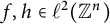
$f, h \in \ell ^2({\mathbb {Z}}^n)$
 , we rewrite the operator
$\mathfrak {L}^{g_1, g_2}_{\sigma }$
 in a weak sense as

For
$1 \leq p \leq \infty $
 , we define
$\mathcal {B}(\ell ^p({\mathbb {Z}}^n))$
 to be the space of all bounded linear operators from
$\ell ^p({\mathbb {Z}}^n)$
 into itself. For
$p=2$
 , the space
$\mathcal {B}(\ell ^2({\mathbb {Z}}^n))$
 is the C
$^*$
 -algebra of bounded linear operator
$\mathcal {A}$
 from
$\ell ^2({\mathbb {Z}}^n)$
 into itself, equipped with the norm

To define the Schatten–von Neumann class
$S_p$
 on
${\mathbb {Z}}^n$
 , we need to first recall the definition of singular values of an operator. For a compact operator
$\mathcal {A} \in \mathcal {B}(\ell ^2({\mathbb {Z}}^n))$
 , the singular values of
$\mathcal {A}$
 are the eigenvalues of the positive self-adjoint operator
$|\mathcal {A}|=\sqrt {\mathcal {A}^* \mathcal {A}}$
 and denoted by
$\{ s_n(\mathcal {A}) \}_{n \in \mathbb {N}}$
 . For
$1 \leq p < \infty $
 , we define the Schatten–von Neumann class
$S_p$
 to be the space of all compact operators whose singular values lie in
$\ell ^p$
 , and equipped with the norm

For
$p=\infty $
 ,
$S_\infty $
 is the class of all compact operators with the norm
$\Vert \mathcal {A} \Vert _{S_\infty } :=\Vert \mathcal {A} \Vert _{\mathcal {B}(\ell ^2({\mathbb {Z}}^n))}$
 . For
$p = 1$
 , the trace of an operator
$\mathcal {A} \in S_1$
 is defined by

where
$\{v_n \}_n$
 is any orthonormal basis of
$\ell ^2({\mathbb {Z}}^n)$
 . In addition, if
$\mathcal {A}$
 is positive, then

For a compact operator
$\mathcal {A}$
 on the Hilbert space
$\ell ^2({\mathbb {Z}}^n)$
 if the positive operator
$\mathcal {A}^* \mathcal {A} \in S_1$
 , then we call the operator
$\mathcal {A}$
 as a Hilbert–Schmidt operator. For any orthonormal basis
$\{v_n \}_n$
 of
$\ell ^2({\mathbb {Z}}^n)$
 , we have

4.1 Boundedness and compactness of
$\mathfrak {L}^{g_1, g_2}_{\sigma }$

Here, we consider
$g_1, g_2 \in M^{\Phi }({\mathbb {Z}}^n)$
 , and prove the results related to the boundedness and compactness of
$\mathfrak {L}^{g_1, g_2}_{\sigma }$
 .
Proposition 4.2 Let
$\Phi $
 be a Young function,
$\sigma \in L^\infty ({\mathbb {Z}}^n \times {\mathbb {T}}^n),$
 and
$g_1, g_2 \in M^{\Phi }({\mathbb {Z}}^n)$
 . Then, the operator
$\mathfrak {L}^{g_1, g_2}_{\sigma } \in \mathcal {B}(\ell ^2({\mathbb {Z}}^n))$
 , and

Proof Let
$f, h \in \ell ^2({\mathbb {Z}}^n)$
 . Applying Hölder’s inequality, we get

Applying Plancherel’s formula (2), we obtain

Since
$M^{\Phi }({\mathbb {Z}}^n) \subset \ell ^2({\mathbb {Z}}^n)$
 , we get

Therefore,

Proposition 4.3 Let
$\Phi $
 be a Young function,
$\sigma \in M^1({\mathbb {Z}}^n \times {\mathbb {T}}^n)$
 and
$g_1, g_2 \in M^{\Phi }({\mathbb {Z}}^n)$
 . Then, the operator
$\mathfrak {L}^{g_1, g_2}_{\sigma } \in \mathcal {B}(\ell ^2({\mathbb {Z}}^n))$
 , and

Proof Let
$f , h \in \ell ^2({\mathbb {Z}}^n)$
 . Using the duality between the modulation spaces
$M^\infty ({\mathbb {Z}}^n \times {\mathbb {T}}^n)$
 and
$M^1({\mathbb {Z}}^n \times {\mathbb {T}}^n)$
 , we obtain

Since
$L^2({\mathbb {Z}}^n \times {\mathbb {T}}^n) \subset M^\infty ({\mathbb {Z}}^n \times {\mathbb {T}}^n)$
 and
$M^{\Phi }({\mathbb {Z}}^n) \subset \ell ^2({\mathbb {Z}}^n)$
 , applying Plancherel’s formula (2), we get


Proposition 4.4 Let
$\Phi $
 be a Young function,
$\sigma \in M^2({\mathbb {Z}}^n \times {\mathbb {T}}^n)$
 and
$g_1, g_2 \in M^{\Phi }({\mathbb {Z}}^n)$
 . Then, the operator
$\mathfrak {L}^{g_1, g_2}_{\sigma } \in \mathcal {B}(\ell ^2({\mathbb {Z}}^n))$
 , and

Proof Let
$f, h \in \ell ^2({\mathbb {Z}}^n)$
 . Applying Hölder’s inequality, we get

Since
$L^2({\mathbb {Z}}^n \times {\mathbb {T}}^n)= M^2({\mathbb {Z}}^n \times {\mathbb {T}}^n)$
 , using (16), we obtain

Therefore,

Theorem 4.5 Let
$1 < p < 2$
 ,
$\sigma \in M^p({\mathbb {Z}}^n \times {\mathbb {T}}^n)$
 ,
$\Phi $
 be a Young function, and
$g_1, g_2 \in M^{\Phi }({\mathbb {Z}}^n)$
 . For fixed
$\sigma \in M^p({\mathbb {Z}}^n \times {\mathbb {T}}^n)$
 , the operator
$\mathfrak {L}^{g_1, g_2}_{\sigma }$
 can be uniquely extended to a bounded linear operator on
$\ell ^2({\mathbb {Z}}^n)$
 , for which

Proof Let
$1< p < 2$
 and
$\sigma \in M^1({\mathbb {Z}}^n \times {\mathbb {T}}^n) \cap M^2({\mathbb {Z}}^n \times {\mathbb {T}}^n)$
 . The modulation spaces
$M^{p}$
 interpolate similar to the corresponding mixed-norm spaces
$L^{p}$
 . From Proposition 4.3, for
$\sigma \in M^1({\mathbb {Z}}^n \times {\mathbb {T}}^n)$
 , we have

Also, from Proposition 4.4, for
$\sigma \in M^2({\mathbb {Z}}^n \times {\mathbb {T}}^n)$
 , we have

Now, for
$1< p < 2$
 , using the Riesz–Thorin interpolation theorem (see [Reference Stein26]), we get

Let
$\sigma \in M^p({\mathbb {Z}}^n \times {\mathbb {T}}^n)$
 and
$\{ \sigma _n \}_{n \geq 1}$
 be a sequence of functions in
$M^1({\mathbb {Z}}^n \times {\mathbb {T}}^n) \cap M^2({\mathbb {Z}}^n \times {\mathbb {T}}^n)$
 such that
$\sigma _n \to \sigma $
 in
$M^p({\mathbb {Z}}^n \times {\mathbb {T}}^n)$
 as
$ n \to \infty $
 . Therefore, for any
$n, k \in \mathbb {N}$
 , we get

Hence,
$\{ \mathfrak {L}^{g_1, g_2}_{\sigma _n} \}_{n \geq 1}$
 is a Cauchy sequence in
$\mathcal {B}(\ell ^2({\mathbb {Z}}^n))$
 . Let
$ \mathfrak {L}^{g_1, g_2}_{\sigma _n} \to \mathfrak {L}^{g_1, g_2}_{\sigma }$
 as
$ n \to \infty $
 . Then, the limit
$ \mathfrak {L}^{g_1, g_2}_{\sigma }$
 remains unaffected by the selection of the sequence
$\{ \sigma _n \}_{n \geq 1}$
 , and we have

Theorem 4.6 Let
$1 \leq p \leq 2$
 ,
$\sigma \in M^p({\mathbb {Z}}^n \times {\mathbb {T}}^n)$
 ,
$\Phi $
 be a Young function, and
$g_1, g_2 \in M^{\Phi }({\mathbb {Z}}^n)$
 . Then, the operator
$\mathfrak {L}^{g_1, g_2}_{\sigma }: \ell ^2({\mathbb {Z}}^n) \to \ell ^2({\mathbb {Z}}^n) $
 is compact.
Proof Let
$\sigma \in M^1({\mathbb {Z}}^n \times {\mathbb {T}}^n)$
 and
$\{ v_n \}_n$
 be an orthonormal basis for
$\ell ^2({\mathbb {Z}}^n)$
 . Since
$M^1({\mathbb {Z}}^n \times {\mathbb {T}}^n) \subset L^1({\mathbb {Z}}^n \times {\mathbb {T}}^n)$
 , applying Parseval’s identity, we get

Hence, the operator
$\mathfrak {L}^{g_1, g_2}_{\sigma } \in S_1$
 . Next, let
$\sigma \in M^p({\mathbb {Z}}^n \times {\mathbb {T}}^n)$
 . We consider
$\{ \sigma _n \}_{n \geq 1}$
 in
$M^1({\mathbb {Z}}^n \times {\mathbb {T}}^n) \cap M^2({\mathbb {Z}}^n \times {\mathbb {T}}^n)$
 such that
$\sigma _n \to \sigma $
 in
$M^p({\mathbb {Z}}^n \times {\mathbb {T}}^n)$
 as
$n \to \infty $
 . Then, applying Theorem 4.5, we obtain

as
$n \to \infty $
 . Therefore,
$\mathfrak {L}^{g_1, g_2}_{\sigma _n} \to \mathfrak {L}^{g_1, g_2}_{\sigma } $
 in
$\mathcal {B}(\ell ^2({\mathbb {Z}}^n))$
 as
$n \to \infty $
 . From the above, we get that
$ \{ \mathfrak {L}^{g_1, g_2}_{\sigma _n} \}_{n \geq 1}$
 is a sequence of linear operators in
$S_1$
 and hence compact, so the operator
$\mathfrak {L}^{g_1, g_2}_{\sigma }$
 is compact.
Now, we calculate the adjoint
$(\mathfrak {L}^{g_1, g_2}_{\sigma })^*$
 of the operator
$\mathfrak {L}^{g_1, g_2}_{\sigma }$
 on
$\ell ^2({\mathbb {Z}}^n)$
 , which determined by the relation

We obtain


Hence, we get

Therefore, the operator
$\mathfrak {L}^{g_1, g_2}_{\sigma }$
 is a self-adjoint operator if
$g_1=g_2$
 and
$\sigma $
 is a real-valued function.
4.2 Localization operators in
$S_p$

Here, we show that the operator
$\mathfrak {L}^{g, g}_{\sigma } \in S_p$
 and give an upper bound of
$\Vert \mathfrak {L}^{g, g}_{\sigma } \Vert _{S_p}$
 .
Proposition 4.7 Let
$\sigma \in M^1({\mathbb {Z}}^n \times {\mathbb {T}}^n)$
 ,
$\Phi $
 be a Young function, and
$g \in M^{\Phi }({\mathbb {Z}}^n)$
 . Then, the operator
$\mathfrak {L}^{g, g}_{\sigma }: \ell ^2({\mathbb {Z}}^n) \to \ell ^2({\mathbb {Z}}^n) $
 is in
$S_1$
 and

Proof Let
$\sigma \in M^1({\mathbb {Z}}^n \times {\mathbb {T}}^n)$
 . Then, from Theorem 4.6, the operator
$\mathfrak {L}^{g, g}_{\sigma } \in S_1$
 . Let
$\sigma \in M^1({\mathbb {Z}}^n \times {\mathbb {T}}^n)$
 be nonnegative real-valued. Then,
$(({\mathfrak {L}^{g, g}_{\sigma }})^* \mathfrak {L}^{g, g}_{\sigma })^{1/2}=\mathfrak {L}^{g, g}_{\sigma }$
 . Let
$\{v_n\}_n$
 be an orthonormal basis for
$\ell ^2({\mathbb {Z}}^n)$
 consisting of eigenvalues of the operator
$(({\mathfrak {L}^{g, g}_{\sigma }})^* \mathfrak {L}^{g, g}_{\sigma })^{1/2}: \ell ^2({\mathbb {Z}}^n) \to \ell ^2({\mathbb {Z}}^n)$
 . If
$\sigma $
 is nonnegative real-valued function, then by using a similar method as in the proof of Theorem 4.6, we get the following estimate:

Next, let
$\sigma \in M^1({\mathbb {Z}}^n \times {\mathbb {T}}^n)$
 be an arbitrary real-valued function. We write
$\sigma = \sigma _+ - \sigma _-$
 , where
$\sigma _+=\max (\sigma , 0)$
 and
$\sigma _-=-\min (\sigma , 0)$
 . Then, applying the relation (17), we get

Finally, let
$\sigma \in M^1({\mathbb {Z}}^n \times {\mathbb {T}}^n)$
 be a complex-valued function. Then, we write
$\sigma =\sigma _1+ i \sigma _2$
 , where
$\sigma _1, \sigma _2$
 are the real and imaginary parts of
$\sigma ,$
 respectively. Applying the relation (18), we get

Theorem 4.8 Let
$\sigma \in M^1({\mathbb {Z}}^n \times {\mathbb {T}}^n)$
 ,
$\Phi $
 be a Young function, and
$g \in M^{\Phi }({\mathbb {Z}}^n)$
 . Then, for
$1 \leq p \leq \infty $
 , the operator
$\mathfrak {L}^{g, g}_{\sigma }: \ell ^2({\mathbb {Z}}^n) \to \ell ^2({\mathbb {Z}}^n)$
 is in
$S_p$
 , and

Proof Using interpolation theorems (see [Reference Wong30, Theorems 2.10 and 2.11]), Proposition 4.4, and Proposition 4.7, we obtain the proof of the theorem.
In the following, we obtain a lower bound of
$\Vert \mathfrak {L}^{g, g}_{\sigma } \Vert _{S_1}$
 , and improve the constant given in Proposition 4.7.
Theorem 4.9 Let
$\sigma \in M^1({\mathbb {Z}}^n \times {\mathbb {T}}^n)$
 be a nonnegative real-valued function,
$\Phi $
 be a Young function, and
$g \in M^{\Phi }({\mathbb {Z}}^n)$
 . Then, the operator
$\mathfrak {L}^{g, g}_{\sigma }$
 is in
$S_1$
 , and

where
$\tilde {\sigma }$
 is given by
$\tilde {\sigma }(m, w)=\left \langle \mathfrak {L}^{g, g}_{\sigma }(M_w T_m g), M_w T_m g \right \rangle _{\ell ^2({\mathbb {Z}}^n)}$
 .
Proof Let
$\sigma \in M^1({\mathbb {Z}}^n \times {\mathbb {T}}^n)$
 . Then, from Proposition 4.7, the operator
$\mathfrak {L}^{g, g}_{\sigma } \in S_1$
 . If
$\{s_n(\mathfrak {L}^{g, g}_{\sigma }) \}_n$
 are the positive singular values of
$\mathfrak {L}^{g, g}_{\sigma }$
 ,
$\{ v_n \}_n$
 is an orthonormal basis for the orthogonal complement of the null space of
$\mathfrak {L}^{g, g}_{\sigma }$
 consisting of eigenvectors of
$|\mathfrak {L}^{g, g}_{\sigma }|$
 and
$\{ u_n \}_n$
 is an orthonormal set in
$\ell ^2({\mathbb {Z}}^n)$
 , then using the canonical form of compact operators (see [Reference Wong30, Theorem 2.2]), we get

Therefore, we obtain

Applying Bessel’s inequality and Cauchy–Schwarz’s inequality, we obtain

To prove that
$\tilde {\sigma } \in L^1({\mathbb {Z}}^n \times {\mathbb {T}}^n)$
 , applying formula (19), we get

Now, using Plancherel’s formula (2), we obtain

4.3
$M^{\Phi }({\mathbb {Z}}^n)$
boundedness

Here, we obtain that the operators
$\mathfrak {L}^{g_1, g_2}_{\sigma } : M^{\Phi }({\mathbb {Z}}^n) \to M^{\Phi }({\mathbb {Z}}^n)$
 are bounded. Let us start with the following propositions.
Proposition 4.10 Let
$\sigma \in M^1({\mathbb {Z}}^n \times {\mathbb {T}}^n)$
 . Let
$\left (\Phi , \Psi \right )$
 be a complementary Young pair, and
$\Phi $
 satisfies a local
$\Delta _2$
 -condition and continuous. Let
$g_1 \in M^{\Psi }({\mathbb {Z}}^n)$
 and
$g_2 \in M^{\Phi }({\mathbb {Z}}^n)$
 . Then, the operator
$\mathfrak {L}^{g_1, g_2}_{\sigma }: M^{\Phi }({\mathbb {Z}}^n) \to M^{\Phi }({\mathbb {Z}}^n)$
 is a bounded linear operator, and

Proof Let
$f \in M^{\Phi }({\mathbb {Z}}^n)$
 and
$g \in M^{\Psi }({\mathbb {Z}}^n)$
 . Since
$(M^{\Phi }({\mathbb {Z}}^n))^* \cong M^{\Psi }({\mathbb {Z}}^n)$
 , applying Hölder’s inequality, we get

For any
$f \in M^{\Phi }({\mathbb {Z}}^n)$
 and
$h \in M^{\Psi }({\mathbb {Z}}^n)$
 , applying relations (14) and (20), we have

Therefore,

Next, using the Schur technique, we get an
$M^{\Phi }({\mathbb {Z}}^n)$
 -boundedness of the operator
$\mathfrak {L}^{g_1, g_2}_{\sigma }$
 . We obtain a new estimate for
$\Vert \mathfrak {L}^{g_1, g_2}_{\sigma } \Vert _{\mathcal {B}(M^{\Phi }({\mathbb {Z}}^n))}$
 .
Proposition 4.11 Let
$\sigma \in M^1({\mathbb {Z}}^n \times {\mathbb {T}}^n)$
 and
$g_1, g_2 \in M^1({\mathbb {Z}}^n) \cap \ell ^\infty ({\mathbb {Z}}^n)$
 . Then, there exists a bounded linear operator
$\mathfrak {L}^{g_1, g_2}_{\sigma }: M^{\Phi }({\mathbb {Z}}^n) \to M^{\Phi }({\mathbb {Z}}^n) $
 for which

Proof We define the function
$\mathcal {K}$
 on
${\mathbb {Z}}^n \times {\mathbb {Z}}^n$
 by

Then, we have

For every
$l \in {\mathbb {Z}}^n$
 , we get

and for every
$k \in {\mathbb {Z}}^n$
 , we have

The kernel function
$\mathcal {K}(k, l)$
 of the localization operator
$\mathfrak {L}^{g_1, g_2}_{\sigma }$
 satisfies (22) and (23). Hence, by Schur’s lemma (see [Reference Folland17]), the operator
$\mathfrak {L}^{g_1, g_2}_{\sigma }$
 extends to a bounded linear operator
$\mathfrak {L}^{g_1, g_2}_{\sigma }: M^{\Phi }({\mathbb {Z}}^n) \to M^{\Phi }({\mathbb {Z}}^n)$
 with the operator norm

Remark 4.12 Based on Proposition 4.11, it is determined that the bounded linear operator on
$M^{\Phi }({\mathbb {Z}}^n)$
 identified in Proposition 4.10 is, in fact, the discrete integral operator on
$M^{\Phi }({\mathbb {Z}}^n)$
 characterized by the kernel
$\mathcal {K}$
 as provided in (21).
Theorem 4.13 Let
$\sigma \in L^1({\mathbb {Z}}^n \times {\mathbb {T}}^n)$
 . Let
$\left (\Phi , \Psi \right )$
 be a complementary Young pair, and
$\Phi $
 satisfies a local
$\Delta _2$
 -condition and continuous. Let
$g_1 \in M^{\Psi }({\mathbb {Z}}^n)$
 and
$g_2 \in M^{\Phi }({\mathbb {Z}}^n)$
 . Then, the operator
$ \mathfrak {L}^{g_1, g_2}_{\sigma } \in \mathcal {B}(M^{\Phi }({\mathbb {Z}}^n))$
 , and

Proof Let
$f \in M^{\Phi }({\mathbb {Z}}^n)$
 and
$h \in M^{\Psi }({\mathbb {Z}}^n)$
 . Using the duality between
$M^{\Phi }({\mathbb {Z}}^n)$
 and
$M^{\Psi }({\mathbb {Z}}^n)$
 , we get

Hence,

Theorem 4.14 Let
$\left (\Phi _i, \Psi _i \right )$
 be complementary Young pairs which satisfy local
$\Delta _2$
 -condition, strictly convex and continuous for
$i = 1, 2$
 . Let
$\sigma \in L^{\Phi _1, \Phi _2} ({\mathbb {Z}}^n \times {\mathbb {T}}^n)$
 and
$g_1, g_2 \in \mathcal {S}({\mathbb {Z}}^n)$
 . Also, let there exists a constant
$x_0> 0$
 such that
$\Psi _i(x) \lesssim \Phi _i(x)$
 for all
$0 \leq x \leq x_0$
 . Then, the localization operator
$ \mathfrak {L}^{g_1, g_2}_{\sigma }$
 is in
$\mathcal {B}(M^{\Phi _1, \Phi _2}({\mathbb {Z}}^n))$
 , and we have

Proof Let
$f \in M^{\Phi _1, \Phi _2}({\mathbb {Z}}^n)$
 and
$h \in M^{\Psi _1, \Psi _2}({\mathbb {Z}}^n)$
 . From the given condition,
$\Phi _i, \Psi _i$
 satisfy condition (3) of Theorem 3.7. Hence, we have
$M^{\Phi _1, \Phi _2}({\mathbb {Z}}^n) \subseteq M^{\Psi _1, \Psi _2}({\mathbb {Z}}^n)$
 . Now, applying Hölder’s inequality (7), we obtain

Hence, using the duality between
$M^{\Phi _1, \Phi _2}({\mathbb {Z}}^n)$
 and
$M^{\Psi _1, \Psi _2}({\mathbb {Z}}^n)$
 , we get

This completes the proof.
Acknowledgments
The authors wish to thank the referees for their valuable comments and suggestions that helped to improve the quality of the article.
Competing interests
The authors declare that there is no potential competing interests regarding the publication of this article.
Data availability statement
The authors confirm that the data supporting the findings of this study are available within the article and its supplementary materials.



