OVERVIEW
Latin American legal systems are often thought of collectively, but each country has a unique structure and each country's system has been influenced by a variety of legal traditions and international sources. The judiciary in Latin America is often minimalised and marginalised due to the notion that legal systems of the countries are based on civil law, which assumes that even high courts are weak.Footnote 1
Since inception, the judiciaries in many Latin American countries have undergone radical changes to both structure and importance, and have taken on a new identity and role in many societies. Judicial authority has been considered and reconsidered during judicial reforms throughout Latin America in the 20th and 21st centuries. Judicial reform encompasses: 1. the types of conflicts a particular court can resolve (judicial review); 2. who can bring certain actions before particular courts (standing); 3. the ability of a court to control its docket (certiorari Footnote 2); and 4. the nature and effect of court decision on future matters (stare decisis,Footnote 3erga omnes,Footnote 4inter partes,Footnote 5 and the like).Footnote 6 All of these factors directly affect the power held by a court. A court that has the authority to control its docket and issue binding decisions, for example, is more powerful than one that must hear every petition before it and whose decisions only apply to the parties involved.Footnote 7
The nature of judicial review varies among courts in the region. For example, whereas in common law jurisdictions, courts are limited to hearing a posteriori cases, i.e. controversies brought by parties challenging enacted laws, many courts in Latin America have both a posteriori jurisdiction as well as a priori jurisdiction, which are challenges to laws before they are enacted, often referred to as abstract cases.Footnote 8
Further, several countries, like Mexico, Argentina, and Brazil, rely on their supreme courts to decide matters of constitutional law as well as other questions of legal importance. Other countries, such as Bolivia, Colombia, and Chile, have created separate constitutional courts exclusively to hear cases of a constitutional nature, thus relieving their supreme courts of this power and duty.
Also unique to Latin America is the concept of amparo. Footnote 9 The Mexican Constitution of 1857 introduced amparo to Latin America, various versions of which have been adopted by every country in the region (except Cuba). Amparo in its many forms allows citizens to bring an action in court against the government for a violation of fundamental or constitutional rights. It is meant to be restorative as opposed to compensatory, and is a means of providing relatively immediate relief in otherwise overloaded and slow judicial systems.Footnote 10
A significant question confronting Latin American countries and their judiciaries is how much importance to give to the decisions, constitutional and non-constitutional, of their highest courts. In common law jurisdictions, the legal rationale in a decision by a higher court binds all lower courts answerable to that higher court. A decision on a point of law by the highest court of the land binds all courts and establishes the law of the land.Footnote 11
In civil law jurisdictions, such as those in Latin America, courts traditionally are limited to applying the laws that have been created by the legislature or by executive decree. Jurisprudence has not historically been a source of law. In fact, most court decisions are inter partes, binding only the parties to the case before the court; they do not even have erga omnes effect, which would allow courts to issue decisions that could then be applied to cases stemming from the same event or with similar circumstances. Thus, many tribunals are deciding the same case and controversy hundreds of times.Footnote 12
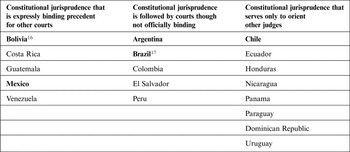
The concept of stare decisis, which creates a rule of law requiring binding precedent for other courts to follow, is not part of the legal tradition of Latin American countries. However, the common law notion of persuasive or binding jurisprudence is no longer completely non-existent in the region.Footnote 13 In the table below, Antonio Canova González divides Latin American national courts into three categories based on the nature of their decisions pertaining specifically to constitutional jurisprudence: binding, followed, and orientating.Footnote 14
What is the nature of jurisprudence of the court that decides constitutional questions?Footnote 15

This paper uses the below chart as a starting point to explore the current state of judicial authority in several countries. It also directs readers to electronic resources for the jurisprudence of these countries.
ESTADOS UNIDOS MEXICANOS / UNITED MEXICAN STATES
The Suprema Corte de Justicia de la Nación (SCJN), the highest court in Mexico, has two chambers: one for civil and penal cases, and the other for administrative and labour cases. Each chamber has five justices with the Chief Justice weighing in only during plenary sessions for certain cases, such as amparo matters, conflicts between the two chambers, and constitutional questions.Footnote 18 The SCJN has original jurisdiction in two types of cases: Constitutional Controversies (involving disputes among political powers such as the judiciary, executive, legislature, states, and federal government), and Actions of Unconstitutionality (pertaining to the constitutionality of laws). The bulk of its cases come from appeals by the district and appellate courts.Footnote 19
Mexico is one of the few countries in Latin America that expressly binds its lower courts to the decisions of the highest court under very specific circumstances. For example, according to Article 192 of the Ley de Amparo of 1936, when eight justices of the SCJN decide a particular question of law and issue an opinion, and the decision is upheld five consecutive times by eight justices of the SCJN sitting en banc or 4 justices if sitting in Sala (Chamber), the interpretation becomes jurisprudencia which signifies binding precedent on all state and federal courts.Footnote 20 In April 2013, Mexico promulgated a new Ley de Amparo which provides the same guidelines in Articles 222–224: jurisprudencia is binding on all courts when no less than eight justices sitting in plenary session, or four justices sitting in Sala, decide the same point of law five times in five different and consecutive cases. Once established, jurisprudencia can only be overturned by a unanimous vote of the SCJN.Footnote 21
Another grant of power to establish jurisprudencia is Article 232 of the Organic Law of the Federal Judicial Branch.Footnote 22 The system of reiteration to form binding precedent from the Federal Electoral Tribunal is slightly more complicated under this law:
The Upper Chamber is required to issue three consecutive decisions upholding a different point of law regarding to the same issue. Regional Chambers are required to issue five consecutive decisions upholding a different point of law regarding the same issue, in addition to the ratification by the Upper Chamber. For these courts to establish a binding decision, they must meet these requirements, but must also obtain a formal declaration from the Upper Chamber, stating that a binding decision has actually been made.Footnote 23
In addition to reiteration as a form of creating binding precedent, the SCJN can create precedent when settling conflicts between the Chambers of the CSJN or the various Collegiate (appellate) courts. The CSJN sitting en banc must settle conflicts between the Chambers of the SCJN, whereas one of the two Chambers of the CSJN may settle conflicts among the Collegiate courts.Footnote 24
The 1994 judicial reforms that created the two actions challenging constitutionality, Constitutional Controversies and Actions of Unconstitutionality, also gave the SCJN the power to establish precedent-setting decisions in these matters, though with a high threshold. Actions of Unconstitutionality (a priori review which can only be brought by the Attorney General and other specific government officials) call for a supermajority of eight of the eleven justices. Constitutional Controversies (requiring an actual controversy between two government bodies) also requires the affirmation of eight of eleven justices for binding precedential effect, but allows for inter partes application with a simple majority.Footnote 25
Some scholars argue that the system of binding precedent in Mexico lends itself to a lower caseload for the courts, especially as compared to a country such as Brazil.Footnote 26 However, there are many other reasons why Brazil's court system has such a severe backlog of cases.
SCJN Decisions:
The SCJN (www.scjn.gob.mx/Paginas/Inicio.aspx) provides electronic access to the decisions of the courts through different means and publications: (1) a searchable database containing public versions of the judgments of the SCJN in full-text, Word format, 2003 to date; and (2) Semanario Judicial de la Federación, containing various texts to find cases including the Gaceta and Tesis y Ejecutorias from 1917.Footnote 27
REPÚBLICA FEDERATIVA DO BRASIL / FEDERATED REPUBLIC OF BRAZIL
Like Mexico, Brazil does not have a separate constitutional court. In fact, any court in Brazil may decide the constitutionality of any law or decree while deciding a controversy before that court. This determination has inter partes effectFootnote 28 except when declared to be a sumula vinculante (discussed in more detail below). Lower court decisions are normally appealable up to the highest court, the Supremo Tribunal Federal (STF) of Brazil. Composed of eleven justices, the STF generally sits in panels of five justices.Footnote 29
The 1988 Constitution of Brazil included significant judicial reform, broadening access to the courts in many respects. One example is the ability of the STF to hear a priori cases through Direct Actions of Unconstitutionality brought by certain political actors, such as the president, leaders of congress, state governors, attorneys general, and the federal bar association; and pertaining to the constitutionality of laws, such as those passed by Congress and the federal and state legislatures.Footnote 30 A minimum of eight justices are required to hear a Direct Action of Unconstitutionality, and at least six are needed to declare the law or decree unconstitutional.Footnote 31
Further, the Declaratory Action of Constitutionality, modified by Constitutional Amendment 3 in 1993 (Emenda Constitutional 3/1993), allows the STF to declare the constitutionality of a governmental policy upon the request of the President, Congress, or Attorney General. After a declaration of constitutionality, which carries with it erga omnes effect, the policy can no longer be contested in the lower courts.Footnote 32
The STF acts as the last court of appeal in a posteriori cases. The STF must accept all appeals; there is no practice of certiorari. STF decisions generally apply inter partes only; there is no erga omnes effect. Also, except in very limited instances, the decisions of the STF are not binding upon the lower courts.Footnote 33
The concept of precedent began infiltrating Brazilian jurisprudence in 1964 when the STF was given the means to declare súmulas. Súmulas are short, official restatements of the Court's recurrent position on a particular issue of the law which carry great persuasive force and tend to determine the outcome of similar cases.Footnote 34 Once a rule has been created by súmula, any argument to the contrary will be rejected by the court.Footnote 35 Beginning in 1964, there have been 736 súmulas declared and issued, the last of which was in 2003.Footnote 36
The declaration of binding precedent (Súmula Vinculante (SV)) for the STF was first approved in Constitutional Amendment 45 in 2004 (Art. 103-A, Emenda Constitutional 45/2004). This power allows the STF to declare an a posteriori case decision and rationale legally binding precedent for the lower courts. An SV can only be issued with an affirmative declaration and the support of eight of the eleven justices.Footnote 37 Since inception, there have been 37 súmulas vinculantes declared.Footnote 38
Constitutional reforms providing greater access to the courts, coupled with very little precedent-setting ability and the inter partes effect of decisions, led to the explosion of cases and the resulting backlog in the judiciary. Further, government agencies are known for appealing cases simply to avoid compensating litigants. From 2000–2009, over one million cases were filed with the STF.Footnote 39
STF Decisions
Prior to 1 January 2011, jurisprudence of Brazilian courts was published in the official judicial gazette, Diário da Justiça. This gazette has been discontinued and decisions are now published in the Diário Oficial. Footnote 40
The Federal Supreme Court (STF) website maintains a database where one can search for jurisprudence of the court, http://www.stf.jus.br/portal/jurisprudencia/pesquisarJurisprudencia.asp. There are pages dedicated to súmulas, http://www.stf.jus.br/portal/cms/verTexto.asp?servico=jurisprudenciaSumula, and súmulas vinculantes, http://www.stf.jus.br/portal/cms/verTexto.asp?servico=jurisprudenciaSumulaVinculante. Note the STF has also provided translations for several cases in various languages, http://www.stf.jus.br/portal/jurisprudenciaTraduzida/jurisprudenciaTraduzida.asp.Footnote 41
Please see the GlobaLex guide for Brazil for a thorough although somewhat outdated overview of the country's legal system: http://www.nyulawglobal.org/globalex/Brazil.htm.
LA REPÚBLICA DE ARGENTINA/ THE REPUBLIC OF ARGENTINA
The Corte Suprema de Justicia de la Nación (CSJN), Argentina's highest tribunal, has seven justices. The CSJN was created in 1853 by the Argentine Constitution and modeled after the Supreme Court of the United States of America.Footnote 42 The decisions of the U.S. Supreme Court and scholarly treatises of North American jurists continued to influence Argentine jurisprudence throughout the 19th century.Footnote 43
As a result, the CSJN follows notions of judicial review similar to the U.S. Supreme Court. The CSJN will only hear a posteriori controversies where the parties have standing, the case is ripe, and the controversy is not moot.Footnote 44 Thus, the CSJN does not hear a priori (abstract) cases as do many other high courts in the region following civil law tradition.
One significant difference between the CSJN and the Supreme Court of the United States is that the decisions of the CSJN bind only the parties to the ruling of the Court; there is no express doctrine of stare decisis.Footnote 45 Over time, however, the CSJN has successfully persuaded the lower courts to follow the rulings of the CSJN by stating, for example, that it is the “moral duty” of the lower courts to follow the nation's supreme tribunal.Footnote 46 The CSJN subsequently scolded lower courts for not following CSJN decisions and declared that such behaviour undermines the judiciary as an institution.Footnote 47 Lower courts have generally been complicit such that although not expressly stated in the Constitution or elsewhere, the decisions of the CSJN have evolved into binding precedent in many regards,Footnote 48 though to what extent remains unclear.Footnote 49
CSJN Decisions
The website of the Supreme Court of the Nation (http://www.csjn.gov.ar/jurisprudencia.html) has scanned pdfs of the Fallos de la Corte Suprema de Justicia de la Nación, the official print court reporter, and official born-digital pdfs. One can search for jurisprudence of the court in several ways: by date for the recent decisions; by theme for summaries of all decisions dating back to the court's inception in 1863; by keyword (or more advanced search) for full-text decisions from 1994; and by browsing a list of cases organized chronologically.Footnote 50 Infojus (http://www.saij.jus.gov.ar/) also provides CJSN jurisprudence.Footnote 51
Please see the GlobaLex guide on Argentina for an excellent overview of the country's legal system: http://www.nyulawglobal.org/globalex/Argentina1.htm.
ESTADO PLURINACIONAL DE BOLIVIA / PLURINATIONAL STATE OF BOLIVIA
Bolivia has a fascinating history of granting judicial power, pulling it away, and reinstating it. Judicial review was first granted to the Tribunal Supremo de Justicia (TSJ) in the Constitution in 1861.The 1878 Constitution went further and gave the TSJ the power to decide the constitutionality of law, decrees, and regulations. Like Argentina, the TSJ was modeled after the Supreme Court of the United States in many respects, but, also like Argentina, with some fundamental differences. For example, TSJ decisions were merely inter partes (as opposed to the erga omnes effect of U.S. Supreme Court decisions); yet the TSJ was the only court in the country with the authority to declare the unconstitutionality of laws (similar to the U.S. system). Also, there was no system of precedent in the Bolivian judiciary, as there is in the U.S. model. Thus, Bolivia's judiciary was unlike any in the region, combining traits of various judicial models in the Americas.Footnote 52
The late 19th and 20th centuries in Bolivia were turbulent, marked by a civil war, a change from conservative to liberal to military leaders, a geographic change in the country's capital (from Sucre to La Paz, except for the TSJ), and a return to democracy in 1982. During the early 20th century, judicial review expanded as did the power of the lower courts to hear constitutional matters such as writs of habeas corpus and amparo. The 12-member TSJ had the responsibility to review lower court decisions. By the 1990s, these constitutional matters were often delayed for more than one year in the lower courts and a further year in the TSJ; other constitutional matters were delayed for as many as three or four years. This inefficiency, which resulted in a lack of citizen protection combined with other political pressures of the fixed-term (10 years) justices of the TSJ, formed the impetus to establish the Tribunal Constitutional de Bolivia (TCB) and a return to a centralized model for constitutional review.Footnote 53
The TCB was created with the 1995 Bolivian Constitution and was given judicial review power well beyond what had been granted to the TSJ, including: 1) erga omnes decision-making power; 2) the power to create binding precedent; and 3) both i priori and i posteriori authority review of legislation. The TCB was conceptualized and created to be a body completely independent of any other branch of government; but compromise with an objecting TSJ placed the TCB within the judicial branch, yet independent of the TSJ.Footnote 54 The TCB had five magistrates who served 10-year terms, elected by a 2/3 vote of all members present in a joint session of Congress.Footnote 55
With the establishment of the TCB, came the creation of nineteen different types of legal instruments, twelve of which were unique to the TCB, giving the TCB original and exclusive jurisdiction in these twelve matters. The various instruments specified who would have standing to use a particular type, and ensured direct access to the TCB for political entities and politicians as well as the general public. In the first decade of the court (1999–2009), the vast majority of complaints filed before the TCB were amparo actions (58%) and habeas corpus motions (26%).Footnote 56
Despite broad access to the TCB, surveys showed that the Bolivian public did not trust the neutrality of the TSJ or the TCB, which led to political attacks against the justices of the high courts.Footnote 57 The election of Evo Morales, the first indigenous president in a country that is 85% indigenous,Footnote 58 led to unprecedented political upheaval and reform. Within the judiciary, countless judges resigned or were impeached for many reasons. By December 2008, the TSJ operated with only eight of twelve members; and by late 2009, the TSJ lost its quorum with only six justices remaining.Footnote 59
The TCB suffered a similar fate. By late 2006, the TCB had lost three of its five magistrates following accusations of bribery from President Morales that were later withdrawn. The Court was forced to operate with only two principal magistrates and three alternates. The following year, however, the entire Court was subjected to impeachment proceedings initiated by the President and overseen by Congress. By the end of 2007, only two alternate justices remained following the resignation of the other three. Although the TCB could not hear cases without a quorum, individual justices could sign administrative decrees, which they did. Eventually, a fourth justice resigned when Congress initiated impeachment proceedings against her after she signed a highly controversial decree denying a recall election for President Morales. The TCB was paralyzed.Footnote 60 At the same time, a new Constitution went into effect in 2009, and the Ley del Deslinde Jurisdiccional established two parallel jurisdictions within the court system in Bolivia: ordinary and indigenous.Footnote 61
In February 2010, Congress approved a law allowing the president to appoint interim justices and magistrates for both high courts. Congress also approved the country's first popular election for members of the high courts for December 2010.Footnote 62 Nonetheless, the TCB was disbanded in 2011 and replaced in 2012 with the Tribunal Constitucional Plurinacional (TCP).
Decisions of the TCP constitute binding precedent. The Law of the Constitutional Tribunal, Article 8, states that decisions of the TCP are vinculante (binding) in nature. Additionally, the Code of Constitutional Procedure, Article 15, provides more specifically that sentences, declarations, and autos of the TCP bind the parties to the case except for Actions of Unconstitutionality, which have broader application. Additionally, legal rationale in the decisions of the TCP constitutes binding precedent for all future decisions in all courts.Footnote 63 This law is clearly an effort to distinguish ratio decidendi from obiter dicta in order to make the TCPs’ legal rationale precedential in nature in a way that has not before been established in Brazil or Latin America generally; it seems more akin to the common law notion of what is binding precedent and what is merely dicta. It will take time to see if this is the case, and to evaluate the true power and authority of the new TCP.
Finding Court Decisions:
Jurisprudence of TCB and the TCP can be found on the new website of the TCP: http://buscador.tcpbolivia.bo/%28S%28bezaphpqhzpzbjq2fvxqk25p%29%29/Default.aspx. One can search for decisions by date, party, or number.
The Supreme Court of Justice also has a website, http://tsj.bo/, where one can search by keyword in an attempt to locate court decisions, http://tsj.bo/buscador-autos-supremos/.
Please see the GlobaLex guide on Bolivia for an excellent introduction to the country's legal framework: http://www.nyulawglobal.org/globalex/Bolivian_Legal_Framework.htm.
LA REPÚBLICA DE CHILE / THE REPUBLIC OF CHILE
The Corte Suprema (CS) and the Tribunal Constitucional (TC) are the highest courts in Chile. The CS is part of the Poder Judicial (Chilean federal judiciary) and acts as a court of cassation. It hears appeals from the appellate courts as well as other tribunals that are not part of the judiciary, such as the environmental courts, intellectual property court, and local police courts.Footnote 64 The TC is an independent body that reviews treaties, proposes reforms to the Constitution, and reviews certain laws for constitutionality i priori as well as i posteriori; and resolves constitutional questions arising from the country's highest courts, the Corte Suprema, the Cortes de Apelaciones, and the Tribunal Calificador de Elecciones (Electoral Tribunal).Footnote 65 Despite the lack of stare decisis in Chile, jurisprudence of these highest courts has evolved over many years and is often used in support of a decision or for illustrative purposes, or somewhere in between support and illustration.Footnote 66
Article 3 of Código de Procedimiento Civil (Code of Civil Procedure), combined with more than a century of tradition, dictates that court decisions are not a formal source of law in Chile.Footnote 67 In March 2012, the Chilean Congress was presented with a proposal for a new Code of Civil Procedure. This proyeto proposes to “unify” the jurisprudence in certain types of cases and remains under consideration.Footnote 68 Debate continues as to whether Chilean Supreme Court decisions should have any authority. Those in opposition believe that awarding the power to establish binding precedent to Supreme Court decisions will diminish judicial independence. Those in favour point to common law countries as examples where judicial independence and a system of precedent and stare decisis reside side-by-side.Footnote 69
Court Decisions:
The website of the TC contains the decisions of the Court. Decisions can be examined by year (from 1972): http://www.tribunalconstitucional.cl/index.php/sentencias/busca_eras; or found through searching: http://www.tribunalconstitucional.cl/index.php/sentencias/busca_basico. The posting of decisions is current.
The Poder Judicial website contains the resolutions of matters heard before the CS as well as the appellate courts and others: http://basejurisprudencial.poderjudicial.cl/. There are advanced search options to guide one through this free but somewhat complex database.
Please see the GlobaLex guide on Chile for an overview of the country's legal system: http://www.nyulawglobal.org/globalex/Chile1.htm.
CONCLUSION
This short survey of judicial power in five Latin American countries demonstrates the many similarities as well as the vast differences among the judiciaries of the region. It is apparent that countries are experimenting with different models, creating new processes, and transplanting practices from other jurisdictions and traditions as they attempt to solve problematic issues while keeping true to their legal foundations. Thus, the modified and tailored principles of judicial authority, including judicial review, standing, certiorari, and precedent, continue to evolve, as do many other aspects of the judiciary and legal system generally, just as in all democratic societies.