1. Introduction
It has been observed that the linear and nonlinear propagation of waves in multicomponent plasmas is different to that in ordinary electron–ion plasmas (Rizzato Reference Rizzato1988). The electron–positron–ion (e–p–i) plasma has an important role in the understanding of the plasmas in the early universe (Weinberg Reference Weinberg1972; Misner, Thorne & Wheeler Reference Misner, Thorne and Wheeler1973; Rees Reference Rees, Gibbson, Hawking and Siklas1983), in active galactic nuclei (Miller & Witta Reference Miller and Witta1987), in pulsar magnetospheres (Michel Reference Michel1982), and in the solar atmosphere (Goldreich & Julian Reference Goldreich and Julian1969; Tandberg-Hansen & Emslie Reference Tandberg-Hansen and Emslie1988). During the last decade, laser–plasma interaction has become a field of growing interest in various fundamental research and technological applications (Modena et al.
Reference Modena, Najmudin, Dangor, Clayton, Marsh, Joshi, Malka, Darrow, Danson, Neely and Walsh1995; Pukhov Reference Pukhov2003; Esarey, Schroeder & Leemans Reference Esarey, Schroeder and Leemans2009). Interesting nonlinear phenomena such as self-focusing, harmonic generation, parametric instabilities, soliton formation, and wave collapse have been observed. Ion acoustic two-soliton systems in unmagnetized quantum e–p–i plasmas were studied in Mandal et al. (Reference Mandal, Ghorui, Saha and Chatterjee2015). The nonlinear dynamics of intense laser pulses in e–p/e–p–i plasma has received a great deal of attention (Berezhiani & Mahajan Reference Berezhiani and Mahajan1994; Shukla, Marklund & Eliasson Reference Shukla, Marklund and Eliasson2004; Asenjo et al.
Reference Asenjo, Borotto, Chian, Munoz, Valdivia and Rempel2012; Cheng et al.
Reference Cheng, Tang, Zhang and Xue2013). Abundant production of e–p pairs in the collision of a multi-petawatt laser beam and a solid target is predicted, and the result shows that the positron density can be up to
 $10^{26}~\text{m}^{-3}$
(Liang, Wilks & Tabak Reference Liang, Wilks and Tabak1998; Ridgers et al.
Reference Ridgers, Brady, Duclous, Kirk, Bennett, Arber, Robinson and Bell2012). The positrons can be used to probe particle transport in tokamaks and, since they have sufficient lifetime, the two-component electron–ion plasma becomes a three component e–p–i one (Surko et al.
Reference Surko, Leventhal, Crane, Passner, Wysocki, Murphy, Strachan and Rowan1986; Surko & Murphy Reference Surko and Murphy1990). The Advanced Satellite for Cosmology and Astrophysics (ASCA) has confirmed the presence of ions in electron–positron plasmas of astrophysical interest occurring in particular environments.
The ubiquitous presence of energetic superthermal particles in plasmas is confirmed by the long-tailed distributions in many space and laboratory plasma observations (Scudder & Olbert Reference Scudder and Olbert1979; Masood et al.
Reference Masood, Schwartz, Maksimovic and Fazakerley2006; Masood & Schwartz Reference Masood and Schwartz2008; Pierrard & Lazar Reference Pierrard and Lazar2010). Numerous models have been proposed to describe this effect on wave dynamics via phenomenological modification to the electron distribution function. One approach to non-Maxwellian plasma modelling is provided by the kappa distribution (Vasyliunas Reference Vasyliunas1968; Hellberg et al.
Reference Hellberg, Mace, Baluku, Kourakis and Saini2009; Kourakis, Sultana & Hellberg Reference Kourakis, Sultana and Hellberg2012) which was introduced by Vasyliunas to fit phenomenologically the power-law-like dependence of electron distribution functions observed in space. The spectral index kappa (
 ${\it\kappa}$
), for which the kappa distribution is named, acts to modify the effective thermal speed in the distribution function (DF). At low values of
 ${\it\kappa}$
, distributions exhibit strong superthermality which implies an enhancement in the superthermal component of the distribution by comparison with that of a Maxwellian. At very large values of
 ${\it\kappa}$
, the distribution function approaches a Maxwellian distribution. It is pertinent to mention here that the physical origin of the distribution is still not clear (Yoon Reference Yoon2012; Yoon et al.
Reference Yoon, Ziebell, Gaelzer, Lin and Wang2012; Livadiotis & McComas Reference Livadiotis and McComas2013). Ion acoustic solitary waves in e–i and e–p–i plasmas have also been investigated in the presence of non-thermal populations of plasma species (Saha & Chatterjee Reference Saha and Chatterjee2014). It is reported that the presence of non-thermal species significantly alters the linear and nonlinear propagation of electrostatic perturbations (Samanta, Saha & Chatterjee Reference Samanta, Saha and Chatterjee2013; Saha, Pal & Chatterjee Reference Saha, Pal and Chatterjee2014).
It is a well-established idea that the linear theory is valid so long as the wave amplitude is small and one may ignore the nonlinearity. However, there are numerous mechanisms by which unstable modes can saturate and attain large amplitudes. When the amplitude of a wave becomes sufficiently large, the nonlinear processes become important and lead to the localization of waves that brings forth different types of interesting nonlinear coherent structures such as solitons, shocks, vortices, etc. It is fairly well known from linear plasma theory that so-called ion drift instabilities exist in low-pressure inhomogeneous plasmas contained in a homogeneous magnetic field (Mikhailovskii Reference Mikhailovskii1974). The interest in these instabilities is connected with the widely held view that drift fluctuations can be the cause of the anomalous particle transport in a magnetically confined fusion plasma. The standard approach of the linear theory of drift instabilities is based on the representation of the drift waves as monochromatic ones with some fixed values of the wavenumbers and frequencies.
In their pioneering work, Kadomtsev & Petviashvilli (Reference Kadomtsev and Petviashvilli1970) explored the propagation characteristics of a soliton in a two-dimensional system. The work was later extended to model the soliton in a three-dimensional system by Zakharov and Kuznetsov (ZK) (Zakharov & Kuznetsov Reference Zakharov and Kuznetsov1974). For a non-relativistic magnetized plasma, they obtained a three-dimensional differential equation, which is known as the ZK equation. However, the ZK equation may also be used for a two-dimensional magnetized system (Infeld & Rowlands Reference Infeld and Rowlands1990). Many investigations have been made of the propagation of two-dimensional solitary waves in plasmas by deriving the ZK equation (Iwasaki, Toh & Kawahara Reference Iwasaki, Toh and Kawahara1990; Mace & Hellberg Reference Mace and Hellberg2001; Mushtaq & Shah Reference Mushtaq and Shah2005; Sahu & Roychoudhury Reference Sahu and Roychoudhury2012). Drift solitons were first studied in an electron–ion plasma by Gell (Reference Gell1977) in the intermediate region of parallel and perpendicular wavenumbers so that the coupling between ion acoustic and drift waves could be studied, and a ZK equation was derived in this regard. Mushtaq (Reference Mushtaq2008) investigated the ion acoustic and drift solitary waves with intermediate parametric range of wavenumbers and arrived at a ZK-type equation. The stationary soliton solution for oblique drift solitary waves was presented and the effect of positron concentration and temperature were also discussed analytically and graphically.
In this paper, we consider a three-component e–p–i plasma in which ions are assumed to be mobile whereas electrons and positrons are considered inertialess since we are studying the waves on the ion time scale. Furthermore, electrons are assumed to follow the isotropic kappa distribution while positrons are assumed to follow the Boltzmann distribution. We study here the linear and weakly nonlinear properties of obliquely propagating ion acoustic and drift waves. We show that in the presence of superthermal electrons the dispersion properties of the waves are modified.
The manuscript is organized as follows. Basic governing equations are given in § 2. The linear dispersion relation of low-frequency electrostatic coupled ion acoustic and drift waves is presented in § 3. The modified Zakharov–Kuznetsov (MZK) equation and its solitary wave solution for a spatially inhomogeneous plasma are given in § 4. The results are presented and discussed in § 5, and finally a summary of the work is given in § 6.
2. Theoretical model
We consider a collisionless, magnetized, inhomogeneous plasma consisting of cold fluid ions, superthermal electrons, and Boltzmann positrons. The constant external magnetic field
 $B_{0}\hat{\boldsymbol{z}}$
is considered to be along the
 $z$
-axis, where
 $\hat{\boldsymbol{z}}$
is the unit vector in the
 $z$
-direction. The inhomogeneity in density is assumed to be along the negative
 $x$
-axis, given by
 $\boldsymbol{{\rm\nabla}}n_{0}=-\hat{\boldsymbol{x}}\,\text{d}n_{0}/\text{d}x$
. The quasi-neutrality condition at equilibrium reads
 $$\begin{eqnarray}n_{i0}+n_{p0}=n_{e0}\end{eqnarray}$$
where
 $n_{i0}$
,
 $n_{p0}$
, and
 $n_{e0}$
are the equilibrium number densities of ions, positrons, and electrons, respectively. The continuity equation is
 $$\begin{eqnarray}\frac{\partial n_{i}}{\partial t}+\boldsymbol{{\rm\nabla}}_{\bot }\boldsymbol{\cdot }(n_{i}\boldsymbol{v}_{i\bot })+\frac{\partial (n_{i}v_{iz})}{\partial z}=0,\end{eqnarray}$$
whereas the ion dynamics is given by the following momentum equation:
 $$\begin{eqnarray}\frac{\partial \boldsymbol{v}_{i}}{\partial t}+(\boldsymbol{v}_{i}\boldsymbol{\cdot }\boldsymbol{{\rm\nabla}})\boldsymbol{v}_{i}=\frac{e}{m_{i}}\left(\boldsymbol{E}+\frac{1}{c}\boldsymbol{v}_{i}\times \boldsymbol{B}_{0}\right)\end{eqnarray}$$
where
 $\boldsymbol{E}=-\boldsymbol{{\rm\nabla}}{\it\phi}$
is the electric field (
 ${\it\phi}$
is the electrostatic potential),
 $\boldsymbol{v}_{i}$
is the ion fluid velocity,
 $m_{i}$
is the ion mass,
 $n_{i}$
is the ion number density,
 $e$
is the magnitude of the electric charge, and
 $c$
is the speed of light in vacuum. The standard three-dimensional isotropic kappa velocity distribution function
 $f_{{\it\kappa}}(v)$
can be expressed as (Summers & Thorne Reference Summers and Thorne1991; Baluku & Hellberg Reference Baluku and Hellberg2008; Hellberg et al.
Reference Hellberg, Mace, Baluku, Kourakis and Saini2009)
 $$\begin{eqnarray}f_{{\it\kappa}}(v)=\frac{n_{0}}{{\it\theta}^{3}}\left(\frac{1}{{\rm\pi}{\it\kappa}}\right)^{3/2}\frac{{\it\Gamma}({\it\kappa}+1)}{{\it\Gamma}({\it\kappa}-1/2)}\left(1+\frac{v^{2}-2e{\it\phi}/m_{e}}{{\it\kappa}{\it\theta}^{2}}\right)^{-({\it\kappa}+1)},\end{eqnarray}$$
where
 ${\it\theta}=[((2{\it\kappa}-3)k_{B}T)/{\it\kappa}m_{e}]^{1/2}$
and
 $k_{B}$
is the Boltzmann constant. From the definition of the kappa distribution function, it is required that
 ${\it\kappa}>3/2$
(Pierrard & Lazar Reference Pierrard and Lazar2010). Integrating the kappa distribution over velocity space, one obtains the following expression for the total electron number density:
 $$\begin{eqnarray}n_{e}=n_{e0}\left[1-\frac{e{\it\phi}}{\displaystyle \left({\it\kappa}-{\textstyle \frac{3}{2}}\right)T_{e}}\right]^{-({\it\kappa}-1/2)},\end{eqnarray}$$
while the number density for the Boltzmann distributed positrons can be expressed as
 $$\begin{eqnarray}n_{p}=n_{p0}\exp \left(-{\it\sigma}\frac{e{\it\phi}}{T_{e}}\right)\end{eqnarray}$$
where
 $T_{j}$
is the temperature of species
 $j$
(
 $j=e$
for electrons and
 $p$
for positrons) and
 ${\it\sigma}=T_{e}/T_{p}$
. The plasma species are coupled through the Poisson equation
 $$\begin{eqnarray}{\rm\nabla}^{2}{\it\phi}=-4{\rm\pi}e(n_{i}+n_{p}-n_{e}).\end{eqnarray}$$
In the limit of small electrostatic perturbations,
 $e{\it\phi}/T_{j}\ll 1$
, using (2.5) and (2.6) in (2.7), we obtain
 $$\begin{eqnarray}({\it\beta}-{\it\lambda}_{De}^{2}{\rm\nabla}^{2}){\it\phi}=4{\rm\pi}e{\it\lambda}_{De}^{2}n_{i}\end{eqnarray}$$
where
 ${\it\lambda}_{De}=\sqrt{T_{e}/4{\rm\pi}n_{e0}e^{2}}$
,
 ${\it\beta}={\it\alpha}+(n_{p0}/n_{e0}){\it\sigma}$
and
 ${\it\alpha}=({\it\kappa}-1/2)/({\it\kappa}-3/2)$
.
3. Linear analysis
Linearizing (2.3) under the drift approximation
 $|\partial /\partial t|\ll {\it\omega}_{ci}$
(
 ${\it\omega}_{ci}=eB_{0}/m_{i}c$
is the ion gyrofrequency), we obtain
 $$\begin{eqnarray}v_{ix}\simeq -\frac{e}{m_{i}{\it\omega}_{ci}}\frac{\partial {\it\phi}}{\partial y},\quad v_{iy}\simeq \frac{\text{i}{\it\omega}e}{m_{i}{\it\omega}_{ci}^{2}}\frac{\partial {\it\phi}}{\partial y},\quad v_{iz}\simeq -\frac{\text{i}e}{m_{i}{\it\omega}}\frac{\partial {\it\phi}}{\partial z}.\end{eqnarray}$$
Using (3.1) in the linearized ion continuity equation (2.2), we find
 $$\begin{eqnarray}n_{i}=\frac{en_{i0}}{m_{i}{\it\omega}^{2}}\left[\frac{{\it\omega}^{2}}{{\it\omega}_{ci}^{2}}\frac{\partial ^{2}{\it\phi}}{\partial y^{2}}-\frac{\partial ^{2}{\it\phi}}{\partial z^{2}}-\frac{\text{i}{\it\omega}}{{\it\omega}_{ci}}{\it\kappa}_{ni}\frac{\partial {\it\phi}}{\partial y}\right]\end{eqnarray}$$
where
 ${\it\kappa}_{ni}=|(1/n_{i0})\,\text{d}n_{i0}/\text{d}x|$
. Using this equation, we can write (2.8) as follows:
 $$\begin{eqnarray}({\it\beta}-{\it\lambda}_{De}^{2}{\rm\nabla}^{2}){\it\phi}=\frac{c_{s}^{2}}{{\it\omega}^{2}}\frac{n_{i0}}{n_{e0}}\left[\frac{{\it\omega}^{2}}{{\it\omega}_{ci}^{2}}\frac{\partial ^{2}{\it\phi}}{\partial y^{2}}-\frac{\partial ^{2}{\it\phi}}{\partial z^{2}}-\frac{\text{i}{\it\omega}}{{\it\omega}_{ci}}{\it\kappa}_{ni}\frac{\partial {\it\phi}}{\partial y}\right]\end{eqnarray}$$
where
 $c_{s}=\sqrt{T_{e}/m_{i}}$
is the ion acoustic speed. Assuming the perturbation proportional to
 $\exp [\text{i}(k_{y}y+k_{z}z-{\it\omega}t)]$
in (3.3), we obtain the following dispersion relation for the coupled ion acoustic drift waves in the presence of superthermal electrons in an inhomogeneous e–p–i plasma:
 $$\begin{eqnarray}\left({\it\beta}+{\it\lambda}_{De}^{2}k^{2}+\frac{n_{i0}}{n_{e0}}{\it\rho}_{s}^{2}k_{y}^{2}\right){\it\omega}^{2}-\frac{n_{i0}}{n_{e0}}{\it\omega}_{\ast }{\it\omega}-\frac{n_{i0}}{n_{e0}}c_{s}^{2}k_{z}^{2}=0\end{eqnarray}$$
where
 ${\it\rho}_{s}=c_{s}/{\it\omega}_{ci}$
,
 ${\it\omega}_{\ast }=v_{d}^{\ast }k_{y}$
is the drift wave frequency, with
 $v_{d}^{\ast }=(cT_{e}/eB_{0}){\it\kappa}_{ni}$
. For
 ${\it\alpha}=1$
, i.e. for Boltzmann electrons and using the long-wavelength approximation (
 ${\it\lambda}_{De}^{2}k^{2}\ll 1$
) this equation reduces to equation (10) of Haque & Saleem (Reference Haque and Saleem2003). It is obvious that for a homogeneous density plasma,
 $\boldsymbol{{\rm\nabla}}n_{0}=\mathbf{0}$
, (3.4) gives the dispersion relation for modified ion acoustic waves in a magnetized plasma, with the presence of superthermal electrons, as
 $$\begin{eqnarray}{\it\omega}^{2}=\frac{c_{s}^{2}k_{z}^{2}(1-p)}{{\it\beta}+{\it\lambda}_{De}^{2}k^{2}+(1-p){\it\rho}_{s}^{2}k_{y}^{2}}\end{eqnarray}$$
where
 $p=n_{p0}/n_{e0}$
. For the long-wavelength approximation (in comparison with
 ${\it\lambda}_{De}$
and
 ${\it\rho}_{s}$
), (3.5) leads to a modified ion acoustic phase speed, given by
 $$\begin{eqnarray}\frac{{\it\omega}^{2}}{k_{z}^{2}}=c_{s}^{2}\left(\frac{1-p}{{\it\alpha}+p{\it\sigma}}\right).\end{eqnarray}$$
Equation (3.6) shows that, due to the positron concentration (or population) in usual e–i plasmas, the phase speed of ion acoustic waves is reduced (Popel, Vladimirov & Shukla Reference Popel, Vladimirov and Shukla1995). It also shows that as the velocity distribution function deviates from a Maxwellian one, spectral index
 ${\it\kappa}$
decreases (smaller
 ${\it\kappa}$
values represent relatively more superthermal particles), and hence the phase speed decreases further. On the other hand, for
 ${\it\omega}\gg c_{s}k_{z}$
, (3.4) leads to the dispersion relation for the modified drift waves in a magnetized e–p–i plasma in the presence of superthermal electrons, given by
 $$\begin{eqnarray}{\it\omega}=\frac{{\it\omega}_{\ast }(1-p)}{{\it\beta}+{\it\lambda}_{De}^{2}k^{2}+(1-p){\it\rho}_{s}^{2}k_{y}^{2}}.\end{eqnarray}$$
Equation (3.7) shows that the drift wave frequency and phase speed decrease with decreasing
 ${\it\kappa}$
.
4. Nonlinear analysis
In the limit of
 ${\it\lambda}_{De}^{2}{\rm\nabla}^{2}\ll {\it\beta}$
,
 $({\it\omega}k_{y}/{\it\omega}_{ci}k_{z})^{2}\ll 1,~|{\it\omega}{\it\kappa}_{ni}k_{y}/{\it\omega}_{ci}k_{z}^{2}|\ll 1$
, (3.3) gives
 $$\begin{eqnarray}{\it\omega}^{2}{\it\phi}=-\frac{c_{s}^{2}}{{\it\beta}}(1-p)\frac{\partial ^{2}{\it\phi}}{\partial z^{2}}.\end{eqnarray}$$
Equation (3.3) with the help of relation (4.1) becomes
 $$\begin{eqnarray}\displaystyle ({\it\beta}-{\it\lambda}_{De}^{2}{\rm\nabla}^{2}){\it\phi}=-\frac{c_{s}^{2}}{{\it\omega}^{2}}(1-p)\left[(1-p)\frac{{\it\rho}_{s}^{2}}{{\it\beta}}\frac{\partial ^{4}{\it\phi}}{\partial y^{2}\partial z^{2}}+\frac{\partial ^{2}{\it\phi}}{\partial z^{2}}+\frac{{\it\kappa}_{ni}}{{\it\omega}_{ci}}\frac{c_{s}}{\sqrt{{\it\beta}}}\sqrt{(1-p)}\frac{\partial ^{2}{\it\phi}}{\partial y\partial z}\right]. & & \displaystyle \nonumber\\ \displaystyle & & \displaystyle\end{eqnarray}$$
Assuming that higher-order terms are negligibly small, it yields
 $$\begin{eqnarray}{\it\omega}\simeq \frac{c_{s}k_{z}}{\sqrt{{\it\beta}}}\sqrt{(1-p)}\left[1-\frac{1}{2{\it\beta}}({\it\lambda}_{De}^{2}+(1-p){\it\rho}_{s}^{2})k_{y}^{2}-\frac{1}{2{\it\beta}}{\it\lambda}_{De}^{2}k_{z}^{2}\right]+\frac{1}{2{\it\beta}}\frac{n_{i0}}{n_{e0}}v_{d}^{\ast }k_{y}.\end{eqnarray}$$
Using (4.3) in the parallel component of (3.1), we get
 $$\begin{eqnarray}\frac{e}{m_{i}}\frac{\partial {\it\phi}}{\partial z}=\frac{c_{s}}{\sqrt{{\it\beta}}}\sqrt{\frac{n_{i0}}{n_{e0}}}\left[\frac{\partial v_{iz}}{\partial z}+\frac{1}{2{\it\beta}}\left({\it\lambda}_{De}^{2}+\frac{n_{i0}}{n_{e0}}{\it\rho}_{s}^{2}\right)\frac{\partial ^{3}v_{iz}}{\partial z\partial y^{2}}+\frac{1}{2{\it\beta}}{\it\lambda}_{De}^{2}\frac{\partial ^{3}v_{iz}}{\partial z^{3}}\right]+\frac{1}{2{\it\beta}}\frac{n_{i0}}{n_{e0}}v_{d}^{\ast }\frac{\partial v_{iz}}{\partial z}.\end{eqnarray}$$
Using (4.4) in (2.3), we obtain the nonlinear equation for the low-frequency coupled ion acoustic and drift waves as
 $$\begin{eqnarray}\displaystyle & & \displaystyle \frac{\partial v_{iz}}{\partial t}+v_{iz}\frac{\partial v_{iz}}{\partial z}+\frac{c_{s}}{\sqrt{{\it\beta}}}\sqrt{\frac{n_{i0}}{n_{e0}}}\left[\frac{\partial v_{iz}}{\partial z}+\frac{1}{2{\it\beta}}\left({\it\lambda}_{De}^{2}+\frac{n_{i0}}{n_{e0}}{\it\rho}_{s}^{2}\right)\frac{\partial ^{3}v_{iz}}{\partial z\partial y^{2}}+\frac{1}{2{\it\beta}}{\it\lambda}_{De}^{2}\frac{\partial ^{3}v_{iz}}{\partial z^{3}}\right]\nonumber\\ \displaystyle & & \displaystyle \qquad \quad +\,\frac{1}{2{\it\beta}}\frac{n_{i0}}{n_{e0}}v_{d}^{\ast }\frac{\partial v_{iz}}{\partial z}=0.\end{eqnarray}$$
Equation (4.5) is the modified Zakharov–Kuznetsov (MZK) equation for describing the nonlinear solitary waves in inhomogeneous magnetized e–p–i plasmas with the presence of superthermal electrons. To find the solitary wave solution of (4.5), we rewrite it in a normalized form as
 $$\begin{eqnarray}\frac{\partial v_{iz}}{\partial t}+v_{iz}\frac{\partial v_{iz}}{\partial z}+A\frac{\partial v_{iz}}{\partial z}+B\frac{\partial ^{3}v_{iz}}{\partial z\partial y^{2}}+C\frac{\partial ^{3}v_{iz}}{\partial z^{3}}+D\frac{\partial v_{iz}}{\partial y}=0\end{eqnarray}$$
where we have normalized the ion fluid velocity by the ion acoustic speed
 $c_{s}$
, the space coordinates by the ion Larmor radius
 ${\it\rho}_{s}$
, and time by the ion gyrofrequency
 ${\it\omega}_{ci}$
. The coefficients
 $A$
,
 $B$
,
 $C$
, and
 $D$
are given by
 $$\begin{eqnarray}A=\frac{1}{\sqrt{{\it\beta}}}\sqrt{\frac{n_{i0}}{n_{e0}}},\quad B=\frac{A}{2{\it\beta}}\left(\frac{n_{i0}}{n_{e0}}+\frac{{\it\lambda}_{De}^{2}}{{\it\rho}_{s}^{2}}\right),\quad C=\frac{A}{2{\it\beta}}\frac{{\it\lambda}_{De}^{2}}{{\it\rho}_{s}^{2}},\quad D=\frac{n_{i0}v_{d}^{\ast }}{2{\it\beta}n_{e0}c_{s}}.\end{eqnarray}$$
It is worth mentioning here that the terms containing coefficients
 $A$
and
 $D$
are absent from the usual ZK equation. Using the tangent hyperbolic method (Malfliet Reference Malfliet1992, Reference Malfliet2004), the solitary wave solution of (4.6) can be put in the form
 $$\begin{eqnarray}v_{iz}=12(B{\it\alpha}^{2}+C)~\text{sech}^{2}(z+{\it\alpha}y-ut)\end{eqnarray}$$
where
 $u=(A+{\it\alpha}D)+4{\it\alpha}^{2}B+4C$
, and
 ${\it\alpha}<1$
is the angle of propagation for ion acoustic drift solitary waves. Note that the coefficients
 $A$
and
 $D$
alter the velocity of the nonlinear structure and hence play a role in the phase shift of the nonlinear solitary structure. By dropping the last term in (4.6), we obtain the limiting case of a spatially homogeneous plasma and obtain a solitary wave solution for ion acoustic waves which looks similar to (4.8) but gives a different phase shift for the nonlinear structure owing to the absence of diamagnetic drift velocity.
5. Results and discussion
In this section, we shall numerically investigate the dependence of the propagation characteristics of the coupled ion acoustic and drift solitary waves on the plasma parameters, such as electron spectral index
 ${\it\kappa}$
, positron concentration, and obliqueness angle
 ${\it\alpha}$
. For illustration, we have chosen the parameters which are typically found in the interstellar medium (Klein & Kerp Reference Klein and Kerp2008):
 $n_{i0}\sim 10^{-3}{-}10^{-2}~\text{cm}^{-3}$
,
 $n_{p0}\sim 0.15\times 10^{-3}{-}0.15\times 10^{-2}~\text{cm}^{-3}$
,
 $T_{e}=10^{7}~\text{K}$
,
 $B_{0}=10^{-5}~\text{G}$
. It should be noted that recent experiments performed at the Lawrence Livermore National Laboratory (LLNL) have given rise to the exciting possibility of generation of hard bremsstrahlung, photonuclear reactions, which is preliminary evidence for positron–electron pair production (Cowan et al.
Reference Cowan, Perry, Key, Ditmire, Hatchett, Henry, Moody, Moran, Pennington, Phillips, Sangster, Sefcik, Singh, Snavely, Stoyer, Wilks, Young, Takahashi, Dong, Fountain, Parnell, Johnson, Hunt and Kühl1999). It is well known that laser-induced plasmas are inhomogeneous and hence the present study becomes all the more important. The next generation ultra-intense laser experiments might open up new challenges for theoretical physicists. Moreover, a study of radiative blast waves in atomic cluster media using intense laser pulses has also been reported (Cowan et al.
Reference Cowan, Perry, Key, Ditmire, Hatchett, Henry, Moody, Moran, Pennington, Phillips, Sangster, Sefcik, Singh, Snavely, Stoyer, Wilks, Young, Takahashi, Dong, Fountain, Parnell, Johnson, Hunt and Kühl1999; Masood et al.
Reference Masood, Jahangir, Eliasson and Siddiq2014). Careful application of these equations and similarities allow experiments to be scaled to astrophysical phenomena that have spatial and temporal scales that are greater by as much as 15–20 orders of magnitude. In this way, radiative blast waves in the laboratory have been scaled to those experienced in supernova remnants and the physics governing their dynamics investigated under controlled conditions (Palastro et al.
Reference Palastro, Divol, Michel, Williams and Strozzi2008; Masood et al.
Reference Masood, Jahangir, Eliasson and Siddiq2014). It is pertinent to mention here that when the laser hits a solid target, fast electrons are produced and such a non-thermal population plays an important role in inertial confinement fusion by fast ignition (Tabak et al.
Reference Tabak, Hammer, Glinsky, Kruer, Wilks, Woodworth, Campbell, Perry and Mason1994; Bell & Kingham Reference Bell and Kingham2003). Another application of the non-Maxwellian electron distribution function is the RF discharge. Accordingly, the generalized Lorentzian (
 ${\it\kappa}$
) distribution function is used to simulate the electron distribution function. By this choice both cases are covered, since the limit of infinite
 ${\it\kappa}$
represents the Maxwellian distribution function (Godyak, Piejak & Alexandrovich Reference Godyak, Piejak and Alexandrovich1993).
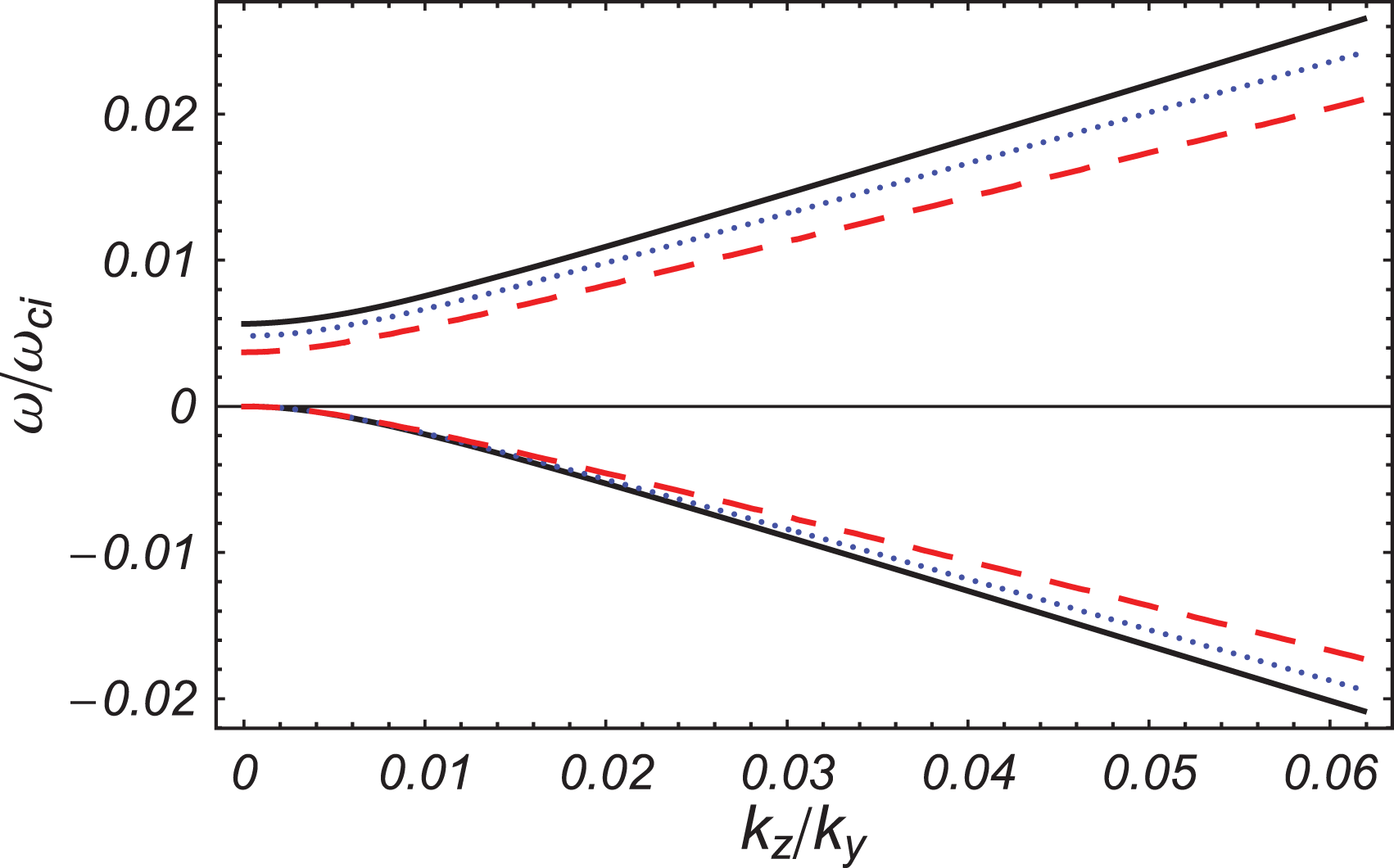
Figure 1 explores the effect of electron spectral index
 ${\it\kappa}$
on the frequency of the coupled ion acoustic and drift wave in a magnetized spatially inhomogeneous e–p–i plasma. It is found that on increasing the superthermal population of electrons (i.e. decreasing
 ${\it\kappa}$
), the frequency of the wave under consideration decreases. This fact can lead to the enhanced Landau damping of the electrostatic waves as the gap between the ion thermal velocity and the phase velocity of the wave shrinks (Lee Reference Lee2007). This also implies that increasing the non-thermal population of electrons (meaning decreasing
 ${\it\kappa}$
) mitigates the restoring force and hence the observed decrement in frequency.
Linear dispersion relation for coupled drift and ion acoustic waves in a magnetized e–p–i plasma. Variation of frequency for different values of the electron spectral index
 ${\it\kappa}$
is illustrated. Solid curve is for a Maxwellian distribution, dotted for
 ${\it\kappa}=6$
, and dashed for
 ${\it\kappa}=3$
.

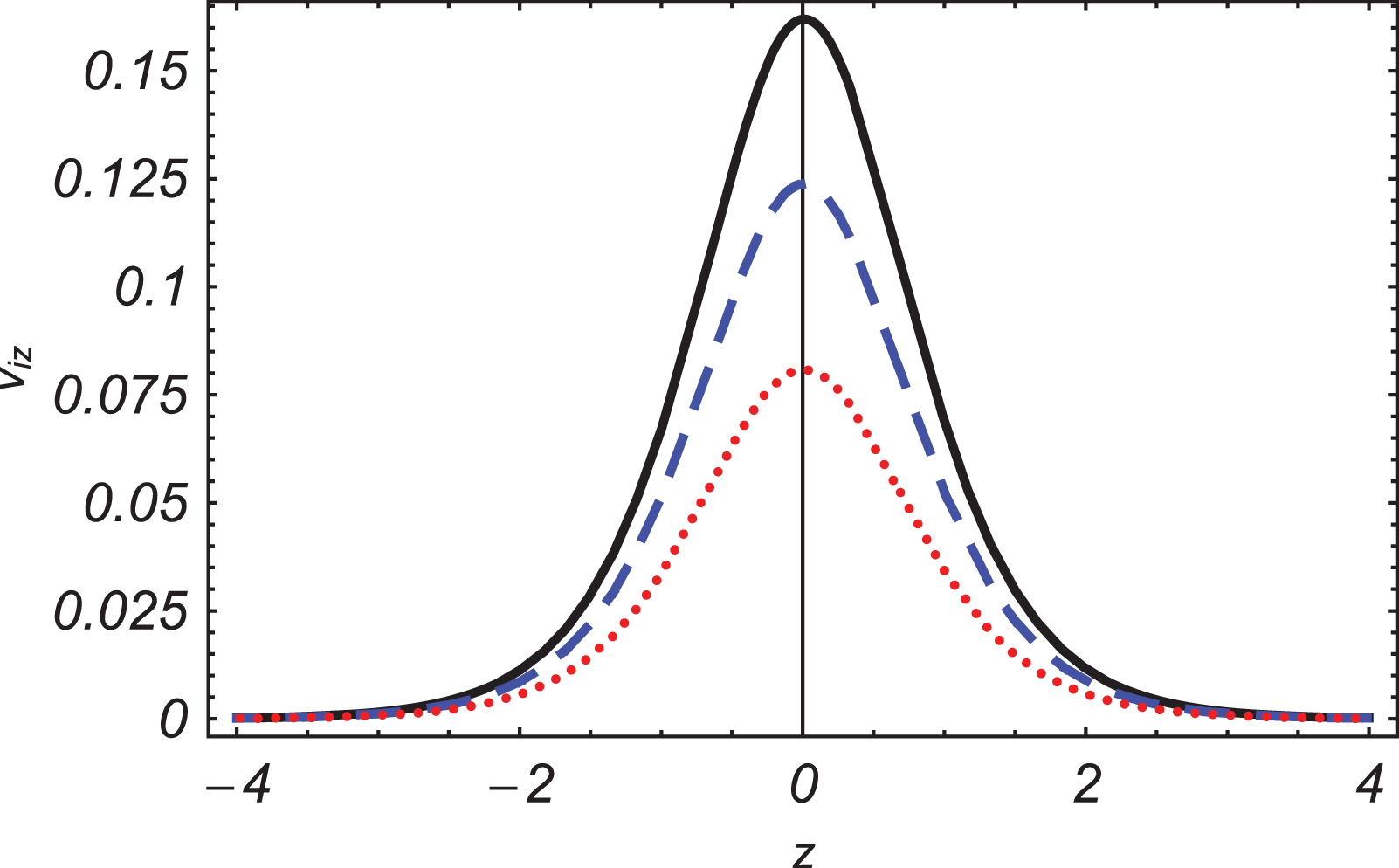
Figure 2 investigates the effect of electron spectral index
 ${\it\kappa}$
on the propagation characteristics of the coupled ion acoustic and drift solitary wave. It is observed that enhancing the electron spectral index
 ${\it\kappa}$
decreases the amplitude as well as the width of the solitary structure. A similar trend was observed by El-Shamy (Reference El-Shamy2014) for an ion acoustic wave in a homogeneous magnetized plasma.The physical reasoning given to explain figure 1 holds here as well.
Variation of the amplitude of drift and ion acoustic solitons for different values of the electron spectral index
 ${\it\kappa}$
. Solid curve is Maxwellian, dashed for
 ${\it\kappa}=6$
, and dotted for
 ${\it\kappa}=3$
. The other parameters are
 $p=0.2$
and
 ${\it\alpha}=0.2$
.

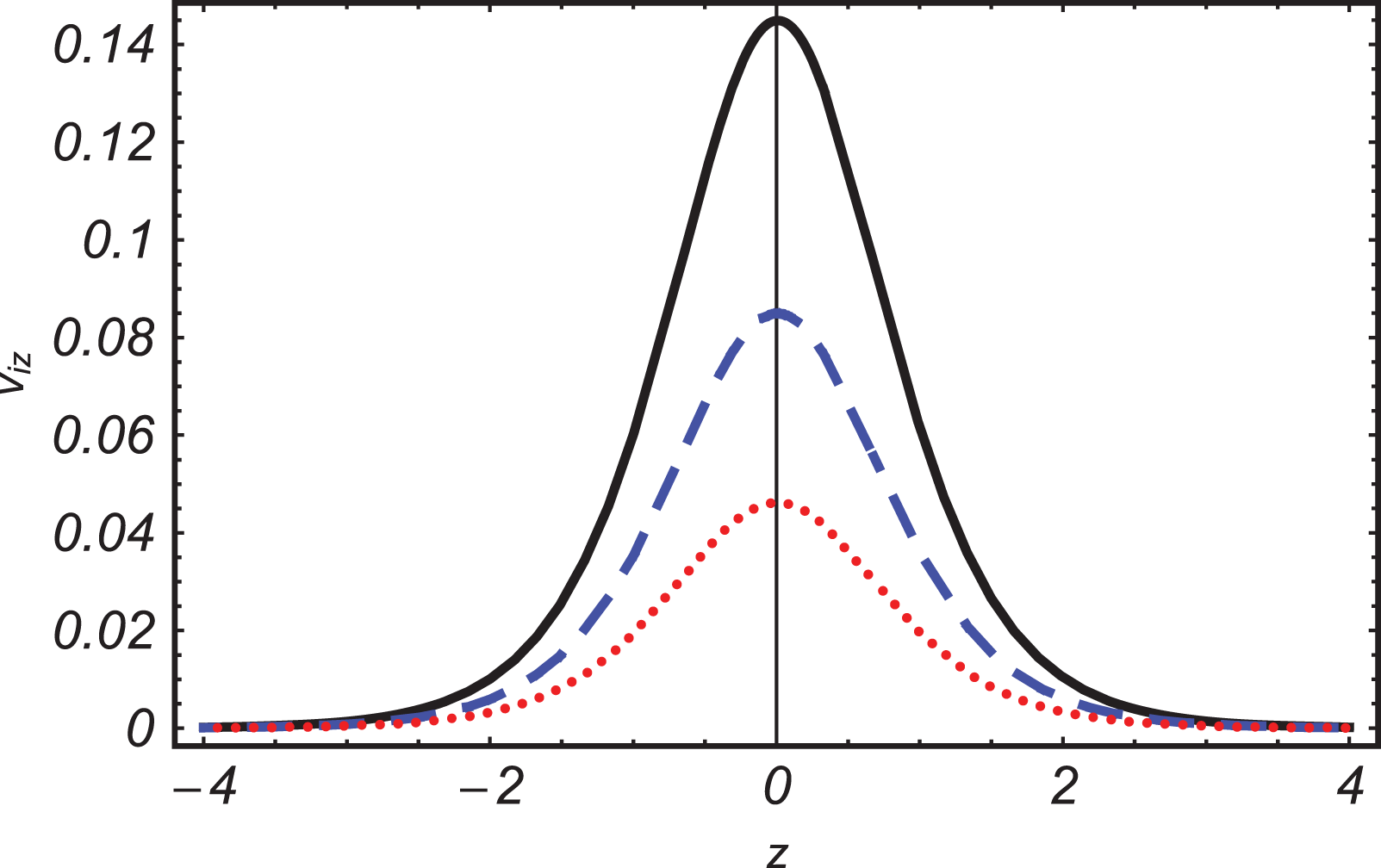
Figure 3 shows the effect of positron concentration on the structure of the ion acoustic drift solitary wave. It is found that increasing positron concentration reduces the amplitude and also decreases the width of the solitary wave, which agrees well with the results presented by Popel et al. (Reference Popel, Vladimirov and Shukla1995) and El-Shamy (Reference El-Shamy2014). This happens because of the quasi-neutrality condition, which dictates that an increase in positrons should be accompanied by a decrease in ion population. Since we are considering the ion dynamics, therefore, a decrease in ion population brings about a decrease both in the linear and nonlinear acoustic structures. It is pertinent to mention here that the results presented by Mushtaq (Reference Mushtaq2008) showed the opposite trend. We doubt his results since increasing the positron concentration means a decrease in the ions in the system and should therefore lead to a decrease in the amplitude of the drift ion acoustic solitary wave.
Variation of the amplitude of drift ion acoustic solitons for different values of positron concentration
 $p=n_{p0}/n_{e0}$
. Solid curve is for
 $p=0$
, dashed for
 $p=0.2$
, and dotted for
 $p=0.4$
. The other parameters are
 ${\it\kappa}=4$
and
 ${\it\alpha}=0.2$
.

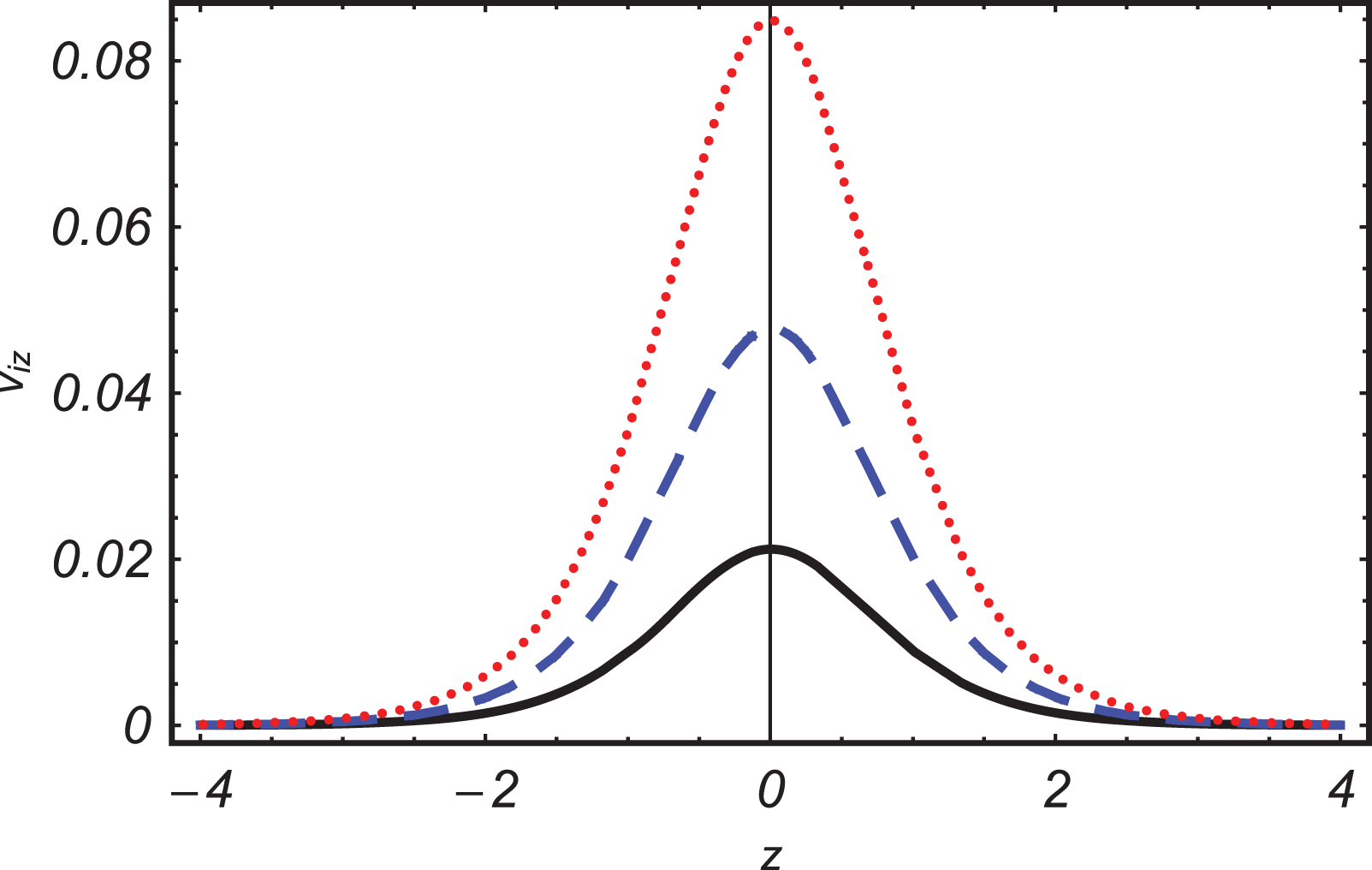
Figure 4 explores the effect of increasing propagation angle on the ion acoustic drift solitary wave. Physically, an increase in angle of propagation means the inclusion of cyclotron as well as drift effects, as the particles experience neither of them along the direction of the magnetic field owing to the absence of Lorentz force. It is observed that increasing the propagation angle enhances both the amplitude and width of the solitary wave, which agrees well with the results presented by Masood et al. (Reference Masood, Hassan, Batool and Siddiq2013). Note that the results are valid only for small angles of propagation, as larger angles pose problems of stability for the solitary wave (Kadomtsev & Petviashvilli Reference Kadomtsev and Petviashvilli1970; Zakharov & Kuznetsov Reference Zakharov and Kuznetsov1974). It is pertinent to mention here that the acoustic drift solitary structures experience a greater shift by comparison with their counterparts in homogeneous plasma as evident from the solution given by (4.8). Finally, we mention that the spatial coordinates are normalized by the ion Larmor radius which is set to be 2000 miles. Therefore, the spatial extent of the ion acoustic drift solitary structures is estimated to be
 ${\sim}7000$
miles.
Variation of the amplitude of drift ion acoustic solitons for different values of the propagation angle
 ${\it\alpha}$
. Solid curve is for
 ${\it\alpha}=0.1$
, dashed for
 ${\it\alpha}=0.15$
, and dotted for
 ${\it\alpha}=0.2$
. The other parameters are
 ${\it\kappa}=4$
and
 $p=0.2$
.

6. Conclusion
In this paper, we have studied the linear and nonlinear propagation of two-dimensional ion acoustic drift solitary structures in an inhomogeneous e–p–i magnetoplasma in the presence of superthermal electrons. It is found that the dispersion characteristics of the wave under consideration are modified by the non-Mawellian electrons. We have also presented a nonlinear analysis and derived the MZK equation for the coupled ion acoustic drift wave in a spatially inhomogeneous plasma. The solution of the MZK equation is obtained by employing the tangent hyperbolic method. Only compressive solitary structures exist in this frame. We have also discussed the limiting case of homogeneous plasma in both the linear and nonlinear regimes. It is found that the electron spectral index
 ${\it\kappa}$
, positron concentration, and propagation angle
 ${\it\alpha}$
modulate the structure of ion acoustic drift solitary waves. For illustration, using the parameters typically found in the interstellar medium, the spatial extent of the solitary structure is estimated to be
 ${\sim}7000$
miles. The work presented here on obliquely propagating ion acoustic drift waves in magnetized e–p–i plasmas can improve our understanding of nonlinear excitations in astrophysical and laser-induced plasmas.