In their target article, McCullough et al. re-conceptualize the familiar concepts of revenge and forgiveness in terms of classes of evolutionarily recurrent situations involving potential costs and benefits, around which proximate psychological mechanisms are designed. Here, “costs” and “benefits” are not synonyms for preferences or desires, but instead correspond to classes of outcomes which relate to differential reproductive success over multiple generations. This approach sheds new light on old constructs, reframes the questions being asked, and provokes new and clear directions for future research. While the target article focuses on revenge and forgiveness, this same perspective also suggests new ways to think about intergroup conflict. For example, intergroup conflict and revenge can be understood as a sequence of triadic interactions, of which there are only four types. Following Strayer and Noel (Reference Strayer, Noel, Zahn-Waxler, Cummings and Iannotti1986), these are as shown in Figure 1:
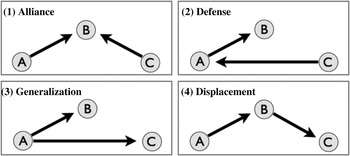
In an Alliance, two agents attack or impose costs on a third agent: A attacks B, and C also attacks B. In Defense, one agent attacks a second, and a third agent responds by attacking the aggressor: A attacks B, C then attacks A. In Generalization, one agent attacks two others: A attacks B and then also C. Finally, in Displacement, one agent attacks another, and that attacked agent responds by subsequently attacking a third agent: A attacks B, B then attacks C. Any instance of intergroup conflict or revenge will involve a particular concatenated sequence of these interactions. What determines this sequence will be the result of cost/benefit decisions on the part of each actor.
This taxonomy of triadic conflict has served descriptive purposes for decades. But from an adaptationist perspective, this taxonomy can also be understood as describing recurrent classes of situations that humans have encountered. Moreover, for each interaction type, the perspective of each agent can be analyzed.
For example, consider (1) Alliance: A should calculate the likelihood that C will ally with him in determining whether or not to initially attack B. A should also consider the consequences of C also attacking B. C needs to calculate the value of allying with A against B. C may do this to ingratiate himself to A, or owe something to A, or be differentially allied with A. Or, C may have a poor relationship with B, and take advantage of this opportunity to impose a cost on B. B should represent the cost imposed by both agents, and should also consider the pairwise relationship comparisons: B with A, B with C, A with C in determining what to do next.
Or, consider, (4) Displacement: B may act because A has an interest in C, and by imposing a cost on C, B is intending to indirectly impose a cost on A. Or, even if A has no interest in C, B's action towards C may cause C to appeal to A to take B's welfare into account (because A's aggression towards B is now yoked to B's aggression towards C, such that if A aggresses again, C will be hurt again). The potential cost to B of doing this is that it may cause A and C to unite against B. This is less of a problem if it is already likely that C would have come to A's defense. A will represent that B has imposed cost on C, and will subsequently calculate the effect on C. To the degree A has an interest in C, or that C will retaliate towards A, A should consider B's action a cost. C will represent that B imposed a cost.
The proximate psychology of multi-person conflict, revenge, and retaliation is built around these recurrent interaction types. Considering each agent's perspective within these triadic interactions therefore allows one to reframe the vague and difficult question, What is the proximate psychology of intergroup conflict?, into sets of deductively richer and tractable questions, such as: What are the classes of situations in which an agent finds themselves in role B during an alliance event? What cost/benefit considerations would that agent need to consider? And, What are the on-the-ground cues that would facilitate identifying these situations?
From this perspective, the folk construct “group” can be understood as classes of relationships between agents which cause them to be more likely to be in particular roles within these interaction types. What it means to be members of a group, as far as the design of the proximate psychology may be concerned, is to be in roles A & C in Alliance, B & C in Defense and Generalization, and A & C in Displacement. These roles would be part of the cue structure on the input end (i.e., observing these roles allows one to deduce an intergroup conflict is unfolding, and also who is allied with whom), and also be embodied in the motivational and representational changes on the output end (being allied or in a group with someone makes it more likely one will execute the behaviors that correspond to these roles). This would be true of the psychologies driving the decisions of the actors within the group context, as well as the psychologies of third parties who are forming expectations and updating their representations of the groups and their members.
This analysis suggests a tentative answer to a question posed by McCullough et al., of whether the psychology that governs the operation of revenge systems also evolved to regulate behavior in intergroup contexts. In many respects, the proximate psychology governing intergroup conflicts is probably interestingly different from systems primarily designed around dyadic revenge (different because it requires triadic, rather than dyadic calculations, and because its cue structure and subsequent behavioral and motivational responses will likely be somewhat different). However, even if the proximate psychologies are interestingly different, they are both examples of phenotypic design to contingently respond to direct or indirect costs imposed by other agents.





In their target article, McCullough et al. re-conceptualize the familiar concepts of revenge and forgiveness in terms of classes of evolutionarily recurrent situations involving potential costs and benefits, around which proximate psychological mechanisms are designed. Here, “costs” and “benefits” are not synonyms for preferences or desires, but instead correspond to classes of outcomes which relate to differential reproductive success over multiple generations. This approach sheds new light on old constructs, reframes the questions being asked, and provokes new and clear directions for future research. While the target article focuses on revenge and forgiveness, this same perspective also suggests new ways to think about intergroup conflict. For example, intergroup conflict and revenge can be understood as a sequence of triadic interactions, of which there are only four types. Following Strayer and Noel (Reference Strayer, Noel, Zahn-Waxler, Cummings and Iannotti1986), these are as shown in Figure 1:
The four types of triadic conflict. Arrows denote attack/cost imposition. All instances of intergroup conflict and revenge are built up out of these interaction types. (Adapted from Strayer & Noel Reference Strayer, Noel, Zahn-Waxler, Cummings and Iannotti1986).
In an Alliance, two agents attack or impose costs on a third agent: A attacks B, and C also attacks B. In Defense, one agent attacks a second, and a third agent responds by attacking the aggressor: A attacks B, C then attacks A. In Generalization, one agent attacks two others: A attacks B and then also C. Finally, in Displacement, one agent attacks another, and that attacked agent responds by subsequently attacking a third agent: A attacks B, B then attacks C. Any instance of intergroup conflict or revenge will involve a particular concatenated sequence of these interactions. What determines this sequence will be the result of cost/benefit decisions on the part of each actor.
This taxonomy of triadic conflict has served descriptive purposes for decades. But from an adaptationist perspective, this taxonomy can also be understood as describing recurrent classes of situations that humans have encountered. Moreover, for each interaction type, the perspective of each agent can be analyzed.
For example, consider (1) Alliance: A should calculate the likelihood that C will ally with him in determining whether or not to initially attack B. A should also consider the consequences of C also attacking B. C needs to calculate the value of allying with A against B. C may do this to ingratiate himself to A, or owe something to A, or be differentially allied with A. Or, C may have a poor relationship with B, and take advantage of this opportunity to impose a cost on B. B should represent the cost imposed by both agents, and should also consider the pairwise relationship comparisons: B with A, B with C, A with C in determining what to do next.
Or, consider, (4) Displacement: B may act because A has an interest in C, and by imposing a cost on C, B is intending to indirectly impose a cost on A. Or, even if A has no interest in C, B's action towards C may cause C to appeal to A to take B's welfare into account (because A's aggression towards B is now yoked to B's aggression towards C, such that if A aggresses again, C will be hurt again). The potential cost to B of doing this is that it may cause A and C to unite against B. This is less of a problem if it is already likely that C would have come to A's defense. A will represent that B has imposed cost on C, and will subsequently calculate the effect on C. To the degree A has an interest in C, or that C will retaliate towards A, A should consider B's action a cost. C will represent that B imposed a cost.
The proximate psychology of multi-person conflict, revenge, and retaliation is built around these recurrent interaction types. Considering each agent's perspective within these triadic interactions therefore allows one to reframe the vague and difficult question, What is the proximate psychology of intergroup conflict?, into sets of deductively richer and tractable questions, such as: What are the classes of situations in which an agent finds themselves in role B during an alliance event? What cost/benefit considerations would that agent need to consider? And, What are the on-the-ground cues that would facilitate identifying these situations?
From this perspective, the folk construct “group” can be understood as classes of relationships between agents which cause them to be more likely to be in particular roles within these interaction types. What it means to be members of a group, as far as the design of the proximate psychology may be concerned, is to be in roles A & C in Alliance, B & C in Defense and Generalization, and A & C in Displacement. These roles would be part of the cue structure on the input end (i.e., observing these roles allows one to deduce an intergroup conflict is unfolding, and also who is allied with whom), and also be embodied in the motivational and representational changes on the output end (being allied or in a group with someone makes it more likely one will execute the behaviors that correspond to these roles). This would be true of the psychologies driving the decisions of the actors within the group context, as well as the psychologies of third parties who are forming expectations and updating their representations of the groups and their members.
This analysis suggests a tentative answer to a question posed by McCullough et al., of whether the psychology that governs the operation of revenge systems also evolved to regulate behavior in intergroup contexts. In many respects, the proximate psychology governing intergroup conflicts is probably interestingly different from systems primarily designed around dyadic revenge (different because it requires triadic, rather than dyadic calculations, and because its cue structure and subsequent behavioral and motivational responses will likely be somewhat different). However, even if the proximate psychologies are interestingly different, they are both examples of phenotypic design to contingently respond to direct or indirect costs imposed by other agents.