

Cicero opens the second book of De inventione, his earliest treatise on rhetoric (written in about 84 BCE), with an anecdote. The citizens of Croton, a prosperous Greek colony in the region of Bruttium in southern Italy, hired the famous painter Zeuxis of Heraclea at a vast price to decorate the interior of a temple dedicated to Juno. After completing several panels, the artist expressed the desire to include among the paintings a portrait of Helen, which he envisaged as an embodiment of supreme female beauty. To draw inspiration and create a picture of high aesthetic value that would earn the admiration and praise of the visitors of the sanctuary, Zeuxis requested that some of the local girls audition.Footnote 1 The Crotoniates, who surpassed all the Greeks in athletic prowess and won many victories at Panhellenic contests, took the painter to the palaestra, where a group of handsome boys was training, and proudly asserted that the sisters of those youths possessed equally superb looks. Eager to inspect the reported beauties, Zeuxis asked them to summon the most exquisite of those virgins in order to choose a suitable model. A public decree was issued, calling all the maidens of the city to gather at a place where the celebrated artist would make his selection, as the contenders paraded in front of him. Knowing that it would be impossible to find all the components of ideal beauty in a single woman, since nature does not grant absolute perfection to every part of one's body, Zeuxis chose five girls instead of one and combined their comeliest features into a composite portrait of Helen.
Zeuxis’ longing to give concrete form to the ideal and represent what is too beautiful to capture on a panel is paradigmatic of the divide between the conceptual and the real, the vision and its materialisation.Footnote 2 As such the anecdote – an example of classical reception from within antiquity that shows how the past blends with the present – can cast light on the transition from the verbal to the optical in filmic recreations of Helen and on the ways in which the two are reconciled on the big screen. By rendering in narrative form the struggle of an artist to give physical definition (i.e. a face and body) to an iconic figure from the sphere of myth, and to incorporate her into a portrait intended for public display, the story of Zeuxis provides a useful parallel from the realm of the ancient visual arts that can help us decode the modern mechanisms whereby the words and ideas of Greek poetry change into images that became available for mass consumption in mainstream cinema. The syncretic manner in which Zeuxis is said to have responded to the challenge of depicting the woman regarded as the epitome of physical perfection in the classical world serves as a precedent for the hybrid look that Homer's heroine is granted on film and can legitimise her depiction in the medium as a collection of fragments appropriated from contemporary aesthetic regimes.
As the fetishised object of the male gaze in Book 3 of the Iliad (156–8, 441–6) Helen is, in Laura Mulvey's psychoanalytic terms, the quintessential cinematic female figure.Footnote 3 Although in both passages she is denied specificity and the text casts her body as a tabula rasa for the audience's imagination,Footnote 4 the close relationship that she enjoys with Aphrodite (best illustrated in 3.395–411) encourages the reader to visualise her external appearance as a reflection of the physical attributes of her divine patroness. These include an emphatically beautiful neck (περικαλλέα δειρήν, 396), an enchanting bosom (στήθεα … ἱμερόεντα, 397) and a set of gleaming eyes (ὄμματα μαρμαίροντα, 397).Footnote 5 Such visual clues offered in the poem that could support the aesthetics of the cinematic Helens and provide textual grounding for her on-screen eroticisation have gone unobserved in recent scholarship. Although thought-provoking, the insights yielded by studies of Helen on film are largely grounded on narrative analysis and characterisation.Footnote 6 Little attention has so far been paid to the representation of classical myth's most notorious femme fatale in physical terms. With one exception,Footnote 7 scholars have generally not addressed the diverse ways in which the medium of cinema has recreated Helen's legendary looks and has sought to portray the fictitious vamp of the Iliad as a flesh-and-blood woman. Furthermore, the importance of the star cast in the role of Helen as a vehicle for conveying the celebrity status that Homer's heroine enjoyed in antiquity has hitherto received cursory treatment. Discussions of the issue, when present at all, are brief and usually suffer from a lack of theoretical and especially contextual basis. The industrial mechanisms and historical conditions that determine the casting process and affect the ways in which a given actress is utilised on film and in extra-cinematic discourses have been almost entirely overlooked in current scholarship on Helen's filmic transplantations.
My paper seeks to make an original contribution to this body of film criticism by focusing on a largely ignored runaway production of the post-war era starring Hedy Lamarr, one of Hollywood's biggest names during the golden age of the studio system (late 1920s to early 1960s).Footnote 8 Shot in Rome in 1953 with the intention of being released in the United States soon after, the picture is symptomatic of a period during which American film-makers repeatedly turned to the ancient Mediterranean world as a source of inspiration for the lavish spectaculars with which they sought to lure viewers away from television and back to the movie theatres. Although the film is the first of the sound era that draws on Greek antiquity, it remains uncharted territory in terms of the ways in which it reworks Homer's text and the new dimensions it adds to Helen's cinematic image. The reason for this lack of critical attention is that, despite the publicity it received as part of its pre-release campaign, it never reached the big screen in the United States.Footnote 9 It was an independently financed venture whose post-production fate confirms the adage ‘big fish eat little fish’ and, as such, it offers testimony to the dynamics and practices prevalent in the oligopolistic film industry. Warner Bros., one of Hollywood's ‘Big Five’, purchased the distribution rights to prevent the film from appearing at theatres before its own multimillion-dollar epic Helen of Troy, which was produced almost concurrently in Rome and released in 1956.Footnote 10 A severely edited version of the Lamarr film played briefly in Italy in 1954 under the title L'amante di Paride (‘The lover of Paris’) and in the United Kingdom in 1955 under the title The face that launched a thousand ships, which was inspired by a famous phrase from Christopher Marlowe's 1604 play Doctor Faustus.Footnote 11
In this paper, I shall focus on Lamarr's pseudo-Grecian look and analyse key details of it – hair, makeup and costumes – in an attempt to illustrate the construction of Helen's celluloid body as a bricolage of modern perceptions about celebrity, elegance and seduction. Dress plays a crucial role in period films, for it establishes, along with the sets and props, the appropriate feeling of an earlier time. A reading of Helen through her clothes, therefore, can elucidate the variety of meanings with which she is invested on screen and explain how her gowns function within the film's iconography to support narrative demands and characterisation, and respond to audience expectations. Building on recent studies of Lamarr's pre- and post-war manipulation of her star image, my analysis will also aim to show how Helen's representation is informed by and seeks to capitalise on the actress's status as an icon of glamour in the film industry. I shall argue that L'amante di Paride is a ‘star vehicle’ that projects a grossly anachronistic version of classical antiquity's gold standard of female beauty, casting Hollywood royalty as Greek royalty – a studio queen incarnating the Spartan queen.
In further exploring the subjection of the cinematic Helen to the conventions of female stardom in the 1950s, I shall move on to her better-known adaptation in the Warner Bros. production. From my discussion it will emerge that, although the studio cast in the lead the young Italian actress Rossana Podestà, who was favoured over her American competitors because she epitomised the allure of natural beauty, she was not immune to Hollywood's dominant aesthetics of femininity and was transformed into a Bronze Age queen whose external appearance has nothing to do with the specific historical period. It offers an illusion of antiquity in general, incorporating a variety of elements from contemporary fashion. Since the ways in which Helen's look sacrifices authenticity for the sake of visual pleasure have been addressed elsewhere, the most original contribution that this paper seeks to make is to explore the conflation of ancient and modern celebrity in rare Italian audio-visual material, which attributes a glamorous lifestyle to Podestà and promotes her as an off-screen diva. My goal is to read Podestà's ‘star text’ not as a theoretical concept related to the audience's imaginative identification with the character on screen, but as a complex amalgam of visual and verbal information circulated through a network of diverse media. Treating the star not only as an image but also as capital operating within a particular industrial framework that is defined historically and geographically, I propose to investigate the context in which Podestà's stardom arose, as well as the impact that her casting as Helen had on her later career.
The most beautiful girl (?) in film as Helen
As the myth of Zeuxis illustrates, the visual recreation of Helen requires the best of the very best. The painter called for audition the most beautiful (formosissimas) of the sisters of the handsome champions-in-the-making that the Crotoniates showed him when they took him to the wrestling school. Helen's cinematic counterpart also requires a female star of exceptional beauty. A star, however, is more than just a good-looking image. Ever since Richard Dyer developed the concept of the ‘star text’Footnote 12 that is available in the public domain for audiences to ‘read’ and informs their reception of a performer, the critical pendulum has swung in the socio-semiotic direction, and it has been virtually impossible to discuss the phenomenon of stardom in a given historical period or geographical area without first paying tribute to Dyer's important formulations.
Dyer called attention to the need to examine stars not only as flesh-and-blood people with a certain look and history (personal as well as professional) behind them but also as a complex configuration of verbal, visual and aural signs found outside the filmic texts in which actors feature. As a real person, the star is the combination of name, physiognomic and other qualities (hair colour, hairstyle, voice timbre, body size, sex appeal), nationality, ethnic identity, race and specific performance skills (singing, dancing, etc.). As an image, the star is a multilayered construct produced discursively across a wide range of media texts – whether authorised by the actor or not – including promotion materials (studio announcements, press handouts, pin-ups, fashion pictures, advertisements in which actors endorse merchandise, etc.), articles in magazines and newspapers, radio and television interviews, biographies, reviews, gossip columns and websites, and so on. In the words of one critic, ‘[a]ctors become stars when their off-screen life-styles and personalities equal or surpass acting ability in importance.’Footnote 13 The scholar, therefore, has to decode the various meanings that are interwoven into a star's mediated image and investigate the extent to which off-screen myths inform his/her on-screen persona.
During Hollywood's golden years, Hedy Lamarr was considered one of the film industry's few ‘auratic stars’ – sensational yet distant, familiar but out of reach.Footnote 14 Thanks to the MGM publicity machine, she became a paragon of beauty, glamour and transgressive sexuality. An article published in The New York Times on 23 August 1970 enumerates, nostalgically, her superb physical qualities as follows:
Of all the glamour queens, surely none was more glamorous than Hedy Lamarr. She seemed the definition of the word. Of all the stars of the forties and early fifties, she was probably the most classically beautiful, with those huge, marbly eyes, the porcelain skin, the dreamy little smile, and the exotic voice that was an artful combination of Old Vienna and the MGM speech school.Footnote 15
Magazines fought to feature a picture of Lamarr's alabaster face on their cover, and gossip columnists revelled in every public appearance she made. An incarnation of the woman whose private life was the source of constant scandal, Lamarr had numerous affairs with men of high economic status and married six times, always filing for divorce after a short period of domestic life. She also became notorious for the auction sales of her lavish possessions (including expensive jewellery and art) and later in her life for her shoplifting habits.
Lamarr was imported to Hollywood after she gained exposure in Europe thanks to a brief yet highly provocative scene in the Czech art-house film Ecstasy (1933, dir. Gustav Machatý), which shows her swimming and running naked through the woods and later reaching ecstasy by simulating an orgasm. The Pope denounced the film in the Vatican newspaper. The Catholic Legion of Decency condemned it. In the United States, given the puritan climate of the time, the film was characterised as ‘indecent and morally dangerous’,Footnote 16 and played at small, out-of-the-way theatres without the seal of the Motion Picture Production Code. Although few people had seen Ecstasy, Lamarr's reputation as a raven-haired siren of irresistible charm preceded her. When she arrived on American soil in 1937 – trying to escape from the rise of anti-Semitism in fascist Europe, as well as from a controlling husband who also happened to be a Nazi – the 23-year-old Viennese émigré Hedwig Kiesler (Lamarr's original Jewish name) was heralded by the press as ‘the most beautiful girl in the world’. The title had been bestowed upon her, along with her new name, by the president of MGM, Louis B. Mayer, who discovered the actress while scouting for talent in Europe.Footnote 17 From 1938, when she made her American debut, until the early 1950s, when her career started to go into decline and she decided to cross over to television, Lamarr starred in eighteen motion pictures alongside the era's most popular leading men. Her inaugural appearance in Algiers (1938, dir. John Cromwell) was so sensational that a member of the audience recalls the reaction to Lamarr's first entrance in the film as follows:
One could feel the audience's anticipation of seeing her face for the first time … It was palpable. Sitting there in the dark, when the shadowed image of Hedy Lamarr suddenly turns her face full to the camera, the impact was audible. Everyone gasped. That's the only time in my whole life I have ever heard an audience do that at the first sight of an actress in a movie. Hedy Lamarr's beauty literally took one's breath away!Footnote 18
Despite the wide range of motion pictures in which Lamarr featured, her screen image never managed to break away from her sordid cinematic past, no matter how much the actress strove to cleanse herself by crossing the Atlantic and changing her name.Footnote 19 Her career was constantly haunted by her salacious appearance in Ecstasy, and directors commonly sought to cast her in the role of the ethnic femme fatale. The prime example of this stereotyping is Cecil DeMille's Samson and Delilah, the highest-grossing film of 1949 and the box-office leader of its decade,Footnote 20 in which Lamarr incarnated the titular temptress of exotic origins. The biblical epic was the defining moment of Lamarr's celebrity status. It catapulted her name to the very top of Hollywood's pyramid of stardom, establishing the actress as the epitome of the vamp in the eyes of moviegoers in the early post-war years. As the columnist and television personality Dorothy Kilgallen put it in 1952, in words that echo Marlowe's proverbial characterisation of Helen and illustrate its pervasiveness in popular culture, ‘Lamarr became this generation's version of the Vamp – a synonym for the woman who launches ships, wrecks homes and sends countless men to glory or to doom.’Footnote 21
It was because of her bankable image as a woman of lethal beauty that Lamarr, although in her late thirties, was one of the favourites for the role of Helen when Warner Bros. announced its plan to adapt the story of the Iliad for the big screen in early 1952. The studio was not the only one intending to produce a spectacular based on the ancient epic; the press saw Helen as the cause of a potential war among Hollywood majors and directors.Footnote 22 DeMille had a script underway that portrayed Homer's heroine as ‘strongly allegorical’, and had started negotiations with Paramount, who financed all his films. However, as an article published in Variety on 22 May 1952 reports, he decided to withdraw from the race for Helen to focus on the remaking of the Old Testament epic The Ten Commandments (1956).Footnote 23 But competition with one of the Big Five did not discourage independent producer Victor Pahlen from moving ahead with his own version of Helen. According to an article in The Hollywood Reporter of 17 April 1953, he summoned the press and announced that he had secured Lamarr as the lead in a picture scheduled to enter production in Rome on 15 May. Earlier that year Lamarr, divorced for the fourth time, had planned to sail to London to shoot The great love stories, a television series scheduled to be directed by Edgar G. Ulmer, with her playing the biblical queen Esther in the first episode. The plan, however, fell through, and in May 1953 she flew to Rome to film another episode in the sequence, with the same directorFootnote 24 but now intended for theatrical release under a new title: The great loves of history. With the money that she borrowed from the Texas oil magnate W. Howard Lee, whom she was dating at the time, Lamarr became the picture's joint producer along with Pahlen, and had the script rewritten for a three-hour long episodic drama. The film, in its present truncated form, casts the Hollywood star as a performer in a travelling theatre troupe who incarnates, on successive nights, three iconic women in love – instead of six, as was the idea behind the original television project: Genevieve de Brabant, Empress Josephine and Helen of Troy.
At first, the trilogy seems to lack coherence, a sense reinforced by the severely edited version in which the picture survives today. However, a closer look shows that there is a unifying theme in the tripartite narrative: ‘the notion that beauty is a burden to which the bearer will inevitably be sacrificed’.Footnote 25 As Helen exclaims when Menelaus (Robert Beatty) asks her to use her physical charms to seduce Paris (Massimo Serato) and keep him captive in Sparta until he gathers an army of Greek allies to face the threat of the Trojans, ‘What else has it [beauty] brought me, save sorrow?’ Another motif that holds this episodic film together is the redemption of three famous women who have historically earned the title of the ‘bad girl’Footnote 26 by elevating them to strong, regal figures. As Lamarr writes in her biography in order to give credit to the project, the script was approved by a member of the former Italian royal family, and she was considered as the ideal star because if she ‘would play Helen of Troy all history would be changed’.Footnote 27 On the visual level, this aesthetic result is achieved through the glamourisation of the film's heroines. Hairstyle, makeup, costumes, diadems and gaudy jewellery – such as necklaces, armlets, bracelets and earrings – are all used to emphasise the royal status of the three characters brought to life by big-screen queen Hedy Lamarr and to show off the actress's exotic beauty and sex appeal at the expense of historical accuracy.Footnote 28
As a ‘star vehicle’ (that is, a script written specifically for Lamarr and built around her star image),Footnote 29 the film privileges sensuality over authenticity, offering an illusion of an earlier epoch without reproducing the fashion details of the particular historical period in which it is set. In costume films of the golden era, ‘it was economically vital’, as Alicia Annas notes, ‘that the star's image was not sacrificed to history’ in order not to disrupt the viewers’ familiarity with it. Hollywood studios followed specific techniques to reconcile audience expectations with the need to produce a convincing sense of a past time:
Since makeup was an integral part of the female star's image, modern corrective glamour makeup was used in every film, regardless of period. There was absolutely no attempt to make women's film makeup reflect history.
Because women's film makeup was always modern, their hairstyles had to follow suit to a degree. Hairstyles became the key visual component for merging the female star image and its modern glamour makeup with the historical illusion provided by the costumes and settings …
[Studio costume departments] developed a generic wig style, the ‘Hollywood beauty queen’. This full-length wig was serviceable for every historical period with its center part, soft, layered crown or temple curls, and soft waves cascading to the shoulder or below. Norma Shearer wore such a wig in Marie Antoinette (1938), as did Hedy Lamarr in Samson and Delilah …Footnote 30
The wig that Lamarr wears for the role of Helen is a variation of the generic ‘Hollywood beauty queen’ that makes Homer's heroine look like an elite woman from the time of the Napoleonic Empire. Similarly, none of Helen's costumes has anything to do with Greek antiquity per se. They are mostly evening gowns that confer upon the Spartan queen the high style and elegance of a Hollywood queen. In addition to suggesting a conflation of character and actor, they also convey a sense of luxury and lavishness. Such qualities offer an escapist fantasy that post-war viewers probably yearned for more than historical accuracy, which would have resulted in a rather austere spectacle.
Lamarr's Helen does not own daywear. Even when she enjoys the serenity of the palace's gardens with her Spartan maids in the daytime (57:43–58:31) or has a romantic moment with Paris in the atrium (1:06:18–1:08:00), she is dressed in formal attire. All her costumes are made of expensive fabrics – mostly in solid colours in line with the haute couture imperatives of the 1950s – and are cut to a body-conscious design that highlights Lamarr's/Helen's erogenous zones (especially her neck, shoulders, bosom and arms) and hence her ability to seduce. The colour choice is often dictated by the action. For example, when Helen appears with Priam (Enrico Glori) upon the Scaean Gates to watch the duel between Paris and Menelaus that will determine which of the two will claim her as his wife, she wears a white gown with a long veil that casts her as a modern bride. Elsewhere, it is the design of the dress that plays a symbolic role in the narrative. For instance, a sign that the queen's body is sensual yet forbidden is the X-motifFootnote 31 formed by large satin straps on the upper part of Helen's gown in the scene in which Paris narrates to her his visitation by the three goddesses and Venus’ promise of the most beautiful woman on earth (1:02:43–1:04:50; Helen has not yet surrendered to him sexually in this scene). The X-motif highlights Helen's breasts and at the same time, by adding an extra layer of fabric over her bust, it functions as a type of armour that protects her physical integrity as a married woman. Simply put, this pattern both accentuates and annuls Helen's sexuality. The same aesthetic effect is achieved by the satin crossed belt that adorns the lower part of her dress. Tied in front of the vulva, it draws attention to her sexual nature and simultaneously denotes the queen's inviolability. Although unavailable, Helen teases Paris. While he tells her about Venus’ promise on mount Ida, she enticingly bites an apple, casting herself as a modern Eve.
The emphasis placed on a woman's sexuality through the costumes in a particular narrative construction is a characteristic trope in the representation of the femme fatale. As Stella Bruzzi notes about film sirens:
The symbolic iconography of the classic femme fatale is a limited, clearly demarcated register of clothes, based on the contrast of light and dark … frequent wardrobe changes (not necessarily motivated by action) and the insertion of distinctive, often anachronistic garments or accessories.Footnote 32
The Helen of Troy segment of the trilogy lasts slightly less than thirty-eight minutes, during which Lamarr changes costume eight times. Some of the costumes are meant to recall, and thus seek to capitalise upon, the star's image in DeMille's biblical epic. For example, the two-piece, belly-dancer-style dress with a long cloak that Helen wears in the scene in which she receives Paris at the palace in her capacity as queen of Sparta (1:00:55–1:02:42) evokes the iconic, Oscar-winning oriental outfits that Edith Head designed for Lamarr for her role as Samson's perilous concubine. Similarly, some of Helen's accessories (e.g. the peacock feather fan that she holds when Paris first flirts with her in her lavish bedroom [1:02:43–1:04:50]) are also appropriated from Delilah's register of exotic articles.Footnote 33 Such oriental details added to Helen's screen look denote a polarisation between West, to which she belongs as queen of Sparta, and East, to which she will soon escape with Paris. Ironically, Lamarr went the opposite route when she escaped from Europe.
Lamarr's/Helen's depiction as a temptress and devourer of men is enhanced by her flawless makeup and dark black hair. Her eyes are painted in various shades of purple to give her the generic look of the vamp and are paired with immaculately plucked, pencilled-in brows, long faux eyelashes and lips coated with thick, red lipstick. Long French-hook earrings and perfectly manicured nails painted in deep red complement her image. The curls on her forehead and the sides of her face are shaped like the coils of a snake and are matched by a ponytail with thick locks that gives Helen a serpentine look, emphasising, in visual terms, the ensnaring power of her beauty over Paris (Fig. 1). In the final scene, in which Menelaus draws his sword to take the life of his adulterous wife only to drop it in the end and forgive her, the coil-shaped hair, as the camera zooms in on Helen, casts her as Medusa, highlighting her ability to disarm men with her looks and win them over. Her capacity to entrap and victimise is also denoted by an article appropriated from Cleopatra's cinematic iconography, the golden snake armlet she wears in the scene in which she first kisses Paris (1:05:44–1:06:14).Footnote 34
Hedy Lamarr (Helen) and Massimo Serato (Paris) in L'amante di Paride (alternative title: The face the launched a thousand ships), dir. Marc Allégret. Credit: CINO DEL DUCA/PCE/THE KOBAL COLLECTION/ART RESOURCE.

Such details are important ‘interventions that interfere with the scenes in which they appear and impose themselves onto the character they adorn’.Footnote 35 Although they are not in accord with ancient visual sources and violate historical accuracy, they deserve scholarly attention because they constitute an indispensible intertext that adds meaning to the script – sometimes in ways that transcend the narrative – and emphasises the role of costume as spectacle made to consume the viewer's gaze.Footnote 36 Made for a Hollywood queen, Lamarr's dresses are a site on which modern perceptions about gender, status and power intersect with one another.
An Italian starlet as Helen
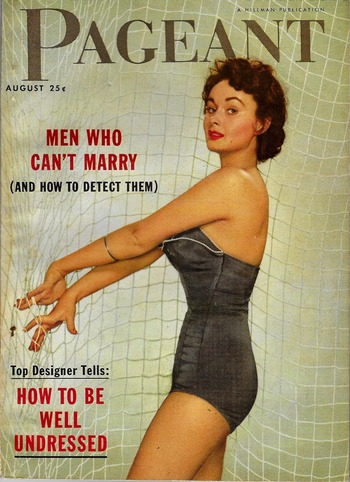
Lamarr was not the only big name in the industry favoured for the role of Helen in Warner Bros.’ mega-production. According to an article published in Pageant in August 1954 under the title ‘Everybody wanted to be Helen of Troy’, director Robert Wise was asked by the studio to consider the following American beauty icons besides Lamarr: Rita Hayworth, Cyd Charisse, Elizabeth Taylor, Lana Turner, Jane Russell and Jeanne Crain.Footnote 37 Small pictures of all of them accompany the short text on the title page:
All but one of the eight pretty faces on these pages should be nearly as familiar to you as your own. They represent a good deal of the most publicized, most expensive glamor that Hollywood has ever produced.
Now, Warner Brothers has said that none of these seven ladies is pretty enough. Warners’ is preparing to film Helen of Troy and, as everybody knows, Helen was the most beautiful woman in the world.
All seven sirens were considered for the role. None of them got it. Instead it went to the eighth girl, 19-year-old Italian beauty Rossana Podestà, whom you may be seeing here for the first time because she has never appeared in a United States film before.Footnote 38
A full-page picture of Podestà taken from the poster of the Mexican melodrama La red (‘The net’, dir. Emilio Fernández), the first foreign film in which the Italian actress was cast as the lead, is included on the opposite page with the caption: ‘This is the contemporary version of “the face that launched a thousand ships”.’Footnote 39 Another full-page picture of her adorns the inside back cover with the following caption in large print: ‘The face that sank a thousand hopes’.
To minimise the production costs, Warner Bros. followed the example of other runaways involving thousands of extras and had Helen of Troy filmed in Rome's Cinecittà studios and on the coast of the Lazio region with a crew of American, British and Italian actors and technicians.Footnote 40 Although she had previously played the part of Nausicaa in Ulysses (1954, dir. Mario Camerini; also produced in Italy), with Kirk Douglas as the titular character, Podestà lacked the glamour and international recognition that her alleged American rivals enjoyed. They were real stars – not only Hayworth, Charisse, Turner, Russell, Lamarr and Crain, all of whom were in their mid- to late thirties with an established career behind them, but also Taylor who was only twenty-two but had appeared in motion pictures, including costume dramas, since the age of nine. Compared to them, Podestà was a starlet who possessed only a photogenic face and too little experience to carry a film that gives Helen centre stage. She did not even speak English and had to learn her lines by rote with a voice coach. Her advantage, however, was her malleability, as opposed to her competitors’ fixed and untouchable look with which audiences were familiar and which was their major selling-point. Podestà's looks, as seen in the domestic films in which she appeared prior to Helen of Troy, were natural and authentic, and had not been contaminated by the glamorisation practices that were adopted by Hollywood studios.Footnote 41
Italian actresses in the 1950s offered an alternative to the meticulously constructed image that American stars projected on the silver screen, especially when they played the role of the vamp, the pin-up, or even sometimes the girl-next-door. Italian stars possessed a raw earthiness and became symbols of post-war economic growth and prosperity. As Stephen Gundle explains:
In contrast to Hollywood studio practice of grooming and preparing many young people and carefully selecting the few who would gradually move up the ladder of stardom, the Italians had been placed directly in films and quickly passed from bit parts to leading roles. They had minimal training as actors, their voices were usually dubbed by professionals, and they had undergone precious little glamorization. In America, sex appeal was a manufactured quality that diffused sexuality through a complex set of signs and techniques. It relied on grooming, fashion, hair styling, cosmetics, studied flirtatiousness and lighting. The Italian actresses, by contrast, offered something more raw and unpolished. This difference was marked by their more or less uniformly dark hair color, as opposed to the bottle blonde that since the 1930s had been a Hollywood sign of virtue, honesty and acceptability.Footnote 42
This popular perception of Podestà (and of Italian actresses in general) is illustrated in the smash-hit 1952 Revlon Fire and ice advertisement for blood-red lipstick and matching fingernail polish. The two-page spread consisted of the high-fashion model Dorian Leigh in a tight silver sequined gown wrapped in a fiery scarlet cape and, on the facing page, the headline ‘ARE YOU MADE FOR “FIRE AND ICE”? Try this quiz and see!’ To find out, prospective female buyers were invited to answer, affirmatively, at least eight of the fifteen questions on the list. The public's reaction to the campaign was sensational. Nine thousand window displays across the continental USA were devoted to Revlon's new line, and periodically updated questionnaires were sent to magazine and newspaper editors, as well as to radio disc jockeys, who encouraged their audiences to submit their responses. Pat Chamburs, the legendary broadcaster of the WFLA radio station in Tampa, replied to the question ‘Name a few of the women who epitomize Fire and Ice to you?’ as follows: ‘Marilyn Monroe, Antonella Lualdi, Rossana Podestà, and Silvana Mangano’.Footnote 43 All three Italian actresses are naturally dark-haired and stand in stark contrast to Monroe's artificial platinum blonde bombshell image.
Whereas Lamarr's Helen was adjusted to the star's established screen image, a starlet like Podestà did not manage to retain her natural looks and eventually succumbed to the hegemony of Hollywood's aesthetics of femininity. Just as Zeuxis’ Helen was a fusion of features appropriated from five maidens, so, too, in Warner Bros.’ production Podestà incarnates an icon of beauty that combines the typical curves of Italian women with the blonde colour and hairstyles (e.g. the braids or the ponytail with short curls over the forehead, Fig. 2) of an all-American girl.Footnote 44 Her transformation is radical compared to her picture on the cover of the August 1954 issue of Pageant from which I quoted above (Fig. 3). Although there, too, she has undergone some glamorisation to look like a pin-up girl in her bathing suit placed against a football kicking net – a pose that denotes her power as the future cinematic Helen to ensnare men – Podestà does retain her natural brunette shade in this pre-production photo shoot. By bleaching her hair for the part, she projects a hybrid image, Mediterranean sensuality mixed with Nordic delicacy, which serves a double end. It titillates the male gaze and at the same time makes the adulterous protagonist more acceptable to the Puritan sensibilities of the middle-class US audiences to whom multi-million-dollar Hollywood productions were predominantly addressed in the 1950s.Footnote 45 Removing Podestà's darkness with a bottle of hair dye denotes an attempt to align Helen with mainstream ideals of beauty, to Anglicise and whitewash the promiscuous heroine of Homer's narrative for mass consumption, casting her as angelic, harmless and therefore more sympathetic – a woman who suffers by being trapped in her marriage with an older, oppressive husband and who finds salvation from her martyrdom, and true love, in the arms of a young, handsome, romantic Trojan prince (Jacques [billed Jack] Sernas), who is also blonde.Footnote 46
Rossana Podestà (Helen) and Jacques Sernas (Paris) in Helen of Troy, dir. Robert Wise. Credit: Wisconsin Center for Film and Theater Research, Helen of Troy 388–5.

Rossana Podestà on the cover of Pageant (August 1954). Magazine from the private collection of Konstantinos P. Nikoloutsos.

A good number of queens in Hollywood epics of the 1930s, before the revival of the genre in the post-war era, were blonde.Footnote 47 In the 1950s, the stereotype was most notably revived by America's fairy tale princess, Grace Kelly, who became engaged to Prince Rainier III of Monaco in 1955 and married him in April 1956.Footnote 48 Podestà's look evokes such popular royal images. Of course, it is not only her hair that compromises authenticity, intending to give the Italian star the glamorous look necessary for a character of Helen's iconicity. As Bella Vivante has illustrated, Helen's dresses also reproduce fashion elements from Greek antiquity in general (from the Minoan to the Classical period) adapted to contemporary trends.Footnote 49 This blending of ancient periods with modern styles is apparent in Roger Furse's costume sketches. One of them (388-A140)Footnote 50 that depicts Helen's royal gown – never brought to life as such – shows how the British designer visualised, at the pre-production level, the transformation of a minor actress into a sensual queen. Although she was from Doric Sparta, Helen wears a chiffon variation of the Ionic peplos that features a low neckline and an assortment of Greco-Roman decorative patterns. Her image is complemented with a gaudy necklace, earrings and a diadem on top of her loose blonde hair, in line with modern perceptions about queens.
To the Italian viewer, for whom the film was also intended, blondness connotes a woman who comes from the affluent northern region of the country or descends from the Frankish nobility of the south, as opposed to the brunette low-class girl from rural Italy that actresses such as Silvana Mangano, Gina Lollobrigida and Sophia Loren often depicted on screen.Footnote 51 Born in 1934 in Libya (then an Italian colony), where her father worked for a road construction company, Podestà had nothing to do with aristocracy in real life.Footnote 52 1934, however, was the year in which Fiat launched its 508 model, commonly known as the Balilla. This coincidence serves as the pretext for a promotional film entitled I vent'anni di Rossana Podestà (‘Rossana Podestà's twenty years’), which was produced by Cinefiat, a sector of the Turin-based automobile company created in 1952 for the purpose of advertising its products both nationally and internationally. The 4'13’’ film was made in late 1953 at the launch of the redesigned four-door sedan Fiat 1100, and portrays Podestà as the daughter of an upper-class Italian family. The opening sequence shows her as a child, picnicking with her parents, who own the old three-gear Balilla, the first utilitaria (economy car). The film continues with the actress in the present time, offering her to Italian viewers as an illustration of post-war economic resurgence and national prosperity. Podestà lives in a neoclassical residence, wears fancy clothes – the volume, texture and details of which denote the wealth of her family – and receives a Fiat 1100 as a gift for her twentieth birthday. While the voice-over enumerates the qualities of the new model, Podestà, seated comfortably behind the steering wheel, drives the luxury compact car confidently on the country's newly constructed highways.Footnote 53
Using a cover girl in a promotional film adds glamour to the product, suggesting at the same time that she and the car are parallel figures. Podestà is fresh, beautiful, elegant and high-class because these are qualities she shares with the model advertised. As Paola Bonifazio notes about the Cinefiat films, ‘The equivalence between female and mechanical bodies is pervasive, linguistically facilitated by the fact that “car” [macchina] is, in Italian, a feminine noun.’Footnote 54 With Podestà ascending to stardom overnight thanks to her casting in Helen of Troy, footage from this film was used in another promotional film entitled La gamma delle vetture Fiat (‘The range of Fiat vehicles’) that was screened at venues, domestically and globally, in 1955/6. This new film seeks to capitalise on the actress's international recognition owing to her leading role in the Hollywood production which was released concurrently: as Podestà drives a Fiat 1100 and winks at the camera, the narrator proudly states, ‘Una diva del cinema non può che preferire una diva della strada’ (‘A goddess of the cinema cannot but prefer a goddess of the road’).Footnote 55
The conflation of the ancient with the modern celebrity attempted in filmic and extra-filmic discourses is a two-way process. As Marcia Landy remarks, the star confers meaning and value upon the character, and in turn the character bestows further appeal upon the star.Footnote 56 Podestà lent a contemporary face to Helen that granted her entry into international stardom, but for years after she starred in Warner Bros.’ production, her career suffered from this identification. Thanks to Helen of Troy, Podestà was established as a ‘queen of the peplum’, a strand of Italian cinema that flourished between 1957 and 1964.Footnote 57 As the actress admitted in an interview:
I sette uomini d'oro è stato il film che mi ha salvato. Da cosa? Dai peplum naturalmente. Dopo Elena di Troia sembrava che non potessi far altro che film mitologici, invece è arrivata la svolta.
The seven men of gold Footnote 58 was the film that saved me. From what? From peplum films, of course. After Helen of Troy it seemed that I could not do anything except mythological films. Instead, came the turning point.Footnote 59
Conclusion
The goal of this paper was to illustrate the plasticity of Helen's celluloid body by focusing on two case studies from the 1950s. In both films, Helen is brought to life by a European actress whose star image was constructed to represent different aesthetics of beauty and femininity. Lamarr conferred glamour and celebrity on Homer's heroine, but she was cast in the role at a time at which she no longer fitted the stereotype of the woman as an object of desire – especially a woman so fresh and beautiful that she could make men go to war for her. She was almost forty years old and had a hyper-visible private life that by then featured four divorces, multiple lovers, three children and constant litigation. In spectatorial imagination, the type of exotic, black-haired femme fatale of film noir, with which Lamarr was identified throughout her film career, threatens gender hierarchy.Footnote 60 The vamp appropriates male agency used in seduction, thereby embodying fears of castration and emasculation. By contrast, casting an actress in her early twenties, outside the Hollywood studio system and with a personal life free of scandals,Footnote 61 allowed Warner Bros. to alter her facial features and depict Helen as a pristine, near-virginal ‘girl in peril’, waiting to be rescued by a handsome Trojan prince – as in a typical Hollywood fairy tale. Podestà's innocent blonde persona represents no real threat to the patriarchal order, for she is seduced by Paris and returns to Menelaus at the film's close.
Depicting Helen as a young object of desire for mass consumption finds a parallel in the myth of Zeuxis. The famous painter made a portrait that, since it was modelled on Crotoniate virgin girls, cast Helen as a κόρη or παρθένος (unmarried maiden), thereby absolving her of the negative image that haunts her in most of her literary representations, that is, that of the adulterous wife and cruel mother who abandoned her husband and only daughter, Hermione, to run away with a foreign man and thus ignite the longest and deadliest war in all classical myth. The goal of Zeuxis was to exalt and idolise his pictorial object, for virginity connotes such highly valued aesthetic and moral qualities as purity, innocence and self-restraint (σωφροσύνη) that Helen is traditionally denied in ancient accounts. Such an idealised yet fragmentary portrayal of Helen fitted perfectly the religious space for which it was commissioned: the temple of Juno, goddess of marriage and the sacred institution of the family.Footnote 62
As the myth of Zeuxis shows, ancient artists did not feel an obligation to be faithful to, and reproduce all the particulars of, their sources. As a modern technology of representation, cinema extends the ancient project of refashioning Helen and inscribing her within new ideological regimes and discursive systems. In the films examined in this paper, Helen is denied the role of the mother that women in antiquity were expected to assume after marriage, and bears children neither to Menelaus nor to Paris. Her lack of fecundity leaves her beauty, the primary constituent of Helen's identity, unimpaired and raises no questions about her age, creating an illusion of virginal availability.Footnote 63 As Martin Winkler points out, ‘Entrapped in a loveless marriage, she can be presented as a woman almost untouched despite her extraordinary beauty and allure … Although married, she is innocent of all emotional attachments and ignorant of the power of love.’Footnote 64 Unspoiled by childbirth and inexperienced in erôs, Helen is cast as a trophy wife, ready to be claimed by Paris and begin a new life with him. This Helen has nothing to do with her ancient counterpart, but she is definitely one that ‘speaks’ to modern viewers on a variety of levels.