



1. Introduction
1.1. Equidistribution of self-similar measures
For a real number  $x\in \mathbb R$, let
 $\{x\}$ denote the fractional part of x. Let
 $\# A$ denote the cardinality of set A.
Definition 1.1. A sequence  $(x_n)_{n\ge 1}$ of real numbers is said to be equidistributed modulo one or uniformly distributed modulo one if for any interval
 $[u,v) \subset [0,1)$ we have
 \begin{equation*}\lim_{N \to \infty} \frac{\#\big\{1\le n\le N\colon \{x_n\} \in [u,v) \big\}}{N} = v-u.\end{equation*}
The equidistribution is closely related to normality. For an integer  $b \ge 2$, a real number x is called b-normal or normal in base b if in the b-ary expansion of
 $\{x\}$, each possible block with length
 $\ell$ occurs with the same asymptotic frequency
 $b^{-\ell}$. Due to Wall [Reference Wall39], a real number x is b-normal if and only if the sequence
 $(b^n x)_{n \ge 1}$ is equidistributed modulo one.
In 1909, Borel [Reference Borel11] showed that Lebesgue almost every  $x \in \mathbb R$ is absolutely normal, i.e., normal in all integer bases
 $b \ge 2$. However, for some specific numbers (such as π, e), it’s quiet difficult to say something about normality. In the late 1950s, Cassels [Reference Cassels15] and Schmidt [Reference Schmidt36] proved independently that in the sense of Cantor-Lebesgue measure, almost every x is b-normal whenever
 $\log b/\log 3\notin\mathbb Q$. Since then, a considerable number of studies have concentrated on investigating normality of typical elements with respect to appropriate measures, particularly fractal measures. For convenience, for an integer
 $b \ge 2$, we call a Borel probability measure µ on
 $\mathbb R$ pointwise b-normal if µ-almost every x is b-normal.
Let  $\Phi=\{f_1, f_2,\ldots,f_n\}$ be a finite collection of contractive similarity maps on
 $\mathbb R^d$, which is called a self-similar iterated function system (IFS). By Hutchinson [Reference Hutchinson26], there exists a unique nonempty compact subset
 $K \subset \mathbb R^d$ satisfying
 \begin{equation*} K = \bigcup_{j=1}^n f_j (K). \end{equation*}
Moreover, given a probability vector  $(p_1, p_2, \ldots, p_n)$, there exists a unique Borel probability measure µ satisfying the equation
 \begin{equation*}\mu = \sum_{j=1}^n p_j \cdot f_j \mu,\end{equation*}
where  $f\mu$ denotes the image measure of µ under the map f. The set K and the measure µ are called self-similar set and measure, respectively. The self-similar measure µ is supported on the self-similar set K. Feldman and Smorodinsky [Reference Feldman and Smorodinsky19] showed the following generalization of Cassels-Schmidt’s results.
Theorem A ([Reference Cassels15, Reference Feldman and Smorodinsky19, Reference Schmidt36])
Let  $q,b \ge 2$ be two integers with
 $\log q / \log b \notin\mathbb Q$. Let µ be a non-atomic self-similar measure with respect to the self-similar IFS
 \begin{equation*}\Big\{f_j(x) = \frac{x + j-1}{q}\Big\}_{j=1}^{q}.\end{equation*}
Then the measure µ is pointwise  $b$-normal.
For an integer  $q \ge 2$, define the transformation
 $T_q$ on
 $\mathbb{T}=\mathbb R/\mathbb Z$ by
 $T_q(x) = q x \pmod{1}$. The measure µ in Theorem A was extended by Host [Reference Host24] to
 $T_q$-invariant and ergodic probability measures with positive entropy under the assumption
 $\gcd(q,b)=1$. Lindenstrauss [Reference Lindenstrauss30] derived the same conclusion under the weaker assumption that
 $q \nmid b^n$ for all
 $n \in \mathbb N$. In 2015, Host’s theorem was generalized by Hochman and Shmerkin [Reference Hochman and Shmerkin23] to the natural assumption that
 $\log q / \log b \not\in \mathbb Q$, see [Reference Hochman22] for a short proof.
Theorem B ([Reference Hochman22–Reference Host24, Reference Lindenstrauss30])
Let  $q,b \ge 2$ be two integers with
 $\log q / \log b \notin\mathbb Q$. Let µ be a
 $T_q$-invariant and ergodic probability measure with positive entropy. Then the measure µ is pointwise
 $b$-normal.
A classical theorem to establish pointwise normality was obtained by Davenport, Erdős, and LeVeque [Reference Davenport, Erdos and LeVeque16] (see theorem 4.3), provided that the average decay rate of the Fourier transform is fast enough. It has many applications for Riesz products or measures with an infinite convolution structure [Reference Bisbas9, Reference Bisbas10, Reference Brown, Moran and Pearce12–Reference Brown, Moran and Pollington14, Reference Gao, Ma, Song and Zhang20, Reference Moran and Pollington33]. Recently, Algom, Rodriguez Hertz, and Wang [Reference Algom, Rodriguez Hertz and Wang5, theorem 1.3] improved the criterion for self-similar measures in  $\mathbb R$, where they only require that the Fourier transform vanishes at infinity (see also [Reference Algom3, theorem 1.2]). A recent breakthrough work of Hochman and Shmerkin [Reference Hochman and Shmerkin23] gave a general criterion for pointwise normality of uniformly scaling measures, which goes beyond the classical approach of Davenport, Erdős, and LeVeque [Reference Davenport, Erdos and LeVeque16]. We refer the reader to [Reference Bárány, Käenmäki, Pyörälä and Wu7] for uniformly scaling measures. In 2022, based on Hochman-Shmerkin’s results, Algom, Baker and Shmerkin [Reference Algom, Baker and Shmerkin4] conducted a disintegration method to obtain the following general result. For a non-integer β > 1, the transformation
 $T_\beta:x\to \beta x \pmod{1}$ admits a unique absolutely continuous invariant measure, which is called the Parry measure. We say that a real number x is β-normal if the orbit
 $(T^n_\beta x)_{n\ge 1}$ equidistributes for the Parry measure (see [Reference Algom, Baker and Shmerkin4] for details).
Theorem C ([Reference Algom, Baker and Shmerkin4, Reference Hochman and Shmerkin23])
Let β > 1 be a Pisot number, and let µ be a non-atomic self-similar measure on  $\mathbb R$ with respect to the self-similar IFS
 $\Phi=\{f_j(x) = s_j x + t_j\}_{j=1}^n$ and a strictly positive probability vector. If
 $\log |s_j| / \log \beta \notin\mathbb Q$ for some
 $1\le j \le n$, then the measure µ is pointwise β-normal.
Very recently, Dayan, Ganguly, and Weiss [Reference Dayan, Ganguly and Weiss17] gave sufficient conditions in terms of the translations of the IFS to ensure pointwise normality. In this paper, we focus on equidistribution of self-similar measures in the plane and try to extend Theorem A for Gaussian integers in the complex plane.
1.2. Main results
For  $x\in\mathbb R^d$ and
 $E\subset\mathbb R^d$, the notation
 $x\in E \pmod{1}$ means that
 \begin{equation*}x \in \bigcup_{k\in\mathbb Z^d}(E+k).\end{equation*}
Definition 1.2. A sequence  $( x_n)_{n\ge1}$ of vectors in
 $\mathbb R^d$ is said to be equidistributed modulo one if, for any Cartesian product
 $I:=\prod_{j=1}^{d}[u_j,v_j)$ of intervals
 $[u_j,v_j)\subset[0,1)$, we have
 \begin{equation*} \lim_{N\to\infty}\frac{\#\big\{1\le n\le N\colon\; x_n\in I \pmod{1} \big\}}{N}=\prod_{j=1}^{d}(v_j-u_j). \end{equation*}
Let  $\mathbb Z[\mathrm{i}]=\{n+m \mathrm{i}: n,m \in \mathbb Z\}$ be the Gaussian integer ring. The units of a ring are the nonzero elements with a multiplicative inverse. The units in
 $\mathbb Z[\mathrm{i}]$ are ±1 and
 $\pm \mathrm{i}$. For
 $a,b \in \mathbb Z[\mathrm{i}]$ we say that a is a divisor of b, denoted by
 $a\mid b$, if there exists an element
 $c\in\mathbb Z[\mathrm{i}]$ such that b = ca. Two elements
 $a, b$ in
 $\mathbb Z[\mathrm{i}]$ are called relatively prime if each common divisor of a and b is a unit, and we also use the notation
 $\gcd(a,b) =1$ as done in
 $\mathbb Z$.
An element  $p\in \mathbb Z[\mathrm{i}]\setminus\{0,\pm 1, \pm \mathrm{i}\}$ is said to be prime if we write p = ab with
 $a, b \in \mathbb Z[\mathrm{i}]$ then either a or b is a unit. Two prime elements p 1 and p 2 are said to be essentially different if
 $ p_1/p_2$ is not a unit. Each element
 $z \in \mathbb Z[\mathrm{i}]\setminus\{0,\pm 1, \pm \mathrm{i}\}$ can be written as
 \begin{equation*}z = u p_1^{n_1} p_2^{n_2} \ldots p_k^{n_k},\end{equation*}
where u is a unit,  $k \in \mathbb N$,
 $n_1, n_2,\ldots, n_k \in \mathbb N$, and
 $p_1,p_2,\ldots, p_k$ are essentially different prime elements.
Now we state the main result of this paper. Here and in the following, we identify  $\mathbb C$ with
 $\mathbb R^2$, and write
 $\overline{z}$ for the complex conjugate of
 $z \in \mathbb C$.
Theorem 1.1 Let  $\alpha,\beta \in \mathbb Z[\mathrm{i}]$ with
 $|\alpha|,|\beta| \gt 1$. Let
 $T \subset \mathbb Z[\mathrm{i}]$ be a finite subset with
 $\#T \ge 2$. Let µ be a non-atomic self-similar measure with respect to the IFS
 \begin{equation*} \bigg\{f_t(z) = \frac{z+t}{\beta}: t \in T \bigg\}. \end{equation*}
Suppose that  $\overline{\beta}$ is not a divisor of β and
 $\gcd(\alpha,\beta)=1$. Then the sequence
 $(\alpha^n z)_{n\ge1}$ is equidistributed modulo one for µ-a.e.
 $z\in \mathbb C$.
Remark 1.1. (i) Pointwise normality will be discussed in  $\S$ 5. We naturally extend the notion of normality to radix expansions of complex numbers in a Gaussian integer base, and obtain an equivalent definition of normality analogous to Wall’s theorem [Reference Wall39], see proposition 5.1 for details.
(ii) In theorem 1.1, we restrict the translation set T in  $\mathbb Z[\mathrm{i}]$. In fact, we will prove a little more general theorem (see theorem 4.1), where we only require that there are two distinct translations
 $t_1,t_2 \in T$ such that
 $t_1-t_2 \in \mathbb Z[\mathrm{i}]$. However, we cannot remove completely the restriction on T. This is because we need to employ p-adic interpolation in
 $\mathbb Z[\mathrm{i}]$.
(iii) The assumptions that  $\overline{\beta}$ is not a divisor of β and
 $\gcd(\alpha,\beta)=1$ are essential in Lemma 3.1, which is the key estimation to establish equidistribution.
(iv) One can check that  $\overline{\beta}$ is not a divisor of β if and only if
 \begin{equation*}\beta \in \mathbb Z[\mathrm{i}] \setminus (\mathbb Z \cup \mathrm{i} \mathbb Z\cup (1+\mathrm{i})\mathbb Z\cup(1-\mathrm{i})\mathbb Z).\end{equation*}
If  $\beta \in \mathbb Z \cup \mathrm{i} \mathbb Z\cup (1+\mathrm{i})\mathbb Z\cup(1-\mathrm{i})\mathbb Z$, then we have
 $\beta^4 \in \mathbb Z$. The measure µ can also be viewed as a self-similar measure with respect to the IFS
 \begin{equation*} \bigg\{f_{\tilde{t}}(z) = \frac{z+\tilde{t}}{\beta^4}: \tilde{t} \in \widetilde{T} \bigg\}, \end{equation*}
where  $\widetilde{T} = \beta^3 T + \beta^2 T + \beta T + T$. This means that the matrix corresponding to β 4 in the IFS is a diagonal integer matrix. See [Reference Algom1, Reference Algom2, Reference Host25, Reference Meiri31, Reference Meiri and Peres32] for related results.
(v) Compared to Theorem A, the assumption that  $\gcd(\alpha,\beta)=1$ is much more stronger. In the language of matrix in
 $\mathbb R^2$,
 $\alpha,\overline{\alpha}$ and
 $\beta,\overline{\beta}$ stand for eigenvalues of corresponding matrices. We have no ideas of what the condition
 $\gcd(\alpha,\beta)=1$ means in geometry. We conjecture that theorem 1.1 holds under the assumption that α and β are multiplicatively independent, i.e.,
 $\alpha^n \ne \beta^m$ for any
 $n,m \in \mathbb{N}$.
(vi) Due to homogeneity of the IFS, the self-similar measure is non-atomic if and only if all probability weights are strictly less than 1.
(vii) In theorem 1.1, we only consider  $\alpha \in \mathbb Z[\mathrm{i}]$. Generally, for
 $\alpha \in \mathbb C$ with
 $|\alpha| \gt 1$, consider the transformation Tα on
 $\mathbb{T}^2=\mathbb C / \mathbb Z[\mathrm{i}]$ defined by
 $T_\alpha(z) = \alpha z \pmod{\mathbb Z[\mathrm{i}]}$. If
 $\alpha \notin \mathbb Z[\mathrm{i}]$, then the Lebesgue measure is not Tα-invariant. Like the Tβ-transformation in
 $\mathbb R$, the equidistribution of orbit
 $(T_\alpha^n z)_{n \ge 1}$ should be considered for the Tα-invariant absolutely continuous measure. We do not delve into this aspect in this paper.
Our approach is derived from Host [Reference Host24] and Meiri [Reference Meiri31]. Because the partition generated by the transformation Tβ on  $\mathbb C/\mathbb{Z}[\mathrm{i}]$ is too complicated, we fail to generalize Theorem B to the complex plane. Compared with other higher-dimensional results [Reference Algom1, Reference Algom2, Reference Host25, Reference Meiri and Peres32], we only consider a class of specific self-similar measures. However, the action induced by a Gaussian integer is no longer a diagonal endomorphism, and it is more intimately connected with radix expansions. As shown in [Reference Davenport, Erdos and LeVeque16], Fourier decay for measures is often sufficient, but not necessary, to establish equidistribution. We recommend the reader to recent works [Reference Algom, Rodriguez Hertz and Wang6, Reference Baker, Khalil and Sahlsten8, Reference Sahlsten35] for polynomial Fourier decay for self-conformal measures. Roughly speaking, non-linearity is necessary to obtain polynomial Fourier decay. So, theorem 1.1 cannot be deduced from these general results. It is worth mentioning that the self-similar measures considered in theorem 1.1 are homogeneous. The random walk approach in [Reference Li and Sahlsten29, Reference Varjú and Yu37] may be more appropriate to deal with non-homogeneous self-similar measures.
Our strategy can be summarized as follows:
Step 1. Exploiting the infinite convolution structure. According to Weyl’s criterion [Reference Weyl40, Reference Weyl41] and Davenport-Erdös-LeVeque’s approach [Reference Davenport, Erdos and LeVeque16], it suffices to establish the convergence of the series in (4.1), which essentially requires that the Fourier transform of self-similar measures has average decay. By utilizing the self-similarity, the Fourier transform can be expressed as an infinite product (see (4.2) and (4.3)).
Step 2. Estimating the distance to nearest integer after projecting. To find out small factors in (4.3), we need to estimate the distance to the nearest integer after projecting the complex number  $(\alpha^n - \alpha^m)(t_1-t_2)\beta^{-j}$ onto a given line, which is determined only by the first j digits when we write the Gaussian integer
 $(\alpha^n - \alpha^m)(t_1-t_2)$ in base β. Thus, the problem is transformed into studying radix expansions of
 $(\alpha^n - \alpha^m)(t_1-t_2)$.
Step 3. Constructing p-adic interpolation. When m is fixed, we develop the p-adic interpolation in  $\mathbb Z[\mathrm{i}]$ to analysis radix expansions of
 $(t_1 - t_2)\alpha^n$. Since α and β is relatively prime, we show that radix expansions of
 $(t_1 - t_2)\alpha^n$ in base β exhibit sufficient diversity when n varies. Then we give an upper bound of the number of relative big values in the desired summation, which yields average Fourier decay.
The rest of paper is organized as follows. In the next section, we recall some known results of radix expansion and give some basic properties. In  $\S$ 3, we develop the p-adic interpolation in
 $\mathbb Z[\mathrm{i}]$ and obtain some delicate estimates of radix expansions. Section 4 is devoted to the proof of theorem 1.1. In the last section, we discuss normality of radix expansions and apply theorem 1.1.
2. Radix expansion
In this section, we introduce some basic facts about radix expansions.
For  $\beta \in \mathbb Z[\mathrm{i}]$ with
 $|\beta| \gt 1$, if there exists a finite set
 $D_\beta \subset \mathbb Z[\mathrm{i}]$ with
 $0\in D_\beta$ such that every Gaussian integer
 $\alpha \in \mathbb Z[\mathrm{i}]\setminus \{0\}$ has a unique representation of the form
 \begin{equation*}\alpha = \sum_{k=0}^{\ell} a_k \beta^k,\end{equation*}
where  $\ell \ge 0$,
 $a_k \in D_\beta$ for all
 $0\le k \le \ell$, and
 $a_\ell \ne 0$, then we call
 $(\beta,D_\beta)$ a number system in
 $\mathbb Z[\mathrm{i}]$. A necessary condition for
 $(\beta,D_\beta)$ to be a number system in
 $\mathbb Z[\mathrm{i}]$ is that Dβ is a set of coset representatives of the quotient
 $\mathbb Z[\mathrm{i}] / (\beta \mathbb Z[\mathrm{i}])$; in particular, we have
 $\# D_\beta = |\beta|^2$.
As an additive group, we can identify  $\mathbb Z[\mathrm{i}]$ with
 $\mathbb Z^2$. For
 $\beta = n + \mathrm{i} m \in \mathbb Z[\mathrm{i}]$ with
 $n,m \in \mathbb Z$, the multiplication by β on
 $\mathbb Z[\mathrm{i}]$ can be identified with the matrix
 \begin{equation*} T_\beta:=\left(
\begin{array}{cc}
n & -m \\
m & n \\
\end{array}
\right) \end{equation*}
acting on  $\mathbb Z^2$. Note that all singular values of Tβ are
 $|\beta|$. Applying [Reference Vince38, corollary 5], we can obtain the following proposition.
Proposition 2.1. Given  $\beta \in \mathbb Z[\mathrm{i}]$ with
 $|\beta| \gt 2$, there exists a finite set
 $ D_\beta \subset \mathbb Z[\mathrm{i}]$ with
 $0\in D_\beta$ such that
 $(\beta, D_\beta)$ is a number system in
 $\mathbb Z[\mathrm{i}]$.
Remark 2.1. For the following cases,  $(\beta, D_\beta)$ is a number system in
 $\mathbb Z[i]$:
•
 $\beta=-1\pm \mathrm{i}$ and
$D_\beta =\{0,1\}$ [Reference Kátai and Szabó27];
•
$\beta=-2, \pm 2\mathrm{i}$ and
$D_\beta = \{0,1,\mathrm{i},1+\mathrm{i}\}$ [Reference Vince38, corollary 2].


But, there is no number systems in  $\mathbb Z[\mathrm{i}]$ for
 $\beta =2, 1\pm \mathrm{i}$ [Reference Vince38, corollary 1].
In the following, fix  $\beta \in \mathbb Z[\mathrm{i}]$ with
 $|\beta| \gt 2$ and a finite set
 $D_\beta \subset \mathbb Z[\mathrm{i}]$ satisfying that
 $(\beta,D_\beta)$ is a number system in
 $\mathbb Z[\mathrm{i}]$. Define
 $|D_\beta|:= \max\{|z|: z \in D_\beta\}$, and let mβ be the smallest integer not less than
 $|D_\beta|/(|\beta|-1)$. Recall that
 $\{x\}$ denotes the fractional part of a real number
 $x\in \mathbb R$. For
 $z= x+ \mathrm{i} y \in \mathbb C$ with
 $x,y \in \mathbb R$, define
 $\{z\}: = \{x\} + \mathrm{i} \{y\}$. Write
 $B(z_0, r):= \{z\in \mathbb C: |z-z_0| \lt r\}$ for the open disc in
 $\mathbb C$ for
 $z_0 \in \mathbb Z$ and r > 0.
Next, we give two basic estimations concerning radix expansions with a fixed length.
Lemma 2.1. Given  $M \in \mathbb N$, for
 $z_0=x+\mathrm{i} y$ with
 $x,y\in[0,1)$ and ρ > 1, define
 \begin{equation*}\mathcal{N}(z_0, \rho) := \left\{(a_j)_{j=1}^{M}\in D_\beta^{M}\colon \Big|\Big\{\sum_{j=1}^{M}a_j\beta^{-j}\Big\}-z_0\Big| \lt \rho|\beta|^{-M}\right\}.\end{equation*}
Then we have
 \begin{equation*}\# \mathcal{N}(z_0, \rho) \le 36 \rho^2 m_\beta^2.\end{equation*}
Proof. The set  $\mathcal{N}(z_0, \rho)$ can be rewritten as
 \begin{equation*} \mathcal{N}(z_0, \rho) = \left\{(a_j)_{j=1}^{M}\in D_\beta^{M}\colon \Big|\beta^M\Big\{\sum_{j=1}^{M}a_j\beta^{-j}\Big\}- \beta^M z_0\Big| \lt \rho\right\}. \end{equation*}
According to the integer part of  $\sum_{j=1}^{M}a_j\beta^{-j}$, we only need to count Gaussian integers in a circle of radius ρ. This is why we obtain an upper bound independent of M.
Note that for all  $(a_j)_{j=1}^{M}\in D_\beta^{M}$,
 \begin{equation*} \Big|\sum_{j=1}^{M}a_j\beta^{-j}\Big| \le \sum_{j=1}^M |a_j| |\beta|^{-j} \lt \frac{|D_\beta|}{|\beta|-1}\le m_\beta. \end{equation*}
Let  $L_\beta:=\big\{-m_\beta, -m_\beta +1, \ldots, 0,1, \ldots, m_\beta-1 \big\}$. Then we have
 \begin{equation*}\sum_{j=1}^{M}a_j\beta^{-j} \in \bigcup_{(n_1,n_2)\in L_\beta^2} [n_1,n_1+1)\times[n_2,n_2+1). \end{equation*}
Note that we identify  $\mathbb C$ with
 $\mathbb R^2$. For each pair
 $(n_1,n_2)\in L_\beta^2$, let
 \begin{equation*} \mathcal{N}_{n_1,n_2} := \bigg\{(a_j)_{j=1}^{M}\in D_\beta^{M}\colon \sum_{j=1}^{M}a_j\beta^{-j} \in [n_1,n_1+1)\times[n_2,n_2+1) \bigg\} \cap \mathcal{N}(z_0, \rho). \end{equation*}
It follows that
 \begin{equation}
\# \mathcal{N}(z_0, \rho) \le \sum_{(n_1,n_2) \in L_\beta^2} \# \mathcal{N}_{n_1,n_2}.
\end{equation}
Fix a pair  $(n_1,n_2)\in L_\beta^2$ with
 $\mathcal{N}_{n_1,n_2} \ne \emptyset$. For
 $(a_j)_{j=1}^{M}\in \mathcal{N}_{n_1,n_2}$, we have
 \begin{equation*} \Big\{\sum_{j=1}^{M}a_j\beta^{-j}\Big\} = \sum_{j=1}^{M}a_j\beta^{-j} - (n_1 + \mathrm{i} n_2),\end{equation*}
and hence,
 \begin{equation*}\bigg| \sum_{j=1}^{M}a_j\beta^{-j} - (n_1 + \mathrm{i} n_2 + z_0)\bigg| \lt \rho \beta^{-M}.\end{equation*}
It follows that
 \begin{equation*}\sum_{j=1}^{M} a_j \beta^{M-j}\in B\big(z_{n_1,n_2},\rho\big),\end{equation*}
where  $z_{n_1,n_2}=\beta^M(n_1+\mathrm{i} n_2+z_0)$. Note that
 $\sum_{j=1}^{M} a_j \beta^{M-j}$ is a Gaussian integer, and
 $(\beta,D_{\beta})$ is a number system. Therefore, we conclude that
 \begin{equation*}\# \mathcal{N}_{n_1,n_2} \le (2\rho+1)^2 \lt 9 \rho^2.\end{equation*}
It follows from (2.1) that
 \begin{equation*}\# \mathcal{N}(z_0, \rho) \lt 9\rho^2 \cdot (\# L_\beta)^2 = 36 \rho^2 m_\beta^2,\end{equation*}
as desired.
For two vectors  $x,y \in \mathbb R^2$, we use
 $\langle x, y \rangle$ to denote the inner product of x and y. Let
 $\|x\|$ denote the distance between x and the set
 $\mathbb Z$, i.e.,
 $\|x\|:=\min_{z\in\mathbb Z}|x-z|$. The following lemma derives an upper bound for the number of the projections onto a given line which are close to integers.
Lemma 2.2. For  $h=(h_1,h_2)\in\mathbb Z^2\setminus\{(0,0)\}$, ρ > 0 and
 $M\in\mathbb N$, let
 \begin{equation*} D_{h,\rho,M}:= \left\{(a_j)_{j=1}^M \in D_\beta^{M}:~ \Big\|\Big\langle h, \sum_{j=1}^{M}a_j\beta^{-j} \Big\rangle \Big\| \lt \rho |\beta|^{-M} \right\}. \end{equation*}
Then we have
 \begin{equation*}\#D_{h,\rho,M} \le 72 m_\beta^2 (2|h_1|+2|h_2|+1) (2\rho+\sqrt{2})^2 |\beta|^M.\end{equation*}
Proof. Without loss of generality, we assume that  $|h_1| \le |h_2|$. Since
 $h\neq(0,0)$, we have
 $h_2 \ne 0$. For a word
 $\mathfrak a=(a_j)_{j=1}^M\in D_{h,\rho,M}$, we define
 $x_{\mathfrak a}, y_{\mathfrak a} \in [0,1)$ by
 \begin{equation*}
x_{\mathfrak a} + \mathrm{i} y_{\mathfrak a}:= \Big\{\sum_{j=1}^{M}a_j\beta^{-j}\Big\}.
\end{equation*}
Then we have
 \begin{equation*}\Big\|\Big\langle h, \sum_{j=1}^{M}a_j\beta^{-j} \Big\rangle \Big\|=\|h_1x_{\mathfrak a}+h_2 y_{\mathfrak a}\| \lt \rho|\beta|^{-M}. \end{equation*}
Note that  $|h_1x_{\mathfrak a}+h_2y_{\mathfrak a}| \lt |h_1|+|h_2|$. Thus, there is an integer
 $n_{\mathfrak a}\in\{0,\pm 1,\dots,\pm (|h_1|+|h_2|)\}$ such that
 \begin{equation*}
|h_1x_{\mathfrak a}+h_2y_{\mathfrak a}-n_{\mathfrak a}| \lt \rho |\beta|^{-M}.
\end{equation*}
For any integer  $|n| \le |h_1| + |h_2|$, let
 $D_{h,\rho,M}^{(n)}:=\big\{\mathfrak a \in D_{h,\rho,M} \colon |h_1x_{\mathfrak a}+h_2y_{\mathfrak a}-n| \lt \rho|\beta|^{-M} \big\}$. Thus, we have
 \begin{equation}
D_{h,\rho,M}\subset\bigcup_{|n|\le|h_1|+|h_2|}D_{h,\rho,M}^{(n)}.
\end{equation}
In the following, fix an integer  $n\in\{0,\pm 1,\dots,\pm (|h_1|+|h_2|)\}$, and define
 $\varphi_n(x):=(-h_1 x + n)/ h_2$. Let
 $[x]$ denote the integer part of a real number
 $x \in \mathbb R$. For
 $\ell=0,1,\dots,[|\beta|^M]$, define
 \begin{equation*}
D_{h,\rho,M}^{(n,\ell)}:= \Big\{\mathfrak a \in D_{h,\rho,M}^{(n)}\colon \ell |\beta|^{-M} \le x_{\mathfrak a} \lt (\ell+1)|\beta|^{-M}\Big\}.
\end{equation*}
If  $D_{h,\rho,M}^{(n,\ell)} = \emptyset$, then there is nothing to prove. If
 $D_{h,\rho,M}^{(n,\ell)} \ne \emptyset$, then we fix a word
 $\mathfrak a=(a_j)_{j=1}^{M}\in D_{h,\rho,M}^{(n,\ell)}$. For any word
 $\mathfrak b=(b_j)_{j=1}^{M}\in D_{h,\rho,M}^{(n,\ell)}$, we have
 \begin{equation*} \big|x_{\mathfrak b}+\mathrm{i} \varphi_n(x_{\mathfrak b})-\big(x_{\mathfrak a}+\mathrm{i} \varphi_n(x_{\mathfrak a})\big)\big|
=\big|x_{\mathfrak b}-x_{\mathfrak a}\big|\sqrt{1+(h_1/h_2)^2} \lt \sqrt{2} \beta^{-M}.\end{equation*}
Note that
 \begin{equation*}\Big|\Big\{\sum_{j=1}^{M}a_j\beta^{-j} \Big\}- \big( x_{\mathfrak a}+ \mathrm{i} \varphi_n(x_{\mathfrak a}) \big)\Big| = \frac{1}{|h_2|}\big|h_2y_{\mathfrak a}+h_1x_{\mathfrak a}-n\big| \lt \rho |\beta|^{-M},\end{equation*}
and also
 \begin{equation*}\Big|\Big\{\sum_{j=1}^{M}b_j\beta^{-j} \Big\}- \big( x_{\mathfrak b}+ \mathrm{i} \varphi_n(x_{\mathfrak b}) \big)\Big| = \frac{1}{|h_2|}\big|h_2y_{\mathfrak b}+h_1x_{\mathfrak b}-n\big| \lt \rho |\beta|^{-M}.\end{equation*}
It follows that
 \begin{equation*}\Big|\Big\{\sum_{j=1}^{M}b_j\beta^{-j}\Big\} -\Big\{\sum_{j=1}^{M}a_j\beta^{-j}\Big\}\Big| \lt (2\rho + \sqrt{2}) |\beta|^{-M}.\end{equation*}
By Lemma 2.1, we conclude that
 \begin{equation*} \#D_{h,\rho,M}^{(n,j)} \le 36(2\rho+\sqrt{2})^2 m_\beta^2. \end{equation*}
It follows from (2.2) that
 \begin{align*}
\#D_{h,\rho,M} & \le \sum_{|n|\le|h_1|+|h_2|} \#D_{h,\rho,M}^{(n)} = \sum_{|n|\le|h_1|+|h_2|} \sum_{\ell=0}^{[|\beta|^{M}]} \#D_{h,\rho,M}^{(n,\ell)} \\
& \le (2|h_1|+2|h_2|+1)\cdot 2 |\beta|^{M} \cdot 36(2\rho+\sqrt{2})^2 m_\beta^2 ,
\end{align*}
as desired.
3. p-adic analysis
To prove theorem 1.1, we need the following key estimation of radix expansions, and we shall develop the p-adic interpolation to prove it in this section.
Lemma 3.1. Let  $\alpha,\beta \in \mathbb Z[\mathrm{i}]$ with
 $|\alpha|,|\beta| \gt 1$, and let
 $\tau \in \mathbb Z[\mathrm{i}] \setminus\{0\}$. For
 $z_0 \in \mathbb Z[\mathrm{i}]$ and
 $k \in \mathbb N$, define
 \begin{equation*}E(z_0,k) := \Big\{1 \le n \le |\beta|^{2k}: \tau \alpha^n \equiv z_0 \pmod{\beta^k}\Big\}. \end{equation*}
Suppose that  $\overline{\beta}$ is not a divisor of β and
 $\gcd(\alpha, \beta)=1$. Then there exist
 $C=C(\tau,\alpha,\beta) \gt 0$ and
 $\varepsilon=\varepsilon(\beta) \gt 0$ such that
 \begin{equation*}\# E(z_0,k) \le C |\beta|^{(1-\varepsilon)k},\end{equation*}
for any  $z_0 \in \mathbb Z[\mathrm{i}]$ and any
 $k \in \mathbb N$.
Remark 3.1. For  $k \in \mathbb{N}$, define
 $\mathrm{Ord}_{\beta^k}(\alpha)$ be the smallest positive integer n such that
 $\alpha^n \equiv 1 \pmod{\beta^k}$. Taking
 $z_0 = 1$ in Lemma 3.1, we obtain that
 \begin{equation*}\mathrm{Ord}_{\beta^k}(\alpha) \ge C^{-1} |\beta|^{(1+\varepsilon)k} \quad \forall k \in \mathbb{N}.\end{equation*}
The analogous result about order in  $\mathbb R$ has appeared in previous works [Reference Cassels15, Reference Host24, Reference Meiri31, Reference Schmidt36].
For a prime number  $p\in \mathbb Z$, the p-adic valuation can be defined on
 $\mathbb Z$, and then is extended to
 $\mathbb Q$. Then we define the p-adic absolute value on
 $\mathbb Q$, which is not complete. By the completion process, we obtain the p-adic field
 $\mathbb Q_p$, and then we can do the p-adic analysis in
 $\mathbb Q_p$. We refer the reader to [Reference Gouvêa21] for details. Note that
 $\mathbb Z[\mathrm{i}]$ is a unique factorization domain, so that its properties are much like those of the usual integers. We can develop the analogous p-adic analysis.
Fix a prime element  $p\in \mathbb Z[\mathrm{i}]$. The p-adic valuation on
 $\mathbb Z[\mathrm{i}]$ is defined as follows: for
 $z \in \mathbb Z[\mathrm{i}] \setminus \{0\}$, let
 $v_p(z)$ be the maximal non-negative integer satisfying
 \begin{equation*}p^{v} \mid z.\end{equation*}
It can be extended to the field  $\mathbb Q(\mathrm{i})$. For
 $z= a/ b \in \mathbb Q(\mathrm{i}) \setminus \{0\}$ with
 $a, b \in \mathbb Z[\mathrm{i}]$, let
 \begin{equation*}v_p(z):= v_p(a) - v_p(b).\end{equation*}
It is often convenient to set  $v_p(0) =+\infty$. One can easily check that for all
 $z_1,z_2 \in \mathbb Q(\mathrm{i})$, we have
•
$v_p(z_1 z_2) = v_p(z_1)+v_p(z_2)$;•
$v_p(z_1 +z_2) \ge \min\{v_p(z_1), v_p(z_2) \}$.


We define the p-adic absolute value on  $\mathbb Q(\mathrm{i})$ by
 \begin{equation*}|z|_p := e^{-v_p(z)}, \; z \in \mathbb Q(\mathrm{i}),\end{equation*}
with the convention  $|0|_p = 0$. The completion of
 $\mathbb Q(\mathrm{i})$ with respect to the p-adic absolute value
 $|\cdot|_p$ is denoted by
 $\mathbb{K}_p$, which is also a field. The extended absolute value on
 $\mathbb{K}_p$ is also denoted by
 $|\cdot|_p$. The p-adic valuation can also be extended to
 $\mathbb{K}_p$ by
 $v_p(z) := - \log |z|_p$ for
 $z \in \mathbb{K}_p \setminus \{0\}$. Note that we also have
 $v_p(z) \in \mathbb Z$ for
 $z \in \mathbb{K}_p \setminus \{0\}$.
Note that  $|\cdot|_p$ is a non-archimedean absolute value on
 $\mathbb{K}_p$. Thus, a sequence
 $(z_n)_{n \ge 1}$ in
 $\mathbb{K}_p$ is a Cauchy sequence if and only if
 \begin{equation*} \lim_{n \to \infty} |a_{n+1} - a_n|_p =0. \end{equation*}
It follows that an infinite series  $\sum_{n=1}^{\infty} z_n$ with
 $z_n \in \mathbb{K}_p$ is convergent if and only if
 \begin{equation*} \lim_{n \to \infty} z_n = 0. \end{equation*}
By [Reference Gouvêa21, proposition 2.3.4], we have
 \begin{equation}
|z_1+z_2|_p = \max\{|z_1|_p, |z_2|_p \} \quad \text{if } z_1, z_2 \in \mathbb{K}_p \text{with } |z_1|_p \ne |z_2|_p.
\end{equation}
Next, we use power series to define the p-adic logarithm and exponential functions in  $\mathbb{K}_p$. Consider the formal power series for the logarithm function:
 \begin{equation}
\mathbf{log}(1+Z) = \sum_{n=1}^{\infty} (-1)^{n+1}\frac{Z^n}{n}.
\end{equation}
Lemma 3.2. For any  $|z-1|_p \lt 1$, the
 $p$-adic logarithm function can be defined as
 \begin{equation*}\mathbf{log}_p(z) := \sum_{n=0}^{\infty} (-1)^{n+1}\frac{(z-1)^n}{n}.\end{equation*}
Moreover, if  $|z-1|_p \lt e^{-1/(|p|-1)}$, then we have
 \begin{equation*}|\mathbf{log}_p(z)|_p = |z-1|_p.\end{equation*}
Proof. As done in [Reference Gouvêa21, proposition 5.4.1], the convergence radius of the series in (3.2) is
 \begin{equation*}r=\frac{1}{\displaystyle \limsup_{n\to \infty}|a_n|_p^{1/n}},\end{equation*}
where  $a_n = (-1)^{n+1}/n$. Note that
 $|a_n|_p^{1/n} = e^{v_p(n) / n}$ and
 $\frac{v_p(n)}{n} \le \frac{\log n}{n \log |p|} \to 0$. We conclude that r = 1. Thus, for any
 $|z|_p \lt 1$, the series in (3.2) converges in
 $\mathbb{K}_p$. Therefore, for
 $|z-1|_p \lt 1$, we can define the p-adic logarithm function as
 \begin{equation*}\mathbf{log}_p(z) = \sum_{n=1}^{\infty} (-1)^{n+1}\frac{(z-1)^n}{n}.\end{equation*}
Note that for  $n\ge2$ with
 $v_p(n)\geq 1$,
 \begin{equation}
\frac{v_p(n)}{n-1} \le \frac{v_p(n)}{|p|^{v_p(n)} -1 } = \frac{1}{|p|-1} \cdot \frac{v_p(n)}{|p|^{v_p(n)-1} + \cdots + |p| + 1} \le \frac{1}{|p|-1}.
\end{equation}
If  $|z-1|_p \lt e^{-1/(|p|-1)}$, then we have
 \begin{equation*}v_p(z-1) \gt \frac{1}{|p|-1}\ge\frac{v_p(n)}{n-1}\quad \forall n \ge 2,\end{equation*}
which implies that
 \begin{equation*}\Big|\frac{(z-1)^{n-1}}{n}\Big|_p \lt 1 \quad\forall n \ge 2.\end{equation*}
It follows that
 \begin{equation*}\Big|\frac{(z-1)^n}{n}\Big|_p \lt |z-1|_p\quad \forall n \ge 2.\end{equation*}
Thus, by (3.1) we conclude that
 \begin{equation*}|\mathbf{log}_p(z)|_p =\lim_{N\to\infty} \bigg| \sum_{n=1}^{N} (-1)^{n+1}\frac{(z-1)^n}{n} \bigg|_p = |z-1|_p.\end{equation*}
The proof is completed.
As done in [Reference Gouvêa21, proposition 5.7.3], we have
 \begin{equation}{\mathbf{log}}_p(z_1z_2)={\mathbf{log}}_p(z_1)+{\mathbf{log}}_p(z_2)\quad\forall\vert z_1-1\vert_p \lt 1,\;\vert z_2-1\vert_p \lt 1.\end{equation}
To define the p-adic exponential function, consider the following formal power series:
 \begin{equation}
\mathbf{exp}(Z) = \sum_{n=0}^{\infty} \frac{Z^n}{n!}.
\end{equation}
We need the following lemma to calculate the convergence radius.
Lemma 3.3. Let  $p \in \mathbb Z[\mathrm{i}]$ be a prime element. Then for any
 $n \in \mathbb N$, we have
 \begin{equation*}v_p(n!) \le \frac{n-1}{|p| -1}.\end{equation*}
Proof. Let  $\widetilde{v}_{p'}(\cdot )$ denote the pʹ-adic valuation on
 $\mathbb Z$ where
 $p' \in \mathbb N$ is a prime number. By [Reference Gouvêa21, problem 180], we have that for
 $n\in\mathbb{N}$
 \begin{equation*}\widetilde{v}_{p'}(n!) \le \frac{n-1}{p'-1}.\end{equation*}
By the description for prime elements in  $\mathbb Z[\mathrm{i}]$ (see [Reference Rotman34, proposition 3.68]), we have
(i) p is an associate of a prime number in
$\mathbb Z$ of the form
$4m+3$; or(ii) p is an associate of
$1+\mathrm{i}$ or its conjugate
$1-\mathrm{i}$; or(iii)
$p = a + \mathrm{i} b$, where
$a^2+b^2$ is a prime number in
$\mathbb Z$ of the form
$4m+1$.


For case (i), we have  $|p|$ is a prime number in
 $\mathbb Z$, and
 $p=\pm|p|$ or
 $\pm \mathrm{i} |p|$. Note that
 $p^{v_p(n!)} \mid n!$ in
 $\mathbb Z[\mathrm{i}]$. It follows that
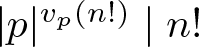 $|p|^{v_p(n!)} \mid n!$ in
 $\mathbb Z$, and hence
 \begin{equation*}v_p(n!) \le \widetilde{v}_{|p|}(n!) \le \frac{n-1}{|p| -1}.\end{equation*}
For case (iii), we have  $\overline{p}$ is also a prime element in
 $\mathbb Z[\mathrm{i}]$ and
 $|p|^2$ is a prime number in
 $\mathbb Z$. Note that
 $p^{v_p(n!)} \mid n!$ in
 $\mathbb Z[\mathrm{i}]$. It follows that
 $\overline{p}^{v_p(n!)} \mid n!$ in
 $\mathbb Z[\mathrm{i}]$. Since
 $p^{v_p(n!)}$ and
 $\overline{p}^{v_p(n!)}$ are relatively prime, we conclude that
 $|p|^{2 v_p(n!) } = p^{v_p(n!)} \overline{p}^{v_p(n!)} \mid n!$ in
 $\mathbb Z$. Thus, we have
 \begin{equation*}v_p(n!) \le \widetilde{v}_{|p|^2}(n!) \le \frac{n-1}{|p|^2 -1} \lt \frac{n-1}{|p| -1}.\end{equation*}
For case (ii), we have  $p \overline{p}=2$. Note that
 $p^{v_p(n!)}\mid n!$ implies that
 $\overline{p}^{v_p(n!)}\mid n!$. Hence
 $2^{v_p(n!)}=(p\overline p)^{v_p(n!)}\mid (n!)^2$. By the definition of
 $\widetilde{v}_{2}(\cdot)$, this implies that
 \begin{equation*}v_p(n!)\le\widetilde{v}_{2}\big((n!)^2\big)=2\widetilde{v}_{2}(n!)\le 2\frac{n-1}{2 -1} \lt \frac{n-1}{|p| -1},\end{equation*}
which completes the proof.
Lemma 3.4. For any  $|z|_p \lt e^{-1/(|p|-1)}$, the
 $p$-adic exponential function can be defined as
 \begin{equation*}\mathbf{exp}_p(z): = \sum_{n=0}^{\infty} \frac{z^n}{n!}.\end{equation*}
Moreover, we have
 \begin{equation*}|\mathbf{exp}_p(z) -1|_p = |z|_p,\end{equation*}
and hence,  $|\mathbf{exp}_p(z)|_p = \max\{|\mathbf{exp}_p(z) -1|_p, |1|_p\} = 1$.
Proof. As done in [Reference Gouvêa21, proposition 5.4.1], the convergence radius of the series in (3.5) is
 \begin{equation*}r=\frac{1}{\displaystyle \limsup_{n\to \infty}|a_n|_p^{1/n}},\end{equation*}
where  $a_n = 1/n!$. By Lemma 3.3, we have
 $r \ge e^{-1/(|p|-1)}$. Thus, for
 $|z|_p \lt e^{-1/(|p|-1)}$, we can define the p-adic exponential function as
 \begin{equation*}\mathbf{exp}_p(z):= \sum_{n=0}^{\infty} \frac{z^n}{n!}.\end{equation*}
Moreover, by again Lemma 3.3, for  $n \ge 2$ we have
 \begin{equation*} |z^{n-1}|_p = |z|_p^{n-1} \lt e^{-\frac{n-1}{|p| -1}} \le e^{-v_p(n!)} = |n!|_p. \end{equation*}
It follows that
 \begin{equation*}\Big| \frac{z^n}{n!} \Big|_p \lt |z|_p \quad \forall n \ge 2.\end{equation*}
Thus, by (3.1) we conclude that
 \begin{equation*}|\mathbf{exp}_p(z) -1|_p = \lim_{N\to\infty} \bigg| \sum_{n=1}^{N}\frac{z^n}{n!} \bigg|_p = |z|_p.\end{equation*}
The proof is completed.
As done in [Reference Gouvêa21, proposition 5.7.7], we have
 \begin{equation*} \mathbf{exp}_p(z_1+ z_2) = \mathbf{exp}_p(z_1) \mathbf{exp}_p(z_2) \quad \forall |z_1 |_p \lt e^{-1/(|p|-1)}, |z_2|_p \lt e^{-1/(|p|-1)}.\end{equation*}
Moreover, if  $|z-1|_p \lt e^{-1/(|p|-1)}$, then we have
 $|\mathbf{log}_p(z)|_p =|z-1|_p \lt e^{-1/(|p|-1)}$ so that
 $\mathbf{log}_p(z)$ is in the domain of expp. As done in [Reference Gouvêa21, proposition 5.7.8], we have
 \begin{equation}
\mathbf{exp}_p\big( \mathbf{log}_p(z) \big) =z \quad \forall |z-1|_p \lt e^{-1/(|p|-1)}.
\end{equation}
The valuation ring
 \begin{equation*}\mathcal{O}_p := \{z \in \mathbb{K}_p: |z|_p \le 1\}.\end{equation*}
Clearly, we have  $\mathbb Z[\mathrm{i}] \subset \mathcal{O}_p$. We can define the power function on
 $\mathcal{O}_p$ by using the p-adic logarithm and exponential functions. Choose
 $\alpha \in \mathbb{K}_p$ with
 $|\alpha-1|_p \lt e^{-1/(|p|-1)}$. Note that for all
 $z \in \mathcal{O}_p$,
 $|z\mathbf{log}(\alpha)|_p \le |\mathbf{log}(\alpha)|_p = |\alpha-1|_p \lt e^{-1/(|p|-1)}$. We can define the power function on
 $\mathcal{O}_p$ as
 \begin{equation*}G_\alpha (z) := \mathbf{exp}_p \big( z\mathbf{log}_p(\alpha) \big), \; z \in \mathcal{O}_p. \end{equation*}
For all  $k \in \mathbb Z$, by (3.4) and (3.6), we have
 \begin{equation*}G_\alpha(k)=\mathbf{exp}_p(k\mathbf{log}_p(\alpha))=\mathbf{exp}_p(\mathbf{log}_p(\alpha^k)) = \alpha^k.\end{equation*}
For any  $z_1,z_2 \in \mathcal{O}_p$, by Lemma 3.4 we obtain
 \begin{align}
&|G_\alpha(z_1) - G_\alpha(z_2)|_p =\left|\mathbf{exp}_p\big(z_2\mathbf{log}_p(\alpha)\big)\right|_p\cdot\left|\mathbf{exp}_p\big((z_1-z_2)\mathbf{log}_p(\alpha)\big)-1\right|_p \nonumber\\
=&\left|\mathbf{exp}_p\big((z_1-z_2)\mathbf{log}_p(\alpha)\big)-1\right|_p=|\mathbf{log}_p(\alpha)|_p |z_1-z_2|_p.
\end{align}
Now we are ready to prove Lemma 3.1.
Proof of Lemma 3.1
Since  $\overline{\beta}$ is not a divisor of β, there exists a prime element
 $p_0\in \mathbb Z[\mathrm{i}]$ such that
 $v_{p_0}(\beta) \gt v_{\overline{p}_0}(\beta)$. This means that p 0 and
 $\overline{p}_0$ are essentially different prime elements in
 $\mathbb Z[\mathrm{i}]$. Write
 \begin{equation*}\beta = up_0^{k_0} \overline{p_0}^{k_0'} p_1^{k_1} p_2^{k_2} \ldots p_m^{k_m},\end{equation*}
where u is a unit,  $p_0, \overline{p_0}, p_1, \ldots, p_m$ are essentially different prime elements in
 $\mathbb Z[\mathrm{i}]$,
 $k_0,\ldots, k_m \in \mathbb N$,
 $k_0' \in \mathbb N \cup \{0\}$ and
 $k_0 \gt k_0'$.
Consider the ring  $R:=\mathbb Z[\mathrm{i}] / (\beta^3 \mathbb Z[\mathrm{i}])$ and the unit group
 $\mathrm{U}(R)=\big(\mathbb Z[\mathrm{i}]/\beta^3\mathbb Z[\mathrm{i}]\big)^\times$ consisting of all the elements
 $x\in R$ such that there exists an element
 $y\in R$ with
 $xy= 1_R$, where
 $1_R = 1+ \beta^3\mathbb Z[\mathrm{i}]$ is the identity element of the ring R. Since
 $\gcd(\alpha,\beta) =1$, there exist
 $\xi,\eta\in\mathbb Z[\mathrm{i}]$ such that
 $\alpha\xi+\beta^3\eta=1$, thus
 $\alpha + \beta^3\mathbb Z[\mathrm{i}] \in \mathrm{U}(R)$. Let
 $\ell$ be the order of
 $\alpha+\beta^3\mathbb Z[\mathrm{i}]$ in the finite group
 $\mathrm{U}(R)$. Then we have
 $\alpha^{\ell}\equiv 1\pmod{\beta^3}$, that is,
 $\beta^3 \mid \alpha^{\ell} -1$ (see [Reference Rotman34, proposition 2.34] for details). It follows that for
 $r=0,1,\ldots, m$,
 \begin{equation*}v_{p_r}(\alpha^{\ell} -1) \ge v_{p_r}(\beta^3) = 3 v_{p_r}(\beta) \ge 3 k_r \ge 3,\end{equation*}
and hence we have
 \begin{equation*}|\alpha^{\ell} -1|_{p_r} \le e^{-3} \lt e^{-1/(|p_r|-1)}.\end{equation*}
Thus, the power function  $G_{\alpha^{\ell}}(z)$ can be defined on all the sets
 $\mathcal{O}_{p_r}$ for
 $r=0,1,\ldots, m$.
Let
 \begin{equation*}N := \max\big\{-\log \big|\tau \alpha^j \mathbf{log}_{p_r}(\alpha^{\ell})\big|_{p_r}: ~j =1,2,\ldots,\ell;~ r = 0,1,\ldots,m \}.\end{equation*}
For  $j=1,2,\ldots, \ell$, define
 \begin{equation*}E(z_0,k,j): = \Big\{0 \le n \lt |\beta|^{2k}/\ell: \tau \alpha^j (\alpha^{\ell})^n \equiv z_0 \pmod{\beta^k}\Big\}.\end{equation*}
For two distinct elements  $n_1,n_2 \in E(z_0,k,j)$, we have
 $\beta^k \mid \tau \alpha^j(\alpha^{n_1 \ell}-\alpha^{n_2\ell})$, i.e.,
 $\beta^k \mid \tau \alpha^j\big( G_{\alpha^{\ell}}(n_1) - G_{\alpha^{\ell}}(n_2) \big)$. Thus for any
 $r = 0,1, \ldots, m$, by (3.7) we have
 \begin{equation*}e^{-N}|n_1 -n_2|_{p_r} \le \Big| \tau \alpha^j\big( G_{\alpha^{\ell}}(n_1) - G_{\alpha^{\ell}}(n_2) \big) \Big|_{p_r} \le e^{-k k_r}. \end{equation*}
This implies that for any  $r = 0,1, \ldots, m$,
 \begin{equation*} p_r^{k k_r-N} \mid n_1 - n_2. \end{equation*}
Since  $n_1-n_2 \in \mathbb Z$, we also have
 \begin{equation*} \overline{p_0}^{k k_0-N} \mid n_1 - n_2. \end{equation*}
It follows that
 \begin{equation*} \beta^k \cdot \overline{p_0}^{(k_0- k_0') k} (p_0 \overline{p_0} p_1 \ldots p_m)^{-N} \mid n_1 - n_2,\end{equation*}
which implies that
 \begin{equation*}|n_1-n_2|\ge|\beta^k \cdot \overline{p_0}^{(k_0- k_0') k} (p_0 \overline{p_0} p_1 \ldots p_m)^{-N}|.\end{equation*}
Therefore, we conclude that
 \begin{equation*}\begin{split}
\# E(z_0,k, j) \le& \frac{|\beta|^{2k}/\ell}{|\beta^k \cdot \overline{p_0}^{(k_0- k_0') k} (p_0 \overline{p_0} p_1 \ldots p_m)^{-N}|} + 1\\
=&|\beta|^k |p_0 \overline{p_0} p_1 \ldots p_m|^{N}/ (\ell |\overline{p_0}|^{(k_0- k_0') k}) + 1.
\end{split}
\end{equation*}
It follows that
 \begin{equation}
\#E(z_0,k) \le \sum_{j=1}^{\ell} \# E(z_0,k, j) \le |p_0 \overline{p_0} p_1 \ldots p_m|^{N} \cdot \Big( \frac{|\beta|}{|\overline{p_0}|^{k_0- k_0'}} \Big)^k + \ell.
\end{equation}
Note that  $|\overline{p_0}| \gt 1$ and
 $k_0 - k_0' \ge 1$. Take sufficiently small
 $\varepsilon$ > 0 such that
 \begin{equation*}|\beta|^\varepsilon \lt |\overline{p_0}|^{k_0- k_0'},\end{equation*}
and  $C = |p_0 \overline{p_0} p_1 \ldots p_m|^{N} +\ell$. The desired result follows from (3.8).
4. Equidistribution in the complex plane
In this section, we will prove the following theorem, which is a little more general than theorem 1.1.
Theorem 4.1 Let  $\alpha,\beta \in \mathbb Z[\mathrm{i}]$ with
 $|\alpha|,|\beta| \gt 1$. Let
 $T \subset \mathbb C$ be a finite subset with
 $\#T \ge 2$. Let µ be a self-similar measure with respect to the IFS
 \begin{equation*} \bigg\{f_t(z) = \frac{z+t}{\beta}: t \in T \bigg\}, \end{equation*}
and a positive probability vector. Suppose that  $\overline{\beta}$ is not a divisor of β,
 $\gcd(\alpha,\beta)=1$, and there exist
 $t_1 \ne t_2 \in T$ such that
 $t_1 - t_2 \in \mathbb Z[\mathrm{i}]$. Then the sequence
 $(\alpha^n z)_{n\ge1}$ is equidistributed modulo one for µ-a.e.
 $z \in \mathbb C$.
Note that theorem 1.1 follows directly from theorem 4.1. The proof of theorem 4.1 relies on Weyl’s criterion and the classical Davenport-Erdös-LeVeque approach. For convenience, we write  $e(x)=e^{2\pi \mathrm{i} x}$ for
 $x\in\mathbb R$.
Theorem 4.2 (Weyl’s criterion [Reference Weyl40, Reference Weyl41], see also [Reference Drmota and Tichy18, theorem 1.19])
A sequence  $(x_n)_{n\ge1}$ of vectors in
 $\mathbb R^2$ is equidistributed modulo one if and only if, for each
 $h\in \mathbb Z^2\setminus\{(0,0)\}$, we have
 \begin{equation*} \lim_{N\to\infty}\frac{1}{N}\sum_{n=1}^N e\big( \langle h, x_n \rangle \big)=0.\end{equation*}
Theorem 4.3 (Davenport, Erdös and LeVeque [Reference Davenport, Erdos and LeVeque16])
Let  $(X,\mathscr{A},\mu)$ be a measure space and let
 $(f_n)_{n\ge1}$ be a sequence of uniformly bounded measurable functions defined on
 $(X,\mathscr{A})$. If
 \begin{equation*} \sum_{N=1}^{\infty}\frac{1}{N}\int_X\Bigl| \frac{1}{N}\sum_{n=1}^Nf_n \Bigr|^2\mathrm{d}\mu \lt +\infty, \end{equation*}
then for µ-a.e.  $x\in X$,
 \begin{equation*} \lim_{N\to\infty}\frac{1}{N}\sum_{n=1}^Nf_n(x)=0. \end{equation*}
Now we begin to prove theorem 4.1. In the following, suppose that all assumptions in theorem 4.1 holds, and let  $(p_t)_{t \in T}$ be the positive probability vector associated with the self-similar measure µ.
By theorems 4.2 and 4.3, it suffices to show that, for each  $h\in \mathbb Z^2\setminus\{(0,0)\}$,
 \begin{equation*} \Sigma_h:=\sum_{N=1}^{\infty}\frac{1}{N}\int\Bigl| \frac{1}{N}\sum_{n=1}^N e\big( \langle h,\alpha^n z \rangle \big) \Bigr|^2\mathrm{d}\mu(z) \lt +\infty. \end{equation*}
We remind the reader that  $\mathbb C$ is identified with
 $\mathbb R^2$. Fix
 $h=(h_1,h_2)\in \mathbb Z^2\setminus\{(0,0)\}$. A direct calculation gives
 \begin{equation*}\begin{split}
\Sigma_h&=\sum_{N=1}^{\infty}\frac{1}{N^3}\sum_{1\le m,n\le N} \int e\big( \langle h, (\alpha^n-\alpha^m) z \rangle \big) \mathrm{d}\mu(z) \\
&\le\sum_{N=1}^{\infty}\frac{1}{N^3}\biggl( N+2\sum_{1\le m \lt n\le N}\Bigl| \int e\big( \langle h, (\alpha^n-\alpha^m) z \rangle \big) \mathrm{d}\mu(z) \Bigr| \biggr).
\end{split}\end{equation*}
Therefore, we only need to prove that
 \begin{equation}
\Sigma_h^{*}:=\sum_{N=2}^{\infty}\frac{1}{N^3} \sum_{1\le m \lt n\le N}\Bigl| \int e\big( \langle h, (\alpha^n-\alpha^m) z \rangle \big) \mathrm{d}\mu(z) \Bigr| \lt +\infty.
\end{equation}
Note that the measure µ is self-similar, i.e.,
 \begin{equation*} \mu = \sum_{t \in T} p_t \cdot f_t \mu. \end{equation*}
We have
 \begin{align}
\lambda_{n,m} &:= \int e\Big( \big\langle h , (\alpha^n-\alpha^m) z \big\rangle \Big)\mathrm{d}\mu(z) \notag\\
& = \sum_{t \in T} p_t \int e\Big( \big\langle h , (\alpha^n-\alpha^m) f_t(z) \big\rangle \Big)\mathrm{d}\mu(z) \notag\\
& = \bigg( \sum_{t \in T} p_t e\Big( \big\langle h, (\alpha^n-\alpha^m)t \beta^{-1}\big\rangle \Big) \bigg) \int e\Big( \big\langle h , (\alpha^n-\alpha^m) \beta^{-1} z \big\rangle \Big)\mathrm{d}\mu(z) \notag\\
& = \bigg( \prod_{j=1}^{\ell} \sum_{t \in T} p_t e\Big( \big\langle h, (\alpha^n-\alpha^m)t \beta^{-j}\big\rangle \Big) \bigg) \int e\Big( \big\langle h , (\alpha^n-\alpha^m) \beta^{-\ell} z \big\rangle \Big)\mathrm{d}\mu(z) \notag\\
& = \prod_{j=1}^{\infty} \sum_{t \in T} p_t e\Big( \big\langle h, (\alpha^n-\alpha^m)t \beta^{-j}\big\rangle \Big).
\end{align}
To estimate (4.2), we need the following lemma.
Lemma 4.1. ([Reference Xiong and Zhao42, lemma 2.1])
Let  $(q_1,\dots,q_\ell)$ be a probability vector and
 $\theta_1,\dots,\theta_\ell$ a sequence of real numbers. We have
 \begin{equation*} \biggl| \sum_{j=1}^{\ell} q_j e(\theta_j) \biggr| \le 1-8q_0\max_{1\le j, k \le \ell}\|\theta_j-\theta_k\|^2, \end{equation*}
where  $q_0=\min \{q_1, q_2, \ldots, q_\ell\}$.
Let  $p_*:=\min\{p_t: t \in T\}$. Note that
 $t_1,t_2 \in T$. Applying Lemma 4.1 to (4.2), we obtain
 \begin{equation}
|\lambda_{n,m}| \le \prod_{j=1}^{\infty}\Big( 1-8p_* \big\| \big \langle h, (\alpha^n-\alpha^m)(t_{1}-t_{2})\beta^{-j}\big\rangle \big\|^2 \Big).
\end{equation}
Since  $\overline{\beta}$ is not a divisor of β, we have
 $\beta \in \mathbb Z[\mathrm{i}] \setminus \big( \mathbb Z \cup \mathrm{i} \mathbb Z \cup (1+\mathrm{i})\mathbb Z \cup (1-\mathrm{i}) \mathbb Z \big)$. This implies that
 $|\beta| \gt 2$. By proposition 2.1, we fix a finite subset
 $D_\beta \subset \mathbb Z[\mathrm{i}]$ such that
 $(\beta,D_\beta)$ is a number system in
 $\mathbb Z[\mathrm{i}]$. Note that
 $0 \in D_\beta$ and
 $\#D_\beta = |\beta|^2$. Recall that
 $|D_\beta|= \max\{|z|: z \in D_\beta\}$, and mβ is the smallest integer not less than
 $|D_\beta|/(|\beta|-1)$. Let
 \begin{equation}
\rho=|D_\beta|(|h_1|+|h_2|)/(|\beta|-1) + 1.
\end{equation}
Choose an integer  $M \in \mathbb N$ such that
 \begin{equation}
72 m_\beta^2 (2|h_1|+2|h_2|+1) (2\rho+\sqrt{2})^2 \le |\beta|^{M\varepsilon/4},
\end{equation}
where  $\varepsilon$ > 0 is as in Lemma 3.1. Then define
 \begin{equation}
N(n,m):=\#\Big\{j\in \mathbb N: \big\| \big\langle h, (\alpha^n-\alpha^m)(t_1 - t_2)\beta^{-Mj}\big\rangle \big\|\ge |\beta|^{-M}\Big\}.
\end{equation}
It follows from (4.3) that
 \begin{equation*} |\lambda_{n,m}| \le \big(1-8p_*|\beta|^{-2M}\big)^{N(n,m)} \le e^{-8p_*|\beta|^{-2M}N(n,m)}, \end{equation*}
where we use the inequality that  $1-x\le e^{-x}$ for
 $0\le x\le 1$. Therefore, we conclude that
 \begin{equation*}
\Sigma_h^{*} \le\sum_{N=2}^{\infty}\frac{1}{N^3} \sum_{1\le m \lt n\le N}e^{-8p_*|\beta|^{-2M}N(n,m)}.
\end{equation*}
The remaining estimation is split into two parts:
 \begin{align*}
\Sigma_{1,N}&:=\sum_{\substack{1\le m \lt n\le N\\N(n,m) \gt c\log\log N}}e^{-8p_*|\beta|^{-2M}N(n,m)}, \\
\Sigma_{2,N}&:=\sum_{\substack{1\le m \lt n\le N\\N(n,m)\le c\log\log N}}e^{-8p_*|\beta|^{-2M}N(n,m)},
\end{align*}
where  $c:=|\beta|^{2M}/(4p_*)$. For the first part, we have
 \begin{equation}
\sum_{N=2}^{\infty}\frac{1}{N^3}\Sigma_{1,N} \le \sum_{N=2}^{\infty}\frac{1}{N^3}N^2e^{-2\log\log N}=\sum_{N=2}^{\infty}\frac{1}{N\log^2 N} \lt +\infty.
\end{equation}
For the second part, we have  $\Sigma_{2,N} \le \mathcal{N}(N)$, where
 \begin{equation*} \mathcal N(N):=\#\big\{(n,m)\colon 1\le m \lt n\le N,\;N(n,m)\le c\log\log N \big\}. \end{equation*}
Lemma 4.2. Let  $\varepsilon$ > 0 be defined as in Lemma 3.1. There exists a constant
 $C$> 0 such that for sufficiently large
 $N$,
 \begin{equation*}\mathcal N(N) \le C N^{2-\frac{\varepsilon}{4}}.\end{equation*}
Proof. For  $m\in\{1,2,\dots,N-1\}$, let
 \begin{equation*}
\mathcal{N}_m(N):=\big\{m+1\le n \le N \colon N(n,m)\le c\log\log N \big\}.
\end{equation*}
In the following, we fix  $m \in \{1,2,\ldots, N-1\}$.
Arbitrarily take  $n\in \mathcal{N}_m(N)$. Note that
 $(\beta,D_\beta)$ is a number system in
 $\mathbb Z[\mathrm{i}]$, and
 $t_1 - t_2 \in \mathbb Z[\mathrm{i}]$. We write
 \begin{equation}
(t_1-t_2)(\alpha^n-\alpha^m)=\sum_{j=0}^{\infty}a^{(n)}_j\beta^{j}
\end{equation}
with each  $a^{(n)}_j \in D_\beta$ and there are only finitely many
 $a^{(n)}_j\neq 0$. Note that the sequence
 $(a^{(n)}_j)_{j\ge 1}$ is uniquely determined by n. It follows that for
 $j\in\mathbb N$,
 \begin{equation*}
(t_1 - t_2)(\alpha^n-\alpha^m)\beta^{-Mj}=\sum_{k=0}^{\infty}a^{(n)}_{Mj+k}\beta^{k}+\sum_{k=1}^{Mj}a^{(n)}_{Mj-k}\beta^{-k}.
\end{equation*}
Let  $D_{h,\rho,M}$ be defined as in Lemma 2.2, where ρ is given in (4.4). If
 $(a^{(n)}_{Mj-k})_{k=1}^{M}\in D_\beta^{M}\setminus D_{h,\rho, M}$, then we have
 \begin{equation*}
\begin{split}
&\Big\| \Big\langle h, (t_1-t_2)(\alpha^n-\alpha^m\big)\beta^{-Mj} \Big\rangle \Big\| \\
=&\Big\| \Big\langle h,\sum_{k=1}^{M}a^{(n)}_{Mj-k}\beta^{-k} +\sum_{k=M+1}^{Mj} a^{(n)}_{Mj-k}\beta^{-k} \Big\rangle \Big\| \\
\ge&\Big\| \Big\langle h, \sum_{k=1}^{M}a^{(n)}_{Mj-k} \beta^{-k}\Big\rangle \Big\| - (|h_1|+|h_2|) \sum_{k=M+1}^{Mj} |a^{(n)}_{Mj-k}||\beta|^{-k} \\
\ge&\Big\| \Big\langle h, \sum_{k=1}^{M}a^{(n)}_{Mj-k} \beta^{-k}\Big\rangle \Big\| - (|h_1|+|h_2|) \frac{|D_\beta|}{|\beta|-1} |\beta|^{-M} \\
\ge& |\beta|^{-M}.
\end{split}
\end{equation*}
By (4.6), we have
 \begin{equation*} \#\Big\{j \in \mathbb N : (a^{(n)}_{Mj-k})_{k=1}^{M}\in D_\beta^{M}\setminus D_{h,\rho, M} \Big\} \le N(n,m) \le c \log\log N, \end{equation*}
where the last inequality follows from  $n \in \mathcal{N}_m(N)$. Now we choose
 $g\in\mathbb N$ such that
 \begin{equation}
|\beta|^{2(g-1)M} \lt N\le|\beta|^{2gM}.
\end{equation}
Clearly, the sequence  $(a_j^{(n)})_{j=0}^{gM-1}$ satisfies
 \begin{equation}
\#\Big\{1\le j \le g: (a^{(n)}_{Mj-k})_{k=1}^{M}\in D_\beta^{M}\setminus D_{h,\rho, M} \Big\} \le c \log\log N,
\end{equation}
and by (4.8) we have
 \begin{equation}
(t_1-t_2)(\alpha^n-\alpha^m) \equiv \sum_{j=0}^{gM-1} a^{(n)}_j\beta^{j} \pmod{\beta^{gM}}.
\end{equation}
Let A be the set of sequences  $(a_j)_{j=0}^{gM-1} \in D_\beta^{gM}$ satisfying
 \begin{equation*}\#\Big\{1\le j \le g: (a_{Mj-k})_{k=1}^{M}\in D_\beta^{M}\setminus D_{h,\rho, M} \Big\} \le c \log\log N.\end{equation*}
For  $\mathfrak{a} = (a_j)_{j=0}^{gM-1} \in D_\beta^{gM}$, define
 \begin{equation*}B(\mathfrak{a}):=\Big\{m+1\le n\le|\beta|^{2gM}\colon (t_1-t_2)(\alpha^n-\alpha^m)\equiv\sum_{j=0}^{gM-1}a_j\beta^{j}\pmod{\beta^{gM}}\Big\}.\end{equation*}
If  $n \in \mathcal{N}_m(N)$, then by (4.10) the sequence
 $\mathfrak{a}^{(n)} = (a^{(n)}_j)_{j=0}^{gM-1}\in A$, and moreover, by (4.11) we have
 $n \in B(\mathfrak{a}^{(n)})$. Thus, we conclude that
 \begin{equation*}\# \mathcal{N}_m(N) \le \sum_{\mathfrak{a} \in A} \# B(\mathfrak{a}).\end{equation*}
By Lemma 3.1 and (4.9), we have
 \begin{equation}
\# B(\mathfrak{a}) \le c_1 |\beta|^{gM(1-\varepsilon)} \le c_1 |\beta|^M N^{\frac{1-\varepsilon}{2}}
\end{equation}
for some  $c_1 \gt 0$. Note by Lemma 2.2 that
 \begin{equation*}\# D_{h,\rho,M}\le c_2 |\beta|^M,\end{equation*}
where  $c_2 =72 m_\beta^2 (2|h_1|+2|h_2|+1) (2\rho+\sqrt{2})^2 \gt 0$. Note by (4.5) that
 $c_2 \le |\beta|^{M\varepsilon/4}$. Thus, we have
 \begin{align*}
\# A & \le \binom{g}{[c\log\log N]}(|\beta|^{2M})^{[c\log\log N]}(\# D_{h,\rho,M})^{g- [c\log\log N]} \\
& \le g^{[c\log\log N]} |\beta|^{M(g+[c \log\log N])} c_2^g \\
& \le g^{c\log\log N} |\beta|^{M(1+c\log\log N)} |\beta|^{gM\varepsilon / 4} N^{1/2} \\
& \le g^{c\log\log N} |\beta|^{M(2+c\log\log N)} N^{\frac{1}{2} + \frac{\varepsilon}{8}} \\
& \le c_3 N^{\frac{1}{2} + \frac{\varepsilon}{4}},
\end{align*}
for some  $c_3 \gt 0$ when N is sufficiently large. Together with (4.12), we obtain that
 \begin{equation*}\# \mathcal{N}_m(N) \le \sum_{\mathfrak{a} \in A} \# B(\mathfrak{a}) \le C N^{1 - \frac{\varepsilon}{4}},\end{equation*}
for some C > 0. It follows that
 \begin{equation*}\mathcal{N}(N) \le \sum_{m=1}^{N} \# \mathcal{N}_m(N) \le C N^{2 - \frac{\varepsilon}{4}},\end{equation*}
as desired.
By Lemma 4.2, for sufficiently large N, we have
 \begin{equation*}\frac{\mathcal{N}(N)}{N^3} \le \frac{C}{N^{1+\varepsilon/4}}.\end{equation*}
It follows that
 \begin{equation*}\sum_{N=2}^{\infty}\frac{1}{N^3}\Sigma_{2,N} \le \sum_{N=2}^{\infty}\frac{1}{N^3}\mathcal{N}(N) \lt +\infty.\end{equation*}
Together with (4.7), we conclude that
 \begin{equation*}\Sigma_h^* \lt +\infty.\end{equation*}
Since h is arbitrary, we complete the proof of theorem 4.1.
5. Application
In this section, let  $(\alpha,D)$ be a number system in
 $\mathbb Z[\mathrm{i}]$ with
 $|\alpha| \gt 1$. Let Eα be the self-similar set generated by the IFS
 \begin{equation}
\bigg\{f_d(z) = \frac{z+d}{\alpha}: d \in D \bigg\}.
\end{equation}
Then the set Eα can be written as
 \begin{equation}
E_\alpha = \Big\{\sum_{j=1}^{\infty} d_j \alpha^{-j}: d_j \in D \;\; \forall j \in \mathbb N \Big\}.
\end{equation}
Let  $\mathcal{L}$ denote the Lebesgue measure in
 ${\mathbb R}^2$. For a set
 $A \subset \mathbb R^2$, let A ∘ denote the set of interior points of A, let
 $\partial A$ denote the set of boundary points of A, and let
 $\overline{A} = A^{\circ} \cup \partial A$ be the closure of A. We remind the reader that
 $\mathbb R^2$ is identified with
 $\mathbb C$. By [Reference Lagarias and Wang28, theorems 1.1 and 1.2], we have
•
$E_\alpha = \overline{E_\alpha^{\circ}}$ and
$\mathcal{L}(\partial E_\alpha) =0$;• Eα tiles
$\mathbb C$ with tiling set
$\mathbb Z[\mathrm{i}]$. That is,
(5.3)\begin{equation}
\mathbb C = \bigcup_{z \in \mathbb Z[\mathrm{i}]} (E_\alpha + z),
\end{equation}and
$\mathcal{L}\big( (E_\alpha +z_1) \cap (E_\alpha +z_2) \big) =0$ for any
$z_1 \ne z_2 \in \mathbb Z[\mathrm{i}]$.


It follows that  $\mathcal{L}(E_\alpha) = \mathcal{L}(E_\alpha^{\circ}) =1$ and
 $E_\alpha^{\circ} \cap (E_\alpha^{\circ} + z) = \emptyset$ for any
 $z \in \mathbb Z[\mathrm{i}]\setminus\{0\}$. Note that
 $E_\alpha = \overline{E_\alpha^{\circ}}$. We conclude that
 \begin{equation}
E_\alpha \cap (E_\alpha^{\circ} + z) = \emptyset\quad \text{for any}\;\; z \in \mathbb Z[\mathrm{i}]\setminus\{0\}.
\end{equation}
By (5.2) and (5.3), for each  $z\in \mathbb C$, we can find a sequence
 $(d_j)_{j=1}^{\infty} \in D^{\mathbb{N}}$ such that
 \begin{equation}
z -\sum_{j=1}^{\infty} d_j \alpha^{-j} \in \mathbb Z[\mathrm{i}].
\end{equation}
Since  $(\alpha,D)$ is a number system in
 $\mathbb Z[\mathrm{i}]$, we can write uniquely
 \begin{equation*}z -\sum_{j=1}^{\infty} d_j \alpha^{-j} = d_{-\ell} \alpha^{\ell} + \ldots + d_{-1} \alpha + d_0 \quad \text{with} \; d_0, d_{-1}, \ldots, d_{-\ell} \in D,\end{equation*}
where  $d_{-\ell} \ne 0$ or
 $\ell=0$. We are interested in the “fractional part”. The sequence
 $(d_j)_{j=1}^{\infty}$ in (5.5) is called an
 $(\alpha,D)$-radix expansion of z. Note that each
 $z \in \mathbb C$ has an
 $(\alpha,D)$-radix expansion, but not unique. A complex number
 $z\in \mathbb C$ is called
 $(\alpha,D)$-normal if z has an
 $(\alpha,D)$-radix expansion
 $(d_j)_{j=1}^{\infty}$ satisfying that for any finite block
 $d'_1 d'_2 \ldots d'_k \in D^k$,
 \begin{equation*}\lim_{N \to \infty} \frac{1}{N} \#\big\{0\le j \le N-1: d_{j+1} = d'_1, d_{j+2} = d'_2, \ldots, d_{j+k} = d'_k \big\} = \frac{1}{|\alpha|^{2k}}.\end{equation*}
We show that normality is equivalent to the equidistribution of sequence  $(\alpha^n z)_{n \ge 1}$.
Proposition 5.1. A complex number  $z \in \mathbb C$ is
 $(\alpha,D)$-normal if and only if the sequence
 $(\alpha^n z)_{n \ge 1}$ is equidistributed modulo one.
For any finite block  $d_1d_2\ldots d_k \in D^k$, define
 $f_{d_1 d_2 \ldots d_k} := f_{d_1} \circ f_{d_2} \circ \cdots \circ f_{d_k}$. We first prove the sufficiency of proposition 5.1.
Proof of sufficiency of proposition 5.1
Assume that the sequence  $(\alpha^n z)_{n \ge 1}$ is equidistributed modulo one. Fix a finite block
 $d'_1 d'_2 \ldots d'_k \in D^k$ and consider the bounded open set
 $f_{d'_1 d'_2 \ldots d'_k}(E_\alpha^{\circ})$.
Since  $\mathcal{L}(E_\alpha) = \mathcal{L}(E_\alpha^{\circ}) =1$, we have
 \begin{equation*}\mathcal{L}\big( f_{d'_1 d'_2 \ldots d'_k}(E_\alpha) \big) = \mathcal{L}\big( f_{d'_1 d'_2 \ldots d'_k}(E_\alpha^{\circ}) \big) = \frac{1}{|\alpha|^{2k}}. \end{equation*}
It follows that the boundary of  $f_{d'_1 d'_2 \ldots d'_k}(E_\alpha^{\circ})$ has Lebesgue measure zero. Thus, for any
 $\varepsilon$ > 0 there exist two sets
 $E_\varepsilon$ and
 $F_\varepsilon$ consisting of finitely many dyadic cubes such that
 \begin{equation*}E_\varepsilon \subset f_{d'_1 d'_2 \ldots d'_k}(E_\alpha^{\circ}) \subset F_\varepsilon \quad\text{and}\quad \mathcal{L}(F_\varepsilon \setminus E_\varepsilon) \lt \varepsilon.\end{equation*}
Applying the equidistribution of sequence  $(\alpha^n z)_{n \ge 1}$ to sets
 $E_\varepsilon$ and
 $F_\varepsilon$, and letting
 $\varepsilon$ → 0, we conclude that
 \begin{equation}
\lim_{N \to \infty} \frac{1}{N} \# \big\{1\le n \le N: \alpha^n z \in f_{d'_1 d'_2\ldots d'_k}(E_\alpha^{\circ}) \pmod{1} \big\} = \frac{1}{|\alpha|^{2k}}.
\end{equation}
Let  $(d_j)_{j=1}^{\infty} \in D^{\mathbb{N}}$ be an
 $(\alpha,D)$-radix expansion of z, i.e.,
 \begin{equation*} z- \sum_{j=1}^{\infty} d_j \alpha^{-j} \in \mathbb Z[\mathrm{i}].\end{equation*}
Suppose that  $\alpha^n z \in f_{d'_1 d'_2\ldots d'_k}(E_\alpha^{\circ}) \pmod{1}$ for some
 $n \in \mathbb N$. Then we have
 \begin{equation*}\sum_{j=1}^{\infty} d_{n + j} \alpha^{-j} \in f_{d'_1 d'_2\ldots d'_k}(E_\alpha^{\circ}) \pmod{1}.\end{equation*}
It follows that
 \begin{equation*} \sum_{j=1}^{\infty} d_{n + j} \alpha^{-j} \in \big( f_{d'_1 d'_2\ldots d'_k}(E_\alpha^{\circ}) + \mathbb Z[\mathrm{i}] \big) \cap E_\alpha.\end{equation*}
Note that  $f_{d'_1 d'_2\ldots d'_k}(E_\alpha) \subset E_\alpha$. It follows that
 $f_{d'_1 d'_2\ldots d'_k}(E_\alpha^{\circ}) \subset E_\alpha^{\circ}$. By (5.4) we have
 $\big( f_{d'_1 d'_2\ldots d'_k}(E_\alpha^{\circ}) + \mathbb Z[\mathrm{i}] \big) \cap E_\alpha = f_{d'_1 d'_2\ldots d'_k}(E_\alpha^{\circ})$. Thus, we obtain
 \begin{equation*}\sum_{j=1}^{\infty} d_{n + j} \alpha^{-j} \in f_{d'_1 d'_2\ldots d'_k}(E_\alpha^{\circ}),\end{equation*}
which implies that
 \begin{equation}
f_{d_{n+1} d_{n+2} \ldots d_{n +k}}(E_\alpha) \cap f_{d'_1 d'_2\ldots d'_k}(E_\alpha^{\circ}) \ne \emptyset.
\end{equation}
Suppose that  $d_{n + 1} d_{n+2} \ldots d_{n +k} \ne d'_1 d'_2\ldots d'_k$. Let
 $\tau = \min\{1 \le j \le k: d_{n +j} \ne d'_{j}\}$. It follows from (5.7) that
 \begin{equation*}f_{d_{n +\tau}}(E_\alpha) \cap f_{d'_{\tau}} (E_\alpha^{\circ}) \ne \emptyset.\end{equation*}
That is,  $E_\alpha \cap (E_\alpha^{\circ} + d'_\tau - d_{n +\tau}) \ne \emptyset$, which contradicts (5.4). Therefore, for any
 $n \in \mathbb N$ with
 $\alpha^n z \in f_{d'_1 d'_2\ldots d'_k}(E_\alpha^{\circ}) \pmod{1}$, we conclude that
 \begin{equation*}d_{n + 1} d_{n+2} \ldots d_{n +k} = d'_1 d'_2\ldots d'_k.\end{equation*}
It follows from (5.6) that
 \begin{equation}
\liminf_{N \to \infty} \frac{1}{N} \# \big\{0\le n \le N-1: d_{n+1} = d'_1, \ldots, d_{n+k} = d'_k \big\} \ge \frac{1}{|\alpha|^{2k}}.
\end{equation}
Since (5.8) holds for any finite block  $d'_1 d'_2 \ldots d'_k \in D^k$, and
 $\# D = |\alpha|^2$, we conclude that
 \begin{equation*}\lim_{N \to \infty} \frac{1}{N} \# \big\{0\le n \le N-1: d_{n+1} = d'_1, \ldots, d_{n+k} = d'_k \big\} = \frac{1}{|\alpha|^{2k}},\end{equation*}
for any finite block  $d'_1 d'_2 \ldots d'_k \in D^k$. It follows from definition that z is
 $(\alpha,D)$-normal.
Next, we use Weyl’s criterion to show the necessity of proposition 5.1.
Proof of necessity of proposition 5.1
Let µ be the restriction of Lebesgue measure on Eα. Let λ be the Lebesgue measure on  $\mathbb{T}^2 = \mathbb C/ \mathbb Z[\mathrm{i}]$ (or
 $\mathbb R^2 / \mathbb Z^2$), and let π be the natural projection from
 $\mathbb C$ (or
 $\mathbb R^2$) to
 $\mathbb{T}^2$. Since Eα tiles
 $\mathbb C$ with tiling set
 $\mathbb Z[\mathrm{i}]$, we have
 $\pi \mu = \lambda$. Recall that
 $e(x)=e^{2\pi \mathrm{i} x}$ for
 $x\in\mathbb R$. It’s well known that for any
 $h \in \mathbb Z^2 \setminus \{(0,0)\}$,
 \begin{equation*}\int_{\mathbb{T}^2} e(\langle h, x \rangle) \;\mathrm{d} \lambda(x) = 0.\end{equation*}
It follows that for any  $h \in \mathbb Z^2 \setminus \{(0,0)\}$,
 \begin{equation}
\int_{\mathbb C} e(\langle h, x \rangle) \;\mathrm{d} \mu(x) = \int_{\mathbb C} e(\langle h, \pi x \rangle) \;\mathrm{d} \mu(x)= \int_{\mathbb{T}^2} e(\langle h, x \rangle) \;\mathrm{d} \pi \mu (x)=0.
\end{equation}
Note that
 \begin{equation*}E_\alpha = \bigcup_{d \in D} f_d(E_\alpha).\end{equation*}
Then we have
 \begin{equation*}\mathcal{L}(E_\alpha) \le \sum_{d \in D} \mathcal{L} \big( f_d(E_\alpha) \big) = (\# D) \cdot \frac{\mathcal{L}(E_\alpha)}{|\alpha|^2} = \mathcal{L}(E_\alpha).\end{equation*}
This implies that  $\mathcal{L}\big( f_{d_1}(E_\alpha) \cap f_{d_2}(E_\alpha)\big) =0$ for any
 $d_1 \ne d_2 \in D$. For any Borel set
 $B \subset \mathbb C$, we have
 \begin{align*}
\mu(B) & = \mathcal{L}(B \cap E_\alpha) = \sum_{d \in D} \mathcal{L}(B \cap f_d(E_\alpha)) \\
& = \frac{1}{|\alpha|^2} \sum_{d \in D} \mathcal{L}( f_d^{-1} (B) \cap E_\alpha) \\
& = \frac{1}{|\alpha|^2} \sum_{d \in D} \mu( f_d^{-1} (B)).
\end{align*}
That is,
 \begin{equation*}\mu = \frac{1}{|\alpha|^2} \sum_{d \in D} f_d \mu.\end{equation*}
It follows that
 \begin{align*}
\int_{\mathbb C} e(\langle h, x \rangle) \;\mathrm{d} \mu(x)
& = \bigg( \frac{1}{|\alpha|^2} \sum_{d \in D} e(\langle h, \alpha^{-1} d \rangle) \bigg) \int_{\mathbb C} e(\langle h, \alpha^{-1} x \rangle) \;\mathrm{d} \mu(x) \\
& = \prod_{j=1}^k \bigg( \frac{1}{|\alpha|^2} \sum_{d \in D} e(\langle h, \alpha^{-j} d \rangle) \bigg) \int_{\mathbb C} e(\langle h, \alpha^{-k} x \rangle) \;\mathrm{d} \mu(x).
\end{align*}
Note that
 \begin{equation*}\lim_{k \to \infty} \int_{\mathbb C} e(\langle h, \alpha^{-k} x \rangle) \;\mathrm{d} \mu(x) =1.\end{equation*}
By (5.9), we conclude that for any  $h \in \mathbb Z^2 \setminus \{(0,0)\}$,
 \begin{equation*} \lim_{k \to \infty} \prod_{j=1}^k \bigg( \frac{1}{|\alpha|^2} \sum_{d \in D} e(\langle h, \alpha^{-j} d \rangle) \bigg) =0,\end{equation*}
which can be rewritten as
 \begin{equation}
\lim_{k \to \infty} \frac{1}{|\alpha|^{2k}} \sum_{d_1 d_2 \ldots d_k \in D^k} e\bigg( \bigg\langle h, \sum_{j=1}^k d_j \alpha^{-j} \bigg\rangle \bigg) =0.
\end{equation}
Assume that z is  $(\alpha,D)$-normal with a normal
 $(\alpha,D)$-radix expansion
 $(d'_j)_{j=1}^{\infty} \in D^{\mathbb{N}}$. Fix
 $h \in \mathbb Z^2 \setminus \{(0,0)\}$. For
 $k \in \mathbb{N}$, define
 \begin{equation*}\varepsilon_k: = \sup_{z \in E_\alpha} |e\big( \langle h, \alpha^{-k} z \rangle \big) - 1|.\end{equation*}
Then we have
 \begin{align*}
&~\left| \frac{1}{N} \sum_{n=1}^{N} e\big(\langle h, \alpha^n z \rangle \big) \right|
= \left| \frac{1}{N} \sum_{n=1}^{N} e\bigg( \bigg\langle h, \sum_{j=1}^{\infty} d'_{n+j} \alpha^{-j} \bigg\rangle \bigg) \right| \\
\le &~ \left| \frac{1}{N} \sum_{n=1}^{N} e\bigg( \bigg\langle h, \sum_{j=1}^k d'_{n+j} \alpha^{-j} \bigg\rangle \bigg) \right| + \frac{1}{N} \sum_{n=1}^{N} \left| e\bigg( \bigg\langle h, \sum_{j=k+1}^{\infty} d'_{n+j} \alpha^{-j} \bigg\rangle \bigg) - 1 \right| \\
\le &~\left| \frac{1}{N} \sum_{n=1}^{N} e\bigg( \bigg\langle h, \sum_{j=1}^k d'_{n+j} \alpha^{-j} \bigg\rangle \bigg) \right| + \varepsilon_k.
\end{align*}
Note that the expansion  $(d'_j)_{j=1}^{\infty}$ is normal. We obtain
 \begin{equation*}\limsup_{N \to \infty}\left| \frac{1}{N} \sum_{n=1}^{N} e\big(\langle h, \alpha^n z \rangle \big) \right| \le \left| \frac{1}{|\alpha|^{2k}} \sum_{d_1 d_2 \ldots d_k \in D^k} e\bigg( \bigg\langle h, \sum_{j=1}^k d_j \alpha^{-j} \bigg\rangle \bigg) \right| + \varepsilon_k.\end{equation*}
Note that
 \begin{equation*}\lim_{k \to \infty} \varepsilon_k = 0.\end{equation*}
Together with (5.10), we conclude that
 \begin{equation*}\lim_{N \to \infty}\left| \frac{1}{N} \sum_{n=1}^{N} e\big(\langle h, \alpha^n z \rangle \big) \right| =0.\end{equation*}
By theorem 4.2, the sequence  $(\alpha^n z)_{n \ge 1}$ is equidistributed modulo one.
Finally, we obtain the following theorem by theorem 1.1 and proposition 5.1.
Theorem 5.1 Let  $\beta \in \mathbb Z[\mathrm{i}]$ with
 $|\beta| \gt 1$. Let
 $T \subset \mathbb Z[\mathrm{i}]$ be a finite subset with
 $\#T \ge 2$. Let µ be a non-atomic self-similar measure with respect to the IFS
 \begin{equation*} \bigg\{f_t(z) = \frac{z+t}{\beta}: t \in T \bigg\}. \end{equation*}
Suppose that  $\overline{\beta}$ is not a divisor of β and
 $\gcd(\alpha,\beta)=1$. Then µ-almost every
 $z \in \mathbb C$ is
 $(\alpha,D)$-normal.
Acknowledgements
The authors would like to thank the referees for his/her valuable comments and suggestions. The first author was supported by NSFC No. 12471085 and Science and Technology Commission of Shanghai Municipality (STCSM) No. 22DZ2229014. The second author was supported by the China Postdoctoral Science Foundation No. 2024M763857.



