I.
Between about 1580 and 1690, early modern England experienced three interrelated developments of particular interest to this special edition on drink and popular song. In the first place was the growth of a successful and sophisticated commercial popular music industry, centred on London, serving a socially broad national market. Specialist publishers sponsored, produced, and traded in songs written by a mishmash of poets, playwrights, scholars and hacks. These were printed (usually words only) on one side of a large sheet, known as broadside ballads. The original ‘single’, literally millions of these sheets circulated in the period. More than 10,000 sheets survive in UK and US public archives today, but many tens of thousands more are now lost to us.Footnote 1 Ballad broadsides sold for about a penny a piece – equivalent to the cost of a quart of ale, a loaf of bread or a yard of cheap ribbon. But they could also be heard, read or memorised for free as the songs were performed publicly at markets and fairs, on the street or in local hostelries, while the sheets were often pasted or pinned to the walls in homes and in alehouses and taverns.
Despite the relatively large archive of ballad sheets left to us, and an extensive knowledge of the tunes to which they were sung, frustratingly few records of writers, producers or performers survive. What little we do have, however, shows that the seventeenth-century trade in ballads was ubiquitous, extensive and potentially very lucrative.Footnote 2 Just over 400 individual printers, booksellers and publishers can be identified that were certainly involved in producing at least one ballad between 1600 and 1700.Footnote 3 A much smaller number – perhaps half – really specialised in the trade, however. Many operated independently, but by 1600 loose companies were formed of three to six publishers who jointly owned shares in the most popular ballad titles. They distributed their wares wholesale to pedlars and other retailers from large ballad warehouses based in London's West Smithfield. By the later part of the century, these companies controlled a large part (although never all) of the popular music trade (Blagden Reference Blagden1954).
In second place, the political and religious turmoil of the period under consideration impinged significantly upon the newly burgeoning popular music industry and its markets. Seventeenth-century Britain suffered bitter civil wars between King and Parliament in the 1640s. These were sparked by widespread fears of popery and arbitrary government. The wars culminated in the defeat of the royalist cause and the shock execution of the King in 1649. The 1650s saw the establishment of several ‘puritan’ republican governments, latterly under the control of the Lord Protector, Oliver Cromwell (1599–1658). His death was soon followed by the collapse of the puritan regime and the restoration of the monarchy in 1660. Religious and political tensions still mounted, however, especially around the Popish Plot (1678–81) and the Exclusion crises of the 1680s. From this factional politics emerged the world's first political parties – derogatively dubbed ‘Whigs’ and ‘Tories’.Footnote 4
Throughout this troubled period, royalists and parliamentarians in the 1640s, 1650s and 1660s, Whigs and Tories, Jacobites and Williamites in the 1680s and 1690s all strategically deployed the medium of popular song for political ends. Songs were used as military recruiters, as morale boosters, as emotional outlets and as party-political campaigning tools. Consequently, about a third of the songs that survive today deal with political subjects, either entirely or in part. From the 1640s, class and education increasingly divided this political song market. Elite satirical songs, which contained sophisticated literary, legal and political allusions, were further distinguished from the more popular retail trade ballad by their graphic format. Whereas the ‘pop’ songs of the period were issued in what was known as ‘black-letter’ type, with woodcut illustrations (see Figure 1), these more sophisticated political songs were printed using ‘roman’ type – known to contemporaries as ‘white letter’ – usually without illustration.Footnote 5 Most of these ‘white-letter’ songs were published by ideologically partisan printers. Although they were often expensively produced on large sheets of good quality paper, they were frequently distributed for free among the ‘right’ kind of people, or were posted up in key public spaces, such as the doors of public buildings in cities like London, or on market crosses and whipping posts in smaller towns and villages.
Anon. 1640s? A Looking Glass for Drunkards (London: Richard Burton). Publisher fl. 1640–74; content suggests 1640s. Courtesy of the Bodleian Libraries.

The popular market also traded in political songs – about a quarter of ‘black-letter’ ballads were concerned in some way with affairs of state – but these songs tended to focus on royal affairs (coronations, births, weddings and deaths), warfare, treason trials, or they expressed concern for Protestantism at home or abroad. A number also railed against social injustice and satirised the manners and corruption of the rich in society. It was also in this more popular format that recruiting ballads – often in the form of love songs – appeared. Although their language and level of allusion was simpler, however, and their satire and insults were more measured than white-letter songs, even the careful and conservative popular song market could become fiercely partisan during the political turmoil of the mid- to late century.
In a third development, taking place from the late sixteenth century onwards, Britain experienced a substantial increase in the per capita consumption of alcoholic drinks across all social classes, for reasons of sociability rather than health or nutrition (Clark Reference Clark1983; Smyth Reference Smyth2004a; Withington Reference Withington2007, Reference Withington2011, Reference Withington, Hindle, Shepard and Walter2013; Brown Reference Brown2008; Hailwood Reference Hailwood2014). As recreational drinking grew apace, alehouses, taverns and inns also grew in number. In 1577 there was one alehouse for every 142 heads of the population; by the 1630s it was 1:95; by 1700 it was 1:87 (Clark Reference Clark1983, pp. 44–7). Puritan or Cavalier, everyone needed alcoholic drink in early modern Britain. Small beer was drunk by young and old for breakfast, while full-bodied beer was considered nutritious and essential to health; indeed, from 1619, standard alehouse licences stipulated that the poor were entitled to purchase a quart (two pints) of strong ale or beer for no more than a penny. On average, working adults may have consumed at least four quarts (about 4 litres) of small and full-bodied ale or beer a day (Smyth Reference Smyth2004a, p. xviii). Wine was imported and subject to customs and excise taxes, so was much more expensive than homemade ale or locally brewed beer; nevertheless, it was thought to have medicinal properties and was increasingly consumed recreationally by ordinary men and women, as well as by the rich (Curth and Cassidy Reference Curth, Cassidy and Smyth2004). As one concerned writer declared: ‘Heretofore wine was only sold in Apothecaries shops, and drunk rather in time of sickness then in health: now its vented in Tavernes, as if it grew in the Thames’ (Florilegus Reference Florilegus1649, p. 20). Wine benefited from an influential literary tradition going back to classical times and was revered as a drink that enhanced the wit and social status of drinkers (Scodel Reference Scodel2002; Smyth Reference Smyth2004a, Reference Smyth2004b; O'Callaghan Reference O'Callaghan2007). Crucially, it was also central to the religious ritual of communion drinking, a connection that irrevocably linked it to church and state (McShane Reference McShane., Withington and McShane2014). This shift in recreational drinking habits led, on the one hand, to a series of ‘moral panics’ by governing and religious authorities looking to control the dangers of heavy drinking, particularly among the lower orders and, on the other hand, to a plethora of classically inspired literary and musical peons in praise of the grape and the grain (Clark Reference Clark1983, Ch. 7; Withington Reference Withington, Herring, Regan, Weinberg and Withington2001; Scodel Reference Scodel2002; Smyth Reference Smyth2004a, Reference Smyth2004b; Nicholls Reference Nicholls2011; Richards Reference Richards, Withington and McShane2014).
While the connections between intoxicating drink and song are almost certainly as old as song itself, in seventeenth-century England this perennial duo teamed up, via the commercial song industry, with politics and religion, to create a dangerous cocktail. This article explores the unexpected effects of this heady mix, in particular the party political use of song to encourage and choreograph heavy drinking as both a test and an assurance of loyalty to the crown. Meanwhile sobriety was denigrated as a sure sign of dissent and sedition that needed to be met with violence.
II.
The relationship between the commercial ballad trade and the topic of drink commenced in earnest only at the end of the sixteenth century, mirroring the increase in recreational drinking briefly outlined above. It manifested itself in a number of ways. Ballad writers were reputed to enjoy a symbiotic relationship with alcohol. This is amply illustrated in the epitaphs of three of the best-known and most prolific balladeers of the early modern period: William Elderton (fl. 1548–92): ‘Dead drunk here Elderton doth lye, / of him it may well be said, / here he but not his thirst is laid’; Martin Parker (fl. 1624–52): ‘He always bathed his beak in ale, / Toping whole tubs off, like some thirsty whale’; playwright and songwriter Thomas D'Urfey (1653–1723): ‘His Tale was pleasant, and his Song was sweet, / His heart was cheerful – but his thirst was great’.Footnote 6 Moral commentators dismissed lesser-known balladeers too as ‘pot poets’ who composed terrible hobbling songs in taverns and alehouses for the purpose of earning more drink money. One writer described a typical scene:
It would doe a mans heart good to see how twinne-like [the ballad writer] and his songman couple. … Now you shall see them … droppe into some blinde Alehouse, where [they] will call for a great potte, a toast and a pipe. … see how they will hug, hooke and shrugge over these materials in a Chimney corner … with botches and old ends, this Ballad Bard ha's expressed the Quintessence of his genius, extracted from the muddye spirit of Bottle-Ale and froth. (Braithwaite Reference Braithwaite1631, pp. 10–11)
Another much-loved songwriter, Laurence Price (fl.1630–60), seemed to confirm this view in Good Ale for my money, which ended with a typical flourish:
Balladeers saw this relationship rather differently from moralists, claiming (as did elite poets) that drink gave them inspiration; witness Richard Rigby (fl. Reference Rigby1680–95), cobbler and songwriter, who was inspired ‘when Ale to thought gives wings’.Footnote 8 Songwriters also acknowledged the inspirations of their fellow balladeers (often also their drinking companions) by comically alluding to each other's drinking songs.Footnote 9
The ballad trade was to a considerable extent dependent on alehouses, taverns and inns, not just for composition and inspiration, but also as hubs in their distribution systems, as customers for sheets and as venues for performance. It was common for musicians, typically a fiddler and his boy, to offer their services to customers in retail drinking establishments, although perhaps the better performers, and sometimes whole consorts, were more likely to be found in the more up-market taverns (which were licenced to sell wine) and inns (which also offered accommodation).Footnote 10 Groups of drinkers could pay musicians to perform songs of their own choosing or even authorship. This could lead to friction if the song in question was political in content. For example, in August 1679, during a particularly fractious election campaign in Buckingham, the court heard how Henry Robinson had forced the fiddlers at the George Inn to accompany him in singing a seditious song (Knights Reference Knights1994, p. 172). Even if a musician's audience were in the private room of a tavern or inn, people in other rooms could sometimes overhear the songs being sung. In alehouses, which were much smaller, more ad hoc places than taverns, being overheard was certain; if the songs being sung criticised individuals, or the state, this could lead to complaints and even arrests (Fox Reference Fox1994; Bellany Reference Bellany2006). Take, for example, the scene in January 1664, at ‘The Half Moon Inn’ in Somerset. Francis Griffin's merry singing of ‘Essex's March’, an old parliamentarian civil war song, deeply offended a fellow drinker. He later complained to the magistrate that it was ‘not suitable’ to the day. He had a point; it was the anniversary of Charles I's execution (Somerset R.O., Q.S.R., 1664 105 / 35).
The content of many drinking songs reflects the world of the alehouse and tavern from which they perhaps originated. This has made them particularly attractive to social historians, literary scholars and folklorists (Clark Reference Clark1983; Fumerton Reference Fumerton2002; Gammon Reference Gammon2008, Ch. 4; Reinke-Williams Reference Reinke-Williams2010; Hailwood Reference Hailwood2014, Ch. 3). Balladeers found the ever-changing and expanding business of drink and conviviality a compelling subject. They tracked changes in taste, from Spanish sack and sherry to French claret wines, they followed changes in prices, and they critically noted shifts in the material culture of drinking, from wooden ‘cans’ to pewter tankards or glass vessels.Footnote 11 This fascination was further inflected with concerns that, as levels of consumption rose across society, the more rigid social demarcations between ale- or wine-drinkers and the users of glass and silver or wooden and leather drinking vessels were breaking down.
Drinking ballads are also full of the characterful personnel of the licensed victualing trade: the drawer, or tapster, who drew the drink and brought it up from the cellar to the table; the landladies or ‘hostesses’ who took the money; the vulnerable young serving maids; the silent ostlers; and the hated excise men. Their customers appear too, in all their varieties of trades, social backgrounds, conversations and levels of drunkenness. In a 1630s song, Fowre wittie gossips disposed to be merry, a group of married women in a tavern debate the merits of ale and wine in relation to cost and value. They conclude, ‘If our opinions do not faile: / a quart twelve cups [of wine] containeth, / Its cheaper then a dozen of ale, / where froth and snuffes remaineth’. (‘Snuffes’ was the ‘backwash’ left when, as was common, multiple people drank from a single vessel.) The wives also point out that the after-effects of drinking sack (a Spanish white wine) are much less injurious than those of drinking too much ale. In consequence, they will not suffer hangovers from drinking all night, as all their husbands currently are.Footnote 12 The offer of a pint of wine in an alehouse or tavern forms an important moment in the action for hundreds of songs of love and courtship.Footnote 13 Ballads also tell stories of crafty ‘town misses’ (or prostitutes) stealing from their unsuspecting seducers in alehouse or tavern bedrooms, of warring couples and neighbours who drink to make friends, and of duelling rivals who drink amiably together before entering into mortal combat.Footnote 14
The ballad business had to negotiate a market that was sometimes heavily policed by both religious and civil authorities. Their response was to produce songs that would please all sides of the moral spectrum. On one hand, the trade produced ‘godly’ songs, that warned against excess drinking and the ‘roaring’, swearing, whoring, and beastliness that inevitably accompanied it. These ballads highlight the shockingly un-Christian sentiments of drinkers, whose songs showed no concern for their fate in the afterlife, as was expressed in popular tune titles and choruses such as ‘hang sorrow and cast away care’. For example, in the 1640s ballad publisher Richard Burton brought out A Looking Glass for Drunkards. Possibly written by a cleric, who preferred (as most ballad authors did) to remain anonymous, this ballad used all the rhetorical force of the medium to make its message clear. It not only expressed religious as well as moral outrage, thundering ‘Drunkards how dare ye boast of your hard drinking? / Think you there is neither heaven nor helle?’, but it was also illustrated with images of roistering, vomiting and fighting men who, in the last image, had turned into beasts (see Figure 1).
The chorus of Looking Glass for Drunkards was ‘Fy Drunkards Fy’, but the tune to which it was set was originally called ‘Fy, Dutchmen, fy’.Footnote 15 This deliberate choice reflected how, in this period, English moralists firmly placed the blame for the new drinking behaviours on foreign influences, especially the Dutch who were notorious for their heavy drinking. A typical example is the Dutch customer in the perennially popular song Joans ale is New:
From the 1590s to the 1630s English soldiers had supported Dutch, French and German Protestants against the Catholic forces of Europe. Moralising pamphlets investigating the causes of excessive drinking claimed that these military experiences had adversely influenced English drinking habits, not least by popularising health-drinking rituals, with which drinkers pledged undying loyalty to lovers, friends, King and country.Footnote 17 There is some musical evidence that this was so. Thomas Ravenscroft published the earliest example I can find of a health-drinking song in print, in Reference Ravenscroft1609. In it, three soldiers ‘lately come forth of the low country’ sing, ‘Here Good Fellow I drinke to thee’ and warn ‘he that will not pledge me this … payes for the shot [the bill] whatever it is’ (Ravenscroft Reference Ravenscroft1609, pp. 62–3).
Ravenscroft's catch was just the beginning. By the 1620s commercially produced drinking ballads had become very numerous, and had also introduced the figure of the ‘good fellow’ to song culture. In the opposite moral camp to godly songs (but often published by the same people), ‘good fellow’ ballads celebrated good company and the generous spirit of the jovial drinker (Gammon Reference Gammon2008, Ch. 4; Hailwood Reference Hailwood2014, Ch. 3). They praised drink as a salve for melancholy and as a way of healing disputes. They also encouraged pledging as a way of binding together lovers, friends and neighbours, while in some cases their illustrations showed how such pledges should be made.Footnote 18 Yet, these songs were also surprisingly antagonistic. They attacked non-recreational drinkers and non-payers as miserable, miserly and bad company, and sometimes included violent threats against them. Pledging could be used as a test rather than a bond in some situations, while refusals to drink someone's health in return could lead to violent reactions.Footnote 19 Once politics and religion entered into this cultural paradigm, it was bound to create explosive social situations.
III.
During the civil wars (1642–47), loyal health-drinking songs became noticeably prevalent, not least because both sides claimed to be fighting for the best interests of the King. Thus, in 1643, printing apprentice Robert White wrote a recruiting song encouraging young men to join up and fight for Parliament against the ‘cavvies’, and also a loyal health-drinking song, hoping that the King and Parliament would soon be reconciled.Footnote 20 As the wars continued, however, healthing rituals became ever more violent and divisive. In 1647, for example, a curfew was prompted in London because parliamentary soldiers were stopping people in the street and forcing them to drink loyal healths; in 1649, a royalist drinker threatened to run an ale-house-keeper through with his sword because he refused to remove his hat in deference to a loyal health.Footnote 21
While all soldiers drank of necessity and also sang to build up comradely morale, the courage to fight, or as a distraction helping to forget the horrors of battle, it was increasingly clear that the manner in which royalists and parliamentarians drank was very different. The two sides were also divided along the already established moral lines of popular song culture. The King's soldiers identified themselves with the devil-may-care ‘good fellows’ of the drinking songs and were notoriously riotous.Footnote 22 This prompted moralising songs from parliamentarian sympathisers. For example, Price's Good Ale for my money described ‘domineering swaggering blades,/and Cavaliers that slashes,/That throw the jugs against the walls,/and break in peeces glasses’; in 1646, The Mercenary Soldier ventriloquised the voice and mores of the cowardly, drunken Cavalier.Footnote 23 Royalists too expressed exasperation with the dissolute and disreputable drinking culture of the King's soldiers. A sermon originally preached before the King at Oxford by army chaplain William Chillingworth thundered against:
they that maintain the King's Righteous Cause with the hazard of their Lives and Fortunes; but by their oathes and curses, by their drunkenness and debauchery, by their irreligion and prophaneness, fight more powerfully against their partie, then by all other meanes they doe or can fight for it. (Chillingworth Reference Chillingworth1644, pp. 12–13)
After the King left London in 1642, his supporters could gain little access to the popular black-letter music industry, but this changed after the trial and execution of the King in January 1649, and the final defeat of his son Prince Charles (II) at Worcester in 1650. New ballads, some of them remaining popular for decades and even hundreds of years, regularly appeared throughout the interregnum, lamenting the defeat of the royalist cause and frequently promoting loyal health drinking.Footnote 24 The new republican regimes did not censor royalist songs but they did try, unsuccessfully, to ban health drinking. At the same time, local authorities clamped down on the riotous behaviour of royalists whenever it came to their attention. One song spoke of drinking healths ‘on our knees’ and shedding a tear ‘for love to the Crowne’, but also of needing to pay and leave swiftly so that ‘we need not be afraid/to be scurvily betrayd/To the Constables ayd’ (Jordan Reference Jordan1643 and 1650).Footnote 25
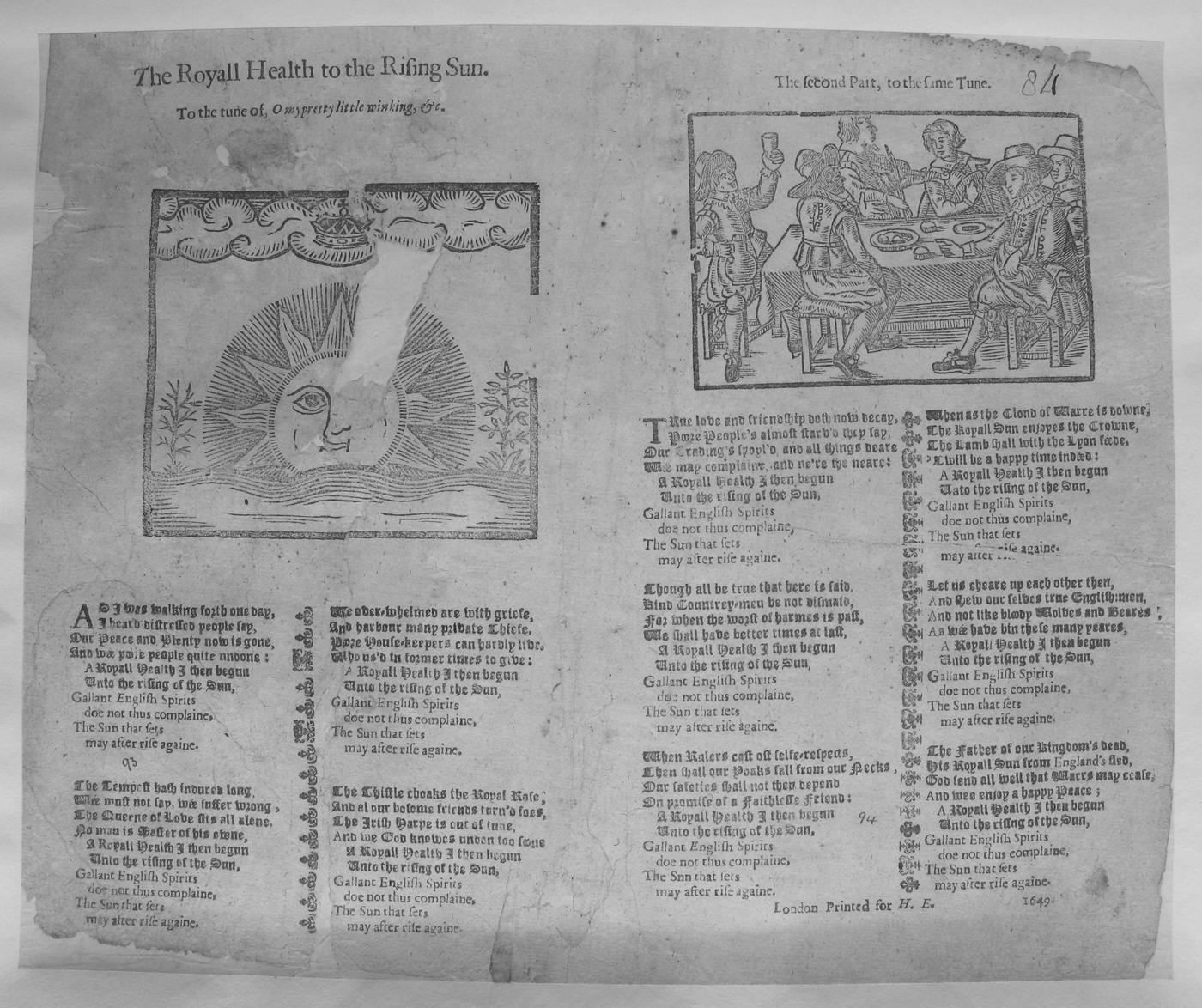
For the next ten years, singing and drinking in company became the defining feature of royalist culture. A Royall Health to the Rising Sun (Figure 2) used words and pictures to show how this would help to drive away the melancholy of defeat and maintain the loyalty of the King's old soldiers to his son:
But, in another song from later in the decade, royalist songwriter Thomas Jordan described the sorry state of Cavaliers, who caroused their sorrows away in gallons of wine, while ale-drinking puritans with ‘puddle … brains’ soberly ran the government.
Anon. 1649? A Royall Health to the Rising Sun (London: H.B.) Content suggests c.1649. (See PBB 182). Courtesy of the Manchester Central Library.
During the interregnum, and after the restoration of the monarchy in 1660, royalist songs further exploited this political differentiation of drinks. They highlighted the low social status of the country's new governors by linking republican leaders with the beer trade. Satirical songwriters made great play of a rumour linking Lord Protector Oliver Cromwell's family with the brewing trade.Footnote 27 In a song entitled The Protecting Brewer, Cromwell personified the drink revolution that had taken place when mechanic ale took over from aristocratic wine (Brome and Brome Reference Brome and Brome1662, pp. 336–9). His red warty nose or ‘Naples face’ was continually satirised by royalist writers who read it as the sure sign of the ‘dirty nose’ or shining ‘carbuncles’ of a tippler.Footnote 28 In 1660, The Traytors Downfal described how power had:
Royalist balladeers also claimed that the family trait was inherited. Richard Cromwell, who failed to maintain his father's regime after his death in 1658, was styled ‘Drunken Dick’ who ‘lov'd a cup of nectar’.Footnote 30
In reality, ale and beer drinkers were indeed marshalled into supporting Parliament's cause. In 1643, Parliament imposed a new excise tax on ale and beer. The Dutch, who had imposed taxes on beer for decades as a way of paying for their military needs, got the blame for setting the example, just as they had done for health drinking and drunkenness. In the past, English commentators had assumed that this was also a way for Dutch governments to punish and control the heavy drinking of their compatriots (Scott Reference Scott1622, pp. 53–6). Now, it seemed, England was faced with the same punitive action. Naturally, balladeers were swift to comment upon these changes. In 1647, The Good Fellowes Complaint expressed particular concerns over the impact of beer tax on the poor since it raised the price of a quart by a farthing.Footnote 31 In 1658, Sack for my Money commented further on the raised costs of ale and beer and proposed switching to wine instead, detailing all the fixed prices that had been newly set by Parliament.Footnote 32 In view of the new taxes on beer, royalists preferred to drink wine (which had always been taxed) as the ideal tipple for use in their, by now, quasi-religious loyal health-drinking rituals (McShane Reference McShane., Withington and McShane2014).
IV.
In 1660, ‘drunken Dick’, the old puritan ‘Rump’ Parliament and the New Model Army having capitulated, countless toasts were drunk and ballads sung in the wake of King Charles II's restoration. The Noble Prodigal declared ‘Let's call, and drink the cellar dry / There's nothing sober underneath the sky’ (Jordan Reference Jordan1660).Footnote 33The Royal Entertainment told how, in London, ‘Conduits did shine / with liquor divine, / [and] the people did bear away hat fulls of wine’.Footnote 34 All drinks were restored to loyalty and also to their proper social and political status. In The Country-Mans Vive le Roy, Jack and Dick go ‘To mother Mabs old Tipling house / where we will take a smart carrouse,/of the brown nappy stuff, till we / Are full of Ale and Loyalty’.Footnote 35
Yet, some songs also called for a crackdown on the immoderate behaviour of the King's old supporters; one loyal ballad spoke of the ‘fear of Cavaliers / that sleep all night and drink all day’, while another exhorted listeners:
In fact, the new government did issue proclamations seeking to curb excessive drinking and healthing but, despite this, royalist behaviours of the 1650s were adopted and absorbed into popular culture more broadly (McShane Reference McShane., Withington and McShane2014).Footnote 37
‘Good fellow’ songs celebrating carefree figures were more numerous than ever, but now they always looked and sounded like old Cavaliers. In particular, songs featuring ‘jolly beggars’ often turned out in the final verse to be old royalists, who had been (and still were) financially ruined by their continued loyalty to the crown during the civil war and interregnum. One song concluded, ‘We live by relief, / And pray for King Charls, our Commander in Chief;/God bless all the Peers, / The wise Overseers / That they may consider the poor Caveliers. For if they do let them but lower to fall, / They'll take our profession and beggar us all’.Footnote 38 Many of these new ‘good fellow’ songs recommended drinking as a way of preventing such discontent turning into disloyalty. The Loyal Subject (as it is reason) Drinks good sack and is free from Treason, made its case admirably explicit:
Early in 1660, as the population anxiously anticipated the coming of the King, balladeers promised their listeners that his ‘coming in’ would certainly bring an end to the hated excise on ale and beer. One song recalled how ‘The sad Excise hath been so rife, / It hath both beggar'd man and wife, / But now we hope that it will down, / When that Charles obtains the Crown’.Footnote 40 Another song predicted ‘Our Taxes will grow less and less, I suppose / For we have been very much troubled with those, / Excise-men (I hope too) in time will go down, / They are the torment of Country and Town’.Footnote 41 It very soon became clear, however, that this was not to be. Rather than attack the new monarch for this disappointment, loyal songwriters put a new spin on the unwelcome news. The taxes raised by loyal drinking would act as a tribute to the King: ‘We drink to shew our Loyalty, / and to fill his Coffers full: / If all his Subjects drank like us, / he would be richer far’ sang England's Triumph, just one in a long line of songs expressing similar sentiments.Footnote 42
Neither drink nor song succeeded in promoting political and religious harmony in Restoration Britain, however. By combining antagonistic discourse and practice, both actively contributed to dissention and fights in alehouses, taverns and other places where political talk and drinking took place (McShane Reference McShane., Withington and McShane2014). By 1680, political upheavals escalated around the alleged discovery of a ‘Popish Plot’ to kill Charles II the previous year. Consequent on this, attempts were made in Parliament to exclude his heir, the Catholic James, Duke of York, from the succession, in favour of Charles’ Protestant, but illegitimate son, James Duke of Monmouth. This led to the loose formation of political parties: ‘Whigs’ believed the Popish Plot was real and supported exclusion, whereas ‘Tories’ thought the Plot was a sham and wanted to maintain the dynastic rights of the crown, regardless of religion (although they were supportive of maintaining the Protestantism of the Anglican Church). As part of their campaigns to whip up support for their views, members of both parties commissioned a very large number of political drinking songs, mainly from ideologically driven publishers such as Nathaniel Thompson and James Dean (both Tories), and Francis Smith, and Benjamin Harris (both Whigs).Footnote 43 These publishers were themselves occasionally drawn into the musical tit-for-tat, although their accusations related to sexual scandal, religious non-conformity and treasonous disloyalty, rather than crimes of inebriety.Footnote 44 A number of specialist ballad producers such as Philip Brooksby also produced Tory songs during the 1680s, although only songs most likely to suit the more popular market were published in the more popular black-letter format, an aspect we will return to later.
Most of the white-letter songs produced on single sheets were not intended for making profits. (This came from the sale of newspapers and other pamphlets). When sheets were sold, it was often at the cost of a ½d, a price that barely covered their production costs. But many were distributed for free among politically useful groups, such as the highly literate apprentices of London (McShane Reference McShane.2007, Reference McShane. and Raymond2011a). These songs were ideally suited for recruiting the young to a cause, especially when combined, as they often were, with treats of drink. In addition, political feasts and pope- or presbyter-burning festivals were regularly organised, for which songs were specially composed. The aggressive, intoxicated and divisive culture that this produced led to some frightening scenes in London, Cheshire and elsewhere. In 1682, rioting pro-Monmouth supporters in Wallasey sang a ballad (not known to me), including the line, ‘Long live the Duke of Monmouth’ at a prominent Tory's door, marking time at the end of every verse by throwing stones and shooting guns at his windows (Calendar of State Papers Domestic, 1683, pp. 393, 406, 439). Gangs of Tory and Whig apprentices also swarmed into the streets calling out ‘A York’ (for Tories) or ‘A Monmouth’ (for Whigs). They stopped coaches and passers-by, threatening and inflicting violence on any who would not pay for and then join in healths to whichever of the rival Dukes they supported (Harris Reference Harris1987, Ch. 5–7).
In a deliberate evocation of the 1640s and 1650s, the new party songs once again used drinking imagery as a vehicle for disparaging political opponents. Whig balladeers took the moral line previously followed by Parliamentarians. They not only accused Tories of replicating the mindless roistering of the old Cavaliers, but also of being Papist fifth-columnists who drank their loyal healths to the triple crown of the Pope: ‘When all the Zealous Whigs are down/we'll drink and fall a roaring / And then set up the triple crown/will saint us all for whoring’.Footnote 45
In their turn, the Tories appropriated the popular character of the loyal ‘good fellow’ whose excessive drinking made him incapable of political designs and plotting. In Praise of the Bottle summarised the argument thus:
Tory writers also made good use of the spin that popular songwriters had put on the King's retaining of the excise on ale and beer as well as wine. The Loyal London Prentice, illustrated with a political ritual healthing scene (Figure 3) claimed he and his fellow Tories were ‘trying to drink us out of debt’. The King's rights to an unfettered income drawn from customs and excise had become a hotly debated party-political issue. Given free access to the excise, the King would be able to rule without interference from the Whig-dominated Parliament that was trying to force his agreement to an exclusion bill.
Anon. 1681. The Loyal London Apprentice (London: Richard Hill) (See PBB 594). Courtesy of the Houghton Library, Harvard.
Tory songs reversed the moral compass of excessive drinking. They claimed that their merry, loyal carousing was morally on the side of the angels, unlike ‘The Grave and the Dul [who were] by sobriety curs'd’ (Shadwell and Anon. Reference Shadwell1675).Footnote 46 Tories decried the untrustworthy hypocrisy of the ‘sullen Whig and trimmer/that boggles at a loyal health / Yet will not bawk a brimmer’ and who sported ‘a bi-fronted conscience’ like an alehouse sign (Anon. 1680).Footnote 47 Like Puritans during the interregnum, Whigs were poor company: ‘In a corner they'l be drunk / With drinking healths unto the Rump’.Footnote 48 Instead of engaging in openly convivial and communal fellowship, they sat alone, ‘sotting and plotting’, ‘smoaking and soaking … sadly looking’ and not singing but ‘croaking’ (Taubman 1683).Footnote 49 The clear implication was that sobriety was, by its nature, seditious. What a Whig needed, Tory ballads argued, was a good few pints of wine poured down him. One song was explicitly titled A Whig Drown'd in an Honest Tory Health, while another, The Courtier's Health, suggested, ‘He that denies the brimmer / we'll drown him in canary and make him all our own. / And when his heart is merry / he'l drink to Charles in's throne’ (Taubman Reference Taubman1682; Anon. 1683).Footnote 50
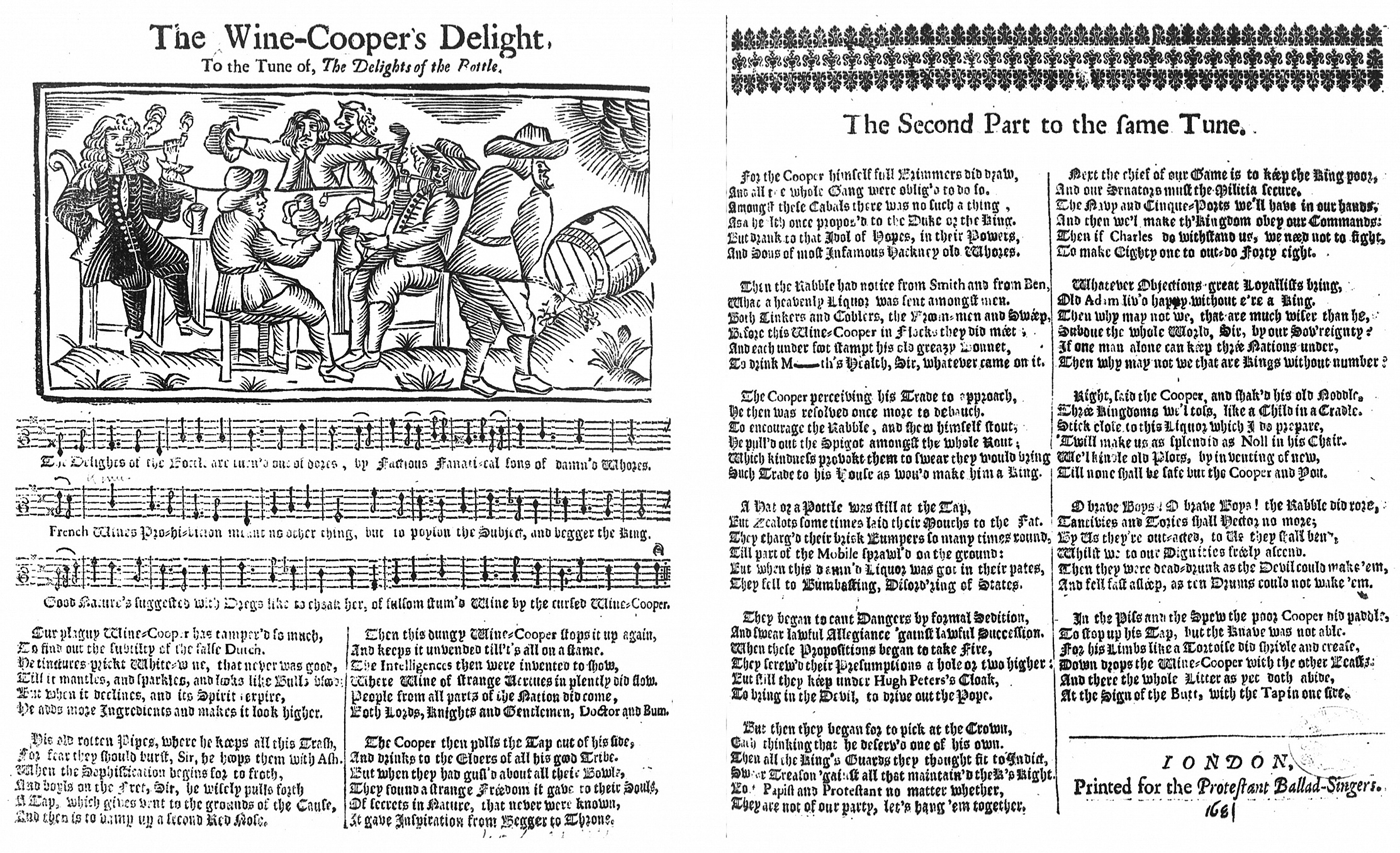
Following the example of Cavalier writers in the 1650s, who had attacked Cromwell as a beer brewer, in the 1680s satirical Tory songsters launched an attack on the aptly named leader of the Whigs, Anthony Ashley Cooper, Earl of Shaftesbury. In 1681, The Wine Cooper's Delight made explicit the connections between Cromwell, the brewer of the ‘Good Old Cause’, and the Whig leader. The song refers to Shaftesbury as a ‘second Red Nose’ who declares, ‘We'l kindle old plots by inventing of new’. His demagogic appeal to ‘Tinkers and Coblers, the Broom-men and Sweep, / [who] Before this Wine-Cooper in flocks they did meet’ was a reminder of the ‘mechanic rule’ of beer-swilling republican regimes in the past. To push this point home, the song was published in both an elite white-letter format and also in a pseudo-popular black-letter one. The black-letter version pictured in Figure 4 was expensively produced. It was exceptionally well printed, on a large, high-quality sheet, and was illustrated with a specially commissioned woodcut. If sold at all, it would have cost far more than the usual single penny per ballad.
Anon. 1681. The Wine Cooper's Delight (London: n.p.) (See PBB 568X). Courtesy of the British Library.
Yet, while civil war and interregnum songs had made a distinction between republican ale and royalist wine, in the party-political songs of the 1680s a new scatological distinction emerged between the bodily fluids of Tory blood and Whig urine. Whig songs accused Tories of being bloodthirsty Papists. For example, in The Bare-Faced Tories, they drunkenly call for an attack on the loyal English whigs:
Whigs could also draw on memories of an old Cavalier practice of mixing wine with their own blood when drinking loyal healths and other loving pledges. This practice (they argued) was reminiscent of the Catholic doctrine that the mass turned communion wine (which was drunk only by priests) into blood.Footnote 52
Tory writers responded by exploiting the (for them) happy circumstance of the Earl of Shaftesbury's renowned colostomy drain. This, one song quipped, made him look ‘like a cask with a Tap in his side’.Footnote 53 Through this, Tory songs claimed, the Whig leader poured out the poison of seditious sobriety.Footnote 54 Many ballads used this metaphoric image, but The Wine Cooper's Delight was the most striking, since it cleverly used music, words and image to drive its attack home. One side of its single, beautifully executed woodcut shows a table, where the well-dressed Earl sits drinking in company with the ‘rabble’. On the other side of the image, the earl appears again, but this time he is figured as a barrel. A man pisses into the flow of the liquid pouring from the barrel's tap, to emphasise the nature of the liquid it contains. The song was set to the tune of a hugely popular theatre song of the period, ‘The Delights of the Bottle’. This song famously included the lines: ‘Love and Wine are the bonds that fasten us all, / The World but for these to confusion would fall … Nor would Kings rule the world but for Love and good drinking’ (Shadwell & Anon. c.Reference Shadwell1675).Footnote 55 But, in contrast to a ‘good fellow's’ drinking that served to eradicate care and thoughts of treason from his mind, the drink pouring from Shaftesbury's tap promoted a beastly drunkenness of political sedition and religious dissent:
In the final verse, Shaftesbury wastes away as all his vital fluids drain off:
Although it was not until 1683, after the scandal of the Rye House Plot, that Shaftesbury was forced to escape the country only to die in exile a few months later, this song expresses how the Tory's political drinking song campaigns had succeeded in making the Whig message utterly unpalatable.
In the period between the Popish Plot (1678–79) and the Glorious Revolution (1688–89), Tory printers seem to have produced many more broadside ballads than the Whig party (based on survival evidence). 255 explicitly Tory song-sheets survive, of which 50 were the more popular black-letter types, as opposed to just 56 explicitly Whig songs, of which 18 were published in black-letter. This suggests that the Tory message of enforced good-fellowship and drink-induced loyal obedience was certainly louder, and may well have been more ‘popular’, or at least more widespread, than the more complicated and moderate ideas of the Whigs. The effect of the campaigns certainly contributed to a dramatic increase in violent episodes over loyal-health drinking (although the presence of song is not always explicit in court records). With the coming of the Revolution, however, the tide turned somewhat against the Tory message of excess and obedience. Between December 1688 and December 1689 alone, 162 ‘Williamite’ Ballads were published, 80 in the most popular format.Footnote 56 One song in particular, sung to the tune of Lilli-burlero, was credited with having ‘sung James II out of three kingdoms’.Footnote 57
Although they were not the only supporters of the change, to a large extent the Revolution achieved the Whig dream – the removal of the Catholic James II and the installation of Protestant monarchs, William III and Mary II of Orange as joint rulers. A Bill of Rights, the nearest Britain has ever come to a written constitution, was soon to follow. This change also brought unintended consequences, especially the beginning of William's long and expensive wars against the Jacobites and French in Ireland and Flanders. Despite the irony of William being Dutch, and although the loyal health remained a fundamental feature of popular political practice and discourse, in response to the new regime, song writers attempted to create a more moderate political relationship between drink and song.
On one hand, William the military general was depicted as knowing the value and power of drink for increasing the courage and morale of the soldier. For example, one ballad tells how, on William's first arrival in Ireland, ‘his Majesty walked round to see / how his Army did then appear, / Which was stout and brave, such as he would have, / … Then he threw them Gold, saying, Now behold! / drink and merry be, Soldiers all; / France shall feel my Rage, soon we'll clear the Stage. / Charge them with Fire, Sword, and Ball; / Trumpets sounding, Warlike Drums shall beat, / Making Foes retreat, / While we them pursue’.Footnote 58
On the other hand, as a civilian King, a series of black-letter ballads depicted the champagne-loving William as more than willing to go out of his way to share more ordinary fare with his people. In The Royal Frolic, William, returning from Ireland with his court, calls incognito at the house of a loyal farmer. Here he drinks ‘nappy March Beer’, and leaves handsome payment in gold as a reward for the family's unsolicited expressions of loyalty. The opening verse recalls those ‘happy days, when great Caesars would be, / familiar with Subjects of e'ry degree / Yet those that have govern'd these Kingdoms of late / Has not been so pleasant since William the Great / …[who] the high road he quitted for merriments sake’.Footnote 59 Certainly, this song offered quite a contrast to one celebrating the opening of Parliament under James II in 1685, which had maintained a strict social and political separation between grape and grain: ‘We'l drink the King's good health in Wine / In Ale the parliaments’.Footnote 60
After the Revolution, even Jacobite songs attempted to curb the idea of excess. While only 15 Jacobite songs are known to have been published in 1689, they increased in number over the 1690s as dissatisfaction with the King and his wars inevitably grew over time. One song, published in 1694, castigated the usurpation of the throne by William and Mary, likening it to Cromwell's rebellion and complaining that the country was being bankrupted by warfare. The final verse was notably moderate in proposing just one (large) toast: ‘And now I do think, / 'Tis time for to drink / A Bumper, don't think it too much Man; / Tis the Restoration, / And Peace to the Nation, / Confusion likewise to the Dutchman’.Footnote 61
V.
Some aspects of the early modern world described above might strike the modern reader as surprisingly familiar, for example, the existence of a highly sophisticated, dynamic popular music industry, with an efficient national distribution system, which was particularly geared towards young urban tastes and behaviours. Equally familiar is an apparent (if grudging) acceptance of intoxication as part of the creative process, especially in the fields of music and entertainment. We might also recognise the tendency for popular song to become most politically active at times of crisis, although the conservative voice, which (as here) is the loudest for much of the time, is often much less interesting for scholars who usually prefer the forces of change to those of stasis – or, as in the case of the Tory message described above, oblivious obedience, punctuated by violent struggle with perceived radical forces.
Over the last 10 years, psychologists have turned their attention to the detrimental impact that popular music can have on young people's attitudes towards intoxicants and intoxication. Studies in the UK and the USA have carefully analysed the most popular songs across a range of genres over time in a bid to understand how far a rise in intoxicant-related lyrics might be correlated with the known rise in intoxicant consumption among the young. They conclude that the content as well as the sound of popular song is influential in normalising cultural attitudes and creating desirable models of behaviour that together have contributed to a greater propensity to consume intoxicants (Sousou, Reference Sousou1997; Primack et al. Reference Primack, Dalton, Carroll, Argwal and Fine2008; Hardcastle et al. Reference Hardcastle, Hughes, Sharples and Bellis2015). As we see from the discussion above, a similar analysis of seventeenth-century song would, on the face of it, certainly suggest that very similar conclusions might be drawn. Although in the early modern case, it is not possible to differentiate in terms of musical styles, instead, their graphic appearance is the key distinguishing feature.
As this essay has shown, in early modern England, drinking songs were significant political agents that could transform convivial spaces into highly charged political and even religious ones. They were used to model excessive behaviours, to choreograph violent actions, to manipulate political memories, to promote ideologies, and to instigate alcoholic tests of loyalty that sometimes led to injury and even death. In light of the very strong strand of moral discourse, also appearing in song, that warned against the dangers of excess, and the constant anxiety of early modern magistrates and other local governors about disorder, why did a sector of the music industry choose to promote excessive and violent drinking behaviours as a way of furthering their own or their paymasters' political ends? And who did they believe this message was reaching?
In 1684, in the wake of the Whig collapse after the Rye House plot, Tory publisher, Nathaniel Thompson issued an anthology of 120 Loyal Songs (the first of several that were to appear over the next few years). Adopting a somewhat smug tone, and an emphatic typography, in his address to the reader, he commented:
Among the several means that have been of late years to reduce the deluded Multitude to their just Allegiance, this of BALLADS and LOYAL SONGS has not been of the least influence. … these flying choristers were asserting the Rights of Monarchy and proclaiming Loyalty in every street. The mis-inform'd Rabble began to listen; they began to hear to Truth in a SONG, in time found their Errors, and were charm'd into Obedience. Those that despise the Reverend Prelate in the Pulpit, and the Grave Judge on the Bench; that will neither submit to the Laws of God or Man, will yet lend an itching Ear to a New SONG, nay, and often become a Convert by It, when all other means prove ineffectual … it cannot be imagined how many scatter'd flocks this melodious Tingling hath reduced … [to the] discipline of Obedience or Government. (Thompson Reference Thompson1684, Sig. A2)
So, Thompson, at least, believed that his white-letter songs had been directed at and consumed by a ‘deluded multitude’ and a ‘misinformed rabble’ and that, whoever these people were, they had successfully been converted by the ‘melodious Tingling’ of his ballads.
But what if we look more carefully at the publishing output of another printer of Tory songs throughout the 1680s – the ballad warehouse partner, Philip Brooksby? Unlike Thompson, who made his fortune as a newspaper man, Brooksby made his living mostly from the popular black-letter ballad trade. Of 27 expressly Tory songs that carried Brooksby's imprint, 17 were produced for the popular retail market in black-letter.Footnote 62 The content of these titles was typical for the popular trade, concerning themselves with the usual four axes of royal affairs, warfare, treason and complaint. But they were also really excellent songs, written by some of the top songwriters of the period, and set to popular theatre tunes. Several were loyal-healthing songs but, tellingly, Brooksby's songs (unlike other Tory ones) always included the King's illegitimate, Protestant, Whig, and hugely popular hero, Monmouth in those healths. Moreover, the songs that Brooksby decided to print for the most popular market always ran to at least two editions, unlike his white-letter ones. Most significantly, as the political winds changed at the Revolution, Brooksby switched to producing Williamite songs, usually in company with his trade partners. This switch is best illuminated by a 1689 loyal ballad, set to the tune ‘The Loyal Health’, and entitled An Excellent new SONG; OR, A true Touch of the TIMES. Giving you a full and true Account of the Transactions, from King James the First, to the present Reign of our Soveraign Lord King William the Third. First issued in 1685, it had been updated by the simple expedient of exchanging the phrase ‘James the Second’ to ‘William the Third’, along with a couple of new verses.
In contemplating how we might interpret this marked difference between what the political white-letter song traders thought they were doing, and what the true popular music market produced, a useful reference point can be found in Simon Frith's fascinating discussion of urban ‘folk’ music in the 1970s and 1980s, which, he argues, was inflected by class as much as by culture (Frith Reference Frith1981). Urban ‘folk’ had nothing to do with ‘authentic’ usually poor and rural experience; it was a fantasy, adapted to reach the tastes of a particular urban youth market, although this did not prevent it from also having its own political agency. Modern musicologists tend still to distinguish between a pre-industrial ‘folk’ music – an authentic reflection of communal experience that was unsullied by commerciality – and the mass-produced music of modernity, which was Frith's main concern. But the tale being told here of seventeenth-century drink and song is a sophisticated story of the concerted attempts of political powers to capture and control the more elite end of the popular music market in printed song, while the highly commercial, mass-produced, mainstream market held its own values, choosing to publish only those songs and messages that would be attractive and acceptable to a nationally and socially broad popular market.
Tory writers like Thomas D'Urfey and James Dean, and political song publishers like Nathaniel Thompson, did not seek to create a representational discourse; they hoped to use the popularity of music, in combination with the essential cultural activity of drinking, to attract people into support for a party ideology that was based on unquestioning obedience to a divinely appointed monarch and his dynasty. In contrast, Whig writers tried to argue for more moderation, not only in drinking, but also in levels of obedience – monarchs should not be able to rule unconstrained; it was vital that subjects and citizens should be sufficiently clear-headed to think for themselves and for the good of their country. However, neither of these campaigns were ‘democratic’ in any real sense. Most of these songs were never intended for the population at large. They were complicated, often full of difficult political and literary allusion. They were intended for those who were already part of the political elite – or for significant groups, such as literate apprentices (who were often drawn from the middling and gentry classes), whose physical support as a mob or as armed bands had been shown to be politically effective in the civil war, and was thought to be a desirable commodity in the turmoil of the 1680s. These, alongside political elites and those with votes, were the ‘rabble’ that Thompson had hoped to convert.
Popular retail-trade publishers, who hoped to make a profit and maintain their credibility, were much more astute about what would sell in the wider market. These songs went to a huge range of people, of all ages and positions, urban and rural. It was in this sphere that lyrics describing changes in drinking fashions and an attention to costs appeared. It was here that moral messages were spelled out and contested. The political elites failed to capture this market, not least because their version of drink and politics was beyond the financial or intellectual capacities of the vast majority of the nation. Health drinking of the kind that could turn a Whig into a Tory was beyond the means of most, while, unlike the unconstrained consumption of political elites, drunkenness among the lower orders was frowned upon and controlled as far as possible by the local authorities.
Ironically, then, although certainly not ‘popular’ among the ‘folk’, it was the songs imposed from above that were the most ‘authentic’ in that they were indeed passionately committed to their message. They represented a community of sorts and sought to entice others, like themselves, to join it or unquestioningly to accept its values. Black-letter songs, on the other hand, were more inventively and essentially musical; as such, their political messages and behavioural influences were arguably more far reaching. Although usually conservative – an effect of careful self-censorship rather than draconian action on the part of the government – when popular songs did become partisan or radical, when they modelled behaviour such as loyal-health drinking, or when they created heroes such as the Duke of Monmouth or William of Orange, their influence was ubiquitous, deep rooted and very hard to shift. Indeed, some of these roots have remained so deep that even today we find their remnants in our politics, our music and our drinking behaviours. ‘Lilli-burlero’ remains a divisive force in Irish politics (and was until fairly recently the theme tune for the BBC), while the universally known tune ‘for he's a jolly good fellow’, still linked to health-drinking behaviours, was one of the most used Cavalier and Tory political tunes of the period.Footnote 63
Acknowledgements
Research for this article was supported the ESRC/AHRC Sheffield University/HRI/V&A Project: Intoxicants and Early Modernity (http://www.intoxicantsproject.org/) and the AHRC Hit Songs and their Significance in Seventeenth Century England Project (https:// www.facebook.com/100HitSongs). I am grateful to the editors and peer reviewers for their helpful and encouraging comments. The article substantially revises and expands an earlier consideration of this material: ‘Roaring Royalists and ranting brewers: the politicisation of drink and drunkenness in political broadside ballads 1640–89’, in Smyth (Reference Smyth2004a).