Introduction
With the global spread of English and the emergence of different varieties of English around the world, World Englishes (WE) researchers have argued for the recognition of ‘Englishes’ in the plural and called for the need to acknowledge the diversity of English (Kachru, Reference Kachru, Quirk and Widdowson1985, Reference Kachru1997). Apart from WE researchers who are interested in investigating nation-bound varieties of English in different parts of the world, a growing number of researchers have begun to examine the phenomenon of English as a Lingua Franca (ELF) communication, given the growth of intercultural exchanges worldwide (Jenkins, Reference Jenkins2000, Reference Jenkins2007; Seidlhofer, Reference Seidlhofer2011). Whilst WE researchers are primarily concerned with how varieties of English differ from each other, ELF researchers are interested in exploring how speakers of different Englishes communicate with each other in contexts where English is the common language. For example, these ELF researchers have studied the communicative and pragmatic strategies which people from different lingua-cultural backgrounds use to communicate with one another through English as a common resource in order to achieve mutual intelligibility (Seidlhofer, Reference Seidlhofer2011). Despite their different focuses, both WE and ELF researchers deal with the same global phenomenon of English use and the pluricentricity of English, and share similar ideas about the ownership of English, and language contact and change (Seidlhofer, Reference Seidlhofer2011). A relatively new field, Global Englishes (GE) (Galloway & Rose, Reference Galloway and Rose2013, Reference Galloway and Rose2014; Jenkins, Reference Jenkins2014), has thus emerged to bring together researchers from both WE and ELF. With an inclusive orientation, GE places less emphasis on native speaker English, emphasizes the diversity of English, and questions the relevance of native speaker norms for English Language Teaching (ELT) (see Galloway & Rose, Reference Galloway and Rose2015).
In this age of globalization, people around the world not only encounter different varieties of English, but also communicate in English with people from different lingua-cultural backgrounds. It is therefore important for language teachers to prepare their students to participate in ELF communication in a wide range of contexts by familiarizing them with GE (Sung, Reference Sung2013a, Reference Sung2013b). However, very few studies have examined how GE can be introduced and incorporated in the ELT classroom, especially in the Asian context. This article therefore reports on a pilot study of implementing a GE component in an English proficiency course at a Hong Kong university and investigating the influence of the GE component on the students’ understanding of English use and learning in the global context.
GE and ELT
With the diversification of English into different varieties, it is widely accepted that there is no one variety that can be used successfully in all situations of international ELF communication (Matsuda & Friedrich, Reference Matsuda and Friedrich2011). Importantly, ‘the linguistic, cultural and functional diversity associated with English today challenges some of the fundamental assumptions of ELT and requires that we revisit our pedagogical practices, especially in classrooms where English is taught as an international language’ (Matsuda & Friedrich, Reference Matsuda, Friedrich and Matsuda2012: 17). Kachru (Reference Kachru, Quirk and Widdowson1985), for example, have advocated the adoption of a ‘polymodel’ approach to ELT, which involves exposing students to different varieties of English, rather than just one variety of English. Specifically, the ‘polymodel’ approach aims to promote pluralism in different varieties of English, raise students’ awareness of different varieties of English, and enhance students’ confidence in their own English varieties (see Xie Reference Xie2014). Similarly, GE, as a relatively new paradigm which challenges the relevance of native speaker norms in ELT, also suggests the need for ‘more exposure to the diversity of English; more value placed on learners’ multilingualism; and increased exposure to ELF communication’ (Galloway & Rose, Reference Galloway and Rose2014: 287). It is argued that exposure to different varieties of English is important for successful ELF communication. In particular, as Jenkins (Reference Jenkins2000) points out, exposure to second language (L2) accents is more important than exposure to first language (L1) accents, because students are more likely to encounter L2 speakers than L1 speakers of English in ELF communication. In addition, increased exposure to the diversity of Englishes is believed to help students become familiar with different accents of English and serve as a catalyst for developing their flexibility in negotiating and accommodating diverse varieties of English in contexts of global intercultural communication (Morrison & White, Reference Morrison and White2005; Sung, Reference Sung2014).
However, much of the discussion on the pedagogical implications of GE and ELF communication remains largely at the theoretical level. Little empirical research has been conducted on how to incorporate a GE perspective in the ELT classroom. While there have been some studies on students’ reactions to the concepts of WE and/or GE in various parts of the world, including China (Xie, Reference Xie2014), Japan (Galloway & Rose, Reference Galloway and Rose2013, Reference Galloway and Rose2014; Takahashi, Reference Takahashi2014), South Korea (Tanghe, Reference Tanghe2014), and Taiwan (Chang, Reference Chang2014; Lin, Reference Lin2012), no studies have so far been carried out in the context of Hong Kong. There is thus a need to understand how the introduction of GE will be received by Hong Kong students. This article aims to address this lacuna and bridge the gap between theory and practice in ELT. It reports on the pilot study of implementing a GE component in a university English proficiency course and investigating its influence on the students’ conceptions of English use and learning in the global context.
The Hong Kong context
Hong Kong presents an interesting context for the investigation into the implementation of a GE component into a university course, given its complex sociolinguistic situation. While Cantonese is the dominant language among the Chinese-speaking population in Hong Kong, Putonghua, the national language of China, also plays an increasingly important part in Hong Kong's linguistic landscape, as a result of the closer economic ties with China. English, as the co-official language with Chinese, plays a vital role in different sectors in Hong Kong society, including the government, business, higher education and professional workplace (Sung, Reference Sung2015a, Reference Sung2015b). As Hong Kong is a cosmopolitan city, there is also a great demand for a high level of English proficiency among its workforce.
It is also noteworthy that the multilingual and multicultural make-up of the population makes ELF interactions commonplace in Hong Kong. In addition to the English-language population comprising L1 English speakers from the UK, the USA and Australia, English is frequently used as a lingua franca by Hong Kong people for communication with settlers and sojourners from Europe and other parts of Asia, including the Philippines and Thailand (Evans, Reference Evans2011). It is therefore inevitable that plentiful opportunities are present for Hong Kong people to interact with people from all around the world and to be exposed to a wide range of Englishes. However, despite Hong Kong's self-acclaimed status as ‘Asia's World City’, native-speaker norms are still entrenched in its ELT practices, largely owing to its colonial history. Given the complex sociolinguistic situation of Hong Kong, it is worthwhile to examine Hong Kong university students’ reactions to a GE component implemented in a university English course.
The pilot study
The pilot study was conducted at a university in Hong Kong, and a GE component was implemented in a course called ‘Varieties of English’, which was recently developed as one of the four compulsory English enhancement courses at the university. While the other three English courses have a focus on English for Academic Purposes (EAP), the course ‘Varieties of English’ primarily deals with English communication in non-academic contexts. By examining a variety of English texts of different genres, the course aims to facilitate students’ development of a linguistic toolkit in light of the increasing demands on effective communication in the globalized world.
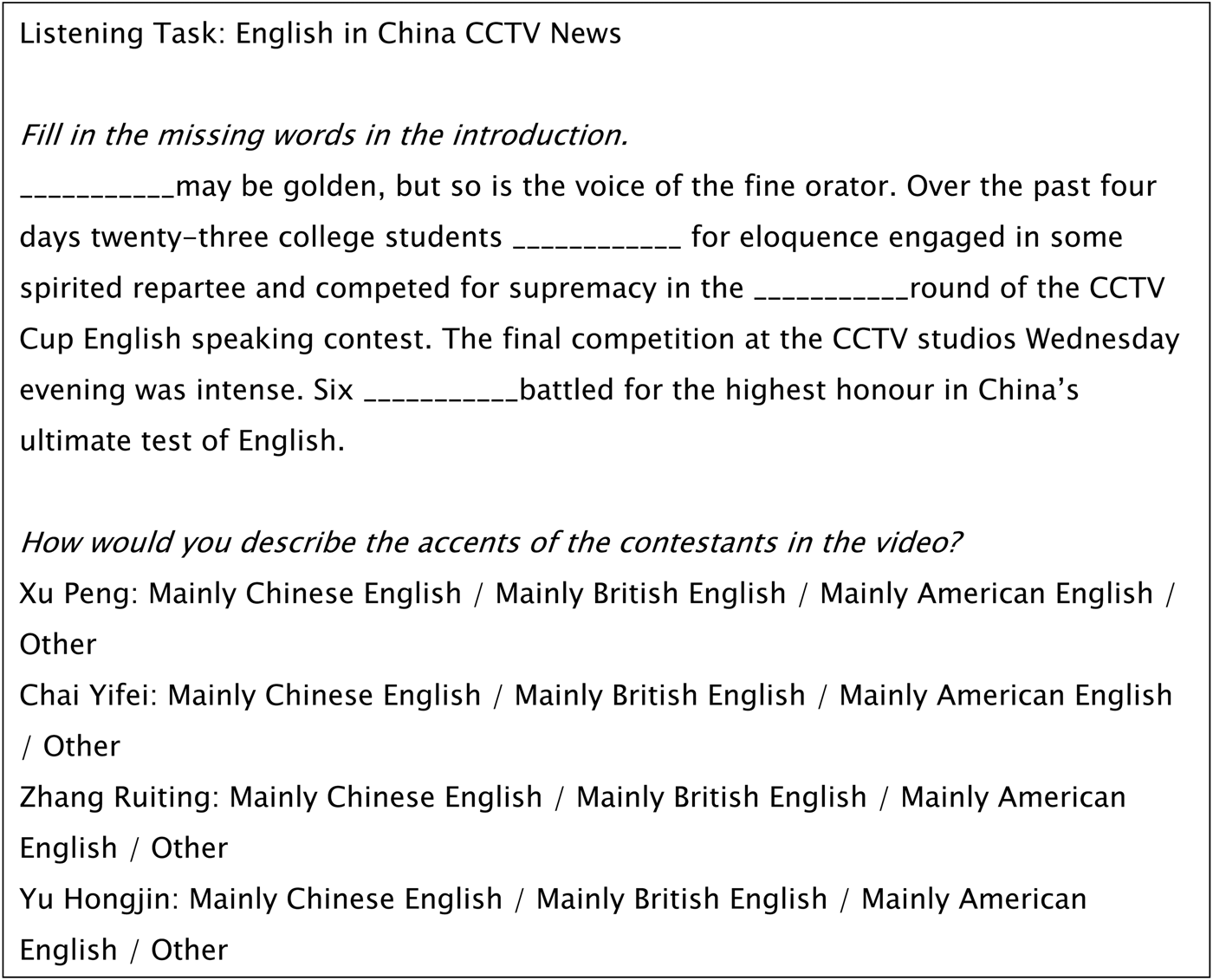
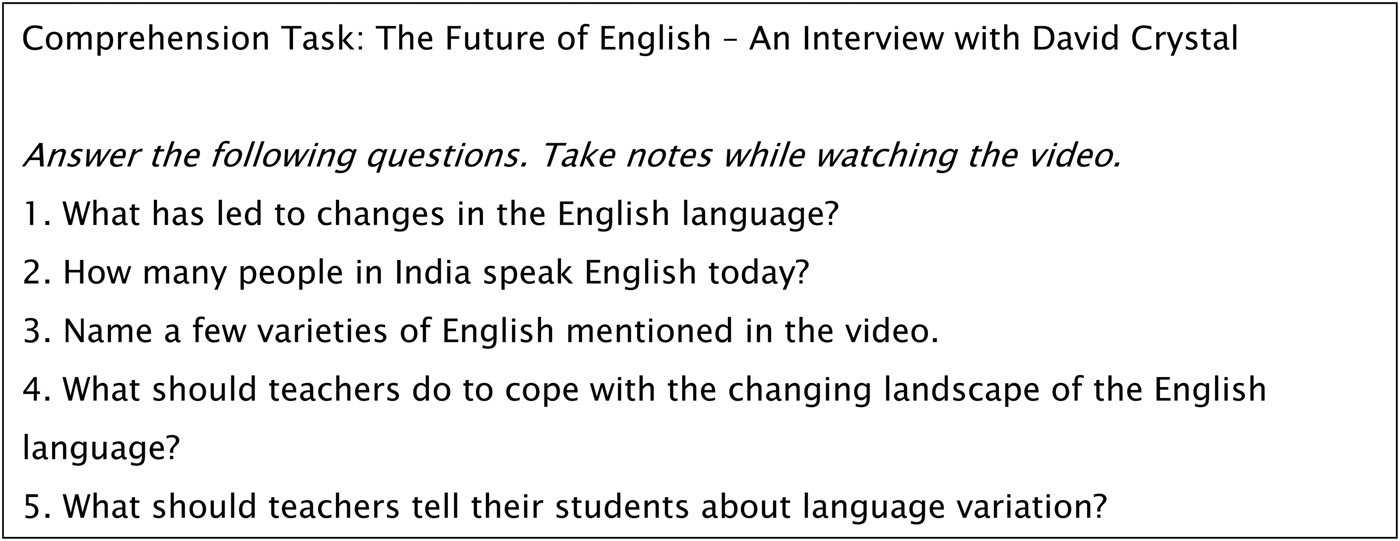
While the course does not primarily aim at raising students’ awareness of GE in particular, I saw it as a unique opportunity to implement a GE component in order to raise students’ awareness of language variation in the context of WE. While the course was taught to all university students in 25 sections, I implemented the GE component in only one section of the course, as part of a pilot study. Specifically, I incorporated a range of GE-oriented activities in the course (in which 25 students from different disciplines enrolled), including a class discussion on ‘Standard English’ and ‘native speaker’ (see Figure 1); a listening task which involves listening to Chinese accents of English’ (see Figure 2); an accent identification task involving different accents of English from the CD accompanying the textbook World Englishes by Kirkpatrick (Reference Kirkpatrick2007); a comprehension task on understanding global English (using a video clip featuring an interview with David Crystal) (see Figure 3); and a group discussion on ELF communication (using a video clip which features an interview with Martin Dewey.) While the entire course lasted for 13 weeks (meeting twice a week), the GE activities were only implemented in 4 weeks (in weeks 1, 2, 6 and 12).
Discussion Task

Listening Task
Comprehension Task
In order to probe into the students’ views about the GE component implemented in the course and its influence on the students’ conceptions of English use and learning, all the students enrolled in the course were invited to an interview. 13 of the 25 students volunteered to participate in the interviews, and two focus group interviews were conducted at the end of the course. Both of the interviews lasted for approximately one hour each. Since both focus group interviews were conducted in Cantonese, the quotes extracted in the following section were translated to English by the author.
Findings
What is clear from the interviews is that the students’ perceptions towards the GE component in the course were overwhelmingly positive. All of the students appreciated the discussions concerning the spread of English, different varieties of English, and ELF communication. Although these students had studied English for more than ten years, they admitted that they had little idea of the English spoken in other parts of the world. As one student said, ‘I didn't really know much about the global use of English before taking the course. This course really helps me understand a lot more about the use of English around the world and about different varieties of English’ (#5). In the interviews, many students also stated that they only had a basic knowledge of British English and American English before taking the course. While their exposure to the former was through commercial ELT materials, their familiarity with the latter was mainly due to movies and the mass media. Because of their limited exposure to other varieties of English, the students expressed a great deal of interest in understanding the use of English in other parts of the world and the different varieties of English spoken by speakers from different L1 backgrounds. For example, one student said, ‘I think I have become more interested in English now. I think listening to different varieties of English can help me understand different accents of English better’ (#7).
Another positive influence on the students is that most of them developed a deeper understanding of the sociolinguistic reality of English today. For example, after the course, they no longer considered native speakers of English the only arbiters of ‘correct’ or ‘standard’ English. As one student commented, ‘I think we have to know that native speakers of English are not always right. I think we can also use standard English as well as native speakers of English’ (#2). In addition, the students came to realize that communicative ability is more important than merely conformity to native-speaker norms, especially in ELF communication (see Seidlhofer, Reference Seidlhofer2011). As one student noted, ‘I don't think native speaker English is the most important thing in intercultural communication. I think our ability to use different communication strategies is more important’ (#4).
Apart from increased awareness of GE, most of the students also developed an appreciation of the differences in the English used by different L1 and L2 speakers, and showed a willingness to accept deviations from native speaker norms. There was also a general consensus among the students that differences in the use of English among different speakers of English are inevitable, given the role of English as a global language. One student, for example, remarked, ‘I know that English is now spoken by so many people. It's okay not to speak like native speakers of English […] I think that speaking English differently doesn't mean speaking bad English’ (#10).
Furthermore, most of the students interviewed expressed more confidence in speaking English with a local accent and with other local linguistic features. While they admitted that there was still room for improvement, they seemed to be more accepting of their own accent and the existence of ‘non-native’ features in their English. As one student stated: ‘I know that I have to improve my English, and that will help me in the long run. But I don't think I have to get rid of my Chinese accent, for example’ (#13). Another student also said, ‘I feel more confident now because I think that I am also one of the many speakers of English. I don't have to feel bad about speaking English’ (#7). With the newfound confidence in their own English, six of the interviewees also appeared to claim ownership of the English language (Widdowson, Reference Widdowson1994). Instead of feeling an obligation to defer to native speaker norms at all times, they mentioned that they were more willing to accept creativity and innovation in ELF communication. One of the students, for example, noted, ‘I think English is now spoken by everyone here. We should be allowed to be creative in our use of English and we don't have to be like native speakers of English’ (#11). Another student also stated that ‘Since English is a global language, we should be able to express our own identities with our own English varieties. We should be allowed to use English more creatively’ (#5).
However, despite their increased awareness of the concept of GE, most students still held negative views of ‘non-native’ varieties of English. Although they claimed to be more willing to accept deviations from native speaker norms, they still perceived ‘non-native’ varieties of English negatively and regarded these varieties as ‘non-standard’ and ‘imperfect’. For instance, one interviewee commented, ‘I think I don't want to learn from English spoken by the Japanese. I don't think it's standard English’ (#9). In addition, they perceived these varieties as containing ‘errors’. In the interviews, one student said, ‘I think non-native varieties of English are full of errors, and we shouldn't learn from these varieties of English’ (#10). One primary reason for the negative perceptions may be related to the deep-seated stereotypes of non-native varieties of English in general (Lippi-Green, Reference Lippi-Green2012).
Furthermore, it was found that most students did not seem to change their perceptions regarding the ideal instructional model for pedagogy. As evident in the analysis, most students insisted upon the importance of ‘standard’ English in ELT and considered ‘native’ English, notably British English and American English, as the ‘default’ models for pedagogical purposes. One student said, ‘I think British and American English should be our model for learning’ (#13). In addition, most students still adopted native speaker norms as the yardstick for measuring competence in English. What is evident here is that increased awareness of GE does not necessarily lead to acceptance of a different pedagogical model.
Discussion
As a preliminary attempt at introducing GE to university students, it must be borne in mind that the positive outcomes of the course were limited by various constraints. As the primary aim of the course ‘Varieties of English’ is to enhance university students’ English proficiency rather than to increase their awareness of GE, only a limited amount of time (over 4 weeks) was spent on introducing students to the concept of GE, thereby limiting the potential impact on students’ mindsets about different varieties of English. More importantly, apart from the lack of resources devoted to the development of a fully fledged GE course, there are practical constraints in implementing an entire course on GE for all university students. At present, courses such as ‘Global Englishes’ or ‘World Englishes’ are only offered to English majors in most universities in Hong Kong, and the enrolment in these courses is often restricted to English majors only. As a result, very few students from other disciplines, such as science and social sciences, are allowed to take these courses as electives. Given the existence of these practical constraints, it is not yet possible to introduce GE as a compulsory course to all university students. A partial, and perhaps interim, solution could be to implement a GE component in an existing English proficiency course that is compulsory for all university students, as the one described in this article.
Despite the constraints in its implementation, it seems clear that the GE component was positively evaluated by the students and had some noticeable positive influence on the students’ conceptions of English use in the global context, including increased awareness of GE and ELF communication, a deepened and critical understanding of the sociolinguistic reality of English today, a willingness to accept diversity, and increased confidence in using English as L2 users of English.
However, the GE component seemed to have little impact on changing students’ perceptions regarding the superiority of native speaker English and their negative perceptions of ‘non-standard’ and/or ‘non-native’ varieties of English. It is also important to note that instances of contradictions were evident in the students’ understanding of GE, English use and English learning. For example, although some students claimed that they were willing to embrace the diversity of different Englishes, including non-native varieties of English, they still saw some non-native varieties of English as containing ‘errors’ that are in need of remediation. In addition, a number of students mentioned that they were comfortable with speaking English with a local accent and did not feel embarrassed by their distinctive accent, but there was still a lingering desire among the students to aspire towards the native speaker ideal. Furthermore, although some students felt that the native/non-native dichotomy is problematic and should be abandoned altogether, they still appeared to subscribe to the myth surrounding the supremacy of native-speaker English over non-native English. From these contradictory comments, it seems that the students’ beliefs about GE are rather complex and may not be easily changed in a short period of time. While they clearly had more appreciation of the diversity of English in today's globalized world after taking the course, they did not seem to embrace the pluralistic concept of GE in its entirety.
Implications and suggestions
While the GE component in the English proficiency course did not result in a radical change in the students’ attitudes towards GE, the pilot study described in this paper clearly indicates some signs of positive outcomes in raising students’ awareness of GE and in preparing students to understand variation in the context of GE. In particular, the positive student feedback received suggests that the incorporation of a GE component in English enhancement courses is worth undertaking and that the scale of its implementation should be expanded.
With a view to maximizing the impact on raising students’ awareness of, and sensitivity towards, GE, there is a need to incorporate GE elements in not just one single course, but in a series of English proficiency courses, including the other three English enhancement courses which have a focus on EAP. Further work is needed to explore the possibility of implementing various GE-oriented activities in a systematic manner in a series of language enhancement courses (over, for example, two years’ time). And in order to ensure continued efforts in further course development and refinement, it is also crucial for language instructors and university senior management to fully understand the rationale and the importance of the GE component in English enhancement courses.
In addition, in light of the students’ deep-seated stereotypes about non-native varieties of English, language teachers play an important role in guiding students to understand the pluralistic nature of English today and develop an open-minded and tolerant attitude towards the diversity of English (Sung, Reference Sung2015a). It is important that the GE component should not only involve presenting students with factual information about the sociolinguistic reality of English, varieties of English and GE, but also engaging them in critical discussions and reflections in order to help ameliorate the potential negative effects of reinforcing students’ ingrained stereotypes about non-native English (as well as native English). For example, teachers should spend time on engaging learners in discussions concerning the ownership of English, the appropriate pedagogical model of English, and the (ir)relevance of native-speaker norms for ELF communication. In the context of an EAP course, for example, teachers could initiate discussions about the relevance of following native academic English norms when writing for an international community of academics. Horner (Reference Horner, Archibald, Cogo and Jenkins2011: 307) even goes further by suggesting the need for students to ‘develop strategies to encourage their readers to tolerate and accommodate differences in their writing.’
Furthermore, given the limited time which can be devoted to incorporating GE in current English enhancement courses, there is a need to encourage students to be exposed to ELF communication and different varieties of English outside the classroom. Galloway and Rose (Reference Galloway and Rose2014), for example, reported on their attempt of using listening journals as an autonomous learning tool in order to expose Japanese university students to GE and raise their awareness of ELF communication. As part of the pedagogical activity, their students were instructed to listen to speakers from a range of English-speaking backgrounds and listen to ELF interactions each week over the course period (13 weeks). Based on their own experiences, the students were also asked to make extended reflective comments on different varieties of English and ELF communication. Galloway and Rose's (Reference Galloway and Rose2014) attempt at incorporating GE in ELT can be seen as an example for language teachers who may plan to implement a similar pedagogical task in order to expose learners to the diversity of English outside the classroom.
In closing, whilst the pilot study reported in the article is a small-scale, preliminary attempt in raising students’ awareness of GE in a university course in Hong Kong, the positive outcomes achieved should encourage more initiatives in incorporating GE materials in university English enhancement courses. It is hoped that with an increased understanding of the variability and variation in GE, university students will be fully prepared to participate in ELF communication and embrace the wide range of possibilities afforded by ELF communication, including the enhancement of their intercultural understanding.
CHIT CHEUNG MATTHEW SUNG is an Assistant Professor in the Department of English at Lingnan University, Hong Kong. He holds a PhD in Linguistics from Lancaster University, UK, and previously taught for several years at the University of Hong Kong. His research focuses on sociolinguistics, global Englishes, language and identity, and second language education. His recent publications have appeared in international refereed journals, including English Today, English Language Teaching Journal, Changing English, Journal of English as a Lingua Franca, Asian Englishes, Linguistics and Education, International Journal of Bilingual Education and Bilingualism, and Language, Culture and Curriculum. Email: matthewsung@ln.edu.hk