


8.1 Behavioral and Neural Correlates of Processing Speed
Why are various people faster than others when performing the same task?Footnote 1 Moreover, why is a single person faster with only certain tasks? To answer these questions, we need to explore both inter- and intra-individual variations in processing speed and cognitive control, across different conditions and tasks. Processing speed can be measured at the neurophysiological and behavioral levels using distinct tasks that may differ in modality, length, and complexity. Therefore, individual variations in processing speed reflect differences in both skills and tasks. For example, perceptual speed is typically measured with simple tasks, whereas decision speed is assessed with more complex ones (Salthouse, Reference Salthouse2000).
Simple processing speed tasks involve motor or sensory-motor exercises and measure simple reaction time (RT) to reflect the participants’ perception of the stimulus and their motor reaction to it. However, the perception of the task, the early phase of information processing, may be measured separately from the motor reaction. The indicator of this early phase of information processing is the inspection time, which has been closely linked to individual IQ scores and shown to vary with age (Jensen, Reference Jensen, Sternberg and Pretz2005; O’Connor & Burns, Reference O’Connor and Burns2003). In contrast to simple RT measures, more complex tasks, such as choice reaction time tasks, require that participants discriminate among items and make a decision, in addition to perceiving the task and producing a motor response. Processing load differs significantly between simple RT measures that require a quick response and more complex tasks that require mental manipulations and the involvement of control processes (Chiaravalloti et al., Reference Chiaravalloti, Christodoulou, Demaree and DeLuca2003). Thus, performance on more complex processing speed tasks is more demanding on cognitive control skills, such as goal maintenance, attention shifting, and inhibition (Cepeda et al., Reference Cepeda, Blackwell and Munakata2013). When researchers use complex speed of processing tasks to assess individual differences in RT, they measure their participants’ cognitive control skills, in addition to their processing speed.
Individual differences at the behavioral level are also associated with neural processing speed. Neuroimaging studies suggest that the relationship between processing speed and neural speed reflects individual differences in white-matter tract integrity (Schubert et al., Reference Schubert, Nunez, Hagemann and Vandekerckhove2019). High-level cognitive functioning requires widespread brain networks with well-connected white matter that may allow for faster and more efficient information processing (Penke et al., Reference Penke, Maniega, Bastin, Hernández, Murray, Royle and Deary2012). White-matter integrity is not a tract specific but a brain-wide property. White matter pathways support information processing across brain networks and facilitate the integration of activities carried out by different brain areas. Variations in the microstructure of white matter tracts that interconnect the brain areas supporting high-level cognitive functioning account for the individual differences in behavioral processing speed (Turken et al., Reference Turken, Whitfield-Gabrieli, Bammer, Baldo, Dronkers and Gabrieli2008). Thus, people with widely connected white matter show improved speed of processing compared to those with less integrated brain networks. Given the interconnectivity of brain areas, weaknesses in one brain tract affect other brain tracts, and this is reflected in an overall slower processing speed, even though neurons might compensate for the connectivity loss with an increase in synaptic response (i.e., less wiring, more firing; Daselaar et al., Reference Daselaar, Iyengar, Davis, Eklund, Hayes and Cabeza2015). Thus, greater brain activity compensates for declines in white-matter connectivity.
8.2 Processing Speed and Cognitive Control
Processing speed and cognitive control show strong interactions; there is a negative correlation between them. The more automatic a behavior, the less cognitive control is needed and the information is processed faster. With faster processing, more content may be integrated efficiently within the same timeframe because fast processing allows one to analyze and interpret more information before the relevant memory traces fade (Demetriou et al., Reference Demetriou, Spanoudis, Shayer, Mouyi, Kazi and Platsidou2013). If, in addition to fast speed, working memory capacity is also increased, then information processing can be further enhanced, and more complex concepts can be more easily analyzed and integrated. Two well-established phenomena in the cognitive control literature are flexibility and adaptation (Botvinick et al., Reference Botvinick, Braver, Barch, Carter and Cohen2001). If there is multiple presentation of the same item or problem in a task, then performance becomes faster and less controlled as a result of repetition-based practice (Shiffrin & Schneider, Reference Shiffrin and Schneider1977). The cognitive system adapts to task-related contextual changes and performance becomes more automatic. Processing speed increases with consistent practice, regardless of the cognitive load, but variations in cognitive load may affect the rate of acquisition. Other examples of the cognitive system’s adaptability are related to post-error adjustments, such as post-error slowing, post-error reduction of interference, and post-error improvement in accuracy (see the explanation further on).
Error detection studies also revealed negative correlations between processing speed and cognitive control. Following an error production, the cognitive system recruits more control (e.g., attention) and slows down to focus on the task and improve performance accuracy by carrying out more careful response selection. This results in an increase in cognitive control, with a decrease in processing speed (Notebaert et al., Reference Notebaert, Houtman, Van Opstal, Gevers, Fias and Verguts2009). According to the cognitive control account, these post-error adjustments are triggered by the performance monitoring system. However, the cognitive control account may also be linked to the inhibition account suggesting reduced motor activity in post-error trials (Danielmeier & Ullsperger, Reference Danielmeier and Ullsperger2011). Once participants make an error, they receive top-down signals from the monitoring system, consequently they start focusing more attention on the task and slow down their motor responses to avoid making further errors.
Alternative explanations of post-error slowing are provided by the orienting hypothesis (Notebaert et al., Reference Notebaert, Houtman, Van Opstal, Gevers, Fias and Verguts2009) and the disengagement account (Carp & Compton, Reference Carp and Compton2009). The orienting hypothesis suggests that post-error slowing is a response to an unexpected event (i.e., an error). The authors used an oddball paradigm to demonstrate that people slow down in response to infrequent stimuli, even if the response is correct (post-correct slowing). This account is further supported by neurophysiological findings; EEG studies revealed a correlation between post-error reaction time and the P3 component, which is specifically linked to orienting responses when novel stimuli are processed (Nunez Castellar et al., Reference Nunez Castellar, Kuhn, Fias and Notebaert2010). This finding, however, does not contradict the interpretation of the cognitive control model because the P3 component reflects attentional resource allocation. Thus, both the cognitive control and the orienting model associate post-error slowing with refocusing attention, but the two accounts emphasize different aspects of this process. The disengagement hypothesis, however, is based on the observation that following an error, individuals do not disengage from the task as quickly as they do following a correct response (Carp & Compton, Reference Carp and Compton2009). Interestingly, the observed reduction in alpha power following an error may signal an orienting response. Taken together, the cognitive control model, the orienting account, and the disengaging hypothesis all point to the role of attention in post-error slowing, even if they do so to varying degrees.
The findings on post-error slowing are also influenced by variations in task and stimulus type, as well as complexity level. According to the cognitive control account, task complexity is determined by both information load and information diversity. Thus, different task features determine the amount of cognitive control needed to perform a given task (Campbell, Reference Campbell1988). For example, if the time interval between the stimuli or between a cue and a stimulus is short, then there is little cognitive control involvement. However, more control would be recruited if the instructions emphasized accuracy over speed, but only if the task is not too difficult for the participants. If the task is too difficult, then regardless of the instructions, individuals may not benefit from recruiting further cognitive control (Danielmeier & Ullsperger, Reference Danielmeier and Ullsperger2011).
Nevertheless, task, item, and instruction types are not the only factors that influence the amount of cognitive control one recruits to improve task performance. Individual differences in skills play a major role as well, and they may lead to a trade-off between processing speed and cognitive control. For example, in a study examining task switching and working memory, children who demonstrated more flexible switching between rules showed better performance on a working memory task than children who tended to perseverate. However, children’s increased flexibility came at a cost in speed. Flexible switchers performed more slowly than perseverators on these tasks when there was distraction. Flexible switchers used more proactive control, while perseverators relied on reactive control. In the presence of a distractor, children seemed to revert back to reactive control, in which perseverators were more efficient than flexible switchers (Blackwell & Munakata, Reference Blackwell and Munakata2014). Why did flexible switchers perform more slowly in the presence of a distractor? These children had relied more on proactive control which was disrupted by shifting their attention to the distracting task. Thus, children’s strategy use – even if it is implicit – plays an important role in their performance on more complex speeded tasks. Certain strategies (e.g., memory retrieval) are faster and more efficient than others (e.g., counting aloud). Hence, the relationship between processing speed and cognitive control is influenced by individual skills, task types, and complexity, as well as strategy use. Cognitive skills in children, however, are also modulated by age because cognitive control develops throughout puberty.
8.3 Age-Related Changes in Processing Speed during Childhood and Adolescence
Processing speed changes in RT can be depicted by a “u” shape over the lifetime. Processing speed is slower during childhood and adolescence than in adults, even though it gradually increases. Young adults show the fastest processing, while older adults exhibit a slow decline in processing speed (Kail & Salthouse, Reference Kail and Salthouse1994). Increases in processing speed during childhood and adolescence are linked to improved information processing and the development of higher-level cognitive functions that are associated with the maturation of the prefrontal cortex (Kail, Reference Kail, DeLuca and Kalmar2008). Adolescence is typically defined as the age range between ten and nineteen years (WHO, 2021), and it is a period of behavioral transitions that are reflected by sensitivity to social cues, increased risk taking, and improved cognitive control (Brenhouse & Andersen, Reference Brenhouse and Andersen2011). At the neuronal level, this period is characterized by synaptic refinement, specifically by pruning the dendritic branching, which helps to streamline processing (Purves & Lichtman, Reference Purves and Lichtman1980). As the neuronal networks become more mature, existing redundancies create inefficient processing, so certain synapses are pruned to increase speed and processing efficiency.
Children’s behavioral outcomes on cognitive control tasks are closely linked to these biological maturational factors. A central question of the mental speed theory of cognition (Jensen, Reference Jensen2006) is whether children’s greater distractibility and more limited attention and working memory span are causes for their slower processing speed or rather manifestations of a limited system that is also responsible for their slower processing. According to the resource theories, older children perform faster on the same tasks as younger children because they need fewer resources to perform a particular activity; therefore, they have more resources available for memory operations (Case et al., Reference Case, Kurland and Goldberg1982), so this account supports the idea of a limited system that is responsible for both capacity constraints and slower processing speed.
An alternative explanation of age-related changes in working memory and processing speed is provided by the task-switching model (Towse & Hitch, Reference Towse and Hitch1995). In linguistic span tasks, where participants have to process sentences and remember their final words, children may use the sentence context to help reconstruct the list of words that have to be remembered. If the task is too complex (processing syntactically complex sentences; recalling exact word order; increasing set length, etc.), then this reconstitution process may be too demanding for the cognitive system, and processing may take so long that pieces of information get lost. The reconstitution process is associated with attention control, so the outcomes of complex working memory span tasks may reflect the ability to control attention, while response times may signal retrieval speed (Hitch et al., Reference Hitch, Towse and Hutton2001; Kail & Salthouse, Reference Kail and Salthouse1994). Younger children’s attentional capacity is more limited than that of older children, and this is reflected in their working memory performance.
The relationship between processing speed and cognitive control is further influenced by the fact that children of different ages may perform the same tasks using different control functions and different strategies (Kail, Reference Kail1991). This is often reflected in their errors. For example, while performing the same linguistic span tasks, younger children (7–8 years) produced more interference errors than omissions, even in simple sentence conditions, whereas older children (9–11 years) produced interference errors only in complex sentence conditions but more omissions in simple sentences. Younger children also relied more on storage resources than their older peers and showed more difficulty in attention switching, as well as in flexible adaptation to changing task requirements (Marton et al., Reference Marton, Abramoff and Rosenzweig2005). These error productions reflected the developmental trajectory of interference control, which improves throughout puberty. Changes in inhibitory control support children’s regulation of their motor behavior, attention, and thought processes and, therefore, play a central role in cognitive development (Bjorklund & Harnishfeger, Reference Bjorklund and Harnishfeger1990; Harnishfeger & Bjorklund, Reference Harnishfeger and Bjorklund1993).
Another critical factor behind children’s slower processing in cognitive tasks is their lack of experience and practice. This was demonstrated by Kail and Park (Reference Kail and Park1990), using mental rotation tasks with children and young adults (11–20 years of age). Without any practice, the young adults outperformed the children, but those children who had enough practice performed faster than the adults with no experience. As discussed above, practice leads to more automatic performance, which is signaled by higher accuracy and faster processing speed. To better understand the mechanisms that allow practiced individuals to become faster, master chess players’ moves were also analyzed (Sheridan & Rheingold, Reference Sheridan and Reingold2014). Eye-tracking data revealed that chess masters found the relevant regions on the chess board much faster than the novices because masters showed more efficient detection as a result of a practice-related perceptual coding advantage and enhanced memory skills. The eye-mind link hypothesis (Reingold et al., Reference Reingold, Reichle, Glaholt and Sheridan2012) suggests that higher-level cognitive skills, such as memory, have a strong effect on eye-movement control, facilitating perceptual coding.
An additional widely accepted component behind age-related changes in cognitive development is the so-called common factor in processing speed, that was suggested by the mental speed theory of cognition (Jensen, Reference Jensen2006). Findings across studies revealed that this common factor is similar to the psychometric g of intelligence, and reflects a general mental aspect of cognitive development. The outcomes from a comprehensive review of 72 published studies showed that this is a domain-general, nonlinear, and nontask-specific factor that rapidly changes during childhood (Kail, Reference Kail1991). However, further research is needed to better understand the nature and role of this common factor.
This was the goal of Demetriou and his colleagues (Reference Demetriou, Spanoudis, Shayer, Mouyi, Kazi and Platsidou2013), who decided to integrate the findings on age, processing speed, working memory (i.e., higher-level cognitive function), and fluid intelligence (gf) by using structural equation modeling. Their findings indicate two levels of mental organization: efficiency and representation. While efficiency is closely linked to processing speed, representation is associated with cognitive control. Processes within levels (i.e., efficiency and representation) are more strongly related than processes across levels. Different processes emerge as the result of cycles of differentiation and integration. Processing speed and cognitive control show a dynamic relationship within these cycles from early to late childhood, as the cognitive processes begin to differentiate. These functional changes are also related to cyclical changes in the neuronal network. For example, there are cyclical changes in cortical thickness during childhood and adolescence, as phases of thickening are followed by pruning (Shaw et al., Reference Shaw, Greenstein, Lerch, Clasen, Lenroot, Gogtay and Giedd2006). The findings suggest that cognitive development is more about these dynamic changes in cortical maturation than about the amount of grey matter.
Although there are many questions remaining about the age-related changes in processing speed, particularly about the common factor, there is agreement in the literature about the interaction between processing speed and cognitive control. It has become clear that more complex speeded tasks require the involvement of more control processes. Thus, their results reflect both children’s processing speed and cognitive control skills. The interaction between task complexity and their demands on cognitive control might lead, on the one hand, to an overestimation of age-related changes in processing speed in complex tasks and, on the other, to an underestimation of age-related changes in cognitive control (Cepeda et al., Reference Cepeda, Blackwell and Munakata2013). Thus, if we want to focus on age-related changes in processing speed, we need to use simple speeded tasks that do not tap into cognitive control as much as complex tasks do because these control functions show significant development during childhood and adolescence.
8.4 Language Status and Processing Speed
Although it is generally accepted in the literature that there is a relationship between processing speed and language development, there is no clear answer about the direction of this relationship. Does processing speed have a significant effect on language development or does the child’s language learning experience affect the overall processing speed? Both questions have been explored, but no consensus has been reached. However, there are findings in typically developing preschool-age children suggesting that processing speed can predict language development, particularly vocabulary acquisition (Fernald & Marchman, Reference Fernald and Marchman2012). This link was explained within the resource theory suggesting that children who process information more quickly have more resources available to attend to relevant language features than children who process material more slowly. Processing speed along with working memory have predicted different aspects of children’s language development. While processing speed at two years of age predicted children’s receptive language skills at four years of age, working memory was a predictor of both receptive and expressive language abilities at four (Newbury et al., Reference Newbury, Klee, Stokes and Moran2016). This finding on working memory is in line with other studies pointing to the role of working memory in language development (e.g., Gathercole, Reference Gathercole2006).
Developmental scientists also found a similar time course for processing speed, working memory, and fluid intelligence, suggesting that these skills develop together (Fry & Hale, Reference Fry and Hale2000). However, the direction of these associations is not clear. Some findings suggest that processing speed and working memory together affect intelligence (Schatz et al., Reference Schatz, Kramer, Ablin and Matthay2000). Others propose that age-related changes in IQ are mediated by the effect of processing speed on working memory (Fry & Hale, Reference Fry and Hale1996, Reference Fry and Hale2000), while a third group of scholars imply that variations in performance IQ may contribute to processing speed development (Miller et al., Reference Miller, Kail, Leonard and Tomblin2001). In addition to its theoretical relevance, this question is also important because processing speed and working memory predict academic achievements, such as reading efficiency and mathematic performance in school-age children (Mulder et al., Reference Mulder, Pitchford and Marlow2010).
Even though the directional links among processing speed, working memory, and other cognitive control functions, as well as different language skills, are not clear, there is a rich literature on school-age children’s processing. There are studies examining these relationships in children with different cognitive, motor, and language impairments (Piek et al., Reference Piek, Dyck, Francis and Conwell2007); in children with emotional and behavioral disorders (Mayes & Calhoun, Reference Mayes and Calhoun2007); and in children with various health problems, such as leukemia (Schatz et al., Reference Schatz, Kramer, Ablin and Matthay2000). Considering our interest in processing speed and cognitive control along the language continuum, we focus on monolingual children with language impairment and on bilingual children, including bilingual children with language impairment.
8.4.1 Processing Speed in Monolingual Children with Developmental Language Disorder (DLD)
Children with DLD often respond more slowly than their typically developing peers on different cognitive tasks, and this slowness has been associated with a weakness in rapid temporal processing (Benasich et al., Reference Benasich, Thomas, Choudhury and Leppänen2002; Kail, Reference Kail1994). According to the generalized slowing account, children with DLD exhibit slowing across all aspects of mental processing in both linguistic and nonlinguistic tasks (Miller et al., Reference Miller, Kail, Leonard and Tomblin2001; Windsor & Hwang, Reference Windsor and Hwang1999). However, there are significant individual differences within the groups of children with DLD (Windsor & Hwang, Reference Windsor and Hwang1999). Even though the majority of children with DLD perform slower on cognitive tasks than the controls, there are a few children with DLD in almost every study who perform similarly to their typically developing peers.
Furthermore, weaknesses in processing speed could not be linked to the severity of children’s language impairment, as measured by standardized language tests (Lahey et al., Reference Lahey, Edwards and Munson2001). Thus, children with more severe language impairment are not necessarily slower than children with milder language problems. There may be several reasons for this finding. The standardized tests may not be sensitive enough to capture the relationship between processing speed and language ability (i.e., the severity of the impairment). Alternatively, the information-processing tasks are often quite complex, with relatively high cognitive demands, particularly in attention, working memory, and interference control. Hence, these tasks may reflect children’s weaknesses in cognitive control independent from the severity of their language impairment. Furthermore, nonlinguistic processing speed appears to be a better predictor for ruling in DLD than for ruling out DLD. Slow processing has hardly ever been seen in typically developing children, but it is common among children with DLD (Park et al., Reference Park, Miller and Mainela-Arnold2015). It is also possible that slow processing is linked to the presence of language impairment, but regardless of severity.
Further research on the relationship between processing speed and cognitive control is needed to explain these inconsistencies in outcomes. Current findings in the literature regularly show weaknesses in various cognitive control functions in children with DLD. These children perform more poorly than the controls in tasks, including attention control (Finneran et al., Reference Finneran, Francis and Leonard2009; Marton, Reference Marton2008); working memory (Archibald & Gathercole, Reference Gathercole2006a; Marton & Schwartz, Reference Marton and Schwartz2003; Montgomery, Reference Montgomery2003); planning and goal maintenance (Henry et al., Reference Henry, Messer and Nash2012; Roello et al., Reference Roello, Ferretti, Colonnello and Levi2015); task switching (Dibbets et al., Reference Dibbets, Bakker and Jolles2006; Marton, Reference Marton2008; Vissers et al., Reference Vissers, Koolen, Hermans, Scheper and Knoors2015); and interference control (Marton et al., Reference Marton, Campanelli, Eichorn, Scheuer and Yoon2014; Seiger‐Gardner & Schwartz, Reference Seiger‐Gardner and Schwartz2008). Poor performance is often reflected in both accuracy and processing speed but in some cases, there is a trade-off between the two. Overall, there is a link between processing speed and cognitive control in children with DLD, similar to that in typically developing children and adults. A remaining question is whether children with more severe language impairment exhibit more severe difficulties in cognitive control.
There is one cognitive control function, inhibition, for which the findings are less consistent. Some authors found no difference between children with DLD and their typically developing peers on inhibition tasks (Laloi et al., Reference Laloi, de Jong and Baker2017; Marton et al., Reference Marton, Campanelli, Scheuer, Yoon and Eichorn2012), while others reported group differences (Spaulding, Reference Spaulding2010). There are a number of explanations for these mixed outcomes. First, most inhibition tasks measure multiple components of inhibitory control; therefore, they do not necessarily reflect the same underlying mechanisms, and researchers have used a number of different tasks across studies. Further, inhibition is a multicomponent construct, and its subcomponents show different developmental patterns. For example, response inhibition develops earlier than resisting interference (Ridderinkhof et al., Reference Ridderinkhof, Band and Logan1999). Finally, children with DLD appear to be younger in those studies where a group difference in response inhibition was found compared to studies with no group effects. Thus, the findings suggest that during the preschool years, children with DLD perform more poorly than their typically developing peers in response inhibition, but this difference disappears by school age. Given that most inhibition tasks are nonlinguistic in nature (e.g., Stop-Signal tasks, Go-NoGo tasks), this age-related difference is in line with findings from developmental studies with typically developing children, indicating that the age-related changes in processing speed are greater for nonverbal tasks than for language tasks (Kail & Miller, Reference Kail and Miller2006).
Whether these developmental changes in response inhibition reflect the changes in processing speed and whether the processing speed differences in nonverbal tasks between children with DLD and their typically developing peers are larger during the preschool years than in school age is unknown. Overall, children with DLD are slower in processing information across domains (i.e., verbal and nonverbal) than their typically developing peers, and they also exhibit weaknesses in most cognitive control functions. These difficulties are often beyond the processing speed differences. Individual differences in processing speed within the group of children with DLD also contribute to the complexity of the relationship among processing speed, cognitive control, and language. Therefore, more research is needed to clarify these questions. One particular area of interest is bilingual children with language impairment. This is an exciting new direction of research that might help us to understand more about the relationship among processing speed, cognitive control, and language.
8.4.2 Processing Speed in Bilingual Typically Developing Children
One of the most widely debated questions in the bilingualism literature is whether individuals who speak more than one language show a cognitive advantage compared to monolingual speakers. A further question is whether this advantage is limited to processing speed or is related to different cognitive control skills as well. Some authors reported an advantage in specific cognitive control functions, such as conflict resolution (Costa et al., Reference Costa, Hernández and Sebastián-Gallés2008); selective attention (Salvatierra & Rosselli, Reference Salvatierra and Rosselli2011); and interference control (Engel de Abreu et al., Reference Engel de Abreu, Cruz-Santos, Tourinho, Martin and Bialystok2012), while others suggested that bilingual individuals only show a more general processing speed advantage compared to their monolingual peers (Hilchey & Klein, Reference Hilchey and Klein2011). A third group of investigators argued that there is no difference in cognitive control between bilingual and monolingual participants (Valian, Reference Valian2015; Yudes et al., Reference Yudes, Mazico and Bajo2011).
Even though a large number of studies have been published on this particular issue across the lifespan, the results are not conclusive. A number of factors contribute to these mixed outcomes, such as the age of the participants (i.e., children, young adults, elderly people); their bilingual experience (i.e., age of acquisition, frequency of language use, level of proficiency, etc.); the particular cognitive function studied (interference control, task switching, working memory, attention, inhibition, etc.); and the nature of the tasks (level of complexity; targeted domain and modality; validity and reliability of the measures, etc.).
Bilingual language processing is characterized by bidirectional interactions between the two languages that are associated with both domain-general cognitive mechanisms and domain-specific language functions (Kroll & Bialystok, Reference Kroll and Bialystok2013; Kroll et al., Reference Kroll, Dussias, Bice and Perrotti2015). In the Adaptive Control Hypothesis, Green and Abutalebi (Reference Green and Abutalebi2013) linked different control processes to distinct communicative contexts and suggested that bilingual speakers exercise various control mechanisms as they adapt their cognitive systems to different communicative contexts (e.g., dense language-switching vs. monolingual situations). Thus, during daily interactions, bilingual individuals activate different control processes, depending on their communicative partners. With monolingual speakers, they need to select one language as target and suppress the other. With a pair of bilingual speakers who share both of their languages, they may switch from one language to the other, according to pragmatic needs. The idea behind the bilingual cognitive advantage is related to the continuous use of different control mechanisms during language selection and language-switching. Thus, bilingual individuals’ superior performance on cognitive control tasks has been attributed to these cross-language interactions and to the associated operations of domain-general cognitive processes (e.g., Costa et al., Reference Costa, Hernández and Sebastián-Gallés2008; Salvatierra & Rosselli, Reference Salvatierra and Rosselli2011).
A frequently recurring question in the bilingualism literature is whether the bilingual cognitive advantage is limited to faster processing speed or also entails qualitative differences in specific control functions. Differences in processing speed between bilingual and monolingual groups are particularly noticeable in children and older adults. (We only focus on children in this chapter.) Six-year-old bilingual children exhibited superior processing speed in the Global–Local and Trail Making tasks compared to their monolingual peers (Bialystok, Reference Bialystok2010). These tasks were highly demanding on several cognitive control mechanisms. The bilingual children outperformed their monolingual peers in both the most difficult incongruent conditions, which required inhibitory control, as well as in the congruent conditions that did not involve any conflict. However, these conditions were demanding on different cognitive control processes because children had to maintain two sets of responses and switch between conditions in the mixed blocks. In contrast to their performance on these complex tasks, the groups did not differ in simpler processing speed tasks, such as the box completion task. Thus, the groups did not differ in basic processing speed, but the bilingual children performed faster than their monolingual peers in the more complex conditions that were more demanding on cognitive control.
Bilingual children (5–7 years of age) performed faster than their monolingual peers in working memory tasks with varying memory load and with manipulations of conflict, too (Morales et al., Reference Morales, Calvo and Bialystok2013). Bilingual children were more efficient in holding two or four rules in memory while ignoring distracting stimuli. Bonifacci and colleagues also showed that bilingual children outperformed their monolingual peers in an anticipatory task with a higher cognitive control load but performed similarly to their monolingual peers in working memory tasks with minimal language load and low cognitive control demands (Bonifacci et al., Reference Bonifacci, Giombini, Bellocchi and Contento2011). The findings from these studies indicate that processing speed differences between bilingual and monolingual children are more pronounced in tasks with high than with low cognitive control demands. Thus, the bilingual advantage is more noticeable in complex conditions than in simple tasks.
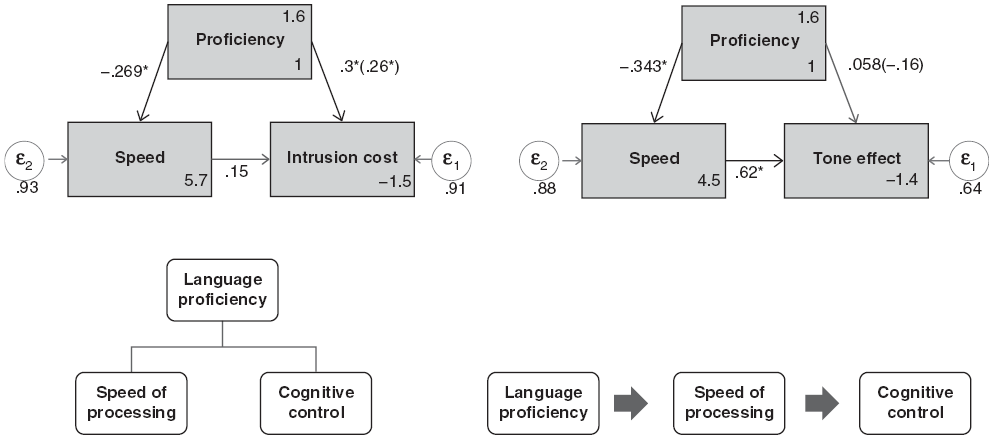
In addition to task complexity, participants’ language proficiency may also influence the outcomes (see details in Chapter 5, “Associations among Language Ability, Language Proficiency, and Cognitive Control”). In four subgroups of four–seven-year-old, English-Hebrew speaking bilingual children (balanced high proficient bilingual speakers, L2-dominant, L1-dominant, and children with low proficiency), children with high language proficiency outperformed their peers with low language proficiency in resisting interference and switching but not in concept generation across different nonverbal tasks (Iluz-Cohen & Armon-Lotem, Reference Iluz-Cohen and Armon-Lotem2013). Similar results were produced by eight–eleven-year-old, bilingual children in resisting interference and in performance monitoring using a simple verbal task (i.e., a categorization task using single high frequency words). Highly proficient bilingual children showed smaller interference effects and faster processing speed than children with lower language proficiency (Marton, Reference Marton2015). Language proficiency was measured along a continuum in this study. Based on the findings, we examined the relationship between processing speed and language proficiency using path analysis and found different patterns. Whereas language proficiency had a direct effect on children’s interference errors and on their processing speed in the interference task, the effect of language proficiency was mediated by processing speed in the performance monitoring task (see Figure 8.1). Thus, processing speed contributes to the interaction between language proficiency and cognitive control, and this interaction varies depending on the given cognitive control component. In some cases, language proficiency’s effect is mediated by processing speed, in other cases, it has a direct effect on the cognitive control function. Processing speed, however, does not affect cognitive control functions independently from language proficiency. These are preliminary results and more research is needed on the relationship between children’s language proficiency and processing speed.
Language proficiency and processing speed: Path analysis
8.4.3 Processing Speed in Bilingual Children with DLD
The critical question here is whether the bilingual experience attenuates the weaknesses in cognitive control in bilingual children with DLD. This is a relatively new field of research that has developed as the need for disentangling the effects of bilingualism and DLD on cognitive-linguistic performance have increased (Armon-Lotem & de Jong, Reference Armon-Lotem, de Jong and Meir2015), so the literature on cognitive control and processing speed in bilingual children with DLD is scarce and the findings are mixed.
Engel de Abreu and colleagues (Reference Engel de Abreu, Cruz-Santos and Puglisi2014) compared Portuguese and Luxembourgish bilingual children with DLD to bilingual typically developing children and to Portuguese monolingual typically developing children on measures of verbal and visuospatial working memory and distractor interference. The bilingual typically developing children performed significantly faster than their monolingual peers on the flanker task that measured resistance to distractor interference, and the bilingual children with DLD showed similar processing speed to the monolingual typically developing children. These results are intriguing because the findings indicate that in tasks with minimal language demands, bilingual children with DLD perform with similar processing speed than monolingual typically developing children. This is in contrast to findings from monolingual children with DLD, who often perform more slowly than the typically developing children on tasks measuring nonverbal working memory or interference control (Marton, Reference Marton2008; Marton et al., Reference Marton, Campanelli, Eichorn, Scheuer and Yoon2014). Unfortunately, Engel de Abreu and colleagues’ study did not involve a group of monolingual children with DLD.
Laloi and colleagues (Reference Laloi, de Jong and Baker2017) also examined cognitive control in bilingual children with DLD by using a Stop-Signal task. The bilingual and monolingual children performed similarly in this study, but the children with DLD were slower than their typically developing peers. These findings contradict some of the previous results. As discussed above, response inhibition does not clearly distinguish children with different language skills, even though influential models of bilingualism are based on inhibitory control for adults (e.g., Green, Reference Green1998).
Marton and colleagues’ (Reference Marton, Gehebe and Pazuelo2019) preliminary findings from monolingual and bilingual children with and without DLD indicate a complex interaction between bilingualism and language impairment. Performance on the N-back task revealed that bilingualism may attenuate the negative effects of DLD, especially in simple task conditions. With smaller set sizes and no interference conditions, bilingual children with DLD showed similar processing speed to monolingual typically developing children. An increase in task complexity (i.e., set size and interference condition), however, resulted in a growing gap between children with DLD and their typically developing peers, regardless of bilingual status. The findings are similar to those by Engel de Abreu and colleagues (Reference Engel de Abreu, Cruz-Santos and Puglisi2014) and suggest that bilingualism may have a positive effect on processing speed in children with DLD when the task conditions are simple, but in more difficult contexts, language impairment has a stronger effect than bilingualism on cognitive control and processing speed.
8.5 Conclusions
Processing speed and cognitive control show a complex interaction that is influenced by a number of factors, such as age, task complexity and modality, targeted cognitive functions, and children’s language ability and proficiency. The age-related (maturational) factors are closely linked to children’s behaviors and experiences with different cognitive control tasks. Although within-group performances are highly influenced by individual differences, monolingual children with DLD generally perform more slowly than their typically developing peers, whereas bilingual children often outperform their monolingual peers in processing speed. Bilingual children with DLD provide an unparalleled opportunity to study the joint effects of bilingualism and DLD on processing speed. The preliminary findings suggest that bilingualism does attenuate the negative effects of DLD but only in simple task conditions. Future research is needed to better understand the relationship between processing speed and cognitive control in children with different language abilities and proficiencies.

 Open access